Key Findings
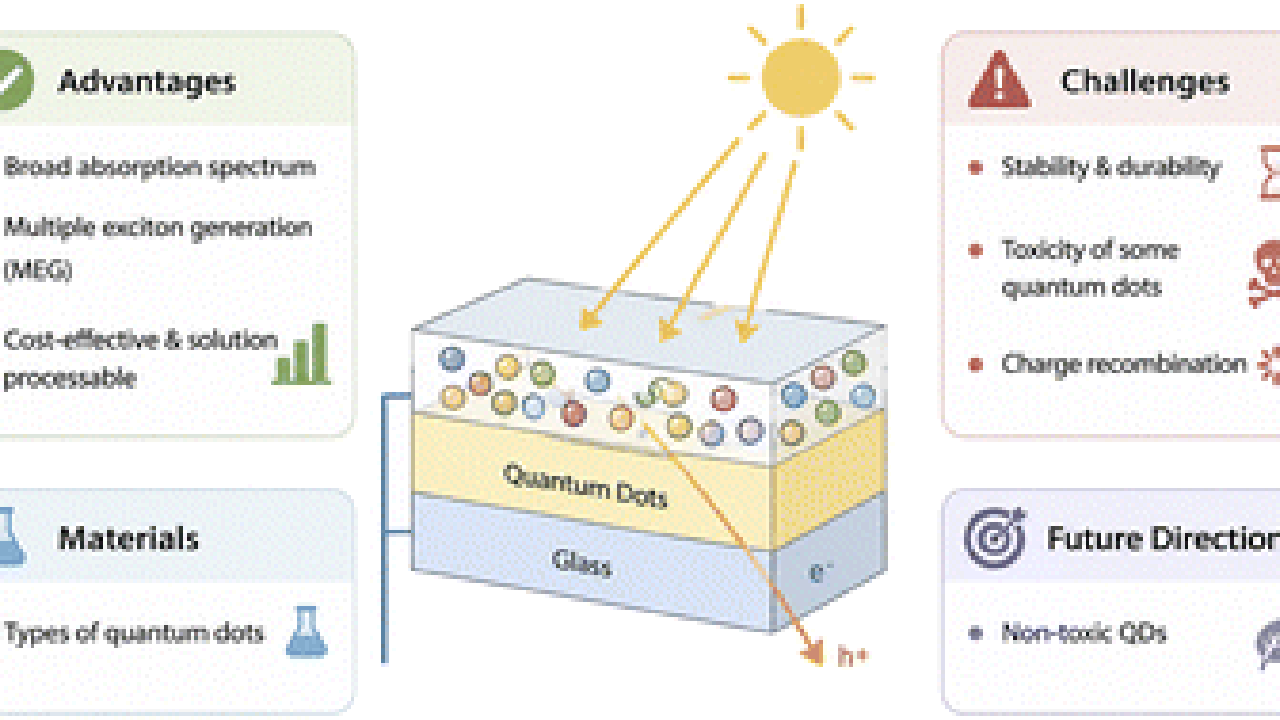
A recent review published in RSC Advances reports that quantum dot solar cells (QDSCs) are demonstrating a clear path towards significant efficiency gains and improved stability through innovations in materials science and device engineering. This comprehensive analysis integrates the latest advancements in materials development, device design, interface optimization, and long-term stability strategies, highlighting the immense potential of next-generation photovoltaic technologies.
Technical / Clinical Details
The review places a strong emphasis on the comparative analysis of various quantum dot materials, including PbS, CdSe, perovskites, graphene, and even environmentally friendly quantum dots. These materials are characterized by tunable bandgaps and high light absorption capabilities, holding the promise to surpass the Shockley-Queisser efficiency limits of conventional silicon-based solar cells. From a device engineering perspective, the article discusses the optimization of charge transport layers, reduction of interface defects, and encapsulation techniques for enhanced stability. Furthermore, emerging trends such as artificial intelligence (AI)-driven device optimization methods, tandem configurations stacking QDSCs with different absorption spectra, and the development of eco-sustainable QD materials are evaluated in detail, all of which are critical for significantly advancing QDSC performance and practical implementation.
Background & Context
Amidst the accelerating global transition to renewable energy, improving the efficiency and cost-effectiveness of photovoltaic technology remains an urgent challenge. Quantum dot solar cells have garnered significant attention as a promising next-generation solar energy technology due to their excellent photoelectric conversion properties and flexible manufacturing processes. However, previous QDSCs have faced limitations in efficiency and long-term stability. The advancements highlighted in this review offer crucial guidance for overcoming these hurdles and elevating QDSCs into commercially viable technologies.
Strategic Significance & Outlook
The integrated approach to materials science and device engineering presented in this review will largely define the future direction of QDSC research. As AI-driven design optimization and the exploration of novel materials accelerate, QDSCs could potentially achieve efficiency and cost-performance metrics that surpass current mainstream solar cells. Particularly, the shift towards environmentally friendly materials is significant for contributing to a sustainable society, making future developments highly anticipated. The primary challenge for commercialization will be establishing large-scale production techniques that ensure both high efficiency and long-term stability.
Source: https://pubs.rsc.org/en/content/articlelanding/2026/ra/d6ra02771g
Get our weekly technology intelligence — free
Receive an infographic that lets you judge at a glance whether each field’s analysis report is worth reading.
Subscribe Free — Weekly Tech Intelligence
By subscribing, you’ll receive Troy-Technical’s weekly technology intelligence newsletter.
- Your email and selected fields are used only to deliver the newsletter.
- We never share your information with third parties.
- You can unsubscribe anytime via the link in each email.
See our Privacy Policy for details.
Takes about a minute · Unsubscribe anytime