Key Findings
A research team from Hunan University and Xiamen University in China has developed a novel supersaturation modulation strategy for the efficient synthesis of ultra-long, high-yield silver (Ag) nanowires (AgNWs), ideally suited for transparent conductor applications. This groundbreaking method enables the production of exceptionally high-quality AgNWs with an average length exceeding 227 micrometers, an aspect ratio greater than 2200, and an impressive yield of 93%. This discovery marks a significant advance in theory-driven synthesis within nanomaterials science.
Technical / Clinical Details
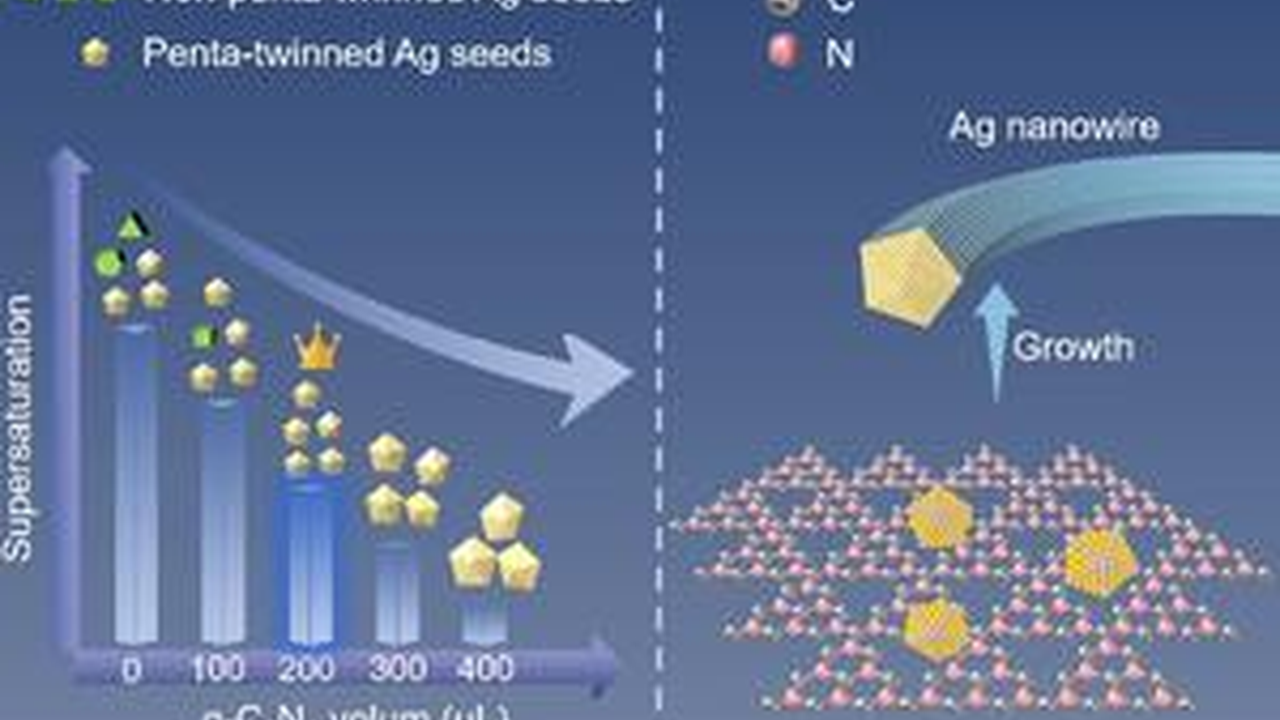
- The research team employed a unique supersaturation modulation strategy involving the addition of 2D materials, specifically g-C₃N₄ (graphitic carbon nitride) and MoS₂ (molybdenum disulfide), to the reaction solution.
- The inclusion of these 2D materials was found to facilitate the efficient in-situ formation of high-purity penta-twinned silver seeds within the solution. This penta-twinned structure is critical for promoting the anisotropic growth of AgNWs into long, rod-like structures and ensuring their single-crystallinity.
- Under optimized conditions, the synthesized AgNWs achieved an extraordinary average length exceeding 227 μm, significantly surpassing many existing synthesis methods.
- The aspect ratio (ratio of length to diameter) also exceeded 2200, providing a crucial advantage for achieving low sheet resistance while maintaining high optical transparency when used in transparent conductive films.
- Furthermore, the synthesis achieved a high yield of 93%, indicating excellent efficiency and suggesting potential for scalable mass production.
- The research findings have been published in the esteemed international academic journal *Nano Research*, confirming their scientific validity and impact.
Background & Context
Silver nanowires have garnered considerable attention as a promising alternative to Indium Tin Oxide (ITO) for transparent conductive materials, given their high electrical conductivity, excellent optical transparency, and flexibility. Applications span touchscreens, flexible displays, OLED lighting, and solar cells. However, previous challenges in AgNWs synthesis have included achieving uniform length, high yield, and managing cost and complexity at large-scale production.
This study provides a theory-driven synthesis strategy to overcome these long-standing challenges, potentially significantly accelerating the adoption of AgNWs in the transparent conductor market.
Strategic Significance & Outlook
The development of this efficient method for synthesizing ultra-long, high-yield AgNWs is set to have a substantial impact on the transparent conductor market. A stable supply of more affordable and higher-quality AgNWs will accelerate the development of next-generation display and sensor technologies, including flexible electronics, wearable devices, and IoT devices. If scalability for mass production is confirmed, this could contribute to building new industrial ecosystems independent of ITO, potentially unlocking billions of dollars in market opportunities for related industries. This breakthrough is a prime example of how nanotechnology can transform fundamental technologies in modern society.
Source: https://www.eurekalert.org/news-releases/1133514
Get our weekly technology intelligence — free
Receive an infographic that lets you judge at a glance whether each field’s analysis report is worth reading.
Subscribe Free — Weekly Tech Intelligence
By subscribing, you’ll receive Troy-Technical’s weekly technology intelligence newsletter.
- Your email and selected fields are used only to deliver the newsletter.
- We never share your information with third parties.
- You can unsubscribe anytime via the link in each email.
See our Privacy Policy for details.
Takes about a minute · Unsubscribe anytime