Background: The Imperative of Advanced AI Reasoning
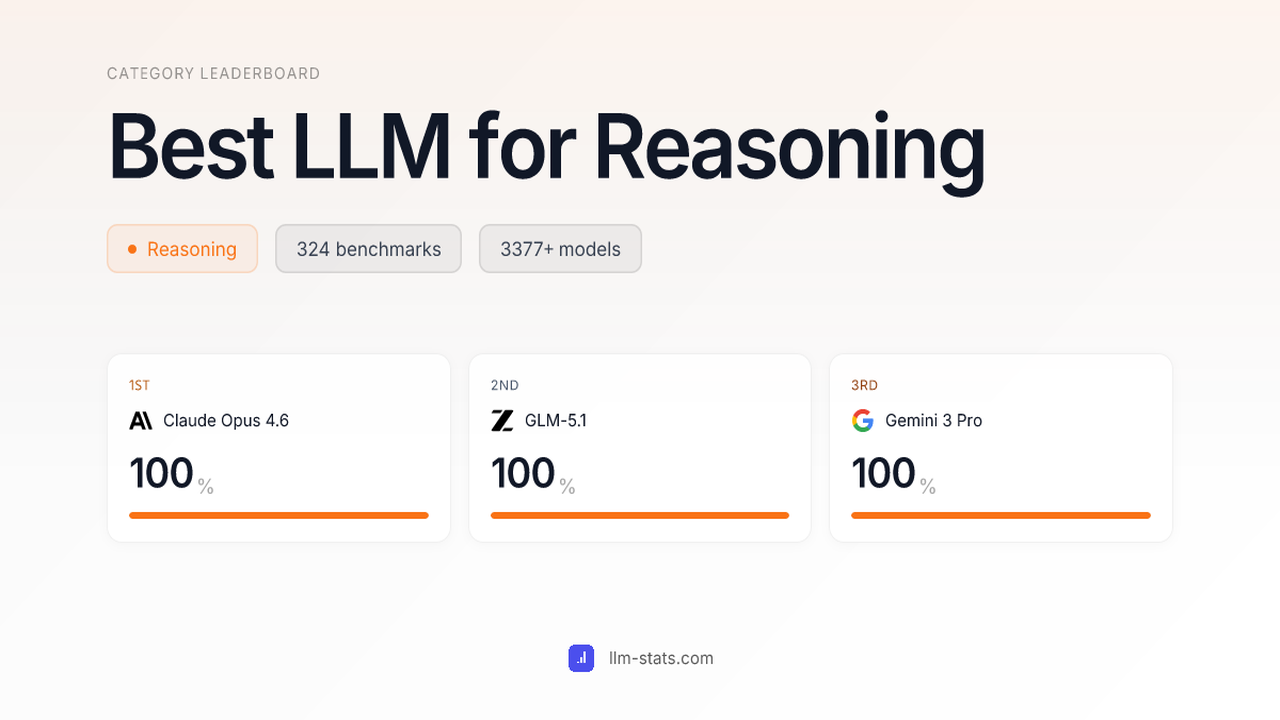
In the rapidly evolving landscape of artificial intelligence, the ability of models to perform sophisticated reasoning tasks is becoming as crucial as their capacity for natural language understanding or generation. Benchmarks that assess reasoning go beyond simple information retrieval, focusing on a model’s capacity for logical deduction, multi-step problem-solving, and the ability to synthesize new conclusions from given information. LLM Stats’ May 2026 ranking provides an up-to-date snapshot of the top-performing AI models in these critical cognitive areas.
Key Findings: Leadership in Logical and Multi-Step Inference
- Claude Mythos Preview Leads: Anthropic’s Claude Mythos Preview currently holds the top position in reasoning benchmarks, achieving a score of 71.2 points. This indicates its strong capabilities in handling complex logical problems and performing advanced inference.
- Close Competition from GPT-5.5 and Claude Opus 4.7: OpenAI’s GPT-5.5 follows with 62.5 points, while Anthropic’s Claude Opus 4.7 is close behind at 62.3 points. The tight scores among these top models underscore the intense competition and rapid progress in developing highly capable reasoning AI.
- Emphasis on Novel Conclusion Derivation: The benchmarks are designed to evaluate a model’s capacity to *derive new conclusions* from provided contexts, rather than merely recalling or reproducing memorized facts. This distinction is vital for applications requiring true problem-solving and analytical thinking.
- Measurement of Multi-Step Reasoning: The evaluations specifically target multi-step reasoning abilities, assessing how well AI models can break down complex problems, follow logical sequences, and integrate information across various steps to arrive at a correct solution.
Significance & Outlook: Enhancing Real-World Problem Solving
The continued advancement in AI reasoning capabilities, as highlighted by these benchmarks, has profound implications for a wide range of real-world applications. Industries such as legal, scientific research, engineering, and strategic planning stand to benefit immensely from models that can perform more accurate and nuanced logical inference. For instance, in legal tech, these models can analyze complex contracts and legal precedents to identify critical clauses or potential liabilities with greater precision. In scientific research, they can help formulate hypotheses or interpret experimental results more effectively. The ability to derive new conclusions from intricate datasets, rather than relying on pre-existing knowledge, unlocks unprecedented potential for innovation and efficiency. As these models become more sophisticated, they will empower organizations to make more informed decisions, automate complex analytical tasks, and ultimately accelerate progress in addressing some of humanity’s most challenging problems.
Source: https://llm-stats.com/leaderboards/best-ai-for-reasoning









Comments