COMPANY PROFILE / ADHESIVES & ENCAPSULANTS
Dymax
A family-owned maker of adhesives, coatings and encapsulants that cure in seconds under light, sold together with the light sources and dispensers
Dymax was founded in 1980 in Connecticut, USA, and is a specialist in light-curable (UV, visible-light and LED) adhesives, coatings and encapsulants. It makes not only the materials but also dispensing equipment and light-curing equipment, and sells them on the premise that the material and the equipment work best as a set. Its main markets are protecting and encapsulating electronic boards (conformal coating, chip encapsulation, potting), reinforcing boards, assembling medical devices, aerospace and defence, and automotive electronics. It is a privately held family company and does not publish sales or other financial results. This article sets out what could be confirmed and what could not.
- At a glance: Dymax and its place in adhesives and encapsulants
- Logo and naming
- Where the company sits in adhesives and encapsulants
- Company scale
- Resources committed to adhesives and encapsulants
- Track record
- Plans
- What the company is aiming for in adhesives and encapsulants
- Partnership map for adhesives and encapsulants
- Technologies, products and services
- Risks
- Glossary
- References
- Claim-to-source audit
1. At a glance: Dymax and its place in adhesives and encapsulants
Connecticut, United States318 Industrial Lane
privately heldThe company says the second and third generations run it. Finances not published
applicationsOffers light-curable materials and equipment together
aerospace and defence, automotiveProtecting and encapsulating electronic boards is one centre
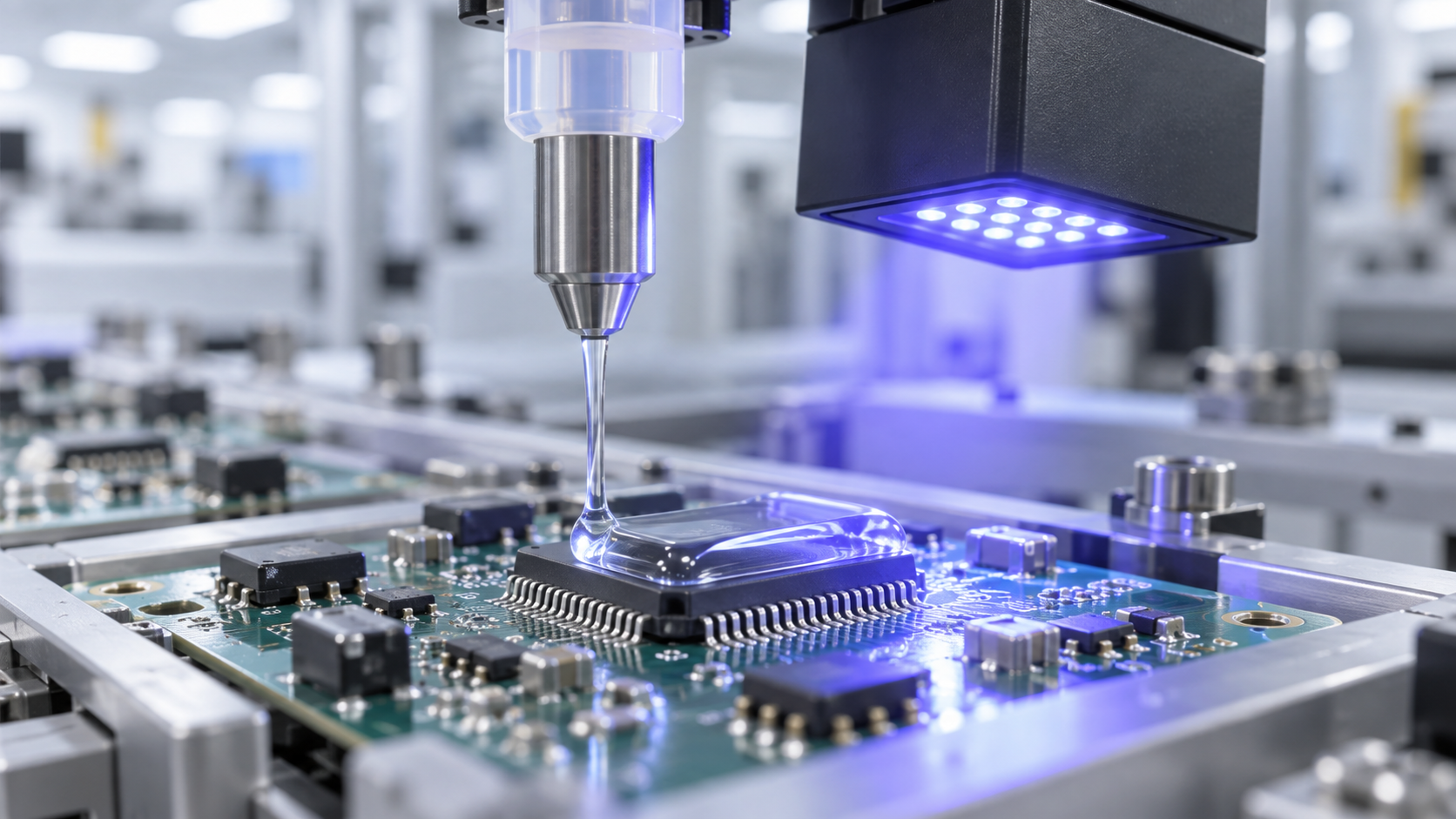
Dymax is a materials-and-equipment company that specialises in curing by light Sourced. Its adhesives, coatings, encapsulants and potting compounds are mostly one-part materials that set in seconds under UV, visible light or LED light, and where light cannot reach a shadowed area, they add a secondary cure by moisture, heat or an activator, called "dual cure". On its potting and encapsulation pages the company presents its products as replacements for epoxy and silicone, and for the reinforcement adhesive it launched in July 2026 it describes "a fast, streamlined alternative to traditional underfill". In other words, it makes resin-based encapsulants itself, and is one of the companies in this series closest to the core of electronics and encapsulation. Epoxy molding compound (EMC) for the inside of semiconductor packages and anisotropic conductive film (ACF) did not appear in the official materials reviewed Not yet confirmed.
2. Logo and naming

The Dymax logo is the company's trademark. This article does not reproduce it with generated images; it uses the
logo image taken from the company's official website, stored as img/dymax_logo.png.
A note on names: the legal entity is Dymax Corporation, originally American Chemical and Engineering Company (company overview). It has regional companies, including Dymax Europe GmbH (Germany), Dymax Engineering Adhesives Ireland Ltd., Dymax Asia Pacific Pte. Ltd. (Singapore), Dymax Korea LLC and Dymax UV Adhesives & Equipment (Shenzhen) Co. Ltd. In China, the former Dymax Chemical (Shanghai) changed its name to Hanarey Chemical (Shanghai) on 15 January 2022, and is now described as the company's master distributor there. The company owns many registered product names, such as Multi-Cure, See-Cure, Ultra-Red and BlueWave. They are treated here as "the company's product lines", and this article does not rank individual products.
Official site: https://dymax.com/3. Where the company sits in adhesives and encapsulants
Dymax's primary type is UV-curing and specialty applications. It has no real secondary type: unlike a semiconductor and electronic-materials company, it does not tailor materials inside chipmakers' processes. It supplies the materials and equipment used to protect, reinforce and assemble the boards of electronics makers. The table sorts out which materials and uses are central, as far as the company's own documents allow.
| Material or use | Where it sits at Dymax | Primary source found | Basis |
|---|---|---|---|
| UV and light-curing adhesives (structural, medical) | Central. Cure in seconds under UV or visible light and bond metal, glass, ceramic and plastics. A USP Class VI medical adhesive line since 1985 | Product and application pages; history | Sourced |
| Conformal coatings (board protection) | Central. One-part, cured by light in seconds and ready to ship at once, the company says. A secondary heat or moisture cure for shadowed areas | Conformal coatings page | Sourced |
| Encapsulants (chip, wire-bond protection, LED) | Central. For chip-on-board, chip-on-flex and COB LEDs. A "glob top" encapsulant was introduced in 1997 | Encapsulants page; history | Sourced |
| Potting compounds | One of the centres. Cure in 10 to 30 seconds, with no fixtures, ovens or racks. Presented as a replacement for epoxy and silicone | Potting compounds page | Sourced |
| Board reinforcement (underfill alternative, edge bond) | One of the centres. 9310 launched in July 2026. The company says it keeps adhesion through reflow and can be reworked at low temperature | Press release | Sourced |
| Thermal interface materials (thermally conductive adhesives) | Part. Thermally conductive adhesives that fix heat sinks to boards (Multi-Cure), cured by light, heat or activator | Thermal interface materials page | Sourced |
| Gaskets and masking materials | Part. UV-curing gasket materials (launched 2001), a water-soluble masking formulation (patent, 1996) and a masking product category | Product category pages; history | Sourced |
| Light-curing and dispensing equipment | One of the centres. Spot, flood and conveyor systems, BlueWave LED line emitters, dispense valves and radiometers | Product pages; press release | Sourced |
| Semiconductor encapsulants (EMC), ACF, solder | Not confirmed in the company's materials | - | Not yet confirmed |
4. Company scale
Dymax is a family-owned private company, and its sales, profit and other financial results are not published. The table shows the scale that the official materials do support Sourced.
| Item | Detail |
|---|---|
| Sales and profit | Not disclosed. This article makes no estimate |
| Founding and headquarters | Founded in 1980 by Andy Bachmann and Clai Bachmann, who bought the assets of the Specialty Chemical Company (three employees at the start). Headquartered in Torrington, Connecticut |
| Employees and sites | More than 550 employees and eight locations worldwide (history page). A distribution and technical centre opened in Querétaro, Mexico, in July 2026. Local companies in North America, Europe (Germany, Ireland) and Asia (Singapore, Hong Kong, Korea, Shenzhen) |
| Management | Greg Bachmann, Director and Chairman of Dymax Companies (since September 2005; the second generation of the family to run it). Chris Ciampi became Acting CFO in early 2026 |
| Patents | More than 30 (history page) |
| Quality and regulation | ISO 9001:2015 certified and compliant with GHS, the global system for classifying and labelling chemicals (regulatory page) |
| Recognition | Named nine times to the Inc. 5000 list of fastest-growing private companies in the United States; UCONN Family Business of the Year (North America); Singapore SME 1000 (Asia Pacific, 2020), among others |
Because the finances are not published, sales from electronics and encapsulation, or the split between materials and equipment, cannot be confirmed Not yet confirmed. The company's own website is also inconsistent on the number of locations: the history page says eight, while the global-contacts page says seven (the list shows eight entities and sites: the United States, Mexico, Germany, Ireland, Singapore, Hong Kong, Korea and Shenzhen). This article counts the eight on the list.
5. Resources committed to adhesives and encapsulants
With finances undisclosed, amounts cannot be confirmed. The table covers four points (people, money, outside investments and deals, universities and public funding) and shows what could and could not be confirmed.
| Item | What could be confirmed | Basis |
|---|---|---|
| People (R&D sites and headcount) | More than 550 employees. R&D is carried out at the U.S. headquarters, at a laboratory in Wiesbaden, Germany (moved in 2014 to a large site that houses an R&D lab), and at an R&D centre in Shanghai (opened in 2017). An in-house Application Engineering team carries out bonding studies in its own lab. Total R&D headcount is not disclosed | Sourced / Not disclosed |
| Money (R&D and capital expenditure) | R&D spending and capital expenditure are not disclosed. Examples of site investment: the Querétaro distribution and technical centre (July 2026), expansion in Wiesbaden (2011 and 2014) and the move into Ireland (2014) | Sourced / Not disclosed |
| Outside investments, acquisitions, joint ventures | Bomar Oligomers: joint venture (1990) and majority ownership (2000). Assets of ADAC Technologies (2000). Dymax Europe: joint venture (1995) and 100% purchase (2002). Dymax Korea: joint venture (2010) and wholly owned subsidiary (2013). A European joint venture with Chemetall (1994). Investment in start-ups could not be confirmed | Sourced / Not confirmed (investment) |
| Universities, research institutes, public funding | There are local awards (Connecticut Economic Resource Center, UCONN Family Business of the Year), but joint research with universities or institutes, and public funding (NEDO, EU projects, U.S. grants and so on), could not be confirmed | Not confirmed |
6. Track record
| When | Event | Why it matters |
|---|---|---|
| 1980 | Andy and Clai Bachmann founded Dymax Corporation by buying the assets of the Specialty Chemical Company | The starting point of its light-curing adhesive business |
| 1981 to 1985 | First UV-curing structural adhesive for headlamps (1981), first glass-bonding adhesives (1982), a USP Class VI medical adhesive line (1985) | The prototypes of its automotive, glass and medical uses |
| 1986 | Launched a line of UV equipment. The company's timeline says it became the only company making both UV-curable adhesives and curing equipment | The start of selling materials and equipment as a set (company statement) |
| 1990 to 1995 | Bomar Oligomers joint venture (1990), visible-light-curing line (1994), a European joint venture with Chemetall (1994), a trigger-cure conformal coating (1994), Dymax Europe joint venture (1995) | Securing raw materials (oligomers) and expanding into Europe |
| 1997 | Introduced electronic encapsulants ("glob top" materials), and was granted a patent on a radiation-curing encapsulant | The entry into electronics and encapsulation |
| 1998 | Patents on a dual-cure formulation and on a non-corroding adhesive for copper | The foundation of curing shadowed areas too |
| 2000 to 2003 | Acquired assets of ADAC Technologies and majority ownership of Bomar Oligomers (2000), patents on electrically conductive radiation-curable materials (2001), 100% purchase of Dymax Europe (2002), establishment of Asian operations (2003) | Bringing raw materials and sales networks in-house |
| 2008 to 2009 | Ultra-Red fluorescing adhesives and See-Cure technology (which lets cure be checked by eye), LED equipment | Ease of inspection, and the move to LED light sources |
| 2010 to 2015 | Korean joint venture (2010) and wholly owned subsidiary (2013), move to Wiesbaden, expansion into Ireland (2014), Encompass technology, Dymax Asia Pacific formed in Singapore (2015) | Expansion in Asia and Europe |
| 2017 to 2019 | R&D centre in Shanghai (2017), a patent on tack-free form-in-place gaskets and sunlight-curable coatings (2017), very-low-viscosity conformal coating 9452-FC (2018), a patent on dual-cure acrylic formulations (2019) | More advanced coatings and gaskets |
| 2020 to 2022 | 40th anniversary (2020), dual-cure coating 9771 meeting NASA's low-outgassing standard (ASTM E595) (2021), change of master distributor in China to Hanarey (January 2022) | Space and aviation uses, and tidying the sales set-up in China |
| July to September 2026 | Distribution and technical centre in Querétaro, Mexico (1 July). Launched the 9310 board-reinforcement adhesive (30 July), the BlueWave FX line emitters (9 September), and the 9208-W electronic coating and 9209-W reworkable encapsulant for wearables (30 September) | Stronger presence in the Americas, and materials and equipment launched together |
7. Plans
Querétaro site furtherThe chairman said it is "just the beginning" (July 2026)
high-speed line curingJudged from the July to September 2026 launches (no figures disclosed)
7 to 8 October 2026Will show PCB protection and thermal-stress management
The company's announcements centre on new products, site openings and trade shows. No sales target, capital expenditure or plan for new acquisitions or partnerships is given Not yet confirmed. The Querétaro site responds to growing demand in medical devices, automotive electronics and aerospace, and the chairman said "this milestone is just the beginning" Sourced.
None of the following appears in the primary sources Not yet confirmed.
Capital expenditure / a sales target / a product plan for semiconductor packaging (EMC, ACF) / plans for new acquisitions or partnerships / receipt of public funding.
8. What the company is aiming for in adhesives and encapsulants
This section includes points the company does not state directly. They are given as inferences drawn from the primary sources, together with the evidence.
| What can be read | Primary-source evidence | Basis |
|---|---|---|
| It aims to replace epoxy, silicone and thermal-cure processes with light curing | The potting page presents its products as replacements for epoxy and silicone, and 9310 is described as a fast alternative to traditional underfill. It stresses that no oven, fixture or rack is needed | Sourced (company statement) |
| The selling point of the replacement is process speed and simplicity rather than peak performance | The pages concentrate on "cures in seconds", "no ovens, fixtures or racks" and "ship immediately", and carry no performance comparison figures against other methods | Inference |
| By selling materials and equipment as a set, it aims to get deep into customers' processes | It says its materials and equipment are matched to work seamlessly together, and has made both since 1986. It offers integration through Tridak and contract coating through ECT | Inference |
| It sees electronics (board protection and encapsulation) and medical as its two pillars | On its home page, medical-device and electronics uses are listed first, and most of its recent product announcements concern electronics | Inference |
| It is strengthening its pursuit of demand in Mexico and Latin America | The Querétaro opening in July 2026 and the exhibit at SMTA Guadalajara in October | Sourced (plan) |
The basis for reading "the selling point is process speed and simplicity rather than peak performance" is that the company's pages stress what is no longer needed more than what the product can do. The potting page says cure takes 10 to 30 seconds, that no jigs, racks or ovens are needed, and that floor space and inventory fall. The July 2026 announcement of 9310 likewise says it removes "the added steps and complexity of underfill". The performance statements on the encapsulation page, by contrast, are mostly qualitative, such as resistance to humidity and thermal shock, and flexibility down to -40 degC, and no direct performance comparison with underfill, epoxy or silicone is published Sourced. This does not contradict the company's claims. It means only that the company itself seems to think process efficiency is what decides adoption Not yet confirmed.
9. Partnership map for adhesives and encapsulants
Dymax's ties are distinctive in that it has brought raw materials and sales networks in-house, moving from joint ventures to acquisition or subsidiary status. Its present partners mostly complement its process and sales: Tridak for automated dispense-and-cure systems, Electronic Coating Technologies for contract coating in the Americas and Europe, and Hanarey for sales in China. By contrast, joint development with named semiconductor or electronics makers could not be confirmed on the company's website Not yet confirmed.
10. Technologies, products and services
The following comes from the company's application and product pages, a technical data sheet and press releases. Figures are the manufacturer's stated values, and test methods are given where the source states them Sourced.
| Product group | What the company's pages say (manufacturer's stated values) |
|---|---|
| Encapsulants (chip encapsulation) | Cure in seconds under UV or visible light and adhere well to flexible circuit substrates such as polyimide and PET, the company says. A secondary cure by heat or moisture is available. LED-grade types resist yellowing and are optically clear. For example, 9624 is for COB LED encapsulation and has a stated nominal viscosity of 120 cP. A type for chip-on-flex stays flexible down to -40 degC |
| Encapsulant and potting resin 9001-E-V3.1 (technical data sheet example) | Modified urethane, solvent-free, one part. Viscosity 4,500 cP (ASTM 2556), glass transition 40 degC (ASTM D5418), modulus of elasticity 17 MPa (ASTM D638), elongation at break 150% (ASTM D638), hardness D45 (ASTM D2240), linear shrinkage 2.0% (Dymax standard test method DSTM 614), water absorption 2.6% (25 degC, 24 hours, ASTM D570). Thermal shock more than 2,000 cycles (-40 to 125 degC, 0.25 mil wire); more than 1,000 hours at 85 degC and 85% RH. Cure: 30 seconds at 150 mW/cm2 (5000-EC system) at 0.005 inch thickness. Secondary heat cure: 110 degC for 60 minutes, 120 degC for 30 minutes or 150 degC for 15 minutes (revised 20 November 2024) |
| Conformal coatings | One part, cured by UV or visible light in seconds, with a secondary heat or moisture cure for shadowed areas. Thickness guides: 51 to 510 microns (0.002 to 0.020 inch) for one type, up to 0.254 mm for another. UL 94 rating of V-0 or V-1 depending on the type. There is a low-viscosity type that cures with LEDs at 365, 385 and 405 nm, and a type free of TPO and PIP 3:1 |
| Potting compounds | Cure in 10 to 30 seconds with UV or LED light, with no fixtures, racks or ovens. There are types for shallow potting (0.25 inch, or 6 mm) and a resin that cures clear and deep. Presented as replacements for epoxy and silicone |
| Board-reinforcement adhesive 9310 (July 2026) | For reinforcing fine-pitch, leadless components. Cures in seconds with light, with a secondary heat cure for shadowed areas. Keeps adhesion through reflow. Elongation 145%, absorbing thermal-expansion strain. High viscosity and thixotropic for edge bonding. Reworkable at relatively low temperature (manufacturer's stated) |
| Wearables: 9208-W and 9209-W (September 2026) | 9208-W: an electronic coating that forms a barrier against moisture, corrosion and thermal stress. 9209-W: a reworkable encapsulant that allows components to be repaired or replaced. Both combine light and moisture cure, and 9209-W is IBOA-free |
| Thermally conductive adhesives | Thixotropic adhesives for attaching heat sinks to boards, cured by light, heat or activator. Light fixes exposed areas at once, and the activator or heat cures the shadowed areas |
| Equipment | Spot, flood and conveyor curing systems and radiometers. BlueWave FX line emitters (September 2026): up to 4.2 W/cm2 at a 25 mm working distance, 75 mm and 150 mm lengths, 365, 385 or 405 nm, CE and UKCA marked |
| Services | Bonding studies by Application Engineering in an in-house lab, contract coating (Electronic Coating Technologies), and automated-system integration (Tridak) |
The data for 9001-E-V3.1 shows the design thinking behind an encapsulant (see also our explainers on glass transition and creep, thermal expansion and semiconductor encapsulants). Its Tg is a low 40 degC, its modulus is 17 MPa and its elongation at break is 150%, so it is a soft material. The Tg sits just above room temperature (about 25 degC), and above 40 degC the resin enters its rubbery region, where thermal expansion is governed by the coefficient above Tg (alpha 2 = 180). The reason the company cites "high CTE and low Tg" as a way to lower stress on components is that a rigid resin transmits thermal strain directly to the parts, while a soft resin absorbs it (general explanation). With fine wire bonds in particular (the data sheet evaluates thermal shock with 0.25 mil wire), a rigid resin can generate forces that pull the wire apart, so a low modulus helps. Even so, linear shrinkage on cure is 2.0%, a level that can leave residual stress at interfaces with the board and components, so this is a design that relieves stress through softness. One caution: the data sheet prints the CTE unit as "mm/m/degC", and given the magnitude of the numbers (alpha 1 = 95, alpha 2 = 180) the unit may be a misprint, so this article does not assert it.
The other point is the issue specific to light-cured materials: shadowed areas. Light does not reach under a component or behind an opaque part. The company solves this with dual cure, adding a secondary cure by heat, moisture or activator to the light cure (as stated on each page). 9001-E-V3.1 needs up to 60 minutes of heat for its secondary cure, so "cures in seconds" applies only to the parts the light reaches, a point easy to overlook when designing a process. The depth of a light cure depends on layer thickness (the data sheet's cure condition is 0.005 inch) and on the intensity and wavelength of the light (general explanation).
Last, the data sheet's caveats. The company states that the data are "based on historical testing" for information only and are "neither specifications nor guarantees", and notes for this product that the technical data were "collected prior to 2008" (revised November 2024). It is a good example of why a manufacturer's stated value is usable only together with its test conditions and revision date.
11. Risks
| Risk | Detail | Basis |
|---|---|---|
| Finances are invisible | Sales, profit, R&D spending and capital expenditure are all undisclosed. The share of electronics and encapsulation cannot be confirmed either | Not yet confirmed |
| Curing where light does not reach | Light curing needs a secondary cure (heat, moisture or activator) for shadowed areas. 9001-E-V3.1 needs up to 60 minutes of heat, which may conflict with the promise of a simpler process | Sourced |
| The barrier to replacing incumbents | To replace epoxy, silicone or underfill, a customer has to repeat reliability testing. No direct performance comparison appears on the company's pages | Inference |
| Age of the technical data | Some data-sheet figures were "collected prior to 2008", and the sheet says they are not specifications or guarantees. They may not match the current formulation | Sourced |
| Reliance on selling materials and equipment as a set | How performance and warranty are handled when a customer uses another maker's light source or dispenser could not be confirmed | Not yet confirmed |
| Regulation of raw materials such as photoinitiators | The company promotes formulations free of TPO and PIP 3:1, IBOA-free grades, and lower use of MeHQ and BHT. If raw-material rules or market demands change, formulations may need revising (the content of any regulation was not checked for this article) | Inference |
| Reorganised sites and sales network | Its Chinese entity was renamed in 2022 and Hanarey became master distributor. The number of locations is given inconsistently on its website (seven and eight) | Sourced |
| Verifying company claims | Statements such as "bio-based oligomers with 40% lower GHG emissions" and "replace epoxy and silicone" are the company's own, and the calculation method and comparison conditions could not be confirmed | Sourced (company claim) |
12. Glossary
- Light curing
- Setting from liquid to solid in seconds under UV, visible or LED light. A photoinitiator absorbs the light and starts the reaction.
- Dual cure
- Curing by a combination of two mechanisms, such as light plus moisture, heat or an activator, so that shadowed areas also harden.
- One-part
- An adhesive or coating used as supplied, with no mixing.
- Conformal coating
- A thin film covering a whole board to protect it from moisture, dust and chemicals.
- Glob top
- A domed encapsulant that covers a chip and its wire bonds entirely.
- Potting
- An encapsulation method in which a component or board is embedded in resin and cured.
- Underfill / edge bond
- A resin that fills the gap between chip and board / a method of fixing a chip by bonding only its perimeter. Both protect solder joints from thermal strain and impact.
- Tg (glass transition temperature)
- A guide to the temperature at which a resin changes from a rigid to a soft state.
- CTE (coefficient of thermal expansion)
- How much a material expands as temperature rises. Alpha 1 is the value below Tg and alpha 2 the value above it.
- Oligomer
- A low-molecular-weight polymer that forms the backbone of a light-curable resin. It governs how hard or soft the adhesive is.
- Radiometer
- An instrument that measures the intensity of curing light (in mW/cm2 and so on), used to spot lamp ageing.
- Manufacturer's stated value
- A performance value given by the manufacturer itself. It cannot be compared with other makers' products without test conditions and a revision date.
13. References
- Dymax History (company website). More than 550 employees, eight locations, more than 30 patents, second and third generations of the family. https://dymax.com/about-dymax/history
- Dymax History: the 1980s (company website). https://dymax.com/about-dymax/history?era=1461
- Dymax History: the 1990s (company website). https://dymax.com/about-dymax/history?era=1462
- Dymax History: the 2000s (company website). https://dymax.com/about-dymax/history?era=1463
- Dymax History: the 2010s (company website). https://dymax.com/about-dymax/history?era=1901
- Dymax History: the 2020s (company website). https://dymax.com/about-dymax/history?era=1985
- Dymax Our Company (company website). Original name and business description. https://dymax.com/about-dymax/our-company
- Dymax Management Team (company website). https://dymax.com/about-dymax/management-team
- Dymax Global Contacts (company website). Locations and local companies, the renaming to Hanarey. https://dymax.com/sales-support/contact-us/global-contacts
- Dymax Regulatory (company website). ISO 9001:2015 and GHS. https://dymax.com/about-dymax/regulatory
- Dymax Sustainability (company website). Environmental efforts. https://dymax.com/about-dymax/sustainability
- Dymax Awards (company website). https://dymax.com/about-dymax/awards
- Dymax "Encapsulants for Microelectronic Component Protection" (company website, encapsulants page). https://dymax.com/markets/electronics/consumer/encapsulation
- Dymax "Potting Compounds For Consumer Electronic Components" (company website, potting page). https://dymax.com/markets/electronics/consumer/potting-compounds
- Dymax "Conformal Coatings for Consumer Electronics PCB Protection" (company website). https://dymax.com/markets/electronics/consumer/conformal-coatings
- Dymax "Light-Curable Materials For Thermal Interfaces" (company website). https://dymax.com/markets/electronics/consumer/thermal-interface-materials
- Dymax Multi-Cure 9001-E-V3.1 (company website, product page). https://dymax.com/products/formulations/light-curable-materials/encapsulating/9001-e-v3.1
- Dymax Multi-Cure 9001-E-V3.1 Product Data Sheet (technical data sheet, revised 20 November 2024). https://dymax.com/brandfolder/download?fieldIdentifier=file&contentId=3829&filename=asseetFilePlaceholder.pdf
- Dymax "Dymax Launches 9310 Adhesive for High-Reliability PCB Reinforcement" (press release, 30 July 2026). https://dymax.com/resources/news-and-media/press-releases/electronics/dymax-launches-9310-adhesive-for-high-reliability-pcb-reinforcement
- Dymax "Dymax Opens New Distribution and Technical Center in Querétaro, Strengthening Regional Support Across Mexico and Latin America" (press release, 1 July 2026). https://dymax.com/resources/news-and-media/press-releases/corporate/dymax-opens-new-distribution-and-technical-center-in-quer%C3%A9taro,-strengthening-regional-support-across-mexico-and-latin-america
- Dymax "Dymax Expands Light-Curable Product Portfolio for Consumer Wearable Assembly" (press release, 30 September 2026). https://dymax.com/resources/news-and-media/press-releases/electronics/dymax-expands-light-curable-product-portfolio-for-consumer-wearable-assembly
- Dymax "Dymax Launches BlueWave FX Line Emitters to Boost Throughput in High-Speed Linear UV/Visible Curing" (press release, 9 September 2026). https://dymax.com/resources/news-and-media/press-releases/equipment/dymax-launches-bluewave-R-fx-line-emitters-to-boost-throughput-in-high-speed-linear-uv-visible-curing
- Dymax "Dymax to Showcase Light-Curing Technologies for PCB Protection and Thermal-Stress Management at SMTA Guadalajara" (press release, 24 September 2026). https://dymax.com/resources/news-and-media/press-releases/trade-show/dymax-to-showcase-light-curing-technologies-for-pcb-protection-and-thermal-stress-management-at-smta-guadalajara
- Dymax "Conformal Coating Services for Electronics Applications" (company website, services page). Electronic Coating Technologies. https://dymax.com/services/coating-services
- Dymax "Automated and Robotic Dispensing and Curing System Design and Implementation" (company website, Tridak page). https://dymax.com/services/tridak-system-integration
- Dymax Working with Dymax (company website). Application Engineering and the in-house lab. https://dymax.com/about-dymax/working-with-dymax
- Dymax Company website (source of the logo image). https://dymax.com/
14. Claim-to-source audit
| Claim in the text | Basis | Source |
|---|---|---|
| Company name, original name American Chemical and Engineering Company, the 1980 founding (Andy and Clai Bachmann, purchase of the Specialty Chemical Company's assets) | Sourced | Reference 7 and 2 https://dymax.com/about-dymax/our-company https://dymax.com/about-dymax/history?era=1461 |
| More than 550 employees, eight locations worldwide, more than 30 patents, family run by the second and third generations (three employees at the start) | Sourced | Reference 1 https://dymax.com/about-dymax/history |
| Headquarters (318 Industrial Lane, Torrington, CT), the local companies, the renaming to Hanarey Chemical (Shanghai) on 15 January 2022, and the 'seven locations' wording | Sourced | Reference 9 https://dymax.com/sales-support/contact-us/global-contacts |
| Management (Greg Bachmann since September 2005; Chris Ciampi as Acting CFO in early 2026) | Sourced | Reference 8 https://dymax.com/about-dymax/management-team |
| ISO 9001:2015 and GHS compliance | Sourced | Reference 10 https://dymax.com/about-dymax/regulatory |
| Recognition (Inc. 5000 nine times, UCONN Family Business of the Year, Singapore SME 1000 and others) | Sourced | Reference 12 https://dymax.com/about-dymax/awards |
| Sales, profit, R&D spending and capital expenditure | Not yet confirmed | None is disclosed, and this article makes no estimate |
| 1980s history (1981 UV-curing structural adhesive for headlamps, 1982 glass adhesives, 1985 USP Class VI adhesives, 1986 UV equipment) | Sourced | Reference 2 https://dymax.com/about-dymax/history?era=1461 |
| 1990s history (Bomar Oligomers joint venture, visible-light-curing line, Chemetall joint venture, Dymax Europe joint venture, 1997 electronic encapsulants, 1998 dual-cure patent) | Sourced | Reference 3 https://dymax.com/about-dymax/history?era=1462 |
| 2000s history (ADAC and Bomar, 100% of Dymax Europe, Asian operations, Ultra-Red and See-Cure, LED equipment) | Sourced | Reference 4 https://dymax.com/about-dymax/history?era=1463 |
| 2010s history (Korean joint venture and subsidiary, move to Wiesbaden, Ireland, Singapore, Shanghai R&D centre, 9452-FC and others) | Sourced | Reference 5 https://dymax.com/about-dymax/history?era=1901 |
| 2020s history (40th anniversary, 9771 meeting NASA's low-outgassing standard ASTM E595) | Sourced | Reference 6 https://dymax.com/about-dymax/history?era=1985 |
| Encapsulant descriptions (cure in seconds, secondary cure, adhesion to flex substrates, LED grades, flexibility to -40 degC, 9624 nominal viscosity of 120 cP) | Sourced | Manufacturer's stated value. Reference 13 https://dymax.com/markets/electronics/consumer/encapsulation |
| Potting compound descriptions (10 to 30 seconds, no fixtures, ovens or racks, 0.25 inch, replacement for epoxy and silicone) | Sourced | Manufacturer's stated value. Reference 14 https://dymax.com/markets/electronics/consumer/potting-compounds |
| Conformal coating descriptions (thickness, UL 94, LED cure, TPO- and PIP 3:1-free types, contract service by ECT) | Sourced | Manufacturer's stated value. Reference 15 https://dymax.com/markets/electronics/consumer/conformal-coatings |
| Thermally conductive adhesive descriptions (cure by light, heat or activator; heat-sink attachment) | Sourced | Reference 16 https://dymax.com/markets/electronics/consumer/thermal-interface-materials |
| 9001-E-V3.1 description (modified urethane, solvent-free, low Tg and modulus, RoHS2 compliance, nominal viscosity of 4,500 cP) | Sourced | Reference 17 https://dymax.com/products/formulations/light-curable-materials/encapsulating/9001-e-v3.1 |
| 9001-E-V3.1 property values (Tg 40 degC, modulus 17 MPa, elongation 150%, D45, shrinkage 2.0%, water absorption, thermal shock, humidity, cure conditions, secondary heat cure, data caveats) | Sourced | Manufacturer's stated value, revised 20 November 2024. The data sheet says the data were collected prior to 2008 and are not specifications or guarantees. Reference 18 https://dymax.com/brandfolder/download?fieldIdentifier=file&contentId=3829&filename=asseetFilePlaceholder.pdf |
| 9310 (reinforcement of fine-pitch components, alternative to underfill, elongation of 145%, adhesion through reflow, low-temperature rework, 30 July 2026) | Sourced | Manufacturer's stated value. Reference 19 https://dymax.com/resources/news-and-media/press-releases/electronics/dymax-launches-9310-adhesive-for-high-reliability-pcb-reinforcement |
| The Querétaro distribution and technical centre (1 July 2026) and the chairman's 'just the beginning' remark | Sourced | Reference 20 https://dymax.com/resources/news-and-media/press-releases/corporate/dymax-opens-new-distribution-and-technical-center-in-quer%C3%A9taro,-strengthening-regional-support-across-mexico-and-latin-america |
| 9208-W and 9209-W (30 September 2026, dual cure, reworkable encapsulant, IBOA-free) | Sourced | Reference 21 https://dymax.com/resources/news-and-media/press-releases/electronics/dymax-expands-light-curable-product-portfolio-for-consumer-wearable-assembly |
| BlueWave FX line emitters (up to 4.2 W/cm2, 25 mm, 75 and 150 mm, 365/385/405 nm, CE and UKCA marks, 9 September 2026) | Sourced | Manufacturer's stated value. Reference 22 https://dymax.com/resources/news-and-media/press-releases/equipment/dymax-launches-bluewave-R-fx-line-emitters-to-boost-throughput-in-high-speed-linear-uv-visible-curing |
| The SMTA Guadalajara exhibit (7 to 8 October 2026) and its themes | Sourced | Reference 23 https://dymax.com/resources/news-and-media/press-releases/trade-show/dymax-to-showcase-light-curing-technologies-for-pcb-protection-and-thermal-stress-management-at-smta-guadalajara |
| Electronic Coating Technologies (contract coating in the Americas and Europe, certifications, capacity) | Sourced | Reference 24 https://dymax.com/services/coating-services |
| Tridak's automated dispense-and-cure system integration | Sourced | Reference 25 https://dymax.com/services/tridak-system-integration |
| Bonding studies by Application Engineering in an in-house lab | Sourced | Reference 26 https://dymax.com/about-dymax/working-with-dymax |
| The statement that the backbone of its bio-based oligomers has 40% lower GHG emissions | Sourced | A company statement with no calculation method given. Reference 11 https://dymax.com/about-dymax/sustainability |
| Joint research with universities or institutes, receipt of public funding, start-up investment, and whether it has EMC or ACF products | Not yet confirmed | Not in the official materials. This article does not conclude that none exist |
| The company's statement that it aims to replace epoxy, silicone and thermal-cure processes with light curing | Sourced | Company statement. Reference 14 and 19 https://dymax.com/markets/electronics/consumer/potting-compounds https://dymax.com/resources/news-and-media/press-releases/electronics/dymax-launches-9310-adhesive-for-high-reliability-pcb-reinforcement |
| The reading that the selling point of replacement is process speed and simplicity rather than peak performance | Inference | This article's interpretation of the pages' focus on process efficiency Reference 13, 14, 19 https://dymax.com/markets/electronics/consumer/encapsulation https://dymax.com/markets/electronics/consumer/potting-compounds https://dymax.com/resources/news-and-media/press-releases/electronics/dymax-launches-9310-adhesive-for-high-reliability-pcb-reinforcement |
| The reading that selling materials and equipment as a set is meant to get deep into customers' processes | Inference | This article's interpretation of its history of making both, and its ties with Tridak and ECT Reference 2, 24, 25 https://dymax.com/about-dymax/history?era=1461 https://dymax.com/services/coating-services https://dymax.com/services/tridak-system-integration |
| The reading that electronics (board protection and encapsulation) and medical are its two pillars | Inference | This article's interpretation of the home page and recent product announcements Reference 19, 21, 27 https://dymax.com/resources/news-and-media/press-releases/electronics/dymax-launches-9310-adhesive-for-high-reliability-pcb-reinforcement https://dymax.com/resources/news-and-media/press-releases/electronics/dymax-expands-light-curable-product-portfolio-for-consumer-wearable-assembly https://dymax.com/ |
| The reading that the barrier to replacing incumbents (customers repeating reliability tests) is a risk | Inference | This article's interpretation of the absence of any direct performance comparison Reference 14 and 19 https://dymax.com/markets/electronics/consumer/potting-compounds https://dymax.com/resources/news-and-media/press-releases/electronics/dymax-launches-9310-adhesive-for-high-reliability-pcb-reinforcement |
| The reading that raw-material rules for photoinitiators and similar could force formulations to be revised | Inference | This article's interpretation of its promotion of TPO-free, IBOA-free and similar formulations Reference 15 and 21 https://dymax.com/markets/electronics/consumer/conformal-coatings https://dymax.com/resources/news-and-media/press-releases/electronics/dymax-expands-light-curable-product-portfolio-for-consumer-wearable-assembly |
| Placing Dymax as a UV-curing and specialty applications company, and the three-type classification | Our calculation | Our own classification. Companies shown are examples from those covered in this series |
| Technical explanation that a low-Tg, low-modulus encapsulant lowers stress on wire bonds, and that light-cured materials need a secondary cure in shadowed areas | Our calculation | General technical explanation, not figures for any individual product (see our explainers in this series) |
Last updated 3 October 2026 / Troy Technical
The content of this article comes from Dymax's official website, official press releases and a technical data sheet. The company is a privately held family business and does not publish its finances, and no research-firm market estimates or press-based figures have been used. Passages marked "Inference" are this article's interpretation of primary sources, not statements made by the company. Performance values are the manufacturer's stated values from the company's product pages and data sheet, not specified in a standard and not guaranteed.