TECHNOLOGY EXPLAINER
Adhesive Tapes and Process Tapes
— Designing “Stick, Hold, Release” Through the Viscoelasticity of the Adhesive
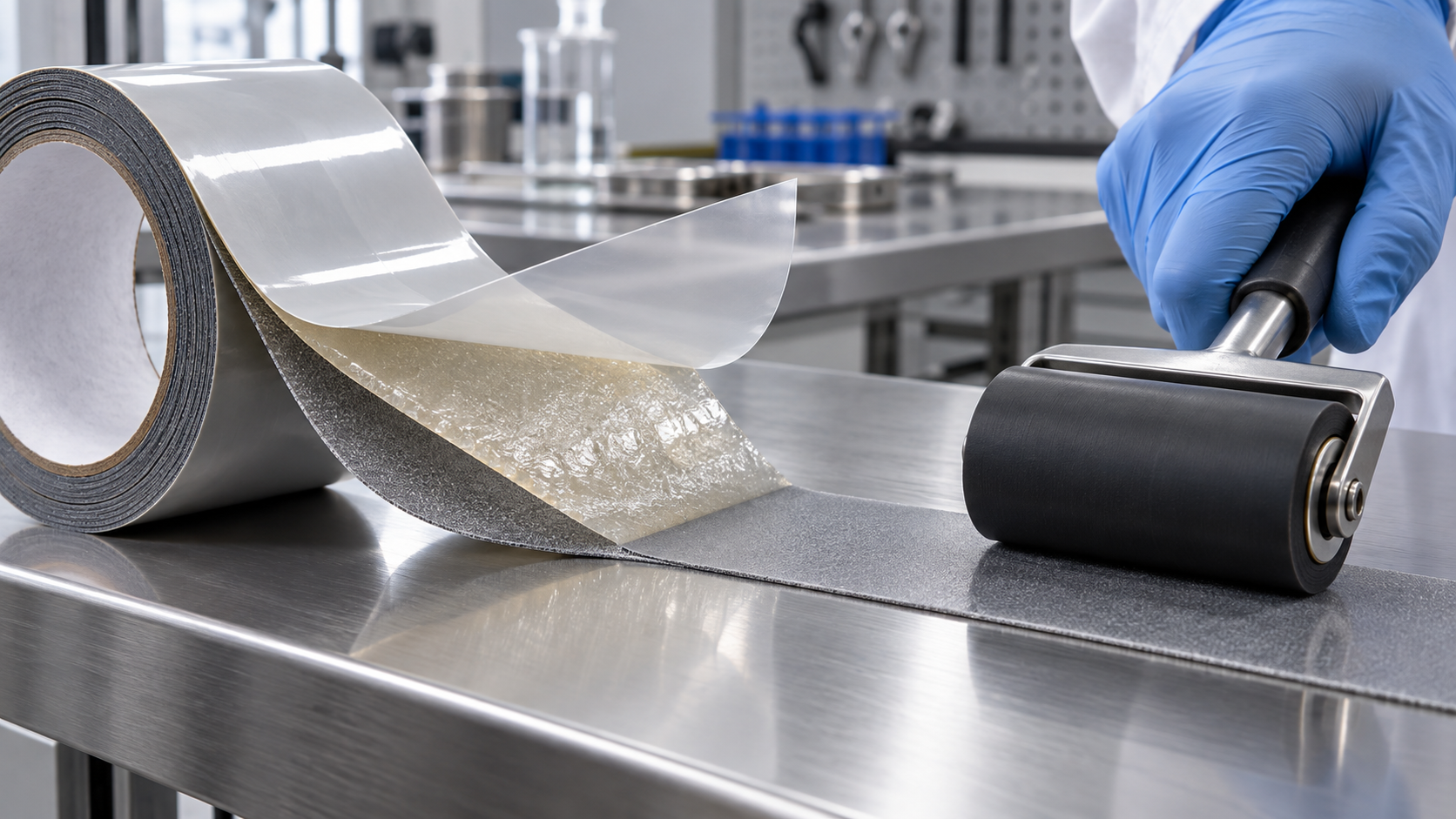
The adhesive on a tape is not like an adhesive that changes from liquid to solid: it stays a “soft solid” even in use. It sticks at a light touch because its viscoelasticity is tuned to flow into the roughness of the surface while resisting the force that would pull it off. So the numbers for a tape move a great deal with time since application, press-down, temperature, speed and adherend. This article sets out the types of pressure-sensitive adhesive, the three measures of tape performance (peel, holding power and tack) and their standards, process tapes for semiconductors (back-grinding, dicing, die bonding), double-sided tapes and heat-resistant tapes, drawing on manufacturers' material, standards and papers.
- What an adhesive tape is (the short version)
- Tape construction — adhesive, backing and release liner
- Types of pressure-sensitive adhesive — acrylic, rubber, silicone
- A materials engineer's view (1): the adhesive is a “slowly flowing solid”
- The three measures — peel, holding power, tack — and the standards
- A materials engineer's view (2): higher peel is not always better
- Our calculation: build-up and design factors in 3M's data sheet
- Process tapes for semiconductors — being removable is the performance
- Double-sided foam tape and heat-resistant tape
- A materials engineer's view (3): “heat resistance” has three definitions
- Limits and what could not be confirmed / Glossary / References / Claim-to-source audit
Sourced = stated in published material (link given)
Our calculation = a figure this article derived, with the assumptions spelled out
Not yet confirmed = a plan or proposal with no confirmed record
Structural readings and materials-design interpretations are marked separately as Commentary.
Adhesion and other values are given with test method, conditions and source; values from manufacturers' material are labelled manufacturer's stated value (typical). Soken Chemical's comparison of adhesive types is that company's qualitative summary, not a ranking of individual products or other companies' products. Standards are paywalled, so this article keeps to what the official pages show: number, title and scope. It does not recommend or criticise any product or company.
1. What an adhesive tape is (the short version)
Soken Chemical, a maker of pressure-sensitive adhesives, explains an adhesive as a material for sticking things together that changes from liquid to solid before and after bonding, and a pressure-sensitive adhesive as a kind of adhesive that has no change of state from liquid to solid. It is also called a PSA, and sticks to an adherend with only a light finger press. It cannot be used straight from a tube like an adhesive: it is coated on a backing (support) such as a film, the solvent or water is evaporated, and it is used as an adhesive tape or filmSourced.
- A material that does not change when it bonds: Creton's introductory review (2003) says a PSA undergoes no physical transformation or chemical reaction during bonding, so its rheology has to be finely tuned, through the polymer architecture, monomer composition and the addition of tackifying resins. PSAs are soft, deformable solids that, depending on the formulation, easily form bridging fibrils between two surfaces on debondingSourced
- Numbers are sensitive to conditions: because a PSA is viscoelastic, its strength changes with time since application, press-down, temperature, speed and adherend. Soken Chemical likewise says results can change greatly with temperature, humidity and adherend preparation, so it is important to evaluate relatively, with the conditions held constantSourced
- Being removable is also performance: in semiconductor manufacturing, a temporary-fixing tape must hold strongly during processing and come off afterwards without damaging the chips. Process tapes change their tack with UV or heat (Chapter 8)Sourced
A tape's “N/20 mm” is a number that contains time and conditions. The same tape differs at 20 minutes and at 72 hours after application, and also with the force of press-down, the temperature and the speed of peeling. And a higher number does not always make a better tape.
For the view of adhesives from the adhesive side, see our explainer on adhesives (which lists pressure-sensitive adhesives in the family that “sets as solvent or water leaves”. Solvent or water leaves at coating, but at bonding the adhesive does not turn from liquid to solid; that is the difference from an adhesive). In Japan, terms and test methods are specified in JIS Z 0109 (glossary of terms for pressure-sensitive adhesive tapes and sheets) and JIS Z 0237 (testing methods). Both were drafted with the Japan Adhesive Tape Manufacturers Association among the originating bodiesSourced.
2. Tape construction — adhesive, backing and release liner
A tape consists of a layer of adhesive, the backing (support) that carries it and a release liner that protects the adhesive face until use. The combination of backing and adhesive changes the character of the tape completely.
The backing is more than a support. Nitto Denko's development report on its thermal-release sheet says that on release the force acts on the backing as well as on the adherend, so that anchorage failure of the adhesive from the backing would cause residue or release failure. The sheet therefore has an intermediate layer between the backing and the heat-release adhesive layerSourced. It is not simply a matter of making the adhesive thicker and stronger.
3. Types of pressure-sensitive adhesive — acrylic, rubber, silicone
Soken Chemical divides PSAs into three main types — acrylic, rubber and silicone (with urethane and others besides) — and into three forms: solvent-based, emulsion and solvent-free (hot melt and UV-polymerised)Sourced.
| Item | Acrylic | Silicone | Rubber |
|---|---|---|---|
| Peel adhesion | ◎ | △ | ◎ |
| Cohesion | ○ | ○ | ○ |
| Stickiness (tack) | ○ | △ | ◎ |
| Water resistance | ◎ | ◎ | ◎ |
| Heat resistance | ◎ | ◎ | △ |
| Weather resistance | ◎ | ◎ | × |
| Solvent resistance | ○ | ◎ | △ |
| Cold resistance | △ | ◎ | ◎ |
| Price band | Medium | High | Low |
All Sourced (Soken Chemical, “Basic knowledge of pressure-sensitive adhesives”, comparison of the solvent-based form of each type [Reference 11], in Japanese). The symbols are the company's own; the page does not give a key, but they read as ◎ best and × weakest (our interpretation). This is the company's qualitative summary, not values for individual products.
Characteristics of each (from Soken Chemical's material)
- Acrylic: based on acrylic esters, it can be designed from strong tack to light tack through the monomer combination. Excellent in weather resistance, heat resistance and transparency, and strong on metals. It has tack from the main component alone; unlike rubber and silicone it does not require a tackifying resin. On the other hand, it is hard to stick to low-polarity, low-surface-energy adherends such as polypropylene, and, owing to its Tg, flows less at low temperature and sticks less readily [Reference 14]
- Rubber: natural and synthetic rubbers (SBR, PIB, SIS, SBS, SEBS and others). Rubber alone shows no tack; a tackifying resin is mixed in to lower the elastic modulus (hardness) so that it sticks. Strong initial tack and stickiness, and it can be used on PP, PE and the like. The weaknesses are that it softens at 40–70 °C, lowering tack and cohesion, and that it is weak to ultraviolet light. Block-copolymer synthetic rubbers form physical crosslinks called domains for cohesion and, because they flow on heating, can be made into hot-melt types [Reference 15]
- Silicone: a silicone polymer plus a silicone resin as the tackifying component. Usable over a wide range of about −60 to 250 °C, with high re-releasability, and it sticks even to silicone rubber and fluoropolymers that rubber and acrylic PSAs find hard to stick to. On the other hand, peel adhesion is low and the price is high. The company warns that gaseous siloxane may cause contact failures in electronic parts and haze in optical members, and that in semiconductor tapes at high temperature it may contaminate the wafer surface [Reference 15]
- Urethane: light tack and excellent re-releasability, with little change in tack with temperature or peel speed. Peel and tack are low, and it is hard to stick to olefins. Its use in medical tapes is advancing [Reference 15]
Henkel's bonding manual also notes that acrylic emulsion PSAs are mainly used for labels, are rated in tack, peel and shear, need a very clean surface, and have a high-temperature performance of about 50 °C. Hot-melt PSAs also exist [Reference 26]Sourced.
4. A materials engineer's view (1): the adhesive is a “slowly flowing solid”
The data sheet for 3M's VHB tape says the tape is viscoelastic, so its strength and stiffness are a function of the rate at which it is stressed. It behaves stronger under a higher rate of stress (dynamic) and shows creep under loads acting over a long time (static). After application, the bond strength gradually increases as the adhesive flows onto the surface (“wet out”), and the degree of flow is largely determined by the surface energy of the substrateSourced.
This is the idea of “wetting first, strength second” from our explainer on adhesives, applied directly to the PSA. A PSA has to be soft to flow and wet (low elastic modulus), and at the same time needs cohesion so that it does not flow too much and slip. That rubber alone will not stick and does so only when a tackifying resin lowers its modulus (Soken Chemical) is the same situation (our commentary).
Nitto Denko's report is an example of a design that turns this duality to advantage. For the thermal-release tape, the elastic modulus at the release temperature matters: if crosslinking is insufficient and the modulus at high temperature is low, the deformation force from the swelling foaming agent cannot be turned into peel force and release capability fallsSourced. Ease of sticking at room temperature and the modulus at the release temperature are designed separately.
5. The three measures — peel, holding power, tack — and the standards
Soken Chemical says the physical properties of a PSA are most often assessed on a tape, as peel adhesion, holding power and tack, which it calls the three elements of adhesionSourced.
That material describes each element as followsSourced.
- Peel adhesion: the force to pull the tape off the adherend, showing how hard it is to peel. A tape on a test plate such as stainless steel is pressed with a roller, and after a set time peeled at a constant speed at 180° or 90° or the like. It is expressed in N/mm or N/m, a force per width of tape. It is greatly affected by the temperature and humidity of the environment and the adherend material
- Holding power: resistance to slipping between adherend and tape. The tape hangs vertically with a load (weight), and is expressed as slip distance (mm) or time to fall (minutes). The closer to 0, the higher the holding power
- Tack: the force by which a tape sticks quickly on a light touch. The typical method is ball tack, evaluated by the number of the largest stainless steel ball that stops for 5 seconds or more on the adhesive face when rolled down a slope. Tack is the initial grab and does not necessarily indicate the strength of adhesion
Standard test methods exist in ISO, ASTM and JIS. From the official pages, here are the numbers, titles and scopeSourced.
| Test | Standard (number, edition) | Title and scope (as on the official page) |
|---|---|---|
| Peel | ISO 29862:2024 | Self adhesive tapes — Determination of peel adhesion properties. Method 1: from stainless steel at 180°; Method 2: from its own backing at 180°; Method 3: double-sided and transfer tapes at 180°; Method 4: adhesion of the liner at 180°. 3rd edition (December 2024) |
| ASTM D3330/D3330M-04(2025) | Standard Test Method for Peel Adhesion of Pressure-Sensitive Tape. A quality-assurance tool that shows the relative peel strength against the standard stainless steel panel. It cannot be used to compare two tapes of the same type but different manufacture, because the measured force is not normalised for a fixed area of stress and the area under stress varies with backing stiffness and adhesive rheology. It may not provide design information, since there is usually no direct relationship between peel adhesion and any functional requirement | |
| Shear (holding power) | ISO 29863:2018 | Self adhesive tapes — Measurement of static shear adhesion. The ability of a pressure-sensitive tape to remain adhered under a constant load applied parallel to the surfaces. Method A: vertical standard steel panel; Method B: vertical panel covered with NIST SRM 1810A fibreboard; Methods D and E: filament-reinforced tape on a horizontal panel |
| ASTM D3654/D3654M-06(2024) | Standard Test Methods for Shear Adhesion of Pressure-Sensitive Tapes. Procedure A measures adhesion to a standard steel panel under constant stress. This may or may not relate to adhesion to other surfaces | |
| Tack | ASTM D6195-22 | Standard Test Methods for Loop Tack. A quantitative measure of the pressure-sensitive tack of an adhesive. Tack varies with the backing (generally stiffer backings give higher values). Suitable for quality control and research |
| ASTM D3121-25 | Standard Test Method for Tack of Pressure-Sensitive Adhesives by Rolling Ball. Intended primarily for quality control, with good within-laboratory reproducibility if film thickness is constant. For most applications, rolling-ball results do not correlate well with application tack requirements. Not recommended for specifying end-use products | |
| Tensile | ISO 29864:2018 | Self adhesive tapes — Measurement of breaking strength and elongation at break |
| Japanese standards | JIS Z 0237:2022 | Testing methods of pressure-sensitive adhesive tapes and sheets (title in Japanese). Test methods for tapes and sheets used for packaging, sealing and marking. Modified adoption (MOD) of ISO 29862:2018, 29863:2018 and 29864:2018. Current (revised January 2022) |
| JIS Z 0109:2015 | Glossary of terms used in pressure sensitive adhesive tapes and sheets (title in Japanese). Terms and definitions. Current (confirmed 2020) |
All Sourced (official pages of ISO, ASTM and the Japanese Standards Association [References 1–9], checked October 2026; the wording is our summary). The ISO 29862 on which JIS Z 0237:2022 is based is the 2018 edition; the current ISO 29862 is the 2024 edition. The difference was not checked.
The reason ASTM D3330 gives for not comparing tapes of different manufacture is suggestive. Peel force is force per unit width, not normalised to the stressed area, so the area under stress (set by backing stiffness and adhesive flow) gets mixed in. The number contains not only the strength of the adhesive but the thickness and stiffness of the backing. Change the backing on the same adhesive and the number changes; tack too changes with backing (ASTM D6195)Sourced. It is the same situation as the peel test in our explainer on adhesive strength testing (our commentary).
6. A materials engineer's view (2): higher peel is not always better
Soken Chemical says the performance asked of a tape differs by application: it is not the case that peel adhesion should simply be strong, holding power merely not slip, and tack simply high. As an example, a protective film for a smartphone must come off with a light force, so a weak peel adhesion is requiredSourced. Nitto Denko's report on its thermal-release sheet writes this contradiction out plainly: strong adhesion and easy release are contrary properties. A strongly adhering tape may, on release, break within the adhesive and leave residue on the adherend (cohesive failure) or even break the adherend, whereas a tape that peels easily is designed to keep its adhesion to the adherend “only as low as is needed to function as a tape”Sourced.
From 3M's data sheets, here are the peel adhesion values of two tapes with different purposes (manufacturer's stated values; both cite ASTM D3330)Sourced.
| Tape (3M) | Purpose | Value in the data sheet (test conditions) | Converted to N/cm |
|---|---|---|---|
| VHB 4914 (double-sided acrylic foam, 0.25 mm) | Permanent bonding; a substitute for rivets, welds, screws and liquid adhesives | 90° peel 23 N/cm (13 lb/in). Stainless steel, 5 mil aluminium-foil backing, 23 °C, 72 h dwell, 304 mm/min | about 23 |
| Polyimide tape 5413 (single-sided, 0.07 mm overall) | Masking boards during soldering; clean removal after the high-temperature step | To steel, 22 oz/in width (24 N/100 mm). Peel angle, dwell and speed not stated in the data sheet | about 2.4 |
Values are Sourced (3M VHB 4914 data sheet, English, September 2024 [Reference 16]; 3M polyimide tape 5413 data sheet [Reference 17]; manufacturer's stated, typical values). The conversion to N/cm is Our calculation (22 oz/in = about 24.1 N/100 mm, matching the data sheet's 24 N/100 mm; 13 lb/in = about 22.8 N/cm, matching the data sheet's 23 N/cm). The test conditions differ, so the roughly tenfold difference is only a guide, not a ranking.
A permanent-bonding tape and a tape that must come off cleanly after a high-temperature step naturally have peel targets that differ by an order of magnitude. For the latter what matters more than a high number is leaving no adhesive residue on removal (no cohesive failure). ASTM D3330 says there is usually no direct relationship between peel adhesion and a functional requirement and that it does not provide design informationSourced. The number is material for deciding not “how strong” but “how it comes off” to suit the purpose (our commentary).
7. Our calculation: build-up and design factors in 3M's data sheet
The data sheet for 3M's VHB 4914 (English, September 2024) says how the tape's strength builds up with time after application and how far test values and design guides differSourced.
- Build-up of strength: at room temperature, about 50 % of ultimate strength after 20 minutes, 90 % after 24 hours and 100 % after 72 hours. Bond strength increases gradually as the adhesive wets out on the surface. Flow is faster at higher temperature, and exposure such as 1 hour at 66 °C can speed the ultimate strength and in some cases raise it. Abrasion (about 180 grit) or primers also raise strength and build-up rate
- Press-down at application: strength depends on the area of contact the adhesive develops with the surface. Press with a roller or platen so that the tape experiences about 100 kPa (15 psi)
- Application temperature: ideally 21 to 38 °C. The suggested minimum for most VHB tapes is 10 to 15 °C; below that the adhesive is too firm to adhere readily (once applied, holding at low temperature is generally satisfactory)
- Static holding (ASTM D3654): on stainless steel, 3.23 cm² (0.5 in²) holds 1,500 g at 23 °C and 500 g at 66 °C and 93 °C for 10,000 minutes (about 7 days)
- Dynamic test (ASTM D1002, ISO 4587): overlap shear on stainless steel, 6.45 cm² (1 in²), jaw speed 12.7 mm/min, 900 kPa (130 lb/in²) (23 °C, 72 h dwell)
- Design guides: for static loads, “about 57 cm² of tape per kg” to prevent excessive creep. For dynamic loads, 85 kPa (12 lb/in²) is a useful general design factor
- Stress in the static test: 1,500 g = 14.7 N divided by 3.23 cm² gives about 45.5 kPa (23 °C). 500 g = 4.9 N gives about 15.2 kPa (66 and 93 °C)Our calculation
- Static design guide: 1 kg (9.81 N) divided by 57 cm² gives about 1.72 kPa, about 1/26 of the stress in the 23 °C test (45.5 ÷ 1.72 = 26.5)Our calculation
- Dynamic design guide: 85 kPa is about 9.4 % (about 1/10.6) of the overlap shear strength of 900 kPa (85 ÷ 900)Our calculation
Assumptions and limits: the test load in (b) is a condition that was held for 10,000 minutes (about 7 days), not the load at which the tape fails. So 1/26 is not a ratio to a “failure load”; it is the ratio of the load held in the test to the design guide. Also (b) and (c) use different ways of loading (a static sliding load and tensile lap shear). The ratios only indicate the size of the safety margin 3M applies to this tape and do not apply to other tapes.
3M says its VHB tape is viscoelastic and shows creep under loads acting over a long time, so it sets the static guide an order of magnitude stricter than the dynamic one (about 1.7 kPa against 85 kPa, about 49 times, 85 ÷ 1.72 = 49)Our calculation. The adhesive sticks because it flows, and creeps because it flows: two faces of one property. The time–temperature thinking of our explainer on glass transition and creep applies directly. And 3M's static shear tests show that the weight held falls as temperature rises (1,500 g at 23 °C, 500 g at 66 and 93 °C, about one third)Sourced. We read this as the adhesive softening and flowing more readily at high temperature (our commentary).
8. Process tapes for semiconductors — being removable is the performance
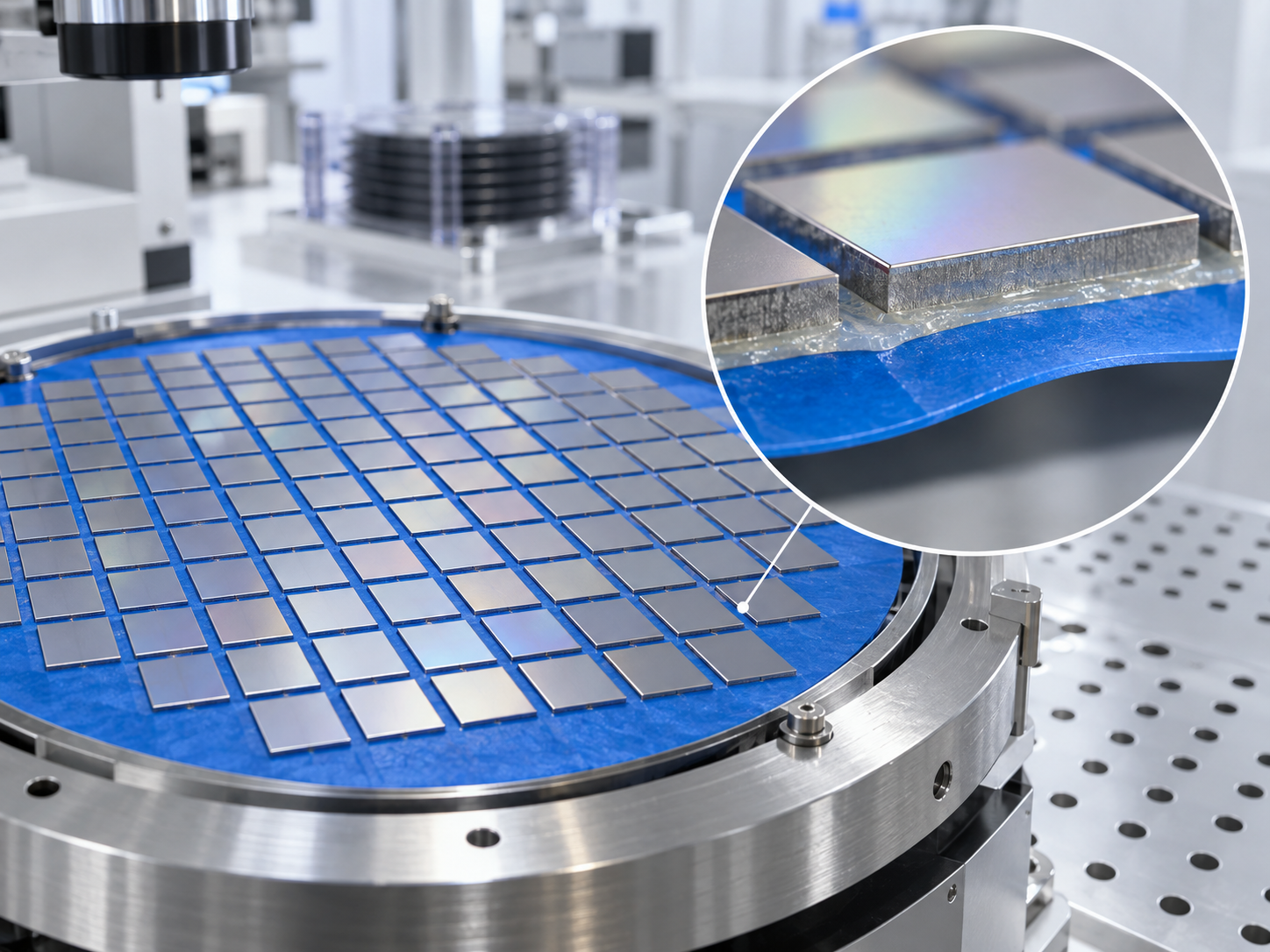
Wafer thinning and dicing do not work without tape. The machines and process are covered in our explainer on wafer thinning and dicing; here we look at the tape side. Lintec's page on semiconductor-related tapes lists four kindsSourced.
| Tape | Purpose (as Lintec states it) | What the product pages say |
|---|---|---|
| Back-grinding (BG) surface-protection tape | Reliably protects the wafer surface during back grinding and keeps grinding water and swarf from contaminating it | E series (UV-curable): UV exposure lowers the tack. Standard grinding (wafer thickness above 100 µm), thin grinding (above 40 µm), antistatic, bumped wafers, special processes such as DBG and chemical etching and PCBL. P series (non-UV): standard grinding (above 100 µm), thin grinding (above 50 µm) |
| Dicing tape | Holds chips strongly before dicing and, after dicing, lowers the tack to ease pick-up | D series (UV-curable): for Si wafers the backing is PVC or PO. Standard, low-pick-up type, for small chips (under 1 mm), anti-swarf. Also for packages, glass and ceramics, stealth dicing, full-cut laser dicing, plasma dicing, solvent-resistant and heat-resistant. G series (non-UV): no UV exposure needed, stable tack, excellent expandability, suits various chip sizes |
| Dicing die-attach tape | Combines the functions of dicing tape and die-bonding agent | LE tape: dicing through die bonding on one sheet of tape. Compared with liquid adhesive: the adhesive form is uniform, full-face bonding (liquid: non-uniform, partial), unaffected by chip size (liquid: affected), no control of adhesive amount or tool needed (liquid: needed), no bleed on cure (liquid: bleed) |
| Chip back-side protection tape | Protects and reinforces the back side of chips mounted circuit-side down, as in flip chip | (Purpose stated on the product page) |
| Removal tape for BG protection tape | A dedicated tape for peeling off the BG surface-protection tape | S series: with a wafer mounter and a BG tape remover it peels the BG tape without damaging the wafer. It bonds firmly by heat and pressure whatever the material of the protection tape, and peels it off reliably |
All Sourced (Lintec, “Semiconductor-related tapes” [Reference 19], Adwill product pages [References 20–25]; in Japanese; the wording is our summary). The product pages do not give specific figures for adhesion or UV dose.
How a thermal-release tape works — from a development report in the Journal of The Adhesion Society of Japan
Arimitsu of Nitto Denko, in a 2008 review (development of a product that won the Adhesion Society of Japan's technology award), describes the thermal-release sheet as followsSourced.
- The problem: as portable electronics shrank, the mainstream electronic parts became smaller than 1 mm square. Conventional temporary fixing (wax, adhesive, adhesive sheet) holds well but is hard to peel after processing, whereas suction fixing releases easily but holds less well
- The mechanism: a heat-responsive foaming agent is added to the adhesive. On heating the foaming agent swells and the surface of the adhesive layer becomes rough. This change of shape generates a stress that peels the adherend off the adhesive layer; at the same time contact changes from areas to points, so contact area falls sharply and re-attachment is prevented. Adhesion becomes almost zero and the adherend separates with no external force (spontaneous release)
- Conditions for the foaming agent: it must foam in a short time at around 100 °C and also hold that state for a long time. If it foams quickly but bursts at once, the part re-attaches
- Adhesive-layer design: to turn the deformation force on foaming efficiently into peel force, the flow of the adhesive layer is restrained. The polymer should have few low-molecular-weight components; the position at which crosslinking functional groups are introduced also greatly affects heat-release behaviour. Modulus and adhesion at the release temperature matter too: the lower the adhesion, the easier the release
- Construction: an intermediate layer between the backing and the heat-release adhesive layer prevents anchorage failure from the backing. Grades with different release temperatures exist; the legend of the graph shows types releasing at 90, 120, 150 and 170 °C (as of 2008)
- Use: most used in making ceramic parts: when cutting small parts of 1005 size (1 mm × 0.5 mm) or 0603 size (0.6 mm × 0.3 mm), tens of thousands to more than 100,000 parts are fixed on one sheet and released by heating after cutting. Some mobile phones use more than 500 ceramic parts each
That adhesion is proportional to contact area is basic to adhesion. Nitto Denko's design brings adhesion close to zero by reducing the area, not the strength of the adhesive. The tape holds strongly on a flat face during processing, and on release roughens the surface to make contact “points”. It reconciles the opposing demands of strength and ease of release through a change of shape, not of material strength (our commentary). UV-type process tapes do the opposite: they advance crosslinking so the adhesive hardens and loses the ability to flow into contact, lowering adhesion (our explainer on wafer thinning and dicing). Either way, the viscoelasticity of the adhesive is deliberately changed by a stimulus (light or heat) to switch between “hold” and “release”.
Soken Chemical says that gaseous siloxane from silicone PSAs may cause contact failures in electronic parts and haze in optical members, and that in semiconductor tapes at high temperature it may contaminate the wafer surfaceSourced. Lintec's range of industrial adhesive tapes includes a “silicone-free adhesive tape series”Sourced (by the product page's heading). For a process tape, residue, outgassing and contamination are part of performance as well as adhesion (our commentary).
9. Double-sided foam tape and heat-resistant tape
Double-sided foam tape (3M VHB 4914 as an example)
The data sheet for 3M's VHB 4914 (0.25 mm, white, double-sided acrylic foam tape with paper liner) says it bonds permanently, with a general-purpose acrylic adhesive and a firm acrylic foam core, to a range of high-surface-energy adherends such as metals, glass and easier-to-bond paints and plastics, and can replace rivets, welds, screws and liquid adhesivesSourced. Here are the statements that show how it differs from an adhesive.
| Item | Data-sheet statement (manufacturer's stated value) |
|---|---|
| Strength from the moment it is applied | The pressure-sensitive adhesive bonds on contact to give immediate handling strength. There is no waiting for cure as with a liquid adhesive |
| Thickness and roughness | The tape conforms to a certain amount of irregularity but will not flow to fill large gaps. For rigid materials of normal flatness, consider tape 1.1 mm (45 mil) or thicker; thinner tapes can be considered as the substrates get more flexible |
| Tolerance of thermal-expansion mismatch | Suits applications in which two surfaces expand and contract at different rates. With good adhesion to both, it typically tolerates differential movement in the shear plane of up to 3 times (300 %) the thickness |
| Flexibility of the bond | The bond is more flexible than other fastening methods. Where more stiffness is needed, modify the design or use rigid fasteners or adhesives in places |
| Preparation before application | Clean most substrates with an IPA/water (70/30) mixture. Heavy oil needs a degreaser, oxidation abrasion (about 180 grit), and plastics and paints primer (adhesion promoter). Porous materials need sealing to give a unified surface |
| Storage | Store at 4 to 38 °C and 0 to 95 % relative humidity; performance is retained for 24 months from manufacture |
All Sourced (3M VHB 4914 data sheet, English, September 2024 [Reference 16], manufacturer's stated value; the wording is our summary).
Against the “internal stress from cure shrinkage and thermal mismatch” seen in our explainer on adhesives, the foam core deforms and lets the stress out; that is the design of this kind of tape (our commentary). But a PSA creeps, so the area for static loads has to be secured using the guide in Chapter 7.
Heat-resistant tape (3M polyimide film tape 5413 as an example)
3M's polyimide film tape 5413 is an amber tape with a polyimide film (1.0 mil) backing and silicone adhesive (1.7 mil), 2.7 mil (69 µm) thick overall. It is used for masking boards during PCB soldering (wave soldering, reflow) and as a release surface when making parts cured at high temperature. The data sheet lists dimensional stability at high temperature, silicone adhesive performance that reduces adhesive transfer and virtually eliminates extra cleaning, flame retardancy and chemical and radiation resistanceSourced. The values are adhesion to steel of 22 oz/in width (ASTM D3330), tensile strength at break of 33 lb/in width (ASTM D3759), elongation at break of 62 % and a temperature use range of −73 to 260 °C (manufacturer's stated, typical values, from a “preliminary” data sheet dated July 2026). Shelf life is 36 months from manufacture (21 °C, 50 % RH).
10. A materials engineer's view (3): “heat resistance” has three definitions
Two 3M data sheets define “heat resistance” in three waysSourced.
- The “temperature use range” of 5413 (polyimide): defined as the maximum time at the stated temperature after which the tape can be removed cleanly from a copper substrate, without staining (the data sheet gives no specific time). The range is −73 to 260 °C. The criterion is “can it be removed?”
- The long-term heat resistance of VHB 4914 (93 °C): the maximum temperature at which the tape supports at least 78 g/cm² (500 g/in²) in static shear for 10,000 minutes. The criterion is “can it hold a load?” (a guide to continuous exposure for days or weeks)
- The short-term heat resistance of VHB 4914 (149 °C): the maximum temperature at which, after 4 hours of conditioning with a 100 g static load, room-temperature dynamic shear properties are unchanged. The criterion is “does performance stay unchanged after it returns?” (a guide to short exposure within a process)
A masking tape required to come off and a structural double-sided tape required to keep supporting a load mean different things by “withstands”. It would be wrong to line up the numbers and say “5413 is 260 °C and VHB is 149 °C”; you have to read what the temperature guarantees. Heat resistance of a tape is set both by how soft the adhesive becomes at high temperature (its flow) and by the heat resistance of the backing. That rubber PSAs soften at 40–70 °C (Soken Chemical) and silicone PSAs are usable at −60 to 250 °C (same source) are on the same axis (our commentary).
11. Limits and what could not be confirmed
(1) Details of the standards' text were not checked
The ISO, ASTM and JIS texts are paywalled, so test-plate material, how the tape is pressed down, dwell time, peel speed and precision were not checked. Also, JIS Z 0237:2022 is based on ISO 29862:2018 (modified adoption) while the current edition is 2024. The effect of the difference between editions on test results could not be confirmed.
(2) Figures for process tapes are not on the official pages
Lintec's product pages give no specific figures for adhesion, UV dose or release conditions. This article therefore keeps to the application categories and the stated features and gives no numerical performance for any specific product.
(3) The thermal-release tape information rests on a 2008 report
Nitto Denko's development report is from 2008; the current product range and release temperatures were not checked in this article (the Nitto Denko product pages could not be accessed).
(4) No quantitative viscoelastic criterion is covered
Classical criteria that express the condition for tack as a range of elastic modulus and the like were not checked because the full text of Creton's review is paywalled (only the abstract was read). The viscoelasticity of PSAs is described only qualitatively.
(5) No ranking of commercial tapes
The two 3M tapes are cited, with conditions, as examples differing in adhesive, backing and purpose, not to rank products. Medical tapes, masking tapes, electrical-insulation tapes (ASTM D1000 and so on) and chemical regulation (siloxanes and so on) are not covered here.
- A PSA is a “soft solid” whose state does not change when it bonds. So its strength moves with time since application, press-down, temperature and speedSourced
- The three measures are peel (peel adhesion), holding power (static shear) and tack (initial grab). Peel is a force per width, and backing stiffness gets into the number, so it cannot be used to compare tapes of different manufacture (ASTM D3330)Sourced
- Higher peel is not always better. Permanent bonding and clean-release tapes aim at targets an order of magnitude apart (about tenfold for two 3M tapes)Our calculation
- 3M's VHB builds to 50 % at 20 minutes, 90 % at 24 hours and 100 % at 72 hours, and its static-load design guide is about 1/26 of the load held in the testOur calculation
- For process tapes, being removable is the performance. There are types that advance crosslinking with UV, types that foam on heating to cut contact area, and types that combine dicing and die attach on one sheetSourced
- “Heat resistance” is defined differently according to what it guarantees. There are three: can be removed cleanly, can hold a load, and performance unchanged after returnSourced
12. Glossary
- Pressure-sensitive adhesive (PSA)
- An adhesive that sticks with a light press. It does not change from liquid to solid when it bonds.
- Backing (support)
- The film, paper or foam that carries and supports the adhesive.
- Release liner
- A paper or film with a release treatment that protects the adhesive face until use.
- Tackifying resin (tackifier)
- A resin that lowers the elastic modulus of rubber-type adhesives and gives them tack.
- Peel adhesion
- The force to peel, expressed per width (N/20 mm, N/100 mm and so on).
- Holding power
- Resistance to slipping under a sustained load, expressed as slip distance or time to fall.
- Tack
- The force to stick quickly on a light touch: the initial grab.
- Ball tack
- A tack test expressed by the largest ball number that stops on the adhesive when rolled down a slope.
- Wet-out
- After application, the adhesive flowing over the adherend surface and increasing contact area.
- Creep
- Deformation that grows with time under a constant load.
- BG tape
- A surface-protection tape that protects the wafer face during back grinding.
- Dicing die-attach tape
- A tape combining dicing tape and a film adhesive for die bonding.
- Thermal-release tape
- A tape whose foaming agent swells on heating so that adhesion almost disappears and it peels off by itself.
13. References
- ISO ISO 29862:2024 Self adhesive tapes — Determination of peel adhesion properties — iso.org
- ISO ISO 29863:2018 Self adhesive tapes — Measurement of static shear adhesion — iso.org
- ISO ISO 29864:2018 Self adhesive tapes — Measurement of breaking strength and elongation at break — iso.org
- Japanese Standards Association (JSA) JIS Z 0237:2022 Testing methods of pressure-sensitive adhesive tapes and sheets (in Japanese) — webdesk.jsa.or.jp
- Japanese Standards Association (JSA) JIS Z 0109:2015 Glossary of terms used in pressure sensitive adhesive tapes and sheets (in Japanese) — webdesk.jsa.or.jp
- ASTM International ASTM D3330/D3330M-04(2025) Standard Test Method for Peel Adhesion of Pressure-Sensitive Tape — store.astm.org
- ASTM International ASTM D3654/D3654M-06(2024) Standard Test Methods for Shear Adhesion of Pressure-Sensitive Tapes — store.astm.org
- ASTM International ASTM D6195-22 Standard Test Methods for Loop Tack — store.astm.org
- ASTM International ASTM D3121-25 Standard Test Method for Tack of Pressure-Sensitive Adhesives by Rolling Ball — store.astm.org
- Creton, C. Pressure-Sensitive Adhesives: An Introductory Course. MRS Bulletin 28(6), 434–439 (2003). DOI 10.1557/mrs2003.124 (abstract checked on the publisher's page) — doi.org
- Soken Chemical & Engineering Basic knowledge of pressure-sensitive adhesives: what they are, forms, types (in Japanese) — sokenchem.com
- Soken Chemical & Engineering Basic properties of pressure-sensitive adhesives: the three elements of adhesion (in Japanese) — sokenchem.com
- Soken Chemical & Engineering How things stick together: the difference between bonding and adhesion (in Japanese) — sokenchem.com
- Soken Chemical & Engineering Features of acrylic pressure-sensitive adhesives (in Japanese) — sokenchem.com
- Soken Chemical & Engineering Features of other pressure-sensitive adhesives: rubber, silicone, urethane (in Japanese) — sokenchem.com
- 3M 3M VHB Tape — Specialty Tape 4914, Technical Data Sheet, English-US, last revision September 2024 — multimedia.3m.com
- 3M 3M Polyimide Film Tape 5413, Technical Data (July 2026) — multimedia.3m.com
- Arimitsu, Y. (Nitto Denko) Development of Thermal Release Sheet “REVALPHA®” (in Japanese). Journal of The Adhesion Society of Japan 44(6), 225–229 (2008). DOI 10.11618/adhesion.44.225 — doi.org
- Lintec Semiconductor-related tapes (in Japanese) — lintec.co.jp
- Lintec (Adwill) Dicing tape D series (UV-curable) (in Japanese) — adwill-global.com
- Lintec (Adwill) Dicing tape G series (non-UV) (in Japanese) — adwill-global.com
- Lintec (Adwill) BG surface-protection tape E series (UV-curable) (in Japanese) — adwill-global.com
- Lintec (Adwill) BG surface-protection tape P series (non-UV) (in Japanese) — adwill-global.com
- Lintec (Adwill) Dicing die-attach tape LE Tape (in Japanese) — adwill-global.com
- Lintec (Adwill) Removal tape for BG surface-protection tape S series (in Japanese) — adwill-global.com
- Henkel How to Create Reliable and Effective Bonded Joints (Adhesive Technologies Expert Bonding Collection), 2022 (PDF) — dm.henkel-dam.com
14. Claim-to-source audit
| Claim in the text | Basis | Label |
|---|---|---|
| The difference between adhesives and PSAs (an adhesive changes from liquid to solid; a PSA is a kind of adhesive with no change of state, also called PSA, sticking with a light finger press; it is coated on a backing and the solvent or water is evaporated to make a tape). The forms of PSA (solvent-based, emulsion, solvent-free = hot melt and UV-polymerised) and types (acrylic, rubber, silicone; also urethane) | Soken Chemical, basic knowledge of PSAs[Reference 11] https://www.sokenchem.com/jp/product/PSA/knowledge/ and [Reference 13] https://www.sokenchem.com/jp/product/PSA/knowledge/structure/ | Sourced |
| That a PSA undergoes no physical transformation or chemical reaction on bonding; that its rheology is tuned through polymer architecture, monomer composition and tackifying resins; that it is a soft deformable solid that easily forms fibrils on debonding | Abstract of Creton (2003)[Reference 10] https://doi.org/10.1557/mrs2003.124 | Sourced |
| The explanation of the three elements of adhesion (peel: roller press, set time, 180° or 90°, N/mm or N/m; holding power: mm or minutes; tack: ball tack, stops for 5 seconds or more, the initial grab not necessarily indicating the strength of adhesion). The importance of relative evaluation with fixed conditions. That higher peel is not always better and that a smartphone protective film needs a weak peel | Soken Chemical, basic properties[Reference 12] https://www.sokenchem.com/jp/product/PSA/knowledge/basic_property/ | Sourced |
| The comparison table of three PSA types (peel, cohesion, tack, water, heat, weather, solvent and cold resistance, price band). Features of acrylic PSAs (no tackifying resin needed, weak on low-polarity adherends and at low temperature) | Soken Chemical[Reference 11] https://www.sokenchem.com/jp/product/PSA/knowledge/ and acrylic page[Reference 14] https://www.sokenchem.com/jp/product/PSA/knowledge/acryl/ | Sourced |
| Rubber PSAs (a tackifying resin lowers the modulus; usable on PP and PE; soften at 40–70 °C; weak to ultraviolet; block-copolymer hot melts), silicone PSAs (silicone polymer plus resin; −60 to 250 °C; re-releasability; low adhesion; possible harm from siloxane; possible wafer contamination in semiconductor tapes), urethane PSAs (light tack, re-releasability) | Soken Chemical, other PSAs[Reference 15] https://www.sokenchem.com/jp/product/PSA/knowledge/other/ | Sourced |
| Henkel's manual: acrylic emulsion PSAs are mainly for labels, rated in tack, peel and shear, need a clean surface and have a high-temperature performance of about 50 °C; hot-melt PSAs exist | Henkel manual[Reference 26] https://dm.henkel-dam.com/is/content/henkel/ACM-Bonding-Manual_Creating-Reliable-and-Effective-Bonded-Joints--07-08-2022 | Sourced |
| The titles and scope of ISO 29862:2024 (Methods 1–4, 3rd edition), ISO 29863:2018 (static shear, Methods A and following) and ISO 29864:2018 (breaking strength and elongation) | ISO official pages[Reference 1] https://www.iso.org/standard/88050.html and [References 2, 3] | Sourced |
| That JIS Z 0237:2022 is a modified adoption (MOD) of the 2018 editions of ISO 29862, 29863 and 29864 and is current; that JIS Z 0109:2015 is the glossary standard and is current; that the Japan Adhesive Tape Manufacturers Association is among the originating bodies | Japanese Standards Association Webdesk[Reference 4] https://webdesk.jsa.or.jp/books/W11M0090/index/?bunsyo_id=JIS+Z+0237%3A2022 and [Reference 5] | Sourced |
| ASTM D3330 (a quality-assurance tool; relative peel strength; why tapes of different manufacture cannot be compared; no design information), ASTM D3654 (adhesion to a standard steel panel under constant stress), ASTM D6195 (loop tack; varies with backing), ASTM D3121 (rolling ball; quality control; poor correlation with application tack) | ASTM official pages[Reference 6] https://store.astm.org/d3330_d3330m-04r25.html and [References 7, 8, 9] | Sourced |
| 3M VHB 4914: construction (0.25 mm, acrylic foam, paper liner); 90° peel of 23 N/cm (stainless steel, 5 mil aluminium foil, 72 h, 304 mm/min); overlap shear of 900 kPa; static shear (1,500 g / 500 g, 3.23 cm², 10,000 min); definitions of long-term 93 °C and short-term 149 °C; strength build-up (50 % at 20 min, 90 % at 24 h, 100 % at 72 h); press-down of 100 kPa; application temperature; viscoelasticity and creep; design guides (57 cm² per kg, 85 kPa); thickness of 1.1 mm or more; 3 times relative movement; cleaning, abrasion, primer; 24-month storage | 3M data sheet (English, September 2024)[Reference 16] https://multimedia.3m.com/mws/media/2366463O/3M-VHB-Tape-Specialty-Tape-4914.pdf | Sourced |
| 3M polyimide tape 5413: construction (1.0 mil backing, 1.7 mil silicone adhesive, 2.7 mil overall); uses; features; adhesion to steel of 22 oz/in width (24 N/100 mm, ASTM D3330); breaking strength and elongation; definition of the −73 to 260 °C temperature use range (clean removal from copper); 36-month storage; a preliminary data sheet of July 2026 | 3M data sheet[Reference 17] https://multimedia.3m.com/mws/media/136011O/3m-polyimide-film-tape-5413-tds.pdf | Sourced |
| Thermal-release sheet (Nitto Denko): the problem; the mechanism (foaming agent, roughness, contact area); the conditions for the foaming agent (about 100 °C, short time, held); adhesive-layer design (flow, low molecular weight, crosslinking sites, modulus, adhesion); the intermediate layer; grades (90 to 170 °C); use (cutting ceramic parts, sizes 1005 and 0603, tens of thousands to over 100,000 per sheet); the contrariness of strong adhesion and easy release | Arimitsu (2008), Journal of The Adhesion Society of Japan[Reference 18] https://doi.org/10.11618/adhesion.44.225 | Sourced |
| Lintec's four kinds of semiconductor-related tape and the descriptions for Adwill D, G, E, P, LE and S (UV-curable and non-UV, PVC/PO backing, wafer-thickness classes, LE against liquid adhesive, heat-and-pressure removal tape). That the industrial tape range has a “silicone-free adhesive tape series” heading | Lintec product pages[Reference 19] https://www.lintec.co.jp/products/electronics/tape/ and Adwill pages[Reference 20] https://www.adwill-global.com/tape/dicing-d.html and [References 21, 22, 23, 24, 25] | Sourced |
| The conversion of 22 oz/in (about 24.1 N/100 mm) and 13 lb/in (about 22.8 N/cm), and the roughly tenfold difference between the two tapes; the stresses in the static test (1,500 g / 3.23 cm² = about 45.5 kPa; 500 g = about 15.2 kPa); the static design guide (about 1.72 kPa, about 1/26 of the test); the dynamic design guide (85 kPa is about 9.4 % of 900 kPa); the ratio of static to dynamic guides (about 49 times) | Our calculation. Values from References 16 and 17 converted with 1 oz = 0.2780 N, 1 lb = 4.448 N, 1 in = 25.4 mm and g = 9.80665 m/s². Assumptions and limits are in each chapter | Our calculation |
| The difference between ISO 29862:2018, on which JIS Z 0237:2022 is based, and the current 2024 edition; the test plate, press-down, dwell time, speed and precision in the standards' text | Not checked because the standards' text is paywalled; only titles, abstracts and status were confirmed | Commentary |
| Nitto Denko's current product range and release temperatures; specific adhesion and UV-dose figures for Lintec's Adwill; the quantitative viscoelastic criteria in the body of Creton's review | Not confirmed within the primary sources accessible to this article, so not stated (the Nitto Denko product pages could not be accessed) | Commentary |
| The reading of the PSA as a “slowly flowing solid”; that backing stiffness gets into the peel number; that the target value comes from how the bond is to end; the link between creep and static-load design; the reading of “moving the area of adhesion”; the arrangement of the three definitions of heat resistance; the notes to Figs. 1 and 5 | This article's organisation and commentary, based on the published material. Not views expressed by any organisation or company | Commentary |
| That Figs. 1, 2, 3 and 5 are explanatory drawings, not real cross-sections or measurements, and that the hero image and Fig. 4 are AI-generated images | Our note | Commentary |
Last updated 3 October 2026. Sources are limited to primary material (official pages of ISO, ASTM and the Japanese Standards Association, material from Lintec, Soken Chemical and 3M, a development report in the Journal of The Adhesion Society of Japan, and the abstract of a peer-reviewed paper). Manufacturers' values are manufacturer's stated values (typical), not specified values. Soken Chemical's comparison of PSA types is that company's qualitative summary and not values for other companies' products or individual grades. Because the article includes structural readings and materials-design interpretations, those are marked as Commentary and kept separate from sourced fact. Details of the standards' text (test plate, press-down, dwell time, speed, precision), the difference between JIS Z 0237 and the current ISO 29862, specific figures for process tapes, Nitto Denko's current thermal-release tapes and quantitative viscoelastic criteria could not be confirmed from published primary sources and are not stated here. Figs. 1, 2, 3 and 5 are vector drawings; the hero image and Fig. 4 are AI-generated images, and none of them shows a real cross-section, product, machine or measurement result.