TECHNOLOGY EXPLAINER
Adhesives
— Three Jobs: Wet the Surface, Set, and Let the Stress Out
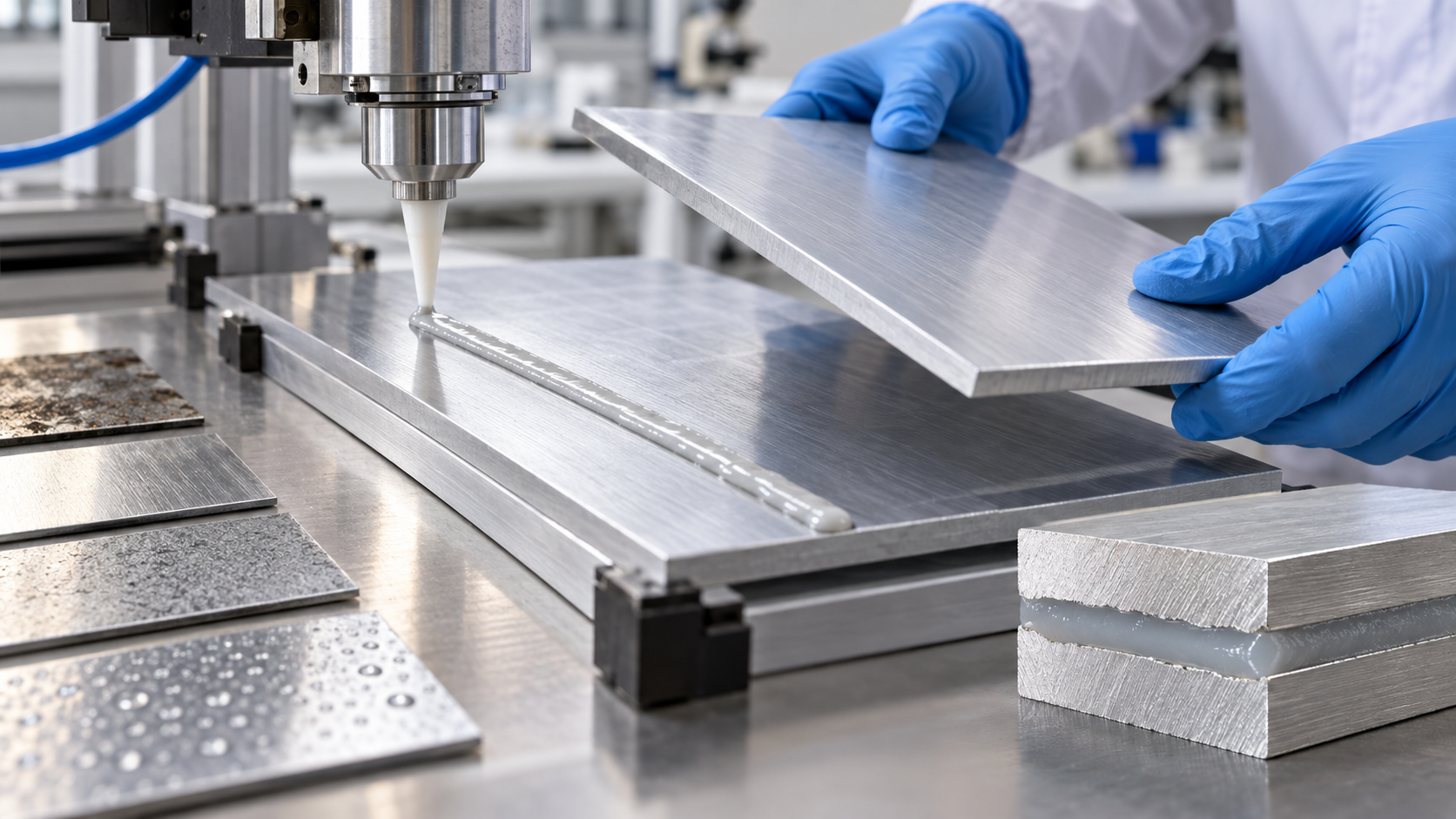
An adhesive spreads as a liquid between two surfaces, sets into a solid there, and transmits force. Choosing “the strongest adhesive” is not enough. Bonding works only when three things come together: the adhesive can wet the surface (the interface), it sets properly (the adhesive itself) and the joint is designed to let stress out (the design). This article sorts out the principles of adhesion, the types, compatibility with adherends, surface preparation, cure shrinkage and thermal stress, and joint design, using manufacturers' manuals, standards and peer-reviewed papers.
- What an adhesive is (the short version)
- The principles of adhesion — four mechanisms
- A materials engineer's view (1): wetting comes first, strength second
- Types — three families by how the adhesive sets
- A materials engineer's view (2): the “stiff” and the “soft” adhesive
- Reading the catalogue — pot life, fixture time, full cure
- Surface preparation and primers — what is decided before bonding
- Our calculation: internal stress from cure shrinkage and thermal mismatch
- Joint design — deciding how the load is carried
- A checklist for choosing
- Limits and what could not be confirmed / Glossary / References / Claim-to-source audit
Sourced = stated in published material (link given)
Our calculation = a figure this article derived, with the assumptions spelled out
Not yet confirmed = a plan or proposal with no confirmed record
Structural readings and materials-design interpretations are marked separately as Commentary.
Strength, temperature and other values are given with test method, conditions and source; values from manufacturers' material are labelled manufacturer's stated value (typical). The comparisons between adhesive types in Henkel's manual are that company's qualitative summary; they do not rank individual products or other companies' products. This article does not recommend or criticise any product or company.
1. What an adhesive is (the short version)
ASTM D907, the terminology standard for adhesives, defines an adhesive as a substance capable of holding materials together by surface attachment. Henkel's manual adds that the German standard DIN EN 923 defines an adhesive as a non-metallic binder that acts via adhesion and cohesionSourced. The Japanese terminology standard is JIS K 6800, “Glossary of terms used in adhesives and adhesion”Sourced.
- The two forces in the definition: “adhesion” is the force at the interface between adhesive and adherend; “cohesion” is the force inside the adhesive itself. If either is missing, the bond fails. How a joint breaks (at the interface or inside the adhesive) tells you which was short (see our explainer on adhesive strength testing)
- Three jobs: an adhesive has to (1) wet the adherend (spread and make contact), (2) set (turn from liquid to a solid that carries force) and (3) withstand stress (the shape, thickness and modulus suit the load) (our grouping)
- The adhesive that fits, not the strongest one: Henkel's manual states that an adhesive's properties (shear strength, fixture time, environmental resistance and so on) depend strongly on the adherends, surface preparation, the way it is applied and cured, and the joint geometry and resulting stress distributionSourced
An adhesive is not just a material: it is a combination of interface, process and shape. The same adhesive breaks at the interface if it does not wet, inside itself if it does not fully set, and from the edges if the shape is poor.
The chemistry of epoxies is covered in our explainer on epoxy resins, urethanes in our explainer on polyurethanes and elastomers, silicones in our explainer on silicones and pressure-sensitive adhesives in our explainer on adhesive tapes. This article looks across them from the viewpoint of how an adhesive is used.
2. The principles of adhesion — four mechanisms
Why do two faces stop coming apart just because a liquid was applied and hardened? Henkel's manual lists the theories relating to the adhesion phenomenon as mechanical interlocking, electrostatic adhesion, diffusion and wetting, and says surface-preparation methods capitalise on these theories to raise bond strengthSourced. The review of polymer adhesion by Awaja and co-workers (2009), on the other hand, treats the mechanisms as mechanical coupling, chemical bonding and thermodynamic adhesion (wetting)Sourced. We combine the two into four: mechanical interlocking, adsorption (wetting), chemical bonding and diffusion (our grouping).
| Mechanism | What happens (as the sources state) | How to bring it about (our commentary) |
|---|---|---|
| Mechanical interlocking | The liquid adhesive penetrates irregularities and pores in the adherend and sets, locking in like a hook. More roughness also means more surface area (Henkel) | Roughen by abrasion or blasting. Especially important for porous adherends |
| Adsorption (wetting) | Once adhesive and adherend are in contact, intermolecular forces (van der Waals forces) act. Henkel explains that a high-surface-energy adherend and a low-surface-tension adhesive wet well and give a strong bond | Cleaning; treatments that raise surface energy (plasma, corona, flame) |
| Chemical bonding | The review by Awaja et al. treats chemical bonding as one adhesion mechanism and discusses adhesion promoters (plasma and chemical treatments). Henkel lists primers and adhesion promoters as chemical means for difficult-to-bond surfaces | Primers, adhesion promoters, choosing a reactive adhesive |
| Diffusion | Henkel says diffusion theory applies to mobile long-chain polymers: molecules of adhesive and adherend move across the interface. The “healing” of a polymer interface by chain interdiffusion was treated theoretically by Prager and Tirrell (1981) | Like polymers with chains that can move, by heat or solvent (solvent bonding, hot melts) |
All Sourced (Henkel manual 2022 [Reference 1], Awaja et al. 2009 [Reference 6], Prager and Tirrell 1981 [Reference 7]). The right-hand column is our commentary.
3. A materials engineer's view (1): wetting comes first, strength second
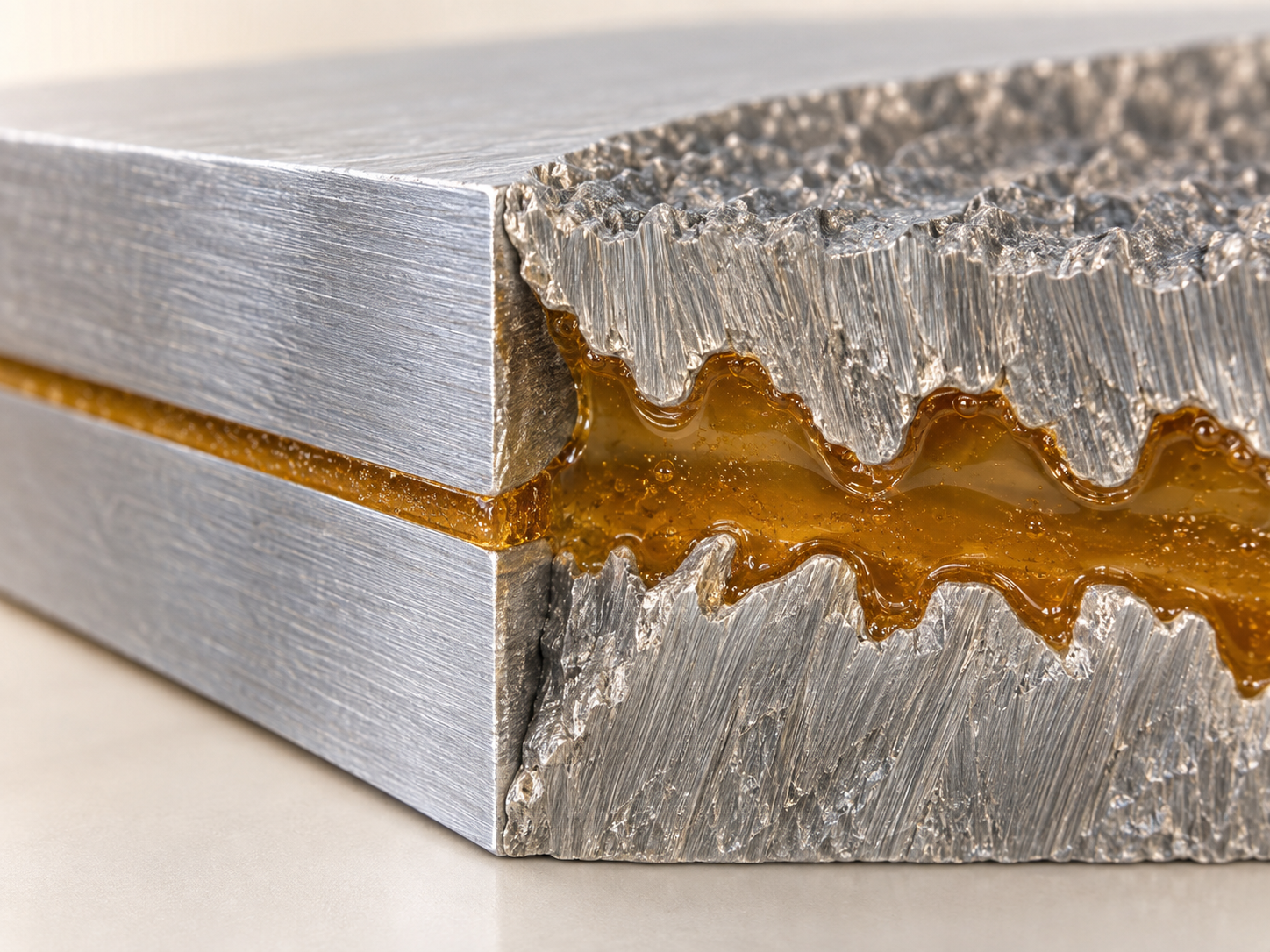
However strong an adhesive is, that strength is not used unless it spreads over the adherend and makes contact. Henkel's manual describes the conditions for wetting as followsSourced.
- Surface energy (mN/m) is the degree of attraction a solid surface exerts; surface tension is a liquid's resistance to surface penetration. In the ideal bonding condition, the adherend has high surface energy and the adhesive has low surface tension
- Wetting is judged by the contact angle. In the manual's figure, a contact angle above 90° means poor wetting and below 60° good wetting. A quick “ink test” with solutions calibrated to surface-tension ranges gives an approximation, but the exact value requires a contact-angle measurement
- The company's guide to bonding plastics (2008) says that wetting occurs when the surface tension of the liquid adhesive is lower than the critical surface tension of the substrate. Otherwise the liquid does not spread but forms a round droplet, like water on a newly waxed car
Metals have very high surface energy and almost any adhesive spreads on them. But a plastic and an adhesive are both polymers, with similar surface energies. Henkel's guide points out that bonding plastics is more complex than wetting clean metal, because the large difference between the critical surface tensions of substrate and adhesive that ensures wetting on metals is missingSourced. The review by Awaja et al. likewise says that most industrial polymer resins and composites have low surface free energy and few polar groups on the surface, hence inherently poor adhesionSourced.
So the “difficulty of bonding” PE, PP and PTFE is not that the adhesive is weak but that it does not wet. At the molecular level, a non-polar hydrocarbon face has nothing for a polar adhesive to attract to (our commentary). That is why the treatment is not about “making it stronger” but about “making it wettable” (Chapter 7). And even with enough surface energy, contamination covering the surface (mould release, oil) prevents wetting; mould release on moulded parts is a classic cause (our commentary).
4. Types — three families by how the adhesive sets
Adhesives can be divided by chemistry (epoxy, urethane...) or by use (structural, elastic, instant...). Henkel's manual sets out a grouping by how the liquid becomes a solid, in three familiesSourced.
The manual's arrangement, family by familySourced:
- Hardening by chemical reaction: six groups — two-part mixes, one-part with a catalyst or hardener, moisture-curing, radiation (light, UV, electron beam) curing, adhesives catalysed by the substrate (anaerobic) and solid forms (tape, film, powder). For example, epoxies were introduced commercially in 1946 and come as 2-part room-temperature cure, 1-part room-temperature cure, 1-part heat cure and 1-part light cure (cationic)
- Hardening by loss of solvent or water: contact adhesives, pressure-sensitive adhesives, reactivatable adhesives. Water-based adhesives bond once water evaporates or is absorbed by the substrate; normally there is no “cure” and drying is the hardening, which suits porous substrates. Solvent-based adhesives often contain flammable solvents, and emissions are subject to environmental regulation
- Hardening by cooling: hot melts are one-part, solvent-free thermoplastic adhesives, solid at room temperature, of low to medium viscosity (750 to 10,000 mPa·s, typically dispensed above 195 °C), and they build strength rapidly on cooling. Polyolefin and EVA types serve packaging and woodwork, polyamide types offer heat and chemical resistance, and reactive urethane (PUR) types set on cooling and then cure with moisture
From the comparison table in the manual (Table 21), we extract the manufacturer's qualitative summary for each type. These are not values for individual products but what this source describes as typical for the categorySourced.
| Type | Typical temperature range | Highest-rated product | Shear | Peel | Elongation / flexibility | Hardness |
|---|---|---|---|---|---|---|
| Elastomers (SMP etc.) | −54 to 93 °C | 93 °C | Medium | Medium | High | Soft |
| Urethanes | −54 to 121 °C | 149 °C | Medium | Medium | High | Soft |
| 2-part acrylics | −54 to 121 °C | 121 °C | High | Medium | Medium | Semi-rigid |
| Two-step (no-mix) acrylics | −54 to 149 °C | 204 °C | High | High | Medium | Semi-rigid |
| Hybrids (CA + epoxy etc.) | −40 to 100 °C | 150 °C | High | Medium | Low | Rigid |
| Cyanoacrylates | −54 to 99 °C | 121 °C | High | Low | Low | Rigid |
| Epoxies | −54 to 87 °C | 204 °C | High | Medium | Low | Rigid |
| Hot melts | −54 to 121 °C | 165 °C | Low | Medium | High | Semi-soft |
| Light cure | −54 to 149 °C | 180 °C | High | Medium | Medium | Semi-rigid |
| Silicones | −54 to 204 °C | 385 °C | Low | Medium | High | Soft |
All Sourced (Henkel manual 2022, Table 21 [Reference 1]; High/Medium/Low and the hardness terms are as in the table). For epoxies, for example, the table gives both a typical range up to 87 °C and a highest-rated product at 204 °C. The manual itself calls this a high-level overview and asks readers to check individual products in the technical data sheet (TDS).
Key points by type (from Henkel's manual)
- Cyanoacrylates (instant adhesives): one-part, solvent-free. Surface moisture neutralises a stabiliser and the adhesive cures to a rigid thermoplastic. Excellent in shear and tension, but poor in impact and peel, with limited gap cure and poor durability on glass. Rubber-toughened grades address impact and peel
- Two-step (no-mix) acrylics: resin and activator go on different faces and react when the parts are mated. No mixing, and practically unlimited open time. High peel and impact strength, but depth of cure is limited to about 1 mm
- 2-part MMA (structural acrylics): room-temperature cure with an adjustable profile — a long open time yet “snap cure” once assembled. Good impact resistance and low-temperature flexibility, and relatively tolerant of contaminated surfaces. On the other hand there are odour and flammability issues, and cold storage is required
- Epoxies: bond well to many substrates and can be modified widely. Room-temperature cure gives less shrinkage and internal stress, with more modest strength, heat and chemical resistance than heat cure. 1-part heat-cure types carry greater internal stress from higher shrinkage and thermal-expansion mismatch and are more brittle. 2-part room-temperature epoxies evolved over three generations, from brittle to flexible to toughened (see our explainer on epoxy resins)
- Urethanes: extremely tough, with good solvent resistance and high cohesive strength. A primer may be needed on some substrates, and high-temperature use is limited (see our explainer on polyurethanes and elastomers)
- Silicones: 1-part moisture-cure (RTV) types cure about 1–3 mm of depth a day and take 7–14 days to cure fully. 2-part addition-cure types give off no by-products and shrink by less than 0.1 %, but are prone to cure inhibition (see our explainer on silicones)
- Light cure: cures on demand and is easy to automate. But the light must reach the bondline, oxygen inhibits surface cure and shrinkage tends to be greater than with other technologies
5. A materials engineer's view (2): the “stiff” and the “soft” adhesive
Henkel's manual contrasts elastomeric adhesives, which often deform to several times their initial length before yielding, with a rigid epoxy's single-digit percent elongation before yieldSourced.
A stiff adhesive suits a design that carries the load in shear. In return for high strength and heat resistance it is weaker in peel and impact. A soft adhesive, according to the same manual, copes with peel and cleavage, non-uniform loading, flexure and thermal-expansion differences (thanks to low modulus and high elongation), and suits vibration damping, sound deadening and sealing. But it is less suited to structural joints that need rigidity and load-bearing, and using one structurally needs careful vettingSourced.
Plastic and rubber adherends, compared with metals, are more flexible, lower in modulus, higher in thermal expansion and anisotropic, so the stress in the bondline is less even. For that reason flexible adhesives are generally recommended over rigid ones, though flexible adhesives may limit the load capacity and the best compromise depends on the applicationSourced.
This is the same story as the difference we saw in our explainer on adhesive strength testing between tests that compare by “stress” and tests that compare by “energy”. Choosing an adhesive on the strength number alone overlooks toughness (the ability to arrest a crack) and modulus (how readily stress can be relieved) (our commentary).
6. Reading the catalogue — pot life, fixture time, full cure
In adhesive technical data sheets (TDS) the same word can mean different things. Henkel's manual defines the main terms as followsSourced.
| Term | Definition in the manual (summary) |
|---|---|
| Open time | The maximum time between mixing (2-part), activation or application (hot melt) and assembling the parts without compromising ultimate strength |
| Working time | The maximum time between applying the adhesive to a surface and mating the surfaces without compromising ultimate bond strength |
| Pot life | The time for the viscosity of a mixed 2-part system to double. It indicates how fast or slow the system cures, not necessarily how long the operator can work with it. Example: from 10,000 mPa·s to 20,000 mPa·s in 30 minutes gives 30 minutes |
| Fixture time | The time at which a bond develops handling strength. Standard method: a lap-shear joint of 25.4 mm × 101.6 mm substrates, 12.7 mm overlap, no induced gap, with a 3 kg mass applied, and the time to hold 0.1 N/mm² for 10 seconds |
| Handling strength | A relatively low bond strength that lets substrates be handled, moved or unclamped. Assembly-specific |
| Full cure time | The time needed to reach the final desired properties. It changes with cure temperature |
All Sourced (Henkel manual [Reference 1]; the wording is our summary). Henkel's LOCTITE 401 data sheet in its Japanese edition (December 2009) also defines fixture time as the time to reach a shear strength of 0.1 N/mm² (1 kgf/cm²) [Reference 12] (document in Japanese).
The 0.1 N/mm² of fixture time is about one three-hundredth of the final strength of 3M's epoxy seen in our explainer on adhesive strength testing (about 31 MPa on etched aluminium) (0.1 ÷ 31.0 = 0.0032)Our calculation. A label such as “fixed in 30 seconds” does not mean the load may be applied then. Henkel's LOCTITE 401 data sheet (February 2012 edition) asks that the adhesive be allowed to cure fully for 24 to 72 hours before the assembly is loadedSourced [Reference 10].
7. Surface preparation and primers — what is decided before bonding
ISO 17212 (structural adhesives — guidelines for the surface preparation of metals and plastics prior to adhesive bonding) gives the usual procedures for preparing component surfaces, for laboratory evaluation and for actual construction, on commonly encountered metals and plasticsSourced. ASTM D2651 lists mechanical and chemical preparations for aluminium alloys, stainless steel, carbon steel, titanium alloys, magnesium alloys and copper and copper alloysSourced. Henkel's manual divides surface preparation into cleaning, mechanical preparation (abrading and roughening), chemical preparation (primers and adhesion promoters) and surface modification of plastics (plasma, corona, flame)Sourced.
| Step | What to do (as the sources state) | The aim (our commentary) |
|---|---|---|
| 1. Cleaning | Sources of contamination: manufacturing (release agents, drawing lubricants), handling (oils), the environment (moisture, dust), machining (cutting fluids, corrosion inhibitors), oxide layers, plating residues and cleaning residues. Any barrier to surface contact reduces strength. Solvent cleaners are good on oils and moisture but can attack plastics; aqueous cleaners handle organic and inorganic soils but beware residues and flash rust | Remove the “weak boundary layer” that blocks wetting |
| 2. Abrading, roughening | As a rule of thumb, 120 to 180 grit sandpaper for metals (Henkel's manual). Clean before and after abrading with solvent or aqueous cleaner (so as not to drive oil in and to remove dust). Avoid aqueous cleaning on freshly abraded metal because of flash rust | Increase area and roughness (mechanical interlocking) and remove oxide |
| 3. Surface modification (plastics) | Plasma, corona and flame raise surface energy. Flame treatment introduces functional groups to an oxidation depth of about 4 to 9 nm with exposure of only a few seconds (Henkel's guide). Corona roughens the surface and introduces reactive sites | Make low-surface-energy polyolefins and the like wettable |
| 4. Chemical preparation | A primer acts as a chemical bridge between substrate and adhesive (reactive groups for the substrate and groups with affinity for the adhesive). Uses given: acetals, fluoropolymers, polyolefins, polyurethanes, silicones. Henkel's LOCTITE 401 data sheet likewise asks for LOCTITE 770 or 7239 primer on low-surface-tension plastics | Give a footing for adhesion on surfaces with little reactivity or affinity |
| 5. Bond immediately | Cleaned parts should be bonded at once or kept protected from recontamination; metals prone to oxidation should be bonded or treated with a rust preventative. 3M's data sheet too asks for bonding or priming as soon as possible after preparation | An active surface degrades and is contaminated with time |
All Sourced (Henkel manual 2022 [Reference 1], Henkel guide to bonding plastics 2008 [Reference 3], ISO 17212 [Reference 4], ASTM D2651 [Reference 5], LOCTITE 401 data sheet [Reference 10], 3M DP460NS data sheet [Reference 8]). The right-hand column is our commentary.
How much surface preparation matters appears in the data sheets and guidesSourced.
- 3M's 2-part epoxy DP460NS: lap-shear strength on aluminium is about 31.0 MPa with FPL etch, about 18.4 MPa with solvent wipe + abrasion and about 15.9 MPa with alkaline degreasing only (manufacturer's stated value, ASTM D1002, 7-day cure; MPa is our conversion; see our explainer on adhesive strength testing)
- Henkel's guide to bonding plastics: on PTFE, “adhesive abrading” — abrading the surface in the presence of liquid adhesive — increases bond strength by approximately 700 percent (the guide's wording). It is speculated that free radicals formed during abrasion react directly with the adhesive (same guide)
Preparation is not just “making the surface clean”. If you think of three separate jobs — removing contamination, raising wettability and creating a reactive footing — you can see which one is missing (our grouping). Chemical treatments such as chromic acid etching and sodium treatment can be very effective, but the same guide says the sodium-treatment etchants are highly hazardous and degrade very rapidly in oxygen. The safety and regulation of chemical treatments need separate checking.
8. Our calculation: internal stress from cure shrinkage and thermal mismatch
A bonded joint carries stress before any load is applied. From Henkel's manual the causes can be sorted into threeSourced.
- Cure shrinkage: in thick bondlines, shrinkage and the exotherm of cure increase internal stress (rigid adhesives are designed to cure in thin sections). 1-part heat-cure epoxies shrink more than room-temperature cure ones. Light cure tends to shrink more than other technologies. 2-part addition-cure silicones give off no by-products and shrink by less than 0.1 %
- Thermal-expansion mismatch: when two joined members expand at different rates, a temperature change makes one expand more than the other, and when this is restrained it becomes thermal stress. Excess stress at each thermal cycle drives further separation. For wide temperature ranges, the closer the thermal-expansion coefficients of adhesive and substrate, the better, and the modulus at service temperatures matters
- Modulus rising at low temperature: an adhesive becomes stiff and brittle at low temperature and can no longer relieve concentrated stress
For a temperature change ΔT, the difference in length if adhesive and adherend could expand freely is estimated as the coefficient difference Δα × ΔT × length LOur calculation.
- Adhesive side: coefficient of thermal expansion of 3M DP460NS below its glass transition (Tg), 74.44×10⁻⁶ /°C (manufacturer's stated value)Sourced
- Adherend side (example): Kyocera's alumina “A440”, 7.1 ppm/K (room temperature to 400 °C, typical value)Sourced. The value used in our explainer on the coefficient of thermal expansion
- Δα = 74.44 − 7.1 = about 67.3 ppm/°C
- For ΔT = 50 °C and L = 10 mm, the strain difference = 67.3×10⁻⁶ × 50 = about 0.34 % and the length difference = 10 mm × 0.0034 = about 34 µm
Assumptions and limits: the Tg of DP460NS could not be confirmed from the data sheet, so we assume this ΔT range lies below Tg (above Tg the coefficient rises to 166×10⁻⁶ /°C). A real joint is constrained, so rather than a “34 µm slip” this becomes strain and stress in the bondline. What matters is whether the bondline can absorb this 0.34 %. A stiff, thin layer relieves strain poorly (a soft adhesive or a thicker layer relieves it more readily). The larger the difference in the expansion of the two members, the more reason to consider the “soft adhesive” of Chapter 5.
For the bondline thickness (gap) of rigid adhesives, Henkel's manual says as thin as possible without risk of insufficient coverage, recommends 0.02 to 0.20 mm (0.001 to 0.008 in), noting that data show strengths do not vary significantly within this range, and gives about 0.1 mm as optimalSourced. A thicker line risks voids, larger stress at the corners and makes it hard to keep axial loads aligned. Too thin and coverage is insufficient.
The same manual also points out that if the gap is not uniform, the axial load does not stay aligned and cleavage stress acts on the adhesiveSourced. Uniformity is obtained with fixtures, a defined clamp load and shims (spacers) in the bondline. Bondline thickness is therefore a matter not only of the amount applied but of how the parts are designed to be parallel (our commentary).
9. Joint design — deciding how the load is carried
Henkel's manual defines the ideal bonded joint as one in which, under all practical loading conditions, the adhesive is stressed in the direction in which it most resists failure, and says that the stress distribution along an adhesive bondline is more uniform than for bolting or welding, which favours fatigue and impactSourced. It also sorts the loads, and states that peel and cleavage are the most common causes of failure, so avoiding them is essential.
| Design principle | What the manual says |
|---|---|
| Carry the load in shear or compression | Stress the adhesive in the direction in which it most resists failure. Lap joints are strongest when forces are applied parallel to the substrates; butt joints fail through bending or impact perpendicular to the plane |
| Avoid peel and cleavage | At right angles, peel forces can arise in unexpected places. Peel and cleavage are the most common forces leading to failure. Start the design from the types of load |
| Increase the bond area | A butt joint between cylindrical parts is very sensitive to bending (peel/buckling) and should be avoided; use a geometry with a larger bonded surface |
| Thin adherends: straps and flexible adhesive | The thinner the substrate, the more prone to peel. Straps should be of the same or similar material with equivalent strength, flexibility and thickness. The adhesive should be as flexible as the substrates or more so |
| Keep the bondline uniform | If the gap is not uniform, the axial load does not stay aligned and becomes cleavage stress. Use clamp load, dedicated fixtures and shims |
| Some designs do not rely on bonding alone | In automobiles, “hybrid connections” combine adhesives with rivets or spot welds, giving immediate handling strength and higher strength in a crash |
| Specimen numbers are a starting point | Data-sheet values are only an entry for choosing candidates. Test with real parts, processes and service conditions. A standard specimen differs from a real joint in geometry and stress distribution |
All Sourced (summary of Henkel's manual 2022 [Reference 1]). For the limits of standard tests, see our explainer on adhesive strength testing.
10. A checklist for choosing
Here are the points of this article reorganised as things to check when choosing an adhesive (this article's proposal, not a requirement of any standard). Henkel's manual too says a TDS is enough to shortlist candidates, but that tests under real conditions are essential before decidingSourced.
| Point | What to check | Chapter |
|---|---|---|
| Adherend | Material, surface energy, contamination (mould release and so on), thermal expansion and modulus. Does the plastic need a primer or surface modification? | Chapters 3 and 7 |
| Type of load | Shear, tension, peel, cleavage, impact, fatigue, creep. Static or dynamic | Chapters 5 and 9 |
| Service temperature and environment | Temperature range (Tg), thermal cycling, moisture, chemicals, ultraviolet | Chapter 8 |
| Gap and thickness | Bondline thickness, parallelism, any need to fill a gap | Chapter 8 |
| Cure method and process | Two-part mixing, heat, moisture, light (can the light reach?), anaerobic (metal, air excluded). Fixture time, working time, time to full cure | Chapters 4 and 6 |
| Storage and handling | Storage temperature (some 1-part epoxies need refrigeration), shelf life, 2-part mix ratio and static mixers | Chapter 4 |
| Safety and regulation | Safety data sheet (SDS), solvent flammability and VOC rules, odour, operator protection and training | Chapter 4 |
| Verification | Tests with real parts, processes and service conditions; checking the failure mode; ageing tests | Chapter 9 |
The grounds are the Sourced facts in the chapters of this article. The arrangement of the points is this article's proposal (commentary). Henkel's manual states that the SDS contains hazard identification, handling and storage recommendations and exposure controls, and that manufacturers are required to provide accurate labelling.
11. Limits and what could not be confirmed
(1) No official classification of adhesives could be confirmed
Classifications of adhesives differ between sources. This article uses the grouping in Henkel's manual (how the adhesive sets); an official classification by the Japan Adhesive Industry Association or the Adhesion Society of Japan could not be confirmed in our research.
(2) No like-for-like source on strength by type was found
The comparison table in Chapter 4 is Henkel's qualitative summary. No primary source measuring epoxy, acrylic, urethane, silicone and others on the same adherend with the same test method could be confirmed, so this article does not put a numerical ranking on strength between types.
(3) Cure shrinkage figures could not be confirmed for most types
A number could be confirmed only for 2-part addition-cure silicone (below 0.1 %). For epoxy, acrylic and light-cure types the shrinkage is described only qualitatively (large or small), and no figure is given.
(4) The role of chemical bonding varies by system
The abstract of the review by Awaja et al. says that disputed aspects of adhesion theory remain. This article does not assert in which systems, or how much, chemical bonding actually acts.
(5) Chemical regulation is not covered
Regulation of isocyanates, dichromates and VOCs, and the recyclability and dismantling of adhesives, are not covered here. For epoxy reuse see our explainer on epoxy resins, and for isocyanate safety our explainer on polyurethanes and elastomers.
- An adhesive has three jobs. Wet (interface), set (the adhesive itself), and withstand stress (design)Sourced (our arrangement of Henkel's manual)
- Adhesion can be sorted into four mechanisms. Mechanical interlocking, adsorption (wetting), chemical bonding and diffusion. In practice several act at once
- The difficulty of bonding plastics is a difficulty of wetting. PE and PP have low critical surface tensions (31 and 29 dyne/cm), and treatments — plasma, corona, flame, primer — are needed to make them wettableSourced
- The types fall into three families by how they set. Chemical reaction, loss of solvent or water, and cooling from the meltSourced
- Stiff and soft adhesives trade strength against stress relief. Flexible adhesives are generally recommended for plasticsSourced
- The bondline has a suitable thickness. 0.02 to 0.20 mm for rigid adhesives, about 0.1 mm optimal. The strain from thermal mismatch is about 0.34 % in the alumina example (ΔT = 50 °C)Our calculation
- Design carries the load in shear and compression and avoids peel and cleavage. A standard specimen's number is only a starting pointSourced
12. Glossary
- Adhesive
- A substance capable of holding materials together by surface attachment (the ASTM D907 definition).
- Adherend
- The material being bonded.
- Adhesion and cohesion
- Adhesion is the force at the interface between adhesive and adherend; cohesion is the force inside the adhesive.
- Wetting
- A liquid spreading over a solid surface. The smaller the contact angle, the better it wets.
- Surface energy
- The degree to which a solid surface attracts a liquid (mN/m). A low value means poor wetting.
- Critical surface tension
- The boundary value below which a liquid wets a solid (dyne/cm).
- Primer
- An undercoat that acts as a chemical bridge between substrate and adhesive.
- 1-part and 2-part (1C and 2C)
- 1-part needs no mixing; 2-part is mixed from resin and hardener (activator).
- Pot life
- The time for the viscosity of a mixed 2-part system to double.
- Fixture time
- The time to reach handling strength (0.1 N/mm²). Not the final strength.
- Hot melt
- A one-part, solvent-free thermoplastic adhesive melted for application and set by cooling.
- Bondline
- The cured adhesive layer between the adherends.
13. References
- Henkel How to Create Reliable and Effective Bonded Joints (Adhesive Technologies Expert Bonding Collection), 2022 (PDF, 232 pages) — dm.henkel-dam.com
- ASTM International ASTM D907-15(2023) Standard Terminology of Adhesives — store.astm.org
- Henkel The Loctite Design Guide for Bonding Plastics, Volume 5, 2008 (PDF, 100 pages) — dm.henkel-dam.com
- ISO ISO 17212:2012 Structural adhesives — Guidelines for the surface preparation of metals and plastics prior to adhesive bonding — iso.org
- ASTM International ASTM D2651-01(2024) Standard Guide for Preparation of Metal Surfaces for Adhesive Bonding — store.astm.org
- Awaja, F.; Gilbert, M.; Kelly, G.; Fox, B.; Pigram, P.J. Adhesion of polymers. Progress in Polymer Science 34(9), 948–968 (2009). DOI 10.1016/j.progpolymsci.2009.04.007 (abstract checked on a university research-information page) — doi.org
- Prager, S.; Tirrell, M. The healing process at polymer–polymer interfaces. The Journal of Chemical Physics 75(10), 5194–5198 (1981). DOI 10.1063/1.441871 — doi.org
- 3M 3M Scotch-Weld Epoxy Adhesive DP460NS, Technical Data Sheet, English-US, last revision September 2024 — multimedia.3m.com
- 3M Scotch-Weld Epoxy Adhesive DP460 Off-White and DP460NS, technical bulletin (in Portuguese), April 2020 — multimedia.3m.com
- Henkel LOCTITE 401 Technical Data Sheet (Slovak-language edition), February 2012 — datasheets.tdx.henkel.com
- Kyocera Ceramic packages: search by material properties (in Japanese) — kyocera.co.jp
- Henkel LOCTITE 401 Technical Data Sheet (Japanese edition), December 2009 — datasheets.tdx.henkel.com
- Japanese Standards Association (JSA) JIS K 6800:1985 Glossary of terms used in adhesives and adhesion (in Japanese) — webdesk.jsa.or.jp
14. Claim-to-source audit
| Claim in the text | Basis | Label |
|---|---|---|
| The definitions of an adhesive (ASTM D907: a substance capable of holding materials together by surface attachment; DIN EN 923: a non-metallic binder acting via adhesion and cohesion). That an adhesive's properties depend strongly on adherends, surface preparation, application and cure, and joint geometry and stress distribution. That a Japanese terminology standard, JIS K 6800, exists | Henkel manual (6.1, opening of Section 4)[Reference 1] https://dm.henkel-dam.com/is/content/henkel/ACM-Bonding-Manual_Creating-Reliable-and-Effective-Bonded-Joints--07-08-2022 and [References 2, 13] | Sourced |
| That adhesion theories include mechanical interlocking, electrostatic, diffusion and wetting, and that surface preparation uses them. Mechanical interlocking: penetration into irregularities and pores. Diffusion: applies to mobile long-chain polymers. Wetting: a high-surface-energy adherend and a low-surface-tension adhesive wet well. Contact angle above 90° poor, below 60° good. The ink test and dyne pens | Henkel manual (4.1)[Reference 1] https://dm.henkel-dam.com/is/content/henkel/ACM-Bonding-Manual_Creating-Reliable-and-Effective-Bonded-Joints--07-08-2022 | Sourced |
| The review by Awaja et al.: adhesion mechanisms treated as mechanical coupling, chemical bonding and thermodynamic adhesion, with plasma and chemical adhesion promoters discussed; most industrial polymer resins and composites have low surface free energy and few polar groups; disputed aspects of adhesion theory remain. Prager and Tirrell: the healing process at polymer–polymer interfaces (1981) | Abstract of Awaja et al. (2009)[Reference 6] https://doi.org/10.1016/j.progpolymsci.2009.04.007 and the title of Prager and Tirrell[Reference 7] https://doi.org/10.1063/1.441871 | Sourced |
| The surface energies in Fig. 3 (PTFE 18, silicone 24, natural rubber 24, PP 29, PE 31, PS 33, PC 35, PVC 40, PET 43, polyamide 6.6 46, epoxy resin 47, polyamide 49, polyimide 50, water 73 mN/m; metals 1,000–2,500). That wetting occurs when the adhesive's surface tension is below the substrate's critical surface tension. That PE and PP have critical surface tensions of 31 and 29 dyne/cm and pose serious wetting challenges. That plastic and adhesive have similar surface energies | Henkel manual (Table 8) and guide to bonding plastics[Reference 3] https://dm.henkel-dam.com/is/content/henkel/Design-Guide-Bonding-Plastics and [Reference 1] | Sourced |
| The arrangement of surface preparation (cleaning, mechanical, chemical, plasma/corona/flame). Sources of contamination, characteristics of solvent and aqueous cleaners, 120–180 grit, cleaning before and after abrading, aqueous cleaning and flash rust. Flame-treatment oxidation depth of 4–9 nm, corona treatment, primers, adhesive abrading raising PTFE strength by about 700 percent, the hazard of sodium-treatment solutions | Henkel manual (4.3) and guide to bonding plastics (surface treatments, adhesive joint design)[Reference 3] https://dm.henkel-dam.com/is/content/henkel/Design-Guide-Bonding-Plastics and [Reference 1] | Sourced |
| That ISO 17212:2012 is a guideline for surface preparation of metals and plastics before bonding and is current (confirmed 2022). That ASTM D2651 lists mechanical and chemical preparations for several metals | ISO and ASTM official pages[Reference 4] https://www.iso.org/standard/50596.html and [Reference 5] | Sourced |
| The three-family arrangement of adhesives (chemical reaction; loss of solvent or water; cooling) and examples. The commercial introduction of epoxies (1946) and their cure options; characteristics of each type (CA, two-step acrylics, MMA, epoxy, urethane, silicone, light cure, water-based, solvent-based, hot melt). Hot-melt viscosity range, strength of 1.5–3.5 N/mm², EVA and PO (about 70 °C), PA (160 °C), the two-stage cure of PUR | Henkel manual (1.1.13, Section 6)[Reference 1] https://dm.henkel-dam.com/is/content/henkel/ACM-Bonding-Manual_Creating-Reliable-and-Effective-Bonded-Joints--07-08-2022 | Sourced |
| The typical temperature range, highest-rated product and qualitative ratings of shear, peel, elongation and hardness for each type (Table 21). That the source calls it a high-level overview and asks readers to check individual values in the TDS | Henkel manual (5.2.3, Table 21)[Reference 1] https://dm.henkel-dam.com/is/content/henkel/ACM-Bonding-Manual_Creating-Reliable-and-Effective-Bonded-Joints--07-08-2022 | Sourced |
| That elastomeric adhesives deform to several times their length before yield while rigid epoxies show single-digit percent elongation; that soft adhesives are unsuited to structural joints; the characteristics of plastic and rubber adherends and the recommendation of soft adhesives with its constraint | Henkel manual (1.1.13.2.4, 5.1.6)[Reference 1] https://dm.henkel-dam.com/is/content/henkel/ACM-Bonding-Manual_Creating-Reliable-and-Effective-Bonded-Joints--07-08-2022 | Sourced |
| Definitions of pot life and fixture time (3 kg, 0.1 N/mm², 10 s, 25.4 × 101.6 mm, 12.7 mm overlap) and the other terms. That the Japanese LOCTITE 401 data sheet defines fixture time at 0.1 N/mm² (1 kgf/cm²) and the Slovak edition asks for 24–72 h of cure | Henkel manual (6.1.1)[Reference 1] https://dm.henkel-dam.com/is/content/henkel/ACM-Bonding-Manual_Creating-Reliable-and-Effective-Bonded-Joints--07-08-2022 and LOCTITE 401 data sheets[Reference 10] https://datasheets.tdx.henkel.com/LOCTITE-401-sk_SK.pdf and [Reference 12] https://datasheets.tdx.henkel.com/LOCTITE-401-ja_JP.pdf | Sourced |
| 3M DP460NS: lap-shear strength on aluminium (FPL etch 316, MEK/abrade/MEK 188, Oakite degrease 162 kgf/cm²); coefficient of thermal expansion (74.44×10⁻⁶ /°C below Tg, 166×10⁻⁶ /°C above); the note asking to bond or prime soon after preparation | 3M data sheets (English, September 2024; Portuguese, April 2020)[Reference 8] https://multimedia.3m.com/mws/media/2365896O and [Reference 9] https://multimedia.3m.com/mws/media/1857254O/product-data-sheet-structural-adhesives-dp460ns-460-off-white.pdf | Sourced |
| Kyocera's alumina “A440” coefficient of thermal expansion of 7.1 ppm/K (room temperature to 400 °C, typical value) | Kyocera material-properties table[Reference 11] https://www.kyocera.co.jp/prdct/semicon/material/ | Sourced |
| Statements on cure shrinkage and thermal mismatch (internal stress in thick layers, higher shrinkage in 1-part heat-cure epoxy, greater shrinkage in light cure, below 0.1 % for addition-cure silicone, closer expansion coefficients are better, modulus rises at low temperature). Rigid-adhesive bondline of 0.02–0.20 mm, about 0.1 mm optimal, a non-uniform gap giving cleavage stress | Henkel manual (4.5.2, 5.2.2, 6.4.2, 6.3.7)[Reference 1] https://dm.henkel-dam.com/is/content/henkel/ACM-Bonding-Manual_Creating-Reliable-and-Effective-Bonded-Joints--07-08-2022 | Sourced |
| Joint shapes and design principles (the ideal joint, butt, lap, joggle, scarf, strap and tapered joints, avoiding peel and cleavage, thin adherends, bondline uniformity, hybrid connections, the TDS as a starting point) | Henkel manual (Section 5, 4.4, 5.2.2)[Reference 1] https://dm.henkel-dam.com/is/content/henkel/ACM-Bonding-Manual_Creating-Reliable-and-Effective-Bonded-Joints--07-08-2022 | Sourced |
| That the 0.1 N/mm² of fixture time is about 0.3 % of the final strength (31.0 MPa). The strain from thermal mismatch (Δα = 74.44 − 7.1 = about 67.3 ppm/°C; about 0.34 % for ΔT = 50 °C; about 34 µm over 10 mm). The MPa conversions | Our calculation. Values from References 1, 8, 9 and 11, converted with 1 kgf/cm² = 0.0980665 MPa; ΔT and length are assumptions of this article (Tg could not be confirmed, so below-Tg is assumed) | Our calculation |
| The arrangement into four mechanisms; the “how to bring it about” column; the “wetting first” reading; the splitting of preparation into three jobs; the colours of Fig. 3; the checklist; linking soft adhesives to stress | This article's organisation and commentary based on the published material. Not views expressed by any organisation or company | Commentary |
| An official classification by the Japan Adhesive Industry Association or similar. Like-for-like strength comparisons between types. Shrinkage of epoxy, acrylic and light-cure types. The extent of chemical bonding. The Tg of DP460NS | Not confirmed within the primary sources accessible to this article, so not stated | Commentary |
| That Figs. 1, 3, 4 and 5 are explanatory drawings, not real cross-sections or measurements, and that the hero image and Fig. 2 are AI-generated images | Our note | Commentary |
Last updated 3 October 2026. Sources are limited to primary material (Henkel's manual and guide to bonding plastics, official pages of ISO, ASTM and the Japanese Standards Association, data sheets from 3M and Henkel, and abstracts of peer-reviewed papers). Manufacturers' values are manufacturer's stated values (typical), not specified values. The comparison between types in Henkel's manual is that company's qualitative summary and not values for other companies' products or individual grades. Because the article includes structural readings and materials-design interpretations, those are marked as Commentary and kept separate from sourced fact. An official classification of adhesives by the Japan Adhesive Industry Association or similar, like-for-like strength comparisons between types, cure shrinkage of epoxy, acrylic and light-cure types, the extent of the contribution of chemical bonding, and the Tg of 3M DP460NS could not be confirmed from published primary sources and are not stated here. Figs. 1, 3, 4 and 5 are vector drawings; the hero image and Fig. 2 are AI-generated images, and none of them shows a real cross-section, micrograph, physical product or measurement result.