TECHNOLOGY EXPLAINER
Bio-Based Adhesives and Encapsulants
— what does a “bio-based content” figure actually count?
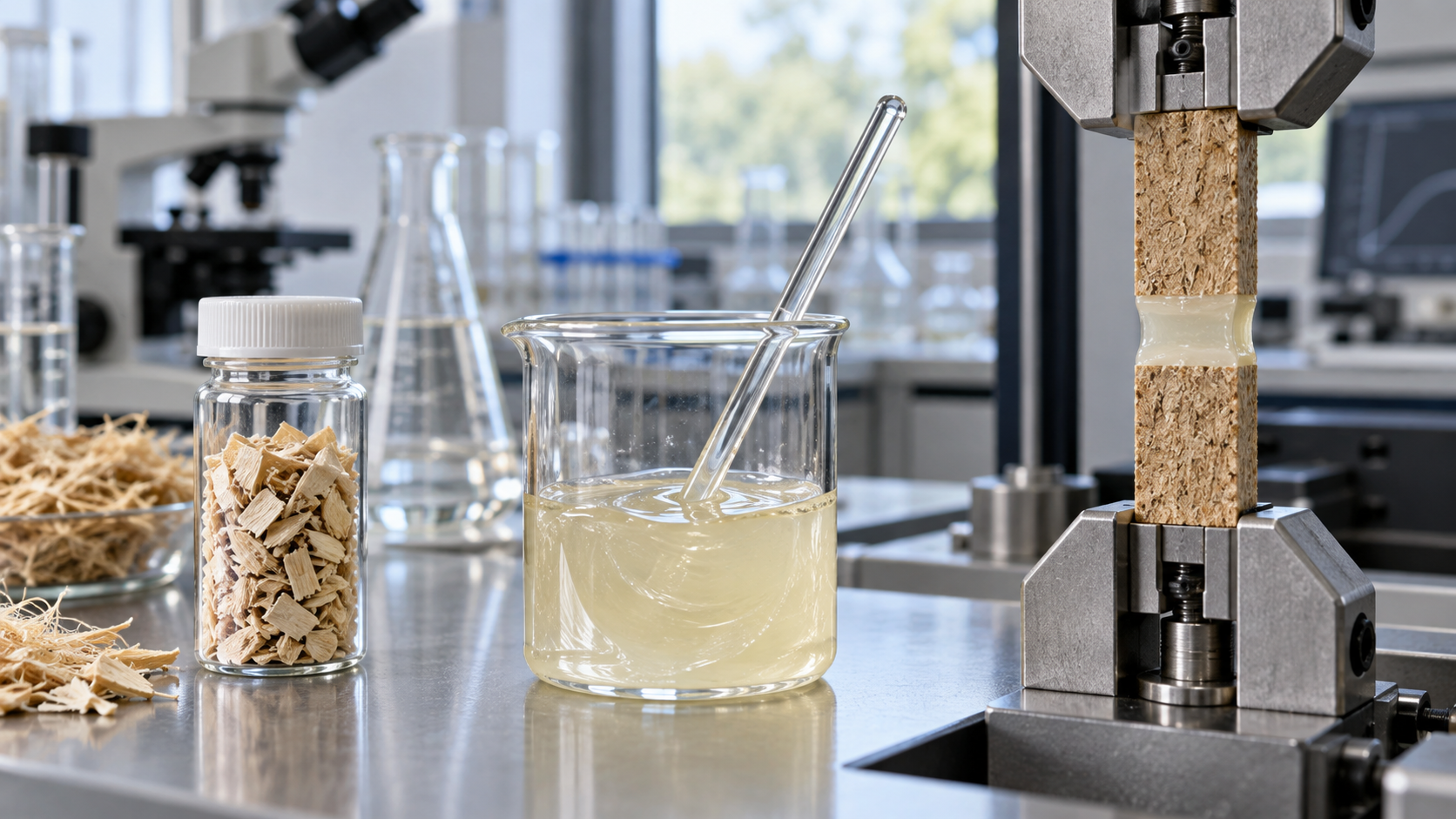
Adhesives and encapsulants made from plant and other biomass — vegetable oils, starch, lignin, proteins — face challenges of water resistance, reactivity and cost, and have so far reached practical use first in wood adhesives. Meanwhile the figure “X% bio-based” mixes three counts of quite different character: the share of carbon measured by radiocarbon (14C), the share by mass, and an accounting allocation under the mass balance approach. Drawing on official material from standards bodies, a certification scheme, companies and peer-reviewed papers, this article sets out what each figure counts and how far practical use can be confirmed.
- What bio-based adhesives and encapsulants are (the short version)
- A map of raw materials — what becomes which adhesive
- Three ways to count “bio-based content”, and the measurement standards
- Our calculation: one molecule can be “28.6%” or “33.5%”
- Mass balance — allocation by accounting
- A materials engineer's view (1): “drop-in” and “new material” types face quite different problems
- Performance and challenges — water resistance, reactivity, cost
- Examples in practical use (confirmed from official material)
- A materials engineer's view (2): three things to check on seeing a figure
- Open issues, and what this article could not confirm
- Glossary / References / Claim-to-source audit
Sourced = content stated in published material, by a standards body or certification scheme, or in a peer-reviewed paper (link given)
Our calculation = a value this article derived from stated assumptions (including hypothetical numbers)
Not yet confirmed = a plan or outlook with no confirmed track record
Structural readings and materials-design interpretations are marked separately as Commentary.
Performance values for products differ in grade and test conditions and are not lined up to rank one against another.
Company names show where a source comes from; they are not a ranking of companies.
Being bio-based says nothing about whether other materials are better or worse.
1. What bio-based adhesives and encapsulants are (the short version)
- Some or all of the raw material comes from biomass such as plants. “Bio-based” and “biodegradable” are different properties (see our explainer on bioplastics).
- The challenges are water resistance, reactivity and cost. A review says the top priority of research on bio-based adhesives is to improve adhesion and water resistance Sourced [Reference 13].
- There are three ways to count “bio-based content”. Figures that can be checked by analysis are mixed with allocations made by accounting, so what a figure means must be checked first (Chapters 3 to 5).
Bio-based adhesives are nothing new. A review says they have been used for millennia but have long had problems with stability in humid and wet environments Sourced [Reference 13]. Protein-based adhesives were also used for a long time but were replaced by synthetic adhesives at the beginning of the 20th century, mainly because of better moisture resistance Sourced [Reference 14]. Interest has returned because of regulation of formaldehyde and the wish to reduce dependence on petroleum-based polymers Sourced [References 13, 14]. There is also a review that discusses advantages other than renewability (Heinrich, Green Chemistry 2019; we confirmed only the bibliographic details and abstract, not the full text) [Reference 19].
This article covers adhesives, and materials for encapsulation and potting. Within what we checked, however, we could not confirm any bio-based encapsulant from official material (Chapter 8). The centre of the article is therefore wood adhesives, where practical use leads, and how bio-based content is counted. The basics of the measurement standards (ASTM D6866 and ISO 16620-1) are in our explainer on bioplastics; this article goes further from the viewpoint of adhesives and encapsulants. For bio-derived silicones see our silicones explainer, for epoxy our epoxy resins explainer, and for the basics of adhesives our adhesives explainer.
2. A map of raw materials — what becomes which adhesive
The biomass raw materials for adhesives fall broadly into proteins, starch, lignin, tannins and vegetable oils. There is also a route in which biomass-derived naphtha or methane is used to make the same chemicals as before (phenol, methanol and so on). We set out what could be confirmed from official material, raw material by raw material.
| Raw material | What the sources state | Source |
|---|---|---|
| Proteins (soy and others) | About 80% of wood-based products use adhesives. Protein-based adhesives were used for a long time but were replaced by synthetic ones at the beginning of the 20th century, mainly for better moisture resistance. Interest has returned because of lower toxicity, renewable sourcing and a smaller environmental footprint. Columbia Forest Products publishes a formaldehyde-free hardwood plywood process (PureBond) that uses soy | [14] [12] |
| Starch | Of interest as a raw material for petroleum-free adhesives, especially for paper and wood surfaces. But because its hydroxyl groups hydrogen-bond with water, native starch is hard to make into a waterproof adhesive. Modifications such as introducing hydrophobic groups (esters), oxidation and crosslinking have been reported | [15] |
| Lignin | The paper industry produces over 50 million tons a year as a by-product, but about 95% is burned to recover chemicals and supply energy. The recalcitrant, heterogeneous and complicated structure makes it hard to use, and very few lignin-derived wood products are commercially available. MGC Wood Chem says wood contains 20 to 30%, that lignin is less reactive than phenol, and that resins with part of the phenol replaced exist that work under current plywood manufacturing conditions, but the replacement is still partial | [17] [11] |
| Tannins | A review highlights tannins, lignin and proteins as raw materials for formaldehyde-free bio-based wood adhesives. But their lower reactivity than some petrochemical raw materials leads to higher production costs, resource availability issues and a need for toxicological checks | [13] |
| Vegetable oils | Triglycerides of soybean, castor and linseed oil and others are chemically modified into polyurethane adhesives. Polyol synthesis routes studied include epoxidation with ring-opening, hydroformylation, thiol-ene reaction, ozonolysis and transesterification. The use of non-renewable isocyanates in bio-based polyurethane adhesives is named as a current limitation, and bio-based isocyanates are shown as a research challenge for raising the renewable share | [16] |
| Biomass naphtha, biomethane | Mitsui Chemicals said it would feed biomass naphtha to its naphtha cracker and start selling chemicals (phenol, acetone, ethylene oxide and others) allocated by the mass balance approach (2021). MGC Wood Chem describes making plywood phenolic adhesive from that biomass phenol and from biomass methanol made from biomethane | [10] [11] |
All Sourced (statements by companies, authors and peer-reviewed papers; company initiatives are the companies' own statements, and their scale and volume could not be confirmed).
3. Three ways to count “bio-based content”, and the measurement standards
Even when something says “X% bio-based”, what was counted differs with the standard or scheme. From the official pages we could check, there are three counts.
| Standard | What the official page states | Edition and status |
|---|---|---|
| ISO 16620-1 Part 1: General principles | General principles and calculation methods for determining the biobased content of plastic products, based on the carbon mass or the mass of each constituent | April 2015, 11 pages, confirmed 2025 (current) [1] |
| ISO 16620-2 Part 2: Determination of biobased carbon content | A calculation method for the biobased carbon content of monomers, polymers and plastic materials, based on 14C measurement | October 2019, 24 pages, confirmed 2024. A revision is in preparation (ISO/AWI 16620-2) [2] |
| ISO 16620-3 Part 3: Determination of biobased synthetic polymer content | A calculation method for the biobased synthetic polymer content, based on its mass | April 2015, 7 pages, confirmed 2025 (current) [3] |
| ISO 16620-4 Part 4: Determination of biobased mass content | Determines the biobased mass content of plastic products from radiocarbon analysis and elemental analysis. The condition is that the product contains carbon and that its elemental composition and biobased carbon content are stated | Second edition, February 2024, 14 pages [4] |
| ISO 16620-5 Part 5: Declaration of biobased carbon content, biobased synthetic polymer content and biobased mass content | Requirements for the declaration and labels of those contents | January 2017, 7 pages. A revision is in preparation (ISO/AWI 16620-5) [5] |
| ASTM D6866 Standard Test Methods for Determining the Biobased Content of Solid, Liquid, and Gaseous Samples Using Radiocarbon Analysis | Test methods that find the biobased content of solid, liquid and gaseous samples by radiocarbon analysis. For materials whose carbon was in equilibrium with atmospheric CO2 (for example a harvested crop), it distinguishes that carbon directly from fossil-derived carbon. Method B (accelerator mass spectrometry with isotope ratio mass spectrometry) and Method C (liquid scintillation) exist, with an inter-laboratory total uncertainty of up to ±3% (absolute) | D6866-24 (updated January 2025) [6] |
| ISO 22095 Chain of custody — General terminology and models | A framework for chain of custody, with a consistent approach, terminology and general requirements for each model. On its own it cannot support claims about an organisation's materials or products; it states that a chain of custody system alone does not specify the characteristics or conditions under which products are made | October 2020, 32 pages. An amendment of 2026 exists [7] |
| ISO 22095-2 Chain of custody — Part 2: Requirements and guidelines for mass balance | Requirements and guidelines for the mass balance approach. Covers differences from controlled blending and book and claim, system boundaries (geography and time), conversion factors, the rolling average percentage method, the credit method, transparency and claims | January 2026, 45 pages [8] |
All Sourced (statements on the standards bodies' official pages. The full texts are paid, so we limit ourselves to titles, scope and status. For ASTM we give only the title and a summary of the scope).
All of Parts 1 to 5 of ISO 16620 apply to “plastic products, plastic materials, polymer resins, monomers and additives” [References 1 to 5], and the word adhesive does not appear in the scope. Most adhesives and encapsulants are resin-based, but from the scope statement alone we cannot say that the standards apply directly to an adhesive (Commentary). In practice one would probably need to measure by a test method that does not depend on the kind of sample, such as ASTM D6866, or agree the standard and calculation method with the customer. Note also that the 14C method shows whether the carbon comes from material that was in equilibrium with atmospheric CO2 [Reference 6]. It cannot confirm an accounting allocation (3) (Chapter 5).
4. Our calculation: one molecule can be “28.6%” or “33.5%”
We check how different the carbon basis (1) and the mass basis (2) can be, using a typical epoxy molecule Our calculation. We take the diglycidyl ether of bisphenol A (DGEBA, n = 0) and assume that only the two glycidyl groups, derived from epichlorohydrin, are bio-based (a hypothetical example, not the composition of any real product).
- Assumptions: DGEBA (n = 0) is C21H24O4. The two glycidyl groups (C3H5O) are derived from epichlorohydrin and bio-based; the rest (the bisphenol A-derived C15H14O2) is fossil. Atomic weights: C = 12.011, H = 1.008, O = 15.999.
- Carbon basis: bio-based carbons = 3 × 2 = 6, total carbons = 21. 6 ÷ 21 = about 28.6%.
- Mass basis: a glycidyl group weighs 3 × 12.011 + 5 × 1.008 + 15.999 = 57.072, and two weigh 114.144. The whole molecule is 21 × 12.011 + 24 × 1.008 + 4 × 15.999 = 340.419. 114.144 ÷ 340.419 = about 33.5%.
Assumptions and limits: a real epoxy adhesive contains hardeners, fillers and additives, and their bio-based share changes the figure. It is said that epichlorohydrin can be made from plant-derived raw materials, but we have not checked any company's published material on this (Commentary). What can be said is that even when the same thing is measured, the figure changes with how it is counted. For reference, a peer-reviewed paper describes a bio-based epoxy resin (Polar Bear) as having “28% bio-based carbon (expressed as a fraction of total organic carbon)” Sourced [Reference 18]. As this example shows, even an epoxy described as bio-based may have bio-based carbon in only part of the whole.
5. Mass balance — allocation by accounting
In chemical supply chains, biomass-derived raw materials are mixed with petroleum-derived ones in the same equipment. The mass balance approach allocates the amount of bio feedstock put in to products, by accounting.
- ISCC PLUS: ISCC describes ISCC PLUS as a voluntary certification scheme designed to validate sustainability characteristics of alternative feedstocks and offers three chain-of-custody methods: physical segregation, controlled blending and mass balance. Every element of the supply chain must be certified, and a certificate is issued per site and is valid for 12 months. Alternative feedstocks are classed as, for example, bio-circular materials (used cooking oil, tall oil, agricultural and forestry residues) and bio materials (sustainably grown agricultural crops and forest biomass) Sourced [Reference 9].
- Mitsui Chemicals: on 24 November 2021 it announced ISCC PLUS certification at its Osaka Works. It said it would feed biomass naphtha to the naphtha cracker, allocate the derivatives under the certification scheme by mass balance and start selling biomass chemicals and resins (feeding biomass naphtha into a cracker is described as a first in Japan). The products it can offer include phenol, acetone and ethylene oxide. It describes mass balance as a method that allocates the share of biomass raw material to the final product by a certified method and lets customers choose, of their own will, to use biomass-based raw material Sourced [Reference 10].
- MGC Wood Chem: it says it has begun trial production of plywood phenolic adhesive using Mitsui Chemicals' ISCC PLUS-certified biomass phenol. It says this phenol is a derivative of biomass naphtha made from used cooking oil and residual oils and is chemically no different from phenol from fossil naphtha, so the resin has no difference in properties or structure from conventional adhesive, can be used under unchanged plywood manufacturing conditions and gives no difference in adhesion performance (the manufacturer's claim). It has also begun using ISCC PLUS-certified biomass methanol made from biomethane and similar sources for the formaldehyde raw material Sourced [Reference 11].
- ISO 22095: it states that a chain of custody system alone does not specify the characteristics or conditions under which products are made and that it cannot on its own support claims about products [Reference 7]. ISO 22095-2, published in January 2026, covers the rolling average percentage method, the credit method, system boundaries and conversion factors [Reference 8].
Our calculation: one product can be “10%”, “100%” or “0%”
Using hypothetical numbers, we check how the figure changes with the way of allocating under mass balance Our calculation. Because we have not confirmed the detailed rules of the real schemes (ISCC PLUS and ISO 22095-2), this is a drastically simplified example.
- Assumptions: a plant takes in 900 t of fossil feedstock and 100 t of bio feedstock (1,000 t in all) per year, with a conversion factor of 1 (the same yield), and ships 1,000 t of product. Physically the product is all the same.
- Method A (averaging): all 1,000 t of product are allocated a bio share of 10%.
- Method B (concentrating on particular products): 100% is allocated to 100 t of the product and 0% to the remaining 900 t.
Assumptions and limits: Methods A and B in the figure are a drastic simplification of the two methods named in ISO 22095-2 (the rolling average percentage method and the credit method); in reality there are rules on system boundaries (geography and time), conversion factors and the scope of certification [Reference 8]. We also made the assumption that all the carbon in the bio feedstock is modern carbon and that the yield is the same. What can be said is that an accounting “X%” is not a figure confirmed by analysing the product; it changes with how it is allocated (Commentary). For the cautious way the European Commission's policy framework treats allocation by mass balance as a way of confirming actual bio-based content, see our explainer on bioplastics.
6. A materials engineer's view (1): “drop-in” and “new material” types face quite different problems
If we divide the cases so far by whether the molecule produced is the same as the conventional one, the problems fall into two kinds (our organisation).
- Drop-in type: making the same phenol or methanol as before from biomass naphtha or biomethane. MGC Wood Chem says its biomass phenol is chemically no different from fossil naphtha-derived phenol and that the resulting resin has no difference in properties or structure and no difference in adhesion performance (the manufacturer's claim) [Reference 11]. The problem for the material is small; raw material cost and supply remain, the company says [Reference 11].
- New-material type: using lignin, starch, proteins, vegetable oils and the like, substances different from the usual raw materials. For lignin, MGC Wood Chem says the complex, heterogeneous structure and lower reactivity than phenol meant that suitable synthesis and formulation conditions had to be found [Reference 11]. Starch has water resistance as a problem [Reference 15], and lignin- and tannin-based polyurethanes have brittleness and water resistance [Reference 16].
The difference also affects what a bio-based figure means. Because the drop-in product is the same as the conventional one, it is likely that the figure is often attached by accounting allocation (mass balance). The new-material type physically contains biomass-derived carbon, so the figure can be checked by the 14C method (both are our commentary).
7. Performance and challenges — water resistance, reactivity, cost
| Challenge | What the sources state | Source |
|---|---|---|
| Water and moisture resistance | Review: bio-based adhesives have problems of stability in humid and wet environments, which can reduce the strength and durability of a panel. Improving adhesion and water resistance is the top research priority. Water resistance is tested with methods based on ASTM D1151 and D1183, for example soaking in room-temperature water (about 23 °C) for 48 hours and measuring wet shear strength immediately, soaking and then drying, and boiling. ASTM D1151 is a practice for expressing bond performance under continuous exposure to moisture and temperature as the percentage of the original strength retained. Starch is hard to make water-resistant because its hydroxyl groups hydrogen-bond with water | [13] [20] [15] |
| Reactivity and cure | Review: renewable raw materials are less reactive than some petrochemical ones, which raises production cost. MGC Wood Chem: lignin is less reactive than phenol, so suitable synthesis and formulation conditions are needed. Where workability and adhesion are to be kept, the replacement of phenol is still partial. Raising the usage rate and holding down cost are the issues | [13] [11] |
| Uniformity and structure of the material | Lignin has a recalcitrant, heterogeneous and complicated structure that makes it hard to use as a starting material for chemicals | [17] [11] |
| Brittleness | Lignin-based polyurethanes are brittle because of lignin's rigid, complex aromatic structure, which limits flexibility and ductility. Vegetable-oil-based polyurethanes, with an aliphatic structure, are said to be more flexible and ductile | [16] |
| Cost and supply | MGC Wood Chem: use of biomass leaves issues of higher cost for the biomass portion of the raw material, and of supply. Review: issues of resource availability | [11] [13] |
| Confirming safety | Review: alternative systems need toxicological investigation so they can be compared with conventional ones. Formaldehyde is under pressure to be replaced because of its toxicity and volatility and restrictions on its use | [13] |
| Use alongside non-bio components | Columbia Forest Products' PureBond includes processes using soy, together with polyvinyl acetate (white glue) and polymeric MDI (pMDI). For bio-based polyurethane adhesives, the use of non-renewable isocyanates is named as a current limitation | [12] [16] |
All Sourced (statements by companies, authors and peer-reviewed papers). Numerical values such as bond strength are not lined up here, because grade, adherend and test conditions differ.
The challenges the reviews give are water resistance, reactivity, cost and confirming safety. Being bio-based solves none of these. Water resistance in particular is basically judged by retained strength after humid heat (a test such as ASTM D1151), a performance unrelated to the bio-based figure (Commentary). And even when bio-based, the reviews say toxicological checks are needed separately [Reference 13]. For how to read bond tests, see our explainer on adhesive strength testing.
8. Examples in practical use (confirmed from official material)
Examples are limited to what could be confirmed from official company material or company reports.
| Example | What the sources state | Source |
|---|---|---|
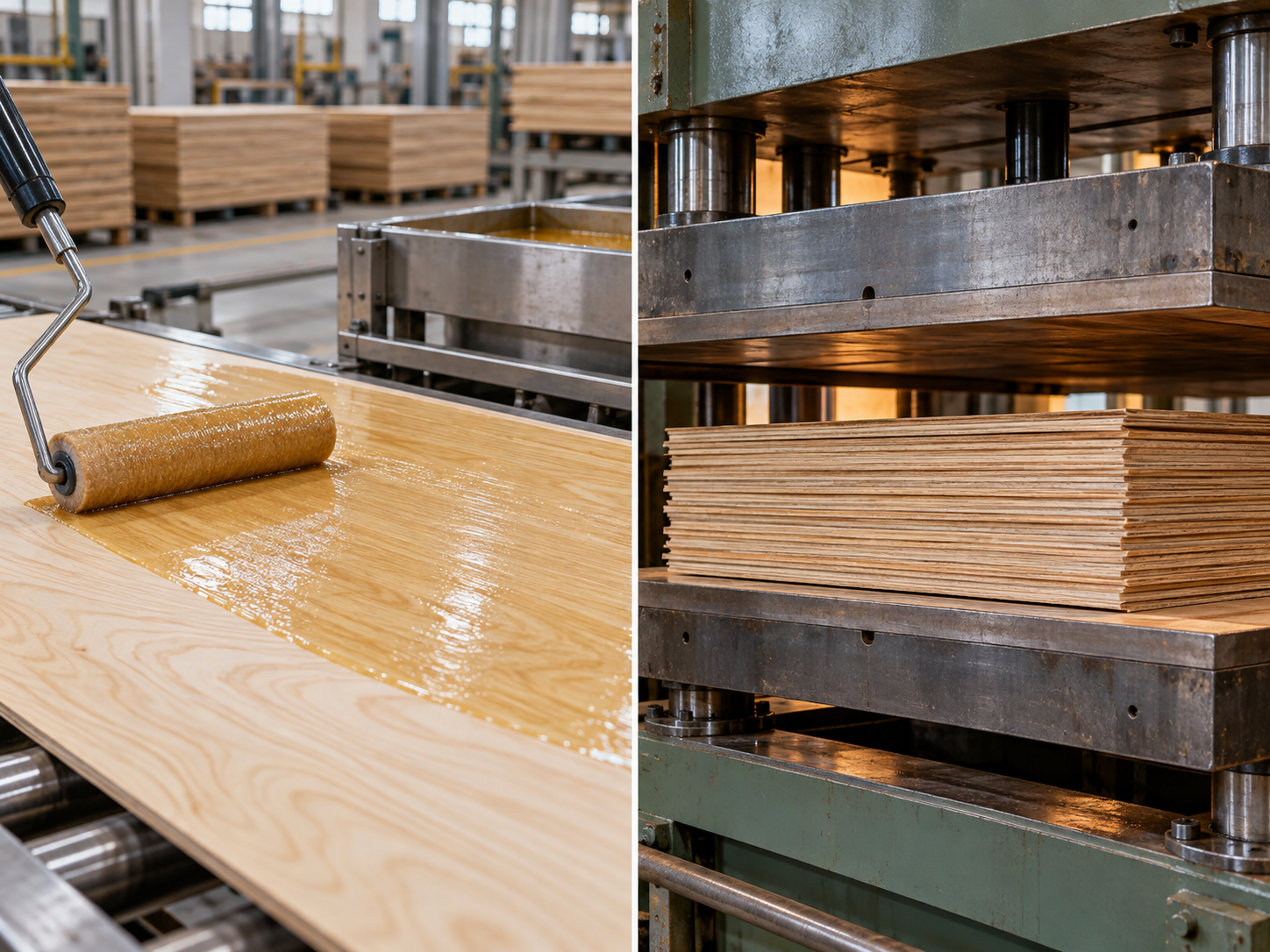
| MGC Wood Chem (adhesives for plywood and wood boards) | A maker of thermosetting adhesives for plywood and wood boards. Plywood mainly uses phenolic resin and wood boards mainly urea-melamine-formaldehyde resin, and all the raw materials are fossil-derived. It describes a lignin-phenol resin (some work under current plywood manufacturing conditions, but replacement is partial), trial production (2022) of plywood phenolic resin using ISCC PLUS-certified biomass phenol, biomass formalin from biomass methanol, and plans to produce and supply biomass adhesives for wood boards. It also mentions the “environment-circulating methanol” of Mitsubishi Gas Chemical (made from exhaust CO2, waste plastics and so on) | [11] |
| Mitsui Chemicals (biomass chemicals) | On 24 November 2021 it announced ISCC PLUS certification at its Osaka Works and said it would sell derivatives of biomass naphtha, allocated by mass balance. Products it can offer include phenol, acetone and ethylene oxide (urea was under re-examination in April 2022) | [10] |
| Columbia Forest Products (PureBond) | A formaldehyde-free hardwood plywood process using soy, polyvinyl acetate and pMDI. The technology has been in place since 2006 and over 200 million panels have been made (the company's statement). The company states that soy-based PureBond is the great majority of its production. The page gives no figure for bio-based content | [12] |
| Bio-based epoxy resin (for reference) | A peer-reviewed paper gives a bio-based epoxy resin (Polar Bear) as having 28% bio-based carbon (as a fraction of total organic carbon). This is a paper on a matrix resin for composites and is not an example of practical adhesive use that we confirmed | [18] |
All Sourced (statements by companies and authors; the scale, volume and market results of each company's initiatives could not be confirmed).
We could not confirm, from official company material, any bio-based encapsulant or potting material for semiconductors or electronic parts. Encapsulants have demanding requirements of their own, such as heat resistance, moisture resistance, ionic impurities and thermal expansion (see our explainers on semiconductor encapsulants and underfill). Whether bio-derived raw materials can meet them is something for which we have no confirmed facts, and this article does not assess it. Nor could we confirm any bio-related initiative for silicone products.
9. A materials engineer's view (2): three things to check on seeing a figure
- Which way of counting? Share of carbon (14C method), share of mass, or accounting allocation (mass balance)? The first two can be checked by analysing the product; the last is an accounting allocation (Chapters 3 to 5). As our bioplastics explainer says, the first step is to check whether it is the 14C method, mass, or an accounting allocation.
- What does the figure include? The resin only, or the whole product with hardener and additives? In the epoxy example, counting only the resin gives 28.6% or 33.5%, but if the hardener is fossil-derived the figure for the whole product is lower (Commentary).
- Has performance been checked separately? Water resistance (retained strength after humid heat), reactivity (cure conditions), brittleness and toxicity checks are separate from the bio-based figure (Chapter 7).
ISO 22095 states that a chain of custody system alone does not determine the characteristics of the product [Reference 7]. In this article's terms: an accounting figure and the performance of the product are checked separately (Commentary).
10. Open issues, and what this article could not confirm
(1) Range of practical examples
The examples are limited to wood adhesives (MGC Wood Chem, PureBond) and the supply of biomass chemicals (Mitsui Chemicals). For adhesives or encapsulants based on cellulose, furan-based materials or epoxidised vegetable oils, we found no practical example confirmed from official company material. Nor could we confirm practical examples for encapsulants for electronics and semiconductors, automotive use or structural bonding.
(2) Applicability of standards, and current editions
ISO 16620 is a standard for plastics, and from the scope statement alone we cannot say it applies directly to adhesives. ISO 16620-2 and -5 are being revised (as of October 2026). ASTM D6866 may be re-issued, so check the latest edition when using it.
(3) Comparing values
We do not line up bond strength, water resistance (retention), cure conditions or specific bio-based figures between products or raw materials. Grades, adherends and test conditions differ, and most published values are companies' own claims.
(4) Systems and regulation
We have not checked Japan's schemes for identifying biomass products or environmental-claims regulation in the EU and elsewhere. For the detailed rules of ISCC PLUS (calculation of allocation, scope of certification) we confirmed only the outline on the official page.
(5) Range of literature checked
For Heinrich (Green Chemistry 2019) we checked only the bibliographic details and abstract. For peer-reviewed reviews we limited ourselves to those whose open-access full text we could read. Practical examples of tannin-based adhesives and of adhesives for paper and corrugated board were also not confirmed from primary sources.
- Bio-based adhesives are old, and water resistance has been the problem. A review makes improving adhesion and water resistance the top research priority Sourced
- “Bio-based content” has three ways of counting. Share of carbon (14C method), share of mass and accounting allocation (mass balance) Sourced
- The same DGEBA molecule gives 28.6% or 33.5%. A hypothetical example Our calculation
- Under mass balance the same product can be “10%”, “100%” or “0%”. Analysing the product does not show the allocation Our calculation
- Drop-in and new-material types have different problems. The former raw material cost and supply; the latter water resistance, reactivity and brittleness Sourced
- Practical examples centre on wood adhesives. We could not confirm an example for encapsulants Sourced
11. Glossary
- Bio-based
- Some or all of the raw material comes from biomass such as plants. A different property from biodegradability.
- Biobased carbon content
- The share of a product's carbon that comes from biomass, found by measuring 14C.
- Biobased mass content
- The share of a product's mass made up of bio-derived constituents. Counts elements other than carbon as well.
- 14C method
- Measures radiocarbon (14C) to tell modern (biomass-derived) carbon from fossil-derived carbon.
- Mass balance approach
- Allocates, by accounting, the amount of bio feedstock put in to products, using a site-wide material balance.
- Chain of custody
- A system that tracks and records the flow of materials or products through the whole supply chain.
- ISCC PLUS
- A voluntary scheme that certifies the sustainability of alternative feedstocks (bio-based, circular, renewable-energy-derived).
- Drop-in
- Chemically the same as the conventional product, so it can be used as it is in existing equipment and uses.
- Lignin
- One of the main components of wood. Comes out as a pulping by-product. Its structure is complex and heterogeneous.
- Tannin
- A polyphenol found in plants. Studied as a raw material for wood adhesives.
- Polyol
- A compound with two or more hydroxyl groups. Reacts with an isocyanate to give polyurethane.
- Epichlorohydrin
- A raw material of epoxy resins. Supplies the glycidyl group (a group bearing the epoxy ring).
- DGEBA
- The diglycidyl ether of bisphenol A. A typical epoxy resin.
- pMDI
- Polymeric MDI. An isocyanate used in polyurethanes and wood adhesives.
- Water-resistant adhesion
- The property of keeping bond strength after contact with moisture or water, expressed as a retention percentage.
- Formaldehyde-based adhesive
- An adhesive for plywood and wood boards made from phenol, urea, melamine and the like with formaldehyde.
12. References
- ISO ISO 16620-1:2015 “Plastics — Biobased content — Part 1: General principles” https://www.iso.org/standard/63766.html
- ISO ISO 16620-2:2019 “Plastics — Biobased content — Part 2: Determination of biobased carbon content” https://www.iso.org/standard/72474.html
- ISO ISO 16620-3:2015 “Plastics — Biobased content — Part 3: Determination of biobased synthetic polymer content” https://www.iso.org/standard/63768.html
- ISO ISO 16620-4:2024 “Plastics — Biobased content — Part 4: Determination of biobased mass content” https://www.iso.org/standard/83892.html
- ISO ISO 16620-5:2017 “Plastics — Biobased content — Part 5: Declaration of biobased carbon content, biobased synthetic polymer content and biobased mass content” https://www.iso.org/standard/65218.html
- ASTM International ASTM D6866-24 “Standard Test Methods for Determining the Biobased Content of Solid, Liquid, and Gaseous Samples Using Radiocarbon Analysis” https://store.astm.org/d6866-24.html
- ISO ISO 22095:2020 “Chain of custody — General terminology and models” https://www.iso.org/standard/72532.html
- ISO ISO 22095-2:2026 “Chain of custody — Part 2: Requirements and guidelines for mass balance” https://www.iso.org/standard/84427.html
- ISCC “ISCC PLUS” (certification scheme page) https://www.iscc-system.org/certification/iscc-certification-schemes/iscc-plus/
- Mitsui Chemicals news release “Acquisition of ISCC PLUS certification (International Sustainability and Carbon Certification)” (in Japanese), 24 November 2021 https://jp.mitsuichemicals.com/jp/release/2021/2021_1124/index.htm
- Tamio Yamazaki (MGC Wood Chem) “Efforts toward sustainable adhesives for wood” (in Japanese), Wood Utilization System Research (Mokuzai Riyo System Kenkyu) vol. 9, pp. 17–20, September 2023. DOI 10.34494/jwus.9.0_17 https://www.jstage.jst.go.jp/article/jwus/9/0/9_17/_article/-char/ja
- Columbia Forest Products “PureBond” https://www.columbiaforestproducts.com/purebond/
- Gonçalves et al. “Non-Formaldehyde, Bio-Based Adhesives for Use in Wood-Based Panel Manufacturing Industry—A Review”, Polymers 13(23), 4086 (2021). DOI 10.3390/polym13234086 (open access) https://doi.org/10.3390/polym13234086
- Raydan, Leroyer et al. “Recent Advances on the Development of Protein-Based Adhesives for Wood Composite Materials—A Review”, Molecules 26(24), 7617 (2021). DOI 10.3390/molecules26247617 (open access) https://doi.org/10.3390/molecules26247617
- Watcharakitti et al. “Modified Starch-Based Adhesives: A Review”, Polymers 14(10), 2023 (2022). DOI 10.3390/polym14102023 (open access) https://doi.org/10.3390/polym14102023
- Maulana, Wibowo et al. “Eco-Friendly and High-Performance Bio-Polyurethane Adhesives from Vegetable Oils: A Review”, Polymers 16(11), 1613 (2024). DOI 10.3390/polym16111613 (open access) https://doi.org/10.3390/polym16111613
- Karthäuser et al. “Lignin and Lignin-Derived Compounds for Wood Applications—A Review”, Molecules 26(9), 2533 (2021). DOI 10.3390/molecules26092533 (open access) https://doi.org/10.3390/molecules26092533
- Rossitti et al. “Cleavable Bio-Based Epoxy Matrix for More Eco-Sustainable Thermoset Composite Components”, Polymers 17(1), 88 (2025). DOI 10.3390/polym17010088 (open access) https://doi.org/10.3390/polym17010088
- Heinrich “Future opportunities for bio-based adhesives – advantages beyond renewability”, Green Chemistry 21(8), 1866–1888 (2019). DOI 10.1039/C8GC03746A (bibliographic details and abstract only) https://doi.org/10.1039/C8GC03746A
- ASTM International ASTM D1151-00(2022) “Standard Practice for Effect of Moisture and Temperature on Adhesive Bonds” https://store.astm.org/d1151-00r22.html
13. Claim-to-source audit
| Claim in the text | Basis | Label |
|---|---|---|
| The title and content of ISO 16620-1 (general principles; calculation methods based on carbon mass or the mass of each constituent), its edition (April 2015, 11 pages, confirmed 2025) and its scope (plastic products and materials, polymer resins, monomers, additives) | ISO 16620-1:2015Reference 1 https://www.iso.org/standard/63766.html | Sourced |
| The title and content of ISO 16620-2 (calculation of biobased carbon content from 14C measurement), its edition (October 2019, 24 pages, confirmed 2024) and that a revision is in preparation (ISO/AWI 16620-2) | ISO 16620-2:2019Reference 2 https://www.iso.org/standard/72474.html | Sourced |
| The title and content of ISO 16620-3 (biobased synthetic polymer content) and its edition (April 2015, 7 pages, confirmed 2025) | ISO 16620-3:2015Reference 3 https://www.iso.org/standard/63768.html | Sourced |
| The title and content of ISO 16620-4 (biobased mass content from radiocarbon and elemental analysis, with the condition that the product contains carbon and its elemental composition and biobased carbon content are stated) and its edition (second edition, February 2024, 14 pages) | ISO 16620-4:2024Reference 4 https://www.iso.org/standard/83892.html | Sourced |
| The title and content of ISO 16620-5 (requirements for declarations and labels), its edition (January 2017, 7 pages) and that a revision is in preparation (ISO/AWI 16620-5) | ISO 16620-5:2017Reference 5 https://www.iso.org/standard/65218.html | Sourced |
| The title of ASTM D6866-24 and a summary of its scope (biobased content by 14C analysis, direct distinction between carbon in equilibrium with atmospheric CO2 and fossil carbon, Methods B and C, inter-laboratory total uncertainty of up to ±3%) | ASTM D6866-24Reference 6 https://store.astm.org/d6866-24.html | Sourced |
| The framework of ISO 22095:2020 (a consistent approach, terminology and general requirements for chain of custody). That it cannot on its own support claims, and that the system alone does not specify the characteristics or conditions of production. Its edition (October 2020, 32 pages) | ISO 22095:2020Reference 7 https://www.iso.org/standard/72532.html | Sourced |
| The content of ISO 22095-2:2026 (requirements and guidelines for mass balance, system boundaries, conversion factors, rolling average percentage method, credit method, transparency and claims) and its edition (January 2026, 45 pages) | ISO 22095-2:2026Reference 8 https://www.iso.org/standard/84427.html | Sourced |
| That ISCC PLUS is a voluntary scheme validating the sustainability characteristics of alternative feedstocks. The three methods (physical segregation, controlled blending, mass balance). Certification of every element of the supply chain, per-site certificates valid for 12 months. The classes of alternative feedstock (bio-circular, bio materials and others) | ISCC PLUS pageReference 9 https://www.iscc-system.org/certification/iscc-certification-schemes/iscc-plus/ | Sourced |
| Mitsui Chemicals and Prime Polymer's ISCC PLUS certification at the Osaka Works (24 November 2021), the feeding of biomass naphtha to the cracker (described as a first in Japan), allocation by mass balance, the products offered (phenol, acetone, ethylene oxide and others; urea under re-examination), and the description of mass balance | Mitsui Chemicals news releaseReference 10 https://jp.mitsuichemicals.com/jp/release/2021/2021_1124/index.htm | Sourced |
| The MGC Wood Chem report (plywood mainly uses phenolic resin and wood boards urea-melamine-formaldehyde resin, with fossil-derived raw materials; lignin content of 20 to 30%, complex structure, low reactivity, partial replacement; use of ISCC PLUS-certified biomass phenol and biomass methanol; the account of no chemical difference; the explanation of mass balance; the cost and supply issues; Mitsubishi Gas Chemical's environment-circulating methanol) | Yamazaki (MGC Wood Chem), Wood Utilization System Research 9, 17–20 (2023)Reference 11 https://www.jstage.jst.go.jp/article/jwus/9/0/9_17/_article/-char/ja | Sourced |
| Columbia Forest Products' PureBond (a formaldehyde-free process using soy, polyvinyl acetate and pMDI; since 2006; over 200 million panels; soy-based the great majority of production). That the page gives no bio-based content | Columbia Forest Products, “PureBond”Reference 12 https://www.columbiaforestproducts.com/purebond/ | Sourced |
| The pressure to replace formaldehyde-based adhesives. The raw materials highlighted for bio-based wood adhesives (tannins, lignin, proteins) and the challenges of lower reactivity (cost, resources, toxicological checks). That bio-based adhesives have been used for millennia, stability in humid and wet environments, and improving adhesion and water resistance as the top research priority. The water-resistance tests (wet tests based on ASTM D1151 and D1183) | Gonçalves et al., Polymers 13, 4086 (2021)Reference 13 https://doi.org/10.3390/polym13234086 | Sourced |
| That about 80% of wood-based products use adhesives. That protein-based adhesives were replaced by synthetic ones in the early 20th century, mainly for better moisture resistance. The renewed interest because of low toxicity, renewable sourcing and a smaller footprint | Raydan et al., Molecules 26, 7617 (2021)Reference 14 https://doi.org/10.3390/molecules26247617 | Sourced |
| That starch is of interest as a raw material for adhesives for paper and wood surfaces, that its hydroxyl groups hydrogen-bond with water so waterproof adhesives are hard to make, and the modifications (hydrophobic groups such as esters, oxidation, crosslinking) | Watcharakitti et al., Polymers 14, 2023 (2022)Reference 15 https://doi.org/10.3390/polym14102023 | Sourced |
| Polyurethane adhesives from vegetable oils (soybean, castor, linseed), the polyol synthesis routes (epoxidation and ring-opening, hydroformylation, thiol-ene, ozonolysis, transesterification), the use of non-renewable isocyanates as a current limitation, the brittleness and low water resistance of lignin- and tannin-based polyurethanes, and the flexibility of vegetable-oil-based ones | Maulana et al., Polymers 16, 1613 (2024)Reference 16 https://doi.org/10.3390/polym16111613 | Sourced |
| That the paper industry produces over 50 million tons of lignin a year as a by-product, that about 95% is burned, the recalcitrant, heterogeneous and complicated structure, and that very few lignin-derived wood products are commercially available | Karthäuser et al., Molecules 26, 2533 (2021)Reference 17 https://doi.org/10.3390/molecules26092533 | Sourced |
| That a bio-based epoxy resin (Polar Bear) is described as having 28% bio-based carbon (as a fraction of total organic carbon), and that the paper concerns a composite matrix resin | Rossitti et al., Polymers 17, 88 (2025)Reference 18 https://doi.org/10.3390/polym17010088 | Sourced |
| That a review exists discussing advantages of bio-based adhesives beyond renewability (bibliographic details and abstract only) | Heinrich, Green Chemistry 21, 1866 (2019)Reference 19 https://doi.org/10.1039/C8GC03746A | Sourced |
| The title of ASTM D1151-00(2022) and that it is a practice expressing bond performance under continuous exposure to moisture and temperature as the percentage of original strength retained | ASTM D1151-00(2022)Reference 20 https://store.astm.org/d1151-00r22.html | Sourced |
| The carbon-basis (6 ÷ 21 = 28.6%) and mass-basis (114.144 ÷ 340.419 = 33.5%) values when only the two glycidyl groups of DGEBA (C21H24O4) are bio-based; atomic weights C 12.011, H 1.008, O 15.999. The hypothetical mass-balance example (1,000 t input of which 100 t bio feedstock; Method A 10%; Method B 100% on 100 t and 0% on 900 t) | Our calculation. The DGEBA example assumes plant-derived glycidyl groups and a fossil bisphenol A core and is not the composition of a real product. The mass-balance example uses simplified hypothetical numbers (conversion factor 1, same yield) and does not reproduce any scheme's rules | Our calculation |
| Japan's schemes for identifying biomass products, environmental-claims regulation in the EU and elsewhere, the detailed allocation rules of ISCC PLUS, company examples of practical use of adhesives from cellulose, furan-based materials or epoxidised vegetable oils, bio-based examples for electronics and semiconductor encapsulants, practical examples of tannin-based and paper or corrugated-board adhesives, and bio-related initiatives for silicones | Not given, because primary sources could not be confirmed within the scope of this article (this article's own note) | Commentary |
| That the scope of ISO 16620 does not name adhesives, so direct applicability cannot be asserted. The reading that a product itself cannot show a mass-balance allocation. The split into drop-in and new-material types and the “bio-based figure” row. The reading that bio-based is not a guarantee of performance. The three checks (which way of counting, what is included, whether performance was checked separately). That a hardener lowers the bio-based figure of an epoxy product | This article's own organisation and commentary based on published statements; not the views of any company or institution | Commentary |
| That Figs. 1, 2, 3, 4 and 5 are explanatory drawings, and that the hero image and Fig. 6 are AI-generated images | Note by this article (our own) | Commentary |
Last updated 3 October 2026. Sources are limited to primary material (official pages of standards bodies and a certification scheme, official company material and reports, and open-access peer-reviewed papers). Product performance values are not lined up. Company initiatives are the companies' own statements, and their scale, volume and market results were not confirmed. Because the article includes structural readings and materials-design interpretations, those are marked as Commentary and kept separate from sourced fact. Japan's schemes for identifying biomass products, environmental-claims regulation in the EU and elsewhere, the detailed allocation rules of ISCC PLUS, practical examples of adhesives from cellulose, furan-based materials or epoxidised vegetable oils, practical examples for electronics and semiconductor encapsulants, and bio-related initiatives for silicones are not stated here, either because no published primary source could confirm them or because we chose not to cover them. The calculations in Chapters 4 and 5 are illustrative examples with hypothetical numbers. Figs. 1, 2, 3, 4 and 5 are vector drawings, and the hero image and Fig. 6 are AI-generated images; none of them shows a real product, plant, formulation or bio-based content.