TECHNOLOGY EXPLAINER
Epoxy Resin
— a material for designing the reaction that turns a liquid into a solid
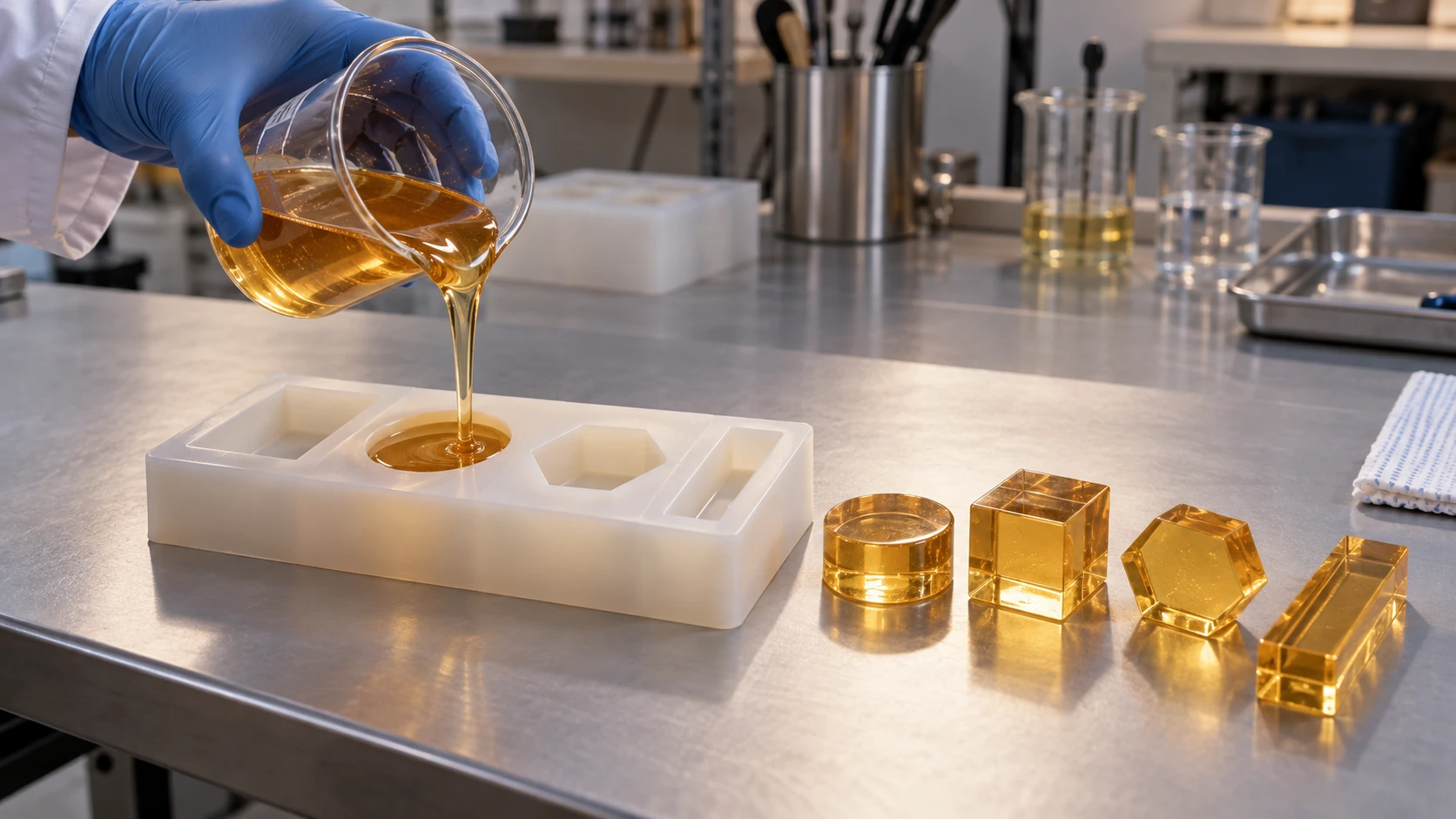
Epoxy resin is a thermosetting resin made by mixing a resin carrying epoxide groups with a curing agent (hardener) and letting them react into a three-dimensional network. A patent granted in 1943 describes curing with acid anhydrides, and one granted in 1952 describes curing with amines; the two main curing routes still used today were already there. Semiconductor encapsulants and underfills are applications of the same reaction.
- What epoxy resin is (the short version)
- Origins and synthesis: bisphenol A and epichlorohydrin
- A materials engineer's view (1): think in equivalents
- Our calculation: chain length and mixing ratio from the EEW
- Curing agents and the curing reaction: amines and acid anhydrides
- A materials engineer's view (2): Tg is also a function of the degree of cure
- Where it is used: adhesives, coatings, composites and electronic materials
- The difficulty of recycling, degradable curing agents and dynamic covalent bonds
- A materials engineer's view (3): ease of degradation is the flip side of stability in use
- Challenges and limits / Glossary / References / Claim-to-source audit
Sourced = a statement found in published material (link given)
Our calculation = a figure this article derived from stated assumptions
Not yet confirmed = a plan or proposal for which a track record has not been confirmed
Structural readings and materials-design interpretations are marked separately as commentary.
Property values are given together with the test method, conditions and source. This article neither recommends nor condemns any particular product or company.
1. What epoxy resin is (the short version)
- What it is: a resin that carries epoxide groups (three-membered rings containing oxygen), for example at the ends of its molecules. On its own it is a viscous liquid or a brittle solid, and it becomes an insoluble thermosetting resin only once it has reacted with a curing agent. A review (Molecules 2023) calls the bisphenol A type epoxy resin (DGEBA) the most widely used epoxy resinSourced.
- Breadth of use: Olin lists coatings, adhesives, flooring, electrical insulation and composites as uses of its liquid epoxy resinsSourced. The same review says its use in electrical insulation goes back to the early 1950s.
- The essence of the design: more than the resin itself, it is which curing agent, in what ratio, cured how that decides the final properties. As shown below, even the glass transition temperature (Tg) varies with the cure conditions for the same combination of resin and curing agent (our commentary).
Epoxy is less a "material" than a "reaction design." The resin's equivalent weight, the curing agent's equivalent weight, the ratio, the temperature and the time: differences in these reaction conditions change the Tg, the strength, the insulation and how easily the material can be recycled. A catalogue figure of "Tg = so many °C" has to be read together with the state of cure of the material it was measured on (our commentary).
2. Origins and synthesis: bisphenol A and epichlorohydrin
Early epoxy-resin development can be traced to two patents granted in 1943 and 1952.
| Patent | What it describes | Curing route |
|---|---|---|
| US 2,324,483 Pierre Castan Filed 1942 (priority 1938), granted 20 July 1943 | A polyhydric phenol such as 4,4'-dihydroxydiphenyl-2,2-propane is reacted with epichlorohydrin in alkaline solution to give a product with at least two ethylene oxide groups (epoxide groups). This is then condensed with the anhydride of a polybasic carboxylic acid. In Example 2, the product is melted with phthalic anhydride at 120 °C and becomes infusible and insoluble at 170 °C | Acid anhydride |
| US 2,585,115 Sylvan O. Greenlee (Devoe & Raynolds) Filed 1945, granted 12 February 1952 | A polyhydric phenol and a polyfunctional halohydrin (epichlorohydrin) are reacted in the presence of caustic alkali to give a complex epoxide with epoxide groups at the ends. The active hydrogens of a polyethylene polyamine react with the epoxide groups and crosslink them. Some combinations cure at room temperature and others need heat (typically 150 °C). The cured film has high chemical resistance | Amine |
All Sourced (descriptions in patents published on Google Patents [References 1 and 2]).
Olin supplies liquid resins equivalent to DGEBA in several grades. It describes D.E.R. 332 as a high-purity bisphenol A diglycidyl ether, a resin with few oligomers and very low viscosity, and D.E.R. 331 as the industry-standard bisphenol A liquid epoxy resinSourced [Reference 5]. The company also writes that D.E.R. 330 often crystallizes at room temperature and returns to a liquid when heated to 50 to 55 °CSourced. Crystallization is not determined by purity alone: resin composition, oligomer content, additives, water and storage conditions can also matter (our commentary based on Reference 4).
3. A materials engineer's view (1): think in equivalents
An epoxy formulation is weighed in grams, while the mixing ratio is calculated using the epoxy equivalent weight (EEW), the mass of resin per equivalent of epoxide groups (g/eq). The EEW can be measured by ISO 3001 (Plastics — Epoxy compounds — Determination of epoxy equivalent), which applies to all epoxy compounds. For epoxyamines, however, the modification in Annex A is requiredSourced [Reference 10]. ASTM D1652 is a titration method for determining the epoxy content of a resin, over the range 0.1 to 26% (as epoxide). According to ASTM, epoxy content is an important variable that determines the reactivity of the resin and the properties of the coatings made from itSourced [Reference 12].
Typical values for commercial liquid DGEBA, from a table in a paper (Polymers 2023) that draws on cited literature, are EEW 182 to 192 g/eq, viscosity 11,000 to 14,000 mPa·s (25 °C), density 1.16 g/cm³ and hydrolysable chlorine below 500 ppmSourced [Reference 4]. Olin's "EL" grades are described as grades for electrical, electronic and encapsulation uses, with hydrolysable chlorine kept below 150 ppm (D.E.R. 331-EL) or below 100 ppm (D.E.R. 330-EL)Sourced [Reference 5]. Low chlorine matters for these uses because chlorine from epichlorohydrin can become an ionic impurity in electronic materials (our commentary).
4. Our calculation: chain length and mixing ratio from the EEW
From the theoretical formula weight of DGEBA, we work out the molecular length (the average number n of repeat units) implied by the EEW of commercial productsOur calculation.
- Basis: DGEBA with n = 0 is C21H24O4. With atomic weights C 12.011, H 1.008 and O 15.999, the molecular weight is 340.42. There are two epoxide groups per molecule, so the theoretical EEW = 340.42 ÷ 2 = 170.2 g/eq
- The repeat unit (–O–bisphenol A backbone–O–CH2–CH(OH)–CH2–) is C18H20O3, with a formula weight of 284.36
- Solving EEW = (340.42 + 284.36 n) ÷ 2 for n gives n = (2 × EEW − 340.42) ÷ 284.36
- EEW = 182 gives n = 0.083, EEW = 187 gives n = 0.118, and EEW = 192 gives n = 0.153
Assumptions and limits: these values assume that the whole excess of EEW over the theoretical value comes from repeat units. In a real resin, components with some epoxide groups opened also affect the EEW. Even so, we can see that a liquid resin is a mixture, mostly molecules with n = 0 with a small amount of oligomer mixed in (the review gives n as usually 0 to 1).
Taking diethylenetriamine (DETA) as an example, we work out the theoretical amountOur calculation.
- Basis: DETA is H2N–CH2CH2–NH–CH2CH2–NH2 (C4H13N3), with a molecular weight of 103.17. There are 2 + 1 + 2 = 5 N–H hydrogens. We assume each N–H reacts with one epoxide group
- Amine hydrogen equivalent weight (AHEW) = 103.17 ÷ 5 = 20.63 g/eq
- Amount of curing agent per 100 parts by mass of resin (phr) = AHEW ÷ EEW × 100. With EEW = 187 this is 11.0 phr; it is 11.3 phr at EEW = 182 and 10.7 phr at 192
Assumptions and limits: this is the theoretical stoichiometric ratio. Real formulations are adjusted for differences in reactivity, fillers, cure conditions and target properties. The review (Molecules 2023) says that in many systems Tg peaks near the equivalent ratio, and gives an example where adding a filler shifts the optimum ratioSourced. If the EEW varies by about ±3%, the equivalent ratio at the same phr also shifts by about 3%.
5. Curing agents and the curing reaction: amines and acid anhydrides
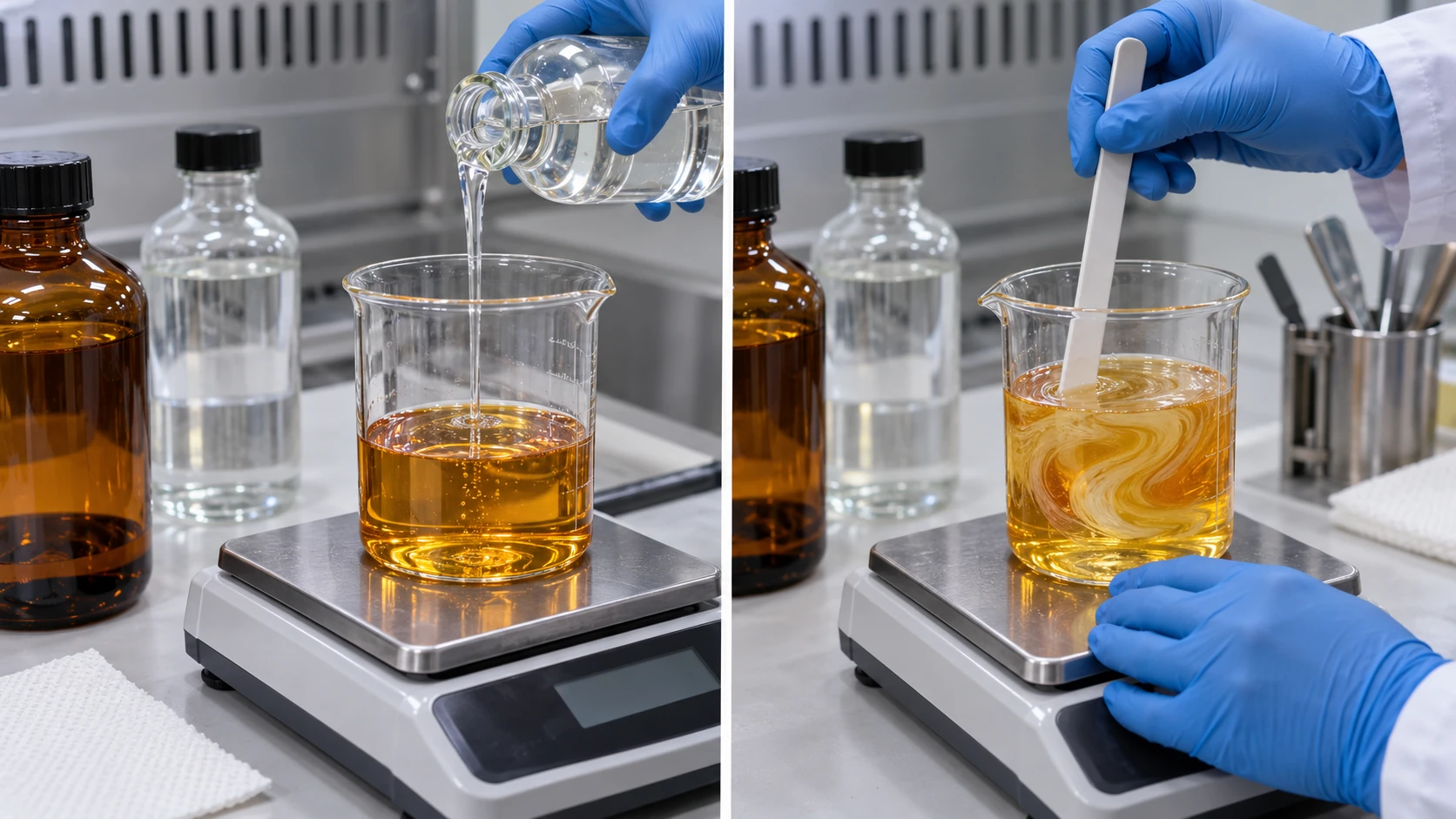
The review in Molecules (2023) divides curing agents into polyamines, acid anhydrides, phenolic types and catalytic types, among others, and says that polyamines and acid anhydrides together make up more than 90% of all curing agentsSourced [Reference 3].
| Curing agent | Outline of the reaction | What the review says (characteristics) |
|---|---|---|
| Polyamine | An active hydrogen of a primary amine opens an epoxide group to give a secondary amine, which reacts further to give a tertiary amine and build the network | Good balance of mechanical properties, but lower heat resistance |
| Acid anhydride | A hydroxyl group in the epoxy resin opens the anhydride to give a carboxylic acid, which reacts with an epoxide group. Direct opening of epoxide groups by hydroxyl groups (etherification) proceeds in parallel | High reaction temperature. Lower cure shrinkage than amines, and higher heat resistance and insulation. Nearly all anhydride curing agents need an accelerator: without one, curing may require temperatures above 200 °C, whereas the review also gives accelerated curing examples at 100–140 °C [Reference 3] |
| Accelerator (anhydride systems) | A tertiary amine (such as DMP-30) opens the anhydride to form an anion, which reacts with an epoxide group to produce a new anion, and the chain continues | Lewis-base accelerators catalyse both the crosslinking of the epoxide and the ring opening of the anhydride |
All Sourced (summary of the description in the Molecules 2023 review [Reference 3]).
The shrinkage in volume that accompanies curing is measured by ISO 3521 (Plastics — Unsaturated polyester and epoxy resins — Determination of overall volume shrinkage)Sourced [Reference 11]. That the size of the shrinkage differs between amine curing and anhydride curing is as the review above describes.
Among acid anhydrides, methylhexahydrophthalic anhydride (MHHPA) is an alicyclic anhydride widely used in electrical and electronic parts, and is characterized by a low melting point, good compatibility, low viscosity, a long pot life, high heat resistance and high-temperature insulation. The review says it is used for coil impregnation, casting of electrical parts and semiconductor encapsulation, among othersSourced.
6. A materials engineer's view (2): Tg is also a function of the degree of cure
Fig. 4 shows Tg for one commercial degradable bio-based epoxy formulation (Polymers 2025). The sample cured only at room temperature gave 69.7 °C on the first DSC heating and 76.6 °C on the secondSourced [Reference 6]. The paper interprets this as further curing during the first heating. The sample post-cured at 100 °C also rose, from 68.0 °C to 72.7 °C, showing that the network was not complete to begin with. The paper says Tg was evaluated on the second heating (to avoid the influence of the endothermic peak of relaxation enthalpy).
The Molecules 2023 review also describes the same tendencySourced [Reference 3].
- In many systems Tg is highest near the equivalent ratio. This is explained by the change in crosslink density.
- Post-cure (carrying out the latter part of the cure at a higher temperature) is described as having advanced the etherification of unreacted epoxide groups in a TGDDM/THPA system, making the network more uniform and raising Tg and mechanical properties.
- For DGEBA/amine (D-230) there is an example in which the sample cured at 80 °C for 6 hours had the highest Tg.
- Two-step curing (a pre-cure near the temperature at which the reaction starts, and a post-cure near the peak temperature) is described as a common scheme for epoxy resins.
In other words, a catalogue "Tg" is a value that includes not only the combination of resin and curing agent but also the cure conditions and how far the cure has gone (the degree of cure). Even for the same formulation, the value changes with (a) whether it is the first or second run, (b) the heating rate, and (c) whether it is measured by DSC, TMA or DMA. The general DSC test method for transition temperatures is ASTM D3418 (transition temperatures and enthalpies of fusion and crystallization) [Reference 13]; the measurement of glass transition is specified in ISO 11357-2 and ASTM E1356, and DMA in ISO 6721-11 and ASTM E1640 [References 14 to 17]. We take up the differences between measurement methods in our explainer on the glass transition and creep.
For underfills and encapsulants, a further point is that the thermal expansion coefficient changes greatly above Tg, and reflow (260 °C) always takes the material into the "above Tg" region. We cover this, with manufacturers' published values, in our explainers on underfill and on the coefficient of thermal expansion. Raising the crosslink density to raise Tg also makes the material harder and less able to relieve stress, and the difficulty of reconciling the two is also sorted out there.
7. Where it is used: adhesives, coatings, composites and electronic materials
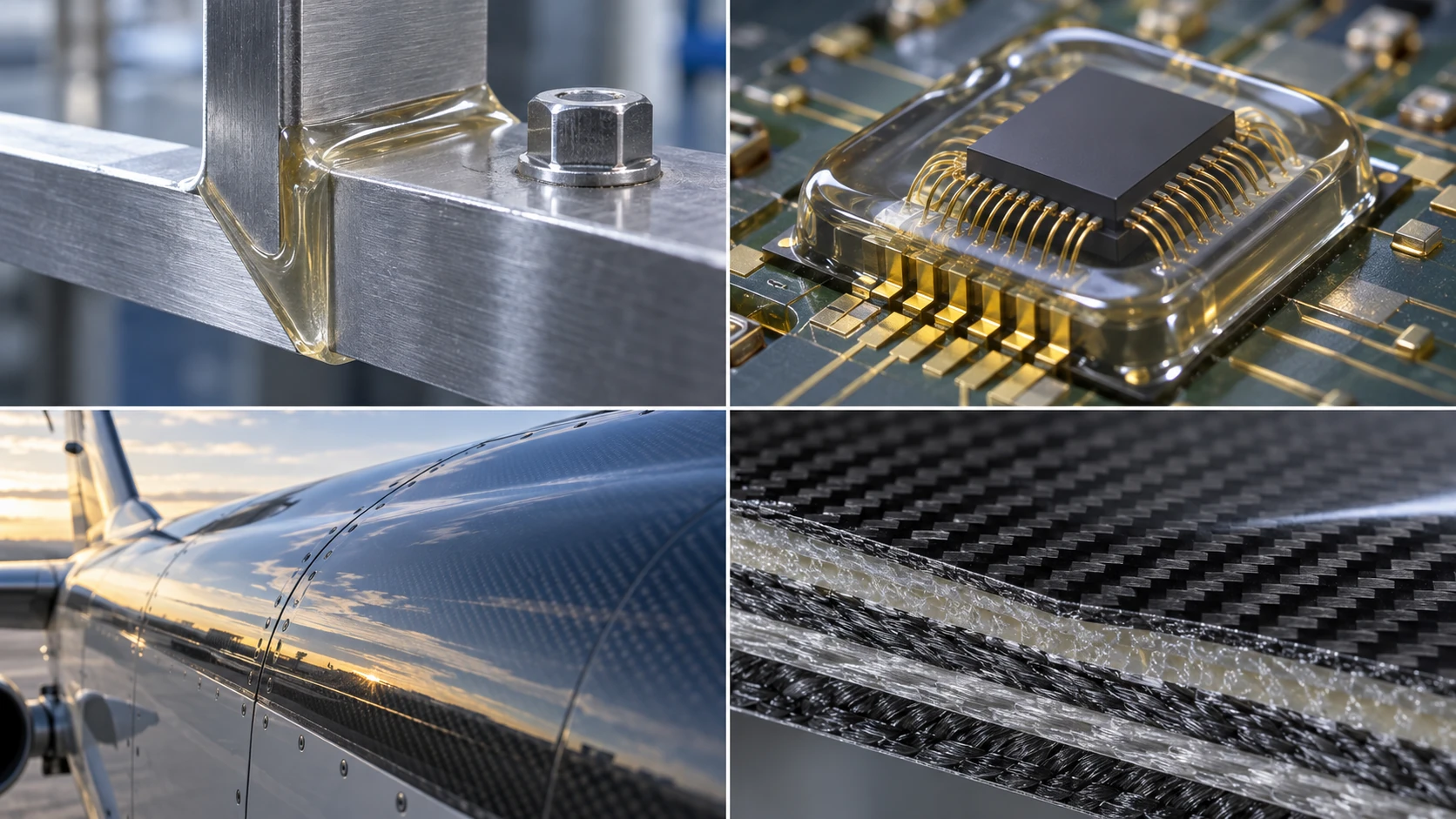
ImageGen conceptual illustration (not a real photograph or measurement). See the original diagram for exact values, names and structure.
Show original diagram with exact annotations and values
For each use, the same idea of "epoxy plus curing agent" appears in a different form.
- Adhesives, coatings, flooring and composites: Olin's liquid resins page lists coatings, adhesives, flooring, electrical insulation and composites. D.E.R. 330 is described as a low-viscosity bisphenol A resin used for composites and castingSourced [Reference 5].
- Electrical insulation: the review lists basin-type insulators for gas-insulated switchgear (GIS) and similar equipment, insulating tubes of fibre-impregnated epoxy, epoxy-impregnated paper for high-voltage bushings, and insulation for high-frequency transformersSourced [Reference 3]. It says overheating and insulation breakdown become problems under heavy current and varied voltage waveforms, and that conductivity increases exponentially with temperature (in one example, by nearly three orders of magnitude at 100 °C compared with 25 °C).
- Electrical laminates and chip packages: Olin lists grades for electrical laminates and a grade for chip packages (D.E.R. 383)Sourced [Reference 5]. We cover encapsulants (molding compounds) and underfill, with manufacturers' published values, in separate explainers in this series.
Resins based on DGEBA are often described as brittle and prone to cracking once cured, and are reinforced with fillers or fibres (Polymers 2023)Sourced [Reference 4]. The same paper reports that when crystallized raw material is used, the chemical resistance of the cured product falls as crystallinity increases, and hardness and brittleness tend to rise (an isophoronediamine-type curing agent, in a hydrophobic coating formulation for concrete). The use is different, but the point that the state of the raw material (whether it has crystallized) affects the properties of the cured product also applies to raw-material control for electronic materials (our commentary).
8. The difficulty of recycling, degradable curing agents and dynamic covalent bonds
Cured epoxy is a three-dimensional network that neither melts nor dissolves in solvents. That it cannot be "melted and reshaped" like a thermoplastic is what makes recycling difficult (our commentary). A peer-reviewed paper (Polymers 2025) also says that most of today's fibre-reinforced plastics are based on thermosetting resins that are hard to recycle, such as epoxy, vinyl ester and polyesterSourced [Reference 7]. Two broad designs have been studied and brought to market in response.
1. Degradable curing agents (putting "breakable bonds" into the network)
The Polymers 2025 paper introduces Recyclamine® (patented by Connora Technologies) as a series of amine curing agents containing an acetal. The terminal groups are linked through a central acetal bond in a polyamine structure, and this bond breaks down at a given temperature in a mildly acidic solution. As a result, the crosslinks can be cut afterwards and the thermosetting epoxy network goes back to a reusable thermoplastic polymer, the paper explainsSourced [Reference 6].
With the commercial degradable bio-based formulation (from R-Concept) that the paper studied, the network was dissolved by treatment in 40 vol% aqueous acetic acid at 80 °C for 2.5 hours, the fibres were filtered off and recovered, and when the acid was neutralized with NaOH the matrix precipitated as a thermoplastic polymer. The combined material recovery yield for fibres and polymer was 95.5% for the glass-fibre composite and 98.8% for the carbon-fibre compositeSourced [Reference 6]. Separately, another paper (Polymers 2025) reports tensile strengths of 464.0 MPa for the conventional epoxy basalt-fibre composite and 390.9 MPa for the Recyclamine-based composite. In this test, the more readily recyclable system had the lower valueSourced [Reference 7].
2. Dynamic covalent bonds (vitrimers)
In a 2011 paper in Science, Montarnal et al. reported epoxy networks whose connectivity can be rearranged by exchange reactions. The network does not depolymerize; it is insoluble yet can be processed. Unlike an ordinary polymer, whose viscosity changes abruptly near the glass transition, the viscosity is said to change gradually (in an Arrhenius manner), like quartz glassSourced [Reference 8]. In later work, vitrimers were made from DGEBA and 2,5-furandicarboxylic acid (FDCA) using 1,5,7-triazabicyclo[4.4.0]dec-5-ene (TBD) as a transesterification catalyst, and stress-relaxation tests confirmed an Arrhenius-type temperature dependence of the relaxation timeSourced [Reference 9].
9. A materials engineer's view (3): ease of degradation is the flip side of stability in use
For the sample in Fig. 4, the paper reports that post-curing at 140 °C lowered Tg by about 25 °C (to about 52 °C). The authors interpret this as degradation of the network by the thermal stress of excessive post-curingSourced [Reference 6]. The usual epoxy rule of thumb, that post-curing raises Tg (Section 6), thus works the other way round for this degradable formulation.
This formulation's Tg (76.6 °C without post-cure) is also lower than that of the organic-substrate encapsulants (120 to 155 °C) introduced in our explainer on underfill, so it sits at a level meant for different uses. It is, however, a value for one specific commercial formulation and does not show the limits of degradable epoxies in general (our commentary).
Three design issues can be read from this (our commentary).
- A narrower cure window: because the breakable bonds are sensitive to heat, the usual tactic of raising the post-cure temperature to gain Tg is hard to use.
- The boundary between the service environment and the degradation conditions: for uses exposed to mildly acidic environments, it has to be confirmed that the material does not degrade in service.
- Extra evaluation: besides the usual properties (Tg, strength, insulation), the recovery yield under the degradation conditions and the quality of the recovered polymer and fibre have to be added to the evaluation items.
10. Challenges and limits
- How to read Tg: a catalogue Tg changes with the cure conditions, degree of cure, measurement method (DSC, TMA, DMA) and heating rate. The Tg of different samples cannot be lined up and compared.
- A note on raw materials: ECHA describes bisphenols as being used to make polymers and resins, and says that the use of some bisphenols is restricted, or being restricted, in the EUSourced [Reference 18]. This article does not cover the individual regulations on BPA (such as restrictions by use).
- The standing of degradable and dynamic covalent systems: the studies introduced here are reports on specific formulations or at laboratory scale. Within the scope of this article, we could not confirm from primary sources how far they are adopted in mass-produced electronic or structural materials.
- Not covered here: other resins such as bisphenol F, novolac, alicyclic and glycidylamine types; bio-based epoxies; flame retardancy (bromine, phosphorus); toughness improvement (rubber, core-shell); adhesion mechanisms; and details of cure kinetics.
- Limits of the property values: the numbers in this article are values for specific samples in specific papers and manufacturer material. They do not apply to other formulations or grades.
11. Glossary
- Epoxide group
- A three-membered ring containing oxygen. The reactive site that opens and bonds to the curing agent.
- DGEBA
- Bisphenol A diglycidyl ether. The basic structure of the most widely used epoxy resin.
- EEW (epoxy equivalent weight)
- The mass of resin per epoxide group (g/eq). Measured by methods such as ISO 3001.
- AHEW
- Amine hydrogen equivalent weight. For an amine curing agent, the mass per hydrogen available for reaction.
- phr
- Parts per hundred resin: the amount added per 100 parts by mass of resin.
- Curing agent
- A chemical that reacts with epoxy resin to form the network. Polyamines and acid anhydrides are typical.
- Accelerator
- An additive that speeds up the curing reaction. Tertiary amines and similar compounds are used in anhydride curing.
- Post-cure
- Additional curing at a higher temperature after the first cure.
- Tg (glass transition temperature)
- A value representing the temperature range over which a hard glassy state turns into a soft rubbery state. It varies with the measurement method.
- Crosslink density
- The density of junctions in the network. The higher it is, the higher the Tg, but the harder and more brittle the material tends to be.
- Degradable curing agent
- A curing agent that builds breakable bonds into the network. A weak acid or similar can turn the network back into a thermoplastic polymer.
- Vitrimer
- A crosslinked polymer whose network connectivity is rearranged by exchange reactions, so that it can be reshaped without melting.
- TBD
- Abbreviation for 1,5,7-triazabicyclo[4.4.0]dec-5-ene, the transesterification catalyst used in Reference 9; it is not a placeholder for “to be determined.”
12. References
- P. Castan US 2,324,483 "Process of preparing synthetic resins" (granted 20 July 1943) — https://patents.google.com/patent/US2324483A/en
- S. O. Greenlee (Devoe & Raynolds) US 2,585,115 "Amine-epoxide compositions" (granted 12 February 1952) — https://patents.google.com/patent/US2585115A/en
- Molecules 2023, 28(2), 547 "Curing Regime-Modulating Insulation Performance of Anhydride-Cured Epoxy Resin: A Review" (DOI: 10.3390/molecules28020547, open access) — https://pmc.ncbi.nlm.nih.gov/articles/PMC9867423/
- Polymers 2023, 15(19), 3871 "Possibilities of Influencing the Crystallization Process of Bisphenol A- and Bisphenol F-Based Epoxy Resins Used for Hydrophobic Coatings on Concrete" (DOI: 10.3390/polym15193871, open access) — https://pmc.ncbi.nlm.nih.gov/articles/PMC10575199/
- Olin Epoxy "Liquid Resins" product listing page — https://olinepoxy.com/product-market-segments/liquid-resins/
- Polymers 2025, 17(1), 88 "Cleavable Bio-Based Epoxy Matrix for More Eco-Sustainable Thermoset Composite Components" (DOI: 10.3390/polym17010088, open access) — https://pmc.ncbi.nlm.nih.gov/articles/PMC11723220/
- Polymers 2025, 17(10), 1348 "Comparison of the Performance of Basalt Fiber-Reinforced Composites Incorporating a Recyclable and a Conventional Epoxy Resin" (DOI: 10.3390/polym17101348, open access) — https://pmc.ncbi.nlm.nih.gov/articles/PMC12115199/
- D. Montarnal et al. "Silica-like malleable materials from permanent organic networks", Science 2011;334:965-968 (DOI: 10.1126/science.1212648, PubMed) — https://pubmed.ncbi.nlm.nih.gov/22096195/
- ACS Applied Polymer Materials 2023, 5(1), 828-838 "Bio-Based Vitrimers from 2,5-Furandicarboxylic Acid as Repairable, Reusable, and Recyclable Epoxy Systems" (DOI: 10.1021/acsapm.2c01774, open access) — https://pubs.acs.org/doi/10.1021/acsapm.2c01774
- ISO "ISO 3001:1999 Plastics — Epoxy compounds — Determination of epoxy equivalent" — https://www.iso.org/standard/29610.html
- ISO "ISO 3521:1997 Plastics — Unsaturated polyester and epoxy resins — Determination of overall volume shrinkage" — https://www.iso.org/standard/8895.html
- ASTM International "ASTM D1652-11(2019) Standard Test Method for Epoxy Content of Epoxy Resins" — https://store.astm.org/d1652-11r19.html
- ASTM International "ASTM D3418-21 Standard Test Method for Transition Temperatures and Enthalpies of Fusion and Crystallization of Polymers by Differential Scanning Calorimetry" — https://store.astm.org/d3418-21.html
- ASTM International "ASTM E1356-25 Standard Test Method for Assignment of the Glass Transition Temperatures by Differential Scanning Calorimetry" — https://store.astm.org/e1356-25.html
- ASTM International "ASTM E1640-23 Standard Test Method for Assignment of the Glass Transition Temperature By Dynamic Mechanical Analysis" — https://store.astm.org/e1640-23.html
- ISO "ISO 11357-2:2020 Plastics — Differential scanning calorimetry (DSC) — Part 2: Determination of glass transition temperature and step height" — https://www.iso.org/standard/77310.html
- ISO "ISO 6721-11:2019 Plastics — Determination of dynamic mechanical properties — Part 11: Glass transition temperature" — https://www.iso.org/standard/74988.html
- European Chemicals Agency (ECHA) "Bisphenols" hot-topic page — https://echa.europa.eu/hot-topics/bisphenols
13. Claim-to-source audit
| Claim in the text | Basis | Label |
|---|---|---|
| US 2,324,483 (Castan): filed 16 February 1942 (priority 23 August 1938), granted 20 July 1943. A polyhydric phenol (4,4'-dihydroxydiphenyl-2,2-propane) is reacted with epichlorohydrin in alkaline solution to give a product with two or more epoxide groups, which is condensed with the anhydride of a polybasic carboxylic acid. Example 2: melted with phthalic anhydride at 120 °C, infusible and insoluble at 170 °C | Google PatentsReference 1 https://patents.google.com/patent/US2324483A/en | Sourced |
| US 2,585,115 (Greenlee, Devoe & Raynolds): filed 18 September 1945, granted 12 February 1952. A polyhydric phenol and a polyfunctional halohydrin (epichlorohydrin) are reacted in the presence of caustic alkali to give a complex epoxide with epoxide groups at the ends. Crosslinking by reaction with the active hydrogens of a polyethylene polyamine. Cure at room temperature or with heat (typically 150 °C). Chemical resistance of the cured film | Google PatentsReference 2 https://patents.google.com/patent/US2585115A/en | Sourced |
| That DGEBA is the most widely used epoxy resin; that n is usually 0 to 1; that electrical insulation use dates from the early 1950s; that polyamines and acid anhydrides account for more than 90% of curing agents; the reaction mechanisms and characteristics of amines and anhydrides (heat resistance, cure shrinkage, reaction temperature, need for an accelerator); the characteristics of MHHPA; examples of Tg peaking near the equivalent ratio, post-cure of TGDDM/THPA, DGEBA/D-230 cured at 80 °C for 6 hours, and two-step curing; uses such as GIS and bushings; and the temperature dependence of conductivity (nearly three orders of magnitude higher at 100 °C than at 25 °C) | Molecules 2023 reviewReference 3 https://pmc.ncbi.nlm.nih.gov/articles/PMC9867423/ | Sourced |
| Typical values for liquid DGEBA (EEW 182 to 192 g/eq, viscosity 11,000 to 14,000 mPa·s, density 1.16 g/cm³, hydrolysable chlorine below 500 ppm). That DGEBA is brittle and prone to cracking. That crystallization is a natural property. The tendency for chemical resistance to fall and hardness and brittleness to rise as crystallinity increases | Polymers 2023, 15, 3871Reference 4 https://pmc.ncbi.nlm.nih.gov/articles/PMC10575199/ | Sourced |
| Olin: uses of liquid resins (coatings, adhesives, flooring, electrical insulation, composites). D.E.R. 330 (crystallizes, returns to a liquid at 50 to 55 °C), D.E.R. 331 (industry standard), D.E.R. 332 (high purity, few oligomers), EL grades (hydrolysable chlorine: below 150 ppm for 331-EL, below 100 ppm for 330-EL), D.E.R. 383 (chip packaging), and grades for electrical laminates | Olin EpoxyReference 5 https://olinepoxy.com/product-market-segments/liquid-resins/ | Sourced |
| Tg of the degradable bio-based epoxy formulation (RT: 69.7 to 76.6 °C; post-cured at 100 °C: 68.0 to 72.7 °C; post-cured at 140 °C: 51.7 to 50.9 °C). DSC conditions (-40 to 170 °C, 20 °C/min, under nitrogen, evaluated on the second run). Recyclamine® (an amine curing agent containing acetal bonds, degraded under mild acid). Recovery conditions (40 vol% acetic acid, 80 °C, 2.5 hours, neutralized with NaOH), and combined fibre-plus-polymer recovery yields of 95.5% for the glass-fibre composite and 98.8% for the carbon-fibre composite | Polymers 2025, 17, 88Reference 6 https://pmc.ncbi.nlm.nih.gov/articles/PMC11723220/ | Sourced |
| That many fibre-reinforced plastics use thermosetting resins that are hard to recycle. In the paper's basalt-fibre composites, tensile strength was 464.0 MPa for the conventional epoxy (BE) and 390.9 MPa for the Recyclamine system (BR) | Polymers 2025, 17, 1348Reference 7 https://pmc.ncbi.nlm.nih.gov/articles/PMC12115199/ | Sourced |
| That epoxy networks can be rearranged by exchange reactions, are insoluble yet processable, and show a gradual, Arrhenius-type change in viscosity | Montarnal et al. (Science 2011)Reference 8 https://pubmed.ncbi.nlm.nih.gov/22096195/ | Sourced |
| The vitrimer from DGEBA and FDCA; use of 1,5,7-triazabicyclo[4.4.0]dec-5-ene (TBD) as the transesterification catalyst; and the Arrhenius-type temperature dependence of stress-relaxation time | ACS Appl. Polym. Mater. 2023Reference 9 https://pubs.acs.org/doi/10.1021/acsapm.2c01774 | Sourced |
| ISO 3001:1999 determines the epoxy equivalent of epoxy compounds and applies to all epoxy compounds, with the Annex A modification required for epoxyamines | ISO 3001Reference 10 https://www.iso.org/standard/29610.html | Sourced |
| That ISO 3521:1997 is a method for determining the overall volume shrinkage of unsaturated polyester and epoxy resins | ISO 3521Reference 11 https://www.iso.org/standard/8895.html | Sourced |
| That ASTM D1652-11(2019) is a titration method for epoxy content (0.1 to 26%), and that epoxy content is an important variable determining reactivity and coating properties | ASTM D1652Reference 12 https://store.astm.org/d1652-11r19.html | Sourced |
| That ASTM D3418-21 is a DSC test method for transition temperatures and enthalpies of fusion and crystallization of polymers | ASTM D3418Reference 13 https://store.astm.org/d3418-21.html | Sourced |
| That ASTM E1356-25 is a method for assigning the glass transition temperature by DSC | ASTM E1356Reference 14 https://store.astm.org/e1356-25.html | Sourced |
| That ASTM E1640-23 is a method for assigning the glass transition temperature by DMA | ASTM E1640Reference 15 https://store.astm.org/e1640-23.html | Sourced |
| That ISO 11357-2:2020 is a method for determining glass transition temperature and step height by DSC | ISO 11357-2Reference 16 https://www.iso.org/standard/77310.html | Sourced |
| That ISO 6721-11:2019 is a method for determining glass transition temperature by dynamic mechanical properties (DMA) | ISO 6721-11Reference 17 https://www.iso.org/standard/74988.html | Sourced |
| That ECHA describes bisphenols as being used to make polymers and resins, and that the use of some is restricted, or being restricted, in the EU | ECHA hot-topic pageReference 18 https://echa.europa.eu/hot-topics/bisphenols | Sourced |
| A DGEBA molecular weight of 340.42, a theoretical EEW of 170.2 g/eq, a repeat unit of 284.36, and the n corresponding to EEWs of 182, 187 and 192 (0.083, 0.118, 0.153). An AHEW of 20.63 g/eq for DETA and a loading of 11.0 phr (10.7 to 11.3 phr). That an EEW variation of about ±3% shifts the equivalent ratio by about 3% | Our calculation. Theoretical values based on atomic weights (C 12.011, H 1.008, O 15.999, N 14.007), an EEW of 182 to 192 (Reference 4) and the structural formula of DETA (five N–H). Real formulations are adjusted for reactivity, fillers and cure conditions | Our calculation |
| The framing of epoxy as "reaction design," the equivalent-based approach to formulation, the explanation that crystallization depends on multiple factors including composition, purity, additives and water, the point that chlorine can become an ionic impurity, the reading that Tg is a function of degree of cure, how Figs. 3, 5 and 6 are drawn, and the design issues for degradable curing agents (cure window, environment, evaluation items) | Our summary and commentary based on published content. Not views expressed by the companies or institutions | Commentary |
| The general property that a cured epoxy network does not dissolve and cannot be reshaped like a thermoplastic | Our summary of a general property. Reference 7 says only that many thermosetting resins are hard to recycle | Commentary |
| Individual regulations on bisphenol A, adoption of degradable curing agents and vitrimers in mass-produced electronic and structural materials, and other resins such as bisphenol F and novolac types, bio-based epoxy, flame retardancy and toughness improvement | Not stated, because they could not be confirmed from primary sources within the scope of this article, or are not covered | Not yet confirmed |
| That Figs. 1, 3, 4, 5 and 6 include explanatory vector drawings, while the hero image, Fig. 2 and a supplementary image for Fig. 5 are AI-generated. The bar chart in Fig. 4 redraws values from the paper | Note by this article | Commentary |
Last updated 3 October 2026. Sources are limited to primary material (patents, manufacturers' product pages, peer-reviewed papers, and public information from standards bodies). Property values and Tg are values for specific samples in specific papers or manufacturer material, given with test methods and conditions, and are not generalized to other formulations or grades. Individual regulations on bisphenol A, mass-production adoption of degradable curing agents and vitrimers, and other kinds of epoxy resin are not stated here because they could not be confirmed within the scope of this article. Figs. 1, 3, 4, 5 and 6 include vector drawings; the hero image, Fig. 2 and a supplementary image for Fig. 5 are AI-generated, and none of them shows a real product or an experimental image.