TECHNOLOGY EXPLAINER
Polyurethanes and Elastomers
— one reaction that makes everything from foam to paint to rubber substitutes
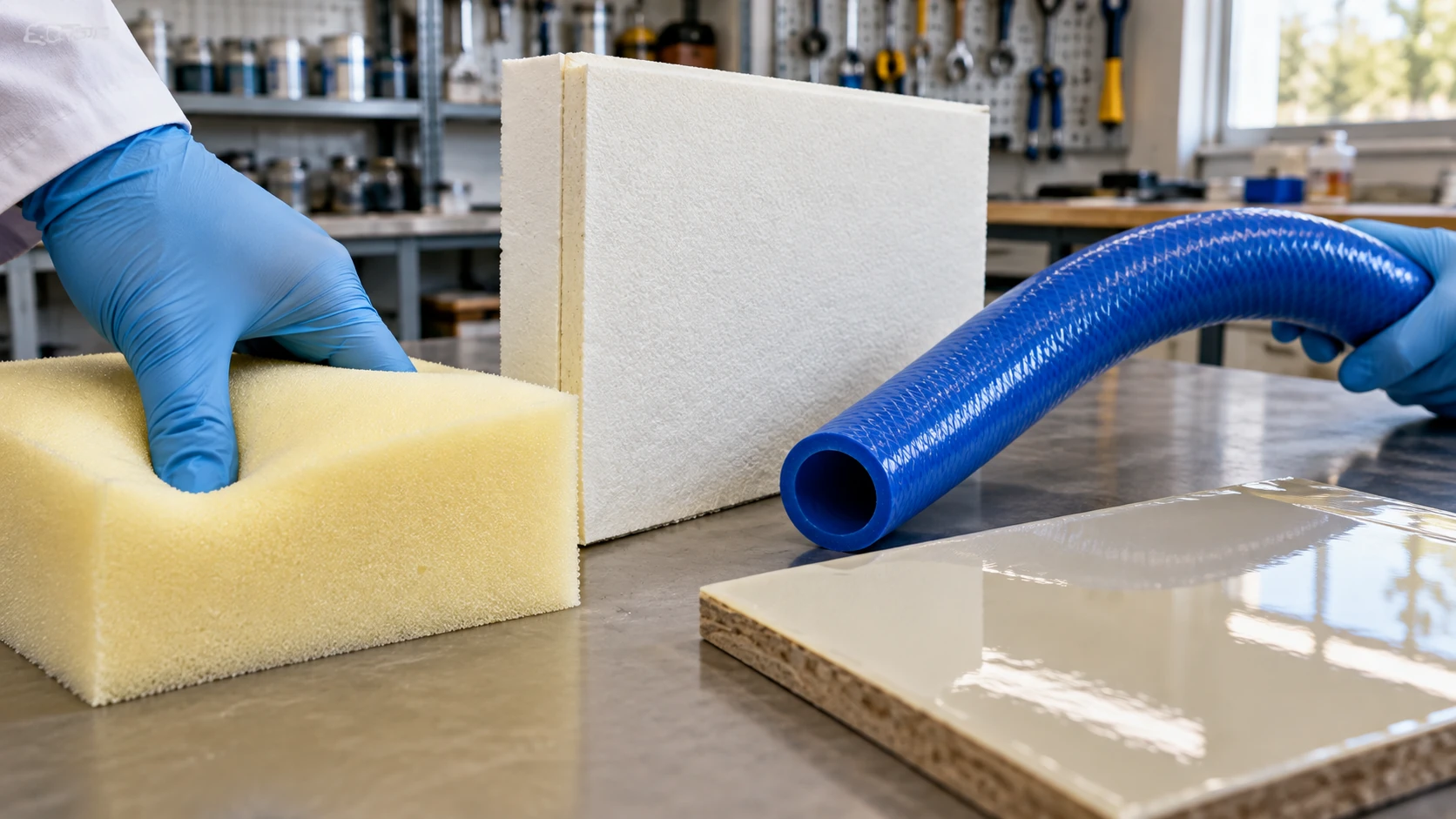
Polyurethane is the collective name for materials made by reacting an isocyanate with a polyol. The same reaction gives us seat cushions, refrigerator insulation, paints, adhesives, shoe soles and hoses. This article sets out, from published material, how the reaction works, how thermoplastic polyurethane (TPU) differs from rubber and thermoplastic elastomers (TPE), rubber vulcanisation, the recycling difficulty of materials that are hard to turn back, and the safety regulation of isocyanates.
- What polyurethanes and elastomers are (the short version)
- How the reaction works — isocyanates and polyols
- Five forms made from the same reaction
- A materials engineer's view (1): TPU is a design of hard and soft segments
- Telling rubber from thermoplastic elastomers (TPE)
- Rubber vulcanisation, and what it means to be thermoset
- A materials engineer's view (2): recycling is hard because the material will not melt
- A materials engineer's view (3): isocyanate safety and regulation
- What is still uncertain, and what this article leaves out
- Glossary / References / Claim-to-source audit
Sourced = content stated in published material, a standard, a regulation or a paper (link given)
Our calculation = a value this article derived from stated assumptions
Not yet confirmed = a plan or outlook with no confirmed track record
Structural readings and materials-design interpretations are marked separately as Commentary.
Property values are manufacturers' stated values or figures from review articles. Values for different grades, test methods and conditions are not lined up to rank one against another.
1. What polyurethanes and elastomers are (the short version)
- Polyurethane is the collective name for polymers containing the urethane linkage (–NH–COO–). OSHA explains that isocyanates (–NCO) react with compounds carrying hydroxyl groups to form polyurethanes, which are components of foams, thermoplastic elastomers, spandex fibres, paints and moreSourced [Ref. 13].
- Properties are tailored by combining soft and hard parts. A review states that the defining feature is hard segments derived from the isocyanate alternating with soft segments derived from the polyolSourced [Ref. 2].
- There are two ways to make a "rubber-like material". One is vulcanised rubber, which is chemically crosslinked and cannot be melted; the other is the thermoplastic elastomer (TPE), which is physically crosslinked and can be melted and moulded. TPU belongs to the latter (our organisation).
This family of materials comes with two constraints that other resins do not have. One is the safety of the isocyanate raw materials: in a 2020 regulation the EU made training a condition of using diisocyanatesSourced [Ref. 12]. The other is the difficulty of turning the material back: vulcanised rubber cannot be melted and re-mouldedSourced [Ref. 9], and mechanical recycling of polyurethane foam centres on grinding, bonding and pressingSourced [Refs. 1, 2]. Following where these two show up in design, evaluation and recycling is the subject of this article.
Our explainers on thermoplastics versus thermosets and on polymer fundamentals cover crosslinking and the basics of thermoplastic and thermoset behaviour. The relationship with polyamides (PEBA and others) is covered in our explainer on polyamides, and recycling in general in our explainers on plastic recycling and chemical recycling.
2. How the reaction works — isocyanates and polyols
ISOPA, the European association of diisocyanate and polyol producers, explains that polyurethane is what you get when a diisocyanate reacts with a compound carrying two or more hydroxyl groups (a polyol) to build a long polymer chainSourced [Ref. 1]. Covestro says that most isocyanates are liquids at room temperature and react with alcohols, amines, acids and also water, which puts strict constraints on how they are stored and usedSourced [Ref. 3].
According to a review (Kemona and Piotrowska, 2020), more than 70% of the polyols used as raw material are polyether polyols (polymers of propylene oxide or ethylene oxide). The properties of a polyol change with the number of hydroxyl groups, the molecular weight and the proportion of ethylene-oxide-derived groupsSourced [Ref. 2]. The same review also says that in foams that use water as the blowing agent, the reaction of isocyanate with water gives off carbon dioxide, and the amine formed then reacts with more isocyanate to make urea linkages, so water-blown foams contain many urea linkagesSourced [Ref. 2].
A word on how isocyanates are made. According to ISOPA, TDI is made by nitrating toluene to dinitrotoluene, reducing that to diaminotoluene (TDA) and reacting it with phosgene. MDI is made by forming methylenedianiline (MDA) from aniline and formaldehyde, reacting it with phosgene to give crude MDI, and purifying itSourced [Ref. 1]. The same document says TDI is used mainly to make flexible foam, and MDI to make rigid, flexible and elastomeric foams [Ref. 1].
The classification of this reaction differs between sources. The review [2] classes the polymers as condensation polymers, while KRAIBURG [7] calls them polyadducts. Because no small molecule is released in forming the bond, this article treats addition as the basic nature of the reaction (our commentary).
Comparing the NCO content of isocyanates
In formulation design, the amount of NCO groups on the isocyanate side is matched to the amount of hydroxyl groups on the polyol side. So for the main diisocyanates we calculate, from the formula weight of the pure monomer, the mass fraction of NCO groups and the NCO equivalent weight (mass per mole of NCO groups).
100 g of MDI (C15H10N2O2, formula weight 250.26) is 0.3996 mol and carries 0.7992 mol of NCO groups. Following the scheme in Fig. 1, in which two NCO groups react with one water molecule to give one molecule of carbon dioxide (and a urea linkage), the carbon dioxide released if all the NCO groups in 100 g of MDI reacted with water would be 0.3996 mol. At 24.47 L/mol at 25 °C and 1 atm, that is about 9.8 LOur calculation.
Assumptions and limits: in real foam formulations only part of the NCO groups is used on water. This value is an order-of-magnitude feel for "the upper limit if everything reacted with water"; it does not show the density or expansion ratio of any foam.
Unlike polyethylene or polypropylene, where a defined monomer gives a defined polymer, polyurethane takes its properties from which isocyanate is reacted with which polyol, in what ratio, and with what added. The review likewise explains that polyurethane is not a polymer with a single repeat unit but one in which different segments are joined by a variety of linkagesSourced [Ref. 2].
So the grade name of a material tells you little about what is inside, and the formulation (recipe) and reaction conditions become the de facto specification. In evaluation, too, you need to check lot-to-lot differences within one named material and changes over time after cure (our commentary). And as Fig. 2 shows, the same mass of isocyanate can react with hydroxyl groups in amounts that differ by about 1.6 times depending on type: the equivalent weight is 84.1 g/eq for HDI and 131.2 g/eq for H12MDIOur calculation.
3. Five forms made from the same reaction
The review divides polyurethanes broadly into foams and "CASE" (Coatings, Adhesives, Sealants, Elastomers), and splits foams into flexible (mattresses, car seats) and rigid (building insulation, commercial refrigeration)Sourced [Ref. 2]. We reorganise these further into five forms, following what is published for each application.
| Form | What is written about raw materials and character | Example applications (as stated) | Source |
|---|---|---|---|
| Flexible foam | Made from TDI or MDI and a polyether polyol | Cushioning for furniture and bedding, car seats | ISOPA [1] |
| Rigid foam | Made from MDI and a polyether polyol. Good thermal insulation | Freezers and refrigerators, construction, automotive | ISOPA [1] |
| Paints | One-component (moisture-curing) and two-component types. HDI, IPDI and H12MDI systems resist light, while TDI and MDI systems tend to yellow in light and lose gloss | Automotive refinishing, aircraft and rail vehicles, anticorrosion, woodworking and furniture | Covestro [5] |
| Adhesives and sealants | Formulated by combining a polyisocyanate such as Desmodur with a polyol | No application-specific examples on that page | Covestro [4] |
| Elastomers | TPU is processed by extrusion, injection moulding and similar methods. BASF's Elastollan ranges in hardness from Shore 45 A to 83 D (including plasticised grades) | Hoses, cable sheathing, conveyor belts, films, profiles, shoe soles | BASF [6] |
All are statements in the companies' and associations' published material (Sourced). The hardness range is that of BASF's whole Elastollan range, not a value for any individual grade.
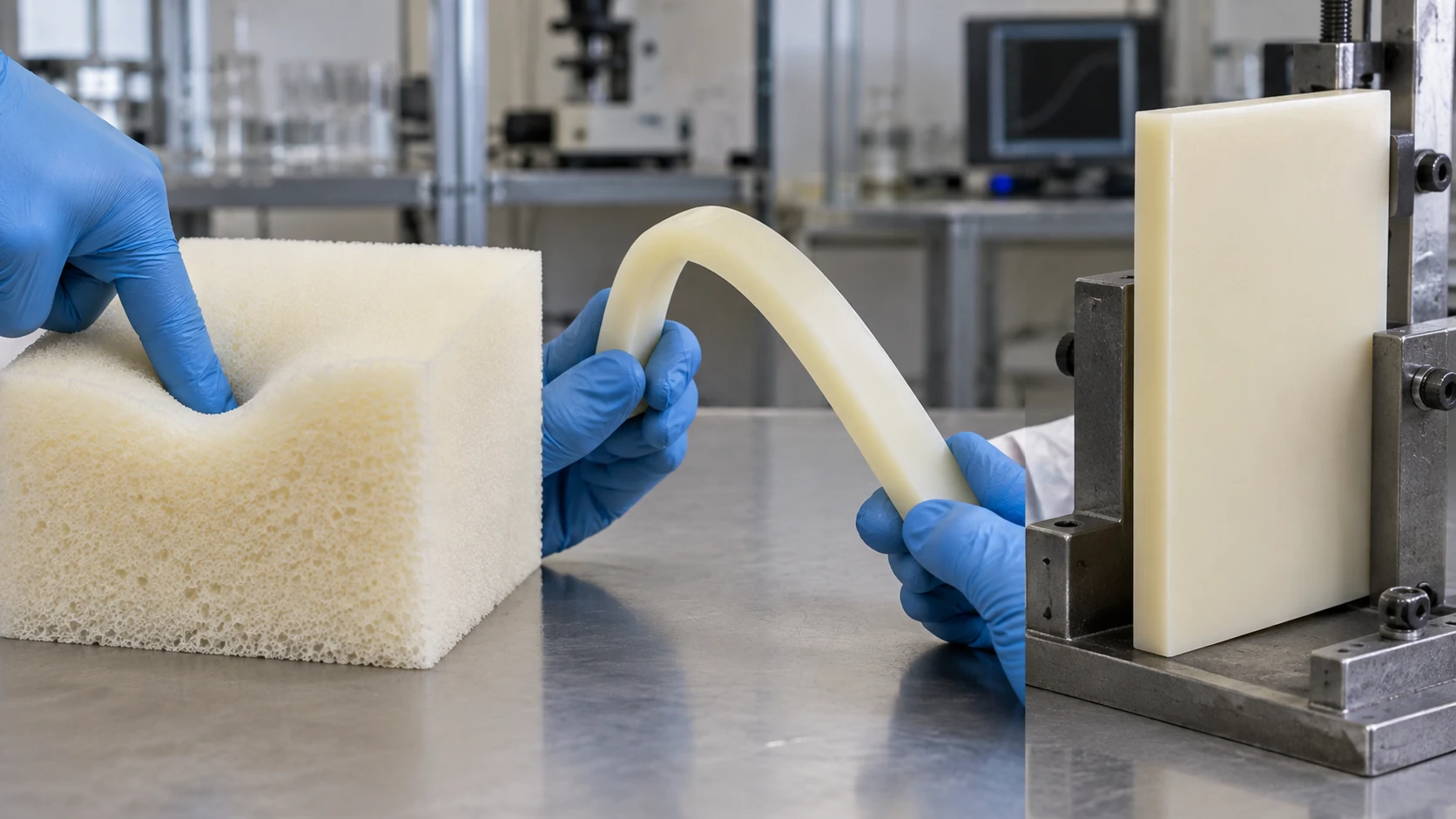
According to the review, foam has the largest production volume and is at the same time the biggest recycling challenge [Ref. 2] (taken up in Section 7).
4. A materials engineer's view (1): TPU is a design of hard and soft segments
Among polyurethane elastomers, the one that can be melted and moulded is thermoplastic polyurethane (TPU). KRAIBURG explains that TPU is generally a polyadduct of a polyisocyanate and a polyol, and that in many cases its properties are set by the choice and combination of raw materials at polymerisationSourced [Ref. 7].
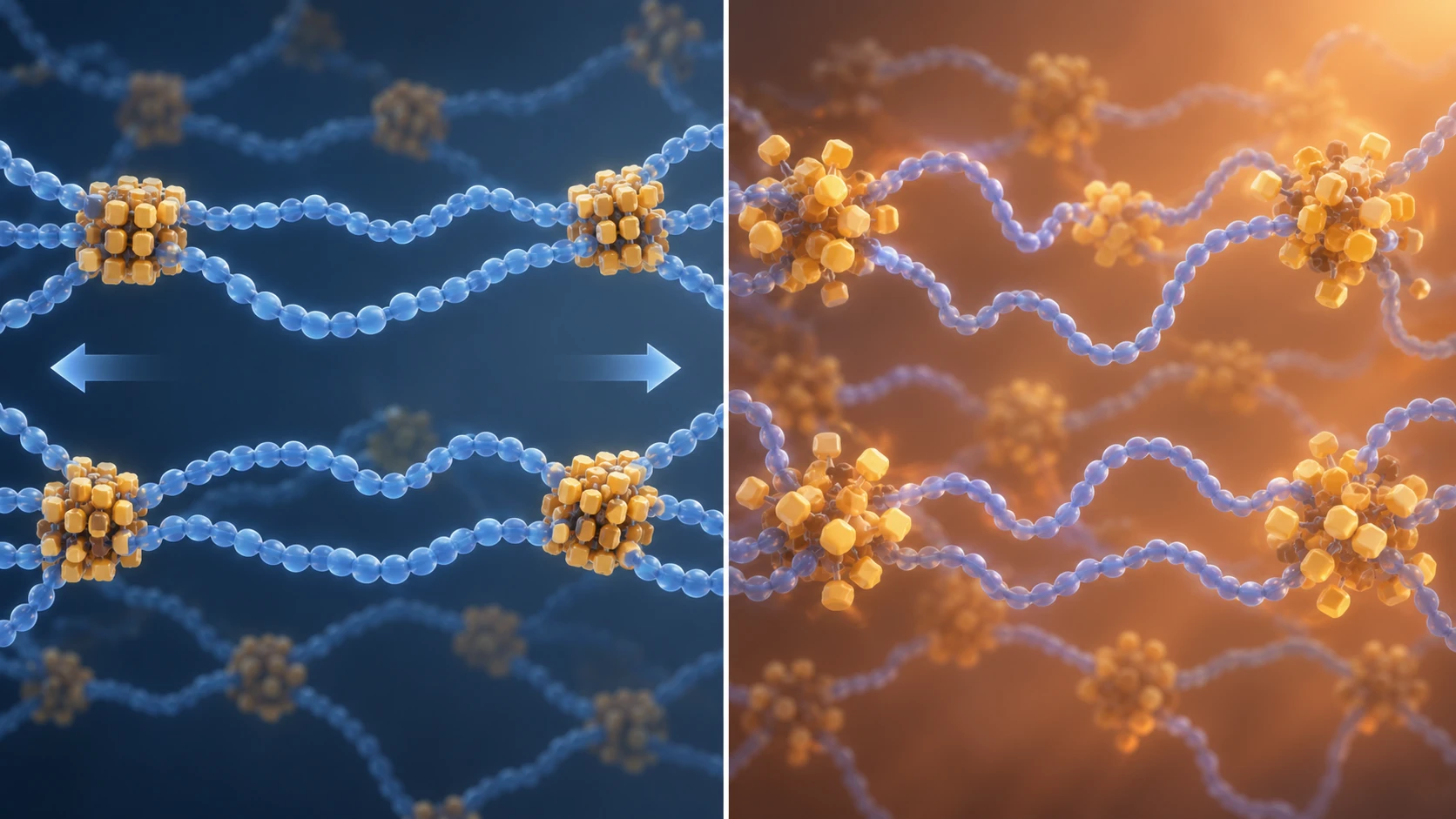
ImageGen conceptual illustration (not a real photograph or measurement). See the original diagram for exact values, names and structure.
Show original diagram with exact annotations and values
BASF publishes its Elastollan range divided into "lines" such as polyether, polyester and aliphatic. Here are the published descriptions side by side.
| Line (chemistry) | Hardness range | BASF's description |
|---|---|---|
| 11 (ether-based) | 50 A to 75 D | Excellent resistance to hydrolysis, flexibility at low temperature and resistance to microbes |
| C (ester-based) | 80 A to 73 D | Excellent mechanical properties, very good damping, good rebound resilience and very good abrasion resistance |
| A (aliphatic, ether- or ester-based) | 65 A to 55 D | Resists discolouration and does not yellow. The ether-based type resists hydrolysis |
| R (ester-based, glass-fibre-reinforced) | Modulus 1,000 to 14,000 MPa | Very high stiffness, with low thermal expansion and shrinkage. Injection-moulded engineering applications |
| BMB (biomass balance) | 70 A to 95 A | Saves fossil raw material by a mass-balance approach. Product quality and properties are stated to be identical |
All are statements in BASF's published material (Sourced) [Ref. 6]. The hardness ranges include plasticised grades. Shore hardness testing is specified in ISO 48-4 [Ref. 18] and tensile stress-strain properties in ISO 37 [Ref. 17].
In the table above, hardness runs from Shore 50 A (comparable to a soft rubber) to glass-fibre-reinforced grades with a modulus of 1,000 to 14,000 MPaSourced [Ref. 6]. KRAIBURG says the hardness of TPU generally lies between Shore 60 and 80 D [Ref. 7], whereas BASF's range also contains many Shore A lines (50 to 95 A). The difference between the two sources is most likely that one gives the "typical range" for TPU as a class of TPE while the other gives the range of its own whole product line (our commentary). When you read a number, always check what range it describes.
Another point needing care is choosing between "ether-based" and "ester-based". BASF names resistance to hydrolysis as a strength of its ether-based line [Ref. 6]. KRAIBURG likewise cautions that TPU is prone to degrade by hydrolysis on contact with water or aqueous solutions, especially at high temperatureSourced [Ref. 7]. The ester linkages of a polyester are vulnerable to water, so in applications that see water and heat, the type of polyol can decide the service life (our commentary; BASF does not say that its ester-based types are inferior in hydrolysis resistance). For the link with water, it helps to read this alongside the chapters on water absorption and hydrolysis in our explainer on polyamides.
On processing, KRAIBURG stresses that thorough pre-drying is essential for moulding and extruding TPU, and that excessive temperature, shear or residence time causes thermal degradation, leaving it sticky or decomposedSourced [Ref. 7].
5. Telling rubber from thermoplastic elastomers (TPE)
"Rubber", "elastomer" and "TPE" are used loosely in daily speech, but they can be clearly distinguished by structure and processing. ISO sets the abbreviations and names for rubbers in ISO 1629 (Rubber and latices — Nomenclature) and the names and abbreviations for thermoplastic elastomers in ISO 18064, in each case on the basis of chemical compositionSourced [Refs. 15, 16]. KRAIBURG lists the TPE classes under ISO 18064 as TPU (thermoplastic polyurethane), TPV (thermoplastic vulcanisate), TPO (olefinic), TPC (copolyester), TPA (copolyamide) and TPS (styrenic block copolymer)Sourced [Ref. 7].
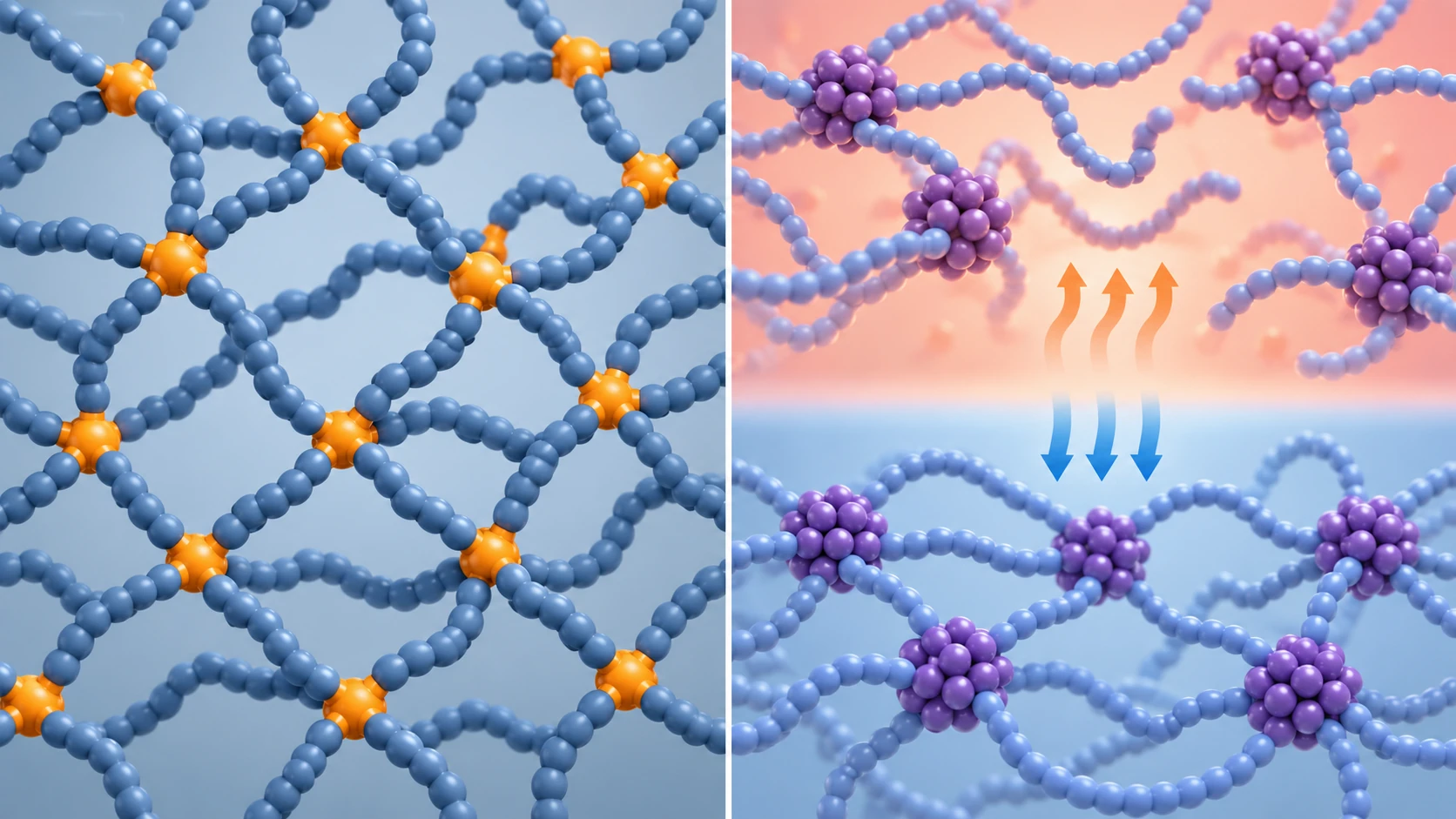
ImageGen conceptual illustration (not a real photograph or measurement). See the original diagram for exact values, names and structure.
Show original diagram with exact annotations and values
| Class | Structure and processing as stated | Hardness and character (as stated) | Source |
|---|---|---|---|
| Vulcanised rubber | Chemically crosslinked and cannot be melted (devulcanisation is an operation that breaks sulfur bonds) | Cannot be melt-processed, and is hard to recycle | Markl et al. [9] KRAIBURG [8] |
| TPU | A polyadduct of a polyisocyanate and a polyol. Processed by injection moulding and extrusion | Typically Shore 60 to 80 D. Resists non-polar oils and fuels, and hydrolyses easily in water and aqueous solutions. High abrasion resistance | KRAIBURG [7] |
| TPS | A soft mid-block with hard polystyrene end-blocks. Treated as a type of polymer blend | From about Shore 00 30 to Shore 60 D. Can be modified in many ways. Inferior to TPU in non-polar media and in abrasion | KRAIBURG [7] |
| TPV | A combination of EPDM and polypropylene is typical. Dynamically crosslinked during manufacture | Shore 40 A to 70 D. Good compression set. Suited to extrusion | KRAIBURG [7] |
| TPA (PEBA) | Evonik's VESTAMID E is a polyether block amide combining PA12 and a polyether | Elasticity, light weight, design freedom | Evonik [11] |
All are statements in the companies' published material (Sourced). The hardness ranges are the "typical ranges" given by each company; they are not values for individual grades and do not rank the TPE classes against one another.
KRAIBURG divides TPEs into "reactor-made types" (TPA, TPU, TPC and others, in which the properties are built into a single polymer) and "TPE compounds" (TPS, TPV and others, made by mixing different polymers)Sourced [Ref. 8]. TPU belongs to the former, so the recipe is fixed at the polymerisation stage (our commentary). The latter mix existing polymers, so KRAIBURG says they offer greater freedom to modify (colour, flame retardancy, conductivity and so on) [Ref. 7].
When replacing rubber with TPE, the first things compared are hardness and strength, but the items where differences tend to show up are different ones.
- Compression set: in applications such as seals that are held under constant compression, the compression set specified in ISO 815-1 [Ref. 19] governs the service life. KRAIBURG says TPV is a good choice for compression setSourced [Ref. 7]. It differs between TPE classes, so you need to name the class and check at the service temperature and time (our commentary).
- Service temperature: TPE loses properties above the temperature at which its hard phase loosens. Because physical crosslinks release on heating, the upper service temperature can be lower than for vulcanised rubber (our commentary; specific temperatures could not be confirmed within the scope of this article).
- Media: each class has its strengths and weaknesses, for example TPU resists oils and fuels but not water, while TPS and TPV resist water and acidsSourced [Ref. 7].
- Process: KRAIBURG says TPEs can be processed by injection moulding and extrusion, with short cycles, and that multi-material moulding can cut assembly costs [Ref. 8]. With no vulcanisation step needed, the process may be simpler (our commentary).
6. Rubber vulcanisation, and what it means to be thermoset
The defining feature of vulcanised rubber is that its molecular chains are joined into a network by chemical bonds. A review by Markl and Lackner (Materials, 2020) states that vulcanised rubber cannot be melted again and is especially difficult to put to new uses, and that current routes for end-of-life tyres and similar waste centre on landfill, incineration in cement works and similar plants, and grinding to fine powderSourced [Ref. 9]. The same review describes devulcanisation as a technology that breaks the sulfur bonds by chemical, thermophysical or biological means so that the crosslinked polymer can be used as a material again, and says it has been studied for more than 50 yearsSourced [Ref. 9].
The chemistry of vulcanisation and crosslinking is summarised in Akiba's review "Vulcanization and crosslinking in elastomers" (Prog. Polym. Sci., 1997)Sourced [Ref. 10] (confirmed from the title; the full text was not checked, so its content is not quoted).
Rubber elasticity arises because the molecular chains are tied into a network. When you stretch the material, the network holds the chains in place, so it springs back when the force is released. The same network stops the chains flowing even on heating, so the material can no longer be shaped by re-melting (our commentary).
This is the flip side of the point in the previous section that the physical crosslinks of TPE release on heating. "Elasticity that returns" and "processability that can be melted back" divide according to whether the crosslinks are chemical bonds or physical aggregations. Polyurethane foam is also a thermoset material with many crosslinks and carries the same constraint (our commentary; for the basics of thermoplastics and thermosets, see our explainer on thermoplastics and thermosets).
7. A materials engineer's view (2): recycling is hard because the material will not melt
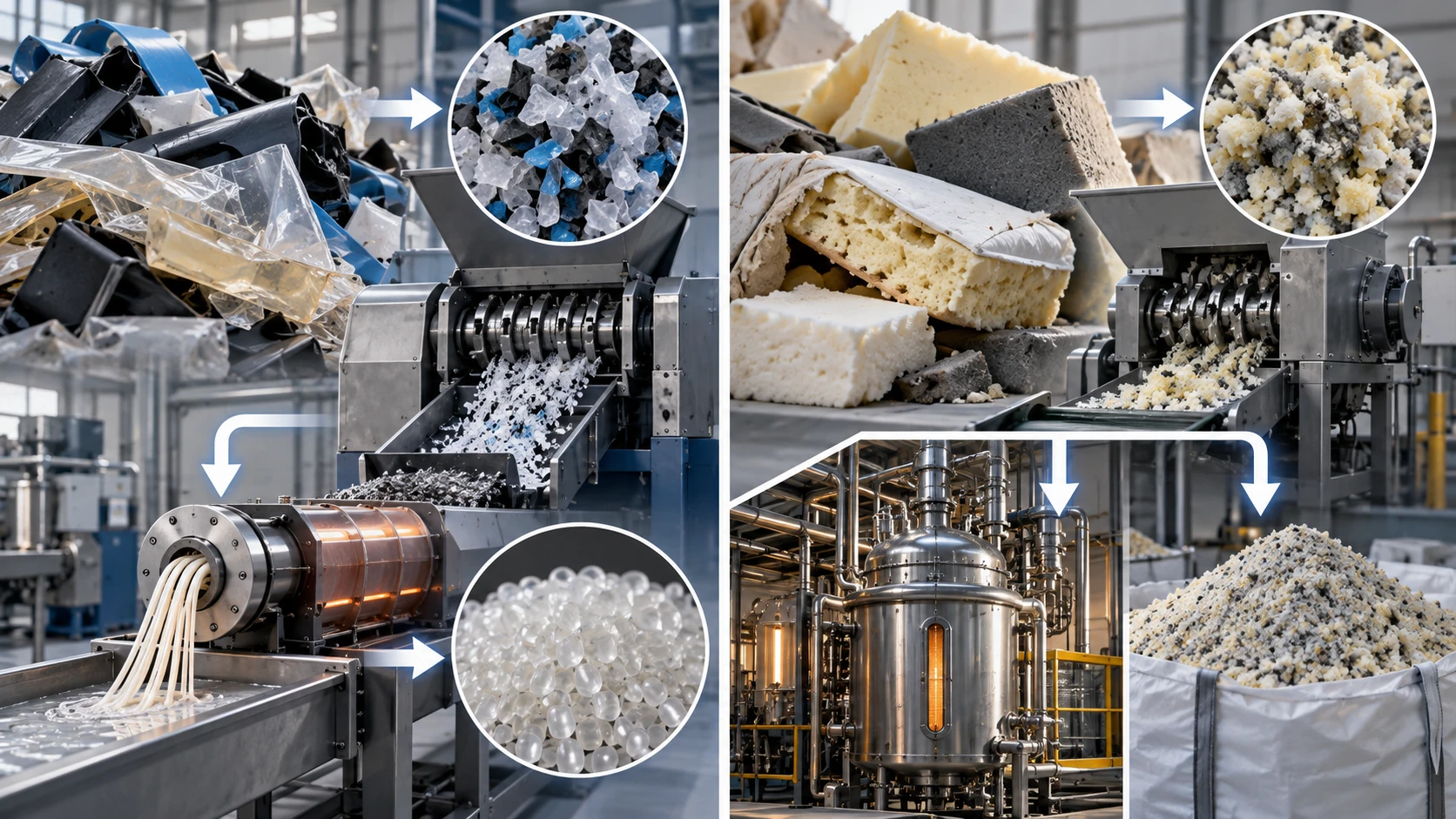
ImageGen conceptual illustration (not a real photograph or measurement). See the original diagram for exact values, names and structure.
Show original diagram with exact annotations and values
(1) Polyurethane foam — mechanical and chemical recycling
The review (Kemona and Piotrowska, 2020) divides polyurethane waste into end-of-life products and manufacturing offcuts, and says offcuts can reach up to 10% of productionSourced [Ref. 2]. It also notes that end-of-life products are dirty or deformed and so poorly suited to reuse. On the mainstream route, it writes that around half of the waste was being landfilled as of 2020 (the review's statement) [Ref. 2].
Mechanical recycling includes grinding the foam for use as filling in pillows and toys, and "rebonding", in which foam offcuts are bound with adhesive into a denser product. Grinding to a fine powder for use as a filler in new polyurethane is also possible, but the viscosity of the foam limits it, the economics are poor and the resulting quality is limited [Ref. 2]. Of the methods for processing polyurethane waste, the review says the ones that matter now are mechanical recycling and glycolysis [Ref. 2]. ISOPA also says there are mechanical methods (regrinding, bonding, pressing, moulding) and chemical ones (glycolysis, hydrolysis, pyrolysis), and that where contamination or the difficulty of collection and breakdown makes recycling uneconomic (automotive shredder residue, for example), energy recovery is still chosenSourced [Ref. 1].
(2) TPU and TPE — melt them and they come back
KRAIBURG explains that TPE can be processed by heat and returns to its original elasticity on cooling, so it can be reclaimed like a thermoplastic, whereas elastomers cannot be melted and processed because they are chemically crosslinked and cannot be reclaimedSourced [Ref. 8] (the company's own account).
(3) Vulcanised rubber — devulcanisation is the focus of research
As noted above, current routes centre on landfill, incineration and grinding, and devulcanisation continues to be studied as a way to change that [Ref. 9].
The review's figure that "manufacturing offcuts can reach up to 10% of production" [Ref. 2] means that this is a resource that turns up in your own process without waiting for end-of-life collection. A thermoplastic can be ground and fed back in within the process. For thermoset foam, the main outlets for offcuts are grinding for filler and rebonding with adhesive, not a route back to foam of the original performance (our commentary).
So at the design stage you have to decide whether to make it a "material that can be melted back" or to turn it into some other value on the premise that it will not melt. This ease of recovery is one of the reasons for choosing TPU or TPE. Conversely, for applications that presuppose thermoset behaviour, such as foam, research on depolymerisation (glycolysis and the like) to return the polyol is advancing, but we could not confirm a primary source showing commercial-scale implementation within the scope of this article.
8. A materials engineer's view (3): isocyanate safety and regulation
Isocyanates, the raw materials of polyurethane, receive special treatment in safety and regulation. This section keeps to published facts (for specific working practices, follow each company's safety data sheets and the guidance of the competent authority).
(1) How the health effects are classified
- EU: according to the recitals of Regulation (EU) 2020/1149, diisocyanates carry a harmonised classification as respiratory sensitisers (category 1) and skin sensitisers (category 1). The document behind the restriction estimates new occupational diseases caused by diisocyanates at more than 5,000 cases a year and calls this an unacceptable level. It also assessed that, because no threshold for sensitisation is known, occupational exposure limits alone would not reduce cases of occupational asthma sufficientlySourced [Ref. 12].
- United States: OSHA lists the health effects of exposure to isocyanates as irritation of the skin and mucous membranes, chest tightness and difficulty breathing, and says the main effects are lung problems such as occupational asthma. It also notes that they include compounds classified as potential human carcinogensSourced [Ref. 13].
- Japan: the model safety data sheet (model SDS) for 2,4-toluene diisocyanate (revised 2018) on the Ministry of Health, Labour and Welfare's Workplace Safety Site gives a GHS classification of category 1 for respiratory and skin sensitisation and category 2 for carcinogenicity, and a control concentration of 0.005 ppmSourced [Ref. 14].
(2) What the EU restriction says
Regulation (EU) 2020/1149 adds entry 74 to Annex XVII of REACH, and provides as follows for diisocyanates (O=C=N–R–N=C=O, where R is an aliphatic or aromatic hydrocarbon group)Sourced [Ref. 12].
- On their own, as constituents of other substances, or in mixtures, they shall not be used for industrial or professional purposes after 24 August 2023. Exceptions apply where the diisocyanate concentration is below 0.1% by weight, individually or in total, or where the employer or similar party ensures that the user has completed training on the safe use of diisocyanates beforehand.
- Where they are placed on the market on or after 24 February 2022 for industrial or professional use, the supplier must, apart from the same concentration exception, provide the recipient with information on the training requirement and show a specified statement prominently on the packaging.
- The training includes instruction on controlling skin and inhalation exposure and is delivered by an occupational safety and health professional. The training content required is set out in levels according to the use.
What this restriction requires is training of the people who handle diisocyanates; it does not prohibit the use of cured polyurethane products. The text of the regulation also defines its subjects as industrial and professional users (the workers who handle the substance and their supervisors) [Ref. 12]. For materials makers and processors, the 0.1% by weight threshold is the practical boundary in formulation design, because substances and mixtures with a diisocyanate concentration below the threshold fall outside this restriction. That is a statement about the scope of the regulation, however, and does not mean that a lower concentration is safe (our commentary).
On properties, Covestro says that most isocyanates are liquids at room temperature with little odour and weak warning properties. It also explains that HDI and TDI are more volatile than MDI and similar compounds, and that polyisocyanates of HDI and TDI were developed originally to reduce evaporation and so lower the inhalation hazardSourced [Ref. 3]. OSHA names, among the operations in which exposure can occur, painting, foam blowing and the manufacture of polyurethane products, as well as the thermal decomposition of polyurethane products [Ref. 13]. Covestro cautions that when nitrogen-containing materials burn, hydrogen cyanide can be released, not only from isocyanate-based polyurethane products [Ref. 3].
9. What is still uncertain, and what this article leaves out
- The upper service temperature of TPE: specific temperatures vary greatly between classes and could not be confirmed in the material we opened.
- Commercial scale of chemical recycling of polyurethane: methods such as glycolysis are described in the review, but we could not confirm a primary source showing commercial-scale implementation.
- Commercialisation of non-isocyanate polyurethanes: not covered here.
- Production volumes, market size and recycling rates: not covered, because our policy is not to use estimates from market research firms. We also do not quote industry-body figures cited in the review, because we could not confirm their definitions and years.
- The content of Akiba's review: we confirmed its existence from the title, but have not checked the full text and do not quote its content.
- Additional national regulation (the legal classification of specified chemical substances in Japan, for example): for Japan we keep to the control concentration and GHS classification in the Ministry of Health, Labour and Welfare's model safety data sheet, and have not confirmed the legal classification.
- Polyurethane is a formulated material. The NCO equivalent weight of diisocyanates spans about 1.6 times, from 84.1 g/eq for HDI to 131.2 g/eq for H12MDIOur calculation.
- TPU covers "rubber to engineering plastic" in one family. BASF's Elastollan runs from Shore 45 A to 83 D, and the glass-fibre-reinforced grades have a modulus of 1,000 to 14,000 MPaSourced.
- The difference between rubber and TPE is whether the crosslinks are chemical bonds or physical aggregations (our commentary).
- The difficulty of turning material back comes from not melting. Vulcanised rubber cannot be re-melted, and about half of polyurethane waste was landfilled (a 2020 review's statement)Sourced.
- The EU imposes a training requirement on diisocyanates, except below 0.1% by weight. For industrial and professional use it applies from 24 August 2023Sourced.
10. Glossary
- Polyurethane (PU)
- The collective name for polymers containing the urethane linkage (–NH–COO–). Made by reacting an isocyanate with a polyol.
- Isocyanate
- A compound carrying the –N=C=O (NCO) group. It reacts with hydroxyl groups, amines and water. Diisocyanates are the raw materials.
- Polyol
- A compound with two or more hydroxyl groups. Polyether and polyester types are the main ones.
- TDI, MDI, HDI
- The toluene, diphenylmethane and hexamethylene diisocyanates. The first two are aromatic; HDI is aliphatic.
- NCO equivalent weight
- The mass of material per mole of NCO groups. Matched against the hydroxyl equivalent weight in formulation.
- Hard / soft segment
- The hard part (from the isocyanate) and the soft part (from the polyol) of a polyurethane chain.
- TPU
- Thermoplastic polyurethane. A polyurethane elastomer that can be melted and moulded.
- TPE
- Thermoplastic elastomer. The collective name for materials that combine rubber elasticity with the processability of a thermoplastic.
- TPS, TPV
- A TPE based on a styrenic block copolymer, and a TPE in which dynamically crosslinked rubber is dispersed in a resin.
- Vulcanisation
- The process of crosslinking the molecular chains of rubber into a network by chemical bonds, giving elasticity and strength.
- Devulcanisation
- A technology that breaks the sulfur bonds of vulcanised rubber to return it to a reusable state.
- Shore hardness
- Hardness measured by durometer indentation. There are A and D scales and others (ISO 48-4).
- Compression set
- The deformation that remains after compression is released. A guide to the service life of a sealing material (ISO 815-1).
- CASE
- Short for Coatings, Adhesives, Sealants, Elastomers. The group of polyurethane applications other than foam.
- Respiratory sensitisation
- A property by which inhalation triggers an immune response that causes asthma and similar reactions on re-exposure. Diisocyanates are category 1.
11. References
- ISOPA Eco-profile of toluene diisocyanate (TDI) and methylene diphenyl diisocyanate (MDI), April 2021 (PDF) — www.isopa.org
- Kemona, Piotrowska "Polyurethane Recycling and Disposal: Methods and Prospects", Polymers 2020, 12, 1752 — doi.org
- Covestro "Questions and Answers About Safe Use and Handling — Isocyanates" (PDF) — solutions.covestro.com
- Covestro "Desmodur®" brand page — solutions.covestro.com
- Covestro "Solventborne coatings & paints" — solutions.covestro.com
- BASF "Think, create, Elastollan® Thermoplastic Polyurethane Elastomers (TPU)" brochure (PDF) — download.basf.com
- KRAIBURG TPE "What are TPEs? Possibilities and limits of TPE classes" — www.kraiburg-tpe.com
- KRAIBURG TPE "What is TPE?" — www.kraiburg-tpe.com
- Markl, Lackner "Devulcanization Technologies for Recycling of Tire-Derived Rubber: A Review", Materials 2020, 13, 1246 — doi.org
- Akiba "Vulcanization and crosslinking in elastomers", Progress in Polymer Science 1997, 22, 475 — doi.org
- Evonik "VESTAMID®" product page (PA12, PA612, PEBA) — www.evonik.com
- European Commission Commission Regulation (EU) 2020/1149 of 3 August 2020 (REACH Annex XVII, diisocyanates) — eur-lex.europa.eu
- OSHA "Isocyanates — Overview" — www.osha.gov
- Ministry of Health, Labour and Welfare (Japan) Workplace Safety Site, safety data sheet "2,4-Toluene diisocyanate" (model SDS; in Japanese) — anzeninfo.mhlw.go.jp
- ISO ISO 18064:2022 Thermoplastic elastomers — Nomenclature and abbreviated terms — www.iso.org
- ISO ISO 1629:2025 Rubber and latices — Nomenclature — www.iso.org
- ISO ISO 37:2024 Rubber, vulcanized or thermoplastic — Determination of tensile stress-strain properties — www.iso.org
- ISO ISO 48-4:2018 Rubber, vulcanized or thermoplastic — Determination of hardness — Part 4: Indentation hardness by durometer method (Shore hardness) — www.iso.org
- ISO ISO 815-1:2019 Rubber, vulcanized or thermoplastic — Determination of compression set — Part 1: At ambient or elevated temperatures — www.iso.org
12. Claim-to-source audit
| Claim in the text | Basis | Label |
|---|---|---|
| That polyurethane is formed by the reaction of a diisocyanate with a compound carrying two or more hydroxyl groups; that TDI is used mainly for flexible foam and MDI for rigid, flexible and elastomeric foams; applications of flexible foam (furniture, bedding, car seats) and rigid foam (freezers and refrigerators, construction, automotive); the manufacturing routes for TDI (toluene, dinitrotoluene, TDA, phosgene) and MDI (aniline and formaldehyde, MDA, phosgene, crude MDI, purification); that recycling methods include mechanical (regrinding, bonding, pressing, moulding) and chemical (glycolysis, hydrolysis, pyrolysis); and that energy recovery is chosen where contamination or difficulty of breakdown makes recycling uneconomic | ISOPA eco-profileReference 1 https://www.isopa.org/wp-content/uploads/2022/09/ISOPA_Eco-profile_TDI_MDI_2021.pdf | Sourced |
| That polyurethane is a polymer derived from the condensation of polyfunctional isocyanates and polyhydric alcohols; the classification into foam and CASE (coatings, adhesives, sealants, elastomers) and the applications of flexible and rigid foam; that more than 70% of polyols are polyether polyols; the carbon dioxide and urea linkages in water-blown foam; that hard segments (isocyanate) and soft segments (polyol) alternate; that offcuts can reach up to 10% of production, the contamination and deformation of end-of-life products, landfilling of about 50% (as of 2020), and that mechanical recycling (grinding, filler, rebonding) and glycolysis are currently the important routes; and that foam viscosity limits fine grinding | Kemona and Piotrowska reviewReference 2 https://doi.org/10.3390/polym12081752 | Sourced |
| That most isocyanates are liquids at room temperature with little odour and weak warning properties; that they react with alcohols, amines, acids and water; that hydrogen cyanide can be released on burning of nitrogen-containing materials in general; and that HDI and TDI evaporate faster than the others and polyisocyanates of HDI and TDI were developed to reduce evaporation | Covestro isocyanates Q&AReference 3 https://solutions.covestro.com/-/media/covestro/corporate/productsafetyfirst/resources/isocyanates-qa-en.pdf | Sourced |
| That Desmodur is a polyisocyanate for flexible and rigid foams, binders, paints, adhesives and sealants | Covestro Desmodur pageReference 4 https://solutions.covestro.com/en/brands/desmodur | Sourced |
| Applications of solventborne one- and two-component polyurethane paints (automotive refinishing, aircraft and rail vehicles, plastics, anticorrosion, woodworking and furniture); that TDI and MDI systems tend to yellow in light and lose gloss, while HDI, IPDI and H12MDI systems resist light | Covestro coatings pageReference 5 https://solutions.covestro.com/en/highlights/articles/theme/product-technology/solventborne-coatings-and-paints | Sourced |
| The chemistry of the Elastollan lines (11, C, A, R, BMB and others) (ether, ester, aliphatic), the hardness ranges (Shore 45 A to 83 D overall, including plasticised grades), the descriptions (resistance to hydrolysis, damping, light resistance, a modulus of 1,000 to 14,000 MPa for glass-fibre-reinforced grades and so on), applications (hoses, cable sheathing, belts, films, shoe soles) and processing methods | BASF Elastollan brochureReference 6 https://download.basf.com/p1/8a8082587fd4b608017fd63b8e444a55/en/Elastollan%3Csup%3E%C2%AE%3Csup%3E_%E2%80%93_Thermoplastic_Polyurethane_Elastomers_(TPU)_Brochure_English.pdf | Sourced |
| That TPU is generally a polyadduct of a polyisocyanate and a polyol whose properties are set by the choice of raw materials at polymerisation; that TPU hardness is typically Shore 60 to 80 D, it hydrolyses easily in water and aqueous solutions, needs thorough pre-drying, and must be protected from thermal degradation; the features of TPS (about Shore 00 30 to 60 D) and TPV (40 A to 70 D, EPDM plus PP, dynamically crosslinked, good compression set); and the classification of TPE (TPU, TPV, TPO, TPC, TPA, TPS) | KRAIBURG TPE classes pageReference 7 https://www.kraiburg-tpe.com/vi/node/1230 | Sourced |
| The division of TPE into reactor types (TPA, TPU, TPC) and compound types (TPS, TPV); that TPE can be processed by heat and reclaimed while elastomers cannot be melted or reclaimed; and the advantages of TPE (ease of processing, short cycles, lower assembly cost through multi-material moulding) | KRAIBURG "What is TPE?" pageReference 8 https://www.kraiburg-tpe.com/en/thermoplastic-elastomers (the company's own account) | Sourced |
| That vulcanised rubber cannot be re-melted and that disposal routes centre on landfill, incineration and grinding; that devulcanisation (breaking sulfur bonds by chemical, thermophysical or biological means) has been studied for more than 50 years | Markl and Lackner reviewReference 9 https://doi.org/10.3390/ma13051246 | Sourced |
| That a review exists dealing with the chemistry of vulcanisation and crosslinking (only the title was confirmed; the full text was not checked) | Akiba reviewReference 10 https://doi.org/10.1016/s0079-6700(96)00015-9 | Sourced |
| That VESTAMID E is a PEBA combining PA12 and a polyether, with elasticity, light weight and design freedom | Evonik VESTAMID pageReference 11 https://www.evonik.com/en/company/businesslines/hp/polyamides/vestamid.html | Sourced |
| The recitals and annex of Regulation (EU) 2020/1149: respiratory and skin sensitisation (category 1) of diisocyanates; the estimate of more than 5,000 occupational diseases a year; that no sensitisation threshold is known; the 0.1% by weight threshold; the Official Journal publication date of 4 August 2020; entry 74 (for industrial and professional use from 24 August 2023, conditional on a concentration below 0.1% by weight or completed training); the information and packaging requirements for supply from 24 February 2022; and the content and levels of the training | European Commission regulationReference 12 https://eur-lex.europa.eu/eli/reg/2020/1149/oj/eng | Sourced |
| OSHA's account: that isocyanates (–NCO) react with hydroxyl groups to form polyurethane; the health effects (irritation of skin and mucous membranes, chest tightness, difficulty breathing, occupational asthma); that they include compounds classified as potential human carcinogens; and the operations in which exposure can occur (painting, foam blowing, manufacture of polyurethane products, thermal decomposition) | OSHA isocyanates overviewReference 13 https://www.osha.gov/isocyanates | Sourced |
| The GHS classification (respiratory and skin sensitisation category 1, carcinogenicity category 2) and the control concentration of 0.005 ppm in the model SDS for 2,4-toluene diisocyanate (revised 2018) | Ministry of Health, Labour and Welfare model SDSReference 14 https://anzeninfo.mhlw.go.jp/anzen/gmsds/584-84-9.html | Sourced |
| That ISO 18064 specifies the nomenclature and abbreviations of thermoplastic elastomers, ISO 1629 those of rubber and latices, ISO 37 tensile stress-strain properties of rubber, ISO 48-4 hardness (Shore hardness) and ISO 815-1 compression set (limited to titles and descriptions of scope; the full texts are paid) | ISO standards, catalogue pagesReference 15 https://www.iso.org/standard/80849.htmlReference 16 https://www.iso.org/standard/88692.htmlReference 17 https://www.iso.org/standard/86892.htmlReference 18 https://www.iso.org/standard/74969.htmlReference 19 https://www.iso.org/standard/74943.html | Sourced |
| NCO content of isocyanates (HDI 50.0%, TDI 48.3%, IPDI 37.8%, MDI 33.6%, H12MDI 32.0%) and NCO equivalent weights (84.1, 87.1, 111.1, 125.1, 131.2 g/eq), and the difference in equivalent weight of about 1.6 times | Our calculation. Values from the formula weights of the pure monomers (C 12.011, H 1.008, N 14.007, O 15.999). They differ from commercial polymeric MDI and prepolymers | Our calculation |
| The amount of carbon dioxide if all the NCO groups in 100 g of MDI reacted with water (0.3996 mol; about 9.8 L at 25 °C and 1 atm) | Our calculation. Assumes one water molecule for two NCO groups (the scheme in Fig. 1) and a molar volume of 24.47 L/mol at 25 °C and 1 atm. An order-of-magnitude upper limit, not a value for a real foam formulation | Our calculation |
| The framing of polyurethane as a "formulated material"; the treatment of the reaction as basically an addition reaction (the review classes it as condensation, KRAIBURG as polyaddition); the grouping into five forms; the framing of TPU as covering "rubber to engineering plastic" and the reading that the two sources' hardness figures differ because of how the range is defined; the interpretation that ester linkages are vulnerable to water so the polyol type decides service life; the thinking on physical crosslinks and service temperature in TPE; the link between rubber crosslinking and the inability to re-melt; the reading of the value of manufacturing offcuts; and the reading of the 0.1% by weight threshold | This article's own organisation and commentary based on published content. Not views expressed by any company or institution | Commentary |
| The upper service temperature of TPE, the commercial scale of chemical recycling of polyurethane, the legal classification in Japan and the content of Akiba's review | Not given, because primary sources could not be confirmed within the scope of this article (this article's own note) | Commentary |
| That Figs. 1, 2, 3, 5, 6, 7 and 8 are explanatory drawings, and that the hero image and Fig. 4 are AI-generated images | Note by this article (our own) | Commentary |
Last updated 2 October 2026. Sources are limited to primary material (official material from industry bodies and manufacturers, EU regulation, information from public bodies, the official pages of standards bodies and peer-reviewed review articles). Property values are statements by the companies and the reviews; grades, test methods and conditions differ, so they are not a ranking of the figures. Because the article includes structural readings and materials-design interpretations, those are marked as Commentary and kept separate from sourced fact. The upper service temperature of TPE, the commercial scale of chemical recycling of polyurethane, the legal classification in Japan, the content of Akiba's review, and production volumes, market size and recycling rates are not stated here, either because no published primary source could confirm them or because we chose not to cover them. Figs. 1, 2, 3, 5, 6, 7 and 8 are vector drawings, and the hero image and Fig. 4 are AI-generated images; none of them shows a real molecular arrangement or a physical product. For specific measures in handling isocyanates, follow each company's safety data sheets and the guidance of the competent authority.