TECHNOLOGY EXPLAINER
Silicones
— an inorganic backbone with organic side groups, used as rubber, adhesive and sealant
Silicones (polysiloxanes) are polymers whose backbone is a chain of alternating silicon and oxygen atoms (Si–O–Si), with organic groups such as methyl attached to it. Shin-Etsu Chemical describes them as “inorganic synthetic polymers”, in contrast with ordinary synthetic polymers whose backbone is a carbon chain. Heat resistance, cold resistance, softness and low surface energy all follow from this structure. In bonding and encapsulation, that softness is both a strength (it relieves stress) and the source of other issues: difficult adhesion, contact failure caused by low-molecular-weight siloxanes, and the EU restriction on D4, D5 and D6.
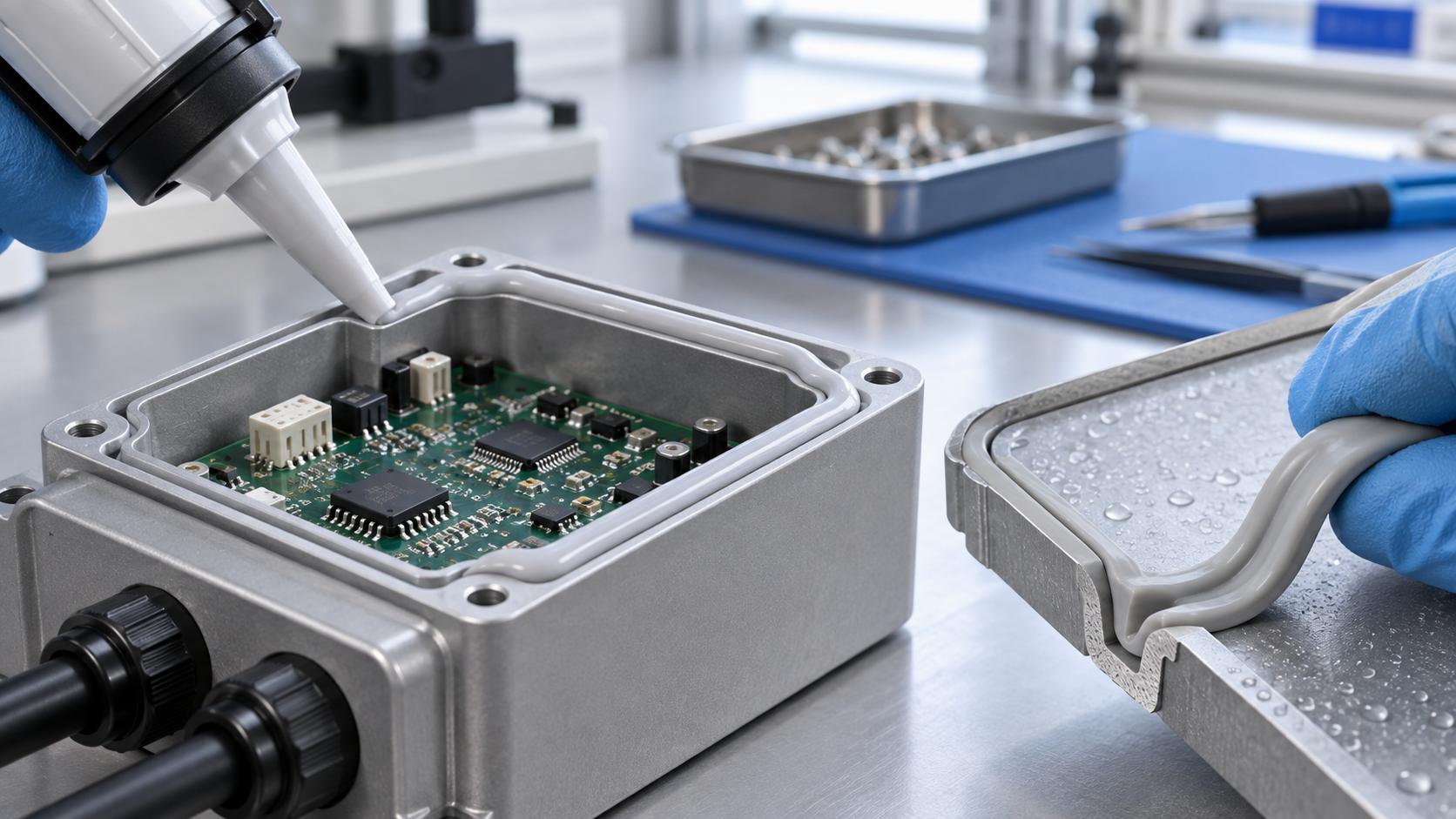
- What silicones are (the short version)
- Four properties set by the Si–O bond: heat resistance, cold resistance, flexibility and low surface energy
- A materials engineer's view (1): heat resistance in air is not the same number as in a sealed space
- Three ways to cure: condensation, addition and peroxide
- A materials engineer's view (2): poisoning in addition cure, by-products in condensation cure
- Sorting the types: fluids, rubbers, resins and gels, and adhesives and sealants
- How silicones differ from epoxies and urethanes: stress relief and adhesion
- Low-molecular-weight siloxanes and contact failure
- The REACH restriction on D4, D5 and D6
- Open issues, and what this article could not confirm
- Glossary / References / Claim-to-source audit
Sourced = content stated in published material or a regulation (link given)
Our calculation = a value this article derived from stated assumptions
Not yet confirmed = a plan or outlook with no confirmed track record
Structural readings and materials-design interpretations are marked separately as Commentary.
Product property values are manufacturers' stated values (typical). Values for different grades and test conditions are not lined up to rank one against another.
Company names show where a source comes from; they are not a ranking of companies.
1. What silicones are (the short version)
- The backbone is Si–O–Si. Shin-Etsu Chemical explains that where the main chain of ordinary organic polymers is a repeating carbon chain, silicone is an “inorganic synthetic polymer” whose main chain is polysiloxane, and that organic units can be introduced as side chains Sourced [Reference 1].
- The same backbone gives fluids, rubbers, resins and gels. Shin-Etsu Chemical groups silicones into fluids, rubbers, liquid rubbers, resins and silanes Sourced [Reference 2].
- In bonding and encapsulation, softness is both a weapon and a weak point. It relieves stress and protects parts, but strong adhesion, control of low-molecular-weight components and chemical regulation become separate issues (our reading).
On raw materials, Shin-Etsu Chemical says that the main sources of silicone are natural silica (SiO2), water and methanol derived from natural gas, and that about 60% of the constituents of polydimethylsiloxane, the most widely made silicone, come from silica and water Sourced [Reference 1]. Wacker says that the development of the Müller–Rochow process some 75 years ago made it possible to obtain methylchlorosilane from silicon metal and methyl chloride, which became the starting point of industrial production Sourced [Reference 12]. The two companies describe different stages of the route, so this article does not go into the details of the manufacturing steps, including how methanol relates to methyl chloride.
This article is limited to silicones as bonding and encapsulation materials. The basics of how silicones differ from epoxies are in our epoxy resins explainer; urethanes and rubber vulcanisation are in polyurethanes and elastomers; the basic formula for thermal stress is in coefficient of thermal expansion; and the overall picture of encapsulants is in underfill and molding. Automotive uses are covered in our explainer on automotive silicones and encapsulants, and the classification of adhesives in general in our explainer on adhesives.
2. Four properties set by the Si–O bond: heat resistance, cold resistance, flexibility and low surface energy
The properties of silicones are explained by two structural features: the Si–O bond in the backbone and the methyl groups that point outward from it. Shin-Etsu Chemical explains that the bond energy of the Si–O bond is far higher than that of the C–C and C–O bonds that make up the main chain of organic polymers, and that it does not break even at around 200 °C, which gives high heat resistance and weatherability Sourced [Reference 3].
| Property | What the sources state | Source |
|---|---|---|
| Heat resistance | Shin-Etsu Chemical: silicone rubber can be used at 150 °C with almost no change, some withstand 200 °C for 10,000 hours or more, and some grades tolerate 350 °C for short periods. Wacker: silicones withstand a wide range of temperatures up to 300 °C | [6] [12] |
| Cold resistance | Shin-Etsu Chemical: the embrittlement point of ordinary organic rubbers is −20 to −30 °C, against −60 to −70 °C for silicone rubbers; some products withstand −100 °C or below. Wacker: flexible down to −50 °C, and special grades down to −100 °C | [6] [12] |
| Flexibility | Shin-Etsu Chemical: dimethyl silicone has a flexible structure in which six Si–O bonds make a 360-degree helical twist, with low intermolecular forces and high elasticity, compressibility and cold resistance | [4] [5] |
| Low surface energy | Shin-Etsu Chemical: the polymer surface is covered by hydrophobic methyl groups, so surface energy is low. The surface tension of dimethyl silicone fluid is 16 to 21 mN/m (mineral oil 29.7, water 72) and its water contact angle exceeds 90° | [7] [4] |
All Sourced (manufacturers' published values; they include differences of product, grade and test condition, so they are not a ranking of figures).
Taking the bond energies from two Shin-Etsu Chemical sources, we work out the ratio Our calculation.
- Catalogue [Reference 6]: Si–O 433 kJ/mol, C–C 355 kJ/mol → 433 ÷ 355 = about 1.22
- Web page [Reference 5]: Si–O 106 kcal/mol, C–C 85 kcal/mol → 106 ÷ 85 = about 1.25 (converting with 1 kcal = 4.184 kJ gives about 443 kJ/mol and about 356 kJ/mol)
Assumptions and limits: even within one company, the Si–O value differs (433 against about 443 kJ/mol). Neither source says which compound the value refers to, or whether it is a dissociation energy or an average. The safe reading is therefore not the digits but the ordering: Si–O is stronger than C–C by a little over 20%. A stronger bond is only one reason for high heat resistance; actual service life depends on formulation, atmosphere and curing agent (next chapter).
3. A materials engineer's view (1): heat resistance in air is not the same number as in a sealed space
The statement that “silicone can be used at 150 °C” is mostly a figure measured in air. The Shin-Etsu Chemical catalogue spells out how conditions change the picture Sourced [Reference 6].
- In air: silicone rubber hardens on heating, and deteriorates as its elongation falls.
- Sealed: it softens as it deteriorates, and its high-temperature life is shorter than in air. This softening is attributed to degradation of the siloxane polymer.
- Remedies: adjusting the formulation, using a different curing agent and post-curing can prevent softening, and such products exist.
- Steam: at normal pressure steam causes almost no deterioration, but high-pressure steam above 150 °C breaks down the siloxane polymer and degrades the rubber.
Encapsulation is exactly a use that is “hard for air to reach”. A package, a potting layer or a fill inside a housing is close to a sealed condition. So the heat-resistance years in a catalogue may not read directly as the life of an encapsulated part (our interpretation). When reading a heat-resistance figure, the first step is to check “in what atmosphere” and “against what indicator (elongation, hardness, mass change)” it was measured. The Shin-Etsu graph defines life as “the time at which elongation at break falls to half its initial value” [Reference 6].
As covered in our explainer on glass transition and creep, the behaviour of rubbery materials at the service temperature is central to design. The high cold resistance of silicone is generally explained as being related to a low glass transition temperature (our interpretation). However, we could not confirm a specific Tg value in the Shin-Etsu Chemical and Wacker material, so no value is given here.
4. Three ways to cure: condensation, addition and peroxide
“Curing” is what turns a liquid silicone, or a gum-like rubber stock, into a usable solid. Wacker divides room-temperature curing silicones (RTV, room-temperature vulcanizing) into one-part RTV-1 and two-part RTV-2, and treats solid rubber as HTV, which cures with heat Sourced [References 13, 14]. The chemistry of curing can be organised into three routes: condensation, addition and peroxide (this three-way grouping is our own, rearranging what the sources state).
| Route | What the sources state | Source |
|---|---|---|
| Condensation RTV-1 (one-part, moisture cure) | Wacker: a ready-to-use system of polysiloxane, curing agent, filler and additives. After application it starts to crosslink on contact with moisture in the air; a skin forms at the surface and cure gradually progresses inward. By-products are released during curing; depending on the crosslinker, small amounts of acetic acid, amine, or neutral by-products such as alcohol. Shin-Etsu Chemical: one-part liquid rubbers can be used straight from the tube or cartridge, become elastic rubbers after curing and adhere to almost all materials; the service range is −40 to +180 °C. In its product table most are condensation cure (by-product: alcohol) and some are acetone types | [13] [8] [11] |
| RTV-2 (two-part) condensation | Wacker: condensation cure needs an organotin catalyst and always releases by-products | [13] |
| Addition (two-part, liquid rubber, gel) | Wacker: addition cure needs a platinum catalyst and releases no by-product. Some special RTV-2 grades can be cured in a short time with ultraviolet light. Shin-Etsu Chemical: two-part liquid rubbers cure when a curing agent is added, cure uniformly even in thick sections (deep-section cure), allow cure time to be adjusted by the type and amount of curing agent or by heating, and keep for long periods because the base and curing agent are stored separately. Its product table lists both condensation and addition types, with an addition example described as “cure time shortened by heating” | [13] [9] |
| Peroxide cure (HTV, solid rubber) | Wacker: solid rubber comes as peroxide-curing grades (ELASTOSIL R) and platinum-catalysed addition-curing grades (ELASTOSIL R plus). Peroxide-curing stock can be processed by extrusion, calendering, compression and transfer moulding, and injection moulding, and cures with heat | [14] |
All Sourced (manufacturers' published statements). Product names are examples and do not imply a ranking. The chemical equations for condensation and addition cure are not given in the sources used here and are not covered in this article.
Addition cure is generally described as hydrosilylation, a reaction between Si–H groups and vinyl groups (Si–CH=CH2) under a platinum catalyst. In the Wacker and Shin-Etsu Chemical material used here, what we could confirm is “platinum catalyst” and “no by-product”; the reaction equation itself was not stated (Commentary).
5. A materials engineer's view (2): poisoning in addition cure, by-products in condensation cure
Addition cure, which releases no by-product, is a route that tends to cure thick sections uniformly through Sourced [References 9, 13]. In return, it will not cure if something that disturbs the platinum catalyst is nearby. Dow lists the following categories of substance that inhibit addition cure Sourced [Reference 15].
- Compounds containing nitrogen, sulfur, tin or phosphorus
- Substances containing arsenic, antimony, selenium or tellurium
- Residual solvents or monomers (although some solvents do not inhibit cure)
- Some primers (other primers do not inhibit cure)
Specific substance names, concentrations and the inhibition mechanism could not be confirmed from the headings on that page alone. Even so, the design implications are large (our interpretation).
- Tin is one of the listed inhibitors. That is a warning when a condensation-cure silicone (organotin catalyst) and an addition-cure one are used next to each other.
- Compounds containing nitrogen, sulfur or phosphorus can be present on the shop floor as components of other resins, rubbers, fluxes, cleaners and primers. Choosing addition cure makes checking cure compatibility with the substrate and neighbouring parts a design item.
- In Shin-Etsu Chemical's two-part product table, “No cure inhibition” is written as a feature of a condensation-cure product, which can be read as the other side of this problem [Reference 9] (our reading).
Condensation cure, on the other hand, is characterised by the fact that a by-product is released and, in the one-part case, that moisture diffuses from the surface inward. Constraints such as slow cure in thick sections, or moisture that is hard to reach in an enclosed space, can be read from Wacker's statement that “a skin forms at the surface and cure gradually progresses inward” [Reference 13]. The effect of the by-product (acetic acid, amine, alcohol, acetone and so on) on surrounding metals and parts is an item to check product by product. Shin-Etsu Chemical states that its one-part acetone-type product is “not corrosive to metals” [Reference 11].
6. Sorting the types: fluids, rubbers, resins and gels, and adhesives and sealants
Shin-Etsu Chemical groups its silicone products into fluids (oils), rubbers, liquid rubbers, resins and silanes, and says it has more than 5,000 products in all Sourced [References 2, 20]. The names used in bonding and encapsulation, “adhesive”, “sealant”, “potting compound” and “encapsulating gel”, are names by use; chemically it is clearer to organise them by crosslink density (our organisation).
| Type | What the sources state | Source |
|---|---|---|
| Fluids (oils) | Shin-Etsu Chemical: dimethyl silicone fluid is virtually unchanged in air up to 150 °C and stays fluid at −50 °C. The methylphenyl type can be used for long periods at 250 °C and stays fluid at −65 °C. Used as release agents, defoamers and water-repellent treatments | [7] |
| Rubbers (for moulding) | Shin-Etsu Chemical: moulding rubbers divide into solid silicone rubber compound (millable) and LIMS, in which liquid rubber is injection moulded | [5] |
| Liquid rubbers (RTV) | Wacker: RTV is used for bonding, sealing, potting, encapsulation, coating and casting. Shin-Etsu Chemical: one-part adheres to almost all materials; two-part features long storage and deep-section cure | [13] [8] [9] |
| Gels | Wacker: silicone gels have a very low crosslink density and cure to an extremely soft rubber below the Shore hardness range. Dow: a gel is a special class of encapsulant that cures to an extremely soft material while keeping the dimensional stability of an elastomer. Shin-Etsu Chemical: the highly heat-resistant gel KE-1066-A/B has a service range of −40 to 200 °C (manufacturer's stated value) | [13] [16] [19] |
| Resins | Shin-Etsu Chemical: the molecules have a three-dimensional network structure and give hard films. Heat resistance is up to 250 °C. Used in paints, coatings and electrical applications | [10] |
All Sourced (manufacturers' stated values; products are examples and do not imply a ranking).
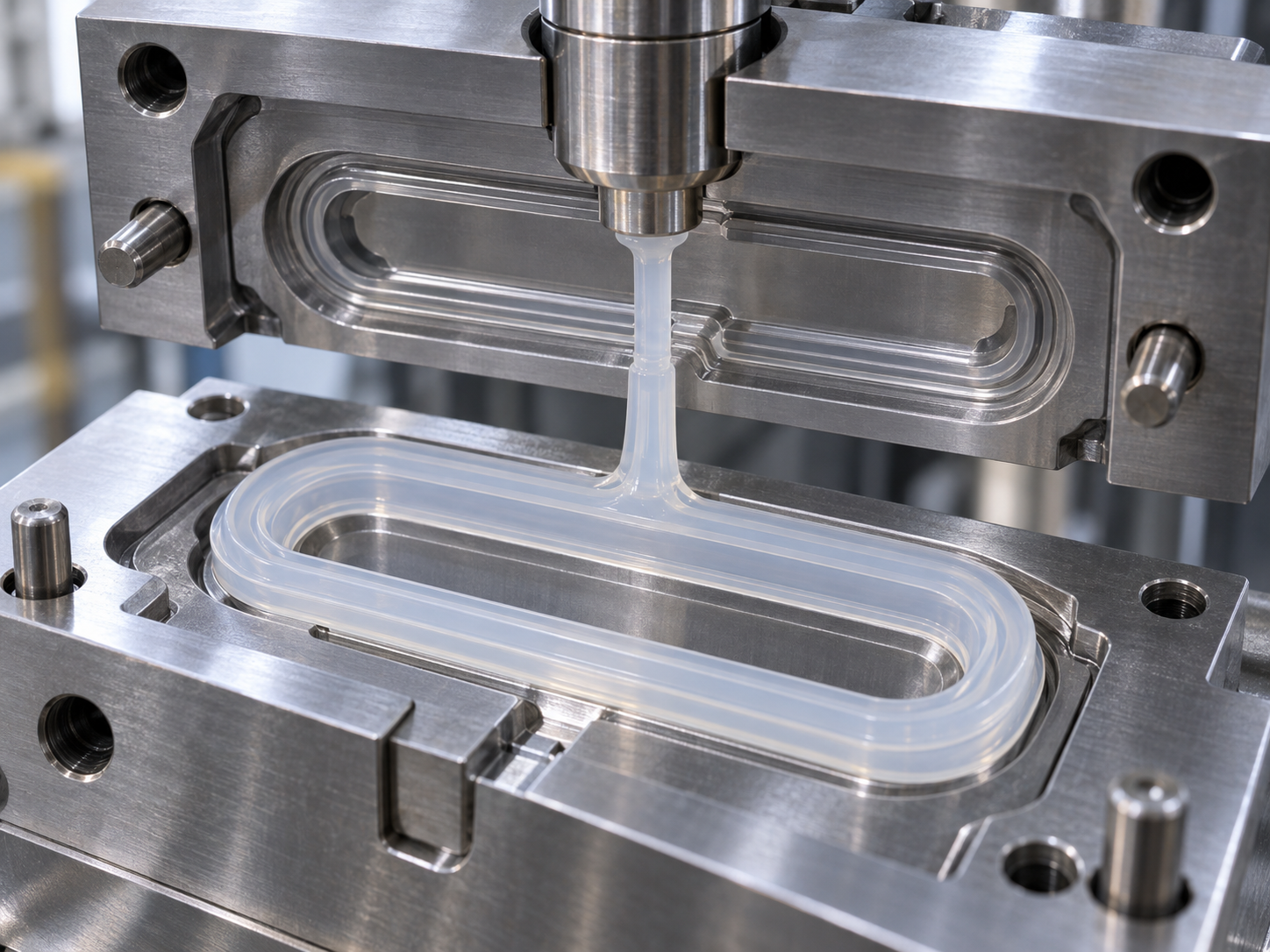
Rubber is also a material that is moulded in a mould
Even in an article on bonding and encapsulation, the rubber side of silicone cannot be left out. The same kind of rubber becomes moulded parts such as sheets, tubes and gaskets and also sealants applied on site. Wacker says that solid silicone rubber can be processed by extrusion, calendering, compression and transfer moulding, and injection moulding, and liquid rubber by injection moulding and low-pressure filling Sourced [Reference 14].
7. How silicones differ from epoxies and urethanes: stress relief and adhesion
Bonding and encapsulation materials can be roughly lined up along a hardness axis: “hard and strong”, “flexible and strong”, and “very soft and temperature-resistant”. Epoxies sit on the first, polyurethane elastomers in the middle, and silicones spread over the soft side (our organisation). Our explainer on coefficient of thermal expansion covers the idea of estimating thermal stress roughly as elastic modulus × difference in thermal expansion coefficient × temperature difference. Applied to that formula, a lower-modulus material puts less stress on the part for the same expansion mismatch (Commentary).
(1) Stress relief: where softness is a weapon
Dow describes the silicone gel as a special class of encapsulant that cures to an extremely soft material while keeping the dimensional stability of an elastomer, and says it provides stress relief and mechanical and environmental protection Sourced [Reference 16]. In its September 2025 announcement, Dow says that DOWSIL EG-4175 silicone gel, for IGBT modules used in EV batteries and in inverters for solar and wind power, withstands up to 180 °C, absorbs vibration and self-heals small cracks (the manufacturer's claims) Sourced [Reference 16]. Shin-Etsu Chemical states for its gel KE-1066-A/B a service range of −40 to 200 °C and a penetration that goes only from 30 to 29 after 200 °C for 2,000 hours (manufacturer's stated values) Sourced [Reference 19]. Dow's selection guide claims that silicones in general have advantages over urethanes and epoxies in protection from mechanical stress caused by thermal cycling or mismatched coefficient of thermal expansion (especially gels) and in protection from shock and vibration (the manufacturer's claim) Sourced [Reference 21]. Its technical paper gives a typical elastic modulus for silicone elastomers of 0.1 to 2 MPa and says silicone resins can exceed 1 GPa without fillers Sourced [Reference 22]. The modulus varies greatly from product to product, so we have not confirmed comparative values against other materials. Encapsulation of power semiconductors is covered in more detail in our explainer on automotive silicones and encapsulants.
(2) Adhesion: strength as the price of softness
Shin-Etsu Chemical says that silicone rubber is weaker than organic rubber at room temperature but keeps its strength better at high temperature. On its graph the two curves cross as temperature rises, and a typical tear strength is given as about 9.8 kN/m Sourced [Reference 6]. The adhesion-related stated values for the products we could confirm are as follows.
| Product (manufacturer's stated) | Published values | Source and note |
|---|---|---|
| KE-3450 (one-part condensation-cure, acetone-type adhesive sealant) | Hardness (durometer A) 42, tensile strength 2.5 MPa, elongation at break 390%, lap shear strength (Al/Al) 1.6 MPa | Shin-Etsu Chemical [11]. The test standard, adherend conditions and cure conditions are not given on the page, so we could not confirm them |
| KE-1066-A/B (addition-cure, highly heat-resistant gel) | Adhesion 0.4 MPa (Al), 0.4 MPa (Cu), penetration 30, volume resistivity 15 TΩ·m, dielectric breakdown strength 16 kV/mm (23 °C). Standard cure 80 °C × 1 h | Shin-Etsu Chemical [19]. The adhesion test method is not given, so we could not confirm it |
| DOWSIL EA-7158 (one-part, heat-curing adhesive) / EG-4175 (gel) | EA-7158: a one-part, high-strength silicone with good primerless adhesion to many substrates. EG-4175: claims adhesion without a primer (self-priming) | Dow [16]. No numerical values were given, so we could not confirm any |
All Sourced (manufacturers' stated values). Products, adherends and test conditions differ, so the values are not lined up to rank one against another.
Silicone has a low surface energy, repels water and is used as a release agent Sourced [References 4, 7]. For that reason it is probably harder than organic adhesives to wet and make close contact with the mating surface (our interpretation). That Dow lists “primerless adhesion” as a feature of EG-4175 and EA-7158 [16], and that Shin-Etsu Chemical writes “initial adhesion within 2 hours” and “self adhesion” as features of its two-part products [9], can be read as a sign that adhesion has to be built into the product (our interpretation). The EU regulation's derogations also name adhesion promoters as a use [18], showing that auxiliary components for adhesion appear as items of regulation and component control as well.
How adhesion tests are read also changes. If compared by shear strength (MPa) alone, a soft material gives a small number. For a soft adhesive, where it failed (at the interface with the adherend or inside the material) and whether it followed the deformation become important (our interpretation). Test standards and how to read failure modes are covered in our explainer on adhesive strength testing.
Shin-Etsu Chemical says that silicone rubber immersed in cold, warm or boiling water for a long time takes up only about 1% water, with almost no effect on mechanical strength or electrical properties Sourced [Reference 6]. The same document also states that thin films of silicone rubber pass gases and water vapour more readily than organic rubbers or plastic films, and that use as a gas and water separation membrane is being studied Sourced [Reference 6].
Water uptake is “the amount of water taken into the material”; permeability is “the amount of water vapour or gas that passes through it”. Not absorbing water and not letting water vapour through are different properties, and whether silicone can be expected to act as a barrier in a hermetic or moisture-proof encapsulation has to be checked separately (Commentary). For the thinking on barrier performance, see our explainer on barrier properties and coatings.
8. Low-molecular-weight siloxanes and contact failure
Cured silicones and silicone fluids retain small amounts of cyclic and linear siloxanes (low-molecular-weight siloxanes) of low degree of polymerisation. When these evaporate and reach electrical contacts, contact failure in which the contacts stop working can occur. We look at what both a component maker and a materials maker have published.
The Omron relay FAQ (ID FAQE10061E, updated 1 October 2021), asked whether the side of a relay may be coated with a silicone-type coating agent, including a low-molecular-weight siloxane reduced type, answers as follows Sourced [Reference 17].
- Answer: use a coating agent that contains no siloxane. Even coating agents with reduced low-molecular-weight siloxane may cause contact failure of relay contacts. Urethane-based coating agents can be used.
- Reason: siloxane is highly permeable and penetrates the inside of plastic-sealed relays. Reduced products still contain siloxane and only lengthen the time it takes to get in. Once inside, a silicon oxide film forms on the contact and causes contact failure. For this reason, silicone-based coating cannot be used even on the side of the relay only.
- Other points: urethane and epoxy coating agents can be used but may contain a small amount of siloxane, so check the ingredients. Moulding, potting and packing on the board should also use silicone-free resin.
Shin-Etsu Chemical, for its one-part, condensation-cure, acetone-type product KE-3450, states that “we have reduced low-molecular-weight siloxane, which causes electrical contact failure”. The low-molecular-weight siloxane content is given as below 300 ppm as ΣD3–D10 (manufacturer's stated value) Sourced [Reference 11].
These two sources describe the same problem from different positions. The materials maker brings out products with less siloxane. The component maker says that even reduced products only lengthen the time to entry (the Omron statement above). Both are statements of fact and do not contradict each other (Commentary).
- The ppm figure is not a pass mark. The measurement conditions for ΣD3–D10 (extraction method, heating conditions) could not be confirmed from the KE-3450 page [Reference 11]. A number alone does not guarantee safety in the real equipment.
- The component side decides first whether it can be used. As with Omron, a component maker may specify no silicone-type coating, and then the material is out of the choices before the question of a reduced grade even arises.
- Where the coating is also matters. The statement that it cannot be used even on the side of a relay, without touching the relay body, shows that siloxane moves through space. Coatings on other parts inside the same housing are also within the range of effect.
9. The REACH restriction on D4, D5 and D6
Among the raw materials and intermediates of silicones are the cyclic dimethylsiloxanes D4 (octamethylcyclotetrasiloxane), D5 (decamethylcyclopentasiloxane) and D6 (dodecamethylcyclohexasiloxane). The EU has made these three the subject of a REACH restriction (entry 70 of Annex XVII). The European Commission adopted Regulation (EU) 2024/1328 on 16 May 2024, and it was published in the Official Journal on 17 May 2024 Sourced [Reference 18].
The main points of the regulation are as follows Sourced [Reference 18].
- Background: on 13 June 2018 the Member State Committee of the European Chemicals Agency identified D4, D5 and D6 as substances of very high concern (SVHC) with very persistent and very bioaccumulative (vPvB) properties. D4 was also identified as having PBT (persistent, bioaccumulative and toxic) properties. D5 and D6 were also identified as PBT when they contain 0.1% or more by weight of D4.
- Risk assessment conclusion: the Risk Assessment Committee (RAC) took total releases to the environment as a proxy for risk and concluded that cosmetic products are the main source of releases.
- Paragraph 1 (placing on the market): D4, D5 and D6 shall not be placed on the market as a substance on its own, as a constituent of other substances, or in mixtures, at a concentration of 0.1% by weight or more of each substance, after 6 June 2026.
For bonding and encapsulation materials, what matters are the derogations (paragraphs 4 to 6).
| Para. | What the derogation says (as stated in the regulation) |
|---|---|
| 4(a) | Placing on the market of D4, D5 and D6 for the industrial uses of monomer in the production of silicone polymer, intermediate in the production of other silicon substances, monomer in polymerisation, formulation or (re)packing of mixtures, production of articles and non-metal surface treatment |
| 5 | Paragraph 1(b) (placing on the market as a constituent of other substances) does not apply to D4, D5 and D6 as a constituent of a silicone polymer on its own |
| 6(a) | For mixtures that contain D4, D5 or D6 as residues from silicone polymers, for use in adhesion, sealing, gluing and casting, paragraph 1(c) (placing on the market in mixtures) does not apply where the concentration of each substance is 1% by weight or less |
| 6(b) | Same residues in protective coatings (including marine coatings): D4 at 0.5% by weight or less, D5 or D6 at 0.3% by weight or less |
| 6(f) | Same residues for use as adhesion promoters: 0.5% by weight or less of each substance |
| 6(g)(h) | 3D printing: 1% by weight or less of each. Rapid prototyping, mould making and high-performance uses stabilised by quartz filler: D5 at 1% or less, D6 at 3% or less |
All Sourced (summarising the annex of Regulation (EU) 2024/1328). There are also derogations for medical devices, dental impression materials, horse products, pad printing and cleaning of art objects, among others.
Paragraph 6(a) makes 1% by weight or less of each substance the condition for the derogation, for mixtures that contain D4, D5 or D6 as residues from silicone polymers and are used for adhesion, sealing, gluing and casting [Reference 18]. For adhesive, sealant and potting products, the residual amount of cyclic siloxanes can therefore be read as an item to manage against this limit (Commentary). However, which products fall under the derogation, how the rules apply after 6 June 2026, and the content of guidance from the European Chemicals Agency (ECHA) are not checked in this article. For compliance, check the text of the regulation and the guidance of the competent authority and ECHA.
Our calculation: how do “0.1%”, “1%” and “300 ppm” differ?
We convert the ΣD3–D10 of KE-3450 (below 300 ppm) from the previous chapter and the thresholds in this regulation into the same unit, ppm, and set them side by side Our calculation. Assuming a mass basis, 1% by weight = 10,000 ppm, 0.1% by weight = 1,000 ppm, 0.3% by weight = 3,000 ppm, 0.5% by weight = 5,000 ppm, and 300 ppm = 0.03% by weight.
Assumptions and limits: the page does not say whether the ppm of KE-3450 is on a mass basis, so we assumed that it is. ΣD3–D10 is the sum of D3 to D10 (the contact-failure viewpoint), while the regulation's thresholds are concentrations of each of D4, D5 and D6 (the viewpoint of release to the environment). For this reason no judgement such as “stricter than the regulation” or “looser than the regulation” can be drawn from this figure. What can be said is that even within one silicone product, contact failure and chemical regulation are managed with different indicators and on different orders of magnitude (Commentary).
10. Open issues, and what this article could not confirm
(1) Items for which no specific value could be confirmed
The glass transition temperature of silicones, specific thermal expansion coefficients and the elastic modulus of gels could not be confirmed in the public material from Shin-Etsu Chemical, Wacker and Dow that this article used, so they are not given. For the modulus, all we found is a statement in a Dow technical paper that a typical value for silicone elastomers is 0.1 to 2 MPa and that resins can exceed 1 GPa [Reference 22]; values and test conditions for individual products were not confirmed. To apply a silicone value to the thermal-stress estimate (our explainer on coefficient of thermal expansion), the values must be checked in the data sheet of the product in question, under matched conditions.
(2) Test conditions for adhesion strength
For the lap shear strength (Al/Al) of 1.6 MPa for KE-3450 and the adhesion of 0.4 MPa for KE-1066, the test standard, adherend conditions and cure conditions are not given on the page, so they are shown only as manufacturers' stated values. They are not lined up against other companies' products or other types of adhesive.
(3) The mechanism and measurement of low-molecular-weight siloxanes
The explanation that a silicon oxide film forms on the contact rests only on Omron's statement; detailed mechanisms such as the link with discharge, and the measurement method for ΣD3–D10, could not be confirmed in the primary sources used here.
(4) Scope of chemical regulation
This article covers only the EU REACH restriction (Regulation (EU) 2024/1328). Systems in other regions, including Japan's Chemical Substances Control Law, how the rules are applied and guided after 6 June 2026, and whether a given product falls under a derogation, are not checked here.
(5) Range of companies checked
This article centred on the official technical material of Shin-Etsu Chemical, Wacker and Dow. Material from other manufacturers such as Momentive was not included in the range checked this time. Company names show where a source comes from and do not rank products or companies.
(6) Bond energy values
Even within material from Shin-Etsu Chemical the Si–O value differs (433 kJ/mol against about 443 kJ/mol), and neither says which compound or which quantity it refers to. This article treats them as an ordering (stronger by a little over 20%), not as precise digits.
- The backbone is Si–O–Si and the side group is methyl. In Shin-Etsu Chemical's material the Si–O bond energy is a little over 20% higher than that of C–C Sourced. The ratio is about 1.22 to 1.25 Our calculation
- Heat resistance in air and in a sealed space are different things. Sealed, the rubber softens as it deteriorates and its life is shorter Sourced
- There are three cure routes. Condensation releases a by-product; addition uses a platinum catalyst and releases none; peroxide cure is for solid rubber that cures with heat Sourced
- Addition cure is inhibited by nitrogen, sulfur, tin, phosphorus and others. Checking compatibility with neighbouring materials becomes a design item Sourced
- Softness relieves stress, and adhesion is built into the product. A gel is an “extremely soft” encapsulant Sourced
- Even reduced low-molecular-weight siloxane is not “zero”. Omron asks that silicone-type coatings not be used near relays Sourced
- D4, D5 and D6 are banned from being placed on the market at 0.1% or more from 6 June 2026. For adhesion, sealing and casting, 1% or less of residues is a condition of the derogation Sourced
11. Glossary
- Silicone
- The collective name for polymers with an Si–O–Si backbone (polysiloxane) carrying organic groups. Includes fluids, rubbers, resins and gels.
- Siloxane bond
- The bond between silicon and oxygen (Si–O–Si). The main chain of silicones.
- PDMS
- Polydimethylsiloxane. The most widely used silicone, carrying only methyl groups.
- RTV
- Room-temperature vulcanizing. A liquid rubber that cures at room temperature, in one-part (RTV-1) and two-part (RTV-2) forms.
- HTV
- Solid silicone rubber that cures with heat. Peroxide-cure and platinum addition-cure types exist.
- LIMS / LSR
- Injection moulding of liquid silicone rubber (LIMS) and the material itself (LSR).
- Condensation cure
- Cure by moisture or a condensation reaction. Releases a by-product (acetic acid, amine, alcohol, acetone and so on).
- Addition cure
- Cure with a platinum catalyst, with no by-product. Inhibitors must be watched for.
- Cure inhibition
- The stalling of cure in addition cure because the platinum catalyst does not work. Compounds of nitrogen, sulfur, tin, phosphorus and others can cause it.
- Gel
- A silicone with a very low crosslink density and extreme softness. Used in stress-relieving encapsulation.
- Low-molecular-weight siloxane
- Cyclic and linear siloxanes of low degree of polymerisation. If they evaporate and reach electrical contacts, they can cause contact failure.
- ΣD3–D10
- The sum of the cyclic siloxanes D3 to D10. Given by manufacturers as an indicator of low-molecular-weight siloxane content.
- D4, D5, D6
- The cyclic dimethylsiloxane 4-, 5- and 6-mers. Restricted under EU REACH.
- SVHC
- Substance of very high concern. Listed on the REACH candidate list.
- vPvB / PBT
- Classifications: very persistent and very bioaccumulative / persistent, bioaccumulative and toxic.
- Derogation
- A provision in a restriction that disapplies it for specified uses and conditions.
- Primer
- An undercoat applied to the adherend before bonding to help adhesion.
- Embrittlement point
- The temperature at which a material becomes brittle in the cold. A guide to the cold resistance of rubber.
12. References
- Shin-Etsu Chemical “What is silicone made of?” https://www.shinetsusilicone-global.com/info/begin1.shtml
- Shin-Etsu Chemical “How is silicone made?” https://www.shinetsusilicone-global.com/info/begin2.shtml
- Shin-Etsu Chemical “Features attributable to siloxane bonds” https://www.shinetsusilicone-global.com/info/begin4.shtml
- Shin-Etsu Chemical “Features attributable to molecular structure” https://www.shinetsusilicone-global.com/info/begin5.shtml
- Shin-Etsu Chemical “What is Silicone Rubber for Molding?” (selection guide for moulding silicone rubber) https://www.shinetsusilicone-global.com/guide/rubber/about/
- Shin-Etsu Chemical “Characteristic properties of Silicone Rubber Compounds” (catalogue, PDF) https://www.shinetsusilicone-global.com/catalog/pdf/rubber_e.pdf
- Shin-Etsu Chemical “Silicone Fluids: The Unique Properties of Silicones” https://www.shinetsusilicone-global.com/products/type/oil/detail/about/index2.shtml
- Shin-Etsu Chemical “One-component liquid rubbers” https://www.shinetsusilicone-global.com/products/type/one_rtv/index.shtml
- Shin-Etsu Chemical “Two-component liquid rubbers (for electric and electronic applications)” https://www.shinetsusilicone-global.com/products/type/two_rtv_e/index.shtml
- Shin-Etsu Chemical “Silicone resins” https://www.shinetsusilicone-global.com/products/type/resin/index.shtml
- Shin-Etsu Chemical “One-component condensation cure liquid silicone rubber flame retardant type” (KE-3450) https://www.shinetsusilicone-global.com/products/notice/168/index2.shtml
- Wacker “SILICONES – Definition and Properties” https://www.wacker.com/cms/en-us/products/product-groups/silicones/silicones.html
- Wacker “Room-Temperature-Vulcanizing Silicone Rubber (RTV-1/RTV-2)” https://www.wacker.com/cms/en-us/products/product-groups/silicone-rubber/room-temperature-silicone-rubber.html
- Wacker “Solid Silicone Rubber (HTV)” https://www.wacker.com/cms/en-us/products/product-groups/silicone-rubber/solid-silicone-rubber.html
- Dow “Gels, Encapsulants and Conformal Coatings” https://www.dow.com/en-us/product-technology/pt-gels-encapsulants.html
- Dow press release “Dow launches DOWSIL™ EG-4175 Silicone Gel to enable higher voltage power electronics in electric vehicles and renewable energy technologies”, 4 September 2025 https://corporate.dow.com/en-us/news/press-releases/dow-launches-dowsil-eg-4175-silicone-gel.html
- Omron relay FAQ “If the side of a relay is coated with silicon that contains siloxane (low molecular-weight siloxane reducer) in the coating agent, will contact failure occur? What about urethane coating?” (ID FAQE10061E, updated 1 October 2021; the page now redirects to aratas.com) https://components.omron.com/eu-en/faq/relays/FAQE10061
- European Commission Commission Regulation (EU) 2024/1328 of 16 May 2024 amending Annex XVII to Regulation (EC) No 1907/2006 (REACH) as regards octamethylcyclotetrasiloxane (D4), decamethylcyclopentasiloxane (D5) and dodecamethylcyclohexasiloxane (D6) https://eur-lex.europa.eu/eli/reg/2024/1328/oj/eng
- Shin-Etsu Chemical “Highly thermostable silicone gel” (KE-1066-A/B) https://www.shinetsusilicone-global.com/products/notice/165/index2.shtml
- Shin-Etsu Chemical “What types of silicone products are available?” https://www.shinetsusilicone-global.com/info/begin3.shtml
- Dow “Encapsulants and gels selection guide” (Form No. 11-3922-01-1123, PDF) https://www.dow.com/documents/11/11-3922-01-silicone-encapsulants-and-gels.pdf
- Dow technical paper “Silicone Material Solutions for Battery Fire Protection” (Form No. 80-8541-01-0825, PDF) https://www.dow.com/documents/80/80-8541-01-silicone-material-solutions-for-battery-fire-protection.pdf
13. Claim-to-source audit
| Claim in the text | Basis | Label |
|---|---|---|
| That silicone is an “inorganic synthetic polymer” with a silicon-oxygen main chain and organic side groups that can be introduced; that the main raw materials are silica, water and methanol, and that about 60% of the constituents of polydimethylsiloxane come from silica and water | Shin-Etsu Chemical, “What is silicone made of?”Reference 1 https://www.shinetsusilicone-global.com/info/begin1.shtml | Sourced |
| That silicones are grouped into fluids, rubbers, liquid rubbers, resins and silanes | Shin-Etsu Chemical, “How is silicone made?”Reference 2 https://www.shinetsusilicone-global.com/info/begin2.shtml | Sourced |
| That the Si–O bond has higher bond energy than C–C and C–O in organic polymers, does not break even at about 200 °C, and gives high heat resistance and weatherability | Shin-Etsu Chemical, “Features attributable to siloxane bonds”Reference 3 https://www.shinetsusilicone-global.com/info/begin4.shtml | Sourced |
| That dimethyl silicone has a flexible structure in which six Si–O bonds make a 360-degree helical twist; that the polymer surface is covered by hydrophobic methyl groups with low surface energy, giving cold resistance, water repellency and release | Shin-Etsu Chemical, “Features attributable to molecular structure”Reference 4 https://www.shinetsusilicone-global.com/info/begin5.shtml | Sourced |
| Si–O at 106 kcal/mol and C–C at 85 kcal/mol; low intermolecular forces and freely rotating methyl groups producing water repellency and release; that moulding rubbers divide into millable and LIMS | Shin-Etsu Chemical, “What is Silicone Rubber for Molding?”Reference 5 https://www.shinetsusilicone-global.com/guide/rubber/about/ | Sourced |
| Si–O at 433 kJ/mol and C–C at 355 kJ/mol; that some products stay almost unchanged at 150 °C, withstand 200 °C for 10,000 hours or more and 350 °C briefly; embrittlement points of −20 to −30 °C for organic rubbers and −60 to −70 °C for silicone rubbers, with some products at −100 °C or below; that in air heating hardens the rubber while sealed it softens and has a shorter life than in air, with formulation, curing agent and post-cure as remedies; that high-pressure steam above 150 °C breaks down the siloxane polymer; water uptake of about 1%; that gas and water-vapour permeability of thin films is higher than for organic rubbers and plastic films; that strength at room temperature is lower than organic rubber and the curves cross at high temperature, with a tear strength of about 9.8 kN/m; that life is defined as the time at which elongation at break falls to half its initial value | Shin-Etsu Chemical, “Characteristic properties of Silicone Rubber Compounds”Reference 6 https://www.shinetsusilicone-global.com/catalog/pdf/rubber_e.pdf | Sourced |
| That dimethyl silicone fluid is virtually unchanged up to 150 °C in air and stays fluid at −50 °C, and the methylphenyl type can be used for long periods at 250 °C and stays fluid at −65 °C; surface tension of 16 to 21 mN/m (mineral oil 29.7, water 72); a water contact angle above 90°; use in release agents, defoamers and water-repellent treatments | Shin-Etsu Chemical, “Silicone Fluids”Reference 7 https://www.shinetsusilicone-global.com/products/type/oil/detail/about/index2.shtml | Sourced |
| That one-part liquid rubbers can be used straight from the tube, adhere to almost all materials and have a service range of −40 to +180 °C; that most products in the table are condensation cure (by-product alcohol) and some are acetone types | Shin-Etsu Chemical, “One-component liquid rubbers”Reference 8 https://www.shinetsusilicone-global.com/products/type/one_rtv/index.shtml | Sourced |
| That two-part liquid rubbers feature deep-section cure, adjustable cure speed and long storage; that the product table has condensation and addition types, with “No cure inhibition” for KE-270, “cure time shortened by heating” for an addition type, and entries “initial adhesion within 2 hours” and “self adhesion” | Shin-Etsu Chemical, “Two-component liquid rubbers”Reference 9 https://www.shinetsusilicone-global.com/products/type/two_rtv_e/index.shtml | Sourced |
| That silicone resins have a three-dimensional network structure, form hard films and have heat resistance up to 250 °C | Shin-Etsu Chemical, “Silicone resins”Reference 10 https://www.shinetsusilicone-global.com/products/type/resin/index.shtml | Sourced |
| That KE-3450 is one-part condensation cure (acetone), has reduced low-molecular-weight siloxane, has ΣD3–D10 below 300 ppm, lap shear strength (Al/Al) 1.6 MPa, durometer A 42, tensile strength 2.5 MPa, elongation at break 390% and UL94 V-0, and is not corrosive to metals | Shin-Etsu Chemical, KE-3450 pageReference 11 https://www.shinetsusilicone-global.com/products/notice/168/index2.shtml | Sourced |
| That the Müller–Rochow process yields methylchlorosilane from silicon metal and methyl chloride and was the start of industrial production; that silicones are flexible up to 300 °C and down to −50 °C (special grades −100 °C) | Wacker, “SILICONES – Definition and Properties”Reference 12 https://www.wacker.com/cms/en-us/products/product-groups/silicones/silicones.html | Sourced |
| That RTV-1 cures with moisture, forms a skin and cures inward, and releases by-products (acetic acid, amine, alcohol and others); that condensation-cure RTV-2 needs an organotin catalyst and releases by-products, while addition cure needs a platinum catalyst and releases none, with UV-curing special grades; that gels have a very low crosslink density and are extremely soft; the uses of RTV (bonding, sealing, potting, encapsulation, coating, casting) | Wacker, “RTV-1/RTV-2”Reference 13 https://www.wacker.com/cms/en-us/products/product-groups/silicone-rubber/room-temperature-silicone-rubber.html | Sourced |
| That solid rubber has peroxide-curing (ELASTOSIL R) and platinum-catalysed addition-curing (R plus) grades; that it can be processed by extrusion, calendering, compression, transfer and injection moulding and cures with heat; that liquid rubber can be processed by injection moulding and low-pressure filling | Wacker, “Solid Silicone Rubber (HTV)”Reference 14 https://www.wacker.com/cms/en-us/products/product-groups/silicone-rubber/solid-silicone-rubber.html | Sourced |
| The categories of substances that inhibit addition cure (compounds of nitrogen, sulfur, tin and phosphorus; substances containing arsenic, antimony, selenium or tellurium; residual solvents and monomers; some primers) | Dow, “Gels, Encapsulants and Conformal Coatings”Reference 15 https://www.dow.com/en-us/product-technology/pt-gels-encapsulants.html | Sourced |
| That a gel is a special class of encapsulant that cures extremely soft while keeping the dimensional stability of an elastomer; that EG-4175 withstands up to 180 °C, absorbs vibration, self-heals small cracks (the manufacturer's claims) and adheres without a primer; that EA-7158 is a one-part, high-strength, heat-curing adhesive with good primerless adhesion to many substrates | Dow press release (4 September 2025)Reference 16 https://corporate.dow.com/en-us/news/press-releases/dow-launches-dowsil-eg-4175-silicone-gel.html | Sourced |
| Omron's answer on silicone-type coatings for relays (use a siloxane-free coating; contact failure possible even with reduced products; siloxane highly permeable and entering plastic-sealed relays; reduced products only lengthen the time to entry; a silicon oxide film on the contact; not usable even on the side only; urethane and epoxy may hold traces of siloxane so check ingredients; silicone-free resin on the board). The ID and update date | Omron relay FAQReference 17 https://components.omron.com/eu-en/faq/relays/FAQE10061 | Sourced |
| That Regulation (EU) 2024/1328 is dated 16 May 2024 and was published on 17 May 2024; the CAS and EC numbers of D4, D5 and D6; the SVHC identification of 13 June 2018 (vPvB; D4 also PBT; D5 and D6 PBT when containing 0.1% or more D4); Regulation (EU) 2018/35 (10 January 2018); RAC's conclusion (cosmetics the main source of releases); paragraph 1 (0.1% by weight or more, after 6 June 2026), paragraph 2 (dry cleaning), paragraph 3 (cosmetics 2027, devices and medicines 2031, D5 dry cleaning 2034); the content of derogations 4(a), 5 and 6(a), (b), (f), (g), (h); paragraph 7 (closed-system dry cleaning) | Commission Regulation (EU) 2024/1328Reference 18 https://eur-lex.europa.eu/eli/reg/2024/1328/oj/eng | Sourced |
| That KE-1066-A/B has a service range of −40 to 200 °C, is a two-part addition cure, has standard cure of 80 °C × 1 h, penetration 30 (29 after 200 °C for 2,000 h), adhesion 0.4 MPa (Al, Cu), volume resistivity 15 TΩ·m and dielectric breakdown strength 16 kV/mm | Shin-Etsu Chemical, KE-1066-A/B pageReference 19 https://www.shinetsusilicone-global.com/products/notice/165/index2.shtml | Sourced |
| That Shin-Etsu Chemical's products number more than 5,000 | Shin-Etsu Chemical, “What types of silicone products are available?”Reference 20 https://www.shinetsusilicone-global.com/info/begin3.shtml | Sourced |
| Dow's claim that silicones have advantages over urethanes and epoxies in protection from mechanical stress caused by thermal cycling or mismatched coefficient of thermal expansion (especially gels) and in protection from shock and vibration | Dow selection guide (Form No. 11-3922-01-1123)Reference 21 https://www.dow.com/documents/11/11-3922-01-silicone-encapsulants-and-gels.pdf | Sourced |
| That a typical elastic modulus for silicone elastomers is 0.1 to 2 MPa and that silicone resins can exceed 1 GPa without fillers | Dow technical paper (Form No. 80-8541-01-0825)Reference 22 https://www.dow.com/documents/80/80-8541-01-silicone-material-solutions-for-battery-fire-protection.pdf | Sourced |
| The Si–O to C–C ratios of 433 ÷ 355 = about 1.22 and 106 ÷ 85 = about 1.25, and the conversion with 1 kcal = 4.184 kJ (about 443 and 356 kJ/mol); 1% = 10,000 ppm, 0.1% = 1,000 ppm, 300 ppm = 0.03%, 1% ÷ 0.03% ≈ 33 times, 0.1% ÷ 0.03% ≈ 3.3 times; the entry-into-force date of 6 June 2024 (the 20th day after publication) | Our calculation. The ppm of KE-3450 is assumed to be on a mass basis. ΣD3–D10 (the sum of D3 to D10) and the regulation's thresholds (each of D4, D5 and D6) differ in indicator and purpose, and no ranking by size is intended | Our calculation |
| How the rules apply after 6 June 2026, ECHA guidance, whether a given product falls under a derogation; systems outside the EU such as Japan's Chemical Substances Control Law | Not checked within the scope of this article and not given (this article's own note) | Commentary |
| The glass transition temperature of silicones; specific values of thermal expansion coefficient; the elastic modulus of gels and product-by-product values of modulus; test standard, adherends and cure conditions for adhesion strength (KE-3450, KE-1066); the measurement method for ΣD3–D10; the link between discharge and the silicon oxide film; material from other manufacturers such as Momentive | Not given, because the public material used here could not confirm them (this article's own note) | Commentary |
| The explanation of addition cure as hydrosilylation (Si–H and vinyl groups, platinum catalyst) | A general chemical explanation; the reaction equation could not be confirmed in the Wacker and Shin-Etsu Chemical material used here | Commentary |
| The grouping into three cure routes; the arrangement of types by crosslink density and the reading that use names are given to formulations; the placing of epoxy, urethane and silicone on a hardness axis; the possibility that heat-resistance data in air do not carry over directly to the life of an encapsulated part; that compatibility with neighbouring materials becomes a design item in addition cure; why “primerless” is a selling point, how to read adhesion tests, and that water uptake and permeability are different properties; the design reading of the space between “reduced” and “zero” low-molecular-weight siloxane; what the regulation means for bonding and encapsulation products; that contact failure and chemical regulation are managed with different indicators in one product | This article's own organisation and commentary based on published statements; not the views of any company or institution. The positions of urethane and epoxy follow our explainers on epoxy resins, polyurethanes and elastomers, and coefficient of thermal expansion | Commentary |
| That Figs. 1, 2, 3, 5, 6, 7 and 8 are explanatory drawings, and that the hero image and Fig. 4 are AI-generated images | Note by this article (our own) | Commentary |
Last updated 3 October 2026. Sources are limited to primary material (official material from manufacturers, a component maker's FAQ and EU regulation). Product property values are manufacturers' stated values; grades, test methods and conditions differ, so they are not a ranking of the figures. Because the article includes structural readings and materials-design interpretations, those are marked as Commentary and kept separate from sourced fact. The glass transition temperature of silicones, the thermal expansion coefficient, the elastic modulus of gels and of individual products, test conditions for adhesion strength, the measurement method for ΣD3–D10, the link with discharge, chemical regulation outside the EU, and how the rules apply after 6 June 2026 are not stated here, either because no published primary source could confirm them or because we chose not to cover them. For compliance, check the text of the regulation and the guidance of the competent authority. Figs. 1, 2, 3, 5, 6, 7 and 8 are vector drawings, and the hero image and Fig. 4 are AI-generated images; none of them shows a real molecular arrangement, physical product or cross-section.