TECHNOLOGY EXPLAINER
Thermal Pads (Gap Pads)
— The Same “Thermal Conductivity” Becomes a Different Number Depending on How You Measure and Compress
A thermal pad is a soft, sheet-type TIM placed between a heat-generating part and a heat sink. It is silicone rubber packed with heat-conducting powder, and it wraps around parts of different heights, step by step. But the numbers in a datasheet — thickness, hardness, compression, thermal conductivity, thermal resistance — cannot be compared unless the test method and conditions match. This article covers pad structure, how to read the numbers, thermal resistance under compression, bleed and outgassing, and how pads are used, from a materials engineer's point of view.
- What a thermal pad is, in three points
- Structure and mechanism: silicone rubber plus thermally conductive filler
- Reading the datasheet (1): thickness, hardness, compression
- Reading the datasheet (2): thermal conductivity and thermal resistance
- Our calculation: what separates “thermal conductivity” from “thermal resistance”
- A materials engineer's view (1): pressure changes thermal resistance
- A materials engineer's view (2): bleed, low-molecular-weight components and outgassing
- Reading a consumer part number: ARCTIC TP-4 as an example
- Fitting and choosing: from the manufacturer's guidance
- Where pads are used: memory, power electronics and EV batteries
- Open problems, and what this article could not confirm
- Glossary / References / Claim-to-source audit
Sourced = stated in published material from manufacturers or standards bodies (link given)
Our calculation = a value this article derived from assumptions it states
Not yet confirmed = a plan or target with no confirmed track record
Structural readings and materials-design interpretations are marked separately as Commentary.
Datasheet values are labelled manufacturer's stated value, with grade, test conditions and revision date where available. This article does not rank products or companies.
1. What a thermal pad is, in three points
A thermal pad (gap pad) is a soft, heat-conducting sheet-type TIM that you use by peeling off the release film and placing it. The big picture of TIMs (the heat path, the addition of thermal resistances, seven forms) was covered in our explainer on thermal interface materials. This article narrows to the sheet type.
- What it does: the Henkel catalogue describes GAP PAD as a material that can thermally join a board carrying parts of different heights directly to an enclosure frame or large heat sink. It says the pad absorbs steps and reduces air gaps, and, with extremely low modulus, also absorbs shock and vibrationSourced
- What it is made of: Henkel's datasheets list the technology as “silicone” and the reinforcement as fibreglass (depending on grade)Sourced. Laird's datasheet calls it a “filled silicone sheet”Sourced
- The pitfall in the numbers: even for “thermal conductivity”, Henkel's datasheet cites ASTM D5470 while Laird's cites “Hot Disk”: the measurement methods differSourced. Putting the numbers side by side is not a comparison
A thermal pad's numbers only mean something together with “which test method, which thickness, and how much compression”. Henkel's datasheet says of its thermal impedance values that “the recorded value includes interfacial thermal resistance” and that they are “provided for reference only; actual application performance is directly related to the surface roughness, flatness and pressure applied”Sourced.
The heat path, Rth = L/k + Rc1 + Rc2, composites that are more than 90% filler by mass, and the idea behind ASTM D5470 were covered in our explainer on thermal interface materials. We do not repeat them here and concentrate on what is specific to pads. Paste-type and liquid gap fillers are in our explainer on high-thermal-conductivity pastes and gap fillers, heat sinks in our explainer on heat sinks, and the chemistry of silicone itself in our explainer on silicones.
2. Structure and mechanism: silicone rubber plus thermally conductive filler
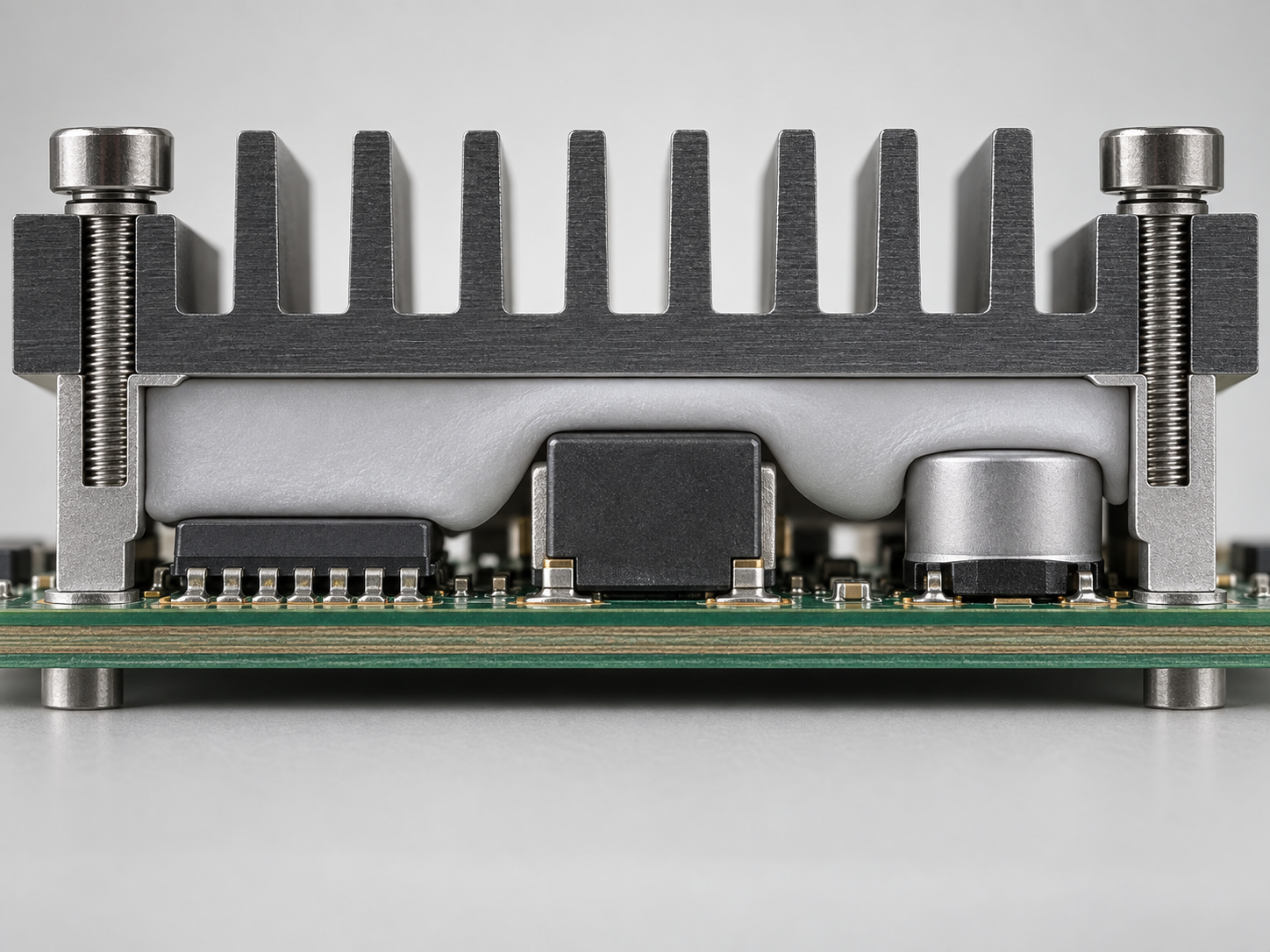
The inside of a pad is silicone rubber packed with a heat-conducting inorganic powder (filler). Laird's datasheet explains that Tflex 700 combines high compliancy (softness) with high thermal performance through “silicone and ceramic filler technology”Sourced. Henkel's GAP PAD TGP 2000 is reinforced with fibreglass for puncture, shear and tear resistanceSourced.
View the original SVG schematic and source notes
“Gap pads” and “insulating sheets” are different things
The Henkel catalogue divides its sheet-type products into two groupsSourced.
| Type | Catalogue description | Values of catalogue-listed products (manufacturer's stated values) |
|---|---|---|
| SIL PAD (thermally conductive insulating sheet) | Silicone resin sheet reinforced with fibreglass; flame retardant (UL94 V-0) with excellent mechanical strength. Power supply units, automotive electronics, motor control boards, power semiconductors and so on | TSP 900 / 1600S / 1800: thickness 0.18 to 0.41 mm, thermal conductivity 0.9 / 1.6 / 1.8 W/m·K, breakdown voltage 3,500 to 6,000 Vac |
| GAP PAD (gap-filling sheet) | Can thermally join a board carrying parts of different heights directly to an enclosure or large heat sink. Combines the gap-filling ability of paste or gel with the easy handling of a sheet | TGP 1000VOUS / 1500R / HC3000: thickness 0.25 to 6.4 mm, thermal conductivity 1.0 / 1.5 / 3.0 W/m·K, bulk hardness (Shore 00) 5 / 40 / 15 |
All Sourced (Henkel Japan catalogue [Ref. 1], as of January 2019; the test method and conditions could not be confirmed in the catalogue). Thickness and values are ranges across the listed products, and test conditions are not necessarily the same even within one table.
So a thin insulating sheet (around 0.2 mm) is for “insulation and thinness”, while a thick gap pad (0.5 mm to several mm) is for “softness that fills steps” (this article's arrangement). The consumer “thermal pads” that people search for most (0.5 to 1.5 mm pads stuck on memory or GPUs) belong to the latter group.
3. Reading the datasheet (1): thickness, hardness, compression
Thickness
Henkel's datasheets state that thickness is measured to ASTM D374 (GAP PAD TGP 2000: 0.508 to 3.175 mm)Sourced. Laird's Tflex 700 is supplied from 0.5 to 5.0 mm in 0.25 mm stepsSourced. The basic rule is to choose a pad somewhat thicker than the gap you need to fill; the manufacturer's guidance in section 9 says the same.
Hardness: first look at “which scale”
Pad hardness is expressed with a durometer (ASTM D2240). According to the ASTM page, the standard covers twelve types of durometer: A, B, C, D, DO, E, M, O, OO, OOO, OOO-S and RSourced. For soft pads, the Type OO (often written “Shore 00”) or Type OOO (“Shore 000”) scales are used. Manufacturers write it “Shore 00” or “Shore OO”; here we read both as the same family of scale (our commentary).
| Product (manufacturer) | Hardness as written | Accompanying figures | Source |
|---|---|---|---|
| BERGQUIST GAP PAD TGP 2000 (Henkel) | Shore 00: 30 (thirty-second delay value, ASTM D2240, bulk rubber) | Young's modulus 310 kPa (45 psi) | Datasheet (October 2018) |
| BERGQUIST GAP PAD TGP 1500R (Henkel) | Shore 00: 40 (same) | Young's modulus 310 kPa (45 psi) | Datasheet (October 2018) |
| BERGQUIST GAP PAD TGP 12000 (Henkel) | Shore 000: 76 (ASTM D2240) | Young's modulus 593 kPa (86 psi) | Datasheet (June 2021) |
| TGP 1000V0US / 3000 / HC5000 (Henkel) | Shore 00: 5 / 15 / 35 | Young's modulus 8 / 16 / 17.5 psi | EV product information sheet (September 2020) |
| Tflex 700 (Laird) | 78 (under 1 mm) / 66 (over 1 mm), “Hardness (3 sec)”, ASTM D2240 | The scale (00 or other) could not be confirmed | Datasheet (June 2016) |
| Tflex HD90000 (Laird) | Shore 00: 32 | — | Product page (updated August 2023) |
| ARCTIC TP-4 | 50 Shore OO | Compression ratio 47% @ 50 psi | Spec sheet |
All Sourced (manufacturers' stated values; Refs. 2 to 5, 7, 8 and 10). Numbers on different scales (00, 000, OO) or with different delay times (30 s, 3 s) cannot be compared as they stand.
In Henkel's EV product information sheet, TGP 3000 is listed as “Shore 00 = 15, Young's modulus 16 psi” and HC5000 as “Shore 00 = 35, Young's modulus 17.5 psi”Sourced. The hardness numbers differ by more than a factor of two, yet the Young's moduli barely differ. The Laird presentation likewise cautions that “hardness is not deflection”, that it is an over-simplification used by industry, and that it is an indentation testSourced.
What decides the force on parts and boards when a pad is pressed down is less the indentation hardness than the stress on compression (the modulus and the stress–strain curve) (our commentary). This is presumably why Henkel's datasheets give Young's modulus (calculated at a strain rate of 0.01 in/min with a 0.79 inch² sample) alongside hardness.
Compression ratio and deflection
Henkel's datasheets give thermal impedance at “10%, 20% and 30% deflection”Sourced. ARCTIC's spec sheet lists a “compression ratio of 47% @ 50 psi” for TP-4Sourced. The Laird presentation shows that stress changes with strain rate (10, 100 and 1000 mil/min in its graph) and notes that “users do not assemble components in mm per minute but mm per second”, so the gap between test conditions and real assembly needs attentionSourced.
4. Reading the datasheet (2): thermal conductivity and thermal resistance
Here are examples where the same item name hides different content.
| Item | Henkel TGP 2000 (October 2018) | Laird Tflex 700 (June 2016) | ARCTIC TP-4 (spec sheet) |
|---|---|---|---|
| Thermal conductivity | 2.0 W/(m·K), test method ASTM D5470 | 5.0 W/mK, test method Hot Disk | No value given (section 8) |
| How thermal resistance is shown | Thermal impedance (0.040 inch thick, D5470): 0.97 at 10% deflection, 0.89 at 20%, 0.80 at 30% °C·in²/W. “Includes interfacial thermal resistance” | No thermal impedance entry in the datasheet table (as far as we could read) | A graph of thermal resistance (°C/W) at contact pressures of 0.5 / 0.9 / 1.2 kgf/cm² under a 100 W thermal load (section 6) |
| Hardness | Shore 00: 30 (after 30 s) | 78 / 66 (3 s) | 50 Shore OO |
| Other | Density 2.9 g/cc, UL 94 V-0, operating temperature −60 to 200°C | Specific gravity 1.73, UL 94 V0, outgassing TML 1.0% and CVCM 0.13% (ASTM E595), operating temperature −40 to 200°C | Specific gravity 3.4 g/cm³, UL94 V-0, continuous use temperature −40 to 150°C |
All Sourced (manufacturers' stated values; Refs. 2, 7 and 10). These are different products, years and test methods, so this is not a ranking.
- The test methods differ: in our explainer on thermal interface materials we introduced ASTM D5470 as the method that measures at several thicknesses and separates contact resistance to get an apparent thermal conductivity. The Laird presentation lists D5470, ISO 22007-2 (hot disc) and laser flash as ways to measure thermal conductivity, and cautions that D5470 cannot measure anisotropySourced. ISO 22007-2:2022 is a standard for finding the thermal conductivity and thermal diffusivity of plastics by the hot disc methodSourced
- Stated as “for reference”: Henkel's datasheet says the data are for reference only and are not for product specifications (“Not for product specifications”)Sourced
- The latest datasheet governs: always check the revision date (October 2018, June 2021 and so on) and the test conditions
5. Our calculation: what separates “thermal conductivity” from “thermal resistance”
Henkel's datasheets list thermal conductivity (D5470) alongside thermal impedance (which includes contact) for each thickness and deflection. From the two we can work out the part of the thermal impedance explained by thickness and thermal conductivity (L/k), and the rest (mainly contact)Our calculation.
Assumption: read “n% deflection” as the thickness falling by n% (thickness = nominal thickness × (1 − n)). Thermal conductivity is the datasheet value (D5470). L/k is found with k converted to W/(in·K) (2.0 W/m·K = 0.0508 W/in·K).
Example (TGP 2000, 0.040 inch, 10% deflection): thickness = 0.040 × 0.9 = 0.036 in; L/k = 0.036 ÷ 0.0508 = 0.71 °C·in²/W. The difference from the datasheet thermal impedance of 0.97 is 0.26. That is the “contact and other” part.
| Product (nominal thickness, thermal conductivity) | Deflection | Thermal impedance (datasheet) | L/k (our calculation) | Remainder (our calculation) |
|---|---|---|---|---|
| TGP 2000 (0.040 in, 2.0 W/m·K) | 10% | 0.97 | 0.71 | 0.26 (about 27%) |
| TGP 2000 (as above) | 20% | 0.89 | 0.63 | 0.26 (about 29%) |
| TGP 2000 (as above) | 30% | 0.80 | 0.55 | 0.25 (about 31%) |
| TGP 1500R (0.020 in, 1.5 W/m·K) | 10% | 1.07 | 0.47 | 0.60 (about 56%) |
| TGP 1500R (as above) | 20% | 0.88 | 0.42 | 0.46 (about 52%) |
| TGP 1500R (as above) | 30% | 0.82 | 0.37 | 0.45 (about 55%) |
All units are °C·in²/W. The thermal impedance values are Sourced from Henkel's datasheets (TGP 2000 and TGP 1500R, October 2018); L/k and the remainder are Our calculation. Percentages are rounded to the nearest whole number.
For TGP 2000, raising the deflection from 10% to 30% lowers the thermal impedance from 0.97 to 0.80, by about 18%Our calculation ((0.97 − 0.80) ÷ 0.97). The part other than L/k barely moves, from 0.26 to 0.25. Most of the benefit of compression can be explained by the pad getting thinner (L falling).
For TGP 1500R (0.020 inch, fibreglass-reinforced), however, the “remainder” is 0.45 to 0.60, about twice that of TGP 2000, and changes a lot between 10% and 20% deflection. This shows that the weight of the contact term shifts with thinner material and with the reinforcement and surface condition (our commentary; it is not a ranking of products).
The k used here is the datasheet “thermal conductivity (D5470)”, an apparent value obtained from the slope of measurements at several thicknesses (see our explainer on thermal interface materials). In other words, “thermal conductivity 2.0” is a bulk value with the contact part removed, and the thermal resistance when you actually fit the pad to a part is always larger by that amount.
6. A materials engineer's view (1): pressure changes thermal resistance
A pad's thickness and contact both change with the pressing force, so thermal resistance is a function of pressure. Here are the trends picked from each source.
| Source | Pressure or deflection | What is stated for thermal resistance (manufacturer's stated values) |
|---|---|---|
| Laird Tflex HD90000 product page | 10 / 30 / 50 psi | Maximum thermal resistance 0.539 / 0.203 / 0.129 °C·in²/W, minimum 0.154 / 0.074 / 0.061 °C·in²/W (the page does not say what min and max refer to; they may reflect the thickness range, but this is unconfirmed) |
| Henkel TGP 2000 datasheet | 10% / 20% / 30% deflection | 0.97 / 0.89 / 0.80 °C·in²/W (0.040 inch thick) |
| Performance graph on the ARCTIC TP-4 product page | 0.50 / 0.90 / 1.20 kgf/cm² (100 W thermal load) | Both series in the graph show thermal resistance (°C/W) falling as pressure rises (for example, one series: 0.1368 → 0.1158 → 0.1087). The legend could not be confirmed within the graph image |
| DuPont technical paper | 20 to 40 psi (TIM2) | A guide to the compression that gives the most advantageous thermal performance. For TIM1, large pressure is avoided because it would damage the die |
All Sourced (Refs. 2, 8, 13 and 14). The ARCTIC graph values were read from the image by this article. 0.5 kgf/cm² is about 7.1 psi and 1.2 kgf/cm² about 17 psiOur calculation.
For Laird's HD90000, raising pressure from 10 psi to 50 psi lowers the maximum thermal resistance from 0.539 to 0.129 and the minimum from 0.154 to 0.061 °C·in²/W, to about 24% and about 40% respectivelyOur calculation (0.129÷0.539 and 0.061÷0.154). The company lists “low pressure versus deflection” and “excellent surface wetting for low contact resistance” among this product's featuresSourced.
Raising pressure lowers thermal resistance, but the force on parts and boards also rises. Small parts such as memory and chips, and thin boards, can take only so much force. So the design goal for a pad is to crush well and conform well under little force. That Henkel lists “low compression stress” and an “ultra low modulus resin” among TGP 12000's features, describing it as for high-performance applications “requiring low assembly stress”Sourced, reflects that requirement (our commentary).
Here is the dilemma we saw in the TIM article. To gain thermal conductivity you want more filler, but more filler raises the modulus and makes the pad harder to crush. The densities in Henkel's datasheets are 2.1 g/cc for TGP 1500R (1.5 W/m·K), 2.9 g/cc for TGP 2000 (2.0) and 3.1 g/cc for TGP 12000 (12)Sourced. The direction that more heavy filler means higher density is visible, but a 12 W/m·K product must have a different filler type, shape and resin, so density alone cannot explain it (our commentary). Laird's Tflex 700 is listed at a specific gravity of 1.73 with 5.0 W/mK (Hot Disk)Sourced, so lining up density and thermal conductivity across manufacturers reveals no relationship.
7. A materials engineer's view (2): bleed, low-molecular-weight components and outgassing
A pad's matrix is silicone. A concern on the materials side is that, to make the pad soft, unreacted low-molecular-weight components or oils can remain in the resin (our commentary). The primary sources also treat this as part of performance.
- Bleed (oozing out): the Laird presentation lists “low outgassing / low bleeding” among the properties wanted of a TIMSourced
- Low-molecular-weight siloxanes: Laird's Tflex HD90000 product page lists “Low Outgassing” and “Low D3-D20 (< 20ppm)” among its features and gives outgassing as CVCM 0.010% and TML 0.170%Sourced. The page does not explain what D3 to D20 means; we read it as low-molecular-weight components such as cyclic siloxanes (not confirmed)
- Products that advertise low volatiles: Henkel's EV product information sheet notes “low volatility” for the GAP PADs TGP 3000 and HC5000 and “low siloxane volatility” for the GAP FILLER TGF 1500Sourced
- A silicone-free option: in a May 2026 press release Henkel announced a silicone-free two-component gap filler (TGF 2030APS) for EV batteriesSourced. It reads as a sign that sensitive applications such as batteries want to avoid silicone-derived components (our commentary)
The “TML” and “CVCM” in datasheets are values measured by ASTM E595 (Standard Test Method for Total Mass Loss and Collected Volatile Condensable Materials from Outgassing in a Vacuum Environment)Sourced. According to the ASTM page, the test is run in vacuum at 125°C for 24 hours, measuring the mass lost (TML) and the amount condensing on a collector at 25°C (CVCM)Sourced. The same page calls the test a screening technique for comparing materials and states that there is no intent to predict actual outgassing in serviceSourced. A small TML or CVCM is therefore a rule of thumb for screening when a pad is used near optics or sensors; it is not a guarantee that no contamination will occur in the real device (our commentary).
We could not confirm a common standard in the primary sources we read that quantifies oil bleed itself. Reports mention a product that advertises “Low Oil” (Parker Chomerics THERM-A-GAP PAD 80LO), but we could not open the manufacturer's official page when writing this article, so we do not cover it.
8. Reading a consumer part number: ARCTIC TP-4 as an example
The searches seen most often are for part numbers of consumer pads stuck on memory, GPUs and SSDs. Here we sort out what can and cannot be read, using the official spec sheet and product page for ARCTIC TP-4 as the primary sources. We do not rank products.
| Item | As stated in ARCTIC TP-4's spec sheet (manufacturer's stated values) |
|---|---|
| Material and colour | Silicone-based (product page). Colour: grey |
| Size and thickness | 100 × 100 mm and 120 × 20 mm. Thickness 0.5 / 1.0 / 1.5 mm. Can be layered up to 2.0 mm (press release) |
| Hardness | 50 Shore OO (the test method could not be confirmed) |
| Compression ratio | 47% @ 50 psi (the test method could not be confirmed) |
| Other | Specific gravity 3.4 g/cm³, tensile strength 1 psi, breakdown voltage 8.62 kV/mm, dielectric constant 7.2 @ 1 MHz, UL94 V-0, RoHS compatible, continuous use temperature −40 to 150°C |
| Thermal conductivity | Not stated |
All Sourced (ARCTIC's spec sheet [Ref. 10], product page [Ref. 9] and press release). The volume resistance entry is omitted because the exponent could not be confirmed in the text extracted from the spec sheet.
ARCTIC explains on its own page why it does not publish thermal conductivity
ARCTIC's overview page for thermal pastes and pads says why it does not publish thermal conductivity values. In summary: because many manufacturers inflate their values, ARCTIC deliberately does not state thermal conductivity for its thermal paste and padsSourced (this is the company's claim; this article has not verified what it says about other manufacturers). The same page says that thermal resistance is set by “bond line thickness divided by thermal conductivity”, and that pads generally conduct heat better than paste but cannot achieve a very thin bond lineSourced.
Retail product pages sometimes list a specific W/m·K for TP-4's thermal conductivity. However, no such value appears in the body of ARCTIC's official spec sheet, product page or user manual, and the company states a policy of not publishing one. A number the manufacturer has not published is not a primary source, so this article does not use it. When you need a number, ask for the manufacturer's datasheet, which states the test method and conditions.
Some items are written differently across documents for the same product
- The product page says “Operating Ambient Temperature −40 to 200°C”, while the spec sheet says “Continuous Use Temperature −40 to 150°C” (the item names differ, so we cannot call this a contradiction)Sourced
- For breakdown voltage the product page says “8620 V/mil” and the spec sheet says “8.62 kV/mm”. 8.62 kV/mm is about 219 V/milOur calculation (8.62 × 25.4), so they cannot be read as the same value. We could not confirm which is correct
- On compression, the product page says it “can be compressed to up to 60% of its original thickness” depending on mounting pressure. The wording can be read two ways (down to 60%, or by 60%), and we could not confirm how it relates to the spec sheet's “47% @ 50 psi”Sourced
This is not about which product is better; it is an example of checking item names, units and conditions in the spec sheet when you use a number (our commentary).
9. Fitting and choosing: from the manufacturer's guidance
ARCTIC's user manual gives the following guidance on choosing and fitting padsSourced.
- Choose a thickness above the gap: for example, one 1.5 mm pad for a 1.2 mm gap, or two stacked 1.5 mm pads for a 2.6 mm gap
- Review the design for gaps over 3 mm: pads fill small gaps and are not suited to large ones
- With almost no gap (under 0.2 mm), use thermal grease:
- Clean the surface: dirt reduces the contact area and hinders heat transfer; wipe with a cloth dampened with isopropyl alcohol or similar
- After removing a used pad, check its thickness: confirm it is the same as the pad you bought
- Peeling the film: because the pad is extremely soft, lift a corner with a utility knife and roll the film back at a 180-degree angle, taking care not to pull the pad and tear it
- Storage: in an airtight container in a cool, dark place at −10 to 40°C, away from moisture
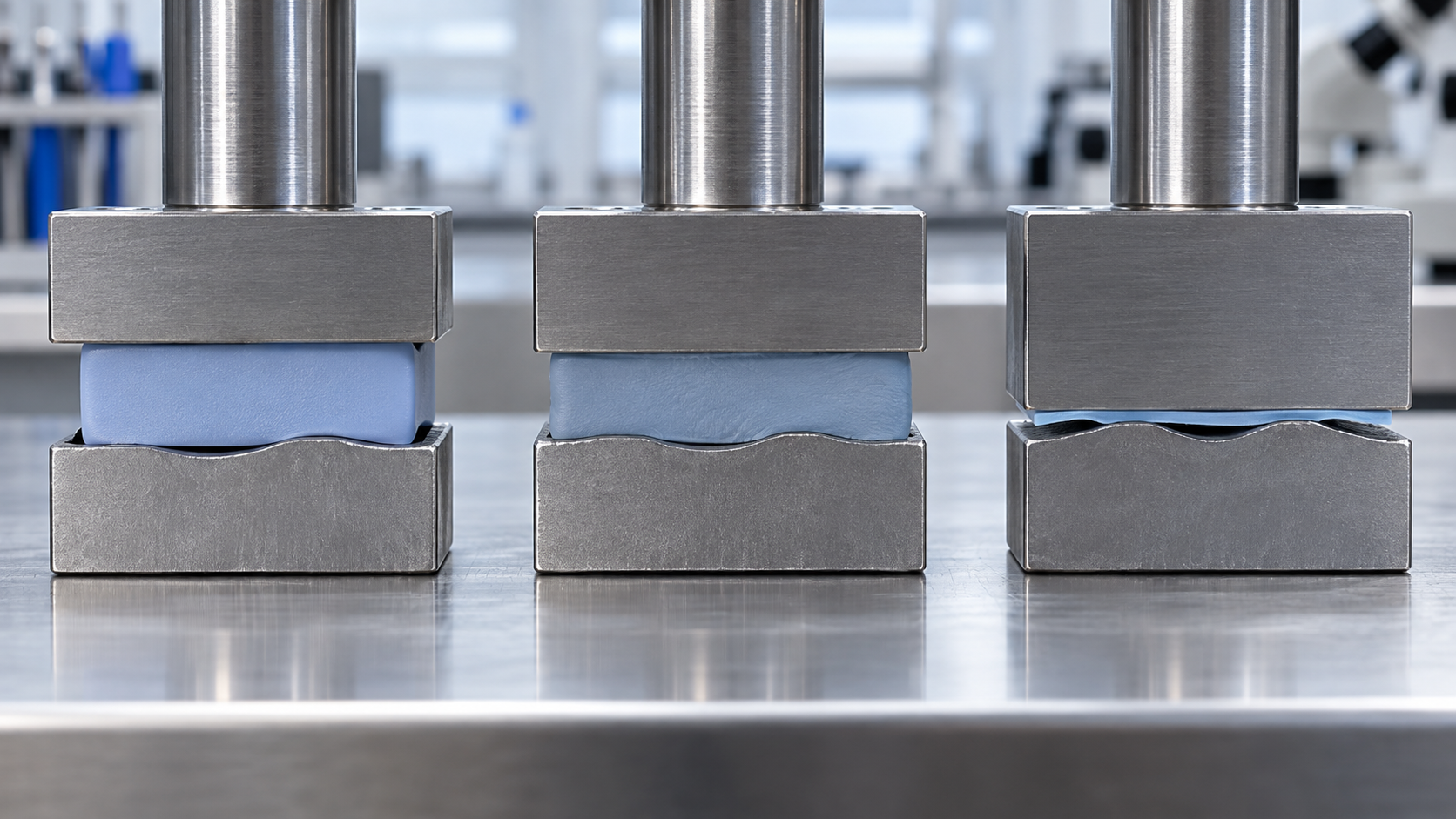
ARCTIC's product page describes TP-4 as “stackable without performance loss”, because “low hardness and low interface resistance” mean multiple pads can be combined without affecting thermal transferSourced (the company's claim). From the equation Rth = L/k + Rc1 + Rc2 in our explainer on thermal interface materials, stacking pads increases L and adds an interface, so in principle thermal resistance moves upward. How much it increases (the softer the pad, the smaller the interface) depends on the material, and we could not confirm numbers in the documents we read (our commentary).
10. Where pads are used: memory, power electronics and EV batteries
- Memory and SSDs: ARCTIC's user manual covers cooling the chips on RAM sticks and M.2 SSDs (cut the pad to cover the length and width of the chips; if there are chips on the underside, apply a pad there too)Sourced. Henkel's TGP 1500R datasheet also lists “RDRAM memory modules / chip scale packages” among its applicationsSourced
- Power supplies and power semiconductors: the Henkel catalogue lists, for GAP PAD, base stations, PCs and peripherals, power converters, discrete FETs and automotive electronics, and for SIL PAD, power supply units, motor control boards and power semiconductorsSourced
- EV power conversion: in Henkel's EV product information sheet (September 2020), GAP PAD is placed “heat source to cooling sink”, and GAP FILLER and thermally conductive adhesives “component / PCB to housing or heat sink”Sourced
- EV batteries: the DuPont technical paper lists a formulated automotive TIM2 between battery packs and heat sinks among the company's productsSourced. Henkel's May 2026 press release introduces a liquid gap filler (TGF 2030APS, 1.7 W/m·K) and a thermally conductive adhesive as new products for moving heat from the battery cell stack to the cooling plateSourced. We could not confirm from the documents we read whether pads are used in battery applications. Requirements such as high-volume dispensing speed (over 40 cc/s) suggest that liquid products are chosen in many cases (our commentary)
11. Open problems, and what this article could not confirm
(1) A comparison with matched test methods and conditions is not possible
Henkel uses D5470, Laird uses Hot Disk, and ARCTIC does not publish thermal conductivity. Years and conditions also differ, so we did not build a table comparing the thermal performance of pads across products.
(2) ARCTIC TP-4's thermal conductivity, and differences in how its official documents are written
We could not confirm the thermal conductivity from official documents. The differences between the product page and spec sheet in the name of the temperature item, the unit of breakdown voltage and the wording on compression cannot be confirmed or corrected by this article.
(3) No common method for evaluating oil bleed could be confirmed
TML and CVCM (ASTM E595) are an outgassing screen, not a standard for measuring the oozing of liquid components. Parker Chomerics' official page could not be opened when this article was written.
(4) The definition of Laird's “D3-D20” could not be confirmed
The product page does not explain it. We read it as low-molecular-weight siloxanes, but we have not confirmed the definition.
(5) Use of pads in EV batteries could not be confirmed
Henkel's 2026 battery products are a liquid gap filler and an adhesive.
(6) Long-term stress relaxation and ageing are not covered
Changes in stress when a pad is kept compressed for a long time, and changes in thermal resistance over time, are not covered because the documents we read had no numbers for them.
- A thermal pad is a soft sheet of silicone packed with filler, and it absorbs the steps between parts of different heights as differences in thicknessSourced
- Read numbers together with the test method and conditions. Henkel uses D5470 and Laird uses Hot Disk; hardness cannot be compared if the scale (00, 000, OO) and delay time differSourced
- A datasheet's thermal impedance includes contact, while its thermal conductivity is a bulk apparent value. For TGP 2000 the part other than L/k is about 0.25 to 0.26 °C·in²/W, and most of the benefit of compression is the pad getting thinnerOur calculation
- Thermal resistance changes a great deal with pressure. For Laird HD90000, from 10 to 50 psi the maximum falls to about 24% and the minimum to about 40%Our calculation
- Bleed and outgassing are part of performance. ASTM E595 is a 125°C, vacuum, 24-hour screen and does not predict real useSourced
- ARCTIC does not publish a thermal conductivity for TP-4. Numbers that have not been published are not primary sources, so we do not use themSourced
12. Glossary
- Thermal pad / gap pad
- A soft sheet-type TIM that fills the gaps between parts of different heights.
- SIL PAD
- Henkel's brand of thermally conductive insulating sheet. Thin (around 0.2 mm); its job is insulation.
- Thermal impedance
- Area-specific thermal resistance (°C·in²/W and so on). Often presented as a value that includes contact thermal resistance.
- Apparent thermal conductivity
- Thermal conductivity worked out from the thermal impedance and thickness of a heterogeneous material (ASTM D5470).
- Deflection
- How far the pad is compressed (the fractional reduction in thickness).
- Shore 00 / OO / 000
- Durometer scales for soft rubbers and gels (Types OO and OOO of ASTM D2240). Numbers on different scales cannot be compared.
- Young's modulus
- The elastic modulus of a material: the ratio of stress to strain for small deformations.
- Bleed
- Components inside a material oozing out to the surface.
- Outgassing
- Volatile components released from a material.
- TML / CVCM
- Total mass loss in vacuum and the amount of collected volatile condensable material (ASTM E595).
- Hot Disk
- The hot disc (transient plane heat source) method for measuring thermal conductivity and diffusivity (ISO 22007-2).
- psi / kgf/cm²
- Units of pressure. 1 psi is about 6.9 kPa; 1 kgf/cm² is about 98 kPa, or about 14.2 psi.
13. References (primary sources)
- Henkel Japan Henkel Japan: Thermal Interface Materials for Heat Dissipation: Thermal Solutions (BERGQUIST product catalogue in Japanese, as of January 2019, PDF) https://dm.henkel-dam.com/is/content/henkel/brochure-bergquist-thermal-interface-materials-jp
- Henkel BERGQUIST GAP PAD TGP 2000 Technical Data Sheet (October 2018, PDF) https://datasheets.tdx.henkel.com/BERGQUIST-GAP-PAD-TGP-2000-en_GL.pdf
- Henkel BERGQUIST GAP PAD TGP 1500R Technical Data Sheet (October 2018, PDF) https://datasheets.tdx.henkel.com/BERGQUIST-GAP-PAD-TGP-1500R-en_GL.pdf
- Henkel BERGQUIST GAP PAD TGP 12000 Technical Data Sheet (June 2021, PDF) https://datasheets.tdx.henkel.com/BERGQUIST-GAP-PAD-TGP-12000-en_GL.pdf
- Henkel "Henkel Thermal Interface Solutions for EV Power Conversion Systems" (product information sheet, September 2020, PDF) https://dm.henkel-dam.com/is/content/henkel/Product_information_sheet-thermal-interface-solutions-ev-power-conversion-systems
- Henkel Press release "Henkel's EV battery thermal management portfolio grows with new thermal interface materials", 12 May 2026 (PDF) https://www.henkel.com/resource/blob/2157222/2d5f17b3c1296a98c28b8077f3abbb01/data/2026-05-12-henkel-press-release-thermal-interface-materials-for-ev-battery-systems.pdf
- Laird Tflex 700 Thermal Gap Filler datasheet (THR-DS-Tflex 700 17June16, PDF) https://www.laird.com/sites/default/files/tflex-700-datasheet.pdf
- Laird Tflex HD90000 (product page; lists a datasheet last updated 22 August 2023) https://www.laird.com/products/thermal-interface-materials/gap-fillers/tflex-hd90000
- ARCTIC Thermal Pad TP-4 (product page) https://www.arctic.de/us/TP-4/ACTPD00063A
- ARCTIC TP-4 Spec Sheet (PDF) https://www.arctic.de/media/0c/7e/5f/1776408477/Spec_Sheet_TP-4_EN.pdf
- ARCTIC TP-4 User Manual https://support.arctic.de/tp-4
- ARCTIC Thermal Paste & Thermal Pads (overview page) https://www.arctic.de/us/products/desktop-pc-cooling/thermal-pastes-pads/
- ARCTIC TP-4 Thermal Resistance Performance Chart (graph image used on the product page) https://www.arctic.de/media/34/52/d0/1778854293/TP-4_Thermal_Resistance_Performance_Chart_2560x1440px_EN.jpg
- DuPont (Claire K. Wemp, Ph.D.) "Advanced Polymer Formulations for Thermal Management of Electronic Devices" (technical paper, PDF) https://www.dupont.com/content/dam/dupont/amer/us/en/articles/corporate/Advanced%20Polymer%20Formulations%20for%20Thermal%20Management%20of%20Electronic%20Devices_r1_66.pdf
- Laird (J. Strader et al.) "Thermal Interface Materials (TIMs) and Challenges Faced by TIM Suppliers", TFAWS 2014, NASA Glenn Research Center (presentation, PDF) https://s3vi.ndc.nasa.gov/ssri-kb/static/resources/TFAWS-2014-PT-06.pdf
- ASTM International D2240-15R21 "Standard Test Method for Rubber Property—Durometer Hardness" (store page) https://store.astm.org/d2240-15r21.html
- ASTM International E595-15(2021) "Standard Test Method for Total Mass Loss and Collected Volatile Condensable Materials from Outgassing in a Vacuum Environment" (store page) https://store.astm.org/e0595-15r21.html
- ASTM International D5470-17R24 "Standard Test Method for Thermal Transmission Properties of Thermally Conductive Electrical Insulation Materials" (store page) https://store.astm.org/d5470-17r24.html
- ISO ISO 22007-2:2022 "Plastics — Determination of thermal conductivity and thermal diffusivity — Part 2: Transient plane heat source (hot disc) method" https://www.iso.org/standard/81836.html
- ARCTIC "TP-4: Premium Performance Thermal Pad" (press release, PDF) https://www.arctic.de/media/8a/33/0d/1779179129/PR%20TP-4.pdf
14. Claim-to-source audit
| Claim in the text | Basis | Category |
|---|---|---|
| The Henkel catalogue's descriptions of GAP PAD, SIL PAD and GAP FILLER (thermally joining parts of different heights directly to an enclosure or large heat sink, absorbing steps to reduce air gaps, extremely low modulus absorbing shock and vibration). SIL PAD TSP 900 / 1600S / 1800 at 0.18 to 0.41 mm, 0.9 / 1.6 / 1.8 W/m·K and breakdown voltage 3,500 to 6,000 Vac. GAP PAD TGP 1000VOUS / 1500R / HC3000 at 0.25 to 6.4 mm, 1.0 / 1.5 / 3.0 W/m·K and bulk hardness (Shore 00) 5 / 40 / 15. The listed applications. That the catalogue is as of January 2019 | Henkel Japan catalogue (in Japanese) Reference 1 https://dm.henkel-dam.com/is/content/henkel/brochure-bergquist-thermal-interface-materials-jp | Sourced |
| TGP 2000: silicone, fibreglass reinforcement, thickness 0.508 to 3.175 mm (ASTM D374), Shore 00 30 (30-second delay, ASTM D2240), density 2.9 g/cc, Young's modulus 310 kPa (45 psi), thermal conductivity 2.0 W/m·K (ASTM D5470), thermal impedance 0.97 / 0.89 / 0.80 °C·in²/W (0.040 in; 10 / 20 / 30% deflection), 'includes interfacial thermal resistance', 'for reference only' and 'not for product specifications'. October 2018 | Henkel TGP 2000 datasheet Reference 2 https://datasheets.tdx.henkel.com/BERGQUIST-GAP-PAD-TGP-2000-en_GL.pdf | Sourced |
| TGP 1500R: thickness 0.254 to 0.508 mm, Shore 00 40, density 2.1 g/cc, Young's modulus 310 kPa (45 psi), thermal conductivity 1.5 W/m·K (ASTM D5470), thermal impedance 1.07 / 0.88 / 0.82 °C·in²/W (0.020 in; 10 / 20 / 30% deflection), memory modules / chip scale packages among applications. October 2018 | Henkel TGP 1500R datasheet Reference 3 https://datasheets.tdx.henkel.com/BERGQUIST-GAP-PAD-TGP-1500R-en_GL.pdf | Sourced |
| TGP 12000: Shore 000 76 (ASTM D2240), density 3.1 g/cc, Young's modulus 593 kPa (86 psi), thermal conductivity 12 W/m·K (ASTM D5470), features of low compression stress, ultra low modulus resin and low assembly stress. June 2021 | Henkel TGP 12000 datasheet Reference 4 https://datasheets.tdx.henkel.com/BERGQUIST-GAP-PAD-TGP-12000-en_GL.pdf | Sourced |
| EV product information sheet: Shore 00 5 / 15 / 35 and Young's modulus 8 / 16 / 17.5 psi for GAP PAD (TGP 1000V0US / 3000 / HC5000); low volatility for TGP 3000 and HC5000; low siloxane volatility for GAP FILLER TGF 1500; GAP PAD placed heat source to cooling sink and GAP FILLER and similar component / PCB to housing or heat sink. September 2020 | Henkel product information sheet Reference 5 https://dm.henkel-dam.com/is/content/henkel/Product_information_sheet-thermal-interface-solutions-ev-power-conversion-systems | Sourced |
| Henkel's press release of 12 May 2026: a silicone-free two-component gap filler for EV batteries, TGF 2030APS (1.7 W/m·K, dispensing over 40 cc/s, low compression force), and a polyurethane-based thermally conductive adhesive, TLB 9270APS | Henkel press release Reference 6 https://www.henkel.com/resource/blob/2157222/2d5f17b3c1296a98c28b8077f3abbb01/data/2026-05-12-henkel-press-release-thermal-interface-materials-for-ev-battery-systems.pdf | Sourced |
| Tflex 700: filled silicone sheet, thermal conductivity 5.0 W/mK (Hot Disk), hardness (3 sec) 78 (under 1 mm) / 66 (over 1 mm) (ASTM D2240), specific gravity 1.73, outgassing TML 1.0% and CVCM 0.13% (ASTM E595), thickness 0.5 to 5.0 mm (0.25 mm steps), silicone and ceramic filler technology. June 2016 | Laird Tflex 700 datasheet Reference 7 https://www.laird.com/sites/default/files/tflex-700-datasheet.pdf | Sourced |
| Tflex HD90000: thermal conductivity 7.50 W/mK, Shore 00 32, density 3.50, thermal resistance at 10 / 30 / 50 psi of maximum 0.539 / 0.203 / 0.129 and minimum 0.154 / 0.074 / 0.061 °C·in²/W, outgassing CVCM 0.010% and TML 0.170%, features of low pressure versus deflection, excellent surface wetting for low contact resistance, and low D3-D20 (< 20ppm) | Laird product page Reference 8 https://www.laird.com/products/thermal-interface-materials/gap-fillers/tflex-hd90000 | Sourced |
| The ARCTIC TP-4 product page (silicone-based, non-adhesive, electrically insulating, compressible to up to 60% of its original thickness depending on mounting pressure, 0.5 / 1.0 / 1.5 mm, stackable without performance loss, operating ambient temperature -40 to 200°C, breakdown voltage 8620 V/mil, 50 Shore OO, specific gravity 3.4) | ARCTIC product page Reference 9 https://www.arctic.de/us/TP-4/ACTPD00063A | Sourced |
| The ARCTIC TP-4 spec sheet (grey, 50 Shore OO, continuous use temperature -40 to 150°C, specific gravity 3.4, compression ratio 47% @ 50 psi, tensile strength 1 psi, breakdown voltage 8.62 kV/mm, dielectric constant 7.2 @ 1 MHz, UL94 V-0, RoHS compatible). That it gives no thermal conductivity | ARCTIC spec sheet Reference 10 https://www.arctic.de/media/0c/7e/5f/1776408477/Spec_Sheet_TP-4_EN.pdf | Sourced |
| ARCTIC's user manual (choose a thickness above the gap; review the design above 3 mm; use grease under 0.2 mm; clean with isopropyl alcohol; peel the film at 180 degrees; storage at -10 to 40°C; use on RAM and M.2). That the body of the manual contains no thermal conductivity value | ARCTIC user manual Reference 11 https://support.arctic.de/tp-4 | Sourced |
| ARCTIC's explanation of why it does not publish thermal conductivity; that thermal resistance is set by bond line thickness divided by thermal conductivity; that pads generally conduct heat better than paste but cannot achieve a very thin bond line (the company's statements) | ARCTIC overview page Reference 12 https://www.arctic.de/us/products/desktop-pc-cooling/thermal-pastes-pads/ | Sourced |
| ARCTIC's graph: thermal resistance at contact pressures of 0.50 / 0.90 / 1.20 kgf/cm² under a 100 W thermal load (one series 0.1368 / 0.1158 / 0.1087 °C/W, the other 0.2036 / 0.1936 / 0.1850 °C/W). That the legend could not be confirmed within the graph image | ARCTIC graph image Reference 13 https://www.arctic.de/media/34/52/d0/1778854293/TP-4_Thermal_Resistance_Performance_Chart_2560x1440px_EN.jpg | Sourced |
| That 20 to 40 psi is a guide to advantageous compression for TIM2; that large pressure is avoided on the die for TIM1; DuPont's automotive TIM2 between battery packs and heat sinks | DuPont technical paper Reference 14 https://www.dupont.com/content/dam/dupont/amer/us/en/articles/corporate/Advanced%20Polymer%20Formulations%20for%20Thermal%20Management%20of%20Electronic%20Devices_r1_66.pdf | Sourced |
| The desirable TIM properties (low outgassing, low bleeding); that hardness is not deflection (compression); strain rate and assembly speed (mm per second); the ways to measure thermal conductivity (D5470, ISO 22007-2, laser flash) and that D5470 cannot measure anisotropy | Laird presentation (TFAWS 2014) Reference 15 https://s3vi.ndc.nasa.gov/ssri-kb/static/resources/TFAWS-2014-PT-06.pdf | Sourced |
| That ASTM D2240 covers twelve durometer types (A, B, C, D, DO, E, M, O, OO, OOO, OOO-S, R); D2240-15R21 (Active) | ASTM store page Reference 16 https://store.astm.org/d2240-15r21.html | Sourced |
| That ASTM E595 is a screening technique measuring TML and CVCM in vacuum at 125°C for 24 hours, with no intent to predict actual outgassing in service | ASTM store page Reference 17 https://store.astm.org/e0595-15r21.html | Sourced |
| That ASTM D5470 is a method for measuring thermal impedance and apparent thermal conductivity. That ISO 22007-2:2022 is a standard for finding the thermal conductivity and thermal diffusivity of plastics by the hot disc method | ASTM store page Reference 18 https://store.astm.org/d5470-17r24.html and ISO official page Reference 19 https://www.iso.org/standard/81836.html | Sourced |
| That ARCTIC TP-4 comes in 0.5 / 1.0 / 1.5 mm and can be layered up to 2.0 mm | ARCTIC press release Reference 20 https://www.arctic.de/media/8a/33/0d/1779179129/PR%20TP-4.pdf | Sourced |
| The L/k values for TGP 2000 and TGP 1500R (0.71 / 0.63 / 0.55 and 0.47 / 0.42 / 0.37 °C·in²/W), the remainders (0.26 / 0.26 / 0.25 and 0.60 / 0.46 / 0.45) and their shares; that for TGP 2000 the thermal impedance falls by about 18% from 10% to 30% deflection | Our calculation. We assumed that 'n% deflection' means the thickness is reduced by n%, and converted the datasheet thermal conductivity (D5470) to W/(in·K) to get L/k (2.0 W/m·K = 0.0508 W/in·K, 1.5 W/m·K = 0.0381 W/in·K). It presumes the thermal conductivity is an apparent value with contact excluded | Our calculation |
| That Laird HD90000's maximum thermal resistance falls to about 24% (0.129÷0.539) and its minimum to about 40% (0.061÷0.154) from 10 to 50 psi; that 0.5 kgf/cm² is about 7.1 psi, 1.2 kgf/cm² about 17 psi and 8.62 kV/mm about 219 V/mil | Our calculation (including unit conversions). 1 kgf/cm² = 14.22 psi; kV/mm × 25.4 = V/mil | Our calculation |
| The reading that Henkel's TGP 3000 and HC5000 differ by more than a factor of two in hardness but barely in Young's modulus; that most of the benefit of compression is explained by thinning (L falling); that the weight of the contact term shifts for thinner pads; that hardness is indentation hardness rather than stress on compression; that stacking adds L and an interface; the account of bleed and low-molecular-weight components; that Shore 00 and OO are the same family of scale; the reading of why silicone-free is wanted; the reading of when liquid gap fillers are chosen; that consumer 'thermal pads' belong with gap pads | This article's own framing and commentary based on published content. Not views expressed by the companies or institutions | Commentary |
| ARCTIC TP-4's thermal conductivity; the numbers on retail sites; which of ARCTIC's product-page and spec-sheet wordings is correct; the definition of Laird's 'D3-D20'; a common method for evaluating oil bleed; official information on Parker Chomerics' low-oil product; use of pads in EV batteries; long-term stress relaxation and ageing | Not covered, because this article could not confirm them. Numbers on retail sites are not primary sources because the manufacturer has not published them. Parker's official page could not be opened when this article was written | Commentary |
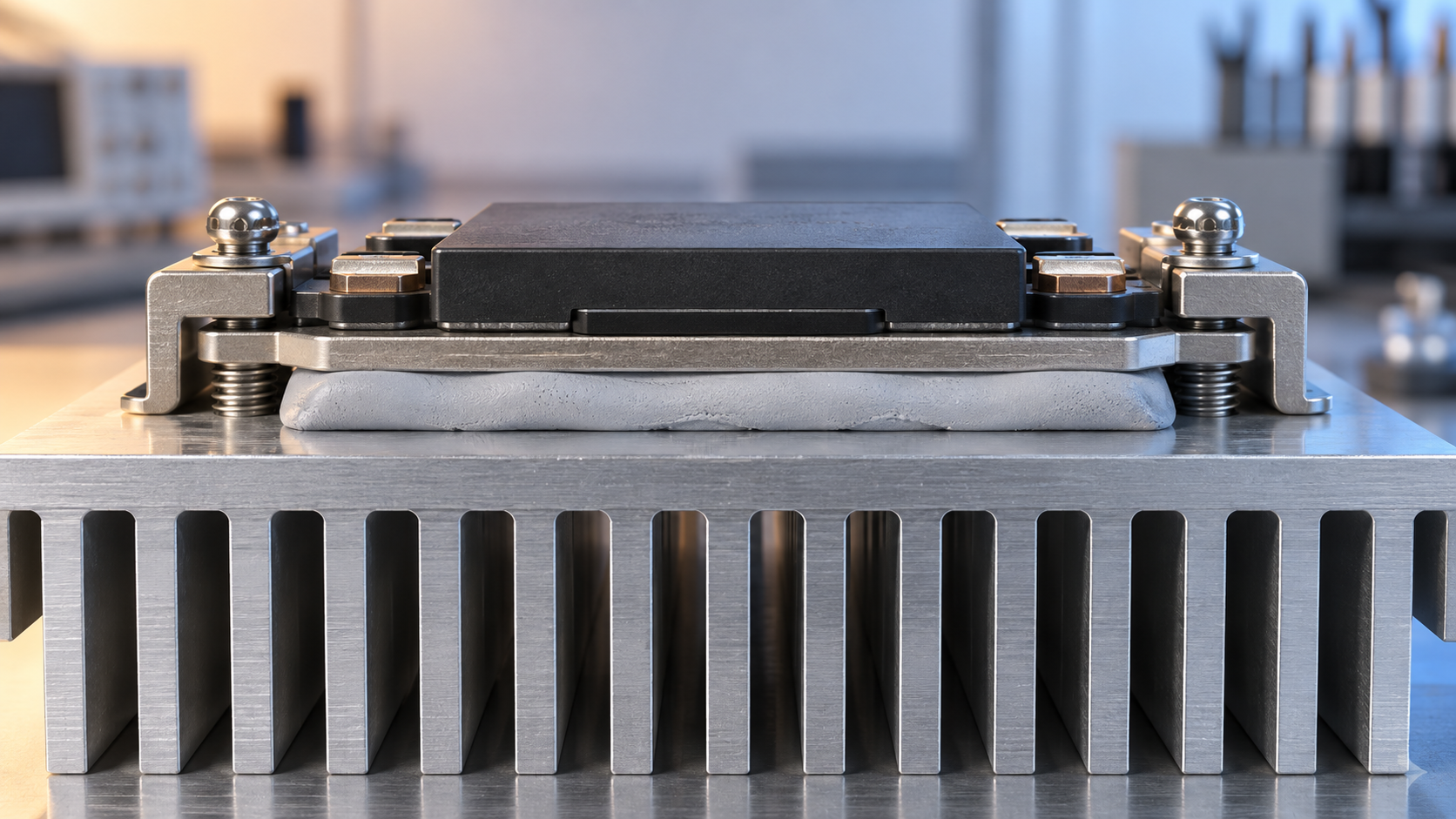
| That Figs. 1 to 3 are explanatory drawings rather than cross-section photographs or measurement results; that the hero image and Fig. 4 are AI-generated images | A note by this article | Commentary |
Last updated 3 October 2026. Sources are limited to primary material (manufacturers' official datasheets, product pages, user manuals and press releases; standards bodies' pages; a conference presentation). Because the article includes structural readings and materials-design interpretations, those are marked as Commentary and kept separate from sourced fact. ARCTIC TP-4's thermal conductivity, a common method for evaluating oil bleed, the definition of Laird's “D3-D20”, use of pads in EV batteries, and long-term stress relaxation are not covered, because they could not be confirmed in primary sources. All figures are for explanation. Figs. 1 to 3 are vector drawings (Fig. 2 includes our calculation), and the hero image and Fig. 4 are AI-generated images; none of them shows an actual cross-section photograph, measurement result or real product.