TECHNOLOGY EXPLAINER
UV Bonding of Glass
— glass transmits ultraviolet light, but not all of it
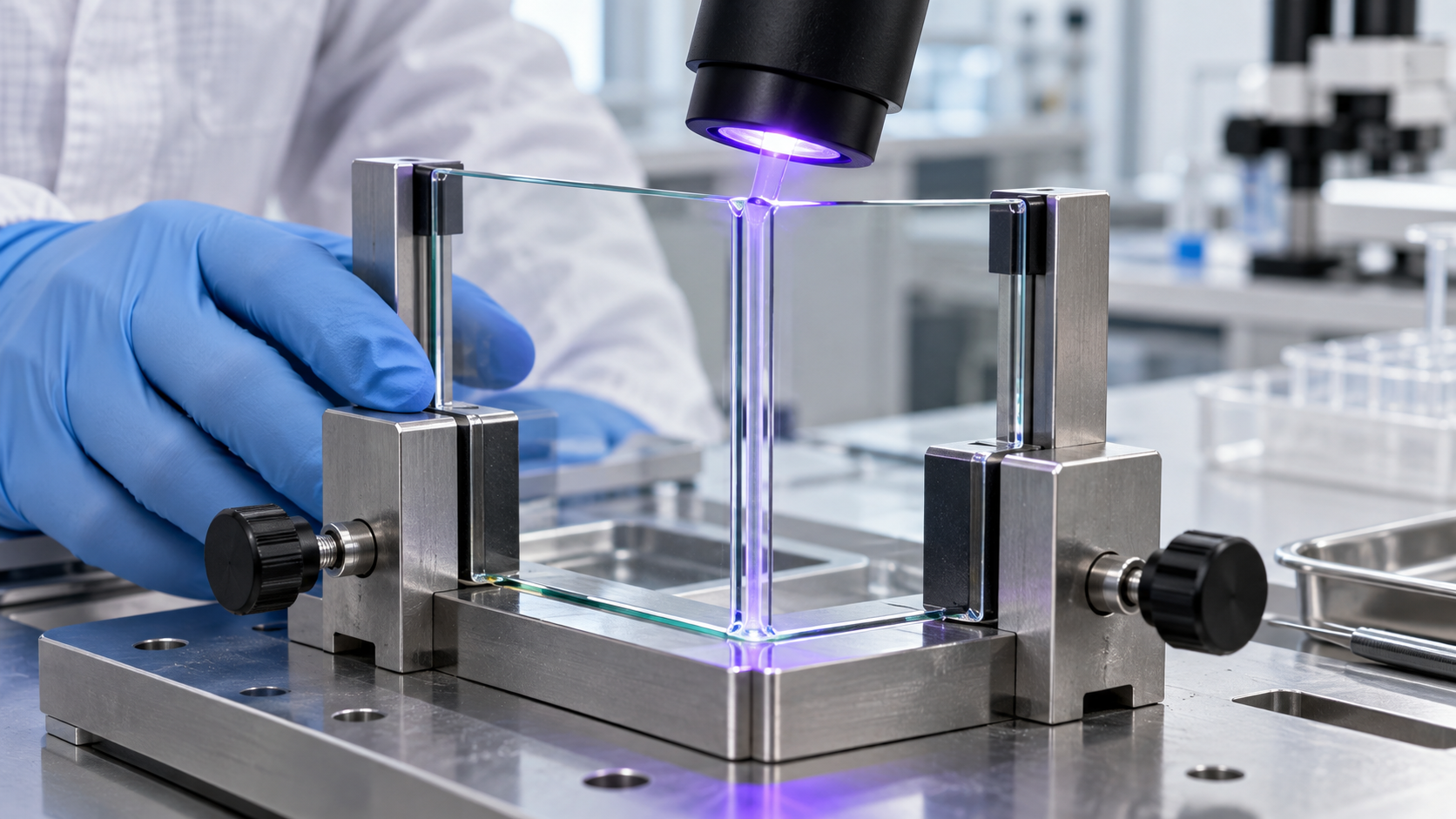
Glass to glass, or glass to metal, bonded by an adhesive that sets within seconds to tens of seconds under ultraviolet light: this is the method used for glass furniture, glassware, optical parts and displays. The key question is whether the light reaches the adhesive layer through the glass. In SCHOTT's published values, a 2 mm sheet of high-transmission glass (B 270) passes about 84% of UVA but only about 19% of UVB, and less than 0.1% at 254 nm. This article sorts out materials, light, the interface (silanes), moisture resistance and evaluation, using primary sources from manufacturers and academia.
- What UV bonding of glass is (in three lines)
- Materials and process: what is bonded, and in what order
- Does glass transmit ultraviolet light? Wavelengths that pass and those that do not
- Our calculation: what remains at the bond line after the glass
- A materials engineer's view 1: glass is a different counterpart for every type
- Index matching: measuring the difference between glass and adhesive
- Designing the interface: primers and silane coupling
- Moisture and water resistance: when water reaches the interface
- Evaluating bond strength: how to read the numbers
- A materials engineer's view 2: the same adhesive gives different results with different counterparts
- Applications: glass furniture, glassware, optical parts and displays
- What could not be confirmed
- Glossary / References / Claim-to-source audit
Sourced = stated in published material (link given)
Our calculation = a figure this article derived, with the assumptions spelled out
Not yet confirmed = a plan or target with no confirmed record
Structural readings and materials-design interpretations are marked separately as Commentary.
Product data sheet values are the manufacturer's stated values (typical), given with grade, test method and revision date. Values for different grades or test conditions are not set side by side to rank them.
1. What UV bonding of glass is (in three lines)
“UV bonding of glass” here means applying a clear adhesive that sets under ultraviolet or visible light between glass and another piece of glass or a metal, and curing it by shining light through the glass. The basics of photocuring (photoinitiators, radical and cationic polymerization, oxygen inhibition, shrinkage and evaluation) are covered in our explainer on UV-curable clear resins. This article keeps to the points specific to glass as the counterpart.
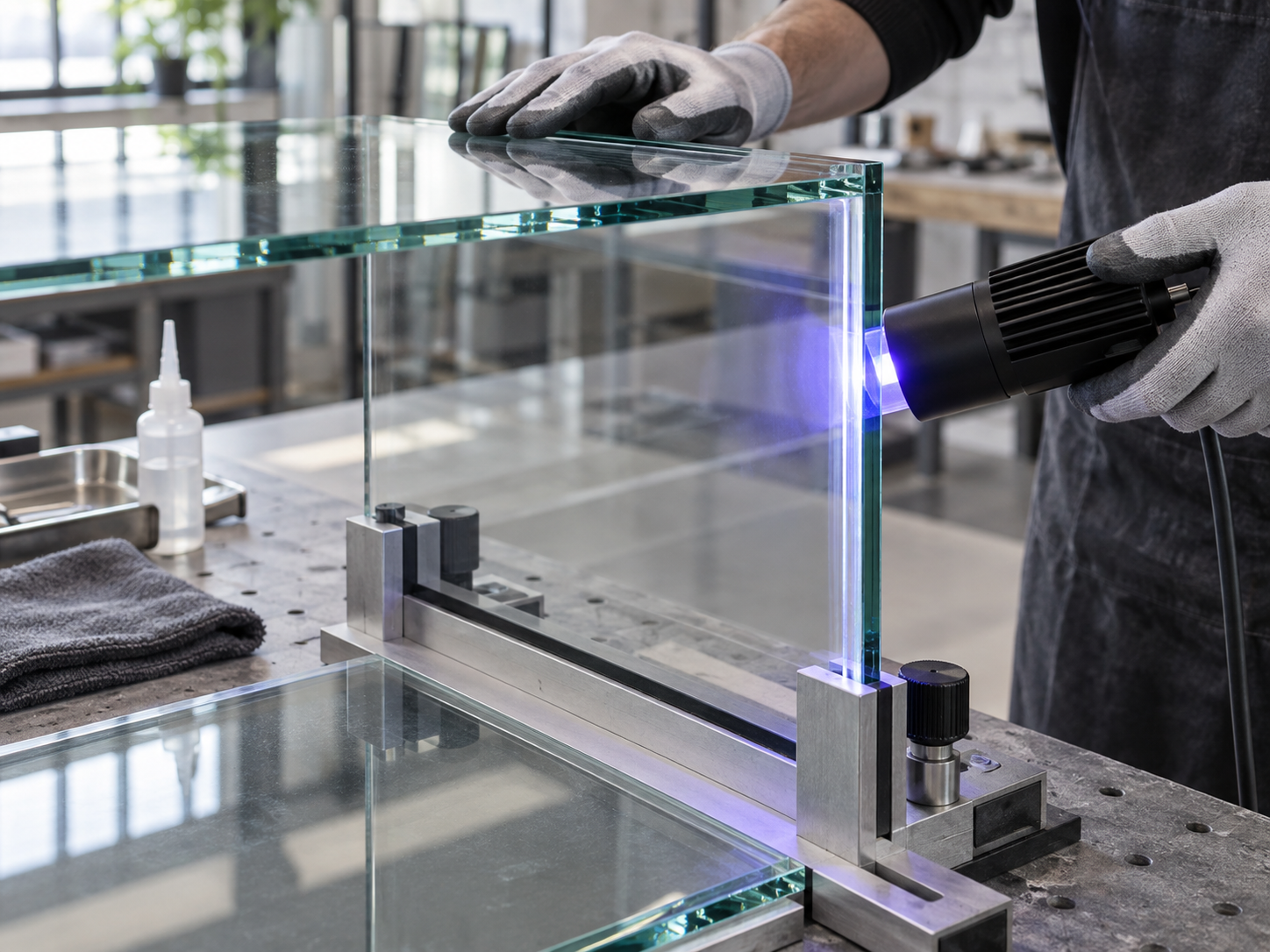
- How it is bonded: for bonds where at least one surface transmits UV, Dymax gives the steps: apply a drop or bead of adhesive to one surface, join the two surfaces so the adhesive spreads to fill the joint, and cure with suitable ultraviolet light for five to ten seconds. The recommended lamp is its 2000-EC flood lampSourced
- What it is used for: Dymax says its glass adhesives adhere to soft glass, borosilicate glass, lead crystal, steel, plated metals and thermoset plastics; are used to assemble glass to glass and glass to metal; and form environmentally resistant bonds with good performance in thermal cyclingSourced
- What makes it hard: Henkel says that for an adhesive application to succeed, one substrate must transmit the appropriate lightSourced. Some glasses block UV; beyond that, results depend on durability when water reaches the bond interface and on the other material in the pair (our reading)
Even clear glass does not transmit every wavelength an adhesive needs. SCHOTT's published values for B 270 (a super-white, modified soda-lime glass), at 2.0 mm thickness, are below 0.1% at 254 nm, 90.8% at 380 nm, 84% for UVA and 19% for UVBSourced. Henkel's guide adds that PVB-laminated safety glass, among others, filters out all 365 nm lightSourced. “It's glass, so UV gets through” remains a hypothesis until the glass type, thickness and wavelength have been checked (Commentary).
2. Materials and process: what is bonded, and in what order
(1) Families of materials
Most UV adhesives for glass are one-component, solvent-free acrylic systems (acrylated urethanes or modified acrylates). The product information available publicly for glass is summarized below (manufacturers' stated values).
| Product (manufacturer) | Chemistry | Statements about glass | Refractive index (stated) |
|---|---|---|---|
| Ultra Light-Weld 4-20260-VLV (Dymax) | Acrylated urethane | Bonding of glassware and stemware, glass case assembly, glass to brick or marble. Stated to work with UV-blocking glass when cured with visible light | 1.51 (20 °C, ASTM D542) |
| 425 (Dymax) | Acrylated urethane | Forms water-white bonds to glass; the bonds are described as dishwasher safe. The data sheet also says it should be evaluated where exceptional moisture resistance is required | 1.50 (20 °C) |
| LOCTITE AA 3492 (Henkel) | Modified acrylate | Bonding, sealing and potting of glass to itself or other materials: rough-surface decorative glass, molded glass tableware, automotive lighting components. Cures under 365 nm UV | 1.48 (uncured liquid) |
| LOCTITE AA 3311 (Henkel) | Acrylated urethane | Designed mainly for bonding PVC to polycarbonate; also stated to show excellent adhesion to glass. Cures under UV or visible light | 1.5 (cured) |
| DELO PHOTOBOND GB (DELO) | Acrylate-based | Glass bonding (glass to glass, mixed glass), decorative elements. UV-resistant and weatherproof; tension-equalizing. Data sheet values could not be confirmed | (not confirmed) |
All Sourced (manufacturers' stated values. Dymax 4-20260-VLV [Ref. 5] and 425 [Ref. 6]; Henkel AA 3492 (November 2014 edition) [Ref. 7] and AA 3311 (April 2026 edition) [Ref. 8]; DELO [Ref. 9]). The refractive indices mix cured and uncured values and different measurement methods, so they are not set side by side to rank products.
(2) Process: the side the light passes through, and the side it need not
Dymax's data sheet for 4-20260-VLV asks that the bonding surfaces be clean and free from contaminants such as grease and mold release, that light-blocking dispensing parts be used because the adhesive reacts to light, and that parts cool after cure before testing or loadingSourced. Henkel's AA 3492 data sheet recommends at least 40 mW/cm² at the bond line and an exposure time of 5 to 6 times the fixture timeSourced.
DELO says that at least one of the parts must transmit the wavelength used for curing; that even when both are opaque, pre-activation lets light curing be used; and that for shadowed areas there are dual-curing adhesives combining light with heat (from +60 °C) or humiditySourced. Dymax cautions that all Light Weld resins must be completely exposed to UV light in order to cureSourced.
3. Does glass transmit ultraviolet light? Wavelengths that pass and those that do not
The UV transmission of glass depends on its composition, its thickness and the wavelength. Take SCHOTT's published values for B 270 (a super-white, modified soda-lime glass, 2.0 mm thick) as an example.
| Wavelength (2.0 mm thick) | Transmittance τ | Meaning |
|---|---|---|
| 254 nm (mercury lamp line) | below 0.1% | Essentially opaque |
| 293 nm (λS) | 5% | Foot of the transmission edge (τ = 0.05) |
| 310 nm (λc) | 46% | UV edge wavelength (τ = 0.46) |
| 338 nm (λP) | 85% | Where transmission nears its plateau (τ = 0.85) |
| 380 nm | 90.8% | High-wavelength side of UVA |
| UVA band average | 84% | Average over the UVA band (SCHOTT's τUVA) |
| UVB band average | 19% | (SCHOTT's τUVB) |
All Sourced (SCHOTT B 270 technical details [Ref. 11]; 2.0 mm values, typical and not guaranteed). The “Meaning” column is this article's framing; the SCHOTT page does not spell out the wavelength ranges of UVA and UVB.
Three things can be read from this (Commentary).
- 365–405 nm UV-LEDs pass through a glass like B 270 well. That agrees with the published 90.8% at 380 nm and 84% over the UVA band. The transmittance at 365 nm itself, however, has no numerical value on the SCHOTT page and could not be confirmed here
- The 254 nm line of a mercury lamp does not pass through glass. Henkel says short wavelengths such as 254 nm are useful for surface cure (see our explainer on UV-curable clear resins), but in glass bonding that wavelength never reaches the adhesive layer. Curing of the adhesive depends on light at about 365 nm and above
- A different glass gives a different curve. SCHOTT describes BOROFLOAT 33 (borosilicate glass) as having excellent transparency in the near-infrared and ultraviolet ranges, and shows its UV transmittance as a graph (this article does not read values from it)Sourced
(1) Glass that does not transmit the light
Henkel's guide gives examples of material that looks clear but blocks UV. Most clear glass types transmit UV light, but Flint F glass (D.E.D.F. 5901) and PVB-laminated safety glass filter out all 365 nm light, which is needed for UV cureSourced. For such substrates, products with a visible-light photoinitiator are the solution, and with newer visible-light technology it is often possible to cure through clear-tinted or clear-colored substrates too, the guide saysSourced.
Dymax's data sheet for 4-20260-VLV says it is compatible with clear or tinted glass, and with UV-blocking glass when cured with visible light (manufacturer's stated)Sourced. Dymax's glass-bonding page says its adhesives cure under LED or UV/visible light, and that some grades cure with an activator or heat for UV-blocked and tinted glassSourced. DELO likewise says that 365, 400 and 460 nm LEDs, together with pre-activation and dual cure, cover cases where one side does not transmit lightSourced.
4. Our calculation: what remains at the bond line after the glass
The light that reaches the adhesive is “surface irradiance × substrate transmittance”. Henkel's AA 3492 data sheet recommends, for bonding between substrates, at least 40 mW/cm² at the bond line (manufacturer's stated)Sourced. Working backward, the required surface irradiance is 40 ÷ transmittanceOur calculation.
- No substrate: 40 ÷ 1 = 40 mW/cm²
- Through B 270 (2.0 mm): using the UVA transmittance of 84%, 40 ÷ 0.84 = about 48 mW/cm²
- UV-transmitting polycarbonate (about 70% at 365 nm): 40 ÷ 0.70 = about 57 mW/cm²
- UV-absorbing polycarbonate (about 3% at 365 nm): 40 ÷ 0.03 = about 1,330 mW/cm²
Assumptions and limits: the 84% is SCHOTT's UVA band average, not a value at 365 nm. The polycarbonate figures of about 70% and about 3% are Henkel's approximate values at 365 nmSourced. The 40 mW/cm² is the recommendation for AA 3492 (a UV-cure grade) and does not apply to other adhesives.
In the published values for B 270 (2.0 mm), UVB is 19% and 254 nm is below 0.1%Sourced. If light must pass through two such plates in sequence (for example in a laminated build-up), simple multiplication gives about 71% for UVA (0.84 × 0.84) and about 3.6% for UVB (0.19 × 0.19)Our calculation.
Assumptions and limits: this is a rough estimate that multiplies each plate's value and ignores, for example, the reduction of reflection between plates when a resin fills the gap. The UVA figure of 71% comes out lower than the case where the light stops short of the second plate (curing through one glass only).
Henkel's AA 3492 data sheet gives the fixture time (the time to reach a shear strength of 0.1 N/mm²) on glass microscope slides for each irradiance measured at 365 nm. Multiplying intensity by timeOur calculation:
- 6 mW/cm² × 5 to 20 s = 30 to 120 mJ/cm²
- 30 mW/cm² × 4 s = 120 mJ/cm²
- 100 mW/cm² × 1 s = 100 mJ/cm²
The same data sheet estimates that full cure takes about 6 times the fixture timeSourced. At 100 mW/cm² that is 6 s, and at 30 mW/cm² it is 24 s, or about 0.6 to 0.7 J/cm² in dose (100 × 6 = 600 and 30 × 24 = 720 mJ/cm²; our calculation).
Assumptions and limits: these are values at a single wavelength (365 nm), apparently with the same type of light source. As seen for Dymax 4-20260-VLV in our explainer on UV-curable clear resins, when the source and the measurement range differ, intensity × time can scatter by more than an order of magnitude.
Henkel's AA 3311 data sheet (April 2026 edition) gives fixture times on the same glass slides of 5 seconds with an LED flood light (514 mW/cm² measured at 405 nm), 5 seconds at 100 mW/cm² measured at 365 nm, and 15 seconds with a blacklight (6 mW/cm² measured at 365 nm)Sourced. In intensity × time that is about 2.6 J/cm², about 0.5 J/cm² and about 0.09 J/cm²Our calculation. With a different wavelength, the same fixture time corresponds to an intensity × time about 5 times larger (2.57 ÷ 0.5 ≈ 5.1) (Commentary; the measurement wavelengths differ between 405 and 365 nm, and the sources appear to be different).
5. A materials engineer's view 1: glass is a different counterpart for every type
Two glasses set side by side from SCHOTT's published values (typical, not guaranteed)Sourced.
| Item | B 270 (modified soda-lime glass) | BOROFLOAT 33 (borosilicate glass) |
|---|---|---|
| Refractive index nd (587.6 nm) | 1.5230 | 1.47140 (technical details) / 1.471 (data sheet) |
| Thermal expansion (20–300 °C) | 9.4 × 10⁻⁶ K−1 (static measurement) | 3.25 × 10⁻⁶ K−1 (ISO 7991) |
| Handling of UV | Transmittance at 2.0 mm: below 0.1% at 254 nm, 90.8% at 380 nm, UVA 84%, UVB 19% | Excellent transparency in the ultraviolet and near-infrared (UV transmittance given as a graph; values not read here) |
| Other | Super-white (high-purity raw materials used to avoid discoloration) | CTE about one third of soda-lime glass (SCHOTT's statement). Young's modulus 64 kN/mm² |
All Sourced (SCHOTT B 270 [Ref. 11]; BOROFLOAT 33 technical details [Ref. 12] and data sheet [Ref. 13]; typical, not guaranteed).
- Refractive index: 1.523 and 1.471 differ from the same adhesive (refractive index 1.50–1.51) by about 0.01 to 0.04 (next chapter)
- Thermal expansion: Dymax 4-20260-VLV has coefficients of thermal expansion of 66 (α1) and 212 (α2) µm/m/°C (manufacturer's stated; α1 is generally the value below Tg)Sourced. Against B 270 (9.4), α1 is about 7.0 times as large (66 ÷ 9.4); against BOROFLOAT 33 (3.25), about 20 times (66 ÷ 3.25)Our calculation. These are ratios of values whose temperature ranges and test methods do not match, so treat them as a guide. The lower the expansion of the glass, the larger the mismatch with the adhesive layer (Commentary). Thermal expansion and bond-line reliability are covered in our explainer on the coefficient of thermal expansion
- Surface chemistry: Gelest's guide on silane coupling agents says that glasses high in sodium or phosphate are frequently the most frustrating substrates for silanes. Alkali metals and phosphates not only fail to form hydrolytically stable bonds with silicon but catalyze the rupture and redistribution of silicon–oxygen bondsSourced. It adds that bulk glass tends to concentrate impurities at the surface during fabrication, and that the surface sodium concentration is frequently orders of magnitude higher than bulk analysis suggestsSourced. Two chapters on, we see what this means
6. Index matching: measuring the difference between glass and adhesive
In glass bonding, the closer the refractive index of the adhesive layer is to that of the glass, the less conspicuous the bond line. Using the interface-reflection formula from our explainer on UV-curable clear resins (R = ((n1 − n2) ÷ (n1 + n2))², normal incidence, absorption and multiple reflections ignored), we calculate combinations of SCHOTT's two glasses and the published refractive indices of adhesivesOur calculation.
| Glass (nd) | Adhesive (stated refractive index) | Index difference Δn | Reflectance R per interface (our calculation) |
|---|---|---|---|
| B 270 (1.5230) | Air (1.0) | 0.523 | about 4.3% |
| BOROFLOAT 33 (1.4714) | Air (1.0) | 0.471 | about 3.6% |
| B 270 (1.5230) | 4-20260-VLV (1.51) | 0.013 | about 0.0018% |
| B 270 (1.5230) | 425 (1.50) / AA 3311 (1.5) | 0.023 | about 0.0058% |
| B 270 (1.5230) | AA 3492 (1.48, uncured liquid) | 0.043 | about 0.021% |
| BOROFLOAT 33 (1.4714) | 4-20260-VLV (1.51) | 0.039 | about 0.017% |
| BOROFLOAT 33 (1.4714) | 425 (1.50) / AA 3311 (1.5) | 0.029 | about 0.0093% |
| BOROFLOAT 33 (1.4714) | AA 3492 (1.48, uncured liquid) | 0.009 | about 0.00085% |
Glass indices are from SCHOTT [Refs. 11, 12]; adhesive indices are manufacturers' stated values [Refs. 5, 6, 7, 8]. All reflectances are Our calculation. The adhesive values mix cured (4-20260-VLV, 425, AA 3311) and uncured (AA 3492) states, and the wavelengths and methods are not the same. The cured refractive index of AA 3492 is not given in its data sheet and could not be confirmed.
Three readings (Commentary).
- An air gap brings in two interfaces of 3.6–4.3% for either glass, so about 7 to 8% is lost to reflection ((1 − 0.043)² = 0.916 for B 270 and (1 − 0.036)² = 0.929 for BOROFLOAT 33; our calculation). Filling the gap with adhesive brings the reflectance per interface down to roughly 0.001–0.02% (values in the table)
- For an index difference between glass and adhesive of 0.01 to 0.04, the reflectance per interface is 0.001–0.02%. In this range, what makes a bond line visible is more likely to be bubbles, thickness variation and squeeze-out (fillets) than the index difference. No primary source quantifying how visible a bond line is could be confirmed here
- The figures for different grades were measured under different conditions. The table shows the steps of the calculation, not a ranking
7. Designing the interface: primers and silane coupling
The strength of a bond is decided at the interface more than by the adhesive itself. A glass surface carries silicon–hydroxyl (Si–OH) groups, and a silane coupling agent is a bridging molecule that bonds both to those hydroxyl groups and to the adhesive polymer.
(1) What a silane coupling agent does at the interface
The Gelest guide (by Arkles, 3rd edition, 2014) writes the general formula of a silane coupling agent as R–(CH2)n–Si–X3, where X is a hydrolyzable group (typically alkoxy) and R is an organofunctional group. Hydrolysis turns X into a silanol, which can condense with silanols on the surface of siliceous material to form siloxane linkagesSourced. Reaction of trialkoxysilanes involves four steps: hydrolysis, condensation to oligomers, hydrogen bonding to OH groups of the substrate, and formation of a covalent linkage during drying or curing (with loss of water)Sourced. At the interface there is usually only one bond from each silicon to the substrate surface; the two remaining silanol groups are present in condensed or free form, and the R group remains available to react with the other phaseSourced.
The guide also says that the formation of covalent bonds proceeds with a certain amount of reversibility: as water is removed (by heating to 120 °C for 30 to 90 minutes, or by evacuation for 2 to 6 hours), bonds may form, break and reform to relieve internal stressSourced. It adds that deposition from a 0.25% silane solution onto glass has been calculated to give three to eight molecular layersSourced.
For acrylic UV adhesives, grades with a methacryl or acryl group as the organofunctional group are used. Gelest says that acrylates and methacrylates, which readily undergo free-radical polymerization, can be modified by copolymerization with silanes bearing unsaturated groups; that methacrylyl and styryl functional silanes undergo addition much more readily than vinylsilanes; and its selection chart has a class for “Acrylate, UV cure”Sourced.
(2) An experimental example: acrylic UV resin on glass
The paper by Dalle Vacche et al. (International Journal of Adhesion and Adhesives, 2019, vol. 92, pp. 16–22, Politecnico di Torino) studied adhesion to glass of a UV-curable methacrylic resin based on perfluoropolyether (PFPE) chains. A silane coupling agent with an acrylate functional group was used either to functionalize the glass substrates (silanization) or as an additive to the resin formulation, and the shear bond strength of lap joints and their resistance to humid environments and water were assessed. According to the abstract, the silane enhanced the adhesive strength, and silanization of the glass was more efficient than adding the silane as an additive. The adhesion strength of the PFPE resin was lower than that of a fluorine-free acrylic resin, but its resistance to water was better, because the hydrophobicity of the PFPE chains hindered water transport at the resin/glass interfaceSourced (stated from the abstract; the full text was not checked here).
The paper by Priola et al. (International Journal of Adhesion and Adhesives, 1990, vol. 10, pp. 77–80) is titled to show that it deals with the adhesion to glass surfaces of UV-curable resins containing alkoxysilane monomers (only the title was checked; the text was not).
Gelest says glasses high in sodium and phosphate are “the most frustrating”; the first step is to extract ions from the surface with deionized water, and hydrophobic dipodal (or multipodal) silanes are usually used together with organofunctional silanesSourced. Soda-lime glass certainly contains sodium (Commentary).
The critical surface tension table in the same guide gives soda-lime glass as 47 when dry and 30.0 when wet (units: mN/m)Sourced. The guide explains that a liquid whose surface tension is below the critical surface tension of a substrate will wet it (contact angle of 0). The table does not give a reason, but it suggests that the range of liquids that can wet the surface may change greatly when water is adsorbed on it (Commentary). Before bonding, not only cleaning but the dryness and storage condition of the glass are conditions too. Dymax's data sheet likewise asks that the bonding surfaces be clean and free of grease and mold releaseSourced.
8. Moisture and water resistance: when water reaches the interface
Water is what matters most in glass bonding. The data sheet of Henkel's AA 3492 (for bonding glass to itself and other materials) gives, for each counterpart, how much of the initial strength remains after 2 and 4 weeks at 49 °C in condensing humidity and after 25 dishwasher cycles (manufacturer's stated, November 2014 edition)Sourced.
| Counterpart bonded to glass | Test | After 2 weeks at 49 °C, condensing humidity | After 4 weeks | After 25 dishwasher cycles |
|---|---|---|---|---|
| Glass (glass to glass) | Lap shear, ISO 4587 | 100% | 100% | 100% |
| Aluminum | Block shear, ISO 13445 | 100% | 100% | 100% |
| Stainless steel | Block shear, ISO 13445 | 100% | 100% | 100% |
| G-10 epoxy-glass | Block shear, ISO 13445 | 100% | 100% | 100% |
| Polycarbonate | Block shear, ISO 13445 | 100% | 90% | 60% |
| Acrylic | Block shear, ISO 13445 | 95% | 75% | 90% |
| ABS | Block shear, ISO 13445 | 100% | 70% | 65% |
| PVC | Block shear, ISO 13445 | 70% | 60% | 50% |
All Sourced (Henkel LOCTITE AA 3492 data sheet, November 2014 edition, manufacturer's stated, % of initial strength, tested at 22 °C [Ref. 7]). Except for the 135° peel test, the data sheet does not state the cure conditions (light intensity and time).
As the table shows, combinations with glass, aluminum, stainless steel and G-10 were still at 100% after 4 weeks. By contrast, PVC fell to 60%, ABS to 70% and acrylic to 75% after 4 weeksSourced. The data sheet does not say at which interface the failures occurred. It reads as though the glass-side interface stayed strong while the plastic-side interface was weakened by water (Commentary). For glass-to-metal bonds this result is favorable, but in combinations that include plastics, the whole bond can weaken even if the glass-side interface is good.
Dymax's data sheet for 425 says it forms water-white bonds to glass and that they are dishwasher safe, yet also that it should be evaluated where exceptional moisture resistance is required (manufacturer's stated)Sourced. Another Dymax grade (431) is introduced as an adhesive for glass-to-glass and glass-to-metal applications that resists high-temperature and high-moisture environments, with low shrinkageSourced. Choosing the grade to suit the humidity conditions of the application is a precondition (Commentary).
The same data sheet also covers heat. For AA 3492, glass-to-glass lap-shear strength was still 100% after 1,000 hours at 121 °C and at 149 °C. The torsional shear strength (ASTM D3658) of an aluminum hex button bonded to glass, however, was 95% after 500 hours and 55% after 1,000 hours at 149 °CSourced. In glass-to-metal bonds, the difference in thermal expansion is probably involved (Commentary).
ISO 9142 (Adhesives — Guide to the selection of standard laboratory ageing conditions for testing bonded joints) organizes how to choose ageing conditions: single and combined conditions, cycles, thermal shock, humidity, and immersion in water or salt solutionsSourced.
9. Evaluating bond strength: how to read the numbers
The same AA 3492 data sheet gives initial bond strengths. The numbers differ by nearly an order of magnitude depending on the counterpart.
| Counterpart / glass combination | Test | Strength (manufacturer's stated) |
|---|---|---|
| Glass to glass | Lap shear, ISO 4587 | 4.1 N/mm² |
| Steel to glass | Block shear, ISO 13445 | 8.3 N/mm² |
| Aluminum to glass | Block shear, ISO 13445 | 4.1 N/mm² |
| G-10 epoxy-glass to glass | Block shear, ISO 13445 | 3.4 N/mm² |
| PVC to glass | Block shear, ISO 13445 | 2.8 N/mm² |
| Stainless steel to glass | Block shear, ISO 13445 | 2.6 N/mm² |
| Polycarbonate to glass | Block shear, ISO 13445 | 1.2 N/mm² |
| ABS to glass | Block shear, ISO 13445 | 1 N/mm² |
| Acrylic to glass | Block shear, ISO 13445 | 1 N/mm² |
| 135° peel (the data sheet gives the counterpart only as “glass”) | 135° peel (cured at 6 mW/cm², 365 nm, 30 s) | 8.8 N/mm |
| Aluminum hex button to glass | Torsional shear, ASTM D3658 | 47.5 N·m or more |
All Sourced (Henkel LOCTITE AA 3492 data sheet, November 2014 edition, manufacturer's stated (typical) [Ref. 7]). ISO 4587 and ISO 13445 are different tests, and their values cannot be compared directly. Cure conditions are not given except for the peel test.
(1) Always look at how it failed
A strength number is read together with where the failure occurred (failure mode). ISO 10365:2022 designates the main failure patterns of bonded assemblies and illustrates them with diagramsSourced. In general they are recorded as failure within the adhesive (cohesive failure), peeling at the interface (adhesion failure) and failure of the bonded material (substrate failure) (our illustration). The AA 3311 data sheet states substrate failure for a polycarbonate lap-shear result of 5.2 N/mm² (manufacturer's stated)Sourced. That means the adhesive was at least as strong as the polycarbonate (Commentary).
A report by Weller, Vogt and Zastrau of TU Dresden (2010, a book of abstracts of a materials-testing society, not peer-reviewed) tested glass-metal joints bonded with UV- and light-curing acrylates and says that failure was, in most cases, adhesion failure. Finite-element analysis of a bonded glass safety barrier also showed that the thickness and length of the glued joint have a large effect on how homogeneous the stress state isSourced. The point is that the geometry of the bond matters as much as the strength of the material (Commentary).
10. A materials engineer's view 2: the same adhesive gives different results with different counterparts
In the AA 3492 data, the same adhesive and the same test method (block shear) give 8.3 N/mm² with steel and 1 N/mm² with ABS or acrylic, a difference of about 8 times (8.3 ÷ 1.0)Our calculation. And the strength retained in humidity reverses with the counterpart: 100% for glass and metals, 60% for PVCSourced.
In other words, the label “glass adhesive” on the adhesive alone does not decide performance. The glass type (composition and surface condition), the counterpart material, the shape of the bond line, the cure dose and the moisture of the service environment all decide the result at the same time (Commentary).
In practice, the order of checks that seems sound is as follows (our organization).
- Light: measure the glass transmittance at the actual thickness, wavelength and source, and confirm the irradiance at the bond line (Chapters 3 and 4)
- Interface: check the glass type (how much sodium) and surface condition, and evaluate silane treatment where needed (Chapter 7)
- Durability: test damp heat, temperature cycling and washing (dishwasher and so on) with the actual counterpart pair (Chapter 8, ISO 9142)
- Failure: record strength together with the failure mode (ISO 10365) (Chapter 9)
11. Applications: glass furniture, glassware, optical parts and displays
Uses of UV bonding of glass that can be confirmed in the companies' official material:
- Glassware and furniture: Dymax lists stemware assembly, glass headlamp assembly, fountain and furniture assembly, art, architectural and bullet-proof glass assembly, crystal figurine, trophy and novelty assembly, and glass-to-metal bracket assemblySourced. Its 431 names furniture, container glass, and lighting and appliance sub-assembliesSourced. Henkel's AA 3492 names rough-surface decorative glass, molded glass tableware and automotive lighting componentsSourced. Dymax's 4-20260-VLV names glass case assembly, stemware and glassware bonding, and bonding of glass to brick or marbleSourced
- Displays and optical parts: Dymax's display-bonding bulletin says its adhesives bond glass to glass and glass to plastic in seconds, are used to laminate LCDs, cover glass and touch screens, and give reduced air entrapment and an on-demand cure that lets parts be repositionedSourced. DELO's PHOTOBOND OC series lists display integration and cover glass bonding among its usesSourced
- Structural glass bonding: the TU Dresden report says glass construction components are conventionally connected by clamping and bolting, and that bonded joints offer a chance for homogeneous load transfer with lower local stress peaks in the contact area; it cites for UV- and light-curing acrylates their clear, colourless appearance and curing times of no more than a few minutes. It compares them with silicone adhesives widely approved by building authorities for specific façade applications (structural sealant glazing systems)Sourced. Whether UV-curing acrylates hold building-code or structural approvals could not be confirmed here
12. What could not be confirmed
(1) Transmittance of each glass at 365 nm
For B 270, the value at 380 nm and the UVA band average were confirmed, but the transmittance at 365 nm itself, and the UV values of other glasses (such as BOROFLOAT 33), are shown only as graphs on the official pages and could not be confirmed here. Official figures for the UV transmittance of tinted, low-emissivity (low-E), laminated and tempered glass were not confirmed either.
(2) Data on the adhesive side
DELO's data sheet for PHOTOBOND GB is distributed through a dedicated portal on its website, and the values could not be confirmed. The AA 3492 data sheet is the November 2014 edition; its cure conditions are only partly given, and neither its cured refractive index nor its failure modes are shown. The data-sheet values of Dymax's glass grades such as 431 and 429 are not covered here.
(3) Silane treatment in practice
Whether commercial one-component UV adhesives contain silane-based adhesion promoters, or recommend primer treatment of the glass, could not be confirmed from the public material reviewed here. For the paper by Dalle Vacche et al., only the abstract was checked, and for that by Priola et al., only the title.
(4) Structural uses and standards
Standards for the load and durability of glass furniture and glass products, and approvals or codes for UV bonding of glass in buildings, could not be confirmed. The TU Dresden report is a non-peer-reviewed conference abstract (2010).
(5) How visible a bond line is
No primary source quantifying the visibility of a bond line by index difference, bubbles and thickness could be confirmed. The reflectances in Chapter 6 are calculated values.
- The adhesive is cured by light shone through the glass. At least one surface must transmit the lightSourced
- Glass does not transmit all UV. B 270 (2.0 mm) passes 84% of UVA, 19% of UVB and less than 0.1% at 254 nm. PVB-laminated glass and similar block 365 nmSourced
- Work backward from the light at the bond line. To obtain 40 mW/cm² at the bond line, about 1,330 mW/cm² is needed through UV-absorbing polycarbonateOur calculation
- With an index difference of 0.01 to 0.04, the reflectance per interface is 0.001 to 0.02%, orders of magnitude below the roughly 4% of an air interfaceOur calculation
- Water is the weak point of the interface. With AA 3492, glass and metals kept 100% after 4 weeks of condensing humidity, while PVC fell to 60%Sourced
- The counterpart changes the result. With the same adhesive and the same test, strength ranged from 8.3 N/mm² down to 1 N/mm², a factor of about 8Our calculation
13. Glossary
- B 270
- SCHOTT's super-white, modified soda-lime (crown) glass. High transmittance from UV to near-infrared.
- BOROFLOAT 33
- SCHOTT's float borosilicate glass, with a low coefficient of thermal expansion.
- Transmittance (τ)
- The fraction of incident light that passes through a material. It changes with thickness and wavelength.
- UVA / UVB / UVC
- Bands of ultraviolet light: UVA 315–400 nm, UVB 280–315 nm, UVC 200–280 nm (Henkel's division).
- Irradiance at the bond line
- The strength of light reaching the adhesive layer: surface irradiance multiplied by the substrate's transmittance.
- Fixture time
- The time to reach 0.1 N/mm² shear strength between glass slides. It is not full cure.
- Pre-activation
- Exposing the adhesive to light before assembly to start the reaction, so that it can cure between opaque parts.
- Index difference (Δn)
- The difference between the refractive indices of the two materials bonded. The smaller it is, the smaller the interface reflection.
- Silane coupling agent
- A bridging molecule that bonds both to an inorganic surface and to an organic polymer. It has hydrolyzable groups and an organofunctional group.
- Dipodal silane
- A silane with two silicon atoms, bonding to the substrate at two points. Resistant to hydrolysis and suited to primers (Gelest).
- Critical surface tension
- The value below which a liquid's surface tension lets it wet a solid surface.
- Block shear
- A test that measures shear strength by pushing a block bonded to a substrate sideways (ISO 13445).
- Lap shear
- A test that bonds two overlapping plates and measures shear strength in tension (ISO 4587).
- Failure mode
- Where the failure occurs: cohesive failure, adhesion failure at the interface, substrate failure and so on (ISO 10365).
- Substrate failure
- The bonded material (glass and so on) breaks before the bond line does.
- Structural sealant glazing
- A method of supporting glass structurally with silicone adhesive on building façades (as described in the TU Dresden report).
- Optical bonding
- Bonding a display to its cover glass with a clear resin that fills the air gap between them.
14. References
- Henkel Corporation “Light Cure Adhesive Technology Guide” (10731/LT-2013, September 2013) (PDF) — dm.henkel-dam.com
- Dymax “Guidelines for UV Curing Adhesives, Sealants, and Coatings” (Technical Bulletin TB092, 25 October 2012, © 2003–2022) (PDF) — dymax.com
- Dymax “Glass Bonding” (product category page) — dymax.com
- Dymax “New Adhesive Resists High Temperature and Moisture” (press release on Ultra Light-Weld 431, undated) — dymax.com
- Dymax “Ultra Light-Weld 4-20260-VLV Product Data Sheet” (DC327, Rev. C, issued September 2017, revised 19 December 2018) (PDF) — dymax.com
- Dymax “425 Product Data Sheet” (Multi-Purpose, Light-Curable Optical Adhesive, revised 3 May 2024) (PDF) — dymax.com
- Henkel “Technical Data Sheet LOCTITE® AA 3492™” (November 2014) (PDF) — datasheets.tdx.henkel.com
- Henkel “Technical Data Sheet LOCTITE® AA 3311™” (April 2026) (PDF) — datasheets.tdx.henkel.com
- DELO Industrial Adhesives “DELO PHOTOBOND” (product page) — delo-adhesives.com
- DELO Industrial Adhesives “Curing Process for adhesives” (Adhesive Know-how) — delo-adhesives.com
- SCHOTT “Technical details of B 270®” — schott.com
- SCHOTT “Technical details of BOROFLOAT®” — schott.com
- SCHOTT “BOROFLOAT® 33 – Technical Data” (data sheet; a PDF distributed by Edmund Optics) — edmundoptics.com
- Gelest, Inc. (Arkles et al.) “Silane Coupling Agents: Connecting Across Boundaries” (3rd edition, 2014) (PDF) — gelest.com
- Dalle Vacche, Forzano, Vitale, Corrado, Bongiovanni Glass lap joints with UV-cured adhesives: Use of a perfluoropolyether methacrylic resin in the presence of an acrylic silane coupling agent, Int. J. Adhes. Adhes. 92, 16–22 (2019) (abstract only checked) — doi.org/10.1016/j.ijadhadh.2019.04.003
- Priola, Gozzelino, Ferrero Adhesion of UV-curable resins containing alkoxysilane monomers on glass surfaces, Int. J. Adhes. Adhes. 10, 77–80 (1990) (title only checked) — doi.org/10.1016/0143-7496(90)90146-o
- Weller, Vogt, Zastrau (TU Dresden) Glass-Metal-Joints bonded with UV and Light Curing Acrylates, Books of Abstracts, Deutscher Verband für Materialforschung und -prüfung, p. 243 (2010) (abstract; not peer-reviewed) — fis.tu-dresden.de
- ISO ISO 4587:2003 Adhesives — Determination of tensile lap-shear strength of rigid-to-rigid bonded assemblies — iso.org
- ISO ISO 13445:2003 Adhesives — Determination of shear strength of adhesive bonds between rigid substrates by the block-shear method — iso.org
- ISO ISO 10365:2022 Adhesives — Designation of main failure patterns — iso.org
- ISO ISO 9142:2003 Adhesives — Guide to the selection of standard laboratory ageing conditions for testing bonded joints — iso.org
- Dymax “UV Display Bonding Adhesives Provide Fast, Clear, Bubble-Free, Optically Clear Bonds” (application bulletin, undated; a PDF distributed by the reseller ellsworth.com) — ellsworth.com
15. Claim-to-source audit
| Claim in the text | Basis | Type |
|---|---|---|
| For an adhesive application to succeed, one substrate must transmit the appropriate light; most clear glass types transmit UV, but Flint F glass (D.E.D.F. 5901) and PVB-laminated safety glass filter out all 365 nm light; UV-transmitting polycarbonate passes about 70% and UV-absorbing polycarbonate about 3% of 365 nm; visible-light photoinitiator products work with UV-blocking substrates and sometimes through tinted substrates; the UV band definitions (UVC 200–280 nm, UVB 280–315 nm, UVA 315–400 nm); 254 nm suited to surface cure | Henkel, Light Cure Adhesive Technology Guide (September 2013) Reference 1 https://dm.henkel-dam.com/is/content/henkel/lt-2730-brochure-light-cure-adhesive-technology-guide | Sourced |
| The steps for bonds where at least one surface transmits UV: apply a drop or bead to one surface, join the surfaces so the adhesive spreads, and cure for 5 to 10 seconds with a 2000-EC flood lamp (nominal 20–60 mW/cm²); that all Light Weld resins must be completely exposed to UV light; the cure-time ranges of 1–4 s between surfaces (glass) and 40–240 s on a surface exposed to air | Dymax TB092 (25 October 2012) Reference 2 https://dymax.com/get-resource-file/7544/file/tb092_guidelines_for_uv_curing_ab.pdf | Sourced |
| That Dymax's glass adhesives adhere to soft glass, borosilicate glass, lead crystal, steel, plated metals and thermoset plastics, are used for glass-to-glass and glass-to-metal assembly, and form environmentally resistant bonds with good thermal-cycling performance; that they cure under LED or UV/visible light, with some grades curing with an activator or heat for UV-blocked and tinted glass; the uses of stemware, glass headlamps, fountains and furniture, art, architectural and bullet-proof glass, crystal figurines and trophies, and glass-to-metal brackets | Dymax, Glass Bonding page Reference 3 https://dymax.com/products/formulations/light-curable-materials/bonding/glass-bonding | Sourced |
| That 431 is for glass-to-glass and glass-to-metal bonding, resists high temperature and high moisture, has low shrinkage, and suits furniture, container glass, and lighting and appliance sub-assemblies | Dymax, press release on 431 (undated) Reference 4 https://dymax.com/resources/news-and-media/press-releases/industrial/new-adhesive-resists-high-temperature-and-moisture | Sourced |
| 4-20260-VLV: acrylated urethane, colorless, refractive index 1.51 (20 °C, ASTM D542), CTE α1 66 and α2 212 µm/m/°C (DSTM 610), Tg 83 °C; usable with clear and tinted glass and, when cured with visible light, with UV-blocking glass; bonding of glassware, stemware, glass cases, and glass to brick or marble; clean bonding surfaces, light-blocking dispensing parts, and cooling after cure before testing; manufacturer's values, not specifications | Dymax 4-20260-VLV data sheet (Rev. C, September 2017, revised 19 December 2018) Reference 5 https://dymax.com/content/download/7218/86249?version=1 | Sourced |
| 425: acrylated urethane, refractive index 1.50 (20 °C); forms water-white bonds to glass that are dishwasher safe; should be evaluated where exceptional moisture resistance is required | Dymax 425 data sheet (revised 3 May 2024) Reference 6 https://dymax.com/content/download/6890/85265?version=2 | Sourced |
| AA 3492: modified acrylate, uncured refractive index 1.48, cured by 365 nm UV, for bonding glass to itself and other materials; fixture times (5 to 20 s at 6 mW/cm², 4 s at 30 mW/cm², 1 s at 100 mW/cm², measured at 365 nm, glass microscope slides) and full cure of about 6 times the fixture time; at least 40 mW/cm² at the bond line and an exposure of 5 to 6 times the fixture time; glass-to-glass lap shear (ISO 4587) 4.1 N/mm²; block shear (ISO 13445) of steel 8.3, aluminum 4.1, stainless steel 2.6, G-10 3.4, PVC 2.8, ABS 1, polycarbonate 1.2 and acrylic 1 N/mm²; 135° peel 8.8 N/mm; torsional shear (ASTM D3658) of 47.5 N·m or more; retention after 2 and 4 weeks at 49 °C in condensing humidity and after 25 dishwasher cycles, and after heat ageing at 121 °C and 149 °C (the % in the tables); November 2014 edition | Henkel LOCTITE AA 3492 data sheet (November 2014) Reference 7 https://datasheets.tdx.henkel.com/LOCTITE-AA-3492-en_GL.pdf | Sourced |
| AA 3311: acrylated urethane, designed mainly for bonding PVC to polycarbonate but with excellent adhesion to glass, cured refractive index 1.5, fixture times on glass slides (5 s at 514 mW/cm² measured at 405 nm, 5 s at 100 mW/cm² at 365 nm, 15 s for a blacklight at 6 mW/cm² at 365 nm), and a polycarbonate lap-shear strength of 5.2 N/mm² (substrate failure); April 2026 edition | Henkel LOCTITE AA 3311 data sheet (April 2026) Reference 8 https://datasheets.tdx.henkel.com/LOCTITE-AA-3311-en_GL.pdf | Sourced |
| That PHOTOBOND is an acrylate-based light-curing adhesive; that GB is for glass bonding (glass to glass, mixed glass), optically transparent, UV-resistant and weatherproof; that the OC series is used for display integration and cover glass bonding, among other uses | DELO, PHOTOBOND product page Reference 9 https://www.delo-adhesives.com/products/adhesives/detail/delo-photobond/ | Sourced |
| That light curing uses 365, 400 and 460 nm LEDs; that at least one component must be translucent; pre-activation; dual curing with light plus heat (from +60 °C) or humidity | DELO, Curing Process page Reference 10 https://www.delo-adhesives.com/academy/adhesive-know-how/curing-process | Sourced |
| That B 270 is a high-transmission, super-white, modified soda-lime glass; refractive index nd 1.5230; CTE 9.4 × 10⁻⁶ K−1 (20–300 °C, static); at 2.0 mm thickness, transmittance below 0.1% at 254 nm, 90.8% at 380 nm, λS (τ = 0.05) 293 nm, λc (τ = 0.46) 310 nm, λP (τ = 0.85) 338 nm, τUVA 84% and τUVB 19%; typical, not guaranteed | SCHOTT, B 270 technical details Reference 11 https://www.schott.com/en-gb/products/b-270-p1000313/technical-details | Sourced |
| That BOROFLOAT has excellent transparency in the ultraviolet and near-infrared; refractive index nd 1.47140; CTE about one third of soda-lime glass | SCHOTT, BOROFLOAT technical details Reference 12 https://www.schott.com/en-gb/products/borofloat/technical-details | Sourced |
| BOROFLOAT 33: CTE 3.25 × 10⁻⁶ K−1 (20–300 °C, ISO 7991), refractive index 1.471, Young's modulus 64 kN/mm², UV transmittance shown as a graph | SCHOTT, BOROFLOAT 33 data sheet Reference 13 https://www.edmundoptics.com/ViewDocument/schott-borofloat-technical-data-sheet-english.pdf | Sourced |
| The general formula of a silane coupling agent and the roles of X (hydrolyzable group) and R (organofunctional group); the four-step reaction of trialkoxysilanes (hydrolysis, condensation, hydrogen bonding, covalent bonding); that there is usually one bond from each silicon to the surface; the reversibility of bond formation and the water-removal conditions (120 °C for 30–90 minutes or 2–6 hours of vacuum); three to eight layers from a 0.25% solution; up to 105 times greater hydrolysis resistance for dipodal silanes; that acrylates and methacrylates can be copolymerized with unsaturated silanes and methacrylyl silanes add more readily than vinylsilanes; the “Acrylate, UV cure” class in the selection chart; that glasses high in sodium or phosphate are the most frustrating substrates and that removing surface ions is the first step; that bulk glass concentrates impurities at the surface, with surface sodium frequently orders of magnitude above bulk analysis; the critical surface tension of soda-lime glass (47 dry, 30.0 wet) | Gelest, Silane Coupling Agents: Connecting Across Boundaries (3rd edition, 2014) Reference 14 https://www.gelest.com/wp-content/uploads/Goods-PDF-brochures-couplingagents.pdf | Sourced |
| Adhesion to glass of a UV-curable methacrylic resin based on PFPE chains; an acrylate-functional silane used for silanization of the glass or as a resin additive; lap-joint shear strength and resistance to humid environments and water assessed; the silane raised the adhesive strength and silanization of the glass was more efficient than the additive; the adhesion strength was lower than that of a fluorine-free acrylic resin, but water resistance was better because PFPE hydrophobicity hindered water transport at the interface (based on the abstract) | Dalle Vacche et al. (2019) Reference 15 https://doi.org/10.1016/j.ijadhadh.2019.04.003 | Sourced |
| That the paper by Priola et al. is an International Journal of Adhesion and Adhesives (vol. 10) paper on the adhesion of UV-curable resins containing alkoxysilane monomers to glass surfaces (title and bibliographic details only) | Priola et al. (1990) Reference 16 https://doi.org/10.1016/0143-7496(90)90146-o | Sourced |
| That glass components are conventionally connected by clamping and bolting, while bonding allows homogeneous load transfer and fewer local stress peaks; that UV- and light-curing acrylates are clear and colourless, with curing times of no more than a few minutes; the comparison with silicone adhesives widely approved by building authorities for specific façade applications (structural sealant glazing); that failure in glass-metal tests was mostly adhesion failure; that in a finite-element analysis of a bonded glass safety barrier the thickness and length of the glued joint strongly affect how homogeneous the stress state is; a 2010 book of abstracts, not peer-reviewed | Weller et al. (TU Dresden, 2010) Reference 17 https://fis.tu-dresden.de/portal/en/publications/glassmetaljoints-bonded-with-uv-and-light-curing-acrylates(4d89b74b-6f79-4502-8d81-6b71dc6c968a).html | Sourced |
| That ISO 4587:2003 is the test method for tensile lap-shear strength of rigid-to-rigid bonded assemblies; ISO 13445:2003 the block-shear method for shear strength; ISO 10365:2022 designates the main failure patterns of bonded assemblies; ISO 9142:2003 is a guide to selecting standard laboratory ageing conditions for testing bonded joints | ISO 4587 Reference 18 https://www.iso.org/standard/34852.html ISO 13445 Reference 19 https://www.iso.org/standard/34853.html ISO 10365 Reference 20 https://www.iso.org/standard/80800.html ISO 9142 Reference 21 https://www.iso.org/standard/36282.html | Sourced |
| Dymax's display-bonding bulletin: bonding glass to glass and glass to plastic in seconds, use in laminating LCDs, cover glass and touch screens, reduced air entrapment, and on-demand cure that lets parts be repositioned | Dymax, display-bonding bulletin (undated) Reference 22 https://www.ellsworth.com/globalassets/literature-library/manufacturer/dymax/dymax-bulletin-uv-display-bonding-adhesives.pdf | Sourced |
| The surface irradiance needed to get 40 mW/cm² at the bond line (40 ÷ transmittance: 40 with no substrate, about 48 for B 270 at a UVA 84%, about 57 for UV-transmitting polycarbonate at 70%, and about 1,330 mW/cm² for UV-absorbing polycarbonate at 3%); about 71% of UVA and about 3.6% of UVB after two plates in sequence; the intensity × time for AA 3492 up to the fixture time (30–120 mJ/cm², 120 mJ/cm², 100 mJ/cm²) and the estimated dose for full cure (600–720 mJ/cm²); the intensity × time for AA 3311 (about 2.6, 0.5 and 0.09 J/cm²) and the factor of about 5.1; the interface reflectance of air against glass (B 270 about 4.3%, BOROFLOAT 33 about 3.6%) and the loss for two interfaces (about 8.4% and 7.1%); the reflectances of each glass and adhesive combination; the CTE ratios of adhesive to glass (66 ÷ 9.4 = about 7.0; 66 ÷ 3.25 = about 20); the strength ratio (8.3 ÷ 1.0 = about 8 times) | Our calculation. The reflectance formula is R = ((n1−n2)÷(n1+n2))² (normal incidence, absorption and multiple reflections ignored). The transmittance is a UVA band average, not a 365 nm value. The CTE ratio compares values with unmatched temperature ranges and test methods. Calculated from manufacturers' stated values, not published figures, and not a ranking of products | Our calculation |
| That “it's glass, so UV gets through” is a hypothesis until glass type, thickness and wavelength are checked; the reading that 254 nm does not reach the adhesive through glass, so curing relies on light at about 365 nm and above; the reading that the lower the expansion of the glass, the larger the mismatch with the adhesive layer; the reading that soda-lime glass contains sodium and silanes may bond poorly to it; the reading of the drop in critical surface tension when wet; the reading that the interface with the plastic counterpart weakens first in water; the speculation that the difference in thermal expansion matters in heat ageing of glass-to-metal bonds; the reading that bubbles, thickness variation and fillets are more likely than index difference to decide how visible a bond line is; the order of checks (light, interface, durability, failure); the reading that substrate failure means the adhesive was at least as strong as polycarbonate | Commentary: this article's own organization and interpretation of the published content, not views expressed by the companies or institutions (the data sheet does not say at which interface the failures occurred) | Commentary |
| The transmittance at 365 nm itself; official UV transmittance figures for other glasses, tinted, low-E, laminated and tempered glass; values in DELO's data sheets; the cured refractive index, cure conditions and failure modes of AA 3492; whether commercial one-component UV adhesives contain silane adhesion promoters; standards for the load and durability of glass furniture and glass products; building approvals or codes for UV bonding of glass; a quantification of bond-line visibility | Not confirmed in public sources, so not stated in this article (DELO's data sheets could not be obtained through its dedicated portal in this survey) | Commentary |
| Figs. 1, 2, 4 and 5 are explanatory concept graphics; Fig. 3 is a graphic that includes this article's own calculations; the hero image and Fig. 6 are AI-generated images | A note by this article | Commentary |
Last updated 3 October 2026. Sources are limited to official material from manufacturers (Dymax, Henkel, DELO, SCHOTT, Gelest), peer-reviewed papers and conference abstracts, and standards bodies' pages. Product data sheet values are the manufacturer's stated values (typical), not specifications or guarantees. Because the article includes structural readings and materials-design interpretations, those are marked as Commentary and kept separate from sourced fact. The transmittance at 365 nm itself, the UV values of other glasses, the values in DELO's data sheets, the cured refractive index and failure modes of AA 3492, whether adhesives contain silane promoters, standards and approvals for glass furniture and buildings, and a quantification of bond-line visibility could not be confirmed and are not stated here. All figures are explanatory. Figs. 1, 2, 4 and 5 are vector drawings, Fig. 3 is a vector drawing that includes our own calculations, and the hero image and Fig. 6 are AI-generated images; none of them shows a real product, instrument or measurement result.