TECHNOLOGY EXPLAINER
UV-Curable Clear Resins
— the wavelength, oxygen and shrinkage design behind “shine a light and it sets”
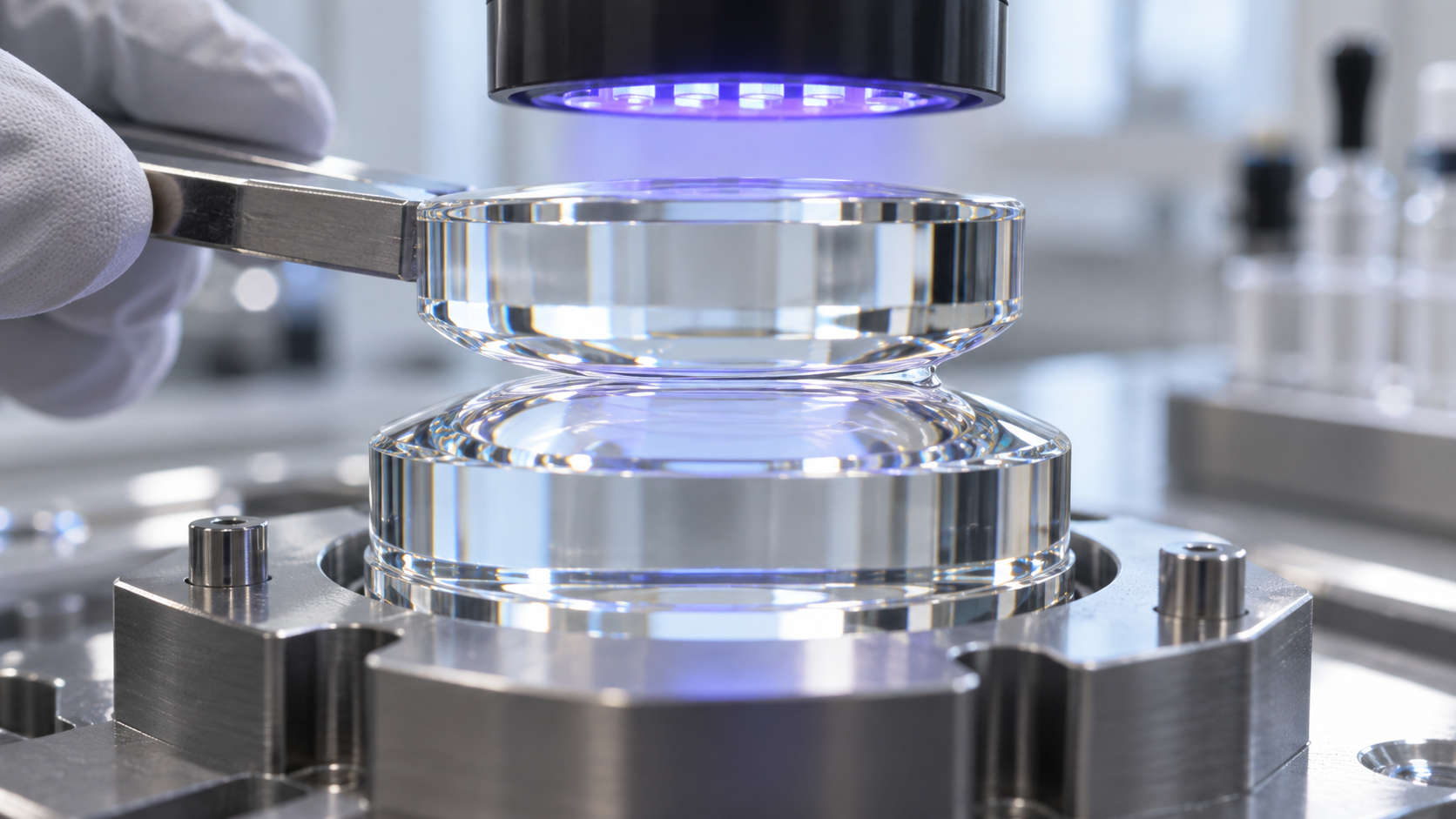
A UV-curable resin sets within seconds because a photoinitiator absorbs light and releases radicals or acid. Getting a clear result takes more than fast curing: the wavelength of the light, contact with air (oxygen), refractive index, yellowing and cure shrinkage all have to be designed together. This article draws on official technical material from Henkel, Dymax, DELO and ThreeBond, read from a materials engineer's point of view.
- What a clear UV-curable resin is (in three lines)
- How it sets: photoinitiators, radical and cationic polymerization
- Light sources and wavelength: from mercury lamps to UV-LEDs
- Our calculation: what dose (intensity × time) tells you
- A materials engineer's view 1: “how many J/cm² to cure” depends on the light source
- Oxygen inhibition and depth cure: two separate problems
- Transparency: refractive index, transmittance and yellowing
- Our calculation: index difference and interface reflection
- Cure shrinkage: how to read the numbers
- A materials engineer's view 2: shrinkage is about where it is constrained
- Evaluation: what to measure, and how
- What could not be confirmed
- Glossary / References / Claim-to-source audit
Sourced = stated in published material (link given)
Our calculation = a figure this article derived, with the assumptions spelled out
Not yet confirmed = a plan or target with no confirmed record
Structural readings and materials-design interpretations are marked separately as Commentary.
Product data sheet values are the manufacturer's stated values (typical), given with grade, test method and revision date. Values for different grades or test conditions are not set side by side to rank them.
1. What a clear UV-curable resin is (in three lines)
“UV-curable resin” is the general name for a resin that turns from liquid to solid the moment ultraviolet (or visible) light falls on it. This article covers the industrial clear light-curing resins used for adhesives, coatings and encapsulation. The composition and performance of hobby “UV resin” kits were not checked against primary sources and are not covered.
- What sets: Henkel describes light-curing adhesives as materials that cure (polymerize) when exposed to light of the appropriate wavelength and intensity. Early systems responded only to UV light; response to suitable visible light is now common, and the term “UV cure” has stayed in use for both, the guide saysSourced
- What decides it: the photoinitiator that starts the reaction when it absorbs light, and the monomers and oligomers that grow from it. DELO's PHOTOBOND series is acrylate-based, with families for glass bonding (GB), optically clear bonds (OC), optical bonding (OB) and optical materials (OM)Sourced
- What makes it hard: Henkel lists, as the main limitation, that suitable light (wavelength and intensity) must reach the material being cured, and that shadowed areas need a secondary cure mechanismSourced. To keep the result clear, oxygen inhibition, refractive index, yellowing and cure shrinkage are added to the list (our reading)
The performance of a clear UV-curable resin is a process value, not just a resin value: it includes the light source, the substrate, the thickness and the atmosphere. Dymax's product data sheet defines fixture time as the time to reach a shear strength of 0.1 N/mm², says that actual cure time is typically 3 to 5 times the fixture time, and defines full cure as the point at which more light no longer improves the cured propertiesSourced. A part can look set within seconds, but “fixed” and “fully cured” are different things (Commentary).
Photocuring topics specific to vat photopolymerization in 3D printers (the working curve, post-curing and unreacted groups) are covered in our explainer on resins for 3D printing. This article looks at the clear resins used for bonding, coating and encapsulation, and leaves the process of bonding glass to our explainer on UV bonding of glass.
2. How it sets: photoinitiators, radical and cationic polymerization
A light-curing resin contains a photoinitiator, a substance that absorbs light and releases a reactive species. Henkel's guide describes the sequence this way: when suitable light reaches the liquid adhesive, the photoinitiators split into free radicals, the radicals start the polymerization of the monomers, and long polymer chains formSourced.
(1) Radical polymerization: the most widely used
Henkel says that the light-cure products used in industry rest on three types of polymerization chemistry (free radical, anionic and cationic), that the majority of commercial products are of the free-radical acrylic type, that they polymerize extremely fast on exposure to suitable light, and that polymerization stops as soon as the light is removedSourced. The ThreeBond technical news (issued 1 January 2023, written by Kimihiro Matsukawa, Specially Appointed Professor at Kyoto Institute of Technology) likewise calls radical polymerization the most used form of photocuring today, and notes that it is fast but inhibited by oxygen in the air, so the surface sometimes fails to cureSourced.
Decker's review (Macromolecular Rapid Communications, 2002) reports that the UV curing of acrylate-based resins proceeds with long kinetic chains (7,700 mol per radical) despite a high initiation rateSourced. In other words, one radical sets thousands of acrylate groups reacting in sequence (Commentary).
(2) Cationic polymerization: tolerant of oxygen, low shrinkage
In cationic polymerization, a photoacid generator releases acid under light, and the acid drives the ring-opening polymerization of epoxides and similar monomers. ThreeBond notes that termination is less likely than in radical systems, so polymerization continues after irradiation stops; that ring-opening epoxy polymerization gives low volumetric shrinkage and good adhesion to the substrate; and that the reaction is stopped by water, making it sensitive to humidity, while the strong acids generated raise a concern about metal corrosionSourced. Henkel agrees that cationic systems are not inhibited by oxygen, cure well at the surface, resist heat and outgas little, but notes that only a limited range of monomers is available (so tailoring is less flexible than with acrylics), that polymerization will not propagate into shadowed areas, and that the photoinitiators can be somewhat toxic with residues that may corrode delicate platings in electronicsSourced.
The initiators widely used for cationic curing are diaryliodonium and triarylsulfonium salts. Crivello's review (Journal of Polymer Science Part A, 1999) states that these onium salts are used widely for photoinduced cationic cross-linking, in coatings, adhesives, printing inks, release coatings and stereolithography, among other usesSourced.
| Item | Radical polymerization (acrylate-based) | Cationic polymerization (epoxy-based and similar) |
|---|---|---|
| Polymerization speed | Very fast | Moderate |
| Inhibition by oxygen | Yes (the surface can stay uncured or tacky) | None |
| Volumetric shrinkage | High | Low |
| Adhesion to the substrate | Rated “poor” in ThreeBond's classification | Good |
| After the light stops | Stops | Continues a little (in practice a heat step is often needed) |
| Points to watch | Wide choice of monomers and design freedom; low material cost | Corrosion of metal substrates and humidity effects; does not spread into shadowed areas |
All Sourced (Table 1 of ThreeBond Technical News 101 [Ref. 8] and the descriptions in Henkel's guide [Ref. 1]). “Adhesion: poor” is ThreeBond's general classification; as shown below, real acrylate-based glass adhesives bond glass well.
Henkel also describes hybrid systems that combine epoxy chemistry with free-radical acrylic curing (fixed by light, then fully cured at room temperature or with heat), light-curing silicones, and light-curing cyanoacrylates that use an anionic dual-cure mechanismSourced. Decker's review notes that adding both radical and cationic initiators to a mixture of a difunctional acrylate and an epoxy monomer lets UV irradiation build an interpenetrating polymer network (IPN)Sourced.
ThreeBond's table classes radical polymerization as “adhesion: poor” and “volumetric shrinkage: high”, and cationic polymerization as “adhesion: good” and “volumetric shrinkage: low”. Yet Dymax's acrylated-urethane glass adhesive (4-20260-VLV) lists glass, metals and ceramics among its recommended substrates, and its linear shrinkage is 0.09% (Dymax standard test method; manufacturer's stated value)Sourced.
The classification describes the tendencies of the bare reactions, not the performance of real products. A real adhesive changes greatly with the oligomer backbone, the number of functional groups, the diluent, the adhesion promoter and the filler (Commentary). Rather than remembering “radical means high shrinkage”, it is more useful in design to think that the higher the concentration of reactive groups, the higher the shrinkage. ThreeBond makes the same point: with multifunctional acrylates, a finer cross-linked network raises hardness but also the cure shrinkage rate, causing warping and cracksSourced.
3. Light sources and wavelength: from mercury lamps to UV-LEDs
A photoinitiator works only when it absorbs light of particular wavelengths. Henkel says that matching the emission spectrum of the light source to the absorption spectrum of the photoinitiator is the basis of every successful light-cure application, and lists the main absorption regions common to many adhesives: 254 nm (surface cure), 365 nm (what the guide calls the workhorse wavelength, which also helps depth cure) and 400 to 436 nm (where visible-light photoinitiators absorb)Sourced.
(1) Short wavelengths act at the surface, long wavelengths reach deeper
Dymax says that short and medium UV wavelengths (280–320 nm, as emitted by mercury vapor lamps) give more efficient surface cure but have depth-of-cure problems; that longer-wavelength systems (400–500 nm) emit little low-wavelength UV and have better depth of cure; and that 320–450 nm gives the best blend of surface and depth cureSourced. Henkel also says that cure depth improves above about 350 nm, recommends visible-light systems for very large cure depths, and says that surface cure is improved by shorter wavelengthsSourced.
From the materials side, the reason is that the more strongly a wavelength is absorbed, the sooner the light is used up near the surface (Commentary; the link between absorption and cure depth is also covered by the working curve in our explainer on resins for 3D printing).
(2) UV-LEDs: narrow-band light, long life, little heat
Henkel describes the features of LEDs as a very narrow emission spectrum, instant on/off and a longer life than mercury-arc and similar bulbs: an LED typically lasts over 10,000 hours, while conventional electrode bulbs fail after 2,000 hours at best; LEDs do not generate significant heat and use less power (statements in the 2013 guide)Sourced. However, LEDs in the UV or in the low visible (405 nm) range still emit UV, so skin and eye protection is still required, while visible-only LEDs emit no UVSourced.
ThreeBond notes that light sources are shifting from conventional high-pressure mercury and metal-halide lamps to LEDs; that 365 nm is the most widely used LED wavelength, with monochromatic light also emitted at 375, 385, 395 and 405 nm. Mercury and metal-halide lamps decompose the photoinitiator with multiple line spectra, whereas an LED emits monochromatic light, so initiator decomposition can be slower and photo-crosslinking less sensitive; it is therefore necessary either to choose an LED wavelength that the initiator absorbs easily, or to develop initiators suited to LED lightSourced.
DELO says that industrial light curing uses high-intensity LED lamps at 365 nm, 400 nm and 460 nm, that the key process parameters for full cure are irradiation time and intensity, and that at least one of the parts must be translucent to the wavelengthSourced. Even when both parts are opaque, pre-activation lets some products use light curing, and for shadowed areas there are dual-curing products that combine light with heat (from +60 °C) or humiditySourced.
4. Our calculation: what dose (intensity × time) tells you
In light curing, irradiance (mW/cm²) multiplied by time is the dose (mJ/cm²). Henkel writes this as mW/cm² × seconds = mJ/cm², with 1 J equal to 1,000 mJSourced.
The manufacturers' examples, simply multiplied outOur calculation.
- Henkel's FAQ example: 100 mW/cm² for 10 seconds = 1,000 mJ/cm² (1 J/cm²). 30 mW/cm² for 20 seconds = 600 mJ/cm² (0.6 J/cm²). The company says its newer products cure with 1 J or less in a typical applicationSourced
- Dymax's example: 2 J/cm² = 2 W/cm² × 1 second = 0.02 W/cm² × 100 seconds. But Dymax explains that if the intensity falls below a minimum (it uses 0.1 W/cm² as an example), the surface may never become tack-free even though the total energy is the sameSourced
Assumptions and limits: the multiplication above assumes constant intensity and that light reaches the material with the same efficiency. In practice, efficiency changes with substrate transmission, spectrum, oxygen and temperature.
The table below takes the fixture times (the time to reach 0.1 N/mm² shear strength between glass slides) printed in the data sheet of Dymax's glass adhesive (Ultra Light-Weld 4-20260-VLV, acrylated urethane) and multiplies them by the intensity of each light source.
| Light source (name in the data sheet) | Intensity (measurement range) | Fixture time | Intensity × time (our calculation) |
|---|---|---|---|
| 2000-EC | 50 mW/cm² (320–395 nm) | 5 s | 250 mJ/cm² |
| 5000-EC | 200 mW/cm² (320–395 nm) | 3 s | 600 mJ/cm² |
| BlueWave LED Flood PrimeCure 385 nm | 850 mW/cm² (350–450 nm) | 6 s | 5,100 mJ/cm² |
| BlueWave 200 | 10 W/cm² (320–395 nm) | 3 s | 30,000 mJ/cm² (30 J/cm²) |
| BlueWave MX-150 PrimeCure 385 nm | 15 W/cm² (350–450 nm) | 6 s | 90,000 mJ/cm² (90 J/cm²) |
| UVCS conveyor with Fusion F300S | 2.5 W/cm² (320–395 nm) | Belt speed 4 m/min | (not calculated: belt speed) |
Light source names, intensities and fixture times are Sourced (Dymax 4-20260-VLV data sheet, manufacturer's stated values (typical), Rev. C, issued September 2017, revised 19 December 2018; thin films cured through substrates transmitting 100% of UV and light [Ref. 3]). The right-hand column is Our calculation.
5. A materials engineer's view 1: “how many J/cm² to cure” depends on the light source
The intensity × time values in the table span 0.25 J/cm² to 90 J/cm², a factor of 360Our calculation. To reach the same fixture condition (0.1 N/mm²), the dose needed is not a constant of the material.
The data sheet does not explain why. Henkel says that even if intensity readings at one wavelength are similar between two light sources, cure efficiency may not be the same because the whole spectral distribution differs, and that a broad-range radiometer can lead to over- or under-exposure when comparing sourcesSourced. Combined with the fact that the intensity ranges differ (320–395 nm versus 350–450 nm) and that fixture time is measured on a thin film through glass, this suggests that a mJ/cm² figure cannot simply be carried over to another light source (Commentary).
What matters more in the plant is Henkel's next point. When light curing suddenly stops working, historically the most likely cause is a change in process conditions, not the adhesive. The company advises checking process speed and part orientation first, then measuring irradiance at the working surface with a radiometer for 365 nm and 400 nm. It cautions that lamp intensity declines slowly and imperceptibly over time, and that contamination of light guides and reflectors also lowers itSourced.
Another trap is a substituted substrate. The same guide says that a material that looks clear may still block the light needed for curing. For example, UV-transmitting polycarbonate passes about 70% of 365 nm light, while UV-absorbing polycarbonate (used in automotive headlamps and other outdoor applications) passes only about 3%, not enough to cure a product that contains only a UV photoinitiatorSourced. If a UV-absorbing plastic is inadvertently substituted for a UV-transparent one, a change not easily evident to the eye, the product may no longer cure under the conditions first established, the company points outSourced.
A clear resin has to be thought of both as the thing being bonded and as something light must pass through. The UV transmission of glass is covered in our explainer on UV bonding of glass.
6. Oxygen inhibition and depth cure: two separate problems
(1) Oxygen inhibition: only the surface exposed to air stays uncured
The weak point of radical polymerization is oxygen in the air. Henkel says that in acrylic systems this oxygen inhibition prevents the molecules at the surface from polymerizing, leaving a wet or tacky surfaceSourced. Dymax explains it as oxygen penetrating the surface and interfering with radical polymerization, leaving partially reacted monomers and oligomersSourced. ThreeBond notes that in photo-radical polymerization oxygen in the air inhibits the reaction and the surface may fail to cure, and presents the thiol-ene reaction, which oxygen does not stop, as a notable featureSourced.
The remedies are a combination of material, equipment and process.
- Intense light: Dymax says that using a light above 1 W/cm² (1,000 mW/cm²) across a broad 280–450 nm range usually makes the adhesive cross-link so fast that the surface is left firm and free from tackiness. Some spot lamps emit up to 15–20 W/cm² at 365 nmSourced
- Inert gas: Dymax explains that flooding the curing area with nitrogen or argon gives a tack-free finish even with low-intensity sources. Henkel notes that nitrogen inerting is effective and used in the coating industry but is not practical for most industrial applicationsSourced
- Short wavelengths: Henkel says surface cure favors sources that emit strongly at short UV wavelengths such as 254 nm (mercury arc, electrodeless H and H+ bulbs)Sourced
- Choice of material: cationic systems are not inhibited by oxygen (Chapter 2), nor is the thiol-ene chemistry that ThreeBond describesSourced
Dymax's data sheet for 425 says that surfaces exposed to air may need high-intensity UV above 100 mW/cm² to produce a dry surface cure (manufacturer's stated, revised 3 May 2024)Sourced. Decker's review summarizes real-time infrared (RT-IR) studies of acrylate UV curing showing that the inhibitory effect of oxygen, together with initiation efficiency, oligomer structure and light intensity, affects how the polymerization proceedsSourced. A review devoted to oxygen inhibition alone is Ligon et al., Chemical Reviews 114, 557–589 (2014); its text could not be checked, so only its title is cited here.
Dymax cautions that the time to reach a tack-free state should not be confused with the time to reach complete cure. Tack-free only shows that the surface has overcome oxygen inhibition; it does not guarantee that the whole bulk is curedSourced. The company's view is that most adhesives have a minimum intensity threshold above which they go tack-free, and a separate minimum total-energy threshold for complete cureSourced.
Also, for a bond sandwiched between two substrates and not exposed to air, surface tackiness is not a big problem. Dymax says that some adhesives made for bonding will never cure tack-free however the intensity or time is changed, and Henkel says surface cure matters in bonding only when there is a large filletSourced.
(2) Depth cure: does the light reach far enough?
Henkel treats cure through depth as a function of product chemistry, wavelength, intensity and exposure time; it is enhanced by longer wavelengths (above 350 nm), and for very large depths the company recommends visible-light systems. For deep or shadowed areas, dual-cure systems using heat, moisture or an activator can helpSourced. It also says that pre-activated cationic systems, exposed before assembly, can cure through opaque parts or in areas that will not see exposureSourced.
The data sheet of Dymax's Ultra Light-Weld 4-20260-VLV describes curing a 9.5 mm diameter cylindrical specimen in a polypropylene mold, cooling it to room temperature, releasing it from the mold and measuring the depth of cure, and shows the increase in depth with exposure time as a graph (only a graph; this article does not read values from it)Sourced. Cure depth can thus be measured as the dimension of a cured piece taken out of a mold (our summary).
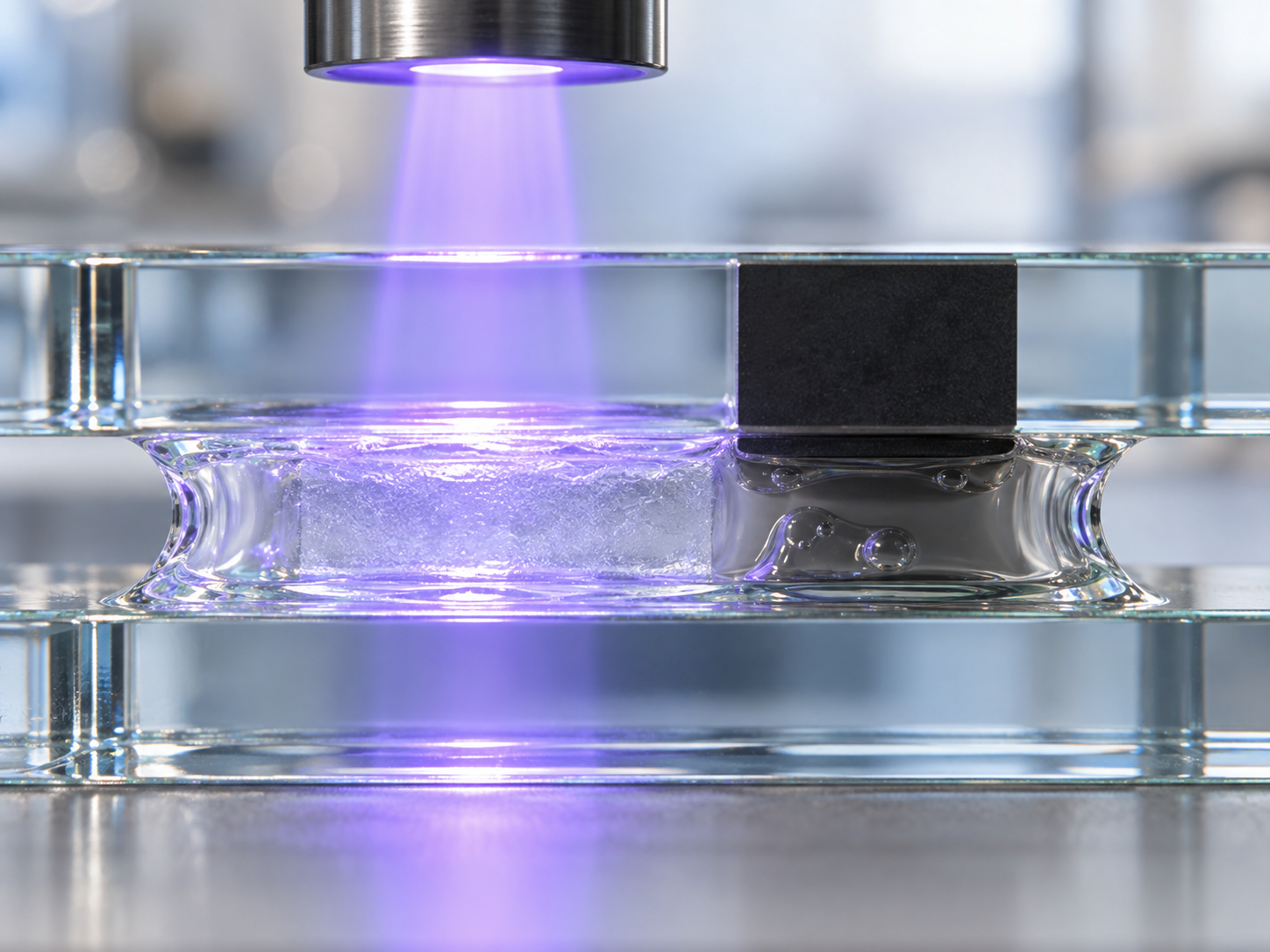
Curing as fast as possible is not always the answer. Henkel says that curing too fast can cause high heat generation, with possible damage to heat-sensitive parts, cracking of the cured product, or fogging from the volatilization of normally non-volatile components, and may also reduce adhesion to the substrateSourced. Dymax's data sheets also note that light curing generally produces heat and recommend cooling fans and an air exhaustSourced.
7. Transparency: refractive index, transmittance and yellowing
“Clear” can be broken into three optical questions (our framing).
- Refractive index: the smaller the index difference from the material it is bonded to (glass or clear plastic), the smaller the reflection at the interface (calculated in the next chapter)
- Transmittance and haze: how much light passes and how much is scattered. Always read together with thickness
- Color (yellowing): the initial tint, and changes over time under light, heat and moisture
(1) Stated values for refractive index and transmittance
For two of Dymax's acrylated-urethane products (manufacturer's stated values), the refractive index is 1.51 for 4-20260-VLV (20 °C, ASTM D542) and 1.50 for 425 (20 °C; the test-method field of the data sheet reads Bausch & Lomb refractometer)Sourced. A Dymax bulletin on display bonding (undated, a PDF distributed by a reseller) carries the values in the table below.
| Grade (Dymax 9700 series) | Viscosity | Refractive index | Yellowness b* (initial) | Volumetric shrinkage | Transmittance at 570 nm |
|---|---|---|---|---|---|
| 9701 (low viscosity) | 200 cP | 1.50 | 0.08 (5 mil thick) | 4.9% | 99% |
| 9702 | 950 cP | 1.49 | 0.12 (5 mil thick) | 4.2% | 100% |
| 9703 (gel) | 30,000 cP | 1.48 | 0.47 (20 mil thick) | 4.2% | 97% |
All Sourced (Dymax application bulletin “UV Display Bonding Adhesives” [Ref. 5], manufacturer's stated values, undated). Only 9703 has its yellowness measured on a 20 mil (about 0.51 mm) film, against 5 mil (about 0.13 mm) for the other two, so the b* values cannot be compared directly (the conversion at 1 mil = 0.0254 mm is our calculation).
What stands out in this table is that products described as low-shrinkage have a volumetric shrinkage of 4.2–4.9%. “Low” seems to be relative to other acrylate-based products (Commentary). Two chapters on, we set this against stated linear shrinkage values.
(2) Yellowing: initial color, and change over time
For yellowing, what a manufacturer claims has to be kept apart from how it is measured.
- Product claims: DELO describes its PHOTOBOND OB series (optical bonding) as stable to yellowing, low outgassing and moisture resistant; the OM series (optical material) as having a high refractive index range, yellowing resistance and optical stability in reflow processes; and the GB series (glass bonding) as UV-resistant and weatherproofSourced. Dymax also describes 425 as resisting yellowing (manufacturer's stated)Sourced
- Measurement: yellowness can be quantified with ASTM E313 (a practice for calculating yellowness and whiteness indices from instrumentally measured color coordinates). Its scope says it should be used only to compare specimens of the same material and the same general appearance, such as similar thickness and translucencySourced. So b* values taken at different thicknesses cannot be lined up and compared, as in the table above (Commentary)
- Research on causes: the paper by Segurola et al. (Polymer Degradation and Stability, 1999) is titled to show that the photoyellowing and discoloration of UV-cured acrylated clear coatings depends on the type of photoinitiator (its text could not be checked; only the title is cited here)
Within the scope of this survey, no public primary source showing color difference or transmittance after weathering (xenon arc and similar) for several products under the same conditions could be confirmed. A manufacturer's “resists yellowing” is treated as a claim, and the premise is that you evaluate it yourself under your application's conditions (light source, temperature, humidity, thickness). (The xenon-arc method in ISO 4892-2 is specified for reproducing, in the presence of moisture, the weathering effects of daylight or of daylight filtered through window glass in actual end-use environmentsSourced.)
8. Our calculation: index difference and interface reflection
For light at normal incidence on an interface, the reflectance is R = ((n1 − n2) ÷ (n1 + n2))² (a standard optics formula; absorption and multiple reflections ignored)Our calculation.
- An air–glass interface: with n = 1.0 and 1.5, R = (0.5 ÷ 2.5)² = 4.0%. If an air gap sits between the bonded surfaces, two such interfaces are involved, so transmission is 0.96 × 0.96 = 0.92, a loss of about 8%
- When the gap is filled with a resin of similar index: for an index difference Δn, R ≈ (Δn ÷ 3.0)² (for n ≈ 1.5)
Assumptions and limits: the glass index is assumed to be about 1.5 (our assumption; real glasses differ by type). The stated resin values (1.48–1.51) are from the sources above.
| Index difference Δn | Reflectance R per interface (our calculation) | For scale |
|---|---|---|
| 0.01 | about 0.0011% | The gap between Dymax's 1.50 and 1.51 |
| 0.02 | about 0.0044% | Within the span of the stated values (1.48–1.51) |
| 0.05 | about 0.028% | A difference beyond the span of the stated values (0.03) |
| 0.10 | about 0.11% | About 1/36 of an air interface (4.0%) |
All Our calculation (R = (Δn ÷ 3.0)², normal incidence, absorption and multiple reflections ignored). The “For scale” column is this article's framing.
For display lamination, Dymax says that optical bonding increases clarity, viewing angle and vibration resistanceSourced. Replacing an air gap with resin is, as the calculation above shows, an operation that cuts interface reflection by several orders of magnitude (Commentary).
9. Cure shrinkage: how to read the numbers
When liquid monomers become a solid polymer, the volume shrinks (because intermolecular van der Waals distances are replaced by covalent-bond distances; Commentary). In bonding and optical uses, this shrinkage can lead to distortion, delamination and misalignment of optical parts. ThreeBond classes the volumetric shrinkage of radical polymerization as “high” and that of cationic polymerization (epoxy ring opening) as “low”, and notes that the thiol-ene reaction, an addition reaction, also has low shrinkageSourced.
The data sheets give “linear shrinkage”, while the display-bonding bulletin gives “volumetric shrinkage”. If shrinkage is isotropic (the same in every direction), volumetric shrinkage is 1 − (1 − linear shrinkage)³Our calculation.
- Dymax 4-20260-VLV: linear shrinkage 0.09% (Dymax standard test method DSTM 614) → 1 − 0.9991³ = about 0.27%
- Dymax 425: linear shrinkage 1.9% (listed as ASTM D2566) → 1 − 0.981³ = about 5.6%
Assumptions and limits: isotropic shrinkage does not hold for an adhesive layer constrained by its substrates. The two linear shrinkage values come from different test methods and different specimen forms, so they are not on the same footing.
Within Dymax's own range, the stated linear shrinkage runs from 0.09% to 1.9%, a factor of about 21 (1.9 ÷ 0.09 ≈ 21)Our calculation. But the two values come from different test methods (the former Dymax's own standard method DSTM 614, the latter listed in the data sheet as ASTM D2566), and the materials differ in other properties as well (the former has a Tg of 83 °C, a modulus of 662 MPa and 20% elongation; the latter a modulus of 3,450 MPa and 7.3% elongation)Sourced. When looking for a low-shrinkage adhesive, read the shrinkage figure together with the test method, specimen thickness, cure conditions and the stiffness (modulus) of the material (Commentary).
10. A materials engineer's view 2: shrinkage is about where it is constrained
An adhesive layer is constrained on both sides by its substrates. Because it cannot shrink freely, the shrinkage remains as stress (Commentary). How large that stress is depends not only on the shrinkage but on the modulus of the material, its Tg, the thermal-expansion mismatch with the substrates and the shape of the bond line.
Dymax's 4-20260-VLV (Tg 83 °C, modulus 662 MPa) has coefficients of thermal expansion of 66 (α1) and 212 (α2) µm/m/°C (generally α1 is the value below Tg and α2 the value above it; manufacturer's stated)Sourced. α2 is about 3.2 times α1 (212 ÷ 66)Our calculation. For uses where the service temperature is near Tg, the point to watch is that expansion and contraction get larger with every temperature cycle. Thermal expansion and bond-line reliability are covered in our explainer on the coefficient of thermal expansion.
With plastic substrates, stress cracking is a practical issue. Dymax's data sheet says that, in rare cases, stress cracking may occur in assembled parts, and lists three optionsSourced:
- Heat-anneal the parts to remove molded-in stress
- Open the gap between mating parts to reduce the stress of an interference fit
- Minimize the time the liquid adhesive remains in contact with the substrate before curing
The third suggests an effect not of cure shrinkage but of uncured liquid components staying in contact with the substrate (Commentary; the data sheet does not explain the mechanism). Henkel likewise advises against partially curing a product on polycarbonate and others and completing the cure later (for example during gamma-ray sterilization), because the uncured portion may cause stress cracking given sufficient time of contact and stress in the substrateSourced.
So the reliability of a clear light-curing resin is decided by three things: the shrinkage (the material), how complete the cure is (the process) and the residual stress of the substrate (the counterpart) (Commentary).
11. Evaluation: what to measure, and how
Evaluating a light-curing resin can be sorted into four groups: light conditions, progress of cure, optical properties and reliability (our grouping).
| What you want to see | Method or standard | Source and caveats |
|---|---|---|
| Light conditions | Measure irradiance at the working position with a radiometer (365 nm and 400 nm probes are the norm), also through the substrate. Dose = irradiance × time | Henkel [Ref. 1]. A broad-range radiometer can mislead when light sources differ |
| Progress of cure (conversion) | Follow the change over time with real-time infrared spectroscopy (RT-IR) | Decker [Ref. 9]. Used to analyze the kinetics of acrylate-based systems |
| Fixture time | Time to reach 0.1 N/mm² shear strength between glass slides | Definition in the Dymax data sheet [Ref. 3]. Not full cure |
| Full cure | Cure at varied conditions and look for the point where tackiness, adhesion, hardness and so on stop changing | Dymax [Ref. 3]. The company recommends a safety factor of longer or stronger curing |
| Surface cure | Tackiness to a finger, wet residue on a glove | Dymax blog [Ref. 2]. Tack-free is not full cure |
| Depth of cure | Cure a cylinder in a mold, release it and measure the depth | Dymax data sheet [Ref. 3] (9.5 mm diameter specimen, polypropylene mold) |
| Refractive index | ASTM D542 (listed in the Dymax data sheet). ISO 489 specifies refractive index of plastics by a refractometer (Method A) or an immersion method (Method B) | [Refs. 3, 15]. Monochromatic light is generally used |
| Transmittance and haze | ASTM D1003 (Procedure A, hazemeter; Procedure B, spectrophotometer) | [Ref. 13]. Always state the thickness |
| Yellowness | ASTM E313 (calculation from color coordinates) | [Ref. 14]. For comparing specimens of the same material, similar appearance and the same thickness |
| Weathering | ISO 4892-2 (xenon arc) | [Ref. 16]. Reproduces the effect of daylight, or of daylight through window glass, in the presence of moisture |
| Hardness, tensile, water absorption | ASTM D2240, ASTM D638, ASTM D570 | Test-method fields of the Dymax data sheets [Refs. 3, 4] |
| Bond strength | Bonding: test to destruction or to a proof load. Coating: peel or cross-hatch. Potting: hardness through a cross-section | Henkel [Ref. 1]. Standards for bond strength are covered in our explainer on adhesive strength testing |
| Cure check on the line | A non-destructive on-line method (Henkel's AssureCure) confirms the degree of cure of a light-curing acrylic in as little as 20 milliseconds | Henkel [Ref. 1]. A product-specific method |
All Sourced (as stated in each source). The four-group sorting is this article's.
12. What could not be confirmed
(1) Photoinitiator type, loading and absorption spectrum
The public Dymax and DELO material reviewed here does not state the photoinitiator type, its loading or its absorption spectrum. The general point that the LED wavelength must match the photoinitiator was confirmed (Chapter 3), but no specific product pairing was.
(2) A quantitative comparison of yellowing
Stated initial yellowness values were confirmed in a Dymax document, but no primary source showing the change after weathering or heat aging for several products under the same conditions could be confirmed. On the mechanism of yellowing, only the title of the paper by Segurola et al. (1999) was checked, not its text.
(3) Values in DELO's data sheets
DELO's product data sheets are distributed through a dedicated portal on its website, and the values could not be confirmed in this survey. For DELO, only the product-family descriptions on its official website are used.
(4) A quantitative treatment of oxygen inhibition
The text of the review by Ligon et al. (Chemical Reviews, 2014), which covers strategies against oxygen inhibition, could not be checked, so only its title is cited. Numbers comparing the strength of oxygen inhibition by film thickness, intensity and initiator are not covered here.
(5) Hobby “UV resin”, and regulation of photoinitiators
The composition and performance of hobby and craft UV resins were not checked against official primary sources and are not covered. One example of photoinitiator regulation was checked. ECHA's Candidate List includes the photoinitiator TPO (diphenyl(2,4,6-trimethylbenzoyl)phosphine oxide, EC 278-355-8, CAS 75980-60-8), added on 14 June 2023 as toxic for reproduction (Article 57(c)). In ECHA's list of recommendations (updated 15 May 2026), it is recommended for inclusion in Annex XIV in the 12th recommendation (final recommendation date 18 November 2025), and it was not on the Authorisation ListSourced. The Commission's decision could not be confirmed. Other photoinitiators and rules in other countries are not covered.
- A photoinitiator absorbs light and the resin sets. Most commercial products are radical-polymerizing acrylics, and the reaction stops when the light stopsSourced. Cationic polymerization (epoxy-based) is not inhibited by oxygen and shrinks little, but humidity and metal corrosion need attentionSourced
- Wavelength separates surface cure from depth cure. Short wavelengths act at the surface, long ones reach deeper, and Dymax says 320–450 nm gives the best balanceSourced
- “How many J/cm² to cure” depends on the light source. Intensity × time up to the fixture time, calculated from a Dymax data sheet, spans 0.25 to 90 J/cm², a factor of 360Our calculation
- A substrate that looks clear can still block UV. UV-absorbing polycarbonate passes only about 3% of 365 nm lightSourced
- Matching refractive indices cuts interface reflection by orders of magnitude. About 8% for an air gap, against about 0.009% for a resin with Δn = 0.02Our calculation
- Read shrinkage figures together with the test method. Linear shrinkage of 0.09% and 1.9% converts to about 0.27% and about 5.6% by volume, but the test methods differOur calculation
13. Glossary
- Photoinitiator
- A substance that absorbs light, releases a reactive species such as radicals and starts polymerization.
- Photoacid generator
- A substance that releases acid under light and starts the cationic polymerization of epoxies and similar monomers. Onium salts are typical.
- Radical polymerization
- Polymerization in which radicals add to double bonds and the chain grows. Acrylates are typical; it is inhibited by oxygen.
- Cationic polymerization
- Polymerization started by acid. Epoxy ring opening is typical. Not inhibited by oxygen; sensitive to humidity.
- Oxygen inhibition
- Oxygen in the air interferes with radical polymerization, leaving the surface exposed to air uncured or tacky.
- Irradiance
- The strength of light arriving per unit area, expressed in mW/cm² and similar units.
- Dose (energy density)
- Irradiance multiplied by time, expressed in mJ/cm² or J/cm².
- Fixture time
- The time to reach 0.1 N/mm² shear strength between glass slides (Dymax's definition). It is not full cure.
- Depth cure
- Curing deep into material that light reaches poorly. Longer wavelengths and visible light help.
- Dual cure
- A system with a second cure mechanism, such as heat or moisture, in addition to light, so that shadowed areas also set.
- Pre-activation
- Exposing the adhesive to light before assembly to start the reaction, so that it can cure between opaque parts.
- Optical bonding
- Bonding a display to its cover glass with a clear resin that fills the air gap between them.
- Refractive index
- A measure of how much a material slows light. The smaller the difference from the material it is bonded to, the smaller the interface reflection.
- Haze
- The degree to which light passing through a clear material is scattered, making it look cloudy.
- Yellowness (b*)
- A number for how yellow a color is. Values at different thicknesses or conditions cannot be compared.
- Cure shrinkage
- The decrease in volume or dimension when liquid becomes solid. A cause of stress and distortion.
- Stress cracking
- Cracking of a plastic substrate under residual stress in contact with liquid components.
- Fillet
- The bead of adhesive squeezed out at the edge of a bond. A place where air contact can make surface cure a problem.
- Acrylated urethane (urethane acrylate)
- An oligomer with urethane linkages and acrylate groups at the ends; one of the main backbones of light-curing resins.
14. References
- Henkel Corporation “Light Cure Adhesive Technology Guide” (10731/LT-2013, September 2013) (PDF) — dm.henkel-dam.com
- Dymax “How to Overcome Oxygen Inhibition in Light-Curable Adhesives” (blog, undated) — dymax.com
- Dymax “Ultra Light-Weld 4-20260-VLV Product Data Sheet” (DC327, Rev. C, issued September 2017, revised 19 December 2018) (PDF) — dymax.com
- Dymax “425 Product Data Sheet” (Multi-Purpose, Light-Curable Optical Adhesive, revised 3 May 2024) (PDF) — dymax.com
- Dymax “UV Display Bonding Adhesives Provide Fast, Clear, Bubble-Free, Optically Clear Bonds” (application bulletin, undated; a PDF distributed by the reseller ellsworth.com) — ellsworth.com
- DELO Industrial Adhesives “Curing Process for adhesives” (Adhesive Know-how) — delo-adhesives.com
- DELO Industrial Adhesives “DELO PHOTOBOND” (product page) — delo-adhesives.com
- ThreeBond Co., Ltd. “ThreeBond Technical News 101: Development of Organic-inorganic Hybrid Materials Using Photo-crosslinking Reactions” (issued 1 January 2023, by Kimihiro Matsukawa) (PDF) — threebond.co.jp
- Decker Kinetic Study and New Applications of UV Radiation Curing, Macromol. Rapid Commun. 23, 1067–1093 (2002) — doi.org/10.1002/marc.200290014
- Crivello The discovery and development of onium salt cationic photoinitiators, J. Polym. Sci. A Polym. Chem. 37, 4241–4254 (1999) — doi.org/10.1002/(SICI)1099-0518(19991201)37:23<4241::AID-POLA1>3.0.CO;2-R
- Ligon, Husár, Wutzel, Holman, Liska Strategies to Reduce Oxygen Inhibition in Photoinduced Polymerization, Chem. Rev. 114, 557–589 (2014) (title only checked) — doi.org/10.1021/cr3005197
- Segurola, Allen, Edge, McMahon, Wilson Photoyellowing and discolouration of UV cured acrylated clear coatings systems: influence of photoinitiator type, Polym. Degrad. Stab. 64, 39–48 (1999) (title only checked) — doi.org/10.1016/S0141-3910(98)00169-4
- ASTM International ASTM D1003 Standard Test Method for Haze and Luminous Transmittance of Transparent Plastics — astm.org
- ASTM International ASTM E313 Standard Practice for Calculating Yellowness and Whiteness Indices from Instrumentally Measured Color Coordinates — store.astm.org
- ISO ISO 489:2022 Plastics — Determination of refractive index — iso.org
- ISO ISO 4892-2:2013 Plastics — Methods of exposure to laboratory light sources — Part 2: Xenon-arc lamps — iso.org
- ECHA (European Chemicals Agency) “Candidate List of substances of very high concern for Authorisation” (checked 3 October 2026) — echa.europa.eu
- ECHA “Recommendations for inclusion in the Authorisation List” (list of recommendations, updated 15 May 2026) — echa.europa.eu
- ECHA “Authorisation List” — echa.europa.eu
15. Claim-to-source audit
| Claim in the text | Basis | Type |
|---|---|---|
| Light-curing adhesives cure (polymerize) with light of appropriate wavelength and intensity; early systems responded only to UV and suitable visible light is now common; the main limitations are that suitable light must reach the material and that shadowed areas need a secondary cure; photoinitiators split into radicals and start polymerization; products rest on free-radical, anionic and cationic chemistries; most commercial products are free-radical acrylics, which stop when the light is removed and suffer oxygen inhibition (a wet or tacky surface); hybrid (epoxy plus radical) systems, light-curing silicones and light-curing cyanoacrylates exist; cationic systems are not inhibited by oxygen, cure well at the surface, resist heat and outgas little, but have a limited monomer choice, do not propagate into shadowed areas, and use photoinitiators that can be toxic with corrosive residues; pre-activated cationic systems can cure through opaque parts or in unexposed areas | Henkel, Light Cure Adhesive Technology Guide (September 2013) Reference 1 https://dm.henkel-dam.com/is/content/henkel/lt-2730-brochure-light-cure-adhesive-technology-guide | Sourced |
| UV bands (UVC 200–280 nm, UVB 280–315 nm, UVA 315–400 nm, visible 400 to about 760 nm); matching the source spectrum to the photoinitiator is the basis of cure; main absorption regions of 254 nm (surface cure), 365 nm (workhorse, also helps depth) and 400–436 nm (visible-light photoinitiators); cure depth improves above 350 nm and surface cure with shorter wavelengths; LED features (narrow spectrum, instant on/off, over 10,000 hours against at best 2,000 hours for conventional bulbs, little heat, low power) and the need for skin and eye protection with UV to 405 nm LEDs; definitions of irradiance and dose (mW/cm² × seconds = mJ/cm²); the FAQ example (10 s at 100 mW/cm² = 1 J; 20 s at 30 mW/cm² = 0.6 J; newer products at 1 J or less); most clear glass transmits UV while Flint F glass and PVB-laminated safety glass block 365 nm; UV-transmitting polycarbonate passes about 70% and UV-absorbing polycarbonate about 3% of 365 nm; unnoticed substrate substitution; lamp intensity declines gradually and process changes are the most likely cause of failures; the caution on broad-range radiometers | Henkel, Light Cure Adhesive Technology Guide (September 2013) Reference 1 https://dm.henkel-dam.com/is/content/henkel/lt-2730-brochure-light-cure-adhesive-technology-guide | Sourced |
| Curing too fast can cause heat, cracking, fogging and reduced adhesion; nitrogen inerting is effective but impractical for most industrial uses; surface cure favors sources strong at 254 nm; surface cure matters in bonding mainly for large fillets; on polycarbonate, partial cure followed by later cure (for example gamma sterilization) may cause stress cracking from the uncured portion; test methods for bonding, coating and potting; AssureCure confirms degree of cure in as little as 20 ms | Henkel, Light Cure Adhesive Technology Guide (September 2013) Reference 1 https://dm.henkel-dam.com/is/content/henkel/lt-2730-brochure-light-cure-adhesive-technology-guide | Sourced |
| Oxygen inhibition as oxygen penetrating the surface and interfering with radical polymerization, leaving partially reacted monomers and oligomers; above 1 W/cm² across 280–450 nm usually gives a tack-free surface; spot lamps up to 15–20 W/cm² at 365 nm; nitrogen or argon flooding; 280–320 nm efficient for surface cure with depth problems, 400–500 nm better for depth, 320–450 nm the best blend; tack-free time should not be confused with complete cure; separate intensity and energy thresholds; the 2 J/cm² example (2 W/cm² × 1 s = 0.02 W/cm² × 100 s) and the warning that a low intensity such as 0.1 W/cm² may never give a tack-free surface; some bonding products never cure tack-free | Dymax blog Reference 2 https://dymax.com/resources/news-and-media/blog/common-questions/how-to-overcome-oxygen-inhibition-in-light-curable-adhesives | Sourced |
| 4-20260-VLV: acrylated urethane, colorless; recommended substrates (glass, metals, ceramic, some plastics); usable with UV-blocking glass when cured with visible light; refractive index 1.51 (20 °C, ASTM D542); linear shrinkage 0.09% (DSTM 614); Tg 83 °C (DSTM 256); CTE α1 66 and α2 212 µm/m/°C (DSTM 610); elongation 20%; modulus 662 MPa; the definition of fixture time (0.1 N/mm² between glass slides) and actual cure time of 3 to 5 times fixture time; the definition of full cure and the recommended safety factor; the intensity, measurement range and fixture time for each light source (2000-EC 50 mW/cm², 5 s; 5000-EC 200 mW/cm², 3 s; LED flood 385 nm 850 mW/cm², 6 s; BlueWave 200 10 W/cm², 3 s; MX-150 385 nm 15 W/cm², 6 s; UVCS with Fusion F300S 2.5 W/cm², 4 m/min); the depth-of-cure test (9.5 mm specimen, polypropylene mold); oxygen inhibition and nitrogen; cooling and exhaust; the three stress-cracking options; values are the manufacturer's, not specifications | Dymax 4-20260-VLV data sheet (Rev. C, September 2017, revised 19 December 2018) Reference 3 https://dymax.com/content/download/7218/86249?version=1 | Sourced |
| 425: acrylated urethane, refractive index 1.50 (20 °C, Bausch & Lomb refractometer), linear shrinkage 1.9% (listed as ASTM D2566), elongation 7.3%, modulus 3,450 MPa; described as resisting yellowing; surfaces exposed to air may need UV above 100 mW/cm² for a dry surface cure; manufacturer's stated values | Dymax 425 data sheet (revised 3 May 2024) Reference 4 https://dymax.com/content/download/6890/85265?version=2 | Sourced |
| The refractive index (1.50, 1.49, 1.48), yellowness b* (0.08, 0.12, 0.47; 9703 at 20 mil, the others at 5 mil), volumetric shrinkage (4.9%, 4.2%, 4.2%), transmittance at 570 nm (99%, 100%, 97%) and viscosity (200, 950, 30,000 cP) of 9701, 9702 and 9703; that optical bonding increases clarity, viewing angle and vibration resistance | Dymax display-bonding application bulletin (undated) Reference 5 https://www.ellsworth.com/globalassets/literature-library/manufacturer/dymax/dymax-bulletin-uv-display-bonding-adhesives.pdf | Sourced |
| Light- and UV-curing adhesives reach full strength within seconds; LED lamps at 365, 400 and 460 nm; irradiation time and intensity as the key parameters; at least one component must be translucent; pre-activation allows light curing of opaque parts; dual curing with light plus heat (from +60 °C) or humidity | DELO, Curing Process page Reference 6 https://www.delo-adhesives.com/academy/adhesive-know-how/curing-process | Sourced |
| PHOTOBOND as acrylate-based light-curing adhesives; the features of GB (glass bonding, UV-resistant and weatherproof), OC (optically clear, low stress, very low shrinkage), OB (optical bonding, low outgassing, stable to yellowing, moisture resistant) and OM (optical material, high refractive index range, yellowing-resistant, optically stable in reflow) | DELO, PHOTOBOND product page Reference 7 https://www.delo-adhesives.com/products/adhesives/detail/delo-photobond/ | Sourced |
| The characteristics table for radical, cationic, anionic and thiol-ene photocuring (speed, oxygen inhibition, volumetric shrinkage, adhesion); radical polymerization as the most used and as oxygen-inhibited; cationic polymerization continuing after irradiation, low shrinkage and good adhesion for epoxy ring opening, sensitivity to water and humidity, and metal corrosion by strong acid; thiol-ene unaffected by oxygen with low shrinkage; the shift to LEDs, 365 nm as most common and 375, 385, 395 and 405 nm as other wavelengths; monochromatic light slowing photoinitiator decomposition; multifunctional acrylates giving higher hardness and higher cure shrinkage; issued 1 January 2023, by Kimihiro Matsukawa | ThreeBond Technical News 101 Reference 8 https://www.threebond.co.jp/en/technical/technicalnews/docs/TechnicalNews101.pdf | Sourced |
| Acrylate-based UV curing proceeds with long kinetic chains (7,700 mol per radical); RT-IR studies of initiation efficiency, oligomer structure, light intensity and oxygen inhibition; interpenetrating networks from difunctional acrylate and epoxy with both initiator types; UV curing used for weathering-resistant coatings and glass laminates, among others | Decker (2002) Reference 9 https://doi.org/10.1002/marc.200290014 | Sourced |
| Diaryliodonium and triarylsulfonium salts are widely used for photoinduced cationic cross-linking, in coatings, adhesives, printing inks, release coatings and stereolithography, among others | Crivello (1999) Reference 10 https://doi.org/10.1002/(SICI)1099-0518(19991201)37:23%3C4241::AID-POLA1%3E3.0.CO;2-R | Sourced |
| That the Ligon et al. paper is a Chemical Reviews article on strategies to reduce oxygen inhibition in photoinduced polymerization, and that the Segurola et al. paper concerns photoyellowing and discoloration of UV-cured acrylated clear coatings and photoinitiator type (bibliographic details and titles only) | Ligon et al. (2014) Reference 11 https://doi.org/10.1021/cr3005197 Segurola et al. (1999) Reference 12 https://doi.org/10.1016/S0141-3910(98)00169-4 | Sourced |
| ASTM D1003 as the method for haze and luminous transmittance (Procedure A hazemeter, Procedure B spectrophotometer); ASTM E313 as the practice for yellowness and whiteness indices, for comparing specimens of the same material and similar appearance; ISO 489:2022 as the refractive index standard for plastics (Method A refractometer, Method B immersion); ISO 4892-2 as the xenon-arc exposure method reproducing the effect of daylight or daylight through window glass in the presence of moisture | ASTM D1003 Reference 13 https://www.astm.org/Standards/D1003.htm ASTM E313 Reference 14 https://store.astm.org/e0313-20.html ISO 489 Reference 15 https://www.iso.org/standard/81837.html ISO 4892-2 Reference 16 https://www.iso.org/standard/55481.html | Sourced |
| That ECHA's Candidate List includes TPO (EC 278-355-8, CAS 75980-60-8), added on 14 June 2023 as toxic for reproduction (Article 57(c)). That in the recommendations list (updated 15 May 2026) it is recommended for inclusion in Annex XIV in the 12th recommendation (final recommendation date 18 November 2025). That TPO is not on the Authorisation List | ECHA Candidate List Reference 17 https://echa.europa.eu/candidate-list-table ECHA recommendations list Reference 18 https://echa.europa.eu/recommendations-for-inclusion-in-the-authorisation-list ECHA Authorisation List Reference 19 https://echa.europa.eu/authorisation-list | Sourced |
| The dose multiplications (100 × 10 = 1,000 mJ/cm²; 30 × 20 = 600 mJ/cm²); intensity × time up to the fixture time (250 mJ/cm², 600 mJ/cm², 5,100 mJ/cm², 30 J/cm², 90 J/cm²) and the 360-fold maximum gap; the conversion at 1 mil = 0.0254 mm (5 mil = about 0.13 mm, 20 mil = about 0.51 mm); the reflectance R = ((n1 − n2) ÷ (n1 + n2))² (air-glass 4.0%, about 8% for two interfaces; Δn = 0.01, 0.02, 0.05 and 0.10 giving about 0.0011%, 0.0044%, 0.028% and 0.11%; about 0.009% for two interfaces at Δn = 0.02; 0.10 being about 1/36 of 4.0%); the conversion from linear to volumetric shrinkage (0.09% to about 0.27%, 1.9% to about 5.6%); the ratio of stated linear shrinkage (1.9 ÷ 0.09 = about 21); CTE α2 ÷ α1 = 212 ÷ 66 = about 3.2 | Our calculation. Assumptions: constant intensity; normal incidence with absorption and multiple reflections ignored; a glass index of about 1.5; isotropic shrinkage. Calculated from the manufacturers' stated values; not published figures; not a ranking of light sources or products | Our calculation |
| The reading that radical systems shrink more because of higher reactive-group concentration; the reading of why intensity × time up to the fixture time is not constant (measurement ranges, spectra, thin films measured through glass); the explanation that the more strongly a wavelength is absorbed the sooner light is used up near the surface; the three-way framing of transparency (refractive index, transmittance and haze, color); the explanation that constrained shrinkage remains as stress, and the reading that the third stress-cracking option points to the contact of uncured liquid components; the four-group framing of evaluation; the explanation that shrinkage arises from the change in intermolecular distance when liquid becomes solid; the reading of one radical setting thousands of acrylate groups | Commentary: this article's own organization and interpretation of the published content, not views expressed by the companies or institutions (the data sheet does not explain the stress-cracking mechanism) | Commentary |
| Photoinitiator type, loading and absorption spectrum; a quantitative comparison of yellowing after weathering or heat aging; the values in DELO's data sheets; a quantitative comparison of oxygen inhibition; the composition and performance of hobby UV resins; photoinitiators other than TPO and rules in other countries | Not confirmed in public sources, so not stated in this article (DELO's data sheets could not be obtained through its dedicated portal in this survey) | Commentary |
| Figs. 1, 2 and 5 are explanatory concept graphics; Figs. 3 and 6 are graphics that include this article's own calculations; the hero image and Fig. 4 are AI-generated images | A note by this article | Commentary |
Last updated 3 October 2026. Sources are limited to official material from manufacturers (Henkel, Dymax, DELO, ThreeBond), peer-reviewed papers and standards bodies' pages. Product data sheet values are the manufacturer's stated values (typical), not specifications or guarantees. Because the article includes structural readings and materials-design interpretations, those are marked as Commentary and kept separate from sourced fact. Photoinitiator type and loading, a quantitative comparison of yellowing after weathering, the values in DELO's data sheets, a quantitative comparison of oxygen inhibition, the composition and performance of hobby UV resins, and photoinitiators other than TPO and rules in other countries could not be confirmed and are not stated here. All figures are explanatory. Figs. 1, 2 and 5 are vector drawings, Figs. 3 and 6 are vector drawings that include our own calculations, and the hero image and Fig. 4 are AI-generated images; none of them shows a real product, instrument or measurement result.