COMPANY PROFILE / AI & MACHINE LEARNING
Cerebras Systems
It turns a whole wafer into one AI chip and sells "fast inference" through the cloud
Cerebras Systems is a U.S. company that designs the Wafer-Scale Engine (WSE), a single processor made from a whole silicon wafer, and offers AI training and inference through systems built on it and through a cloud. It listed on Nasdaq in May 2026. Revenue in 2025 was US$510 million, up 76%, and in the first half of 2026 more than half of revenue came from cloud. At the same time, customers are concentrated in a few names and the OpenAI agreement makes up a large part of future revenue. This profile sets out the WSE specifications (as stated by the company), the stage of the OpenAI and AWS agreements, its manufacturing partners and its flow of funds, within what the company has filed. Claims such as "fastest" are treated as company claims and are not verified here. Check date: 15 October 2026.
- Cerebras in 30 seconds, and where it stands in AI and machine learning
- The logo and how the name is written
- Where the company sits in the AI and machine learning field
- Scale (limited to the AI-related business)
- Resources committed to AI and machine learning
- What it has done so far
- What comes next
- What the company is aiming for in AI and machine learning
- Map of partnerships in AI and machine learning
- Technology, products and services
- The risks this company carries
- Glossary / References / Claim-to-source audit
1. Cerebras in 30 seconds, and where it stands in AI and machine learning
(14 May 2026)IPO of 34,500,000 Class A shares at US$185, gross proceeds US$6.4 billion
Cloud & infrastructure (secondary)It designs the chip and also rents it through a cloud; about 56% of first-half 2026 revenue was cloud (our calculation). The classification is ours
Cerebras CloudA wafer-scale chip made at TSMC on 5nm, and the system built around it
Cerebras uses no GPUs or HBM; its idea is to use an entire wafer as one chip, keeping memory on the chip and reducing data movement. In August 2026 the company said it does not use HBM memory, CoWoS packaging or 3nm fabrication technology, all of which are currently supply limited Sourced. Its sales, however, are concentrated in very few customers: G42 was 85% of revenue in 2024, and in 2025 MBZUAI was 62% and G42 24%. In the second quarter of 2026 three unnamed customers were 34%, 32% and 10% Sourced. The December 2025 agreement with OpenAI (750 MW) adds to this, and the centre of gravity is shifting from selling hardware to providing capacity through the cloud. This profile reads the company through those two points: a different way of building the chip, and customer concentration.
2. The logo and how the name is written

A note on names: the legal entity is Cerebras Systems Inc. WSE (Wafer-Scale Engine) is the chip, CS-3 is the system built around it and Cerebras Cloud is the cloud service; none is a company name. G42 and MBZUAI (an Abu Dhabi university) are customers of the company and are related parties of each other.
Official site: https://www.cerebras.ai/3. Where the company sits in the AI and machine learning field
4. Scale (limited to the AI-related business)
Cerebras listed only recently and has not yet filed an annual report (Form 10-K). Figures up to 2025 are from the prospectus and 2026 figures from the 10-Q. Units are US$ millions Sourced.
| Indicator (US$ millions) | 2023 | 2024 | 2025 |
|---|---|---|---|
| Revenue | 78.7 | 290.3 | 510.0 |
| Net income (loss) | Not confirmed | (481.6) | 237.8 (see note) |
| R&D expense | Not confirmed | 158.2 | 243.3 |
| Capital expenditure (purchases of PP&E) | Not confirmed | 23.4 | 382.7 |
| Largest customer, share of revenue | Not confirmed | G42 85.0% | MBZUAI 62.0% (G42 24.0%) |
Note: the 2025 net income was affected by items such as the change in fair value (extinguishment) of a forward contract liability. Excluding stock-based compensation and the forward-contract liability change, the prospectus shows a non-GAAP net loss of US$75.7 million in 2025 and US$21.8 million in 2024.
Latest figures follow (first half of 2026, from the 10-Q and the earnings release). Check date: 15 October 2026 Sourced.
| 2026 (to 30 June) | Second quarter | First half (six months) |
|---|---|---|
| Revenue (US$ millions) | 180.1 (up 74% year on year) | 373.5 (up 84% year on year) |
| Hardware | 54.1 | 164.7 |
| Cloud and other services | 126.0 | 208.8 |
| Cloud share of revenue | About 70% (our calculation) | About 56% (our calculation) |
| R&D (US$ millions) | 320.2 (includes US$228.0 million of IPO-related stock compensation) | 395.6 |
| Net loss (US$ millions) | (450.5) | (464.5) |
| Capital expenditure (US$ millions) | Not confirmed | 548.9 (US$185.1 million a year earlier) |
| Customer share of revenue | A 34% / B 32% / C 10% (names not disclosed) | A 49% / B 20% / D 10% |
Revenue is an accounting figure, not the volume of AI usage itself. According to the 10-Q, US$44.3 million of amortisation of warrants granted to customers such as OpenAI was deducted from revenue in the second quarter, and revenue also includes "pass-through" amounts for data center costs billed to certain customers. The company's non-GAAP "core" revenue (US$209.9 million) excludes these Sourced. The second-quarter 2026 gross margin was 14% on a GAAP basis and 41% on the company's "core" basis, a large gap depending on the basis. This article does not judge which is closer to reality. Of the US$25.4 billion in remaining performance obligations, the company expects about 22% to be recognised by the end of June 2028, about 43% in months 25 to 48, and the rest after that Not yet confirmed.
5. Resources committed to AI and machine learning
The table shows whether the four items (people, money, outside investments and acquisitions, and ties with universities and public bodies) could be confirmed in the prospectus, 10-Q and earnings release.
| Type of resource | Details | Status |
|---|---|---|
| People | 708 employees on 31 December 2025 (426 in the U.S.). R&D sites in the U.S., Canada and India. It plans to raise manufacturing capacity more than tenfold in 2026 and added lines at contract manufacturers Flex, Sanmina and Rocket EMS (company statements) | Sourced |
| Money: R&D | US$243.3 million in 2025 (US$158.2 million in 2024), 48% of revenue. US$395.6 million in the first half of 2026 | Sourced |
| Money: capex | US$382.7 million in 2025, mainly systems for the cloud service. US$548.9 million in the first half of 2026. Data centers are leased from third parties (California, Oklahoma and Canada at the time of the prospectus) | Sourced |
| Money: funding | US$6.4 billion gross from the IPO (15 May 2026). A working capital loan of about US$1.0 billion from OpenAI (January 2026, 6% a year, repayable by the end of 2032 at the latest). A revolving credit facility of up to US$850 million. Cash, restricted cash and short-term investments of US$8.6 billion at 30 June 2026 | Sourced |
| Outside investments and acquisitions | No significant acquisitions, investments, joint ventures or divestitures could be confirmed in the prospectus or 10-Q. The company issued warrants to customers (33,445,026 shares to OpenAI and 2,696,678 to AWS), which are accounted for as reductions of revenue | Not confirmed |
| Public funding | No receipt of public funds such as subsidies could be confirmed. Its customers include Sandia National Laboratory and the U.S. Department of Defense | Not confirmed |
| Universities and research bodies | MBZUAI (an Abu Dhabi university), Sandia National Laboratory and GSK are named as customers; no joint-research arrangement could be confirmed | Not confirmed |
Key products and facilities, as far as the company's materials let us confirm (check date 15 October 2026).
| Product or facility | Scale and content | Stage | Date | Source |
|---|---|---|---|---|
| WSE-3 / CS-3 | 4 trillion transistors, 900,000 cores, 44 GB of on-chip memory, 21 PB/s of memory bandwidth, 46,225 mm² of silicon, TSMC 5nm (company stated) | In production and sale | May 2026 (prospectus) | Reference 1 https://www.sec.gov/Archives/edgar/data/2021728/000162828026035214/cerebras-424b4.htm |
| OpenAI MRA | A contract for 750 MW of inference compute capacity, delivered in tranches over 2026-2028, with an option for 1.25 GW more by the end of 2030. Term of three or four years (up to five) | Contracted; delivery under way (revenue recognised from Q1 2026) | Signed December 2025 | Reference 1, 2 https://www.sec.gov/Archives/edgar/data/2021728/000162828026035214/cerebras-424b4.htm https://www.sec.gov/Archives/edgar/data/2021728/000162828026056357/cbrs-20260630.htm |
| Data center capacity | More than 600 MW live and under contract for delivery by the end of 2027 (company statement) | Live / contracted Not yet confirmed | 12 August 2026 | Reference 3 https://www.sec.gov/Archives/edgar/data/2021728/000162828026056186/cbrsannouncesfinancialresu.htm |
| AWS lease agreement | A hardware leasing agreement to place a joint compute solution in AWS data centers; as of 30 June 2026 the lease commencement conditions had not been met | Contracted (leases not yet commenced) | June 2026 | Reference 2 https://www.sec.gov/Archives/edgar/data/2021728/000162828026056357/cbrs-20260630.htm |
| Disaggregated inference with AMD | A configuration combined with AMD hardware to raise throughput by up to 5x; production expected in the fourth quarter of 2026 | Set up; production planned Not yet confirmed | 12 August 2026 | Reference 3 https://www.sec.gov/Archives/edgar/data/2021728/000162828026056186/cbrsannouncesfinancialresu.htm |
| Amazon Bedrock support | Expected to bring Cerebras' disaggregated inference to Amazon Bedrock with the same up-to-5x throughput benefit | Plan Not yet confirmed | Expected Q1 2027 | Reference 3 https://www.sec.gov/Archives/edgar/data/2021728/000162828026056186/cbrsannouncesfinancialresu.htm |
"Plan", "planned" and "expected" do not mean the outcome is certain.
6. What it has done so far
| When | What happened | Why it matters |
|---|---|---|
| April 2016 | Incorporated in Delaware, U.S. | Per the 10-Q |
| 2022-2025 | Revenue rose from US$24.6 million (2022) to US$510.0 million (2025). G42 was 85% of revenue in 2024 and MBZUAI 62% in 2025 | Rapid growth and customer concentration went together |
| September 2024 - October 2025 | Filed a Form S-1 (30 September 2024) and requested its withdrawal on 3 October 2025 | The first attempt to list was not completed |
| December 2025 - January 2026 | Signed the MRA with OpenAI (December). The roughly US$1.0 billion working capital loan was funded (January) and the first tranche of the warrant vested. Announced as a deal "valued at more than $20 billion" (January) | The turning point toward capacity for OpenAI |
| March-June 2026 | Binding term sheet with AWS (March), later a global hardware leasing agreement (June). Filed the S-1 again on 17 April | A move to secure distribution through a large cloud |
| 13-15 May 2026 | The S-1 became effective (13 May), trading began on Nasdaq on 14 May and the IPO closed on 15 May with gross proceeds of US$6.4 billion | Raised the funds to expand facilities and capacity |
| 12 August 2026 | Second-quarter results. Stated that it does not use HBM, CoWoS or 3nm. Announced disaggregated inference with AMD, more than 600 MW of capacity and more | Emphasised a structure that avoids constrained components |
7. What comes next
over 2026-2028The option for 1.25 GW runs to the end of 2030. Delivery has time-based conditions; if missed OpenAI may terminate
The company presents these as outlook, plans and targets, not as achieved facts Not yet confirmed. The 10-Q also says the AWS lease agreement has not yet met its commencement conditions.
None of the following could be confirmed in the company's prospectus, 10-Q or earnings materials Not yet confirmed: the specifications or timing of the next WSE generation; customer names for 2026 (the 10-Q uses anonymous "Customer A, B, C"); the price breakdown of the OpenAI agreement; when the AWS leases begin; any significant acquisitions, investments or public subsidies. Performance claims such as "fastest" or "up to 15 times faster than other solutions" are company claims, and this article has not verified them, including their measurement conditions.
8. What the company is aiming for in AI and machine learning
This chapter includes points the company does not state directly. They are written as inferences from primary sources, with the evidence alongside.
| What can be read | Primary evidence | Status |
|---|---|---|
| It is reorganising from selling chips to providing inference cloud capacity | Cloud was about 70% of second-quarter 2026 revenue. The OpenAI MRA is a services arrangement for providing capacity, and the 10-Q says the cloud share will rise significantly | Inference |
| It presents not competing for the same supply as GPUs as a strength | The August 2026 release says it uses none of HBM, CoWoS or 3nm, all of which are supply limited | Inference |
| Dependence on one customer continues in a new form, with OpenAI | Most of the US$25.4 billion in remaining performance obligations is the OpenAI MRA, and the prospectus says it represents a substantial portion of projected revenue | Sourced |
| It is extending toward divided roles in inference with AMD and AWS | It works with AMD on disaggregated inference and expects to bring a 5x throughput to Bedrock in Q1 2027 | Inference |
| Its structure of depending on TSMC alone for manufacturing has not changed | The prospectus says TSMC fabricates all wafers and there is no formal long-term supply or allocation commitment; the earnings release says wafer supply has been secured | Sourced |
In the supply section of the August 2026 release, the company says that, thanks to its wafer-scale architecture, it avoids many of the components in short supply, and that it does not use HBM memory, CoWoS packaging or 3nm fabrication technology Sourced. The same section says manufacturing capacity will rise more than tenfold in 2026. From this we read that Cerebras presents a design that avoids the contested AI-chip inputs (HBM and advanced packaging) as a strength in meeting rising demand. But the chip itself is still made at TSMC with no formal long-term supply commitment, so supply concerns are not removed Not yet confirmed.
9. Map of partnerships in AI and machine learning
10. Technology, products and services
| Layer | Main products | What the prospectus and official materials say |
|---|---|---|
| Chip | Wafer-Scale Engine (WSE); the third generation is WSE-3 | Three generations delivered at 16, 7 and 5 nm. WSE-3 puts 900,000 cores and 44 GB of on-chip memory on one piece of silicon (company stated) |
| System | CS-3 and Cerebras AI supercomputers | An appliance with power delivery, cooling, networking and management; several CS-3 systems act as one logical computer |
| Software | Cerebras compiler (CSoft) and training and inference platforms | Says large language models can be mapped to the WSE from familiar frameworks |
| Cloud | Cerebras Cloud (dedicated capacity and on-demand) and offerings through partners | Partners named include AWS Marketplace, Microsoft Marketplace, IBM watsonx Model Gateway, Vercel AI Gateway, OpenRouter and Hugging Face |
| AI services | Custom AI modelling and operation of customers' clusters | Includes co-development contracts; says the top ten customers increased spending by about 80% within 12 months of first purchase |
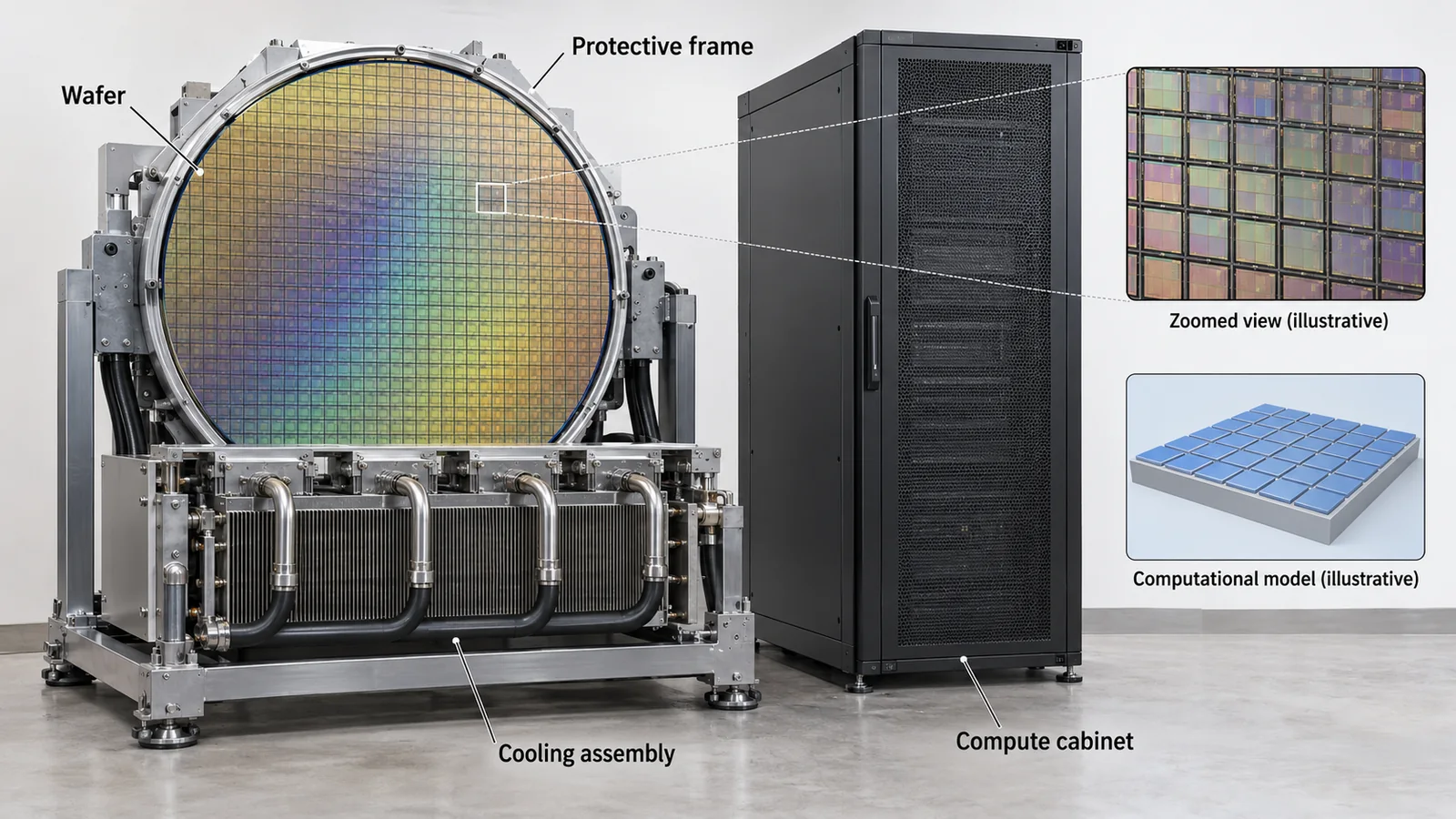
Joining: wiring between dies: normally the small dies (regions of circuitry) on a wafer are cut out and used individually. The prospectus says the largest chip before Cerebras was about 840 mm² and that the company connects dies inside the wafer fabrication process using a "cross-reticle connection" so that the whole 46,225 mm² works as one processor Sourced. This is the opposite direction to CoWoS and chiplets in our series, which join separate chips afterwards.
Yield: redundancy that routes around flaws: the larger a chip, the higher the chance it hits a flaw and the lower the yield. The company says it designed the architecture to recognise, switch off and route around defects using redundant building blocks, an approach used in memory manufacturing applied to a processor. That is the company's account and is not verified here.
Power, cooling and packaging: the company says delivering power to a chip this large, packaging it without cracking and cooling it so the coolant does not warm before reaching the far side were all open problems, and that it was among the first to use water cooling on the processor. Thermal expansion and coolant paths are areas where materials and structure matter Not yet confirmed.
Memory: on-chip SRAM and bandwidth: the company says WSE-3 has 44 GB of on-chip memory with 21 PB/s of bandwidth, a different approach from external HBM. It says this is 2,625 times the memory bandwidth of NVIDIA's B200 package, but that is the company's own comparison between on-chip memory and a package that includes external HBM, under differing conditions, so this article draws no conclusion on superiority (see our explainers on HBM and AI accelerators).
11. The risks this company carries
| Risk | Details | Status |
|---|---|---|
| Customer concentration | In 2025 MBZUAI was 62% of revenue and G42 24%; MBZUAI was 77.9% of receivables at the end of 2025. In Q2 2026, Customer A was 34%, B 32% and C 10%. The OpenAI MRA represents a substantial portion of projected revenue | Sourced |
| Terms of the OpenAI contract | If capacity is not delivered on schedule or service levels fall short, OpenAI may terminate part or all of the contract. The roughly US$1.0 billion loan may have to be repaid immediately if the MRA ends in certain cases | Sourced |
| Dependence on TSMC | TSMC fabricates all wafers and there is no formal long-term supply or allocation commitment. TSMC has customers far larger than Cerebras and could reduce deliveries. The prospectus also cites geopolitical risk in Taiwan and South Korea | Sourced |
| Data centers and power | Data centers are leased from third parties on long terms, exposing it to capacity access, power costs and delays. Over- or under-estimating demand could mean surplus rent or shortages | Sourced |
| Export controls | Its products are subject to U.S. export controls and exports require a licence or exception. The licence process is uncertain and could affect customers | Sourced |
| How revenue appears | The company says warrant amortisation reduces revenue and that gross margin will be significantly lower in the near term. The gap between GAAP and core is large | Sourced |
| Funding and costs | Net loss in Q2 2026 was US$450.5 million (including IPO-related stock compensation). Data center leases are long and hard to terminate. It plans to expand using IPO proceeds (US$6.4 billion) | Sourced |
| Competition | The prospectus names competition from NVIDIA, AMD, Intel and chips designed by large clouds. Some competitors have greater financial and manufacturing resources | Sourced |
12. Glossary
- WSE
- Wafer-Scale Engine: Cerebras' processor made from an entire wafer.
- CS-3
- The system that houses WSE-3 with power delivery, cooling and networking.
- MRA
- Master Relationship Agreement: the comprehensive contract with OpenAI covering capacity, a loan and a warrant.
- Warrant
- A right to buy shares at a set price. Warrants granted to customers are accounted for as reductions of revenue.
- Remaining performance obligations (RPO)
- The amount under contract that has not yet been recognised as revenue.
- Inference
- Using a trained AI model to produce answers or outputs.
- Cross-reticle connection
- Wiring that connects circuits across the boundaries of a single exposure field (reticle).
- Disaggregated inference
- Splitting inference into stages run on different hardware, each handling what it does best.
- HBM
- High bandwidth memory stacked beside a GPU. Cerebras does not use it.
- Form 10-Q / 424B4
- The quarterly report filed with the U.S. SEC / the final prospectus used when shares are offered.
13. References
- Cerebras Systems Prospectus (Form 424B4, filed with the U.S. SEC on 14 May 2026). Business, WSE-3 specifications, revenue and results, customer concentration, the OpenAI agreement, the AWS term sheet, manufacturing partners, headcount and export controls. https://www.sec.gov/Archives/edgar/data/2021728/000162828026035214/cerebras-424b4.htm
- Cerebras Systems Form 10-Q for the quarterly period ended June 30, 2026 (filed with the U.S. SEC on 12 August 2026). Second-quarter and first-half 2026 revenue and results, customer percentages, remaining performance obligations and the status of the OpenAI and AWS agreements. https://www.sec.gov/Archives/edgar/data/2021728/000162828026056357/cbrs-20260630.htm
- Cerebras Systems Cerebras Systems Fast Inference Cloud Business Nearly Quadruples in Second Quarter 2026 (earnings release, exhibit to Form 8-K, 12 August 2026). Data center and manufacturing capacity, work with AMD and AWS, and the third-quarter outlook. https://www.sec.gov/Archives/edgar/data/2021728/000162828026056186/cbrsannouncesfinancialresu.htm
- Cerebras Systems Form 8-K (filed 15 May 2026). Completion of the initial public offering (34,500,000 Class A shares at US$185.00; gross proceeds US$6.4 billion). https://www.sec.gov/Archives/edgar/data/2021728/000162828026035605/closing8-k.htm
- Cerebras Systems Form RW (3 October 2025). A request to withdraw the Form S-1 first filed on 30 September 2024. https://www.sec.gov/Archives/edgar/data/2021728/000119312525230382/d886849drw.htm
- Cerebras Systems Form S-1 (filed 17 April 2026). The renewed filing for the initial public offering. https://www.sec.gov/Archives/edgar/data/2021728/000162828026025762/cerebras-sx1april2026.htm
- Cerebras Systems Official website (source of the logo image, embedded in the page header; checked 15 October 2026). https://www.cerebras.ai/
14. Claim-to-source audit
| Claim in the text | Status | Reference |
|---|---|---|
| Incorporation (April 2016, Delaware), headquarters (Sunnyvale), 708 employees (31 December 2025) and 96 issued patents (31 March 2026) | Sourced | Reference 1 https://www.sec.gov/Archives/edgar/data/2021728/000162828026035214/cerebras-424b4.htm |
| WSE-3 specifications (4 trillion transistors, 900,000 cores, 44 GB on-chip memory, 21 PB/s memory bandwidth, 46,225 mm², TSMC 5nm) and the comparison with NVIDIA's B200 (company claims) | Sourced | Reference 1 https://www.sec.gov/Archives/edgar/data/2021728/000162828026035214/cerebras-424b4.htm |
| Revenue (2022-2025), 2025 net income and non-GAAP net loss, R&D, capex and cash | Sourced | Reference 1 https://www.sec.gov/Archives/edgar/data/2021728/000162828026035214/cerebras-424b4.htm |
| Customer concentration (G42 85% in 2024; G42 24% and MBZUAI 62% in 2025) and MBZUAI at 77.9% of receivables | Sourced | Reference 1 https://www.sec.gov/Archives/edgar/data/2021728/000162828026035214/cerebras-424b4.htm |
| The OpenAI MRA (750 MW in tranches over 2026-2028, an option for 1.25 GW more, a US$1.0 billion working capital loan, a warrant for 33,445,026 shares) | Sourced | Reference 1 https://www.sec.gov/Archives/edgar/data/2021728/000162828026035214/cerebras-424b4.htm Reference 2 https://www.sec.gov/Archives/edgar/data/2021728/000162828026056357/cbrs-20260630.htm |
| The January 2026 announcement of a deal "valued at more than $20 billion"; the binding AWS term sheet (March 2026) and the warrant for 2,696,678 shares | Sourced | Reference 1 https://www.sec.gov/Archives/edgar/data/2021728/000162828026035214/cerebras-424b4.htm |
| Manufacturing: TSMC fabricates all wafers with no long-term supply commitment; ASE handles redistribution layers; final packaging is in-house | Sourced | Reference 1 https://www.sec.gov/Archives/edgar/data/2021728/000162828026035214/cerebras-424b4.htm |
| Export controls (subject to U.S. export controls; exports need a licence or exception) | Sourced | Reference 1 https://www.sec.gov/Archives/edgar/data/2021728/000162828026035214/cerebras-424b4.htm |
| Completion of the IPO (15 May 2026; 34,500,000 shares at US$185; gross US$6.4 billion) | Sourced | Reference 4 https://www.sec.gov/Archives/edgar/data/2021728/000162828026035605/closing8-k.htm |
| The S-1 filing (September 2024), withdrawal request (October 2025) and re-filing (April 2026) | Sourced | Reference 5 https://www.sec.gov/Archives/edgar/data/2021728/000119312525230382/d886849drw.htm Reference 6 https://www.sec.gov/Archives/edgar/data/2021728/000162828026025762/cerebras-sx1april2026.htm |
| Second-quarter and first-half 2026 revenue, the hardware and cloud split, R&D, net loss, customer percentages (34%, 32%, 10%), US$25.4 billion of remaining performance obligations and the AWS lease agreement (June 2026) | Sourced | Reference 2 https://www.sec.gov/Archives/edgar/data/2021728/000162828026056357/cbrs-20260630.htm |
| 600 MW of data center capacity; manufacturing capacity up more than 10x; secured TSMC wafer supply; disaggregated inference with AMD (Q4 2026); Amazon Bedrock support (Q1 2027); the plan to more than triple revenue in 2027 | Not yet confirmed | Reference 3 https://www.sec.gov/Archives/edgar/data/2021728/000162828026056186/cbrsannouncesfinancialresu.htm |
| The company's statement that it does not use HBM, CoWoS or 3nm (12 August 2026) | Sourced | Reference 3 https://www.sec.gov/Archives/edgar/data/2021728/000162828026056186/cbrsannouncesfinancialresu.htm |
| Source of the logo image | Sourced | Reference 7 https://www.cerebras.ai/ |
| Cloud and other services at about 70% of second-quarter 2026 revenue and about 56% of the first half | Our calculation | Our calculation (125,991 / 180,110 and 208,804 / 373,516) |
| The four-type classification and where Cerebras sits | Our calculation | Our own classification; company names are examples from firms covered in this series (this article) |
| Verification of the company's performance claims such as "fastest" and "15 times faster"; customer names for 2026; plans for the next WSE generation; any acquisitions, investments or public subsidies | Not yet confirmed | Not in the prospectus, 10-Q or earnings release, or company claims we have not verified. These are items we could not confirm, not company outlook |
| The readings that wafer-scale integration ties into engineering problems of cost, yield, power and cooling, and that the company has reorganised around the shift of AI demand toward inference | Inference | This article's interpretation of the prospectus, 10-Q and earnings release |
| The materials engineer's view (cross-reticle connections, redundancy, cooling and power, packaging) | Commentary | General technical commentary, not a company disclosure; figures are the company's stated values |
Last updated 15 October 2026 / Troy Technical
Figures in this article come from Cerebras Systems' statutory filings with the U.S. Securities and Exchange Commission (the Form 424B4 prospectus, Form 10-Q and Form 8-K) and from its earnings release. No research-firm estimates or press-based figures have been used (market estimates by research firms that appear in the prospectus are not used either). Statements such as "fastest" about performance are company claims and are not verified here. Passages marked "Inference" are this article's interpretation of primary sources, not statements made by the company.