COMPANY PROFILE / AI & MACHINE LEARNING
CoreWeave
Scaling an AI-dedicated GPU cloud quickly on long customer contracts and borrowing
At the end of June 2026, RPO (backlog) was US$103.7 billion, active power was 1.5 GW and contracted power was about 3.7 GW. In 2025, however, 67% of revenue came from its largest customer, Microsoft, and debt had grown to about US$35.1 billion by the end of June 2026 (our calculation). This profile looks at a company specialised in GPU cloud for AI and sets out from primary sources what it is investing in, who it works with and what it is aiming for. Contracts, investments and datacenter plans reflect what was published as of 15 October 2026 and are treated as not yet confirmed. Debt and contract disclosures are described neutrally, with no particular assessment.
- CoreWeave in 30 seconds, and where it stands in AI and machine learning
- The logo and how the name is written
- Where the company sits in AI and machine learning
- Scale
- Resources committed to AI and machine learning
- What it has done so far
- What comes next
- What the company is aiming for in AI and machine learning
- Map of AI and machine learning partnerships
- Technologies, products and services
- Risks this company carries
- Glossary, references and claim-to-source audit
1. CoreWeave in 30 seconds, and where it stands in AI and machine learning
Nasdaq: CRWVInitial public offering in 2025 (10-K). Fiscal year ends on 31 December
Platforms & adopters (secondary)An AI-dedicated GPU cloud that also provides its own software
(GPU cloud)Offers NVIDIA GB200 and GB300 NVL72 systems, among others
CoreWeave is a company that supplies GPU cloud dedicated to AI training and inference, expanding rapidly on borrowing, on a base of multi-year “take-or-pay” customer contracts. According to its 10-K, customers commit to buying a specified amount of capacity over the contract term. FY2025 revenue was US$5.13 billion, operating income was close to zero (a loss of about US$0.05 billion) and the net loss was US$1.17 billion Sourced.
Its defining features are customer concentration and the size of its debt. In 2025, 67% of revenue came from its largest customer, Microsoft, and debt grew from about US$21.4 billion at the end of 2025 to about US$35.1 billion at the end of June 2026 (our calculation Our calculation) Sourced. Net interest expense in FY2025 was about 24% of revenue (our calculation Our calculation). The business depends on contracts continuing to be performed.
2. The logo and how the name is written
A note on names: the legal name is CoreWeave, Inc.. The company name is one word, with no space. Product names include “CoreWeave Cloud” (the service as a whole), “CoreWeave Mission Control” (operations software) and “SUNK” (Slurm on Kubernetes) Sourced.
Official website: https://www.coreweave.com/3. Where the company sits in AI and machine learning
4. Scale
Because CoreWeave specialises in GPU cloud for AI, the whole company is in this field. Figures come from the Form 10-K for the year to December 2025 and the Form 10-Q for the period to June 2026 Sourced.
| Measure (US$ million) | FY2023 (year to Dec 2023) | FY2024 (year to Dec 2024) | FY2025 (year to Dec 2025) |
|---|---|---|---|
| Revenue | 229 | 1,915 | 5,131 |
| Operating income (loss) | (14) | 324 | (46) |
| Net interest expense | (28) | (361) | (1,229) |
| Net loss | (594) | (863) | (1,167) |
| Cash paid for property and equipment | - | 8,700 (approx.) | 10,300 (approx.) |
| 2026 (Form 10-Q) | Second quarter (April to June) | First half (January to June) |
|---|---|---|
| Revenue (US$ million) | 2,575 (1,212 a year earlier) | 4,653 (2,194 a year earlier) |
| Operating income (loss) (US$ million) | (49) | (193) |
| Net interest expense (US$ million) | (640) | (1,176) |
| Net loss (US$ million) | (626) | (1,366) |
| Cash paid for property and equipment (US$ billion) | - | 14.1 (3.9 a year earlier) |
| Other basics | Details |
|---|---|
| Employees (31 December 2025) | 2,189 (1,967 in the U.S. and 222 in 19 other countries) |
| Datacenters (31 December 2025) | 43 sites with over 850 MW of active power. At the end of 2024, 32 sites and about 360 MW; at the end of 2023, 10 sites and about 70 MW (10-K) |
| Cash (30 June 2026) | US$5.52 billion (US$3.13 billion at the end of December 2025). The revolving credit facility had no borrowings and US$2.0 billion of capacity |
| Ownership of datacenters | All existing datacenters are leased. A joint venture with a third-party infrastructure developer is developing a multi-phase datacenter campus in Kenilworth, New Jersey (10-K) |
The figures above are company-wide. CoreWeave has almost no business outside AI, so company-wide figures are close to AI-cloud figures, but the 10-K does not break down customer use (training or inference) or how much is for AI model makers rather than general enterprises. “Active power” and “contracted power” are the company’s terms, and the sources used here do not say whether they mean IT load or utility capacity Sourced.
5. Resources committed to AI and machine learning
| Resource | What could be confirmed | Type |
|---|---|---|
| People | 2,189 at the end of December 2025. The CoreWeave Apprenticeship programme trains early-career staff (10-K) | Sourced |
| Money (capital expenditure) | Cash paid for property and equipment was about US$8.7 billion in 2024, about US$10.3 billion in 2025 and US$14.1 billion in the first half of 2026. The 10-K says it expects to increase investment relative to 2025. Funding comes from debt and securities issuance, delayed draw term loans (DDTLs), OEM financing and cash on hand | Sourced |
| Outside investments, acquisitions and joint ventures | Weights & Biases (an AI developer platform) acquired on 5 May 2025 for US$1.03 billion (mostly stock); it also acquired OpenPipe, Marimo and Monolith AI. The merger agreement with Core Scientific (July 2025) ended on 30 October 2025 because Core Scientific’s stockholders did not approve it. A joint venture is developing a site in Kenilworth. NVIDIA bought US$2 billion of CoreWeave stock in January 2026 (CoreWeave is the investee) | Sourced |
| Universities, research institutions and public funding | No AI-related university collaboration or public funding such as NAIRR appears in the 10-K or 10-Q | Not found |
| Datacenter power (MW or GW) | Active power was over 850 MW at the end of December 2025 and 1.5 GW at the end of June 2026 (up nearly 500 MW). Contracted power went from about 3.1 GW to about 3.7 GW (including capacity yet to be deployed). Neither term is defined as IT load or utility capacity. With NVIDIA, it aims to build “more than 5 gigawatts of AI factories by 2030” (not yet confirmed) | Not yet confirmed |
Debt and leases as disclosed (using the company’s own definitions)
| Item (US$ million) | 31 December 2025 | 30 June 2026 |
|---|---|---|
| Total debt, net (our calculation: recourse plus non-recourse debt) | 21,373 | 35,068 |
| of which non-recourse debt | 647 | 3,663 |
| Operating lease liabilities | - | 16,319 |
| Leases not yet commenced (company estimate of undiscounted future payments) | - | 35,500 |
Besides leases not yet commenced (starting between 2026 and 2029, with terms of 7 to 16 years), the 10-Q describes leases whose payments depend on construction costs. For one site, 393 MW of power remained undelivered (to be delivered in phases in 2026 to 2028) and rent is capped at US$14.7 billion over 16 years; at other sites a further 355 MW is undelivered Sourced. At 30 June 2026 (10-Q), balances included US$2.75 billion of 9.75% senior notes due 2031, US$1.25 billion of 9.625% senior notes due 2032, euro-denominated senior notes due 2032 (EUR 2.0 billion, US$2.28 billion), US$4.0 billion of convertible senior notes due 2032 and several DDTLs. In September 2026 it also issued 2.875% convertible notes due 2033 (net proceeds of about US$4.14 billion). These are obligations as disclosed, not an assessment of CoreWeave’s finances.
CoreWeave’s RPO is defined in the 10-Q as the aggregate transaction price allocated to performance obligations not delivered, or partially undelivered, net of estimated variable consideration, and includes both billed and unbilled amounts. It was US$60.7 billion at 31 December 2025 (weighted-average contract duration of about five years) and US$103.7 billion at 30 June 2026, of which 41% is expected over the first 24 months (to June 2028), 39% in months 25 to 48, and the rest (about 20%; our calculation) in months 49 to 78 Sourced.
The 11 August 2026 results release gives “revenue backlog” of about US$104 billion, defined as RPO plus other amounts expected to be recognized as revenue under committed customer contracts (a different scope from the 10-Q’s RPO), and notes that it excludes more than US$25 billion of net new commitments added early in the third quarter Sourced. Because contracts depend on “delivery and availability of service requirements”, a large amount does not guarantee it will be recognized as revenue as scheduled Not yet confirmed.
6. What it has done so far
| When | What happened | Why it matters |
|---|---|---|
| 2017 | Formed as a Delaware limited liability company (10-K) | Only the year of formation is confirmed; the sources used here give no detail on its early history |
| March 2025 | Master services agreement with OpenAI, which committed to pay up to about US$11.9 billion (through October 2030) (10-K). The company also held its initial public offering during the year (per the 10-K; the month is not in the sources used here) | A large contract with an AI model maker and a listing in the same year |
| 5 May 2025 | Acquired Weights & Biases (purchase price US$1.03 billion, mostly stock) | Added developer software to its compute |
| July to October 2025 | Signed a merger agreement with Core Scientific, which ended on 30 October 2025 when Core Scientific’s stockholders did not approve it | Taking in a datacenter operator did not happen |
| September 2025 | Further order form with OpenAI (up to about US$6.5 billion, through May 2031) and an order form with Meta (initially up to about US$14.2 billion, through December 2031) | Customer base widened |
| 26 January 2026 | NVIDIA invested US$2 billion (US$87.20 per share) and the two announced a collaboration framework to accelerate building “more than 5 gigawatts of AI factories by 2030” | A key GPU supplier became a shareholder |
| 31 March 2026 | New order form with Meta, which committed to pay about US$21 billion (new compute capacity through 2032 plus exercise of an existing option) (8-K) | The mix of top customers changed |
| 11 August 2026 | Second-quarter 2026 results: active power up nearly 500 MW to 1.5 GW, contracted power about 3.7 GW, revenue backlog about US$104 billion | Power coming online is accelerating |
| 17 to 22 September 2026 | Announced convertible notes (2.875%, due 2033) and an equity distribution agreement (ATM) for up to 35 million shares | Continuing to raise funds |
7. What comes next
All of the above are company targets or plans, and none is guaranteed Not yet confirmed. The 10-Q says it expects to increase investment in technology and infrastructure relative to 2025, and on 17 September 2026 CoreWeave signed an agreement allowing it to sell up to 35 million shares Sourced.
None of the following appears in the sources used here Not yet confirmed.
Whether active and contracted power means IT load or utility capacity / the number of GPUs owned / the split of contracts by use (training or inference) / start dates for each site / termination terms of the Microsoft, OpenAI and Meta contracts. Figures from press reports or earnings-call remarks are not used here.
8. What the company is aiming for in AI and machine learning
This part includes points the company has not stated directly. They are inferences from primary sources, set out with their basis.
| What can be read | Primary-source basis | Type |
|---|---|---|
| It is diversifying customers to reduce reliance on Microsoft | The largest customer’s share was 67% in 2025. Large OpenAI and Meta contracts were added, and in Q2 2026 the top three customers were 36%, 26% and 10% | Inference |
| Being first to deploy the newest GPU generation is central to its competitiveness | The 10-K stresses offering the latest generation first, and it is working with NVIDIA on early adoption of Rubin and Vera CPUs | Inference |
| It wants to raise the quality of its revenue with software | The 10-K describes Weights & Biases, Mission Control and SUNK as a “single stack” | Inference |
| It runs capital expenditure ahead on debt and recovers it through customer contracts | The 10-K says infrastructure is financed mainly through asset-level debt supported by take-or-pay customer contracts | Sourced |
| It is also starting to develop its own datacenters | The Kenilworth joint venture. The 10-K says it is “beginning to develop our own data centers, rather than relying on third parties” and cites limited experience as a risk | Sourced |
The 10-K says customers contract on take-or-pay terms to buy a specified amount of capacity over the contract term, and that infrastructure is financed “primarily through asset-level debt supported by take-or-pay customer contracts, supplemented by corporate-level equity and debt” Sourced.
From this structure we read the customer contracts as being, in effect, the collateral and repayment source for the borrowing, so that the more stable the customer base, the more stable the funding Not yet confirmed. However, the 10-K does not set out each contract’s termination terms, or how far DDTL repayment terms depend on customer performance, so we cannot confirm this.
9. Map of AI and machine learning partnerships
10. Technologies, products and services
| Product or facility | Scale and specifications (developer’s stated values) | Stage | Date and source |
|---|---|---|---|
| CoreWeave Cloud (infrastructure) | GPU clusters including NVIDIA GB200 and GB300 NVL72 systems. Networking uses NVIDIA Quantum-X800 (800 Gbps), Quantum-2 InfiniBand and Spectrum-X. CPUs from AMD and Intel | In service | 10-K (2 March 2026) |
| Network | A company-built backbone linking datacenters across North America and Europe. Customers connect at 10, 100 and 400 Gbps. A “Zero Egress Migration” programme can reduce or eliminate data-transfer fees | In service | 10-K |
| Operations software | Mission Control (provisioning, scheduling and monitoring), SUNK (Slurm on Kubernetes) and its own storage | In service | 10-K |
| Weights & Biases | Tools for AI researchers and developers to track model training and build applications. Acquired in May 2025 | In service | 10-K |
| NVIDIA Vera Rubin NVL72 | The company says it completed the “industry’s first” bring-up and validation in Q2 2026. Customer availability is expected in the second half of 2026 (10-K) | Bring-up validated (availability not yet confirmed) | Results release (11 August 2026) |
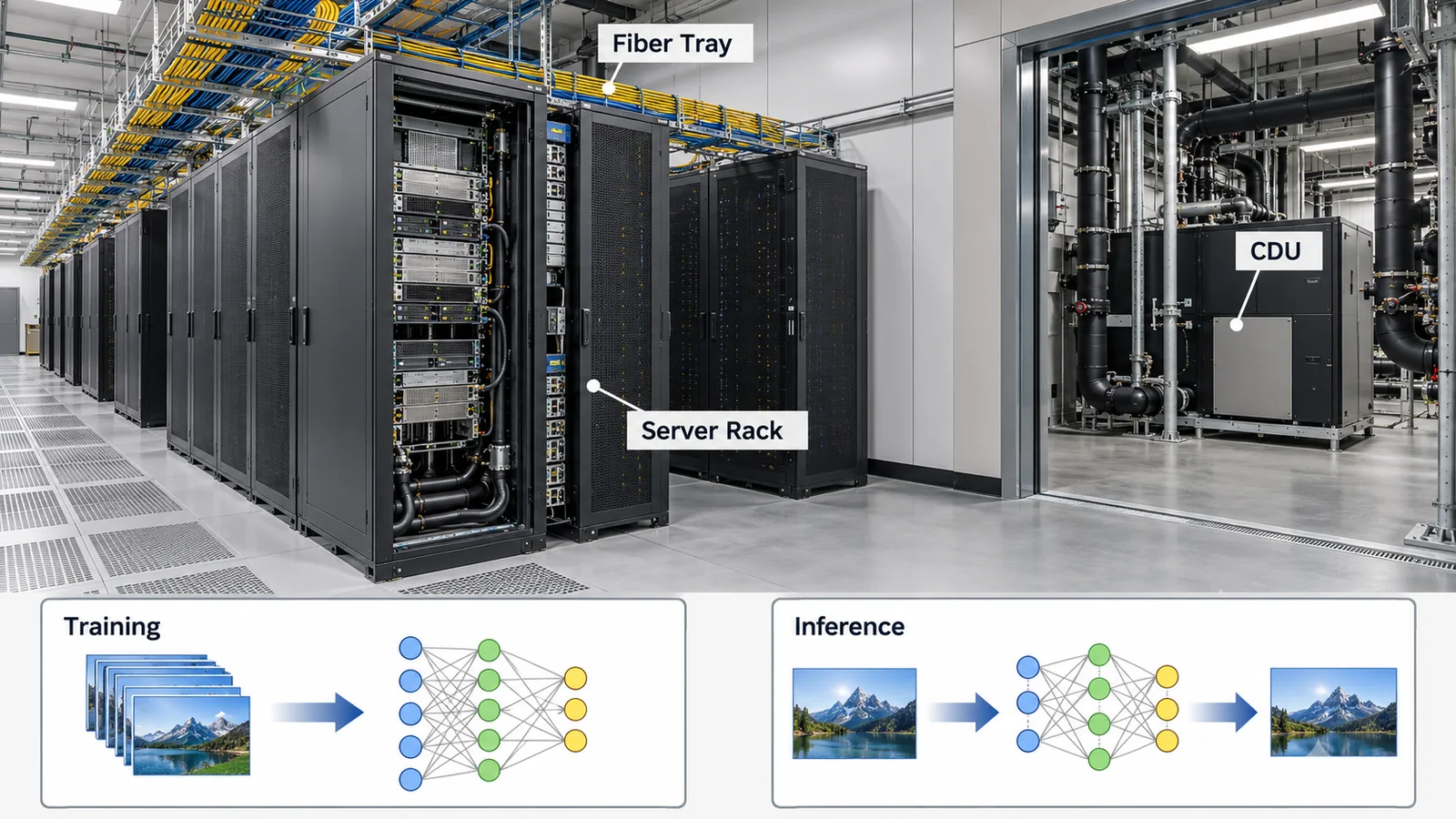
The 10-K says datacenters across the industry are moving towards higher rack density and more power per rack, which raises cooling requirements sharply Sourced. CoreWeave says its closed-loop liquid cooling allows higher power density and closer rack placement while greatly reducing water use.
The 10-K names “GB200 and GB300 NVL72” among the products it offers and says the network uses NVIDIA Quantum-X800 (800 Gbps connectivity) and similar technology to build a low-latency network. It also lists the chip supply chain (NVIDIA depends on suppliers such as TSMC) and the long lead times for datacenter power and equipment as risks. See also our explainers on power and cooling for AI datacenters and on training clusters and interconnects.
11. Risks this company carries
| Risk | Details | Type |
|---|---|---|
| Customer concentration | About 67% of 2025 revenue came from Microsoft, the largest customer. In Q2 2026 the top three customers were 36%, 26% and 10%. The 10-K says a drop in spending or performance by a few customers would have a major adverse effect | Sourced |
| Customer credit and performance | OpenAI is a private company, and the 10-K cites the possibility of excess capacity and of remaining responsible for components, infrastructure and datacenter lease costs if a customer cannot pay, for example through insolvency | Sourced |
| Size of debt | Debt was about US$35.1 billion (30 June 2026; our calculation). Net interest expense in FY2025 was US$1.23 billion, about 24% of revenue (our calculation). The 10-Q says substantial indebtedness could materially and adversely affect the business. These are disclosed obligations, not an assessment of CoreWeave’s financial health | Sourced |
| Operating results and net loss | FY2025 had an operating loss of US$0.046 billion and a net loss of US$1.17 billion. The first half of 2026 also had a net loss of US$1.37 billion | Sourced |
| Leased datacenters and delay risk | All sites are leased, and the 10-K cites failures at third-party facilities and delays in its own development as possible causes of late delivery | Sourced |
| Reliance on suppliers | The 10-K says it relies on a limited number of suppliers for components and, through NVIDIA, on the supply chain (including TSMC) | Sourced |
| Recognition of backlog | RPO depends on meeting “delivery and availability of service requirements” and includes estimates of variable consideration. The 10-K says it may fluctuate from quarter to quarter | Sourced |
| Litigation | The 10-K discloses a securities class action filed on 12 January 2026 and shareholder derivative actions filed on 10 February 2026. They are pending, and this profile draws no conclusion | Sourced |
| Failed M&A | The merger agreement with Core Scientific ended because Core Scientific’s stockholders did not approve it | Sourced |
12. Glossary
- Take-or-pay
- A contract form under which the customer pays for an agreed quantity whether or not it uses it.
- RPO (CoreWeave’s definition)
- The aggregate transaction price allocated to undelivered performance obligations, net of estimated variable consideration.
- Revenue backlog
- A measure used in results releases: RPO plus other amounts expected to be recognized as revenue under committed customer contracts.
- DDTL
- Delayed draw term loan. A term loan drawn in several instalments as equipment is purchased.
- Non-recourse debt
- Debt whose repayment can be claimed only against the assets of a specific subsidiary, not the parent.
- Active power / contracted power
- The company’s terms: power at datacenters in operation, and contracted power still to be deployed. Whether it means IT load or utility capacity is not stated.
- SUNK
- Slurm on Kubernetes. CoreWeave’s operations software for managing large AI training jobs.
- AI factory
- NVIDIA’s term for a datacenter that carries out AI training and inference at scale.
13. References
- CoreWeave Form 10-K for the fiscal year ended December 31, 2025 (filed with the U.S. SEC on 2 March 2026). Business description, revenue and losses, active and contracted power, RPO, customer concentration, debt, risk factors and acquisitions. https://www.sec.gov/Archives/edgar/data/1769628/000176962826000104/crwv-20251231.htm
- CoreWeave Form 10-Q for the quarterly period ended June 30, 2026 (filed with the U.S. SEC on 12 August 2026). Results for the first half of 2026, RPO of US$103.7 billion, debt, leases and customer concentration. https://www.sec.gov/Archives/edgar/data/1769628/000176962826000366/crwv-20260630.htm
- CoreWeave Exhibit 99.1 to the Form 8-K filed 11 August 2026, “CoreWeave Reports Strong Second Quarter 2026 Results”. Revenue backlog, active power and contracted power. https://www.sec.gov/Archives/edgar/data/1769628/000176962826000362/coreweave2q26earningspress.htm
- CoreWeave Exhibit 99.1 to the Form 8-K filed 26 January 2026, “NVIDIA and CoreWeave Strengthen Collaboration to Accelerate Buildout of AI Factories”. NVIDIA’s US$2 billion investment and the collaboration framework. https://www.sec.gov/Archives/edgar/data/1769628/000176962826000044/ex991pressrelease_final.htm
- CoreWeave Form 8-K filed 9 April 2026 (Item 8.01). The new order form with Meta (about US$21 billion). https://www.sec.gov/Archives/edgar/data/1769628/000176962826000154/crwv-20260331.htm
- CoreWeave Form 8-K filed 31 October 2025 (Item 1.02). Termination of the merger agreement with Core Scientific. https://www.sec.gov/Archives/edgar/data/1769628/000095010325014006/dp236631_8k.htm
- CoreWeave Form 8-K filed 22 September 2026 (Items 1.01 and 3.02). Terms of the convertible notes. https://www.sec.gov/Archives/edgar/data/1769628/000176962826000432/crwv-20260917.htm
- CoreWeave Form 8-K filed 17 September 2026. Launch of the convertible notes offering and an equity distribution agreement (ATM) for up to 35 million shares. https://www.sec.gov/Archives/edgar/data/1769628/000176962826000429/crwv-20260917.htm
- CoreWeave Official website (to confirm company details; the logo was taken from the site’s content-delivery host). https://www.coreweave.com/
14. Claim-to-source audit
| Claim in the text | Type | Source |
|---|---|---|
| Legal name, formation, headquarters, Nasdaq listing, headcount, and the trend in datacenters and power (2023 to 2025) | Sourced | Reference 1, 9 https://www.sec.gov/Archives/edgar/data/1769628/000176962826000104/crwv-20251231.htm https://www.coreweave.com/ |
| Revenue, operating income, net interest expense, net loss and capital expenditure (FY2023 to FY2025), RPO of US$60.7 billion and its duration, customer concentration (Microsoft 67%), OpenAI and Meta contract amounts, debt breakdown | Sourced | Reference 1 https://www.sec.gov/Archives/edgar/data/1769628/000176962826000104/crwv-20251231.htm |
| First-half 2026 revenue, results and capital expenditure, RPO of US$103.7 billion and its split, debt breakdown, leases, customer concentration, OpenAI and Meta contract amounts | Sourced | Reference 2 https://www.sec.gov/Archives/edgar/data/1769628/000176962826000366/crwv-20260630.htm |
| Revenue backlog of about US$104 billion, active power of 1.5 GW, contracted power of about 3.7 GW, and validation of Vera Rubin NVL72 | Sourced | Reference 3 https://www.sec.gov/Archives/edgar/data/1769628/000176962826000362/coreweave2q26earningspress.htm |
| NVIDIA’s US$2 billion investment and the framework for more than 5 GW | Sourced | Reference 4 https://www.sec.gov/Archives/edgar/data/1769628/000176962826000044/ex991pressrelease_final.htm |
| The new order form with Meta (about US$21 billion) | Sourced | Reference 5 https://www.sec.gov/Archives/edgar/data/1769628/000176962826000154/crwv-20260331.htm |
| Termination of the merger agreement with Core Scientific | Sourced | Reference 6 https://www.sec.gov/Archives/edgar/data/1769628/000095010325014006/dp236631_8k.htm |
| Convertible notes (2.875%, net proceeds of about US$4.14 billion) | Sourced | Reference 7 https://www.sec.gov/Archives/edgar/data/1769628/000176962826000432/crwv-20260917.htm |
| Equity distribution agreement (ATM) for up to 35 million shares | Sourced | Reference 8 https://www.sec.gov/Archives/edgar/data/1769628/000176962826000429/crwv-20260917.htm |
| Total debt of about US$35.1 billion, net interest expense at about 24% of revenue, and the “about 20%” remainder of RPO | Our calculation | Our calculation from the figures in References 1 and 2 |
| Classification used in the type chart (cloud & infrastructure primary, platforms & adopters secondary) | Our calculation | Our own classification, based on the business description in Reference 1 |
| Whether active and contracted power means IT load or utility capacity, the number of GPUs owned, and the split of contracts by use | Not yet confirmed | Not in References 1 to 3. Press figures are not used https://www.sec.gov/Archives/edgar/data/1769628/000176962826000104/crwv-20251231.htm |
| University or public-funding collaboration | Not yet confirmed | Not in References 1 or 2. We do not claim it does not exist https://www.sec.gov/Archives/edgar/data/1769628/000176962826000366/crwv-20260630.htm |
| More than 5 GW by 2030, deployment of 3.7 GW of contracted power, Rubin deployment, and the start of leases not yet commenced | Not yet confirmed | Reference 1, 2, 4 https://www.sec.gov/Archives/edgar/data/1769628/000176962826000104/crwv-20251231.htm https://www.sec.gov/Archives/edgar/data/1769628/000176962826000366/crwv-20260630.htm https://www.sec.gov/Archives/edgar/data/1769628/000176962826000044/ex991pressrelease_final.htm |
| Reading: diversifying customers to reduce reliance on Microsoft | Inference | Our own reading of the change in customer shares and the new large contracts |
| Reading: first to deploy the newest GPU generation is central to competitiveness | Inference | Our own reading of the 10-K description and the collaboration with NVIDIA |
| Reading: raising the quality of revenue with software | Inference | Our own reading of the 10-K product description |
| Reading: customer contracts serve as the repayment source for borrowing | Inference | Our own reading of the 10-K’s description of financing |
Last updated: 15 October 2026 (date checked) / Troy Technical
All figures in this article are based on documents CoreWeave, Inc. filed with the U.S. Securities and Exchange Commission. Market-research estimates and press figures are not used. Service performance figures are the developer’s stated values, not independent measurements. Passages marked “Inference” are our reading of primary sources and are not statements by the company. Contracts, investments and datacenter plans reflect what had been published as of 15 October 2026. This profile draws no conclusion on pending litigation.