COMPANY PROFILE / AI & MACHINE LEARNING
Google (Alphabet; including Google DeepMind)
A full-stack AI company that owns its models (Gemini), its own chips (TPU) and its cloud
This profile covers the AI parts of Alphabet: Google DeepMind, which builds the Gemini models; the TPU, a chip Google designs itself; and Google Cloud, which supplies AI infrastructure to enterprises. In 2026 it announced its eighth-generation TPUs (TPU 8t and 8i) in April and a new frontier model, Gemini 4 Argon, in September, and Google Cloud revenue in April to June 2026 was about 1.8 times that of a year earlier (Form 10-Q). Capital expenditure has risen steeply too, reaching US$80.6 billion in the first half of 2026 alone. The article sets all this out only as far as Alphabet's Form 10-K and 10-Q filings with the U.S. SEC and Google's own announcements confirm it. Advertising and Search in general are out of scope.
- Google in 30 seconds, and where it stands in AI and machine learning
- The logo and how the name is written
- Where the company sits in the AI field
- Scale
- Resources committed to AI and machine learning
- What it has done so far
- What comes next
- What the company is aiming for in AI
- Map of AI partnerships
- Technologies, products and services
- The risks this company carries
- Glossary, references and claim-to-source audit
1. Google in 30 seconds, and where it stands in AI and machine learning
Gemini 3.8 FlashArgon announced 30 September 2026 (company announcement)
Ironwood (7th gen)Announced 22 April 2026; general availability planned later in 2026
The key to reading Alphabet's AI is that the cost of model research (Google DeepMind) is not allocated to segments but reported separately as "Alphabet-level activities" Sourced. The operating loss in that line was US$16.76 billion in 2025 and US$11.18 billion in the first half of 2026, and the 10-K explains it as chiefly shared AI research and development. The revenue from AI sold to outsiders, meanwhile, shows up in Google Cloud. So the cost appears in one place and the revenue in another, and this article sets the two side by side.
2. The logo and how the name is written

A note on names: "Google" in this article means Google, the core company of Alphabet Inc. (Search, cloud and AI). The entity that files the statutory disclosures (10-K and 10-Q) is the parent, Alphabet Inc., and the research organisation that builds the Gemini models is Google DeepMind. Alphabet also has "Other Bets" such as Waymo, which are outside this article. The logo shown is the logo image Google publishes officially.
Official site: https://about.google/3. Where the company sits in the AI field
4. Scale
Because the whole company is large, this section pulls out only the figures that bear on AI. All come from Alphabet's 10-K and 10-Q.
| Item | What it is | Notes and category |
|---|---|---|
| Revenue (year to December 2025) | US$402.8 billion (2024: US$350.0 billion) | All of Alphabet. Google Cloud was US$58.7 billion (2024: US$43.2 billion). That advertising is over 70% of total revenue is outside this article's scope (10-K) Sourced |
| Google Cloud operating income | 2025: US$13.9 billion (2024: US$6.1 billion) | 10-K segment information. April to June 2026: US$8.8 billion (US$2.8 billion a year earlier) Sourced |
| April to June 2026 (10-Q) | Revenue US$119.8 billion, of which Google Cloud US$24.8 billion | Revenue a year earlier US$96.4 billion; Google Cloud US$13.6 billion Sourced |
| Google Cloud growth (April to June) | About 82% | Our calculation (US$24.8 billion / US$13.6 billion). Matches Pichai's statement of 82% Our calculation |
| Google Cloud operating margin (April to June) | 2026: about 35.6%; 2025: about 20.7% | Our calculation (operating income / revenue) Our calculation |
| R&D expense (whole company) | 2025: US$61.1 billion (2024: US$49.3 billion) | All of Alphabet. The split for Google DeepMind is not disclosed Sourced |
| Employees | 190,820 (31 December 2025) | All of Alphabet. AI-dedicated headcount could not be confirmed Sourced |
The revenue and profit figures above are for all of Alphabet or all of Google Cloud, not AI alone. Google Cloud also includes data analytics, security and business software (Workspace), and no disclosure isolating AI-related revenue was found Not yet confirmed. Separate amounts for Gemini revenue or TPU revenue are "not disclosed", and this article does not estimate them.
5. Resources committed to AI and machine learning
The table below shows, for people, money, outside stakes and ties to universities or public bodies, whether Alphabet's 10-K and 10-Q and Google's official material confirm them.
| Type of resource | What it is | Notes and category |
|---|---|---|
| People | 190,820 employees (all of Alphabet). Headcount and research sites for Google DeepMind | AI-dedicated headcount is not stated in the official material checked Not confirmed |
| Money: R&D | 2025: US$61.1 billion (whole company). Model research is booked under "Alphabet-level activities", with a 2025 operating loss of US$16.76 billion | 10-K. The line is described as chiefly shared AI research and development Sourced |
| Money: capital expenditure | 2025: US$91.4 billion (2024: US$52.5 billion). First half of 2026: US$80.6 billion (US$39.6 billion a year earlier). To rise significantly in 2026 versus 2025 | 10-K and 10-Q. No AI-only breakdown is disclosed Sourced |
| Money: financing and commitments | June 2026: net proceeds of US$49.6 billion from stock and mandatory convertible preferred (for uses including capex to scale AI infrastructure). Fixed or guaranteed contractual commitments of US$707.0 billion (30 June 2026) | 10-Q. Most commitments are long-term supply agreements; commitments run into the future Sourced |
| Acquisitions | Wiz: completed for US$29.5 billion (11 March 2026). Intersect: completed for US$5.9 billion (10 March 2026; data-centre and energy development) | 10-Q Sourced |
| Outside investments | Non-marketable securities carried at US$131.5 billion (30 June 2026; US$68.7 billion at end-2025). The 10-Q says mainly "an investment in a private company" and does not name it | The company and the stake could not be confirmed Not yet confirmed |
| Universities, research bodies and public funding | U.S. Department of Energy Genesis Mission: AI tools for researchers at 17 national laboratories (18 December 2025). Also taking part in the U.S. government's voluntary pre-release access process (Argon) | No government funding was confirmed Sourced |
Status of principal products, models and facilities
Prices and specifications are the values on official pages as checked up to 15 October 2026. They change often, so check the current official page before relying on them.
| Product, model or facility | Scale or specification (company's figures) | Stage | Date | Source |
|---|---|---|---|---|
| Gemini 4 Argon | 1 million tokens maximum output (up from 64,000). Introductory price: US$2 input / US$10 output per million tokens | Released (broad availability began 13 October 2026) | 30 September 2026 | References 4 and 5 |
| Gemini 3.8 Flash / 3.8 Flash Cyber | 3.8 Flash for general use; Cyber for trusted defenders (Fairwind Program) | Released | 2 September 2026 | Reference 7 |
| TPU 8t (training) | 9,600 chips per superpod, 2 petabytes of shared HBM, 121 exaflops (company figure; the numerical precision is not given on that page) | Plan (general availability planned later in 2026) | 22 April 2026 | Reference 8 |
| TPU 8i (inference) | 288 GB of HBM plus 384 MB of on-chip SRAM; 19.2 Tb/s interchip bandwidth; 80% better performance per dollar than the previous generation (company figure) | Plan (general availability planned later in 2026) | 22 April 2026 | Reference 8 |
| External sales of TPU systems | Supplied under "a limited number of agreements" to customers needing on-premises infrastructure. Revenue recognition began in April to June 2026; the significant majority will be recognised in 2027 | Contract (revenue recognised in stages) | 23 July 2026 (10-Q) | Reference 2 |
| Google Cloud revenue backlog | US$519.5 billion (US$513.9 billion of it Google Cloud). Just over half expected to be recognised within 24 months | Contract (revenue in the future) | 30 June 2026 | Reference 2 |
6. What it has done so far
| When | What happened | Why it matters |
|---|---|---|
| 18 December 2025 | Google DeepMind backed the U.S. Department of Energy's Genesis Mission, offering AI tools to researchers at 17 national laboratories | A tie to public research bodies |
| 10 and 11 March 2026 | Completed the acquisitions of Intersect (US$5.9 billion) and Wiz (US$29.5 billion) | Energy and data centres, and cloud security |
| 6 April 2026 | Anthropic announced a multi-gigawatt TPU agreement with Google and Broadcom (Anthropic's account) | A large TPU customer (the other party's announcement) |
| 22 April 2026 | Announced the eighth-generation TPUs (TPU 8t and 8i) | The first generation split into training and inference chips |
| June 2026 | Raised net proceeds of US$49.6 billion through stock and mandatory convertible preferred | Stated for uses including capex on AI infrastructure |
| 22 and 23 July 2026 | Q2 results. Google Cloud revenue about 1.8 times a year earlier. The 10-Q describes the start of revenue recognition on TPU systems | A stage of selling TPUs to outsiders as a product |
| 2 September 2026 | Announced Gemini 3.8 Flash and 3.8 Flash Cyber | The third Flash release in six weeks, three weeks after 3.7 Flash |
| 30 September 2026 | Announced Gemini 4 Argon, rolling out first to trusted defenders through the Fairwind Program | Phased release |
| 13 October 2026 | Began broad availability of Argon and expanded the Fairwind Program | An order that takes account of cyber capability |
7. What comes next
All four items above are company plans or expectations, not things that have happened Not yet confirmed. The same applies to the items below.
| Plan | What the company states | Category |
|---|---|---|
| Reach of Gemini 4 Argon | Wider availability to developers, enterprises and consumers; broad availability began on 13 October 2026 | Not yet confirmed |
| Recognition of the revenue backlog | Just over half of US$519.5 billion expected to be recognised within 24 months | Not yet confirmed |
| Contractual commitments | Most of the US$707.0 billion of fixed or guaranteed commitments are long-term supply agreements; supply and content-licence commitments are expected to be fulfilled generally through 2030, and energy agreements run to as late as 2054 | Not yet confirmed |
| Energy-related guarantees | Guarantees supporting procurement of power-related equipment are up to US$7.6 billion (terms through September 2026) | Not yet confirmed |
8. What the company is aiming for in AI
This section goes beyond what the company says directly. It sets out inferences that official material supports, each with its basis.
| What can be read | Primary evidence behind it | Category |
|---|---|---|
| It is widening into a business that sells its own chips to others | The 10-Q says revenue from TPU systems began in April to June 2026, under "a limited number of agreements", mostly to be recognised in 2027 | Inference |
| It releases its top model in stages, giving defenders access first because of cyber capability | Argon went first to trusted defenders through the Fairwind Program, with the U.S. government's voluntary pre-release process involved, and broad availability followed on 13 October | Sourced |
| It is arranging funding ahead of the expansion in capex | Raised net proceeds of US$49.6 billion in June 2026; capex to rise significantly in 2026; commitments of US$707.0 billion | Inference |
| It is strengthening a structure in which AI sold to outsiders shows up in Google Cloud | Cloud operating margin about 20.7% in April to June 2025 and about 35.6% in 2026 (our calculation). Backlog US$519.5 billion | Our calculation |
| It is moving toward holding power and land itself | Acquired Intersect (data-centre and energy development) for US$5.9 billion. The TPU announcement says power is a binding constraint | Sourced |
Alphabet's Q2 10-Q says it began recognising revenue from agreements to supply TPU systems to customers for their on-premises use Sourced. The same 10-Q adds that it is engaging in the supply of TPU systems to meet customers' AI compute demand, and cautions that this may raise costs and operational complexity Sourced. Meanwhile Anthropic has announced an agreement for multiple gigawatts of TPU capacity with Google and Broadcom (Anthropic's account). From these, this article reads Google as repositioning the TPU from an internal component to a product and service sold to outsiders Inference. But the 10-Q names no customers and gives no amounts, so the scale cannot be confirmed.
9. Map of AI partnerships
10. Technologies, products and services
These are the main products and services on offer.
| Product or service | What it is (as stated in official announcements, checked 15 October 2026) | Source |
|---|---|---|
| Gemini (models) | Alphabet's 10-K says all 15 of its "half-billion-user" products use Gemini. Gemini 4 Argon and 3.8 Flash were announced in September 2026 | References 1 and 4 |
| The Gemini app | 950 million monthly users (Pichai, 22 July 2026). A Windows version was offered in September 2026 | References 3 and 6 |
| Gemini API and developer products | The API processes about 22 billion tokens a minute (July 2026; 16 billion a quarter earlier). More than 9 million developers build each month | Reference 3 |
| Google Cloud (AI infrastructure) | Offers both TPUs and NVIDIA GPUs. More than 200 foundation models in Vertex AI (Gemini, third-party and open models). Gemini Enterprise is used by nearly 90% of the Fortune 100 | References 1 and 3 |
| Google Cloud networking and software | Virgo Network (connects up to a million accelerators across sites). Supports JAX, PyTorch, vLLM and SGLang | Reference 3 |
| Fairwind Program | A framework for limited access for cyber defenders. Used for Argon and 3.8 Flash Cyber | References 4 and 7 |
How to read the company's own evaluations
The Argon announcement says things such as "77.9% on DeepSWE v1.1" and "#1 on AutomationBench (51.3%)". These are values Google itself reported, and the evaluation settings and comparison conditions can be checked only as far as the announcement goes. This article does not reproduce the scores or rank anyone against anyone Sourced.
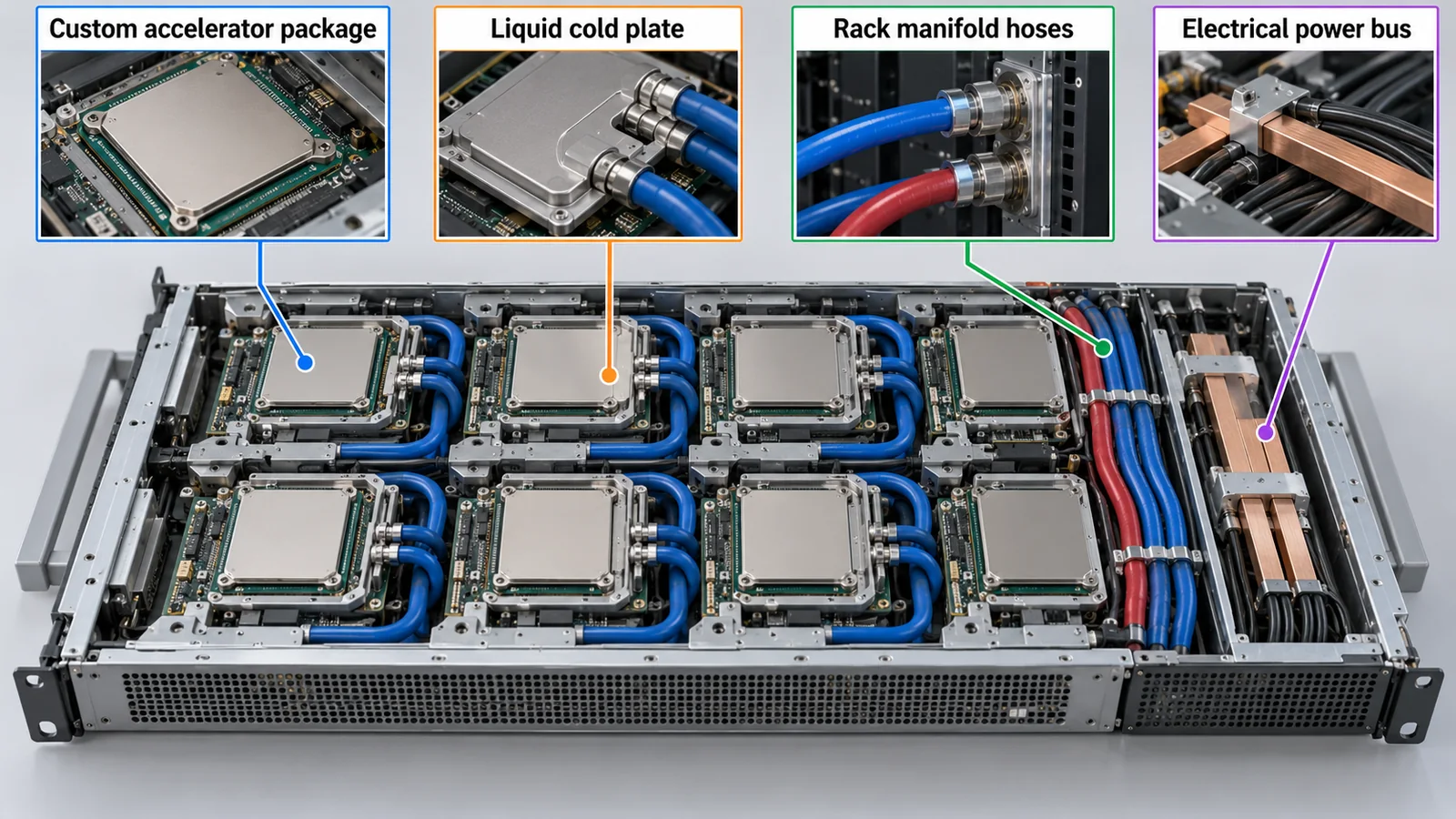
For TPU 8i, Google says it pairs 288 GB of HBM with 384 MB of on-chip SRAM (three times the previous generation) so that a model's working set stays on the chip and processors stop waiting, easing the "memory wall" Sourced. In LLM inference the limit is often how fast data can be read from memory and how fast chips talk to each other rather than raw arithmetic, so raising HBM capacity, on-chip SRAM and interchip bandwidth (19.2 Tb/s) together addresses that. It also says performance per watt is up to twice that of the previous generation, Ironwood (company figure).
The same announcement says power, not only chip supply, is a binding constraint in data centres, and mentions integrated power management and liquid cooling Sourced. See also our explainers on AI accelerators, HBM, power and cooling for AI data centers, and training clusters and interconnects.
11. The risks this company carries
| Risk | Substance | Category |
|---|---|---|
| Supply constraints | In July 2026 Pichai said supply is constrained relative to demand. The 10-K also says shortages, price rises and longer lead times for components could affect operations | Sourced |
| Size of capex and commitments | Capex was US$91.4 billion in 2025 and US$80.6 billion in the first half of 2026 alone. Fixed or guaranteed commitments are US$707.0 billion. The 10-Q cautions that if a counterparty fails to perform, it may incur additional liabilities or have excess capacity it cannot easily redeploy | Sourced |
| Credit support for data centres | It provides backstops for third-party data-centre payment obligations (terms up to 15 years). Depending on performance of those contracts, a burden could arise | Sourced |
| Rising costs | The 10-K says depreciation, energy, equipment and network costs are expected to increase significantly because AI needs more compute than past offerings | Sourced |
| Regulation and litigation | The 10-K lists AI regulation such as the EU AI Act, claims relating to AI training, development and commercialisation, and antitrust suits by the U.S. Department of Justice and others as business risks. This article does not predict individual outcomes | Sourced |
| Cyber capability and scope of release | Argon began as limited access for trusted defenders, with broad availability on 13 October. Google says extra safeguards were put in place because cyber and biology capabilities rose | Sourced |
| How revenue appears | Model research cost sits in Alphabet-level activities and AI revenue appears in Google Cloud, so the stand-alone profitability of AI cannot be read from the disclosures | Inference |
12. Glossary
- Alphabet-level activities
- Company-wide costs not allocated to segments. The 10-K describes them as chiefly shared AI research and development.
- TPU (Tensor Processing Unit)
- A chip for AI that Google designs. Seventh generation Ironwood; eighth generation TPU 8t (training) and 8i (inference).
- Google DeepMind
- Google's AI research organisation, which builds the Gemini models.
- Revenue backlog
- Contracted amounts not yet recognised as revenue. The 10-K term is remaining performance obligations.
- HBM
- High bandwidth memory, the high-bandwidth memory stacked next to AI chips.
- Fairwind Program
- Google's framework for limited access for cyber defenders.
- Superpod
- The basic unit of many chips tied together at high speed. 9,600 chips for TPU 8t.
- Goodput
- The share of time chips actually spend on useful training, excluding time lost to failures and restarts.
- Capital expenditure (capex)
- Spending on servers, network equipment, data centres and the like.
13. References
- Alphabet Inc. Form 10-K for the fiscal year ended December 31, 2025 (filed with the SEC on 5 February 2026). Revenue, segments, R&D, capital expenditure, headcount, revenue backlog, and the Wiz and Intersect acquisition agreements. https://www.sec.gov/Archives/edgar/data/1652044/000165204426000018/goog-20251231.htm
- Alphabet Inc. Form 10-Q for the quarterly period ended June 30, 2026 (filed with the SEC on 23 July 2026). Quarterly and half-year revenue, Google Cloud revenue and operating income, revenue backlog, capital expenditure, sales of TPU systems, completion of the Wiz and Intersect acquisitions, equity raising, and contractual commitments. https://www.sec.gov/Archives/edgar/data/1652044/000165204426000071/goog-20260630.htm
- Google (Sundar Pichai) Alphabet earnings call, Q2 2026: Sundar Pichai's remarks (22 July 2026). Statements on monthly users of the Gemini app, API token throughput, Cloud growth and supply constraints. https://blog.google/company-news/inside-google/message-ceo/alphabet-earnings-q2-2026/
- Google Gemini 4 Argon: Built to solve your hardest problems (30 September 2026). The new frontier model, phased access through the Fairwind Program, the introductory price, and the U.S. government's voluntary pre-release access process. https://blog.google/innovation-and-ai/models-and-research/gemini-models/gemini-4-argon/
- Google Developing Gemini 4 Argon responsibly and safely (13 October 2026). The start of broad availability of Argon, the expansion of the Fairwind Program, and safeguards. https://blog.google/innovation-and-ai/technology/safety-security/gemini-4-model-safety-security/
- Google The latest AI news we announced in September 2026 (monthly roundup). Gemini 3.8 Flash, 3.8 Flash Cyber, Project Suncatcher and more. https://blog.google/innovation-and-ai/technology/ai/google-ai-updates-september-2026/
- Google Introducing Gemini 3.8 Flash and 3.8 Flash Cyber (2 September 2026). https://blog.google/innovation-and-ai/models-and-research/gemini-models/3-8-flash-and-3-8-flash-cyber/
- Google Our eighth generation TPUs: two chips for the agentic era (22 April 2026). Specifications of TPU 8t and TPU 8i (the company's figures) and planned general availability later in 2026. https://blog.google/innovation-and-ai/infrastructure-and-cloud/google-cloud/eighth-generation-tpu-agentic-era/
- Google DeepMind Google DeepMind supports US Department of Energy on Genesis (18 December 2025). AI tools for researchers at all 17 DOE national laboratories. https://deepmind.google/blog/google-deepmind-supports-us-department-of-energy-on-genesis/
- Anthropic Anthropic expands partnership with Google and Broadcom for multiple gigawatts of next-generation compute (6 April 2026). Anthropic's account of its agreement to use Google's TPUs. https://www.anthropic.com/news/google-broadcom-partnership-compute
14. Claim-to-source audit
| Claim in the text | Category | Source |
|---|---|---|
| Alphabet revenue, Google Cloud revenue and operating income, R&D, capex and headcount (2025) | Sourced | Reference 1 https://www.sec.gov/Archives/edgar/data/1652044/000165204426000018/goog-20251231.htm |
| That Alphabet-level activities chiefly cover shared AI R&D, with a 2025 operating loss of US$16.76 billion | Sourced | Reference 1 https://www.sec.gov/Archives/edgar/data/1652044/000165204426000018/goog-20251231.htm |
| April to June and first-half 2026 revenue, Google Cloud revenue and operating income, and capex of US$80.6 billion | Sourced | Reference 2 https://www.sec.gov/Archives/edgar/data/1652044/000165204426000071/goog-20260630.htm |
| Backlog of US$519.5 billion (Google Cloud US$513.9 billion), US$707.0 billion of commitments and US$7.6 billion of guarantees | Sourced | Reference 2 https://www.sec.gov/Archives/edgar/data/1652044/000165204426000071/goog-20260630.htm |
| External sales of TPU systems and the start of revenue recognition (mostly in 2027) | Sourced | Reference 2 https://www.sec.gov/Archives/edgar/data/1652044/000165204426000071/goog-20260630.htm |
| Completion of the Wiz (US$29.5 billion) and Intersect (US$5.9 billion) acquisitions, and the June 2026 equity raise of US$49.6 billion | Sourced | Reference 2 https://www.sec.gov/Archives/edgar/data/1652044/000165204426000071/goog-20260630.htm |
| Non-marketable securities at US$131.5 billion, described as mainly "an investment in a private company" (unnamed) | Sourced | Reference 2 https://www.sec.gov/Archives/edgar/data/1652044/000165204426000071/goog-20260630.htm |
| 950 million monthly Gemini app users, about 22 billion API tokens a minute, 82% Cloud growth and the supply-constraint remark | Sourced | Reference 3 https://blog.google/company-news/inside-google/message-ceo/alphabet-earnings-q2-2026/ |
| Gemini 4 Argon announcement, 1 million output tokens, introductory price, Fairwind Program and the U.S. government's voluntary process | Sourced | Reference 4 https://blog.google/innovation-and-ai/models-and-research/gemini-models/gemini-4-argon/ |
| The start of broad availability of Argon (13 October 2026) and safeguards | Sourced | Reference 5 https://blog.google/innovation-and-ai/technology/safety-security/gemini-4-model-safety-security/ |
| Announcement of Gemini 3.8 Flash and 3.8 Flash Cyber (2 September 2026) | Sourced | Reference 7 https://blog.google/innovation-and-ai/models-and-research/gemini-models/3-8-flash-and-3-8-flash-cyber/ Reference 6 https://blog.google/innovation-and-ai/technology/ai/google-ai-updates-september-2026/ |
| TPU 8t and 8i specifications (company figures) and planned availability in 2026 | Sourced | Reference 8 https://blog.google/innovation-and-ai/infrastructure-and-cloud/google-cloud/eighth-generation-tpu-agentic-era/ |
| AI tools for the 17 national laboratories under the DOE Genesis Mission | Sourced | Reference 9 https://deepmind.google/blog/google-deepmind-supports-us-department-of-energy-on-genesis/ |
| That Anthropic announced an agreement to use Google's TPUs (Anthropic's account) | Sourced | Reference 10 https://www.anthropic.com/news/google-broadcom-partnership-compute |
| Google Cloud growth of about 82% and operating margins of about 35.6% and 20.7% | Our calculation | Our calculation from 10-Q figures |
| AI-dedicated headcount, stand-alone Gemini or TPU revenue, and customer names and amounts for TPU systems | Not yet confirmed | Not stated in the official material checked, so this article says "could not be confirmed" or "not disclosed". Third-party estimates are not used |
| The reading that it is widening into selling its own chips to others | Inference | This article's interpretation, drawn from the 10-Q wording |
| The reading that it is arranging funding ahead of the expansion in capex | Inference | This article's interpretation, drawn from the 10-Q on equity raising and capex |
| The reading that it is moving toward holding power and land itself | Inference | This article's interpretation, drawn from the Intersect acquisition and the TPU announcement |
| The risk that stand-alone AI profitability cannot be read from disclosures | Inference | This article's interpretation, based on its observation of the segment disclosure structure |
| Classification of the company (model developer primary, cloud and chips secondary) | Our calculation | This article's own classification |
Last updated: 15 October 2026 / Troy Technical
The figures in this article come from Alphabet's Forms 10-K and 10-Q filed with the U.S. Securities and Exchange Commission and from Google's official announcements. No research-firm estimates or press-only figures have been used. Values marked "Our calculation" are derived from 10-K and 10-Q figures. Passages marked "Inference" are this article's interpretation of official material, not statements made by the company. Performance values are Google's own reports and are not ranked.