COMPANY PROFILE / AI & MACHINE LEARNING
Meta
A company building models, its own chips and data centres at large scale in house, to put AI into its own products
This profile covers the AI parts of Meta: Meta Superintelligence Labs, which builds the models (Muse Spark was announced in April 2026); Llama, the open-weight family it published up to 2025; its own MTIA chips; and gigawatt-class data centres. Meta is an advertising company that invests in AI to put it into its own apps and glasses; it has no business renting out compute as a cloud. In 2026 it raised its capital expenditure outlook to US$130 to 145 billion, while cutting about 8,000 jobs in May (10-Q). The article sets all this out only as far as Meta's Forms 10-K and 10-Q filed with the U.S. SEC and its official announcements confirm it, and does not cover social networks or advertising in general.
- Meta in 30 seconds, and where it stands in AI and machine learning
- The logo and how the name is written
- Where the company sits in the AI field
- Scale
- Resources committed to AI and machine learning
- What it has done so far
- What comes next
- What the company is aiming for in AI
- Map of AI partnerships
- Technologies, products and services
- The risks this company carries
- Glossary, references and claim-to-source audit
1. Meta in 30 seconds, and where it stands in AI and machine learning
(Llama 4 dates from 2025)Muse is a closed model; its API is in public preview
(four generations in two years planned)The company says hundreds of thousands are deployed for inference
The key to reading Meta's AI is that the Llama it has published and the Muse it issued in 2026 sit on different tracks Sourced. Llama 4 in April 2025 was open-weight, with the weights published; Muse Spark in April 2026 is used in Meta's own apps and offered outside only through a limited API. The 10-K says it expects to train a combination of open and closed models, and the Muse Spark announcement says it hopes to open-source future versions. This article sets the two statements side by side and does not predict which way it will lean.
2. The logo and how the name is written

A note on names: the legal name is Meta Platforms, Inc., and it is generally called "Meta". In this article "Llama" is Meta's family of open-weight models and "Muse" is the family developed by Meta Superintelligence Labs; they are separate names. The logo shown is the logo mark displayed on the company's official website (about.meta.com).
Official site: https://about.meta.com/3. Where the company sits in the AI field
4. Scale
Because the company as a whole centres on social networks and advertising, this section pulls out only the costs and investments that bear on AI. All come from Meta's 10-K and 10-Q.
| Item | What it is | Notes and category |
|---|---|---|
| Revenue | 2025: US$201.0 billion (2024: US$164.5 billion) | All of Meta; almost all from advertising (10-K). April to June 2026: US$60.8 billion, up 28% year on year Sourced |
| Operating income | 2025: US$83.3 billion (2024: US$69.4 billion) | April to June 2026: US$18.78 billion, down 8% year on year, including severance and other costs (10-Q) Sourced |
| R&D expense | 2025: US$57.4 billion (2024: US$43.9 billion) | April to June 2026: US$21.7 billion (US$12.9 billion a year earlier). No AI-only breakdown is disclosed Sourced |
| Capital expenditure | 2025: US$69.7 billion (purchases basis); US$72.2 billion including finance-lease principal | 10-K. April to June 2026: US$31.08 billion (including finance-lease principal) Sourced |
| Employees | 78,865 (31 December 2025) to 75,472 (30 June 2026) | About 8,000 cut in May 2026; the 30 June figure still includes most of those affected (10-Q) Sourced |
| AI revenue | Could not be confirmed | No stand-alone revenue for Muse or Llama is disclosed. This article does not estimate it Not yet confirmed |
The revenue and profit figures above are for all of Meta, not AI revenue. Meta uses AI to improve advertising and features in its own apps, and no disclosure isolating AI-only revenue was found Not yet confirmed. What shows is AI costs (R&D and capex) rising steeply with no matching revenue disclosed.
5. Resources committed to AI and machine learning
The table below shows, for people, money, outside stakes and ties to universities or public bodies, whether Meta's 10-K and 10-Q and official material confirm them.
| Type of resource | What it is | Notes and category |
|---|---|---|
| People | 75,472 employees (whole company). About 8,000 cut in May 2026 (US$1.18 billion of severance). AI-dedicated headcount not disclosed | 10-Q. The headcount of the AI research organisation (Meta Superintelligence Labs) could not be confirmed Not confirmed |
| Money: R&D | 2025: US$57.4 billion. First half of 2026: US$39.4 billion (US$25.1 billion a year earlier) | 10-K and 10-Q. Cites compensation and data-centre and cloud costs for the increase Sourced |
| Money: capital expenditure | 2025: US$69.7 billion. First-half 2026 purchases: US$49.1 billion. 2026 outlook: US$130 to 145 billion | 10-K, 10-Q and earnings release. Raised from the 10-K's US$115 to 135 billion Sourced |
| Money: contractual commitments | Non-cancellable commitments of US$349.3 billion (mostly third-party cloud capacity, servers and data centres). Leases not yet commenced: US$279.0 billion | 10-Q (30 June 2026). Commitments run into the future Sourced |
| Money: financing | Net proceeds of US$24.9 billion from fixed-rate senior unsecured notes in May 2026. Cash and securities US$90.3 billion | 10-Q Sourced |
| Outside investments | A minority stake in Scale AI (US$13.80 billion, completed in 2025). A 20% interest in the Louisiana data-centre venture (total development cost about US$27 billion) | 10-K and 10-Q. The Scale AI stake percentage could not be found Sourced |
| Joint ventures and co-development | Louisiana: 20% interest, leases of about US$12.31 billion (from 2029) and a residual value guarantee (threshold about US$28 billion). El Paso: exclusivity agreement in July 2026, a 20% interest if completed | 10-Q. El Paso is before definitive agreements Sourced |
| Universities, research bodies and public funding | No university or public-funding tie for AI research was found in the material checked. In Louisiana, US$5 million to a local community college (data-centre workforce training) | No public funding was confirmed Sourced |
Status of principal products, models and facilities
Specifications are the values on official pages as checked up to 15 October 2026. They change often, so check the current official page before relying on them.
| Product, model or facility | Scale or specification (company's figures) | Stage | Date | Source |
|---|---|---|---|---|
| Muse Spark | The first model from Meta Superintelligence Labs. Rolled into its own apps; API in private preview | Released (in its own apps) | 8 April 2026 | Reference 4 |
| Muse Spark 1.1 | 1-million-token context window. Meta Model API in public preview | Released (API in public preview) | 9 July 2026 | Reference 5 |
| Llama 4 Scout / Maverick | 17B active parameters (Scout: 16 experts; Maverick: 128 experts, 400B total). Weights published (open weights) | Released (2025) | 5 April 2025 | Reference 6 |
| MTIA | Hundreds of thousands deployed for inference. MTIA 300 in production; MTIA 400, 450 and 500 to follow over two years. A first commitment of over 1 GW with Broadcom | Deployed and planned | 11 March and 14 April 2026 | References 8 and 9 |
| AMD Instinct GPUs | Multi-generation agreement for up to 6 GW. First shipments in the second half of 2026 | Contract (shipments partly not yet started) | 24 February 2026 | Reference 10 |
| NVIDIA GPUs and CPUs | Millions of Blackwell and Rubin GPUs, Grace CPUs and Spectrum-X | Contract (multi-generation) | 17 February 2026 | Reference 11 |
| Hyperion (Louisiana) | Expanding to 5 GW. A multi-gigawatt training cluster. More than US$50 billion invested in the region | Under construction; expansion planned | 13 July 2026 | Reference 12 |
6. What it has done so far
| When | What happened | Why it matters |
|---|---|---|
| 5 April 2025 | Released Llama 4 Scout and Maverick (open weights) | The latest Llama to date |
| 2025 (completed) | Completed a US$13.80 billion minority investment in Scale AI. In October took a 20% interest in the Louisiana data-centre development | Securing talent, data and facilities |
| 9 January 2026 | Announced nuclear power agreements with Vistra, TerraPower and Oklo | Securing power for AI |
| 17 and 24 February 2026 | Announced agreements with NVIDIA (millions of GPUs) and AMD (up to 6 GW) | Diversifying suppliers |
| 11 March 2026 | Announced the plan for four generations of MTIA | Own chips centred on inference |
| 8 April 2026 | Announced Muse Spark, the first model from Meta Superintelligence Labs | A closed-model track |
| 14 April 2026 | Co-developing several MTIA generations with Broadcom (first commitment over 1 GW) | Broadcom's CEO left Meta's board to become an adviser |
| May 2026 | Cut about 8,000 jobs (US$1.18 billion of severance) | Reallocating investment and headcount toward AI |
| 9 and 13 July 2026 | Muse Spark 1.1 and the Meta Model API in public preview; Louisiana expanded to 5 GW | The API opens it to outside developers |
| 29 July 2026 | Updated the 2026 capex outlook to US$130 to 145 billion | Up from the 10-K's US$115 to 135 billion |
7. What comes next
All four items above are company plans or outlooks, not things that have happened Not yet confirmed. The same applies to the items below.
| Plan | What the company states | Category |
|---|---|---|
| MTIA with Broadcom | A first commitment of over 1 GW, expanding in steps to multiple gigawatts | Not yet confirmed |
| Nuclear agreements | Up to 6.6 GW across agreements with Vistra, TerraPower, Oklo and others (wording at announcement) | Not yet confirmed |
| El Paso data centre | In exclusivity talks on co-development; closing expected in the third quarter of 2026 (before definitive agreements) | Not yet confirmed |
| Open-sourcing Muse | A hope to open-source future versions (timing and scope not set) | Not yet confirmed |
| Performance of contractual commitments | Leases not yet commenced (US$279.0 billion) will start from 2026 through 2036 | Not yet confirmed |
8. What the company is aiming for in AI
This section goes beyond what the company says directly. It sets out inferences that official material supports, each with its basis.
| What can be read | Primary evidence behind it | Category |
|---|---|---|
| It ties AI investment to strengthening its own advertising and apps | The 10-K lists the purposes of AI investment as recommending content, improving ad tools and ad delivery and measurement, and developing new products. No business of selling AI to others is described | Sourced |
| It is growing its own chips around inference | MTIA is "inference-first", with hundreds of thousands already deployed, and MTIA 400, 450 and 500 are planned for generative AI inference | Sourced |
| It spreads suppliers rather than depend on one | Uses NVIDIA, AMD, Broadcom (custom chips), Arm (CPU) and AWS, which the company calls a "portfolio approach" | Sourced |
| For models it leans closed for now, keeping open as an option | Muse is closed with the API opening in stages. The 10-K says it expects to use both, and the company expresses a hope to open-source future versions | Inference |
| It is securing power and land early through long-term contracts | Nuclear agreements, 5 GW in Louisiana, US$279.0 billion of lease obligations, and commitments for outside cloud capacity | Inference |
The 2025 10-K says Meta has a history of open-sourcing and then adds that it has not released everything it has developed and expects to continue training a combination of open and closed models Sourced. The April 2026 Muse Spark announcement puts the model in its own apps, limits the API to selected partners, and says it hopes to open-source future versions Sourced. In July 2026, with Muse Spark 1.1, the API moved to public preview. From this, this article reads Meta as using its most advanced models in house first and opening them outward as needed Inference. Whether a new Llama will be released cannot be confirmed from this material.
9. Map of AI partnerships
10. Technologies, products and services
These are the main products and mechanisms on offer.
| Product or mechanism | What it is (as stated in official announcements, checked 15 October 2026) | Source |
|---|---|---|
| Meta AI (assistant) | Powered by Muse Spark. In the Meta AI app, meta.ai, WhatsApp, Instagram, Facebook, Messenger and AI glasses | Reference 4 |
| Meta Model API | Offers Muse Spark 1.1 to outside developers (public preview). Outside reviewers quoted in the post describe an OpenAI-compatible format | Reference 5 |
| Llama (open weights) | Llama 4 weights distributed on llama.com and Hugging Face under the Llama 4 Community License | References 6 and 7 |
| MTIA | Custom chips for its own inference, ranking and recommendations. Co-developed with Broadcom | References 8 and 9 |
| Helios rack in the Open Compute Project | A rack-scale design developed with AMD, used for the first shipments of AMD GPUs | Reference 10 |
| AI glasses | Ray-Ban Meta and Oakley Meta carry Meta AI. Specifications were not checked for this article | Reference 4 |
How to read the Llama licence
The Llama 4 weights are distributed, but the licence is a bespoke set of terms, not the open-source licence the phrase usually implies. The Llama 4 Community License requires a separate licence from Meta for operators with more than 700 million monthly active users, requires that an AI model built with Llama include "Llama" in its name, and requires a "Built with Llama" notice on products and documents, among other terms Sourced. Check the terms before deciding what "open" means here.
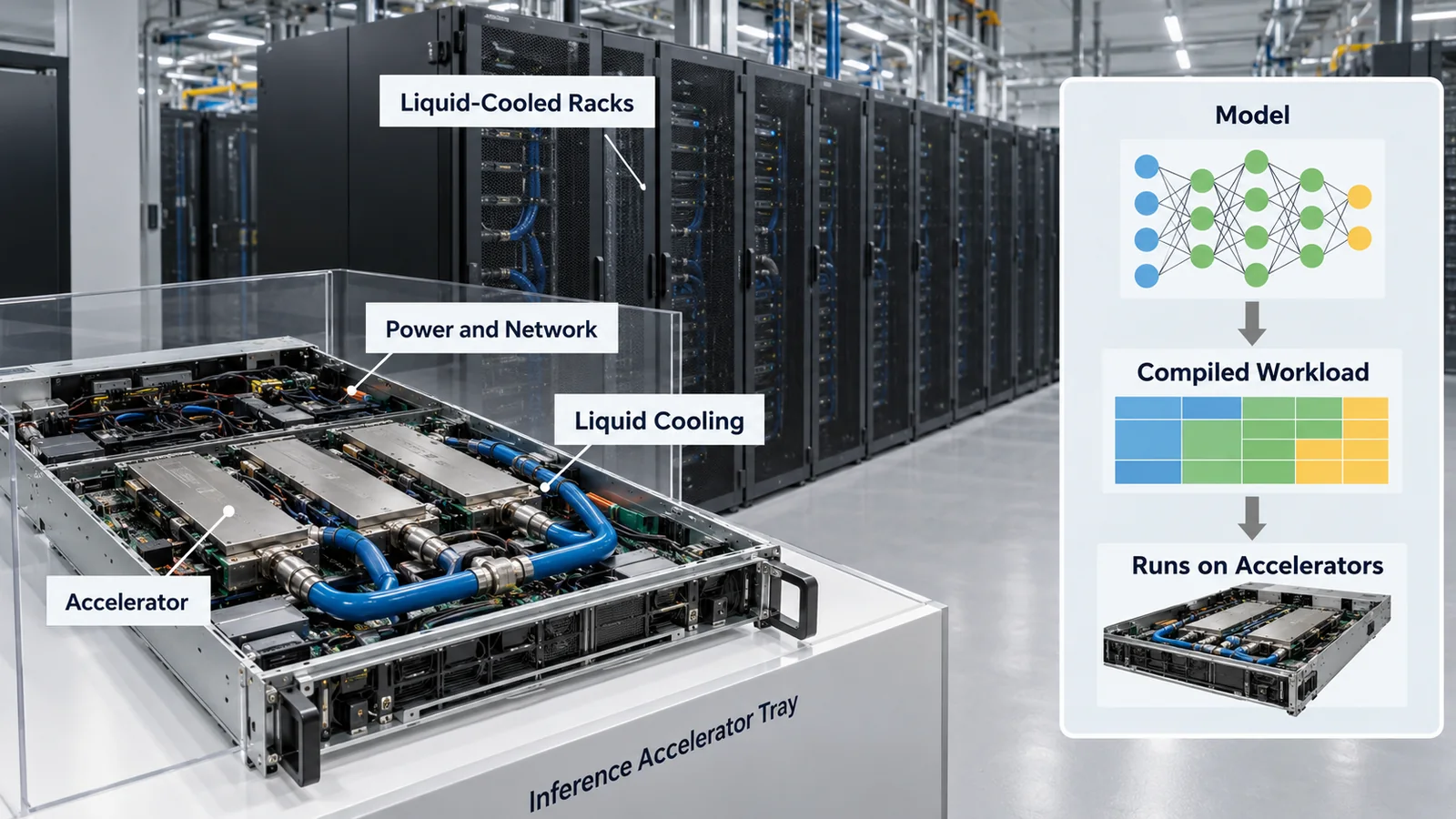
Meta says it designed MTIA "inference-first", raising compute, memory bandwidth and efficiency with each generation Sourced. The new chips have a modular structure that drops straight into existing rack systems, and the company says it can ship a new generation in six months or less. Whether a generation can be swapped in without changing the rack's power and cooling envelope governs how fast it can be deployed.
For GPUs, it uses the Helios rack-scale design that it developed with AMD through the Open Compute Project, with shipments starting in the second half of 2026 Sourced. Data-centre scale is described in gigawatts, which presumes securing power. See also our explainers on AI accelerators, HBM, power and cooling for AI data centers, and data centers and energy storage.
11. The risks this company carries
| Risk | Substance | Category |
|---|---|---|
| AI revenue cannot be seen | AI costs (R&D up 67% year on year in April to June) are rising steeply with no matching revenue disclosed. The 10-K says that if AI investments are not successful, performance could be harmed | Sourced |
| Size of capex and commitments | The 2026 outlook is US$130 to 145 billion. Non-cancellable commitments are US$349.3 billion and leases not yet commenced are US$279.0 billion. It also provides a residual value guarantee in Louisiana (threshold about US$28 billion) | Sourced |
| Headcount reduction | About 8,000 jobs cut in May 2026, a reorganisation as it shifts weight to AI, with US$1.18 billion of severance | Sourced |
| Copyright suits over AI training | Several suits allege that books and other material were improperly acquired and used to train AI (Kadrey and others). On 25 June 2025 the court granted summary judgment on fair use as to the named plaintiffs, but remaining claims continue, with a hearing scheduled for 25 February 2027. No outcome is predicted here | Sourced |
| EU interim measure | In June 2026 the European Commission imposed an interim measure requiring the WhatsApp Business API to be offered free to general-purpose AI providers. Meta intends to appeal | Sourced |
| Uncertain model path | Whether a new Llama will come, or Muse will be opened, is not settled within the company's statements | Inference |
| AI regulation and safety | The 10-Q lists the EU AI Act, U.S. state AI laws, and FTC and state attorney-general inquiries into AI chatbots as business risks | Sourced |
12. Glossary
- Meta Superintelligence Labs (MSL)
- The AI organisation that builds Meta's most advanced models, including the Muse series.
- Open weights
- A form in which the model's weights (the training result) are distributed so users can run it themselves. Distinct from publishing source code or training data.
- MTIA
- Meta Training and Inference Accelerator, the AI chip Meta designs.
- Mixture of experts (MoE)
- A structure that runs only a subset of specialised parts for each input, reducing computation.
- Capital expenditure (capex)
- Spending on servers, network equipment, data centres and the like.
- Residual value guarantee
- A promise to make up the shortfall if a leased asset's value at the end of the lease is below a set amount.
- Gigawatt (GW)
- A unit for the scale of a data centre or its power. In AI it is a rough gauge of how many chips can be run.
- Helios
- The rack-scale design that AMD and Meta developed through the Open Compute Project.
13. References
- Meta Platforms, Inc. Form 10-K for the fiscal year ended December 31, 2025 (filed with the SEC on 29 January 2026). Revenue, R&D, capital expenditure, headcount, the 2026 capex outlook, the Scale AI investment, and the statement that it expects to train a combination of open and closed models. https://www.sec.gov/Archives/edgar/data/1326801/000162828026003942/meta-20251231.htm
- Meta Platforms, Inc. Form 10-Q for the quarterly period ended June 30, 2026 (filed with the SEC on 30 July 2026). Quarterly revenue and R&D, capital expenditure, contractual commitments, the Louisiana and El Paso co-developments, the headcount reduction, copyright suits over AI training, and the EU interim measure. https://www.sec.gov/Archives/edgar/data/1326801/000162828026050705/meta-20260630.htm
- Meta Platforms, Inc. Exhibit 99.1 (earnings release) to Form 8-K of 29 July 2026. Capital expenditure for April to June 2026 and the 2026 capex outlook (US$130 to 145 billion). https://www.sec.gov/Archives/edgar/data/1326801/000162828026050596/meta-06302026xexhibit991.htm
- Meta Introducing Muse Spark: Meta's Most Powerful Model Yet (8 April 2026). The first model from Meta Superintelligence Labs, the private API preview, and the hope to open-source future versions. https://about.fb.com/news/2026/04/introducing-muse-spark-meta-superintelligence-labs/
- Meta Introducing Muse Spark 1.1 (9 July 2026). The public preview of the Meta Model API and a 1-million-token context window. https://ai.meta.com/blog/introducing-muse-spark-meta-model-api/
- Meta The Llama 4 herd (5 April 2025). The release of Llama 4 Scout and Maverick (open weights) and their specifications (developer's stated values). https://ai.meta.com/blog/llama-4-multimodal-intelligence/
- Meta Llama 4 Community License Agreement. The licence terms, including the permission needed above 700 million monthly active users and the "Built with Llama" notice. https://www.llama.com/llama4/license/
- Meta Expanding Meta's Custom Silicon to Power Our AI Workloads (11 March 2026). The plan for four MTIA generations and the deployment of hundreds of thousands of MTIA chips for inference. https://about.fb.com/news/2026/03/expanding-metas-custom-silicon-to-power-our-ai-workloads/
- Meta Meta Partners With Broadcom to Co-Develop Custom AI Silicon (14 April 2026). Co-development of several MTIA generations, with a first commitment exceeding 1 GW. https://about.fb.com/news/2026/04/meta-partners-with-broadcom-to-co-develop-custom-ai-silicon/
- Meta Meta and AMD Partner for Longterm AI Infrastructure Agreement (24 February 2026). Up to 6 GW of AMD Instinct GPUs, with first shipments in the second half of 2026. https://about.fb.com/news/2026/02/meta-amd-partner-longterm-ai-infrastructure-agreement/
- NVIDIA Meta Builds AI Infrastructure With NVIDIA (17 February 2026). Millions of Blackwell and Rubin GPUs, Grace CPUs and Spectrum-X switches. https://nvidianews.nvidia.com/news/meta-builds-ai-infrastructure-with-nvidia
- Meta Deepening our investment in Richland Parish, Louisiana (13 July 2026). Expansion of the data centre to 5 GW, and Hyperion. https://datacenters.atmeta.com/2026/07/deepening-our-investment-in-richland-parish-louisiana/
- Meta Meta Announces Nuclear Energy Projects (9 January 2026). Nuclear agreements with Vistra, TerraPower and Oklo. https://about.fb.com/news/2026/01/meta-nuclear-energy-projects-power-american-ai-leadership/
- Meta What Is Compute Power? Meta's AI Infrastructure Explained (June 2026). Chips from several suppliers and the co-developed Arm CPU. https://about.fb.com/news/2026/06/what-is-compute-power-meta-ai-infrastructure/
14. Claim-to-source audit
| Claim in the text | Category | Source |
|---|---|---|
| 2025 revenue, operating income, R&D, capex, headcount and the 2026 capex outlook (at the time) | Sourced | Reference 1 https://www.sec.gov/Archives/edgar/data/1326801/000162828026003942/meta-20251231.htm |
| The US$13.80 billion minority investment in Scale AI and the statement on using open and closed models | Sourced | Reference 1 https://www.sec.gov/Archives/edgar/data/1326801/000162828026003942/meta-20251231.htm |
| April to June and first-half 2026 revenue, R&D, capex, contractual commitments, net bond proceeds and the headcount reduction | Sourced | Reference 2 https://www.sec.gov/Archives/edgar/data/1326801/000162828026050705/meta-20260630.htm |
| The Louisiana co-development (20%, leases of about US$12.31 billion, residual value guarantee) and the El Paso exclusivity | Sourced | Reference 2 https://www.sec.gov/Archives/edgar/data/1326801/000162828026050705/meta-20260630.htm |
| Copyright suits over AI training (Kadrey and others) and the European Commission's interim measure | Sourced | Reference 2 https://www.sec.gov/Archives/edgar/data/1326801/000162828026050705/meta-20260630.htm |
| The 2026 capex outlook of US$130 to 145 billion and April to June capex of US$31.08 billion | Sourced | Reference 3 https://www.sec.gov/Archives/edgar/data/1326801/000162828026050596/meta-06302026xexhibit991.htm |
| The announcement of Muse Spark (Meta Superintelligence Labs) and the hope to open-source future versions | Sourced | Reference 4 https://about.fb.com/news/2026/04/introducing-muse-spark-meta-superintelligence-labs/ |
| Muse Spark 1.1, the Meta Model API public preview and the 1-million-token context | Sourced | Reference 5 https://ai.meta.com/blog/introducing-muse-spark-meta-model-api/ |
| The release and specifications of Llama 4 Scout and Maverick (developer's stated values) | Sourced | Reference 6 https://ai.meta.com/blog/llama-4-multimodal-intelligence/ |
| Llama 4 Community License terms (permission above 700 million users, Built with Llama) | Sourced | Reference 7 https://www.llama.com/llama4/license/ |
| The four-generation MTIA plan and hundreds of thousands deployed for inference | Sourced | Reference 8 https://about.fb.com/news/2026/03/expanding-metas-custom-silicon-to-power-our-ai-workloads/ |
| Co-development of several MTIA generations with Broadcom (first commitment over 1 GW) | Sourced | Reference 9 https://about.fb.com/news/2026/04/meta-partners-with-broadcom-to-co-develop-custom-ai-silicon/ |
| The agreement with AMD for up to 6 GW and first shipments in the second half of 2026 | Sourced | Reference 10 https://about.fb.com/news/2026/02/meta-amd-partner-longterm-ai-infrastructure-agreement/ |
| The NVIDIA agreement for millions of Blackwell and Rubin GPUs and more | Sourced | Reference 11 https://nvidianews.nvidia.com/news/meta-builds-ai-infrastructure-with-nvidia |
| Louisiana expanded to 5 GW with more than US$50 billion invested in the region | Sourced | Reference 12 https://datacenters.atmeta.com/2026/07/deepening-our-investment-in-richland-parish-louisiana/ |
| The nuclear agreements (Vistra, TerraPower, Oklo) | Sourced | Reference 13 https://about.fb.com/news/2026/01/meta-nuclear-energy-projects-power-american-ai-leadership/ |
| Chips from several suppliers and the co-developed Arm CPU | Sourced | Reference 14 https://about.fb.com/news/2026/06/what-is-compute-power-meta-ai-infrastructure/ |
| AI-dedicated headcount, stand-alone AI revenue and the Scale AI stake percentage | Not yet confirmed | Not stated in the official material checked, so this article says "could not be confirmed". Third-party estimates are not used |
| The reading that it ties AI investment to strengthening its own advertising and apps | Inference | This article's interpretation, drawn from the 10-K wording |
| The reading that it uses its most advanced models in house first and opens them outward as needed | Inference | This article's interpretation, drawn from the 10-K and the Muse announcements |
| The reading that it secures power and land early through long-term contracts | Inference | This article's interpretation, drawn from the nuclear, data-centre and lease statements |
| The risk that the model path is unsettled | Inference | This article's interpretation, based on its observation that the company's statements can read both ways |
| Classification of the company (model developer primary, own chips and data centres secondary) | Our calculation | This article's own classification |
Last updated: 15 October 2026 / Troy Technical
The figures in this article come from Forms 10-K, 10-Q and 8-K that Meta Platforms, Inc. filed with the U.S. Securities and Exchange Commission and from official announcements by Meta and NVIDIA. No research-firm estimates or press-only figures have been used. Passages marked "Inference" are this article's interpretation of official material, not statements made by the company. No outcome of any lawsuit is predicted.