COMPANY PROFILE / AI & MACHINE LEARNING
OpenAI
A model developer controlled through a nonprofit foundation, now spanning models, products and its own inference chip
OpenAI is a model developer best known for the GPT series, ChatGPT and Codex. Since September 2026 it has released the GPT-6 family (Astra, Sol and Luna) one after another, and on 7 October it brought GPT-6 to ChatGPT at large. The shape of the company itself is also moving: a compute supply that mixes several clouds and several chips, Jalapeño (an inference chip developed with Broadcom), and the confidential submission of a draft S-1 announced in June 2026. This profile sets all of this out only as far as OpenAI's own announcements and court records confirm it. The company is private, so no audited financial statements are public.
- OpenAI in 30 seconds, and where it stands in AI and machine learning
- The logo and how the name is written
- Where the company sits in the AI field
- Scale
- Resources committed to AI and machine learning
- What it has done so far
- What comes next
- What the company is aiming for in AI
- Map of AI partnerships
- Technologies, products and services
- The risks this company carries
- Glossary, references and claim-to-source audit
1. OpenAI in 30 seconds, and where it stands in AI and machine learning
(the for-profit company)Parent: the nonprofit OpenAI Foundation
Astra, Sol, LunaReleased September to October 2026 (company announcements)
committed31 March 2026; post-money valuation US$852 billion
weekly usersAnnounced 7 October 2026
It would be a mistake to see OpenAI only as an "AI model company". Laid side by side, the company's 2026 announcements show a model builder that has spread both downstream (ChatGPT, Codex) and upstream (cloud procurement and its own chips) Sourced. OpenAI calls this a "full stack": own the parts where tight integration pays, and partner or buy elsewhere. Note, however, that the company is private, so revenue and costs can be checked only through its own statements. Every amount in this article is a figure the company stated officially, not an audited number.
2. The logo and how the name is written

A note on names: "OpenAI" is used for both the nonprofit OpenAI Foundation and the for-profit public benefit corporation OpenAI Group PBC. Before the recapitalization of 28 October 2025, the structure was a nonprofit, named OpenAI, Inc., that owned a for-profit subsidiary. This article uses OpenAI Group for the side that runs the business (models and products) and OpenAI Foundation for the nonprofit parent. The logo shown is the Blossom mark distributed on the company's brand guidelines page.
Official site: https://openai.com/brand/3. Where the company sits in the AI field
4. Scale
This section covers the size of the company as a whole. Every figure is something OpenAI itself stated officially; no third-party estimates are used.
| Item | What it is | Notes and category |
|---|---|---|
| Organisation | The nonprofit OpenAI Foundation controls OpenAI Group PBC | At completion of the recapitalization, the Foundation held 26% of OpenAI Group, Microsoft about 27% and the remaining 47% sat with current and former employees and investors, per the company website (28 October 2025) Sourced |
| Valuation | US$852 billion post-money | Company announcement of the funding round of 31 March 2026 Sourced |
| Funding | US$122 billion committed | Led by Amazon, NVIDIA and SoftBank; more than US$3 billion from individual investors Sourced |
| Revenue | About US$2 billion a month (company statement) | A statement in the 31 March 2026 announcement. Audited financial statements are not public Sourced |
| Users | ChatGPT: 900 million+ weekly, then 1.2 billion+ | Company statements of 31 March 2026 (900 million+) and 7 October 2026 (1.2 billion+) Sourced |
| Employees | Could not be confirmed | Not stated in the official material checked Not yet confirmed |
The revenue and valuation figures are numbers written in company blog posts. Because the company is private, they cannot be cross-checked against SEC filings. In June 2026 it announced that it had confidentially submitted a draft S-1 registration statement, but a confidential draft is not made public. No public S-1 turned up within the scope of this check Not yet confirmed.
5. Resources committed to AI and machine learning
The table below shows, for people, money, outside stakes and ties to universities or public bodies, whether OpenAI's official material confirms them.
| Type of resource | What it is | Notes and category |
|---|---|---|
| People | Headcount of researchers and staff, research sites | Not stated in the official material checked. The Foundation board and senior officers are listed on the company website Not confirmed |
| Money: R&D and capex | Accounting R&D expense and capital expenditure | Not disclosed. Contract values are separate (next row) Not disclosed |
| Money: compute contracts with others | AWS: the existing US$38 billion agreement extended by US$100 billion over eight years (February 2026). Azure: an additional US$250 billion purchase (October 2025) | Company announcements. These are contract values, not amounts already spent Sourced (contract value) |
| Outside investment | Amazon: US$50 billion (US$15 billion first, a further US$35 billion if conditions are met). The US$122 billion round was led by Amazon, NVIDIA and SoftBank | Investment into OpenAI. Amazon's second tranche is conditional Sourced |
| Acquisitions | Announced acquisitions of Promptfoo (9 March 2026), Astral (19 March), TBPN (2 April) and Ona (11 June) | Headlines of official news posts. Terms and amounts were not checked for this article Sourced |
| Universities, research bodies and public funding | ChatGPT for Academic Researchers: free access for up to 100,000 researchers (more than US$250 million committed through 2027), NextGenAI (about US$50 million), and a link to the U.S. Department of Energy's Genesis Mission | Company programmes. No government funding was confirmed Sourced |
| The nonprofit Foundation's funds | An initial US$25 billion commitment; at least US$1 billion expected to be spent over the next year (March 2026) | The Foundation's plan, not an amount already spent Not yet confirmed |
Status of principal products, models and facilities
Prices are the standard rates on the official pages as checked on 15 October 2026. Prices change often, so check the current official page before relying on them.
| Product, model or facility | Scale or specification (company's figures) | Stage | Date | Source |
|---|---|---|---|---|
| GPT-6 Astra | API price: US$10 input / US$50 output per million tokens | Released (to some organisations first, then widely) | Posted 3 September 2026, updated 22 September | Reference 10 |
| GPT-6.1 Sol | API price: US$2 input / US$10 output; cached input US$0.10 | Released | 29 September 2026 | Reference 11 |
| GPT-6 Luna | API price: US$0.10 input / US$0.50 output | Released | 22 September 2026 (added) | Reference 11 |
| Jalapeño (inference chip) | First chip OpenAI designed itself. Nine months from design to tape-out; engineering samples running in the lab | Plan (initial deployment envisaged by the end of 2026) | 24 June 2026; measurements on 25 August | References 7 and 8 |
| Use of Trainium | A commitment to use about 2 gigawatts of capacity through AWS. Trainium4 expected in 2027 | Contract (timing of operation not confirmed) | 27 February 2026 | Reference 6 |
| Individual data centres such as Stargate | The official material checked gives no per-site size or stage. Third-party estimates are not used | Could not be confirmed | - | - |
6. What it has done so far
| When | What happened | Why it matters |
|---|---|---|
| 2015 and 2019 | Founded as a nonprofit; a for-profit subsidiary was created in 2019 (company website) | The company says the for-profit side has always been governed by the nonprofit |
| 28 October 2025 | The recapitalization was completed: the nonprofit became the OpenAI Foundation and the for-profit became OpenAI Group PBC. A new definitive agreement with Microsoft | The company states it followed discussions with the California and Delaware Attorneys General |
| 27 February 2026 | Announced a partnership in which Amazon invests US$50 billion; extended the AWS agreement and committed to about 2 GW of Trainium | More weight on clouds other than Microsoft |
| 31 March 2026 | Announced US$122 billion of committed funding at a post-money valuation of US$852 billion | Led by Amazon, NVIDIA and SoftBank |
| 27 April 2026 | Amended the Microsoft agreement: a non-exclusive licence, and products may be offered through any cloud | Revenue-share payments continue to 2030, subject to a cap |
| 18 to 20 May 2026 | In Musk's lawsuit, an advisory jury found the trial claims barred by the statute of limitations; the court adopted that verdict by an order of 20 May | From the court record. Other claims and counterclaims remain (Chapter 11) |
| 8 June 2026 | Announced the confidential submission of a draft S-1; timing of any listing undecided | Described as keeping the option of listing open |
| 24 June 2026 | Announced the Jalapeño inference chip with Broadcom | First chip OpenAI designed itself |
| 3 to 29 September 2026 | Released GPT-6 Astra (3 September), Sol and Luna (22 September) and GPT-6.1 Sol (29 September) | A model generation turned over in about a month |
| 7 October 2026 | Brought GPT-6 to ChatGPT Chat (Sol for Plus and above, Luna for Free and Go) | Reaches more than 1.2 billion weekly users |
7. What comes next
All four items above are company plans or expectations, not things that have happened Not yet confirmed. The same applies to the items below.
| Plan | What the company states | Category |
|---|---|---|
| Enterprise share of revenue | Expected to match consumer by the end of 2026 (statement of 31 March 2026) | Not yet confirmed |
| Foundation spending | At least US$1 billion over the next year (life sciences, economic opportunity, safety, community programmes) | Not yet confirmed |
| ChatGPT for Academic Researchers | To expand to 100,000 researchers by 2027 | Not yet confirmed |
| Amazon's further US$35 billion | If certain conditions are met | Not yet confirmed |
| GPT-6.1 Sol Ultrafast | Said on 29 September 2026 to be coming "in the next few days"; its release was not checked for this article | Not yet confirmed |
8. What the company is aiming for in AI
This section goes beyond what the company says directly. It sets out inferences that official material supports, each with its basis.
| What can be read | Primary evidence behind it | Category |
|---|---|---|
| It is moving from being a model company to managing the whole system, including compute and products | The August 2026 official post treats data centres, chips, models, products and devices as one integrated system in which each layer strengthens the next | Inference |
| It is making performance per dollar of inference its main battleground | Price cuts (Luna down 80%, Terra down 20%), Jalapeño being an inference-only chip, and the stated 20% cut in serving cost appear together | Inference |
| Its weight is shifting to agents (Codex, dots) and enterprise | The company says agentic work through Codex is 99.8% of weekly output tokens, and enterprise is over 40% of revenue (March 2026) | Sourced |
| It wants several sources of compute and less dependence on Microsoft | The April 2026 amendment lets it offer products through any cloud; it lists Microsoft, Oracle, AWS, CoreWeave and Google Cloud | Sourced |
| It is keeping access to capital markets as an option | The confidential S-1 submission and the statement that timing is undecided, alongside very large commitments and continued fundraising | Inference |
In its posts of 31 July and 25 August 2026 (written by Sarah Friar) the company says the right measure is cost per successful outcome, and sets out a cycle in which lower prices widen the uses. Around the same time Luna's price was cut by 80% and measurements of the inference-only chip were published Sourced. From this sequence this article reads lowering the unit cost of inference as a management theme alongside the contest on model capability Inference. That reading rests on public posts, not on internal company material.
9. Map of AI partnerships
10. Technologies, products and services
These are the main products and services on offer.
| Product or service | What it is (as stated in official announcements, checked 15 October 2026) | Source |
|---|---|---|
| ChatGPT | Consumer and business conversation and work product. GPT-6 brought to it on 7 October 2026: GPT-6 Sol for Plus and above, GPT-6 Luna for Free and Go | Reference 12 |
| Codex | A coding-centred agent. Cloud, CLI, code review and Codex Security Cloud were announced at DevDay 2026 | Reference 13 |
| API (gpt-6-astra, gpt-6.1-sol and others) | For developers. The Agents API offers the Codex harness as a managed service. Also available on Azure and Amazon Bedrock | References 10 and 13 |
| dots | Always-on agents, powered by GPT-6 Astra. Available on Pro, Business Premium and Enterprise | Reference 13 |
| Private Intelligence | A combination of zero data retention with Private Safety Processing, and Private Inference (preview) | Reference 13 |
How to read the company's own evaluations
The GPT-6 Astra page carries tables comparing its own models with other vendors'. OpenAI ran these itself in its own environment, and other vendors' values are quoted from public reports. Settings (reasoning effort, harness, version) differ by evaluation, so this article does not rank anyone against anyone. A few of OpenAI's own figures follow, with their conditions (checked 15 October 2026) Sourced.
| Evaluation | GPT-6 Astra value (OpenAI's figure) | Conditions |
|---|---|---|
| FrontierMath Tier 4 (v2) | 97.6% | Run in OpenAI's research environment or via its API. Best value across reasoning settings |
| DeepSWE v1.1 | 74.1% | As above. The page also tabulates other vendors' models, but settings differ, so this article does not set them side by side |
| OSWorld 2.0 (v2026.08.08, offline set, partial score) | 72.6% | As above. Note: OpenAI quotes other vendors' values from public reports or the official leaderboard |
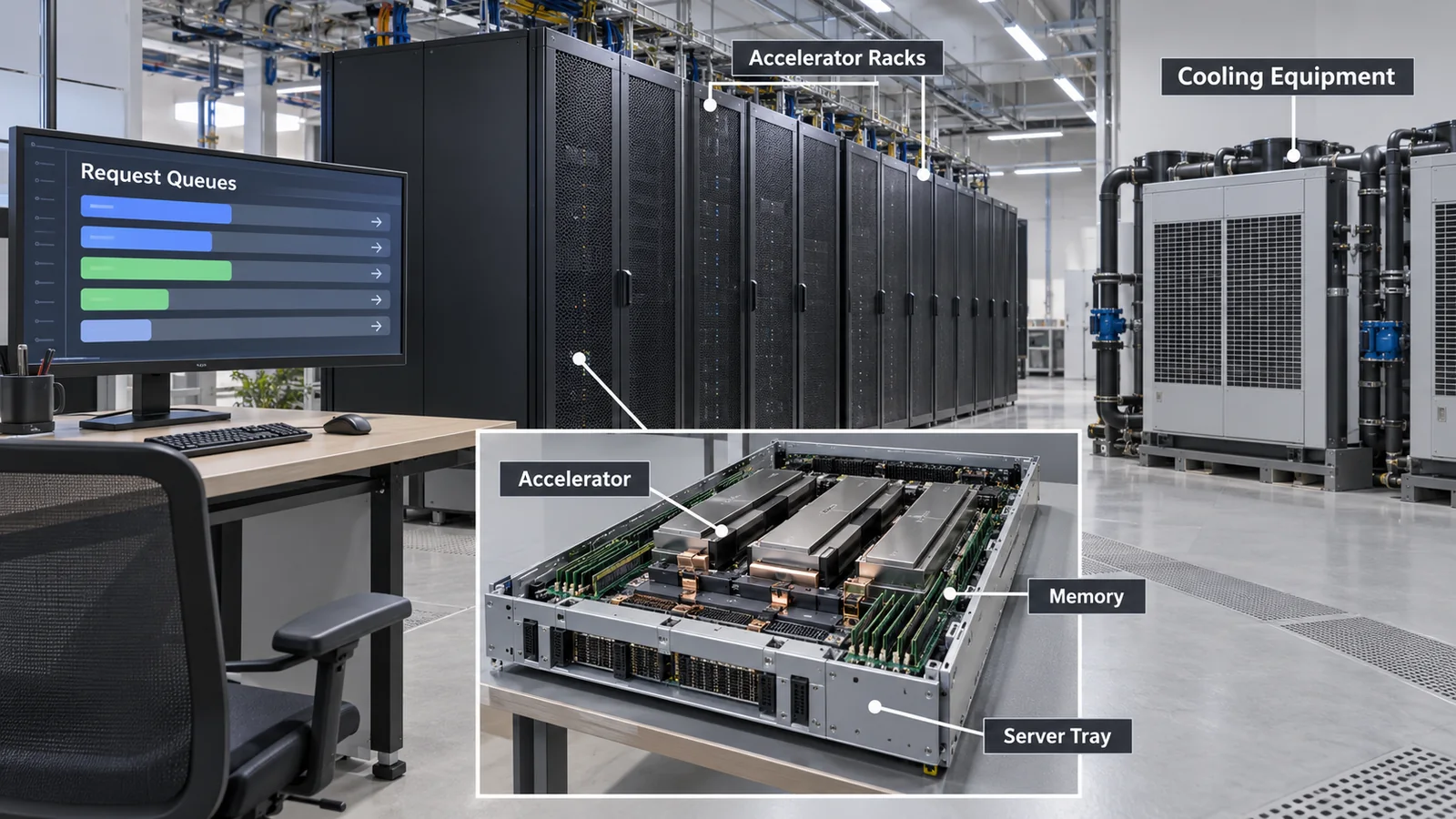
The company says Jalapeño was designed to reduce data movement and balance compute, memory and networking so that real utilisation gets much closer to theoretical peak performance Sourced. In LLM inference, the limit is often how fast data can be read from memory and how fast chips can talk to each other rather than raw arithmetic, which is why chip, board, rack and network switch (Tomahawk) are designed together.
On the software side the company says it cut end-to-end serving cost by 20% and raised token-generation efficiency by more than 15% through better speculative decoding Sourced. Hardware performance per watt and software savings in wasted computation both come down to one measure, tokens per watt. See also our explainers on AI accelerators, inference optimization and serving, and power and cooling for AI data centers.
11. The risks this company carries
| Risk | Substance | Category |
|---|---|---|
| Finances cannot be verified externally | Revenue, valuation and contract values come only from company announcements. Audited statements are not public and no S-1 has been published | Not yet confirmed |
| Whether and when it lists | The S-1 was submitted confidentially. The company says timing is undecided and that staying private is also an option | Not yet confirmed |
| Very large compute commitments | AWS US$100 billion over eight years, an additional US$250 billion of Azure purchases and more. Whether demand and utilisation match them cannot be confirmed from this material | Inference |
| A changing relationship with Microsoft | From exclusive to non-exclusive. Revenue-share payments continue to 2030 subject to a cap | Sourced |
| Litigation: Musk | In May 2026 an advisory jury verdict and an order adopting it (Dkt. 580). But the order of 1 July 2026 appointed a mediator and put claims that have not reached final judgment within the scope of mediation. No outcome is predicted here | Sourced |
| Litigation: copyright | The New York Times Company v. Microsoft Corporation and related cases (S.D.N.Y. 1:23-cv-11195, consolidated with others) are pending, with filings as recently as October 2026. No outcome is predicted here | Sourced |
| Safety | The company states that GPT-6 Astra's cyber capability meets the Critical threshold in its Preparedness Framework, and that extra safety checks may pause legitimate work | Sourced |
| Fast model turnover | From GPT-6 Astra to GPT-6.1 Sol within about a month in September 2026. Prices and availability change quickly | Sourced |
12. Glossary
- Public benefit corporation (PBC)
- A company form that runs a for-profit business but is required by its charter to pursue public benefit too. OpenAI Group PBC is a U.S. PBC.
- OpenAI Foundation
- OpenAI's nonprofit. It controls OpenAI Group PBC and houses the Safety and Security Committee.
- GPT-6 Astra / Sol / Luna
- The three GPT-6 models: Astra the top tier, Sol the middle, Luna light and low-priced (OpenAI's naming).
- Post-money valuation
- The company's valuation after the new money from a funding round is counted in.
- Inference chip
- A semiconductor specialised for running a trained model, that is, generating responses. Jalapeño is for this use.
- Tape-out
- Completing a chip design and handing it to manufacturing.
- Trainium
- An AI chip designed by AWS.
- S-1
- The registration statement filed with the SEC to list shares in the U.S. A draft can be submitted confidentially.
- Preparedness Framework
- The framework OpenAI publishes for assessing capability in severe-risk areas such as cyber and biology.
13. References
- OpenAI Our structure. The relationship between the OpenAI Foundation and OpenAI Group PBC, the board, and ownership at completion of the recapitalization (Foundation 26%, Microsoft about 27%, others 47%). Checked on 15 October 2026. https://openai.com/our-structure/
- OpenAI (Bret Taylor) Built to benefit everyone (28 October 2025). Completion of the recapitalization, the renaming to OpenAI Foundation, the move to OpenAI Group PBC, and the Foundation's equity then valued at about US$130 billion. https://openai.com/index/built-to-benefit-everyone/
- OpenAI The next chapter of the Microsoft-OpenAI partnership (28 October 2025). Microsoft's stake of about 27%, the term of its IP licence, and the additional US$250 billion Azure purchase commitment. https://openai.com/index/next-chapter-of-microsoft-openai-partnership/
- OpenAI The next phase of the Microsoft-OpenAI partnership (27 April 2026). The amended agreement: a non-exclusive licence, availability through any cloud provider, and the cap and 2030 end of revenue-share payments. https://openai.com/index/next-phase-of-microsoft-partnership/
- OpenAI Accelerating the next phase of AI (31 March 2026). US$122 billion of committed funding, a post-money valuation of US$852 billion, the statement of US$2 billion in monthly revenue, and the list of infrastructure partners. https://openai.com/index/accelerating-the-next-phase-ai/
- OpenAI OpenAI and Amazon announce strategic partnership (27 February 2026). Amazon's US$50 billion investment, the US$100 billion extension of the AWS agreement over eight years, and about 2 GW of Trainium capacity. https://openai.com/index/amazon-partnership/
- OpenAI / Broadcom OpenAI and Broadcom introduce Jalapeño (24 June 2026). OpenAI's first self-designed inference chip, taped out in nine months, with initial deployment envisaged by the end of 2026. https://openai.com/index/openai-broadcom-jalapeno-inference-chip/
- OpenAI (Sarah Friar) The full stack behind abundant intelligence (25 August 2026). Jalapeño measurement results and the infrastructure portfolio of cloud, chip and data-centre partners. https://openai.com/index/the-full-stack-behind-abundant-intelligence/
- OpenAI (Sarah Friar) Building abundant intelligence (31 July 2026). Price changes, reductions in serving cost and user numbers. https://openai.com/index/building-abundant-intelligence/
- OpenAI GPT-6 Astra (published 3 September 2026, updated 22 September). OpenAI's own evaluations, API pricing, and the cyber capability and its place in the Preparedness Framework. https://openai.com/index/gpt-6-astra/
- OpenAI Introducing GPT-6.1 Sol (29 September 2026). API prices for Sol, Luna and Astra, availability, and OpenAI's own evaluations. https://openai.com/index/introducing-gpt-6-1-sol/
- OpenAI GPT-6 and Intelligent UI for everyone (7 October 2026). The rollout of GPT-6 in ChatGPT and more than 1.2 billion weekly users. https://openai.com/index/gpt-6-for-everyone/
- OpenAI DevDay 2026 recap (29 September 2026). dots, Codex, the Agents API, Amazon Bedrock Managed Agents and Private Intelligence. https://openai.com/index/devday-2026-recap/
- OpenAI (Bret Taylor) Update on the OpenAI Foundation (24 March 2026). The Foundation's focus areas and the expectation of at least US$1 billion in spending over the next year. https://openai.com/index/update-on-the-openai-foundation/
- OpenAI OpenAI confidentially submits draft S-1 (8 June 2026). The confidential submission of a draft registration statement and the statement that timing is undecided. https://openai.com/index/openai-submits-confidential-s-1/
- OpenAI (Sam Altman, Jakub Pachocki) Built to benefit everyone: our plan (8 June 2026). The company's three goals and its stated expectation for March 2028. https://openai.com/index/built-to-benefit-everyone-our-plan/
- OpenAI ChatGPT for Academic Researchers (29 July 2026). Free access for up to 100,000 researchers, more than US$250 million committed through 2027, NextGenAI, and the link to the U.S. Department of Energy's Genesis Mission. https://openai.com/index/chatgpt-for-academic-researchers/
- U.S. District Court, Northern District of California Docket of Musk v. Altman, Case No. 4:24-cv-04722-YGR (via CourtListener), including Dkt. 580 (20 May 2026) and Dkt. 606 (1 July 2026). https://www.courtlistener.com/docket/69013420/musk-v-altman/
- U.S. District Court, Southern District of New York Docket of The New York Times Company v. Microsoft Corporation, Case No. 1:23-cv-11195 (via CourtListener). https://www.courtlistener.com/docket/68117049/the-new-york-times-company-v-microsoft-corporation/
14. Claim-to-source audit
| Claim in the text | Category | Source |
|---|---|---|
| The OpenAI Foundation controls OpenAI Group PBC, which is a public benefit corporation | Sourced | Reference 1 https://openai.com/our-structure/ Reference 2 https://openai.com/index/built-to-benefit-everyone/ |
| Ownership at completion of the recapitalization (Foundation 26%, Microsoft about 27%, others 47%) | Sourced | Reference 1 https://openai.com/our-structure/ |
| US$122 billion of commitments, US$852 billion post-money valuation, and the statement of about US$2 billion in monthly revenue | Sourced | Reference 5 https://openai.com/index/accelerating-the-next-phase-ai/ |
| Amazon's US$50 billion investment, the US$100 billion AWS extension and about 2 GW of Trainium | Sourced | Reference 6 https://openai.com/index/amazon-partnership/ |
| The US$250 billion Azure purchase and Microsoft's stake of about 27% (October 2025) | Sourced | Reference 3 https://openai.com/index/next-chapter-of-microsoft-openai-partnership/ |
| The April 2026 amended Microsoft agreement (non-exclusive, any cloud, revenue share capped and running to 2030) | Sourced | Reference 4 https://openai.com/index/next-phase-of-microsoft-partnership/ |
| The Jalapeño announcement, nine-month tape-out and initial deployment envisaged by the end of 2026 | Sourced | Reference 7 https://openai.com/index/openai-broadcom-jalapeno-inference-chip/ |
| Jalapeño measurement results and the multi-cloud, multi-chip portfolio | Sourced | Reference 8 https://openai.com/index/the-full-stack-behind-abundant-intelligence/ |
| Price changes, the 20% cut in serving cost, user numbers and the 99.8% share of output tokens via Codex | Sourced | Reference 9 https://openai.com/index/building-abundant-intelligence/ |
| GPT-6 Astra availability, API pricing and the Critical-threshold statement on cyber capability | Sourced | Reference 10 https://openai.com/index/gpt-6-astra/ |
| Pricing and availability of GPT-6.1 Sol and GPT-6 Luna | Sourced | Reference 11 https://openai.com/index/introducing-gpt-6-1-sol/ |
| The rollout of GPT-6 in ChatGPT and more than 1.2 billion weekly users | Sourced | Reference 12 https://openai.com/index/gpt-6-for-everyone/ |
| dots, Codex, the Agents API, Bedrock Managed Agents and other products | Sourced | Reference 13 https://openai.com/index/devday-2026-recap/ |
| The Foundation's focus areas and the expectation of at least US$1 billion in spending over the next year | Sourced | Reference 14 https://openai.com/index/update-on-the-openai-foundation/ |
| The confidential draft S-1 and the statement that timing is undecided | Sourced | Reference 15 https://openai.com/index/openai-submits-confidential-s-1/ |
| The expectation for automating research by March 2028 | Sourced | Reference 16 https://openai.com/index/built-to-benefit-everyone-our-plan/ |
| ChatGPT for Academic Researchers, more than US$250 million, NextGenAI and Genesis Mission | Sourced | Reference 17 https://openai.com/index/chatgpt-for-academic-researchers/ |
| Musk v. Altman: an advisory jury found the claims time-barred and the court adopted that (Dkt. 580) | Sourced | Reference 18 https://www.courtlistener.com/docket/69013420/musk-v-altman/ |
| Musk v. Altman: the appointment of a mediator, with claims not yet at final judgment within the scope of mediation (Dkt. 606) | Sourced | Reference 18 https://www.courtlistener.com/docket/69013420/musk-v-altman/ |
| The New York Times Company v. Microsoft Corporation (S.D.N.Y.) is pending | Sourced | Reference 19 https://www.courtlistener.com/docket/68117049/the-new-york-times-company-v-microsoft-corporation/ |
| Headcount, R&D expense and per-site data-centre size | Not yet confirmed | Not stated in the official material checked, so this article says "could not be confirmed". Third-party estimates are not used |
| The reading that it is moving from a model company to one managing the whole system | Inference | This article's interpretation, drawn from the August 2026 official posts and similar material |
| The reading that lowering the unit cost of inference is a management theme | Inference | This article's interpretation, drawn from the sequence of price cuts and chip announcements |
| The reading that it keeps access to capital markets as an option | Inference | This article's interpretation, drawn from the statement on the confidential S-1 |
| The risk of whether demand matches the size of the compute commitments | Inference | This article's interpretation, based on its observation of the contract values |
| Classification of the company (model developer primary, platform secondary) | Our calculation | This article's own classification |
Last updated: 15 October 2026 / Troy Technical
The figures in this article come from announcements on OpenAI's own website and from U.S. federal court records. No research-firm estimates or press-only figures have been used. Because the company is private, revenue, valuation and contract values are "figures the company stated officially", not audited numbers. Passages marked "Inference" are this article's interpretation of official material, not statements made by the company. No outcome of any lawsuit is predicted.