INSTITUTION PROFILE / AI & MACHINE LEARNING
International Organization for Standardization (ISO)
The maker of international standards for AI terminology, risk management and management systems. They are not legally binding
ISO is an independent, non-governmental organization whose members are national standards bodies. It does not build AI models, and it does not regulate AI. Its role in AI and machine learning is carried out through ISO/IEC JTC 1/SC 42, a subcommittee run jointly by ISO and the International Electrotechnical Commission (IEC), which turns AI terminology, risk management and management systems into international standards. Organizations use the standards voluntarily. Where a law or a certification scheme cites a standard, it becomes a de facto benchmark within that scope. This profile looks at one question: how much influence ISO actually has over AI and machine learning. Standard editions and development stages carry a check date (15 October 2026).
- ISO in 30 seconds
- What kind of body it is: the four types of influence
- What it does for AI and machine learning
- How far its influence reaches (powers and geography)
- Companies and organizations it works with
- Outlook
- Glossary, references and claim-to-source audit
1. ISO in 30 seconds
An ISO standard is not a rule you must obey. It is an agreed common yardstick. ISO says its standards are voluntary and that it does not regulate or legislate, while noting that countries may adopt standards as regulations or cite them in legislation Sourced. For the best-known AI standard, ISO/IEC 42001, ISO explains that certification is voluntary Sourced. So ISO's influence comes from supplying a shared language for how to name, manage and verify AI. A standard binds only to the extent that someone cites it.
2. What kind of body it is: the four types of influence
Unlike the companies in this series, none of the institutions that appear in AI coverage builds AI models. What separates them is the route by which they influence the industry, and that gives four types.
3. What it does for AI and machine learning
AI standards are handled by SC 42, a subcommittee of ISO/IEC JTC 1, the joint technical committee of ISO and the IEC. SC 42's scope is "standardization in the area of artificial intelligence". It acts as the focus of JTC 1's AI programme and gives guidance to JTC 1, IEC and ISO committees that develop AI applications Sourced. The main standards are below (checked 15 October 2026). The texts are sold, so this article covers titles and the descriptions on ISO's pages only.
| Standard | Published | Title and content (ISO's pages) | Stage |
|---|---|---|---|
| ISO/IEC 22989:2022 | July 2022 | Artificial intelligence concepts and terminology. Can support other standards and communication among stakeholders | Sourced Published. Amendment 1 on generative AI is at the final draft stage (FDAmd) |
| ISO/IEC 23894:2023 | February 2023 | Guidance on AI risk management, for organizations that develop, provide or use AI | Sourced Published |
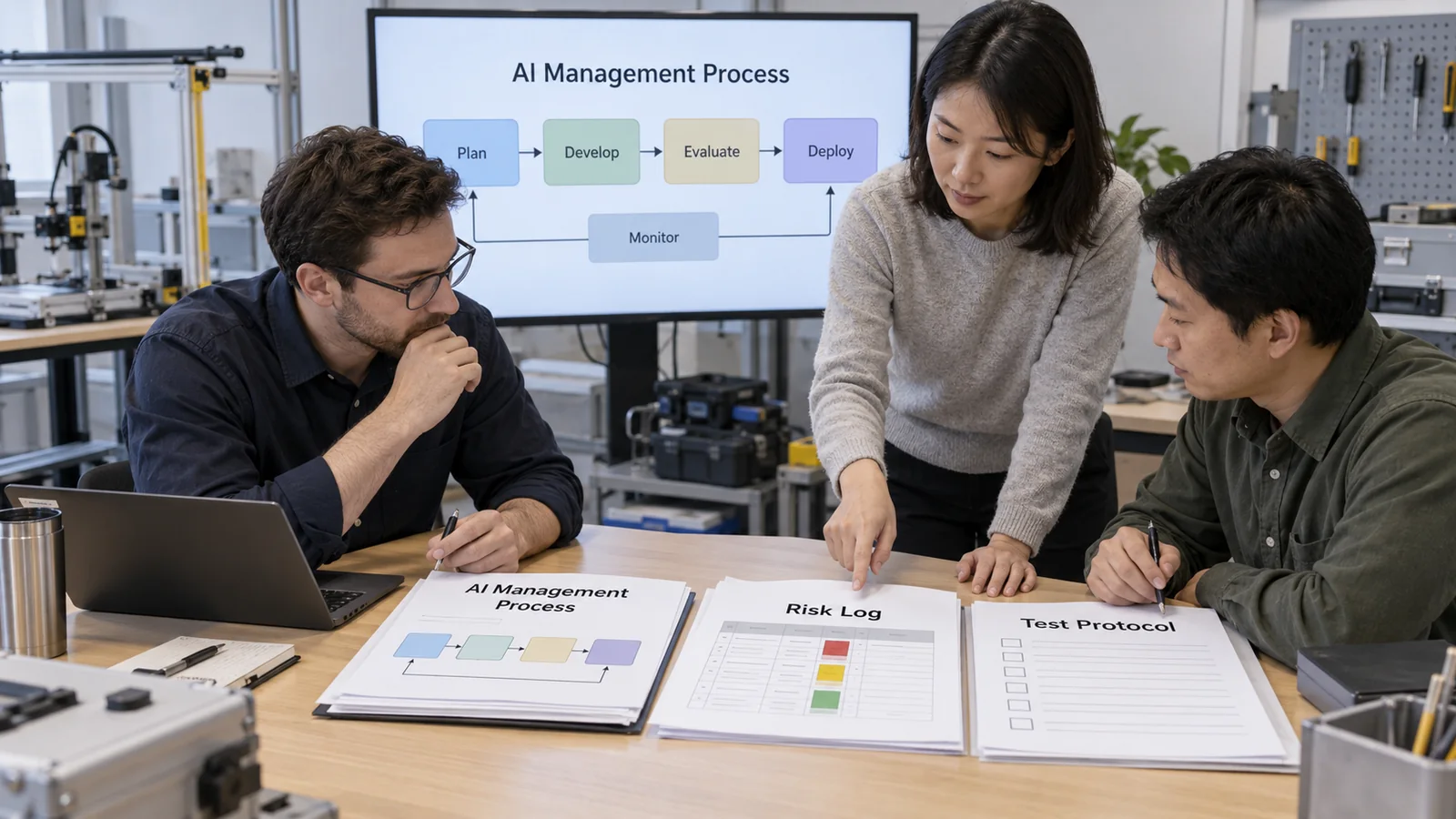
| ISO/IEC 42001:2023 | December 2023 | Requirements for an AI management system (AIMS). Specifies requirements for establishing, implementing, maintaining and continually improving an AIMS in organizations that provide or use AI-based products or services | Sourced Published. Certification is voluntary |
| ISO/IEC 42005:2025 | May 2025 | Guidance on AI system impact assessment, covering effects on individuals, groups and society | Sourced Published |
| ISO/IEC 42006:2025 | July 2025 | Requirements for bodies providing audit and certification of AI management systems | Sourced Published |
| ISO/IEC 5338:2023 | 2023 | AI system life cycle processes | Sourced Published |
| ISO/IEC 5259 series | 2024 | Data quality for analytics and machine learning (Parts 1 to 4, including the overview and terminology, quality measures, and management requirements) | Sourced Published |
| ISO/IEC 42007, 42003, 4213 | n/a | 42007: a high-level framework for conformity assessment schemes. 42003: guidance on implementing 42001. 4213: performance measurement for AI tasks | Not yet confirmed All under development (42007 and 4213 at the ballot-draft stage, 42003 at the new-proposal stage) |
ISO/IEC 42001 sets out how an organization handling AI should arrange its policies, risk handling, roles and improvement cycle. It does not guarantee that a particular AI model is accurate or safe. When an engineer who uses AI sees "based on 42001", the basic reading is that it concerns the organization's management system, not the performance figures of an individual product. Model performance is checked separately, through benchmarks and evaluation methods. For more, see our explainers on reading benchmarks and evaluations, and on AI safety evaluation and risk management.
4. How far its influence reaches (powers and geography)
| Aspect | What ISO has | What ISO does not have |
|---|---|---|
| Powers | It runs a system in which standards are written and published by consensus among experts nominated by members (national standards bodies). In AI, SC 42 drafts standards and members vote | Legal force and enforcement. ISO standards are voluntary, and national law takes precedence. ISO does not regulate or legislate |
| Geography | 177 national members (one per country). SC 42 has 61 participating and 24 observing members. Countries can adopt the standards | Power to make anyone use a standard. Whether to cite one in regulation is for each country or region to decide |
| Relation to Europe | International standards can be adopted by CEN-CENELEC as European standards (adopting international standards is among the aims of its JTC 21) | Power to decide the harmonised standards for the EU AI Act. Those are drafted by CEN-CENELEC's JTC 21 on the basis of a European Commission standardization request |
| Size | 26,528 standards and other deliverables and 844 committees and subcommittees (all fields). SC 42: 44 published and 50 under development, counting updates | No AI-only budget or headcount is published. ISO's total staff was not confirmed either |
The 26,528 standards and 844 committees are totals for all fields, not for AI Sourced. SC 42's "44 published" includes updated editions and is not the same as the number of standards that bear directly on AI. We could not confirm from ISO's materials how many organizations hold ISO/IEC 42001 certification. Whether ISO/IEC 42001 or other ISO/IEC standards will be cited as harmonised standards under the EU AI Act is also unconfirmed Not yet confirmed.
5. Companies and organizations it works with
| Party | Relationship described in primary sources | Link to this series |
|---|---|---|
| IEC and ANSI | SC 42 is a subcommittee of JTC 1, the joint ISO/IEC committee. The secretariat of both JTC 1 and SC 42 is held by ANSI (United States) | n/a |
| CEN-CENELEC (JTC 21) | The European AI committee. It develops harmonised standards in support of the EU AI Act and adopts international standards. Harmonised standards are drafted on a Commission standardization request, and once published in the Official Journal they give a presumption of conformity | See our institution profile of the European Commission |
| Individual AI companies | The ISO pages we checked do not say that any particular company has been certified to 42001 | If a company profile mentions certification, confirm it against the company's own announcement |
* Adopting a standard or holding certification is not a judgment of any company's merits or safety. Check individual certification against each company's announcement and the certification body's register.
6. Outlook
| What we can read from the sources | Primary evidence | Type |
|---|---|---|
| ISO/IEC 22989's amendment on generative AI is at the final stage | SC 42's catalogue lists 22989:2022/FDAmd 1 (generative AI) at the final draft stage. No publication date | Not yet confirmed |
| The standards around 42001 (42003 on implementation, 42007 on conformity assessment schemes) are being built out | SC 42's catalogue lists 42003 at the new-proposal stage and 42007 at the ballot-draft stage | Not yet confirmed |
| Harmonised standards for the EU AI Act are written by CEN-CENELEC's JTC 21, not by ISO, so an ISO standard does not necessarily give a legal presumption of conformity | JTC 21's page says it develops harmonised standards and that publication in the Official Journal gives a presumption of conformity. We could not confirm whether ISO/IEC 42001 will be cited as a harmonised standard | Inference |
| Combined with 42006, 42001 may spread third-party certification | 42006 set requirements for certification bodies in July 2025. ISO says certification is voluntary. We could not confirm how many organizations are certified | Inference |
7. Glossary
- JTC 1 / SC 42
- Subcommittee 42 of ISO/IEC Joint Technical Committee 1 (information technology). It standardizes artificial intelligence.
- AIMS
- AI management system. An organization's policies, risk handling, roles and improvement cycle for AI. ISO/IEC 42001 sets the requirements.
- Harmonised standard
- In the EU, a standard drafted by a European standards body on a Commission request and published in the Official Journal. Using it gives a presumption of conformity with legal requirements.
- P-member / O-member
- A member that votes and works in a committee, and an observer that follows its work.
- Voluntary
- Users can choose whether to adopt it. It is not a legal obligation.
- Third-party certification
- An accredited certification body audits an organization against a standard and attests that it conforms. Optional for ISO/IEC 42001.
8. References
- ISO About ISO (founded 1946-47, 26,528 standards and other deliverables, 177 members, 844 committees and subcommittees, headquarters; checked 15 October 2026). https://www.iso.org/about
- ISO Media kit (statement that standards are voluntary and that ISO does not regulate or legislate). https://www.iso.org/media-kit.html
- ISO Foreword - Supplementary information (statement that standards are voluntary and national law takes precedence). https://www.iso.org/foreword-supplementary-information.html
- ISO ISO/IEC JTC 1/SC 42 Artificial intelligence (scope, secretariat, 61 participating and 24 observing members, 44 published and 50 under development; checked 15 October 2026). https://www.iso.org/committee/6794475.html
- ISO ISO/IEC JTC 1 Information technology (scope, secretariat ANSI). https://www.iso.org/committee/45020.html
- ISO ISO/IEC 42001:2023 Information technology — Artificial intelligence — Management system (December 2023; summary of requirements). https://www.iso.org/standard/42001
- ISO ISO/IEC 42001 explained (certification is voluntary). https://www.iso.org/insights/iso-42001-explained
- ISO ISO/IEC 22989:2022 Information technology — Artificial intelligence — Artificial intelligence concepts and terminology (July 2022). https://www.iso.org/standard/74296.html
- ISO ISO/IEC 23894:2023 Information technology — Artificial intelligence — Guidance on risk management (February 2023). https://www.iso.org/standard/77304.html
- ISO ISO/IEC 42005:2025 Information technology — Artificial intelligence (AI) — AI system impact assessment (May 2025). https://www.iso.org/standard/42005
- ISO ISO/IEC 42006:2025 Information technology — Artificial intelligence — Requirements for bodies providing audit and certification of artificial intelligence management systems (July 2025). https://www.iso.org/standard/42006
- ISO Catalogue of SC 42 (5338, the 5259 series, the stages of the 22989 amendment, 42003, 42007 and 4213; checked 15 October 2026). https://www.iso.org/committee/6794475/x/catalogue/p/1/u/0/w/0/d/0
- CEN-CENELEC Artificial Intelligence (aims of JTC 21, harmonised standards for the EU AI Act, presumption of conformity; checked 15 October 2026). https://www.cencenelec.eu/areas-of-work/cen-cenelec-topics/artificial-intelligence/
9. Claim-to-source audit
| Claim in the text | Type | Source |
|---|---|---|
| 177 members, 26,528 standards and other deliverables, 844 committees and subcommittees, non-governmental, one member per country | Sourced | Reference 1 https://www.iso.org/about |
| Standards are voluntary and ISO does not regulate or legislate (countries may cite or adopt them) | Sourced | Reference 2 https://www.iso.org/media-kit.html |
| Standards are voluntary and national law takes precedence | Sourced | Reference 3 https://www.iso.org/foreword-supplementary-information.html |
| SC 42's scope, ANSI secretariat, 61 participating and 24 observing members, 44 published and 50 under development | Sourced | Reference 4 https://www.iso.org/committee/6794475.html |
| JTC 1's scope and secretariat | Sourced | Reference 5 https://www.iso.org/committee/45020.html |
| Title and summary of ISO/IEC 42001:2023 (December 2023) | Sourced | Reference 6 https://www.iso.org/standard/42001 |
| Certification to ISO/IEC 42001 is voluntary | Sourced | Reference 7 https://www.iso.org/insights/iso-42001-explained |
| Title and scope of ISO/IEC 22989:2022 (July 2022) | Sourced | Reference 8 https://www.iso.org/standard/74296.html |
| Title of ISO/IEC 23894:2023 (February 2023) | Sourced | Reference 9 https://www.iso.org/standard/77304.html |
| Title and summary of ISO/IEC 42005:2025 (May 2025) | Sourced | Reference 10 https://www.iso.org/standard/42005 |
| Title of ISO/IEC 42006:2025 (July 2025) | Sourced | Reference 11 https://www.iso.org/standard/42006 |
| Titles of 5338:2023 and the 5259 series (2024); stages of the 22989 amendment, 42003, 42007 and 4213 | Sourced | Reference 12 https://www.iso.org/committee/6794475/x/catalogue/p/1/u/0/w/0/d/0 |
| CEN-CENELEC JTC 21's aims, harmonised standards, and presumption of conformity on Official Journal publication | Sourced | Reference 13 https://www.cencenelec.eu/areas-of-work/cen-cenelec-topics/artificial-intelligence/ |
| The four-type grouping of institutions; the grouping of standards (foundations, risk, management) | Our calculation | This article's own grouping |
| ISO's total staff, the number of organizations certified to 42001, citation of 42001 and others as harmonised standards, publication dates of amendments and standards under development | Not yet confirmed | Not in References 1 to 13. This article does not estimate them |
| The outlook in Section 6 (relation to harmonised standards, spread of third-party certification) | Inference | This article's reading of References 7, 11 and 13 |
Last updated 15 October 2026 / Troy Technical
Figures and editions come from ISO's website and CEN-CENELEC's page. Standard texts are sold, so this article covers titles and the descriptions on ISO's pages only. This field moves fast, so development stages are as of the check date. Items marked "Inference" are this article's reading of the primary information, not statements by ISO.