TECHNOLOGY EXPLAINER
Model Efficiency: Mixture-of-Experts, Distillation and Quantization
— what shrinks with mixture of experts, distillation, quantization, pruning and small models, and what you pay
The more parameters a large language model has, the more memory and compute it needs. The main ways to hold this down are mixture of experts (MoE), knowledge distillation, quantization (INT8, FP8, FP4), pruning and small models. But each shrinks something different; MoE, for example, reduces the compute and weight reads for one token, while the amount that must sit in memory (total parameters) does not shrink. This article sets out the mechanism of each approach, the figures confirmed in official sources and original papers, estimates of memory and speed (our calculations), and the specifications and licence terms of open-weight models, organizing the trade-offs among accuracy, speed and memory under stated conditions.
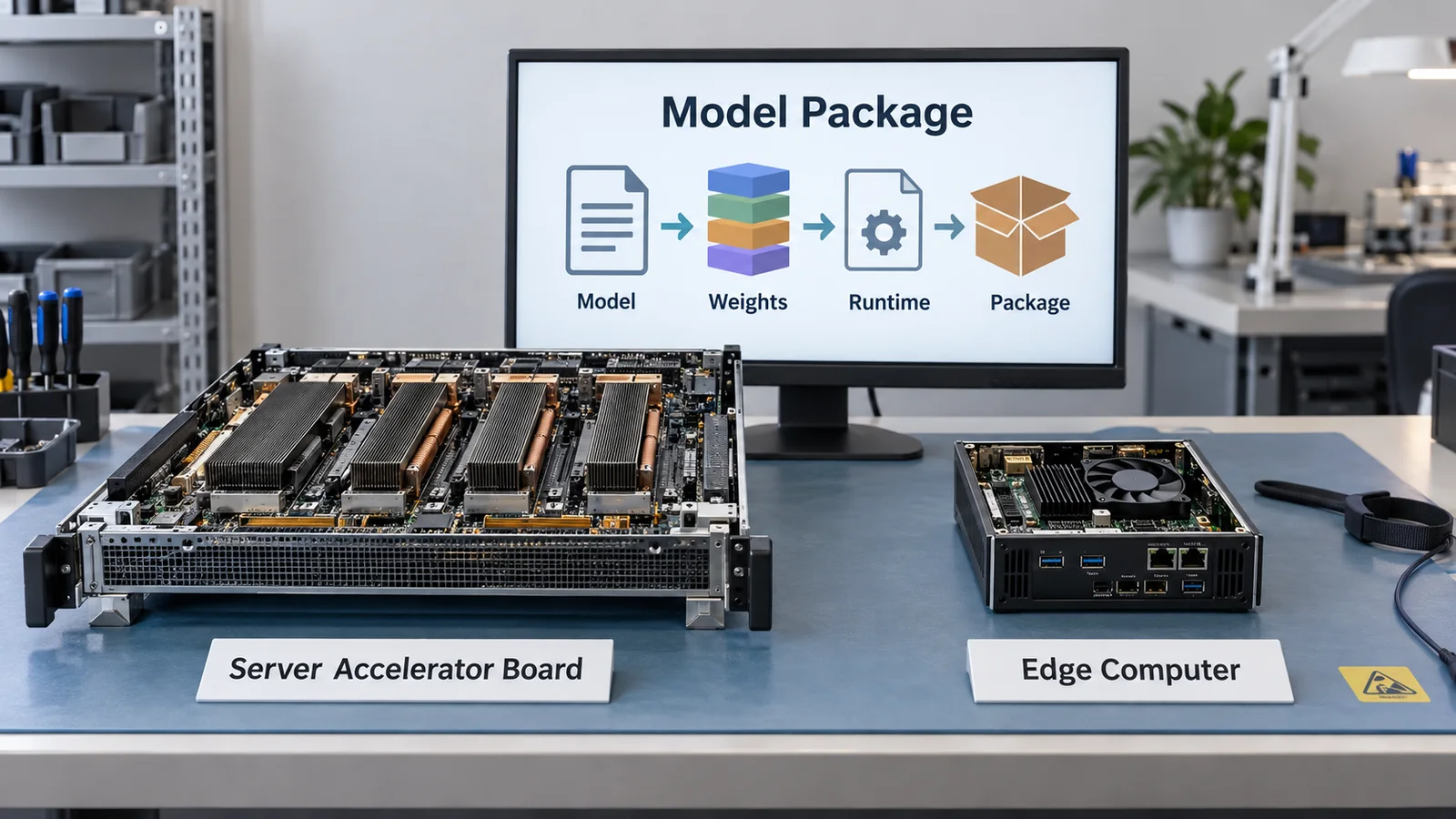
- A map of efficiency (the short version)
- Mixture of experts (MoE) — total and active parameters
- Knowledge distillation — moving a large model's knowledge into a small one
- Quantization — INT8, FP8, FP4 and block-shared scaling
- Pruning
- Small models and the specifications of open-weight models
- Trade-offs among memory, speed and accuracy (our calculation)
- How to read licence terms
- Limits, and what could not be confirmed
- How to read evaluations and standards
- Glossary
- References (primary sources)
- Claim-to-source audit
Sourced = stated in published material (link given)
Our calculation = a figure this article derived, with the assumptions spelled out
Not yet confirmed = under development or revision, or at proposal stage, and not final
Our readings of how things work are marked separately as Commentary. Inference is shown in bold.
Figures for accuracy, speed and memory belong to a particular model and version, quantization scheme, batch size, input and output length, hardware and software. Figures under different conditions are not ranked against each other to say which method or model is better. Parameter counts, context lengths and licences are as stated in the official sources (checked 15 October 2026) and may change, so always check the latest official page and the full licence text before use. The explanations of licences are general information, not legal advice.
1. A map of efficiency (the short version)
- Each approach shrinks something different: MoE shrinks the compute and weight reads per token, quantization shrinks the bytes per parameter, and distillation and pruning shrink the size of the model itself (with retraining) (our organization).
- MoE "loads everything and uses part": gpt-oss-120b has 116.83B total parameters of which 5.13B are active per token. The official sources say that putting most of the weights (the MoE part, over 90%) in MXFP4 (4.25 bits per parameter) lets it fit on a single 80GB GPUSourced[Ref. 9, 10].
- The accuracy price is conditional: A study that ran more than 500,000 evaluations across the whole Llama-3.1 family reports that FP8 is effectively lossless, well-tuned INT8 loses 1 to 3%, and 4-bit weight-only quantization can rival 8-bitSourced[Ref. 21]. This is a result for one model series and one evaluation setup.
An efficiency figure that does not say "which parameter count", "which precision format" and "under which conditions the speed was measured" cannot be compared. The "120B" of an MoE is the total parameters (what has to be held in memory), while speed depends on the active parameters. Memory after quantization has to be estimated for the weights, and separately for the KV cache and activations (see our explainer on retrieval-augmented generation and context windows).
2. Mixture of experts (MoE) — total and active parameters
(1) How it works
MoE splits the feed-forward network (FFN) of each Transformer layer into several "experts", and a router (gate) picks a few of them for each token. Shazeer and colleagues made conditional computation (running only part of the network per input) practical, showed that model capacity can be raised by more than 1000 times with little loss of computational efficiency, and reported an MoE of up to 137 billion parameters applied between stacked LSTM layersSourced[Ref. 1]. Mixtral 8x7B has eight FFN blocks (experts) per layer and picks two per token; the paper says each token has access to 47B parameters but uses only 13B active parameters in inference [Ref. 2].
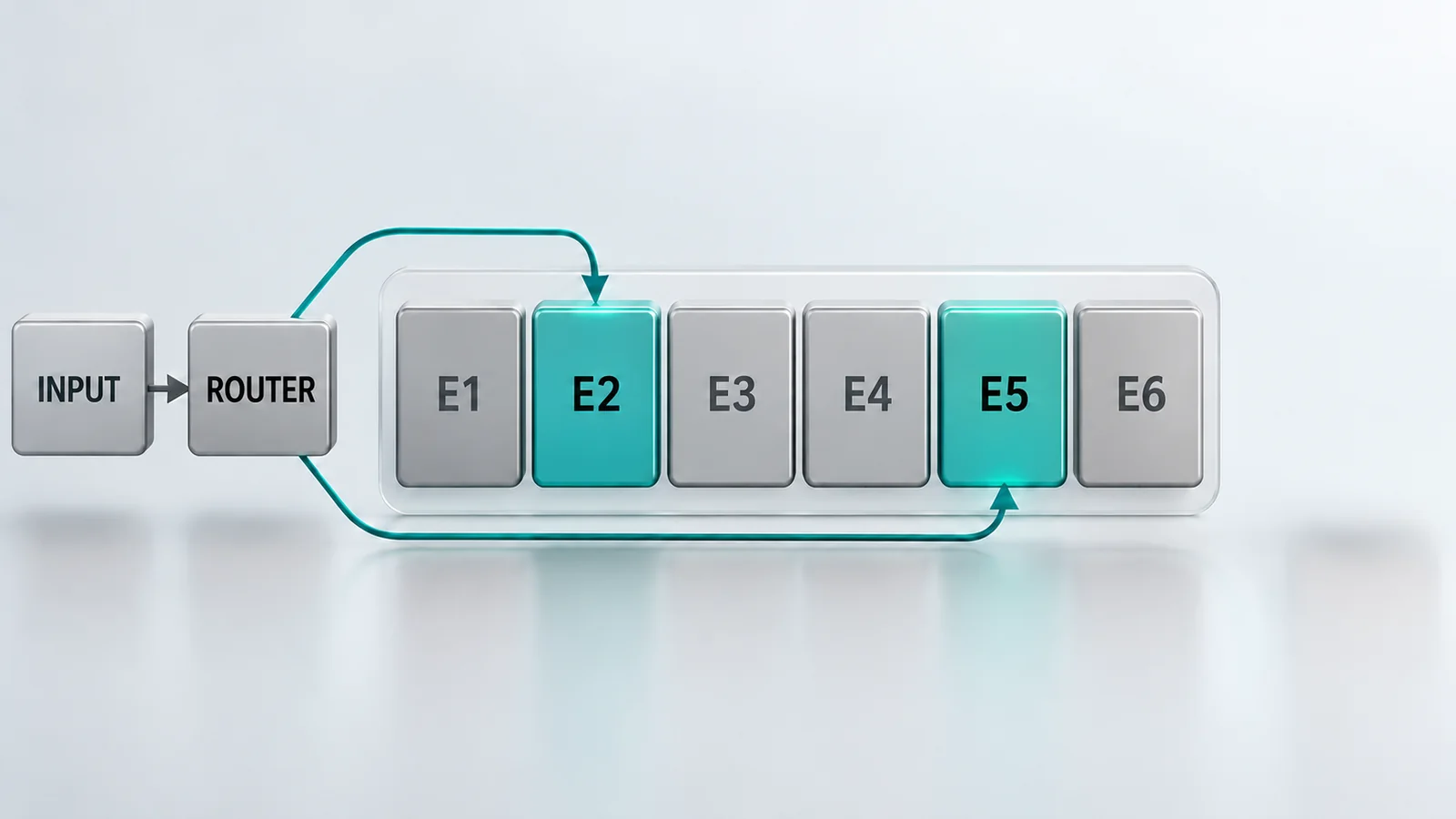
View original SVG, values and source annotations
(2) Total and active parameters of main models
Fig. 3 gathers the values confirmed in official sources. Even for "active", the way of counting (embeddings, shared experts, output-side matrices) differs by provider. For example, the gpt-oss model card notes that the unembedding is counted toward active and the input embedding is not [Ref. 9]. The "E" in Gemma 4's "E2B" and "E4B" stands for "effective" parameters: each layer has its own small embedding (Per-Layer Embeddings), and the large embedding tables are used only for lookups, so the effective parameter count is much smaller than the total [Ref. 14]Sourced.
| Model (source) | Total / active parameters | Expert configuration | Context length (as stated officially) |
|---|---|---|---|
| Mixtral 8x7B (paper) [2] | about 47B / about 13B | 8 experts per layer, 2 selected | 32k context size in training |
| DeepSeek-V3 (technical report, model card) [3, 4] | 671B / 37B (the total on Hugging Face is 685B = 671B main model + 14B MTP) | DeepSeekMoE with MLA. n_routed_experts in the config is 256 | 128K |
| Qwen3-235B-A22B (model card) [7] | 235B / 22B | 8 of 128 experts active. 94 layers, GQA (64 Q and 4 KV heads) | 32,768 natively, 131,072 with YaRN |
| Qwen3-30B-A3B (model card) [8] | 30.5B / 3.3B | 8 of 128 experts. 48 layers | 32,768 natively, 131,072 with YaRN |
| gpt-oss-120b / 20b (model card) [9] | 116.83B / 5.13B; 20.91B / 3.61B | 128 experts (32 for 20b), top 4 selected. The MoE part is over 90% of total parameters | 131,072 (full-attention layers extended with YaRN) |
| Gemma 4 26B A4B (model card) [14] | 25.2B / 3.8B | 8 of 128 experts plus 1 shared. 30 layers. Alternates local attention (window 1024) and global attention | 256K |
All Sourced (papers, official model cards, config.json; checked 15 October 2026). How "active" is counted differs by provider.
(3) How it affects memory and speed
The advantage of MoE is that the compute and weight reads for one token amount to just the active parameters. The DeepSeek-V3 technical report says that it adopts MLA and DeepSeekMoE for efficient inference and economical training, and that pre-training on 14.8 trillion tokens required 2.788 million H800 GPU hours [Ref. 3]. The Qwen3 technical report says that Qwen3's MoE base models can reach comparable performance even with one-tenth of the active parameters of the Qwen2.5 dense base model, with significant advantages in inference and training cost [Ref. 6]Sourced (the developer's evaluation). On the other hand, the amount you must hold in memory is set by the total parameters. The weights of all experts must be placed in GPU memory (or across several GPUs), and gpt-oss-120b fits on a single 80GB GPU because its MoE part is in MXFP4 [Ref. 9]. Also, when the batch grows, different tokens select different experts and the number of experts read in one step increases, so the MoE advantage is not as large as the batch-1 estimate suggests (our commentary; see the estimate in Chapter 7).
In materials terms, MoE is like keeping every reagent in the storeroom and using only a few kinds in any one experiment (our analogy). The size of the storeroom (memory) is set by the total amount of reagents, while the effort of one experiment (compute and reads) is set by the reagents used. In a plan to run AI in-house, estimating memory (total parameters) and speed (active parameters) separately is the starting point for choosing equipment. How high-bandwidth memory such as HBM decides the capacity and bandwidth limits is covered in our explainers on HBM and on inference optimization and serving.
3. Knowledge distillation — moving a large model's knowledge into a small one
(1) The principle and a classic example
Hinton and colleagues' distillation develops a way of compressing the knowledge of a large model, or of an ensemble of models, into a single small model that is easier to deploy [Ref. 11]. DistilBERT uses distillation at the pre-training stage and reports reducing the size of BERT by 40% and making it 60% faster while retaining 97% of its language-understanding capabilitySourced[Ref. 12].
(2) How it is used in recent models
- Gemma 2: says it trained the 2B and 9B models with knowledge distillation instead of next-token prediction [Ref. 13].
- Qwen3: uses "strong-to-weak distillation" from large models to lightweight models, and in a comparison on Qwen3-8B reports that on-policy distillation achieved significantly better performance than reinforcement learning with about one-tenth of the GPU hours (the developer's experiment) [Ref. 6].
- Pruning combined with distillation (Minitron): pruning an existing 15B model and retraining it with distillation to get 8B and 4B models needed up to 40 times fewer training tokens than training from scratch and saved 1.8 times the compute cost for the whole model family, the authors report [Ref. 28].
(3) Caution: how licences treat distillation
Distillation uses a teacher model's outputs to build another model, so the teacher's licence or terms of use can reach the resulting student model. For example, DeepSeek-V3's model licence defines "Derivatives of the Model" to include any other model created by transfer of patterns of the model's weights, parameters, activations or output, and requires derivatives to carry the same use-based restrictions (Attachment A) [Ref. 36]. The Llama 3.1 licence requires that if you use the Llama materials or their outputs to create, train, fine-tune or otherwise improve an AI model that is distributed, you include "Llama" at the beginning of that model's name [Ref. 33]. The Gemma Terms of Use (before Gemma 4) state that Outputs are not Model Derivatives [Ref. 34]Sourced. Even for the same "distillation", the conditions imposed on the result differ with the teacher used. If you use the output of a commercial service as the teacher, that service's terms of use must also be checked (this article does not cover individual terms).
4. Quantization — INT8, FP8, FP4 and block-shared scaling
(1) What is quantized
Quantization represents numbers with fewer bits to reduce memory and compute. What is quantized falls into three groups: weights (W), activations (A, the values flowing between layers) and the KV cache. "W8A8" means both weights and activations in 8 bits; "W4A16" means 4-bit weights and 16-bit activations. Kurtic and colleagues use this notation to compare FP8 (W8A8-FP), INT8 (W8A8-INT) and INT4 weight-only (W4A16-INT)Sourced[Ref. 21].
(2) Number formats: bit layouts
A floating-point number consists of a sign, an exponent and a mantissa. The FP8 paper proposes two encodings, E4M3 (4 exponent bits, 3 mantissa bits) and E5M2 (5 exponent bits, 2 mantissa bits), explaining that E5M2 follows IEEE 754 conventions for special values, while E4M3 extends its dynamic range by not representing infinities and having only one mantissa bit pattern for NaN [Ref. 15]. The Microscaling (MX) formats combine one shared scale per block with narrow element types (FP8, FP6, FP4, INT8); in the paper's table, MXFP4 has a block size of 32, an 8-bit E8M0 scale and 4-bit FP4 (E2M1) elements [Ref. 16]. MXFP4 therefore costs 4 + 8/32 = 4.25 bits per element, which agrees with the gpt-oss model card's statement that the MoE weights are quantized to 4.25 bits per parameter [Ref. 9]Sourced.
(3) Quantization methods
- LLM.int8(): computes only the outlier feature dimensions in 16 bits and multiplies more than 99.9% of values in 8 bits, halving inference memory, and reports no performance degradation even for a 175B-parameter model [Ref. 17].
- GPTQ: a one-shot weight-quantization method using approximate second-order information; it reports quantizing a 175B model in about four GPU hours to 3 or 4 bits per weight with negligible accuracy degradation [Ref. 18].
- AWQ: argues that not all weights are equally important and that protecting only 1% of salient weights greatly reduces quantization error, with the salient channels identified from the activation distribution, not from the weights [Ref. 19].
- SmoothQuant: moves activation outliers into the weights to make W8A8 (8-bit weights and activations) quantization possible, reporting up to 1.56 times speedup and 2 times memory reduction with negligible loss of accuracy [Ref. 20].
- Low precision from the training stage: DeepSeek-V3 says it validated FP8 mixed-precision training on an extremely large-scale model for the first time, and distributes only FP8 weights [Ref. 4]. gpt-oss was post-trained with its MoE weights in MXFP4 [Ref. 9]. An NVIDIA paper presents a method for training a 12-billion-parameter model on 10 trillion tokens in the NVFP4 format (the authors' report) [Ref. 23]Sourced.
(4) The accuracy price: what primary sources confirm
Kurtic and colleagues compared FP8, INT8 and INT4 quantization over the whole Llama-3.1 family on academic benchmarks and real-world tasks, in more than 500,000 evaluations. They found that (1) FP8 (W8A8-FP) is effectively lossless at all scales, (2) well-tuned INT8 (W8A8-INT) shows a low accuracy degradation of 1 to 3%, and (3) INT4 weight-only (W4A16-INT) is more competitive than expected, rivaling 8-bit. From their analysis of inference performance in vLLM, they also say that W4A16 is the most cost-efficient for synchronous setups, W8A8 dominates in asynchronous continuous batching, and for mixed workloads the optimum depends on the use caseSourced[Ref. 21]. Dettmers and Zettlemoyer ran more than 35,000 experiments at 3 to 8 bits on BLOOM, OPT, NeoX/Pythia and GPT-2, and report that 4-bit precision was almost universally optimal for total model bits and zero-shot accuracy [Ref. 22]. These are results for particular model series, benchmarks and implementations, and may not hold for other models or tasks (commentary).
(5) Memory for weights: our calculation
The memory taken by weights is "number of parameters × bytes per parameter". We calculated it from nominal parameter counts (total parameters) for each format. The KV cache and activations are not included.
| Model | Total parameters | BF16 (2 bytes) | 8-bit (1 byte) | 4-bit (0.5 byte) | MX at 4.25 bits |
|---|---|---|---|---|---|
| Llama 3.1 8B | 8B | 16 GB | 8 GB | 4 GB | 4.3 GB |
| Llama 3.1 70B | 70B | 140 GB | 70 GB | 35 GB | 37.2 GB |
| Llama 3.1 405B | 405B | 810 GB | 405 GB | 203 GB | 215 GB |
| Qwen3-30B-A3B | 30.5B | 61 GB | 30.5 GB | 15.3 GB | 16.2 GB |
| Qwen3-235B-A22B | 235B | 470 GB | 235 GB | 118 GB | 125 GB |
| DeepSeek-V3 | 671B | 1,342 GB | 671 GB | 336 GB | 357 GB |
| gpt-oss-120b | 116.83B | 234 GB | 117 GB | 58 GB | 62 GB |
Our calculation (GB = 109 bytes, weights only). Parameter counts are from the official sources [Ref. 2-9]. In practice not all parameters are given the same precision (gpt-oss has only its MoE part in MXFP4 and the rest in BF16). Block scales, embeddings, quantization metadata, the KV cache and activations are not included.
We checked the validity of the calculation on gpt-oss. Table 1 of the model card gives the 120b's MLP (MoE) as 114.71B, attention as 0.96B, embedding and output side as 1.16B, and the checkpoint size as 60.8 GiB [Ref. 9]. With the MoE at 4.25 bits and the rest in BF16 (2 bytes), 114.71B × 4.25/8 + (0.96 + 1.16)B × 2 comes to about 65.2 GB, or about 60.7 GiB, nearly equal to the table's 60.8 GiBOur calculation. In other words, the numbers confirm a configuration in which only the bulk of the weights (the MoE) is put in 4 bits and the rest stays at 16 bits, rather than "everything in 4 bits".
Studies of the accuracy loss from quantization center on general language-understanding, mathematics and code benchmarks [Ref. 21, 22]. We could not confirm whether the loss is of the same size for materials and process work such as unit conversion, handling of digits, standard numbers, equations and reading numbers from tables. As an inference, processing that handles digits and signs may be sensitive even to a small loss of precision. When you adopt a quantized model, run the same evaluation on your own representative questions (see our explainer on benchmarks and how to read evaluations) for the original-precision model and the quantized model, and measure whether the difference is acceptable.
5. Pruning
Pruning removes unimportant weights or structures. It falls broadly into unstructured (zeroing arbitrary weights), structured (removing layers, heads, dimensions and the like as units) and semi-structured (zeroing in a fixed pattern, such as 2:4) (our organization).
- Semi-structured (2:4): NVIDIA's Ampere GPUs have Sparse Tensor Cores that exploit a 2:4 (50%) sparsity pattern for twice the matrix-math throughput, the paper explains. It also notes that research on sparsity has focused on high levels of sparsity, and that maintaining accuracy while achieving significant speedups on modern matrix-math hardware remains a challenge [Ref. 24].
- SparseGPT: prunes large GPT-family models to at least 50% sparsity in one shot with no retraining, and on OPT-175B and BLOOM-176B reaches 60% unstructured sparsity with a negligible increase in perplexity, the authors report [Ref. 25].
- Wanda: removes, per output, the weights with the smallest product of weight magnitude and input activation, needing neither retraining nor weight updates [Ref. 26].
- Structured pruning with retraining (Sheared LLaMA, Minitron): Sheared-LLaMA, which pruned LLaMA2-7B to 1.3B and 2.7B [Ref. 27], and Minitron, which pruned 15B to 8B and 4B and retrained with distillation [Ref. 28], have been reported.
All Sourced (the statements of each paper). Performance figures are for each paper's conditions.
Caution: zeroing 50% of the weights does not by itself make things faster. Unstructured sparsity may not translate into real speedups without dedicated hardware and software support (our commentary; see the statement by Mishra et al. above). A reduction in memory is likewise obtained only if the weights are stored in a sparse format.
6. Small models and the specifications of open-weight models
(1) Why small models: anticipating inference demand
Sardana and colleagues added the cost of inference to the Chinchilla scaling laws of Hoffmann et al. (compute-optimal training) [Ref. 32] and showed that when large inference demand (about 1 billion requests) is expected, one should train a smaller model for longer than Chinchilla-optimal. They also report that model quality keeps improving as tokens per parameter are raised to 10,000 [Ref. 31]. The Llama 3 paper likewise says that its flagship model is of roughly compute-optimal size but that the smaller models are trained much longer than compute-optimal and perform better than compute-optimal models at the same inference budget [Ref. 5]Sourced. The Phi-3 technical report says that phi-3-mini, with 3.8B parameters trained on 3.3 trillion tokens, has performance (the developer's evaluation, including 69% on MMLU) rivaling Mixtral 8x7B and GPT-3.5 while small enough to be deployed on a phone [Ref. 29].
(2) Specifications of open-weight models (checked 15 October 2026)
| Model | Scale | Weight format and precision as distributed | Context length | Licence (summary) |
|---|---|---|---|---|
| gpt-oss-120b / 20b [9, 10] | 116.83B / 5.13B active; 20.91B / 3.61B active | MoE weights post-trained in MXFP4 (4.25 bits). The model card says 120b fits on a single 80GB GPU and 20b runs within 16GB of memory | 131,072 | Apache 2.0. Comply with the usage policy and applicable law |
| Qwen3-235B-A22B / 30B-A3B [7, 8] | 235B / 22B active; 30.5B / 3.3B active | bf16 on the model card (torch_dtype in the config) | 32,768 natively, 131,072 with YaRN | Apache 2.0 |
| DeepSeek-V3 [3, 4, 36] | 671B / 37B active | Only FP8 weights are distributed (a conversion script to BF16 is provided) | 128K | Code under MIT; the model under the "DeepSeek Model Agreement" (with use-based restrictions; Chapter 8) |
| Mixtral 8x7B [2] | about 47B / about 13B active | bf16 in the official config | 32k in training | Apache 2.0 |
| Llama 3.1 8B / 70B / 405B [5, 33] | Dense 8B / 70B / 405B | The paper takes BF16 as its baseline and describes quantizing most matrix multiplications to FP8 on H100 for inference | 128K | Llama 3.1 Community License (a condition for over 700 million monthly users, attribution, usage policy) |
| Gemma 4 (E2B / E4B / 12B / 26B A4B / 31B) [14, 35] | E2B 2.3B effective (5.1B with embeddings), E4B 4.5B effective (8B), 12B (11.95B), 26B A4B (25.2B total, 3.8B active), 31B (30.7B) | Pre-trained and instruction-tuned variants | 128K for small, 256K for medium | Apache 2.0 (up to Gemma 3, the Gemma Terms of Use [34]) |
| Phi-3-mini [29, 30] | 3.8B | — | 4K and 128K variants | MIT |
All Sourced (the statements of each model card, paper, config.json and licence; checked 15 October 2026). The FP8 statement for Llama 3.1 is from the "FP8 Quantization" section of the Llama 3 paper [5] (this article does not cover the quantization details). The figures are specifications and do not show which performs better.
7. Trade-offs among memory, speed and accuracy (our calculation)
(1) Estimating the upper bound of decode speed from weight reads
In decode, which generates text one token at a time, the weights are read from memory for every token, so memory bandwidth sets the upper limit of speed (our commentary; see our explainer on inference optimization and serving). At batch 1 with an assumed memory bandwidth of 3 TB/s, the upper-bound speed = bandwidth / (bytes of weights read per token). For MoE only the active part is read; for gpt-oss-120b we estimated the read volume from the model card's breakdown. The active MoE is 114.71B × 4/128 = about 3.58B (4.25 bits = about 1.90 GB), attention 0.96B (BF16 = 1.92 GB) and the output side about 0.58B (BF16 = 1.16 GB), about 4.98 GB in totalOur calculation (consistent with the model card's 5.13B active).
| Model and format | Weights read per token | Upper bound on speed (3 TB/s assumed) |
|---|---|---|
| Llama 3.1 70B, BF16 | 140 GB | about 21 tokens/s |
| Llama 3.1 70B, FP8 | 70 GB | about 43 tokens/s |
| Llama 3.1 70B, 4-bit | 35 GB | about 86 tokens/s |
| Llama 3.1 405B, FP8 | 405 GB | about 7 tokens/s |
| DeepSeek-V3, FP8 (37B active) | 37 GB | about 81 tokens/s |
| Qwen3-235B-A22B, FP8 (22B active) | 22 GB | about 136 tokens/s |
| gpt-oss-120b, MXFP4 (5.13B active) | about 4.98 GB | about 602 tokens/s |
Our calculation (speed = 3,000 GB/s / weights read). Assumptions: batch 1, 3 TB/s memory bandwidth, weight reads only. The KV cache, activations, communication, overlap of experts within a batch and compute overheads are excluded. Real speed varies greatly with batch size, precision, hardware, input and output length, and software.
(2) Which approach tends to help in which situation (a conditional organization)
| Situation | Approaches that tend to help | Conditions and cautions (sourced where based on primary sources) |
|---|---|---|
| Fitting on a single GPU or PC (memory) | 4-bit quantization, small models, quantizing MoE weights (gpt-oss) | MoE needs memory for the total parameters. The effect of 4 bits on accuracy is conditional [21, 22]. Reserve the KV cache and activations separately (see our explainer on retrieval-augmented generation and context windows) |
| Low latency for a single user (batch 1) | Weight quantization (W4A16), MoE (few active parameters) | Kurtic et al. report W4A16 as the most cost-efficient in synchronous settings [21] |
| Many concurrent requests (large batch) | W8A8 (FP8, INT8) | Reported to dominate in asynchronous continuous batching [21]. With a large batch, MoE reads more experts and is less advantageous than the batch-1 estimate (commentary) |
| Prioritizing accuracy | BF16, FP8 | FP8 (W8A8-FP) reported effectively lossless across the Llama-3.1 sizes [21]. Check on your own task |
| Reducing training and development cost | Distillation; pruning plus distillation | Qwen3 reports distillation at about one-tenth of the GPU hours of reinforcement learning (developer) [6]; Minitron reports up to 40 times fewer tokens [28] |
The sourced parts are Sourced (each paper). The arrangement of the table and the "conditions and cautions" are our commentary.
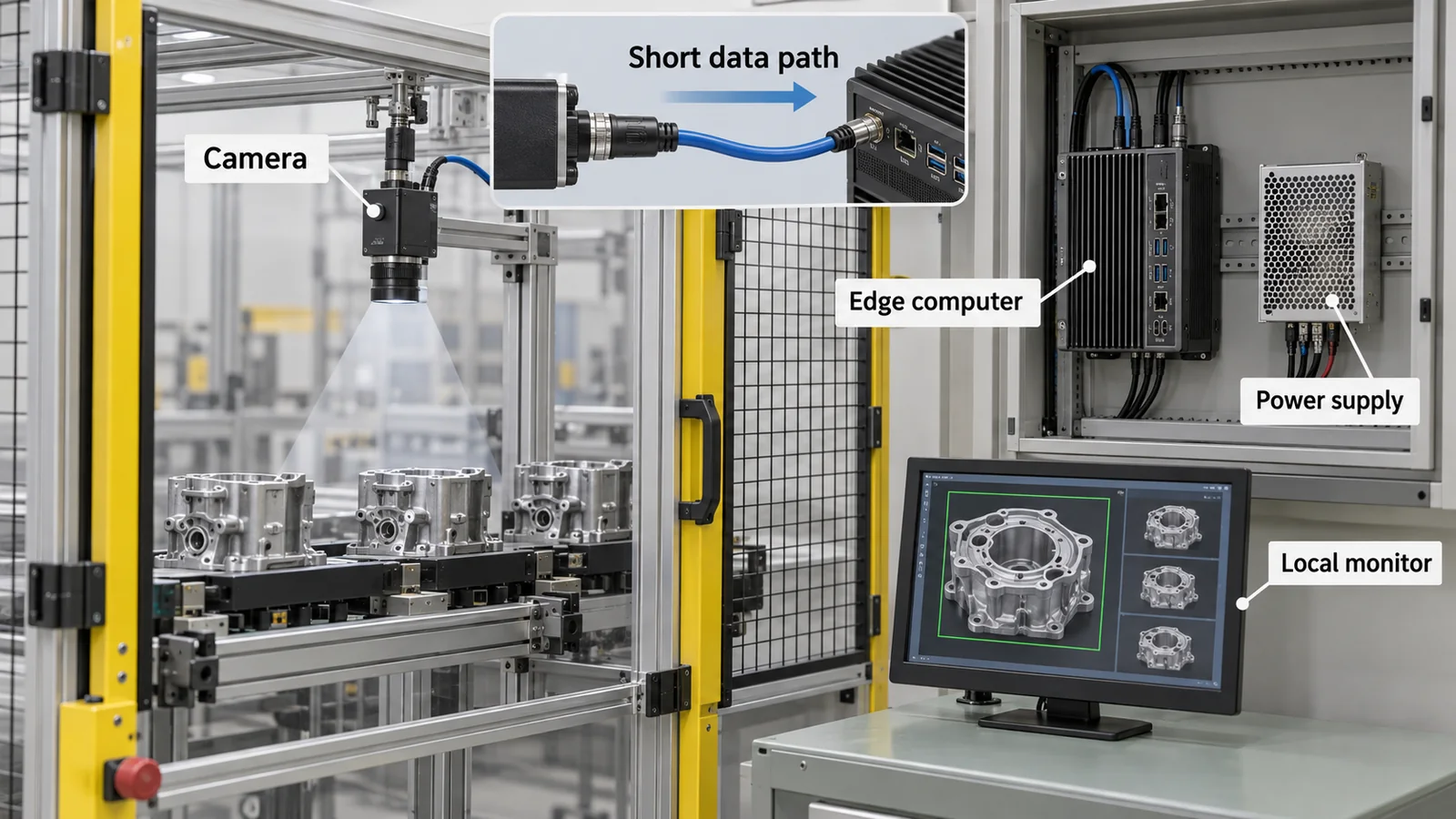
Running a small model near the equipment on site is attractive, but speed and memory figures change with batch, precision format, input and output length, hardware and software (Chapter 7). Rather than carrying a result evaluated in the cloud straight over to a small machine on site, the surest approach is to measure accuracy, speed, memory and heat on the on-site equipment, using your own representative questions. Constraints of power, cooling and packaging are covered in our explainers on edge and on-device AI and on AI data-center power and cooling.
8. How to read licence terms
"Open weights" means the weights are published, and the conditions for use, modification and redistribution differ by model. The Open Source Initiative's Open Source AI Definition 1.0 requires, for an open-source AI, sufficiently detailed information about the training data (Data Information), the complete source code to train and run the system (Code) and the model parameters (Parameters), all made available under OSI-approved terms, and says that "Open Source models" and "Open Source weights" must include the data information and code used to derive those parameters [Ref. 38]Sourced. Having published weights (open weights) is therefore different from being open-source AI under the OSI definition. This article does not judge whether any model meets that definition.
| Licence | Main conditions confirmed in the text | Examples (models covered here) |
|---|---|---|
| Apache License 2.0 [37] | Grants copyright and patent licences (royalty-free, irrevocable, worldwide). If you bring patent litigation, the patent licence ends (Section 3). Redistribution requires giving recipients a copy of the licence, marking modified files, retaining copyright, patent, trademark and attribution notices, and including the notices of any NOTICE file (Section 4) | gpt-oss [9, 10], Qwen3 [7, 8], Mixtral [2], Gemma 4 [14, 35] |
| MIT License | Permits using, copying, modifying and distributing the software without restriction, on condition that the copyright and permission notices are kept (we checked the licence file of Phi-3-mini) [30] | Phi-3-mini [30]; the code of DeepSeek-V3 [4] |
| DeepSeek model licence (Model Agreement) [36] | Grants copyright and patent licences (royalty-free, worldwide, irrevocable) but requires use-based restrictions (Attachment A) to be included as enforceable provisions in any agreement governing use or distribution of the model or derivatives. "Derivatives" includes any other model created by transfer of patterns of the model's weights, parameters, activations or output. "Distribution" includes hosting for third parties, for example through an API | The DeepSeek-V3 model [3, 4] |
| Llama 3.1 Community License [33] | When redistributing, or offering a product or service containing Llama (including another AI model), you give a copy of the agreement and display "Built with Llama". If you use the Llama materials or their outputs to create, train, fine-tune or otherwise improve an AI model that is distributed, you include "Llama" at the beginning of the model's name. You follow the acceptable use policy. If, on the release date, the licensee's and affiliates' monthly active users exceed 700 million, you must request a licence from Meta. There is a termination clause if you sue Meta over intellectual-property infringement by the Llama materials or outputs | Llama 3.1 [5] |
| Gemma Terms of Use (up to Gemma 3) [34] | Redistribution requires including the use restrictions (the Prohibited Use Policy) as enforceable provisions in downstream agreements and attaching a copy of the agreement and a Notice file. Google reserves the right to restrict, remotely or otherwise, usage it reasonably believes violates the terms. Google may update Gemma from time to time. Outputs are not Model Derivatives, and Google claims no rights in Outputs | Up to Gemma 3 [34] |
| The Gemma 4 licence [14, 35] | The model card states "License: Apache 2.0", and the Gemma site has an Apache License 2.0 page. Even under the same name, Gemma, the licence changes with the generation | Gemma 4 [14] |
All Sourced (licence texts and official pages; checked 15 October 2026). The summaries are our own and are not legal advice. Confirm the exact meaning of the terms in the full licence text and, where needed, with professional advice.
Before fine-tuning an open-weight model on your own data, building it into in-house systems or providing it to business partners, check the following (a general checklist from this article, not legal advice).
- Definition of derivatives: whether a model made by fine-tuning, quantization or distillation counts as a derivative (some licences, like DeepSeek's, include distillation that uses outputs).
- Attribution and naming duties: conditions such as the "Built with Llama" notice or "Llama" at the start of a model name.
- Limits on scale and use: the condition of 700 million monthly users, and use-based restrictions (prohibited uses).
- Passing terms downstream: whether the same use restrictions must go into the agreement when you redistribute or offer a service.
- Clauses the provider can change or use to restrict: as in the Gemma Terms of Use, the reserved right to restrict use remotely, and the update clause.
- Changes by generation: as between Gemma 3 and earlier and Gemma 4, the licence changes with the generation. Keep the licence text of the version you use.
9. Limits, and what could not be confirmed
(1) Comparing model performance
This article does not treat which model performs better. Parameter counts, context lengths and licences are as stated in the official sources (checked 15 October 2026), and we did not individually check each company's latest models or updated versions of these models.
(2) Assumptions of the estimates
The estimates in Chapters 4 and 7 rest on nominal parameter counts and the illustrative assumptions of 3 TB/s memory bandwidth, batch 1 and weight reads only. Real speed changes with batch, parallelism, the KV cache, compute overheads and software. The read volume for gpt-oss's active parameters (about 4.98 GB) is our estimate derived from the model card's breakdown, not a measurement of an implementation.
(3) How general the accuracy losses are
The effects of quantization, pruning and distillation on accuracy are results for each paper's particular models, benchmarks and implementations. We could not confirm a primary source that measured the effect on materials and process work (the materials engineer's view 2 in Chapter 4 includes our inference). The effects of distillation (about one-tenth of the GPU hours for Qwen3, up to 40 times fewer tokens for Minitron) are reports by the developers or authors, and we could not confirm independent replications.
(4) Text of standards and specifications
For ISO/IEC standards we checked only the title, publication date and scope (abstract), not the full text. We could not obtain the original of the OCP Microscaling Formats Specification and confirmed the formats from the table of the MX paper. IEEE P3109 is a project under development, and we did not check its text.
(5) Licences
The summaries of licences in Chapter 8 are general explanations based on the published texts and are not legal advice. We did not check the latest versions of the Llama licence, the licences of other generations, or the full text of each model's usage policy.
- Each efficiency approach shrinks something different. MoE shrinks compute and reads, quantization the bytes, and distillation and pruning the size of the model (with retraining) (commentary)
- Distinguish the "total" and "active" of MoE. Memory is set by total parameters and speed by active parameters. gpt-oss-120b has 116.83B total and 5.13B active and fits on an 80GB GPU with its MoE part at 4.25 bitsSourced
- The accuracy price of quantization is conditional. For Llama-3.1, FP8 is reported effectively lossless, INT8 loses 1 to 3%, and 4-bit weight-only is also competitiveSourced
- The speed upper bound is set by the weights read. In an estimate with stated assumptions, gpt-oss-120b (MXFP4) comes to about 600 tokens/s and Llama 3.1 70B (BF16) to about 21 tokens/sOur calculation
- "Open weights" covers different licence terms. Apache 2.0, MIT, licences with use restrictions, the Llama conditions and Gemma, which changes with the generation: check the original textSourced
- Compare the original model and the efficiency-optimized model with the same evaluation on your own tasks. The more your work involves numbers, the more you should check the effect of quantization (commentary)
10. How to read evaluations and standards
Evaluation of model efficiency can be considered in four parts: how much accuracy is kept (the difference from the original model), speed and throughput, memory and energy, and the statement of specifications and licence. International standards exist for number formats, but we could not confirm an international standard that defines how to evaluate efficiency itself. The table below lists what we could confirm, with a type for each row.
| What is evaluated | Representative benchmark or evaluation method (name, source) | Standards and guidelines (ISO/IEC, IEEE, NIST and others) | Cautions in reading |
|---|---|---|---|
| Keeping accuracy (after quantization, pruning or distillation) | Compare with the original model on the same benchmark under the same settings. Kurtic et al.'s evaluation across the whole Llama-3.1 family with more than 500,000 evaluations (FP8, INT8, INT4) [21]. The k-bit inference scaling laws of Dettmers et al. [22]Sourced | Could not be confirmed (no standard defining the procedure for evaluating the accuracy of quantization or pruning was found) | The loss changes with model series, benchmark and implementation. Run the same evaluation as for the original model on your own tasks (see our explainer on benchmarks and how to read evaluations) |
| Number formats | The proposal of FP8 (E4M3, E5M2) [15]. The MX formats (block of 32, E8M0 scale, MXFP4 = 4.25 bits) [16]Sourced | IEEE 754-2019, "Floating-Point Arithmetic" (published 22 July 2019; specifies interchange and arithmetic formats and methods for binary and decimal floating point) [40]. IEEE P3109, "Arithmetic Formats for Machine Learning", is under development (PAR approved 15 February 2023) [41]Not yet confirmed. FP8's E5M2 follows IEEE 754 conventions (FP8 paper) [15] | We did not confirm whether formats such as FP8 and FP4 are part of IEEE 754 itself. P3109 is not yet adopted, so conformance cannot be claimed. Even for formats with the same name, how scales are applied and how values are rounded differ by implementation |
| Speed and throughput | MLPerf Inference: Datacenter (MLCommons). Each benchmark is defined by a dataset and a quality target; the Closed division uses the same model as the reference implementation to compare hardware and frameworks "apples to apples", while the Open division allows a different model or retraining. Results come in Available, Preview and RDI categories (the page showed V6.1) [39]Sourced | ISO/IEC TR 17903:2024 (an overview of machine learning computing devices; terminology and characteristics, and how characteristics are set and used to optimize performance; May 2024; TR = technical report) [42]Sourced | Check the submission category (Closed or Open, Available or Preview), the system configuration and the version. Speeds a developer announces cannot be compared without the batch, precision, input and output length, hardware and software. A TR is not requirements |
| Memory, energy and environment | Weight-memory calculation from nominal parameter counts and formats (Chapter 4). For the KV cache see our explainer on retrieval-augmented generation and context windowsSourced | ISO/IEC TR 20226:2025 (an overview of environmental sustainability aspects of AI systems and potentially related metrics; July 2025; TR) [43]. ISO/IEC TS 42112:2026 (guidance on optimizing the efficiency of machine learning model training; June 2026; TS) [44]Sourced | TS 42112 concerns training efficiency; from its abstract we could not confirm whether it directly covers inference-side efficiency such as quantization or MoE inference. We could not confirm a standard measurement of inference energy |
| Specification statements, openness and licence | Each model's official model card, config.json and technical report (the table in Chapter 6) | OSI Open Source AI Definition 1.0 (Data Information, Code and Parameters under OSI-approved terms) [38]Sourced. We could not confirm an international standard defining specification statements or licences for "open weights" | The OSI definition is a definition by an industry body, not a standard with legal force. Licences are set by each company and change with generation (Chapter 8). How active parameters are counted in model cards differs by provider |
| Risk management and management systems | Could not be confirmed (these are management frameworks, not evaluation methods) | NIST AI 100-1 (AI RMF 1.0, January 2023; a voluntary framework) [46]. ISO/IEC 42001:2023 (requirements for an AI management system) [45]Sourced | NIST is voluntary. ISO/IEC 42001 has requirements and can be a basis for certification, but it does not prescribe methods of model efficiency |
Standard numbers, titles, publication dates and stages were checked on the official ISO, IEEE, NIST, OSI and MLCommons pages (Sourced; checked 15 October 2026). The essentials of benchmarks and frameworks come from each original paper or official page. The arrangement of the table and the "cautions in reading" column are Our calculation (our own organization).
Cautions in reading
- Benchmark values change with the settings and the evaluator. Speed and memory figures change with batch, precision format, input and output length, hardware and software, and MLPerf too must be read with its submission category and system configuration. The figures for accuracy loss are limited to particular model series and evaluation settings.
- Watch for saturation and contamination. The accuracy of quantization and pruning is often argued on small differences in public benchmarks, so check whether such a difference is within the error (Chapter 5 of our explainer on benchmarks and how to read evaluations).
- Read standards and guidelines by whether they recommend or require, and whether they have legal force. IEEE 754 is a published standard, IEEE P3109 is under development, ISO/IEC TRs and TSs are reports and specifications, NIST is a voluntary framework, the OSI definition is an industry body's definition and MLCommons benchmarks are industry benchmarks. None of them decides the merit of a particular efficiency method or model.
- Distinguish declared values from measured values. Statements by a developer such as "fits on a single 80GB GPU" or "several times faster" are declared values. What you measure for memory, speed and accuracy on your own equipment and settings is the measured value.
11. Glossary
- Mixture of experts (MoE)
- A scheme that splits the FFN into several experts and has a router pick a few for each token.
- Total / active parameters
- The number of weights overall / the number of weights actually used in one token's computation. They differ greatly in MoE.
- Knowledge distillation
- Training a small model (student) using the outputs of a large model (teacher).
- Quantization
- Representing numbers with fewer bits to cut memory and compute.
- W8A8 / W4A16
- Notation for the bits of weights and activations. W8A8 = both 8-bit; W4A16 = 4-bit weights and 16-bit activations.
- FP8 (E4M3 / E5M2)
- 8-bit floating point. Two variants with different splits of exponent and mantissa bits.
- MX formats (MXFP4 and others)
- Narrow-bit formats with a shared scale (E8M0) per block of 32 elements. MXFP4 is 4.25 bits per element.
- Pruning
- Removing unimportant weights or structures. Unstructured, structured and semi-structured (2:4) kinds exist.
- 2:4 sparsity
- A pattern that zeroes two of every four consecutive weights. Speeds up arithmetic on supporting hardware.
- Open weights
- The model weights are published. Conditions for use, modification and redistribution vary. Different from OSI's "open-source AI".
- Per-Layer Embeddings (PLE)
- Gemma 4's scheme of giving each layer a small embedding to keep the effective parameter count down.
- MLPerf Inference
- MLCommons' inference-performance benchmark, with Closed and Open divisions and submission categories.
- TR / TS
- ISO/IEC technical report / technical specification. Different from an International Standard (IS) with requirements.
- PAR
- The approval of an IEEE standards project (Project Authorization Request). Approval does not mean the standard has been adopted.
12. References (primary sources)
- Shazeer N. et al. "Outrageously Large Neural Networks: The Sparsely-Gated Mixture-of-Experts Layer", arXiv:1701.06538 (January 2017) — arxiv.org/abs/1701.06538
- Jiang A. Q. et al. "Mixtral of Experts", arXiv:2401.04088 (January 2024) — arxiv.org/abs/2401.04088
- DeepSeek-AI "DeepSeek-V3 Technical Report", arXiv:2412.19437 (December 2024; v2 February 2025) — arxiv.org/abs/2412.19437
- DeepSeek-AI "deepseek-ai/DeepSeek-V3" (official Hugging Face model card: FP8-only weights, licence statements; checked 15 October 2026) — huggingface.co/deepseek-ai/DeepSeek-V3
- Llama Team (Grattafiori A. et al.) "The Llama 3 Herd of Models", arXiv:2407.21783 (July 2024; v3 November 2024) — arxiv.org/abs/2407.21783
- Qwen Team (An Yang et al.) "Qwen3 Technical Report", arXiv:2505.09388 (May 2025) — arxiv.org/abs/2505.09388
- Qwen "Qwen/Qwen3-235B-A22B" (official Hugging Face model card; checked 15 October 2026) — huggingface.co/Qwen/Qwen3-235B-A22B
- Qwen "Qwen/Qwen3-30B-A3B" (official Hugging Face model card; checked 15 October 2026) — huggingface.co/Qwen/Qwen3-30B-A3B
- OpenAI "gpt-oss-120b & gpt-oss-20b Model Card", arXiv:2508.10925 (8 August 2025) — arxiv.org/abs/2508.10925
- OpenAI "openai/gpt-oss-120b" (official Hugging Face model card: MXFP4, 80GB GPU and Apache 2.0 statements; checked 15 October 2026) — huggingface.co/openai/gpt-oss-120b
- Hinton G. et al. "Distilling the Knowledge in a Neural Network", arXiv:1503.02531 (March 2015) — arxiv.org/abs/1503.02531
- Sanh V. et al. "DistilBERT, a distilled version of BERT: smaller, faster, cheaper and lighter", arXiv:1910.01108 (2019; v4 March 2020) — arxiv.org/abs/1910.01108
- Gemma Team "Gemma 2: Improving Open Language Models at a Practical Size", arXiv:2408.00118 (July 2024; v3 October 2024) — arxiv.org/abs/2408.00118
- Google DeepMind "Gemma 4 model card" (Google AI for Developers; checked 15 October 2026) — ai.google.dev/gemma/docs/core/model_card_4
- Micikevicius P. et al. "FP8 Formats for Deep Learning", arXiv:2209.05433 (September 2022) — arxiv.org/abs/2209.05433
- Rouhani B. D. et al. "Microscaling Data Formats for Deep Learning", arXiv:2310.10537 (October 2023) — arxiv.org/abs/2310.10537
- Dettmers T. et al. "LLM.int8(): 8-bit Matrix Multiplication for Transformers at Scale", arXiv:2208.07339 (August 2022) — arxiv.org/abs/2208.07339
- Frantar E. et al. "GPTQ: Accurate Post-Training Quantization for Generative Pre-trained Transformers", arXiv:2210.17323 (October 2022; v2 March 2023) — arxiv.org/abs/2210.17323
- Lin J. et al. "AWQ: Activation-aware Weight Quantization for LLM Compression and Acceleration", arXiv:2306.00978 (June 2023) — arxiv.org/abs/2306.00978
- Xiao G. et al. "SmoothQuant: Accurate and Efficient Post-Training Quantization for Large Language Models", arXiv:2211.10438 (November 2022) — arxiv.org/abs/2211.10438
- Kurtic E. et al. "Give Me BF16 or Give Me Death"? Accuracy-Performance Trade-Offs in LLM Quantization, arXiv:2411.02355 (November 2024) — arxiv.org/abs/2411.02355
- Dettmers T., Zettlemoyer L. "The case for 4-bit precision: k-bit Inference Scaling Laws", arXiv:2212.09720 (December 2022; v2 February 2023) — arxiv.org/abs/2212.09720
- NVIDIA "Pretraining Large Language Models with NVFP4", arXiv:2509.25149 (September 2025; v2 March 2026) — arxiv.org/abs/2509.25149
- Mishra A. et al. "Accelerating Sparse Deep Neural Networks", arXiv:2104.08378 (April 2021) — arxiv.org/abs/2104.08378
- Frantar E., Alistarh D. "SparseGPT: Massive Language Models Can Be Accurately Pruned in One-Shot", arXiv:2301.00774 (January 2023) — arxiv.org/abs/2301.00774
- Sun M. et al. "A Simple and Effective Pruning Approach for Large Language Models", arXiv:2306.11695 (June 2023; Wanda) — arxiv.org/abs/2306.11695
- Xia M. et al. "Sheared LLaMA: Accelerating Language Model Pre-training via Structured Pruning", arXiv:2310.06694 (October 2023) — arxiv.org/abs/2310.06694
- Muralidharan S. et al. "Compact Language Models via Pruning and Knowledge Distillation", arXiv:2407.14679 (July 2024; v2 November 2024; Minitron) — arxiv.org/abs/2407.14679
- Abdin M. et al. "Phi-3 Technical Report: A Highly Capable Language Model Locally on Your Phone", arXiv:2404.14219 (April 2024; v4 August 2024) — arxiv.org/abs/2404.14219
- Microsoft "microsoft/Phi-3-mini-4k-instruct" (official Hugging Face model card and LICENSE (MIT); checked 15 October 2026) — huggingface.co/microsoft/Phi-3-mini-4k-instruct
- Sardana N. et al. "Beyond Chinchilla-Optimal: Accounting for Inference in Language Model Scaling Laws", arXiv:2401.00448 (December 2023; v3 April 2025) — arxiv.org/abs/2401.00448
- Hoffmann J. et al. "Training Compute-Optimal Large Language Models", arXiv:2203.15556 (March 2022) — arxiv.org/abs/2203.15556
- Meta "Llama 3.1 Community License Agreement" (23 July 2024; LICENSE of the llama-models repository) — github.com/meta-llama/llama-models/blob/main/models/llama3_1/LICENSE
- Google "Gemma Terms of Use" (Google AI for Developers; checked 15 October 2026) — ai.google.dev/gemma/terms
- Google "Apache License 2.0 | Gemma" (the licence page for Gemma 4; checked 15 October 2026) — ai.google.dev/gemma/apache_2
- DeepSeek-AI "DeepSeek License Agreement" (LICENSE-MODEL of DeepSeek-V3) — github.com/deepseek-ai/DeepSeek-V3/blob/main/LICENSE-MODEL
- Apache Software Foundation "Apache License, Version 2.0" — www.apache.org/licenses/LICENSE-2.0
- Open Source Initiative "The Open Source AI Definition – 1.0" (checked 15 October 2026) — opensource.org/ai/open-source-ai-definition
- MLCommons "MLPerf Inference: Datacenter" (official page; the page showed V6.1; checked 15 October 2026) — mlcommons.org/benchmarks/inference-datacenter/
- IEEE "IEEE 754-2019 IEEE Standard for Floating-Point Arithmetic" (published 22 July 2019) — standards.ieee.org/ieee/754/6210/
- IEEE "P3109 Standard for Arithmetic Formats for Machine Learning" (Active PAR; PAR approved 15 February 2023; checked 15 October 2026) — standards.ieee.org/ieee/3109/11165/
- ISO/IEC "ISO/IEC TR 17903:2024 Information technology — Artificial intelligence — Overview of machine learning computing devices" (May 2024; technical report) — www.iso.org/standard/85078.html
- ISO/IEC "ISO/IEC TR 20226:2025 Information technology — Artificial intelligence — Environmental sustainability aspects of AI systems" (July 2025; technical report) — www.iso.org/standard/86177.html
- ISO/IEC "ISO/IEC TS 42112:2026 Information technology — Artificial intelligence — Guidance on machine learning model training efficiency optimization" (June 2026) — www.iso.org/standard/42112
- ISO/IEC "ISO/IEC 42001:2023 Information technology — Artificial intelligence — Management system" (December 2023) — www.iso.org/standard/81230.html
- NIST "Artificial Intelligence Risk Management Framework (AI RMF 1.0)", NIST AI 100-1 (January 2023), DOI 10.6028/NIST.AI.100-1 — doi.org/10.6028/NIST.AI.100-1
13. Claim-to-source audit
| Claim in the article | Basis | Type |
|---|---|---|
| MoE: Shazeer et al.'s more-than-1000x capacity and up to 137B parameters. Mixtral's 8 experts, 2 selected, 47B / 13B, 32k, Apache 2.0 | Shazeer et al.; the Mixtral paper Reference 1 https://arxiv.org/abs/1701.06538 Reference 2 https://arxiv.org/abs/2401.04088 | Sourced |
| DeepSeek-V3: 671B / 37B, MLA and DeepSeekMoE, 14.8 trillion tokens, 2.788 million H800 hours, FP8 mixed-precision training, FP8-only weights, the 685B breakdown, MIT code and Model Agreement for the model | Technical report; HF model card Reference 3 https://arxiv.org/abs/2412.19437 Reference 4 https://huggingface.co/deepseek-ai/DeepSeek-V3 | Sourced |
| Llama 3: 8B / 70B / 405B, 128K, GQA, the description of FP8 quantization, smaller models trained longer than compute-optimal | The Llama 3 paper Reference 5 https://arxiv.org/abs/2407.21783 | Sourced |
| Qwen3: comparable performance with one-tenth of the active parameters in MoE, strong-to-weak distillation, on-policy distillation at about one-tenth of the GPU hours of reinforcement learning. Scale, experts, layers, context length and Apache 2.0 for Qwen3-235B-A22B and 30B-A3B | Qwen3 technical report; official model cards Reference 6 https://arxiv.org/abs/2505.09388 Reference 7 https://huggingface.co/Qwen/Qwen3-235B-A22B Reference 8 https://huggingface.co/Qwen/Qwen3-30B-A3B | Sourced |
| gpt-oss: 116.83B / 5.13B, 20.91B / 3.61B, the breakdown in Table 1, the 60.8 GiB checkpoint, MXFP4 at 4.25 bits with MoE over 90%, 128 experts and top 4, 80GB and 16GB, Apache 2.0 | The gpt-oss model card; HF model card Reference 9 https://arxiv.org/abs/2508.10925 Reference 10 https://huggingface.co/openai/gpt-oss-120b | Sourced |
| Distillation: Hinton's principle, DistilBERT (40% smaller, 60% faster, 97%), Gemma 2 (2B and 9B trained by distillation) | Each paper Reference 11 https://arxiv.org/abs/1503.02531 Reference 12 https://arxiv.org/abs/1910.01108 Reference 13 https://arxiv.org/abs/2408.00118 | Sourced |
| Gemma 4: scales of E2B / E4B / 12B / 26B A4B / 31B, effective parameters and PLE, the MoE configuration, local and global attention, context lengths, Apache 2.0 | The Gemma 4 model card Reference 14 https://ai.google.dev/gemma/docs/core/model_card_4 | Sourced |
| FP8 (E4M3 and E5M2, IEEE 754 conventions), MX formats (block of 32, E8M0, MXFP4 = FP4 elements) | The FP8 paper; the MX paper Reference 15 https://arxiv.org/abs/2209.05433 Reference 16 https://arxiv.org/abs/2310.10537 | Sourced |
| Contents and numbers of LLM.int8(), GPTQ, AWQ and SmoothQuant | Each paper Reference 17 https://arxiv.org/abs/2208.07339 Reference 18 https://arxiv.org/abs/2210.17323 Reference 19 https://arxiv.org/abs/2306.00978 Reference 20 https://arxiv.org/abs/2211.10438 | Sourced |
| Evaluations across Llama-3.1 with more than 500,000 evaluations (FP8 lossless, INT8 1 to 3%, the competitiveness of W4A16, synchronous and asynchronous recommendations). The 4-bit scaling laws (more than 35,000 experiments) | Kurtic et al.; Dettmers et al. Reference 21 https://arxiv.org/abs/2411.02355 Reference 22 https://arxiv.org/abs/2212.09720 | Sourced |
| Training a 12-billion-parameter model on 10 trillion tokens with NVFP4 | The NVIDIA paper Reference 23 https://arxiv.org/abs/2509.25149 | Sourced |
| Pruning: 2:4 Sparse Tensor Cores, SparseGPT (50% or more, 60%), Wanda, Sheared-LLaMA, Minitron (up to 40 times fewer tokens, 1.8 times saving) | Each paper Reference 24 https://arxiv.org/abs/2104.08378 Reference 25 https://arxiv.org/abs/2301.00774 Reference 26 https://arxiv.org/abs/2306.11695 Reference 27 https://arxiv.org/abs/2310.06694 Reference 28 https://arxiv.org/abs/2407.14679 | Sourced |
| Small models: phi-3-mini (3.8B, 3.3 trillion tokens, MMLU 69%, MIT), smaller and longer training when inference demand is anticipated, Chinchilla | The Phi-3 report and model card; Sardana et al.; Hoffmann et al. Reference 29 https://arxiv.org/abs/2404.14219 Reference 30 https://huggingface.co/microsoft/Phi-3-mini-4k-instruct Reference 31 https://arxiv.org/abs/2401.00448 Reference 32 https://arxiv.org/abs/2203.15556 | Sourced |
| Licences: Llama 3.1 (Built with Llama, name prefix, 700 million, AUP, litigation clause), Gemma Terms of Use (use restrictions, remote restriction, Outputs), Gemma 4 (Apache 2.0), DeepSeek Model Agreement (use-based restrictions, definition of derivatives), Apache 2.0 (Sections 3 and 4) | The licence texts and official pages Reference 33 https://github.com/meta-llama/llama-models/blob/main/models/llama3_1/LICENSE Reference 34 https://ai.google.dev/gemma/terms Reference 35 https://ai.google.dev/gemma/apache_2 Reference 36 https://github.com/deepseek-ai/DeepSeek-V3/blob/main/LICENSE-MODEL Reference 37 https://www.apache.org/licenses/LICENSE-2.0 | Sourced |
| OSI's Open Source AI Definition 1.0 (Data Information, Code, Parameters) | OSI Reference 38 https://opensource.org/ai/open-source-ai-definition | Sourced |
| MLPerf Inference: Datacenter (scenarios, quality targets, Closed and Open, Available / Preview / RDI, V6.1) | The MLCommons page Reference 39 https://mlcommons.org/benchmarks/inference-datacenter/ | Sourced |
| IEEE 754-2019, IEEE P3109 (Active PAR, 15 February 2023) | The IEEE pages Reference 40 https://standards.ieee.org/ieee/754/6210/ Reference 41 https://standards.ieee.org/ieee/3109/11165/ | Sourced |
| Numbers, titles and publication dates of ISO/IEC TR 17903:2024, TR 20226:2025, TS 42112:2026 and 42001:2023 | ISO standard pages Reference 42 https://www.iso.org/standard/85078.html Reference 43 https://www.iso.org/standard/86177.html Reference 44 https://www.iso.org/standard/42112 Reference 45 https://www.iso.org/standard/81230.html | Sourced |
| NIST AI 100-1 (a voluntary framework) | NIST Reference 46 https://doi.org/10.6028/NIST.AI.100-1 | Sourced |
| Weight-memory calculations (GB for BF16 / 8-bit / 4-bit / 4.25-bit), the reproduction of the gpt-oss checkpoint (about 65.2 GB = about 60.7 GiB), the active read volume (about 4.98 GB), the upper bound on decode speed (about 21 / 43 / 86 / 7 / 81 / 136 / 602 tokens/s) | Our calculation. The 3 TB/s memory bandwidth, batch of 1 and weight reads only are illustrative assumptions, not any product's values | Our calculation |
| "Each efficiency approach shrinks something different", "which approach tends to help in which situation", "six things to check in the licence", the materials engineer's views 1 to 4, and the analogy of "what you load and what you run" for MoE | Our own organization and commentary based on published content, not legal advice and not views stated by any institution (this article) | Commentary |
| That Figs. 2, 3, 4 and 6 are illustrative drawings and that Figs. 1 and 5 are AI-generated concepts (unplaced frames) | Notes by this article | Commentary |
| The effect of quantization or pruning on accuracy in materials and process work, an international standard defining how to evaluate efficiency, the original OCP MX specification, the text of IEEE P3109, individual performance of each company's latest models, and the full licence texts of other generations | Could not be confirmed in the primary sources accessible within our research, so not stated (this article) | Commentary |
Last updated: 15 October 2026 (check date). Sources are limited to primary materials: original papers, developers' official model cards, licences and config.json files, and the official pages of MLCommons, IEEE, OSI, ISO and NIST. The full text of the standards is paid and was not checked. Parameter counts, context lengths and licences can change, and we do not guarantee the state after the check date. The summaries of licences are general explanations, not legal advice. The effect of quantization or pruning on accuracy in materials and process work, an international standard defining how to evaluate efficiency, the original OCP MX specification, the text of IEEE P3109, individual performance of each company's latest models, and the full licence texts of other generations could not be confirmed and are not stated. The estimates of speed and memory are rough, based on nominal parameter counts and illustrative assumptions (3 TB/s memory bandwidth, batch of 1), and are not real speeds. Figs. 2 to 4 and 6 are vector drawings; Figs. 1 and 5 are AI-generated concepts (frames with no image placed). None of them shows the inside of a real product or a measurement screen of real equipment.