TECHNOLOGY EXPLAINER
Multimodal AI and Generative Models
— how images, video and audio are turned into tokens, read, and then made
AI that looks at a picture and answers questions, AI that makes images, video and audio from a sentence, AI that holds a spoken conversation in real time. All of them rest on a "pre-processing" step that turns images, sound and video into sequences of numbers (tokens or latent representations) a model can handle. This article sets out, from primary sources, how vision-language models are put together, tokenization, diffusion models and flow matching, real-time voice, and how to read the evaluation metrics (FID, CLIPScore, human evaluation). Deepfakes are covered in a separate explainer in this series.
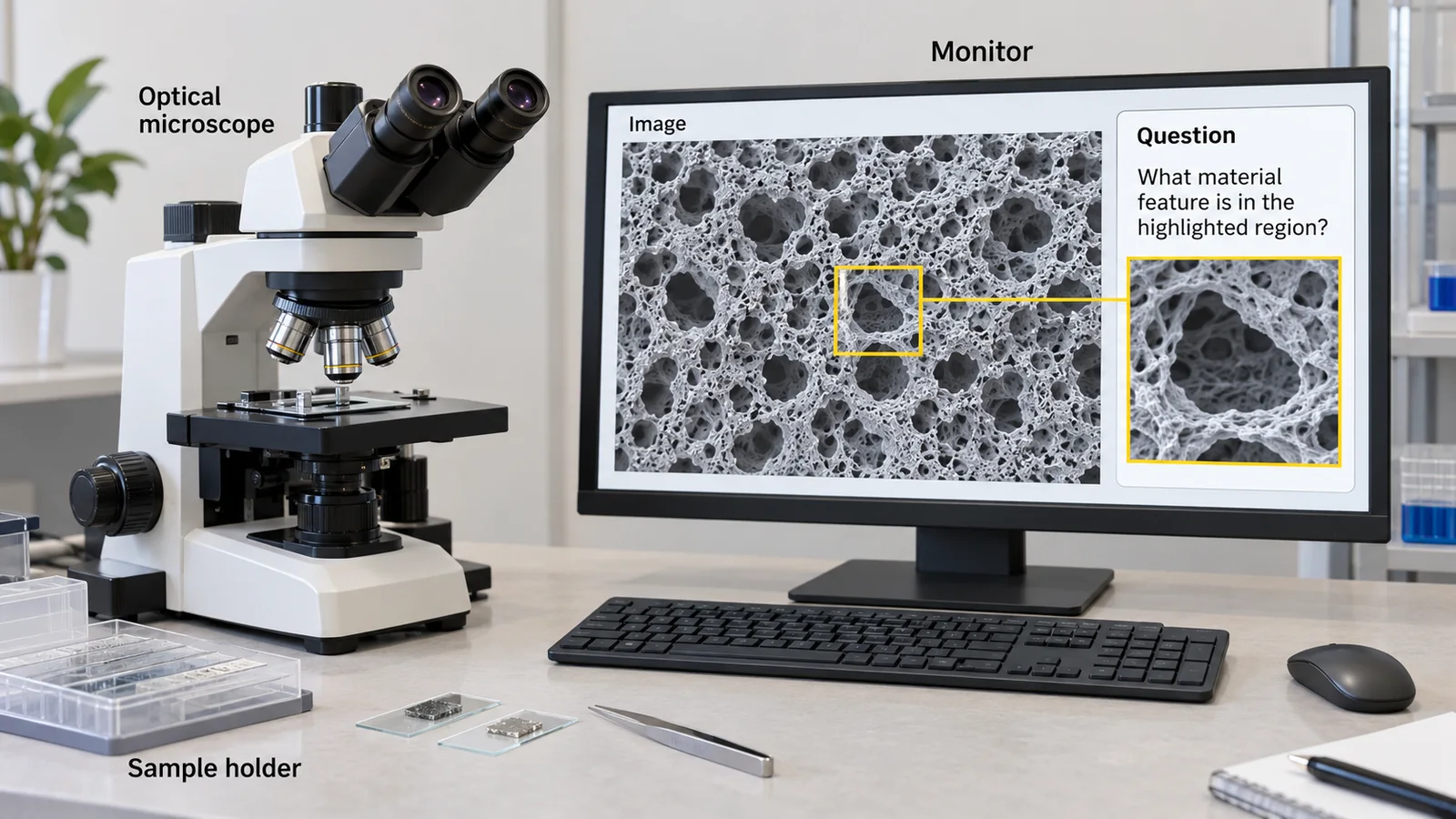
- What multimodal AI is (the short version)
- The big picture — the understanding branch and the generation branch
- Vision-language models — how they read images, and where they are weak
- Tokenization — turning images, audio and video into sequences
- Diffusion models and flow matching — making data from noise
- Generating video and audio, and real-time voice
- Deepfakes belong to a separate explainer — the scope of this article
- Limits, and what could not be confirmed
- How to read evaluations and standards
- Glossary
- References (primary sources)
- Claim-to-source audit
Sourced = stated in published material (link given)
Our calculation = a figure this article derived, with the assumptions spelled out
Not yet confirmed = a plan or schedule whose record has not been confirmed
Other readings are marked separately as Commentary. Inference is shown in bold.
This field moves fast, and model generations and availability change within months. The model names and dates here are what could be confirmed in public documents on 15 October 2026; they do not describe "the latest today". Evaluation numbers are values published by a paper or developer under particular settings and by a particular evaluator. Numbers from different settings or evaluators are not lined up here to rank models. Third-party leaderboards are treated only as reference values, and rankings are not asserted as fact.
1. What multimodal AI is (the short version)
- "Reading" and "making" grew up on different mechanisms: vision-language models, which read an image and answer in words, are basically a vision encoder joined to a language model. Generative models for images, video and audio are mostly diffusion models or flow matching. Recently, attempts to handle both in a single model have appearedSourced [Sources 1, 3, 9, 15, 20]
- The common key is tokenization: images become patches or latent representations, audio becomes the codes of an audio codec, and video becomes spacetime patches — all turned into sequences a Transformer can handle. As resolution or duration grows, the sequence gets longer and the burden on computation and memory grows sharplySourced / Our calculation
- Evaluation is not settled by one number: FID measures whether the distribution of generated images is close to that of real images, CLIPScore whether an image and a sentence match, and human evaluation which output people prefer. Each changes with settings and evaluator, and they can disagreeSourced [Sources 28, 31, 30]
A low FID does not guarantee that people find the images good. Jayasumana et al. show cases where FID contradicts human raters and where the result changes with the number of samples, and they call for a reassessment of using FID as the primary quality metric for recent text-to-image modelsSourced [Source 30].
2. The big picture — the understanding branch and the generation branch
Multimodal AI is easier to see when sorted by input and output. Taking in images, audio or video and answering in text is "understanding"; taking in text or images and producing images, video or audio is "generation". The former has mostly been a design that joins a vision encoder to a language model, the latter mainly diffusion models and flow matching (the following sections).
Recently, more models straddle this boundary. For example, the GPT-4o system card describes GPT-4o as an "autoregressive omni model" that accepts any combination of text, audio, image and video as input and generates any combination of text, audio and image as output, "trained end-to-end across text, vision, and audio, meaning that all inputs and outputs are processed by the same neural network" (dated 8 August 2024)Sourced [Source 24]. On the research side, Chameleon presented an "early-fusion, token-based" model that understands and generates images and text in any sequence [Source 19], and Transfusion showed how to train one Transformer with both next-token prediction and diffusion [Source 20]Sourced.
However, labels such as "omni" and "natively multimodal" are the developers' own descriptions, and what is handled by a single model, and how far, has to be checked in each company's technical documents. This article does not assert the internal structure of any particular model.
3. Vision-language models — how they read images, and where they are weak
(1) Lining images up like "words": ViT and CLIP
The Vision Transformer (ViT) cuts an image into P x P patches and feeds the resulting sequence to a Transformer. The paper explains that for an image of resolution H x W the number of patches is N = HW/P², which is also the length of the input sequence to the Transformer (the "16x16 words" of the title are 16 x 16-pixel patches)Sourced [Source 1].
CLIP is pretrained on 400 million (image, text) pairs collected from the internet to predict which text goes with which image, which maps images and text into one space. This allows "zero-shot" transfer: classifying images by concepts specified in natural language rather than a predetermined set of categories. The paper reports matching the accuracy of the original ResNet-50 on ImageNet without using any of the 1.28 million ImageNet training imagesSourced [Source 2].
(2) Joining a vision encoder to a language model
Many models that read an image and answer in words are built by joining a pretrained vision encoder and a pretrained language model with a small connecting component. The main designs, as described in the papers, are sorted belowSourced.
| Design | Representative examples (papers) | Key points (as described in the papers) | Cautions when reading |
|---|---|---|---|
| Contrastive two-tower | CLIP [Source 2] | Maps images and text into one space with separate encoders. Pretrained on 400 million image-text pairs | Not a model that "generates" text. Used as the vision encoder of other models |
| Bridging frozen models | Flamingo [Source 4], BLIP-2 [Source 5] | Flamingo bridges pretrained vision-only and language-only models and handles input in which images and text are interleaved. BLIP-2 joins a frozen image encoder and a frozen language model with a lightweight Querying Transformer | BLIP-2 reports beating Flamingo80B by 8.7% on zero-shot VQAv2 with 54 times fewer trainable parameters (a value under the paper's conditions and date) |
| Projection + instruction tuning | LLaVA [Source 3] | Connects CLIP's vision encoder to a language model (Vicuna) and fine-tunes end to end on image-language instruction data generated by language-only GPT-4 | The instruction data is generated by another AI. Part of the evaluation is a relative score against GPT-4, which is not the same as human evaluation |
| Early fusion / unified tokens | Chameleon [Source 19] | Turns both images and text into discrete tokens and understands and generates mixed sequences with one model | Information is lost in discretizing images (Section 4) |
All Sourced (abstracts and text of each paper). The way of grouping the designs is this article's own (commentary).
(3) Weak points: fine geometry, and "seeing" what is not there
Vision-language models score highly on many benchmarks, yet they fail unexpectedly on simple visual tasks. Rahmanzadehgervi et al. report that on seven simple tasks (BlindTest) — whether two circles overlap, how many times two lines intersect, which letter of a word is circled, how many circles are in an Olympic-style logo — four state-of-the-art vision-language models at the time of the paper averaged 58.07% accuracy. The best model reached 77.84%, against an expected human accuracy of 100%. They also show that accuracy becomes close to 100% when more space is added between shapes, and that the vision encoders contain the information needed to solve the tasks while the language model fails to turn it into the right answer (linear-probing experiments)Sourced [Source 38]. These are results for the models at the time of the paper (July 2024; final version March 2025), not the performance of today's models.
Li et al. also studied systematically "object hallucination", in which vision-language models describe objects that are not in the image, and reported that objects that appear frequently in the instruction data, or that tend to co-occur with objects in the image, are especially likely to be invented. Because the evaluation method itself is affected by the input instruction and output style, they proposed a method that asks repeated yes/no questions (POPE)Sourced [Source 37].
There are many occasions on which one wants a vision-language model to read scanning electron microscope (SEM) or optical images, spectrum plots or instrument screens. The BlindTest results suggest that the jobs often needed in materials image analysis — judging overlapping particles, counting intersections, telling apart close shapes — lie close to what vision-language models are weak at (the paper uses artificial shapes and does not directly show performance on microscope images; this is this article's commentary).
A safer set-up in practice is to use a vision-language model for a first draft of "what is shown" and as an aid to classification, and to confirm numbers such as particle count, particle size, film thickness, and the number and position of defects with conventional image processing (thresholding, segmentation) and a human eye. Because fine structure can be lost if the image is downsized or tiled before it reaches the model, the input resolution and the treatment of the scale bar should also be recorded as conditions (commentary). MMMU, a set of college-level multi-discipline problems, uses 30 image types including chemical structures and is one attempt to measure the ability to read specialist figures, but performance on one's own images can only be confirmed with one's own data [Source 36].
4. Tokenization — turning images, audio and video into sequences
A language model processes text after turning it into a sequence of integers called tokens. To treat images, audio and video the same way, one first has to turn a continuous signal into a sequence of finite length. The design of this conversion (tokenization, or compression into a latent representation) largely decides quality, computation and latency.
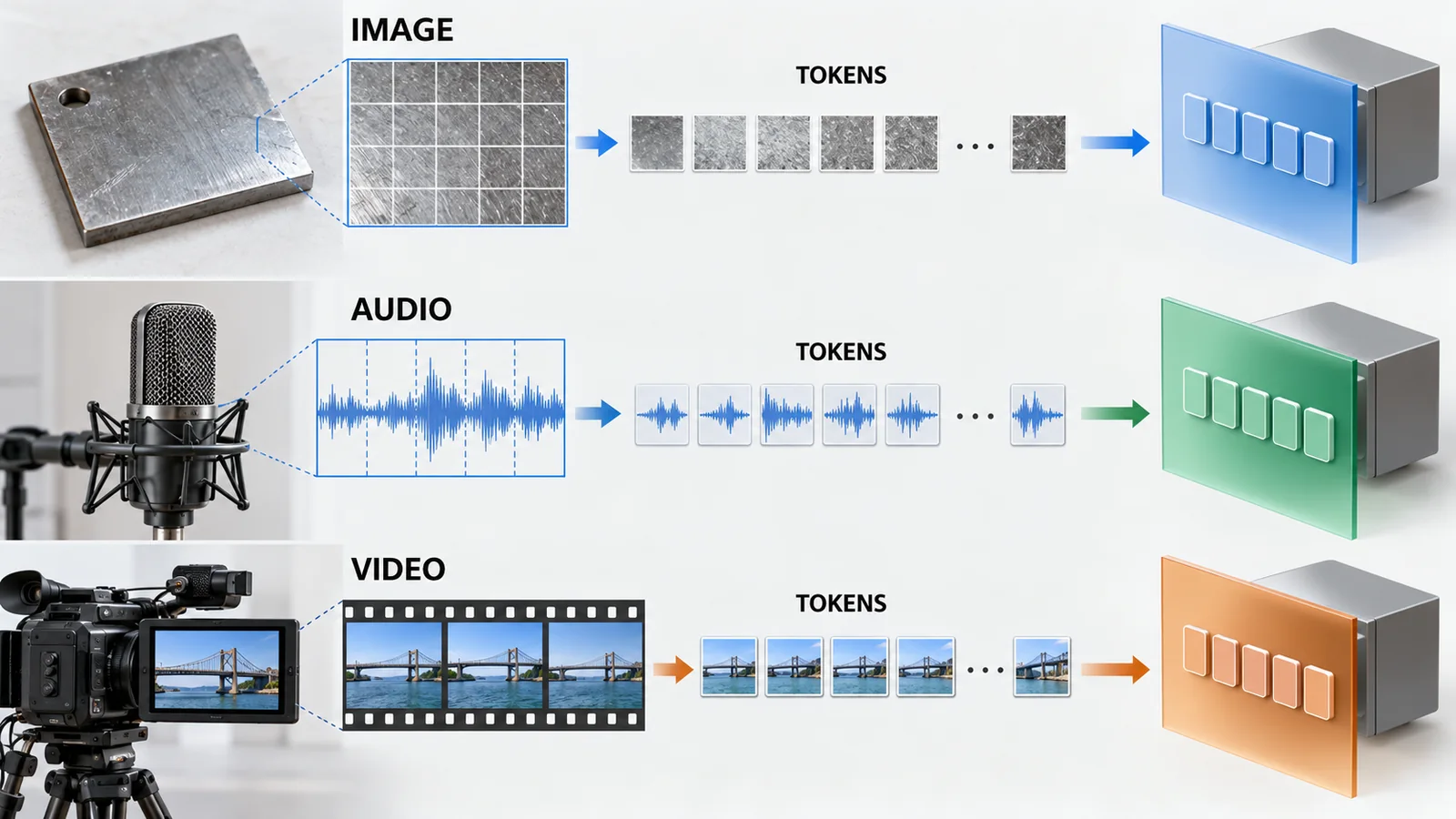
View original SVG, values and source annotations
| Target | Main methods (sources) | Key points |
|---|---|---|
| Image: patches | ViT [Source 1] | Cut the image into P x P patches and line them up as they are. The smaller the patch, the longer the sequence |
| Image: discrete tokens | VQ-VAE [Source 6], VQGAN [Source 7] | Turn the encoder output into indices of a codebook. VQGAN learns a "vocabulary of image constituents" with convolutions and models their composition with a Transformer |
| Image: latent space | Latent diffusion models [Source 8] | Run diffusion in the latent space of a pretrained autoencoder. According to the paper, pixel-space diffusion models can take hundreds of GPU days to train, and the latent space reduces the computation. Conditions such as text are supplied by cross-attention |
| Audio: neural audio codecs | SoundStream [Source 27], EnCodec [Source 26], Mimi (Moshi) [Source 25] | A convolutional encoder-decoder with residual vector quantization (RVQ) turns audio into sequences of indices into several codebooks. SoundStream works at 3-18 kbps; EnCodec supports 1.5-24 kbps at 24 kHz, with 1,024 entries (10 bits) per codebook |
| Video: spacetime patches | Sora technical report [Source 21] | Turn video into a latent representation compressed in both time and space, split it into spacetime patches, and use them as Transformer tokens. The report states that it does not include model and implementation details |
All Sourced (descriptions in each paper or technical report).
Our calculation: resolution and token count, and audio bitrate
From the formulas and values in the papers, we calculate how the "sequence length" growsOur calculation.
- ViT: N = HW/P² (paper). For 224 x 224 and P = 16, N = (224 x 224)/(16 x 16) = 196. For 448 x 448 it is 784 (4 times). The number of token pairs that self-attention considers, N², goes from 196² = 38,416 to 784² = 614,656, a factor of 16
- DiT: a 256 x 256 image becomes a 32 x 32 x 4 latent, and with patch size p = 2 gives T = (I/p)² = (32/2)² = 256 tokens. A 512 x 512 image becomes a 64 x 64 x 4 latent and, with p = 2, 1,024 tokens (values given in the paper). The DiT paper also states that halving p quadruples T and at least quadruples the compute (Gflops)
- Audio (Mimi): 12.5 Hz, 8 codebooks, 2,048 entries each (11 bits). Per second that is 12.5 x 8 = 100 tokens, and the bitrate is 12.5 x 8 x 11 = 1,100 bit/s = 1.1 kbps (matching the value stated in the paper). One minute is 6,000 tokens
- A sense of compression: uncompressed 24 kHz, 16-bit, mono audio is 24,000 x 16 = 384 kbps (this assumption is ours). The ratio to 1.1 kbps is 384 / 1.1 = about 349 times
Assumptions and limits: N² is a rough measure of "the pairs attention looks at"; real compute depends on the non-attention layers (fully connected layers and so on) and on algorithmic tricks, and does not simply scale by 16. For the DiT compute we rely only on the paper's statement that it is "at least 4 times". Video adds a frame dimension and the sequence grows further, but Sora's compression ratio and sequence length are not stated in the report, so this article does not calculate them.
Demands such as higher resolution or longer video come back to the computer as more tokens. A longer sequence means more attention computation and not enough memory capacity and bandwidth to hold intermediate results. This connects directly to the memory-bandwidth and packaging constraints of AI accelerators covered in this series' explainers on HBM and CoWoS (this article's commentary; the memory required by individual generative models could not be confirmed from public material and is not given).
Put differently, the "high quality" and "long duration" of generative AI are carried by compute and memory, and so by electric power and cooling. It is consistent with this that NIST's generative-AI profile lists environmental impact (the large compute resources used in training and operation) among the risks unique to or exacerbated by generative AI [Source 46]. Power and cooling are covered in this series' explainer on power and cooling for AI data centers.
5. Diffusion models and flow matching — making data from noise
(1) Diffusion models: learning the "reverse" of adding noise
A diffusion model is a generative model that fixes a process which gradually adds noise to data until only noise remains, and learns the reverse (the process that returns from noise to the original data) with a neural network. The DDPM of Ho et al. showed high-quality image generation in this framework (reported FID 3.17 and Inception score 9.46 for unconditional CIFAR-10 generation)Sourced [Source 9]. Song et al. formulated diffusion as a stochastic differential equation (SDE) and explained earlier score-based generative modeling and diffusion probabilistic modeling in one framework. The reverse-time process depends only on the score (the gradient field of the data distribution), and an equivalent ordinary differential equation (ODE) that samples from the same distribution can also be derivedSourced [Source 10].
Plain diffusion models need many iterative steps, which makes generation slow. Methods proposed to ease this include DDIM (same training procedure, reported to generate 10 to 50 times faster in wall-clock time) [Source 12] and consistency models, which map noise directly to data in a single evaluation (one-step generation is supported by design, and multistep sampling can trade compute against quality) [Source 13]Sourced.
A widely used way to make a condition such as text take effect is classifier-free guidance. A conditional and an unconditional score estimate are trained together and the two are combined to adjust the trade-off between sample quality and diversitySourced [Source 11].
(2) Latent diffusion and Transformers (DiT)
As in the previous section, latent diffusion models run diffusion in the latent space of an autoencoder to cut computation and supply conditions such as text through cross-attention [Source 8]. The DiT of Peebles and Xie replaces the backbone of a diffusion model, from a U-Net to a Transformer that handles latent patches, and shows that the larger the compute (Gflops), the lower the FID tends to be. The largest, DiT-XL/2, reports an FID of 2.27 on class-conditional ImageNet at 256 x 256 (a value under those conditions and at the time of the paper)Sourced [Source 14].
(3) Flow matching and rectified flow: near-straight paths
Flow matching by Lipman et al. is a "simulation-free" way to train continuous normalizing flows (CNFs) by regressing the vector fields of fixed probability paths. It includes diffusion paths as special cases and can also use other paths based on optimal transport. The paper reports that on ImageNet it consistently gave better likelihood and sample quality than diffusion-based methodsSourced [Source 15]. Rectified flow by Liu et al. learns an ordinary differential equation that connects points of two distributions as straight as possible, and it is reported that nearly straight paths can give high-quality results even with a single Euler discretization stepSourced [Source 16].
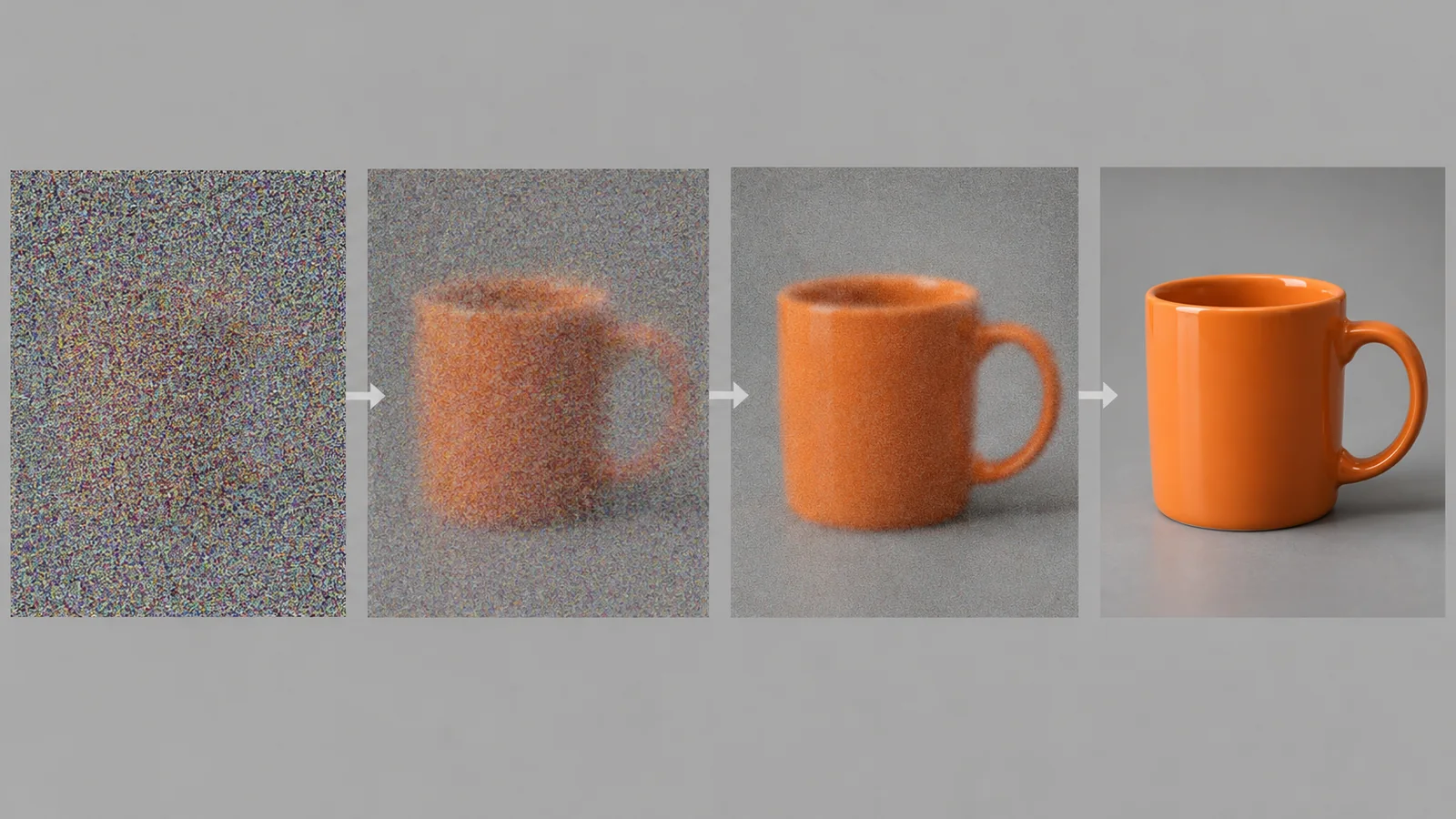
View original SVG, values and source annotations
The Stable Diffusion 3 paper (Esser et al.) reports that training rectified flow with noise sampling biased toward perceptually relevant scales gave better results than established diffusion formulations for high-resolution text-to-image synthesis, and proposes a Transformer architecture (MMDiT) that uses separate weights for image and text with information flowing in both directions between them. It also states that model scale and validation loss follow predictable trendsSourced [Source 17]. The model card of FLUX.1 [dev] from Black Forest Labs describes the model as "a 12 billion parameter rectified flow transformer" (checked 15 October 2026)Sourced [Source 18].
Both flow matching and rectified flow showed good results in experiments with stated conditions in their papers, and they are mathematically close relatives of diffusion models (flow matching includes diffusion paths as special cases). The models in those papers also differ in scale, data and metrics. This article does not assert which family is generally better. Which formulation a new image or video model actually uses has to be checked in the developer's technical documents (and is sometimes not disclosed).
(4) Understanding and generation in one model
Transfusion trains a single Transformer on mixed-modality sequences with the language-modeling next-token loss and diffusion together. It reports models up to 7 billion parameters trained on 2 trillion mixed tokens, producing images and text on a par with diffusion models and language models of similar scale, and says it scales significantly better than quantizing images and training a language model over discrete image tokensSourced [Source 20]. This is one answer to the problem of "information lost in discretization" in Section 4 (a claim of the paper, from a comparison with limited conditions).
6. Generating video and audio, and real-time voice
(1) Video generation
OpenAI's technical report on Sora (15 February 2024) says that it trained text-conditional diffusion models jointly on videos and images of variable durations, resolutions and aspect ratios, using a Transformer that operates on spacetime patches of video and image latent codes, and that the largest model can generate a minute of high-fidelity video. It also offers a suggestion that scaling video generation is a promising path toward general-purpose simulators of the physical world, yet the same report lists many limitations as a simulator, such as not accurately modeling the physics of basic interactions like glass shatteringSourced [Source 21]. The report states that it does not include model and implementation details. "World simulator" is the developer's view, not a demonstrated fact (world models are covered in this series' explainer on world models and embodied AI).
Google DeepMind's model card for Veo 3 (stated as published 23 May 2025 and updated 13 January 2026) describes Veo 3 as a generation system that makes high-resolution video with audio from text or images, uses latent diffusion, and applies diffusion to the temporal audio latents and the spatio-temporal video latents. It says training used Google's TPUs and JAXSourced [Source 22]. The same card states as a known limitation that "maintaining complete consistency throughout complex scenes or those with complex motion, remains a challenge". On evaluation, it uses MovieGenBench, released by Meta (1,003 prompts for video and 527 for video plus audio), among others, and the developer states that in head-to-head comparisons of outputs by human raters against other companies' models, Veo 3 performed best on overall preference and on following prompts. In what we could check, details such as the number and selection of raters are not given on the cardSourced [Source 22].
Google's Gemini API documentation (the page states it was last updated 30 June 2026; checked 15 October 2026) lists Gemini Omni Flash and Veo 3.1 as the video generation models and recommends the former as the defaultSourced [Source 23]. That the names and recommendations of the offered video models changed within little more than a year of Veo 3 in May 2025 is one example of how fast this field moves (this article's commentary).
(2) Real-time voice: what decides latency
Conventional voice dialogue was a cascaded pipeline that runs voice activity detection, speech recognition, text dialogue and speech synthesis in turn. The Moshi paper lists as problems that delays add up from stage to stage so that responses are delayed by several seconds, that emotion and non-speech sounds are lost because text sits in the middle, and that the segmentation into speaker turns cannot handle overlaps and interruptionsSourced [Source 25].
In contrast, end-to-end systems that generate speech directly from speech have been proposed. Moshi starts from a text language model, generates the codes of a neural audio codec, and models its own speech and the user's as two parallel streams. The paper calls it a real-time, full-duplex spoken language model with a theoretical latency of 160 ms and 200 ms in practice. The Mimi codec's frame is 80 ms, and the paper gives a theoretical latency of 160 ms for the setting with the acoustic-token delay set to one frameSourced [Source 25]. The GPT-4o system card states that it can respond to audio inputs in as little as 232 ms, with an average of 320 msSourced [Source 24]. Both the paper and the card compare with human conversational response times by citing a study of turn-taking (Stivers et al., 2009).
Comparing "160 ms" with "232 ms" does not show which is better. Moshi's 160 ms is a theoretical value fixed by the model's configuration (200 ms in practice), while GPT-4o's 232 ms and 320 ms are response times given by the developer; in what we could check, conditions such as the start and end points of measurement, network delay, hardware and number of trials are not in a form that can be compared under the same definition. The latency a user actually feels also changes with the network path, server load and the processing on the device (this article's commentary).
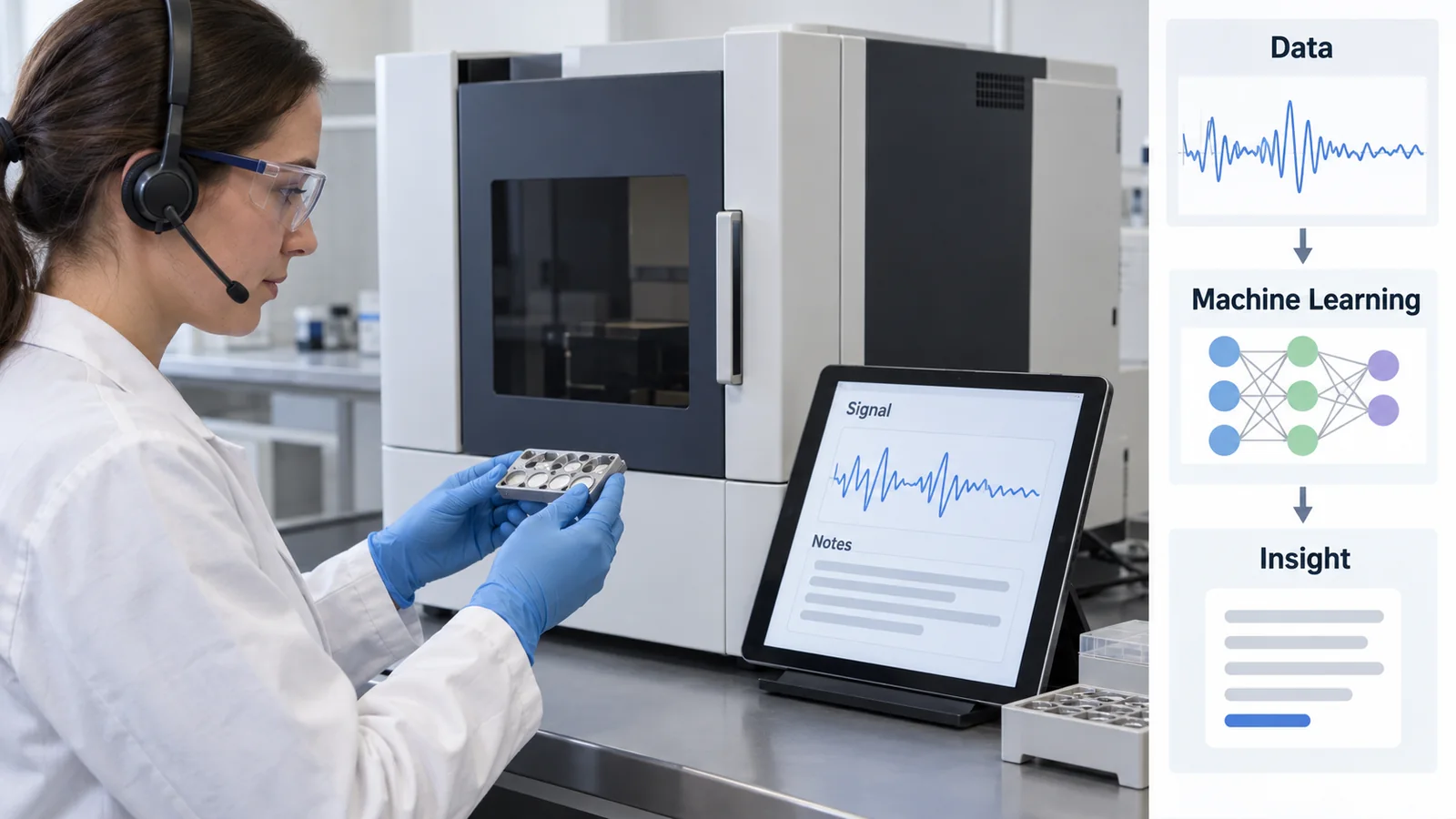
A generative model makes "something that resembles the data distribution"; there is no guarantee that it satisfies physical laws or the structure of a material. The Sora report itself lists physics errors, and the Veo 3 card admits the difficulty of consistency in complex motion [Sources 21, 22]. In materials work, treating a "plausible microscope image" or "plausible cross-section" made by a generative model as experimental data or as a figure in a paper amounts to fabricating data. Even when synthetic images are used to enlarge training data, they should be recorded so they can be told apart from real ones, and evaluation should be done on real data (this article's commentary).
As noted above, FID uses features from an Inception network trained on natural images, so, as an inference, it may not be reliable as it stands as a measure of the "fidelity" of specialist images such as materials micrographs. The paper points out that Inception's representation does not adequately capture the content generated by recent text-to-image models [Source 30].
7. Deepfakes belong to a separate explainer — the scope of this article
Generating images, video and audio also leads to misuse: making fake material indistinguishable from the real thing. This article does not cover procedures or concrete methods of misuse. A fuller account is in this series' explainer on copyright, provenance and deepfakes. Here we give only the frameworks that could be confirmed in primary documents.
- Classification of risks: NIST AI 600-1 (July 2024) sorts the risks unique to or exacerbated by generative AI into 12 items (CBRN information, confabulation, dangerous, violent or hateful content, data privacy, environmental impacts, harmful bias and homogenization, human-AI configuration, information integrity, information security, intellectual property, obscene, degrading and abusive content, and value chain and component integration). Information integrity refers to a lowered barrier to producing and circulating content that does not distinguish fact from opinion or fiction, and that could be used for large-scale disinformation and misinformation campaignsSourced [Source 46]
- What a developer says about countermeasures: the Veo 3 card acknowledges that the model can produce deepfakes, and states that their quality was lower than those made by dedicated deepfake tools and that SynthID watermarking can mitigate them in partSourced [Source 22]. This is the developer's self-assessment, not the result of independent verification
- What this article does not write: how to imitate a particular person or work, how to evade detection, or how to bypass any company's safety measures. The thinking behind countermeasures (provenance information, watermarks, the limits of detection) is set out in the separate explainer
8. Limits, and what could not be confirmed
(1) Performance of current models
The models covered here (GPT-4o, Veo 3, Moshi, FLUX.1 [dev] and others) and the evaluation values in each paper are for the time of publication and the settings stated. We have not covered every company's latest model as of 15 October 2026 or newer evaluation results. For evaluations such as BlindTest and MMMU, whose results can change as models are updated after a paper appears, numbers are not given.
(2) Developers' own evaluations
Evaluations the developers published themselves, such as Veo 3's human comparison and GPT-4o's response time, have not been checked for independent third-party reproduction. Items whose details are not given, such as the number of raters, how they were chosen and how prompts were chosen, are stated as not confirmed.
(3) Retrieving official pages
OpenAI's page for the Sora technical report refuses automated retrieval, so the full text was checked in a copy of the same page saved by the Internet Archive. ISO's standard pages cannot be retrieved automatically for the same reason, so titles, editions, publication dates and scope were checked from the official-page entries shown in search results; the texts of the standards were not checked.
(4) Internal structure and scale
Many commercial models do not disclose parameter counts, training data or required compute. This article does not estimate them (they are treated as "not disclosed" or "could not be confirmed"). The 12 billion parameters of FLUX.1 [dev] is a statement in the developer's model card.
(5) What is not covered
Image editing, image-to-3D generation, music generation, voice identity (voice cloning), copyright and training data, and deepfake detection technology are not covered in this article (some are covered in other explainers in this series). Specialist generative models for microscope images and materials data are also not covered.
- Images, audio and video enter a model only after being turned into tokens (sequences). As resolution or length grows, the sequence gets longer and the burden on computation and memory growsSourced / Our calculation
- "Reading" models are basically a vision encoder joined to a language model, and are weak at fine geometry and at "hallucinating" things that are not there. Confirm microscope-image numbers with conventional image processing and a human eyeSourced
- "Making" models are mostly diffusion and flow matching (rectified flow). They are close relatives, and we cannot say that one is betterSourced
- Real-time voice is moving from cascaded pipelines to direct speech generation. Latency figures use different definitions and are not rankedSourced
- Each metric measures something different. Do not judge image quality by FID alone; check the settings and the evaluatorSourced
9. How to read evaluations and standards
Evaluating multimodal AI has five sides: (1) statistical closeness of generated output (FID and others), (2) consistency with the input (CLIPScore, number and position of objects), (3) human preference (head-to-head comparison, scoring by raters), (4) accuracy of understanding (question answering, hallucination), and (5) speed (latency). Each is measured with a different tool, and results change with settings, versions and evaluator. Standards and guidance mostly provide frameworks for AI management, risk, terminology and quality models rather than the performance of the model itself.
| What is evaluated | Representative benchmarks and methods (name, source) | Standards and guidance (ISO/IEC, NIST, ITU and others) | Cautions when reading |
|---|---|---|---|
| Quality of generated images, closeness of distributions | FID: distance between the distributions of generated and real images in Inception-v3 features (Heusel et al., 2017) [Source 28]. Inception Score: measures quality and diversity from classifier outputs (Salimans et al., 2016) [Source 29]. CMMD: a proposal using CLIP features and maximum mean discrepancy (Jayasumana et al.) [Source 30] | No ISO/IEC or NIST standard defining a quality metric for generated images was found. ISO/IEC TS 4213:2022 addresses the assessment of machine-learning classification performance [Source 44] | There are cases where FID disagrees with human evaluation and where the result changes with the number of samples (Jayasumana et al.). Salimans et al. say it matters to evaluate Inception Score on a large number of samples (about 50,000). Applying these to specialist images such as micrographs is an inference, so take care Sourced |
| Consistency between text and image | CLIPScore: measures image-text fit with CLIP without reference captions (Hessel et al., EMNLP 2021) [Source 31]. GenEval: checks co-occurrence, position, count and color of objects with object detectors and similar models (Ghosh et al.) [Source 32] | Not found | The CLIPScore paper notes that it is weaker than reference-based metrics where contextual knowledge is needed, as with news captions. The GenEval paper reports that the models of its day were still weak at spatial relations and attribute binding Sourced |
| Multi-aspect evaluation | HEIM: evaluates text-to-image models on 12 aspects (alignment, quality, aesthetics, originality, reasoning, knowledge, bias, toxicity, fairness, robustness, multilinguality, efficiency), 62 scenarios and 26 models (Lee et al.) [Source 33] | NIST AI RMF 1.0 (NIST AI 100-1, January 2023) and the generative AI profile NIST AI 600-1 (July 2024). Both are frameworks for voluntary use [Sources 47, 46] | HEIM reports that no single model excels in all aspects; strengths differ by aspect Sourced |
| Video quality | FVD: a video version of the distribution distance (Unterthiner et al., 2018) [Source 34]. VBench: splits video quality into 16 dimensions, validated with human preference annotations (Huang et al.) [Source 35]. Developer's human comparison: the Veo 3 card uses MovieGenBench [Source 22] | Not found | The FVD paper reports good correlation with human judgment in a large-scale human study. The developer's human comparison has no rater details on the card (in what we could check). Results change with the competitors, versions and dates Sourced |
| Understanding by vision-language models | MMMU: 11,500 college-level questions, 6 disciplines, 30 subjects, 183 subfields, 30 image types (Yue et al.) [Source 36]. POPE: evaluation of object hallucination by repeated questions (Li et al.) [Source 37]. BlindTest: seven simple visual tasks (Rahmanzadehgervi et al.) [Source 38] | Not found. ISO/IEC TS 4213:2022 addresses classification performance and does not directly address free-form text generation [Source 44] | MMMU is the accuracy on academic problems, which is different from accuracy in reading images in the field. BlindTest uses artificial shapes. Results are for the models at publication and change as versions advance Sourced |
| Human preference (head-to-head) | Chatbot Arena: a method that ranks models statistically from human votes comparing two outputs (Chiang et al., a paper on LLMs) [Source 39]. Similar leaderboards for images and video were not individually checked in this article | Not found | For third-party leaderboards, check the method, update date and the mix of voters, and use them as a reference value. Do not assert rankings as fact Sourced |
| Audio quality and latency | MUSHRA (used by the EnCodec paper for subjective audio-quality evaluation) [Source 26]. Latency: GPT-4o 232 ms (minimum) and 320 ms (average) [Source 24]; Moshi 160 ms theoretical and 200 ms in practice [Source 25] | ITU-R BS.1534-3 (October 2015): subjective assessment of audio systems of intermediate quality (MUSHRA), with a hidden reference and anchors and scoring on a continuous 0-100 scale [Source 40] | No common measurement standard for latency was found. Each company's definition differs, so do not rank them. MUSHRA results change with listening conditions, listeners and anchor settings Sourced |
| AI management, risk, terminology, quality model | (a framework rather than a benchmark) | ISO/IEC 42001:2023 (AI management system, December 2023) [Source 41]. ISO/IEC 23894:2023 (guidance on AI risk management, February 2023) [Source 42]. ISO/IEC 22989:2022 (AI concepts and terminology, July 2022) [Source 43]. ISO/IEC 25059:2023 (quality model for AI systems, June 2023) [Source 45]. NIST AI 600-1 (12 risks) [Source 46] | 42001 sets requirements for an organization's management system and does not guarantee the quality of a model's output. 23894 and 22989 are guidance and terminology. 25059 organizes quality aspects. The texts are paid, so only titles and scope are given Sourced |
The organization of the table is this article's own (commentary), not our calculation. The texts of ISO/IEC standards are paid and were not checked. Checked 15 October 2026.
Three cautions for materials engineers
- Benchmark values change with settings and evaluator. Even for the same model, results change with the choice of prompts, competitors, raters and version. A human comparison run by the developer, such as Veo 3's, is not an independent evaluation. Third-party leaderboards stay at reference values after checking the method and date
- Each metric measures one thing. FID measures a distribution, CLIPScore the match with text, GenEval the count, position and color of objects, and latency measures time. Check image quality, correctness and speed separately. It is hard for a user to confirm that questions or images of a public benchmark have not leaked into the training data (this article's commentary); saturation and contamination are covered in this series' explainer on benchmarks and how to read AI evaluations
- Some standards and guidance are binding and some are not. NIST AI RMF 1.0 and AI 600-1 are frameworks for voluntary use (AI 600-1 notes that the AI RMF is intended for voluntary use). ISO/IEC 42001 is a standard that sets an organization's management system, and meeting it does not mean that an individual model's output is correct. Legally binding regulation such as the EU AI Act is covered in this series' explainer on the EU AI Act
10. Glossary
- Multimodal
- Handling several kinds of data such as text, images, audio and video.
- Vision-language model (VLM)
- A model that takes images (or video) and text as input and answers in text.
- Token
- A discrete unit a model processes. For images and audio, a patch or a codebook index.
- Patch
- A small square piece cut from an image; the unit of input to a Transformer.
- Latent representation (latent space)
- A representation smaller than the original image, compressed by an autoencoder or similar.
- VQ (vector quantization)
- Replacing a continuous value with the index of the nearest codebook entry.
- RVQ (residual vector quantization)
- Quantizing the remaining error of one quantization with the next codebook; used in audio codecs.
- Diffusion model
- A generative model that learns the reverse of adding noise and makes data from noise.
- Flow matching / rectified flow
- Ways of generating by learning paths that connect noise and data (rectified flow uses near-straight paths).
- Classifier-free guidance
- Combining conditional and unconditional estimates to adjust how closely the output follows the condition.
- DiT / MMDiT
- Transformers used as the backbone of diffusion. MMDiT has separate weights for image and text.
- FID
- Fréchet Inception Distance. The distance between distributions of features of generated and real images.
- CLIPScore
- A metric of image-text fit that uses CLIP.
- MUSHRA
- A subjective test of audio quality with a hidden reference and anchors (ITU-R BS.1534).
- Hallucination
- Stating something not in the input as if it were plausible. NIST AI 600-1 calls it confabulation.
- Full duplex
- Listening and speaking at the same time, so that overlaps and interruptions can be handled.
11. References (primary sources)
- Dosovitskiy A. et al. "An Image is Worth 16x16 Words: Transformers for Image Recognition at Scale", arXiv:2010.11929 (2020) — arxiv.org/abs/2010.11929
- Radford A. et al. "Learning Transferable Visual Models From Natural Language Supervision", arXiv:2103.00020 (2021) — arxiv.org/abs/2103.00020
- Liu H. et al. "Visual Instruction Tuning", NeurIPS 2023, arXiv:2304.08485 — arxiv.org/abs/2304.08485
- Alayrac J.-B. et al. "Flamingo: a Visual Language Model for Few-Shot Learning", arXiv:2204.14198 (2022) — arxiv.org/abs/2204.14198
- Li J. et al. "BLIP-2: Bootstrapping Language-Image Pre-training with Frozen Image Encoders and Large Language Models", arXiv:2301.12597 (2023) — arxiv.org/abs/2301.12597
- van den Oord A. et al. "Neural Discrete Representation Learning", arXiv:1711.00937 (2017) — arxiv.org/abs/1711.00937
- Esser P. et al. "Taming Transformers for High-Resolution Image Synthesis", arXiv:2012.09841 (2020) — arxiv.org/abs/2012.09841
- Rombach R. et al. "High-Resolution Image Synthesis with Latent Diffusion Models", arXiv:2112.10752 (2021) — arxiv.org/abs/2112.10752
- Ho J. et al. "Denoising Diffusion Probabilistic Models", arXiv:2006.11239 (2020) — arxiv.org/abs/2006.11239
- Song Y. et al. "Score-Based Generative Modeling through Stochastic Differential Equations", arXiv:2011.13456 (2020) — arxiv.org/abs/2011.13456
- Ho J., Salimans T. "Classifier-Free Diffusion Guidance", arXiv:2207.12598 (2022) — arxiv.org/abs/2207.12598
- Song J. et al. "Denoising Diffusion Implicit Models", arXiv:2010.02502 (2020) — arxiv.org/abs/2010.02502
- Song Y. et al. "Consistency Models", arXiv:2303.01469 (2023) — arxiv.org/abs/2303.01469
- Peebles W., Xie S. "Scalable Diffusion Models with Transformers", arXiv:2212.09748 (2022) — arxiv.org/abs/2212.09748
- Lipman Y. et al. "Flow Matching for Generative Modeling", arXiv:2210.02747 (2022) — arxiv.org/abs/2210.02747
- Liu X. et al. "Flow Straight and Fast: Learning to Generate and Transfer Data with Rectified Flow", arXiv:2209.03003 (2022) — arxiv.org/abs/2209.03003
- Esser P. et al. "Scaling Rectified Flow Transformers for High-Resolution Image Synthesis", arXiv:2403.03206 (2024) — arxiv.org/abs/2403.03206
- Black Forest Labs FLUX.1 [dev] model card (Hugging Face). Checked 15 October 2026 — huggingface.co/black-forest-labs/FLUX.1-dev
- Chameleon Team "Chameleon: Mixed-Modal Early-Fusion Foundation Models", arXiv:2405.09818 (2024) — arxiv.org/abs/2405.09818
- Zhou C. et al. "Transfusion: Predict the Next Token and Diffuse Images with One Multi-Modal Model", arXiv:2408.11039 (2024) — arxiv.org/abs/2408.11039
- OpenAI "Video generation models as world simulators", technical report (15 February 2024). The official page blocks automated fetching, so the full text was checked in an Internet Archive copy — openai.com/index/video-generation-models-as-world-simulators
- Google DeepMind "Veo 3 Model Card" (published 23 May 2025, updated 13 January 2026, as stated on the card). Checked 15 October 2026 — storage.googleapis.com/deepmind-media/Model-Cards/Veo-3-Model-Card.pdf
- Google "Video generation in the Gemini API" (page states last updated 30 June 2026). Checked 15 October 2026 — ai.google.dev/gemini-api/docs/video
- OpenAI "GPT-4o System Card", arXiv:2410.21276; the system card itself is dated 8 August 2024 (cdn.openai.com/gpt-4o-system-card.pdf) — arxiv.org/abs/2410.21276
- Défossez A. et al. (Kyutai) "Moshi: a speech-text foundation model for real-time dialogue", arXiv:2410.00037 (2024) — arxiv.org/abs/2410.00037
- Défossez A. et al. "High Fidelity Neural Audio Compression", arXiv:2210.13438 (2022) — arxiv.org/abs/2210.13438
- Zeghidour N. et al. "SoundStream: An End-to-End Neural Audio Codec", arXiv:2107.03312 (2021) — arxiv.org/abs/2107.03312
- Heusel M. et al. "GANs Trained by a Two Time-Scale Update Rule Converge to a Local Nash Equilibrium", NeurIPS 2017, arXiv:1706.08500 (the paper that introduced FID) — arxiv.org/abs/1706.08500
- Salimans T. et al. "Improved Techniques for Training GANs", arXiv:1606.03498 (2016) — arxiv.org/abs/1606.03498
- Jayasumana S. et al. "Rethinking FID: Towards a Better Evaluation Metric for Image Generation", arXiv:2401.09603 (2023) — arxiv.org/abs/2401.09603
- Hessel J. et al. "CLIPScore: A Reference-free Evaluation Metric for Image Captioning", EMNLP 2021, arXiv:2104.08718 — arxiv.org/abs/2104.08718
- Ghosh D. et al. "GenEval: An Object-Focused Framework for Evaluating Text-to-Image Alignment", arXiv:2310.11513 (2023) — arxiv.org/abs/2310.11513
- Lee T. et al. "Holistic Evaluation of Text-To-Image Models", arXiv:2311.04287 (2023) — arxiv.org/abs/2311.04287
- Unterthiner T. et al. "Towards Accurate Generative Models of Video: A New Metric & Challenges", arXiv:1812.01717 (2018) — arxiv.org/abs/1812.01717
- Huang Z. et al. "VBench: Comprehensive Benchmark Suite for Video Generative Models", arXiv:2311.17982 (2023) — arxiv.org/abs/2311.17982
- Yue X. et al. "MMMU: A Massive Multi-discipline Multimodal Understanding and Reasoning Benchmark for Expert AGI", arXiv:2311.16502 (2023) — arxiv.org/abs/2311.16502
- Li Y. et al. "Evaluating Object Hallucination in Large Vision-Language Models", arXiv:2305.10355 (2023) — arxiv.org/abs/2305.10355
- Rahmanzadehgervi P. et al. "Vision language models are blind: Failing to translate detailed visual features into words", arXiv:2407.06581 (2024; v6 of March 2025) — arxiv.org/abs/2407.06581
- Chiang W.-L. et al. "Chatbot Arena: An Open Platform for Evaluating LLMs by Human Preference", arXiv:2403.04132 (2024) — arxiv.org/abs/2403.04132
- ITU-R Recommendation ITU-R BS.1534-3 (10/2015), "Method for the subjective assessment of intermediate quality level of audio systems" (MUSHRA) — itu.int (R-REC-BS.1534-3-201510)
- ISO/IEC ISO/IEC 42001:2023, "Information technology — Artificial intelligence — Management system" (Edition 1, December 2023) — iso.org/standard/81230.html
- ISO/IEC ISO/IEC 23894:2023, "Information technology — Artificial intelligence — Guidance on risk management" (Edition 1, February 2023) — iso.org/standard/77304.html
- ISO/IEC ISO/IEC 22989:2022, "Information technology — Artificial intelligence — Artificial intelligence concepts and terminology" (Edition 1, July 2022) — iso.org/standard/74296.html
- ISO/IEC ISO/IEC TS 4213:2022, "Information technology — Artificial intelligence — Assessment of machine learning classification performance" — iso.org/standard/79799.html
- ISO/IEC ISO/IEC 25059:2023, "Software engineering — Systems and software Quality Requirements and Evaluation (SQuaRE) — Quality model for AI systems" (Edition 1, June 2023) — iso.org/standard/80655.html
- NIST NIST AI 600-1, "Artificial Intelligence Risk Management Framework: Generative Artificial Intelligence Profile" (July 2024) — doi.org/10.6028/NIST.AI.600-1
- NIST NIST AI 100-1, "Artificial Intelligence Risk Management Framework (AI RMF 1.0)" (January 2023) — doi.org/10.6028/NIST.AI.100-1
12. Claim-to-source audit
| Claim in the text | Basis | Class |
|---|---|---|
| ViT splits an image into P×P patches so that the sequence length is N = HW/P² [Source 1]; CLIP was pretrained on 400 million image-text pairs and matched ResNet-50 on ImageNet without using its training images [Source 2] | Reference 1 https://arxiv.org/abs/2010.11929 Reference 2 https://arxiv.org/abs/2103.00020 | Sourced |
| Vision-language model designs (LLaVA: CLIP + Vicuna with GPT-4-generated instruction data; Flamingo; BLIP-2: Querying Transformer and its 8.7% / 54x-fewer-parameters report; Chameleon: early-fusion token-based) | Reference 3 https://arxiv.org/abs/2304.08485 Reference 4 https://arxiv.org/abs/2204.14198 Reference 5 https://arxiv.org/abs/2301.12597 Reference 19 https://arxiv.org/abs/2405.09818 | Sourced |
| BlindTest (7 tasks, four-model average 58.07%, best 77.84%, expected human accuracy 100%, near 100% with more spacing, linear probing); POPE and object hallucination; MMMU (11,500 questions, 6 disciplines, 30 subjects, 183 subfields, 30 image types) | Reference 38 https://arxiv.org/abs/2407.06581 Reference 37 https://arxiv.org/abs/2305.10355 Reference 36 https://arxiv.org/abs/2311.16502 | Sourced |
| VQ-VAE discrete codes; VQGAN's "vocabulary of image constituents"; latent diffusion (hundreds of GPU days, latent space, cross-attention); SoundStream (3-18 kbps, RVQ); EnCodec (1.5-24 kbps at 24 kHz, 1024-entry codebooks); Mimi (12.5 Hz, 8 codebooks of 2048, 1.1 kbps, 80 ms frame); Sora report (compression to latents and spacetime patches, details not disclosed) | Reference 6 https://arxiv.org/abs/1711.00937 Reference 7 https://arxiv.org/abs/2012.09841 Reference 8 https://arxiv.org/abs/2112.10752 Reference 27 https://arxiv.org/abs/2107.03312 Reference 26 https://arxiv.org/abs/2210.13438 Reference 25 https://arxiv.org/abs/2410.00037 Reference 21 https://openai.com/index/video-generation-models-as-world-simulators/ | Sourced |
| ViT: 196 to 784 tokens at 224 to 448 px (N² 38,416 to 614,656, x16); DiT: 256 to 1,024 tokens at 256 to 512 px; Mimi: 100 tokens/s and 1.1 kbps, about 349x versus 24 kHz / 16-bit / mono (384 kbps) | Our calculation using the formulas and values in the papers (ViT: N = HW/P²; DiT: T = (I/p)² with 256 and 1,024 tokens; Mimi: 12.5 Hz, 8 codebooks, 2048 entries). The uncompressed-audio baseline (24 kHz, 16-bit, mono) is our assumption. Attention cost does not simply scale by 16 | Our calculation |
| DDPM (FID 3.17, Inception score 9.46 on CIFAR-10); SDE formulation; DDIM (10-50x faster in wall-clock time); consistency models (one-step generation); classifier-free guidance; DiT (FID 2.27; relation between Gflops and FID) | Reference 9 https://arxiv.org/abs/2006.11239 Reference 10 https://arxiv.org/abs/2011.13456 Reference 12 https://arxiv.org/abs/2010.02502 Reference 13 https://arxiv.org/abs/2303.01469 Reference 11 https://arxiv.org/abs/2207.12598 Reference 14 https://arxiv.org/abs/2212.09748 | Sourced |
| Flow matching (includes diffusion paths as special cases); rectified flow (near-straight paths, high quality even in one step); Stable Diffusion 3 (rectified flow + MMDiT); FLUX.1 [dev] (12-billion-parameter rectified flow transformer, checked 15 October 2026) | Reference 15 https://arxiv.org/abs/2210.02747 Reference 16 https://arxiv.org/abs/2209.03003 Reference 17 https://arxiv.org/abs/2403.03206 Reference 18 https://huggingface.co/black-forest-labs/FLUX.1-dev | Sourced |
| GPT-4o system card (dated 8 August 2024; omni model trained end to end); Transfusion (next-token prediction + diffusion; 7 billion parameters, 2 trillion tokens) | Reference 24 https://arxiv.org/abs/2410.21276 Reference 20 https://arxiv.org/abs/2408.11039 | Sourced |
| Sora technical report (15 February 2024; spacetime patches; one-minute video; physics limits; "world simulator" as a suggestion); Veo 3 model card (latent diffusion; TPUs and JAX; MovieGenBench human comparison as the developer's statement; limits in consistency of complex motion; deepfakes and SynthID); Gemini API video page (Gemini Omni Flash and Veo 3.1; last updated 30 June 2026) | Reference 21 https://openai.com/index/video-generation-models-as-world-simulators/ Reference 22 https://storage.googleapis.com/deepmind-media/Model-Cards/Veo-3-Model-Card.pdf Reference 23 https://ai.google.dev/gemini-api/docs/video | Sourced |
| Problems of cascaded pipelines (latency, information loss, turn segmentation); Moshi (full duplex; 160 ms theoretical / 200 ms practical; two streams); GPT-4o audio response time (232 ms minimum / 320 ms average) | Reference 25 https://arxiv.org/abs/2410.00037 Reference 24 https://arxiv.org/abs/2410.21276 | Sourced |
| FID (distance between Inception-v3 feature distributions); Inception Score (about 50,000 samples recommended); CMMD and the problems of FID; CLIPScore (reference-free; weaker where contextual knowledge is needed); GenEval; HEIM (12 aspects, 62 scenarios, 26 models); FVD; VBench (16 dimensions); Chatbot Arena (pairwise preference votes) | Reference 28 https://arxiv.org/abs/1706.08500 Reference 29 https://arxiv.org/abs/1606.03498 Reference 30 https://arxiv.org/abs/2401.09603 Reference 31 https://arxiv.org/abs/2104.08718 Reference 32 https://arxiv.org/abs/2310.11513 Reference 33 https://arxiv.org/abs/2311.04287 Reference 34 https://arxiv.org/abs/1812.01717 Reference 35 https://arxiv.org/abs/2311.17982 Reference 39 https://arxiv.org/abs/2403.04132 | Sourced |
| ITU-R BS.1534-3 (October 2015; MUSHRA); ISO/IEC 42001:2023, 23894:2023, 22989:2022, TS 4213:2022 (classification performance), 25059:2023; NIST AI 100-1 (January 2023); NIST AI 600-1 (July 2024; 12 risks; voluntary framework). ISO numbers, titles, editions and dates follow the official pages; full texts were not checked | Reference 40 https://www.itu.int/dms_pubrec/itu-r/rec/bs/R-REC-BS.1534-3-201510-I!!PDF-E.pdf Reference 41 https://www.iso.org/standard/81230.html Reference 42 https://www.iso.org/standard/77304.html Reference 43 https://www.iso.org/standard/74296.html Reference 44 https://www.iso.org/standard/79799.html Reference 45 https://www.iso.org/standard/80655.html Reference 47 https://doi.org/10.6028/NIST.AI.100-1 Reference 46 https://doi.org/10.6028/NIST.AI.600-1 | Sourced |
| The 12 risk categories of NIST AI 600-1, the definition of "information integrity", the environmental-impact item, and the Veo 3 card's statement on deepfakes and SynthID (the developer's self-assessment) | Reference 46 https://doi.org/10.6028/NIST.AI.600-1 Reference 22 https://storage.googleapis.com/deepmind-media/Model-Cards/Veo-3-Model-Card.pdf | Sourced |
| Latest models and evaluation values of each company, independent third-party reproductions, the full texts of ISO/IEC standards, internal scale and memory needs of video-generation models, specifics of image/video arena leaderboards, and vision-language model performance on microscope images | Could not be confirmed in the primary sources accessible within this article's scope, so not stated | Commentary |
| The readings "separate counting/measuring from classification drafts for microscope images", "high resolution and long duration in generative AI are carried by compute and memory", "a plausible image is not a physically correct image", "FID may not carry over to specialist images (inference)", "do not rank latency figures", and the tables in Sections 3 and 9 | This article's own organization and explanation based on published content; not views expressed by any company or institution | Commentary |
| Figs. 2 to 6 are explanatory drawings, not measured data; Figs. 1 and 7 are AI-generated image slots | A note by this article | Commentary |
Last updated 15 October 2026. Sources are limited to primary material (arXiv papers, developers' model cards, system cards and technical reports, and official pages of NIST, ISO and ITU). The texts of ISO/IEC standards are paid and could not be checked. Because the article includes readings and organization of its own, these are marked as Commentary and kept separate from sourced fact. Each company's latest models and latest evaluation values, independent third-party reproductions, the texts of the standards, and the internal scale of video-generation models could not be confirmed and are not stated here. Evaluation values are for the time of publication and the settings given, and do not show which model is better. Figs. 2 to 6 are vector drawings; Figs. 1 and 7 are AI-generated image slots (none of them shows a real measurement result or a physical product).