COMPANY PROFILE / BIOSENSORS
Abbott
A diversified health-care company whose FreeStyle Libre and Lingo glucose sensors and i-STAT point-of-care tests put it squarely in biosensors
Abbott comes up in any discussion of biosensors because inside a global health-care group it runs both a large continuous glucose monitoring (CGM) business and a point-of-care testing business built on electrochemical sensors (i-STAT). In 2025 the group reported sales of US$44,328 million, of which the Diabetes Care business accounted for US$7,998 million (about 18%), according to its Form 10-K. FreeStyle Libre and Lingo are product names, not companies. This profile covers only the part of Abbott that touches biosensors, namely continuous glucose monitoring in Diabetes Care and point-of-care testing (POCT) in Diagnostics, using primary sources only. It is not a recommendation to use any product.
- Abbott in 30 seconds, and where it stands in biosensors
- The logo and how the name is written
- Where the company sits in the field
- Scale
- Resources committed to biosensors
- What it has done so far
- What comes next
- What the company is aiming for in biosensors
- Map of partnerships in biosensors
- Technologies, products and services
- The risks this company carries
- Glossary, references and claim-to-source audit
1. Abbott in 30 seconds, and where it stands in biosensors
In vitro diagnostics & POCT (secondary)The group as a whole is a diversified health-care company with four segments
chemistry and immunoassay targets in whole bloodFDA documents: Libre uses amperometric measurement with glucose oxidase
Abbott is not a dedicated biosensor company; it is a diversified group in which two of its businesses (diabetes and diagnostics) are biosensor businesses. Diabetes Care is about 18% of group sales and about 37% of the Medical Devices segment Our calculation (US$7,998 million / US$44,328 million, and / US$21,387 million). In the 10-K, Diabetes Care is a sales category inside the Medical Devices segment, so operating profit and R&D spending for Diabetes Care alone are not disclosed Not yet confirmed. The Diagnostics segment, by contrast, discloses sales, R&D and operating earnings at the segment level Sourced.
2. The logo and how the name is written

A note on names: the legal name is Abbott Laboratories. The diabetes business operates as Abbott Diabetes Care (the applicant name in FDA documents, which list a site in Alameda, California). FreeStyle Libre, Libre Rio, Libre Duo, Lingo, i-STAT and ID NOW are product names, not companies. The logo was taken from the company's official website (abbott.com).
Official site: https://www.abbott.com/3. Where the company sits in the field
4. Scale
Abbott is large, so group-wide figures are kept brief and the discussion centers on the parts that touch biosensors (Diabetes Care and Diagnostics). The figures below come from the 10-K Sourced.
| Indicator (US$ million) | 2023 | 2024 | 2025 | Change in 2025 |
|---|---|---|---|---|
| Group sales | 40,109 | 41,950 | 44,328 | +5.7% (our calculation) |
| Group R&D expense | 2,741 | 2,844 | 2,942 | +3.4% (our calculation) |
| Diabetes Care sales | 5,761 | 6,805 | 7,998 | +17.5% (+16.3% excluding exchange; 10-K) |
| Diagnostics segment sales | 9,988 | 9,341 | 8,937 | -4.3% (our calculation) |
| Diagnostics R&D expense | 698 | 656 | 602 | -8.2% (our calculation) |
| Diagnostics operating earnings | 2,433 | 2,073 | 1,740 | -16.1% (our calculation) |
| Medical Devices segment sales (including Diabetes Care) | 16,887 | 18,986 | 21,387 | +12.6% (our calculation) |
| Diagnostics sales categories (US$ million) | 2024 | 2025 | Change | Note |
|---|---|---|---|---|
| Core Laboratory | 5,235 | 5,360 | +2.4% | Immunoassay, clinical chemistry, hematology and more |
| Molecular | 521 | 517 | -0.7% | PCR instruments and others |
| Point of Care | 588 | 606 | +3.1% | i-STAT and others |
| Rapid Diagnostics | 2,997 | 2,454 | -18.1% | COVID-19-related sales were US$285 million in 2025 and US$725 million in 2024 |
Of Diabetes Care's 2025 sales, US$3,181 million were in the U.S. and US$4,817 million outside it (results release for October to December 2025). In the first half of 2026, Diabetes Care sales were US$4,268 million (up 12.1% on the first half of 2025), of which April to June was US$2,188 million; CGM sales grew 11.0% as reported (9.5% on a comparable basis) in April to June Sourced. In October to December 2025, CGM sales were US$2.0 billion (up 15.0%) per the results release. The group had about 115,000 employees, 69% of them outside the U.S. (end of 2025), and 89 manufacturing sites worldwide, 33 in Medical Devices and 21 in Diagnostics.
From 2026 the Diagnostics categories changed (Core Laboratory, Rapid and Molecular, and Cancer Diagnostics from Exact Sciences). Of the US$3,092 million of Diagnostics sales in April to June 2026, US$919 million came from Exact Sciences (cancer tests), which Abbott acquired in March 2026 and which is outside the biosensor scope. The 2025 and 2026 Diagnostics sales are therefore not directly comparable. "Point of Care", which includes i-STAT, is not shown as a separate line in the 2026 filings (10-Q), and this article does not estimate it Not yet confirmed.
5. Resources committed to biosensors
Abbott discloses almost no people or investment figures specific to biosensors. Below, group-wide or segment-level values are separated from what could not be confirmed.
| Resource | What primary sources confirm | Status |
|---|---|---|
| People | About 115,000 employees group-wide (31 December 2025; 69% outside the U.S.). Of 89 manufacturing sites, 33 are in Medical Devices and 21 in Diagnostics. R&D facilities in the U.S. are mainly in California, Illinois, Minnesota, New Jersey and Ohio. Headcount for Diabetes Care or point of care alone is not disclosed | Sourced / partly undisclosed |
| Money (R&D) | Group: US$2,741 million in 2023, US$2,844 million in 2024, US$2,942 million in 2025. Diagnostics: US$602 million in 2025; Medical Devices: US$1,753 million. R&D for Diabetes Care alone is not disclosed | Sourced / partly undisclosed |
| Money (capital expenditure) | Group purchases of property and equipment: US$2,171 million in 2025 (US$2,207 million in 2024, US$2,202 million in 2023). Amounts for Diabetes Care or Diagnostics alone, or for Libre plants, are not confirmed | Sourced / partly not confirmed |
| Acquisitions and investments | Acquisition of Exact Sciences completed on 23 March 2026 (US$105 per share in cash; agreement signed 19 November 2025). Cash paid for business acquisitions in the first half of 2026 was US$19,962 million (10-Q), and US$20 billion of senior notes were issued in February to March 2026 (8-K). Exact Sciences is a cancer-testing company and outside the biosensor scope. No acquisitions or investments in diabetes or point of care were found in the sources checked | Sourced / diabetes and POC deals not found |
| Universities, research institutes, public funding | ClinicalTrials.gov lists 77 studies with Abbott Diabetes Care as sponsor or collaborator (43 as lead sponsor) and 17 for Abbott Point of Care (searched 4 October 2026). NIH or other public grant funding is not confirmed in the 10-K | Sourced / public funding not confirmed |
Regulatory standing (confirmed in FDA's official documents)
| Product | Use (as written in FDA documents) | Category and number | Date |
|---|---|---|---|
| FreeStyle Libre 3 / Libre 2 family (including the Libre 2 Plus and Libre 3 Plus sensors) | Management of diabetes. The Libre 2 Plus sensor is for ages 2 and older and is intended to communicate with other devices including automated insulin dosing (AID) systems. The FDA summary lists wear of up to 14 days for Libre 3 and up to 15 days for Libre 3 Plus | 510(k) clearance K233537 (product code QBJ). The original Libre 3 was K212132 (product code QLG) | 23 April 2024 (K212132: 26 May 2022) |
| Lingo | Over-the-counter (OTC) continuous glucose monitor for people 18 and older who are not on insulin. Helps detect euglycemic and dysglycemic levels and understand how diet and exercise relate to glucose excursions. The document says the user is not intended to take medical action on the output without consulting a qualified health care professional | 510(k) clearance K233655 (product code SAF) | 29 May 2024 |
| Libre Rio | OTC continuous glucose monitor for people 18 and older who are not on insulin | 510(k) clearance K233861 (product code SBH) | 7 June 2024 |
| Libre Duo 10 Day | An integrated system that measures glucose and ketones continuously (21 CFR 862.1354, product code SJD). In the company's announcement, for people with type 1 or type 2 diabetes aged 2 and older who use insulin or SGLT2 inhibitors (FDA's decision summary was not found) | De Novo authorization DEN250049 | 25 August 2026 |
| i-STAT Crea cartridge (i-STAT 1) | Quantification of creatinine in arterial, venous or capillary whole blood at the point of care or in a clinical laboratory. Prescription use | 510(k) clearance K261039 (product code CGL, enzymatic ion-based electrode) | 26 June 2026 |
| i-STAT hs-TnI cartridge (i-STAT Alinity) | Quantification of cardiac troponin I in whole blood or plasma, as an aid in the diagnosis of myocardial infarction, at the point of care or in a laboratory | 510(k) clearance K253051 (product code MMI) | 11 June 2026 |
The Libre products, Lingo and i-STAT are all 510(k) clearances; only Libre Duo is a De Novo authorization. None is a PMA approval. Abbott's U.S. Libre website states that the product is for prescription only (company statement). For Libre Duo, the company announced a CE mark in Europe in May 2026 (second-quarter results release). The status of approvals or certifications in Japan was not checked for this article Not yet confirmed.
The FDA summary for Lingo says the Lingo biosensor's hardware and technology are "based on" the already-cleared FreeStyle Libre 2 sensor (K222447), and that the user-contacting materials (patch mount, adhesive pad, plug components, introducer needle and sensor) are identical to Libre 2, so the biocompatibility evaluation under ISO 10993-1 carries over Sourced. The electron-beam sterilization validation (ISO 11137-1 and -2) done for Libre 2 is likewise treated as applicable. From the materials side, a well-developed combination of electrode, enzyme, adhesive and sterilization is being reused across prescription and over-the-counter products Not yet confirmed.
6. What it has done so far
Abbott has a long history in biosensors, but this section lists only events whose dates could be confirmed in public documents.
| When | Event | Meaning |
|---|---|---|
| 26 May 2022 | FreeStyle Libre 3 received 510(k) clearance (K212132, product code QLG, the category not intended for use with automated insulin dosing systems) | The sensor-integrated generation. Libre 2 had several clearances from 2020 onward |
| 23 April 2024 | The Libre 3 / Libre 2 family (including the Libre 2 Plus and Libre 3 Plus sensors) received 510(k) clearance (K233537, product code QBJ) | Includes a use intended to communicate with automated insulin dosing systems |
| 29 May 2024 | Lingo received 510(k) clearance (K233655) | OTC for people 18 and older not on insulin; based on the Libre 2 sensor |
| 7 June 2024 | Libre Rio received 510(k) clearance (K233861) | Another OTC continuous glucose monitor |
| 24 July 2024 | Correction notice for Libre 3 sensors. FDA's record says users reported erroneously high readings | FDA's quantity field shows 8,174 units for that product number. See the risk section |
| 20 December 2024 | Confidential settlement and patent license agreement with DexCom (listed in Dexcom's 10-K exhibit list) | Resolves a dispute with a rival. Contents not public |
| 19 November 2025 | Agreement to acquire Exact Sciences, a cancer-testing company | The 10-K says it will let Abbott enter cancer diagnostics. Outside the biosensor scope |
| 24 November 2025 | Correction notice for Libre 3 and Libre 3 Plus sensors. FDA's record cites a manufacturing process issue that may cause carbon build-up in the sensor and incorrect low readings | FDA's quantity field shows 1,060,723 units (for that product number's line) |
| 23 March 2026 | Acquisition of Exact Sciences completed (US$105 per share in cash) | Cash paid for business acquisitions in the first half of 2026: US$19,962 million |
| May 2026 | Libre Duo (a sensor measuring glucose and ketones) received a CE mark in Europe (company announcement) | Obtained in Europe before the U.S. |
| 11 and 26 June 2026 | The i-STAT hs-TnI cartridge (for i-STAT Alinity) and the i-STAT Crea cartridge received 510(k) clearance (K253051, K261039) | Broadening the POCT cartridge menu |
| 25 August 2026 | Libre Duo 10 Day received De Novo authorization (DEN250049), a new FDA category for integrated glucose-ketone monitors (21 CFR 862.1354) | About 11 months after the application was received on 29 September 2025 (openFDA record) |
7. What comes next
In its announcement of 25 August 2026, the company stated the following plans Not yet confirmed.
- Libre Duo integrations: Beta Bionics (iLet) and Sequel Med Tech (twiist) "by the end of this year"; Insulet and Tandem in 2027; MiniMed expected in 2027.
- Abbott and MiniMed (Medtronic's diabetes business) are collaborating on an exclusive integration between Abbott-manufactured glucose-ketone sensors and MiniMed's smart dosing systems.
- Libre Duo 10 Day wears for up to 10 days; per the company, 84.1% of adult sensors and 68.8% of pediatric sensors lasted the full duration (study conditions were not confirmed here).
Operating profit, R&D and capital expenditure for Diabetes Care alone / production capacity by Libre plant / 2026 sales of the point-of-care business (the categories changed) / FDA's decision summary for Libre Duo (not found on FDA's site as of 4 October 2026) / the status of approvals or certifications in Japan / public grant funding. None appears in the primary sources checked for this article.
8. What the company is aiming for in biosensors
This section separates what the company says it is aiming for from what this article reads into the record. An Inference is our interpretation of primary sources, not a statement by the company.
| What can be read | Supporting primary information | Category |
|---|---|---|
| Extending what is measured from glucose to ketones as well | De Novo authorization for Libre Duo (a new FDA category, 862.1354) and the CE mark (company announcement). The company calls it the "world's first" dual glucose-ketone sensor (company claim) | Sourced (authorization) / Inference (future emphasis) |
| Having over-the-counter products in addition to prescription ones | OTC 510(k) clearances for Lingo and Libre Rio (2024). The Lingo summary says it is based on the Libre 2 sensor | Sourced |
| Connecting to automated insulin delivery systems from several makers | August 2026 announcement: planned integrations with Beta Bionics, Sequel Med Tech, Insulet, Tandem and MiniMed | Sourced (company plan) |
| Widening the menu of hand-held point-of-care cartridges | 510(k) clearances for i-STAT hs-TnI, Crea and others in 2024 to 2026; the 10-K's description of Diagnostics lists i-STAT | Sourced (clearances) / Inference (policy) |
| Shifting the center of Diagnostics toward laboratory and cancer testing | The Exact Sciences acquisition (not biosensors). Rapid Diagnostics fell 18.1% in 2025 as COVID-19-related sales declined | Sourced / Inference |
The reading that the company is "widening both what it measures and where it sells" rests on three kinds of authorization in about two years: prescription (Libre), over the counter (Lingo and Libre Rio) and ketone sensing (Libre Duo). The FDA summary for Lingo says its hardware and technology are based on the Libre 2 sensor and that the user-contacting materials are identical, so the basic sensor design is being reused for a different intended population Sourced. However, how Libre Duo measures ketones is not described in the FDA documents or company materials checked for this article, so whether it extends the Libre design or is a new design cannot be confirmed Not yet confirmed.
9. Map of partnerships in biosensors
The integration partners named are those in the company's announcement of 25 August 2026 about Libre Duo. As for MiniMed, Dexcom's 10-K describes it as the entity into which Medtronic's diabetes business was separated. Abbott's announcement says only "an exclusive integration between Abbott-manufactured sensors and MiniMed systems," and neither supply performance nor contract terms were confirmed here Not yet confirmed. Integration partners for existing products such as Libre Rio and Lingo are not listed in the primary sources checked for this article.
10. Technologies, products and services
Abbott's biosensor-related products fall into two broad forms: on-body sensors that measure continuously (Libre, Lingo) and cartridge-based tests that measure whole blood in minutes at the point of care (i-STAT). The 10-K lists them as Diabetes Care products (in the Medical Devices segment) and point-of-care products (in Diagnostics) Sourced. Performance figures are marked as either manufacturer's stated values or FDA review documents; no ranking is made across products or tests.
| Product | What the official documents say | Note |
|---|---|---|
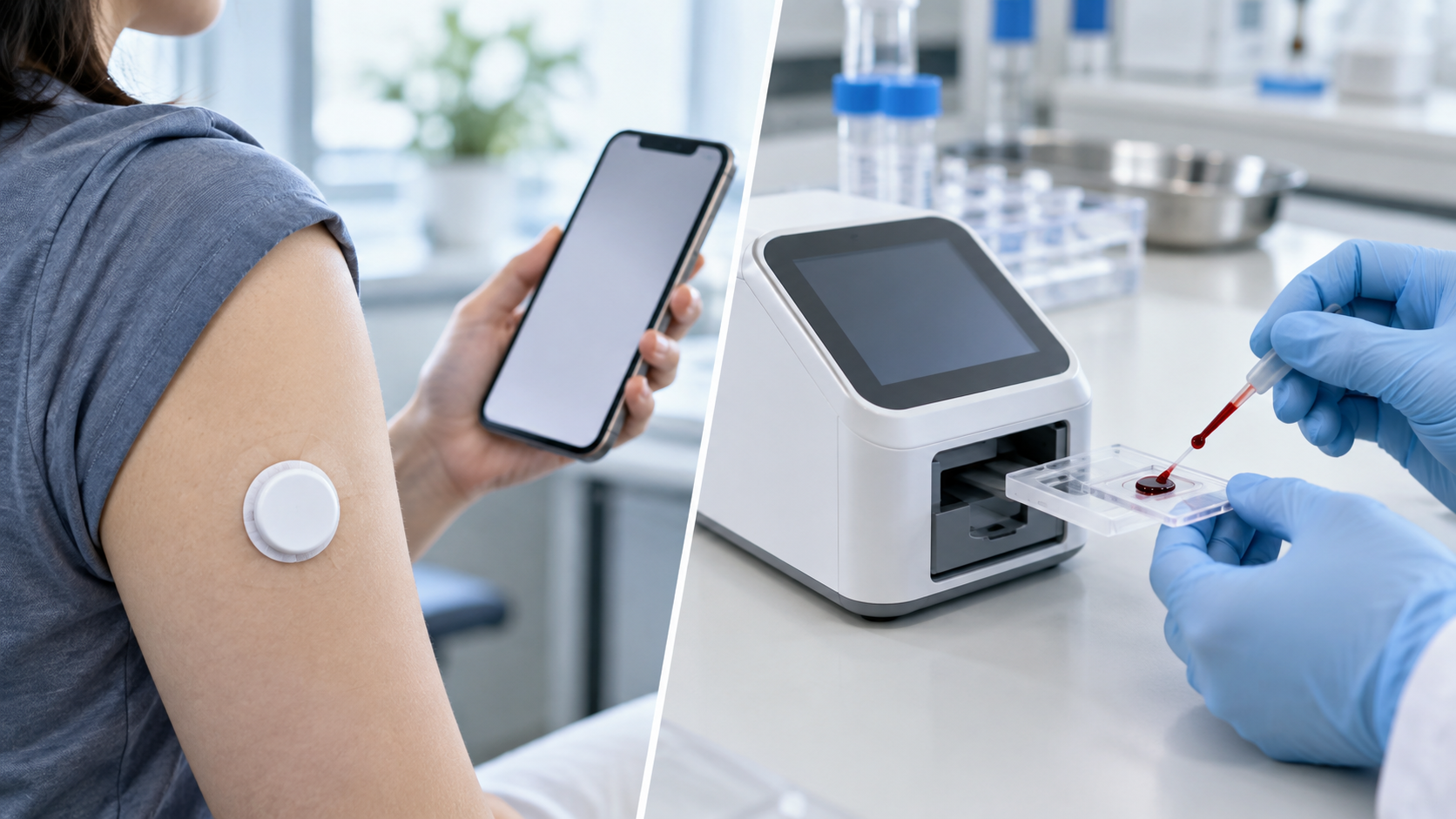
| FreeStyle Libre 3 / 3 Plus | FDA document (K233537): measures glucose in interstitial fluid as a current through a glucose oxidase reaction (amperometry). Test range 40 to 400 mg/dL. The sensor is single-use and powered by a silver oxide battery; the sensor tail is inserted under the skin with a needle that then retracts, and the sensor stays attached to the back of the upper arm with a medical-grade adhesive. Wear of up to 14 days for Libre 3 and up to 15 days for Libre 3 Plus. NFC is used to start a sensor and Bluetooth Low Energy to receive data on the app | Prescription (the company's site says "prescription only") |
| FreeStyle Libre 2 / 2 Plus | FDA document (K233537): a CGM with real-time alarms. The Libre 2 Plus sensor is for ages 2 and older. The Libre 2 Plus sensor has an 8-hour memory capacity | Includes a use intended to communicate with other devices |
| Lingo | FDA document (K233655): an OTC continuous glucose monitor for people 18 and older not on insulin. Hardware and technology are based on the FreeStyle Libre 2 (K222447) sensor | Said to help detect glucose levels and understand how diet and exercise relate to them |
| Libre Rio | FDA document (K233861): an OTC integrated CGM for people 18 and older not on insulin | U.S. sales status was not checked here |
| Libre Duo 10 Day | FDA: De Novo authorization (DEN250049), an integrated system measuring glucose and ketones continuously. Company announcement: wear of up to 10 days; 84.1% of adult sensors and 68.8% of pediatric sensors lasted the full duration | U.S. launch planned for later in 2026 (company). Figures are the company's; conditions not confirmed |
| Blood glucose meters and test strips (FreeStyle and others) | 10-K: continuous and blood glucose monitoring systems, test strips and accessories under the FreeStyle and Libre brands | Individual products and performance are not covered here |
| i-STAT / i-STAT Alinity | 10-K: cartridges for blood gases, chemistry, electrolytes, coagulation and immunoassay. FDA document (K261039): the creatinine cartridge is classified as an "enzymatic ion-based electrode" (product code CGL). K253051: hs-TnI is an aid in diagnosing myocardial infarction | Whole blood is tested at the bedside. The cartridges centre on electrochemical sensors (our reading of the K261039 classification name) |
| ID NOW, BinaxNOW, Afinion and others | 10-K: rapid molecular (isothermal nucleic acid amplification), lateral-flow and cardiometabolic tests. The ID NOW respiratory viral tests received 510(k) clearance on 31 August 2026 (K262747, product codes include OCC) | Rapid immunoassay and molecular tests rather than biosensors; outside this article's scope |
According to FDA review documents, Libre is a single-use sensor that measures the current from an enzyme (glucose oxidase) reaction at an electrode and runs on a silver oxide battery. It is held on the skin with a medical-grade adhesive, and the applicator's sub-component is electron-beam sterilized Sourced. The sensor tail goes under the skin with a needle that then retracts, and the adhesive is what holds the unit on the skin for up to 14 to 15 days. Reuse of the same design is documented in the Lingo FDA summary: the user-contacting materials (patch mount, adhesive pad, plug components, introducer needle, sensor) are said to be identical to Libre 2, and biocompatibility and electron-beam sterilization validation are carried over Sourced.
Process control, in turn, bears directly on performance. FDA's recall record gives the cause of the November 2025 correction as "a manufacturing process issue that may cause carbon build up in the sensor," which may result in incorrect low readings (root-cause category "process control"). For the July 2024 notice the category is "process design," and the trigger was reports of erroneously high readings Sourced. Which process or material was involved is not public. It is conceivable that an electrode material or a printing or deposition step was involved, but that is an Inference and has not been confirmed.
11. The risks this company carries
| Risk | Detail | Category |
|---|---|---|
| Recalls and correction notices | FDA's recall database lists correction notices for Libre sensors that started on 24 July 2024 (reports of erroneously high readings) and on 24 November 2025 (a manufacturing process issue that may cause carbon build-up and incorrect low readings). The quantity fields show 8,174 and 1,060,723 units respectively (for the product-number lines concerned). The notices describe steps for checking affected sensors and obtaining replacements. Responses for individual users are set out in each notice; this article gives no advice to users | Sourced (as recorded by FDA) |
| A shrinking Diagnostics segment | Diagnostics sales fell from US$9,988 million in 2023 to US$8,937 million in 2025. Rapid Diagnostics fell 18.1% in 2025 on lower COVID-19-related demand. Diagnostics operating earnings fell from US$2,433 million to US$1,740 million (-28.5%, our calculation) | Sourced / Our calculation |
| Debt from the acquisition | The 10-K says consolidated indebtedness was about US$12.9 billion at the end of 2025 and that Abbott planned to fund the Exact Sciences acquisition with about US$20 billion of borrowings. US$20 billion of senior notes were issued in February to March 2026 (8-K). This article does not assess the effect on the biosensor business | Sourced |
| Group-wide litigation | The 10-K describes lawsuits over infant formula, among others. These are unrelated to the biosensor business and outside this article's scope | Sourced (out of scope) |
| Competition and a changing market definition | Dexcom's 10-K names Abbott's Diabetes Care as a main competitor (including for Stelo), and notes that FDA's January 2026 guidance broadening "general wellness devices" may matter for over-the-counter monitors (statements in another company's filing) | Sourced (another company's statement) |
| Many integrations are only planned | Integration of Libre Duo with other companies' systems is planned for late 2026 to 2027. Whether it happens or slips is not yet confirmed | Not yet confirmed |
| Verifying the business unit from outside | Diabetes Care is a category inside a segment, with no operating profit, R&D or capital expenditure disclosed. Point of care is not a separate line in the 2026 filings | Not yet confirmed |
| Group-wide trade and currency risks | The 10-K lists tariffs and other trade measures, currency and price changes as group-wide risks (no biosensor-specific effect is stated) | Sourced (general) |
12. Glossary
- CGM (continuous glucose monitoring)
- A method that automatically measures glucose in interstitial fluid under the skin every few minutes. It is distinct from fingerstick blood glucose testing.
- iCGM / iCGK
- FDA categories of continuous monitor, defined by special controls, designed to connect safely to other devices such as automated insulin dosing systems. iCGK measures both glucose and ketones (21 CFR 862.1354).
- OTC (over the counter)
- Available without a prescription. The intended population and exclusions are as written in the FDA document.
- 510(k) clearance
- FDA's finding that a device is substantially equivalent to a legally marketed predicate device. It is separate from PMA approval.
- De Novo authorization
- An FDA pathway that classifies a new type of low-to-moderate-risk device that has no predicate.
- POCT (point-of-care testing)
- Testing done near the patient, such as in a clinic, emergency department or ward, rather than in a central laboratory.
- Glucose oxidase
- An enzyme that oxidizes glucose and produces hydrogen peroxide; the resulting current is used to determine glucose concentration.
- Amperometry
- Determining the concentration of a substance from the size of the current that flows at an electrode held at a fixed voltage.
- Integrated device
- A device, like an iCGM, designed and reviewed to be used connected to other digital medical devices.
- Adjusted EPS
- Earnings per share with certain items, such as acquisition-related costs, excluded by the company. Its definition must be checked before comparing.
13. References
- Abbott Form 10-K for the year ended 31 December 2025 (filed 20 February 2026). Business description, segments and sales categories, employees, R&D, capital expenditure, manufacturing sites, the Exact Sciences plan and risks. https://www.sec.gov/Archives/edgar/data/1800/000162828026010185/abt-20251231.htm
- Abbott Form 10-Q for the quarter ended 30 June 2026 (filed 28 July 2026). Sales categories for April to June and the first half of 2026, cash paid for acquisitions, and the change in Diagnostics categories. https://www.sec.gov/Archives/edgar/data/1800/000162828026050134/abt-20260630.htm
- Abbott Form 8-K Exhibit 99.1, "Abbott Reports Second-Quarter 2026 Results" (16 July 2026). 2026 outlook, Diabetes Care sales and the Libre Duo CE mark. https://www.sec.gov/Archives/edgar/data/1800/000162828026048377/abt-2026q2xexhibitx991.htm
- Abbott Form 8-K Exhibit 99.1 (22 January 2026, results for October to December 2025). CGM sales and the 2025 U.S. and international split of Diabetes Care sales. https://www.sec.gov/Archives/edgar/data/1800/000162828026002982/abt-2025q4xexhibitx991.htm
- Abbott Form 8-K (23 March 2026). Completion of the Exact Sciences acquisition and the US$105 per share consideration. https://www.sec.gov/Archives/edgar/data/1800/000110465926033079/tm268709d2_8k.htm
- Abbott Form 8-K (9 March 2026). Completion of the US$20 billion senior notes offering. https://www.sec.gov/Archives/edgar/data/1800/000110465926025240/tm264905d8_8k.htm
- Abbott Press release, "Abbott receives FDA authorization for world's first dual glucose-ketone sensing technology for people with diabetes" (25 August 2026). Libre Duo's intended population, wear time, launch and integration plans, and user numbers. https://abbott.mediaroom.com/2026-08-25-Abbott-receives-FDA-authorization-for-worlds-first-dual-glucose-ketone-sensing-technology-for-people-with-diabetes
- U.S. Food and Drug Administration 510(k) clearance letter and summary K233537 (FreeStyle Libre 3 / Libre 2 family, 23 April 2024). Intended use, principle of operation and construction. https://www.accessdata.fda.gov/cdrh_docs/pdf23/K233537.pdf
- U.S. Food and Drug Administration 510(k) clearance letter and summary K233655 (Lingo, 29 May 2024). Intended use, identity with Libre 2, biocompatibility and sterilization. https://www.accessdata.fda.gov/cdrh_docs/pdf23/K233655.pdf
- U.S. Food and Drug Administration 510(k) clearance letter and summary K233861 (Libre Rio, 7 June 2024). https://www.accessdata.fda.gov/cdrh_docs/pdf23/K233861.pdf
- U.S. Food and Drug Administration 510(k) clearance letter and summary K261039 (i-STAT Crea cartridge, 26 June 2026). https://www.accessdata.fda.gov/cdrh_docs/pdf26/K261039.pdf
- U.S. Food and Drug Administration 510(k) clearance letter and summary K253051 (i-STAT hs-TnI cartridge for i-STAT Alinity, 11 June 2026). https://www.accessdata.fda.gov/cdrh_docs/pdf25/K253051.pdf
- U.S. Food and Drug Administration (openFDA) Record for DEN250049 (Libre Duo 10 Day; decision 25 August 2026, received 29 September 2025). https://api.fda.gov/device/510k.json?search=k_number:DEN250049
- U.S. Food and Drug Administration (openFDA) Classification for product code SJD (integrated continuous glucose ketone monitoring system, 21 CFR 862.1354). https://api.fda.gov/device/classification.json?search=product_code:SJD
- U.S. Food and Drug Administration (openFDA) Record for K212132 (FreeStyle Libre 3; decision 26 May 2022). https://api.fda.gov/device/510k.json?search=k_number:K212132
- U.S. Food and Drug Administration (openFDA) Recall record, event 98049 (Libre 3 and Libre 3 Plus sensors; started 24 November 2025). https://api.fda.gov/device/recall.json?search=res_event_number:98049
- U.S. Food and Drug Administration (openFDA) Recall record, event 95047 (Libre 3 sensors; started 24 July 2024). https://api.fda.gov/device/recall.json?search=res_event_number:95047
- ClinicalTrials.gov Count of studies registered with "Abbott Diabetes Care" as sponsor or collaborator (API; total of 77 confirmed). https://clinicaltrials.gov/api/v2/studies?query.spons=Abbott%20Diabetes%20Care&countTotal=true&pageSize=1&fields=NCTId
- ClinicalTrials.gov Count of studies registered with "Abbott Point of Care" as sponsor or collaborator (API; total of 17 confirmed). https://clinicaltrials.gov/api/v2/studies?query.spons=Abbott%20Point%20of%20Care&countTotal=true&pageSize=1&fields=NCTId
- Dexcom Form 10-K for the year ended 31 December 2025. Exhibit list (settlement and patent license agreement with Abbott Diabetes Care, dated 20 December 2024), the description of MiniMed and the competition discussion. https://www.sec.gov/Archives/edgar/data/1093557/000109355726000027/dxcm-20251231.htm
- Abbott FreeStyle Libre U.S. website. The statement that the product is for prescription only. https://www.freestyle.abbott/us-en/home.html
- Abbott Official website (source of the logo image). https://www.abbott.com/
- U.S. Food and Drug Administration 510(k) clearance letter and summary K262747 (ID NOW respiratory viral tests, 31 August 2026). https://www.accessdata.fda.gov/cdrh_docs/pdf26/K262747.pdf
14. Claim-to-source audit
| Claim in the article | Category | Source |
|---|---|---|
| Legal name Abbott Laboratories, Illinois corporation, headquarters, NYSE and SIX listings, about 115,000 employees, 89 manufacturing sites (33 Medical Devices, 21 Diagnostics), R&D facilities | Sourced | Reference 1 https://www.sec.gov/Archives/edgar/data/1800/000162828026010185/abt-20251231.htm |
| Group sales (US$40,109 / 41,950 / 44,328 million) and R&D expense (US$2,741 / 2,844 / 2,942 million) | Sourced | Reference 1 https://www.sec.gov/Archives/edgar/data/1800/000162828026010185/abt-20251231.htm |
| Diabetes Care sales (US$5,761 / 6,805 / 7,998 million); Diagnostics segment sales, R&D and operating earnings; Medical Devices sales | Sourced | Reference 1 https://www.sec.gov/Archives/edgar/data/1800/000162828026010185/abt-20251231.htm |
| Diagnostics sales categories (Core Laboratory, Molecular, Point of Care, Rapid Diagnostics) and the fall in COVID-19-related sales | Sourced | Reference 1 https://www.sec.gov/Archives/edgar/data/1800/000162828026010185/abt-20251231.htm |
| 2025 Diabetes Care sales in the U.S. (US$3,181 million) and outside it (US$4,817 million); CGM sales of US$2.0 billion (+15.0%) in October to December 2025 | Sourced | Reference 4 https://www.sec.gov/Archives/edgar/data/1800/000162828026002982/abt-2025q4xexhibitx991.htm |
| First-half 2026 Diabetes Care sales of US$4,268 million (+12.1%), April to June US$2,188 million, CGM sales +11.0% and +9.5% | Sourced | Reference 2 https://www.sec.gov/Archives/edgar/data/1800/000162828026050134/abt-20260630.htm Reference 3 https://www.sec.gov/Archives/edgar/data/1800/000162828026048377/abt-2026q2xexhibitx991.htm |
| Diabetes Care at about 18% of group sales and about 37% of Medical Devices; year-on-year changes (+5.7%, -4.3%, -8.2%, -16.1%, +12.6%, +3.4%, -28.5%) | Our calculation | Our own division and subtraction of figures in Reference 1. Reference 1 https://www.sec.gov/Archives/edgar/data/1800/000162828026010185/abt-20251231.htm |
| 2026 change in Diagnostics categories (Cancer Diagnostics added; Point of Care no longer a separate line) and Exact Sciences sales of US$919 million | Sourced | Reference 2 https://www.sec.gov/Archives/edgar/data/1800/000162828026050134/abt-20260630.htm |
| Purchases of property and equipment (US$2,171 / 2,207 / 2,202 million) | Sourced | Reference 1 https://www.sec.gov/Archives/edgar/data/1800/000162828026010185/abt-20251231.htm |
| Exact Sciences acquisition (agreed 19 November 2025, completed 23 March 2026, US$105 per share, US$19,962 million cash paid in the first half) and US$20 billion of senior notes | Sourced | Reference 1 https://www.sec.gov/Archives/edgar/data/1800/000162828026010185/abt-20251231.htm Reference 2 https://www.sec.gov/Archives/edgar/data/1800/000162828026050134/abt-20260630.htm Reference 5 https://www.sec.gov/Archives/edgar/data/1800/000110465926033079/tm268709d2_8k.htm Reference 6 https://www.sec.gov/Archives/edgar/data/1800/000110465926025240/tm264905d8_8k.htm |
| Consolidated indebtedness of about US$12.9 billion and the plan to borrow about US$20 billion | Sourced | Reference 1 https://www.sec.gov/Archives/edgar/data/1800/000162828026010185/abt-20251231.htm |
| Registered studies on ClinicalTrials.gov (Abbott Diabetes Care 77, Abbott Point of Care 17) | Sourced | Reference 18 https://clinicaltrials.gov/api/v2/studies?query.spons=Abbott%20Diabetes%20Care&countTotal=true&pageSize=1&fields=NCTId Reference 19 https://clinicaltrials.gov/api/v2/studies?query.spons=Abbott%20Point%20of%20Care&countTotal=true&pageSize=1&fields=NCTId |
| Operating profit, R&D and capital expenditure for Diabetes Care alone; headcount; investment in Libre plants; NIH or other public funding; 2026 point-of-care sales | Not yet confirmed | Not found in References 1 and 2. We make no estimate. Reference 1 https://www.sec.gov/Archives/edgar/data/1800/000162828026010185/abt-20251231.htm |
| Libre 3 / Libre 2 family: 510(k) K233537 (23 April 2024), intended use, ages, principle (glucose oxidase), construction (silver oxide battery, adhesive, electron-beam sterilized part), wear time | Sourced | Reference 8 https://www.accessdata.fda.gov/cdrh_docs/pdf23/K233537.pdf |
| FreeStyle Libre 3 first clearance K212132 (26 May 2022, product code QLG) | Sourced | Reference 15 https://api.fda.gov/device/510k.json?search=k_number:K212132 |
| Lingo: 510(k) K233655 (29 May 2024), OTC, 18 and older not on insulin, based on the Libre 2 sensor, identical user-contacting materials, carried-over electron-beam validation | Sourced | Reference 9 https://www.accessdata.fda.gov/cdrh_docs/pdf23/K233655.pdf |
| Libre Rio: 510(k) K233861 (7 June 2024), OTC, 18 and older not on insulin | Sourced | Reference 10 https://www.accessdata.fda.gov/cdrh_docs/pdf23/K233861.pdf |
| Libre Duo 10 Day: De Novo DEN250049 (decided 25 August 2026, received 29 September 2025), product code SJD, 21 CFR 862.1354 | Sourced | Reference 13 https://api.fda.gov/device/510k.json?search=k_number:DEN250049 Reference 14 https://api.fda.gov/device/classification.json?search=product_code:SJD |
| Libre Duo's intended population (ages 2 and older on insulin or SGLT2 inhibitors), wear time of up to 10 days, 84.1% and 68.8% lasting the full duration, U.S. launch plan, integration plans, user numbers, exclusive integration with MiniMed | Not yet confirmed | Reference 7 https://abbott.mediaroom.com/2026-08-25-Abbott-receives-FDA-authorization-for-worlds-first-dual-glucose-ketone-sensing-technology-for-people-with-diabetes |
| Libre Duo CE mark (May 2026) | Sourced | Reference 3 https://www.sec.gov/Archives/edgar/data/1800/000162828026048377/abt-2026q2xexhibitx991.htm |
| i-STAT Crea: 510(k) K261039 (26 June 2026), product code CGL, prescription use | Sourced | Reference 11 https://www.accessdata.fda.gov/cdrh_docs/pdf26/K261039.pdf |
| i-STAT hs-TnI (i-STAT Alinity): 510(k) K253051 (11 June 2026), aid in the diagnosis of myocardial infarction | Sourced | Reference 12 https://www.accessdata.fda.gov/cdrh_docs/pdf25/K253051.pdf |
| ID NOW respiratory viral tests: 510(k) K262747 (31 August 2026) | Sourced | Reference 23 https://www.accessdata.fda.gov/cdrh_docs/pdf26/K262747.pdf |
| Product descriptions in the 10-K (FreeStyle, Libre, Lingo, Alinity, i-STAT, BinaxNOW, ID NOW, Afinion and others) | Sourced | Reference 1 https://www.sec.gov/Archives/edgar/data/1800/000162828026010185/abt-20251231.htm |
| Libre 3 correction notices: started 24 July 2024 (high readings; quantity 8,174) and 24 November 2025 (manufacturing process issue; carbon build-up; quantity 1,060,723) | Sourced | Reference 16 https://api.fda.gov/device/recall.json?search=res_event_number:98049 Reference 17 https://api.fda.gov/device/recall.json?search=res_event_number:95047 |
| The grouping "Libre, Lingo and i-STAT are 510(k) clearances, Libre Duo is De Novo, none is a PMA approval" | Our calculation | Our own summary, based on the categories in the FDA documents (References 8 to 13). Reference 8 https://www.accessdata.fda.gov/cdrh_docs/pdf23/K233537.pdf |
| Abbott's U.S. Libre website stating the product is for prescription only | Sourced | Reference 21 https://www.freestyle.abbott/us-en/home.html |
| Settlement and patent license with DexCom (20 December 2024), the description of MiniMed, and Dexcom's view of Abbott as a competitor | Sourced | Reference 20 https://www.sec.gov/Archives/edgar/data/1093557/000109355726000027/dxcm-20251231.htm |
| Group 2026 outlook (comparable growth of 6.5 to 7.5%; adjusted EPS of US$5.45 to 5.60) | Not yet confirmed | Company outlook (outlook, not a result). Reference 3 https://www.sec.gov/Archives/edgar/data/1800/000162828026048377/abt-2026q2xexhibitx991.htm |
| Planned integrations (Beta Bionics and Sequel by end of 2026; Insulet and Tandem in 2027; MiniMed in 2027) | Not yet confirmed | Reference 7 https://abbott.mediaroom.com/2026-08-25-Abbott-receives-FDA-authorization-for-worlds-first-dual-glucose-ketone-sensing-technology-for-people-with-diabetes |
| The four-type classification (diabetes and continuous monitoring primary; in vitro diagnostics and POCT secondary) and the example company names | Our calculation | Our own classification. Company names are examples from this series. Reference 1 https://www.sec.gov/Archives/edgar/data/1800/000162828026010185/abt-20251231.htm |
| Readings of ketone expansion, over-the-counter products, links to several makers, a wider POCT menu and a shifting Diagnostics center | Inference | Our interpretation of References 1, 3, 7, 9, 11 and 12. Reference 7 https://abbott.mediaroom.com/2026-08-25-Abbott-receives-FDA-authorization-for-worlds-first-dual-glucose-ketone-sensing-technology-for-people-with-diabetes |
| The possibility that an electrode material or a printing or deposition step was involved in the process issue | Inference | Our interpretation of the descriptions in References 16 and 17. The details of the cause are not public. Reference 16 https://api.fda.gov/device/recall.json?search=res_event_number:98049 |
Last updated 4 October 2026 / Troy Technical
Every figure in this article comes from Abbott Laboratories's statutory filings (SEC filings), U.S. FDA public documents, ClinicalTrials.gov and the company's official announcements. No research-firm estimates or press-based figures have been used. Passages marked "Inference" are this article's interpretation of primary sources, not statements made by the company. Nothing here recommends using a product or makes a medical judgment.