COMPANY PROFILE / BIOSENSORS
Apple
A consumer-device maker that puts sensors in a general-purpose watch and obtains FDA authorization or clearance one software feature at a time
Apple appears in a biosensor series not because it sells glucose meters or laboratory analyzers, but because the electrical and optical sensors on the back of the Apple Watch, and some of the software features that run on them, are the subject of U.S. Food and Drug Administration (FDA) authorizations and clearances. In the FDA databases we found five lines of biosignal-related features: an ECG app, irregular rhythm notifications, an atrial fibrillation (AFib) history feature, sleep apnea notifications and hypertension notifications. Other functions, such as blood oxygen and temperature, are described by Apple itself as not intended for medical use, and a blood glucose measurement is not listed in Apple's official specifications. This profile sets out, from primary sources only, what the company puts into this area, which features were authorized or cleared under which pathway, and how much it discloses.
- Apple in 30 seconds, and where it stands in biosensors
- The logo and how the name is written
- Where the company sits in the field
- Scale
- Resources committed to biosensors (including the regulatory position)
- What it has done so far
- What comes next
- What the company is aiming for in biosensors
- Map of partnerships in biosensors
- Technologies, products and services
- The risks this company carries
- Glossary, references and claim-to-source audit
1. Apple in 30 seconds, and where it stands in biosensors
(a user of sensors)Not a dedicated maker of sensor parts or diagnostic instruments
accelerometerHeart rate, rhythm suggestive of AFib, breathing disturbances in sleep, patterns suggestive of hypertension
What the FDA documents cover is not the watch hardware itself but the software features that run on it, each described as a "software-only mobile medical application" with a stated purpose, age range and set of limitations Sourced. The 510(k) summary for the hypertension feature, for example, states that the Apple Watch is a general-purpose computing platform and that medical-device hardware testing is therefore not applicable. It is more accurate to read the record as "specific features were authorized or cleared for specific uses, populations and conditions" rather than "the Apple Watch became a medical device" Our calculation.
This article is an explainer on companies and regulation. It is not diagnosis, treatment or advice on how to read any measurement for an individual reader, and it does not recommend using any product. Please ask a healthcare professional what a notification or measurement means and whether to seek care. Performance figures are results of specific studies described in FDA documents and are meaningful only together with their conditions (population, reference method and analysis set).
2. The logo and how the name is written

A note on naming: the legal entity is Apple Inc. The FDA databases list the applicant as "Apple, Inc." Apple Watch, watchOS and the Health app are product and software names, not corporate names. "ECG app" and "Irregular Rhythm Notification Feature" are names of features. The logo image is the one that apple.com specifies as its "logo" in the site's structured data.
Official website: https://www.apple.com/3. Where the company sits in the field
Apple's main category is wearables & consumer devices. It is not a company that makes sensors from raw materials; it is a company that puts biosignal sensors into its own general-purpose device and creates value with software that analyzes the signals. We assign no secondary category: Apple has no continuous glucose monitor and no in vitro diagnostic instrument of its own Our calculation. As our explainers on wearable biosensors and on regulatory categories for medical devices and home use describe, the regulatory burden depends on what is measured and what is claimed. In Apple's case, features submitted to the FDA were authorized or cleared for narrowly defined uses and populations, while functions that were not submitted are labelled "not for medical use" Sourced.
4. Scale
Apple is a very large company, and the company as a whole is not the subject here. We give group-wide figures briefly and cover what bears on biosensors from Section 5 onward.
| Indicator (US$ million) | Fiscal 2024 | Fiscal 2025 | Change |
|---|---|---|---|
| Group sales (total net sales) | 391,035 | 416,161 | +6% |
| Operating income | 123,216 | 133,050 | +8% (our calculation) |
| Net income | 93,736 | 112,010 | +19% (our calculation) |
| Research and development (R&D) | 31,370 | 34,550 | +10% (8% of sales) |
| Sales of Wearables, Home and Accessories | 37,005 | 35,686 | -4% |
The fiscal year ends in late September (fiscal 2025 ended 27 September 2025). Apple had approximately 166,000 full-time equivalent employees as of 27 September 2025 Sourced. The Wearables, Home and Accessories category covers smartwatches, wireless headphones, the Apple Vision Pro spatial computer, home products and accessories, and sales of the Apple Watch alone are not disclosed. The 10-K attributes the fiscal 2025 decline to lower sales of Accessories and Wearables. In the third quarter of fiscal 2026 (April-June 2026) the category was US$7,883 million (US$7,404 million a year earlier, up 6%), and the nine months to that quarter totalled US$27,277 million (US$26,673 million a year earlier, up 2%) Sourced.
"Wearables sales" and "biosensor sales" are not the same thing. Features such as the ECG app and hypertension notifications are included in the price of the device, and sales by feature are not disclosed. Neither the 10-K nor the Form 10-Q discloses sales, profit or R&D spending for biosensors, and this article does not estimate them Not yet confirmed.
5. Resources committed to biosensors (including the regulatory position)
Apple does not disclose staffing, spending or investment limited to biosensors. The table below shows, for four viewpoints, what primary sources confirm and what they do not ("not stated" is itself a finding).
| Resource | What primary sources confirm | Category |
|---|---|---|
| People | About 166,000 full-time equivalent employees company-wide (27 September 2025). The number of people working on health features, sensors or regulatory affairs is not disclosed | Sourced / partly undisclosed |
| Money (R&D and investment) | Group R&D expense was US$34,550 million in fiscal 2025 (8% of sales). Payments for property, plant and equipment were US$12,715 million (company-wide). R&D and capital spending specific to health and sensors are not disclosed. Nine-month R&D in fiscal 2026 was US$34,035 million; the Form 10-Q attributes the increase to infrastructure costs including investment in artificial intelligence (AI) and to headcount-related expenses | Sourced / partly undisclosed |
| Outside investments, acquisitions, joint ventures and divestments | The 10-K mentions investment in new business strategies, commercial relationships and acquisitions only as a general risk. We could not confirm any individual acquisition or investment related to biosensors | Could not be confirmed |
| Universities, research institutions and public funding | ClinicalTrials.gov lists 12 studies with Apple as lead sponsor (searched 3 October 2026). Listed collaborators include Stanford University (Apple Heart Study), the American Heart Association (Apple Heart & Movement Study), Brigham and Women's Hospital (Apple Health Study) and the clinical-trial partner IQVIA Pty Ltd (three ECG and irregular-rhythm studies). We could not confirm any public funding (NIH, BARDA and so on) | Sourced / public funding not confirmed |
Regulatory position (as far as FDA public documents confirm)
The table below lists eight biosignal-related records found in the FDA 510(k) database (openFDA) under applicants whose name contains "Apple", plus the functions for which we could not confirm any authorization or clearance. De Novo authorization (classification of a new type of low-to-moderate-risk device), 510(k) clearance (substantial equivalence to an existing device) and PMA approval are separate pathways. We found no PMA record for the applicant name "Apple" in the openFDA PMA search Sourced. All are premarket decisions, and the uses, populations and limitations are those stated in the FDA documents.
| Feature | Use (summary of the FDA document) | Pathway | Date | Source |
|---|---|---|---|---|
| ECG app (first version) | Records and displays a single-lead (Lead I-like) ECG and classifies AFib versus sinus rhythm. Over the counter (OTC). Not for people under 22. Not a substitute for diagnosis | De Novo authorization DEN180044 (21 CFR 870.2345, Class II, product code QDA) | Submitted 14 August 2018 / decided 11 September 2018 | Reference 3 |
| ECG 2.0 app | As above, and adds a classification for high heart rate (no AFib detected, heart rate 100-150). Same population | 510(k) clearance K201525 (predicate DEN180044) | 8 October 2020 | Reference 5 |
| Irregular Rhythm Notification Feature (IRNF) | Analyzes the photoplethysmograph (PPG) pulse signal and notifies the user of irregular rhythms suggestive of AFib. OTC. Not for people under 22 or with a prior AFib diagnosis. The absence of a notification does not mean the absence of disease | De Novo authorization DEN180042 (21 CFR 870.2790, Class II, QDB) | Submitted 8 August 2018 / decided 11 September 2018 | Reference 4 |
| IRNF 2.0 | Same use and population | 510(k) clearance K212516 | 22 October 2021 | Reference 6 |
| Atrial Fibrillation History Feature | For people aged 22 and over with an AFib diagnosis. Shows a retrospective estimate of time in AFib during past wear (burden) and its trend. Does not give individual notifications | 510(k) clearance K213971 | 3 June 2022 | Reference 7 |
| IRNF (with a change control plan) | Same use and population as IRNF. Implements a predetermined change control plan (PCCP) that defines in advance the scope and method of software updates | 510(k) clearance K231173 | 21 July 2023 | Reference 8 |
| Sleep Apnea Notification Feature (SANF) | For adults 18 and over without a sleep apnea diagnosis. Uses accelerometer data to notify the user of breathing-disturbance patterns suggestive of moderate-to-severe sleep apnea. Not intended to diagnose, treat or manage sleep apnea. The absence of a notification does not mean the absence of sleep apnea | 510(k) clearance K240929 (21 CFR 868.2378, QZW; predicate: Samsung Electronics' DEN230041) | 13 September 2024 | Reference 9 |
| Hypertension Notification Feature (HTNF) | For adults 22 and over without a hypertension diagnosis. Analyzes PPG data and notifies the user of patterns suggestive of hypertension. Not for use during pregnancy. Not a replacement for diagnosis, not for monitoring treatment effect, and not for blood pressure surveillance | 510(k) clearance K250507 (21 CFR 870.2380, SFR; predicate: Viz.ai's Viz HCM, DEN230003; includes a PCCP) | 11 September 2025 | Reference 10 |
| Blood Oxygen app | Apple's description: not for medical use, only for general fitness and wellness purposes. Not available to people under 18 | No FDA authorization or clearance found (no matching record in the openFDA 510(k) search) | - | References 14, 15, 22 |
| Temperature sensing, Vitals app | Apple's description: temperature sensing is not intended for medical use; the Vitals app is for wellness purposes only and not for medical use | No FDA authorization or clearance found | - | References 14, 21, 22 |
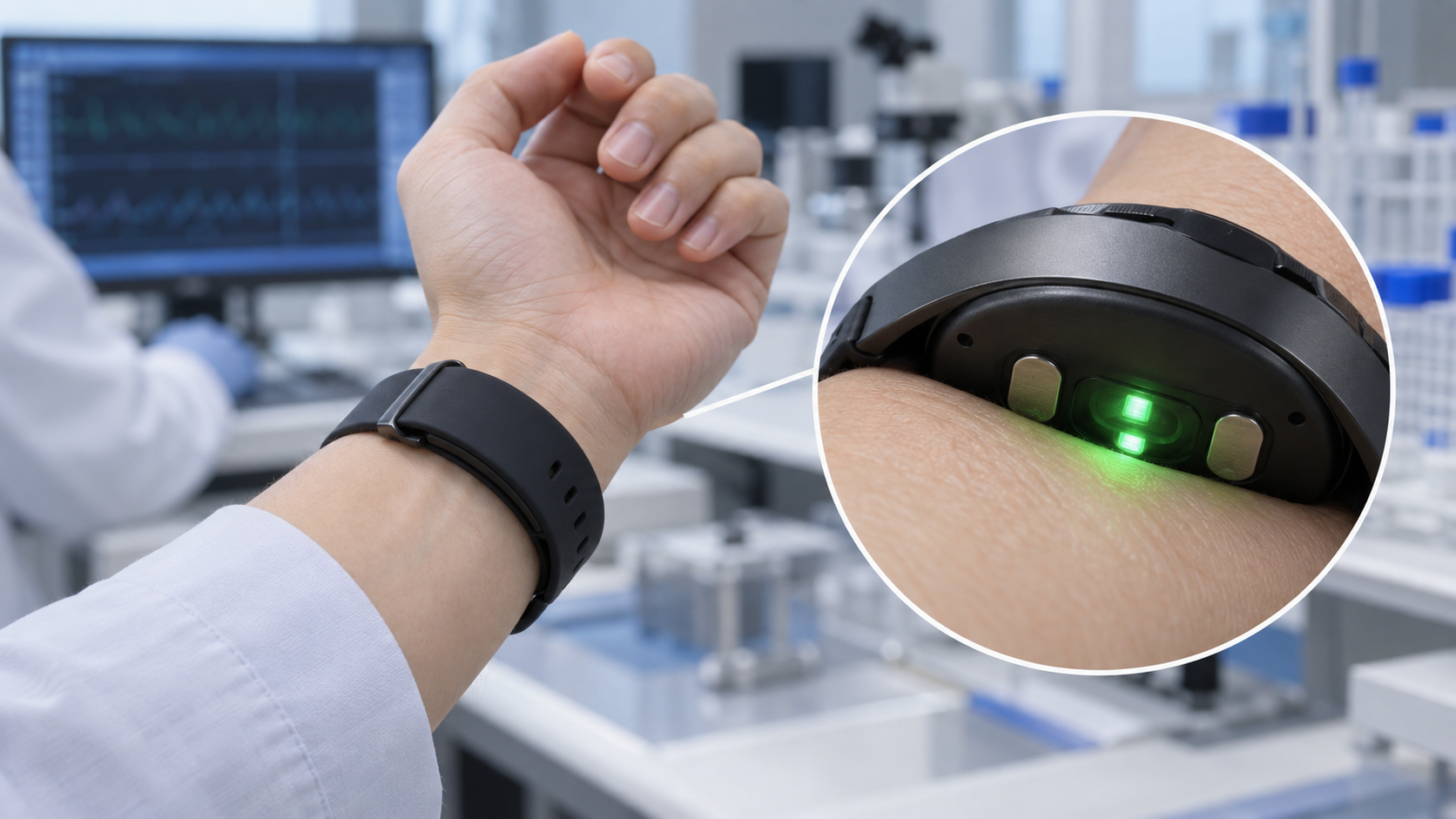
The pulse wave measured by the optical sensor on the back of the watch (green LEDs and photodiodes) is used for displaying heart rate, for irregular rhythm notifications and for hypertension-pattern notifications. Even when the sensor hardware is the same, "what is claimed" changes the FDA category, and that is a defining feature of this field Sourced. The FDA documents look closely at performance under conditions such as skin tone, motion, low perfusion (low blood flow) and hand tremor (the IRNF De Novo document reports no clinically relevant difference by skin tone across 1,124 subjects and about 1.3 million measurements). This suggests that materials-side issues such as the transparent window, the electrodes and contact with skin are ultimately judged by whether the software can absorb the remaining error Not yet confirmed.
6. What it has done so far
| When | What happened | Why it matters |
|---|---|---|
| 29 November 2017 to 21 February 2019 | Apple Heart Study (with Stanford University). Registered enrollment on ClinicalTrials.gov: 419,927. A single-arm study of whether a watch's pulse signal (PPG) can identify irregular rhythms | One source of evidence behind the irregular rhythm notification. This describes the registered study, not the performance of the feature |
| 12 March to 14 May 2018 | ECG clinical validation study (602 registered participants; clinical-trial partner IQVIA Pty Ltd) | The count matches the 602-subject study in the DEN180044 De Novo document |
| 11 September 2018 | The ECG app (DEN180044) and irregular rhythm notification (DEN180042) were authorized under De Novo (decision date in the database) | New device types were created: OTC electrocardiograph software (21 CFR 870.2345) and OTC PPG analysis software (21 CFR 870.2790) |
| 14 November 2019 | Apple Heart & Movement Study started (collaborator: American Heart Association) | The registered completion date is 28 February 2025 (estimated). Apple's September 2026 announcement says data from this study was used to develop "readiness" |
| 8 October 2020 | ECG 2.0 app (K201525) received 510(k) clearance | Added a classification for high heart rate |
| 22 October 2021 / 3 June 2022 | IRNF 2.0 (K212516) and the AFib History Feature (K213971) received 510(k) clearance | Besides notifications, a "history" feature for people already diagnosed was recognized as a separate use |
| 21 July 2023 | IRNF (K231173) received 510(k) clearance, with a predetermined change control plan (PCCP) | Adoption of a mechanism that agrees with the FDA in advance the scope and procedure of post-clearance software updates |
| 13 September 2024 | The sleep apnea notification (K240929) received 510(k) clearance | The predicate was a Samsung Electronics feature (DEN230041): an example of another company's authorization serving as the benchmark |
| 12 February 2025 | Apple Health Study started (collaborators include Brigham and Women's Hospital) | The registered completion date is February 2030 (estimated). The target enrollment is 500,000 (estimated) |
| 9-11 September 2025 | On the 9th Apple announced the Apple Watch Series 11 and hypertension notifications (saying at that time that FDA and other clearances were expected soon). On 11 September the hypertension notification (K250507) received 510(k) clearance | At announcement it was not yet cleared; clearance followed two days later. An example of separating a company announcement from a regulatory decision |
| 9 September 2026 | Apple announced the Apple Watch Series 12 and Ultra 4 with a new Health Sensing System (electrical and optical heart sensors). Availability from 18 September | An update to the sensor components. We could not confirm in the databases whether a new FDA submission accompanied this generation |
7. What comes next
Primary sources also contain the following Not yet confirmed.
- The September 2026 announcement puts the "Health Sensing System" behind features such as readiness and Health Age. Apple describes readiness as a single 0-10 score calculated from activity, training load, vitals and sleep score (we could not confirm an FDA category for it).
- The footnote of the September 2026 announcement still says the Vitals app is "for wellness purposes only and not for medical use". Whether new features built on the same sensors will obtain medical authorization is not confirmed.
- The FDA document for the hypertension feature says its PCCP does not include adaptive algorithms that continue to learn in the field: modified algorithms are trained, tuned and locked before release. Users are to be informed of changes through updates to the Instructions for Use.
Whether a new FDA submission exists for the new sensors in the Series 12 and Ultra 4; an official description of work on new measurement targets such as glucose; R&D spending and headcount limited to health and sensors; sales or user numbers by feature; names of biosensor-related acquisitions or investments; whether any public funding exists. None of these is stated in the 10-K, the 10-Q, FDA documents or Apple's official announcements.
8. What the company is aiming for in biosensors
We separate what the company says directly from what we read into it. Inference marks our interpretation of primary sources; it is not something the company has said.
| What can be read | Primary evidence | Category |
|---|---|---|
| Sensors are carried on the watch as a shared platform, with regulatory decisions sought feature by feature | The FDA documents consistently cover "software-only mobile medical applications", and the hypertension 510(k) summary treats the Apple Watch as a general-purpose computing platform to which hardware testing does not apply | Inference |
| It separates features it takes through regulation from those it labels "not for medical use" | ECG, irregular rhythm, AFib history, sleep apnea and hypertension features are authorized or cleared. Blood Oxygen, temperature and Vitals are labelled by Apple as not for medical use | Sourced (the separation) / Inference (the intent) |
| It uses other companies' authorizations as predicates for new features | The sleep apnea feature used Samsung Electronics' feature, and the hypertension feature used Viz.ai's software, as the predicate in its 510(k) | Sourced |
| It runs large in-house studies to gather performance evidence and raw material for new features | Apple Heart Study (419,927), Apple Heart & Movement Study, Apple Health Study (target 500,000), and Apple's statement that readiness was developed using Heart and Movement Study data | Sourced (the studies) / Inference (the purpose) |
| It has not stepped into diagnosis-like measurement such as continuous glucose monitoring, at least for now | No glucose sensor in the official sensor list. On 21 February 2024 the FDA warned against smartwatches and smart rings that claim to measure blood glucose (no brand names given) | Sourced (the specification) / Inference (the policy) |
| It adds entry points other than sensors, such as blood tests, to the health data | The September 2026 announcement describes booking Quest Diagnostics tests inside the Health app | Sourced (an announced plan) |
The reading that "other companies' authorizations are used as predicates" rests on the predicate device field of the 510(k). The summary for the sleep apnea feature (K240929) names Samsung Electronics' "Sleep Apnea Feature" (DEN230041) as predicate, says the intended use and principle of operation are the same, and lists the differences as the sensor (Apple uses an accelerometer, Samsung blood oxygen) and the detection method (Apple passive detection over 30 days, Samsung an on-demand two-night assessment) Sourced. The hypertension feature likewise names Viz.ai's hypertrophic cardiomyopathy software (DEN230003) as predicate. The system suggests that once one company opens a new type of feature, followers can enter the same category more easily through 510(k) Not yet confirmed. Performance figures from different studies are separate results, and we do not rank products by them.
9. Map of partnerships in biosensors
The collaborations and cooperation that Apple makes public are limited to those in ClinicalTrials.gov and Apple's press releases. Neither the 10-K nor the biosensor-related materials name component makers, sensor-material suppliers or contract manufacturers Sourced. We therefore cannot draw a material or component supply chain (the 10-K says only, in general terms, that some key components come from single or limited sources). Note that "predicate" in the figure refers to another company's device used as a benchmark in regulatory documents; it is not a partnership.
10. Technologies, products and services
The official Apple Watch specifications describe the sensor set as follows. Because conditions differ by product, we give no performance figures except those in FDA documents.
| Element | What official materials list | Note |
|---|---|---|
| Electrical heart sensor | The Series 12 specification lists a "second-generation electrical heart sensor". In the original De Novo document, electrodes on the back and the Digital Crown on the side measure the potential between wrist and fingertip for 30 seconds to produce a single-lead ECG | Assumes the electrodes are in contact with skin |
| Optical heart sensor (pulse wave, PPG) | Green LEDs and light-sensitive photodiodes detect changes in blood volume (IRNF De Novo document). Apple says the Series 12 uses larger, power-efficient green LEDs and measures heart rate every five seconds | Company statement (the heart-rate accuracy claim comes from a study run by Apple) |
| Blood oxygen sensor | Listed in the specification. Apple says it is for wellness only and not for medical use, and measurements are calculated and viewed on the iPhone in the Health app (Series 12 specification) | No FDA authorization or clearance found |
| Temperature sensor | On the Series 8 and later, among others. Apple states it is not intended for medical use | No FDA authorization or clearance found |
| Accelerometer | Used to detect breathing disturbances during sleep (K240929). Patterns are assessed over 30-day evaluation windows and the user is notified if one is found | A third signal source, neither optical nor electrical |
| Software (machine learning) | The hypertension feature combines a deep-learning model pre-trained on unlabeled data from over 86,000 participants with a linear model built on data from over 9,800 participants with home blood pressure reference measurements. As stated in the FDA document | The FDA defines the scope of algorithm updates in the PCCP |
| Performance in FDA documents (with conditions) | Population and conditions | Result |
|---|---|---|
| ECG app (DEN180044) | 602 enrolled at 5 sites; 588 eligible (301 with AFib, 287 in sinus rhythm). Reference: physician-adjudicated 12-lead ECG. Evaluated on classifiable recordings only | Sensitivity 98.3%, specificity 99.6% (97.5% lower bounds 95.8% and 97.7%). Counting unreadable (8.8%, 49) and unclassified (3.4%, 19) results, the probability that a person with AFib was classified as AFib was 85.2% (95% CI 80.5-89.2) |
| IRNF (DEN180042) | 226 analyzable subjects wearing a 7-day ECG patch. Reference: patch ECG adjudicated by cardiologists | Positive predictive value (PPV) of one-minute irregular tachograms 66.6% (97.5% lower bound 63.0%); the pre-specified goal was not met. Secondary analysis: notification-level PPV 78.9% (95% CI 66.1-88.6) in an enriched population |
| Sleep apnea notification (K240929) | 1,499 enrolled, 1,278 in the notification analysis. Reference: a home sleep apnea test device (K192469). Apnea-hypopnea index (AHI) of 15 or more counts as moderate-to-severe | Sensitivity 66.3% (95% CI 62.2-70.3), specificity 98.5% (98.0-99.0). The document says performance was optimized for specificity |
| Hypertension notification (K250507) | 2,229 enrolled without a prior hypertension diagnosis; 1,863 with at least 15 days of usable data in the primary analysis. 30-day wear; reference: an FDA-cleared home blood pressure monitor. Hypertension defined as average systolic 130 mmHg or higher or diastolic 80 mmHg or higher (American Heart Association) | Sensitivity 41.2% (95% CI 37.2-45.3), specificity 92.3% (90.6-93.7). PPV 70.9% (assuming 31.4% prevalence). Sensitivity for stage 2 hypertension 53.7% |
These values come from different studies with different references and populations, and they do not show which feature is better than another. The FDA documents state for every feature that the absence of a notification does not mean the absence of disease Sourced.
The FDA document for the IRNF lists factors that affect pulse measurement: motion, hand and finger movements, dark tattoos on the wrist, and reduced skin blood flow in the cold Sourced. An optical sensor reads how much green light that entered the skin comes back changed by blood flow, so the clarity of the optical window, its positioning relative to the photodiodes and the stability of contact provided by the band would be expected to matter. For the electrical sensor, electrode-to-skin contact resistance (dryness, sweat, contact pressure) matters Not yet confirmed. However, the materials of the back cover, the electrodes, the optical window and the bands are not stated in the official materials we checked, so we could not confirm the effect of any particular material. See also our explainers on wearable biosensors, patch sensors and skin adhesion, and electrochemical sensors.
11. The risks this company carries
| Risk | Detail | Category |
|---|---|---|
| Limits on what can be claimed | Authorizations and clearances carry conditions on use, age and history (many features exclude people under 22 or with a prior diagnosis). FDA documents state for every feature that no notification does not mean no disease | Sourced |
| Performance limits | The hypertension notification had a sensitivity of 41.2% under the FDA study conditions, and Apple itself says it does not detect every case. The ECG app has high sensitivity on classifiable recordings, but about 12% of recordings were unreadable or unclassified | Sourced |
| Changing regulation | The 10-K lists as a risk that moving into specialized applications such as health, and using machine learning and AI, require navigating new legal, regulatory and ethical considerations | Sourced |
| Handling of health data | The 10-K describes growing legal obligations for sensitive information such as health and biometric data | Sourced |
| Differences in availability by region | Apple's support page says the Blood Oxygen app is only available by default in certain countries and regions. At the 9 September 2025 announcement, hypertension notifications were described as awaiting clearance from the FDA and other regulators (FDA clearance followed on 11 September) | Sourced |
| Difficulty of external verification | Apple Watch sales, users per feature and R&D are not disclosed, so the scale of the biosensor business is hard to verify from outside | Not yet confirmed |
| Recalls and safety communications | The openFDA medical device recall search showed no record for a firm named "Apple Inc" (a different spelling could cause a miss) | Could not be confirmed |
| Variation in wearables sales | Wearables, Home and Accessories sales fell 4% in fiscal 2025 and rose 2% over the nine months of fiscal 2026 | Sourced |
12. Glossary
- De Novo (new classification)
- A pathway under which the FDA classifies a new type of low-to-moderate-risk device that has no equivalent; later devices can use it as a predicate in a 510(k).
- 510(k) clearance
- The FDA's finding that a device is substantially equivalent to an existing (predicate) device. Distinct from PMA approval.
- PCCP (predetermined change control plan)
- A plan, agreed with the FDA in advance, that defines the scope and validation of software changes to be made after clearance.
- OTC (over the counter)
- A category a user can use directly without a prescription; FDA documents write "over-the-counter".
- PPG (photoplethysmography)
- A method that measures changes in blood volume from how light shone into the skin returns; in a watch it uses green LEDs and photodiodes.
- Atrial fibrillation (AFib)
- An arrhythmia in which the upper chambers of the heart beat irregularly. The notification features in FDA documents are not diagnoses; they only "suggest" it.
- Sensitivity and specificity
- The share of people with a condition who are correctly flagged (sensitivity), and the share of people without it who are correctly not flagged (specificity).
- Positive predictive value (PPV)
- Of those flagged positive, the share who actually have the condition; it depends on how common the condition is in the population.
- AHI (apnea-hypopnea index)
- The number of apnea and hypopnea events per hour of sleep; 15 or more is classed as moderate-to-severe.
- Predicate device
- The existing device to which a new device is compared for equivalence in a 510(k).
13. References
- Apple Form 10-K for the fiscal year ended September 27, 2025 (filed with the SEC on 31 October 2025). Company profile, sales, Wearables, Home and Accessories, R&D, employees, component sourcing, regulatory and data risks. https://www.sec.gov/Archives/edgar/data/320193/000032019325000079/aapl-20250927.htm
- Apple Form 10-Q for the quarterly period ended June 27, 2026 (filed 31 July 2026). Wearables, Home and Accessories and R&D for the third quarter and nine months of fiscal 2026. https://www.sec.gov/Archives/edgar/data/320193/000032019326000020/aapl-20260627.htm
- U.S. Food and Drug Administration (FDA) De Novo Classification Request for ECG App (DEN180044), decision summary. Use, sensitivity and specificity, clinical study, special controls. https://www.accessdata.fda.gov/cdrh_docs/reviews/DEN180044.pdf
- U.S. Food and Drug Administration (FDA) De Novo Classification Request for Irregular Rhythm Notification Feature (DEN180042), decision summary. Use, limitations, PPG principle, skin-tone testing, clinical study. https://www.accessdata.fda.gov/cdrh_docs/reviews/DEN180042.pdf
- U.S. Food and Drug Administration (FDA) 510(k) K201525 (ECG 2.0 App): clearance letter and 510(k) summary, 8 October 2020. https://www.accessdata.fda.gov/cdrh_docs/pdf20/K201525.pdf
- U.S. Food and Drug Administration (FDA) 510(k) K212516 (IRNF App): clearance letter and 510(k) summary, 22 October 2021. https://www.accessdata.fda.gov/cdrh_docs/pdf21/K212516.pdf
- U.S. Food and Drug Administration (FDA) 510(k) K213971 (Atrial Fibrillation History Feature): clearance letter and 510(k) summary, 3 June 2022. https://www.accessdata.fda.gov/cdrh_docs/pdf21/K213971.pdf
- U.S. Food and Drug Administration (FDA) 510(k) K231173 (Irregular Rhythm Notification Feature): clearance letter and 510(k) summary, 21 July 2023. Implementation of a PCCP. https://www.accessdata.fda.gov/cdrh_docs/pdf23/K231173.pdf
- U.S. Food and Drug Administration (FDA) 510(k) K240929 (Sleep Apnea Notification Feature): clearance letter and 510(k) summary, 13 September 2024. Predicate DEN230041, clinical study. https://www.accessdata.fda.gov/cdrh_docs/pdf24/K240929.pdf
- U.S. Food and Drug Administration (FDA) 510(k) K250507 (Hypertension Notification Feature): clearance letter and 510(k) summary, 11 September 2025. Predicate DEN230003, clinical study, PCCP. https://www.accessdata.fda.gov/cdrh_docs/pdf25/K250507.pdf
- U.S. Food and Drug Administration (FDA) Do Not Use Smartwatches or Smart Rings to Measure Blood Glucose Levels: FDA Safety Communication (21 February 2024). https://www.fda.gov/medical-devices/safety-communications/do-not-use-smartwatches-or-smart-rings-measure-blood-glucose-levels-fda-safety-communication
- Apple Newsroom Apple debuts Apple Watch Series 11, featuring groundbreaking health insights (9 September 2025). Status of hypertension notifications at announcement. https://www.apple.com/newsroom/2025/09/apple-debuts-apple-watch-series-11-featuring-groundbreaking-health-insights/
- Apple Newsroom Introducing Apple Watch Series 12, with the all-new Health Sensing System (9 September 2026). New sensors, readiness, the Health app, footnotes. https://www.apple.com/newsroom/2026/09/introducing-apple-watch-series-12-with-the-all-new-health-sensing-system/
- Apple Apple Watch Series 12 Tech Specs. Sensor set, and footnotes stating that Blood Oxygen, temperature and Vitals are not for medical use. https://www.apple.com/apple-watch-series-12/specs/
- Apple Support How to use the Blood Oxygen app on Apple Watch. Not for medical use, age 18 and over, availability by country. https://support.apple.com/en-us/120358
- ClinicalTrials.gov NCT03335800 Apple Heart Study (419,927 participants; collaborator Stanford University). https://clinicaltrials.gov/study/NCT03335800
- ClinicalTrials.gov NCT03492554 Electrocardiogram Clinical Validation Study (602 participants; collaborator IQVIA Pty Ltd). https://clinicaltrials.gov/study/NCT03492554
- ClinicalTrials.gov NCT04699812 Atrial Fibrillation Algorithms Clinical Validation Study (573 participants; collaborator IQVIA Pty Ltd). https://clinicaltrials.gov/study/NCT04699812
- ClinicalTrials.gov NCT04198194 Apple Heart & Movement Study (collaborator American Heart Association). https://clinicaltrials.gov/study/NCT04198194
- ClinicalTrials.gov NCT06958523 Apple Health Study (collaborators Brigham and Women's Hospital and MCRA). https://clinicaltrials.gov/study/NCT06958523
- Apple Newsroom Apple advances health and fitness capabilities using Apple Intelligence (9 September 2026). Vitals footnote; booking Quest Diagnostics tests. https://www.apple.com/newsroom/2026/09/apple-advances-health-and-fitness-capabilities-using-apple-intelligence/
- U.S. Food and Drug Administration (FDA) openFDA 510(k) API (search by applicant name "Apple"). Confirms Apple's biosignal records and the absence of a Blood Oxygen record. https://api.fda.gov/device/510k.json?search=applicant:%22Apple%22&limit=100&sort=decision_date:desc
- U.S. Food and Drug Administration (FDA) openFDA PMA API (search by applicant name "Apple" returned no match). https://api.fda.gov/device/pma.json?search=applicant:%22Apple%22&limit=3
- ClinicalTrials.gov NCT04247581 ECG App Algorithms Clinical Validation Study (546 participants; collaborator IQVIA Pty Ltd). https://clinicaltrials.gov/study/NCT04247581
- U.S. Food and Drug Administration (FDA) openFDA device recall API (no match for "Apple Inc"). https://api.fda.gov/device/recall.json?search=recalling_firm:%22Apple%20Inc%22&limit=5
- Apple Official website apple.com (source of the logo image, specified as the logo in structured data). https://www.apple.com/
14. Claim-to-source audit
| Claim in the article | Category | Source |
|---|---|---|
| Legal name, headquarters, Nasdaq listing, California corporation | Sourced | Reference 1 https://www.sec.gov/Archives/edgar/data/320193/000032019325000079/aapl-20250927.htm |
| Group sales, operating income, net income, R&D, and Wearables, Home and Accessories sales with year-on-year change | Sourced | Reference 1 https://www.sec.gov/Archives/edgar/data/320193/000032019325000079/aapl-20250927.htm |
| Employees: approximately 166,000 full-time equivalents (27 September 2025) | Sourced | Reference 1 https://www.sec.gov/Archives/edgar/data/320193/000032019325000079/aapl-20250927.htm |
| Payments for property, plant and equipment of US$12,715 million (company-wide) | Sourced | Reference 1 https://www.sec.gov/Archives/edgar/data/320193/000032019325000079/aapl-20250927.htm |
| Third-quarter and nine-month fiscal 2026 Wearables, Home and Accessories sales, and the reason for the R&D increase | Sourced | Reference 2 https://www.sec.gov/Archives/edgar/data/320193/000032019326000020/aapl-20260627.htm |
| ECG app De Novo authorization (DEN180044): use, decision date, participants, sensitivity and specificity, share of unclassifiable results | Sourced | Reference 3 https://www.accessdata.fda.gov/cdrh_docs/reviews/DEN180044.pdf |
| Irregular rhythm notification De Novo authorization (DEN180042): use, limitations, PPG principle, PPV and the unmet goal, skin-tone testing (1,124 subjects, about 1.3 million measurements) | Sourced | Reference 4 https://www.accessdata.fda.gov/cdrh_docs/reviews/DEN180042.pdf |
| ECG 2.0 app (K201525) and the added high-heart-rate classification | Sourced | Reference 5 https://www.accessdata.fda.gov/cdrh_docs/pdf20/K201525.pdf |
| IRNF 2.0 (K212516) clearance | Sourced | Reference 6 https://www.accessdata.fda.gov/cdrh_docs/pdf21/K212516.pdf |
| AFib History Feature (K213971) use and clearance | Sourced | Reference 7 https://www.accessdata.fda.gov/cdrh_docs/pdf21/K213971.pdf |
| IRNF (K231173) clearance and PCCP implementation | Sourced | Reference 8 https://www.accessdata.fda.gov/cdrh_docs/pdf23/K231173.pdf |
| Sleep apnea notification (K240929): use, Samsung predicate (DEN230041), sensor difference, sensitivity and specificity | Sourced | Reference 9 https://www.accessdata.fda.gov/cdrh_docs/pdf24/K240929.pdf |
| Hypertension notification (K250507): use, Viz HCM predicate (DEN230003), study size, sensitivity, specificity, PPV, model structure, PCCP | Sourced | Reference 10 https://www.accessdata.fda.gov/cdrh_docs/pdf25/K250507.pdf |
| FDA warning: it has not authorized, cleared or approved any smartwatch or smart ring that measures or estimates blood glucose on its own (21 February 2024, no brands named) | Sourced | Reference 11 https://www.fda.gov/medical-devices/safety-communications/do-not-use-smartwatches-or-smart-rings-measure-blood-glucose-levels-fda-safety-communication |
| Status of hypertension notifications at announcement (clearance expected soon, 30-day assessment, training data from over 100,000 participants, validation in over 2,000) | Sourced | Reference 12 https://www.apple.com/newsroom/2025/09/apple-debuts-apple-watch-series-11-featuring-groundbreaking-health-insights/ |
| Series 12 new sensors, heart rate every five seconds, readiness, Health app redesign, availability from 18 September 2026 | Sourced | Reference 13 https://www.apple.com/newsroom/2026/09/introducing-apple-watch-series-12-with-the-all-new-health-sensing-system/ |
| Sensor set (second-generation electrical heart sensor, optical, blood oxygen, temperature) and the company's statements that Blood Oxygen, temperature and Vitals are not for medical use | Sourced | Reference 14 https://www.apple.com/apple-watch-series-12/specs/ Reference 21 https://www.apple.com/newsroom/2026/09/apple-advances-health-and-fitness-capabilities-using-apple-intelligence/ |
| Blood Oxygen is not for medical use, age 18 and over, availability depends on country | Sourced | Reference 15 https://support.apple.com/en-us/120358 |
| Apple Heart Study (29 November 2017 to 21 February 2019, 419,927 participants, Stanford University) | Sourced | Reference 16 https://clinicaltrials.gov/study/NCT03335800 |
| ECG validation study (2018, 602 participants), ECG algorithm study (546), irregular rhythm and AFib history algorithm study (573); collaborator IQVIA Pty Ltd | Sourced | Reference 17 https://clinicaltrials.gov/study/NCT03492554 Reference 24 https://clinicaltrials.gov/study/NCT04247581 Reference 18 https://clinicaltrials.gov/study/NCT04699812 |
| Apple Heart & Movement Study (American Heart Association); Apple Health Study (Brigham and Women's Hospital, target 500,000, estimated completion February 2030) | Sourced | Reference 19 https://clinicaltrials.gov/study/NCT04198194 Reference 20 https://clinicaltrials.gov/study/NCT06958523 |
| Booking Quest Diagnostics tests inside the Health app (planned) | Sourced | Reference 21 https://www.apple.com/newsroom/2026/09/apple-advances-health-and-fitness-capabilities-using-apple-intelligence/ |
| List of Apple's eight biosignal-related FDA records, and the absence of a Blood Oxygen record | Sourced | Reference 22 https://api.fda.gov/device/510k.json?search=applicant:%22Apple%22&limit=100&sort=decision_date:desc |
| No PMA record found for Apple | Sourced | Reference 23 https://api.fda.gov/device/pma.json?search=applicant:%22Apple%22&limit=3 |
| No medical device recall record found | Sourced | Reference 25 https://api.fda.gov/device/recall.json?search=recalling_firm:%22Apple%20Inc%22&limit=5 |
| Names of biosensor-related acquisitions or investments, public funding, and R&D, headcount and sales limited to health and sensors | Not yet confirmed | Not stated in the 10-K or 10-Q. Could not be confirmed; we do not claim they do not exist. Reference 1 https://www.sec.gov/Archives/edgar/data/320193/000032019325000079/aapl-20250927.htm Reference 2 https://www.sec.gov/Archives/edgar/data/320193/000032019326000020/aapl-20260627.htm |
| Whether a new FDA submission exists for the new Series 12 / Ultra 4 sensors | Not yet confirmed | Could not be confirmed in the FDA database. We do not claim it does not exist. Reference 22 https://api.fda.gov/device/510k.json?search=applicant:%22Apple%22&limit=100&sort=decision_date:desc |
| Plans for blood glucose measurement | Not yet confirmed | No plan stated in official materials. Could not be confirmed. Reference 14 https://www.apple.com/apple-watch-series-12/specs/ |
| Component suppliers, and the materials of the back cover, electrodes, optical window and bands | Not yet confirmed | Not stated in the official materials we checked. Could not be confirmed. Reference 14 https://www.apple.com/apple-watch-series-12/specs/ Reference 13 https://www.apple.com/newsroom/2026/09/introducing-apple-watch-series-12-with-the-all-new-health-sensing-system/ |
| The framing of Apple as a consumer-device maker whose sensors and regulatory work combine to create value (the wearables & consumer category) | Our calculation | Our own framing, an interpretation of the sales categories (Reference 1) and FDA documents (References 3-10) |
| The four-type classification and the example company names | Our calculation | Our own classification; the companies are examples drawn from those covered in this series |
| Year-on-year change in operating income and net income (+8%, +19%) | Our calculation | Our own calculation from Reference 1 figures |
| Reading that sensors are carried as a shared platform with regulation sought feature by feature | Inference | This article's interpretation of the fact that FDA documents cover software only (References 3-10) |
| Reading of the intent behind separating regulated features from those labelled not for medical use | Inference | This article's interpretation of the list of authorizations and clearances and the not-for-medical-use statements (References 10, 14, 15) |
| Reading that the purpose of large in-house studies is performance evidence and raw material for new features | Inference | This article's interpretation of the study registrations (References 16, 19, 20) and the announcement (Reference 13) |
| Reading that Apple has not moved into diagnosis-like measurement such as glucose | Inference | This article's interpretation of the sensor list (Reference 14) and the FDA warning (Reference 11) |
| The view that another company's authorization as predicate makes it easier for followers to enter | Not yet confirmed | This article's view based on the predicate fields (References 9, 10); whether it generalizes as a system is unconfirmed |
| The explanation that optical windows, electrodes and band contact affect signal quality | Not yet confirmed | This article's interpretation of the influencing factors in the FDA document (Reference 4); the effect of particular materials could not be confirmed |
Last updated 3 October 2026 / Troy Technical
Figures in this article come from Apple's SEC filings (Form 10-K, Form 10-Q), FDA public documents, Apple's official announcements and product specifications, and ClinicalTrials.gov. No research-firm estimates or press-based figures have been used. Passages marked "Inference" are this article's interpretation of primary sources, not statements made by the company. This article is not medical advice for any individual reader.