COMPANY PROFILE / BIOSENSORS
Biolinq
A privately held maker of "Shine," a glucose sensor that measures in the shallow layer of the skin (intradermal); it won FDA De Novo authorization in 2025, but only for adults who do not use insulin
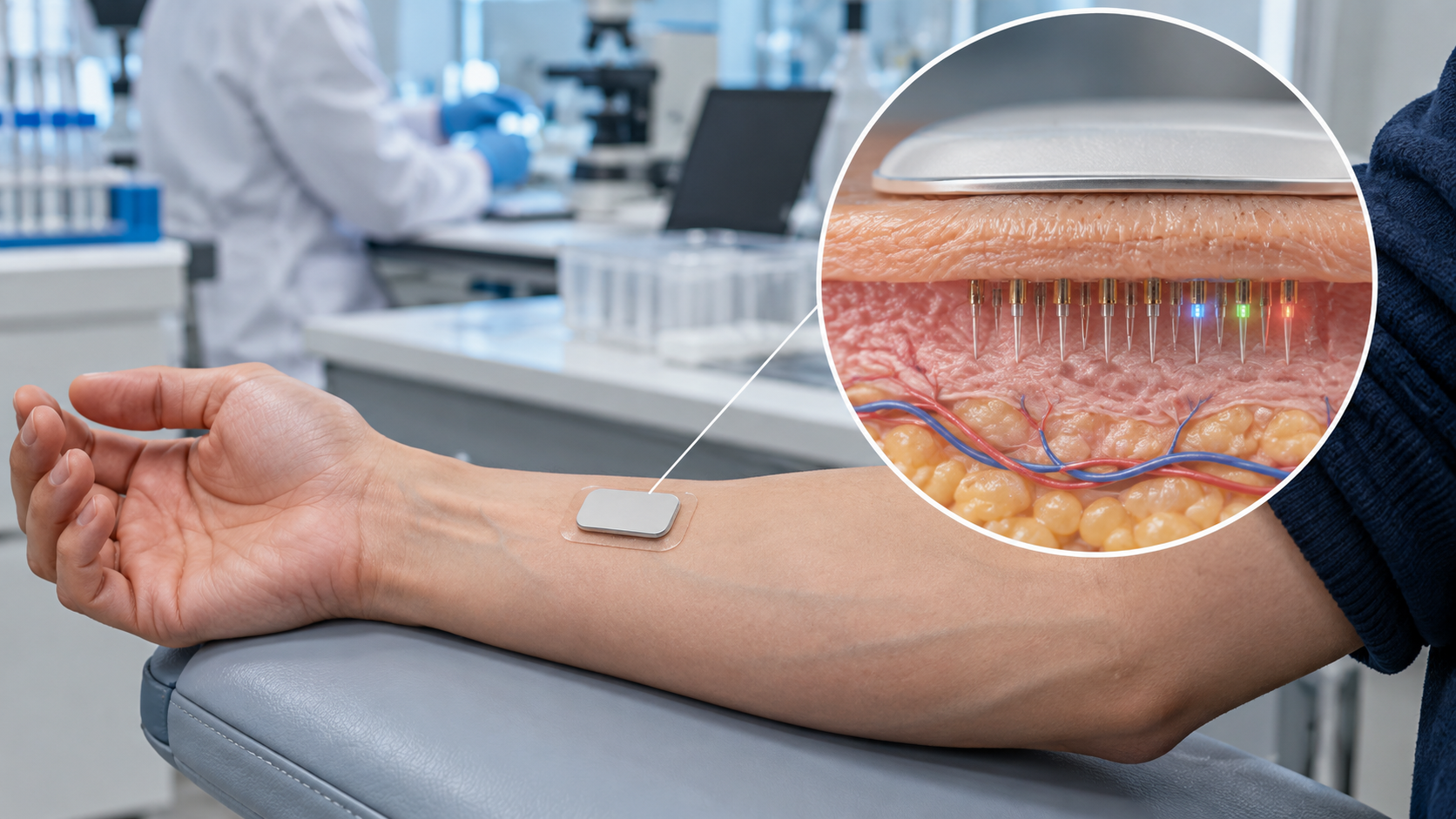
Biolinq comes up in any discussion of biosensors because it built a new type of sensor that places an array of seven microelectrodes in the intradermal layer, shallower than a conventional CGM (continuous glucose monitor), and has obtained a regulatory authorization for it. According to the FDA decision summary, the product "Biolinq Shine" received De Novo authorization on 23 September 2025, under a new category, "glucose range monitoring system." It is a semi-quantitative device that shows ranges by LED color rather than glucose numbers, intended for people 22 and older who are not on insulin, by prescription. The company does not disclose its finances, but its SEC fundraising filings (Form D) and NIH grant records show where the money has come from. This profile sets out, from primary sources, what the product can and cannot measure, and where the funding comes from.
- Biolinq in 30 seconds, and where it stands in biosensors
- The logo and how the name is written
- Where the company sits in the field
- Scale
- Resources committed to biosensors
- What it has done so far
- What comes next
- What the company is aiming for in biosensors
- Map of partnerships in biosensors
- Technologies, products and services
- The risks this company carries
- Glossary, references and claim-to-source audit
1. Biolinq in 30 seconds, and where it stands in biosensors
(intradermal sensor)A prescription medical device; distinct from consumer wearables
23 September 2025DEN240080. Class II, product code SFU
not on insulinShows ranges by LED color, not numbers. Not for hypoglycemia awareness
glucose oxidaseMeasures interstitial fluid in the intradermal layer (papillary dermis) as a current (FDA document)
Biolinq Shine is a CGM that does not show numbers. What the FDA authorized is a semi-quantitative device that shows a range by LED color: blue (70-180 mg/dL), yellow (181-400 mg/dL) and red (below 70 mg/dL) (time in range), and it has no alarms. The FDA document says explicitly that it must not be used by people on insulin, people with type 1 diabetes or people at significant risk of severe hypoglycemia, and not for hypoglycemia awareness Sourced. The company's website says "FDA cleared," but in the FDA database the category is a De Novo authorization (granted), which is not a 510(k) clearance Sourced. The launch date, price and scope of sale are not stated in the materials we reviewed Not yet confirmed.
2. The logo and how the name is written

A note on names: the legal entity is Biolinq Incorporated (registered with the SEC as Biolinq Inc). Biolinq Shine is the product name; its formal name in FDA documents is "Biolinq Shine Autonomous Time-in-Range Microsensor." The logo is the white version used at the top of the company's official website; because it is made for dark backgrounds, it is shown here on a dark panel.
Official site: https://www.biolinq.com/3. Where the company sits in the field
4. Scale
Biolinq is privately held and its sales, profit and headcount are not disclosed. In the Form D filings sent to the SEC, the revenue-range field says "Decline to Disclose." What can be confirmed is the scale of capital raised Sourced.
| Form D filing date | Total offering (US$) | Amount sold (US$) | Investors | First sale |
|---|---|---|---|---|
| 28 September 2016 | 750,000 | 450,000 | 5 | 16 September 2016 |
| 27 November 2017 | 13,115,919 | 8,115,919 | 17 | 14 November 2017 |
| 20 March 2019 | 3,000,000 | 3,000,000 | 9 | 13 March 2019 |
| 7 April 2020 (amended 7 July) | 8,000,000 (10,000,000 after amendment) | 3,554,335 | 17 | 25 March 2020 |
| 23 March 2021 | 6,000,000 | 5,223,811 | 21 | 16 March 2021 |
| 17 September 2021 (amended 1 June 2022) | 109,511,762 (105,609,392 after amendment) | 62,178,431 (77,946,902 after amendment) | 54 (62 after amendment) | 2 September 2021 |
| 26 December 2023 (amended March and September 2024) | 50,000,000 (59,139,615 final) | 35,114,615 (59,139,615 final) | 25 (43 final) | 13 December 2023 |
| 21 March 2025 | 100,000,000 | 90,000,000 | 45 | 7 March 2025 |
A Form D is the notice filed with the SEC for a private fundraising, and it states the total offering and the amount sold. Because amounts from different filings may overlap, this profile does not add them up. The company announced the close of a Series C of US$100 million on 22 April 2025. Its technology page also carries the phrase "120M dollars invested" (read as cumulative investment), but gives no date or breakdown Sourced.
Biolinq's sales, headcount, manufacturing sites and contract manufacturers are not in the materials we reviewed. A Form D offering amount is not a guide to company value or sales. The company's technology page repeatedly carries an "Investigational device" caution (it is undated, and reads as referring to the multi-analyte platform rather than Shine, but this is not stated). The current state of sales of the product "Shine" could not be confirmed in this profile Not yet confirmed.
5. Resources committed to biosensors
Biolinq is privately held, and headcount and spending are not disclosed. The table shows what could be confirmed.
| Resource | What primary sources confirm | Status |
|---|---|---|
| People | Headcount is not disclosed. The leadership page lists the CEO (Rich Yang, formerly at Dexcom and Medtronic), co-founder, President and CTO Jared Tangney (PhD in bioengineering from UC San Diego), and heads of regulatory and clinical, R&D, quality and operations; many are described as coming from CGM companies such as Dexcom | Sourced / partly undisclosed |
| Money (capital raised) | Form D amounts are in Chapter 4. On 22 April 2025 the company announced a US$100 million Series C (led by Alpha Wave Ventures, with existing investors RiverVest Venture Partners, AXA IM Alts, LifeSci Venture Partners, M Ventures, Hikma Ventures, Aphelion Capital, Taisho Pharmaceutical and Features Capital). The stated use is "the US regulatory approval process" and "preparing to bring the first autonomous intradermal glucose sensor to market." R&D and capital spending are not disclosed | Sourced / partly undisclosed |
| Acquisitions, investments, joint ventures | No acquisition or investment by Biolinq in another company could be confirmed. The investors in Biolinq are as above. No divestiture was found either | Not found |
| Universities, research institutes, public funding | The NIH research-funding database (RePORTER) shows 14 project-year records under Biolinq's name, totaling US$6,129,929 (our calculation; fiscal years 2013-2026). They include NIDDK grants for "multianalyte sensing with intradermal microneedles" (R43DK097989, fiscal years 2013-2014) and "electrolyte sensing" (R43DK103559), a NIAAA grant for "wearable blood alcohol measurement" (R44AA024643, fiscal years 2015-2017), an NIA grant for "continuous hydration monitoring" (R43AG048626), and an NIDDK grant for "wearable lactate and glucose measurement" (R44DK129875, September 2021 to May 2028; US$861,567 in fiscal year 2026). The company's website says it partnered with "leading universities and bioengineering institutions," but names none | Sourced / partly not found |
Regulatory status (as far as could be confirmed)
| Product | Intended use | Category | Date | Source |
|---|---|---|---|---|
| Biolinq Shine Autonomous Time-in-Range Microsensor | A continuous intradermal glucose sensor with a color-changing indicator light. The qualitative display communicates changes in glucose levels, to aid in the management of a disease or condition related to glycemic control in persons 22 years or older not on insulin. An app gives more granular information. Prescription only. The user is not intended to take medical action on the output without consulting a healthcare professional | FDA De Novo authorization (DEN240080; Class II, product code SFU, 21 CFR 862.1359, "glucose range monitoring system"). Not a 510(k) | Received 27 December 2024; decision 23 September 2025 (about nine months; our calculation) | References 1, 2 |
| People for whom it is not intended (FDA document) | Type 1 diabetes, insulin users, people at significant risk of severe hypoglycemia, users of automated insulin delivery systems, pregnant women, people on dialysis, critically ill patients, and anyone under 22. Not for hypoglycemia awareness. No alarms or alerts | - | - | Reference 1 |
| EU, Japan and elsewhere | - | CE mark and PMDA approval or certification could not be confirmed | - | - |
An FDA "De Novo" authorization creates a new classification for a novel, low- to moderate-risk device with no equivalent on the market. It is different from a "510(k) clearance" (equivalence to an existing device) and from "PMA approval".
According to the FDA decision summary, Biolinq Shine oxidizes glucose with the enzyme glucose oxidase, passes electrons to an electrode and measures the current (amperometry), and places an array of seven microelectrodes ("microsensors") in the papillary dermis of the intradermal layer. The device is factory calibrated and does not accept user calibration. It begins providing measurements two hours after application and stores up to five days of data Sourced. The company says the array is made with "semiconductor manufacturing technology" and sits "up to 20 times more shallow" than conventional subcutaneous sensors (the company's claim). Its technology page describes a design in which several independent sensors work together to improve reliability Not yet confirmed. Chapter 10 goes into more detail.
6. What it has done so far
| When | What happened | Why it matters |
|---|---|---|
| Fiscal years 2013-2015 | The earliest NIH Small Business Innovation Research (SBIR) grants: multianalyte sensing with intradermal microneedles (NIDDK, R43DK097989), electrolyte sensing (NIDDK, R43DK103559) and continuous hydration monitoring (NIA, R43AG048626) | Early technical validation with public money. The multi-analyte idea is there from the start |
| Fiscal years 2015-2017 | A grant for wearable blood alcohol measurement (NIAAA, R44AA024643, Phase II) | Development on a target other than diabetes |
| 28 September 2016 | First Form D (total offering US$750,000) | The oldest fundraising confirmable in SEC filings |
| September 2021 | A Form D of roughly US$105-110 million (first sale 2 September 2021). The same month an NIDDK grant for "wearable lactate and glucose measurement" (R44DK129875) began | The idea of measuring lactate, activity and glucose together |
| 13 December 2023 | A Form D of about US$50 million (first sale date; US$59.1 million was ultimately sold) | The company's news page lists outside press reports of a roughly US$58 million raise in April 2024; the timing and size are close to the Form D amount, but we did not confirm the text of a company release |
| 29 February to 10 June 2024 | Pivotal clinical study at six U.S. centers (NCT06229743). 247 enrolled; 202 wore Biolinq Shine | The data behind the FDA decision |
| 10 to 27 September 2024 | A clinical study of external interferents (NCT06560177; 31 participants; a single 1,000 mg dose of acetaminophen) | Checking the effect of an interfering substance |
| 27 December 2024 | The FDA received the De Novo request | |
| March and April 2025 | Form D (filed 21 March 2025; US$100 million offering, US$90 million sold). A Series C of US$100 million announced as closed on 22 April | The last fundraising before authorization |
| 23 September 2025 | FDA De Novo authorization (DEN240080). The company announced it on 25 September | The first device in a new classification, "glucose range monitoring system" (the classification is in the FDA document; "first" is the company's claim) |
| 2026 | The fiscal year 2026 installment of the NIH grant (R44DK129875; US$861,567). The website displays "Now FDA cleared" | The company says "cleared," but the FDA category is "De Novo" |
7. What comes next
Everything below is stated in company announcements or grant plans; none of it has been achieved. No specific dates for sales or for the multi-analyte plans appear in the materials we could confirm Not yet confirmed.
Launch date, price, sales channels and insurance coverage for Shine; sales volumes; manufacturing sites and contract manufacturers; headcount; revenue; the materials of the electrodes, enzyme and membrane; the number of patents; plans to extend the indication to insulin users; submissions outside the U.S. (EU, Japan); and the development status of measurements other than glucose.
8. What the company is aiming for in biosensors
This chapter separates what the company says directly from what we have read into its materials. Inference marks our interpretation of primary sources.
| What can be read | Primary evidence | Status |
|---|---|---|
| It is entering through a market of lifestyle awareness, not treatment decisions | The FDA intended use is "22 or older, not on insulin," "not intended to take medical action without consulting a healthcare professional," and "acute behavior and lifestyle modifications." The company also says "initially" for type 2 diabetes not dependent on insulin | Sourced (use, announcement) / Inference (choice of market) |
| Later it has measurements beyond glucose (such as lactate) and linkage with automated insulin delivery in view | The NIH grant summary names the burden on users of AID and CGM, and the aim of reducing hypoglycemia with a sensor that measures activity (accelerometer), lactate and glucose. The technology page stresses a multi-analyte platform | Sourced (the grant's aim) / Inference (direction of the product) |
| It aims for a sensor that can be made in volume with semiconductor manufacturing | The company release says the array is made with "state-of-the-art semiconductor technology," and the technology page says "Designed for scale." Manufacturing sites and volumes are not disclosed | Sourced (claim) / Inference (scale outlook) |
| It wants to remove the need for a smartphone for display | FDA document: the on-device LEDs are the main display, and the app is optional. The company says it "works with and without a phone" | Sourced |
The reading "it has a later extension of the indication to insulin users in view" rests on the NIH grant summary. The summary for NIDDK grant R44DK129875 (September 2021 to May 2028) says that, while AID and CGM have advanced, the burden of manually entering meal and exercise information is heavy, and that a sensor measuring exercise (accelerometer), lactate and glucose could reduce hypoglycemia and raise time in target range. The Phase IIb funding is for final technology optimization, a pilot process, confirming final requirements with the FDA and initial commercialization planning Sourced. The 2025 FDA authorization, by contrast, explicitly excludes insulin users and users of automated insulin delivery, and which regulatory category the product aimed at in the grant would fall under, and when, is not stated Not yet confirmed.
9. Map of partnerships in biosensors
The relationships in Biolinq's materials where the counterparty can be named are the Series C investors (listed in the company release) and the NIH grants Sourced. Joint development or licensing deals, and the suppliers or contract manufacturers for the sensor's parts (electrodes, enzyme, membrane, semiconductor fabrication), are not in the materials we reviewed Not yet confirmed.
10. Technologies, products and services
Biolinq Shine consists of a body worn on the skin (the sensor, LEDs, an accelerometer, an ambient light sensor and a battery) and an app. The performance values below are results of the clinical study in the FDA decision summary; they must be read with the comparator method, population and conditions, and they cannot be lined up against other companies' products to rank them.
| Category | What the official materials say | Note |
|---|---|---|
| Sensor | An array of seven microelectrodes placed in the papillary dermis of the intradermal layer. Amperometry with glucose oxidase (FDA document). Measuring range 70-400 mg/dL. Worn on the inner forearm only | The company says there is "no hypodermic needle for insertion" and that it is "up to 20 times more shallow" (the company's claims) |
| Display | On-device LED: blue = 70-180 mg/dL, yellow = 181-400 mg/dL, red = below 70 mg/dL. Rapid rises and values above 400 mg/dL are shown by flashing. An error is a white flash, and end of life is purple | Semi-quantitative, no numbers. There are no alarms or alerts |
| Use and specifications | Factory calibrated; the user cannot calibrate. Measurements begin two hours after application. Data are stored for up to five days. Water resistance: 2 m depth for up to 30 minutes. Operating temperature 10-42 °C; altitude up to 3,200 m. Single use | Measurement begins two hours after application (per the FDA document) |
| App | Gives more granular glucose information and correlates it with meals, rest and activity. Records activity (accelerometer) and sleep duration | Optional; a supplement |
| Platform | A concept of measuring multiple analytes. The technology page describes it with an investigational-device caution | A separate area from Shine, with no authorization at present |
Clinical study results (FDA decision summary; values in the regulator's document, not manufacturer claims)
| Item | Value | Conditions and source |
|---|---|---|
| Study design | 247 enrolled; 202 wore the device | Six U.S. centers, 29 February to 10 June 2024. Adults (22 and older) with diabetes: 66.8% type 1, 20.3% type 2 on intensive insulin therapy, 5.9% type 2 on basal insulin only, 6.9% type 2 not on insulin (type 1 participants were included to obtain enough data across the display range). Comparator: venous blood measured on a laboratory glucose analyzer (YSI 2300 STAT Plus) every 15 minutes. The device was blinded. Glucose was manipulated by protocol |
| Agreement of the on-device display with the comparator | 73.9% when the comparator was below 70; 79.8% at 70-180; 86.2% at 181-400; 78.6% above 400 | Same study. For each comparator range, the share of readings where the display showed the same range (the diagonal of the FDA table; our reading). Of the readings with the comparator at 70-180, 6.7% showed red and 13.5% showed yellow |
| Agreement between two devices worn together | 90.8% for the 70-180 display | 77 people wore two devices; 68 people and 77,311 matched pairs were analyzed. Agreement of the display range |
| Sensor survival | 84.7% over five days | 96.3% on day 1, 91.1% on day 3, 88.9% on day 4. The share of the 190 devices worn that completed the intended five days |
| Display rate | Mean 93.9% (median 98.4%) | The share of expected glucose readings that could be displayed. 88.9% of devices had a display rate of 85% or higher |
| Interfering substances | Acetaminophen, hydroxyurea, xylose | Positive bias in bench testing. For acetaminophen it was also seen in a 31-person clinical study (a single 1,000 mg dose), with the device tending to show a higher range. Reflected in the FDA document's precautions |
The FDA document supports the following points on materials Sourced.
- Glucose oxidase electrochemistry: turning an enzyme reaction into current is shared with other electrochemical CGMs (see our explainers on electrochemical sensors and on enzyme and electrode interface materials). The difference is placing the electrodes in the shallow intradermal layer, where the amount of tissue fluid to measure is small (our commentary).
- Interfering substances: acetaminophen, hydroxyurea and xylose are said to make readings higher. Sensitivity to substances that react readily at the electrode is a general issue for electrochemical methods (our commentary).
- Sterilization and storage: electron-beam sterilization (20-35 kGy, sterility assurance level of 10 to the power of minus 6) and a storage shelf life of 6 months (2-30 °C). The stability of enzyme-containing parts may be what sets the shelf life (inference; no reason is given).
- Biocompatibility: for patient-contacting parts, evaluation of cytotoxicity, sensitization, irritation, systemic toxicity, pyrogenicity, subacute and subchronic toxicity, genotoxicity, implantation, and chronic toxicity and carcinogenicity was performed (following ISO 10993-1).
- Battery and adhesive: a sealed, non-rechargeable lithium manganese dioxide battery; an adhesive patch holds it on the forearm (see our explainer on patch sensors and skin adhesion). The 84.7% five-day survival does not say which of adhesion, electrodes or communication was the cause.
However, the electrode metal, the enzyme immobilization method, the diffusion-limiting membrane and the material of the microelectrodes are not stated in the materials we reviewed. This article does not fill the gap by guessing.
11. The risks this company carries
| Risk | Detail | Status |
|---|---|---|
| A narrow intended population | The FDA intended use is limited to people 22 and older who are not on insulin. It excludes type 1 diabetes, users of insulin or automated insulin delivery systems, people at significant risk of severe hypoglycemia, and pregnant, dialysis and critically ill patients. It is not for hypoglycemia awareness, and has no alarms or alerts | Sourced |
| Semi-quantitative (range display) | It shows ranges by LED color rather than glucose numbers. How users, clinicians and payers will value a display without numbers is not stated in the materials we reviewed | Sourced (specification) / Not yet confirmed |
| Sensor durability | 84.7% of devices operated for the intended five days (FDA document, 190 devices), and the wear period itself is five days. No comparison with other makers' products is made here because the conditions differ | Sourced |
| Interfering substances | Acetaminophen and hydroxyurea read high, and a xylose-based test may interfere. The FDA document reflects this in its precautions | Sourced |
| A privately held company dependent on funding | Revenue is undisclosed, and, as the Form D filings show, it has repeatedly raised outside capital. It obtained authorization in 2025, but the start of sales and the revenue outlook could not be confirmed | Sourced / Inference (dependence on funding) |
| A discrepancy in wording | The website says "Now FDA cleared," but the FDA category is a "De Novo authorization." Regulatory terms need to be checked against the regulator's documents | Sourced |
| Uncertainty over market entry | The launch date, price, insurance coverage, manufacturing sites and volume-production capacity could not be confirmed. The multi-analyte products are investigational, with no date | Not yet confirmed |
| Status outside the U.S. | Approval, certification or submission in the EU, Japan and elsewhere could not be confirmed | Not yet confirmed |
12. Glossary
- Intradermal
- Within the dermis, below the epidermis. Shallower than the subcutaneous layer (the fatty layer under the dermis).
- Papillary dermis
- The shallow part of the dermis, the layer containing capillaries. The FDA document gives it as the sensor's position.
- De Novo
- An FDA pathway that creates a new classification for a novel, low- to moderate-risk device with no equivalent on the market. Different from 510(k) and PMA approval.
- Glucose range monitoring system
- The classification the FDA created for this device (21 CFR 862.1359, product code SFU). It indicates glucose ranges.
- Semi-quantitative
- A measurement reported as a range or level rather than a number.
- Time in range (TIR)
- The share of time spent within a set target range.
- Amperometry
- An electrochemical method that applies a fixed voltage and derives concentration from the current produced by an enzyme reaction.
- Form D
- A notice filed with the SEC for a private fundraising under an exemption from registration. It states the total offering and the amount sold.
- SBIR
- The U.S. small-business research funding program, with agencies such as the NIH. It has stages such as Phase I and Phase II.
13. References
- FDA De Novo DEN240080 Decision Summary, "Biolinq Shine Autonomous Time-in-Range Microsensor." Indications for use, principle of operation, performance, clinical study, sterilization and storage, biocompatibility, risks and benefits. https://www.accessdata.fda.gov/cdrh_docs/reviews/DEN240080.pdf
- FDA De Novo database record, DEN240080 (received 27 December 2024; decision 23 September 2025; granted). https://www.accessdata.fda.gov/scripts/cdrh/cfdocs/cfpmn/denovo.cfm?ID=DEN240080
- Biolinq Official website (home page; source of the logo image). https://www.biolinq.com/
- Biolinq Official website, Technology page. Description of the platform (with an investigational-device caution). https://www.biolinq.com/technology
- Biolinq Official website, Team page. Leadership and board. https://www.biolinq.com/team
- Biolinq Official website news: Globe Newswire, "Biolinq Shine Granted De Novo Classification by U.S. FDA..." (25 September 2025; company release). https://www.biolinq.com/news/biolinq-shine-tm-granted-de-novo
- Biolinq Official website news: Business Wire, "Biolinq Announces Close of $100M Series C Financing..." (22 April 2025; company release). https://www.biolinq.com/news/biolinq-announces-close-of-100m-series-c-financing-to-advance-its-biowearable-platform-for-metabolic-health
- SEC EDGAR List of Form D filings by Biolinq Inc (CIK 0001685406), 12 filings from 2016 to 2025. https://www.sec.gov/cgi-bin/browse-edgar?action=getcompany&CIK=0001685406&type=D&dateb=&owner=include&count=40
- SEC EDGAR Form D filed 21 March 2025. Total offering US$100,000,000, amount sold US$90,000,000, 45 investors, date of first sale 7 March 2025. https://www.sec.gov/Archives/edgar/data/1685406/000168540625000001/primary_doc.xml
- SEC EDGAR Form D/A filed 13 September 2024. Offering and amount sold both US$59,139,615, 43 investors, first sale 13 December 2023. https://www.sec.gov/Archives/edgar/data/1685406/000168540624000002/primary_doc.xml
- SEC EDGAR Form D filed 26 December 2023. Total offering US$50,000,000, amount sold US$35,114,615, 25 investors. https://www.sec.gov/Archives/edgar/data/1685406/000168540623000003/primary_doc.xml
- SEC EDGAR Form D/A filed 1 June 2022. Total offering US$105,609,392, amount sold US$77,946,902, 62 investors, first sale 2 September 2021. https://www.sec.gov/Archives/edgar/data/1685406/000168540622000001/primary_doc.xml
- ClinicalTrials.gov NCT06229743: Biolinq Safety and Effectiveness Trial (led by Biolinq; started 29 February 2024; completed; 247 participants). https://clinicaltrials.gov/study/NCT06229743
- ClinicalTrials.gov NCT06560177: Biolinq External Interferent Protocol (led by Biolinq; completed; 31 participants). https://clinicaltrials.gov/study/NCT06560177
- NIH RePORTER R44DK129875, "Wearable Metabolic Sensor for Monitoring of Lactate and Glucose for People with Diabetes" (NIDDK; 1 September 2021 to 31 May 2028; US$861,567 in fiscal year 2026). https://reporter.nih.gov/project-details/11352574
- NIH RePORTER R43DK097989, "Microneedle arrays for non-invasive continuous multianalyte sensing in diabetes" (NIDDK; fiscal years 2013-2014). https://reporter.nih.gov/project-details/8735938
- NIH RePORTER R44AA024643, "Wearable Biosensors for Real-time Blood Alcohol Monitoring" (NIAAA; fiscal years 2015-2017). https://reporter.nih.gov/project-details/9334673
- NIH RePORTER R43AG048626, "Non-invasive Continuous Hydration Monitoring" (NIA; fiscal years 2014-2015). https://reporter.nih.gov/project-details/8915602
- NIH RePORTER R43DK103559, "Microneedle-based Transdermal Sensing of Electrolytes" (NIDDK; fiscal years 2014-2015). https://reporter.nih.gov/project-details/8881174
14. Claim-to-source audit
| Claim in the text | Status | Source |
|---|---|---|
| Legal name, headquarters, Delaware corporation, privately held | Sourced | Reference 2 https://www.accessdata.fda.gov/scripts/cdrh/cfdocs/cfpmn/denovo.cfm?ID=DEN240080 Reference 8 https://www.sec.gov/cgi-bin/browse-edgar?action=getcompany&CIK=0001685406&type=D&dateb=&owner=include&count=40 |
| De Novo DEN240080: received 27 December 2024, decision 23 September 2025, granted, Class II, product code SFU, 21 CFR 862.1359 | Sourced | Reference 1 https://www.accessdata.fda.gov/cdrh_docs/reviews/DEN240080.pdf Reference 2 https://www.accessdata.fda.gov/scripts/cdrh/cfdocs/cfpmn/denovo.cfm?ID=DEN240080 |
| Intended use of Biolinq Shine (intradermal continuous glucose sensor; age 22 and older, not on insulin; prescription) and who it is not intended for | Sourced | Reference 1 https://www.accessdata.fda.gov/cdrh_docs/reviews/DEN240080.pdf |
| Array of seven microelectrodes, papillary dermis, glucose oxidase, amperometry, factory calibration, measurement two hours after application, five days of data storage, meaning of the LEDs | Sourced | Reference 1 https://www.accessdata.fda.gov/cdrh_docs/reviews/DEN240080.pdf |
| Water resistance (2 m, 30 minutes), operating temperature, altitude, battery (lithium manganese dioxide), e-beam sterilization, 6-month shelf life | Sourced | Reference 1 https://www.accessdata.fda.gov/cdrh_docs/reviews/DEN240080.pdf |
| Biocompatibility evaluation items | Sourced | Reference 1 https://www.accessdata.fda.gov/cdrh_docs/reviews/DEN240080.pdf |
| Pivotal clinical study (six U.S. centers, 29 February to 10 June 2024, 247 enrolled, 202 wore it, participant mix, YSI 2300 comparator) | Sourced | Reference 1 https://www.accessdata.fda.gov/cdrh_docs/reviews/DEN240080.pdf Reference 13 https://clinicaltrials.gov/study/NCT06229743 |
| Agreement of the display with the comparator, agreement between two devices, five-day survival of 84.7%, display rate | Sourced | Reference 1 https://www.accessdata.fda.gov/cdrh_docs/reviews/DEN240080.pdf |
| Interfering substances (acetaminophen, hydroxyurea, xylose) and the 31-person clinical study | Sourced | Reference 1 https://www.accessdata.fda.gov/cdrh_docs/reviews/DEN240080.pdf Reference 14 https://clinicaltrials.gov/study/NCT06560177 |
| The website's "Now FDA cleared" wording versus the FDA category (De Novo) | Sourced | Reference 1 https://www.accessdata.fda.gov/cdrh_docs/reviews/DEN240080.pdf Reference 2 https://www.accessdata.fda.gov/scripts/cdrh/cfdocs/cfpmn/denovo.cfm?ID=DEN240080 Reference 3 https://www.biolinq.com/ |
| Company release of 25 September 2025: initially for type 2 diabetes not dependent on insulin, array made with semiconductor technology, no insertion needle, 20 times more shallow | Sourced | Reference 6 https://www.biolinq.com/news/biolinq-shine-tm-granted-de-novo |
| Series C of US$100 million (22 April 2025), the listed investors and the stated use | Sourced | Reference 7 https://www.biolinq.com/news/biolinq-announces-close-of-100m-series-c-financing-to-advance-its-biowearable-platform-for-metabolic-health |
| Form D offering amounts, amounts sold, investor counts and first-sale dates (2016-2025); revenue range not disclosed | Sourced | Reference 8 https://www.sec.gov/cgi-bin/browse-edgar?action=getcompany&CIK=0001685406&type=D&dateb=&owner=include&count=40 Reference 9 https://www.sec.gov/Archives/edgar/data/1685406/000168540625000001/primary_doc.xml Reference 10 https://www.sec.gov/Archives/edgar/data/1685406/000168540624000002/primary_doc.xml Reference 11 https://www.sec.gov/Archives/edgar/data/1685406/000168540623000003/primary_doc.xml Reference 12 https://www.sec.gov/Archives/edgar/data/1685406/000168540622000001/primary_doc.xml |
| 14 NIH grant records totaling US$6,129,929 (fiscal years 2013-2026) | Our calculation | Our own sum of the annual award amounts in NIH RePORTER. The individual grant pages are Reference 15 to Reference 19: Reference 15 https://reporter.nih.gov/project-details/11352574 Reference 16 https://reporter.nih.gov/project-details/8735938 Reference 17 https://reporter.nih.gov/project-details/9334673 Reference 18 https://reporter.nih.gov/project-details/8915602 Reference 19 https://reporter.nih.gov/project-details/8881174 |
| NIDDK grant R44DK129875 (lactate and glucose; 1 September 2021 to 31 May 2028; US$861,567 in fiscal year 2026) and its summary | Sourced | Reference 15 https://reporter.nih.gov/project-details/11352574 |
| Early NIH grants (R43DK097989, R43DK103559, R43AG048626, R44AA024643) | Sourced | Reference 16 https://reporter.nih.gov/project-details/8735938 Reference 17 https://reporter.nih.gov/project-details/9334673 Reference 18 https://reporter.nih.gov/project-details/8915602 Reference 19 https://reporter.nih.gov/project-details/8881174 |
| Leadership backgrounds (formerly at Dexcom, Medtronic and others) | Sourced | Reference 5 https://www.biolinq.com/team |
| Technology page: multi-analyte platform, partnering with universities and bioengineering institutions (no names), US$120 million invested, investigational-device caution | Sourced | Reference 4 https://www.biolinq.com/technology |
| Sales, headcount, manufacturing sites, contract manufacturers, launch date, price, patents, status in the EU and Japan | Not yet confirmed | Not stated in the materials we reviewed. Not confirmed; we do not claim they do not exist. Reference 1 https://www.accessdata.fda.gov/cdrh_docs/reviews/DEN240080.pdf Reference 3 https://www.biolinq.com/ Reference 4 https://www.biolinq.com/technology Reference 8 https://www.sec.gov/cgi-bin/browse-edgar?action=getcompany&CIK=0001685406&type=D&dateb=&owner=include&count=40 |
| Time from receipt to decision of the De Novo request (about nine months) | Our calculation | Our own date difference (Reference 2: 27 December 2024 to 23 September 2025) |
| The four-type classification and the example company names | Our calculation | Our own grouping; company names are examples from the companies covered in this series |
| How to read the display-agreement table (rows = comparator range, columns = device display) | Our calculation | Our own reading of the FDA table (the diagonal entries). See Reference 1 for the table headings |
| The reading that it enters through lifestyle awareness rather than treatment decisions | Inference | Our interpretation of References 1 and 6 - this article's own reading |
| The reading that it has measurements beyond glucose and linkage with automated insulin delivery in view | Inference | Our interpretation of the grant summary (Reference 15) and Reference 4 - this article's own reading |
| The reading that it aims at high-volume production with semiconductor manufacturing | Inference | Our interpretation of the statements in References 4 and 6 - this article's own reading |
| The reason for the 6-month shelf life; susceptibility of electrochemical methods to interfering substances | Commentary | Commentary in this article (A materials engineer's view), organizing the facts in Reference 1 from a materials viewpoint |
Last updated: 3 October 2026 / Troy Technical
The figures in this article come from FDA public documents, the company's website, SEC Form D filings, ClinicalTrials.gov and NIH RePORTER. Market-research estimates and press-report figures are not used. Passages marked "Inference" are our own readings of primary sources and are not statements by the company. This article does not recommend any product, and it is not guidance on treatment or on reading measurements.