COMPANY PROFILE / BIOSENSORS
Senseonics
A specialist in Eversense, a continuous glucose monitor implanted under the skin for up to a year, which took sales back in-house in 2026 and whose finances are as its filings describe
Senseonics comes up in any discussion of biosensors because it is a dedicated maker of one of the few implantable continuous glucose monitors (CGMs), a sensor placed inside the body that measures glucose continuously for up to a year. Its product is Eversense. In 2025 it reported revenue of US$35.3 million, R&D spending of US$31.6 million and 130 employees, all in the U.S. (Form 10-K). Until the end of 2025, sales were handled by Ascensia Diabetes Care; the company took over sales in the U.S. in January 2026 and in four major European countries in June 2026. This profile sets out, from primary sources only, what the company makes, what it invests in, who it works with and what challenges it faces. Its finances are presented as the filings describe them, without assessment. It is not a recommendation to use any product.
- Senseonics in 30 seconds, and where it stands in biosensors
- The logo and how the name is written
- Where the company sits in the field
- Scale
- Resources committed to biosensors
- What it has done so far
- What comes next
- What the company is aiming for in biosensors
- Map of partnerships in biosensors
- Technologies, products and services
- The risks this company carries
- Glossary, references and claim-to-source audit
1. Senseonics in 30 seconds, and where it stands in biosensors
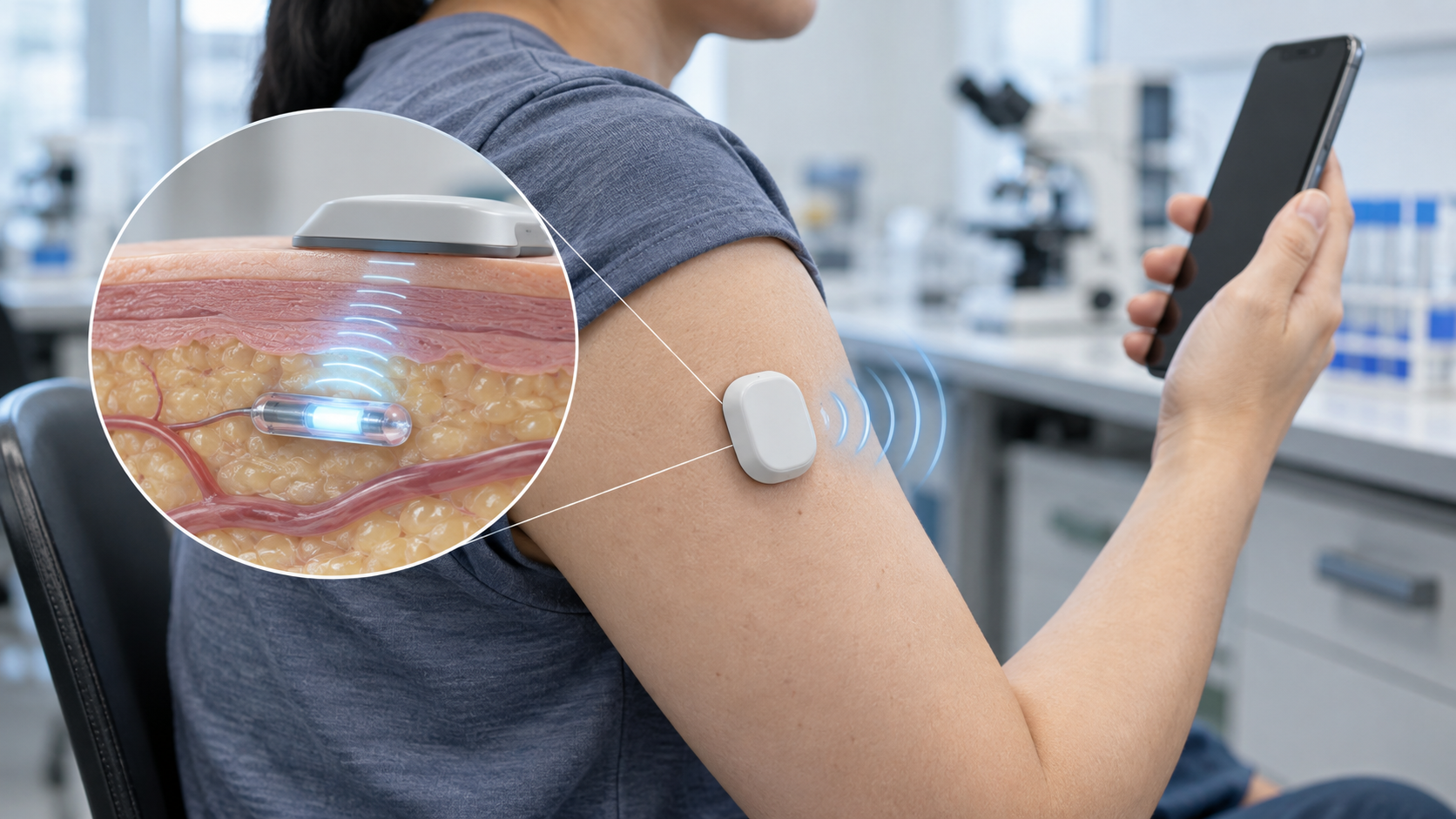
(implanted fluorescent hydrogel)10-K: an LED excites the gel and photodiodes measure the fluorescence
Senseonics is a company whose CGM is not worn on the skin but implanted under it by a clinician, so the business rests on the sensor's life (up to one year) and on an insertion and removal procedure performed by clinicians Sourced. In 2026 it took over sales from Ascensia, which had distributed Eversense through the end of 2025, in the U.S. and in four European markets (Italy, Germany, Spain and Sweden) (10-K and 8-Ks). On finances, the March 2026 10-K states that, because of recurring losses and uncertainty about liquidity, there is substantial doubt about the company's ability to continue as a going concern. This article did not find the same wording in the August 2026 10-Q; the more than US$100 million raised in April to June 2026 is described below Sourced. This article does not assess these matters.
2. The logo and how the name is written

A note on names: the listed company is Senseonics Holdings, Inc., while the applicant for FDA authorizations is its subsidiary Senseonics, Incorporated. Eversense (E3, 365, AP) are product names, and Gemini and Freedom are names for products in development, not companies. The logo (a small image) was taken from the company's official website (senseonics.com).
Official site: https://www.senseonics.com/3. Where the company sits in the field
4. Scale
Senseonics makes only implantable CGM, so company-wide figures are the biosensor figures. Everything below comes from the 10-K and 10-Q Sourced.
| Indicator (US$ thousand) | 2024 | 2025 | Change |
|---|---|---|---|
| Total revenue | 22,472 | 35,257 | +56.9% (our calculation) |
| Of which related party (Ascensia) | 18,499 | 18,173 | -1.8% (our calculation) |
| Gross profit | 533 | 15,763 | Gross margin 2.4% to 44.7% (our calculation) |
| R&D expense | 41,144 | 31,592 | -23.2% (our calculation) |
| Selling, general and administrative expense | 34,231 | 52,508 | +53.4% (our calculation) |
| Operating loss | -74,842 | -68,337 | Loss narrowed |
| Net loss | -78,616 | -69,113 | Loss narrowed |
| 2026 (US$ thousand) | Apr to Jun 2025 | Apr to Jun 2026 | First half 2026 |
|---|---|---|---|
| Total revenue | 6,649 | 14,483 | 26,194 |
| Gross profit | 3,121 | 8,559 | 15,499 |
| R&D expense | 7,715 | 11,639 | 20,250 |
| Selling, general and administrative expense | 9,729 | 32,908 | 63,083 |
| Net loss | -14,501 | -36,705 | -69,038 |
At 30 June 2026, cash, restricted cash and cash equivalents were US$143.0 million and indebtedness including accrued interest was US$55.5 million (August 2026 results release). The company raised its 2026 full-year revenue outlook to US$62 million to US$66 million (from US$60 million to US$64 million) and its gross margin outlook to 58% to 61% (company outlook) Sourced.
The jump in 2026 revenue is probably partly due to the change from selling through a distributor to booking direct sales after sales moved in-house (Inference; the company says U.S. revenue grew more than 150% and active prescribers about 130%, so volume growth is included). Because the way of selling differs, 2025 and 2026 revenue are not directly comparable. At the same time, building its own sales and marketing organization pushed April to June 2026 selling, general and administrative expense to about 3.4 times the prior-year quarter Our calculation (32,908 / 9,729).
5. Resources committed to biosensors
| Resource | What primary sources confirm | Status |
|---|---|---|
| People | 130 employees (31 December 2025, all in the U.S.). According to the August 2026 results release, its Eon Care network of insertion nurses has over 90 nurses, performs about 40% of Eversense insertion procedures, and has a year-end goal of 100. R&D headcount is not disclosed | Sourced / partly undisclosed |
| Money (R&D) | US$41.1 million in 2024 and US$31.6 million in 2025. April to June 2026: US$11.6 million (US$7.7 million a year earlier), which the company attributes to Gemini clinical work and the ongoing development of Freedom | Sourced |
| Manufacturing | 10-K: manufacturing of all components of the Eversense system is outsourced to contract manufacturers in North America and Europe, and the company plans to continue this. FDA PMA supplements in 2023 record a new supplier for a critical sensor component, scale-up of the sensor sub-assembly process and a new supplier for a critical transmitter component. The contract manufacturers' names are not given in the 10-K (FDA documents list separate firms for final packaging and distribution) | Sourced / names not confirmed |
| Acquisitions, investments and financing | (1) Purchase of Ascensia's sales assets: master agreement signed 31 December 2025; the U.S. part closed on 1 January 2026; in Europe, Germany, Spain and Sweden closed on 1 June 2026 and Italy on 8 June. The 8-K says the European payments are mainly the reference balance-sheet value, expected to consist chiefly of inventory (the total was not confirmed here). (2) Insertion network: the assets of NPG were acquired and became the Eon Care network, operating in about 30 states (10-K). (3) Public offering: underwriting agreement of 30 April 2026 for 8,000,000 shares and 8,000,000 pre-funded warrants at US$5.00 per share, with net proceeds expected to be about US$74.75 million (the underwriters' option is separate). (4) Hercules Capital loan: expanded to up to US$140.0 million in May 2026; US$35.0 million was funded initially and a further US$10.0 million at the second amendment; maturity 3 September 2029 | Sourced |
| Universities, research institutes, public funding | ClinicalTrials.gov lists 12 studies with Senseonics as sponsor or collaborator (searched 4 October 2026). NIH or other public grant funding is not confirmed in the 10-K | Sourced / public funding not confirmed |
Regulatory standing (confirmed in FDA's official documents)
| Product | Use (as written in FDA documents) | Category and number | Date |
|---|---|---|---|
| Eversense CGM system (90-day) | Continuous measurement of glucose for up to 90 days in adults (18 and older) with diabetes. Prescription. Real-time readings, trends and alerts for predicted and detected low and high glucose | PMA approval P160048 (product code QCD) | 21 June 2018 |
| Same (replacing fingerstick) | Labeling added so that it can be used in place of fingerstick testing for treatment decisions | PMA supplement approval P160048/S006 | 6 June 2019 |
| Eversense E3 | Expanded indications and a modified sensor design allowing use for up to 180 days | PMA supplement approval P160048/S016 | 10 February 2022 |
| Eversense AP CGM system (6-month) | Adults, up to 6 months. Replaces fingerstick testing. Communicates with other devices including automated insulin dosing (AID) systems. Prescription. Contraindicated for people for whom dexamethasone or dexamethasone acetate is contraindicated | De Novo authorization DEN230052 (21 CFR 862.1357, product code SBA, Class II) | 29 April 2024 |
| Eversense 365 | Adults (18 and older), up to 1 year. Replaces fingerstick testing. Communicates with devices including AID systems. Prescription required | 510(k) clearance K241335 (product code SBA) | 16 September 2024 (the 10-K says 17 September) |
Three categories are mixed here: the original PMA approval, a De Novo authorization and a 510(k) clearance. Eversense 365 was cleared by 510(k) on the basis of the iCGM category created through De Novo (for sensors containing dexamethasone acetate). In Europe the 10-K says the E3 received a CE mark in June 2022 and the 365 in January 2026. The FDA documents checked here include no pediatric indication (the 10-K says an investigational device exemption for a pediatric cohort was obtained in 2023). The status of approvals or certifications in Japan was not checked for this article Not yet confirmed.
According to the 10-K, the Eversense sensor has a glucose-indicating hydrogel bound to the surface of its capsule by polymerization; an LED excites it and two photodiodes measure the fluorescence, which is proportional to the glucose level in interstitial fluid. The sensor has no battery and is powered by inductive NFC from the transmitter Sourced. It is therefore an optical (fluorescence) measurement, not the enzyme-and-current method of subcutaneous wire sensors. The FDA summary for Eversense 365 says the sensor has a silicone collar component that holds the anti-inflammatory steroid dexamethasone acetate, which elutes locally to reduce inflammation around the sensor. The De Novo decision summary says every lot is tested for in vitro elution kinetics and conformed to the specifications set in P160048 Sourced.
The recall record that started on 18 September 2019 (1,344 sensors; now terminated) gives the cause as inadequate hydration of the sensor's glucose-sensing surface, so sensors stopped functioning prematurely Sourced. Hydration of the hydrogel and control of steroid elution from the silicone look like the materials conditions that govern an implant's life of up to a year Not yet confirmed.
6. What it has done so far
| When | Event | Meaning |
|---|---|---|
| September 2017 | Eversense XL received a CE mark (sold in parts of Europe and the Middle East; 180 days) | The first move into Europe (10-K) |
| 21 June 2018 | The Eversense CGM system (90-day) received PMA approval (P160048): adults with diabetes, up to 90 days | The U.S. starting point for implantable CGM |
| 6 June 2019 | Labeling allowing use in place of fingerstick testing approved as a PMA supplement (S006) | The 10-K describes use for treatment decisions including insulin dosing |
| 18 September 2019 | Recall started for 1,344 sensors, which stopped working early because the glucose-sensing surface was not adequately hydrated (FDA record; now terminated) | A record relating to hydrogel material control |
| August 2020 | Collaboration and commercialization agreement with Ascensia, which got exclusive worldwide distribution rights (10-K) | Selling through an outside partner |
| 10 February 2022 | Eversense E3 approved for up to 180 days (PMA supplement S016); CE mark in June | A longer life |
| 8 September 2023 | Loan agreement with Hercules Capital (amended in September 2025 and May 2026) | Debt financing |
| 29 April 2024 | Eversense AP received De Novo authorization (DEN230052): up to 6 months, an iCGM that communicates with AID systems and others | A new category for sensors containing dexamethasone acetate (862.1357) |
| 16 September 2024 | Eversense 365 received 510(k) clearance (K241335): up to 1 year. Ascensia sold it in the U.S. from October 2024 | An implantable CGM lasting up to a year |
| 3 September 2025 | Memorandum of understanding with Ascensia on returning the sales business | As stated in the 10-K |
| 31 December 2025 | Master asset purchase agreement with Ascensia. The U.S. part closed on 1 January 2026. A restated agreement ended Ascensia's U.S. sales rights and made its rights in four European countries non-exclusive | From January 2026 the company is entitled to 100% of revenue in those four countries (10-K) |
| December 2025 | FDA approved the investigational device exemption (IDE) for Gemini, allowing enrollment in its pivotal study | Development of a battery-equipped 2-in-1 product (10-K) |
| January 2026 | Eversense 365 received a CE mark | European launch planned for the second half of 2026 |
| 30 April to May 2026 | Public offering (8 million shares plus 8 million pre-funded warrants at US$5.00) and expansion of the Hercules loan (up to US$140 million) | More than US$100 million raised in April to June 2026 (company) |
| 1 and 8 June 2026 | Purchase of Ascensia's European sales assets completed (Germany, Spain and Sweden on 1 June; Italy on 8 June) | Sales and marketing brought in-house |
7. What comes next
The primary sources also describe the following plans Not yet confirmed.
- Gemini: an implantable sensor with a built-in battery, a 2-in-1 type that either reads continuously through a transmitter or is read on demand by holding a smartphone over it (flash-type). It is built on the 365-day sensor platform, with work focused on demonstrating the battery integration. The pivotal study can now enroll (IDE approved December 2025).
- Freedom: a concept in which the sensor includes Bluetooth, removing the on-body component (10-K).
- More AID pairings: the company says in its results release that use of Eversense 365 together with twiist (an AID system from Sequel Med Tech) is growing. The overall list of integration partners was not confirmed here.
- More financing capacity: the parts of the up-to-US$140 million Hercules facility that become available once conditions are met, and a doubling of authorized shares (70 million to 140 million, approved on 20 May 2026).
The total paid to Ascensia for the U.S. assets / the names and capacity of the contract manufacturers / performance figures (such as MARD) for Eversense 365 (the 10-K gives a MARD for an earlier trial, but 365-day figures were not confirmed here) / the launch date of Gemini / any FDA decision on a pediatric indication / the status of approvals or certifications in Japan / public grant funding. None appears in the primary sources checked for this article.
8. What the company is aiming for in biosensors
This section separates what the company says it is aiming for from what this article reads into the record. An Inference is our interpretation of primary sources, not a statement by the company.
| What can be read | Supporting primary information | Category |
|---|---|---|
| Taking sales back in-house to have its own direct route to patients | Purchase of Ascensia's sales assets in the U.S. (January 2026) and four European countries (June 2026). The results release says direct-to-consumer marketing is now its largest source of new patients | Sourced / Inference (the aim) |
| Expanding its own route for the insertion procedure | It acquired NPG's insertion network and built Eon Care: over 90 nurses, about 40% of insertions, a goal of 100 by year-end | Sourced (company goal) |
| Extending life and making a once-a-year procedure its selling point | Launch of Eversense 365 (up to a year); the "The One Year. One CGM." campaign (10-K) | Sourced |
| Moving to the next generation with a built-in battery (Gemini) and no on-body component (Freedom) | The Gemini concept and IDE approval in December 2025; the reason given for higher R&D spending | Sourced (in development) / Inference (priority) |
| Widening use together with AID systems | The 510(k) and De Novo uses include communication with AID systems; the company describes growing use with twiist | Sourced |
The reading that the company wants "a direct route to patients" rests on the fact that it did not stop at taking sales back; it also acquired a network of nurses who perform the insertions. An implantable sensor must be inserted under the skin by a clinician and removed at the end of its life, so adoption depends on the number of places and people able to perform the procedure. The 10-K describes the insertion network as a way to widen patient access in the U.S., and the August 2026 release says Eon Care accounts for about 40% of insertion procedures Sourced. However, Eon Care's costs and contribution to revenue are not disclosed (they sit within selling, general and administrative expense), so whether having this route pays cannot be verified Not yet confirmed.
9. Map of partnerships in biosensors
Until the end of 2025 Ascensia was Eversense's exclusive worldwide distributor and a significant related party: in 2025 about 52% of revenue came from related parties Sourced (18,173 / 35,257, Our calculation). Under the restated agreement of 2026, Ascensia's U.S. sales rights ended and its rights in four European countries became non-exclusive. As for Sequel Med Tech, the company only mentions the combined use in its results release, and no contract terms appear in the sources checked for this article.
10. Technologies, products and services
Senseonics' product has three parts: a sensor implanted under the skin, an externally worn rechargeable transmitter, and a smartphone app. A clinician inserts the sensor with a dedicated insertion tool and removes it at the end of its life Sourced. Performance figures are marked as either FDA review documents or company statements in the 10-K; no ranking is made across products or tests.
| Product | What the official documents say | Note |
|---|---|---|
| Eversense 365 | FDA document (K241335): the sensor, inserted under the skin, is powered by radio frequency from the transmitter and measures glucose in interstitial fluid every 5 minutes by fluorescence, sending the readings to the transmitter. Operating life of up to one year. A silicone collar releases dexamethasone acetate locally. The rechargeable transmitter is held on the skin by an adhesive patch and sends data to the app over Bluetooth Low Energy (BLE). Prescription required | The 10-K contrasts "up to 12 months" with 7 to 15 days for non-implantable CGM (company statement) |
| Eversense E3 / AP | 10-K: sensor life of up to six months. FDA (DEN230052): the 6-month system is for adults and communicates with devices including AID systems. The FDA document says the transmitter is MR Unsafe and must be removed before an MRI | E3 from 2022; AP labeling from 2024 |
| Gemini (in development) | 10-K: an implantable sensor with a built-in battery; a 2-in-1 type that reads continuously via a transmitter or on demand by holding a smartphone over it. IDE approved in December 2025 | Not authorized; a company development plan |
| Freedom (concept) | 10-K: a concept with Bluetooth in the sensor, eliminating the on-body component | Not authorized; at the concept stage |
| Eon Care (insertion service) | 10-K and results release: a network of insertion nurses (about 30 states) who insert and remove sensors in clinics or at home. Over 90 nurses as of August 2026 | A service, not a product |
Where subcutaneous wire CGMs from other companies measure a current from an enzyme (glucose oxidase) reaction, Eversense uses a hydrogel whose fluorescence changes with glucose, excited by an LED and read by photodetectors (10-K) Sourced. Unlike methods where enzyme deactivation limits life, the limits shift to the stability of the hydrogel, hydration of the surface and the foreign-body response of the surrounding tissue. Accordingly, as the FDA documents show, the sensor carries a silicone part that elutes an anti-inflammatory steroid, and elution rate is tested on every lot. The 2019 recall record cites inadequate hydration of the glucose-sensing surface as the cause of premature failure Sourced.
Powering a battery-free sensor inductively from the transmitter suits a smaller sensor and a longer life. The transmitter, in turn, supplies power and communication (BLE), is fixed to the skin with an adhesive patch and must be removed before an MRI. The material requirements for the in-body part (biocompatibility, long-term stability) and the out-of-body part (battery, water resistance, adhesive) are very different, which looks central to the design Not yet confirmed.
11. The risks this company carries
The financial statements below are presented as the filings describe them and are not assessed by this article.
| Risk | Detail | Category |
|---|---|---|
| Going-concern language | The March 2026 10-K states that "because of recurring losses and uncertainty about our ability to maintain liquidity sufficient to operate our business effectively, there is substantial doubt about our ability to continue as a going concern." This article did not find the wording in the August 2026 10-Q. At 30 June 2026 cash and equivalents were US$143.0 million and debt US$55.5 million (results release) | Sourced (as disclosed) |
| Continuing losses | Net loss of US$69.1 million in 2025 and US$69.0 million in the first half of 2026. Selling, general and administrative expense for April to June 2026 was US$32.9 million, about 3.4 times the prior-year quarter | Sourced / Our calculation |
| Financing and dilution | In April to June 2026 it carried out a public offering (US$5.00 per share) and expanded the Hercules loan, and it doubled authorized shares from 70 million to 140 million in May 2026. Further share issuance is possible | Sourced / effect is an Inference |
| Transition of the sales business | Sales moved in-house in 2026, and the transition in Europe was completed in June. The August 2026 results release says European revenue was affected by the timing of tender updates | Sourced |
| Fully outsourced manufacturing | All components are made by contract manufacturers. The 10-K cites the loss of a key supplier or a disruption at a facility as risks to gross margin and results. Names are not given | Sourced (company's own risk statement) |
| Recalls | FDA's recall database lists one entry: sensors recalled from 18 September 2019 (1,344 units) after failing early due to inadequate hydration (now terminated). No other entry was found in the sources checked | Sourced (as recorded by FDA) |
| Dependence on a procedure | Sensors are inserted and removed by clinicians. Because adoption depends on the number of places and people able to perform insertion, the company is expanding Eon Care. Safety information on the procedure is in each FDA document; this article gives no advice to users | Sourced / Inference |
| Competition | The 10-K names Dexcom, Medtronic and Abbott as well-capitalized competitors, and contrasts the 7 to 15 days of non-implantable CGM with Eversense | Sourced |
| External verification of performance figures | The sources checked here offer limited performance figures (such as MARD) for Eversense 365 | Not yet confirmed |
12. Glossary
- Implantable CGM
- A method in which a sensor placed under the skin measures glucose in interstitial fluid continuously. A clinician inserts and removes the sensor.
- iCGM
- An FDA category of CGM, defined by special controls, designed to connect safely to other devices such as automated insulin dosing systems.
- PMA approval
- FDA's premarket approval required for high-risk devices. Later changes are approved as supplements.
- De Novo authorization
- An FDA pathway that classifies a new type of low-to-moderate-risk device that has no predicate.
- 510(k) clearance
- FDA's finding that a device is substantially equivalent to a legally marketed predicate device.
- Fluorescent hydrogel
- A gel whose fluorescence intensity changes with glucose. It is excited by light and the emitted light is measured.
- NFC / RF power
- Short-range wireless links that deliver power and communication to a part that has no battery.
- Dexamethasone acetate
- An anti-inflammatory steroid. In this sensor it elutes locally from a part of the device to reduce inflammation in the surrounding tissue.
- Related party
- A party with a special relationship to the company. Because terms may differ from ordinary dealings, transactions are disclosed separately.
- Pre-funded warrant
- A right to buy a share of common stock for a nominal price, often used for investors who wish to avoid an ownership cap.
13. References
- Senseonics Form 10-K for the year ended 31 December 2025 (filed 2 March 2026). Business overview, technology, regulatory history, the Ascensia relationship, manufacturing, employees, finances and risks. https://www.sec.gov/Archives/edgar/data/1616543/000110465926022298/sens-20251231x10k.htm
- Senseonics Form 10-Q for the quarter ended 30 June 2026 (filed 6 August 2026). Finances for April to June and the first half of 2026. https://www.sec.gov/Archives/edgar/data/1616543/000110465926092056/sens-20260630x10q.htm
- Senseonics Form 8-K Exhibit 99.1, "Senseonics Holdings, Inc. Reports Second Quarter 2026 Financial Results" (6 August 2026). Results, 2026 outlook, Eon Care and financing. https://www.sec.gov/Archives/edgar/data/1616543/000110465926092018/sens-20260806xex99d1.htm
- Senseonics Form 8-K (2 January 2026). The master asset purchase agreement with Ascensia (31 December 2025) and closing of the U.S. part. https://www.sec.gov/Archives/edgar/data/1616543/000110465926000056/tm261636d1_8k.htm
- Senseonics Form 8-K (12 March 2026). The local asset purchase agreements for four European countries. https://www.sec.gov/Archives/edgar/data/1616543/000110465926027055/tm268623d1_8k.htm
- Senseonics Form 8-K (8 June 2026). Completion of the European asset purchases (1 and 8 June). https://www.sec.gov/Archives/edgar/data/1616543/000110465926071370/tm2616827d1_8k.htm
- Senseonics Form 8-K (1 May 2026). The underwriting agreement for the offering (8 million shares plus 8 million pre-funded warrants at US$5.00). https://www.sec.gov/Archives/edgar/data/1616543/000110465926053515/tm2613286d1_8k.htm
- Senseonics Form 8-K (4 May 2026). The second amendment to the Hercules Capital loan agreement. https://www.sec.gov/Archives/edgar/data/1616543/000110465926054861/tm2613400d1_8k.htm
- Senseonics Form 8-K (20 May 2026). The increase in authorized shares (70 million to 140 million). https://www.sec.gov/Archives/edgar/data/1616543/000110465926064540/tm2615102d1_8k.htm
- U.S. Food and Drug Administration (openFDA) PMA P160048 (the original Eversense approval of 21 June 2018 and supplements S006, S016 and S024 to S026). https://api.fda.gov/device/pma.json?search=pma_number:P160048&limit=1000
- U.S. Food and Drug Administration De Novo Decision Summary DEN230052 (Eversense AP CGM System, 29 April 2024). Intended use, construction and steroid elution testing. https://www.accessdata.fda.gov/cdrh_docs/reviews/DEN230052.pdf
- U.S. Food and Drug Administration 510(k) clearance letter and summary K241335 (Eversense 365, 16 September 2024). Intended use, construction and materials. https://www.accessdata.fda.gov/cdrh_docs/pdf24/K241335.pdf
- U.S. Food and Drug Administration (openFDA) Classification for product code SBA (integrated CGM with a sensor containing dexamethasone acetate, 21 CFR 862.1357). https://api.fda.gov/device/classification.json?search=product_code:SBA
- U.S. Food and Drug Administration (openFDA) Recall record, event 83896 (Eversense sensors; started 18 September 2019; terminated). https://api.fda.gov/device/recall.json?search=res_event_number:83896
- ClinicalTrials.gov Count of studies registered with "Senseonics" as sponsor or collaborator (API; total of 12 confirmed). https://clinicaltrials.gov/api/v2/studies?query.spons=Senseonics&countTotal=true&pageSize=1&fields=NCTId
- Senseonics Official website (source of the logo image). https://www.senseonics.com/
14. Claim-to-source audit
| Claim in the article | Category | Source |
|---|---|---|
| Legal name Senseonics Holdings, Inc., Germantown headquarters, Nasdaq listing (SENS), 130 employees (all in the U.S.), all components made by contract manufacturers, acquisition of the insertion network (Eon Care) | Sourced | Reference 1 https://www.sec.gov/Archives/edgar/data/1616543/000110465926022298/sens-20251231x10k.htm Reference 3 https://www.sec.gov/Archives/edgar/data/1616543/000110465926092018/sens-20260806xex99d1.htm |
| Revenue, related-party revenue, gross profit, R&D, SG&A, operating loss and net loss for 2024 and 2025 (US$ thousand) | Sourced | Reference 1 https://www.sec.gov/Archives/edgar/data/1616543/000110465926022298/sens-20251231x10k.htm |
| Revenue, gross profit, R&D, SG&A and net loss for April to June and the first half of 2026 | Sourced | Reference 2 https://www.sec.gov/Archives/edgar/data/1616543/000110465926092056/sens-20260630x10q.htm |
| Cash of US$143.0 million and debt of US$55.5 million at 30 June 2026; 2026 revenue outlook of US$62 to 66 million and gross margin of 58 to 61%; Eon Care's 90+ nurses and about 40% of insertions; U.S. revenue growth | Sourced | Reference 3 https://www.sec.gov/Archives/edgar/data/1616543/000110465926092018/sens-20260806xex99d1.htm |
| Year-on-year changes and ratios (+56.9%, -1.8%, gross margin 2.4% to 44.7%, -23.2%, +53.4%, about 3.4 times, about 52% related-party revenue) | Our calculation | Our own division of figures in References 1 and 2. Reference 1 https://www.sec.gov/Archives/edgar/data/1616543/000110465926022298/sens-20251231x10k.htm |
| Ascensia collaboration agreement (August 2020), memorandum (3 September 2025), master asset purchase agreement (31 December 2025), U.S. closing (1 January 2026), restated agreement and 100% of European revenue | Sourced | Reference 1 https://www.sec.gov/Archives/edgar/data/1616543/000110465926022298/sens-20251231x10k.htm Reference 4 https://www.sec.gov/Archives/edgar/data/1616543/000110465926000056/tm261636d1_8k.htm |
| Local asset purchase agreements for four European countries (12 March 2026) and their completion (1 and 8 June) | Sourced | Reference 5 https://www.sec.gov/Archives/edgar/data/1616543/000110465926027055/tm268623d1_8k.htm Reference 6 https://www.sec.gov/Archives/edgar/data/1616543/000110465926071370/tm2616827d1_8k.htm |
| Public offering (8 million shares plus 8 million pre-funded warrants at US$5.00; net proceeds of about US$74.75 million expected) | Sourced | Reference 7 https://www.sec.gov/Archives/edgar/data/1616543/000110465926053515/tm2613286d1_8k.htm |
| Hercules Capital loan (up to US$140.0 million; maturity 3 September 2029; second amendment of 1 May 2026) | Sourced | Reference 8 https://www.sec.gov/Archives/edgar/data/1616543/000110465926054861/tm2613400d1_8k.htm |
| Increase in authorized shares (70 million to 140 million, 20 May 2026) | Sourced | Reference 9 https://www.sec.gov/Archives/edgar/data/1616543/000110465926064540/tm2615102d1_8k.htm |
| The going-concern language in the March 2026 10-K | Sourced | Reference 1 https://www.sec.gov/Archives/edgar/data/1616543/000110465926022298/sens-20251231x10k.htm |
| Registered studies on ClinicalTrials.gov (12) | Sourced | Reference 15 https://clinicaltrials.gov/api/v2/studies?query.spons=Senseonics&countTotal=true&pageSize=1&fields=NCTId |
| R&D headcount, names and capacity of contract manufacturers, total paid to Ascensia, NIH or other public funding, performance figures for Eversense 365, pediatric indication, Gemini launch date | Not yet confirmed | Not found in References 1, 3 and 4. We make no estimate. Reference 1 https://www.sec.gov/Archives/edgar/data/1616543/000110465926022298/sens-20251231x10k.htm |
| Eversense (90-day): PMA P160048 (21 June 2018), supplements S006 (6 June 2019), S016 (E3, 10 February 2022) and S024 to S026 (suppliers and manufacturing) | Sourced | Reference 10 https://api.fda.gov/device/pma.json?search=pma_number:P160048&limit=1000 |
| Eversense AP: De Novo DEN230052 (29 April 2024), up to 6 months, 18 and older, AID communication, dexamethasone acetate elution testing, MRI removal of the transmitter | Sourced | Reference 11 https://www.accessdata.fda.gov/cdrh_docs/reviews/DEN230052.pdf |
| Eversense 365: 510(k) K241335 (16 September 2024, product code SBA), up to 1 year, 18 and older, silicone collar, fluorescence measurement, RF power | Sourced | Reference 12 https://www.accessdata.fda.gov/cdrh_docs/pdf24/K241335.pdf Reference 13 https://api.fda.gov/device/classification.json?search=product_code:SBA |
| The 10-K's date of 17 September 2024 for the clearance, CE marks (E3 in June 2022, 365 in January 2026) and the pediatric IDE | Sourced | Reference 1 https://www.sec.gov/Archives/edgar/data/1616543/000110465926022298/sens-20251231x10k.htm |
| Fluorescent hydrogel, LED, photodiodes and NFC power as the measurement principle | Sourced | Reference 1 https://www.sec.gov/Archives/edgar/data/1616543/000110465926022298/sens-20251231x10k.htm |
| Eversense sensor recall: started 18 September 2019, 1,344 units, early failure from inadequate hydration, terminated | Sourced | Reference 14 https://api.fda.gov/device/recall.json?search=res_event_number:83896 |
| Competitors (Dexcom, Medtronic, Abbott) and the comparison with the 7 to 15 days of non-implantable CGM | Sourced | Reference 1 https://www.sec.gov/Archives/edgar/data/1616543/000110465926022298/sens-20251231x10k.htm |
| Gemini (built-in battery; IDE approved in December 2025) and the Freedom concept | Not yet confirmed | Reference 1 https://www.sec.gov/Archives/edgar/data/1616543/000110465926022298/sens-20251231x10k.htm |
| European launch of Eversense 365 (second half of 2026), Eon Care's goal of 100 nurses, and the growing use with twiist | Not yet confirmed | Reference 1 https://www.sec.gov/Archives/edgar/data/1616543/000110465926022298/sens-20251231x10k.htm Reference 3 https://www.sec.gov/Archives/edgar/data/1616543/000110465926092018/sens-20260806xex99d1.htm |
| The four-type classification (diabetes and continuous monitoring) and example company names | Our calculation | Our own classification. Company names are examples from this series. Reference 1 https://www.sec.gov/Archives/edgar/data/1616543/000110465926022298/sens-20251231x10k.htm |
| Readings of a direct route to patients, an expanded insertion network and next-generation investment | Inference | Our interpretation of References 1, 3, 4, 5 and 6. Reference 1 https://www.sec.gov/Archives/edgar/data/1616543/000110465926022298/sens-20251231x10k.htm |
| The reading that revenue booking changed after the move in-house, and the materials reading (hydrogel stability and hydration, steroid elution govern life) | Inference | Our interpretation of References 1, 12 and 14. Reference 12 https://www.accessdata.fda.gov/cdrh_docs/pdf24/K241335.pdf |
Last updated 4 October 2026 / Troy Technical
Every figure in this article comes from Senseonics's statutory filings (SEC filings), U.S. FDA public documents, ClinicalTrials.gov and the company's official announcements. No research-firm estimates or press-based figures have been used. Passages marked "Inference" are this article's interpretation of primary sources, not statements made by the company. Nothing here recommends using a product or makes a medical judgment.