COMPANY PROFILE / BIOSENSORS
Toyobo
A materials company that ferments and purifies the diagnostic enzymes at the heart of glucose sensors
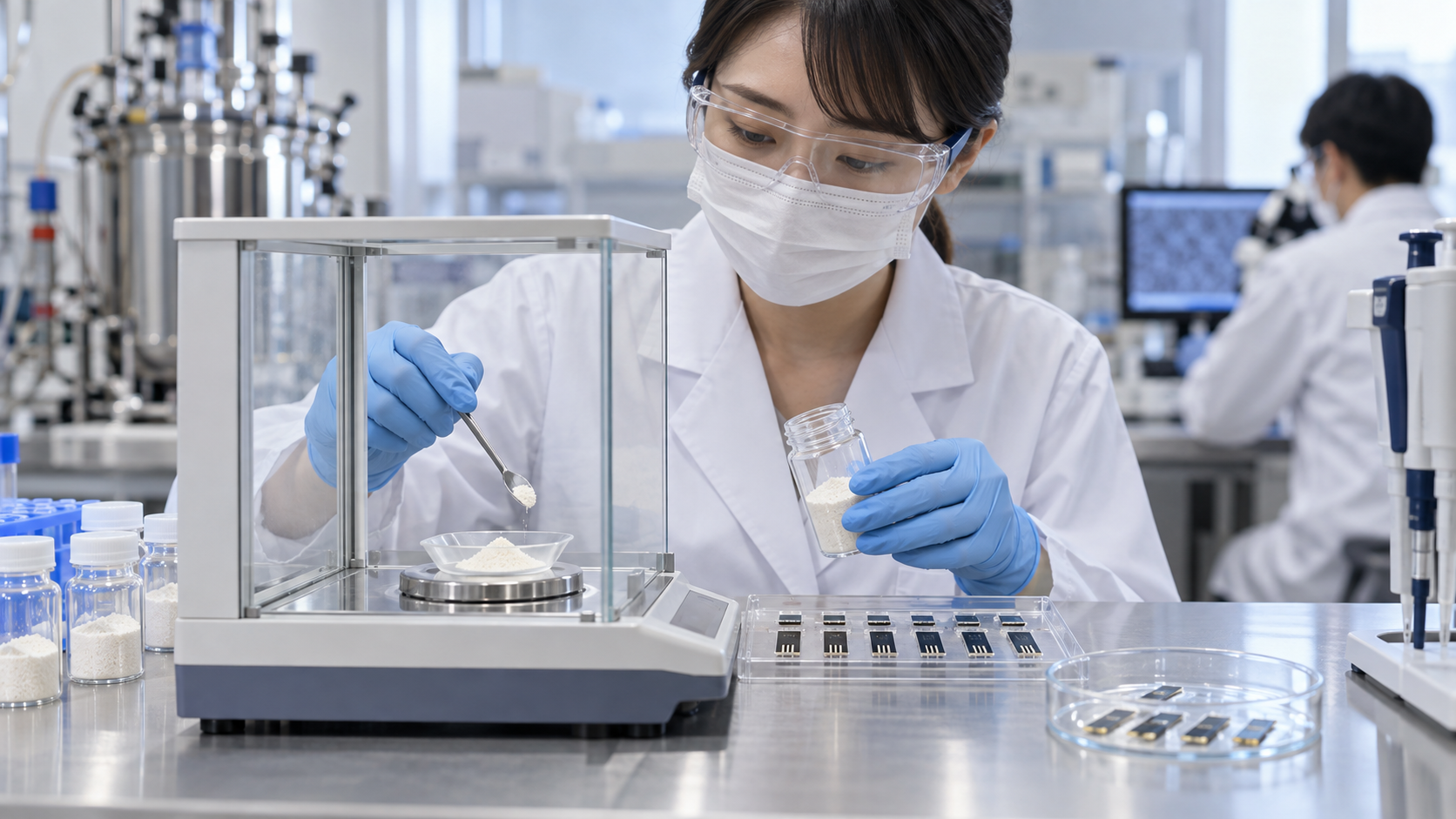
Toyobo is a diversified materials maker with four main businesses: films, life sciences, environmental and functional materials, and functional fibers. Its link to biosensors runs through the bio business inside life sciences, which makes raw-material enzymes for diagnostic reagents, used in tests for glucose, cholesterol and other analytes, by culturing microorganisms and purifying the enzyme. At a December 2025 business briefing, the company said it holds about 35% of the world market for FAD-GDH, the raw-material enzyme for blood glucose sensors (the company's own calculation). It supplies the material that carries out the sensing reaction, not the sensor or the meter. This article draws on the Annual Securities Report, business briefings, the company's own product data and its patents to set out what could be confirmed and what could not, and then explains, from a materials engineer's view, what about an enzyme determines sensor performance.
- At a glance: Toyobo and its place in biosensors
- Logo and naming
- Where the company sits in biosensors
- Company scale
- Resources committed to biosensors
- Track record
- Plans
- What the company is aiming for in biosensors
- Partnership map for biosensors
- Technologies, products and services
- Risks
- Glossary
- References
- Claim-to-source audit
1. At a glance: Toyobo and its place in biosensors
(TOYOBO CO., LTD.)Renamed from Toyo Boseki in October 2012 (history section of the Annual Securities Report)
1-13-1 UmedaIts predecessor, Osaka Spinning, was founded in 1882
Prime Market89,048,792 shares outstanding (31 March 2026)
(secondary: In vitro diagnostics & POCT)Mainly supplies enzymes; diagnostic reagents and instruments are secondary
FAD-GDH for glucose sensorsFor tests of glucose, cholesterol, creatinine, GOT/GPT and others (the company's description)
Toyobo is not a maker of glucose meters or test strips. It makes the enzyme inside them that detects sugar Sourced. The Annual Securities Report (the statutory annual report that Japanese listed companies file under the Financial Instruments and Exchange Act) describes the life sciences segment only as "bio products such as enzymes for diagnostic reagents, pharmaceuticals, medical membranes and medical devices," and the words "blood glucose," "glucose" and "biosensor" do not appear in it. That the enzyme is for blood glucose sensors can be confirmed from the business briefing materials (FAD-GDH, about 35% of the world market, and a blood glucose sensor enzyme launched in 1990) and from patent specifications in the company's name. On the other hand, the published list of the company's enzyme products has no individual page for FAD-GDH Not yet confirmed. So the starting point of this article is that the company's blood glucose sensor business can be confirmed in briefing materials and patents, but its figures and product specifications cannot be traced in public documents.
2. Logo and naming

The logo is the corporate logo published in the header of the company's official website (toyobo.co.jp), the word TOYOBO with the tagline "Beyond Horizons," taken as it is. It has not been recreated with generated images.
Naming: the company is Toyobo Co., Ltd. (in Japanese, Tōyōbō Kabushiki Kaisha), and the logo is the Latin-letter form "TOYOBO." It was established in 1914 through the merger of Osaka Spinning and Mie Spinning as Toyo Boseki Co., Ltd., and renamed Toyobo Co., Ltd. in October 2012. The company's identity page says the corporate logo was renewed and a tagline adopted in 2022. Since April 2023, its environmental and functional materials business has been run by Toyobo MC, a joint venture with Mitsubishi Corporation; the bio business is run by Toyobo itself (Annual Securities Report). Enzyme codes such as GLD-311 are product part numbers, not company names.
Official site: https://www.toyobo.co.jp/3. Where the company sits in biosensors
Toyobo's primary type is materials & components. Its secondary type is in vitro diagnostics & POCT (point-of-care testing): it also makes research reagents and diagnostics for gene testing, a gene-testing instrument, urine-testing instruments and readers for point-of-care tests (company product pages). This article, however, centers on the raw-material enzymes for diagnostic reagents used in blood glucose and other tests and in blood glucose sensors. The table below sets out which materials and uses are central, as far as the company's own documents allow.
| Material / use | Role at Toyobo | Primary sources found | Status |
|---|---|---|---|
| Raw-material enzymes for biochemical diagnostics | Core. Main-reaction enzymes in reagents for glucose, cholesterol, creatinine, GOT/GPT and other tests. The gene for the enzyme is introduced into a microorganism, which is cultured; the enzyme is purified and sold as powder | Business briefing materials; enzyme product pages and data sheets | Sourced |
| Raw-material enzyme for blood glucose sensors (FAD-GDH) | One of the core lines. The company says about 35% of the world market (the company's own calculation). A blood glucose sensor enzyme was launched in 1990. No individual page in the published enzyme list | Business briefing materials (2022 and 2025); four patents in the company's name | Sourced (company statement) |
| Other enzymes for glucose measurement | Listed: NAD(P)-dependent glucose dehydrogenase (GLD-311), PQQ-dependent glucose dehydrogenase (GLD-321) and glucose oxidase (GLO-101 and 201). The list is headed "diagnostic reagent grade" | Enzyme product pages; data sheets for GLD-311, GLD-321 and GLO-101/201 | Sourced |
| Research reagents, diagnostics and instruments for gene testing | Secondary. The GENECUBE gene-testing instrument, gene-test reagents, urine-testing instruments, a point-of-care reader and others. A business separate from blood glucose sensors | Product pages; business briefing materials | Sourced |
| Hollow-fiber membranes for artificial kidneys; contract pharmaceutical manufacturing | Separate businesses within life sciences (medical business; pharmaceutical contract manufacturing). Not biosensors, so not covered here | Annual Securities Report | Sourced |
| Sensor electrodes, test strips, meter bodies | Not confirmed in the company's documents. We could not confirm that it sells finished glucose meters or test strips | – | Not yet confirmed |
4. Company scale
Toyobo is a listed company, and its consolidated finances are disclosed in the Annual Securities Report. The first table shows the scale of the whole company, and the second shows the life sciences segment, which contains the bio business Sourced. Sales and profit for the bio business alone are not disclosed; the segment is reported as life sciences.
| Item (consolidated, year to March 2026) | Detail |
|---|---|
| Sales | ¥421,563 million (prior year ¥422,032 million, down 0.1%) |
| Operating profit | ¥27,906 million (prior year ¥16,653 million). Ordinary profit ¥22,878 million; profit attributable to owners of the parent ¥11,174 million |
| Total assets and net assets | Total assets ¥627,667 million; net assets ¥251,995 million. Debt-to-equity ratio 1.22 times (1.37 times at the prior year-end) |
| Capital and employees | Capital ¥51,730 million. 9,398 consolidated employees (plus 1,643 temporary staff) |
| Listing and headquarters | Tokyo Stock Exchange Prime Market. 1-13-1 Umeda, Kita-ku, Osaka. Ikuo Takeuchi, Representative Director and President (at the time of filing) |
| Businesses | Films, life sciences, environmental and functional materials, and functional fibers and trading (plus real estate). The company positions films and life sciences as "key expansion businesses" |
| Life sciences (segment) | Year to March 2025 | Year to March 2026 |
|---|---|---|
| Sales to external customers | ¥34,341 million | ¥34,494 million (up 0.4%) |
| Segment profit (operating-profit basis) | ¥2,010 million | ¥65 million (down 96.8%; the text rounds it to "¥100 million") |
| Segment assets | ¥78,745 million | ¥87,422 million |
| Depreciation | ¥3,258 million | ¥4,053 million |
| Increase in tangible and intangible fixed assets | ¥9,279 million | ¥6,816 million |
| Employees (consolidated / filing company) | – | 1,083 (plus 125 temporary) / 702 (plus 98 temporary) |
| Share of company sales | – | About 8.2% (Our calculation 34,494 ÷ 421,563) |
Life sciences operating profit for the year to March 2026 fell short of the outlook (sales of ¥37.0 billion and operating profit of ¥2.5 billion) that the company gave at its December 2025 briefing (actual: sales of ¥34.5 billion and segment profit of ¥65 million) Sourced. The Annual Securities Report explains that in the bio business "demand for raw-material enzymes for diagnostic reagents held firm, but sales of diagnostic reagents were weak because of conditions in the Chinese market," and that lower sales at overseas sites and a delayed start-up of a new medical-business plant also weighed on the result. What share of the bio business is enzymes for blood glucose sensors, and what profit they earn, is not disclosed Not yet confirmed.
5. Resources committed to biosensors
People and spending for the bio business alone are not disclosed, so figures for life sciences as a whole are kept separate from figures for the bio business's sites and equipment. The table shows, for people, money, outside stakes and universities, what could and could not be confirmed.
| Item | What could be confirmed | Status |
|---|---|---|
| People (R&D sites and headcount) | 1,083 consolidated employees in life sciences (31 March 2026). Enzymes are made at the Tsuruga Bio Plant (Tsuruga, Fukui; 237 employees plus 35 temporary staff). In the briefing's site map, research is at the Biotechnology Research Laboratories and the Research Center (Otsu, Shiga). The Annual Securities Report also mentions the Tsuruga Bio Research Laboratory (established 1992); we did not confirm how the two relate. Total R&D headcount for the bio business is not disclosed | Sourced / not disclosed |
| Money (R&D and capital spending) | Life sciences R&D spending of ¥2.2 billion and capital spending of ¥6.8 billion in the year to March 2026 (of which ¥6.5 billion was for expanding pharmaceutical manufacturing equipment). In the bio business, new production equipment at the Tsuruga Bio Plant (a third culture building and a new purification building) cost ¥7.0 billion, has operated since fiscal 2024, and raises capacity 1.5 times (company statement). Equipment for gene-testing research reagents and diagnostics also cost ¥6.5 billion (in operation from fiscal 2025). The Tsuruga Bio Plant's book value is ¥18,680 million (enzyme production equipment and others) | Sourced |
| Investments, acquisitions, joint ventures | Acquired Spinreact of Spain, a maker of diagnostics and diagnostic instruments, in 2013 (briefing materials). Spinreact, S.A.U. is now a consolidated subsidiary that makes and sells diagnostics and instruments (Annual Securities Report). We could not confirm any startup investment or biosensor joint venture | Sourced / not confirmed (investments, joint ventures) |
| Universities, research institutions, public funding | The company states in general terms that it works with public research bodies such as NEDO (New Energy and Industrial Technology Development Organization), AMED (Japan Agency for Medical Research and Development) and JST (Japan Science and Technology Agency), and has joint research and comprehensive partnership agreements with national and private universities. We could not confirm any joint research or public funding specific to biosensors or glucose-measuring enzymes. There is a public-interest foundation, the Toyobo Biotechnology Research Foundation, that supports young researchers | Sourced / not confirmed (individual projects) |
Regulatory and quality position
Toyobo's diagnostic enzymes are raw materials, which the company's safety guide describes as "mainly used for in vitro diagnostic reagents." Regulatory classification as a glucose meter or test strip rests with the company that places the finished product on the market. The table summarizes what could be confirmed from regulators' documents and the company's materials for the company's raw-material enzymes (this article does not give advice on diagnosis, treatment or how to read measured values).
| Subject | Use / content | Category | Date |
|---|---|---|---|
| Raw-material enzymes for diagnostics (GLD-311, GLD-321, GLO-101/201 and others) | Company safety guide: "mainly used for in vitro diagnostic reagents"; "do not use directly in the bodies of humans or animals" | Sold as raw materials. Any approval, certification or notification category as a product could not be confirmed | Checked October 2026 |
| Blood glucose meters using the glucose dehydrogenase (GDH) method (except those using NAD or NADP as the coenzyme) | The Ministry of Health, Labour and Welfare asked manufacturers and importers to revise package inserts promptly, including adding a warning, because it had found that such meters read higher than the actual value for patients receiving maltose-containing infusions and similar | Administrative notice (tsūchi) | 29 September 2004 |
| Quality management at the Tsuruga Bio Plant and others | ISO 9001 (LRQA, registration no. 0065402): development and manufacture of industrial enzymes and of proteins used as raw materials for in vitro diagnostics and research reagents | Private third-party certification (not a regulatory approval) | Certified October 1997 |
| Head office, Biotechnology Research Laboratories and Tsuruga Bio Plant | ISO 13485 (TÜV SÜD Japan, registration no. Q5 068523 0007): design, development, manufacture and distribution of in vitro diagnostics and their standard solutions, auxiliary reagents and intermediates; manufacture and distribution of testing instruments | Private third-party certification (not a regulatory approval) | Certified April 2009 |
| The company's own in vitro diagnostics (gene-test reagents and others) | The product page labels them "gene-test reagents (in vitro diagnostics)." Individual approval or certification numbers and dates were not checked for this article | Not confirmed | – |
6. Track record
| When | Event | Meaning |
|---|---|---|
| 1948 | At the Inuyama plant (Aichi), research on yeast began to treat waste liquor from rayon pulp | Starting point of the bio business (from environmental protection) |
| 1971–1972 | Entered the bio business in September 1971 (Annual Securities Report). In 1972 launched enzyme-based biochemical test reagents and moved into diagnostic reagents and their raw materials (briefing materials) | Entry into diagnostic enzymes |
| 1975–1978 | In 1975 decided to put the bio business's emphasis on the diagnostic market. In 1978 the Tsuruga enzyme plant started (now the Tsuruga Bio Plant) | A mass-production base for enzymes |
| 1982 and 1986 | Launched enzymes for genetic engineering (1982). A new research building was completed at Tsuruga (1986) | Expansion into research enzymes and stronger R&D |
| 1990 | Launched a blood glucose sensor enzyme (2022 briefing materials) | The point of contact with biosensors |
| 1992 and 1997 | Tsuruga Bio Research Laboratory established (1992). Tsuruga Bio Plant certified to ISO 9001 (October 1997) | Research and quality-assurance setup |
| 2006–2010 | Patent for a modified FAD-dependent glucose dehydrogenase with improved heat stability (priority 14 November 2006; US application 13 November 2007; granted 16 February 2010; US7662600B2) | Designing an enzyme to survive sensor-chip manufacture and storage |
| 2009 and 2011 | ISO 13485 certification (April 2009). A new culture building was completed (2011) | Quality system for in vitro diagnostics, and culture capacity |
| 2011–2016 | Patent on a novel flavin-binding glucose dehydrogenase (priority 31 October 2011; granted 16 February 2016; US9260699B2) and on a more heat-stable enzyme (priority 21 October 2013; granted 23 May 2017; US9657325B2) | Continued improvement of sugar selectivity and heat resistance |
| 2013 and 2015 | Acquired Spinreact of Spain (2013). Built a new enzyme purification building (2015) | Reach downstream into diagnostics and instruments; more purification capacity |
| 2015–2021 | Patented a specification for enzyme preparations because trace trehalase contamination can raise the blank value of a glucose sensor (priority 9 April 2015; granted 9 February 2021; US10913971B2) | An example where purity, not only activity, decides performance |
| 2024 | New production equipment at the Tsuruga Bio Plant began operating (capacity 1.5 times; investment ¥7.0 billion) | More supply capacity |
| December 2025 to June 2026 | Life sciences business briefing (1 December 2025), 2030 Medium-term Management Plan (6 April 2026), 168th Annual Securities Report (23 June 2026). Life sciences operating profit fell from about ¥2.0 billion to about ¥0.65 billion | The role of the blood glucose sensor enzyme was explained, while earnings weakened |
7. Plans
at Tsuruga now runningThird culture building and new purification building. Capacity 1.5 times; ¥7.0 billion (from fiscal 2024)
culture of enzymesThe company says about one-fifth of the culture scale of batch culture gives the same output
rising to about 30% (fiscal 2035)Raw-material enzymes for biochemical diagnostics. About 25% now, second in the world
¥50 billion in the medium term¥80 billion or more later. The direction for life sciences set out in the December 2025 materials
The 2030 Medium-term Management Plan (6 April 2026) states the direction of the bio business as "number one in raw-material supply for biochemistry and genetics (shifting upstream)." For raw-material enzymes in biochemistry it is to expand share by improving cost competitiveness through continuous culture technology, and for gene-testing diagnostics to shift toward development-focused work Not yet confirmed. Its policy also includes focusing on middle-income countries, where market growth is expected, and development-proposal-style sales matched to customers' needs.
None of the following appears in the primary sources Not yet confirmed.
Sales, profit or volume targets for blood glucose sensor enzyme (FAD-GDH) alone / plans for new or improved FAD-GDH products / plans for enzymes for continuous glucose monitoring (CGM) / plans for specific customers or joint development / sales and operating-profit targets for the bio business alone. The 2030 plan presentation does show planned life sciences sales and operating profit as charts, but without numeric labels, so this article does not read values off the charts.
8. What the company is aiming for in biosensors
This section includes points the company does not state directly. They are written as inferences readable from the primary sources, with the basis for each.
| What can be read | Primary-source basis | Status |
|---|---|---|
| It aims to be the world's leading supplier of raw materials (enzymes), not of instruments or diagnostic services | 2030 Medium-term Management Plan: "number one in raw-material supply for biochemistry and genetics (shifting upstream)"; gene-testing diagnostics to become development-focused | Sourced (company policy) |
| It sees itself as at the stage of cutting cost to widen share in raw-material enzymes for biochemistry | Self-assessment in the briefing: product customization and brand strength rated best, production capacity and cost competitiveness rated lowest. Continuous culture technology is under construction | Sourced (company statement) |
| In blood glucose sensors, it differentiates on quality (heat resistance, sugar selectivity, low impurities) rather than price | The company's four patents deal with heat resistance (priority 2006 and 2013), sugar selectivity (2011) and impurities (trehalase, 2015). The briefing also lists "product customization" as a strength | Inference |
| It expects demand growth in middle-income countries | Business briefing materials: "focusing on middle-income countries where market expansion is expected" | Sourced (company policy) |
| The company attributes the weaker earnings of the year to March 2026 mainly to Chinese market conditions and delays in new equipment start-up and productivity | Annual Securities Report: weak diagnostic-reagent sales (Chinese market), lower sales at overseas sites, delayed start-up of a new medical-business plant. Briefing materials: delayed productivity gains | Sourced (company explanation) |
The reason for reading "quality is the axis of differentiation" is that the problems the patents address concentrate on how an enzyme behaves once it is built into a sensor, not on how high its activity is. The patent with a 2006 priority date notes that sensor-chip manufacture sometimes involves heat drying, and so addresses modifications that raise the heat resistance of a recombinant enzyme made in E. coli. The patent with a 2013 priority date points out that finished sensor strips are guaranteed for up to two years at around room temperature, and that in summer they may be exposed to more than 35 °C or 40 °C, and so asks for a more heat-resistant enzyme. The patent with a 2015 priority date analyzes how a trace of trehalase mixed into an enzyme preparation could raise the blank value (the signal that appears even when the sample has no glucose) of sensors to which trehalose has been added, and sets an impurity specification. All of these are statements in the company's patent specifications, and we cannot confirm whether actual products meet the patent's specifications, or whether customers buy because of these points Not yet confirmed. This does not contradict the company's claims; it means that the problem-setting in the patents suggests the company is trying to sell "an enzyme that fits the sensor maker's process and storage conditions."
9. Partnership map for biosensors
What stands out about Toyobo's ties is that the company's materials never name the sensor and diagnostic makers it supplies. Because it supplies raw materials to finished-product makers, customer names may be withheld for commercial reasons, but this is our inference, not the company's statement Inference. What can be confirmed is limited to the acquired Spinreact (diagnostics and instruments) and the overseas sales network, a public-interest foundation that supports young researchers, and general ties with public bodies and universities. No joint-development case or supply contract with a specific company in biosensors could be confirmed in official materials Not yet confirmed.
10. Technologies, products and services
What follows comes from the company's enzyme product pages, product data, business briefing materials and patent specifications. Values are the manufacturer's stated values, and the activity unit (U) is defined by a different assay for each enzyme Sourced. For FAD-GDH, the enzyme for blood glucose sensors, no public product data could be found, so no performance values are given Not yet confirmed.
| Product | Company page (manufacturer's stated values) |
|---|---|
| GLD-311 Glucose dehydrogenase (NAD(P)-dependent) | White lyophilized powder. Grade III, 250 U/mg-solid or more. Contaminating enzymes (NADH oxidase, α-glucosidase, glucose-6-phosphate dehydrogenase) each ≤1.0×10⁻³%. Stable at −20 °C for at least one year. Molecular weight about 101,000 (gel filtration), optimum pH 9.0, thermal stability 45 °C (15-minute treatment in 50 mM potassium phosphate buffer, pH 7.0). Requires NAD⁺ or NADP⁺ as a coenzyme. Relative activity (glucose = 100%, substrate at 150 mM): xylose 16.2%, maltose 1.4%, lactose 1.5%. Activity is assayed by NADH absorbance at 340 nm (37 °C) |
| GLD-321 Glucose dehydrogenase (PQQ-dependent) | Purple lyophilized powder. Grade III, 500 U/mg-solid or more (1 U is the amount of enzyme that forms 0.5 micromole of diformazan per minute, by reducing NTB through PMS). Contaminating enzymes (NAD-dependent glucose dehydrogenase, hexokinase) each ≤1.0×10⁻³%. Stabilizers are Ca2+ and BSA. Stable at −20 °C for at least one year. Molecular weight about 100,000, optimum pH 7.0 (37 °C), thermal stability below 50 °C (pH 7.5, 30 minutes). Relative activity (glucose = 100%, substrate at 50 mM): maltose 107.0%, lactose 68.9%, galactose 16.0%, xylose 15.0%. Inhibitors: Cu, Pb, Ag |
| GLO-101 / 201 Glucose oxidase (from Aspergillus sp.) | Yellowish lyophilized powder. Grade I is 180 U/mg-solid or more (catalase ≤5.0×10⁻³%); Grade II is 100 U/mg-solid or more with about 50% stabilizers (catalase ≤3.0%). Stabilizers are potassium gluconate and sodium glutamate. A glycoprotein carrying two FAD per molecule. Molecular weight about 153,000, optimum pH 4.5, thermal stability below 50 °C (pH 5.7, 1 hour). Relative activity (glucose = 100%, substrate at 0.1 M): maltose 0.69%, xylose 0.93%, lactose 0%. Activity is assayed by the dye formed from hydrogen peroxide, read at 555 nm |
| FAD-GDH for blood glucose sensors | Briefing materials say: "raw-material enzyme for blood glucose sensors, FAD-GDH, about 35% share, No. 1 in the world (share is the company's own calculation)." A blood glucose sensor enzyme was launched in 1990. It is not in the published enzyme list, and no product data could be found. Patents in the company's name (US7662600B2, US9260699B2, US9657325B2, US10913971B2) deal with improving the heat resistance, selectivity and purity of FAD-dependent glucose dehydrogenase |
| Other diagnostic raw-material enzymes | Cholesterol esterase, cholesterol oxidase, lipoprotein lipase, peroxidase, creatinine-related enzymes, uricase, hexokinase, lactate oxidase and others. The product page describes "enzymes for in vitro diagnostic reagents for a wide range of analytes, including blood glucose, cholesterol and triglycerides." A price list for small packs (10 mg and other units) is also published |
| Contract manufacturing and diagnostic systems | Contract manufacture of proteins (antibodies, antigens, enzymes and others) using animal cells (the company cites more than 25 years of experience). Gene-testing instruments, urine-testing instruments, point-of-care readers and others (secondary business) |
| Storage and handling guidance | Powders are stored frozen (−20 °C) and liquids refrigerated (4 °C), in all cases at low humidity, unopened and in the dark. To avoid inactivation by moisture, the company's safety guide says a powder taken from the refrigerator should be left at room temperature, unopened, for at least three hours |
(1) The type of enzyme sets how electrons are passed on, and its weak point. The company's patent specifications sort the enzymes used in blood glucose sensors as follows (the company's view). Glucose oxidase is highly selective for glucose and heat resistant, but because oxygen accepts the electrons, dissolved oxygen affects the reading. NAD(P)-dependent dehydrogenases are not affected by oxygen, but a coenzyme must be added separately and their stability is described as poor. PQQ-dependent dehydrogenases are not affected by oxygen either, but they also react with sugars other than glucose, such as maltose and lactose, which is described as a problem. FAD-dependent dehydrogenases bind the coenzyme to the enzyme, are described as unaffected by oxygen, and as reacting hardly at all with maltose. The company's product data show the difference numerically: PQQ-dependent GLD-321 is at 107% for maltose (substrate at 50 mM, glucose = 100%), NAD(P)-dependent GLD-311 is at 1.4% (150 mM), and glucose oxidase GLO-101/201 is at 0.69% (0.1 M). But the substrate concentrations and assays differ, so these three figures cannot be lined up to rank the enzymes. In 2004, Japan's Ministry of Health, Labour and Welfare, noting that meters using the GDH method (except NAD- and NADP-based ones) read high when used on patients receiving maltose-containing infusions and similar, asked for package inserts to be revised. It is an example of an enzyme's selectivity feeding directly into a finished product's safety notes (this article does not advise on how to read measured values).
(2) The enzyme has to withstand the heat of sensor manufacture and storage. The company's patent with a 2013 priority date says that, when the enzyme solution is dried on the reaction layer during sensor manufacture, heating at 50 °C or more is often used to raise efficiency; that finished strips are guaranteed for up to two years at around room temperature; that users do not necessarily store them under strict temperature control; and that summers can exceed 35 °C or 40 °C. It concludes that high stability of the enzyme itself is desirable. The patent with a 2006 priority date reports that an E. coli-expressed recombinant FAD-dependent glucose dehydrogenase kept only about 13% of its activity after 15 minutes at 50 °C, against about 77% for an enzyme purified from a wild-type strain (Aspergillus oryzae), and presumes that the absence of sugar chains on the surface of a recombinant enzyme is one cause. These are figures from patent examples, not specifications of current products. They are best read as showing a design idea: raise heat resistance by changing the amino acid sequence.
(3) Impurities can matter more than activity. The patent with a 2015 priority date investigated problems such as readings that vary between sensors, read higher than the actual glucose concentration, or show a raised blank (the signal that appears even when the sample contains no glucose), and concluded that where the sensor formulation contains trehalose, a trace of trehalase mixed into the enzyme preparation can be the cause. Trehalase breaks trehalose down into glucose, which the enzyme then detects. The patent therefore gives a specification: 0.1 mL of the composition added to 2.9 mL of a solution containing 10 mM trehalose and 1 mmol/L potassium ferricyanide, adjusted to an enzyme activity of 500 U/mL and incubated at 37 °C, must show a fall in absorbance at 405 nm of less than 20 milli-absorbance units per minute. The company's product data also state upper limits for contaminating enzymes, such as ≤1.0×10⁻³%, for GLD-311, GLD-321 and GLO-101/201. This suggests a materials-side view that high specific activity (U/mg) and usable purity for a sensor are different things.
(4) Manufacture (fermentation and purification) and storage decide quality. According to the company, the gene for the enzyme is isolated and modified, a microorganism (yeast, mold and others) carrying it produces the enzyme, and crude and fine purification yield a powder product. The powders are freeze-dried and may contain stabilizers (Ca2+ and BSA in GLD-321; potassium gluconate and sodium glutamate in GLO-101/201, where Grade II is about 50% stabilizer). So activity per weight of enzyme changes with the amount of stabilizer, and activity values cannot be compared directly across grades or products. Storage is as a powder at −20 °C, and the safety guide gives a concrete procedure (leave it at room temperature for three hours before opening) because moisture causes inactivation. The Tsuruga Bio Plant has held ISO 9001 certification since October 1997. With continuous culture, the company says the same output comes from about one-fifth of the culture scale, but how continuous culture changes enzyme purity or stability could not be confirmed.
For the material design of the enzyme-electrode interface (the mediators that carry electrons and the immobilization on the electrode), see our explainers on materials for enzyme-electrode interfaces, electrochemical sensors and continuous glucose monitoring. Toyobo supplies the enzyme; the design of electrodes and test strips lies with its customers (not confirmed in the company's materials).
11. Risks
| Risk | Detail | Status |
|---|---|---|
| Bio business profit is not visible | Sales and profit for the bio business alone are not disclosed, only life sciences as a whole. Sales, volume and customer mix for blood glucose sensor enzymes cannot be confirmed either | Not yet confirmed |
| Weaker earnings | Life sciences operating profit fell from about ¥2.0 billion (year to March 2025) to about ¥0.65 billion (year to March 2026), below the December 2025 outlook of ¥2.5 billion. The company explains this by weak diagnostic-reagent sales because of the Chinese market, lower sales at overseas sites and a delayed start-up of a new medical-business plant | Sourced |
| Dependence on the Chinese market | The company cites "intensifying competition in the Chinese market" as a difference from its assumptions for fiscal 2025. Overseas sales are about 70% of sales of raw-material enzymes for biochemical diagnostics (September 2022 briefing). The share for China could not be confirmed | Sourced (company statement) |
| Basis of the share figures | "About 35% of the world market (FAD-GDH)" and "about 25% (raw-material enzymes for biochemical diagnostics, second in the world)" are the company's own calculations. The market sizes and growth rates behind them are also the company's calculations, and the test-volume data rely on a market-research firm's report, so this article does not adopt any market-size figure. No third-party verification could be found | Sourced (company claim) |
| Product specifications are not visible | There is no public product data for FAD-GDH for blood glucose sensors, so actual values for heat resistance, selectivity and purity could not be confirmed. Patents state problems and examples, not product specifications | Not yet confirmed |
| Start-up of new equipment and productivity | The new production equipment has run since fiscal 2024, but the company names delayed productivity gains as a reason for weaker earnings. Continuous culture technology is still being built, and its effect lies ahead | Sourced |
| Quality and purity demands | Sensor makers look not only at enzyme activity but also at the amount of contaminating enzymes and at heat resistance. A patent says a trace of trehalase can affect a sensor's values. Failing to control impurities could cost customer trust | Inference |
| Unknown split of demand | The company's materials do not say how demand for blood glucose sensor enzymes divides between test-strip self-monitoring and continuous measurement | Not yet confirmed |
| Regulatory change reaches it indirectly | As in the 2004 notice from the Ministry of Health, Labour and Welfare, an enzyme's selectivity for sugars can affect a finished product's precautions. A raw-material maker is affected indirectly by regulation of its customers' finished products | Inference |
12. Glossary
- Raw-material enzyme (for diagnostics)
- An enzyme used for the main reaction in blood or urine test reagents. Reagent and sensor makers buy it and mix it with buffers and other components to make a test.
- Glucose dehydrogenase (GDH)
- An enzyme that oxidizes glucose. There are three types by coenzyme: NAD(P)-dependent, PQQ-dependent and FAD-dependent.
- FAD-GDH
- A GDH with FAD (flavin adenine dinucleotide) bound to the enzyme as its coenzyme. Used in blood glucose sensors. Patents describe it as less affected by oxygen.
- Glucose oxidase (GOD)
- An enzyme that oxidizes glucose and produces hydrogen peroxide. Because oxygen is the electron acceptor, dissolved oxygen can affect the reading.
- Coenzyme
- A small molecule that helps an enzyme react, such as NAD, PQQ or FAD. Some types are bound to the enzyme; others must be added separately.
- Mediator
- A substance that carries electrons between an enzyme and an electrode. Potassium ferricyanide is one example (it appears in the patent's test conditions).
- Specific activity (U/mg)
- Activity per milligram of enzyme. The definition of 1 U differs by assay, and the value is lower in products that contain stabilizers.
- Contaminating enzyme
- A different enzyme mixed in with the target enzyme. Even a trace can affect a sensor's blank value or selectivity.
- Blank value
- The signal that appears even when the sample has none of the substance being measured. If it is high, low concentrations are measured less accurately.
- Freeze-drying
- A method of freezing water and sublimating it to turn an enzyme into powder. It limits inactivation during storage.
- SMBG / CGM
- Self-monitoring of blood glucose (SMBG) and continuous glucose monitoring (CGM). The former relies mainly on test strips and sensor chips; the latter uses a sensor worn under the skin.
- Manufacturer's stated value
- A performance value given by the maker itself. It cannot be compared with other products unless the test conditions and edition come with it.
13. References
- Toyobo 168th Annual Securities Report, year to March 2026 (filed 23 June 2026; print version of the EDINET filing; in Japanese). Business description, history, segment information, employees, equipment, R&D spending, business risks. https://ir.toyobo.co.jp/ja/ir/library/securities/main/03/teaserItems1/02/linkList/00/link/168thYuho.pdf
- Toyobo Life Sciences Business Briefing (1 December 2025; in Japanese). Overview of the bio business, FAD-GDH share, growth strategy, continuous culture, capital spending, target state. https://ir.toyobo.co.jp/ja/ir/library/meeting/main/02/teaserItems2/0/link/20251201LS.pdf
- Toyobo Life Sciences Business Briefing (16 September 2022; in Japanese). History of the bio business (blood glucose sensor enzyme launched in 1990), overseas sales share of raw-material enzymes. https://ir.toyobo.co.jp/ja/ir/library/meeting/main/05/teaserItems1/00/linkList/0/link/lifescience.pdf
- Toyobo 2030 Medium-term Management Plan (FY2026–2030) presentation (6 April 2026; in Japanese). Direction and strategy of the bio business. https://ir.toyobo.co.jp/ja/ir/library/plan/main/00/teaserItems1/09/linkList/0/link/2030chukeisetsumei.pdf
- Toyobo Biotechnology Operating Department Diagnostic raw materials: enzymes (company website; in Japanese). Enzymes for in vitro diagnostic reagents for blood glucose, cholesterol, triglycerides and others. https://www.toyobo.co.jp/seihin/xr/enzyme/
- Toyobo Biotechnology Operating Department Enzyme list (company website; in Japanese). Diagnostic-reagent-grade enzymes, grades, activities, specifications for contaminating enzymes. https://www.toyobo.co.jp/seihin/xr/enzyme/enzyme_list/
- Toyobo Biotechnology Operating Department GLD-311 glucose dehydrogenase (NAD(P)-dependent) product data (company website). https://www.toyobo.co.jp/seihin/xr/enzyme/enzyme_list/GLD_311/index.html
- Toyobo Biotechnology Operating Department GLD-321 glucose dehydrogenase (PQQ-dependent) product data (company website). https://www.toyobo.co.jp/seihin/xr/enzyme/enzyme_list/GLD_321/index.html
- Toyobo Biotechnology Operating Department GLO-101/201 glucose oxidase product data (company website). https://www.toyobo.co.jp/seihin/xr/enzyme/enzyme_list/GLO_101_201/index.html
- Toyobo Biotechnology Operating Department Safety guide (company website; in Japanese). Safe handling of enzymes; preventing inactivation (storage and opening procedure). https://www.toyobo.co.jp/seihin/xr/enzyme/safety/
- Toyobo Biotechnology Operating Department Small packs (price list), enzymes (company website; in Japanese). Pack sizes. https://www.toyobo.co.jp/seihin/xr/enzyme/package/
- Toyobo Biotechnology Operating Department Contract manufacturing (company website; in Japanese). Contract production of proteins using animal cells. https://www.toyobo.co.jp/seihin/xr/enzyme/oem/
- Toyobo Find product sites by business area (company website; in Japanese). Bio-related products and clinical testing instruments and reagents in life sciences. https://www.toyobo.co.jp/products/category/index.html
- Toyobo ISO certification information (company website; in Japanese). ISO 9001 and ISO 13485 at the Tsuruga Bio Plant. https://www.toyobo.co.jp/company/iso.html
- Toyobo Industry-government-academia and external collaboration (R&D section of the company website; in Japanese). Ties with NEDO, AMED, JST and universities; the Toyobo Biotechnology Research Foundation. https://www.toyobo.co.jp/rd/public/
- Toyobo Gallery and corporate identity (company website; in Japanese). The 2022 renewal of the corporate logo and the tagline. https://www.toyobo.co.jp/about/CI/
- Toyobo Co Ltd (Google Patents) US7662600B2, "Modified flavin adenine dinucleotide dependent glucose dehydrogenase." Priority 14 November 2006; filed 13 November 2007; granted 16 February 2010. https://patents.google.com/patent/US7662600B2/en
- Toyobo Co Ltd (Google Patents) US9260699B2, "Glucose dehydrogenase." Priority 31 October 2011; filed 30 April 2014; granted 16 February 2016. https://patents.google.com/patent/US9260699B2/en
- Toyobo Co Ltd (Google Patents) US9657325B2, "Glucose dehydrogenase." Priority 21 October 2013; filed 21 April 2016; granted 23 May 2017. https://patents.google.com/patent/US9657325B2/en
- Toyobo Co Ltd (Google Patents) US10913971B2, "Enzyme preparation for use in measurement of glucose." Priority 9 April 2015; filed 7 April 2016; granted 9 February 2021. https://patents.google.com/patent/US10913971B2/en
- Ministry of Health, Labour and Welfare, Pharmaceutical Safety Division (posted by PMDA) Administrative notice, "Voluntary inspection of blood glucose meters using the glucose dehydrogenase (GDH) method" (29 September 2004; in Japanese). https://www.pmda.go.jp/safety/info-services/devices/0048.html
- Toyobo Company website (source of the logo image). https://www.toyobo.co.jp/
14. Claim-to-source audit
| Claim in the text | Status | Source |
|---|---|---|
| Company name (Toyobo Co., Ltd.), the October 2012 renaming, the 1914 establishment, headquarters address, Tokyo Stock Exchange Prime Market, shares outstanding, capital | Sourced | Reference 1 https://ir.toyobo.co.jp/ja/ir/library/securities/main/03/teaserItems1/02/linkList/00/link/168thYuho.pdf |
| Consolidated sales of ¥421,563 million, operating profit of ¥27,906 million, ordinary and net profit, total and net assets, debt-to-equity ratio, 9,398 employees (year to March 2026) | Sourced | Reference 1 https://ir.toyobo.co.jp/ja/ir/library/securities/main/03/teaserItems1/02/linkList/00/link/168thYuho.pdf |
| Life sciences is described as "bio products such as enzymes for diagnostic reagents, pharmaceuticals, medical membranes and medical devices"; the words "blood glucose," "glucose" and "biosensor" do not appear in the report | Sourced | Reference 1 https://ir.toyobo.co.jp/ja/ir/library/securities/main/03/teaserItems1/02/linkList/00/link/168thYuho.pdf |
| Life sciences segment (sales of ¥34,494 million [prior year ¥34,341 million], segment profit of ¥65 million [prior year ¥2,010 million], segment assets, depreciation, fixed-asset additions, 1,083 and 702 employees) | Sourced | Reference 1 https://ir.toyobo.co.jp/ja/ir/library/securities/main/03/teaserItems1/02/linkList/00/link/168thYuho.pdf |
| Life sciences R&D of ¥2.2 billion and capital spending of ¥6.8 billion (of which ¥6.5 billion for pharmaceutical manufacturing equipment); Tsuruga Bio Plant: 237 employees and book value of ¥18,680 million; weak diagnostic-reagent sales (Chinese market); delayed start-up of a new medical-business plant; "intensifying competition in the Chinese market"; films and life sciences positioned as key expansion businesses | Sourced | Reference 1 https://ir.toyobo.co.jp/ja/ir/library/securities/main/03/teaserItems1/02/linkList/00/link/168thYuho.pdf |
| History (yeast research from 1948, bio business from 1971, Tsuruga enzyme plant in 1978, Tsuruga Bio Research Laboratory in 1992, Toyobo MC taking over functional-materials businesses in April 2023) | Sourced | Reference 1 https://ir.toyobo.co.jp/ja/ir/library/securities/main/03/teaserItems1/02/linkList/00/link/168thYuho.pdf |
| Spinreact, S.A.U. is a consolidated subsidiary that makes and sells diagnostics and instruments | Sourced | Reference 1 https://ir.toyobo.co.jp/ja/ir/library/securities/main/03/teaserItems1/02/linkList/00/link/168thYuho.pdf |
| About 35% of the world market for FAD-GDH, the blood glucose sensor raw-material enzyme (company calculation); about 25% of raw-material enzymes for biochemical diagnostics (second in the world); self-assessment (product customization and brand rated best, production capacity and cost competitiveness rated lowest) | Sourced (company claim) | Reference 2 https://ir.toyobo.co.jp/ja/ir/library/meeting/main/02/teaserItems2/0/link/20251201LS.pdf |
| Overview of the bio business (raw-material enzymes for biochemical diagnostics, research reagents and diagnostics for gene testing, diagnostic instruments); enzyme production process (gene isolation and modification, production by microorganisms, crude and fine purification, powder); the 2013 Spinreact acquisition; the 2015 purification building; 2024 new production equipment | Sourced | Reference 2 / 3 https://ir.toyobo.co.jp/ja/ir/library/meeting/main/02/teaserItems2/0/link/20251201LS.pdf https://ir.toyobo.co.jp/ja/ir/library/meeting/main/05/teaserItems1/00/linkList/0/link/lifescience.pdf |
| New production equipment at the Tsuruga Bio Plant (third culture building and new purification building; ¥7.0 billion; in operation from fiscal 2024; capacity 1.5 times); equipment for gene-testing research reagents and diagnostics (¥6.5 billion); fiscal 2024 results and the fiscal 2025 outlook (sales of ¥37.0 billion; operating profit of ¥2.5 billion) | Sourced | Reference 2 https://ir.toyobo.co.jp/ja/ir/library/meeting/main/02/teaserItems2/0/link/20251201LS.pdf |
| Continuous culture technology (the same output at about one-fifth of the culture scale); share targets (about 25% in fiscal 2030; about 30% in fiscal 2035); focus on middle-income countries; the life sciences "target state" (first, sales of about ¥50 billion in the medium term; ¥80 billion or more later) | Not yet confirmed (company plan) | Reference 2 https://ir.toyobo.co.jp/ja/ir/library/meeting/main/02/teaserItems2/0/link/20251201LS.pdf |
| Market sizes, growth rates and test volumes are the company's calculations, and test volumes rely on a market-research report, so this article does not adopt them | Sourced (company document) | Reference 2 https://ir.toyobo.co.jp/ja/ir/library/meeting/main/02/teaserItems2/0/link/20251201LS.pdf |
| A blood glucose sensor enzyme launched in 1990; entry into raw-material and diagnostic reagents in 1972; overseas sales share of about 70% for raw-material enzymes (September 2022) | Sourced | Reference 3 https://ir.toyobo.co.jp/ja/ir/library/meeting/main/05/teaserItems1/00/linkList/0/link/lifescience.pdf |
| 2030 Medium-term Management Plan: direction of the bio business (number one in raw-material supply for biochemistry and genetics, shifting upstream) and strategy (share growth through cost competitiveness from continuous culture; gene-testing diagnostics to become development-focused) | Not yet confirmed (company plan) | Reference 4 https://ir.toyobo.co.jp/ja/ir/library/plan/main/00/teaserItems1/09/linkList/0/link/2030chukeisetsumei.pdf |
| Enzyme product page (enzymes for in vitro diagnostic reagents for blood glucose, cholesterol, triglycerides and others) | Sourced | Reference 5 https://www.toyobo.co.jp/seihin/xr/enzyme/ |
| Enzyme list (GLD-311, GLD-321, GLO-101/201; diagnostic reagent grade) and the absence of an individual page for FAD-dependent glucose dehydrogenase | Sourced | Reference 6 https://www.toyobo.co.jp/seihin/xr/enzyme/enzyme_list/ |
| GLD-311 specifications and properties (Grade III, 250 U/mg-solid or more, contaminating enzymes, one year stable at −20 °C, optimum pH, thermal stability, relative activity [maltose 1.4% and others], requires NAD+ or NADP+) | Sourced (manufacturer's stated values) | Reference 7 https://www.toyobo.co.jp/seihin/xr/enzyme/enzyme_list/GLD_311/index.html |
| GLD-321 specifications and properties (Grade III, 500 U/mg-solid or more, stabilizers Ca2+ and BSA, thermal stability, relative activity [maltose 107.0%, lactose 68.9% and others], unit definition) | Sourced (manufacturer's stated values) | Reference 8 https://www.toyobo.co.jp/seihin/xr/enzyme/enzyme_list/GLD_321/index.html |
| GLO-101/201 specifications and properties (Grades I and II, stabilizers, about 50% stabilizer, glycoprotein with two FAD, relative activity [maltose 0.69% and others]) | Sourced (manufacturer's stated values) | Reference 9 https://www.toyobo.co.jp/seihin/xr/enzyme/enzyme_list/GLO_101_201/index.html |
| Powders stored at −20 °C and liquids at 4 °C; leave at room temperature for at least three hours before opening; "mainly used for in vitro diagnostic reagents"; "do not use directly in the bodies of humans or animals" | Sourced | Reference 10 https://www.toyobo.co.jp/seihin/xr/enzyme/safety/ |
| Small-pack sizes (10 mg and others); contract manufacturing (more than 25 years of experience; equipment) | Sourced | Reference 11 / 12 https://www.toyobo.co.jp/seihin/xr/enzyme/package/ https://www.toyobo.co.jp/seihin/xr/enzyme/oem/ |
| Life sciences product lines (main diagnostic raw-material enzymes: glucose dehydrogenase, peroxidase, lipoprotein lipase; gene-testing instruments and reagents) and the label "gene-test reagents (in vitro diagnostics)" | Sourced | Reference 13 https://www.toyobo.co.jp/products/category/index.html |
| ISO 9001 (LRQA, 0065402, October 1997) and ISO 13485 (TÜV SÜD Japan, Q5 068523 0007, April 2009) scopes | Sourced | Reference 14 https://www.toyobo.co.jp/company/iso.html |
| General statements on ties with NEDO, AMED, JST and universities; support for young researchers by the Toyobo Biotechnology Research Foundation | Sourced | Reference 15 https://www.toyobo.co.jp/rd/public/ |
| The 2022 renewal of the corporate logo and the Beyond Horizons tagline | Sourced | Reference 16 https://www.toyobo.co.jp/about/CI/ |
| Heat-resistance improvement of FAD-dependent glucose dehydrogenase (about 13% residual activity for a recombinant enzyme after 15 minutes at 50 °C; about 77% for a wild-type-derived enzyme; heat drying in sensor-chip manufacture); the patent's sorting of enzyme types and their problems | Sourced (patent specification) | Reference 17 https://patents.google.com/patent/US7662600B2/en |
| A novel flavin-binding glucose dehydrogenase (unaffected by oxygen, almost no reaction with maltose, the xylose issue) | Sourced (patent specification) | Reference 18 https://patents.google.com/patent/US9260699B2/en |
| Heat resistance of FAD-dependent glucose dehydrogenase (heating at 50 °C or more in sensor manufacture, strips guaranteed up to two years, summer conditions above 35 °C and 40 °C, problems of NAD(P)-dependent and PQQ-dependent enzymes) | Sourced (patent specification) | Reference 19 https://patents.google.com/patent/US9657325B2/en |
| Analysis of blank-value increase from trehalase contamination of an enzyme preparation, and the specification (absorbance at 405 nm falling by less than 20 milli-absorbance units per minute) | Sourced (patent specification) | Reference 20 https://patents.google.com/patent/US10913971B2/en |
| Request to revise package inserts for blood glucose meters using the GDH method (except NAD- and NADP-based), which read high with maltose-containing infusions and similar | Sourced | Reference 21 https://www.pmda.go.jp/safety/info-services/devices/0048.html |
| The logo image is the corporate logo published in the header of the company's website | Sourced | Reference 22 / 16 https://www.toyobo.co.jp/ https://www.toyobo.co.jp/about/CI/ |
| Sales, volume and customers of blood glucose sensor enzymes; profit of the bio business alone; public product data for FAD-GDH; sales of sensor electrodes, test strips or meter bodies; joint development or supply contracts in biosensors; startup investments; individual approval numbers | Not yet confirmed | No source found. This article does not assert that these do not exist (this article) |
| The readings "aiming to be the world's leading raw-material supplier," "at the stage of cutting cost to widen share," "expects growth in middle-income countries," and "weaker earnings mainly from Chinese market conditions and delays in new equipment start-up and productivity" | Sourced (company policy and explanation) | Reference 2 / 4 / 1 https://ir.toyobo.co.jp/ja/ir/library/meeting/main/02/teaserItems2/0/link/20251201LS.pdf https://ir.toyobo.co.jp/ja/ir/library/plan/main/00/teaserItems1/09/linkList/0/link/2030chukeisetsumei.pdf https://ir.toyobo.co.jp/ja/ir/library/securities/main/03/teaserItems1/02/linkList/00/link/168thYuho.pdf |
| The reading that, in blood glucose sensors, the company differentiates on quality (heat resistance, sugar selectivity, low impurities) rather than price | Inference | Reference 17 / 18 / 19 / 20 / 2 https://patents.google.com/patent/US7662600B2/en https://patents.google.com/patent/US9260699B2/en https://patents.google.com/patent/US9657325B2/en https://patents.google.com/patent/US10913971B2/en https://ir.toyobo.co.jp/ja/ir/library/meeting/main/02/teaserItems2/0/link/20251201LS.pdf |
| The readings that customer names may be withheld for commercial reasons, that failing to control impurities could cost trust, and that regulatory change reaches a raw-material maker indirectly | Inference | Reference 10 / 20 / 21 https://www.toyobo.co.jp/seihin/xr/enzyme/safety/ https://patents.google.com/patent/US10913971B2/en https://www.pmda.go.jp/safety/info-services/devices/0048.html |
| Classifying Toyobo as materials & components (secondary: in vitro diagnostics & POCT) and the four-type framework | Our calculation | Our own classification and arithmetic (the technical explanations are general commentary, not values for the company's individual products; see our biosensor explainers) |
| Life sciences' share of company sales (about 8.2%; 34,494 ÷ 421,563) and the change in operating profit from the prior year | Our calculation | Our own classification and arithmetic (the technical explanations are general commentary, not values for the company's individual products; see our biosensor explainers) |
| The explanation of how enzyme types pass on electrons and their weak points, the heat resistance of recombinant enzymes, and enzyme purity | Our calculation | Our own classification and arithmetic (the technical explanations are general commentary, not values for the company's individual products; see our biosensor explainers) |
Last updated: 3 October 2026 / Troy Technical
This article is based on Toyobo's Annual Securities Report, business briefing materials, official product pages and data sheets, patent specifications in the company's name, and a notice from Japan's Ministry of Health, Labour and Welfare. It uses no market-research estimates or press-based figures (the market sizes and shares in the company's briefing materials are quoted only as the company's own calculations, and said to be so). Items marked "Inference" are our reading of the primary sources and are not company disclosures. Product performance values are the manufacturer's stated values from the company's product data, not specification limits or guarantees. This article does not advise individual readers on diagnosis, treatment, medication or how to read measured values.