TECHNOLOGY EXPLAINER
Continuous Glucose Monitoring (CGM)
— measuring interstitial fluid, not blood, with an enzyme electrode
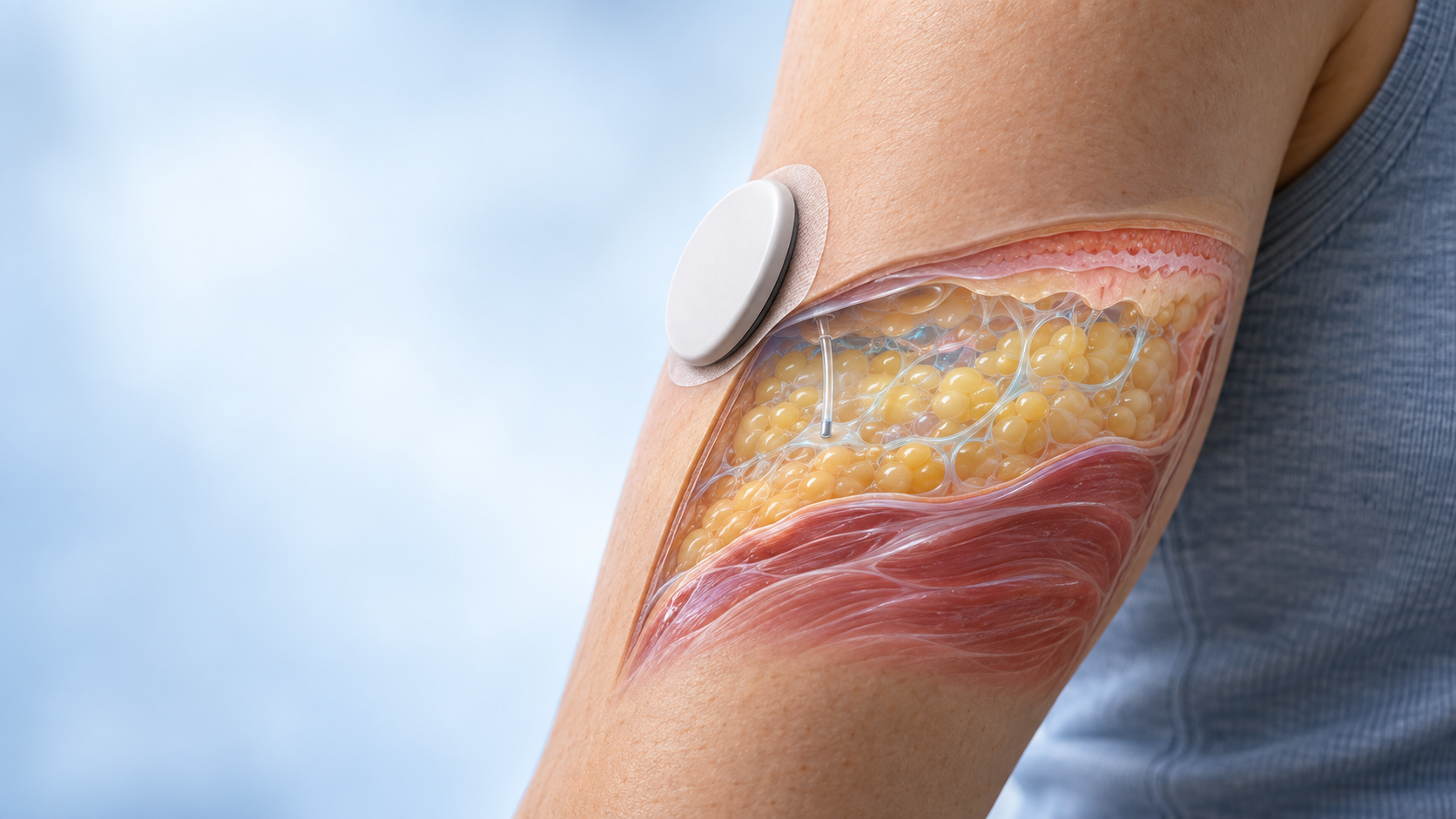
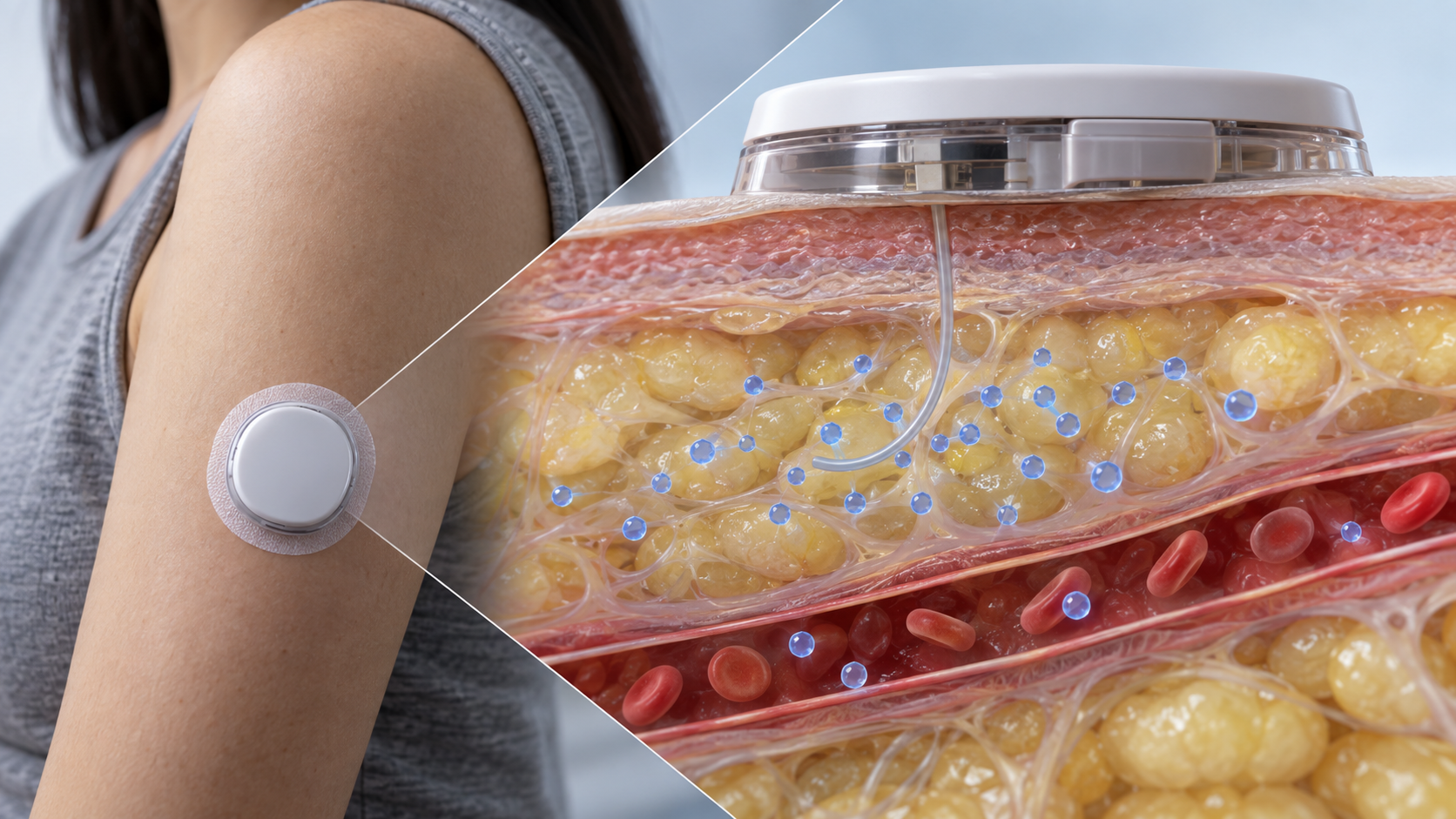
A thin sensor inserted under the skin measures glucose in the interstitial fluid that fills the space around cells, by turning an enzyme reaction into an electric current, and it keeps doing so for days. The number it reports is not the glucose in blood itself but the value in a second compartment that follows blood with a delay. This explainer sets out the mechanism, calibration, lag, the accuracy metric MARD, interfering substances and FDA classification of these sensors, using regulatory documents and peer-reviewed papers.
- What CGM is, in three points
- A tiny enzyme electrode under the skin: what reacts, and how
- A materials engineer's view (1): four hurdles — enzyme, sterilisation, biocompatibility and adhesion
- Calibration: done at the factory, or by the user
- Lag: blood and interstitial fluid are different compartments
- The accuracy metric MARD: definition and limits
- Our calculation: why the same sensor can show a different MARD
- Wear duration: what each product's documents state
- Interfering substances: what labelling and review documents say
- The FDA's iCGM special controls: what a device must meet
- From PMA approval to De Novo, and then over the counter
- A materials engineer's view (2): “accurate” compared with what?
- Open problems, and what this article could not confirm
- Glossary / References / Claim-to-source audit
Sourced = stated in an official document, manufacturer labelling or a paper (link given)
Our calculation = a value this article derived from assumptions it states
Not yet confirmed = a plan or target with no confirmed track record
Structural readings and materials-design interpretations are marked separately as Commentary.
This article explains technology. It gives no advice on diagnosis, treatment or how to read a measured value, and it does not recommend any product.
For how to use a product or handle a reading, follow the product's instructions for use and your healthcare professional.
1. What CGM is, in three points
CGM (continuous glucose monitoring) is a device that measures glucose in the fluid beneath the skin and reports it electronically every few minutes. A fingerstick blood glucose meter (SMBG) captures a single moment; CGM leaves a continuous record along the time axis (our commentary).
- What it measures: interstitial fluid, not blood. The FDA review document for the Dexcom G6 says the sensor continuously measures glucose concentration in interstitial fluidSourced, and the FDA summary for FreeStyle Libre likewise says a sensor placed under the skin generates a current according to glucose in interstitial fluidSourced
- How it measures: an enzyme, glucose oxidase, oxidises glucose, and the reaction is converted to an electric current. The FDA documents state that the size of the current is proportional to the amount of glucoseSourced
- What it is evaluated against: in clinical studies, blood drawn at the same time is measured by a laboratory method and compared. The Libre summary (SSED) says a YSI 2300 analyser was the referenceSourced
A CGM number is not “glucose in blood” itself. It is an estimate: glucose in interstitial fluid, measured by an enzyme electrode and converted by an algorithm. That is why there is lag, why there are calibration schemes, and why accuracy can only be discussed together with the conditions: compared with what, in whom, over which range. Since 2018 the FDA has classified this kind of device as an “iCGM” with special controlsSourced.
2. A tiny enzyme electrode under the skin: what reacts, and how
The heart of the sensor is a thin, thread-like (wire-like) part inserted into subcutaneous tissue. Putting the FDA documents side by side gives the following picture.
View the original SVG schematic, source notes and numerical details
| Item | What the FDA documents say | Source |
|---|---|---|
| Enzyme and current | Dexcom G6: glucose oxidase catalyses oxidation of glucose and produces hydrogen peroxide, which generates a current “proportionate to the interstitial glucose concentration” | De Novo decision summary [Reference 4] |
| Enzyme and current | FreeStyle Libre 2 and 3: glucose oxidase oxidises glucose and transfers electrons to an electrode, producing a current. The size of the current is proportional to the amount of glucose in the subcutaneous space | 510(k) summary [Reference 6] |
| Form of the sensor | Dexcom G7: a “wire-type” sensing mechanism. Stelo: a “small and flexible wire” inserted into subcutaneous tissue. Libre: the sensor “tail” is placed under the skin guided by a needle, which is then retracted | [References 7, 9, 6] |
| Reportable range | Dexcom G6 and G7: 40 to 400 mg/dL; values below are shown as “LOW” and above as “HIGH” | [References 4, 7] |
| Reporting interval | Dexcom G6 and G7: every 5 minutes. Libre 2 and 3: a glucose measurement every minute | [References 4, 7, 6] |
All Sourced (FDA review documents and 510(k) summaries). Products are updated over time.
The idea of an enzyme electrode is old: in 1967 Updike and Hicks published “The Enzyme Electrode” in NatureSourced. A recent review sorts the routes by which electrons reach the electrode into three generations. In the first, oxygen is the electron acceptor and the hydrogen peroxide produced is oxidised at the electrode to read a current. In the second, an artificial electron acceptor (a mediator) is used. In the third, electrons pass directly from the enzyme to the electrode. The same review states that the current electrochemical CGM sensors are all based on glucose oxidase (GOx)Sourced [Reference 14]. Mediators and enzyme immobilisation are covered in more detail in our explainer on materials for the enzyme–electrode interface.
3. A materials engineer's view (1): four hurdles — enzyme, sterilisation, biocompatibility and adhesion
Reading the FDA documents through a materials lens, a single sensor has to clear several hurdles.
- 1. The enzyme must keep working for the whole wear period. The review says GOx has better long-term stability than FAD-dependent glucose dehydrogenase (FAD-GDH), which is why FAD-GDH has had limited use in CGMSourced [Reference 14]. Keeping a protein active for 10 to 15 days in a body-temperature fluid is a major materials challenge (our commentary).
- 2. Activity must survive sterilisation and storage. The Libre sensor pack is described as electron-beam sterilisedSourced [Reference 6]. The Dexcom G6 review document cites a radiation-sterilisation standard (ISO 11137) and says shelf-life testing supported a useful life of up to 3 months for the sensorSourced [Reference 4]. The enzyme has to withstand radiation and storage (commentary).
- 3. Biocompatibility as a material that stays in the body. The Dexcom G6 sensor was evaluated as an implant-type device in tissue contact for long cumulative duration (treated as exceeding 30 days), with tests including cytotoxicity, sensitisation, irritation, systemic toxicity, subacute/subchronic toxicity, genotoxicity and implantationSourced [Reference 4]. The Libre SSED lists the ISO 10993 tests, including 4-week and 26-week implantationSourced [Reference 5]. Although one wear is 10 to 15 days, evaluation assumes repeated use (commentary).
- 4. On the skin side, it becomes an adhesion problem. The Libre review document lists a “medical grade adhesive layer” that holds the sensor to the skin, and adhesive irritation among the possible adverse effectsSourced [Reference 5]. The Dexcom G7 510(k) lists an adhesive tape (product code KGX, Class I) as a separate product codeSourced [Reference 7]. The outer parts of the Dexcom G6 transmitter are described as an epoxy and palladium contactsSourced [Reference 4]. The materials design of skin adhesion is covered in our explainer on patch sensors and skin adhesion.
These four are requirements in a different dimension from the measurement principle. Good data in an enzyme-electrode paper is not enough if all of them are not met (our commentary).
4. Calibration: done at the factory, or by the user
To convert current into concentration, a CGM needs calibration. Who calibrates, and when, has changed with product generations.
| Product (review document) | What it says about calibration |
|---|---|
| Dexcom G6 (De Novo, 2018) | If the calibration code supplied with the sensor is entered, no calibration is needed during the wear period. Without the code, two fingerstick values are entered at start-up and then every 24 hours. Optional manual calibration is possible |
| FreeStyle Libre (PMA, 2017) | Factory calibration at manufacture. It neither requires nor accepts user calibration with blood glucose values |
| FreeStyle Libre 2 and 3 (510(k), 2024) | Factory calibrated; fingerstick calibration is not required |
| Stelo (510(k), 2024) | Factory calibration only, with no calibration input |
All Sourced (FDA review documents [References 4, 5, 6, 9]).
Factory calibration is only workable if sensitivity varies little from lot to lot. The FDA's iCGM special controls also require controls during manufacturing and at product release to ensure the released product meets its performance specificationsSourced [Reference 1]. Removing calibration from the user also means moving the burden to manufacturing control (our commentary).
5. Lag: blood and interstitial fluid are different compartments
One reason CGM numbers disagree with a glucose meter is lag. Two causes add up: a physiological delay as glucose moves from blood into interstitial fluid, and a device-side delay from the sensor's response and signal processing. The difference between the two compartments, and the difficulty of measuring interstitial glucose accurately, are reviewed by Cengiz and Tamborlane [Reference 18].
- Physiological delay: Basu and colleagues placed microdialysis catheters in the abdominal subcutaneous space of eight healthy, overnight-fasted adults and compared the appearance of intravenously given glucose tracers in plasma and in interstitial fluid. The mean delay in the interstitial space was 5.3 to 6.2 minutesSourced [Reference 15].
- Delay including the device: Schmelzeisen-Redeker and colleagues used a prototype glucose sensor in 37 patients (108 data sets) and reported the time delay of the raw signal relative to blood glucose as a mean of 9.5 minutes (SD 3.7), median 9 minutes. A prediction algorithm shortened the delay by 4 minutes on averageSourced [Reference 16].
- Distortion: Cobelli and colleagues used model-based simulation to show that interstitial glucose is not a blood curve merely shifted in time, but has a more complex relationship that depends on both the glucose level and the equilibration timeSourced [Reference 17].
Suppose blood glucose changes at a constant rate and the interstitial value is simply delayed in timeOur calculation.
- Rate of change 1 mg/dL per minute, delay 5.3 minutes → difference 1 × 5.3 = about 5 mg/dL
- Rate of change 2 mg/dL per minute, delay 9.5 minutes → difference 2 × 9.5 = about 19 mg/dL
Assumptions and limits: a real interstitial value is not just a time shift but also changes in shape [Reference 17]. This is a rough estimate of the order of magnitude, not a prediction of any device's error. The FDA's iCGM special controls also require accuracy of the displayed rate of change, for example that no more than 1% of measurements indicate a positive rate of change greater than 1 mg/dL/min when the true rate of change is more negative than −2 mg/dL/minSourced [Reference 1].
The 2018 review document for the Dexcom G6 included, among the conditions of use, a statement that the device should not be used for treatment decisions while glucose is rising or falling rapidlySourced [Reference 4]. That was the labelling at the time of review, not the current instructions for use. We cite it as an example of how the physical property of lag is reflected in precautions for use.
6. The accuracy metric MARD: definition and limits
The number most often quoted for CGM accuracy is MARD (mean absolute relative difference). The definition is simple: for each pair, take the difference between the CGM value and the reference value, divide by the reference value and take the absolute value, then average over all pairs and express it as a percentage (our commentary).
But this number is not an intrinsic property of a sensor. Two reviews explain why.
- Heinemann and colleagues write that MARD is the parameter used most often to characterise CGM measurement performance and that comparison looks straightforward, but that interpreting the MARD figures supplied by manufacturers is difficult because of a number of complex aspects. They state that MARD should not be used as the sole parameter, especially for non-adjunctive use (use for treatment decisions)Sourced [Reference 19].
- Vigersky and McMahon write that MARD is strongly affected by the design of data collection in an accuracy study: participant demographics such as type of diabetes and age, sensor wear site, and the share of data collected in each glycaemic range all influence it. They add that no clinical study has shown that MARD can distinguish a safe sensor from an unsafe one, and that alternatives include error grid analysisSourced [Reference 20].
Review documents show the effect of conditions plainly. The Dexcom G6 document gives MARD against a laboratory method by CGM value range for adults (159 participants) with abdominal wear.
| Range of CGM value | Number of pairs | MARD (against the laboratory method) |
|---|---|---|
| Below 54 mg/dL | 383 | 13.8% |
| 54 to 69 mg/dL | 1,537 | 11.5% |
| 70 to 180 mg/dL | 9,453 | 10.9% |
All Sourced (Dexcom G6 De Novo review document [Reference 4]; adults, 159 participants, abdominal wear, two studies at 11 centres combined; ranges are defined by the CGM value). The same document says the reference was a laboratory method and that, for some young children (ages 2 to 6), a blood glucose meter was used.
The 2017 approval summary (SSED) for FreeStyle Libre also shows how the same device can look different under different conditions. In the first US study, MARD against a laboratory method (a YSI 2300 analyser) was 12.5%; after the device was modified, it was 9.7% in the pivotal studySourced [Reference 5]. Figures from different studies cannot be lined up to rank products.
On standardisation, the CLSI document “POCT05 Performance Metrics for Continuous Interstitial Glucose Monitoring” (2nd edition, published November 2020, reaffirmed July 2025) deals with CGM performance metricsSourced [Reference 21]. Because its full text is paywalled, this article confirms only its title and standing.
7. Our calculation: why the same sensor can show a different MARD
(1) The calculation: suppose three pairs of reference and CGM values were as followsOur calculation.
- Reference 100, CGM 110 → |110 − 100| / 100 = 10%
- Reference 180, CGM 162 → |162 − 180| / 180 = 10%
- Reference 60, CGM 72 → |72 − 60| / 60 = 20%
- MARD = (10 + 10 + 20) / 3 = about 13.3%
(2) The effect of study design: suppose a sensor's error is fixed by range at 20% below 60, 10% from 70 to 180, and 8% above 180 (assumed values for illustration). If two studies collect data in different proportions, the overall MARD of the same sensor differsOur calculation.
For the same reason, the view that a smaller MARD is simply better is risky. Vigersky and McMahon also say clinically meaningful assessments, such as error grid analysis or clinical studies in people with diabetes, should be used in place of MARD [Reference 20]. The FDA's iCGM special controls likewise set their criteria not as MARD but as lower bounds on agreement rates by range (Chapter 10).
8. Wear duration: what each product's documents state
| Product | Wear duration and features in the FDA document | Document and pathway |
|---|---|---|
| FreeStyle Libre (first generation) | Up to 10 days after an initial 12-hour warm-up. Gives a value only when the user scans the sensor | PMA P160030 (approved 2017) |
| Dexcom G6 | Up to 10 days. Abdomen only for adults; abdomen or buttock for children | De Novo DEN170088 (2018) |
| Dexcom G7 | Up to 10 days plus a 12-hour grace period. Sends a value every 5 minutes | 510(k) K234133 (2024) |
| Dexcom G7 15 Day | Up to 15 days plus a 12-hour grace period. Indicated for ages 18 and over | 510(k) K243214 (2025) |
| FreeStyle Libre 3 / 3 Plus | Up to 14 / 15 days. Worn on the back of the upper arm. Contains a silver oxide battery | 510(k) K233537 (2024) |
| Stelo (OTC) | Up to 15 days plus a 12-hour grace period. The document says it uses the same hardware as the G7 and that firmware changes extend wear from 10 to 15 days | 510(k) K234070 (2024) |
| Lingo (OTC) | Up to 14 days. Based on the FreeStyle Libre 2 sensor | 510(k) K233655 (2024) |
All Sourced (FDA review documents and 510(k) summaries [References 4 to 10]). The year is the year of the decision. How a longer wear affects accuracy and safety was examined in each study, and this article does not compare products.
The Stelo 510(k) summary says that, with the same hardware design, firmware changes extended the wear period from 10 to 15 days while maintaining accuracySourced [Reference 9]. It is one example showing that making a sensor last depends not only on the enzyme and membrane materials but also on signal-processing software (our commentary).
9. Interfering substances: what labelling and review documents say
In an enzyme electrode, substances other than glucose that react at the electrode, or that affect the enzyme reaction, can shift the reading. The FDA's iCGM special controls require clinically acceptable performance in the presence of reasonably expected interfering substances, including endogenous substances, metabolites, foods, supplements and medicationsSourced [Reference 1]. What follows reports what manufacturers' labelling and review documents state; it is not a basis for any individual's decision about use.
| Substance | What the documents say | Source |
|---|---|---|
| Acetaminophen | Dexcom states that, for G6 and G7, amounts above the standard-to-maximum dose (1 g every 6 hours in adults) may raise readings, and that earlier generations (G4/G5) were affected. In the G6 review document, in a clinical study of 65 adults the mean maximum interference effect after a single 1 g dose was 5.2 mg/dL; in bench testing, about 2 mg/dL (physiological concentration at a standard dose) caused no clinically significant change, while 6.5 mg/dL caused up to 22 mg/dL of bias and 20 mg/dL up to 70 mg/dL | [References 12, 4] |
| Hydroxyurea | Dexcom states that taking it makes sensor readings higher than actual glucose and that the degree depends on the amount in the body | [Reference 12] |
| Ascorbic acid (vitamin C) | FreeStyle Libre labelling: above the maximum recommended daily allowance, sensor readings may be falsely raised | [References 13, 5] |
| Salicylic acid (e.g. aspirin) | FreeStyle Libre labelling: sensor readings may be slightly lowered | [References 13, 5] |
All Sourced (manufacturers' pages and FDA review documents). For hydroxyurea, Dexcom's page also recommends against using the system for treatment decisions. Labelling may change with product, version and region, so any actual decision rests on the latest instructions for use and a healthcare professional. The bench-test concentrations are transcribed from the review document.
Substances differ in effect, presumably because what reacts at the electrode depends on the electrode potential, the selectivity of the membrane and whether a mediator is used (our commentary). The review notes that second-generation designs can operate at an applied potential lower than that needed to oxidise hydrogen peroxide directly, which reduces the influence of interferentsSourced [Reference 14]. For acetaminophen, which strongly affected earlier Dexcom generations, the review document says the G6 sensor was designed to reduce the effectSourced [Reference 4]. The material makeup used to achieve this was not described in the public documents checked for this article. The thinking behind selectivity of electrodes and membranes is covered in our explainers on electrochemical sensors and on materials for the enzyme–electrode interface.
10. The FDA's iCGM special controls: what a device must meet
The FDA classifies CGM designed to connect digitally with other devices, such as automated insulin dosing systems, as iCGM (integrated continuous glucose monitoring system), Class II (special controls), under 21 CFR 862.1355Sourced [Reference 1]. The special controls in the regulation text include numerical criteria that must be met in a clinical study in adults. Each is expressed as “the lower one-sided 95 percent confidence bound of the agreement rate must exceed this value”.
Beyond the numerical criteria, the special controls set out items such as the followingSourced [Reference 1].
- Comparison with simultaneously collected blood values measured by a laboratory method that the FDA accepts and that is traceable to a higher-order reference
- Consistent performance throughout the wear period, and no clinically significant gaps in data
- A mechanism preventing a disposable sensor from being used beyond its claimed wear period
- A usability study, a strategy for secure and reliable data transmission, and manufacturing and release controls
- Labelling that reports accuracy by glucose range (below 54, 54 to below 70, 70 to 180, above 180 to 250, above 250 mg/dL), accuracy of rate of change, frequency of data gaps, alert rates, performance by insertion site, and the observed sensor life
11. From PMA approval to De Novo, and then over the counter
The regulatory position of CGM has shifted considerably in under ten years. In FDA terms, approval (PMA), a grant (De Novo) and clearance (510(k)) are separate procedures. Fig. 5 sorts them out so they are not confused.
| Category (FDA product code) | Description in the FDA classification database |
|---|---|
| QBJ | Integrated CGM, factory calibrated. An iCGM designed to connect with digitally connected devices, including automated insulin dosing systems |
| QLG | Integrated CGM, factory calibrated, not for use with automated insulin delivery systems (the user manually controls therapy actions) |
| SAF / SBH | iCGM for non-intensive glucose monitoring / management, over the counter. For persons not on insulin and without a significant risk of problematic hypoglycaemia. Devices that control insulin delivery are excluded from connection |
All Sourced (FDA product classification database; the Stelo 510(k) record [Reference 9] shows the classification name and product code SAF). The Libre 3 510(k) lists product codes QBJ and QLG [Reference 6].
Stelo's indication is for people 18 and over who are not on insulin, and it states that the user is not intended to take medical action based on the device output without consultation with a qualified healthcare professionalSourced [Reference 9]. Being sold over the counter and being usable for treatment decisions are separate matters, and the FDA classes reflect that difference (our commentary). The classification of medical devices and home-use devices is covered in our explainer on device classification and home use.
12. A materials engineer's view (2): “accurate” compared with what?

- The reference differs. The FDA's special controls call for a laboratory method that the FDA accepts and that is traceable to a higher-order reference [Reference 1]. In the Dexcom G6 studies the reference was a laboratory method for adults, and a blood glucose meter (SMBG) for some young childrenSourced [Reference 4]. With a different reference, the same “agreement rate” means something different (commentary).
- The site differs. The G6 review document says adult performance was evaluated at the abdomen only and that performance at other sites was not evaluated and may differSourced [Reference 4]. The regulation also requires performance by insertion site in the labelling [Reference 1]. If the state of subcutaneous tissue differs by site, the same sensor can give different results (commentary).
- Sensors vary even against each other. In the G6 review document, 67 participants wore two devices at the same site at the same time. The mean absolute relative difference between the two devices was 9.6% and the mean coefficient of variation was 8.4%Sourced [Reference 4]. This figure shows the sensor's own reproducibility, without the reference-method problem (commentary).
- The test tube is not the body. Even if a response is good in vitro, in the body there are additional effects: loss of enzyme activity, protein adsorption, reaction of surrounding tissue, and movement at the wear site. This is one reason review documents call for clinical studies (our commentary). The reaction that sensors meet inside the body is covered in our explainer on implantable sensors.
13. Open problems, and what this article could not confirm
(1) Membrane, enzyme immobilisation and mediator makeup by product
The FDA documents checked for this article (review documents and 510(k) summaries) do not give the composition of each product's diffusion-limiting membrane, the way the enzyme is immobilised, or whether a mediator is used. The Libre SSED says only that glucose oxidase transfers electrons to an electrode, and the use of a mediator could not be confirmed. This article therefore does not describe product-by-product material differences.
(2) Each product's current stated MARD and latest instructions for use
Manufacturers' stated MARD varies with reference method, population, site and date and is updated over time, so this article does not use it. The MARD figures given here are limited to values for specific studies stated in FDA review documents.
(3) Long-term clinical outcomes, and product-specific lag values
Long-term clinical effects of CGM use and product-specific lag values could not be confirmed in the official documents and papers checked, so they are not given. The lag figures here are limited to values from papers on specific populations and devices [References 15, 16].
- CGM is an estimate of interstitial glucose measured by an enzyme electrode. The FDA documents say the current produced by the glucose oxidase reaction is proportional to glucose in interstitial fluidSourced
- Lag has a physiological part and a device part. Reports include 5.3 to 6.2 minutes in healthy adults by microdialysis, and a mean of 9.5 minutes for the raw signal of a prototype sensorSourced
- MARD depends on study design. It varies by glucose range and study, and reviews say it should not be the sole metricSourced
- The FDA's iCGM criteria are set as lower bounds of agreement rates by range. For adults, for example, more than 85% within ±15 mg/dL below 70 mg/dLSourced
- The pathway moved from PMA (approval) to De Novo (grant) to 510(k) (clearance), and to over the counter. The three are separate proceduresSourced
- From the materials side, enzyme stability, sterilisation, biocompatibility and skin adhesion are all required at once. This is our commentary
14. Glossary
- CGM
- Continuous glucose monitoring. A device that measures glucose in subcutaneous interstitial fluid continuously, every few minutes.
- Interstitial fluid (ISF)
- The fluid that fills the space around cells. Glucose reaches it from blood through capillaries.
- Glucose oxidase (GOx)
- An enzyme that oxidises glucose. Widely used in the sensors of current electrochemical CGM.
- Mediator
- An artificial electron acceptor that carries electrons between enzyme and electrode. Used in second-generation sensors.
- MARD
- Mean absolute relative difference. The mean of the absolute difference from the reference divided by the reference (%).
- iCGM
- Integrated CGM. An FDA Class II (special controls) category for CGM designed to work with other connected devices.
- OTC
- Over the counter. Available without a prescription.
- PMA
- Premarket approval. The premarket route for Class III devices.
- De Novo
- A route to classify a novel low-to-moderate-risk device. A grant creates a new device classification.
- 510(k)
- A premarket notification showing substantial equivalence to a legally marketed device. The result is called clearance.
- YSI
- A product name for a laboratory glucose analyser. Commonly used as the reference in CGM studies.
- Lag
- The time difference between a change in blood glucose and its appearance in the CGM value.
- Traceability
- The property that a measured value links to a higher-order reference (a reference material or method).
- Special controls
- Device-specific requirements imposed on Class II devices in addition to general controls.
15. References (primary sources)
- U.S. Food and Drug Administration (FDA; eCFR) “21 CFR 862.1355 Integrated continuous glucose monitoring system” — www.ecfr.gov
- FDA (Federal Register) “Medical Devices; Clinical Chemistry and Clinical Toxicology Devices; Classification of the Integrated Continuous Glucose Monitoring System”, 87 FR 9237, 18 February 2022 — www.federalregister.gov
- FDA De Novo database record DEN170088 (Dexcom G6): decision granted 27 March 2018; regulation 862.1355; product code QBJ — www.accessdata.fda.gov
- FDA “DEN170088 Evaluation of Automatic Class III Designation for Dexcom G6 Continuous Glucose Monitoring System: Decision Summary” — www.accessdata.fda.gov
- FDA “PMA P160030 FDA Summary of Safety and Effectiveness Data (FreeStyle Libre Flash Glucose Monitoring System)”, approved 27 September 2017 — www.accessdata.fda.gov
- FDA “K233537 510(k) summary and clearance letter (FreeStyle Libre 2 / Libre 3)”, 23 April 2024 — www.accessdata.fda.gov
- FDA “K234133 510(k) summary and clearance letter (Dexcom G7)”, 26 February 2024 — www.accessdata.fda.gov
- FDA “K243214 510(k) summary and clearance letter (Dexcom G7 15 Day)”, 9 April 2025 — www.accessdata.fda.gov
- FDA “K234070 510(k) summary and clearance letter (Stelo Glucose Biosensor System)”, 5 March 2024 — www.accessdata.fda.gov
- FDA “K233655 510(k) summary and clearance letter (Lingo Glucose System)”, 29 May 2024 — www.accessdata.fda.gov
- FDA “K233861 510(k) summary and clearance letter (Libre Rio Continuous Glucose Monitoring System)”, 7 June 2024 — www.accessdata.fda.gov
- Dexcom “Interfering substances and risks” (labelling page for Dexcom G6 / G7) — www.dexcom.com
- Abbott “What substances could interfere with the results generated by the FreeStyle Libre 2 Plus system?” (support page for Saudi Arabia) — www.freestyle.abbott
- Hatada M, Okuda-Shimazaki J, Sode K. “Glucose Oxidoreductases for Glucose Monitoring: A Bird's Eye View of Glucose-Sensing Enzymes II”, J Diabetes Sci Technol (2026) (PMC) — pmc.ncbi.nlm.nih.gov
- Basu A et al. “Time lag of glucose from intravascular to interstitial compartment in humans”, Diabetes 62:4083 (2013) — doi.org
- Schmelzeisen-Redeker G et al. “Time Delay of CGM Sensors: Relevance, Causes, and Countermeasures”, J Diabetes Sci Technol 9:1006 (2015) — doi.org
- Cobelli C et al. “Interstitial Fluid Glucose Is Not Just a Shifted-in-Time but a Distorted Mirror of Blood Glucose: Insight from an In Silico Study”, Diabetes Technol Ther 18:505 (2016) — doi.org
- Cengiz E, Tamborlane WV. “A tale of two compartments: interstitial versus blood glucose monitoring”, Diabetes Technol Ther 11 Suppl 1:S-11 (2009) — doi.org
- Heinemann L et al. “Benefits and Limitations of MARD as a Performance Parameter for Continuous Glucose Monitoring in the Interstitial Space”, J Diabetes Sci Technol 14:135 (2020) — doi.org
- Vigersky RA, McMahon C. “The Myth of MARD (Mean Absolute Relative Difference): Limitations of MARD in the Clinical Assessment of Continuous Glucose Monitoring Data”, Diabetes Technol Ther 26:38 (2024) — doi.org
- CLSI “POCT05 Performance Metrics for Continuous Interstitial Glucose Monitoring”, 2nd edition (published November 2020; reaffirmed July 2025): product page — clsi.org
- Updike SJ, Hicks GP. “The Enzyme Electrode”, Nature 214:986 (1967) — doi.org
16. Claim-to-source audit
| Claim in the text | Basis | Type |
|---|---|---|
| That CGM measures glucose in interstitial fluid. For the Dexcom G6: the sensor continuously measures interstitial glucose; glucose oxidase oxidises glucose and produces hydrogen peroxide, generating a current proportional to interstitial glucose; reporting every 5 minutes; a reportable range of 40 to 400 mg/dL; up to 10 days; calibration by calibration code or two fingerstick entries; a laboratory method (including YSI) as the clinical reference, with a blood glucose meter for some young children; the study size (380 participants, 11 centres); evaluation at the adult abdomen only; paired same-site devices with MARD 9.6% and CV 8.4% (67 participants); sensor shelf-life testing supporting up to 3 months; the types of biocompatibility test; transmitter exterior (epoxy and palladium contacts); reference to a radiation-sterilisation standard | DEN170088 review document Reference 4 https://www.accessdata.fda.gov/cdrh_docs/reviews/DEN170088.pdf | Sourced |
| MARD for adults (159 participants) by CGM value range: below 54, 13.8% (383 pairs); 54 to 69, 11.5% (1,537); 70 to 180, 10.9% (9,453). 89.9% within 20% overall. Acetaminophen: mean maximum interference effect 5.2 mg/dL after a single 1 g dose in 65 adults; bench results (no significant change at about 2 mg/dL; up to 22 mg/dL bias at 6.5; up to 70 mg/dL at 20); effects in G4/G5; the condition of use at review (not for treatment decisions while glucose is rising or falling rapidly) | DEN170088 review document Reference 4 https://www.accessdata.fda.gov/cdrh_docs/reviews/DEN170088.pdf | Sourced |
| The definition of iCGM and Class II (special controls). The adult criteria (A) to (K): lower one-sided 95% bound above 85% for within ±15 mg/dL below 70 mg/dL; above 70% within ±15% from 70 to 180; above 80% within ±15% above 180; 98 to 99% for the ±40 criteria; above 87% within ±20% overall; no opposite-range disagreements; no more than 1% rate-of-change direction errors. Comparison with a laboratory method traceable to a higher-order reference; consistency across the wear period; acceptable performance with interferents; prevention of use beyond wear period; usability study; manufacturing and release controls; labelling content (accuracy by glucose range and insertion site, rate of change, gaps, alerts, sensor life) | Regulation text (eCFR) Reference 1 https://www.ecfr.gov/current/title-21/chapter-I/subchapter-H/part-862/subpart-B/section-862.1355 | Sourced |
| The date the FDA classified the iCGM as Class II with special controls in the Federal Register (18 February 2022; 87 FR 9237) | Reference 2 https://www.federalregister.gov/documents/2022/02/18/2022-03504/medical-devices-clinical-chemistry-and-clinical-toxicology-devices-classification-of-the-integrated | Sourced |
| That the De Novo for DEN170088 (Dexcom G6) was granted on 27 March 2018, with regulation number 862.1355 and product code QBJ | Reference 3 https://www.accessdata.fda.gov/scripts/cdrh/cfdocs/cfpmn/denovo.cfm?id=DEN170088 | Sourced |
| That the PMA for FreeStyle Libre (P160030) was approved on 27 September 2017. That glucose oxidase transfers electrons to a metal electrode and the current is proportional to the amount of glucose. Factory calibration with no user calibration required or accepted. Up to 10 days (after a 12-hour warm-up); a value only on scan. The medical grade adhesive layer and adhesive irritation among adverse effects. MARD of 9.7% in the pivotal study (12.5% in the first US study) against a YSI 2300. Labelling on ascorbic acid and salicylic acid. The ISO 10993 tests (including 4-week and 26-week implantation) | PMA P160030 SSED Reference 5 https://www.accessdata.fda.gov/cdrh_docs/pdf16/P160030B.pdf | Sourced |
| The FreeStyle Libre 2 and 3 510(k) (23 April 2024): the glucose oxidase principle, electron-beam sterilisation, measurement every minute, 14 / 15 days of wear, the back of the upper arm, factory calibration, a silver oxide battery, age indications, and product codes QBJ, QLG and NBW | Reference 6 https://www.accessdata.fda.gov/cdrh_docs/pdf23/K233537.pdf | Sourced |
| The Dexcom G7 510(k) (26 February 2024): wire-type sensing, 5-minute reporting, 40 to 400 mg/dL, up to 10 days plus a 12-hour grace period, and an adhesive tape (product code KGX, Class I) listed alongside | Reference 7 https://www.accessdata.fda.gov/cdrh_docs/pdf23/K234133.pdf | Sourced |
| The Dexcom G7 15 Day 510(k) (9 April 2025): up to 15 days plus a 12-hour grace period; indicated for ages 18 and over | Reference 8 https://www.accessdata.fda.gov/cdrh_docs/pdf24/K243214.pdf | Sourced |
| The Stelo 510(k) (5 March 2024): an OTC iCGM for people 18 and over not on insulin; a small, flexible wire; the same hardware design as the G7 with firmware changes extending wear from 10 to 15 days; factory calibration only; the statement about consulting a healthcare professional before medical action; product code SAF | Reference 9 https://www.accessdata.fda.gov/cdrh_docs/pdf23/K234070.pdf | Sourced |
| The Lingo 510(k) (29 May 2024): an OTC iCGM for people 18 and over not on insulin, based on the FreeStyle Libre 2 sensor, up to 14 days | Reference 10 https://www.accessdata.fda.gov/cdrh_docs/pdf23/K233655.pdf | Sourced |
| The Libre Rio 510(k) (7 June 2024): an OTC iCGM for non-insulin-using people 18 and over, up to 15 days, factory calibrated | Reference 11 https://www.accessdata.fda.gov/cdrh_docs/pdf23/K233861.pdf | Sourced |
| Dexcom's labelling: acetaminophen (G6 and G7 usable at standard to maximum doses; excess amounts may raise readings) and hydroxyurea (raises readings, depending on the amount in the body, with a recommendation against using it for treatment decisions) | Reference 12 https://www.dexcom.com/en-us/interference | Sourced |
| Abbott's labelling (FreeStyle Libre 2 Plus): ascorbic acid above the maximum recommended daily allowance may falsely raise readings, and salicylic acid may slightly lower them | Reference 13 https://www.freestyle.abbott/en-sa/support/what-substances-could-interfere-with-the-results-generated-by-the-freestyle-libre-2-plus-system-1.html | Sourced |
| The three generations of enzyme electrodes (oxygen and hydrogen peroxide / mediator / direct electron transfer). That current electrochemical CGM sensors are all based on GOx. That GOx is more stable over the long term than FAD-GDH, which has limited FAD-GDH use in CGM. That second-generation designs work at a lower applied potential and reduce interference | Reference 14 https://pmc.ncbi.nlm.nih.gov/articles/PMC13518614/ | Sourced |
| The physiological delay of glucose from blood to interstitial fluid (eight healthy adults, overnight fasted, microdialysis; mean 5.3 to 6.2 minutes) | Reference 15 https://doi.org/10.2337/db13-1132 | Sourced |
| The mean delay of the raw signal against blood glucose for a prototype sensor in 37 patients (108 data sets): 9.5 minutes (SD 3.7), median 9 minutes; 4 minutes shorter on average with a prediction algorithm | Reference 16 https://doi.org/10.1177/1932296815590154 | Sourced |
| That interstitial glucose is not simply a time-shifted copy of blood glucose but has a distorted relationship that depends on equilibration time and glucose level | Reference 17 https://doi.org/10.1089/dia.2016.0112 | Sourced |
| A review of the difference between the blood and interstitial compartments and the difficulty of measuring interstitial glucose accurately | Reference 18 https://doi.org/10.1089/dia.2009.0002 | Sourced |
| That MARD is the parameter most often used for CGM performance, that manufacturers' figures are hard to interpret, and that it should not be the sole parameter for use in treatment decisions | Reference 19 https://doi.org/10.1177/1932296819855670 | Sourced |
| That MARD depends on study design (participant demographics, wear site, share of data in each glycaemic range), that no clinical study shows MARD separates safe from unsafe sensors, and the alternatives such as error grid analysis | Reference 20 https://doi.org/10.1089/dia.2023.0435 | Sourced |
| The title, edition and publication date (9 November 2020) of CLSI POCT05, and its reaffirmation in July 2025 | Only the title and standing were confirmed, because the full text is paywalled Reference 21 https://clsi.org/standards/products/point-of-care-testing/documents/poct05/ | Sourced |
| That Updike and Hicks published “The Enzyme Electrode” in Nature in 1967 | Reference 22 https://doi.org/10.1038/214986a0 | Sourced |
| The way MARD is computed (about 13.3% for the three-pair example); the overall MARD of 11.4% and 9.6% for studies A and B; the conversion of delays of 1 mg/dL/min × 5.3 min and 2 mg/dL/min × 9.5 min into about 5 and about 19 mg/dL | Our calculation. The errors by glucose range (20%, 10%, 8%), the mix of data and the “pure time shift” are assumptions set by this article. They are not values for any real sensor or study | Our calculation |
| The grouping that three OTC products were cleared by 510(k) in 2024 (Stelo, Lingo, Libre Rio), and the choice of milestones | This article’s own framing. Dates and numbers were checked against each 510(k) document [References 9 to 11] | Commentary |
| Composition of each product's diffusion-limiting membrane, enzyme immobilisation method and whether a mediator is used; each product's latest stated MARD; product-specific lag values; long-term clinical outcomes | Not stated in the official documents and papers checked for this article, so not given here | Commentary |
| That the size of lag may vary with the reference, the site and the individual; that factory calibration moves the burden to manufacturing control; the framing of four hurdles (enzyme, sterilisation, biocompatibility, adhesion); the difference between the test tube and the body; the reading that being sold over the counter differs from being usable for treatment decisions | This article’s own framing and commentary based on published content. Not views expressed by the authors or regulators of those documents | Commentary |
| That Figs. 1, 2 and 5 are concept diagrams (vector drawings), Fig. 3 is a drawing that includes our calculation, Fig. 4 charts the numbers in the regulation, and that the hero image and Fig. 6 are AI-generated images | A note by this article | Commentary |
Last updated 3 October 2026. Sources are limited to primary material (FDA regulation text, review documents and 510(k) summaries; manufacturers' labelling pages; peer-reviewed papers and reviews). No market-size or market-share estimates are used. Because the article includes structural readings and materials-design interpretations, those are marked as Commentary and kept separate from sourced fact. Membrane makeup, enzyme immobilisation and mediator use by product, each product's latest stated MARD and lag, and long-term clinical outcomes are not covered, because they could not be confirmed in published primary sources. Figs. 1, 2 and 5 are concept diagrams, Fig. 3 includes our calculation, Fig. 4 charts the numbers in the regulation, and the hero image and Fig. 6 are AI-generated images; none of them shows a real product, cross-section or measured data. This article explains technology. It gives no advice on diagnosis, treatment or how to read a measured value, and it does not recommend any product.