TECHNOLOGY EXPLAINER
Closed-Loop Systems (Automated Insulin Delivery)
— connecting a sensor, a control algorithm and a pump as regulated “components”
A pump adjusts insulin delivery automatically from sensor glucose values. The FDA recognises such a system as three separate components: an iCGM that measures continuously, an iAGC (the algorithm) that decides delivery, and an ACE pump that receives commands and infuses. This explainer sets out the structure and the classes, and the points where materials matter (the cannula, adhesion, sensor durability and insulin stability), using official documents and peer-reviewed papers. It gives no advice on how doses are decided or how to use a system.
- What a closed loop is, in three points
- Three components and how they connect: sensor, algorithm, pump
- What the control algorithm does (as FDA documents describe it)
- FDA classification: from an integrated PMA to component-by-component classes
- A materials engineer's view (1): wetted materials, sterilisation and insulin stability
- Our calculation: how small one delivery step is, and the volume before an occlusion is detected
- Cannula and infusion-set failures: published numbers
- A materials engineer's view (2): three consumables on different cycles, and the burden of adhesion
- When communication drops: what design must provide
- Open problems, and what this article could not confirm
- Glossary / References / Claim-to-source audit
Sourced = stated in an official document or a paper (link given)
Our calculation = a value this article derived from assumptions it states
Not yet confirmed = research-stage work or a plan with no confirmed track record
Structural readings and materials-design interpretations are marked separately as Commentary.
This article explains technology. It gives no advice on diagnosis, treatment, insulin doses or settings, and it does not recommend any product.
How to use a product and how to set it are matters for the product's instructions for use and a healthcare professional.
1. What a closed loop is, in three points
A closed loop is a system that runs the cycle “measure → decide → deliver → measure again” without a person stepping in each time (our commentary). In diabetes it is called automated insulin delivery (AID) and sometimes an artificial pancreas.
- What it is made of: FDA regulations divide it into an iCGM that measures glucose (21 CFR 862.1355), an iAGC (interoperable automated glycemic controller, 21 CFR 862.1356) that calculates doses and issues commands, and an ACE pump (alternate controller enabled infusion pump, 21 CFR 880.5730) that receives commands and infusesSourced
- Is the loop fully closed: most current products are “hybrid” designs that leave user actions in place, for example at mealtimes. The FDA document for Control-IQ says mealtime boluses are delivered manually by the userSourced
- Where materials come in: the infusion pathway (reservoir, tubing, cannula), the adhesive that holds devices on the skin, sensors that last days to two weeks, and the stability of insulin, which is a drug. Any of these can stop the loop even if the algorithm is right (our commentary)
In a closed loop the algorithm is the clever part, but it is usually the “hardware” that stops the loop. In the six-month Control-IQ comparison study, no severe hypoglycaemia occurred in either arm, and there was one diabetic ketoacidosis, whose cause is recorded as an infusion set failureSourced. However good the control, it means nothing if insulin does not reach the body, and that plain fact becomes a materials and structural problem (our commentary).
2. Three components and how they connect: sensor, algorithm, pump
The regulation text sets out agreements between the components in detailSourced.
- iAGC (862.1356): a device that automatically calculates drug doses from inputs such as glucose and commands a connected pump to deliver them. As a rule, glucose input comes from an iCGM (862.1355) and commands go to an ACE pump (880.5730). Documentation is required showing that safe therapy is maintained when communication is interrupted, lost or re-established [Reference 2].
- ACE pump (880.5730): delivers basal and bolus infusion, and communicates securely with external automated dosing systems to receive, execute and confirm commands [Reference 3].
- iCGM (862.1355): a Class II CGM designed to connect with other devices; its special controls include meeting agreement-rate criteria by range in an adult clinical study [Reference 1]. See our explainer on continuous glucose monitoring for details.
3. What the control algorithm does (as FDA documents describe it)
The inside of an algorithm is confidential, but FDA review documents give an outline of how it behaves. We introduce only the description of operation here, and do not touch settings or usage.
| System (review document) | Outline of operation |
|---|---|
| MiniMed 670G (PMA, 2016) | SmartGuard technology automatically adjusts basal delivery from sensor glucose values and suspends delivery when the value falls, or is predicted to fall. Described as a “closed loop” system; at approval it was for type 1 diabetes in people 14 and over |
| Control-IQ (De Novo, 2019) | A software-only device. It predicts glucose 30 minutes ahead, increases, decreases or suspends basal delivery every 5 minutes, and also delivers correction boluses automatically in response to the prediction. Mealtime boluses are calculated and entered by the user. It is installed on an ACE pump |
| SmartAdjust (510(k), 2022) | Used with an iCGM and an ACE pump, it automatically increases, decreases and pauses insulin delivery based on current and predicted glucose values |
| iLet dosing decision software (510(k), 2023) | Autonomously determines and commands increases, decreases, maintenance or suspension of basal doses and correction doses, and determines mealtime doses autonomously from the user's meal announcements |
All Sourced (FDA documents [References 5, 6, 8, 9]). Indicated ages and compatible devices differ by product and version and are set in the labelling.
Every one of these systems depends on the accuracy and lag of the sensor value. From the control side, sensor error and lag flow directly into dosing decisions. That is why the iCGM special controls require not only agreement rates by range but also freedom from rate-of-change direction errors and data gaps [Reference 1] (our commentary). Doyle and colleagues' review sets out the design objectives, variables and challenges involved in developing an artificial pancreas [Reference 19].
4. FDA classification: from an integrated PMA to component-by-component classes
At first, the FDA recognised automated insulin delivery by granting one PMA (approval) for the whole system. It then moved to classes for each component, which are combined. FDA “approval”, “grant” and “clearance” are separate procedures.
| Category | FDA description (regulation text and classification database) |
|---|---|
| OZP (PMA) | Automated insulin dosing device system, single hormonal control. Automatically raises or lowers insulin infusion from a pump based on thresholds of glucose measured by a sensor. Class III (FDA product classification database) |
| ACE pump (QFG, 880.5730) | Delivers basal and bolus infusion and communicates securely with external automated dosing systems to receive, execute and confirm commands. Class II. Special controls include infusion accuracy, detection of hazards such as occlusion, drug compatibility (including drug stability), biocompatibility of fluid-contacting parts (chemical and particulate characterisation), and a design that maintains safe therapy when communication is lost (for example, reverting to a pre-programmed safe delivery rate) |
| iAGC (QJI, 862.1356) | Automatically calculates drug doses from inputs such as glucose and commands a connected pump to deliver them. Class II. Requires a clinical implementation strategy and clinical performance data, a human factors study, specifications for connected devices, safety when communication is lost, and storage of critical events. Labelling names the compatible therapeutic agents and their concentration |
All Sourced (21 CFR 862.1356 and 880.5730 [References 2, 3] and the FDA product classification database [Reference 17]). For children, the iAGC labelling must carry a contraindication unless clinical performance data or other information show it can be used safely.
The first De Novo (DEN180058, Tandem t:slim X2) recognised the pump on its own as “a component that can receive commands from external automated dosing software”. According to the review document, this pump shares its hardware and much of its software with already approved pumps, and only some software was modifiedSourced [Reference 4]. The next, DEN190034 (Control-IQ), recognised a software-only iAGC and named the Dexcom G6 as the compatible iCGM at the time of evaluationSourced [Reference 5]. This “class designed for combination” has led to the 510(k)s that companies have filed since (our commentary).
5. A materials engineer's view (1): wetted materials, sterilisation and insulin stability
View the original SVG schematic, source notes and numerical details
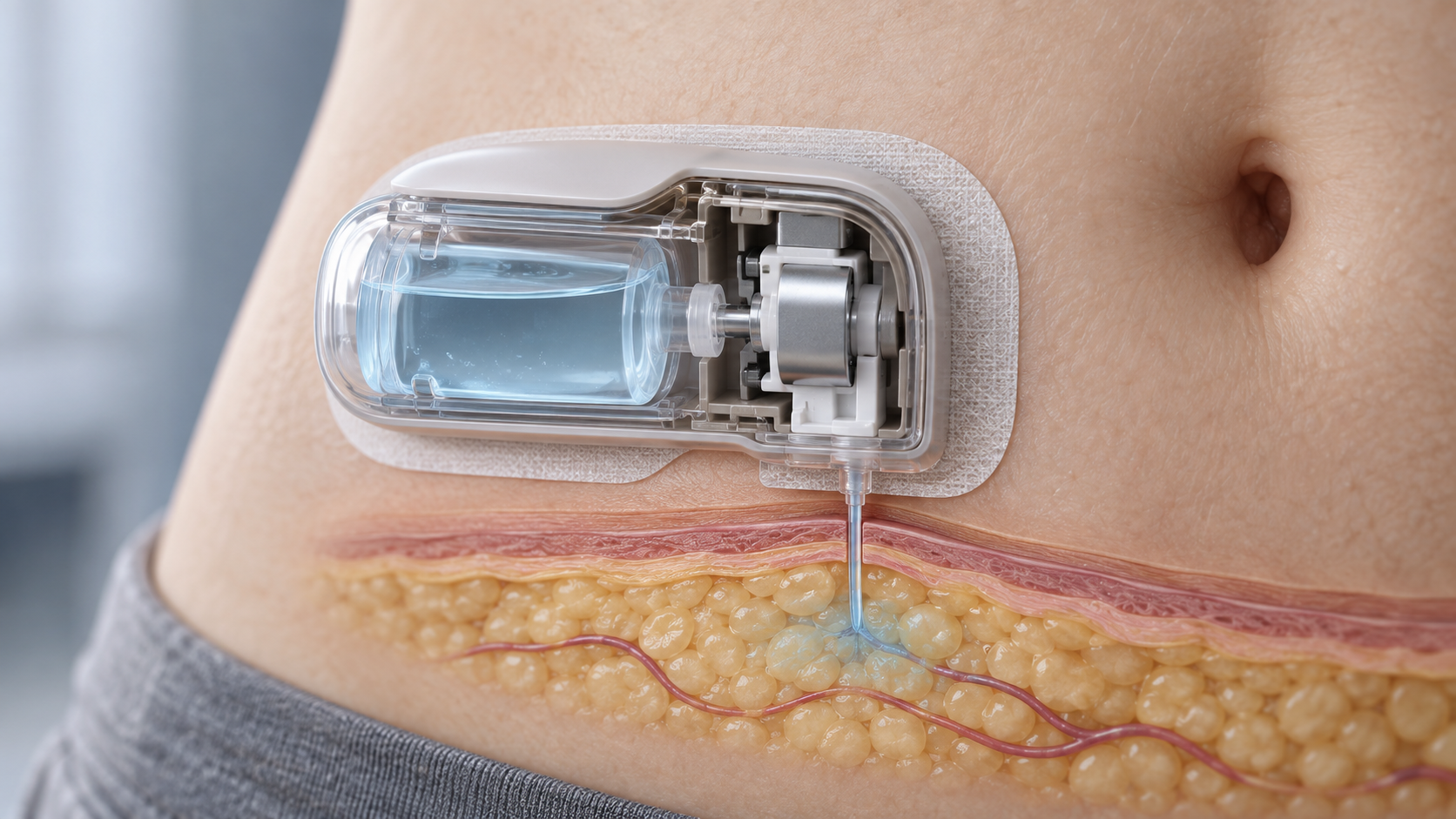
- 1. A combination of materials in contact with the drug. The Omnipod 5 510(k) lists fluid-pathway materials as FEP, fluorosilicone, stainless steel, PDMS, PP, COC and PESourced [Reference 7]. Transparent COC and PP, flexible silicone and a chemically inert fluoropolymer: materials of very different character sit along one pathway (our commentary).
- 2. Compatibility with the drug is in the regulation. The special controls for ACE pumps require drug-compatibility testing to include assessment of drug stability under reasonably foreseeable conditions such as temperature and light, and require fluid-contacting parts to show through chemical and particulate characterisation that the risk from residues is reasonably lowSourced [Reference 3].
- 3. An example of insulin stability testing. The t:slim X2 review document says the stability of Humalog and Novolog was examined for 6 days at 25 °C and, as a worst case, for up to 3 days at 37 °C, and that degradation products, extractables and leachables were acceptable. The cartridge is designed to be replaced at least once every three days and holds 3 mL (300 units at U-100)Sourced [Reference 4].
- 4. Sterilisation differs by component. The t:slim X2 cartridge is sterilised by gamma radiation (in a Tyvek/polyethylene pouch, sterility assurance level 10−6) [Reference 4]; the Omnipod 5 Pod is sterilised with ethylene oxide and has an 18-month shelf life [Reference 7]Sourced. Tolerance to radiation or ethylene oxide is one condition in choosing materials (commentary).
- 5. The body's side of the response. A study in swine reported that when infusion sets were worn for 7 days or more, the loss of insulin absorption was attributed not to the preservative m-cresol but to an inflammatory response to the infusion set and the insulin protein itself (peaking at day 7 histologically)Sourced [Reference 11]. This is an animal study and not a result in people.
6. Our calculation: how small one delivery step is, and the volume before an occlusion is detected
U-100 insulin is 100 units per mL. So we take 1 unit = 0.01 mL = 10 µL (an assumption)Our calculation.
- The smallest increment: the Omnipod 5 510(k) gives the increment for basal and bolus delivery as 0.05 unit [Reference 7]. 0.05 × 10 µL = 0.5 µL, one hundredth of a drop of water (taken as about 50 µL).
- The maximum bolus rate: 1.5 units per minute = 15 µL per minute [Reference 7].
- Until an occlusion is found: in the t:slim X2 review document, in a test with basal delivery set to 2.0 units per hour and the line blocked, the mean time to occlusion detection was 1 hour 1 minute 39 seconds [Reference 4]. 2.0 × 1.0275 hours = about 2.06 units = about 20.6 µL would be pushed into the pathway before detection. For a 3-unit bolus the mean detection was about 1 minute.
- Cartridge capacity: 3 mL = 300 units. Used at 2.0 units per hour, 300 / 2.0 = 150 hours (about 6.3 days) to empty, so the intended replacement (at least every 3 days) comes first.
Assumptions and limits: 2.0 units per hour is one condition used in the review document's tests, not a typical setting. “One drop is 50 µL” is this article's assumption. Occlusion detection time depends on delivered volume, rate and tubing length (a 110 cm infusion set in the test). The calculation is for order of magnitude and does not assess any individual use or safety. It shows a piece of physics: at low flow, a large volume has to be pushed into the pathway before an occlusion shows up as pressure (our commentary).
7. Cannula and infusion-set failures: published numbers
The last exit of the loop is the thin cannula under the skin. If it blocks, shifts or kinks, insulin does not arrive even though the pump and the algorithm are working normally.
- An example from a review document: in the six-month randomised Control-IQ comparison (168 people) there was one diabetic ketoacidosis, whose cause is recorded as an infusion set failure. Hyperglycaemia or ketosis events meeting the reporting criteria numbered 13 in the closed-loop arm (112 people) and 2 in the control (sensor-augmented pump) arm (56 people)Sourced [Reference 5].
- Types of failure: an expert panel report lists the sources of infusion-set failure as kinking, dislocation or leakage of the cannula, reservoir leakage, a loose connection between reservoir and cannula, insulin precipitation in the cannula, and occlusions that may or may not trigger pump alarmsSourced [Reference 12].
- How little is known: a review by Heinemann and Krinelke says published knowledge about infusion sets is relatively small and that no prospective clinical study on current infusion sets and insulin formulations gives representative data on the type and frequency of their problemsSourced [Reference 13].
A study that quantified frequency is that of Kanapka and colleagues. It analysed 22,741 infusion sets used by 263 participants aged 6 to 72 in two clinical trialsSourced [Reference 10].
- Sets removed before 72 hours in association with prolonged hyperglycaemia numbered 748 (3.3%). Under a less restrictive definition (above 300 mg/dL at the time of removal) the figure was 1,688 (7.4%)Sourced [Reference 10].
- By age, 1.9% for those 18 and over, 5.8% for 14 to 17 and 4.4% for 6 to 13. By set type, 4.0% for 90° Teflon sets, 1.9% for steel sets and 1.3% for angled Teflon setsSourced [Reference 10].
- The authors say such changes occur about four times a year on averageSourced [Reference 10]. Changing every 3 days uses about 122 sets a year (365 / 3); multiplied by 0.033 that is about fourOur calculation.
This figure rests on an operational definition, “removed after the sensor showed prolonged high glucose”, and does not separate causes such as kinking, occlusion or dislodgement. Seen through a materials lens, the result suggests that cannula material, shape and insertion angle may affect failure frequency, but identifying causes would take device-by-device studies (our commentary).
8. A materials engineer's view (2): three consumables on different cycles, and the burden of adhesion
| Consumable | Replacement or wear period in the FDA document | Source |
|---|---|---|
| Insulin cartridge (t:slim X2) | Designed to be replaced at least once every 3 days. Capacity 3 mL | DEN180058 |
| Pod (Omnipod 5) | Held on the skin by an adhesive pad and supplies up to 3 days of insulin before replacement | K203768 |
| Guardian Sensor 3 (MiniMed 670G) | 7 days of continuous use | P160017 |
| Dexcom G6 / G7 / G7 15 Day | Up to 10 days / 10 days plus 12 hours / 15 days plus 12 hours | DEN170088, K234133, K243214 |
| FreeStyle Libre 3 Plus | Up to 15 days. Use with automated insulin dosing systems is included in the indication (Plus sensors) | K233537 |
All Sourced (FDA documents [References 4 to 7, 18, 20 to 22]). Updated with each product and version.
- Mismatched cycles. The infusion side is about 3 days and the sensor side 7 to 15 days (table above). One loop contains several consumables with different lifetimes, each stuck to the skin (our commentary).
- The burden of adhesives on skin. The MiniMed 670G SSED lists allergic reaction to adhesives and infection at the infusion-set and sensor insertion sites among possible adverse events. Exclusion criteria for its clinical study also included people who cannot tolerate the tape adhesive at the sensor siteSourced [Reference 6]. The materials design of skin adhesion is covered in our explainer on patch sensors and skin adhesion.
- Sensor durability is the availability of the loop. The iCGM special controls require that data gaps over the sensor's life do not prevent connected devices from achieving their intended use [Reference 1]. If a sensor stops partway, the loop opens (our commentary).
- Reusable parts. Disposable parts (sensor, Pod, cartridge) and reusable parts (transmitter, controller) call for different material properties, such as cleaning and disinfection, and rechargeable batteries (commentary).
9. When communication drops: what design must provide
The loop runs only when three devices are connected wirelessly. The regulation text sets out what must happen when the connection is lostSourced [References 2, 3].
- ACE pump: it must include measures to keep therapy safe when communication with a digitally connected alternate controller is interrupted, lost or re-established (for example, reverting to a pre-programmed safe delivery rate), and validation must show that events during the loss (commands, malfunctions, occlusions and so on) are handled and logged appropriately.
- iAGC: documentation is needed showing that safe therapy is maintained across interruption, loss and re-establishment, and critical events such as commands and confirmations, malfunctions, alarms and their acknowledgements, and connectivity events must be stored and accessible for an adequate period.
- Both: the interface requirements include secure authentication (pairing) with the other device, sharing of state information (battery, reservoir level, sensor use life, errors) and continuing to operate safely when data outside the specified bounds is received.
From a materials viewpoint, hardware reliability (batteries, antennas, waterproofing of housings, connection to the sensor) bears directly on how easily communication drops (our commentary). The special controls for ACE pumps also require reliability of pump function over the use life, and testing of electrical safety, electromagnetic compatibility and the safety and availability of the radio linkSourced [Reference 3].
10. Open problems, and what this article could not confirm
(1) The specific materials of each company's infusion sets, cannulas and adhesives
Among the FDA documents checked for this article, only the Omnipod 5 510(k) listed fluid-pathway materials. The specific materials of cannulas and adhesives for the t:slim X2, MiniMed, iLet and other products could not be confirmed, and the Omnipod 5 document does not say which material is used in which part.
(2) Algorithm internals, and comparisons between systems
The inside of the algorithms (models, parameters, the handling of targets) could not be confirmed in published documents, so only outlines of operation are given. Comparisons of clinical results between systems are not covered, because populations and conditions differ.
(3) Interaction of insulin formulation additives with materials
Interactions between additives such as preservatives (m-cresol, phenol) or zinc and the pathway materials were not shown in detail in the documents checked. The swine study [Reference 11] gives the result under one set of experimental conditions.
(4) Regulation in other regions, and systems built by individuals
Classification in Europe (MDR) and Japan (PMDA), and automated delivery systems that individuals build, for example with open-source tools, were neither checked nor discussed.
- The FDA divides automated insulin delivery into three components. The iCGM (862.1355), the iAGC (862.1356) and the ACE pump (880.5730)Sourced
- The pathway moved from an integrated PMA to component-by-component classes. From the MiniMed 670G (PMA) in 2016, to De Novo grants in 2019, to 510(k)s from 2022Sourced
- Materials are assessed together with the drug, for three days. Insulin stability, chemical and particulate characterisation of fluid-contacting parts, biocompatibility and sterilisation appear in the review documentsSourced
- The exit often stops the loop. The DKA in the Control-IQ study was due to an infusion set failure, and in an analysis of 22,741 sets, 3.3% were removed before 72 hours in association with prolonged hyperglycaemiaSourced
- Several consumables on different cycles are stuck to the skin. Adhesion and the burden on skin set how long the loop lasts (our commentary)
11. Glossary
- AID
- Automated insulin delivery. A system that adjusts insulin infusion automatically from sensor values. Also called closed loop or artificial pancreas.
- Hybrid design
- A closed loop that is not fully closed because some actions, such as mealtime dosing, are left to the user.
- iCGM
- Integrated CGM. An FDA Class II category (862.1355) for CGM designed to work with other devices.
- iAGC
- Interoperable automated glycemic controller. Software that calculates doses and commands the pump (862.1356).
- ACE pump
- Alternate controller enabled infusion pump. A pump that can receive commands from an external controller (880.5730).
- Cannula
- A thin tube that delivers insulin under the skin. Made of soft polymer or steel.
- Infusion set
- The assembly of tubing, adhesive and cannula that connects a pump to the body.
- Bolus
- An additional dose delivered at once, for example around a meal. Distinguished from basal (a continuous small flow).
- U-100
- The concentration label of an insulin product: 100 units per mL.
- DKA
- Diabetic ketoacidosis. A serious condition that can occur when insulin action is insufficient.
- Occlusion
- A blockage of the pathway so that the drug no longer comes out.
- FEP
- Fluorinated ethylene propylene. A chemically inert fluoropolymer.
- COC
- Cyclic olefin copolymer. A transparent resin that absorbs little water.
- De Novo / 510(k) / PMA
- The FDA's three premarket procedures. Called grant / clearance / approval respectively.
12. References (primary sources)
- U.S. Food and Drug Administration (FDA; eCFR) “21 CFR 862.1355 Integrated continuous glucose monitoring system” — www.ecfr.gov
- FDA (eCFR) “21 CFR 862.1356 Interoperable automated glycemic controller” — www.ecfr.gov
- FDA (eCFR) “21 CFR 880.5730 Alternate controller enabled infusion pump” — www.ecfr.gov
- FDA “DEN180058 Evaluation of Automatic Class III Designation for t:slim X2 insulin pump with interoperable technology: Decision Summary” — www.accessdata.fda.gov
- FDA “DEN190034 Evaluation of Automatic Class III Designation for Control-IQ Technology: Decision Memorandum” — www.accessdata.fda.gov
- FDA “PMA P160017 FDA Summary of Safety and Effectiveness Data (MiniMed 670G System)”, approved 28 September 2016 — www.accessdata.fda.gov
- FDA “K203768 510(k) summary and clearance letter (Omnipod 5 ACE Pump)”, 27 January 2022 — www.accessdata.fda.gov
- FDA “K203774 510(k) summary and clearance letter (SmartAdjust technology)”, 27 January 2022 — www.accessdata.fda.gov
- FDA “K220916 510(k) summary and clearance letter (iLet Dosing Decision Software)”, 19 May 2023 — www.accessdata.fda.gov
- Kanapka L et al. “Insulin Pump Infusion Set Failures Associated with Prolonged Hyperglycemia: Frequency and Relationship to Age and Type of Infusion Set During 22,741 Infusion Set Wears”, Diabetes Technol Ther 24:396 (2022) — doi.org
- Swinney MR et al. “Insulin, Not the Preservative m-cresol, Instigates Loss of Infusion Site Patency Over Extended Durations of CSII in Diabetic Swine”, J Pharm Sci 110:1418 (2021) — doi.org
- Deiss D et al. “Insulin Infusion Set Use: European Perspectives and Recommendations”, Diabetes Technol Ther 18:517 (2016) (PMC) — pmc.ncbi.nlm.nih.gov
- Heinemann L, Krinelke L. “Insulin Infusion Set: The Achilles Heel of Continuous Subcutaneous Insulin Infusion”, J Diabetes Sci Technol 6:954 (2012) — doi.org
- FDA “K223846 510(k) summary and clearance letter (iLet ACE Pump)”, 19 May 2023 — www.accessdata.fda.gov
- FDA “K251032 510(k) summary and clearance letter (MiniMed 780G insulin pump)”, 1 July 2025 — www.accessdata.fda.gov
- FDA “K251217 510(k) summary and clearance letter (SmartGuard technology; Predictive Low Glucose technology)”, 29 August 2025 — www.accessdata.fda.gov
- FDA Product classification database, product code OZP “Automated Insulin Dosing Device System, Single Hormonal Control” (via the openFDA API) — api.fda.gov
- FDA “K233537 510(k) summary and clearance letter (FreeStyle Libre 2 / Libre 3)”, 23 April 2024 — www.accessdata.fda.gov
- Doyle FJ 3rd et al. “Closed-loop artificial pancreas systems: engineering the algorithms”, Diabetes Care 37:1191 (2014) — doi.org
- FDA “DEN170088 Dexcom G6 Decision Summary”, 27 March 2018 — www.accessdata.fda.gov
- FDA “K234133 510(k) summary and clearance letter (Dexcom G7)”, 26 February 2024 — www.accessdata.fda.gov
- FDA “K243214 510(k) summary and clearance letter (Dexcom G7 15 Day)”, 9 April 2025 — www.accessdata.fda.gov
13. Claim-to-source audit
| Claim in the text | Basis | Type |
|---|---|---|
| That the system is divided into an iCGM (21 CFR 862.1355), an iAGC (862.1356) and an ACE pump (880.5730). That, as a rule, an iAGC takes glucose input from an iCGM and commands an ACE pump. Measures for safe therapy on interruption, loss or re-establishment of communication, the storage of critical events, labelling naming compatible therapeutic agents, and the handling of the paediatric contraindication | Regulation text (eCFR) Reference 2 https://www.ecfr.gov/current/title-21/chapter-I/subchapter-H/part-862/subpart-B/section-862.1356 | Sourced |
| The definition and Class II (special controls) of the ACE pump: basal and bolus infusion, communication with external systems, infusion accuracy, detection of hazards such as occlusion, drug compatibility (assessment of stability), biocompatibility of fluid-contacting parts (chemical and particulate characterisation), reliability over the use life, electrical safety, EMC and the safety and availability of the radio link, maintaining safe therapy on loss of communication, and storage of critical events | Regulation text (eCFR) Reference 3 https://www.ecfr.gov/current/title-21/chapter-I/subchapter-H/part-880/subpart-F/section-880.5730 | Sourced |
| The definition of the iCGM, agreement rates by range, rate-of-change direction errors, data gaps, and manufacturing and release controls | Regulation text (eCFR) Reference 1 https://www.ecfr.gov/current/title-21/chapter-I/subchapter-H/part-862/subpart-B/section-862.1355 | Sourced |
| That the t:slim X2 (DEN180058) was granted on 14 February 2019 as an ACE pump (880.5730, Class II, QFG); that its hardware and much of its software are identical to already approved t:slim pumps; a 3 mL (300 unit) U-100 cartridge, replaced at least once every 3 days; biocompatibility tests; gamma sterilisation (SAL 10−6, Tyvek/polyethylene packaging); stability of Humalog and Novolog (6 days at 25 °C, up to 3 days at 37 °C); occlusion detection times (mean 1 h 1 min 39 s at basal 2.0 units/h; about 1 minute for a 3-unit bolus); the indication (ages 6 and over) | DEN180058 Decision Summary Reference 4 https://www.accessdata.fda.gov/cdrh_docs/reviews/DEN180058.pdf | Sourced |
| That Control-IQ (DEN190034) was granted on 13 December 2019 as a software-only iAGC (862.1356, Class II, QJI). That it predicts 30 minutes ahead, adjusts basal every 5 minutes and delivers correction boluses automatically, with mealtime boluses manual. The Dexcom G6 as the compatible iCGM at evaluation. The six-month randomised study (168 people; 112 treatment, 56 control), no severe hypoglycaemia, one DKA (caused by an infusion set failure), and hyperglycaemia or ketosis events meeting reporting criteria numbering 13 in the closed-loop arm and 2 in the control arm | DEN190034 Decision Memorandum Reference 5 https://www.accessdata.fda.gov/cdrh_docs/reviews/DEN190034.pdf | Sourced |
| That the MiniMed 670G (P160017) was approved by PMA on 28 September 2016; product code OZP; that SmartGuard technology adjusts basal delivery automatically and suspends delivery when values fall or are predicted to fall; type 1 diabetes in people 14 and over; the Guardian Sensor 3 for 7 days; compatibility with existing Paradigm infusion sets and reservoirs; the adverse events (allergic reaction to adhesives, infection at insertion sites); that people who cannot tolerate the sensor-site tape adhesive were excluded from the study; electron-beam sterilisation of the sensor | PMA P160017 SSED Reference 6 https://www.accessdata.fda.gov/cdrh_docs/pdf16/P160017B.pdf | Sourced |
| The Omnipod 5 ACE Pump (K203768, 27 January 2022): the Pod is placed with an adhesive pad on the back of the arm, abdomen and so on and supplies up to 3 days of insulin; the fluid-pathway materials (FEP, fluorosilicone, stainless steel, PDMS, PP, COC, PE); a delivery increment of 0.05 unit and a maximum bolus rate of 1.5 units/min; ethylene oxide sterilisation and an 18-month shelf life; the algorithm carried in the Pod and the app | Reference 7 https://www.accessdata.fda.gov/cdrh_docs/pdf20/K203768.pdf | Sourced |
| SmartAdjust (K203774, 27 January 2022): used with an iCGM and an ACE pump, it automatically increases, decreases and pauses insulin delivery based on current and predicted glucose values; type 1 diabetes in people 6 and over | Reference 8 https://www.accessdata.fda.gov/cdrh_docs/pdf20/K203774.pdf | Sourced |
| The iLet Dosing Decision Software (K220916, 19 May 2023): autonomously determines and commands basal increases, decreases, maintenance and suspension and corrections, and determines mealtime doses from meal announcements; ages 6 and over | Reference 9 https://www.accessdata.fda.gov/cdrh_docs/pdf22/K220916.pdf | Sourced |
| The analysis of 22,741 infusion sets (263 people, ages 6 to 72): 748 (3.3%) removed before 72 hours in association with prolonged hyperglycaemia, 1,688 (7.4%) under a less restrictive definition; by age (1.9% for 18 and over, 5.8% for 14 to 17, 4.4% for 6 to 13) and by set type (4.0% for 90° Teflon, 1.9% for steel, 1.3% for angled Teflon); about four times a year on average | Reference 10 https://doi.org/10.1089/dia.2021.0548 | Sourced |
| The swine study: that insulin, not m-cresol, causes the loss of infusion site patency, and that the inflammatory response to the infusion set and the insulin protein peaks at day 7 | Animal (swine) study Reference 11 https://doi.org/10.1016/j.xphs.2020.12.008 | Sourced |
| Sources of infusion-set failure (kinking, dislocation or leakage of the cannula, reservoir leakage, loose connection, insulin precipitation in the cannula, occlusion) | Expert panel report Reference 12 https://pmc.ncbi.nlm.nih.gov/articles/PMC5040072/ | Sourced |
| That published knowledge about infusion sets is relatively small and no prospective clinical study gives representative data on the type and frequency of problems | Reference 13 https://doi.org/10.1177/193229681200600429 | Sourced |
| That the iLet ACE Pump (K223846, 19 May 2023) was cleared as an ACE pump (ages 6 and over) | Reference 14 https://www.accessdata.fda.gov/cdrh_docs/pdf22/K223846.pdf | Sourced |
| That the MiniMed 780G pump (K251032, 1 July 2025) was cleared as an ACE pump (880.5730, QFG) and SmartGuard technology (K251217, 29 August 2025) as an iAGC (862.1356, QJI and QJS) | Reference 15 https://www.accessdata.fda.gov/cdrh_docs/pdf25/K251032.pdf Reference 16 https://www.accessdata.fda.gov/cdrh_docs/pdf25/K251217.pdf | Sourced |
| That product code OZP is an automated insulin dosing system (single hormonal control) in Class III | FDA product classification database Reference 17 https://api.fda.gov/device/classification.json?search=product_code:OZP | Sourced |
| That the FreeStyle Libre 3 Plus includes use with automated insulin dosing systems in its indication and lasts up to 15 days | Reference 18 https://www.accessdata.fda.gov/cdrh_docs/pdf23/K233537.pdf | Sourced |
| The existence of a review setting out design objectives, variables and challenges in artificial pancreas development | Only the abstract was checked Reference 19 https://doi.org/10.2337/dc13-2108 | Sourced |
| That the Dexcom G6 lasts up to 10 days, the G7 10 days plus 12 hours and the G7 15 Day 15 days plus 12 hours | Reference 20 https://www.accessdata.fda.gov/cdrh_docs/reviews/DEN170088.pdf Reference 21 https://www.accessdata.fda.gov/cdrh_docs/pdf23/K234133.pdf Reference 22 https://www.accessdata.fda.gov/cdrh_docs/pdf24/K243214.pdf | Sourced |
| 0.05 unit = 0.5 µL, 1.5 units/min = 15 µL/min, 2.0 units/h × 1.0275 h = about 2.06 units (about 20.6 µL), 300 / 2.0 = 150 hours (about 6.3 days), 4.0 / 1.3 = about 3.1 times, 365 / 3 × 0.033 = about 4 times | Our calculation. Assumes U-100 is 100 units per mL (1 unit = 10 µL), a drop of about 50 µL, that 2.0 units/h is a test condition and not a typical setting, and that occlusion detection time depends on volume, rate and tubing length | Our calculation |
| The specific materials of each company’s infusion sets, cannulas and adhesives (other than Omnipod 5); algorithm internals; clinical comparisons between systems; interaction of insulin additives with materials; regulation in other regions; systems built by individuals | Not stated in the official documents and papers checked for this article, so not given here | Commentary |
| The framing that the algorithm is the clever part but the hardware stops the loop; the reading that materials touching the drug are a mix of very different character; the physics of occlusion at low flow; the reading that cannula material, shape and angle may affect failure frequency; mismatched replacement cycles and the burden of adhesion; hardware reliability and communication | This article’s own framing and commentary based on published content. Not views expressed by the authors or regulators of those documents | Commentary |
| That Figs. 1, 2 and 3 are concept diagrams (vector drawings), Fig. 4 is a drawing that includes our calculation, and that the hero image and Fig. 5 are AI-generated images | A note by this article | Commentary |
Last updated 3 October 2026. Sources are limited to primary material (FDA regulation text, review documents, 510(k) summaries and the product classification database; peer-reviewed papers). No market-size or market-share estimates are used. Because the article includes structural readings and materials-design interpretations, those are marked as Commentary and kept separate from sourced fact. The specific materials of infusion sets, cannulas and adhesives (other than for Omnipod 5), algorithm internals, clinical comparisons between systems, interactions of insulin additives with materials, and regulation in other regions are not covered, because they could not be confirmed in published primary sources. Figs. 1, 2 and 3 are concept diagrams, Fig. 4 includes our calculation, and the hero image and Fig. 5 are AI-generated images; none of them shows a real product, cross-section or measured data. This article explains technology. It gives no advice on diagnosis, treatment, insulin doses or settings, and it does not recommend any product.