TECHNOLOGY EXPLAINER
Field-Effect Transistor (FET) Sensors
— Turning Surface Charge into Current, Until Body Fluids Hide It Within About 1 nm
When the charge on a molecule touches a transistor's gate, the channel current changes. The appeal is that this works without labels, at small size, and in one piece with electronics; but in a liquid rich in ions such as body fluid, the effect of the charge is cut off at a distance of about 1 nm called the Debye length. This article sets out the principles of ISFETs, graphene FETs and nanowire FETs, Debye screening, sweat and body-fluid sensors, and reproducibility and volume manufacture, for materials engineers. It is not medical advice.
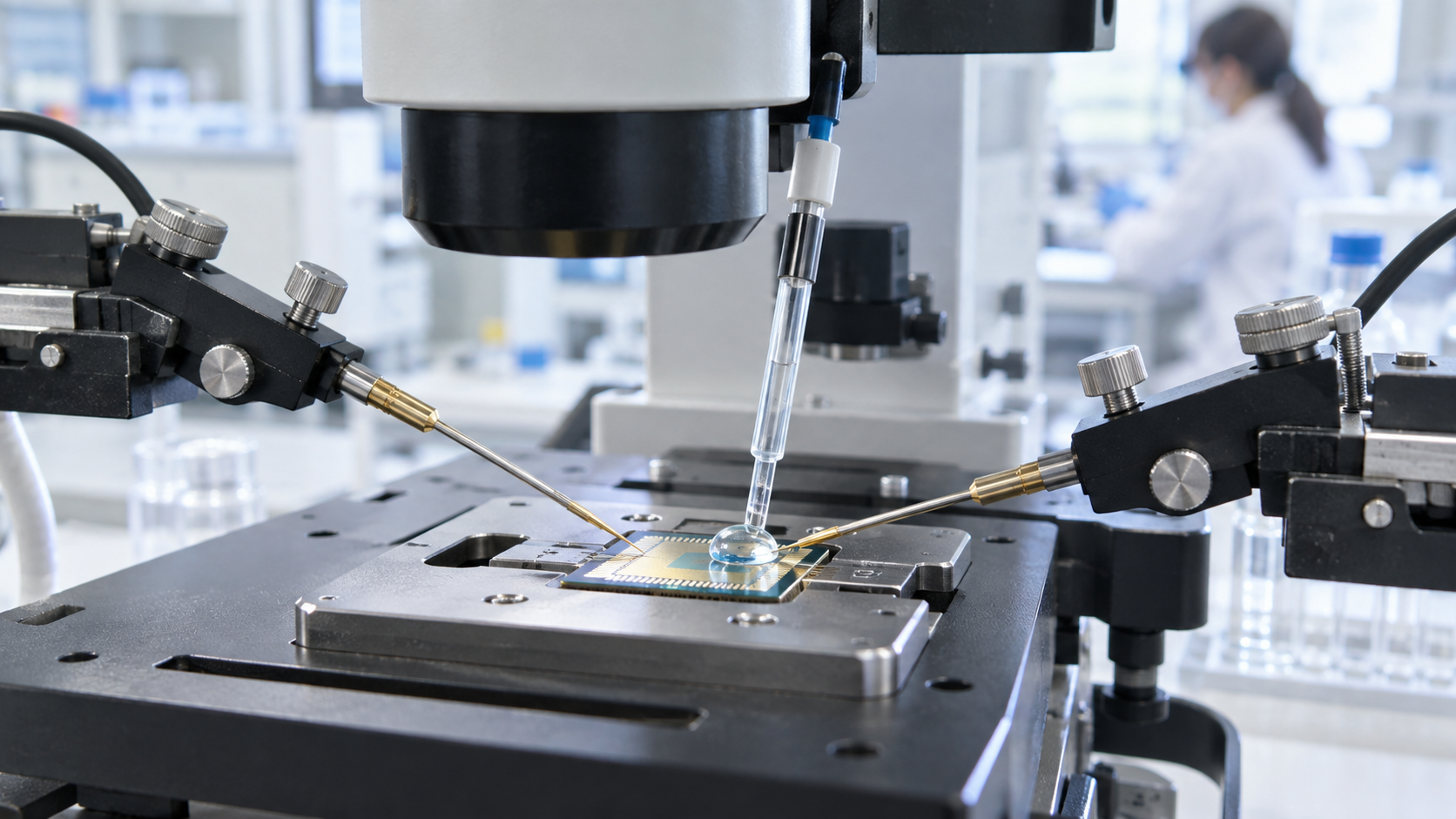
- What an FET sensor is, in three lines
- Principle: charge on the gate surface changes the channel current
- Types: ISFET, nanowire, graphene, extended-gate and dual-gate
- Debye screening: why charge disappears in body fluid
- Our calculation: the Debye length, and the potential left 10 nm away
- A materials engineer's view (1): loosening the screening with PEG, small receptors and surface design
- Moving to sweat and body-fluid sensors
- A materials engineer's view (2): reproducibility and volume manufacture: eliminating device-to-device spread with materials and circuits
- Standards and regulation / strengths and challenges / what we could not confirm
- Glossary / References / Claim-to-source audit
Sourced = stated in published material (source linked)
Our calculation = a value this article derived from explicitly stated assumptions
Not yet confirmed = a plan or target with no confirmed outcome
Materials-design readings are marked Commentary; weakly grounded guesses are marked Inference.
Performance figures are given together with what they were compared against, what sample was used and under what conditions. Please do not read in vitro, artificial-sweat or buffer results as clinical performance in everyday life.
1. What an FET sensor is, in three lines
An FET (field-effect transistor) sensor is "a sensor that reads a change in charge at the surface of a transistor's gate as a change in the current between source and drain". The review by Grieshaber et al. describes it as using transistor technology to measure, as a current, a potentiometric effect at a gate electrodeSourced.
- Strengths: the review by Vu and Chen presents FET biosensors as label-free, real-time detectors with potential for volume production using semiconductor-industry technology (especially silicon nanowires)Sourced. Grieshaber et al. also list as advantages small size, low-power operation, high-density fabrication and easy connection to micro- and nanoelectronic elementsSourced
- The biggest wall: the perspective by Kesler et al. says that the Debye length under physiological conditions is under 1 nm, whereas an antibody is 10–15 nm long and a 30-base aptamer up to about 10 nm, and that this mismatch in dimensions is a fundamental challenge for electronic biosensors generallySourced
- Challenge for practical use: Vu and Chen name large device-to-device variation and low carrier mobility as the primary issues to be overcome on the way to commercialising silicon-nanowire FETsSourced
This article explains principles, materials and evaluation. It gives no advice to individual readers about diagnosis, treatment or how to read a measured value. It does not rank any particular product or company.
2. Principle: charge on the gate surface changes the channel current
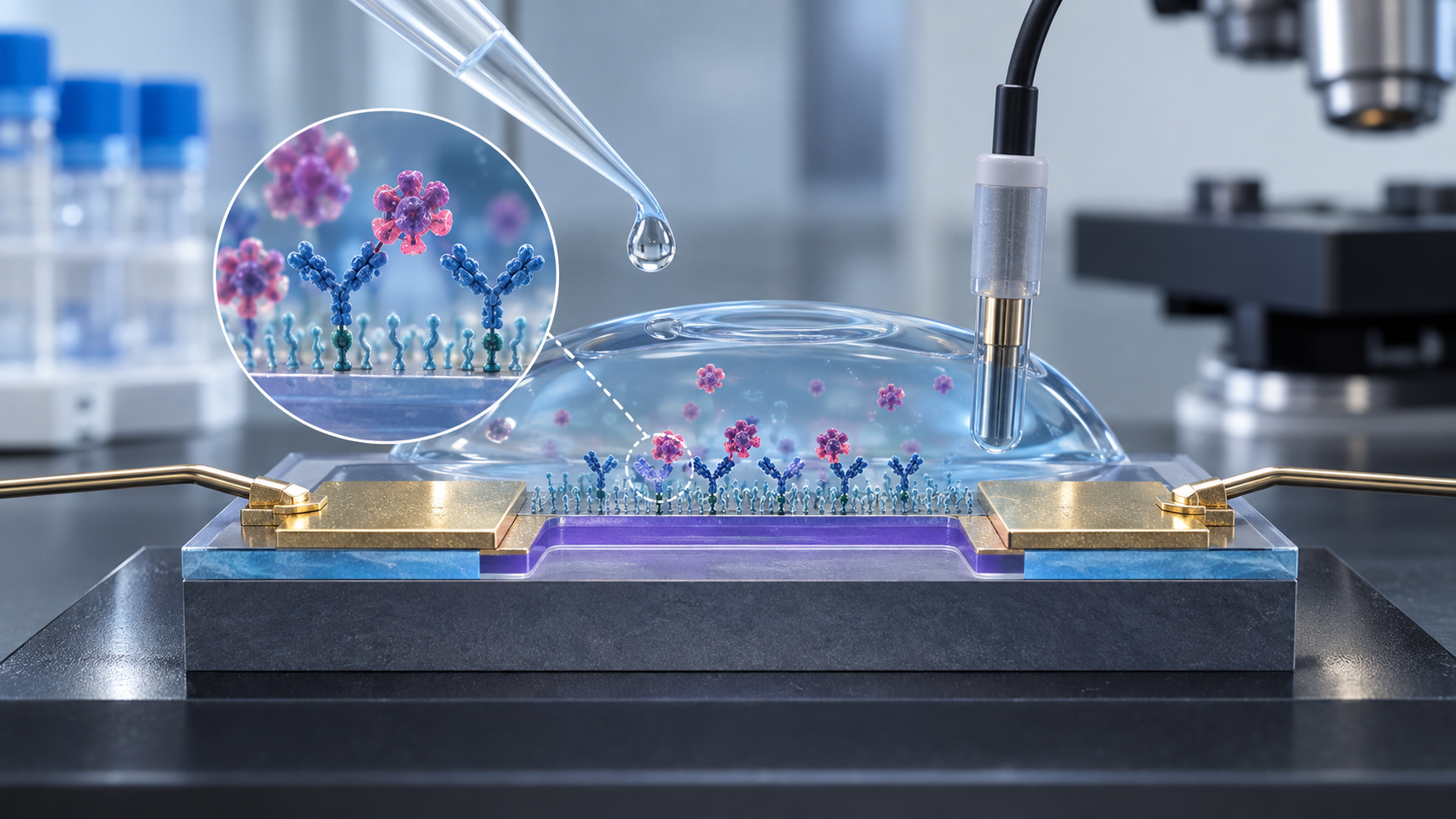
An FET has a source and a drain electrode at the two ends of a semiconductor channel, and a gate whose potential controls the current between them across an insulating filmSourced (Grieshaber et al.). In a biosensor the metal gate is replaced by a sensing surface in contact with the solution. The solution contains a reference electrode that sets the gate potentialSourced (Grieshaber et al.). When a charged molecule binds to the surface it has the same effect as applying a voltage, and the threshold voltage changesSourced (Sadighbayan et al.).
View the original SVG schematic, source notes and numerical details
The idea is old. The ISFET starts with Bergveld's 1970 report of the development of an ion-sensitive solid-state device for neurophysiological measurementsSourced (from the title of Bergveld 1970; a later review is titled "Thirty years of ISFETOLOGY"Sourced). The sensitivity and capability of an ISFET depend strongly on the nature of the sensitive insulating layerSourced (Sadighbayan et al.).
3. Types: ISFET, nanowire, graphene, extended-gate and dual-gate
FET sensors can be sorted by channel material and gate configuration.
| Type | Channel / configuration | Features (as reported) | Challenges |
|---|---|---|---|
| ISFET / EnFET | The MOSFET gate replaced by a pH-sensitive surface or by a membrane carrying an enzyme | The enzyme FET (EnFET) for penicillin, glucose and urea is typical. Apart from a few ISFETs, mainly for pH, FET biosensors have not been commercially successfulSourced (Grieshaber et al.; a 2008 statement) | Signal depends on the enzyme immobilisation method; response and recovery times; no standard methods for depositing and patterning the enzyme layer that suit silicon processingSourced (a 2008 statement) |
| Silicon nanowire FET | Boron-doped Si nanowires. Top-down (CMOS-compatible) or bottom-up | Cui et al. reported pH response and detection of biotin-streptavidin binding (down to at least the picomolar range)Sourced. Stern et al. reported label-free detection of antibodies below 100 fM using a CMOS-compatible fabrication approachSourced | Large device-to-device spread and low mobilitySourced (Vu and Chen). Bottom-up requires hybrid fabrication and is hard to integrateSourced (Stern et al.) |
| Graphene FET | Single-layer graphene channel. Electrolyte gate | Ohno et al. reported transconductance 30 times higher in electrolyte than in vacuum, a linear rise in conductance with pH, and response to protein adsorption at several hundred picomolarSourced | Surface oxygen groups let pH response creep in (a TCPP coating has been tried to suppress it)Sourced (Nguyen et al.). Graphene is covered in our explainer on graphene and carbon nanotubes |
| Metal-oxide thin-film FET | In₂O₃ and similar (2–3 nm films). Can be made on flexible substrates | An example in which the film was formed by a sol-gel method and FETs were made on polyimideSourced (Wang et al.) | Selection looks at stability in solution (pH, ionic strength), sensitivity to light and temperature, availability in volume, and compatibility with large-area fabrication on flexible substratesSourced (Nguyen et al.) |
| Extended-gate (EG-FET) | The sensing electrode is taken off the chip and wired to the MOSFET gate | Most of the electrical signal is isolated from the measurement environment, encapsulation is simple and reliable, light-induced variation is reduced, and fabrication is easySourced (Nguyen et al.) | Reproducibility of the sensing electrode and parasitic capacitance of the wiring need separate design (commentary) |
| Dual-gate | A bottom gate plus a top (or liquid) gate | Increases the response, improves signal-to-noise and reduces signal drift and hysteresisSourced (Nguyen et al.) | The structure and drive circuit become more complex (commentary) |
Grieshaber et al. [Ref. 8], Cui et al. [Ref. 3], Stern et al. [Ref. 4], Ohno et al. [Ref. 6], Vu and Chen [Ref. 10], Nguyen et al. [Ref. 11], Wang et al. [Ref. 12]. The parts of "Challenges" marked (commentary) are this article's own grouping. The reported performance values differ between papers in sample, conditions and device, and are not a ranking.
4. Debye screening: why charge disappears in body fluid
At the surface of an electrode in liquid, ions of opposite sign gather to form an electrical double layer that cancels the effect of the surface charge. The Debye length is a rough measure of the distance over which this cancelling acts. Kesler et al. explain that all biological samples contain high concentrations of ions and that this screening of electric fields greatly attenuates the signals of electronic biosensorsSourced. The same perspective says that the Debye length under physiological conditions is under 1 nm, whereas an antibody is 10–15 nm long and a 30-base aptamer up to about 10 nm, and that this mismatch is a fundamental challenge for biosensors built on these reagentsSourced.
Stern et al. likewise report that for nanowire FETs careful control of the solution Debye length is critical for unambiguous, selective detection of macromoleculesSourced (abstract).
How people have dealt with screening
- Measure in diluted samples: Vu and Chen summarise that most responses to the Debye-length problem have been to measure in diluted samples or to use small recognition elements (antibody fragments, DNA aptamers, RNA aptamers)Sourced
- Mixed SAMs with PEG: Gao et al. showed a strategy of modifying silicon nanowires with poly(ethylene glycol) (PEG) to widen the detectable region for prostate-specific antigen (PSA) in 150 mM phosphate bufferSourced (as introduced by Vu and Chen). The group of Tarasov went on to combine mixed SAMs with antibody fragments and reported detecting thyroid-stimulating hormone (TSH) in serum with 10 kDa mPEG and F(ab′)₂ at a limit of detection below 500 fM with an extended-gate MOSFET (gold sensing channel) and 10 fM with an electrolyte-gated graphene FETSourced (as described in the review by Vu and Chen; conditions are in the original papers)
- Conformational change of aptamers: if a conformational change of a charged receptor occurs within or near the Debye length it can shift the surface potential enough, which is used for detecting small, nearly neutral moleculesSourced (Vu and Chen)
- The idea of Debye volume: Kesler et al. note that double layers need space, introduce simulations showing that screening is weaker in concave geometries, and describe limiting the volume available to the double layer by putting large polymers (such as PEG) on the surfaceSourced
5. Our calculation: the Debye length, and the potential left 10 nm away
In an aqueous solution of a 1:1 electrolyte (such as NaCl) the Debye length λD is inversely proportional to the square root of the ionic strength I, and at 25 °C λD ≈ 0.304/√I (nm, with I in mol/L)Our calculation (computed from λD = √(ε₀εr kT/(2Nₐe²I)), assuming a relative permittivity of water of 78.4 and an ideal solution).
- Ionic strength near body fluid (about 150 mM): λD ≈ 0.78 nm, about one-thirteenth to one-nineteenth of an antibody's length (10–15 nm)Our calculation
- Potential 10 nm away: fitting the Debye-Hückel-type exponential decay exp(−x/λD), the potential left 10 nm from the surface at 150 mM is about 3×10⁻⁶ of its surface value (0.0003%). At 1.5 mM (equivalent to a 100-fold dilution) λD ≈ 7.8 nm and about 28% remainsOur calculation
- Ionic strength of sweat: sweat Na⁺ is cited as 10–140 mMSourced (a value cited in the table of Nguyen et al.). Treating this as the ionic strength of a 1:1 electrolyte gives λD of about 3.0 nm (10 mM) to 0.81 nm (140 mM)Our calculation. Less extreme than body fluid, but still short of an antibody's length
Assumptions and limits: this is a rough estimate assuming a 1:1 electrolyte, an ideal solution and simple exponential decay; at real interfaces the result changes with ion size, multivalent ions, polymer layers on the surface and field strength. Kesler et al. say that simple models of this kind have "reached the limits of their utility" and propose new ideas such as Debye volume and non-equilibrium measurementSourced. The numbers are meant to show the order of magnitude behind "why an antibody's charge is hard to see in undiluted body fluid", not to predict the performance of any sensor.
6. A materials engineer's view (1): loosening the screening with PEG, small receptors and surface design
Debye screening is a wall of physics, but most of the responses are work for materials and surface chemistry.
- Smaller recognition elements: aptamers are synthesised in vitro, so batch-to-batch variation is small; they tolerate temperature fluctuations, stay stable in long storage, and can be covalently immobilised on most surfaces through the 5′ or 3′ endSourced (Nguyen et al.). Against an antibody's 10–15 nm, an aptamer is about 10 nm and a nanobody under 3 nm long (about 13 kDa), so the charge sits closer to the surfaceSourced (Kesler et al., Vu and Chen). Aptamers are covered in our aptamer explainer in this series
- The role of PEG: PEG is known as an antifouling material, but in the series of work by Tarasov et al. its main role is described not as antifouling but as widening the region within the Debye length where binding can be sensed, and Vu and Chen note that this gave roughly a three-fold signal enhancement in a graphene FETSourced
- Channel surface chemistry: on carbon nanotubes a linker (1-pyrenebutyric acid) is attached through π-π stacking of the pyrene group and an amine-bearing probe is coupled to the carboxyl group with EDC/NHS. On graphene a porphyrin such as TCPP is stacked by π-π interaction and probes are coupled through the surrounding carboxyl groupsSourced (Nguyen et al.). A TCPP coating has also been reported to cover oxygen-containing groups and reduce the response to pHSourced
- The gate insulator: the sensitivity of an ISFET depends strongly on the sensing insulating layerSourced (Sadighbayan et al.). pH response is set by protonation and deprotonation of surface functional groups (commentary). Wang et al. self-assembled an aminosilane (APTES) diluted with a propylsilane (PTMS) at 1:9 on an In₂O₃ channel to make an interface that reads pH through the charge on the amine groupsSourced
- Flexible thin films: In₂O₃ films 2–3 nm thick were formed by a sol-gel method, with RMS roughness of 0.34 nm (comparable to 0.4 nm on silicon), described as uniform at wafer scaleSourced (Wang et al.). Their pH response was reported as essentially unchanged on bending to radii of 15, 20 and 33 mmSourced
7. Moving to sweat and body-fluid sensors
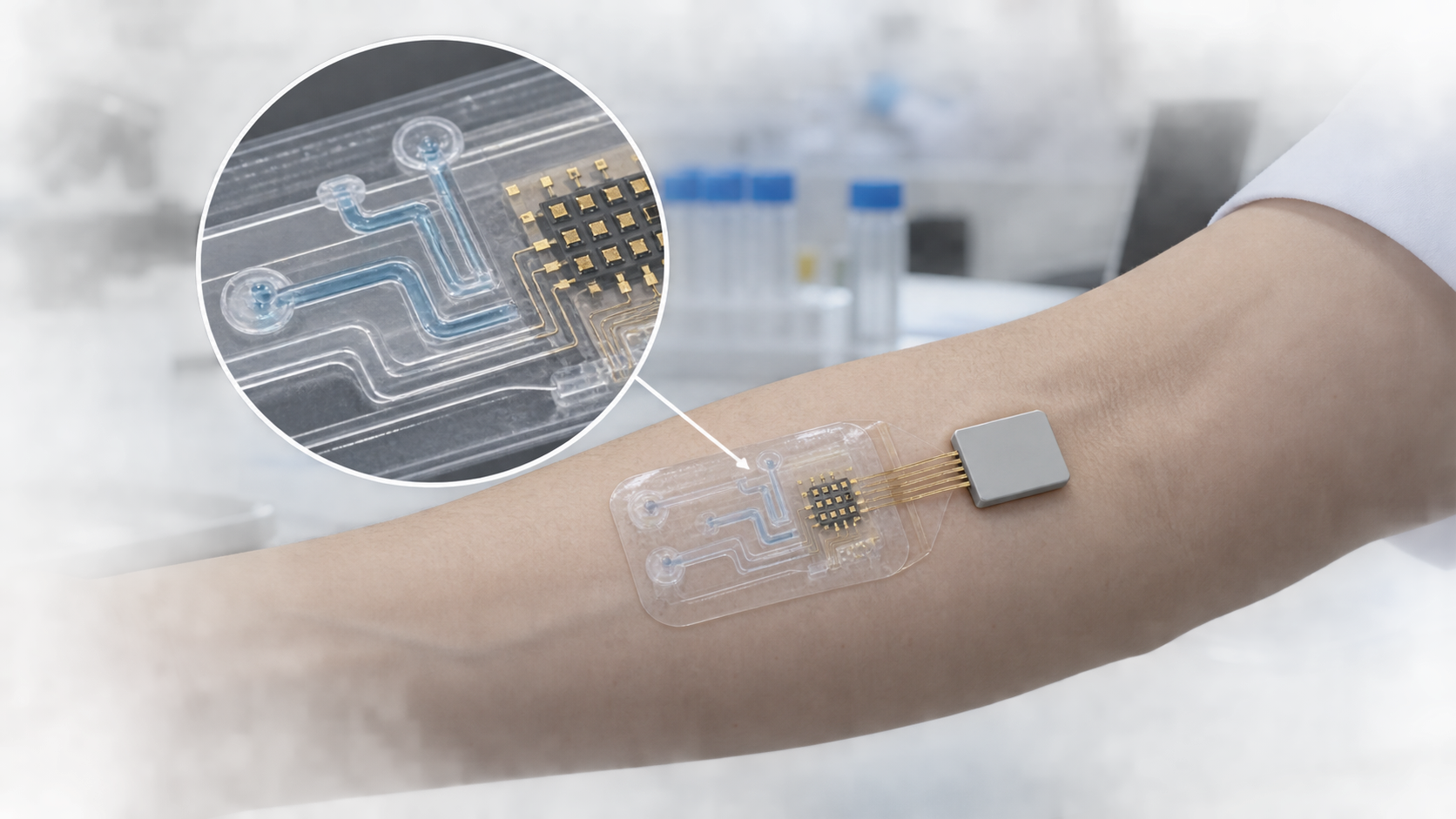
Body fluids reachable at the body surface, such as sweat, saliva and tears, are being explored as targets for FET sensors because the sample can be touched without drawing blood. The review by Nguyen et al. tabulates FET studies measuring ammonia, sodium, potassium and calcium, lactate and cortisol in sweat, together with the sample type and the clinically expected concentration rangeSourced. Here we take as one example the aptamer FET for cortisol in sweat (Wang et al. 2022), where materials and construction are described most concretely.
- What was measured: the authors state that cortisol in sweat is at low nanomolar levels (the estimated physiological concentration is about 10 nM) and that earlier wearable sensors were limited to analytes in the micromolar to millimolar rangeSourced. They report that a newly identified cortisol aptamer combined with In₂O₃ FETs responded from 1 pM to 1 µM in artificial sweat, with an on-FET Kd of about 30 pMSourced (in vitro, artificial sweat)
- A caution from the authors themselves: because gated semiconductor responses are inherently nonlinear, the authors say they cannot describe sensitivity and limits of detection as for conventional devices (such as electrochemical glucose sensors) and give instead the dynamic range (1 pM to 1 µM) as the key parameter, with 1 pM the lowest practically detectable concentration, and say the dynamic range covers the physiological range in sweat and saliva (100 pM to 100 nM)Sourced. This is an example of how the definition of a detection limit differs by method (covered in our explainer on label-free detection and the limit of detection in this series)
- Selectivity: responses to the structurally similar steroid hormones testosterone and progesterone, and to serotonin, were reported as negligible against 10 nM cortisolSourced (artificial sweat and saliva, within physiological concentration ranges)
- How far human confirmation went: saliva and sweat were collected in the morning (about 9 a.m.) and the late afternoon (about 5 p.m.) from 17 healthy participants, and the correlation between salivary and sweat cortisol measured by ELISA was 0.73. The aptamer-FET check of diurnal variation was done on samples from one representative subject and agreed with ELISASourced. This is a pilot study and does not show performance usable for diagnosis or management. The authors themselves say that adding iontophoresis to induce sweat, antifouling for prolonged use, correction for sweat secretion and validation in more clinical samples are still neededSourced
FETs that measure ions: sodium, potassium and calcium
In FETs for ions in body fluid, an ion-selective membrane (PVC plus ionophore and similar) is placed on the gate. Nguyen et al. introduce a platform of 3D extended-metal-gate ISFETs measuring pH, Na⁺, K⁺ and Ca²⁺ in sweat, reporting sensitivities of 58 mV/pH, −57 mV per decade (Na⁺), −48 mV per decade (K⁺) and −26 mV per decade (Ca²⁺), close to the Nernstian limit, as an in vitro demonstration, with a whole platform area under 2.5 mm² and a low power consumption of 2 pW per sensorSourced. The same review also describes a carbon-nanotube FET combining a sodium-selective membrane (PVC plus ionophore) with a miniature on-chip reference electrode, and touches on the problem that commercial reference electrodes were too large for wearablesSourced.
8. A materials engineer's view (2): reproducibility and volume manufacture: eliminating device-to-device spread with materials and circuits
One of the biggest obstacles to practical FET sensors is device-to-device variation. Vu and Chen name large device-to-device variation and low mobility as the primary issues to overcome on the way to commercialising silicon-nanowire FETsSourced. The context is that many large-scale assembly methods for controlling nanowire dimensions, orientation and density have been proposed, yet problems remain.
- How it is made is how well it scales: silicon top-down fabrication (patterning an SOI substrate by lithography and etching) can make many micro-devices in a controlled setting and is described as cost-effective and easy to scaleSourced (Nguyen et al.). By contrast, bottom-up synthesis by CVD requires precise control of experimental conditions and is considered too complicated and expensive for mass productionSourced. Stern et al. likewise report that bottom-up nanowires need hybrid fabrication and are hard to integrate, while a CMOS-compatible top-down approach demonstrated antibody detection below 100 fMSourced
- Correcting the spread in the circuit: Wang et al. report that for pH-sensing FET arrays, device-to-device variation fell from about 50% to about 30% with baseline normalisation and to below 10% using calibrated responsesSourced (two arrays of two pH-sensitive FETs each; tested in buffer). In the wearable cortisol version they used the same normalisation and put a reference FET carrying a scrambled sequence instead of the aptamer into the array to measure non-specific responseSourced
- Stabilising by structure: the extended-gate type isolates most of the electrical signal from the measurement environment and is easy to encapsulate; the dual-gate type suppresses drift and hysteresisSourced (Nguyen et al.). On the materials side, stability of the insulator in solution, sealing and passivation are needed (Nguyen et al. say a semiconductor unstable in ambient conditions may need a passivation step)Sourced
- Connection is also a materials problem: Wang et al. joined the polyimide FET array to the electronics with ACF and stacked a tape-based channel to guide sweatSourced. The articles in our adhesives and encapsulants series are useful for adhesion, sealing and channel materials
In short, the reproducibility of an FET sensor is decided by the combination of uniformity of the channel material, density of the surface modification, reliability of sealing and correction in the readout circuit (commentary).
| Challenge | Cause (as reported) | Examples of countermeasures |
|---|---|---|
| Debye screening | Body fluid has a high ionic strength and the screening length is shorter than an antibody | Dilution, small recognition elements (Fab, aptamer, nanobody), mixed SAMs with PEG, Debye-volume design |
| Device-to-device spread | Dimensions, orientation and density of nanostructures are hard to control (bottom-up) | CMOS-compatible top-down fabrication, baseline normalisation and calibrated response, reference FETs |
| Drift and hysteresis | Fluctuations of the interface potential in liquid; ambient light | Dual gate, extended gate, sealing |
| Non-specific adsorption | Serum contains many proteins and blocking alone is sometimes not enough | Blocking agents (ethanolamine, BSA, MCH), PEG, scrambled-sequence reference FETs |
| Miniaturising the reference electrode | Commercial reference electrodes are large for wearables | On-chip reference electrodes (such as printed Ag/AgCl); see also our explainer on electrochemical sensors |
| Continuous, long-term use | Fouling and difficult regeneration. The device of Wang et al. is suited to single-point measurements | Antifouling, regeneration by gate voltage, sampling mechanisms |
Organised by challenge from the descriptions in Kesler et al. [Ref. 7], Vu and Chen [Ref. 10], Nguyen et al. [Ref. 11] and Wang et al. [Ref. 12] (this article's commentary). The effect of each countermeasure was reported under each paper's conditions and cannot be generalised.
9. Standards and regulation / strengths and challenges / what we could not confirm
Standards and regulation
The FET is a type of sensing element and does not in itself carry a regulatory category. Whether a sensor or instrument counts as a medical device or an in vitro diagnostic is decided by its intended use (what is measured, and for what purpose). The regulatory position of individual products is covered in our explainer on regulatory pathways for medical devices and home use in this series. Within the scope of this survey, we could not confirm an international standard specific to FET biosensors.
What is said about commercialisation
In their 2008 review, Grieshaber et al. state that apart from a few ISFET-based devices, mainly for pH testing, FET-based biosensors have not yet been commercially successfulSourced. In their 2020 review, Sadighbayan et al. stress as a strength that FETs themselves are already mass-produced in standard processesSourced. We have not been able to survey comprehensively the present state of commercialisation of FETs as biosensors.
Strengths and challenges
- Strengths: label-free, real-time detection, small size and low power, and affinity with semiconductor volume manufacturingSourced (Vu and Chen, Grieshaber et al.). They can also be made on flexible substrates (polyimide)Sourced (Wang et al.)
- Challenges: Debye screening, device-to-device variation, drift and hysteresis, non-specific adsorption, miniaturising the reference electrode, and continuous, long-term use (above)
What we could not confirm
- The full text of Bergveld 1970: only the title and bibliographic record (Crossref) were checked, not the text.
- Test conditions in Cui et al., Stern et al., Ohno et al. and Gao et al.: we checked only abstracts and how other reviews introduce them, and did not individually confirm whether detection was in buffer or serum, or whether the sample was diluted.
- An international standard specific to FET biosensors: not confirmed within the scope of this survey.
- The current state of commercialisation: limited to statements in the 2008 and 2020 reviews; no up-to-date comprehensive check was made.
- Long-term performance of sweat sensors on the body: Wang et al. describe their device as suited to single-point measurement; continuous and long-term performance is not shown here.
- An FET sensor reads a change in charge at the gate surface as a channel current. The solution and reference electrode play the part of the gateSourced
- The biggest wall is Debye screening. The Debye length under physiological conditions is reported as under 1 nm, shorter than an antibody (10–15 nm) or an aptamer (about 10 nm)Sourced
- At 150 mM, λD ≈ 0.78 nm and the potential left 10 nm away is about 3×10⁻⁶; diluted to 1.5 mM it is about 28%Our calculation
- The countermeasures—dilution, small recognition elements, mixed SAMs with PEG, Debye-volume design—are mostly work for materials and surface chemistrySourced
- In the flexible-FET example for cortisol in sweat, a dynamic range of 1 pM to 1 µM (artificial sweat) is given, while the authors say a detection limit in the conventional sense cannot be definedSourced
- The challenge for practical use is device-to-device spread, handled by a combination of materials, circuit and structure: top-down fabrication, baseline normalisation, reference FETs and dual gatesSourced
10. Glossary
- FET
- Field-effect transistor. A device in which the gate potential controls the current between source and drain.
- ISFET
- Ion-sensitive FET. An FET whose gate is replaced by a surface sensitive to ions in solution.
- EnFET
- Enzyme FET. An ISFET with an enzyme immobilised on its surface.
- BioFET
- A general term for FETs used as biosensors.
- Source / drain / gate
- The three terminals of an FET: current in / current out / control.
- Channel
- The semiconductor region between source and drain through which current flows.
- Debye length
- A measure of the distance over which surface charge is screened in an electrolyte. Under 1 nm under physiological conditions.
- Electrical double layer
- A layer formed when ions of opposite sign gather at an electrode surface.
- Extended gate
- A configuration in which the sensing electrode is taken off the chip and wired to the transistor gate.
- Dual gate
- A configuration with two gates. Suppresses drift and hysteresis.
- Hysteresis
- Different outputs for the same conditions depending on the direction of a sweep.
- Nanowire
- A thread-like semiconductor with a diameter of nanometres.
- CMOS-compatible
- Can be made by the same methods as standard silicon integrated circuits.
- PEG
- Polyethylene glycol. A polymer used for antifouling and for widening the sensing region.
- SAM
- Self-assembled monolayer. A film of molecules arranged in order on a surface.
- Dynamic range
- The range of concentration over which a sensor responds.
- Iontophoresis
- A method that uses a weak current to stimulate sweat secretion.
11. References
- Bergveld P "Development of an ion-sensitive solid-state device for neurophysiological measurements" IEEE Trans Biomed Eng 1970;BME-17:70–71 (bibliographic record) — https://doi.org/10.1109/TBME.1970.4502688
- Bergveld P "Thirty years of ISFETOLOGY: What happened in the past 30 years and what may happen in the next 30 years" Sens Actuators B 2003;88:1–20 (bibliographic record) — https://doi.org/10.1016/S0925-4005(02)00301-5
- Cui Y, Wei Q, Park H, Lieber CM "Nanowire nanosensors for highly sensitive and selective detection of biological and chemical species" Science 2001;293:1289–1292 (abstract) — https://pubmed.ncbi.nlm.nih.gov/11509722/
- Stern E, Klemic JF, Routenberg DA, et al. "Label-free immunodetection with CMOS-compatible semiconducting nanowires" Nature 2007;445:519–522 (abstract) — https://pubmed.ncbi.nlm.nih.gov/17268465/
- Stern E, Wagner R, Sigworth FJ, Breaker R, Fahmy TM, Reed MA "Importance of the Debye screening length on nanowire field effect transistor sensors" Nano Lett 2007;7:3405–3409 (abstract) — https://pubmed.ncbi.nlm.nih.gov/17914853/
- Ohno Y, Maehashi K, Yamashiro Y, Matsumoto K "Electrolyte-gated graphene field-effect transistors for detecting pH and protein adsorption" Nano Lett 2009;9:3318–3322 (abstract) — https://pubmed.ncbi.nlm.nih.gov/19637913/
- Kesler V, Murmann B, Soh HT "Going beyond the Debye Length: Overcoming Charge Screening Limitations in Next-Generation Bioelectronic Sensors" ACS Nano 2020;14:16194–16201 — https://pmc.ncbi.nlm.nih.gov/articles/PMC7761593/
- Grieshaber D, MacKenzie R, Vörös J, Reimhult E "Electrochemical Biosensors – Sensor Principles and Architectures" Sensors 2008;8:1400–1458 — https://pmc.ncbi.nlm.nih.gov/articles/PMC3663003/
- Sadighbayan D, Hasanzadeh M, Ghafar-Zadeh E "Biosensing based on field-effect transistors (FET): Recent progress and challenges" TrAC Trends Anal Chem 2020;133:116067 — https://pmc.ncbi.nlm.nih.gov/articles/PMC7545218/
- Vu CA, Chen WY "Field-Effect Transistor Biosensors for Biomedical Applications: Recent Advances and Future Prospects" Sensors 2019;19:4214 — https://pmc.ncbi.nlm.nih.gov/articles/PMC6806101/
- Nguyen TTH, Nguyen CM, Huynh MA, Vu HH, Nguyen TK, Nguyen NT "Field effect transistor based wearable biosensors for healthcare monitoring" J Nanobiotechnology 2023;21:411 — https://pmc.ncbi.nlm.nih.gov/articles/PMC10629051/
- Wang B, Zhao C, Wang Z, et al. "Wearable aptamer-field-effect transistor sensing system for noninvasive cortisol monitoring" Sci Adv 2022;8:eabk0967 — https://pmc.ncbi.nlm.nih.gov/articles/PMC8730602/
- Gao N, Zhou W, Jiang X, et al. "General strategy for biodetection in high ionic strength solutions using transistor-based nanoelectronic sensors" Nano Lett 2015;15:2143–2148 (bibliographic record) — https://doi.org/10.1021/acs.nanolett.5b00133
12. Claim-to-source audit
| Claim in the text | Basis | Label |
|---|---|---|
| That Bergveld reported in 1970 the development of an ion-sensitive solid-state device for neurophysiological measurements (title and bibliographic record) | Bibliographic record Reference 1 https://doi.org/10.1109/TBME.1970.4502688 | Sourced |
| That Bergveld's review "Thirty years of ISFETOLOGY" (2003) exists | Bibliographic record Reference 2 https://doi.org/10.1016/S0925-4005(02)00301-5 | Sourced |
| That boron-doped silicon nanowires showed pH-dependent conductance, detected streptavidin down to at least the picomolar range with biotin-modified nanowires, and detected reversible antibody binding with antigen-functionalised nanowires | Abstract of Cui et al. 2001 Reference 3 https://pubmed.ncbi.nlm.nih.gov/11509722/ | Sourced |
| That bottom-up nanowires need hybrid fabrication and are hard to integrate while top-down fabrication is limited by process-induced degradation; and that label-free detection of antibodies below 100 fM was reported with a CMOS-compatible approach | Abstract of Stern et al. 2007 (Nature) Reference 4 https://pubmed.ncbi.nlm.nih.gov/17268465/ | Sourced |
| That careful control of the solution Debye length is important for selective detection of macromolecules with nanowire FETs | Abstract of Stern et al. 2007 (Nano Lett) Reference 5 https://pubmed.ncbi.nlm.nih.gov/17914853/ | Sourced |
| That electrolyte-gated graphene FETs showed transconductance 30 times that in vacuum, a linear rise in conductance with pH and response to protein at several hundred picomolar | Abstract of Ohno et al. 2009 Reference 6 https://pubmed.ncbi.nlm.nih.gov/19637913/ | Sourced |
| That ionic screening of electric fields greatly reduces biosensor signals; that the Debye length under physiological conditions is under 1 nm while an antibody is 10–15 nm and a 30-base aptamer up to about 10 nm; the Debye-volume idea (weaker screening in concave shapes, occupying volume with large polymers); and the remark that simple models have reached their limits | Kesler et al. Reference 7 https://pmc.ncbi.nlm.nih.gov/articles/PMC7761593/ | Sourced |
| The structure of an FET (source, drain, gate, reference electrode); ISFET and EnFET; that as of 2008 FET biosensors other than a few ISFETs mainly for pH had not been commercially successful; the challenges of EnFETs (immobilisation, response and recovery times, standard enzyme-layer deposition); and the advantages of FETs (small, low power, high density, connection to electronics) | Grieshaber et al. Reference 8 https://pmc.ncbi.nlm.nih.gov/articles/PMC3663003/ | Sourced |
| That binding of charged biomolecules is equivalent to applying a gate voltage and changes the threshold voltage; that ISFET sensitivity depends on the insulating layer; and that FETs are mass-produced in standard processes | Sadighbayan et al. Reference 9 https://pmc.ncbi.nlm.nih.gov/articles/PMC7545218/ | Sourced |
| That silicon-nanowire FETs suit semiconductor volume manufacture and that the main commercialisation issues are device-to-device spread and low mobility; that responses to the Debye-length problem were dilution and small recognition elements; the PEG mixed SAM of Gao et al. (PSA in 150 mM phosphate buffer); TSH in serum by Tarasov et al. (below 500 fM, 10 fM) and the role of PEG (widening the sensing region rather than antifouling, about three-fold enhancement); the size of nanobodies; aptamer conformational change; and that the detection limits in the summary table differ by medium | Vu and Chen Reference 10 https://pmc.ncbi.nlm.nih.gov/articles/PMC6806101/ | Sourced |
| The features of extended-gate and dual-gate types; criteria for choosing a semiconductor; the difference between top-down and bottom-up fabrication (CVD being complex and expensive for volume production); the advantages of aptamers; modification of carbon nanotube and graphene surfaces (pyrene, TCPP, EDC/NHS); that TCPP reduces pH response; the cited clinical range of sweat Na⁺ (10–140 mM); the sweat ISFET platform (58 mV/pH, −57, −48, −26 mV per decade, under 2.5 mm², 2 pW per sensor); the on-chip reference electrode of a CNT-FET; and the need for passivation | Nguyen et al. Reference 11 https://pmc.ncbi.nlm.nih.gov/articles/PMC10629051/ | Sourced |
| The aptamer FET for cortisol in sweat: sweat cortisol at low nanomolar levels, sol-gel formation of a 2–3 nm In₂O₃ film, a polyimide substrate (about 7 µm), Au/Ti electrodes, APTES/PTMS at 1:9, MBS cross-linking, a tape channel (about 170 µm), ACF connection, a dynamic range of 1 pM to 1 µM in artificial sweat with an on-FET Kd of about 30 pM, the authors' explanation that a detection limit cannot be defined in the conventional sense, selectivity (testosterone, progesterone, serotonin), an ELISA correlation of 0.73 between saliva and sweat in 17 participants, device-to-device spread (about 50% to about 30% to below 10%), bending tests, and the further work required | Wang et al. Reference 12 https://pmc.ncbi.nlm.nih.gov/articles/PMC8730602/ | Sourced |
| That Gao et al. modified silicon nanowires with PEG for detection at high ionic strength (title and bibliographic record) | Bibliographic record Reference 13 https://doi.org/10.1021/acs.nanolett.5b00133 | Sourced |
| λD ≈ 0.304/√I nm; λD at each ionic strength (0.78 nm at 150 mM, 2.5 nm at 15 mM, 7.8 nm at 1.5 mM, 3.0 nm at 10 mM, 0.81 nm at 140 mM); the ratio to antibody length (about one-thirteenth to one-nineteenth); and exp(−10 nm/λD) (about 3×10⁻⁶ at 150 mM, about 1.8% at 15 mM, about 28% at 1.5 mM) | Our calculation. Assumes a relative permittivity of water of 78.4, 25 °C, a 1:1 electrolyte, an ideal solution and simple Debye-Hückel-type exponential decay | Our calculation |
| The grouping of FET gate configurations (three types), the grouping of channel surface chemistry, the reading that reproducibility is decided by a combination of materials, circuit and structure, the challenge-and-countermeasure table, and the way the layers in the stack figure are arranged | Commentary by this article. A materials-viewpoint rearrangement of the sources | Commentary |
| The full text of Bergveld 1970, the test conditions (buffer or serum) of each paper, an international standard specific to FET biosensors, a comprehensive check of present commercialisation, and the long-term performance of sweat sensors | Not confirmable from published primary sources within the scope of this survey, so not stated | Commentary |
| That Figs. 1, 2, 3 and 4 are explanatory drawings and not real measurement data or product structures, and that the hero image and Fig. 5 are AI-generated images | Note by this article | Commentary |
Last updated October 2026. Sources are limited to primary material (abstracts and text of peer-reviewed reviews and research papers, and bibliographic records). Because the article includes materials-design readings, those are marked as Commentary and kept separate from sourced fact. The full text of Bergveld 1970, the test conditions of each paper, an international standard specific to FET biosensors and the present state of commercialisation are not stated here because no published primary source could be confirmed. The calculations in this article are derived from an ideal solution and simple exponential decay and are not measurements from real sensors. Reported detection limits and dynamic ranges differ between papers in sample, conditions and device, and are not a ranking. All figures are explanatory concept graphics. Figs. 1, 2, 3 and 4 are vector drawings; the hero image and Fig. 5 are AI-generated images, and none of them shows a real cross-section, micrograph or physical product. This article explains principles, materials and evaluation and is not medical advice.