COMPANY PROFILE / CELL CULTURE TECHNOLOGY
Corning
Just 6% of a glass giant's sales: can a veteran maker of culture vessels hold its ground in large-scale culture for cell therapy?
Corning is best known as a U.S. materials company making optical fibre and display glass, but it is also a major laboratory products maker that has been producing research consumables and equipment for more than 110 years under the Corning, Falcon, PYREX and Axygen brands. Its Life Sciences business had sales of US$972 million in 2025, 6% of the company's total segment sales Sourced. And from 2026 the business is no longer a separate reportable segment. This profile keeps the company as a whole brief and, within what can be confirmed from statutory filings with the U.S. SEC and the company's official website, sets out how much in the way of resources goes into the cell culture business and where it is heading.
- Corning in 30 seconds, and where it stands in cell culture
- The logo and how the name is written
- Where the company sits in the cell culture field
- Scale (the company in brief, with the focus on Life Sciences)
- Resources committed to cell culture
- What it has done so far
- What comes next
- What the company is aiming for in cell culture
- Map of cell culture partnerships
- Technologies, products and services
- The risks this company carries
- Glossary, references and claim-to-source audit
1. Corning in 30 seconds, and where it stands in cell culture
USAOne Riverfront Plaza
and cell therapyVaccines, biologics, and cell and gene therapy
PYREX, AxygenSold mainly through distributors
Companies involved in cell culture fall into three broad types: contract development and manufacturing organisations (CDMOs), suppliers of tools, consumables and media, and developers of cell and regenerative therapies. Corning's Life Sciences business is a supplier, selling plastic culture vessels, surface treatments that help cells attach, media and serum, and equipment. The 10-K lists among the uses of its products the "mass production of cells for clinical trials and bioproduction", so it is involved in both the culture of biologics such as antibodies and vaccines and cell therapy, where the cells themselves are the product Sourced. Seen from the company as a whole, however, this is a small business, around 6% of sales and 2% of profit (section 4). To understand what Corning does in cell culture, you have to look at this business's figures, not the company's.
2. The logo and how the name is written
Corning's "Logo Usage Guidelines" on its official website state that using the logo requires the approval of its corporate communications department. In accordance with this rule, this article does not display the Corning logo.
A note on names: the legal entity is Corning Incorporated (a New York corporation). Cell culture products are handled by its in-house Corning Life Sciences business. Pharmaceutical Technologies, which makes glass containers for drugs (such as Valor), was placed in a different segment from Life Sciences in the 2025 10-K (Hemlock and Emerging Growth Businesses).
https://www.corning.com/worldwide/en/about-us/news-events/resources/corning-incorporated-logo-usage.html3. Where the company sits in the cell culture field
Corning's strength is the technology of making "the surface cells grow on". The 10-K cites the Life Sciences business's expertise "in the fields of materials science, polymer surface science, cell culture and cell biology" Sourced. Many cells will not multiply unless they are attached to something (adherent culture), so the material and surface treatment of the vessel directly determine productivity. Our view is that a glass company makes plastic culture vessels because this surface technology is shared with its core business Not yet confirmed.
4. Scale (the company in brief, with the focus on Life Sciences)
The size of the company as a whole is as follows Sourced.
| Whole company (US$ million) | 2023 | 2024 | 2025 |
|---|---|---|---|
| Consolidated net sales | 12,588 | 13,118 | 15,629 |
| Research, development and engineering expenses | 1,076 | 1,089 | 1,110 |
| Capital expenditure | 1,390 | 965 | 1,282 |
The company had about 67,200 employees in 44 countries (end of 2025) and 128 manufacturing plants and processing facilities in 14 countries Sourced. Now to the main subject, the Life Sciences segment.
| Life Sciences segment (US$ million) | 2023 | 2024 | 2025 |
|---|---|---|---|
| Segment net sales | 959 | 979 | 972 |
| Segment net income | 50 | 63 | 61 |
| Research, development and engineering expenses (direct) | 33 | 22 | 25 |
| Depreciation | 69 | 67 | 61 |
| Capital expenditure | 41 | 15 | 24 |
| Segment assets | 782 | 800 | 795 |
Source: Note 18 to the Form 10-K for the year to December 2025. Figures for 2023 and 2024 are restated to the 2025 segment structure. Segment net income is Corning's own measure (calculated assuming a 21% tax rate).
| Ratio (2025) | Value | Calculation |
|---|---|---|
| Life Sciences' share of total segment sales | 5.9% | 972 ÷ 16,408 (the 10-K says 6%) |
| Life Sciences segment net margin | 6.3% | 61 ÷ 972. For the company as a whole (total of segments), 16.6% (2,721 ÷ 16,408) |
| Share of total segment net income | 2.2% | 61 ÷ 2,721 |
| Life Sciences R&D-to-sales ratio (direct) | 2.6% | 25 ÷ 972 |
| Share of total segment capital expenditure | 1.9% | 24 ÷ 1,287 |
| Sales growth (2023 to 2025) | +1.4% | 972 ÷ 959 - 1 (over the two years) |
All Our calculation, from the figures in Note 18 to the 10-K.
The figures above cover the whole Life Sciences business, including pipette tips, PCR plates and general glassware. Sales of cell culture products alone, and sales for cell therapy, are not disclosed Not yet confirmed. Nor is the Life Sciences headcount. Because it stopped being a reportable segment in 2026, the quarterly report shows only product-line sales for "Life Sciences products" (US$477 million in January to June 2026, against US$474 million a year earlier) Sourced.
5. Resources committed to cell culture
Following our standard method, we look at four things (people, money, investments and acquisitions, and links with universities and research institutions) and note whether each could be confirmed from primary sources.
| Aspect | What primary sources confirm | Status |
|---|---|---|
| People (dedicated organisation, sites, headcount) | The Corning Life Sciences division (headed by a vice president and general manager). Manufacturing sites in eight U.S. states (California, Illinois, Maine, Massachusetts, New York, North Carolina, Utah and Virginia) and in China, France, Mexico, Brazil and Poland. Life Sciences headcount is not disclosed | Sites confirmed / headcount not disclosed |
| Money (capital expenditure and R&D) | Direct research, development and engineering expenses of US$25 million and capital expenditure of US$24 million in 2025 (Note 18 to the 10-K). No breakdown for cell culture products alone | Confirmed at segment level |
| Investments and acquisitions | The only acquisition in the 10-K for the year to December 2025 is a solar module plant; no acquisitions or investments related to Life Sciences are mentioned. In August 2025 Corning signed a letter of intent (LOI) with Revital Healthcare of Kenya to set up joint manufacturing in Africa | Acquisitions and investments not found |
| Universities and research institutions | In June 2024, a collaboration with Ireland's National Institute for Bioprocessing Research and Training (NIBRT), installing an Ascent fixed-bed bioreactor for training and demonstrations | Confirmed (one case) |
Direct R&D in Life Sciences is 2.6% of sales, far below the company's consolidated R&D ratio of 7.1% (1,110 ÷ 15,629) Our calculation. But the footnote to the 10-K says segment R&D covers "direct project spending that is identifiable to a segment", so basic research on surface chemistry and polymer moulding done at the central research labs may not be included here Not yet confirmed. The performance of a culture vessel is set by the moulding precision of the polystyrene, surface modification such as plasma treatment, and the uniformity of coatings, all of which are the same "surfaces and interfaces" technologies as optical fibre and display glass. It can also be read as a structure in which the company's materials technology is reused with a relatively small research budget.
6. What it has done so far
| When | What happened | Why it matters |
|---|---|---|
| 1851 | Founded as a glass business (the present legal entity was incorporated in New York in 1936) | Its starting point as a materials company |
| From more than 110 years ago | Begins developing and making laboratory products for research (the 10-K says "over 110 years") | From glassware to plastic culture vessels |
| August 2017 | The manufacturing site in Oneonta, New York marks 50 years of operation | One of Life Sciences' main manufacturing sites |
| July to September 2023 | Announces Springboard, a company-wide growth plan (not a plan specific to Life Sciences) | Sets a target for additional sales by the end of 2026 |
| June 2024 | Collaboration with NIBRT (Ireland), bringing the Ascent fixed-bed bioreactor into training | A foothold in European cell and gene therapy manufacturing |
| August 2025 | Signs an LOI with Revital Healthcare (Kenya) towards joint manufacturing in Africa | Regional production of laboratory consumables. Not aimed at cell therapy |
| January to March 2026 | Segment reorganisation. Life Sciences ceases to be a reportable segment and is combined into "Life Sciences and Emerging Growth Businesses" | Because it no longer meets the quantitative threshold (as explained in the 10-Q) |
7. What comes next
expected in 2026The Life Sciences share is not disclosed
vector yieldsAs stated on the official website
The official website says the company is working to raise viral vector production yields for gene therapy, and that for immune cell therapy it offers a clinical cell expansion platform that can scale from research to commercial production Sourced. The 10-K and 10-Q, on the other hand, give no investment plan or sales target specific to the Life Sciences business. On the company-wide Springboard plan, the 10-K says that "as of the fourth quarter of 2025, we achieved both our growth and profitability targets a full year ahead of plan", but it does not break down which businesses contributed, and in what we checked we found no statement treating Life Sciences as a pillar of growth.
None of the following appears in the 10-K, 10-Q or official website Not yet confirmed.
Sales of cell culture products alone and the share going to cell therapy; Life Sciences headcount; unit sales of the Ascent fixed-bed bioreactor and the names of customers using it; mid-term targets for the Life Sciences business; and Life Sciences' own profit and loss after the 2026 reorganisation (the new segment combines it with other emerging businesses). Press reports and research-firm market estimates are not used in this article.
8. What the company is aiming for in cell culture
This section goes beyond what the company says directly. It sets out inferences that can be drawn from primary sources, each with its basis.
| What can be read | Primary evidence behind it | Category |
|---|---|---|
| Life Sciences is positioned not as a pillar of company growth but as a stable, peripheral business | Sales flat over three years (US$959 million to US$972 million), capital expenditure at 1.9% of the total, and removal from the reportable segments in 2026 | Inference |
| Within cell culture, it is aiming at scaling up adherent culture | A product line-up that puts scale-up front and centre: HYPERStack, CellSTACK, CellCube and the Ascent fixed-bed bioreactor. The NIBRT collaboration also centres on Ascent | Inference |
| Within cell therapy, it emphasises mesenchymal stromal cells (MSCs) and iPS cells | The cell therapy page names MSCs and iPS cells, and the product home page features the launch of MSCulture Max, a medium for MSCs | Sourced |
| It will not move into contract manufacturing or drug development | The 10-K's business description covers only product sales, and lists contract manufacturing organisations (CMOs) among its customers | Inference |
| Its sales channel relies heavily on distributors | The 10-K says products are marketed "primarily through distributors", and that the top two customers account for 45% of segment sales | Sourced |
The 10-Q for the quarter to June 2026 explains that Life Sciences was removed from the reportable segments because it "does not meet the quantitative threshold for separate reporting" Sourced. Over the same period, sales of optical communications products jumped by about 32% year on year (April to June 2026, from US$1,566 million to US$2,072 million) Our calculation, and the bigger the company grows, the smaller a broadly flat Life Sciences business looks by comparison. From this we read that, for Corning, cell culture is a business to defend, not one to bet on Not yet confirmed. That said, the disclosures we checked say nothing about any plan to sell or shrink the business.
9. Map of cell culture partnerships
As Fig. 2 shows, Corning's cell culture business is marked by very few named partnerships. This reflects its business model as a "supplier of general-purpose products", selling most of its products through distributors to a broad range of customers. The primary sources we checked contain no supply agreement tied to a specific therapy (the kind of announcement other companies make that their product "is used in the manufacture of approved drug X").
10. Technologies, products and services
| Category | Main products | What official material says |
|---|---|---|
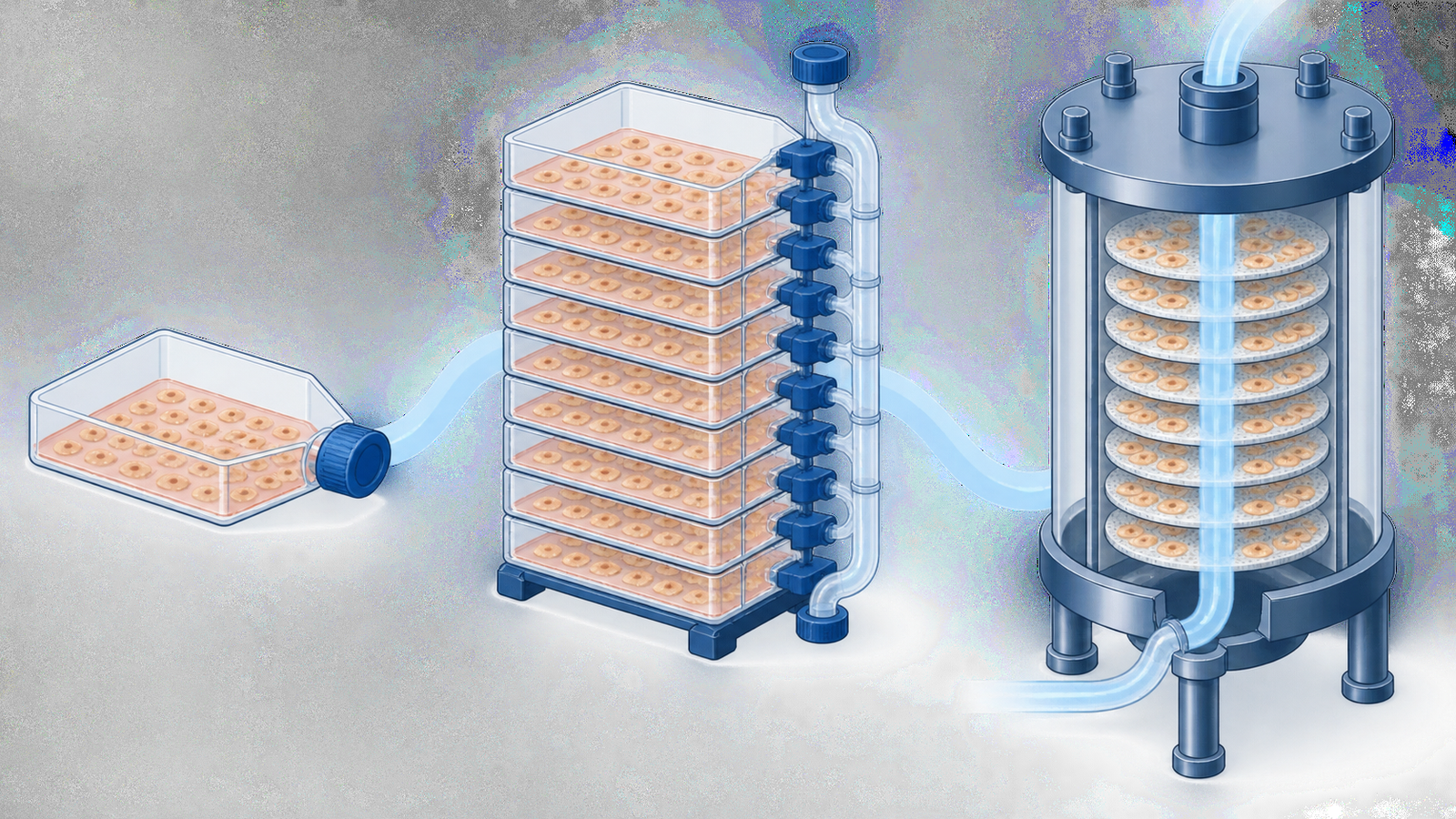
| Multilayer culture vessels | HYPERStack, HYPERFlask, CellSTACK and roller bottles | Mass culture of adherent cells by scale-out (adding more layers). Also used in vaccine production |
| Bioreactors | Ascent Fixed Bed Bioreactor (FBR), the CellCube perfusion system, spinner flasks and Erlenmeyer flasks | Ascent is an automated production platform that grows and harvests large numbers of adherent cells, for cell therapy, gene therapy and vaccines |
| Surfaces and scaffolds | Specialty surfaces, coated vessels, extracellular matrix (ECM), microcarriers and Elplasia 48K vessels | The 10-K lists "specialty surfaces" among its main consumables |
| Media and serum | Media and serum, custom media, and MSCulture Max (for mesenchymal cells) | The 10-K lists "cell culture media and serum" among its main consumables |
| Closed systems and single-use | Closed-system solutions, single-use technologies, harvest and cryopreservation | Described as reducing contamination risk and helping with regulatory compliance |
| General lab products | Falcon-brand products, Axygen liquid handling products, PYREX glassware and microplates | Also used for research and diagnostics beyond cell culture |
The official website says that products for cell and gene therapy that are classified as medical devices in the United States are manufactured in line with FDA 21 CFR 820 (cGMP), and puts its product range at "more than 30,000" items Sourced.
There are two ways to grow more adherent cells: scale-out, which adds more vessels (stacking CellSTACK or HYPERStack units many layers high), and scale-up, which makes the vessel itself bigger. Scale-out offers the reassurance of growing cells on the same flat surfaces as in the lab, but the more layers there are, the more labour and space it takes. A fixed-bed bioreactor stacks carriers with culture surfaces inside a column and flows medium through them, keeping conditions close to flat culture while greatly increasing the culture area per unit. Corning's ownership of both multilayer vessels (HYPERStack) and a fixed bed (Ascent) is probably intended to cover the whole intermediate stage as customers move from scale-out to scale-up Not yet confirmed. See also our explainers on bioreactors and single-use systems.
11. The risks this company carries
| Risk | Substance | Category |
|---|---|---|
| Customer concentration | The top two customers account for 45% of Life Sciences segment sales (2025). Sales go mainly through distributors, leaving the business exposed to distributors' behaviour | Sourced |
| Competitors and distributors' private labels | The 10-K names Thermo Fisher, Avantor, Greiner, Eppendorf, Sarstedt and Danaher as competitors, and notes competition from "large distributors that have pursued backward integration or introduced private label products" | Sourced |
| Stalled growth | Sales were almost flat from 2023 to 2025 (+1.4%). Product sales in January to June 2026 were also level with the year before (+0.6%) | Our calculation |
| Lower priority within the company | Removed from the reportable segments in 2026, so its own profit and loss is no longer disclosed. Capital expenditure is under 2% of the company total | Inference |
| Reduced disclosure | From 2026 it is reported in a segment combined with other emerging businesses, making it harder to track Life Sciences' own profitability from outside | Sourced |
12. Glossary
- Adherent culture
- Growing cells attached to the bottom of a vessel or the surface of a carrier. Most stem cells and many cells used in vaccine production are grown this way.
- Suspension culture
- Growing cells floating in liquid, as with the CHO cells used to make antibodies. See our explainer on bioreactors.
- Fixed-bed bioreactor
- A device in which carriers with culture surfaces are fixed and stacked inside a vessel, with medium flowing through to grow large numbers of adherent cells.
- MSC (mesenchymal stromal cell)
- Cells taken from bone marrow, fat and other tissues. Being researched and brought into use as a raw material for cell therapy.
- CMO
- A contract manufacturing organisation for drugs. One that also takes on development is a CDMO. See our explainer on CDMOs.
- Reportable segment
- Under U.S. accounting standards, a business unit whose sales, profit and other figures are disclosed separately. Below certain quantitative thresholds it can be combined with others.
- Form 10-K / 10-Q
- The annual and quarterly reports that U.S.-listed companies file with the SEC. Statutory disclosures carrying legal liability.
- 21 CFR 820
- The U.S. quality system regulation for medical devices: the standard for quality control in medical device manufacturing.
13. References
- Corning Incorporated Form 10-K for the fiscal year ended December 31, 2025 (filed with the U.S. SEC on 12 February 2026). Company profile; Life Sciences segment business description, manufacturing sites, competitors and customer concentration; consolidated net sales, R&D and capital expenditure; segment information in Note 18; headcount. https://www.sec.gov/Archives/edgar/data/24741/000002474126000124/glw-20251231.htm
- Corning Incorporated Form 10-Q for the quarterly period ended June 30, 2026 (filed with the U.S. SEC on 29 July 2026). The 2026 segment reorganisation and sales by product line. https://www.sec.gov/Archives/edgar/data/24741/000002474126000255/glw-20260630.htm
- U.S. SEC EDGAR submissions API (CIK 0000024741). Used to check the list of filings and filing dates. https://data.sec.gov/submissions/CIK0000024741.json
- Corning Incorporated Life Sciences Products (product portfolio). https://www.corning.com/worldwide/en/products/life-sciences.html
- Corning Incorporated Cell and Gene Therapies (products for cell and gene therapy, and quality systems). https://www.corning.com/worldwide/en/products/life-sciences/applications/cell-therapy.html
- Corning Incorporated Bioprocess Applications (products for bioprocessing). https://www.corning.com/worldwide/en/products/life-sciences/applications/bioprocess-applications.html
- Corning Incorporated "Corning Announces Collaboration with NIBRT To Help Accelerate Cell Therapy Development" (18 June 2024). https://www.corning.com/worldwide/en/about-us/news-events/news-releases/2024/06/corning-announces-collaboration-with-nibrt-to-help-accelerate-cell-therapy-development.html
- Corning Incorporated "Corning and Revital Healthcare sign Letter of Intention" (7 August 2025). https://www.corning.com/worldwide/en/about-us/news-events/news-releases/2025/08/corning-and-revital-healthcare-sign-letter-of-intention-to-estab.html
- Corning Incorporated Life Sciences News Releases (list of news releases). https://www.corning.com/worldwide/en/products/life-sciences/news-events/news-releases.html
- Corning Incorporated Logo Usage Guidelines (approval rules for use of the logo). https://www.corning.com/worldwide/en/about-us/news-events/resources/corning-incorporated-logo-usage.html
14. Claim-to-source audit
| Claim in the article | Category | Source |
|---|---|---|
| Legal name, head office address, listing venue, founded 1851, incorporated 1936, renamed 1989 | Sourced | Reference 1 https://www.sec.gov/Archives/edgar/data/24741/000002474126000124/glw-20251231.htm |
| Consolidated net sales, R&D and capital expenditure (2023 to 2025), and expected 2026 capital expenditure of about US$1.7 billion | Sourced | Reference 1 https://www.sec.gov/Archives/edgar/data/24741/000002474126000124/glw-20251231.htm |
| About 67,200 employees in 44 countries, and 128 plants and processing facilities in 14 countries | Sourced | Reference 1 https://www.sec.gov/Archives/edgar/data/24741/000002474126000124/glw-20251231.htm |
| Life Sciences' products, uses (mass production of cells for clinical trials and bioproduction), brands, sales channels and manufacturing sites | Sourced | Reference 1 https://www.sec.gov/Archives/edgar/data/24741/000002474126000124/glw-20251231.htm |
| Life Sciences segment net sales, net income, R&D, depreciation, capital expenditure and assets (Note 18), and 6% of total segment sales | Sourced | Reference 1 https://www.sec.gov/Archives/edgar/data/24741/000002474126000124/glw-20251231.htm |
| Top two customers at 45% of segment sales, competitors, and distributors' private labels | Sourced | Reference 1 https://www.sec.gov/Archives/edgar/data/24741/000002474126000124/glw-20251231.htm |
| The only 2025 acquisition being a solar module plant, and the Springboard plan | Sourced | Reference 1 https://www.sec.gov/Archives/edgar/data/24741/000002474126000124/glw-20251231.htm |
| Pharmaceutical Technologies being part of Hemlock and Emerging Growth Businesses | Sourced | Reference 1 https://www.sec.gov/Archives/edgar/data/24741/000002474126000124/glw-20251231.htm |
| The 2026 segment reorganisation (why Life Sciences stopped being a reportable segment), and sales by product line (Life Sciences products, optical communications) | Sourced | Reference 2 https://www.sec.gov/Archives/edgar/data/24741/000002474126000255/glw-20260630.htm |
| Filings and filing dates | Sourced | Reference 3 https://data.sec.gov/submissions/CIK0000024741.json |
| Product portfolio (Elplasia 48K, MSCulture Max, ECM, microplates and others) | Sourced | Reference 4 https://www.corning.com/worldwide/en/products/life-sciences.html |
| References to MSCs and iPS cells, more than 30,000 products, manufacturing in line with 21 CFR 820, and work for gene therapy and immune cell therapy | Sourced | Reference 5 https://www.corning.com/worldwide/en/products/life-sciences/applications/cell-therapy.html |
| Bioprocess products including HYPERStack, CellSTACK, CellCube, Ascent and microcarriers | Sourced | Reference 6 https://www.corning.com/worldwide/en/products/life-sciences/applications/bioprocess-applications.html |
| The NIBRT collaboration and the Ascent fixed-bed bioreactor | Sourced | Reference 7 https://www.corning.com/worldwide/en/about-us/news-events/news-releases/2024/06/corning-announces-collaboration-with-nibrt-to-help-accelerate-cell-therapy-development.html |
| The LOI with Revital Healthcare | Sourced | Reference 8 https://www.corning.com/worldwide/en/about-us/news-events/news-releases/2025/08/corning-and-revital-healthcare-sign-letter-of-intention-to-estab.html |
| The small number of Life Sciences news releases (including the 2017 item on 50 years at Oneonta) | Sourced | Reference 9 https://www.corning.com/worldwide/en/products/life-sciences/news-events/news-releases.html |
| Use of the logo requires approval | Sourced | Reference 10 https://www.corning.com/worldwide/en/about-us/news-events/resources/corning-incorporated-logo-usage.html |
| The three types of cell culture company, and placing Corning among the suppliers | Our calculation | Our own classification. Companies shown are examples from the 20 in this series |
| Sales share of 5.9%, net margins of 6.3% and 16.6%, profit share of 2.2%, R&D ratios of 2.6% and 7.1%, capital expenditure share of 1.9%, sales growth of +1.4% and +0.6%, and growth of about 32% in optical communications products | Our calculation | Our calculation (from figures in References 1 and 2) |
| Sales of cell culture products alone, the cell therapy share, Life Sciences headcount, Ascent's sales record, and business-specific mid-term targets | Not yet confirmed | Not in the 10-K, 10-Q or official website. This article makes no estimate https://www.sec.gov/Archives/edgar/data/24741/000002474126000124/glw-20251231.htm |
| The possibility that central research spending is not included in Life Sciences' direct R&D | Not yet confirmed | This article's commentary on the footnote to Note 18 (only directly attributable expenses) https://www.sec.gov/Archives/edgar/data/24741/000002474126000124/glw-20251231.htm |
| The readings of a stable peripheral business, aiming at scaled-up adherent culture, not moving into contract manufacturing, a "business to defend", and lower priority within the company | Inference | This article's interpretation of statements in References 1, 2 and 5 to 7 |
| The view that having both multilayer vessels and a fixed bed covers the move from scale-out to scale-up | Inference | This article's commentary on the product line-up in References 6 and 7 |
Last updated 24 September 2026 / Troy Technical
The figures in this article are based on statutory filings (Forms 10-K and 10-Q) that Corning Incorporated has made with the U.S. Securities and Exchange Commission (SEC), and on the company's official website. No research-firm estimates or press-based figures have been used. Passages marked "Inference" are this article's interpretation of primary sources, not statements made by the company.