COMPANY PROFILE / CELL CULTURE TECHNOLOGY
Lonza
A pure-play CDMO running on two engines: large-scale antibody culture and contract cell therapy manufacturing
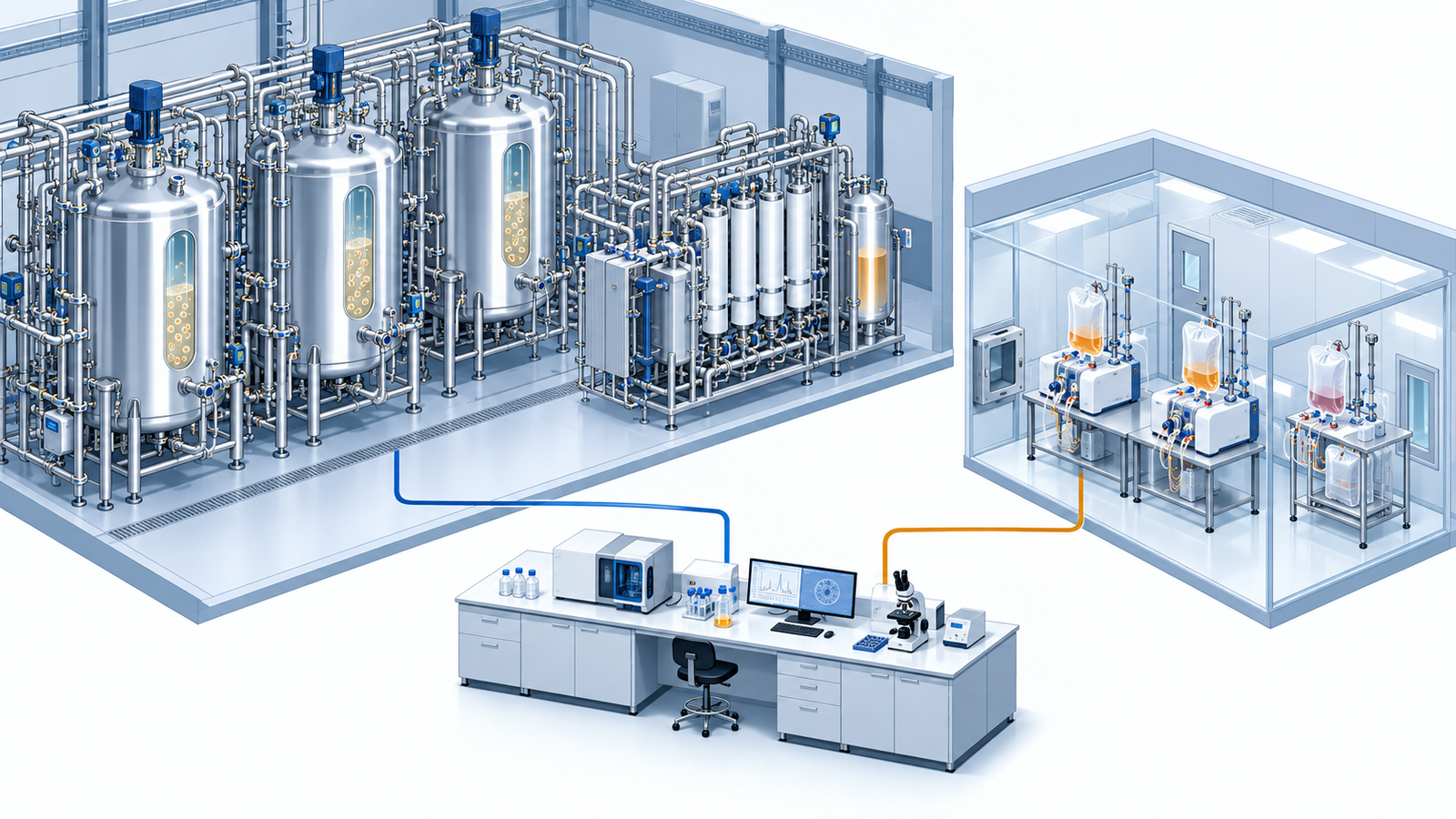
Lonza is a CDMO (contract development and manufacturing organisation): pharmaceutical and biotech companies pay it to develop and make their medicines. Its connection to cell culture runs along two lines. One is contract manufacturing of antibodies and other biologics grown in large volumes of animal cells; the other is contract manufacturing of cell and gene therapies, in which the cells themselves are the medicine. In 2024 it bought Roche's large plant in Vacaville in the U.S. (bioreactor capacity of about 330,000 L), and in March 2026 it agreed to sell its capsules and health ingredients business (CHI), after which it describes itself as a "pure-play CDMO". This profile keeps the company-wide figures brief and concentrates on what Lonza is putting into cell culture, who it works with and what it is aiming for, using only the annual report, half-year report and press releases Lonza has published.
- Lonza in 30 seconds, and where it stands in cell culture
- The logo and how the name is written
- Where the company sits in the cell culture landscape
- Scale (focusing on the businesses tied to cell culture)
- Resources committed to cell culture
- What it has done so far
- What comes next
- What the company is aiming for in cell culture
- Map of cell culture partnerships
- Technologies, products and services
- The risks this company carries
- Glossary, references and claim-to-source audit
1. Lonza in 30 seconds, and where it stands in cell culture
LONNSecondary listing on the Singapore Exchange (O6Z)
Media & reagents (secondary)Not a developer of cell therapies itself
about 330,000 LAcquired from Roche in October 2024
productsA sixth approval announced for H1 2026
Companies involved in cell culture fall into three broad types: contract development and manufacturing organisations (CDMOs), suppliers of equipment, consumables and media, and developers of cell and regenerative therapies. Lonza is primarily a CDMO, with a secondary Bioscience business that sells culture media, primary cells and transfection instruments Sourced. What sets it apart is that it takes on contract work in both senses of "cell culture": (1) growing animal cells to make antibodies and other proteins, and (2) cell therapy, where the cells themselves are the product. Most of the revenue, however, comes from the antibody side (Integrated Biologics); Specialized Modalities, which includes cell therapy, accounts for about 16% of revenue from continuing operations Our calculation. Read Lonza as "a cell therapy company" and you will get its scale wrong.
2. The logo and how the name is written

The Lonza logo is a trademark of the company. We have not recreated it with generated imagery;
the logo image (SVG) embedded in the official website is placed here as img/lonza_logo.svg.
A note on names: the listed holding company is Lonza Group Ltd. Japanese-language coverage writes the name phonetically in katakana; this series uses the Latin-alphabet name throughout. The Capsules & Health Ingredients (CHI) business, which Lonza agreed to sell in March 2026, is reported separately as a discontinued operation, so unless stated otherwise the revenue and profit figures in this article are for continuing operations (the CDMO business), excluding CHI.
Official site: https://www.lonza.com/3. Where the company sits in the cell culture landscape
Since April 2025 Lonza's continuing operations have been organised into the following three business platforms Sourced. Two of them are directly tied to cell culture: Integrated Biologics, which handles antibody production in animal cells, and Specialized Modalities, which includes cell and gene therapy and Bioscience. Advanced Synthesis covers the chemistry side of small molecules and antibody-drug conjugates (ADCs) and has little direct connection with cell culture.
| Business platform | What it contains (per the annual report) | Link to cell culture |
|---|---|---|
| Integrated Biologics | Mammalian (drug substance made in animal cells) and Drug Product (formulation and fill) | (1) Contract animal cell culture for antibodies and similar molecules. The core of revenue |
| Specialized Modalities | Cell & Gene, Microbial, mRNA and Bioscience | (2) Contract manufacturing of cell and gene therapies, and sales of media, primary cells and transfection instruments |
| Advanced Synthesis | Small Molecules and Bioconjugates (ADCs and others) | Mainly chemical synthesis. No direct link to cell culture |
4. Scale (focusing on the businesses tied to cell culture)
The company-wide figures are shown only briefly. All amounts are in Swiss francs (CHF) and cover continuing operations, excluding CHI Sourced.
| Measure (CHF million) | Year to Dec 2024 | Year to Dec 2025 | H1 2026 |
|---|---|---|---|
| Revenue | 5,480 | 6,531 | 3,374 |
| CORE EBITDA | 1,653 | 2,064 | 1,175 |
| CORE EBITDA margin | 30.2% | 31.6% | 34.8% |
| Employees (full-time equivalents) | 15,734 (average) | 16,866 (average) | 20,141 (end of June, incl. CHI) |
The 2024 figures are restated with CHI reclassified as a discontinued operation. CORE EBITDA is Lonza's own adjusted measure.
The two business platforms tied to cell culture are sized as follows Sourced.
| Year to Dec 2025 (CHF million) | Integrated Biologics | Specialized Modalities | (For reference) Advanced Synthesis |
|---|---|---|---|
| External revenue | 3,649 | 1,034 | 1,611 |
| Revenue growth at constant exchange rates | +32.2% | −3.0% | - |
| CORE EBITDA (margin) | 1,287 (35.3%) | 176 (17.0%) | 674 (41.8%) |
| Additions to property, plant and equipment | 451 | 358 | 305 |
| R&D expense (included in CORE EBITDA) | 111 | 41 | 13 |
| H1 2026 (CHF million) | Integrated Biologics | Specialized Modalities |
|---|---|---|
| Revenue | 1,870 | 553 |
| Revenue growth at constant exchange rates | +10.0% | +22.6% |
| CORE EBITDA margin | 36.0% | 28.0% |
| Capital expenditure (CapEx) | 231 | 94 |
Revenue for cell and gene therapy (Cell & Gene) on its own is not disclosed Not yet confirmed. Specialized Modalities also includes Microbial, mRNA and Bioscience, so its CHF 1,034 million cannot be read as "cell therapy revenue". Likewise, Integrated Biologics' CHF 3,649 million includes formulation and fill (Drug Product), and revenue from animal cell culture alone is not published. This article makes no estimate.
The annual report also quotes market growth forecasts sourced from research firms such as Evaluate Pharma, Frost & Sullivan and Citeline; because these are research-firm estimates, this article does not use them.
5. Resources committed to cell culture
As in every profile in this series, we check four kinds of resource (people, money, external investments and acquisitions, and ties with universities and research institutes) and show whether each could be confirmed from primary sources.
| Type of resource | What could be confirmed | Status |
|---|---|---|
| People (sites) | Cell and gene therapy manufacturing sites: Portsmouth (U.S.), Houston (U.S.), Geleen (Netherlands) and Tuas (Singapore). In Tokyo, a facility owned and operated by Nikon Cell innovation Co. Ltd. (under a Nikon-Lonza partnership). Drug substance from animal cells: Visp (Switzerland), Vacaville and Portsmouth (U.S.), Slough (UK), Tuas and Porriño (Spain). Media are made in Verviers (Belgium) and primary cells in Durham (U.S.) | Confirmed |
| People (headcount) | 20,141 company-wide (end of June 2026, incl. CHI, full-time equivalents). More than 750 people transferred with the Vacaville acquisition. Headcount for the cell culture businesses specifically is | Not disclosed |
| Money (capital expenditure) | 2025 CapEx of CHF 1.3 billion company-wide (18% of revenue). Additions to property, plant and equipment of CHF 451 million in Integrated Biologics and CHF 358 million in Specialized Modalities. About CHF 500 million of further investment planned at Vacaville | Confirmed |
| Money (R&D) | CHF 169 million company-wide (2024: 218 million), of which Specialized Modalities CHF 41 million (2024: 82 million) and Integrated Biologics CHF 111 million (2024: 99 million). The amount for cell therapy alone is | Not disclosed |
| External investments and acquisitions | Acquisition of the Vacaville plant from Roche (October 2024; cash consideration US$1,269 million). Acquisition of Redberry (rapid microbial testing) in 2025. In the other direction, an agreement to sell the Personalized Medicines business, including the automated cell therapy manufacturing platform Cocoon, to Octane Medical Group (announced March 2026) | Confirmed |
| Start-up investments | No investment in cell culture start-ups is mentioned in the annual or half-year report | Not confirmed |
| University and research ties | No joint research with universities or research institutes in cell culture appears in the primary sources consulted (participation in the CMAC research centre is mentioned, but that concerns small molecules and formulation) | Not confirmed |
R&D of CHF 169 million against revenue of CHF 6.5 billion is about 2.6% Our calculation, which looks tiny by pharmaceutical standards. That is simply the nature of a CDMO: the customer pays for the research on the drug itself, while Lonza invests in processes and plant. Indeed, capital expenditure in the same year was CHF 1.3 billion, about 7.7 times R&D Our calculation. A note in the annual report also explains that part of R&D spending sits in the cost of sales of R&D services, so the true figure is larger than the amount shown in the income statement (CHF 112 million) Sourced.
6. What it has done so far
| When | What happened | Why it matters |
|---|---|---|
| 2013 | Collaboration with Genetix Biotherapeutics begins (a March 2026 release refers to a collaboration "established in 2013"). ZYNTEGLO later received commercial approval in 2022 | Built a track record in commercial cell and gene therapy manufacturing |
| March 2024 | Agreement to acquire Roche's large biologics plant in Vacaville (U.S.) (US$1.2 billion) | Secured about 330,000 L of animal cell culture capacity on the U.S. West Coast |
| October 2024 | Vacaville acquisition completed; more than 750 employees transferred | Plan to keep making Roche's existing products while moving to other customers |
| December 2024 | New "One Lonza" strategy announced | A declared focus on the CDMO business |
| April 2025 | Move to a structure of three business platforms | Three pillars: antibodies, chemical synthesis and new modalities |
| 2025 | Amended agreement with Mesoblast to support scale-up of commercial manufacturing of Ryoncil, a mesenchymal stromal cell (MSC) therapy. Nine new cell and gene therapy customers and two commercial manufacturing programmes added | Every Cell & Gene site now holds a manufacturing contract for an approved commercial product |
| 2025 | First GMP run in a 20,000 L vessel at Visp (Switzerland). A 2,000 L vessel at Portsmouth produced process performance qualification (PPQ) batches | Expansion of large-scale animal cell culture capacity |
| July 2025 | Launch of the "4D-Nucleofector LV Unit PRO", an electroporation system for delivering genes into large numbers of T cells | A tool for CAR-T and other cell therapies (Bioscience) |
| October 2025 | Launch of "TheraPEAK AmpliCell Cytokines", GMP-grade cytokines for cell and gene therapy, and "TheraPEAK 293-GT Medium" for AAV production. Agreement to acquire Redberry | A broader range of media and quality testing |
| March 2026 | Agreement to sell CHI to Lone Star Funds (enterprise value CHF 2.3 billion). Agreements to sell the Personalized Medicines business, including Cocoon, to Octane Medical Group, and to sell the MODA software | Lonza says this completes its transformation into a pure-play CDMO. Exit from devices for decentralised cell therapy manufacturing |
| March 2026 | Commercial manufacturing agreement with Genetix extended, with ZYNTEGLO capacity expanded at the Houston site | Continued commercial manufacture of gene-modified cell therapy |
| H1 2026 | Large-scale animal cell culture assets at Visp enter commercial operation. A sixth commercial therapy approved in Cell & Gene | Announced in the Half-Year Report 2026 |
| July 2026 | Expanded strategic collaboration with a leading U.S. biopharmaceutical company (name not disclosed), with manufacturing across all of Lonza's commercial-scale biologics sites in the U.S. | More large-scale antibody contract work |
7. What comes next
at constant FXGuidance maintained in July 2026
as % of revenueThe medium-term "CDMO Organic Growth Model"
The following specific plans related to cell culture have been announced Sourced.
- Vacaville: the first phase of investment began in 2025, and over the next two to three years automation and multi-product capability will be strengthened. The site is moving towards being a contract plant serving several customers, and Lonza expects to sign new contracts in 2026 as well.
- Portsmouth: an expansion adding two 2,000 L vessels and a purification area began in early 2025.
- Growth projects: the Half-Year Report 2026 says growth projects are progressing in Mammalian (including preparing Vacaville for contract work), Drug Product, Bioconjugates and Cell & Gene.
- Capital Markets Day: scheduled for 13 to 14 October 2026 in Vacaville.
None of the following appears in the primary sources consulted Not yet confirmed.
A revenue target for cell and gene therapy alone; the amount of capital expenditure on cell therapy; the names of new customers at Vacaville; the name of the leading U.S. biopharmaceutical company whose collaboration was expanded in July 2026; and the sale price of the Cocoon business. Company names and amounts that appear in press coverage are not used in this article.
8. What the company is aiming for in cell culture
This section goes beyond what the company says directly. It sets out inferences that can be drawn from primary sources, each with its basis.
| What can be read | Primary evidence behind it | Category |
|---|---|---|
| The centre of gravity of the cell culture business is large-scale animal cell culture for antibodies; cell therapy is an option for growth | 2025 external revenue of CHF 3,649 million in Integrated Biologics against CHF 1,034 million in Specialized Modalities. The big investments (the Vacaville acquisition, 20,000 L at Visp, the Portsmouth expansion) are concentrated on the antibody side | Inference |
| In cell therapy, Lonza has narrowed its focus to making therapies under contract rather than selling equipment | It is selling the business that includes the automated manufacturing platform Cocoon (more than 150 units installed), while its Cell & Gene CDMO keeps adding customers and commercial products | Inference |
| Media and reagents are kept where they complement contract manufacturing | CHI and MODA were sold, but Bioscience (media, primary cells, Nucleofector) remains within Specialized Modalities and launched new products in 2025 | Inference |
| Vacaville is being turned from a single-customer plant into a multi-product contract plant | At the time of the acquisition Lonza explained that volumes supplied to Roche would decline over the medium term, with the site moving to other customers. Vacaville revenue in 2026 is expected to be flat on the previous year | Sourced |
| Lonza is also reaching into allogeneic (donor-derived) cell therapies and exosomes | The annual report lists iPS cells, MSCs, NK cells and exosomes within its scope, and Lonza makes Mesoblast's MSC therapy and exosomes for Exogenus and RION | Inference |
Cocoon is a closed, automated culture system designed for decentralised manufacture close to the hospital of autologous cell therapies, which are made from a patient's own cells. The annual report says that "to date, we have worked with more than 30 customers and installed more than 150 Cocoon® instruments" Sourced. It was, in other words, a proven product, yet Lonza agreed to sell the business that contains it to Octane Medical Group. Over the same period it has been adding contract work carried out centrally in its own plants, such as expanded ZYNTEGLO manufacture in Houston (Genetix) and scaled-up commercial manufacture of Mesoblast's Ryoncil. This article reads that as a choice to pursue cell therapy as a centralised contract manufacturer rather than as a maker of equipment for decentralised production Not yet confirmed. The company itself presents the sale only as part of its "strategic portfolio transformation to a pure-play CDMO" and gives no reason specific to Cocoon.
9. Map of cell culture partnerships
10. Technologies, products and services
| Category | What it covers (per the annual report) | Type of cell culture |
|---|---|---|
| Drug substance from animal cells | Contract manufacture of antibodies, bispecific antibodies, fusion proteins and similar molecules in bioreactors at 1,000 L, 2,000 L, 12,000 L, 20,000 L and 25,000 L scale | (1) Biologics |
| Licensing the GS expression system | Lonza licenses its own "GS®" mammalian gene expression system to other companies. It has more than 400 licensees, and more than 100 approved medicines contain its licensed technology | (1) Biologics |
| Contract cell and gene therapy | Autologous CAR-T, TIL, haematopoietic stem cells, TCR, regulatory T-cell gene therapy, allogeneic cells such as iPS cells, MSCs and NK cells, exosomes, and AAV and lentiviral vectors | (2) Cell therapy |
| Media and reagents (Bioscience) | Cell culture media (Verviers, Belgium), human and animal primary cells (Durham, U.S.), and the TheraPEAK range of media and cytokines | Both (1) and (2) |
| Transfection instruments (Bioscience) | The Nucleofector electroporation system. The LV Unit PRO launched in 2025 uses a cartridge that can transfect up to one billion cells in a single run | (2) Cell therapy |
| Quality testing (Bioscience) | Endotoxin testing and rapid microbial testing (Redberry's technology cuts sterility and bioburden testing from 14 days to 4) | Both (1) and (2) |
In gene-modified cell therapies such as CAR-T, one way to get genes or genome-editing components into cells without a viral vector is electroporation: an electrical pulse briefly opens pores in the cell membrane. Laboratory instruments typically handle cells in the millions, so processing a clinical quantity used to mean splitting it into many runs. Lonza says the cartridge it launched in 2025 can process up to one billion cells in a single run Sourced. From the materials side, what matters here is the uniformity of the electrodes and the cartridge's plastic parts. The larger the volume processed, the more directly any unevenness in the electric field turns into variation in cell viability, so the cartridge's dimensional accuracy and the condition of the electrode surfaces become the components that decide performance Not yet confirmed (this is a general observation; Lonza has not disclosed the cartridge's materials or construction).
11. The risks this company carries
| Risk | Substance | Category |
|---|---|---|
| Customer concentration | In 2025 the largest customer accounted for 11.7% of revenue and the second for 10.8%; the third to fifth accounted for 7.6%, 5.3% and 4.9%. The top five together come to about 40.3% | Our calculation |
| Weakness in cell and gene therapy | Specialized Modalities revenue fell 3.0% at constant exchange rates in 2025, and the company described Cell & Gene performance as soft. It recovered in H1 2026 | Sourced |
| Filling Vacaville | Under the contract, supply to Roche declines over the medium term. Profitability depends on whether other customers' products fill the capacity. Vacaville revenue in 2026 is expected to be flat on the previous year | Sourced |
| Conditions for completing the sale | Completion of the CHI sale depends on regulatory approvals and the legal separation of CHI. Completion is expected by the end of 2026 | Sourced |
| Currency | A currency headwind of roughly 2 to 3% on 2026 revenue is expected (mainly from a weaker U.S. dollar) | Sourced |
| Tariffs and geopolitics | The annual report lists changing trade conditions, including tariffs, as a management consideration (and says they had no material effect on 2025 results) | Sourced |
| A shift in how cell therapies are made | The annual report itself notes growing investment in in vivo CAR-T, in which CAR-T cells are generated inside the body. If this spreads, the demand for contract work that grows cells outside the body could change shape | Inference |
12. Glossary
- CDMO
- Contract Development and Manufacturing Organization. A company that develops and manufactures medicines under contract. See our explainer on CDMOs for more.
- Mammalian cell culture
- A manufacturing method in which mammalian cells are grown in tanks and the antibodies or other proteins they secrete are recovered.
- Bioreactor
- A tank in which cells are grown, with temperature, pH and oxygen under control. See our explainer on bioreactors.
- GS expression system
- A gene expression system that uses glutamine synthetase (GS) as a marker to select cells that produce large amounts of the target protein. Lonza licenses it to other companies.
- CAR-T cells
- A cell therapy in which a patient's T cells are given the gene for a receptor that recognises cancer and then returned to the patient. See our explainer on CAR-T cells.
- MSC
- Mesenchymal stromal cell. A cell obtained from bone marrow and other tissues that modulates the immune system. Used in allogeneic therapies, which use cells from another person.
- Exosome
- A small membrane-bound particle released by cells, carrying proteins and nucleic acids. Exosomes are being developed as therapeutics.
- Electroporation
- A method that uses an electrical pulse to open temporary pores in the cell membrane so that genes or other material can enter the cell.
- PPQ
- Process performance qualification. The step in which actual production runs show that a defined manufacturing process consistently yields product meeting its quality standards.
- CORE EBITDA
- Lonza's own adjusted profit measure: EBITDA excluding items such as restructuring and acquisition-related costs.
13. References
- Lonza Group Ltd Annual Report 2025 (published 1 April 2026). Business platform structure, site map, facilities at Vacaville, Visp and Portsmouth, Cell & Gene scope and 2025 achievements, Cocoon, new Bioscience products, Redberry, revenue, CORE EBITDA, R&D and additions to property, plant and equipment by business, the note on R&D expense, average headcount, revenue share of major customers, accounting for the Vacaville acquisition, and listing information. https://www.lonza.com/annualreport/2025/documents/LONZA_AR_2025_SCREEN_FULL.pdf
- Lonza Group Ltd Half-Year Report 2026 (published 22 July 2026, unaudited). H1 2026 revenue, CORE EBITDA, capital expenditure, figures by business and headcount; the sixth commercial therapy approved in Cell & Gene; completion of the sale of Cocoon and related businesses; head office address. https://www.lonza.com/-/media/39523D97F3B24D6C9664FB75A9555D00
- Lonza Group Ltd Press release "Half-Year 2026 results" (22 July 2026). Upgraded 2026 outlook, expected completion of the CHI sale and the share buyback, growth projects, commercial operation at Visp, and currency outlook. https://www.lonza.com/news/2026-07-22-06-30
- Lonza Group Ltd Press release "Lonza Completes its Transformation to a Pure-Play CDMO with Agreement to Divest Capsules & Health Ingredients" (6 March 2026). Terms of the CHI sale, the sale of the Personalized Medicines business including Cocoon to Octane Medical Group, the sale of MODA, and the CDMO Organic Growth Model. https://www.lonza.com/news/2026-03-06-18-05
- Lonza Group Ltd Press release "Lonza Signs Agreement to Acquire Large-Scale Biologics Site in Vacaville (US) from Roche" (20 March 2024). Purchase price of US$1.2 billion, about 330,000 L, planned further investment of about CHF 500 million, and supply to Roche. https://www.lonza.com/news/2024-03-20-07-00
- Lonza Group Ltd Press release "Lonza Completes Acquisition of Large-Scale Biologics Site in Vacaville (US) from Roche" (1 October 2024). Completion of the acquisition and transfer of more than 750 employees. https://www.lonza.com/news/2024-10-01-16-45
- Lonza Group Ltd Press release "Lonza and Genetix Biotherapeutics Extend Commercial Manufacturing Agreement" (9 March 2026). Commercial manufacture of ZYNTEGLO in Houston and the collaboration dating from 2013. https://www.lonza.com/news/2026-03-09-14-00
- Lonza Group Ltd Press release "Lonza Expands Strategic Collaboration with Leading US Biopharmaceutical Company" (1 July 2026). Expanded collaboration with an unnamed leading U.S. company. https://www.lonza.com/news/2026-07-01-07-00
- Lonza Group Ltd Official website (source of the logo image). https://www.lonza.com/
14. Claim-to-source audit
| Claim in the article | Category | Source |
|---|---|---|
| Legal name, SIX listing (LONN) and SGX secondary listing (O6Z) | Sourced | Reference 1 https://www.lonza.com/annualreport/2025/documents/LONZA_AR_2025_SCREEN_FULL.pdf |
| Head office address (Basel, Muenchensteinerstrasse 38) | Sourced | Reference 2 https://www.lonza.com/-/media/39523D97F3B24D6C9664FB75A9555D00 |
| 2024 and 2025 revenue, CORE EBITDA, margin and average headcount | Sourced | Reference 1 https://www.lonza.com/annualreport/2025/documents/LONZA_AR_2025_SCREEN_FULL.pdf |
| H1 2026 revenue, CORE EBITDA, figures by business, capital expenditure and 20,141 employees | Sourced | Reference 2 https://www.lonza.com/-/media/39523D97F3B24D6C9664FB75A9555D00 |
| 2025 revenue, CORE EBITDA, additions to property, plant and equipment, and R&D by business | Sourced | Reference 1 https://www.lonza.com/annualreport/2025/documents/LONZA_AR_2025_SCREEN_FULL.pdf |
| The note that part of the CHF 169 million R&D spending is included in cost of sales | Sourced | Reference 1 https://www.lonza.com/annualreport/2025/documents/LONZA_AR_2025_SCREEN_FULL.pdf |
| Specialized Modalities is about 16% of revenue from continuing operations (1,034 / 6,531) | Our calculation | Calculated in this article from the figures in reference 1 |
| R&D is about 2.6% of revenue, and capital expenditure about 7.7 times R&D | Our calculation | Calculated in this article from the figures in reference 1 (CHF 169 million, CHF 6,531 million and CHF 1.3 billion) |
| Structure of the three business platforms and the move to it in April 2025 | Sourced | Reference 1 https://www.lonza.com/annualreport/2025/documents/LONZA_AR_2025_SCREEN_FULL.pdf |
| List of cell and gene therapy and animal cell culture sites; the Tokyo facility owned and operated by Nikon Cell innovation | Sourced | Reference 1 https://www.lonza.com/annualreport/2025/documents/LONZA_AR_2025_SCREEN_FULL.pdf |
| Vacaville acquisition (US$1.2 billion, about 330,000 L, about CHF 500 million of further investment planned, supply to Roche declining over the medium term) | Sourced | Reference 5 https://www.lonza.com/news/2024-03-20-07-00 |
| Completion of the Vacaville acquisition (1 October 2024) and transfer of more than 750 employees | Sourced | Reference 6 https://www.lonza.com/news/2024-10-01-16-45 |
| Consideration for the Vacaville acquisition (cash portion US$1,269 million) | Sourced | Reference 1 https://www.lonza.com/annualreport/2025/documents/LONZA_AR_2025_SCREEN_FULL.pdf |
| Amended agreement with Mesoblast (Ryoncil), nine new customers and two commercial programmes added | Sourced | Reference 1 https://www.lonza.com/annualreport/2025/documents/LONZA_AR_2025_SCREEN_FULL.pdf |
| Exosome work with Exogenus and RION | Sourced | Reference 1 https://www.lonza.com/annualreport/2025/documents/LONZA_AR_2025_SCREEN_FULL.pdf |
| Nucleofector LV Unit PRO (up to one billion cells), new TheraPEAK products and the Redberry acquisition | Sourced | Reference 1 https://www.lonza.com/annualreport/2025/documents/LONZA_AR_2025_SCREEN_FULL.pdf |
| Outline of Cocoon (collaboration with more than 30 companies, more than 150 units installed) | Sourced | Reference 1 https://www.lonza.com/annualreport/2025/documents/LONZA_AR_2025_SCREEN_FULL.pdf |
| Sale of CHI to Lone Star Funds, sale of Cocoon to Octane Medical Group, sale of MODA | Sourced | Reference 4 https://www.lonza.com/news/2026-03-06-18-05 |
| Extension of the ZYNTEGLO manufacturing agreement with Genetix (Houston) | Sourced | Reference 7 https://www.lonza.com/news/2026-03-09-14-00 |
| Expanded collaboration with a leading U.S. biopharmaceutical company (name not disclosed) | Sourced | Reference 8 https://www.lonza.com/news/2026-07-01-07-00 |
| 2026 outlook (revenue +11 to 12%, margin 33 to 34%), expected completion of the CHI sale within the year, CHF 500 million buyback, currency headwind | Not yet confirmed | Reference 3. Company guidance, not actual results https://www.lonza.com/news/2026-07-22-06-30 |
| Further investment at Vacaville over the next two to three years, the Portsmouth expansion, Capital Markets Day (October 2026) | Not yet confirmed | References 1 and 2. Company plans https://www.lonza.com/annualreport/2025/documents/LONZA_AR_2025_SCREEN_FULL.pdf |
| Revenue share of major customers, and about 40.3% for the top five | Our calculation | This article's sum of the individual percentages in reference 1 https://www.lonza.com/annualreport/2025/documents/LONZA_AR_2025_SCREEN_FULL.pdf |
| Cell & Gene revenue on its own, capital expenditure on cell therapy, headcount in cell culture, and the Cocoon sale price | Not yet confirmed | None is disclosed, and this article makes no estimate |
| Market growth forecasts (sourced from research firms) | Not yet confirmed | Given in reference 1, but not used in this article because they are research-firm estimates |
| Start-up investments and joint research with universities in cell culture | Not yet confirmed | Not in references 1 or 2. This article does not conclude that none exists https://www.lonza.com/annualreport/2025/documents/LONZA_AR_2025_SCREEN_FULL.pdf |
| The three types (CDMO; tools, consumables and media; cell and regenerative therapy) | Our calculation | Our own classification. Companies shown are examples from the 20 in this series |
| The reading that the focus is large-scale antibody culture, with cell therapy as an option for growth | Inference | This article's interpretation of revenue and capital expenditure by business |
| The reading that in cell therapy Lonza has narrowed its focus to contract manufacturing rather than equipment sales | Inference | This article's interpretation of the Cocoon sale and the growth of Cell & Gene contract work |
| The reading that media and reagents are kept where they complement contract manufacturing | Inference | This article's interpretation of the CHI and MODA sales and the retention of Bioscience |
| The reading that Lonza is reaching into allogeneic cells and exosomes | Inference | This article's interpretation of the scope and partners listed in reference 1 |
| The risk that the spread of in vivo CAR-T could reshape demand for contract work | Inference | This article's interpretation of the market commentary in reference 1 |
| The view that the precision of electroporation cartridge parts decides performance | Not yet confirmed | A general explanation by this article, not based on Lonza's disclosures |
Last updated 24 September 2026 / Troy Technical
Every figure in this article comes from the annual report, half-year report and press releases published by Lonza Group Ltd. No research-firm estimates or press-based figures have been used. Passages marked "Inference" are this article's interpretation of primary sources, not statements made by the company.