TECHNOLOGY EXPLAINER
Biosimilars
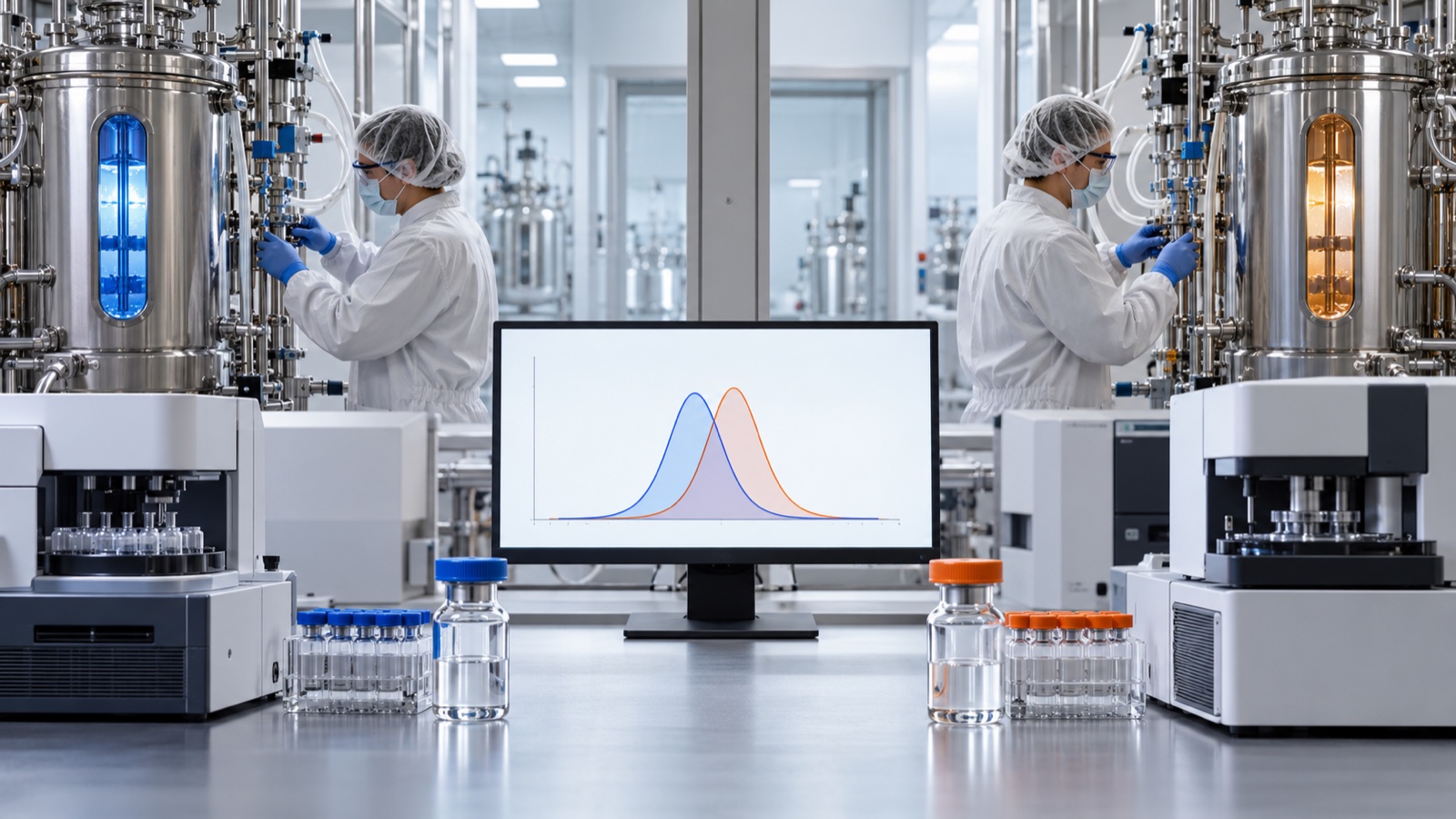
— an "identical" copy cannot be made, so the job is to show that the distributions overlap
A generic version of a chemically synthesized drug is the same compound as the original. A biosimilar is not. A protein made by cells is, by nature, a mixture of molecules that differ in glycans and other features. And recently the main way of showing similarity has been moving from clinical trials to analysis.
 AI-generated concept
- What a biosimilar is (the short version)
- How it differs from a generic — "highly similar", not "identical"
- How similarity is shown — the "totality of the evidence", from analysis to clinical studies
- What is compared in the analysis
- A materials engineer's view 1: the "reference product" itself is a moving target
- What makes manufacturing hard — host cells, glycans, impurities, formulation
- Regulatory differences — FDA, EMA, PMDA
- What interchangeability means
- From clinical trials to analysis — rethinking comparative efficacy studies
- A materials engineer's view 2: when analytical methods become the "star of the review"
- Open issues, and what is not yet settled
- Glossary / References / Claim-to-source audit
Sourced = stated in published material (link given)
Our calculation = a figure this article derived from stated assumptions
Not yet confirmed = a plan or target whose results have not been confirmed
Structural arrangements and readings on materials and process design are marked separately as commentary.
This article explains the quality evaluation, manufacture and regulation of biosimilars from the viewpoint of materials and analysis. It does not evaluate the efficacy or safety of any particular product, nor does it compare a reference product with a biosimilar, or biosimilars with each other, to rank them. It is not medical advice and does not encourage switching any medicine. Always consult a physician or pharmacist about choosing or changing a treatment.
1. What a biosimilar is (the short version)
- What it is: the MHLW guideline defines a biosimilar (in Japanese, a "bio-kōkōhin", or follow-on biologic) as a medicine developed by a different marketing authorization holder as having quality, safety and efficacy equivalent or comparable to those of a biotechnology-derived medicine already approved in Japan as a new active ingredient (the "reference biologic")Sourced
- The U.S. definition: U.S. law defines a biosimilar as a product that is "highly similar to the reference product notwithstanding minor differences in clinically inactive components" and for which there are "no clinically meaningful differences ... in terms of the safety, purity, and potency" from the reference productSourced
- Why it is not called "identical": the EMA explains that biosimilars are not regarded as generics of biological medicines because the natural variability of biological medicines and their more complex manufacturing do not allow exact replication of the molecule's micro-heterogeneitySourced
Developing a biosimilar is not a job of "making the same molecule" but of "making the same distribution". What is more, the reference product it is compared with is itself a distribution that shifts a little with every manufacturing change. ICH Q5E says that showing comparability before and after a manufacturing change does not necessarily mean that the quality attributes are identical, but that the products are highly similarSourced. A biosimilar is the challenge of achieving this "highly similar" state by a different company, with a different cell line and a different process (commentary in this article).
2. How it differs from a generic — "highly similar", not "identical"
The MHLW guideline says the following about biological medicines. Because they use the biosynthetic processes of living organisms in manufacture, there is inherently a possibility that molecules with a heterogeneous structure are produced. It is therefore difficult to demonstrate that the active ingredients of the reference biologic and the biosimilar are identical, and the approach used for generics of chemically synthesized drugs, which have the same structure as the originator, cannot be appliedSourced.
ICH Q6B likewise says that, because of the biosynthetic processes organisms use, proteins inherently show some degree of structural heterogeneity, and that the desired product may be a mixture of expected post-translational modifications (for example, glycoforms)Sourced. In an IgG antibody, for example, an N-linked glycan is attached at position 297 of each heavy chain, and those glycans differ in how fucose, galactose, sialic acid and so on are attachedSourced.
3. How similarity is shown — the "totality of the evidence", from analysis to clinical studies
U.S. law asks for the following data in a biosimilar applicationSourced.
- Analytical studies: showing that the product is highly similar to the reference product notwithstanding minor differences in clinically inactive components
- Assessment of toxicity: may rely on, or consist of, analytical studies or clinical studies (a 2022 amendment replaced the earlier wording "animal studies")
- Clinical studies: including an assessment of immunogenicity and of pharmacokinetics or pharmacodynamics, sufficient to demonstrate safety, purity and potency in one or more appropriate conditions of use
It is also a requirement that the product use the same mechanism of action as the reference product (to the extent the mechanism is known)Sourced. The FDA's draft guidance of October 2025 says that whether the analytical, pharmacokinetic and immunogenicity data are sufficient is assessed on the basis of the totality of the evidence submitted in the biologics license applicationSourced.
4. What is compared in the analysis
The MHLW guideline sets out the content of the comparative quality studies as followsSourced.
| What is compared | What the guideline says (summary) |
|---|---|
| Structure and physicochemical properties | Amino-acid sequence, disulfide bonds, glycan structure, other post-translational modifications, subunit structure and so on. If there is a difference in primary structure, the product is not judged to be a biosimilar. Where heterogeneity arising from post-translational modifications, such as N-terminal and C-terminal processing, differs, it must be assured that clinical efficacy and safety are not affected. Secondary and tertiary structure are also compared |
| Biological properties | Bioactivity is compared, wherever possible, by multiple methods. For an antibody, in addition to antigen-binding activity, it is necessary to compare neutralizing activity, binding to the Fcγ receptors, the neonatal Fc receptor and complement C1q, and ADCC (antibody-dependent cellular cytotoxicity) and CDC (complement-dependent cytotoxicity) activity |
| Impurities | The kinds and amounts of product-related impurities (fragments, aggregates and so on) are compared. Aggregates are suggested to be linked to immunogenicity and can be of various sizes and shapes, so it is useful to compare them by several analytical methods based on different principles |
| Process-related impurities | Because they differ with the process, comparison is not always necessary. However, if proteins that differ between the two products are compared by the same assay, as in the ELISA for host-cell proteins, the difference in the assay's specificity may mean the result does not reflect the actual difference in residual amounts |
| Quality attributes related to immunogenicity | Post-translational modification structures, product-related impurities, process-related impurities and so on can cause differences in immunogenicity. Because evaluation in nonclinical studies is difficult, clarifying differences through the quality comparison is also useful for planning the clinical studies |
All Sourced (MHLW, "Guidelines for Ensuring Quality, Safety and Efficacy of Biosimilar Products" (in Japanese), 4 February 2020 [Ref. 11]). The guideline states that, in principle, material manufactured by the process for the commercial product is used for comparison, and that the degree of similarity is clarified by comparing multiple lots of drug substance or drug productSourced.
Each of the two heavy chains of an IgG carries one N-linked glycan at position 297Sourced. Assumption: suppose 5 glycan types are possible at each site, and the two heavy chains are not distinguished (swapping left and right gives the same molecule) (our assumption)Our calculation.
- Same type on both: 5 ways; different types: 5 × 4 ÷ 2 = 10 ways → 15 ways in total
- With 10 types: 10 + 45 = 55 ways
Assumptions and limits: the number of types is an assumption for illustration and does not show the actual glycan species or their abundance. Multiplying in differences in other modifications, such as at the C-terminus, would increase the combinations further. This calculation shows, in orders of magnitude, that "one antibody product" is in fact a mixture of many molecular species.
5. A materials engineer's view 1: the "reference product" itself is a moving target
What is easily overlooked in biosimilar development is that the thing being compared with (the reference product) is not constant either. ICH Q5E is a guideline for the case in which the same manufacturer (including a contract manufacturer) changes its own process, and it sets out how to compare the product before and after the change directly and show comparabilitySourced. In other words, the maker of the reference product itself also changes its process and keeps supplying product while showing "highly similar" each time.
In 2011, Schiestl et al. analyzed the quality profiles of Aranesp (darbepoetin alfa), Rituxan/MabThera (rituximab) and Enbrel (etanercept) obtained from the market in 2007–2010, compared batches before and after manufacturing changes, and presented examples of "acceptable variation in quality attributes" in products that kept being sold with no change in labellingSourced.
The MHLW guideline also assumes this situation. It states that in identifying critical quality attributes (CQAs) and setting their acceptable ranges, the results of lot analysis of the reference biologic are important information, and it asks for evaluation in accordance with ICH Q5E when a company changes its own processSourced.
In a materials engineer's terms, this is the work of "buying many commercial lots of a competitor's product and deciding the window of your own specification from the width of their distribution" (commentary in this article). If the other side's distribution moves over time, which lots are taken as the baseline changes the window to aim at. Quality design for a biosimilar can be read as a design that chases a moving distribution, not a fixed target value (commentary in this article).
Show the original schematic with sources and numbers
Original schematic for Fig. 3 (concept diagram, vector drawing). That quality attributes can vary before and after a manufacturing change of the reference product, and that there are examples in which such variation was accepted with no change in labelling, come from Schiestl et al. (2011) [Ref. 16]; the approach to evaluating comparability at a process change from ICH Q5E [Ref. 14]; and the importance of the reference product's lot-analysis results for setting acceptable ranges from the MHLW guideline [Ref. 11]. The points, band and direction of change are all schematic and do not show measured values for any particular product or quality attribute.
6. What makes manufacturing hard — host cells, glycans, impurities, formulation
A biosimilar maker can use neither the reference maker's cell line nor its process conditions. The MHLW guideline says that the manufacturer must carry out its own process development, characterization of quality attributes and formulation design, and build a control strategy that allows consistent manufacture across the whole product life cycleSourced.
| Issue | What the guideline says | What it means from the materials and process side (commentary in this article) |
|---|---|---|
| Host cell | The host cell affects post-translational modifications such as glycans, and the profile of host-cell proteins. If the host cell of the reference product is known, the same host cell is preferable; if a different cell is used, studies focused on the impurity profile should be carried out more thoroughly than for the same host | The cell plays the part of a "catalyst in the reactor". If the catalyst changes, the cast of by-products changes |
| Glycans | Even with the same host cell, it is known that glycan heterogeneity can vary greatly with various factors such as the insertion site of the gene expression construct and the culture conditions | Even with the same cell and the same sequence, the distribution moves with the medium and culture conditions. That process conditions set the compositional distribution is close to the compositional distribution of a copolymer |
| Formulation | The route of administration must be the same as the reference product's. The dosage form may differ if justified (for example, a liquid against a freeze-dried product), and an identical formulation is not required. A formulation with safer excipients is also possible | Excipients, containers and dosage form are where design freedom remains within the frame of similarity. They can be an entry point for materials suppliers |
| Comparator | The comparator is, in principle, a product approved in Japan. If a product approved overseas is used, it must be explained, for example by quality comparison studies, that it can be regarded as the same as the one approved in Japan | Even under the same product name, the "sameness" of lots in each region has to be shown by analysis |
Everything in the "What the guideline says" column is Sourced (MHLW guideline [Ref. 11]). The right-hand column is commentary in this article.
7. Regulatory differences — FDA, EMA, PMDA
| Item | United States (FDA) | Europe (EMA) | Japan (MHLW, PMDA) |
|---|---|---|---|
| Name and definition | Biosimilar: highly similar to the reference product, with no clinically meaningful differences in safety, purity and potency | Biosimilar: highly similar to an approved biological medicine in structure, biological activity, efficacy, safety and immunogenicity profile | Biosimilar ("bio-kōkōhin"): quality, safety and efficacy equivalent or comparable to the reference biologic |
| First approval | Zarxio (filgrastim-sndz), 6 March 2015 (a BLA under the 351(k) pathway) | 2006 | Somatropin BS (Sandoz), June 2009 (PMDA material) |
| Number approved, etc. | The FDA states that it had approved 82 biosimilars as of March 2026 | 86 products approved between 2006 and 2022 (including those no longer marketed in the EU) | Antibody biosimilars: 18 products by December 2023 (a paper by PMDA staff) |
| When an application can be made | An application can be submitted from 4 years after first licensure of the reference product, and approval takes effect from 12 years | In general, an application can be made once at least 8 years have passed since approval of the reference product | An application can be made when the re-examination period of the reference biologic has expired, among other conditions |
| Naming | Core name plus a meaningless four-letter lowercase suffix (example: filgrastim-sndz) | — (not checked in this article) | Brand name made of the nonproprietary name, "BS" and the company name (example: Somatropin BS, Sandoz) |
| Interchangeability | A statutory "interchangeable" designation system exists (Chapter 8) | The EMA and HMA have published a statement that biosimilars approved in the EU are scientifically interchangeable | The guideline we consulted does not describe a designation system for interchangeability like that of the United States |
All Sourced (U.S. law [Ref. 1], FDA [Refs. 3, 5, 6, 8], EMA [Refs. 9, 10], MHLW guideline [Ref. 11], PMDA training material [Ref. 12], Goto et al. [Ref. 13]). How the EMA handles naming was not examined in this article and is shown as "—".
8. What interchangeability means
(1) United States: statutory "interchangeability"
U.S. law defines "interchangeable" as meaning that the product "may be substituted for the reference product without the intervention of the health care provider who prescribed the reference product"Sourced. Beyond being a biosimilar, the requirements are that the product can be expected to produce the same clinical result as the reference product in any given patient and, for a product administered more than once, that the risk in terms of safety or diminished efficacy of alternating or switching between the reference product and the biosimilar is not greater than the risk of using the reference product without such alternating or switchingSourced.
- The first interchangeability determination: the FDA approval letter describes the 10 mL vial and 3 mL pen of Semglee (insulin glargine-yfgn) as the first biological product determined to be interchangeable for any condition of use. The signature date is 28 July 2021Sourced
- A change in the insulin framework: on 23 March 2020 insulin was included among the products whose earlier approvals were deemed to be approvals of biological productsSourced. Taken together with the fact that the application for Semglee was accepted under 351(k) (the biosimilar pathway) on 29 July 2020Sourced, it can be read that the transition of the framework opened the way to biosimilars and interchangeability for insulin (commentary in this article)
- Review of switching studies: on 20 June 2024 the FDA published a revised draft of its interchangeability guidance and indicated its view that switching studies are generally no longer needed. It states that 9 of the 13 interchangeable biosimilars approved at that time were approved without additional clinical switching-study dataSourced
(2) Europe: what is approved is scientifically interchangeable
In a joint statement, the EMA and the Heads of Medicines Agencies (HMA) say that biosimilars approved in the EU are interchangeable, including using a biosimilar in place of its reference product (or the reverse) and replacing one biosimilar of a reference product with another. At the same time, they say that how this is put into practice, such as automatic substitution at the pharmacy, is outside the EMA's remit and is decided by each Member StateSourced.
From the FDA's June 2024 statement, 9 ÷ 13 = about 69%Our calculation. Assumptions and limits: this is the count as of June 2024 and excludes later approvals. It does not mean that biosimilars without an interchangeability designation are inferior in quality or safety. In the same statement the FDA also says that the safety and efficacy of biosimilars can be relied upon whether or not they have been approved as interchangeableSourced.
9. From clinical trials to analysis — rethinking comparative efficacy studies
The biggest change in recent years is the place of the comparative efficacy study (CES). A CES is a large clinical trial that compares the efficacy of the reference product and the biosimilar in patients.
The draft says that comparative analytical assessment (CAA) is generally more sensitive than a CES in detecting differences between the two products, if any exist, that could preclude a demonstration of biosimilaritySourced.
It then says that a streamlined approach should be considered in the following casesSourced.
- The reference product and the proposed biosimilar are manufactured from clonal cell lines, are highly purified and can be well characterized analytically
- The relationship between quality attributes and clinical efficacy for the reference product is generally understood, and those attributes can be evaluated by the assays included in the CAA
- A human pharmacokinetic similarity study is feasible and clinically relevant
In its announcement of 9 March 2026, the FDA described this draft guidance as reducing unnecessary comparative efficacy studies that can take 1 to 3 years and cost US$24 million, and it also published a new draft guidance on streamlining clinical pharmacokinetic studiesSourced.
The trend is international. ICH endorsed the concept paper for M18, "Framework for Determining the Utility of Comparative Efficacy Studies in Biosimilar Development Programs", on 19 November 2025. The paper cites a growing recognition that a CES lacks the sensitivity needed to distinguish products that differ in quality attributes, and that modern analytical technology is sensitive enough to detect differences between a biosimilar and its reference productSourced. The EMA also says it has adopted a reflection paper on a "tailored clinical approach" that aims to reduce the amount of clinical data needed for developing and approving biosimilarsSourced.
There is also a paper analyzing the Japanese record. In 2025, Goto et al. of the PMDA examined the review reports of 18 antibody biosimilars approved in Japan in 2014–2023 and reported that a CES had been carried out for all 18 and that 64% of the differences in quality attributes were explained by data on other quality attributes, and only 6% by the results of the CESSourced.
10. A materials engineer's view 2: when analytical methods become the "star of the review"

That the FDA's draft guidance states plainly that CAA is generally more sensitive than a CESSourced means a great deal when seen from the side of materials and analysis. The regulatory system is moving toward letting analysis play the role of patient studies that take years (commentary in this article).
- The performance of the analytical method sets the development time directly: whether a CES can be omitted depends on whether the quality attributes can be characterized well enough by analysisSourced. The resolution and reproducibility of separation, mass spectrometry, spectroscopy, light scattering and cell-based assays bear directly on whether development succeeds (commentary in this article)
- "Several methods based on different principles" are asked for: the MHLW guideline recommends evaluating a complex attribute such as aggregates from several angles using several analytical methods based on different principlesSourced. Checking particle-size distribution by principles other than DLS (dynamic light scattering) is the familiar idea of orthogonal methods in materials evaluation (commentary in this article)
- The specificity of the analytical reagent itself becomes an issue: in the ELISA for host-cell proteins, if the host cells differ between the reference product and the biosimilar, the same reagent may not allow a fair comparisonSourced. That the measuring tool (an antibody reagent) depends on the origin of the material being measured is an interesting problem in analytical chemistry (commentary in this article)
The freedom in formulation should not be overlooked either. While the guideline requires the same route of administration, it says that an identical formulation is not required, and a change of dosage form (for example from freeze-dried to liquid) or the use of safer excipients is possibleSourced. The active ingredient must be made "to resemble the reference product", while the formulation "may be made better": this asymmetry leaves room for improvement on the side of containers, excipients and devices (commentary in this article).
11. Open issues, and what is not yet settled
(1) The treatment of comparative efficacy studies is still at the "draft" stage
The FDA's October 2025 guidance is a draftSourced, and ICH M18 is at the concept-paper stageSourced. The final content and the dates of application in each country were not settled at the time of this article's survey (September 2026)Not yet confirmed.
(2) The U.S. interchangeability guidance is also at the revised-draft stage
The June 2024 revision under which switching studies are generally unnecessary was published as a draftSourced, and the FDA's October 2025 draft guidance also refers to it as a draft (June 2024)Sourced. When the final version will appear could not be confirmed within the scope of this surveyNot yet confirmed.
(3) What could not be confirmed for Japan
- An official regulatory count of the total number of biosimilars approved in Japan (all fields) could not be confirmed within the scope of this survey. The "June 2009" in Chapter 7 comes from a list in PMDA training material (which notes that it is based on the presenter's personal views)
- No primary source indicating plans to introduce an interchangeability designation system like that of the United States could be confirmed within the scope of this surveyNot yet confirmed
- Policy targets for promoting use, drug prices and uptake rates are outside the scope of this technical explainer and are not covered
- A biosimilar is "highly similar", not "identical". Because of the heterogeneity that comes from biosynthesis, identity is hard to demonstrateSourced
- If there is a difference in primary structure (amino-acid sequence), the product is not judged to be a biosimilarSourced
- The reference product also shifts with process changes. What it is compared with is a "moving distribution"Sourced
- With only 5 glycan types, the combinations for two heavy chains come to 15Our calculation
- The United States has a statutory "interchangeable" designation, and Europe regards approved biosimilars as scientifically interchangeableSourced
- The main evidence of similarity is moving from clinical trials to analysis. Among Japan's 18 antibody biosimilars, 6% of the differences were explained by a CESSourced
12. Glossary
- Biosimilar (follow-on biologic)
- A biological medicine developed by another company as having quality, safety and efficacy equivalent or comparable to a reference biologic.
- Reference product
- The already approved biological medicine that a biosimilar is compared with.
- Similarity / comparability
- A state in which quality attributes are highly similar and any differences can be judged scientifically not to affect clinical efficacy or safety.
- Heterogeneity
- A state in which molecules with different modifications, such as glycans, are mixed within one product. Inherent to biological medicines.
- Post-translational modification
- A modification added to a protein after it is synthesized in the cell, such as glycosylation.
- Host cell
- The cell used to produce a recombinant protein, such as a CHO cell.
- Host-cell protein (HCP)
- Impurity protein derived from the cells used in production. Measured by ELISA and similar methods.
- Aggregate
- A clump of protein molecules. An impurity suggested to be linked to immunogenicity.
- Immunogenicity
- The property by which the body's immune system reacts to a drug and makes antibodies and the like.
- Comparative analytical assessment (CAA)
- An evaluation that compares the quality attributes of a reference product and a biosimilar by analysis.
- Comparative efficacy study (CES)
- A clinical trial in patients that compares the efficacy of a reference product and a biosimilar.
- Interchangeability
- In the United States, the status under which a product may be substituted for the reference product without the intervention of the prescriber.
- Switching study
- A clinical trial that examines the effect of alternating between a reference product and a biosimilar.
- ICH Q5E
- The international guideline on evaluating comparability of biotechnological/biological products before and after a manufacturing change.
- Orthogonal methods
- Confirming the same attribute by several analytical methods based on different principles.
- Extrapolation
- Granting an indication that was not studied in clinical trials on the basis of an explanation such as the mechanism of action.
13. References (primary sources)
- U.S. Code (published by the Legal Information Institute) "42 U.S. Code § 262 — Regulation of biological products" — law.cornell.edu
- FDA "Scientific Considerations in Demonstrating Biosimilarity to a Reference Product: Updated Recommendations for Assessing the Need for Comparative Efficacy Studies (Draft Guidance)", October 2025 (PDF) — fda.gov
- FDA "FDA Takes Further Steps to Streamline Biosimilar Development and Make Medicines More Affordable", 9 March 2026 — fda.gov
- FDA "FDA updates guidance on interchangeability", 20 June 2024 — fda.gov
- FDA "Nonproprietary Naming of Biological Products: Guidance for Industry", January 2017 — fda.gov
- FDA "BLA 125553 approval letter (Zarxio, filgrastim-sndz)", 6 March 2015 (PDF) — accessdata.fda.gov
- FDA "BLA 761201 approval letter (Semglee, insulin glargine-yfgn)", 28 July 2021 (PDF) — accessdata.fda.gov
- FDA "FACT SHEET: Bringing Lower-Cost Biosimilar Drugs to American Patients" (PDF) — fda.gov
- European Medicines Agency "Biosimilar medicines: Overview" — ema.europa.eu
- EMA / HMA "Statement on the scientific rationale supporting interchangeability of biosimilar medicines in the EU", EMA/627319/2022 (PDF) — ema.europa.eu
- Ministry of Health, Labour and Welfare (MHLW), Pharmaceutical Evaluation Division Notice on the "Guidelines for Ensuring Quality, Safety and Efficacy of Biosimilar Products" (in Japanese; Yakusei-Yakushin-hatsu 0204 No. 1, 4 February 2020) — mhlw.go.jp
- Pharmaceuticals and Medical Devices Agency (PMDA) "How to proceed with quality assurance (comparability evaluation) of biosimilars" (in Japanese), material for a Regulatory Science Expert Training Seminar, 28 January 2026 (PDF; carries a note that it is based on the presenter's personal views) — pmda.go.jp
- Goto, K., Hariu, A., Kuribayashi, R. "Survey on the Role of Comparative Efficacy Studies Required for Biosimilar Monoclonal Antibody Approval in Japan…" Pharmaceutical Medicine 39(6), 477–491 (2025). doi:10.1007/s40290-025-00583-w — pubmed.ncbi.nlm.nih.gov
- ICH "Q5E: Comparability of Biotechnological/Biological Products Subject to Changes in their Manufacturing Process", Step 4, 18 November 2004 (PDF) — database.ich.org
- ICH "Final Concept Paper M18: Framework for Determining the Utility of Comparative Efficacy Studies in Biosimilar Development Programs", endorsed 19 November 2025 (PDF) — database.ich.org
- Schiestl, M. et al. "Acceptable changes in quality attributes of glycosylated biopharmaceuticals" Nature Biotechnology 29(4), 310–312 (2011). doi:10.1038/nbt.1839 — nature.com
- Vidarsson, G., Dekkers, G., Rispens, T. "IgG subclasses and allotypes: from structure to effector functions" Frontiers in Immunology 5, 520 (2014). doi:10.3389/fimmu.2014.00520 — pmc.ncbi.nlm.nih.gov
- FDA "'Deemed to be a License' Provision of the BPCI Act" — fda.gov
- ICH "Q6B: Specifications: Test Procedures and Acceptance Criteria for Biotechnological/Biological Products", Step 4, 10 March 1999 (PDF) — database.ich.org
14. Claim-to-source audit
| Claim in the text | Basis | Category |
|---|---|---|
| The definition of a biosimilar (highly similar to the reference product notwithstanding minor differences in clinically inactive components, with no clinically meaningful differences in safety, purity and potency). The definition of interchangeable (may be substituted without the intervention of the prescribing health care provider) and its requirements (the same clinical result expected in any patient; for a product given more than once, the risk of alternating or switching not greater than that of not switching). The data required for an application (analytical studies, assessment of toxicity, clinical studies including immunogenicity and PK/PD), the 2022 amendment that replaced the wording "animal studies", and the requirement of the same mechanism of action. That an application can be submitted from 4 years after first licensure of the reference product and approval takes effect from 12 years | 42 U.S.C. 262 Reference 1 https://www.law.cornell.edu/uscode/text/42/262 | Sourced |
| That CAA is generally more sensitive than a CES. The three conditions for considering a streamlined approach (clonal cell lines, high purification and adequate characterization; understanding of the relationship between quality attributes and clinical efficacy and ability to evaluate them in the CAA; feasibility and clinical relevance of a human PK similarity study). That sufficiency of data is assessed on the totality of the evidence. That it is a draft dated October 2025. That it refers to the interchangeability guidance (June 2024) as a draft | FDA draft guidance (October 2025) Reference 2 https://www.fda.gov/media/189366/download | Sourced |
| That in its announcement of 9 March 2026 the FDA described the October 2025 draft guidance as reducing unnecessary comparative efficacy studies that can take 1 to 3 years and cost US$24 million, that it published a new draft guidance on streamlining clinical PK studies, and that it states it has approved 82 biosimilars | FDA press release (9 March 2026) Reference 3 https://www.fda.gov/news-events/press-announcements/fda-takes-further-steps-streamline-biosimilar-development-and-make-medicines-more-affordable | Sourced |
| That on 20 June 2024 the FDA published a revised draft of its interchangeability guidance and indicated that switching studies are generally no longer needed, that 9 of 13 interchangeable biosimilars were approved without additional clinical switching-study data, and that safety and efficacy can be relied upon whether or not a product is approved as interchangeable | FDA publication (20 June 2024) Reference 4 https://www.fda.gov/drugs/drug-alerts-and-statements/fda-updates-guidance-interchangeability | Sourced |
| That the nonproprietary name of a biological product is a core name combined with a meaningless four-letter lowercase suffix (January 2017) | FDA naming guidance Reference 5 https://www.fda.gov/regulatory-information/search-fda-guidance-documents/nonproprietary-naming-biological-products-guidance-industry | Sourced |
| That the BLA for Zarxio (filgrastim-sndz) was approved under 351(k) on 6 March 2015 | FDA approval letter BLA 125553 Reference 6 https://www.accessdata.fda.gov/drugsatfda_docs/appletter/2015/125553Orig1s000ltr.pdf | Sourced |
| That the BLA for Semglee (insulin glargine-yfgn) was accepted under 351(k) on 29 July 2020 and approved, that the 10 mL vial and 3 mL pen are the first biological products determined to be interchangeable for any condition of use, and that the signature date is 28 July 2021 | FDA approval letter BLA 761201 Reference 7 https://www.accessdata.fda.gov/drugsatfda_docs/appletter/2021/761201Orig1s000ltr.pdf | Sourced |
| That it took 24 years for the first biosimilar, Zarxio, to reach patients from the 1991 approval of its reference product Neupogen | FDA fact sheet Reference 8 https://www.fda.gov/media/189382/download | Sourced |
| The EMA's description of a biosimilar (highly similar in structure, biological activity, efficacy, safety and immunogenicity profile), that the EU approved the first biosimilar in 2006, why biosimilars are not regarded as generics (natural variability and complex manufacturing do not allow exact replication of micro-heterogeneity), that 86 products were approved between 2006 and 2022, that an application can be made once at least 8 years have passed since approval of the reference product, and that a reflection paper on a tailored clinical approach was adopted | EMA, Biosimilar medicines: Overview Reference 9 https://www.ema.europa.eu/en/human-regulatory-overview/biosimilar-medicines-overview | Sourced |
| That the EMA and HMA state that biosimilars approved in the EU are interchangeable, including replacement of the reference product (and the reverse) and replacement by another biosimilar of the same reference product, and that how this is put into practice, such as automatic substitution at the pharmacy, is outside the EMA's remit and decided by each Member State | EMA/HMA joint statement EMA/627319/2022 Reference 10 https://www.ema.europa.eu/en/documents/public-statement/statement-scientific-rationale-supporting-interchangeability-biosimilar-medicines-eu_en.pdf | Sourced |
| The definition of a biosimilar and of comparability. The inherent heterogeneity arising from biosynthesis, the difficulty of demonstrating identity, and that the approach for generics of chemically synthesized drugs cannot be applied. That an application becomes possible when the re-examination period of the reference biologic has expired, among other conditions. Own process development and control strategy, the importance of the reference biologic's lot-analysis results, and evaluation of process changes under ICH Q5E. The statements on host cells, glycans, formulation and comparator. The quality comparison studies (structure and physicochemical properties, that a difference in primary structure means the product is not judged a biosimilar, biological properties, impurities, evaluating aggregates by several methods based on different principles, the specificity problem of the HCP ELISA, quality attributes related to immunogenicity). Comparison using material made by the commercial process and across multiple lots | MHLW guideline (4 February 2020) Reference 11 https://www.mhlw.go.jp/web/t_doc?dataId=00tc4737&dataType=1&pageNo=1 | Sourced |
| That the list of biosimilars approved in Japan begins with Somatropin BS (Sandoz) (June 2009), and that the brand name takes the form of the nonproprietary name plus "BS" and the company name. That the material notes it is based on the presenter's personal views | PMDA training material (28 January 2026) Reference 12 https://www.pmda.go.jp/files/000274803.pdf | Sourced |
| That in Japan 18 products were approved by December 2023 since the first antibody biosimilar in 2014, that a CES was carried out for all of them, and that 64% of the differences in quality attributes were explained by data on other quality attributes and 6% by the results of the CES | Goto et al. (2025), abstract Reference 13 https://pubmed.ncbi.nlm.nih.gov/40971119/ | Sourced |
| That Q5E covers comparison before and after a process change by the same manufacturer (including a contract manufacturer), that showing comparability does not necessarily mean the quality attributes are identical but that they are highly similar, and that Step 4 was on 18 November 2004 | ICH Q5E Reference 14 https://database.ich.org/sites/default/files/Q5E%20Guideline.pdf | Sourced |
| That the ICH M18 concept paper was endorsed on 19 November 2025, and that it cites a growing recognition that a CES lacks the sensitivity to distinguish products that differ in quality attributes, and the sensitivity of modern analytical technology | ICH M18 concept paper Reference 15 https://database.ich.org/sites/default/files/ICH_M18_Final_Concept_Paper_MCEndorsed_2025_1119.pdf | Sourced |
| That the quality profiles of Aranesp, Rituxan/MabThera and Enbrel obtained from the market in 2007–2010 were analyzed, batches before and after manufacturing changes were compared, and examples of acceptable variation in products sold with no change in labelling were presented | Schiestl et al. (2011) (the summary on the journal page) Reference 16 https://www.nature.com/articles/nbt.1839 | Sourced |
| That an N-linked glycan is attached at position 297 of each IgG heavy chain, and that there are forms with fucose, galactose, sialic acid and so on added | Vidarsson et al. (2014) Reference 17 https://pmc.ncbi.nlm.nih.gov/articles/PMC4202688/ | Sourced |
| That on 23 March 2020 approvals of a group of products including insulin were deemed to be approvals of biological products | FDA page explaining the "deemed to be a license" provision Reference 18 https://www.fda.gov/drugs/guidance-compliance-regulatory-information/deemed-be-license-provision-bpci-act | Sourced |
| That proteins have an inherent structural heterogeneity arising from biosynthesis, and that the desired product may be a mixture of post-translational modifications | ICH Q6B Reference 19 https://database.ich.org/sites/default/files/Q6B%20Guideline.pdf | Sourced |
| The combinations when glycan types are assumed to be 5 and 10 (15 ways and 55 ways). The conversion of the U.S. 4 and 12 years, the European 8 years and Zarxio's 24 years into bars. "Other, about 30%" in Goto et al. (100−64−6). The about 69% of interchangeable biosimilars (9÷13) | Our calculation. The number of glycan types is an assumption for illustration and not the actual species or abundance. Figures that differ in subject and period are placed side by side and are not for comparing with each other. None of them shows the merit of any product | Our calculation |
| The FDA guidance on comparative efficacy studies, the guidance on interchangeability, the final content and dates of application of ICH M18. Plans to introduce an interchangeability designation system in Japan | All are at the draft or concept-paper stage, and no primary source showing they are settled could be confirmed at the time of this article's survey (September 2026) (commentary in this article) | Not yet confirmed |
| The total number of biosimilars approved in Japan in all fields, how the EMA handles naming, and policy targets for promoting use, drug prices and uptake rates | An official regulatory count could not be confirmed within the scope of this survey, or the item is outside the scope of the technical explainer and is not stated | Commentary |
| The arrangement of biosimilar development as a job of making "the same distribution", not "the same molecule". Describing the reference product as a "moving distribution" and likening the work to setting the window of a specification from the distribution of commercial lots. Likening the host cell to a catalyst and the glycan distribution to the compositional distribution of a copolymer. The reading that freedom in formulation can be an entry point for materials suppliers. The reading that the transition of the insulin framework opened the way to biosimilars and interchangeability. The readings that analytical performance sets development time, that the idea of orthogonal methods is needed, and that the specificity of analytical reagents depends on the origin of the material. The arrangement of the asymmetry that the active ingredient is made "to resemble" while the formulation "may be made better" | This article's arrangement and commentary based on published content. Not views stated by regulators or the authors of the papers | Commentary |
| The efficacy and safety of each product, the relative merit of products, and whether to switch | This article explains quality evaluation, manufacture and regulation, and does not evaluate or compare therapeutic effect or safety or recommend switching | Commentary |
| That the figures combine ImageGen-generated explanatory images and vector drawings, kept distinct from real objects and measured images | Note by this article | Commentary |
Last updated 26 September 2026. Sources are limited to primary material (the U.S. Code, FDA guidance, approval letters and publications, EMA publications, the MHLW guideline, PMDA material, ICH guidelines and peer-reviewed papers). Because the article includes readings on quality design and analysis, those are marked as commentary and kept separate from sourced fact. The FDA's guidance on comparative efficacy studies and on interchangeability and ICH M18 are at the draft or discussion stage, and their final content is not settled. The total number of biosimilars in all fields in Japan, policy targets for promoting use and uptake rates are not stated. This article is a technical and regulatory explanation, and it does not evaluate or compare therapeutic effect or safety and is neither medical advice nor a recommendation to switch medicines. All figures are explanatory concept diagrams. The figures combine ImageGen-generated explanatory images and vector drawings. The generated images are not photographs, micrographs or measured data of real objects. The original schematics, which include numbers and sources, are either shown as they are or kept expandable under the new images.