COMPANY PROFILE / FUNCTIONAL MATERIALS
Aspen Aerogels
A silica material that is 97% air, sold for EV battery thermal-runaway protection and for insulating oil and LNG plants
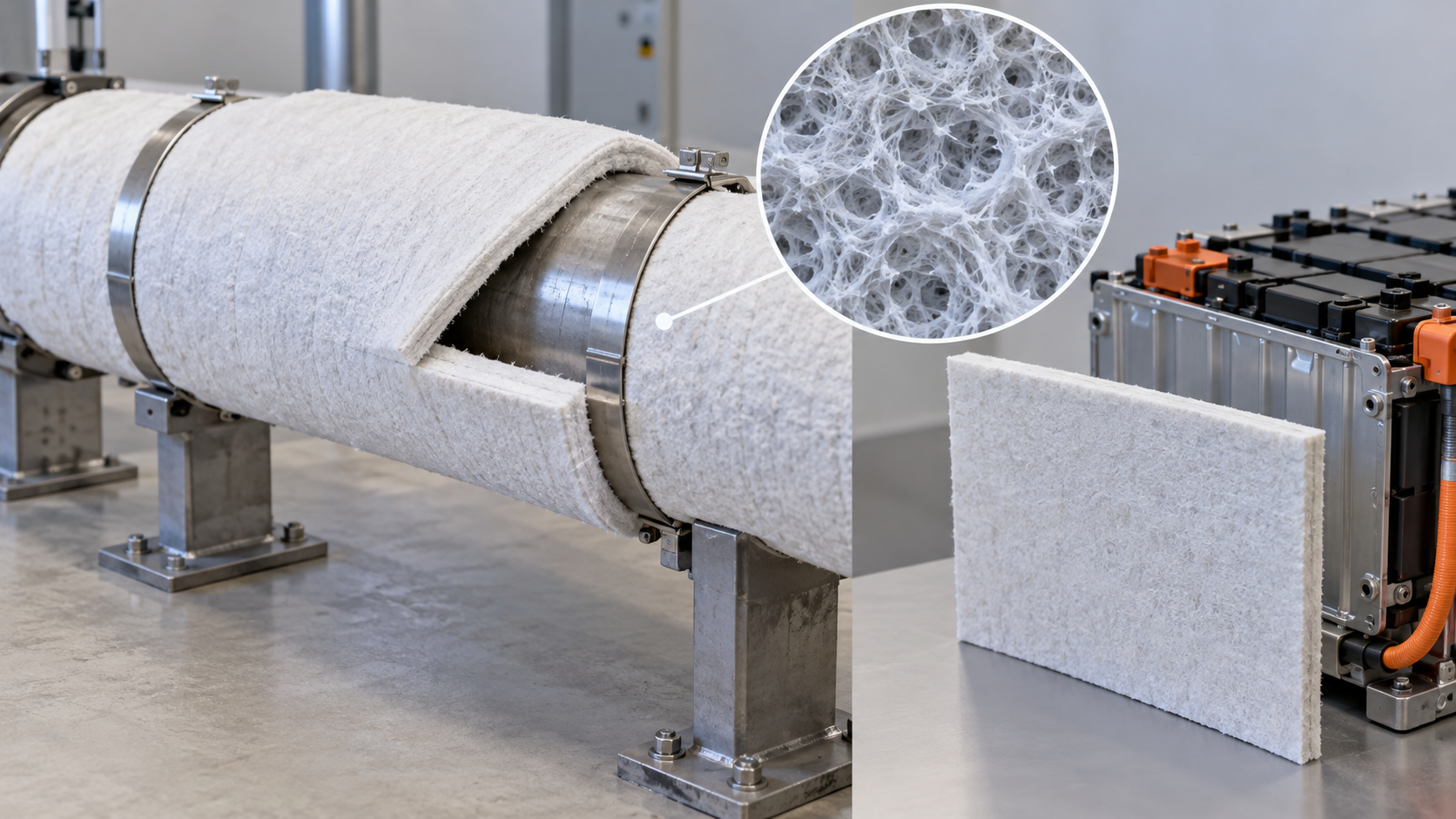
Aspen Aerogels is a U.S. materials company that makes silica aerogel in a flexible, blanket-like sheet and produces it at industrial scale. By the company’s account, silica aerogel is 97% air by volume, which is why it conducts heat so poorly. It sells into two markets. One is pipe and equipment insulation for refineries, LNG facilities and similar sites (its Energy Industrial business). The other is PyroThin, a thin thermal barrier that slows the spread of thermal runaway inside electric-vehicle (EV) battery packs. Revenue for 2025 was $271.1 million, down 40% from the year before, because demand from its largest customer, GM, fell with lower North American EV production. In 2026 its main plant, in East Providence, suffered a fire (January) and an explosion (8 April), and began a staged restart on 14 May. This profile sets out what Aspen makes, who it sells to, where it makes it and what is happening now, drawing mainly on its filings with the U.S. Securities and Exchange Commission (SEC).
- Aspen Aerogels in 30 seconds, and where it stands in functional materials
- The logo and how the name is written
- Where the company sits in the functional-materials field
- Scale
- Resources committed to functional materials
- What it has done so far
- What comes next
- What the company is aiming for in functional materials
- Map of partnerships in functional materials
- Technology, products and services
- The risks this company carries
- Glossary, references and claim-to-source audit
1. Aspen Aerogels in 30 seconds, and where it stands in functional materials
(secondary: components)Makes aerogel; supplies EV barriers as fabricated parts
blankets97% air by volume (company description)
Energy Industrial 102.2$ million, year to December 2025
Aspen is a materials company that built volume production in a new market (EVs), only to see that revenue swing with the demand of a single customer Sourced. Sales of its EV thermal barriers were $110.1 million in 2023, $306.8 million in 2024 and $168.9 million in 2025: a sharp rise over two years, then a sharp fall. The 10-K says GM reduced its demand in 2025 and that this had a “significant adverse impact” on the business. Its insulation for oil and gas facilities, by contrast, has grown from $17.2 million in 2008 to $102.2 million in 2025, a compound annual growth rate of 11%. In reading this company, the value of the material (aerogel) needs to be kept apart from the structural weakness of depending on one use and one customer.
2. The logo and how the name is written
A note on names: the legal entity is Aspen Aerogels, Inc., known as Aspen. Its product brands are Pyrogel (high temperature), Cryogel (low and cryogenic temperature) and PyroThin (EV batteries), all trademarks of the company. It has no connection with Aspen Technology, the process-simulation software company. The logo is the vector image taken from the company’s official website.
Official site: https://www.aerogel.com/3. Where the company sits in the functional-materials field
We classify Aspen as a materials and raw-material maker (primary type) that also straddles components (secondary type) in EVs Our calculation. Its core material is the silica aerogel blanket, and the function is “making heat hard to conduct (insulation and thermal barriers)”. The 10-K lists “fabrication” as a final manufacturing step: cutting, lamination and production of multi-layer parts. PyroThin for EVs is therefore delivered not as raw material but as a multi-layer part fabricated to fit the customer’s battery pack. For the types and properties of aerogel, see our explainer on hydrogels and aerogels; this profile concentrates on Aspen’s business and products.
4. Scale
Aspen is a relatively small listed company, so we give its figures for the whole company Sourced.
| Metric (year to December, $ million) | 2023 | 2024 | 2025 |
|---|---|---|---|
| Revenue (total) | 238.7 | 452.7 | 271.1 |
| Energy Industrial | 128.6 | 145.9 | 102.2 |
| EV thermal barriers | 110.1 | 306.8 | 168.9 |
| Net income (loss) | (45.8) | 13.4 | (389.6) |
| Research and development spending | 16.4 | 18.1 | 13.4 |
| Shipments (million square feet) | 28.4 | 28.5 | 20.6 |
| Item | Detail | As of |
|---|---|---|
| Employees | 854 (278 in the U.S., 576 abroad; most employees in Mexico are covered by a collective agreement) | 31 December 2025 |
| Revenue in the first half of 2026 | $87.7 million (first half of 2025: $156.7 million, down 44%). EV barriers 45.7, Energy Industrial 42.0 | Six months to 30 June 2026 |
| Revenue in the second quarter of 2026 | $49.8 million (second quarter of 2025: $78.0 million). Net loss of $23.3 million | Second quarter of 2026 |
| Cash | Unrestricted cash and equivalents of $156.9 million at the end of 2025 and $151.7 million at the end of June 2026 | Each period end |
| Patents | 400 issued and 438 pending (U.S. and foreign) | 31 December 2025 |
Most of the 2025 net loss of $389.6 million came from one-off charges, mainly a $286.6 million impairment on the second plant it stopped building in Statesboro, Georgia Sourced. The 10-K says this impairment is not expected to recur, so it expects the net loss to improve in 2026. At the same time, the 10-K and the 10-Q for June 2026 expect EV thermal-barrier revenue to fall in 2026 compared with 2025 Not yet confirmed. The size of the loss alone does not tell you the value of the material.
5. Resources committed to functional materials
For each of the four points we show whether official materials let us confirm it.
| Type of resource | What we found | Status |
|---|---|---|
| People | 854 employees (end of 2025). For research and design, the Advanced Thermal Barrier Center in Marlborough, Massachusetts, opened in 2023 (about 59,000 square feet, a design and prototyping site). The number working on R&D is not disclosed | Sourced / not confirmed |
| Money | R&D spending of $13.4 million in 2025 (about 4.9% of revenue). Cash used in investing activities was $86.3 million in 2024 and $37.4 million in 2025. For 2026 it expects capital expenditure of under $10 million, excluding the cost of restoring East Providence (company outlook) | Sourced |
| Outside investments, acquisitions, joint ventures, divestments | The Mexican fabricator OPE Manufacturer Mexico was set up under a contract with Prodensa and later bought for a nominal sum (10-K). The Statesboro plant assets are being offered for sale (in August 2026 the company said a non-binding letter of intent for a sale had expired and it is marketing the assets) | Sourced |
| Universities, research institutes, public funding | It withdrew in 2025 its application for a loan from the U.S. Department of Energy (DOE) Loan Programs Office. The 10-K does not mention joint research with universities (the company’s case studies include a university’s steam network, but that is a customer use) | Sourced / not confirmed |
| Company partnerships | GM offered a loan facility of up to $100 million that was never drawn and ended in August 2024. A patent cross-license with Cabot. Technical and commercial ties with ExxonMobil and TechnipFMC (Chapter 9) | Sourced |
The status of main products and facilities is below.
| Product / facility | Plant / equipment | Scale | Stage | Date | Reference |
|---|---|---|---|---|---|
| Aerogel blankets (all grades) | East Providence, Rhode Island, USA (owned; about 148,000 sq ft manufacturing facility; operating since 2008) | Shipments of 20.6 million sq ft in 2025 (capacity figure not disclosed) | Operating. Fire in January 2026, explosion on 8 April, staged restart on 14 May | January to May 2026 | References 1, 2, 3 |
| Some Energy Industrial grades | External contract manufacturer in China (name not disclosed) | Not disclosed (no minimum purchase quantity) | Operating (covered supply while East Providence was stopped) | 2026 | References 1, 2 |
| PyroThin fabrication (cutting, lamination) | OPE Manufacturer Mexico in Mexico (the 10-K’s table of leased properties lists about 266,000 sq ft in Monterrey, Mexico) | Not disclosed | Operating | End of 2025 | Reference 1 |
| Second plant (Statesboro) | Georgia, USA | – | Construction halted in February 2025. Assets to be sold | From February 2025 | References 1, 4 |
The steps listed in the 10-K are: (1) dissolve silica precursors in ethanol with a catalyst to make a sol, (2) combine it with fibre batting (a wool-like reinforcement) and cast it to form a gel, (3) age it in a fluid, (4) remove the ethanol under supercritical conditions to give a dried aerogel blanket, (5) heat-treat to remove trace ethanol, salts and water, (6) fabricate, and (7) test thermal conductivity, hydrophobicity and other properties Sourced. In general, a gel dried in the ordinary way shrinks as capillary forces collapse its pores. Supercritical extraction avoids that shrinkage and keeps the porous structure, and is one of the steps likely to push up cost (this is a general explanation, not a statement in the company’s documents). Material costs were 36%, 38% and 42% of product revenue in 2023, 2024 and 2025 (10-K). The 10-K also says that the price of certain silica precursors (silanes) has risen sharply at times because of a supply imbalance.
The explosion in April 2026 is described in the company’s announcement as having originated, in preliminary reports, in “a specific high-temperature oven”. Which process the oven served and what caused the explosion are under investigation and have not been disclosed Not yet confirmed. The 10-K confirms that the process involves flammable solvents such as ethanol, but we do not infer any link to the accident.
6. What it has done so far
| When | What happened | Why it matters |
|---|---|---|
| 2008 | Began operating the East Providence plant. Launched Pyrogel and Cryogel | The starting point of the Energy Industrial business |
| 2020 to 2021 | Signed contracts with GM to supply multi-part barriers for EV batteries | The start of volume EV business |
| November 2022 | A loan agreement with GM for up to $100 million. The draw period was later amended and the facility ended in 2024 without being drawn | A customer was helping to finance capacity |
| 2023 | Production contracts for barriers with Toyota, Scania, ACC, Audi, Volvo Truck and a large European battery maker. Opened the Marlborough design and prototyping centre | The customer base widened beyond GM |
| 2024 | Revenue of $452.7 million (2023: $238.7 million). In August, set up a new credit facility (the MidCap Loan Facility, with a $125 million term loan) and repurchased a $150 million convertible note | The EV peak |
| February 2025 | Announced a restructuring plan. Stopped building Statesboro, withdrew the DOE loan application and cut headcount | Scaled investment to the expected demand |
| 2025 | Revenue fell 40% to $271.1 million. GM remained the largest customer, but its demand fell | Lower North American EV production hit directly |
| January 2026 | A fire at East Providence damaged an emissions control unit | The start of operating disruption |
| 8 April 2026 | An explosion at East Providence damaged part of the production space and halted operations temporarily. Eleven employees were taken to hospital for evaluation and later released | The main plant stopped |
| 14 May 2026 | Began a staged restart | The date of full recovery is not disclosed |
| 6 August 2026 | Reported second-quarter results. Announced a PyroThin award across two next-generation vehicle architectures at Jaguar Land Rover, with production expected to start in 2027 | Customers outside North America (Europe) are growing |
7. What comes next
All of these outlooks are company targets, not results already achieved Not yet confirmed. The 10-K and 10-Q say that EV thermal-barrier revenue will fall in 2026 and Energy Industrial revenue will rise. The East Providence recovery is at the stage of a phased ramp-up; the company says it is keeping customers supplied through inventory, external manufacturing and limited production, on the assumption that the restart proceeds as expected.
None of the following could be confirmed from official materials Not yet confirmed.
The date of full recovery at East Providence; the cause of the accident and the total losses (the company says they cannot be reasonably estimated); numerical production capacity; whether the Statesboro assets will be sold; the timing and revenue of commercialising the carbon aerogel anode material and the LFP cathode.
8. What the company is aiming for in functional materials
This chapter includes points the company has not stated directly. They are inferences drawn from primary sources, set out with their grounds.
| What we infer | Primary-source basis | Status |
|---|---|---|
| Volume EV business came to depend heavily on one customer (GM) | GM was 59% of 2025 revenue (64% in 2024). The ten largest customers were about 84%. GM has no minimum purchase obligation and can terminate at any time | Sourced |
| It is trying to spread its customers to European automakers | In August 2026 it raised its European EV outlook and announced the Jaguar Land Rover award. The 10-K also lists production contracts with Audi, Scania, Volvo Truck and ACC | Inference |
| It has shifted its weight from big new plants to restoring existing ones and using external manufacturing | Statesboro construction halted; 2026 capital expenditure under $10 million (excluding restoration); the 10-K and 10-Q say it is expanding the capabilities of its external manufacturer in China | Inference |
| It has an idea of extending aerogel from insulation to battery materials | The 10-K says it is working with partners to commercialise carbon aerogel anode materials, and its website describes an LFP aerogel cathode (a company claim of a 10C charging rate). No revenue contribution is confirmed | Inference |
We do not read “expansion into battery materials” as an official plan. In the 10-K the carbon aerogel anode material is described only in terms of “developing” and an expectation that “partners will accelerate commercialisation”, with no revenue or shipments given Sourced. The website page on the LFP cathode refers to a “10x improvement in C-rate” and “single-digit minute full charges”, but it does not say under what conditions or in what form (electrode, cell or laboratory sample) these were obtained. We therefore treat them as claims from a company at the research and development stage, not as the performance of a production product Not yet confirmed. Even so, the 10-K states a strategy of using the aerogel technology platform for applications beyond insulation, so we read the company as looking for another growth pillar now that EV barriers have stalled.
9. Map of partnerships in functional materials
10. Technology, products and services
| Product (company description) | Use | Construction and features (manufacturer’s stated values) |
|---|---|---|
| Pyrogel XTE | Insulating high-temperature pipes in refineries and petrochemical plants (its best-selling product) | Reinforced with glass-fibre batting. Upper use temperature of 650 °C, optimised for 100 to 400 °C. Hydrophobic and vapour permeable, which reduces the risk of corrosion under insulation (CUI) |
| Pyrogel HPS | Power generation and other service above 400 °C | Upper use temperature of 650 °C. High durability |
| Pyrogel XTF | Locations needing fire protection | Reinforced with glass and silica fibre batting |
| Cryogel Z | Low and cryogenic temperatures (LNG and others) | Reinforced with glass and polyester fibre. Integral vapour barrier |
| Spaceloft Subsea | Pipe-in-pipe in offshore oil production | Reinforced with glass and polyester fibre. Fabricated and pre-packaged for shipment |
| PyroThin | Between cells, modules and packs in EV and energy-storage batteries | An ultra-thin, light, flexible thermal barrier. Designed with other functional layers to impede the spread of thermal runaway. The company says it can also act as a compression pad |
According to the 10-K, the company’s products are installed in more than 30% of the world’s refineries (the company’s belief) in the energy market, and in EVs they are qualified for use in the next-generation battery systems of five of the largest automakers Sourced. Qualification requires meeting each customer’s internal specifications and consensus standards such as those developed by ASTM International, and customers generally do not publish their test results (we do not cover the content of ASTM standards here).
The 10-K explains that aerogel suppresses all three paths of heat transfer at once Sourced. (1) Conduction: the solid fraction is very small, so little heat travels through the skeleton. (2) Convection: gas movement is restricted inside the nanoscale pores, so convection does not occur. (3) Radiation: infrared-absorbing additives are added to cut radiative transfer at high temperatures. So it is not only “light”: the design of the material itself (the additives) is part of how it handles radiation, which matters more as temperature rises.
Reinforcement: the 10-K says silica aerogels are “usually fragile”. In the blanket, the gel is therefore formed inside a fibre batting, and the fibre is changed by use and temperature (glass fibre for high temperature, glass and silica fibre for fire protection, glass and polyester fibre for low temperature). The fibre decides not only strength but also the upper use temperature and how well the blanket resists burning.
In EV batteries the trade-off is among thinness, thermal protection and compression: the company describes PyroThin as an “ultra-thin, lightweight, flexible” barrier combined with other functional layers, which it says can meet safety goals “without sacrificing energy density” (a company claim). How well a barrier works depends not only on the material’s thermal conductivity but also on its thickness and how it is compressed when the cells swell. Balancing these three is what customer-by-customer design involves (the 10-K speaks of optimising thermal conductivity, thickness and compression response), but we could not confirm specific thermal conductivity or heat-test figures from the static text of the public pages Not yet confirmed.
Aspen’s PyroThin page says it helps battery engineers meet and exceed China’s GB 38031 and the United Nations’ ECE/TRANS/180/Add.20 (a company claim). China’s national standards public-disclosure system lists GB 38031-2025, Safety Requirements for Traction Battery of Electric Vehicle, as a mandatory standard, with a publication date of 28 March 2025 and an implementation date of 1 July 2026, and shows the earlier GB 38031-2020 as abolished Sourced. We could not confirm the United Nations document, because we could not reach the official site. We also have not confirmed from which date and to which vehicles the new standard applies (new type approvals or existing models). Whether Aspen’s products have passed any particular test is treated as the company’s claim, and this article does not assess it.
11. The risks this company carries
| Risk | What it is | Status |
|---|---|---|
| Customer concentration | GM was 59% of revenue and the ten largest customers about 84%. GM has no minimum purchase obligation and may terminate at any time. In 2025 GM cut demand, with a significant adverse effect | Sourced |
| EV demand and policy changes | Lower North American EV production and changes in regulation and incentives have led customers to rethink production plans and investment timing. The company expects EV revenue to fall in 2026 | Sourced |
| Concentrated production site and accidents | Its main production is at one site, East Providence. A fire and an explosion followed in 2026, and the restart is staged. The company says total losses cannot be estimated and is pursuing property and business-interruption insurance claims | Sourced |
| Funding and loan terms | The MidCap borrowing carries financial covenants such as minimum liquidity, and the company writes that, given the fall in 2025 revenue, it cannot guarantee future compliance. A December 2025 amendment removed the minimum EBITDA covenant. Cash was $151.7 million at the end of June 2026 | Sourced |
| Weak patent protection | The 10-K says aerogel dates back some 80 years and that much of the general manufacturing technology is not protected by patents. In Korea, invalidation decisions against its patents came in October to December 2024, and it appealed in 2025; the appeals are pending | Sourced |
| Competition | The 10-K names aerogel makers such as Armacell, Alkegen, IBIDEN and several Chinese companies, as well as conventional insulation, and expects competition to intensify | Sourced |
| Raw materials and sourcing | Prices of silica precursors have spiked. The China external manufacturer is exposed to U.S.-China relations and Chinese regulation | Sourced |
| Sale of the Statesboro assets | The letter of intent expired and the company is looking for buyers. The carrying value at the end of 2025 was $32.7 million (remeasured to fair value less costs to sell, with an $18.2 million loss). A sale below that value remains possible | Sourced |
| Litigation | A suit by a former Polish distributor is stayed pending arbitration (claims of more than $16 million; the original notice cited $20 million). The company intends to contest it | Sourced |
12. Glossary
- Aerogel
- An ultra-light porous solid made by removing the liquid from a gel and keeping the skeleton. Silica types are mostly air and conduct heat poorly.
- Blanket
- A fibre batting sheet impregnated with aerogel so that it bends like cloth.
- Supercritical drying
- Removing the solvent in a state with no distinction between liquid and gas, which prevents capillary forces from collapsing the pores.
- Thermal runaway
- A lithium-ion cell overheating abnormally, with temperature rising in a chain reaction. Stopping the spread to neighbouring cells (“propagation”) is the challenge.
- CUI (corrosion under insulation)
- Corrosion of metal caused by water collecting beneath pipe insulation.
- Thermal Barrier / Energy Industrial
- Aspen’s two reporting segments: barriers for EV batteries, and insulation for oil, gas and power facilities.
- 10-K / 10-Q / 8-K
- The annual, quarterly and current reports that U.S.-listed companies file with the SEC.
- GB 38031
- China’s mandatory national standard for the safety of traction batteries in electric vehicles.
13. References
- Aspen Aerogels, Inc. Form 10-K for the fiscal year ended December 31, 2025 (filed with the SEC on 13 March 2026). Business, products, manufacturing process, customers, revenue, costs, impairments, risks, litigation, headcount, patents and financial figures. https://www.sec.gov/Archives/edgar/data/1145986/000119312526106453/aspn-20251231.htm
- Aspen Aerogels, Inc. Form 10-Q for the quarterly period ended June 30, 2026 (filed with the SEC on 7 August 2026). First-half 2026 revenue, the East Providence accident and restart, insurance and outlook. https://www.sec.gov/Archives/edgar/data/1145986/000119312526340275/aspn-20260630.htm
- Aspen Aerogels, Inc. Form 8-K (21 April 2026). Status of the East Providence explosion. https://www.sec.gov/Archives/edgar/data/1145986/000117184326002620/f8k_042126.htm
- Aspen Aerogels, Inc. Press release, Second Quarter 2026 Financial Results (Exhibit 99.1 to Form 8-K, 6 August 2026). Third-quarter outlook, the Jaguar Land Rover award and the status of the Statesboro sale. https://www.sec.gov/Archives/edgar/data/1145986/000117184326005289/exh_991.htm
- Aspen Aerogels, Inc. PyroThin (official product page; reference to GB 38031 and other standards, and a statement on volume production). Retrieved 10 October 2026. https://www.aerogel.com/product/pyrothin/
- Aspen Aerogels, Inc. Pyrogel XTE (official product page). Retrieved 10 October 2026. https://www.aerogel.com/product/pyrogel-xte/
- Aspen Aerogels, Inc. Extreme Fast Charging LFP Cathode (official page describing the LFP aerogel cathode program). Retrieved 10 October 2026. https://www.aerogel.com/industries/battery-materials/
- State Administration for Market Regulation and Standardization Administration of China National Standards Full-text Disclosure System, search results for GB 38031-2025 and GB 38031-2020 (in Chinese). Retrieved 10 October 2026. https://openstd.samr.gov.cn/bzgk/gb/std_list?p.p1=0&p.p90=circulation_date&p.p91=desc&p.p2=38031
- Aspen Aerogels, Inc. Official website (logo; company overview). https://www.aerogel.com/
14. Claim-to-source audit
| Claim in the text | Status | Source |
|---|---|---|
| Legal name, headquarters, NYSE listing, Delaware incorporation, subsidiaries | Sourced | Reference 1 https://www.sec.gov/Archives/edgar/data/1145986/000119312526106453/aspn-20251231.htm |
| Revenue, segment revenue, net income (loss), R&D and shipments for 2023 to 2025; GM at 59% (64% in 2024); the ten largest customers at about 84% | Sourced | Reference 1 https://www.sec.gov/Archives/edgar/data/1145986/000119312526106453/aspn-20251231.htm |
| 854 employees, 400 patents and 438 pending, cash of $156.9 million, investing cash of $37.4 million and $86.3 million | Sourced | Reference 1 https://www.sec.gov/Archives/edgar/data/1145986/000119312526106453/aspn-20251231.htm |
| 97% air by volume, the three heat-transfer paths, the manufacturing steps, material cost ratios and product specifications (650 °C and so on) | Sourced | Reference 1 https://www.sec.gov/Archives/edgar/data/1145986/000119312526106453/aspn-20251231.htm |
| Statesboro construction halted (February 2025), $286.6 million impairment, $18.2 million loss, withdrawal of the DOE loan application, the GM loan facility (undrawn) | Sourced | Reference 1 https://www.sec.gov/Archives/edgar/data/1145986/000119312526106453/aspn-20251231.htm |
| Patent invalidation decisions in Korea and the appeals, the Cabot cross-license, the former Polish distributor dispute | Sourced | Reference 1 https://www.sec.gov/Archives/edgar/data/1145986/000119312526106453/aspn-20251231.htm |
| First-half 2026 revenue, net loss, cash, the restart and insurance after the accident, and the 2026 outlook (EV down, Energy Industrial up) | Sourced | Reference 2 https://www.sec.gov/Archives/edgar/data/1145986/000119312526340275/aspn-20260630.htm |
| The explosion of 8 April 2026, the eleven employees, the high-temperature oven in preliminary reports, cause under investigation | Sourced | Reference 3 https://www.sec.gov/Archives/edgar/data/1145986/000117184326002620/f8k_042126.htm |
| Third-quarter outlook, 2026 capital expenditure, European EV outlook, the Jaguar Land Rover award, the status of the Statesboro sale | Not yet confirmed | Company outlook in Reference 4 https://www.sec.gov/Archives/edgar/data/1145986/000117184326005289/exh_991.htm |
| PyroThin’s claimed help in meeting GB 38031 and other standards, and the volume-production statement | Sourced | As a company claim, Reference 5 https://www.aerogel.com/product/pyrothin/ |
| Uses and features of Pyrogel XTE | Sourced | Reference 6 https://www.aerogel.com/product/pyrogel-xte/ |
| The company’s claim for an LFP aerogel cathode (10C charging rate) | Not yet confirmed | Company claim in Reference 7 https://www.aerogel.com/industries/battery-materials/ |
| GB 38031-2025 is a mandatory standard, published 28 March 2025, effective 1 July 2026; GB 38031-2020 is abolished | Sourced | Reference 8 https://openstd.samr.gov.cn/bzgk/gb/std_list?p.p1=0&p.p90=circulation_date&p.p91=desc&p.p2=38031 |
| The United Nations document ECE/TRANS/180/Add.20, and the scope and timing of GB 38031 | Not yet confirmed | Official documents could not be confirmed; we do not infer them. https://www.aerogel.com/product/pyrothin/ |
| The general explanation that supercritical drying avoids pore shrinkage | Commentary | This article’s general explanation (not a statement in the company’s documents) |
| EV barriers at about 62% of revenue (168.9 / 271.1) and R&D at about 4.9% of revenue | Our calculation | Our calculation from the values in Reference 1 |
| Classifying Aspen as a materials and raw-material maker (primary) and a components maker (secondary) | Our calculation | Our own classification. Company names are examples from this series |
| R&D headcount, numerical capacity, the China contract manufacturer’s name, the accident’s cause and total losses, the date of full recovery | Not yet confirmed | All undisclosed or under investigation. We do not estimate them. https://www.sec.gov/Archives/edgar/data/1145986/000119312526106453/aspn-20251231.htm |
| Spreading customers to Europe | Inference | This article’s reading of the raised outlook, the award announcement and the list of production contracts |
| A shift of weight to restoring existing plants and external manufacturing | Inference | This article’s reading of the halted construction, the capital expenditure outlook and the external-manufacturing statements |
| An idea of extending aerogel to battery materials | Inference | This article’s reading of the 10-K’s strategy statements and the website’s development claims |
Last updated: 10 October 2026 / Troy Technical
Figures in this article are based on the statutory filings that Aspen Aerogels made with the U.S. Securities and Exchange Commission and on the company’s official materials. Product performance values are the company’s own statements (manufacturer’s stated values) and have not been verified here. We have not used market-research estimates or press-based figures. Passages marked “Inference” are our own reading of primary sources, not statements by the company.