COMPANY PROFILE / FUNCTIONAL MATERIALS
Croda
A cosmetics-ingredients company that also sells plant-based phase change materials, under the CrodaTherm name
Croda is a UK specialty chemicals company whose business is dominated by ingredients for personal care, pharmaceuticals and agriculture. This profile covers only one corner of it: the phase change materials (PCMs) sold by its Industrial Specialties business. A PCM absorbs heat as it melts and releases it as it solidifies, which is why it is used in cold-chain packs, building materials and heat storage. Croda’s products are waxes made from plant-based raw materials, and microcapsules that enclose those waxes in a polymer shell. In its half-year results statement of July 2026, the company named “phase change materials for thermal management” as a driver of growth in this business. But PCM sales themselves appear in no disclosure we could find. This article does not estimate them; it separates what we could confirm from what we could not.
- Croda in 30 seconds, and where it stands in functional materials
- The logo and how the name is written
- Where the company sits in the functional-materials field
- Scale (the group in brief)
- Resources committed to functional materials
- What it has done so far
- What comes next
- What the company is aiming for in functional materials
- Map of partnerships in functional materials
- Technology, products and services
- The risks this company carries
- Glossary, references and claim-to-source audit
1. Croda in 30 seconds, and where it stands in functional materials
(CrodaTherm)13 wax grades melting at 5 to 75 °C, plus capsules
2025 sales: £194.5 millionAbout 11% of group sales
in H1 2026Wording in the July 2026 half-year statement
For Croda, PCMs are not a main business but one product family inside a small business unit Sourced. The annual report describes Industrial Specialties as a business that “contributes to the efficiency of our manufacturing model” by putting spare capacity and core chemistries on shared sites to work in target markets. In 2025 its sales were £194.5 million, about 11% of group sales of £1,699.4 million, and its adjusted operating profit was £9.0 million. Yet the July 2026 half-year statement says core sales grew in this unit, “particularly of phase change materials for thermal management”. We cannot see how large PCMs are, but we can confirm they are a product family the company itself singles out as growing.
2. The logo and how the name is written

A note on names: the legal entity is Croda International Plc, known as Croda. The PCM product brand is CrodaTherm. PCMs are presented on Croda’s industrial-specialties website (Croda Industrial Specialties). The logo is the vector image taken from the company’s official website.
Official site: https://www.croda.com/en-gb3. Where the company sits in the functional-materials field
We classify Croda as a materials and raw-material maker Our calculation. Its core material is the phase change material (PCM), and the function is “absorbing and releasing a large amount of heat at a set temperature”. The company’s own page explains that, to be used, PCM wax must be sealed in a container, which is called macroencapsulation. The container, heat store or cold pack is made by the customer (or a partner); Croda supplies the material. For the kinds of PCM and how to read their test data, see our explainer on phase change materials and heat storage; this profile concentrates on Croda’s position.
4. Scale (the group in brief)
The group’s wider businesses (personal care, pharmaceuticals, agriculture, fragrances) are not the subject here, so we give only the scale Sourced.
| Metric (year to December 2025) | 2024 | 2025 | Note |
|---|---|---|---|
| Group sales (£ million) | 1,628.1 | 1,699.4 | Consumer Care 972.7 / Life Sciences 532.2 / Industrial Specialties 194.5 |
| Industrial Specialties sales (£ million) | 203.8 | 194.5 | Down 4.6% (down 2.4% at constant currency) |
| Industrial Specialties adjusted operating profit (£ million) | 15.5 | 9.0 | On an IFRS basis, a loss of £1.7 million in 2025 (a profit of £13.6 million in 2024) |
| Group research and development charge in the income statement (£ million) | 63.6 | 60.2 | No breakdown by business is disclosed |
| Group net capital expenditure (£ million) | 137.9 | 108.2 | No breakdown by business is disclosed |
| By region, Annual Report 2025 | Employees | Principal manufacturing sites | Innovation sites |
|---|---|---|---|
| Europe, Middle East and Africa | 2,970 | 18 | 20 |
| Asia | 1,699 | 15 | 18 |
| North America | 812 | 5 | 6 |
| Latin America | 473 | 6 | 6 |
| Total (our calculation) | 5,954 | 44 | 50 |
These figures are for the whole group, or the whole Industrial Specialties unit. PCM sales, profit, headcount and R&D spending appear in neither the annual report nor the half-year statement Not yet confirmed. The annual report does not contain the words “phase change” or “thermal” at all (we searched the full text). The company’s industrial-specialties website lists PCMs alongside coatings additives, textile chemicals, food emulsifiers and water-treatment products, and sales also include by-products and co-streams. The annual report attributes the 2025 decline to a fall in sales under a supply agreement and to weaker price and mix caused by a higher share of by-product and co-stream sales. The unit’s numbers therefore cannot be read as the size of the PCM business.
5. Resources committed to functional materials
Money and headcount for PCMs alone are not disclosed. Below we show what we could and could not confirm, across four points.
| Type of resource | What we found | Status |
|---|---|---|
| People | PCM headcount and R&D sites are not disclosed. The group has 5,954 employees by region (our calculation). A 2018 technical presentation said CrodaTherm waxes were made in the Netherlands, but we could not confirm the current manufacturing site from the official pages | Sourced / not confirmed |
| Money | R&D spending and capital expenditure for PCMs are not disclosed. Group-wide, R&D was £60.2 million and capital expenditure £108.2 million in 2025 | Sourced / not confirmed |
| Outside investments, acquisitions, joint ventures, divestments | The Annual Report 2025 and the 2026 half-year statement do not mention any investment, acquisition, joint venture or sale related to PCMs | Not confirmed |
| Universities, research institutes, public funding | The official materials we reviewed do not mention university collaboration or public grants for PCMs | Not confirmed |
| Company partnerships | INUTEQ (personal cooling vests), Axiotherm (PCM heat stores, announced in 2018) and membership of the PCM industry association Gütegemeinschaft PCM e.V. (Chapter 9) | Sourced |
The status of main products and facilities is below. We could not confirm production capacity or the operating status of any plant from official materials.
| Product | Plant / equipment | Scale | Stage | Date | Reference |
|---|---|---|---|---|---|
| CrodaTherm waxes (13 grades) | Not confirmed (the Netherlands in a 2018 presentation) | Not confirmed | On sale (samples can be requested) | Checked 10 October 2026 | Reference 1 |
| CrodaTherm microcapsules (4 grades) | Not confirmed | Not confirmed | On sale (dispersions; a powder form is also mentioned) | Checked 10 October 2026 | References 1, 3 |
| New PCM plant or expansion | None mentioned | None mentioned | No plan or investment decision found | – | References 6, 7 |
According to the annual report, Industrial Specialties is a business that uses “spare capacity and core chemistries on shared manufacturing sites” Sourced. It is not a model built on a large dedicated plant. It raises the utilisation of reactors and purification equipment that already serve cosmetics or agrochemicals. The raw materials of the PCMs are described as plant-based, but the official product page lists the chemical description as “Proprietary”, so we could not confirm which compound is the main component Not yet confirmed. The advantage of shared equipment is a smaller investment and an easier way to add grades (melting points). The drawback is that purity and volume may be constrained by the shared equipment, and a sudden rise in PCM demand would not by itself justify adding dedicated capacity.
6. What it has done so far
| When | What happened | Why it matters |
|---|---|---|
| 2018 (the file name is dated 26 January) | Croda GmbH and Axiotherm GmbH presented a heat store using CrodaTherm at a Swiss symposium on thermal energy storage. The waxes were stated to be “manufactured in the Netherlands”, with an “average bio-based content” of 96% | Shows that the PCM business and the product brand existed by 2018 at the latest |
| January 2025 | The PCM industry association’s newsletter featured CrodaTherm 5, which melts at 5 °C (for 2 to 8 °C cold chains), with comments from a Croda employee | Aimed at cold-chain transport. However, the 2018 presentation lists a grade of the same name, so we could not confirm what “recently developed” means |
| 28 July 2026 | The half-year statement said the rise in Industrial Specialties’ “core sales” was led by PCMs for thermal management, while sales under a supply agreement fell | The one passage we found in a company results document that names PCMs |
| 10 October 2026 (date checked) | The official website listed 13 CrodaTherm wax grades (melting at 5 to 75 °C) and 4 microcapsule grades | Confirms the current range |
Croda’s announcement of its collaboration with INUTEQ (for personal cooling vests) is on its official news page, but it carries no date. We left it out of the timeline and cover it in Chapter 9.
7. What comes next
over 2026 to 2028Company target (organic growth)
thermal managementDescribed as “selective growth opportunities”
The 2026 half-year statement says the company targets an organic increase in Industrial Specialties sales of (3) to 3% a year over 2026 to 2028, expected to include higher core sales from selective opportunities in coatings, electrification and thermal management, offset by a continued reduction in sales under supply agreements Not yet confirmed. Because the lower end is negative, the company itself allows for the unit’s total sales falling.
PCM sales targets, production capacity, any new plant or expansion, launch plans for new grades and plans to obtain certification appear in none of the official materials Not yet confirmed.
8. What the company is aiming for in functional materials
This chapter includes points the company has not stated directly. They are inferences drawn from primary sources, set out with their grounds.
| What we infer | Primary-source basis | Status |
|---|---|---|
| PCMs are not the group’s main growth driver but one product family that helps keep shared sites busy | The annual report describes Industrial Specialties as contributing to “the efficiency of our manufacturing model”. The unit’s adjusted operating margin was 4.1% in H1 2026 | Inference |
| PCMs sit within the thermal-management and electrification growth areas | The half-year statement names “phase change materials for thermal management” as a source of growth and lists thermal management and electrification in its target | Sourced |
| The basis of differentiation is plant-based origin, ease of handling and a wide choice of melting points, not a larger latent heat | The official pages stress bio-based origin, low flammability, low evaporative loss and a wide melting range. Stated latent heat falls in a range of 206 to 226 J/g | Inference |
| It is focusing on pharmaceutical cold-chain transport at 2 to 8 °C | The temperature-controlled packaging page names CrodaTherm 5 and 6.5 for 2 to 8 °C and cites the EU’s good distribution practice guidelines. The January 2025 newsletter also featured the 5 °C grade | Inference |
The numbers show why we read the differentiation as lying elsewhere than latent heat. In the official wax table, latent heat on melting falls between 206 and 226 J/g across the 13 grades (the company’s typical values) Sourced. Croda’s own 2018 presentation put paraffin PCMs at 150 to 220 kJ/kg, salt hydrates at about 190 kJ/kg and CrodaTherm at 176 to 226 kJ/kg, and said these “compare well” with other technologies. On latent heat alone, then, its products sit in the same range as other types of PCM. What the company puts forward is “bio-based”, “high flash point”, “slow to evaporate” and “a melting point you can choose”. From this we read its products as chosen for handling and environmental profile rather than latent heat Not yet confirmed. This is a summary of the company’s pitch, not an assessment of its products against others.
9. Map of partnerships in functional materials
The INUTEQ announcement says that INUTEQ’s PAC cooling vests use CrodaTherm 15, 21 and 29, and that the two companies agreed to promote such products in Europe, the Middle East, Africa and Asia Sourced. In the Axiotherm case, a 2018 presentation shows a heat store that used CrodaTherm 53 in Axiotherm’s macroencapsulated elements. The statements about savings in that presentation were Axiotherm’s own, so we do not repeat them here.
10. Technology, products and services
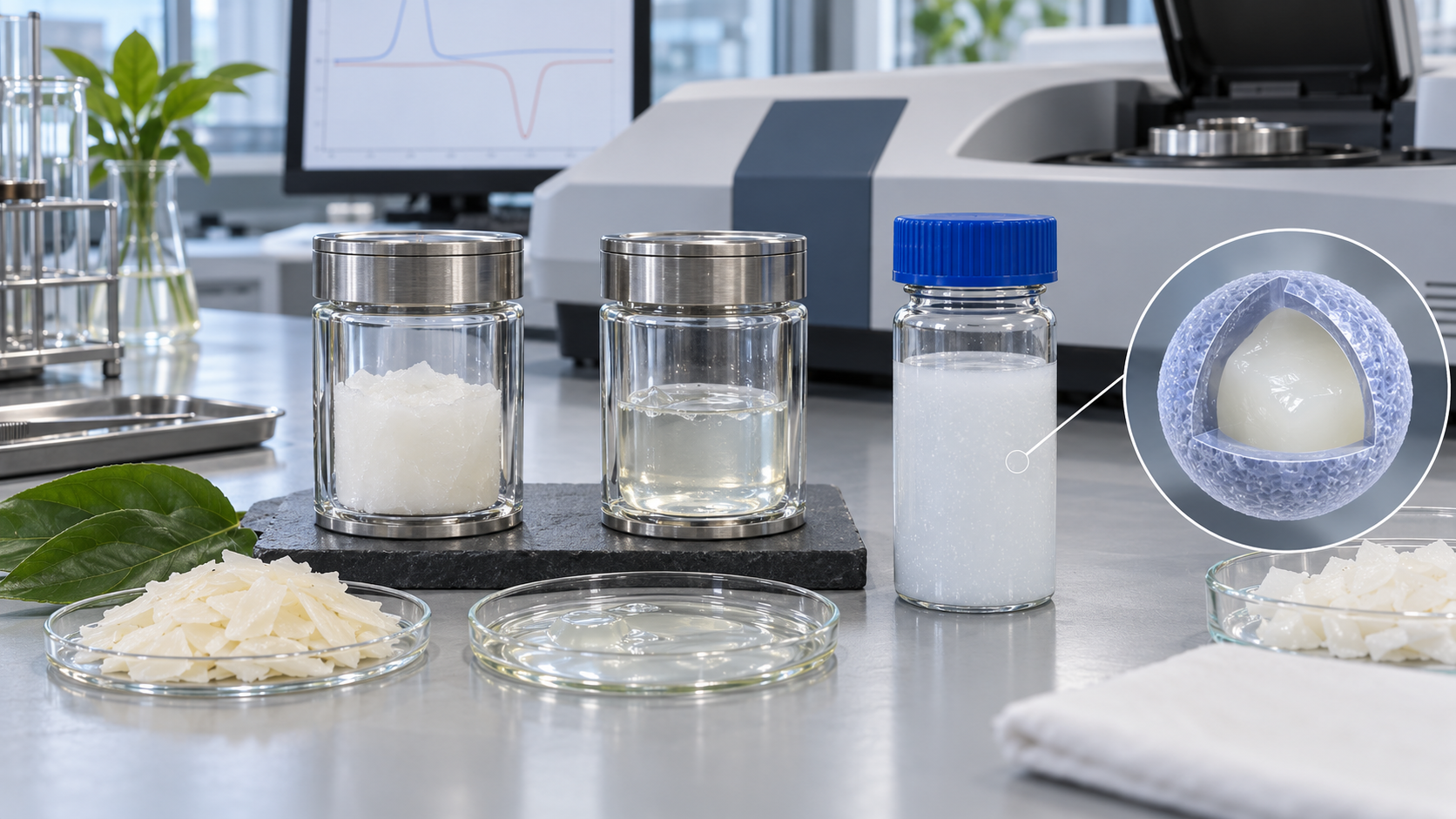
Croda’s PCMs come in two forms: waxes (bulk) and microcapsules.
| Grade (manufacturer’s stated typical values) | Melting point (°C) | Crystallisation temperature (°C) | Latent heat on melting (J/g) | Latent heat on crystallising (J/g) |
|---|---|---|---|---|
| CrodaTherm 5 | 5 | 4 | 217 | 219 |
| CrodaTherm 21 | 20 | 20 | 215 | 210 |
| CrodaTherm 29 | 28 | 27 | 223 | 222 |
| CrodaTherm 37 | 36 | 36 | 216 | 217 |
| CrodaTherm 53 | 52 | 52 | 220 | 221 |
| CrodaTherm 60 | 60 | 60 | 215 | 219 |
| CrodaTherm 74 | 75 | 71 | 226 | 224 |
The table above picks 7 of the 13 grades in the official wax table Sourced. For some grades the number in the name does not match the melting point in the table (for example, CrodaTherm 29 melts at 28 °C and CrodaTherm 74 at 75 °C). In a 2018 technical presentation, Croda measured CrodaTherm 53 by differential scanning calorimetry (DSC) at a scanning rate of 1 K/min, giving a melting point of 53 °C and a latent heat of 226 J/g. CrodaTherm 47 appears in the product list but not in this table. The wax table carries no note on measurement method; the note “obtained using DSC, typical values” sits under the microcapsule table.
On thermal energy storage, the company’s page gives “typical total heat capacities up to 230 kJ/kg” for CrodaTherm (manufacturer’s stated value). It presents the plant-based origin as an advantage over petroleum-derived paraffin PCMs, and says salt hydrates “may suffer instability over time” in stationary use. These are the company’s comparisons, not test results from a third party.
| Microcapsule grade (dispersion; manufacturer’s stated value) | Particle size d90 (µm) | Melting point (°C) | Crystallisation temperature (°C) | Latent heat on melting (J/g) |
|---|---|---|---|---|
| CrodaTherm ME 24XD | 10 | 24 | 19 | 160 |
| CrodaTherm ME 29D | 10 | 29 | 24 | 183 |
| CrodaTherm ME 29XD | 10 | 29 | 22 | 165 |
| CrodaTherm ME 29DS | 3 | 29 | 21 | 175 |
The company describes its microcapsules as a bio-based wax core inside an acrylic polymer shell, free of formaldehyde and supplied as a powder or a water-based dispersion Sourced. The thermal data are typical values obtained by DSC, and the note says that for dispersions the measurement was made after the water had evaporated. Applications named are textiles, bedding and foam, and construction materials.
(1) Latent heat is about two thirds that of ice. The company’s page gives the latent heat of melting ice as 334 kJ/kg. The highest wax value, 226 J/g, and the lowest, 206 J/g, are about 68% and about 62% of that Our calculation. Water melts only at 0 °C, so the company’s argument is that a PCM lets you “place a large latent heat in the temperature band you need”. Being able to choose the temperature is worth more in design than the size of the latent heat itself.
(2) The gap between melting and crystallisation temperature is a guide to supercooling. Across the 13 grades, the gap between the two is 0 to 4 °C (calculated from the table values) Our calculation. The largest is 4 °C for CrodaTherm 74; 11 grades are within 0 to 1 °C. A small gap suits uses such as cold-chain packaging, where the material must melt and set within a narrow band. But because the wax table carries no note on measurement method, these gaps cannot be compared with other companies’ values until the conditions are confirmed.
(3) Encapsulation lowers latent heat per unit of weight. For the 29 °C band, the wax (CrodaTherm 29, 223 J/g on melting) compares with 165 to 183 J/g for the 29 °C microcapsule dispersions, a ratio of about 74 to 82% Our calculation. The shell, which stores no heat, may account for part of the difference, but the official pages do not say whether the capsule core is the same substance as CrodaTherm 29 Not yet confirmed.
(4) The durability claim is worded differently across documents. The current official page says “a minimum of 7000 cycles” of stable performance; the 2018 presentation said category A under the RAL (German quality association) specification, with 10,000 cycles. The number of cycles and the test conditions are not the same, and both are manufacturer’s stated values. Thermal conductivity, density and specific heat are not in the public tables; they are items to check in the data sheet, which requires registration Not yet confirmed.
One way for a third party to check PCM quality is the “RAL Quality Mark PCM” of the German industry association Gütegemeinschaft PCM e.V. (RAL Quality Association PCM). Croda Europe Ltd. is listed on its website as a member. However, the association’s “certified products” list, which we retrieved on 10 October 2026 (16 products from 8 companies), does not include any CrodaTherm product Sourced. The association’s own page says certification is demanding and costly and that not all members’ products have been certified, so this does not mean the quality is lower. We treat Croda’s certification status as not confirmed from official materials (we do not conclude that it holds none).
The temperature-controlled packaging page cites the EU’s good distribution practice guidelines (Guidelines of 5 November 2013 on Good Distribution Practice of medicinal products for human use, 2013/C 343/01) and explains that avoiding temperature excursions in transit is required. This is not a proposal or an adoption in progress: it is an existing guideline published in 2013. This article gives no medical advice. Whether a PCM cold pack meets the transport conditions of an individual medicine is left to the user’s own validation.
11. The risks this company carries
| Risk | What it is | Status |
|---|---|---|
| The PCM business cannot be seen from outside | PCM sales, profit and capacity are not disclosed, so the scale of growth cannot be checked. The company’s reference to rising PCM sales gives no absolute amount | Sourced |
| Low profitability of the unit | Industrial Specialties’ adjusted operating profit was £9.0 million in 2025 (£15.5 million in 2024) and £4.0 million in H1 2026 (a 4.1% margin). On an IFRS basis, 2025 was a loss | Sourced |
| The unit’s sales target allows for a decline | The 2026 to 2028 target is (3) to 3%, with sales under supply agreements expected to keep falling | Sourced |
| Dependence on customers’ and partners’ container technology | PCM wax has to be sealed in a container (macroencapsulation); compatibility with the container material and leak control depend on the customer’s design | Sourced |
| Lack of certification could be a barrier | No CrodaTherm product appears in the list certified under the RAL quality mark. A buyer that requires certification might ask for extra testing | Inference |
| Competition from other PCM types | The company itself compares its products with paraffin and salt hydrate PCMs as alternatives. Each type has strengths and weaknesses, and the choice varies with the use | Sourced |
12. Glossary
- PCM (phase change material)
- A material that absorbs or releases a large amount of heat when it changes between solid and liquid. It is used to store heat or hold a temperature steady.
- Latent heat
- Heat that goes in or out when a material changes state (solid to liquid or back) without changing temperature.
- Melting point and crystallisation temperature
- The temperature at which the material melts and the temperature at which it solidifies again. A large gap between them indicates supercooling.
- DSC (differential scanning calorimetry)
- A method that raises and lowers temperature at a set rate and measures the heat flow. It is used to measure melting point and latent heat.
- Macroencapsulation
- Sealing a PCM inside a container such as a panel, pouch or ball.
- Microcapsule
- A particle in which a PCM is enclosed by a shell smaller than the width of a hair. It can be mixed into fibres or coatings.
- RAL Quality Mark PCM
- A quality certification for PCMs issued by a German industry association. Performance and durability are confirmed by testing.
- GDP (good distribution practice)
- European guidelines for keeping medicines within their quality limits during transport and storage.
13. References
- Croda Industrial Specialties Phase change materials (CrodaTherm wax table, microcapsule table and product list). Retrieved 10 October 2026. https://www.crodaindustrialspecialties.com/en-gb/functions/phase-change-materials
- Croda Industrial Specialties About phase change materials (explanation of latent heat, product features, cycling stability). Retrieved 10 October 2026. https://www.crodaindustrialspecialties.com/en-gb/functions/phase-change-materials/about-phase-change-materials
- Croda Industrial Specialties Microencapsulated PCMs (acrylic-shell microcapsules, applications). Retrieved 10 October 2026. https://www.crodaindustrialspecialties.com/en-gb/functions/phase-change-materials/microencapsulated-pcms-2
- Croda Industrial Specialties Thermal energy storage (explanation of PCM heat storage, stated total heat capacity). Retrieved 10 October 2026. https://www.crodaindustrialspecialties.com/en-gb/applications/thermal-energy-storage
- Croda Industrial Specialties Temperature controlled packaging (cold-chain transport, grades for 2 to 8 °C, reference to EU GDP). Retrieved 10 October 2026. https://www.crodaindustrialspecialties.com/en-gb/applications/temperature-controlled-packaging
- Croda International Plc Annual Report & Accounts 2025 (Industrial Specialties sales and profit, group sales, employees and sites by region, R&D, capital expenditure, listing). https://www.croda.com/mediaassets/files/corporate/annual-report-2025/croda-annual-report-2025.pdf?la=en-GB&hash=49A5CFC09C17CE953B5D58AF6F8F6F24
- Croda International Plc 2026 Half Year Results statement (28 July 2026: Industrial Specialties sales, growth in PCMs, 2026 to 2028 target). https://www.croda.com/mediaassets/files/corporate/investors/2026-half-year-results/croda-h1-2026-results-statement-28-july-2026-final.pdf?la=en-GB&hash=4999898F199BBD6B73E50E637A1A56C1
- Croda International Plc Croda and INUTEQ (use of CrodaTherm 15, 21 and 29 in personal cooling vests; undated). https://www.croda.com/en-gb/media-hub/news/general/croda-and-inuteq
- Croda GmbH / Axiotherm GmbH Thermal Recuperation using CrodaTherm PCMs and Axiotherm Heat Storage Technology (Swiss Symposium on Thermal Energy Storage, 2018; CrodaTherm technical presentation). https://www.hslu.ch/-/media/campus/common/files/dokumente/ta/ta-forschung/tes/sstes18-referats/2018-01-26swiss-symposium-on-thermal-energy-storagecroda-axiotherm-neu.pdf/?la=de-ch
- Gütegemeinschaft PCM e.V. (RAL Quality Association PCM) Members and Certified products. Retrieved 10 October 2026. https://pcm-ral.org/certified-products/
- Gütegemeinschaft PCM e.V. Phase Change Matters newsletter, January 2025 (feature on CrodaTherm 5). https://pcm-ral.org/phase-change-matters-newsletter-january-2025/
- European Union Guidelines of 5 November 2013 on Good Distribution Practice of medicinal products for human use (OJ C 343, 23.11.2013). EUR-Lex. https://eur-lex.europa.eu/legal-content/EN/TXT/?uri=CELEX:52013XC1123(01)
- Croda International Plc Official website (logo; company overview). https://www.croda.com/en-gb
14. Claim-to-source audit
| Claim in the text | Status | Source |
|---|---|---|
| Croda’s legal name, headquarters and listing on the London Stock Exchange | Sourced | References 6, 13 https://www.croda.com/mediaassets/files/corporate/annual-report-2025/croda-annual-report-2025.pdf?la=en-GB&hash=49A5CFC09C17CE953B5D58AF6F8F6F24 |
| Group sales of £1,699.4 million; Industrial Specialties sales of £194.5 million, adjusted operating profit of £9.0 million and IFRS loss of £1.7 million; its share of group sales | Sourced | Reference 6 https://www.croda.com/mediaassets/files/corporate/annual-report-2025/croda-annual-report-2025.pdf?la=en-GB&hash=49A5CFC09C17CE953B5D58AF6F8F6F24 (the report’s chart shows 11.5%; 194.5 / 1,699.4 is 11.4%) |
| Industrial Specialties uses spare capacity on shared sites; the 2025 decline reflects lower supply-agreement sales and a higher share of by-product and co-stream sales | Sourced | Reference 6 https://www.croda.com/mediaassets/files/corporate/annual-report-2025/croda-annual-report-2025.pdf?la=en-GB&hash=49A5CFC09C17CE953B5D58AF6F8F6F24 |
| R&D of £60.2 million, capital expenditure of £108.2 million, and employees and sites by region | Sourced | Reference 6 https://www.croda.com/mediaassets/files/corporate/annual-report-2025/croda-annual-report-2025.pdf?la=en-GB&hash=49A5CFC09C17CE953B5D58AF6F8F6F24 |
| Totals of 5,954 employees, 44 manufacturing sites and 50 innovation sites | Our calculation | Our own sum of the regional figures in Reference 6. Our calculation |
| The Annual Report 2025 does not contain the words “phase change” or “thermal” | Sourced | Our own full-text search of Reference 6 https://www.croda.com/mediaassets/files/corporate/annual-report-2025/croda-annual-report-2025.pdf?la=en-GB&hash=49A5CFC09C17CE953B5D58AF6F8F6F24 |
| H1 2026 Industrial Specialties sales of £99.5 million, growth in core sales including PCMs, adjusted operating profit of £4.0 million (4.1% margin) | Sourced | Reference 7 https://www.croda.com/mediaassets/files/corporate/investors/2026-half-year-results/croda-h1-2026-results-statement-28-july-2026-final.pdf?la=en-GB&hash=4999898F199BBD6B73E50E637A1A56C1 |
| The 2026 to 2028 Industrial Specialties sales target of (3) to 3% a year and the growth areas (coatings, electrification, thermal management) | Not yet confirmed | Company target in Reference 7 https://www.croda.com/mediaassets/files/corporate/investors/2026-half-year-results/croda-h1-2026-results-statement-28-july-2026-final.pdf?la=en-GB&hash=4999898F199BBD6B73E50E637A1A56C1 |
| Melting points, crystallisation temperatures and latent heats of the 13 CrodaTherm wax grades (manufacturer’s stated typical values) | Sourced | Reference 1 https://www.crodaindustrialspecialties.com/en-gb/functions/phase-change-materials |
| Particle size, melting point, crystallisation temperature and latent heat of the 4 microcapsule grades (dispersions measured after water evaporation) | Sourced | References 1, 3 https://www.crodaindustrialspecialties.com/en-gb/functions/phase-change-materials/microencapsulated-pcms-2 |
| PCM wax must be macroencapsulated; the chemical description is listed as proprietary | Sourced | Reference 1 https://www.crodaindustrialspecialties.com/en-gb/functions/phase-change-materials |
| Latent heat of melting ice of 334 kJ/kg; a minimum of 7000 cycles of stability; bio-based, low-flammability, low-evaporation claims | Sourced | Reference 2 https://www.crodaindustrialspecialties.com/en-gb/functions/phase-change-materials/about-phase-change-materials |
| Uses in thermal energy storage and the stated total heat capacity of up to 230 kJ/kg | Sourced | Reference 4 https://www.crodaindustrialspecialties.com/en-gb/applications/thermal-energy-storage |
| Grades for 2 to 8 °C (CrodaTherm 5 and 6.5) and the reference to the EU GDP guidelines | Sourced | References 5, 12 https://www.crodaindustrialspecialties.com/en-gb/applications/temperature-controlled-packaging |
| The GDP guidelines are dated 5 November 2013 and were published in OJ C 343 on 23 November 2013 | Sourced | Reference 12 https://eur-lex.europa.eu/legal-content/EN/TXT/?uri=CELEX:52013XC1123(01) |
| INUTEQ’s cooling vests use CrodaTherm 15, 21 and 29 (undated) | Sourced | Reference 8 https://www.croda.com/en-gb/media-hub/news/general/croda-and-inuteq |
| The 2018 presentation: made in the Netherlands, 96% average bio-based content, DSC at 1 K/min, latent-heat comparison, RAL category A and 10,000 cycles, CrodaTherm 53 in Axiotherm’s heat store | Sourced | Reference 9 https://www.hslu.ch/-/media/campus/common/files/dokumente/ta/ta-forschung/tes/sstes18-referats/2018-01-26swiss-symposium-on-thermal-energy-storagecroda-axiotherm-neu.pdf/?la=de-ch |
| Croda Europe Ltd. is a member of the RAL Quality Association PCM; the certified-products list (8 companies, 16 products) contains no CrodaTherm product | Sourced | Reference 10 https://pcm-ral.org/certified-products/ |
| The January 2025 feature on CrodaTherm 5 | Sourced | Reference 11 https://pcm-ral.org/phase-change-matters-newsletter-january-2025/ |
| Latent heat at about 62 to 68% of ice, a melting-to-crystallisation gap of 0 to 4 °C, and capsule latent heat at about 74 to 82% of the wax | Our calculation | Our calculation from the values in References 1, 2 and 3 |
| The grouping of Croda as a materials and raw-material maker | Our calculation | Our own classification. Company names are examples from this series |
| PCM sales, profit, headcount, R&D, capacity, manufacturing site, investments and university collaboration | Not yet confirmed | All undisclosed or not mentioned. We do not estimate them. https://www.croda.com/mediaassets/files/corporate/annual-report-2025/croda-annual-report-2025.pdf?la=en-GB&hash=49A5CFC09C17CE953B5D58AF6F8F6F24 |
| PCMs are a product family that keeps shared sites busy rather than a growth pillar for the group | Inference | This article’s reading of the unit’s role and margin |
| Differentiation lies in handling, environmental profile and choice of melting point rather than latent heat | Inference | This article’s reading of the company’s pitch and the range of stated latent heats |
| A focus on pharmaceutical cold-chain transport at low temperature | Inference | This article’s reading of the packaging page and the January 2025 newsletter feature |
| Absence of certification could be a barrier to adoption | Inference | This article’s reading of its absence from the certified list |
Last updated: 10 October 2026 / Troy Technical
Figures in this article are based on Croda International Plc’s annual report, half-year results statement, official product pages and technical material. All performance values are the manufacturer’s stated values, and we have not compared values measured under different conditions to rank products. We have not used market-research estimates or press-based figures. Passages marked “Inference” are our own reading of primary sources, not statements by the company.