COMPANY PROFILE / FUNCTIONAL MATERIALS
Gentex
Electrochromics made in volume as auto-dimming mirrors; most sales are automotive, and aircraft dimmable windows are under 1% of sales on the same technology
Gentex is the world’s largest supplier of electrochromic auto-dimming mirrors; the 10-K puts its worldwide share at about 79% in 2025 (company estimate). The same technology goes into dimmable aircraft windows supplied for the Boeing 787 and 777X and for Airbus. This profile leaves the wider automotive business aside and covers electrochromics as a functional-materials business. Mirrors and automotive electronics bring in about US$2.1 billion, while window products are about US$19 million, under 1% of company sales, as the 10-K reports by product.
- Gentex in 30 seconds, and where it stands in functional materials
- The logo and how the name is written
- Where the company sits in functional materials
- Scale
- Resources committed to functional materials
- What it has done so far
- What comes next
- What the company is aiming for in functional materials
- Map of functional-materials partnerships
- Technologies, products and services
- The risks this company carries
- Glossary
- References
- Claim-to-source audit
1. Gentex in 30 seconds, and where it stands in functional materials
GNTXFrom the cover page of the 10-K
(mirrors, dimmable windows)A gel between two glass panels (aircraft windows)
Gentex’s electrochromics can be confirmed in two places: automotive mirrors, where volume is large, and aircraft windows, where sales are small but the function is more demanding Sourced. According to the 10-K, automotive mirrors and electronics account for 89% of company sales. Window products, which include aircraft windows, were US$18.9 million in 2025, or 0.7% of sales Our calculation (18.9 divided by 2,534). The size of the technology and the size of the sales do not match. This article reads the aircraft window as a showcase for the technology rather than a source of revenue (chapter 8).
2. The logo and how the name is written

A note on naming: the company is Gentex Corporation, shortened to Gentex. Because it acquired VOXX in April 2025, the company-wide sales in the 10-K include premium audio and aftermarket electronics (VOXX contributed US$267.2 million in 2025). Those businesses are outside this article. The 10-K reports aircraft dimmable window sales under “Windows Products”.
Company website: https://www.gentex.com3. Where the company sits in functional materials
Gentex’s function appears as a layer that changes tint electrically, built into a part such as a mirror or a window. It is not painted on a surface; it is a part with the electrochromic material sealed between sheets of glass. Our explainer on electrochromic materials and smart windows covers how this function works.
4. Scale
Company-wide scale is kept brief Sourced.
| Indicator (company-wide, US$ million) | 2023 | 2024 | 2025 |
|---|---|---|---|
| Revenue | 2,299.2 | 2,313.3 | 2,534.3 |
| Of which VOXX (acquired April 2025) | – | – | 267.2 |
| Engineering, research and development (company-wide) | 154.4 | 181.5 | 203.3 |
| Capital expenditure | 183.7 | 144.7 | 129.1 |
| Revenue by product (US$ million) | 2023 | 2024 | 2025 | Relation to functional materials |
|---|---|---|---|---|
| Automotive mirrors & electronics | 2,128.5 | 2,145.8 | 2,136.1 | Includes electrochromic auto-dimming mirrors (also non-dimming mirrors and electronic features) |
| HomeLink modules (not integrated into mirrors) | 126.2 | 118.9 | 119.8 | Outside scope |
| Window products (aircraft dimmable windows and others) | 18.6 | 20.2 | 18.9 | Electrochromic aircraft windows |
| Fire protection products | 25.9 | 26.8 | 24.6 | Outside scope |
| Premium audio, aftermarket, consumer, biometrics, medical | – | – | – | Outside scope (added in 2025 with VOXX) |
The “automotive mirrors & electronics” revenue is not the sales of electrochromic mirrors alone. It includes non-dimming mirrors, cameras, displays and electronic features such as HomeLink. Sales of the electrochromic part alone are not disclosed Not yet confirmed. The three largest customers accounted for Toyota 18%, Volkswagen 11% and General Motors 10% of sales in 2025.
5. Resources committed to functional materials
| Type of resource | What was confirmed | Status |
|---|---|---|
| People | 6,398 employees (5,708 in the U.S. and 690 abroad). A chemistry lab in Zeeland supports production. Headcount for electrochromics alone is not disclosed | Sourced |
| Money (R&D) | Engineering, research and development cost US$203.3 million (8.0% of sales). The amount for electrochromics alone is not disclosed | Sourced |
| Money (capital expenditure) | US$129.1 million in 2025. US$125 to 140 million is expected for 2026, mostly production equipment. The amount for electrochromics alone is not disclosed | Sourced / Not yet confirmed (2026) |
| Investments, acquisitions, joint ventures and disposals | Acquired the electrochromic research and development company Argil in 2020. Agreed with PPG Aerospace in 2005 to work together on dimmable windows for the Boeing 787 (as described in the 10-K for 2011). Acquired VOXX in April 2025 for US$148.3 million (a business separate from electrochromics) | Sourced |
| Universities, research institutes and public funding | Collaboration with universities or research institutes on electrochromics, and public funding, were not found in the 10-K | Not confirmed |
Status of main products and facilities
| Product / facility | Location and scale | Stage | Date | Source |
|---|---|---|---|---|
| Manufacture of electrochromic products | Mainly the plants in Zeeland and Holland, Michigan (per the 10-K’s risk discussion). A 345,000 sq ft manufacturing building in Zeeland, completed in 2023, cost about US$85 million | Operating | Completed 2023 | Reference 1 |
| Distribution centre and plant expansions | The distribution centre was extended by 300,000 sq ft (about US$40 million) and another plant by 60,000 sq ft (about US$20 million) | Completed | Fourth quarter of 2024 | Reference 1 |
| Aircraft dimmable windows | Continued supply for the Boeing 787; first production shipments for the 777X in 2019; Airbus production began in 2021. Plant names and volumes are not stated | Operating (in supply) | Deliveries for the 787 began in 2010 | References 1 to 4 |
| Large-area dimmable devices (sunroofs, windows, sun visors) | Described as in development in the 10-K. Production sites and timing are not stated | In development | – | Reference 1 |
6. What it has done so far
| When | What happened | Why it matters |
|---|---|---|
| 1974 | Incorporated in Michigan; first made smoke detectors | The starting point, before electrochromics |
| 1980s to 1990s | Introduced interior auto-dimming mirrors (first electromechanical, then electrochromic), then exterior electrochromic mirrors | The start of volume electrochromics |
| 2005 | Agreed with PPG Aerospace to work together on dimmable windows for the Boeing 787 (10-K for 2011) | The move into aircraft |
| 2010 | Began delivering electrochromic aircraft windows | The start of volume aircraft dimmable windows |
| 8 January 2019 | Announced that its latest-generation dimmable windows would be offered as optional content on the Boeing 777X | The company claims they eliminate over 99.999% of visible light and darken twice as fast as before |
| 6 January 2020 | Announced that Airbus was offering its latest-generation electrochromic windows. Production began in 2021 | Extension beyond Boeing |
| 2020 | Acquired the electrochromic R&D company Argil | Strengthening electrochromic materials and manufacturing (the company’s description) |
| 1 April 2025 | Acquired VOXX for US$148.3 million in cash | Adds premium audio and similar lines, lowering the relative weight of electrochromics |
| 2025 | Argil’s technology assets (US$6.3 million) moved from “in-process” the year before to “developed technology” (12-year amortisation) | Possibly a step towards use in products (our inference; chapter 8) |
7. What comes next
For automotive electrochromics, the 10-K describes large-area dimmable devices (sunroofs, driver and passenger windows, sun visors and others) and small-scale dimmable devices that darken to improve contrast and legibility for transparent displays, conceal sensors and adjust camera exposure as in development Not yet confirmed. For aircraft, it says it is exploring uses of electrochromics such as optimising cabin lighting and personalising the in-flight experience with biometrics (development stage).
None of the following appears in the 10-K or in official announcements Not yet confirmed.
The vehicles, launch timing and price of large-area dimmable devices; sales of the electrochromic part alone; shipment volumes of aircraft windows; the current relationship with PPG Aerospace (absent from the latest 10-K); R&D spending and headcount for electrochromics alone.
8. What the company is aiming for in functional materials
The company sets out no strategy specific to electrochromics, so what follows is inference from published facts.
| What can be read from the record | Primary information behind it | Type |
|---|---|---|
| The aircraft window matters more as a demonstration of the technology than as a source of revenue | Window products are 0.7% of sales (US$18.9 million). The 10-K says success with electrochromics opens opportunities for other commercial applications | Inference |
| Large-area automotive dimming (sunroofs and the like) is seen as the next growth area for electrochromics after mirrors | The 10-K names large-area dimmable devices as a product in development | Inference |
| The Argil acquisition aims to strengthen in-house electrochromic materials | The 10-K says Argil’s technology complements and expands product offerings and can be leveraged for manufacturing efficiencies. In 2025 the technology asset moved to “developed” | Sourced (the explanation) / Inference (the meaning of the reclassification) |
| The VOXX acquisition is meant to reduce dependence on automotive mirrors | The 10-K calls the VOXX acquisition a strategic addition to the portfolio | Inference |
Argil’s technology assets appear in the 10-K for 2024 as in-process R&D (not amortised) and in the 10-K for 2025 as developed technology (12-year amortisation) Sourced. In accounting terms, amortisation starts when an in-process asset becomes ready for use. The small 2025 charge (about US$0.13 million, against a full-year equivalent of about US$0.5 million) fits amortisation having started in the fourth quarter. It is natural to read this as technology from Argil having reached a usable stage by the end of 2025, but the 10-K does not say which product will use it or when it will be sold Not yet confirmed.
9. Map of functional-materials partnerships
10. Technologies, products and services
The table lists the products that could be confirmed, with where each performance figure comes from. All are manufacturer’s stated values (the company’s own statements) that this article did not verify, and no comparison with other makers’ products is made.
| Product | Function | Manufacturer’s stated value and conditions | Source |
|---|---|---|---|
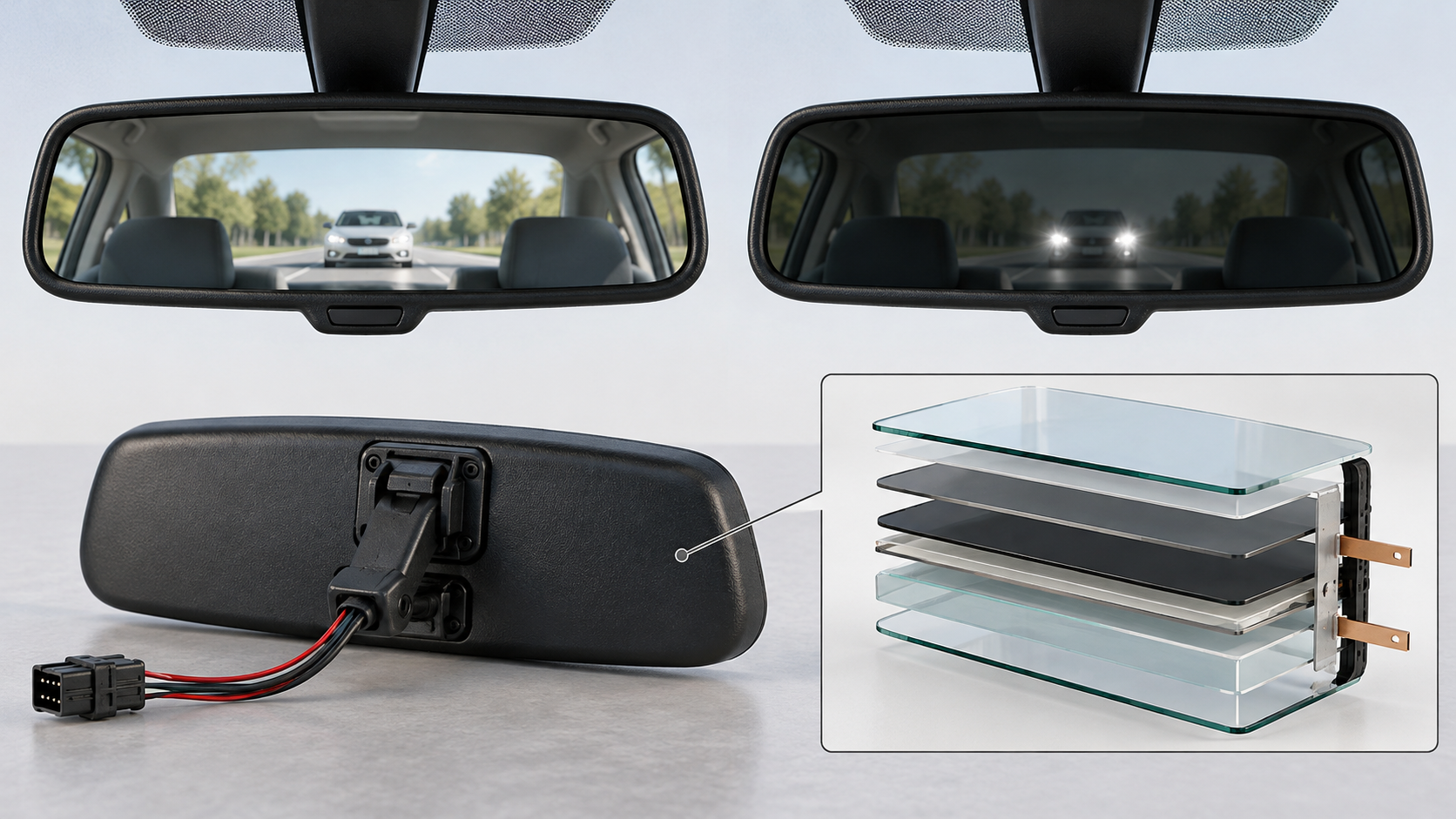
| Electrochromic auto-dimming mirrors (interior and exterior) | Darken in proportion to the glare of the headlamps of following vehicles | The interior mirror also drives the exterior mirrors. Worldwide share about 79% (2025, company estimate). The company believes its electrochromic materials and manufacturing process are the most efficient and cost-effective way to make these products; the 10-K gives no comparative data against other approaches | Reference 1 |
| Dimmable aircraft windows (EDW) | Passengers choose the tint; infrared is blocked, reducing the cabin’s air-conditioning load | An electrochromic gel is sealed between two thin glass panels. A low-voltage current through conductive coatings drives an electrochemical reaction that darkens the gel, and removing the voltage lets it return to transparent. The latest generation darkens twice as fast as before and eliminates more than 99.999% of visible light (releases of 2019 and 2020). A thin-film coating is also said to block infrared and ultraviolet light | References 2 and 3 |
| Large-area and small-scale dimmable devices | Sunroofs and windows; transparent displays and sensors | Described in the 10-K only as in development. No figures or timing | Reference 1 |
The company’s aircraft-window releases put forward both darkness (over 99.999% of visible light eliminated) and speed (twice as fast) Sourced. Eliminating 99.999% means transmittance of 0.001% or less, an extremely dark state. In electrochromics it is generally the case that a darker state needs a thicker or more concentrated colouring layer, which tends to slow switching and bleaching (our general commentary). Gentex’s claim of a state 100 times darker with twice the speed therefore amounts to having pushed that relationship outward through improvements to the gel. The composition and structure behind this are not public Not yet confirmed.
The other constraint is area. A mirror is small and a window somewhat larger, but a sunroof or car window is larger still. The larger the area, the more the electrical resistance of the conductive coating makes the voltage vary from place to place, which tends to cause uneven tint and slower switching (our general commentary). That the 10-K keeps large-area dimmable devices at the “in development” stage is consistent with this being central to production design Not yet confirmed.
The releases say that removing the voltage lets the gel return to its natural, transparent state, which matches PPG’s description of Alteos defaulting to clear when power is lost. For electrochromic aircraft windows, returning to the clear state when power is cut appears to be a common design choice.
“99.999%”, “twice as fast” and “100 times darker” are comparisons with earlier designs that the company states itself, and the releases do not give measurement conditions (wavelength, temperature, window size). The 79% share is a company estimate. None of these figures shows superiority over any other maker’s products.
11. The risks this company carries
| Risk | What it is | Type |
|---|---|---|
| Dependence on automotive | Automotive mirrors and electronics are 89% of sales. The 10-K says the automotive industry is cyclical and sensitive to economic activity | Sourced |
| Customer concentration | The top three customers (Toyota 18%, Volkswagen 11%, GM 10%) account for about four-tenths of sales. The loss or reduced production of one would weigh heavily | Sourced / Our calculation |
| Tariffs and the China market | Because it manufactures mainly in the United States, tariffs and counter-tariffs cut exports to China and lowered its worldwide share, the 10-K says. Auto-dimming mirror shipments fell 6% in 2025 | Sourced |
| Competition | Magna Mirrors is the main rival and has considerably more resources, the 10-K says. Chinese domestic makers also sell auto-dimming mirrors | Sourced |
| Concentrated manufacturing sites | Electrochromic products are made mainly at plants in Zeeland and Holland, Michigan, and the 10-K lists business disruption there as a risk | Sourced |
| R&D uncertainty | In 2024 it recorded an impairment of US$8.9 million on goodwill and IPR&D relating to Vaporsens (nanofibre sensing). An example of new technology not progressing as expected | Sourced |
| Small scale of aircraft windows | Window products are 0.7% of sales and depend on aircraft production plans | Sourced / Our calculation |
12. Glossary
- Electrochromic
- A property by which colour or tint changes reversibly when a voltage is applied. Gentex uses it in mirrors and windows.
- Auto-dimming mirror
- A mirror that senses the glare of headlamps behind and darkens its reflection automatically.
- EDW
- Electronically dimmable window: a window whose tint can be changed electrically.
- Transmittance
- The share of incident light that passes through. 0.001% is one part in 100,000.
- Conductive coating
- A transparent electrically conducting film on glass. It acts as the electrode that applies voltage to the electrochromic layer.
- IPR&D
- In-process research and development: an unfinished R&D asset valued at the time of an acquisition.
- OEM
- Original equipment manufacturer, such as a carmaker that builds the finished product.
- Form 10-K
- The annual report that U.S.-listed companies file with the U.S. SEC.
13. References
- Gentex Corporation Annual Report on Form 10-K for the fiscal year ended 31 December 2025 (filed with the U.S. SEC on 24 February 2026). Business, revenue by product, R&D spending, capital expenditure, headcount, customers, market share and outlook. https://www.sec.gov/Archives/edgar/data/355811/000035581126000010/gntx-20251231.htm
- Gentex Corporation Airbus Now Offering Gentex Dimmable Aircraft Windows (press release, 6 January 2020). https://ir.gentex.com/news-releases/news-release-details/airbus-now-offering-gentex-dimmable-aircraft-windows
- Gentex Corporation Boeing’s New 777X to Offer Gentex Dimmable Windows (press release, 8 January 2019). https://ir.gentex.com/news-releases/news-release-details/boeings-new-777x-offer-gentex-dimmable-windows
- Gentex Corporation Annual Report on Form 10-K for the fiscal year ended 31 December 2011 (filed with the U.S. SEC on 22 February 2012). The 2005 agreement with PPG Aerospace and the history of the dimmable windows for the Boeing 787. https://www.sec.gov/Archives/edgar/data/355811/000119312512071341/d271124d10k.htm
- Gentex Corporation Aerospace (company website). Its position as a supplier of dimmable windows. The About page covers in-house skills such as chemical development, glass processing and coatings. https://www.gentex.com/aerospace
14. Claim-to-source audit
| Claim in the text | Type | Source |
|---|---|---|
| Company name, incorporation (1974), headquarters, listing, 6,398 employees (5,708 in the U.S.) | Sourced | Reference 1 https://www.sec.gov/Archives/edgar/data/355811/000035581126000010/gntx-20251231.htm |
| Revenue (2023 to 2025) and revenue by product (mirrors and electronics, HomeLink, window products, fire protection) | Sourced | Reference 1 https://www.sec.gov/Archives/edgar/data/355811/000035581126000010/gntx-20251231.htm |
| Window products at US$18.9 million, 0.7% of company sales (18.9 divided by 2,534) | Our calculation | Our calculation from product revenue in Reference 1 |
| Automotive mirrors and electronics at 89% of sales; the top three customers’ shares | Sourced | Reference 1 https://www.sec.gov/Archives/edgar/data/355811/000035581126000010/gntx-20251231.htm |
| The top three customers together account for about four-tenths of sales (18% + 11% + 10%) | Our calculation | Our calculation from the customer shares in Reference 1 |
| R&D of US$203.3 million, capital expenditure of US$129.1 million, 2026 expectations | Sourced | Reference 1 https://www.sec.gov/Archives/edgar/data/355811/000035581126000010/gntx-20251231.htm |
| About 79% worldwide share and the reduction in exports to China from tariffs | Sourced | Reference 1 https://www.sec.gov/Archives/edgar/data/355811/000035581126000010/gntx-20251231.htm |
| Revenue outlook for 2026 and 2027, and expected capital expenditure | Not yet confirmed | Reference 1 https://www.sec.gov/Archives/edgar/data/355811/000035581126000010/gntx-20251231.htm |
| The 345,000 sq ft Zeeland building and the expansions | Sourced | Reference 1 https://www.sec.gov/Archives/edgar/data/355811/000035581126000010/gntx-20251231.htm |
| The Argil acquisition (2020) and the classification of its technology assets at the end of 2025 | Sourced | Reference 1 https://www.sec.gov/Archives/edgar/data/355811/000035581126000010/gntx-20251231.htm |
| Large-area and small-scale dimmable devices are in development | Not yet confirmed | Reference 1 https://www.sec.gov/Archives/edgar/data/355811/000035581126000010/gntx-20251231.htm |
| The 2005 agreement with PPG Aerospace, deliveries from 2010, and the 2008 Hawker Beechcraft work | Sourced | Reference 4 https://www.sec.gov/Archives/edgar/data/355811/000119312512071341/d271124d10k.htm |
| Airbus offering the latest-generation electrochromic windows (6 January 2020) and the technology description | Sourced | Reference 2 https://ir.gentex.com/news-releases/news-release-details/airbus-now-offering-gentex-dimmable-aircraft-windows |
| Adoption on the Boeing 777X (8 January 2019) and the technology description | Sourced | Reference 3 https://ir.gentex.com/news-releases/news-release-details/boeings-new-777x-offer-gentex-dimmable-windows |
| The chemistry lab, and in-house glass processing and coating skills | Sourced | Reference 5 https://www.gentex.com/aerospace |
| The four-type classification of companies (Fig. 1) | Our calculation | Our own grouping; company names are examples from those covered in this series |
| Sales of the electrochromic part alone, aircraft-window shipment volumes, and R&D spending and headcount for electrochromics alone | Not yet confirmed | Not in the 10-K; this article does not estimate them Reference 1 https://www.sec.gov/Archives/edgar/data/355811/000035581126000010/gntx-20251231.htm |
| The current relationship with PPG Aerospace | Not yet confirmed | Not in the latest 10-K; could not be confirmed Reference 4 https://www.sec.gov/Archives/edgar/data/355811/000119312512071341/d271124d10k.htm |
| Vehicles and launch timing of large-area dimmable devices | Not yet confirmed | Not in the 10-K Reference 1 https://www.sec.gov/Archives/edgar/data/355811/000035581126000010/gntx-20251231.htm |
| Reading that the aircraft window is a demonstration of the technology rather than a revenue source | Inference | This article’s interpretation of the sales share and the 10-K’s wording |
| Reading that large-area dimming is the next growth area after mirrors | Inference | This article’s interpretation of the 10-K’s statement that it is in development |
| Reading of the meaning of Argil’s reclassification | Inference | This article’s interpretation of the accounting change from in-process to developed |
| Reading that VOXX is meant to reduce automotive dependence | Inference | This article’s interpretation of the 10-K’s description of the acquisition |
| The darkness, speed and area trade-offs, and the shared fail-clear design | Not yet confirmed | Our commentary; not a statement in Gentex’s materials |
Last updated 10 October 2026 / Troy Technical
Figures in this article come from Gentex’s statutory filings with the U.S. Securities and Exchange Commission and from Gentex’s press releases and website. No research-firm estimates or press-based figures have been used. Product performance values are manufacturer’s stated values and were not verified here. Passages marked “Inference” are this article’s interpretation of primary sources, not statements made by the company.