COMPANY PROFILE / FUNCTIONAL MATERIALS
Kyocera
— A components-and-devices maker that links ceramic materials to finished parts, starting from fine ceramics
Kyocera began in 1959 as a small workshop making ceramic insulators, and today it also makes printers, tools and electronic components. This profile leaves the group as a whole aside and covers the functional-materials part: fine-ceramic components and multilayer piezoelectric elements (PZT). According to the English translation of its annual securities report for the year to March 2026, the “Core Components Business,” which contains this part, had sales revenue of ¥653.4 billion, or 31.6% of the group. Sales of fine-ceramic parts and piezoelectric elements are not reported separately, however. We separate what can be confirmed from what cannot.
- Kyocera at a glance, and its place in functional materials
- Logo and naming
- Where the company sits in functional materials
- Company scale (the group in brief)
- Resources committed to functional materials
- Track record
- Plans
- What the company appears to be aiming for
- Partnership map
- Technologies and products
- Risks
- Glossary / References / Claim-to-source audit
1. Kyocera at a glance, and its place in functional materials
Prime Market: 6971As of 31 March 2026
Materials (secondary)Makes its own ceramic materials
Multilayer piezoelectric elements (PZT)The scope of this profile
Kyocera sells its functional materials as parts made by firing ceramic materials, not as raw materials Sourced. In the securities report, fine-ceramic components for semiconductor processing equipment, automotive camera modules, ceramic packages and organic packages and boards are grouped into a single “Core Components Business.” As a result, the sales and profit of fine-ceramic parts or piezoelectric elements alone cannot be read from it Not yet confirmed. What is more, the English translation of the securities report (192 pages) does not contain the word “piezo” at all. We therefore describe the piezoelectric elements from what Kyocera’s official product sites state, and we say plainly that their contribution to company results could not be confirmed.
2. Logo and naming

A note on naming: the legal name is Kyocera Corporation (the name derives from the founding name, Kyoto Ceramic Co., Ltd.). In this article “Kyocera” means Kyocera Corporation and its consolidated subsidiaries. The medical-device business was handed over in October 2025 to a separate company, Kyocera Medical Corporation, and this profile does not go into medical devices.
Official site: https://global.kyocera.com/3. Where the company sits in functional materials
Kyocera is mainly a components-and-devices maker, but it is also a maker of its own ceramic materials Our calculation. Its official product site lists 14 ceramic materials, among them alumina, sapphire (single-crystal alumina), zirconia, silicon nitride, silicon carbide, aluminum nitride, ZTA (zirconia toughened alumina) and cermet, and sells them as parts for specific industries Sourced. The fields that our explainers “Piezoelectric materials and lead-free alternatives” and “Ferroelectric and dielectric materials” cover from the materials side are ones Kyocera mass-produces as parts.
4. Company scale (the group in brief)
Group-wide figures are below. They are not figures for fine-ceramic parts or piezoelectric elements alone Sourced.
| Indicator (consolidated, IFRS) | FY2024 (year to March 2024) | FY2025 (year to March 2025) | FY2026 (year to March 2026) |
|---|---|---|---|
| Sales revenue (¥ million) | 2,004,221 | 2,014,454 | 2,070,203 |
| Profit before income taxes (¥ million) | 136,143 | 63,631 | 168,994 |
| Employees (year-end) | 79,185 | 77,136 | 73,856 |
The part that bears on functional materials is the Core Components Business. Its FY2026 breakdown follows Sourced.
| Core Components Business (sales revenue, ¥ million) | FY2025 | FY2026 | Change |
|---|---|---|---|
| Core Components Business, total | 591,720 | 653,429 | +10.4% |
| Industrial & Automotive Components Unit (fine-ceramic components, automotive systems, optical components) | 241,871 | 250,069 | +3.4% |
| Semiconductor Components Unit (ceramic packages, organic packages and boards) | 327,049 | 379,432 | +16.0% |
| Others (medical devices and other) | 22,800 | 23,928 | +4.9% |
Fine-ceramic components are part of the Industrial & Automotive Components Unit, which also includes automotive camera modules and other products. We could not confirm from the English translation of the securities report which unit the piezoelectric elements belong to Not yet confirmed. The ¥61.7 billion rise in Core Components sales is attributed by the company mainly to the Semiconductor Components Unit (ceramic packages for information and communications markets, and organic packages for data centers). Whether fine-ceramic parts or piezoelectric elements grew or shrank cannot be told from this document.
5. Resources committed to functional materials
| Type of resource | What the sources show | Status |
|---|---|---|
| People | 73,856 in the group (31 March 2026). R&D sites: the Kirishima R&D Center in Kagoshima (research, production-technology and analysis divisions were centralized there in September 2022), the Keihanna Research Center in Kyoto Prefecture and the Minatomirai Research Center in Yokohama. Headcount for fine-ceramic parts and piezoelectric elements alone is not disclosed | Sourced |
| Money (R&D) | Group R&D was ¥115.7 billion in FY2026, of which the Core Components Business accounted for ¥26.1 billion (¥21.4 billion in FY2025, +22.0%). The company’s forecast for the group in FY2027 (year to March 2027) is ¥120.0 billion | Sourced; forecast is not yet confirmed |
| Money (capital expenditure) | Of group capital expenditure of ¥149.1 billion, the Core Components Business accounted for ¥78.8 billion in FY2026 (property, plant and equipment basis). The company says it expanded Core Components production capacity to meet rising semiconductor-related demand. The group forecast for FY2027 is ¥225.0 billion (+50.9%); the stated main purpose in each segment is “introduction of equipment to increase production and productivity” | Sourced; forecast is not yet confirmed |
| Investments, acquisitions, disposals | In October 2025 it acquired 33.0% of Japan Aviation Electronics Industry (capital and business alliance). In January 2026 it transferred its silicon-diode power-semiconductor business to Shindengen Electric Manufacturing and its U.S. tool subsidiary to TL Sapphire Holdings (a subsidiary of Truelink Capital Management). On 22 January 2026 it signed an agreement to transfer to Sumitomo Bakelite the shares of a new company that will take over its chemical business (semiconductor encapsulation materials and pastes); execution is scheduled for the end of October 2026. No investment or acquisition in ceramic materials or parts could be confirmed | Sourced |
| Universities, research institutes, public funding | The R&D section mentions open innovation using external resources, including academia, and, in medical devices, joint research with outside institutions. No specific university or institute, and no public funding such as NEDO, could be confirmed | Not confirmed |
Status of main products and facilities
| Product | Plant / facility | Scale | Stage | Date and source |
|---|---|---|---|---|
| Fine-ceramic components, ceramic packages | Shiga Higashiomi Plant (Gamo and Yokaichi plants integrated in April 2024), Kagoshima Sendai Plant, Kagoshima Kirishima Plant (Kokubu and Hayato plants integrated in April 2026) | Capacity not disclosed | Operating | Reference 1 https://global.kyocera.com/ir/library/pdf/yuho/FY26_4Q_ar.pdf |
| Multilayer piezoelectric elements | The plant could not be confirmed | “More than 50 million automotive fuel-injector elements shipped over more than 10 years” (a statement on the company’s product page, with no reference date) | Mass production (since 2005) | References 7, 8 https://global.kyocera.com/prdct/ecd/piezo_d33/index.html https://global.kyocera.com/prdct/ecd/casestudy/piezo01.html |
| Capital expenditure for FY2027 | Group forecast of ¥225.0 billion; the company states it does not plan expenditure project by project | — | Plan (Not yet confirmed) | References 1, 2 https://global.kyocera.com/ir/library/pdf/yuho/FY26_4Q_ar.pdf https://global.kyocera.com/ir/library/pdf/f_results/FY26_4Q_FinancialResults.pdf |
6. Track record
| When | What happened | Why it matters |
|---|---|---|
| April 1959 | Founded as Kyoto Ceramic Co., Ltd. With 28 people it began producing ceramic insulators for television picture tubes | The origin of the “fine ceramics” company |
| 2005 | Began mass production of multilayer piezoelectric elements (development started in 1999; single-plate elements for piezoelectric buzzers had been made since the early days) | A track record of mass-producing piezoelectric elements for diesel-engine injectors (from a company interview article) |
| 2008 | Began developing a casing-type piezoelectric actuator for mass flow controllers in semiconductor processing equipment | A move to a different duty, with voltage applied continuously |
| September 2022 | Centralized research, production-technology and analysis divisions of the Kagoshima Kokubu Plant in the Kirishima R&D Center | Consolidation of the materials and process research base |
| October 2025 | Transferred the medical business to Kyocera Medical Corporation. Acquired 33.0% of Japan Aviation Electronics Industry | Reshaping of the business portfolio |
| January 2026 | Transferred the silicon-diode power-semiconductor business and the U.S. tool subsidiary. Signed the agreement to transfer its chemical business to Sumitomo Bakelite (22 January) | Businesses outside ceramics are being sorted out |
| April 2026 | Integrated the Kagoshima Kokubu and Hayato plants into the Kagoshima Kirishima Plant | Consolidation of sites |
7. Plans
All of these are company forecasts and plans, not achieved results Not yet confirmed. As directions for R&D, the company names components and materials for next-generation semiconductor processing equipment, packages for high-speed optical communications and optoelectronic modules, and ceramic core substrates for chiplet packages Sourced. For piezoelectric elements, an engineer in the case study says that smaller size and higher flow rates will be needed, but no product plan or numerical target is given.
None of the following appears in the primary sources we reviewed Not yet confirmed.
Standalone sales or profit of fine-ceramic parts and piezoelectric elements / production capacity / individual plans for new plants or expansions / customer names (semiconductor-equipment makers, automakers and others) / a sales target for piezoelectric elements. PZT contains lead, but we do not state its treatment under the EU RoHS Directive and similar rules, because we could not confirm the final legal text.
8. What the company appears to be aiming for
This section includes points the company does not state directly. They are inferences from the primary sources, shown with their basis.
| What can be read | Primary-source basis | Status |
|---|---|---|
| The growth axis of its functional ceramics is semiconductors and information and communications | The main driver of Core Components growth is the Semiconductor Components Unit. The capital-expenditure explanation is “capacity expansion to meet rising semiconductor-related demand” | Sourced |
| Piezoelectric elements are probably one tool in the technology box rather than the main growth driver | The word “piezo” does not appear in the English translation of the securities report, while the product site emphasizes semiconductor-equipment uses | Inference |
| It is shedding non-ceramic businesses to concentrate resources on ceramics | Transfers of the tool subsidiary and the power-semiconductor business in January 2026, and the agreement to transfer the chemical business to Sumitomo Bakelite | Inference |
| Capital expenditure rises sharply in FY2027 | Group forecast of ¥225.0 billion (+50.9%); no breakdown by segment is given | Sourced (forecast is not yet confirmed) |
The company describes its capital-expenditure plan at the segment level but not at the project level Sourced. The Core Components Business accounted for ¥78.8 billion of capital expenditure in FY2026, about 53% of the group total. In the same year, the company went on selling off businesses such as the tool subsidiary. From this we read it as likely that the FY2027 increase is also weighted toward Core Components, and especially toward semiconductor applications. That is not something the company has said, and no segment forecast is published, so it remains an inference Not yet confirmed.
9. Partnership map
10. Technologies and products
Kyocera’s official sites describe its functional-materials products as follows (performance values are manufacturer’s stated values) Sourced.
| Area | What the official sites say |
|---|---|
| Fine-ceramic components | Parts made from alumina, sapphire, zirconia, silicon nitride, silicon carbide, aluminum nitride, ZTA, cermet and other materials, for semiconductor processing equipment, industrial machinery, analytical and laboratory instruments, medical equipment, energy and environment, automotive, ultra-high vacuum, space and astronomy, and consumer products |
| Materials, machining and bonding technologies | Presented examples include high-thermal-conductivity silicon nitride (SN241O), high-voltage-resistant alumina, low-dielectric-loss, high-strength, high-purity alumina (AO479U), metallized large ceramic substrates, diffusion bonding of multilayer alumina, simultaneous sintering and bonding, direct bonding of alumina and sapphire, semiconductive ceramic coating, and ceramic additive manufacturing |
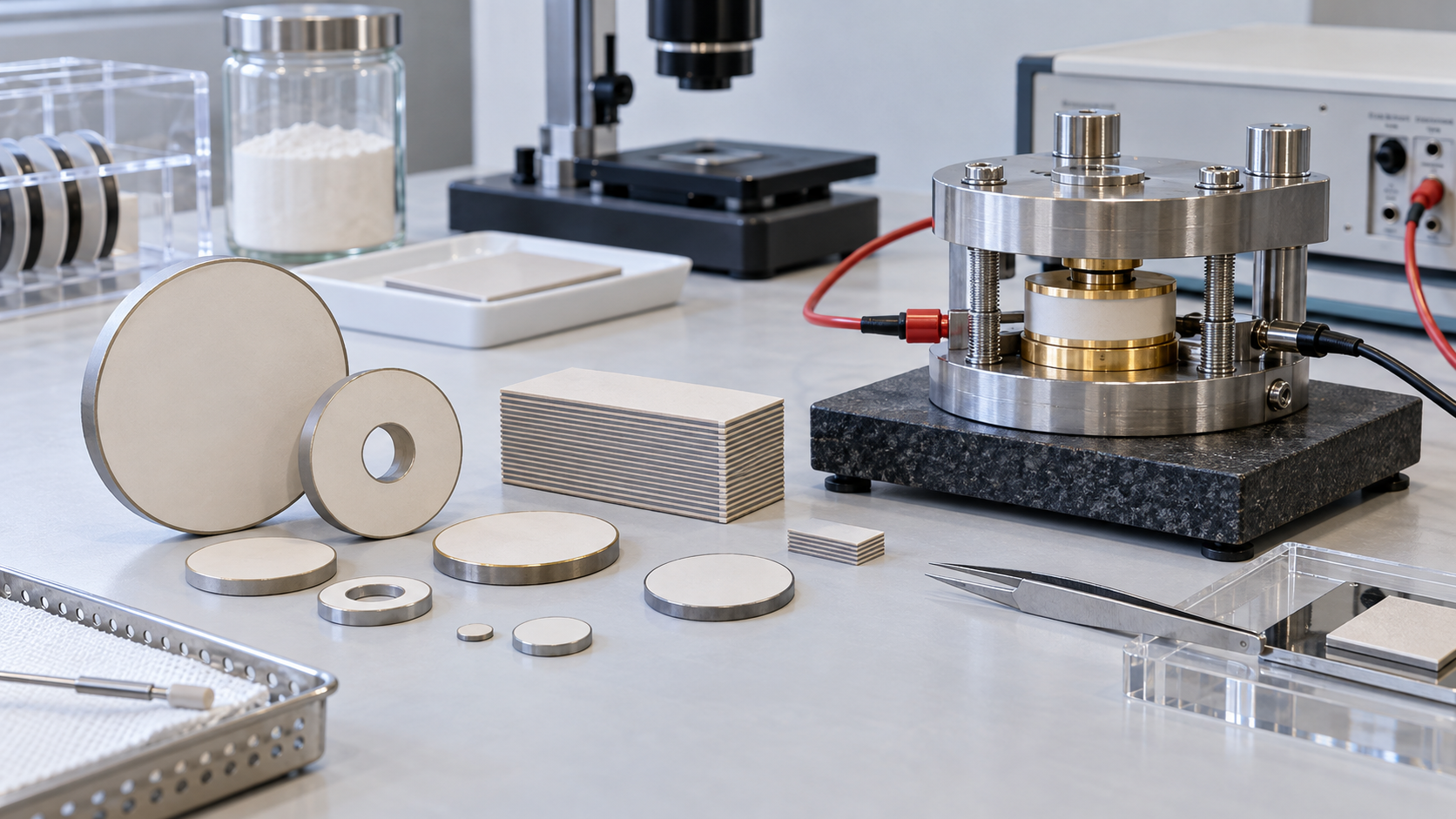
| Multilayer piezoelectric elements (PZT) | Tens to hundreds of PZT (lead zirconate titanate) ceramic layers alternate with internal electrodes. Three types: vertical-displacement (d33), horizontal-displacement (d31) and single-plate. Examples of standard vertical-displacement products: a 44 mm element gives 45 to 63 μm of displacement at 150 V, and a 64 mm element gives 73 to 103 μm. Dimensions range from 2 to 10 mm in width and length and 5 to 60 mm in height |
| Applications of piezoelectric elements | Antenna adjustment, image stabilization, speakers, pressure sensors, mass flow controllers, valve controllers and dispenser controllers in semiconductor equipment, wafer polishing, precision stages, optical-axis adjustment, power generation, automotive fuel injection and others |
| Other energy-conversion devices | Ceramic heaters (alumina and silicon nitride) said to heat above 1,000°C within seconds, and SOFC (solid oxide fuel cell) cell stacks |
Kyocera’s case study describes concretely the materials-side measures that decide the reliability of a multilayer piezoelectric element Sourced. A piezoelectric element expands and contracts with voltage, but it contains parts that stretch and parts that do not, and stress concentrates at the boundary, causing cracks and short circuits. The usual answer is to make the element stronger. Kyocera instead built in a deliberately fragile “crack control layer” to steer how cracks form. The company says an element with 20 layers will not short-circuit, whereas the one for mass flow controllers has more than 900 layers.
The second measure concerns the surface protection. Piezoelectric elements are commonly coated with silicone resin, but at high temperature the resin decomposes and causes dielectric breakdown. Kyocera therefore switched to a special inorganic coating and sealed the element completely in a stainless-steel case to improve humidity resistance. A diesel injector switches on and off at very high speed, whereas a mass flow controller works like a valve and the voltage must be applied continuously, so the way the element degrades differs. Solving that difference as a materials problem is the heart of the case study. This is Kyocera’s own account, not an independent verification. PZT contains lead; for trends in lead-free systems see our explainer “Piezoelectric materials and lead-free alternatives.”
11. Risks
| Risk | Detail | Status |
|---|---|---|
| Materials performance is hard to see | Sales and profit of fine-ceramic parts and piezoelectric elements are not disclosed on their own, so outsiders can hardly check how the business is moving | Sourced |
| Dependence on semiconductors and information and communications | The Core Components increase came mainly from the Semiconductor Components Unit, so a shift in AI and data-center demand would affect it. The company itself cites the risk that, as customers’ technical requirements rise, delays in expanding production and development capacity could prevent expected results | Sourced |
| Raw-material prices and supply | The company cites the possibility that higher raw-material prices cannot be passed on, its reliance on certain suppliers for some raw materials, and its work on alternative products that avoid high-risk materials subject to export and import rules | Sourced |
| Trade and regulatory change | It lists changes in tariffs, import and export restrictions and economic-security laws as risks of its international business | Sourced |
| Past impairments | About ¥43 billion of impairment in the Organic Packages and Boards Business (a one-time cost within Core Components) in FY2025, and about ¥10 billion of idle-asset write-downs and similar charges in FY2026 | Sourced |
| Recovering the investment | The company plans a large increase in capital expenditure in FY2027; if demand falls short of expectations, the depreciation burden would grow heavier | Inference |
12. Glossary
- Fine ceramics
- High-performance ceramics made by tightly controlling raw-material purity, particles and firing. Kyocera also calls them “advanced ceramics.”
- PZT
- Lead zirconate titanate, the best-known piezoelectric ceramic. It contains lead.
- Piezoelectric element
- A device that expands or contracts when voltage is applied and generates electricity when pressed. It serves as an actuator (to move) or a sensor (to measure).
- d33 / d31
- The direction of displacement in a piezoelectric element. d33 elongates along the electric field (the lamination direction); d31 elongates perpendicular to it.
- ZTA
- Zirconia toughened alumina: alumina with zirconia added to resist fracture better.
- Mass flow controller
- A device that holds gas flow constant in semiconductor manufacturing and elsewhere. Some designs use a piezoelectric element to drive the valve.
- Ceramic package
- A ceramic container or substrate that houses and protects an IC and connects it electrically to the outside.
- Securities report
- The annual report that Japanese listed companies file under the Financial Instruments and Exchange Act. Kyocera also publishes an English translation (the Annual Report).
13. References
- Kyocera Annual Report (English translation of the securities report), 72nd business term (1 April 2025 to 31 March 2026), filed 19 June 2026. Segments, sales revenue, R&D, capital expenditure, history, material agreements, risk factors, employees. https://global.kyocera.com/ir/library/pdf/yuho/FY26_4Q_ar.pdf
- Kyocera Consolidated Financial Results for the year ended March 31, 2026. Forecasts for capital expenditure and R&D for the year ending March 2027; segment capital expenditure. https://global.kyocera.com/ir/library/pdf/f_results/FY26_4Q_FinancialResults.pdf
- Kyocera Investor Relations, “Basic Information” (securities code, listing, shareholders as of 31 March 2026). https://global.kyocera.com/ir/s_info/basic.html
- Kyocera Kyocera Fine Ceramics (Advanced Ceramics) product site. List of ceramic materials and industries served. https://global.kyocera.com/prdct/fc/
- Kyocera Kyocera Fine Ceramics, “About Us”. Founding, sales, employees and group companies as of 31 March 2026. https://global.kyocera.com/prdct/fc/about-us/index.html
- Kyocera Energy Conversion Devices product site (ceramic heaters, piezoelectric devices, SOFC cell stacks). https://global.kyocera.com/prdct/ecd/index.html
- Kyocera Piezoelectric devices, “Multi-layer Vertical displacement type (d33 mode)”. Structure, applications and standard-product specifications (manufacturer’s stated values). https://global.kyocera.com/prdct/ecd/piezo_d33/index.html
- Kyocera Case study, “High-Reliability Piezoelectric Actuator Casing Brings Added Value to the Semiconductor Processing Equipment (SPE) Industry”. Development history, inorganic coating, crack control layer. https://global.kyocera.com/prdct/ecd/casestudy/piezo01.html
- Kyocera Solution Technologies (materials, machining and bonding technologies for ceramics). https://global.kyocera.com/prdct/fc/technologies/index.html
14. Claim-to-source audit
| Claim in the text | Status | Source |
|---|---|---|
| Legal name, headquarters, listing and securities code | Sourced | References 1, 3 https://global.kyocera.com/ir/library/pdf/yuho/FY26_4Q_ar.pdf https://global.kyocera.com/ir/s_info/basic.html |
| Sales revenue, profit before income taxes and employees (FY2024 to FY2026); group scale | Sourced | Reference 1 https://global.kyocera.com/ir/library/pdf/yuho/FY26_4Q_ar.pdf |
| Core Components sales revenue of ¥653,429 million, the unit breakdown and the main driver of the increase | Sourced | Reference 1 https://global.kyocera.com/ir/library/pdf/yuho/FY26_4Q_ar.pdf |
| Definition of the Core Components Business (fine-ceramic components for semiconductor processing equipment, automotive camera modules, ceramic packages, organic packages and boards) | Sourced | Reference 1 https://global.kyocera.com/ir/library/pdf/yuho/FY26_4Q_ar.pdf |
| R&D expenses (group ¥115,701 million, Core Components ¥26,120 million) and the FY2027 forecast of ¥120,000 million | Sourced | References 1, 2 https://global.kyocera.com/ir/library/pdf/yuho/FY26_4Q_ar.pdf https://global.kyocera.com/ir/library/pdf/f_results/FY26_4Q_FinancialResults.pdf |
| Capital expenditure (group ¥149,099 million, Core Components ¥78,759 million), the FY2027 forecast of ¥225,000 million and its main purpose | Sourced | References 1, 2 https://global.kyocera.com/ir/library/pdf/yuho/FY26_4Q_ar.pdf https://global.kyocera.com/ir/library/pdf/f_results/FY26_4Q_FinancialResults.pdf |
| 33.0% stake in Japan Aviation Electronics Industry; transfers of the silicon-diode business and the tool subsidiary; takeover of the medical business | Sourced | Reference 1 https://global.kyocera.com/ir/library/pdf/yuho/FY26_4Q_ar.pdf |
| Share transfer agreement with Sumitomo Bakelite (signed 22 January 2026; execution planned for the end of October 2026) | Sourced | Reference 1 https://global.kyocera.com/ir/library/pdf/yuho/FY26_4Q_ar.pdf |
| R&D sites and plant integrations (Shiga Higashiomi, Kagoshima Kirishima) | Sourced | Reference 1 https://global.kyocera.com/ir/library/pdf/yuho/FY26_4Q_ar.pdf |
| R&D directions (components and materials for next-generation equipment, optical-communications packages, ceramic core substrates) | Sourced | Reference 1 https://global.kyocera.com/ir/library/pdf/yuho/FY26_4Q_ar.pdf |
| 14 ceramic materials and industries served; list of materials, machining and bonding technologies | Sourced | References 4, 9 https://global.kyocera.com/prdct/fc/ https://global.kyocera.com/prdct/fc/technologies/index.html |
| Founding (1959, 28 people), 279 group companies, 73,856 employees | Sourced | Reference 5 https://global.kyocera.com/prdct/fc/about-us/index.html |
| Piezoelectric element structure (PZT, multilayer, d33, d31, single-plate), standard-product specifications, applications, shipments for automotive fuel injection | Sourced (manufacturer’s stated values) | References 6, 7 https://global.kyocera.com/prdct/ecd/index.html https://global.kyocera.com/prdct/ecd/piezo_d33/index.html |
| Start of multilayer development (1999) and mass production (2005), start of casing-type development (2008), inorganic coating, crack control layer, more than 900 layers | Sourced (manufacturer’s account) | Reference 8 https://global.kyocera.com/prdct/ecd/casestudy/piezo01.html |
| Ceramic heaters and SOFC cell stacks as products | Sourced | Reference 6 https://global.kyocera.com/prdct/ecd/index.html |
| Risks: raw-material prices, supplier dependence, trade rules, impairments, delays in expanding capacity | Sourced | Reference 1 https://global.kyocera.com/ir/library/pdf/yuho/FY26_4Q_ar.pdf |
| Kyocera’s type (components and devices primary, materials secondary) | Our calculation | Our own classification in this article |
| Standalone sales, profit, capacity and customer names for fine-ceramic parts and piezoelectric elements | Not yet confirmed | Not stated in the primary sources; we do not estimate them. Reference 1 https://global.kyocera.com/ir/library/pdf/yuho/FY26_4Q_ar.pdf |
| That piezoelectric elements are not mentioned in the English translation of the securities report | Sourced | The result of our review of the full text. Reference 1 https://global.kyocera.com/ir/library/pdf/yuho/FY26_4Q_ar.pdf |
| University or public-funding partnerships and investments or acquisitions related to ceramics | Not yet confirmed | Not confirmed; we do not assert that none exist. Reference 1 https://global.kyocera.com/ir/library/pdf/yuho/FY26_4Q_ar.pdf |
| FY2027 forecasts for capital expenditure, R&D and sales revenue | Not yet confirmed | Company forecasts, not achieved results. Reference 2 https://global.kyocera.com/ir/library/pdf/f_results/FY26_4Q_FinancialResults.pdf |
| That the growth axis is semiconductors and information and communications | Inference | Our own reading of the main driver of Core Components growth and the capital-expenditure explanation |
| That piezoelectric elements are one tool in the technology box | Inference | Our own reading of their absence from the securities report |
| That resources are being concentrated on ceramics | Inference | Our own reading of the business transfers and reorganizations |
| Risk of recovering the capital expenditure | Inference | Our own reading of the FY2027 capital-expenditure plan |
Last updated: 10 October 2026 / Troy Technical
The figures in this article come from the English translation of Kyocera’s securities report for the year to March 2026 filed with the Kanto Local Finance Bureau, its financial results materials and its official product sites. We use no market-research estimates or press-report figures. Product specifications are manufacturer’s stated values; the standard-product displacement is given at an applied voltage of 150 V, and other test conditions are not stated on the official page. Passages marked “Inference” are our own reading of the primary sources and are not statements by the company.