COMPANY PROFILE / FUNCTIONAL MATERIALS
Murata Manufacturing
“Good electronic components come from good materials”: barium titanate dielectrics and PZT piezoelectric ceramics, made in house
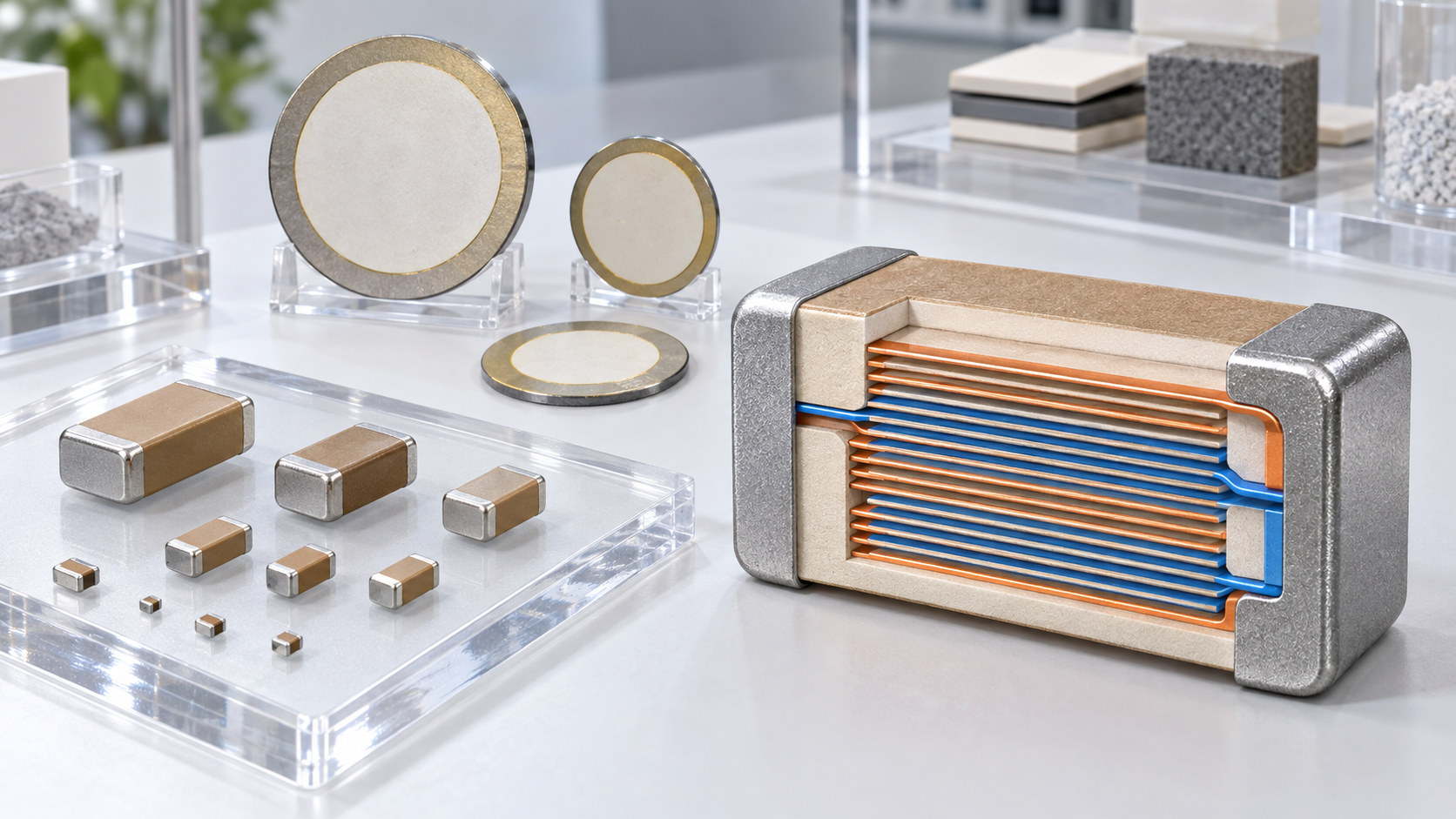
Murata Manufacturing is the electronic-components maker best known for the multilayer ceramic capacitors (MLCCs) that fill smartphones and servers. It began in 1944 by making ceramic capacitors. This profile does not cover the whole company. It covers functional ceramics, that is, dielectrics (MLCCs) and piezoelectric ceramics. In its technology pages Murata says plainly that its MLCC dielectric is barium titanate (BaTiO3) and that its piezoelectric materials include lead zirconate titanate (PZT). In the year to March 2026 the Capacitors category, which includes MLCCs, had revenue of ¥936.4 billion, 51.1% of group revenue. By contrast, revenue from piezoelectric parts alone appears in no disclosure we could find. This article does not estimate it; it separates what we could confirm from what we could not.
- Murata in 30 seconds, and where it stands in functional materials
- The logo and how the name is written
- Where the company sits in the functional-materials field
- Scale (the group in brief)
- Resources committed to functional materials
- What it has done so far
- What comes next
- What the company is aiming for in functional materials
- Map of partnerships in functional materials
- Technology, products and services
- The risks this company carries
- Glossary, references and claim-to-source audit
1. Murata in 30 seconds, and where it stands in functional materials
(secondary: materials)Also makes its own ceramic raw materials
PZT piezoelectric ceramicsNamed in the company’s technology page
in April to June 2026Led by servers and data centres
Murata’s functional ceramics have two faces Sourced. One is the dielectric (MLCC), which accounts for half of revenue. This is the core business, and the company’s medium-term policy says it aims to win the number one share of the capacitor market. The other is piezoelectric ceramics for ultrasonic sensors, microblowers and actuators. The technology page says PZT is used, but the size of the business is not disclosed. This profile does not give the two equal weight. For the piezoelectric side it also notes a regulatory clock: the EU exemption for lead expires in 2027.
2. The logo and how the name is written

A note on names: the legal entity is Murata Manufacturing Co., Ltd., and the brand is written Murata. This profile does not cover the group’s other businesses (high-frequency modules, batteries, communications modules and so on). The logo is the vector image taken from the company’s official website.
Official site: https://corporate.murata.com/en-global3. Where the company sits in the functional-materials field
We classify Murata as a components and devices maker (primary type) that also straddles materials and raw-material making (secondary type) because it makes its own ceramic raw materials Our calculation. Its Annual Securities Report lists sites whose business includes “manufacturing of raw materials” (for example the Yokaichi Plant in Shiga) and a Chinese subsidiary, Foshan Murata Materials (raw-material manufacturing, 90.0% owned). The company states its materials philosophy as “good electronic equipment comes from good electronic components, and good electronic components come from good materials”, and says it has inorganic, metallic and organic materials technologies. For the physics of ferroelectrics and the move to lead-free piezoelectrics, see our explainers on ferroelectrics and dielectric materials and on piezoelectric materials and lead-free alternatives; this profile concentrates on Murata’s business and products.
4. Scale (the group in brief)
We give the scale of the whole company, with the emphasis on the parts that touch functional ceramics Sourced.
| Metric (year to March, ¥ million) | Year to March 2025 | Year to March 2026 | Note |
|---|---|---|---|
| Revenue (group) | 1,743,352 | 1,830,856 | Up 5.0% |
| Operating profit | 279,702 | 281,835 | Operating margin of 15.4% |
| Capacitors (includes MLCCs) | 831,845 | 936,418 | 51.1% of group revenue; up 12.6% |
| Inductors and EMI filters | 201,273 | 223,316 | Mainly ferrite-based parts (not detailed here) |
| Functional Device (sensors, timing devices) | 97,822 | 107,074 | Up 9.5%. No breakdown for piezoelectric parts |
| R&D expenses (group) | 149,274 | 158,870 | Of which the Components business: ¥57,083 million |
| Capital expenditure (group) | 180,471 | 247,778 | Of which the Components business: ¥187,749 million |
| Consolidated employees (persons) | 72,572 | 74,302 | At each year end |
| Latest quarter (April to June, ¥ million) | 2025 | 2026 | Change |
|---|---|---|---|
| Revenue (group) | 416,154 | 502,264 | Up 20.7% |
| Capacitors | 217,330 | 282,508 | Up 30.0% (mainly data centres and servers) |
These figures are for the whole group or a reporting segment. “Capacitors” includes more than MLCCs, and MLCC revenue on its own is not disclosed. The results summary says only that the Capacitors category includes MLCCs. Likewise, revenue, profit, headcount and R&D spending for piezoelectric parts appear in neither the results summary nor the Annual Securities Report Not yet confirmed. The description of the Functional Device category mentions sensors and timing devices and notes that “revenue of actuators increased”, but the total for products using piezoelectric ceramics cannot be read from it. The company has issued a full-year forecast for the year to March 2027 (revenue of ¥1,960 billion and operating profit of ¥380 billion), but this is the company’s forecast Not yet confirmed.
5. Resources committed to functional materials
For each of the four points we show whether official materials let us confirm it.
| Type of resource | What we found | Status |
|---|---|---|
| People | 74,302 consolidated employees at the end of March 2026. R&D sites include the head office and the Nagaoka Plant in Kyoto and the Minato MIRAI Innovation Center in Yokohama (opened in 2020). Headcount in materials research or piezoelectrics is not disclosed | Sourced / not confirmed |
| Money | R&D spending of ¥158.9 billion for the group (¥57.1 billion in the Components business). Capital expenditure of ¥247.8 billion (¥187.7 billion in Components). For the year to March 2027 it plans ¥250 billion of capital expenditure and ¥167 billion of R&D (company forecast) | Sourced |
| Outside investments, acquisitions, joint ventures, divestments | The Chinese raw-material subsidiary Foshan Murata Materials (capital of US$68.9 million, 90.0% owned). A new in-house corporate venture capital firm, WONDERSTONE Ventures, in the U.S. (in the year to March 2026). Strategic investments already executed or approved came to ¥28.3 billion. We could not confirm any acquisition or investment specific to dielectrics or piezoelectrics | Sourced / not confirmed |
| Universities, research institutes, public funding | The report cites open innovation through technical exchange and joint development with outside parties, and a co-creation project, “KUMIHIMO Tech Camp with Murata 2025-2026”. Named universities, or public grants specific to dielectric or piezoelectric materials, were not confirmed in the materials we reviewed | Not confirmed |
The status of main facilities is below.
| Facility | Plant / equipment | Scale | Stage | Date | Reference |
|---|---|---|---|---|---|
| Component production (Izumo Murata Manufacturing) | Izumo, Shimane, and other sites | Planned spending of ¥58 billion (capacity gain not disclosed) | Plan for new or expanded equipment (own funds) | March 2026 to March 2027 | Reference 1 |
| Component production (Fukui Murata Manufacturing) | Echizen, Fukui, and other sites | Planned spending of ¥32 billion | Plan (own funds) | March 2026 to March 2027 | Reference 1 |
| Raw-material, device and module production (Yasu Division) | Yasu, Shiga | Planned spending of ¥15 billion | Plan (own funds) | March 2026 to March 2027 | Reference 1 |
| Production in Thailand, Wuxi (China) and the Philippines | Overseas subsidiaries | ¥20 billion, ¥12 billion and ¥8 billion | Plan | March 2026 to March 2027 | Reference 1 |
| Production equipment for ceramic raw materials and other items | Machinery and equipment added by the reporting company in the year to March 2026, as described in the report | Amount not disclosed | Installed | Year to March 2026 | Reference 1 |
The Annual Securities Report says some of the company’s manufacturing companies and sites make raw materials, and that in the year to March 2026 it added machinery for “production facilities for ceramic raw materials, etc.” Sourced. The technology page describes the route as micronising high-purity BaTiO3 powder to submicron size, forming it into sheets and sintering it in tightly controlled furnaces. In MLCCs, refining and homogenising the dielectric powder and smoothing the sheet surface during forming set the limit on how thin and how many layers can be made. The design is therefore one in which controlling the material from the powder up bears directly on the performance and reliability of the part. The ¥15 billion planned for the Yasu Division in the year to March 2027 is described as for “raw materials, devices and modules” production equipment, which hints at in-house raw-material expansion, but no numerical raw-material capacity is disclosed Not yet confirmed.
6. What it has done so far
| When | What happened | Why it matters |
|---|---|---|
| October 1944 | Founded in Kyoto, starting to make ceramic capacitors | Ceramic dielectrics are where the business began |
| 1962 | Established the Yokaichi Plant (Shiga) and invested in Fukui Murata Manufacturing | The start of its domestic production network |
| 1983 to 1987 | Founded Izumo Murata Manufacturing (1983), Kanazawa Murata Manufacturing (1984) and the Yasu Plant (1987) | Sites that remain targets of capital spending today |
| 1994 | Founded Wuxi Murata Electronics in China | Expansion of component production overseas |
| 10 July 2025 | Began mass production of a 47µF MLCC in the 0402-inch size (1.0 × 0.5 mm), stated to be a world first by Murata’s own research. Mounting area is about 60% smaller than a 0603-inch part of the same capacitance | A result of shrinking dielectric layers and internal electrodes |
| 8 April 2026 | Began mass production of seven automotive MLCCs, for example 100µF in the 1206-inch size (previously 1210-inch) and 1µF in 0402-inch at 25 Vdc. Murata says these are the largest capacitances for their rated voltage and size | The company credits particle refinement and uniformity |
| Year to March 2026 | Began closed-loop recycling of silver, which it describes as a first in the electronic components industry. Set up the U.S. corporate venture capital firm WONDERSTONE Ventures | A response to resource constraints, and a link to outside start-ups |
| 30 April 2026 | Announced results for the year to March 2026. MLCC revenue rose, led by servers | Capturing AI and data-centre demand |
7. What comes next
These forecasts are company targets, not results already achieved Not yet confirmed. The results summary names higher capacitor and power-supply-module sales for servers as growth drivers, and lower sales of multilayer resin substrates for smartphones, among others, as offsets. The medium-term policy (Medium-Term Direction 2027) names edge devices, mobility and IT infrastructure as core fields and aims for the number one share in capacitors and in inductors and EMI filters.
Sales targets for piezoelectric ceramics, numerical MLCC production capacity, raw-material output, plans to commercialise lead-free piezoelectric materials and the timing of any switch away from PZT appear in none of the official materials Not yet confirmed.
8. What the company is aiming for in functional materials
This chapter includes points the company has not stated directly. They are inferences drawn from primary sources, set out with their grounds.
| What we infer | Primary-source basis | Status |
|---|---|---|
| The centre of its functional ceramics is the MLCC, with piezoelectrics in a separate position | Capacitors are 51.1% of revenue. Products using piezoelectrics belong to the Functional Device category (¥107.1 billion, sensors and timing devices), with no separate category or figure | Inference |
| It places its MLCC competitiveness on materials (powder and microstructure control) | In April 2026 it credited “proprietary ceramic materials and particle refinement and uniformity”, and its technology page explains the core-shell structure and nickel-electrode compatibility | Sourced |
| It is concentrating capital spending on AI and server demand | The results summary says planned spending of ¥250 billion for the year to March 2027 is mainly to expand capacity for products whose demand is expected to grow, particularly servers | Sourced |
| It is building its business on the premise of continuing to use lead-containing PZT for the time being | The technology page describes PZT-based piezoelectric materials and does not mention lead-free ones. The EU exemption (to the end of 2027) could be a basis | Inference |
The last row is our observation, not a company policy. The technology page, in explaining piezoelectric materials, cites PZT as its example and says characteristics are designed for the application, without mentioning lead-free materials or any transition Sourced. The EU RoHS Directive, meanwhile, exempts lead in piezoelectric ceramics (PZT) until 31 December 2027 (Chapter 10). From this we read the company as designing products around PZT until the rules change Not yet confirmed. This does not mean the company is not researching lead-free materials. We simply could not confirm it from public materials.
9. Map of partnerships in functional materials
10. Technology, products and services
Dielectrics: MLCCs
According to the company’s technology page, the MLCC dielectric is barium titanate (BaTiO3), “a critical material that determines the capacitor’s capacitance and voltage withstand characteristics”. High-purity powder is micronised to submicron size, formed into sheets and sintered in precisely controlled furnaces Sourced. According to the company’s FAQ, production takes eight steps: printing internal electrodes on dielectric sheets, stacking the sheets, pressing, cutting, sintering, applying and baking the outer electrodes, plating, and measurement and packaging.
| Announcement (manufacturer’s stated values) | Specification | Date and conditions |
|---|---|---|
| 47µF MLCC (GRM158R60E476ME01, GRM158C80E476ME01) | 0402-inch (1.0 × 0.5 mm). Rated 2.5 Vdc, ±20%. Two variants: X5R (-55 to +85 °C) and X6S (-55 to +105 °C). Mounting area about 60% smaller than a 0603-inch part of the same capacitance; about 2.1 times the capacitance of the earlier 22µF part of the same size | Announced 10 July 2025. “World’s first mass production” according to Murata’s research as of 9 July 2025 |
| Seven automotive MLCCs (GCM series) | For example 100µF in the 1206-inch size at 2.5 to 4 Vdc, 2.2µF in 0201-inch, and 1µF in 0402-inch at 25 Vdc. AEC-Q200 qualified. The 100µF part in 1206-inch gives the capacitance previously available in 1210-inch, with about 36% less mounting area | Announced 8 April 2026. “The largest capacitance for each rated voltage and size” according to Murata’s research as of 7 April 2026 |
Piezoelectric ceramics: ultrasonic sensors, microblowers, actuators
According to the company’s product pages, the main products using piezoelectric ceramics are as follows Sourced.
| Product (manufacturer’s stated values) | Use and features | Conditions and notes |
|---|---|---|
| Aerial ultrasonic sensors | They send ultrasonic waves into the air and receive the reflection from objects. Used for intruder alarms, automatic doors and distance measurement in automotive parking assistance. Types include a 300 kHz high-frequency type (for double-feed detection), a 40 kHz open-structure type and a 48 kHz drip-proof type | The company attributes them to “unique piezoelectric ceramic technology developed over many years” |
| Microblower (MZB3005T06) | A thin piezoelectric air pump driven by the ultrasonic vibration of ceramic | Drive resonance frequency 21.5 to 24.5 kHz. Flow of at least 155 mL/min at 18 Vdc and static pressure of at least 50 kPa at 19.5 Vdc, measured at 18 to 28 °C and 950 to 1020 hPa. Flow and pressure fall sharply if the metal surface of the pump exceeds 60 °C. The page states that it cannot be used for automobile applications (including accessories) |
| Piezoelectric actuators | They use the displacement of piezoelectric ceramic under voltage for position control and fine drive control | Individual specifications are not covered here |
The technology page names, as the microstructure of BaTiO3 for MLCCs, a core-shell structure in which a ferroelectric core is surrounded by a non-ferroelectric shell Sourced. Additives dissolve into the shell, and the volume ratio of shell to core strongly affects properties. As an example, dissolving the rare-earth element dysprosium (Dy) into the shell is said to flatten the temperature characteristics of capacitance and extend component life. The design trade-off in play is between small variation of capacitance with temperature (a thicker shell) and high capacitance (a larger ferroelectric core), and the adjustment is made through firing conditions and additive quantities (our summary within what the technology page says).
Nickel internal electrodes: the company says that, to use low-cost nickel electrodes, designing a dielectric resistant to reduction, so that it does not degrade when fired in a reducing atmosphere, was decisive. As layers got thinner, non-uniformity and abnormal regions became problems; reliability was secured by refining and homogenising the powders and smoothing the substrate surface during sheet forming.
The rare earth Dy is a material subject to resource constraints and potentially to Chinese export controls on rare earths. The Annual Securities Report cites tightening mineral supply in general, but does not disclose Dy usage, sources or the state of substitution Not yet confirmed.
PZT: the technology page says piezoelectric materials such as PZT have “piezoelectric characteristics and temperature characteristics designed to suit the application”, and describes the function as essential for ultrasonic distance sensors and precision microactuators. Because it contains lead, the following regulatory position matters.
Annex III to the EU RoHS Directive (Directive 2011/65/EU) sets out exemptions for lead. Commission Delegated Directive (EU) 2025/2363, adopted on 8 September 2025 and published in the Official Journal on 21 November 2025, provides the following Sourced.
(1) 7(c)-I, “electrical and electronic components containing lead in a glass or ceramic other than dielectric ceramic in capacitors, e.g. piezoelectronic devices”: expires on 30 June 2027 (all categories). (2) A new 7(c)-VI, for lead in “piezoelectric lead zirconium titanate (PZT) ceramics” and in ceramics with a positive temperature coefficient (PTC): expires on 31 December 2027. (3) 7(c)-II, lead in dielectric ceramic in capacitors rated 125 V AC or 250 V DC or higher: expires on 31 December 2027 (this concerns lead-containing dielectrics; barium titanate, BaTiO3, has no lead in its formula).
Member States were to adopt national measures by 30 June 2026 and apply them from 1 July 2026 (Article 2 of the Directive). These are adopted and published provisions, not proposals. An exemption can be the subject of a renewal request before it expires, so whether an expiry date means an immediate ban depends on whether renewal is granted. We could not confirm, from public materials, which exemption entry any individual Murata product relies on.
11. The risks this company carries
| Risk | What it is | Status |
|---|---|---|
| Dependence on capacitors | The Annual Securities Report lists the fact that capacitors are 51% of revenue, a high dependence, as a risk. No customer group exceeds 10% | Sourced |
| Demand swings and falling selling prices | The company’s forecast lists a fall in selling prices and higher fixed costs as offsets to the profit gain from higher output. With investment concentrated on AI-server demand, it is exposed to changes in that demand | Sourced |
| Raw materials and mineral resources | The company writes that supply and demand for mineral resources is tightening and that there is a long-term risk of depletion; supply disruption or price spikes could cause production stoppages or delivery delays. It has begun closed-loop recycling of silver | Sourced |
| Expiry of the lead exemptions | The exemption for lead in PZT piezoelectric ceramics expires on 31 December 2027 (renewal undecided). The size of the piezoelectric business is not disclosed, so the effect cannot be assessed | Sourced / not confirmed |
| Tightening chemical regulation | The company expects environmental regulation of chemical substances in products to tighten and costs to rise, and lists a partial withdrawal from business among possible outcomes if adaptation proves very difficult | Sourced |
| Limits on automotive use | The microblower page states that the product cannot be used for automobile applications. Uses of piezoelectric products need to be checked product by product | Sourced |
| Price and capacitance competition | The company says it aims for the top share in capacitors, but its Annual Securities Report gives no named competitors or figures for comparison. This article does not rank companies | Sourced |
12. Glossary
- MLCC (multilayer ceramic capacitor)
- A small capacitor made by stacking many thin sheets of ceramic dielectric with metal internal electrodes and firing them.
- BaTiO3 (barium titanate)
- A ferroelectric with a high dielectric constant, used as the main component of MLCC dielectrics.
- Core-shell structure
- A particle whose centre (core) and outer layer (shell) differ in properties. In MLCC dielectrics, a ferroelectric core is wrapped in a non-ferroelectric shell.
- PZT (lead zirconate titanate)
- A representative piezoelectric ceramic that converts pressure into electricity and electricity into deformation or vibration. It contains lead.
- Piezoelectricity
- The property of producing a voltage when force is applied, and of deforming when a voltage is applied.
- RoHS Directive
- An EU directive restricting hazardous substances such as lead in electrical and electronic equipment. It has time-limited exemptions for particular uses.
- AEC-Q200
- A reliability-test standard for passive components used in vehicles.
- Annual Securities Report
- The annual report that Japanese listed companies file under the Financial Instruments and Exchange Act.
13. References
- Murata Manufacturing Co., Ltd. Annual Securities Report, 90th fiscal year (1 April 2025 to 31 March 2026), English translation (published on the company’s website on 10 July 2026; the Japanese original was filed with the Kanto Local Finance Bureau). Business, history, R&D, capital expenditure, major facilities and plans, risks. https://corporate.murata.com/-/media/corporate/about/newsroom/news/irnews/irnews/2026/0710/90_annualsecuritiesreport.ashx?la=en&cvid=20260709072633000000
- Murata Manufacturing Co., Ltd. Consolidated Financial Results for the Year Ended March 31, 2026 (Under IFRS) (results summary, 30 April 2026). Revenue, segment revenue, forecasts. https://corporate.murata.com/-/media/corporate/about/newsroom/news/irnews/irnews/2026/0430/25q4-e-fls.ashx?la=en&cvid=20260430013812000000
- Murata Manufacturing Co., Ltd. Consolidated Financial Results for the Three Months Ended June 30, 2026 (Under IFRS) (results summary, 31 July 2026). Revenue for April to June 2026. https://corporate.murata.com/-/media/corporate/about/newsroom/news/irnews/irnews/2026/0731/26q1-e-fls.ashx?la=en&cvid=20260731015630000000
- Murata Manufacturing Co., Ltd. Inorganic Materials Technology (official technology page: BaTiO3, core-shell structure, nickel internal electrodes, PZT, ferrites). Retrieved 10 October 2026. https://corporate.murata.com/en-global/technology/technology-platform/materials-technology/inorganic-materials
- Murata Manufacturing Co., Ltd. Materials Technology (official technology page: materials philosophy). Retrieved 10 October 2026. https://corporate.murata.com/en-global/technology/technology-platform/materials-technology
- Murata Manufacturing Co., Ltd. Murata Begins World’s First Mass Production of 47µF Multilayer Ceramic Capacitor in 0402-inch Size (10 July 2025). https://www.murata.com/news/capacitor/ceramiccapacitor/2025/0710
- Murata Manufacturing Co., Ltd. Murata begins mass production of seven automotive MLCCs with world-leading capacitance for their rated voltage and size (8 April 2026). https://www.murata.com/en-us/news/capacitor/ceramiccapacitor/2026/0408
- Murata Manufacturing Co., Ltd. What is the production process of Multilayer Ceramic Capacitors? (official FAQ). Retrieved 10 October 2026. https://www.murata.com/support/faqs/capacitor/ceramiccapacitor/conf/0002
- Murata Manufacturing Co., Ltd. Ultrasonic Sensors (official product page). Retrieved 10 October 2026. https://www.murata.com/en-us/products/sensor/ultrasonic
- Murata Manufacturing Co., Ltd. Micro Mechatronics (microblowers and actuators). Retrieved 10 October 2026. https://www.murata.com/en-us/products/mechatronics
- Murata Manufacturing Co., Ltd. Microblower MZB3005T06 (official product page: specifications and notes). Retrieved 10 October 2026. https://www.murata.com/en-us/products/mechatronics/fluid/overview/lineup/microblower_mzb3005t06
- European Commission Commission Delegated Directive (EU) 2025/2363 of 8 September 2025 amending Directive 2011/65/EU as regards an exemption for lead in glass or ceramic components (OJ L, 21.11.2025). Text read through the EU Publications Office. http://data.europa.eu/eli/dir_del/2025/2363/oj
- Murata Manufacturing Co., Ltd. Official website (logo; company overview). https://corporate.murata.com/en-global
14. Claim-to-source audit
| Claim in the text | Status | Source |
|---|---|---|
| Legal name, headquarters, Tokyo Stock Exchange Prime listing, founding in 1944 with ceramic capacitors, history | Sourced | Reference 1 https://corporate.murata.com/-/media/corporate/about/newsroom/news/irnews/irnews/2026/0710/90_annualsecuritiesreport.ashx?la=en&cvid=20260709072633000000 |
| R&D (group and by segment), capital expenditure (group and by segment), 74,302 employees, raw-material companies and sites, ownership of Foshan Murata Materials, WONDERSTONE Ventures, KUMIHIMO Tech Camp | Sourced | Reference 1 https://corporate.murata.com/-/media/corporate/about/newsroom/news/irnews/irnews/2026/0710/90_annualsecuritiesreport.ashx?la=en&cvid=20260709072633000000 |
| Plans for new facilities in the year to March 2027 (Izumo ¥58,000 million, Fukui ¥32,000 million, Yasu ¥15,000 million, Thailand, Wuxi, the Philippines) | Not yet confirmed | Company plans in Reference 1 https://corporate.murata.com/-/media/corporate/about/newsroom/news/irnews/irnews/2026/0710/90_annualsecuritiesreport.ashx?la=en&cvid=20260709072633000000 |
| Capacitors at 51% of revenue and a high dependence, the risks on mineral resources and chemical regulation, no customer above 10% | Sourced | Reference 1 https://corporate.murata.com/-/media/corporate/about/newsroom/news/irnews/irnews/2026/0710/90_annualsecuritiesreport.ashx?la=en&cvid=20260709072633000000 |
| Revenue, operating profit and segment revenue for the year to March 2026, the Functional Device description, the Capacitors category including MLCCs | Sourced | Reference 2 https://corporate.murata.com/-/media/corporate/about/newsroom/news/irnews/irnews/2026/0430/25q4-e-fls.ashx?la=en&cvid=20260430013812000000 |
| Forecasts for the year to March 2027 (revenue ¥1,960 billion, operating profit ¥380 billion, capital expenditure ¥250 billion, R&D ¥167 billion) and the medium-term policy | Not yet confirmed | Company forecasts in Reference 2 https://corporate.murata.com/-/media/corporate/about/newsroom/news/irnews/irnews/2026/0430/25q4-e-fls.ashx?la=en&cvid=20260430013812000000 |
| Revenue of ¥502,264 million and Capacitors of ¥282,508 million (up 30.0%) for April to June 2026 | Sourced | Reference 3 https://corporate.murata.com/-/media/corporate/about/newsroom/news/irnews/irnews/2026/0731/26q1-e-fls.ashx?la=en&cvid=20260731015630000000 |
| BaTiO3, the core-shell structure, dissolved Dy, nickel internal electrodes and reduction resistance, PZT, powder refinement | Sourced | Reference 4 https://corporate.murata.com/en-global/technology/technology-platform/materials-technology/inorganic-materials |
| The materials-technology philosophy (inorganic, metallic, organic) | Sourced | Reference 5 https://corporate.murata.com/en-global/technology/technology-platform/materials-technology |
| Mass production of the 47µF MLCC (0402-inch, about 60%, about 2.1 times, X5R and X6S) | Sourced | Murata’s research in Reference 6 https://www.murata.com/news/capacitor/ceramiccapacitor/2025/0710 |
| Mass production of seven automotive MLCCs (100µF in 1206-inch, about 36% less mounting area, and so on) | Sourced | Murata’s research in Reference 7 https://www.murata.com/en-us/news/capacitor/ceramiccapacitor/2026/0408 |
| The eight MLCC production steps | Sourced | Reference 8 https://www.murata.com/support/faqs/capacitor/ceramiccapacitor/conf/0002 |
| Uses and types of ultrasonic sensors (300 kHz, 40 kHz, 48 kHz) | Sourced | Reference 9 https://www.murata.com/en-us/products/sensor/ultrasonic |
| The description of the microblowers and actuators | Sourced | Reference 10 https://www.murata.com/en-us/products/mechatronics |
| MZB3005T06 specifications (21.5 to 24.5 kHz, at least 155 mL/min, at least 50 kPa) and the ban on automotive use | Sourced | Manufacturer’s stated values in Reference 11 https://www.murata.com/en-us/products/mechatronics/fluid/overview/lineup/microblower_mzb3005t06 |
| RoHS Annex III entries 7(c)-I (30 June 2027), 7(c)-VI (PZT and PTC, 31 December 2027) and 7(c)-II (31 December 2027); Member States apply from 1 July 2026 | Sourced | Reference 12 http://data.europa.eu/eli/dir_del/2025/2363/oj |
| Revenue from piezoelectric parts or MLCCs alone, headcount in materials and piezoelectrics, Dy usage and sources, lead-free plans, numerical capacity, named universities or public grants | Not yet confirmed | All undisclosed or not mentioned. We do not estimate them. https://corporate.murata.com/-/media/corporate/about/newsroom/news/irnews/irnews/2026/0430/25q4-e-fls.ashx?la=en&cvid=20260430013812000000 |
| The positioning of dielectrics and piezoelectrics, and the summary of the core-shell design trade-off | Commentary | This article’s summary of the statements in Reference 4 |
| Classifying Murata as components and devices (primary) and materials (secondary) | Our calculation | Our own classification. Company names are examples from this series |
| MLCCs are the centre of its functional ceramics, with piezoelectrics in a separate position | Inference | This article’s reading of the revenue split by segment |
| It is designing around lead-containing PZT for the time being | Inference | This article’s reading of the technology page and the RoHS exemption deadlines |
Last updated: 10 October 2026 / Troy Technical
Figures in this article are based on Murata Manufacturing’s Annual Securities Report, results summaries, official technology and product pages, and official European Union documents. Performance values are the manufacturer’s stated values, and we have not compared values measured under different conditions to rank products. “World’s first” and “largest” are the company’s own claims. We have not used market-research estimates or press-based figures. Passages marked “Inference” are our own reading of primary sources, not statements by the company.