COMPANY PROFILE / FUNCTIONAL MATERIALS
Solstice Advanced Materials
About four-tenths of sales are refrigerants; the functional-materials link is high-barrier film, UHMWPE fibre, phase change thermal materials and sputtering targets
Solstice Advanced Materials was spun off from Honeywell and listed on 30 October 2025. Its mainstay is low-GWP refrigerants, which made up about four-tenths of 2025 sales. This profile leaves that aside and picks out the parts that touch functional materials. What can be confirmed is a high-barrier clear film for drug packaging (Aclar), ultra-high-molecular-weight polyethylene fibre (Spectra), phase change materials for thermal interfaces in semiconductor and AI hardware, and copper-manganese sputtering targets. Revenue is disclosed by business, and we calculate that the businesses concerned add up to about US$800 million, roughly a fifth of company sales.
- Solstice Advanced Materials in 30 seconds, and where it stands in functional materials
- The logo and how the name is written
- Where the company sits in functional materials
- Scale
- Resources committed to functional materials
- What it has done so far
- What comes next
- What the company is aiming for in functional materials
- Map of functional-materials partnerships
- Technologies, products and services
- The risks this company carries
- Glossary
- References
- Claim-to-source audit
1. Solstice Advanced Materials in 30 seconds, and where it stands in functional materials
New Jersey, USAAs stated in the 10-K
Refrigerants alone brought in US$1,511 million in 2025, about 39% of company sales Sourced. The three businesses closest to functional materials are Healthcare Packaging (Aclar) at US$204 million, Electronic Materials at US$409 million and Safety & Defense Solutions (Spectra fibre) at US$187 million, which total about US$800 million, roughly 21% of company sales Our calculation. Electronic Materials also includes etchants and cleaning solvents, so this is not the sales of functional materials alone. It is more accurate to read the company as a fluorine-chemistry and high-purity-materials business, part of which touches this field.
2. The logo and how the name is written

A note on naming: the company is Solstice Advanced Materials Inc., shortened to Solstice. It is the former Advanced Materials business of Honeywell, and it carries the Aclar, Spectra and Genetron brands (the 10-K says some trademarks are used under licence from Honeywell). Honeywell International Inc., the company it separated from, is a different company and not the subject of this article.
Company website: https://www.solstice.com/us/en/home3. Where the company sits in functional materials
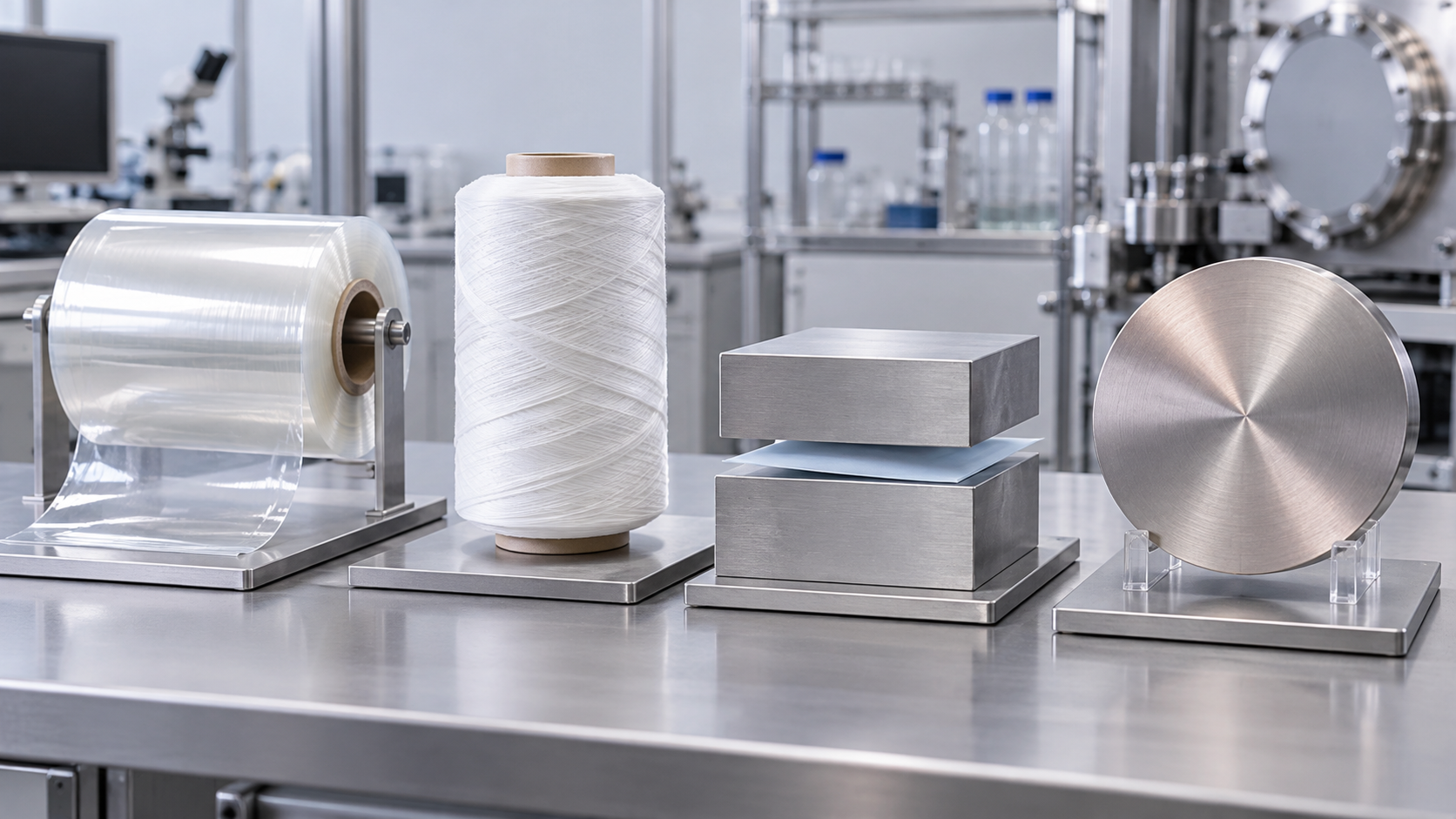
Solstice’s functions appear as materials sold as materials: a fluoropolymer film that resists water vapour, a polyethylene fibre that is light and strong, thermal interface materials for carrying heat away, and metal plates used to deposit thin films (sputtering targets). Our explainers on barrier properties and coatings, on polymers and resins, on phase change materials and thermal storage, on thermal-management and radiative-cooling materials, and on nano-coatings and thin films cover the background.
4. Scale
Company-wide scale is kept brief Sourced.
| Indicator (company-wide, US$ million) | 2023 | 2024 | 2025 |
|---|---|---|---|
| Net sales | 3,649 | 3,770 | 3,886 |
| Research and development expenses | 81 | 83 | 97 |
| Capital expenditure (incurred) | 299 | 296 | 408 |
At 31 December 2025 the 10-K reports about 4,100 employees, 20 manufacturing sites, four standalone R&D sites and more than 5,700 issued patents and pending applications.
| Net sales by business (US$ million) | 2023 | 2024 | 2025 | Relation to functional materials |
|---|---|---|---|---|
| Refrigerants | 1,372 | 1,302 | 1,511 | Outside scope (low-GWP refrigerants) |
| Building Solutions and Intermediates | 718 | 738 | 719 | Outside scope |
| Nuclear (conversion services) | 308 | 446 | 356 | Outside scope |
| Healthcare Packaging (Aclar) | 231 | 235 | 204 | High-barrier clear film. Includes the aerosol business |
| Research and Performance Chemicals | 464 | 482 | 500 | Outside scope (reagents, high-purity chemicals) |
| Electronic Materials | 407 | 381 | 409 | Sputtering targets, electronic polymers, thermal materials (phase change). Includes etchants and solvents |
| Safety and Defense Solutions (Spectra) | 149 | 186 | 187 | Ultra-high-molecular-weight polyethylene fibre |
| Total | 3,649 | 3,770 | 3,886 | – |
The three businesses closest to this field (Healthcare Packaging, Electronic Materials, Safety and Defense) totalled 204 + 409 + 187 = US$800 million in 2025, about 21% of company sales Our calculation. Each includes products that are not functional materials (medical aerosols, etchants, cleaning solvents), and sales by product, such as phase change pads alone or sputtering targets alone, are not disclosed Not yet confirmed.
5. Resources committed to functional materials
| Type of resource | What was confirmed | Status |
|---|---|---|
| People | About 4,100 employees company-wide, more than 300 technologists and engineers, 20 manufacturing sites and four standalone R&D sites. Many plants have R&D capability on site. Headcount for the functional-materials businesses alone is not disclosed | Sourced |
| Money (R&D) | R&D expenses were US$97 million in 2025 (US$83 million in 2024). The 10-K attributes the rise to continued investment in offerings such as Spectra Y and next-generation molecules. The split by business is not disclosed | Sourced |
| Money (capital expenditure) | US$408 million in 2025 (about 10% of sales). The 10-K expects US$400 to 425 million in 2026, with the increase driven mainly by projects supporting new products and solutions in electronic materials and advanced fibre | Sourced / Not yet confirmed (2026) |
| Investments, acquisitions, joint ventures and disposals | Separated from Honeywell on 30 October 2025. The 10-K describes agreements with Honeywell covering an intellectual property cross-licence, licensing of some brands, site sharing and transition services. Signed a merger agreement with Element Solutions on 6 July 2026 and terminated it by mutual agreement on 27 August (no payments either way); on the same day the board approved a repurchase of up to US$500 million. The 10-K says contract manufacturing and joint ventures are used where appropriate for regional access or lower cost | Sourced |
| Universities, research institutes and public funding | For the electronic and specialty materials segment the 10-K says R&D is done mainly in house, “leveraging national or university laboratories where applicable”. Institution names, amounts and public grants are not stated | Sourced (the policy) / Not confirmed (details) |
Status of main products and facilities
| Product / facility | Location and scale | Stage | Date | Source |
|---|---|---|---|---|
| Capacity additions in electronic materials and advanced fibre | The 10-K says order rates exceed current production capacity for certain key product lines and that it is investing in capacity. Plant names and capacities (tonnes a year or similar) are not stated | Investment under way (the specific stage could not be confirmed) | February 2026 | Reference 1 |
| Sputtering targets (copper-manganese, high-purity titanium) | The 10-K says an extrusion process gives precise control of grain structure. Production sites are not stated | Operating (supplied as a product) | February 2026 | Reference 1 |
| Thermal materials such as phase change pads | The product families (PTM and PCM) are listed on the company website. Plants and capacity are not stated | On sale | Checked October 2026 | References 3 and 4 |
6. What it has done so far
| When | What happened | Why it matters |
|---|---|---|
| 8 October 2024 | Honeywell announced a plan to spin off its Advanced Materials business | The start of the move to an independent listed company |
| 30 October 2025 | The separation completed and shares began trading on Nasdaq as “SOLS” (one Solstice share for every four Honeywell shares) | Honeywell holds no Solstice shares after the separation |
| 2025 | Capital expenditure of US$408 million (US$296 million the year before), driven mainly by electronic materials and advanced fibre projects | Rising investment in businesses touching this field |
| 19 February 2026 | Filed its first 10-K | The point from which revenue by business is available in a statutory filing |
| 6 July 2026 | Signed a merger agreement with Element Solutions | The terms are not examined here (the agreement was attached to an 8-K/A) |
| 27 August 2026 | Terminated the merger agreement by mutual agreement (no payments either way). Approved a repurchase of up to US$500 million the same day | The merger did not happen and the company returned to an independent course |
7. What comes next
Because order rates exceed production capacity for some key product lines, the 10-K says capital expenditure is expected to stay at or above about 10% of sales in the near term, and describes a medium-term outlook of low to mid single-digit organic growth Not yet confirmed. It also attributes the rise in R&D spending to investment in “Spectra Y” and next-generation molecules Sourced (the 10-K does not explain what Spectra Y is, and we could not confirm it).
None of the following appears in the 10-K or in official announcements Not yet confirmed.
Sales and capacity by product for phase change pads, sputtering targets, Aclar and Spectra; the plant names and start-up dates of the capacity additions; the specification of Spectra Y; R&D spending and headcount for functional materials alone.
8. What the company is aiming for in functional materials
The company sets out no strategy specific to functional materials, so what follows is inference from published facts.
| What can be read from the record | Primary information behind it | Type |
|---|---|---|
| Among the businesses near this field, capital spending is weighted to electronic materials and advanced fibre | The 10-K explains the rise in capital expenditure as projects supporting new products and solutions in electronic materials and advanced fibre | Sourced |
| The growth case rests on cooling for AI computing, advanced semiconductors and defence demand | The 10-K says phase change materials benefit from EV inverters and GPU cooling in data centers, targets serve advanced-node semiconductors, and Spectra is tied to defence spending | Inference |
| Healthcare Packaging is, in the short run, hit by destocking | Sales fell from US$235 million to US$204 million, which the 10-K attributes to volume declines from customer destocking, while the company expects demand to grow faster than GDP | Sourced (the fall and its stated reason) / Inference (the outlook) |
The reason for reading the growth case as AI cooling and defence is how the 10-K describes the markets. Phase change materials “benefit from growth associated with battery inverters used in electric vehicles and GPU cooling in data centers”, and Spectra’s growth is described as closely tied to global defence spending Sourced. But sales by product are not disclosed, so how much these products are actually growing cannot be confirmed. The 10-K attributes the 2025 increase in electronic materials to demand-driven volume, without a breakdown Not yet confirmed.
9. Map of functional-materials partnerships
10. Technologies, products and services
The table lists the products that could be confirmed, with where each performance figure comes from. All are manufacturer’s stated values that this article did not verify, and no comparison with other makers’ products is made. Where the company’s page names an ASTM test number, we give it only as the page’s own statement and do not describe the standard.
| Product | Function | Manufacturer’s stated value and conditions | Source |
|---|---|---|---|
| Aclar / Aclar Accel | High-barrier clear film for drug packaging (PCTFE, polychlorotrifluoroethylene) | The company says it has the highest moisture barrier of any clear thermoplastic film (10-K and website), used mainly in blister packs, with mid, high and ultra-high moisture-barrier grades. No figures or test conditions on the website | References 1 and 5 |
| HydroBlock | Industrial high-barrier PCTFE film | For non-food and non-pharmaceutical uses. The page cites moisture barrier, clarity, retention of dimensions and mechanical properties at low temperature, low gas absorption and insulation value. No figures on the page | Reference 6 |
| Spectra fibre | High-strength ultra-high-molecular-weight polyethylene (UHMWPE) fibre | The website says it is fifteen times stronger than steel by weight (no basis of comparison or test conditions given). The 10-K lists armour, rope, fishing lines and medical devices as uses | References 1 and 7 |
| PTM7950 (phase change pad) | Thermal interface material for semiconductors and power equipment | Thermal impedance 0.04 to 0.08 °C·cm²/W (no shim; the page states the test method as a modified ASTM D5470), thermal conductivity 8.5 W/m·K (page cites ASTM D5470), specific gravity 2.8 g/cm³ (page cites ASTM D374). Bond-line thickness is a minimum of about 20 µm and typically under 50 µm, and 30 to 40 psi of pressure is needed. Silicone-free. The company says it passed 150°C baking for 1,000 hours and 1,000 thermal cycles | Reference 4 |
| Sputtering targets | Metal plates for depositing thin films (for front-end semiconductors and advanced packaging) | Copper-manganese and high-purity titanium. The 10-K says an extrusion process gives precise control of grain structure and extends product life. No figures given | Reference 1 |
| Electronic polymers | For planarisation, gap fill, hard mask and doping in semiconductor manufacturing | The 10-K only lists the uses. No performance figures | Reference 1 |
The PTM7950 page lists both thermal conductivity (8.5 W/m·K) and thermal impedance (0.04 to 0.08 °C·cm²/W) Sourced. The first is a property of the material itself (bulk); the second is the thermal resistance of the interface, including the contact surfaces. In a real device what matters is the gap between chip and heat sink, which depends on bond-line thickness and pressure (the page explains that thickness falls as pressure rises). The company says phase change materials are solid at room temperature and soften when heated, filling the gaps between contact surfaces and giving a thin bond line without the pump-out seen with greases.
The trade-off is that adding more conductive filler tends to compromise the softening and wetting that let the material fill those gaps (our general commentary, not a statement in the company’s materials). That the company specifies 30 to 40 psi of pressure shows that the design assumes a clamped assembly to reach a thin bond line. Figures for other makers’ phase change materials or greases cannot be compared with these unless the test method, pressure and thickness are the same.
For a high-barrier film such as Aclar, the low water-vapour permeability is generally explained by the low moisture uptake and crystallinity of fluorine-containing polymers Not yet confirmed (our commentary, not a statement in the company’s materials). Because the company does not disclose figures, no ranking against other high-barrier films can be given.
“The highest moisture barrier” and “fifteen times stronger than steel” are company claims with no stated basis of comparison or test conditions. The PTM7950 values hold under the test methods and conditions the company gives, and are not for direct comparison with other thermal interface materials. Nothing about drug-packaging performance here is medical advice.
11. The risks this company carries
| Risk | What it is | Type |
|---|---|---|
| Functional materials are a minority of sales | Refrigerants are about 39% of sales; changes in refrigerant regulation, prices or product mix drive company results and can weigh on the functional-materials businesses | Sourced |
| Product-level sales are invisible | Sales and capacity by product for phase change pads, targets, Aclar and Spectra are not disclosed | Sourced |
| Demand swings | Healthcare Packaging sales fell in 2025 on customer destocking. The 10-K says electronic materials depend on semiconductors and safety and defence on defence spending | Sourced |
| Reliance on Honeywell agreements | The company depends on an intellectual property cross-licence and licences for some brands. The 10-K also lists a weaker brand as a competitive risk | Sourced |
| Burden of capital spending | The company plans to keep capital expenditure at about 10% of sales or more, which would weigh on it if demand falls short | Inference |
| M&A uncertainty | The Element Solutions agreement ended a little over a month after signing. The future direction (acquisitions, buybacks) is not settled | Sourced (the course of events) / Not yet confirmed |
12. Glossary
- PCTFE
- Polychlorotrifluoroethylene. A clear fluorine-containing thermoplastic that resists water vapour. The material behind Aclar.
- UHMWPE
- Ultra-high-molecular-weight polyethylene. Its extremely long molecules make a light, strong fibre.
- Phase change material (PCM)
- A material that moves between solid and softened states with temperature. Here it serves as a heat-conducting interface material.
- Thermal interface material (TIM)
- A material that fills the gap between a chip and a heat sink to carry heat across.
- Thermal impedance
- How hard it is for heat to cross an interface, including contact resistance. Unit °C·cm²/W; smaller means heat passes more easily.
- Sputtering target
- The source metal plate from which a thin film is made by bombarding it with ions in a vacuum.
- Organic growth
- Growth in sales excluding currency effects, acquisitions and divestitures.
- Spin-off
- A parent company separating a business and giving its shareholders shares in the new company so that it stands alone.
13. References
- Solstice Advanced Materials Annual Report on Form 10-K for the fiscal year ended 31 December 2025 (filed with the U.S. SEC on 19 February 2026). Business and revenue by business, R&D spending, capital expenditure, headcount, sites and the separation from Honeywell. https://www.sec.gov/Archives/edgar/data/2064953/000206495326000008/sols-20251231.htm
- Solstice Advanced Materials Current Report on Form 8-K dated 27 August 2026. Termination of the merger agreement with Element Solutions and approval of a share repurchase of up to US$500 million. https://www.sec.gov/Archives/edgar/data/2064953/000110465926102503/tm2620579d9_8k.htm
- Solstice Advanced Materials Phase Change Materials for Thermal Management (company website). The role of phase change materials in thermal interfaces. https://www.solstice.com/us/en/products/advanced-semiconductor-materials/thermal-management/phase-change-materials
- Solstice Advanced Materials PTM7950 (official product page). Specification, test methods and reliability claims for a phase change pad. https://www.solstice.com/us/en/products/advanced-semiconductor-materials/thermal-management/phase-change-materials/ptm7950
- Solstice Advanced Materials Medical & Pharmaceutical Packaging Films (company website). Aclar and Aclar Accel. https://www.solstice.com/us/en/products/medical-and-pharmaceutical-packaging-films
- Solstice Advanced Materials HydroBlock barrier films (company website). Industrial high-barrier PCTFE films. https://www.solstice.com/us/en/products/hydroblock-barrier-films
- Solstice Advanced Materials Spectra Fibers (company website). Uses and claims for UHMWPE fibre. https://www.solstice.com/us/en/products/spectra-fibers
14. Claim-to-source audit
| Claim in the text | Type | Source |
|---|---|---|
| Company name, headquarters, Nasdaq listing (SOLS), about 4,100 employees, 20 manufacturing sites, four R&D sites | Sourced | Reference 1 https://www.sec.gov/Archives/edgar/data/2064953/000206495326000008/sols-20251231.htm |
| Separation from Honeywell (plan announced 8 October 2024, completed 30 October 2025) | Sourced | Reference 1 https://www.sec.gov/Archives/edgar/data/2064953/000206495326000008/sols-20251231.htm |
| Net sales and net sales by business (2023 to 2025), R&D expenses and capital expenditure | Sourced | Reference 1 https://www.sec.gov/Archives/edgar/data/2064953/000206495326000008/sols-20251231.htm |
| The three nearest businesses total US$800 million (204 + 409 + 187), about 21% of sales | Our calculation | Our calculation, adding business-level sales from Reference 1 |
| Refrigerants at US$1,511 million, about 39% of company sales | Our calculation | Our calculation from business-level sales in Reference 1 |
| Capital expenditure rising because of electronic materials and advanced fibre projects; US$400 to 425 million expected for 2026 | Sourced | Reference 1 https://www.sec.gov/Archives/edgar/data/2064953/000206495326000008/sols-20251231.htm |
| Order rates above production capacity for some key lines, and the medium-term growth outlook | Not yet confirmed | Reference 1 https://www.sec.gov/Archives/edgar/data/2064953/000206495326000008/sols-20251231.htm |
| R&D done mainly in house, using national or university laboratories where applicable | Sourced | Reference 1 https://www.sec.gov/Archives/edgar/data/2064953/000206495326000008/sols-20251231.htm |
| Agreements with Honeywell (IP cross-licence, brand licensing, site sharing and services) | Sourced | Reference 1 https://www.sec.gov/Archives/edgar/data/2064953/000206495326000008/sols-20251231.htm |
| Merger agreement with Element Solutions (6 July 2026), mutual termination (27 August) and the repurchase of up to US$500 million | Sourced | Reference 2 https://www.sec.gov/Archives/edgar/data/2064953/000110465926102503/tm2620579d9_8k.htm |
| Description of phase change materials (solid at room temperature, softening when heated) | Sourced | Reference 3 https://www.solstice.com/us/en/products/advanced-semiconductor-materials/thermal-management/phase-change-materials |
| PTM7950 specification, test methods and reliability claims | Sourced | Reference 4 https://www.solstice.com/us/en/products/advanced-semiconductor-materials/thermal-management/phase-change-materials/ptm7950 |
| Aclar and Aclar Accel descriptions and the barrier claim | Sourced | Reference 5 and 1 https://www.solstice.com/us/en/products/medical-and-pharmaceutical-packaging-films https://www.sec.gov/Archives/edgar/data/2064953/000206495326000008/sols-20251231.htm |
| HydroBlock description | Sourced | Reference 6 https://www.solstice.com/us/en/products/hydroblock-barrier-films |
| Spectra fibre description and the “fifteen times stronger than steel” claim | Sourced | Reference 7 and 1 https://www.solstice.com/us/en/products/spectra-fibers https://www.sec.gov/Archives/edgar/data/2064953/000206495326000008/sols-20251231.htm |
| Sputtering-target extrusion process and grain-structure control | Sourced | Reference 1 https://www.sec.gov/Archives/edgar/data/2064953/000206495326000008/sols-20251231.htm |
| The four-type classification of companies (Fig. 1) | Our calculation | Our own grouping; company names are examples from those covered in this series |
| Sales and capacity by product, plant names and start-up dates, the specification of Spectra Y | Not yet confirmed | Not in the 10-K; this article does not estimate them Reference 1 https://www.sec.gov/Archives/edgar/data/2064953/000206495326000008/sols-20251231.htm |
| R&D spending and headcount for functional materials alone, and institution names | Not yet confirmed | Not disclosed or not stated Reference 1 https://www.sec.gov/Archives/edgar/data/2064953/000206495326000008/sols-20251231.htm |
| Capital spending weighted to electronic materials and advanced fibre | Sourced | Reference 1 https://www.sec.gov/Archives/edgar/data/2064953/000206495326000008/sols-20251231.htm |
| Reading that the growth case rests on AI cooling, advanced semiconductors and defence | Inference | This article’s interpretation of how the 10-K describes the markets |
| Reading of the Healthcare Packaging outlook | Inference | This article’s interpretation of the destocking decline and the company’s demand view |
| The filler and wetting trade-off in phase change pads, and the general mechanism of high-barrier film | Not yet confirmed | Our commentary; not a statement in the company’s materials |
| The risk of the burden of capital spending | Inference | This article’s interpretation of the scale of the capital plan |
Last updated 10 October 2026 / Troy Technical
Figures in this article come from Solstice Advanced Materials’ statutory filings with the U.S. Securities and Exchange Commission and from its website and product pages. No research-firm estimates or press-based figures have been used. Product performance values are manufacturer’s stated values and were not verified here. Passages marked “Inference” are this article’s interpretation of primary sources, not statements made by the company.