TECHNOLOGY EXPLAINER
Electrochromic Materials and Smart Windows
— how voltage-switched materials work, how windows, mirrors and aircraft use them, and how “lifetime” is measured
Electrochromic (EC) materials change their light transmittance or colour reversibly when a voltage is applied. Built into glass, they become “smart windows” that regulate sunlight in place of blinds; in cars, they become mirrors that automatically cut the glare of the headlights behind. The materials range widely: inorganic thin films such as tungsten oxide (WO3) and nickel oxide (NiO), organic molecules such as viologens, and conductive polymers. A window can switch over minutes but must survive tens of thousands of cycles and decades outdoors, whereas mirrors and displays prize a response of seconds. This article sets out, from primary sources, the colouring mechanism, the families of materials, how to read the performance metrics (coloration efficiency, response time, cycle life, memory effect), how buildings, cars and aircraft use them, how thermochromic and photochromic systems differ, and how to read the evaluation standards.
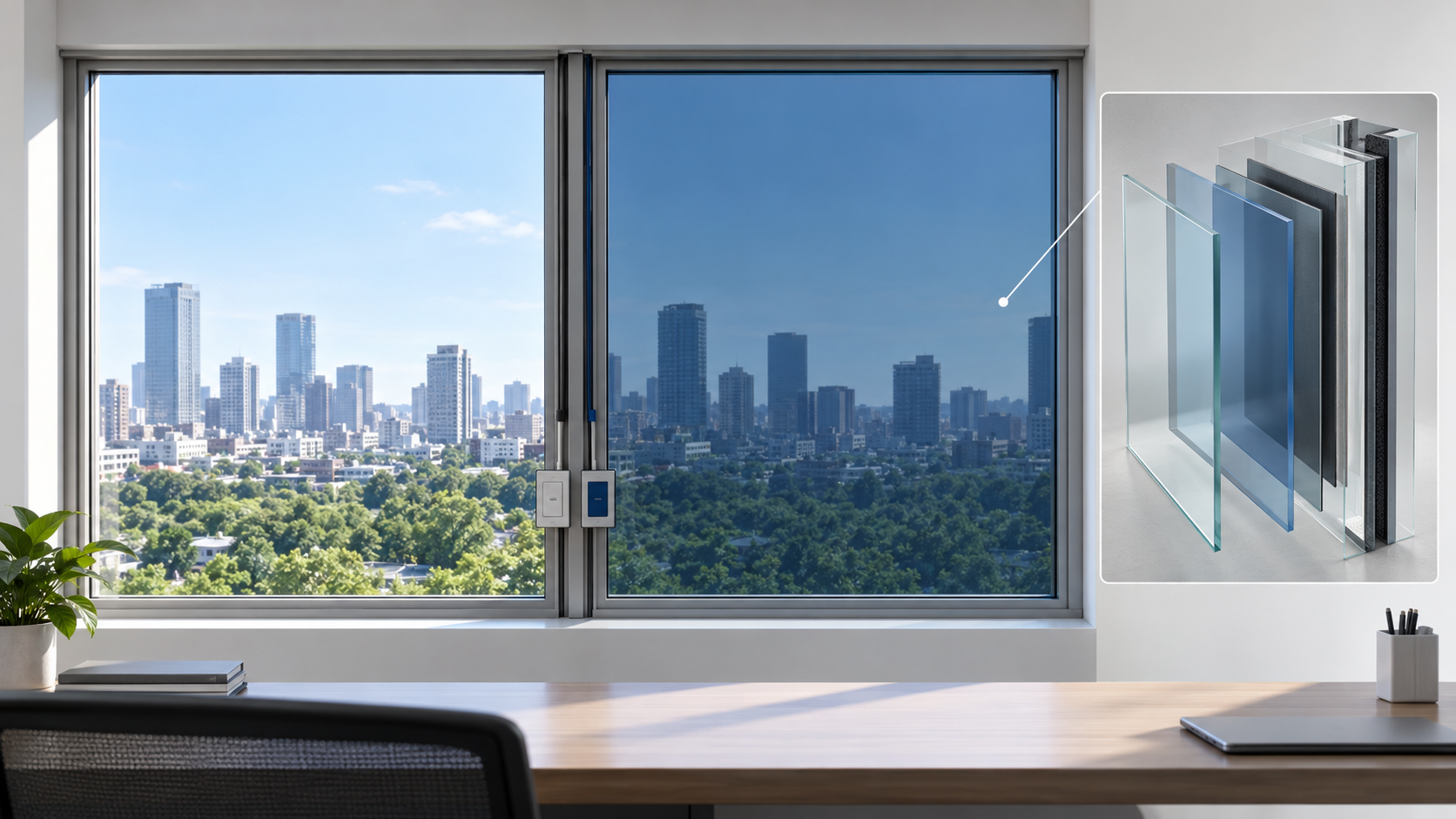
- Electrochromic materials and smart windows (the short version)
- Mechanism — electrons and ions go in together, and the colour changes
- Families of materials — inorganic oxides, viologens, conductive polymers
- A materials engineer's view 1: the electrolyte and counter electrode set colour and lifetime
- Reading the performance metrics — coloration efficiency, response time, cycle life, memory effect
- Our calculation: the charge needed to darken 1 m² of window
- How they are used — buildings, auto-dimming mirrors, aircraft
- A materials engineer's view 2: controlling visible light and near-infrared separately
- How thermochromic and photochromic systems differ
- Laboratory performance versus deployment
- Limits, and what could not be confirmed
- How to read evaluations and standards
- Glossary
- References (primary sources)
- Claim-to-source audit
Sourced = stated in published material (link given)
Our calculation = a figure this article derived, with the assumptions spelled out
Not yet confirmed = a plan, schedule or research-stage matter whose record has not been confirmed
Materials-design interpretations are marked separately as Commentary. Inference is shown in bold.
The coloration efficiencies, response times, cycle counts and energy-saving rates here are results for particular samples, devices and conditions in the laboratory, simulation results, or statements by companies. Please do not read champion data from a small test piece as the performance of a large-area window or a product. Company statements (such as “greatest” or “industry’s highest”) are the companies’ claims, not independent confirmation. This article does not rank companies or products. Conductive polymers and ion conductors are covered in our explainer on conductive polymers and ionic conductors, and transparent conductive films in our explainer on transparent conductive films; here we stay with the points that matter for windows and mirrors.
1. Electrochromic materials and smart windows (the short version)
- Materials that change how light passes, by voltage: EC materials change their optical properties reversibly and persistently when a voltage is applied. Built into multilayer devices, they can modulate optical transmittance between widely separated extremaSourced [Source 1]. Mortimer’s review describes the colour change as effected either by an electron-transfer (redox) process or by a sufficient electrochemical potentialSourced [Source 2]
- Different uses ask for different things: a window can switch over minutes but needs large area and long life; a display needs a response of seconds or milliseconds. The Chem. Rev. review states that for smart windows or energy storage the acceptable switching times are on the order of minutes, while displays usually need seconds (or even milliseconds)Sourced [Source 6]
- The biggest difficulty is “how to measure lifetime”: a 2023 paper points out that, despite the long history of electrochromism, there is no universally accepted method for quantitatively comparing cycling stability between different materials or devicesSourced [Source 13]. The international standard ISO 18543 specifies an accelerated ageing test for electrically switched EC glazing, but its numbers alone do not rank materialsSourced [Source 19]
EC is a contest not of “does it change colour” but of “how many cycles, how many years, and under what temperature and sunlight can it keep the same range of colour”. A response of a few seconds or a stability of a few hundred cycles in the laboratory is a different matter from ten-year outdoor durability of a window. Read every number together with the wavelength of colouration, temperature, voltage, charge and the definition of the end point.
2. Mechanism — electrons and ions go in together, and the colour changes
In a typical inorganic EC device, the colour changes when electrons and small cations (H+, Li+ and so on) enter the colouring layer (tungsten oxide, for example) together. According to the review by Niklasson and Granqvist, today’s research on inorganic EC is focused on tungsten oxide (colouring under charge insertion) and nickel oxide (colouring under charge extraction). In charged tungsten oxide the electrons enter localised states, and the optical absorption can be modelled phenomenologically as a superposition of transitions between different charge states of the W ions (6+, 5+ and 4+)Sourced [Source 1]. The same review says that devices with large optical modulation can be accomplished essentially by connecting W-oxide-based and Ni-oxide-based films through a layer serving as a pure ion conductorSourced [Source 1].
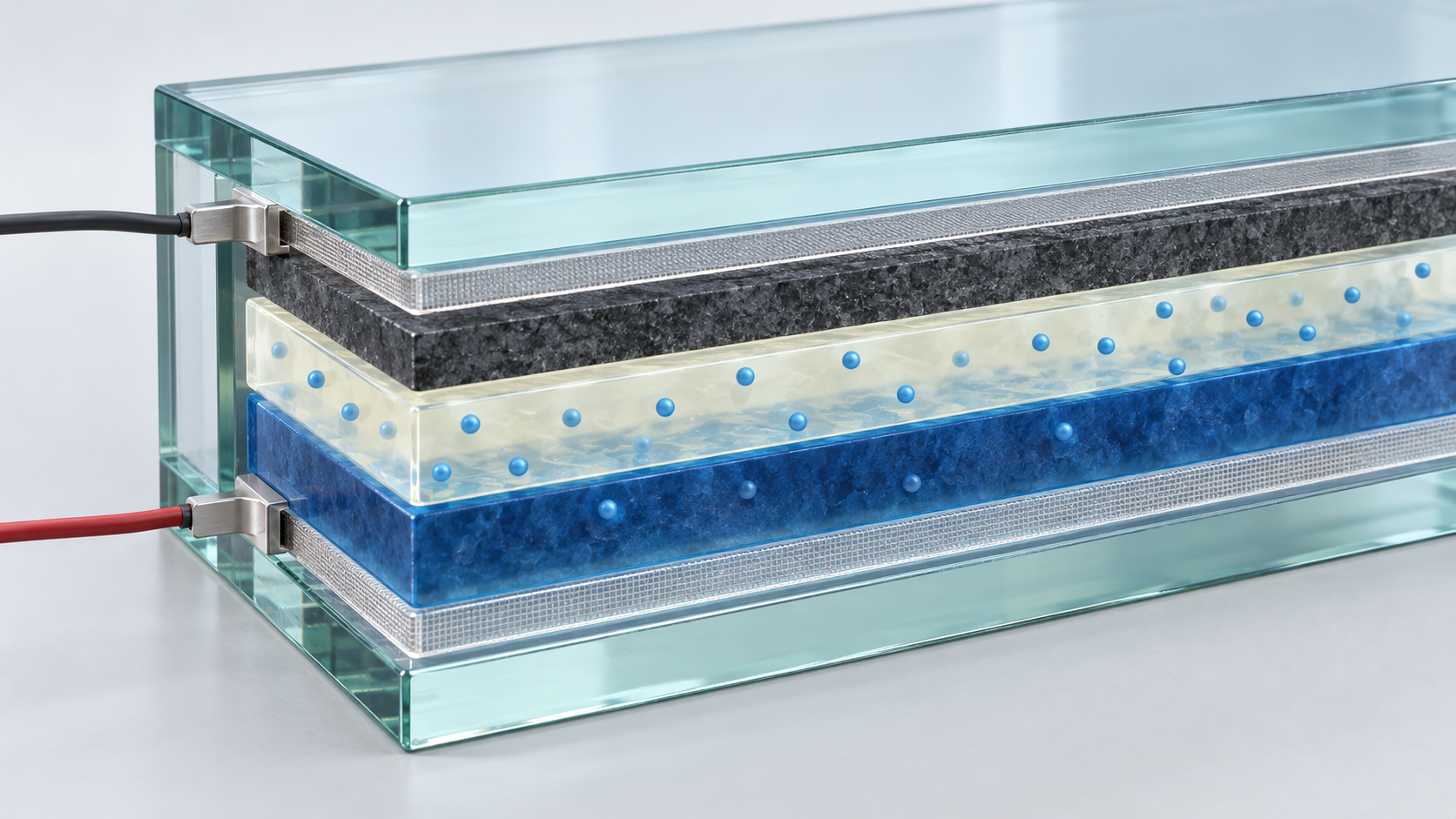
View the original SVG schematic and exact annotations
Niklasson and Granqvist’s review indicates that the colouration of nickel oxide appears to be a surface phenomenon confined to the outer parts of the grains; once hydrated Ni oxide has been transformed into hydroxide and oxy-hydroxide phases, electrochromism is consistent with reversible changes between Ni hydroxide and oxy-hydroxide (the Bode reaction scheme), and it was demonstrated to be associated solely with proton transfer. The films are made by sputtering, and mixing Ni oxide with other oxides of wide band gap is treated as a way to enhance bleached-state transmittanceSourced [Source 1].
3. Families of materials — inorganic oxides, viologens, conductive polymers
Mortimer’s review sorts the main classes of EC materials into metal oxides, viologens (in solution and as adsorbed or polymeric films), conjugated conducting polymers, metal coordination complexes (as polymeric, evaporated or sublimed films), and metal hexacyanometallates. It adds that other materials aspects important for building devices include optically transparent electrodes, electrolyte layers and device encapsulationSourced [Source 2]. The table below is our own arrangement.
| Family | How it colours (within what is reported) | Character | Basis confirmed in this article |
|---|---|---|---|
| Inorganic: WO3 (cathodic), NiO (anodic) | WO3 colours on insertion of electrons and ions; NiO on extraction (proton transfer) | Inorganic thin films are made by sputtering in the examples shown. Ways to raise NiO’s bleached-state transmittance are being studied | Niklasson and Granqvist (2007) [Source 1] |
| Organic small molecules: viologen plus an anodic compound (solution, gel) | A viologen (cathodic) reduced at one electrode and an anodic compound oxidised at the other colour together on applying voltage. Electron-transfer reactions in solution (the classification in Byker’s patent) | A family used in auto-dimming mirrors. Instability of the solution (oxygen, water, chemical reactivity) was an obstacle to commercialisation | Byker’s patent US 4,902,108 (1990); Mortimer (2011) [Sources 5, 2] |
| Conductive (conjugated) polymers | Redox of the polymer changes the pi-conjugated state and hence the colour | Colour is thought to be designable through chemical structure (our commentary). A DOE report on polymer-plus-ionic-liquid windows found they stopped bleaching when cycled under heat and sunlight, with insufficient durability for outdoor windows | Mortimer (2011), DOE report (2008) [Sources 2, 8] |
| Others (complexes, hexacyanometallates such as Prussian blue) | Redox of the metal centre changes the colour | Named as a class in Mortimer’s review. Details were not checked here | Mortimer (2011) [Source 2] |
The families cannot be ranked from this table, since wavelength, layer structure and conditions differ. For conductive polymers themselves, see our explainer on conductive polymers and ionic conductors.
Byker’s patent (US 4,902,108, filed 31 March 1986 and granted 20 February 1990; the patent record lists Gentex Corp as applicant) proposes single-compartment, self-erasing, solution-phase EC devices. The solution consists of a solvent, a cathodic compound (including the known viologens) whose absorption in the visible increases on reduction, and an anodic compound whose absorption increases on oxidation. It states that the devices are surprisingly stable to cycling between light and dark states and that transmittance can be varied over more than a factor of 10 in several seconds. The obstacle to commercial use was the instability of the solution, and minimising oxygen and water raises stability, it addsSourced [Source 5].
4. A materials engineer’s view 1: the electrolyte and counter electrode set colour and lifetime
Discussion of EC performance tends to gather around the colouring layer (WO3 and the like), but in a real device it is the counter electrode (the side that stores ions), the electrolyte, the transparent electrodes and the encapsulation that determine the range of colour and the lifetime. Mortimer’s review likewise names transparent electrodes, electrolyte layers and device encapsulation as important materials aspects of building devicesSourced [Source 2].
The “clarity” of the counter electrode: if nickel oxide is the counter electrode and some colour remains in the bleached state, the window’s clarity falls. Niklasson and Granqvist take up mixing nickel oxide with other wide-band-gap oxides to enhance bleached-state transmittanceSourced [Source 1]. Electrolytes and polymers: a DOE report prototyped windows that combined cathodic and anodic organic semiconducting polymers with a room-temperature ionic-liquid electrolyte. It says that specific bands of the visible and near-infrared could be targeted for variable transmittance, and that, built into an insulating glass unit, parameters such as the solar heat gain coefficient improved over those of a typical unit with a low-emissivity coating. However, in that state the technology was not durable enough for an exterior window: the redox chemistry failed to recover to the bleached state when cycled under heat and solar exposure. The authors surmise that polymer degradation reactions are accelerated by heat and sunlight in both the reduced and oxidised states, and conclude that degradation under real-life temperature and solar exposure must be understoodSourced [Source 8] (a report of 2008; it does not show the durability of polymers today).
Chemical stability of solution-type devices: Byker’s patent says the obstacle to commercial use of solution-type devices was the lack of stability of the solution, and that reducing oxygen and water raises stabilitySourced [Source 5]. For ion-conductor materials (ionic liquids, polymer electrolytes, ion gels) see our explainer on conductive polymers and ionic conductors, and for solid electrolytes for batteries, our all-solid-state battery explainers.
5. Reading the performance metrics — coloration efficiency, response time, cycle life, memory effect
The Chem. Rev. review (organised for displays) defines the main EC metrics as followsSourced [Source 6].
| Metric | Definition (as stated in the Chem. Rev. review) | Reading note |
|---|---|---|
| Optical modulation, contrast ratio | The difference in absorbance or transmittance at the characteristic absorption wavelength before and after colour switching; for reflective devices, the difference in reflectivity | Which wavelength is needed. For windows, give visible (daylight) transmittance and near-infrared separately |
| Response time | The time to reach 90% of the full optical modulation from the bleached to the colored state (or the reverse) | Some papers report times that are not based on reaching the full modulation, making comparison difficult |
| Coloration efficiency (CE) | The optical modulation at the characteristic absorption wavelength per injected charge per unit area | The higher the CE, the less charge is needed for the same modulation. Wavelength and voltage are conditions |
| Durability and lifetime | Durability is the ability to withstand an unfavourable external environment. Lifetime is the retention of electro-optical switching capacity over colouring-bleaching cycles (cycle life) and the working time (calendar life) | For displays, at least 104–106 cycles are considered desirable (a statement for displays). Outdoor durability of windows has different conditions |
| Memory effect | The ability to keep an optical state for a period without continuous input of electrical power | Holding time and self-discharge of window products could not be confirmed in primary sources |
These definitions are the review’s arrangement for displays; for evaluation standards for windows, see Chapter 12.
As concrete examples, the film of W18O49 nanowires and gold nanorods of Sheng et al. (a laboratory test piece) coloured in 4.5 s (613.5 nm) and 6.5 s (900 nm) and bleached in 4.0 s and 5.0 s on a step voltage (−1.0 V and +0.2 V for 30 s), with coloration efficiencies of 48.46 cm²/C (613.5 nm) and 86.23 cm²/C (900 nm), and the transmittance difference ΔT stayed at about 96% (613.5 nm) and 93% (900 nm) after 300 switching cyclesSourced [Source 7]. Llordés et al. report that a composite film of tin-doped indium oxide nanocrystals in niobium oxide glass blocks near-infrared and visible light independently over a 2.5 V range and retained 96% of its charge capacity after 2,000 cyclesSourced [Source 4]. Both are numbers for small laboratory samples and bear no direct relation to a window’s lifetime (decades outdoors).
Padilla et al. state that there is no universally accepted method for quantitatively comparing cycling stability between different electrochromic materials or devices, and propose a three-step procedure that defines the testing conditions adequately and describes analytically how performance evolves with cycling. Their subjects are conducting polymers, transition-metal oxides, metallo-supramolecular polymers and viologensSourced [Source 13]. A figure such as “tens of thousands of cycles” cannot be compared unless the voltage, wavelength, temperature and end point (the percentage to which the optical modulation may fall) are given.
6. Our calculation: the charge needed to darken 1 m² of window
Coloration efficiency (CE) is defined per unit area of injected charge (optical modulation ΔOD = log10(bleached transmittance / coloured transmittance); CE = ΔOD / (charge / area)). The charge needed to darken 1 m² of window by ΔOD = 1 (transmittance one-tenth) is “1 / CE”Our calculation. With the CE of the film of Sheng et al. (48.46 cm²/C) it is about 206 C/m²; with the same film’s CE at 900 nm (86.23 cm²/C), about 116 C/m². With the CE of a display device presented in the Chem. Rev. review (440 cm²/C), it is about 23 C/m²Our calculation. If the window switches in 5 minutes (300 s), the average currents are about 0.69 A, 0.39 A and 0.076 A respectivelyOur calculation (1 C = 1 A·s; the charge entering and leaving the counter electrode is assumed equal to this).
Commentary: if current is fed from the edge of a large window, the voltage drops across the resistance of the transparent conductor, and the colouring speed may differ between the edge and the centre. Window size, conductor resistance and current become constraints on the uniformity of colouring and on the switching time. Quantitative figures for this could not be confirmed in our primary sources. For transparent conductive materials, see our explainer on transparent conductive films.
7. How they are used — buildings, auto-dimming mirrors, aircraft
Windows in buildings: energy saving and comfort
A 2004 report by LBNL (Lawrence Berkeley National Laboratory) used DOE-2.1E simulation on a three-story prototypical office building in five US climates and 16 California climate zones. It compared an EC window controlled to hold daylight illuminance at a set level with a spectrally selective low-e window (with daylighting controls, no interior or exterior shading) and reports that, in a building with a large window-to-wall area ratio of 0.60, perimeter-zone primary energy use in east, south and west zones falls by 10–20%, and peak demand under the same condition by 20–30%Sourced [Source 10] (simulation results, not a guarantee for real buildings). A 2006 report also includes a 2.5-year outdoor test of prototype large-area EC windows. Compared with an efficient low-e window with the same daylighting control, it states, annual peak cooling load fell by 19–26% and lighting energy use by 48–67% when controlled for visual comfort. Subjects strongly preferred the EC window, with preferences related to perceived reductions in glare, reflections on the computer monitor and window luminanceSourced [Source 9]. LBNL’s 2006 design guide says it compiles, for designers, basic information on what an EC window looks like, how fast it switches and what product offerings then existed, from data drawn from simulations, laboratory tests and a 2.5-year outdoor testSourced [Source 11].
On the manufacturing side, Soladigm’s (later View) final report to DOE (2011) says it moved from a 2-inch research prototype to inline manufacture of full-scale commercial insulating glass units and that its technology exceeds DOE’s 2020 performance and reliability targets (a company report; the content and figures of those targets were not checked here)Sourced [Source 12]. SageGlass’s product page lists “SageGlass Classic”, which tints the full pane uniformly, and “SageGlass Harmony”, which tints with an in-pane gradient, and says tinting is controlled by a predictive algorithm and weather data (the product page’s description)Sourced [Source 18].
Cars: from anti-glare mirrors to dimmable components
Gentex describes its auto-dimming mirrors (interior and exterior) as using light sensors, proprietary gels and microprocessor-based algorithms to detect glare and darken to the level needed. Its “Dimmable Glass” page lists, as uses of the same EC technology, self-dimming sunroofs and moonroofs, sun visors, head-up-display combiners and sensor shrouds (the company’s description)Sourced [Source 16]. Byker’s patent lists, among uses of EC devices, variable-transmittance light filters and variable-reflectance mirrors such as anti-glare rear-view mirrors of automotive vehiclesSourced [Source 5].
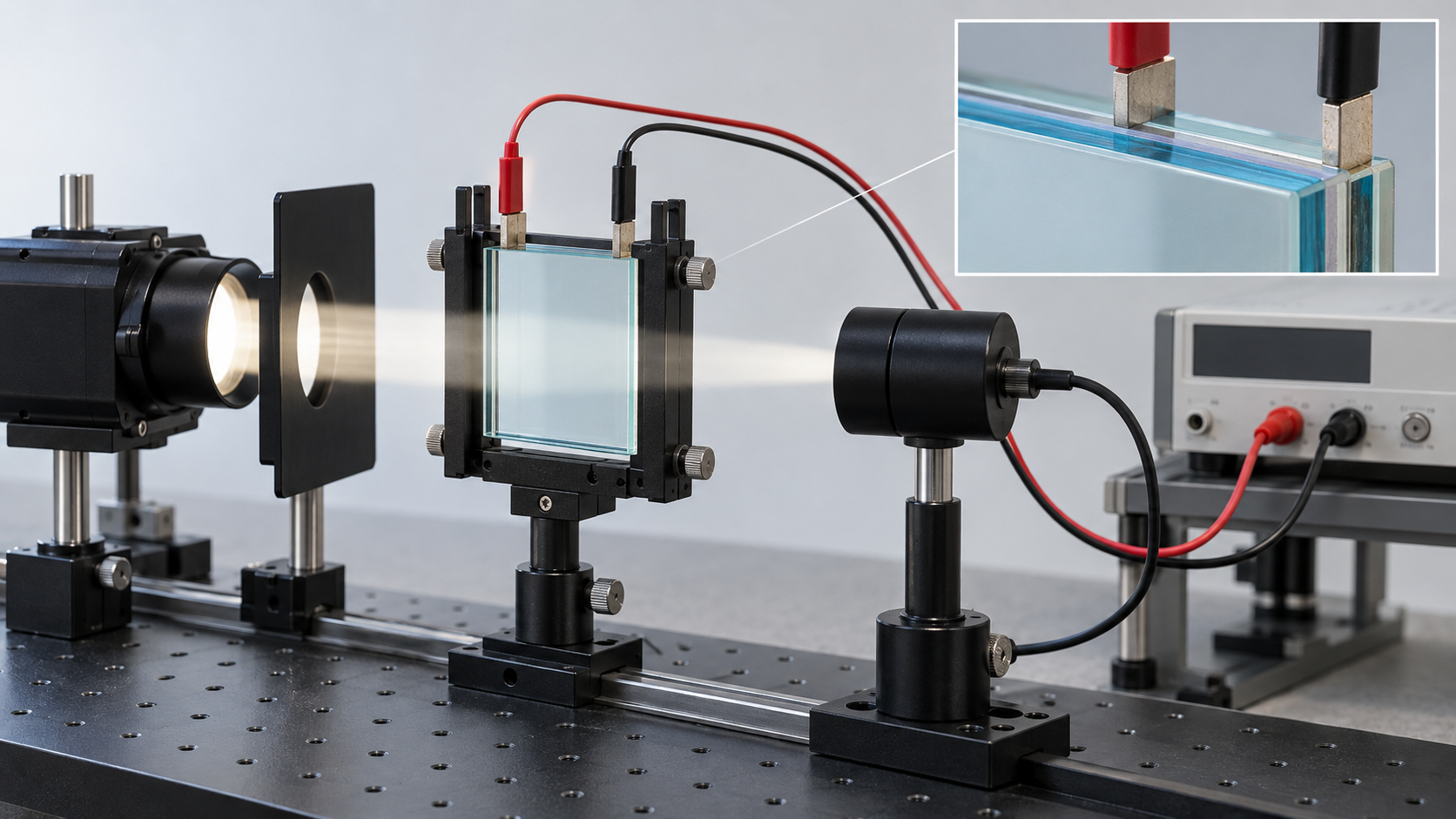
Aircraft: windows that “darken electrically”
Gentex presents its electronically dimmable windows (EDW) for aircraft as windows that darken on demand to cut sunlight and glare while keeping the view. It cites no moving parts; that the windows fail clear, making them FAA compliant for emergency-exit integration; a wide visible-transmittance range with light-blocking efficiency above 99.999% and low haze; a lower cabin heat load; and reduced acoustic transmission into the cabin (the company’s description; measurement conditions, standards and independent confirmation are not given)Sourced [Source 17].
| Use | Conditions asked (our arrangement) | What was published | Caution |
|---|---|---|---|
| Building windows | Large area, uniform colouring, decades of outdoor durability, switching over minutes, a neutral colour, low cost | Simulation: perimeter-zone primary energy 10–20% lower. Field test of prototype windows: peak cooling load 19–26% lower, lighting 48–67% lower | Reports of 2004–2006 (prototypes of the time), not figures for current products [9, 10] |
| Auto-dimming mirrors | A response of seconds, a temperature range, durability to ultraviolet light and heat, a reflective construction | Darken automatically with a light sensor. The patent states a transmittance change of more than 10x in several seconds | Company description. Correspondence of standards: see Chapter 12 [5, 16] |
| Aircraft windows | Dimming range, low haze, fail-safe, light weight, regulatory compliance | Electronically dimmable windows. Fail clear on failure, no moving parts (company description) | Measurement conditions and standards could not be confirmed [17] |
| Sunroofs, visors, HUDs | Visibility for people, solar shielding, automotive temperature range | A product group listed as dimmable components (company description) | Details could not be confirmed [16] |
Company descriptions are the companies’ claims, not independent confirmation.
8. A materials engineer’s view 2: controlling visible light and near-infrared separately
About half of solar radiation lies in the near-infrared and is mostly used for heating the interior. Sheng et al. likewise say that visible light (400–760 nm) matters for daylighting, while regulating near-infrared transmission (760–2,500 nm) has a significant effect on indoor temperatureSourced [Source 7]. The review by Wang et al. also stresses, because nearly 50% of solar energy lies in the near-infrared, the importance of modulating the visible and near-infrared bands separately (dual-band), and notes that some latest results show solution-processable nanostructured systems selectively modulating near-infrared light without affecting visible transmittanceSourced [Source 3].
Llordés et al. made a composite film in which tin-doped indium oxide (ITO) nanocrystals are covalently bonded into niobium oxide glass and showed that by varying the voltage over a 2.5 V range, near-infrared and visible light can be blocked selectively and independently. The glass strongly modulates visible light owing to its reconstructed bonding near the nanocrystal–glass interface; they report optical contrast enhanced fivefold and 96% of charge capacity retained after 2,000 cyclesSourced [Source 4]. Sheng et al. made a film in which gold nanorods selectively absorb near-infrared (760–1,360 nm) while colouring W18O49 nanowires actively block sunlightSourced [Source 7]. From the materials side, this is a division of labour in design: near-infrared is handled by free-carrier (plasmonic) absorption, and visible light by the electronic states of the oxide (interband and localised levels) (our commentary).
9. How thermochromic and photochromic systems differ
Smart-window materials fall into three groups by what “triggers” the colour change. The review by Wang et al. sets out the basic principles and recent developments of electrochromic, photochromic and thermochromic materials for smart windowsSourced [Source 3].
Thermochromic: the review by Cui et al. says vanadium dioxide (VO2) is a promising material for energy-saving smart windows because of its reversible metal-to-insulator transition near room temperature with large changes in optical properties. It surveys the effects of atomic defects, doping and lattice strain and nano- and micro-scale morphology engineering, and sets out the challenges of bridging the gap between laboratory research and large-scale practical applicationSourced [Source 14]. Sheng et al. note that VO2 has a fixed transition temperature (Tc) of 68 °C and co-assembled tungsten-doped W–VO2 nanowires to show a window responding over a wide range of 30–50 °CSourced [Source 7]. Photochromic: the IUPAC technical report defines organic photochromism as a reversible colour change by light and identifies fatigue (chemical degradation) and the number of cycles, cyclability and half-life as the main evaluation parametersSourced [Source 15]. The difference from EC: ISO 18543 states that it is applicable to chromogenic glazings that switch by electrical stimulus and is not applicable to photochromic and thermochromic glazingsSourced [Source 19].
10. Laboratory performance versus deployment
| Aspect | Shown in laboratory or demonstration | What deployment asks | Source and label |
|---|---|---|---|
| Response time | A test piece colours in 4.5 s and bleaches in 4.0 s (613.5 nm) | Windows can take minutes (per the review), but uniformity across the pane is the issue. Response times for large areas could not be confirmed in primary sources | [7] [6] Sourced; large area is Not yet confirmed |
| Cycles | ΔT about 96% after 300 cycles; 96% of charge capacity kept after 2,000 cycles | Decades outdoors. Passing the ISO 18543 accelerated ageing test. No standard for comparison | [7] [4] [13] [19] Sourced |
| Area | A 2-inch prototype; films of a few cm up to 7 cm | Inline manufacture of large-area insulating glass units. Cost and yield could not be confirmed | [12] [7] Sourced (including a company report) |
| Durability (organic) | Polymer-plus-ionic-liquid windows showed selective transmittance control in the near-infrared and visible | They stopped bleaching under heat and sunlight, and were not durable enough for outdoor use (report of 2008) | [8] Sourced |
| Energy saving | Simulation: perimeter zones 10–20% lower. Field test of prototype windows: peak cooling 19–26% lower, lighting 48–67% lower | Operation in real buildings, quality of control, window-to-wall ratio, climate and cost. The effect depends on the reference case and conditions | [9] [10] Sourced |
| Company statements | A wide dimming range, light blocking above 99.999%, fail clear (aircraft) | Measurement conditions, standards and independent confirmation could not be confirmed | [17] Sourced (company claims) |
| Evaluation standards | Conditions differ from paper to paper | ISO 18543 exists for accelerated ageing of EC windows. A standard procedure for comparing materials could not be confirmed | [13] [19] Sourced |
11. Limits, and what could not be confirmed
(1) Performance figures of products
The colouring and bleaching times, cycle life, warranty, cost and in-pane uniformity of the products of SageGlass, Gentex and Soladigm (View) could not be confirmed numerically in the primary sources we checked. Company descriptions are quoted as they stand.
(2) The texts of reviews
Granqvist’s reviews (Thin Solid Films 2014; Sol. Energy Mater. Sol. Cells 2012) and the review of conductive polymers by Beaujuge and Reynolds (Chem. Rev. 2010) were not cited, because neither text nor abstract could be checked. We checked the abstracts of Niklasson and Granqvist, Mortimer, Wang et al. and Cui et al., and the open full texts on PubMed Central of the Chem. Rev. review (2022) and of Sheng et al. (2023).
(3) Reports of the US Department of Energy and LBNL
The DOE and LBNL reports were checked through OSTI’s catalogue records (abstracts). The full texts (PDF) could not be read because the service did not respond when we checked. The figures are limited to those given in the abstracts.
(4) The texts of standards
We have not checked the texts (which are paid) of ISO 18543, ISO 9050, JIS R 3106 and JIS D 5705. Test conditions, cycle counts and pass criteria are not described.
(5) Other applications
EC displays (electronic paper), devices combined with energy storage, metal-electrodeposition types (reversible metal electrodeposition), other electro-optical dimming methods such as liquid crystals and SPDs, wearables and fibre-shaped devices are not covered here.
- EC is a material that changes colour when electrons and ions enter the colouring layer together. The inorganic core is WO3 (colours on charge insertion) and NiO (colours on extraction), assembled into a multilayer device with an ion conductor between themSourced
- In practice, the materials around the colouring layer matter. The counter electrode’s clarity, the electrolyte, encapsulation, and degradation under heat and sunlight set lifetime. A polymer-plus-ionic-liquid window was reported in 2008 as not durable enough for outdoor useSourced
- To darken 1 m² of window by ΔOD = 1 takes about 206 C at CE 48.5 cm²/C. Switching in 5 minutes gives an average current of about 0.69 AOur calculation (using the CE of a laboratory film)
- Uses are building windows, auto-dimming mirrors and aircraft windows. For buildings, simulation gives 10–20% lower perimeter-zone primary energy, and a field test of prototype windows 19–26% lower peak cooling (reports of 2004–2006)Sourced
- There is no standard for comparing cycle life. ISO 18543 is an accelerated ageing standard for EC glazing and does not apply to thermochromic or photochromic onesSourced
12. How to read evaluations and standards
What is measured: EC materials and devices are evaluated for optical modulation (the difference in transmittance), coloration efficiency (modulation per injected charge), response time (time to 90% of the modulation), cycle life and durability, from transmission and reflection spectra in the coloured and bleached states and from electrochemical measurements (potential, current, charge). For window glass, the visible transmittance, solar transmittance and solar heat gain coefficient are calculated from spectral measurements for each coloured state.
| Item evaluated | ISO | IEC / IEEE | JIS | ASTM | What changes the value with measurement conditions |
|---|---|---|---|---|---|
| Accelerated ageing test and requirements for EC glazingSourced | ISO 18543:2021 (Glass in building – Electrochromic glazings – Accelerated ageing test and requirements). Edition 2, October 2021, replacing ISO 18543:2017. It covers EC glazings that control solar transmission (insulating glass units, laminated glass or a combination), made of inorganic or organic materials. It is limited to glazing switched by electrical stimulus and does not apply to photochromic or thermochromic glazing [19] | Could not be confirmed | We could not confirm a JIS test standard for EC glass in the JIS search | ASTM E2141. Edition 2014 (E2141-14) is mentioned in the Chem. Rev. review (written for displays) as a durability standard for EC devices. Its title and test content could not be confirmed from non-ASTM sources [6] | Temperature, humidity, solar exposure, voltage, number of cycles, definition of the end point. The conditions the review gives for displays (−40 to 80 °C, 80% humidity) are not those of windows |
| Luminous and solar characteristics of window glass (per coloured state)Sourced | ISO 9050:2026 (Glass in building – Determination of luminous and solar characteristics of glazing). Edition 3, July 2026, replacing ISO 9050:2003. A method for luminous and solar characteristics; angular properties are excluded [20] | Could not be confirmed | JIS R 3106 (Japanese title: test method for transmittance, reflectance and emittance of flat glass and evaluation of solar heat gain coefficient of glass in buildings; our translation). The year of the edition and its correspondence to ISO 9050 were not checked [21] | Could not be confirmed | The coloured state (at which voltage and how dark it is measured), wavelength range, angle of incidence, reference solar spectrum. An EC glazing gives different values for each state (our commentary) |
| Automotive mirrors (including anti-glare mirrors)Sourced | Could not be confirmed | Could not be confirmed | JIS D 5705 (Japanese title: mirrors for automobiles; our translation). How far it applies to anti-glare mirrors was not checked [22] | Could not be confirmed | Reflectance (light and dark states), temperature, measurement light source. The text of the standard was not checked |
| Comparing materials (optical modulation, coloration efficiency, response time, cycling stability)Sourced | Could not be confirmed | Could not be confirmed | Could not be confirmed | Could not be confirmed | No common standard could be confirmed; there is only a proposal in a paper (the three-step procedure of Padilla et al. [Source 13]). Wavelength, voltage, temperature and end point are conditions |
| Evaluating thermochromic and photochromic systemsSourced | Outside the scope of ISO 18543. We could not confirm other standards | Could not be confirmed | Could not be confirmed | Could not be confirmed | For photochromics, the IUPAC technical report takes fatigue, number of cycles, cyclability and half-life as evaluation parameters [15] |
Which standard we match to which item is our own arrangement (Our calculation). Numbers and titles were checked on the official ISO page for ISO and the JISC JIS search for JIS. For ASTM E2141 we give only the number, edition and subject as written in a non-ASTM public source (the Chem. Rev. review); the ASTM website was not opened.
How the standards differ in standing
- ISO is an international standard; JIS is Japan’s national standard. The correspondence between JIS R 3106 and ISO 9050, and whether JIS D 5705 applies to EC mirrors, were not checked here
- ASTM E2141 is a US industry standard. It is a separate standard from ISO 18543, and we did not check whether the content of the tests (temperatures, cycles and so on) matches
- ISO 18543 is a standard for glazing, not for a material by itself. It looks at the durability of the assembled EC window and does not compare the merits of materials such as WO3 or viologens (our commentary)
Cautions in reading the standards
- A standard is a test method and requirements, not a guarantee of lifetime. We did not check the text of ISO 18543 (test conditions, number of cycles, pass criteria). If you see a claim that a product conforms to ISO 18543, check the edition and what the test involved
- The same named metric can differ in method and conditions. Response time is defined as the time to 90% of the modulation, yet some reports do not reach the full modulation [6]. Cycle life changes with voltage, wavelength and end point [13]
- Read a manufacturer’s value together with the standard, edition and test conditions it follows. Gentex’s “light-blocking efficiency above 99.999%” and “fail clear” for aircraft windows come with no measurement conditions or standards [17]
- The gap between a standard’s range and conditions of use: ISO 9050 covers luminous and solar characteristics with angular properties excluded [20]. In-plane non-uniformity of colouring, oblique incidence and long-term outdoor degradation are not in that standard’s values (our commentary)
13. Glossary
- Electrochromism (EC)
- A reversible change of light transmission or colour by voltage.
- Coloration efficiency (CE)
- Optical modulation per injected charge per unit area.
- ΔOD (change in optical density)
- log10(bleached transmittance / coloured transmittance). ΔOD = 1 means transmittance falls to one-tenth.
- Optical modulation
- The difference in transmittance or absorbance before and after colouring.
- Counter electrode (ion storage layer)
- The electrode layer that stores the ions moving in and out of the colouring layer.
- Ion conductor (electrolyte)
- A layer that passes ions but not electrons.
- Viologen
- An organic compound that colours when reduced at an electrode (cathodic).
- Memory effect
- The ability to keep an optical state without continuous power.
- IGU
- Insulating glass unit: a double- or triple-glazed unit.
- Dual-band
- Modulating visible light and near-infrared separately.
- Thermochromic
- Changing colour or transmission with temperature. VO2 is representative.
- Photochromic
- Changing colour reversibly with light.
14. References (primary sources)
- Niklasson G. A., Granqvist C. G. “Electrochromics for smart windows: thin films of tungsten oxide and nickel oxide, and devices based on these”, J. Mater. Chem. 17, 127–156 (2007), DOI 10.1039/B612174H — doi.org/10.1039/B612174H
- Mortimer R. J. “Electrochromic Materials”, Annu. Rev. Mater. Res. 41, 241–268 (2011), DOI 10.1146/annurev-matsci-062910-100344 — doi.org/10.1146/annurev-matsci-062910-100344
- Wang Y., Runnerstrom E. L., Milliron D. J. “Switchable Materials for Smart Windows”, Annu. Rev. Chem. Biomol. Eng. 7, 283–304 (2016), DOI 10.1146/annurev-chembioeng-080615-034647 — doi.org/10.1146/annurev-chembioeng-080615-034647
- Llordés A. et al. “Tunable near-infrared and visible-light transmittance in nanocrystal-in-glass composites”, Nature 500, 323–326 (2013), DOI 10.1038/nature12398 — doi.org/10.1038/nature12398
- Byker H. J. (applicant: Gentex Corp) “Single-compartment, self-erasing, solution-phase electrochromic devices, solutions for use therein, and uses thereof”, US Patent 4,902,108 (filed 31 March 1986, granted 20 February 1990) — patents.google.com/patent/US4902108A
- Gu C. et al. “Emerging Electrochromic Materials and Devices for Future Displays”, Chem. Rev. 122, 14679–14721 (2022), DOI 10.1021/acs.chemrev.1c01055 (checked in the open full text on PubMed Central) — doi.org/10.1021/acs.chemrev.1c01055
- Sheng S.-Z. et al. “Nanowire-based smart windows combining electro- and thermochromics for dynamic regulation of solar radiation”, Nat. Commun. 14, 3231 (2023), DOI 10.1038/s41467-023-38353-4 (open access) — doi.org/10.1038/s41467-023-38353-4
- Boykin C. et al. “Energy Efficient Electrochromic Windows Incorporating Ionic Liquids” (report to the US Department of Energy, OSTI, November 2008) — doi.org/10.2172/1001225
- Lee E. S. et al. (LBNL) “Advancement of Electrochromic Windows” (LBNL report, OSTI, April 2006) — doi.org/10.2172/899732
- Lee E. S., Yazdanian M., Selkowitz S. E. (LBNL) “The energy-savings potential of electrochromic windows in the US commercial buildings sector” (LBNL report, OSTI, April 2004) — doi.org/10.2172/891618
- Lee E. S. et al. (LBNL) “A Design Guide for Early-Market Electrochromic Windows” (LBNL report, OSTI, May 2006) — doi.org/10.2172/898284
- Rozbicki R. (Soladigm) “Soladigm DOE Final Scientific/Technical Report” (OSTI, December 2011; a company report) — doi.org/10.2172/1060493
- Padilla J. et al. “Quantitative Assessment of the Cycling Stability of Different Electrochromic Materials and Devices”, ACS Appl. Opt. Mater. 1, 1174–1183 (2023), DOI 10.1021/acsaom.3c00087 — doi.org/10.1021/acsaom.3c00087
- Cui Y. et al. “Thermochromic VO2 for Energy-Efficient Smart Windows”, Joule 2, 1707–1746 (2018), DOI 10.1016/j.joule.2018.06.018 — doi.org/10.1016/j.joule.2018.06.018
- Bouas-Laurent H., Dürr H. “Organic photochromism (IUPAC Technical Report)”, Pure Appl. Chem. 73, 639–665 (2001), DOI 10.1351/pac200173040639 — doi.org/10.1351/pac200173040639
- Gentex Corporation “Dimmable Glass” (automotive product page; the company’s description) — gentex.com/products-technology/automotive/dimmable-glass
- Gentex Corporation “Electronically Dimmable Windows” (aerospace product page; the company’s description) — gentex.com/products-technology/aerospace/electronically-dimmable-windows
- SageGlass (Saint-Gobain) Product page (descriptions of SageGlass Classic and Harmony) — sageglass.com/en
- ISO “ISO 18543:2021” page — iso.org/standard/75536.html
- ISO “ISO 9050:2026” page — iso.org/standard/88642.html
- Japanese Industrial Standards Committee (JISC) JIS search listing for “JIS R 3106” — jisc.go.jp (JIS R 3106)
- Japanese Industrial Standards Committee (JISC) JIS search listing for “JIS D 5705” — jisc.go.jp (JIS D 5705)
15. Claim-to-source audit
| Claim in the text | Basis | Label |
|---|---|---|
| The definition of EC materials (reversible and persistent change of optical properties by voltage), WO3 (colours on insertion) and NiO (colours on extraction), transitions among W6+, W5+ and W4+, NiO as a surface phenomenon with the Bode reaction and proton transfer only, sputter deposition, mixing NiO with wide-band-gap oxides, devices joining WO3-based and NiO-based films through an ion conductor | Niklasson and Granqvist (2007) Reference 1 https://doi.org/10.1039/B612174H | Sourced |
| The main classes of EC materials (metal oxides, viologens, conjugated conducting polymers, metal coordination complexes, hexacyanometallates), the importance of transparent electrodes, electrolyte layers and encapsulation, colour change by redox | Mortimer (2011) Reference 2 https://doi.org/10.1146/annurev-matsci-062910-100344 | Sourced |
| The arrangement of EC, photochromic and thermochromic systems, the importance of dual-band control (near-infrared about 50%), selective modulation in nanostructures, widespread implementation not yet realised | Wang et al. (2016) Reference 3 https://doi.org/10.1146/annurev-chembioeng-080615-034647 | Sourced |
| ITO nanocrystals in niobium oxide glass, independent blocking of near-infrared and visible light over 2.5 V, fivefold optical contrast, 96% charge capacity retained after 2,000 cycles | Llordés et al. (2013) Reference 4 https://doi.org/10.1038/nature12398 | Sourced |
| Single-compartment, self-erasing, solution-phase EC devices, cathodic compounds (including viologens) and anodic compounds, transmittance varied by more than 10x in several seconds, solution stability as the obstacle and the reduction of oxygen and water, filing and grant dates, uses (variable-transmittance filters, anti-glare mirrors) | Byker’s patent US 4,902,108 Reference 5 https://patents.google.com/patent/US4902108A/en | Sourced |
| Definitions of EC metrics (optical modulation, response time = 90%, coloration efficiency, durability and lifetime, memory effect), window switching on the order of minutes, 104–106 cycles for displays, −40 to 80 °C and 80% humidity, mention of ASTM E2141-14, the CE 440 cm²/C and 0.5 s example | Gu et al. (2022), Chem. Rev. (open full text on PubMed Central) Reference 6 https://doi.org/10.1021/acs.chemrev.1c01055 | Sourced |
| The film of W18O49 nanowires and gold nanorods (colouring 4.5 s, bleaching 4.0 s, CE 48.46 and 86.23 cm²/C, ΔT about 96% and 93% after 300 cycles), the share of near-infrared, VO2 Tc of 68 °C and W doping (30–50 °C) | Sheng et al. (2023) Reference 7 https://doi.org/10.1038/s41467-023-38353-4 | Sourced |
| Polymer-plus-ionic-liquid EC windows (selective visible and near-infrared control, improved solar heat gain coefficient in insulating glass units), not durable enough for outdoor use, failure to recover bleaching under heat and sunlight | DOE report (2008) Reference 8 https://doi.org/10.2172/1001225 | Sourced |
| A 2.5-year outdoor test of prototype large-area EC windows, peak cooling load 19–26% lower and lighting energy 48–67% lower, subjects’ preferences | LBNL (2006) Reference 9 https://doi.org/10.2172/899732 | Sourced |
| DOE-2.1E simulation (three-story prototype office, five climates plus 16 California zones), perimeter-zone primary energy 10–20% lower and peak demand 20–30% lower (window-to-wall ratio 0.60) | LBNL (2004) Reference 10 https://doi.org/10.2172/891618 | Sourced |
| A design guide for designers (based on simulation, laboratory tests and a 2.5-year outdoor test) | LBNL (2006) Reference 11 https://doi.org/10.2172/898284 | Sourced |
| Moving from a 2-inch prototype to inline manufacture of large-area commercial insulating glass units, and the company’s report of exceeding DOE’s 2020 targets | Soladigm’s final report to DOE (2011) Reference 12 https://doi.org/10.2172/1060493 | Sourced |
| That no universally accepted method exists for comparing the cycling stability of EC materials, and a proposed three-step procedure | Padilla et al. (2023) Reference 13 https://doi.org/10.1021/acsaom.3c00087 | Sourced |
| The metal-insulator transition of VO2, energy-saving smart windows, defects, doping, strain and morphology control, challenges for practical use | Cui et al. (2018) Reference 14 https://doi.org/10.1016/j.joule.2018.06.018 | Sourced |
| The definition of organic photochromism, fatigue (chemical degradation), number of cycles, cyclability and half-life | IUPAC technical report (2001) Reference 15 https://doi.org/10.1351/pac200173040639 | Sourced |
| Gentex’s description of auto-dimming mirrors and dimmable components (sunroofs, visors, HUD combiners, sensor shrouds) | Gentex product page (company description) Reference 16 https://www.gentex.com/products-technology/automotive/dimmable-glass/ | Sourced |
| Gentex’s description of aircraft electronically dimmable windows (fail clear, light-blocking efficiency above 99.999%, no moving parts, lower cabin heat load) | Gentex product page (company description) Reference 17 https://www.gentex.com/products-technology/aerospace/electronically-dimmable-windows/ | Sourced |
| SageGlass Classic (uniform full-pane tint) and Harmony (in-pane gradient), and control of tinting by a predictive algorithm and weather data | SageGlass product page (company description) Reference 18 https://www.sageglass.com/en | Sourced |
| Number, title and edition: ISO 18543:2021 (Edition 2, October 2021, replacing ISO 18543:2017, not applicable to photochromic or thermochromic glazing) | ISO Reference 19 https://www.iso.org/standard/75536.html | Sourced |
| Number, title and edition: ISO 9050:2026 (Edition 3, July 2026, replacing ISO 9050:2003, angular properties excluded) | ISO Reference 20 https://www.iso.org/standard/88642.html | Sourced |
| Number and title: JIS R 3106 (Japanese title on the JISC listing) | JISC JIS search Reference 21 https://www.jisc.go.jp/app/jis/general/GnrJISNumberNameSearchList?show&jisStdNo=R3106 | Sourced |
| Number and title: JIS D 5705 (Japanese title on the JISC listing) | JISC JIS search Reference 22 https://www.jisc.go.jp/app/jis/general/GnrJISNumberNameSearchList?show&jisStdNo=D5705 | Sourced |
| The charge needed to darken 1 m² of window by ΔOD = 1 (about 206 C/m² at CE 48.46 cm²/C, about 116 C/m² at 86.23 cm²/C, about 23 C/m² at 440 cm²/C) and the average current when switching in 5 minutes (about 0.69 A, 0.39 A and 0.076 A) | Our calculation. Charge needed = 1 / CE (ΔOD = 1). CE values are from References 6 and 7 for samples under different conditions. 1 C = 1 A·s. The charge entering and leaving the counter electrode is assumed equal | Our calculation |
| The colouring and bleaching times, cycle life, warranty, cost and in-pane uniformity of EC products, the title and test content of ASTM E2141, a JIS standard for EC glass, the texts of standards, the content of the reviews by Granqvist and by Beaujuge and Reynolds, and the full texts of the OSTI reports | Not given, because they could not be confirmed in the primary sources accessible to this investigation | Commentary |
| The readings “the layers around the colouring layer fail first”, “the clarity of the counter electrode”, “near-infrared handled by free carriers and visible by the oxide’s electronic states”, “in a large window the conductor’s resistance constrains uniformity of colouring”, “ISO 18543 is not a standard for a material by itself”, “an EC glazing gives different values per state”. The arrangement of the families table | Our own arrangement and commentary based on the published material; not views expressed by the companies or institutions | Commentary |
| That Figs. 2, 3 and 5 are explanatory drawings, not real data or real product constructions, and that Figs. 1 and 4 are AI-generated images | Note from this article | Commentary |
Last updated 10 October 2026. Sources are limited to primary material (peer-reviewed papers, a patent, reports of the US Department of Energy and LBNL, official pages of ISO and JISC, and company product pages). The texts of standards are paid and could not be checked. The ASTM International website was not opened. Because the article includes structural readings and materials-design interpretations, those are marked as Commentary and kept separate from sourced fact. The colouring and bleaching times, cycle life, warranty and cost of products, the title and test content of ASTM E2141, a JIS standard for EC glass and the texts of standards could not be confirmed and are not stated here. The figures are results for particular samples and conditions, simulation results or company statements, and cannot be generalised to other devices, products or real buildings. All figures are explanatory concept graphics. Figs. 2, 3 and 5 are vector drawings; Figs. 1 and 4 are AI-generated images, and none of them shows a real photograph, measured data or a physical product.