TECHNOLOGY EXPLAINER
Phase Change Materials and Thermal Storage
— how a figure like “latent heat of X J/g” was measured, and how the material was contained
A phase change material (PCM) stores and releases latent heat at a nearly constant temperature when it changes state between solid and liquid (or between two solid forms). Paraffins, fatty acids, salt hydrates and solid-solid PCMs are the main families, and they are studied and used in buildings, battery thermal management, clothing and data centers. Yet the reported latent heat and melting point shift a great deal with the DSC heating rate, calibration, sample container, and whether the material is pure or a composite. This article uses a calculation to show how far latent heat exceeds sensible heat, then sets out, from primary sources, supercooling and incongruent melting in salt hydrates; containment (encapsulation and shape stabilization) that addresses leakage and thermal conductivity; cycling stability and flammability; and the pitfalls of DSC measurement.
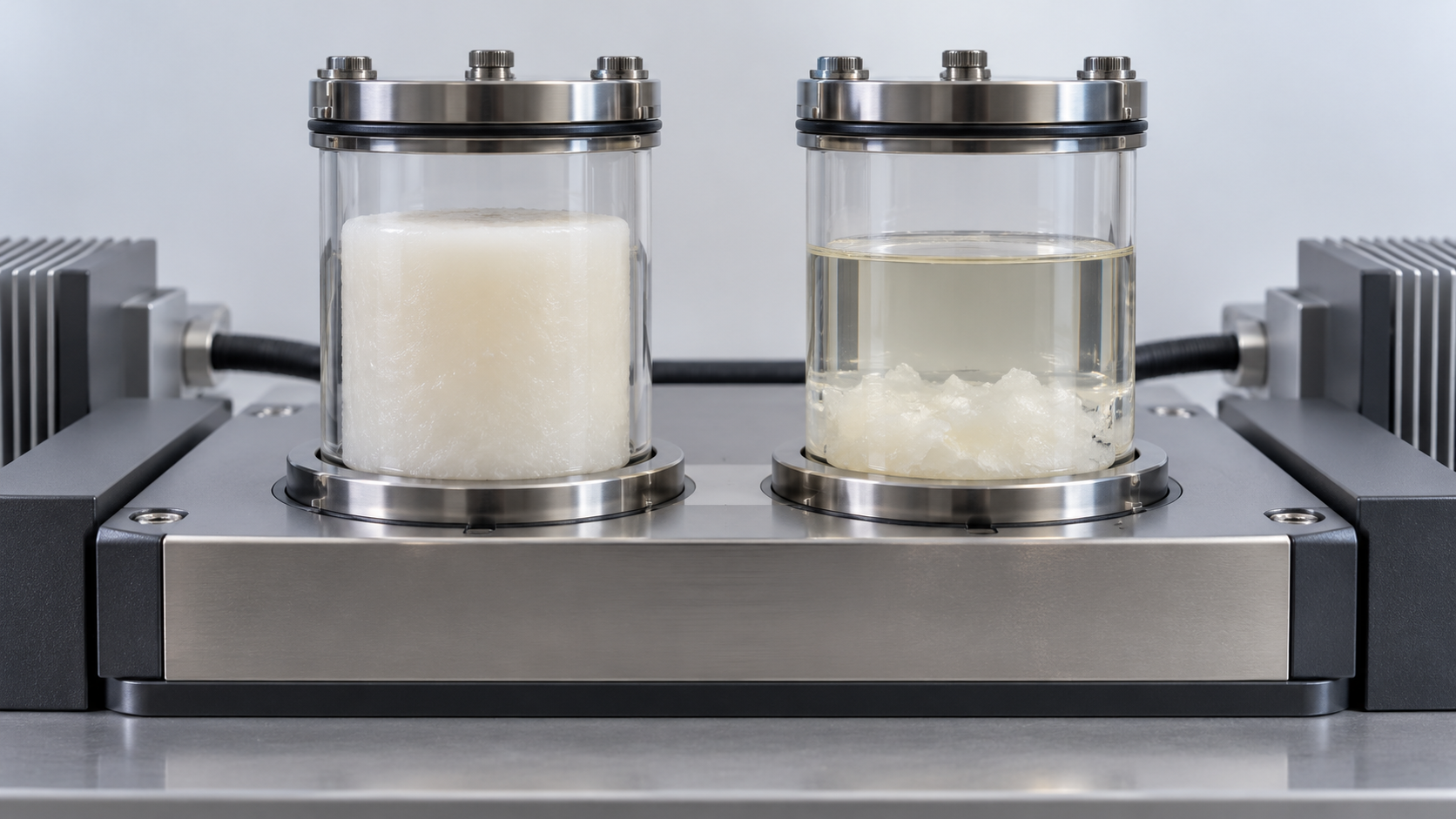
- What a phase change material is (the short version)
- Latent heat versus sensible heat — how large is the difference (our calculation)
- Families of materials — paraffins, fatty acids, salt hydrates, solid-solid
- The difficulties of salt hydrates — incongruent melting, supercooling, scatter in reported values
- Leakage and thermal conductivity — encapsulation and shape stabilization
- Cycling stability and flammability — "how many cycles" and "does it burn"
- Measuring with DSC — the heating rate changes the result
- Applications — buildings, battery thermal management, clothing, data centers
- How to read evaluations and standards
- Limits, and what could not be confirmed
- Glossary
- References
- Claim-to-source audit
Sourced = stated in published material (link given)
Our calculation = a figure this article derived, with the assumptions spelled out
Not yet confirmed = a plan or schedule whose record has not been confirmed
Materials-design interpretations are marked separately as Commentary. Inference is shown in bold.
The melting points and latent heats here (kJ/kg or J/g) change with the measurement method (such as the DSC heating rate), whether the material is pure or a composite, and whether the value was measured or quoted from the literature. Chapter 4 shows an example in which the literature values for one material differ by 20–30%. The results for batteries, buildings and data centers are reports under specific test or simulation conditions and do not guarantee safety or energy savings. This article does not rank products or companies and gives no individual safety advice.
1. What a phase change material is (the short version)
- It exchanges latent heat at a nearly constant temperature: a PCM can take in, store and release heat at a nearly constant temperature. But if the temperature of use does not match the temperature of the phase change, the latent heat cannot be used and the material is no better than ordinary sensible-heat storageSourced[Ref. 1]
- There are four families: paraffins (organic), fatty acids (organic), salt hydrates (inorganic), and solid-solid PCMs whose crystal state changes while remaining solid. Each has its own character in latent heat, supercooling, leakage and flammabilitySourced[Refs. 1, 2, 3, 8]
- The numbers carry conditions: latent heat and melting point change with the DSC heating rate and calibration, the container, and whether the material is a composite. In an IEA international comparison, even a pure substance gave widely scattered results between laboratories unless the procedure was fixedSourced[Refs. 4, 5]
“Latent heat of X J/g, melting point of Y °C” means something only when it states which procedure was used and for which form (pure or composite) it was measured. In the IEA’s three round robins, the first comparison, with no fixed procedure, was not reproducible; only when the heating rate was made slow (below 0.5 K/min for a 5 mg sample) and calibration, baseline and data processing were unified did the enthalpy and temperature on heating agree. The cooling side did not agreeSourced[Ref. 4].
2. Latent heat versus sensible heat — how large is the difference (our calculation)
We compute the difference between the heat used to raise a temperature (sensible heat) and the heat used while melting without a temperature rise (latent heat), for a real substance. n-Octadecane, used as the reference PCM in the IEA round robins, has reference values collected in the literature of an enthalpy of fusion of 241.65 J/g, a melting point of 28.15 °C, and specific heats of 1.91 J/(g·K) for the solid and 2.23 J/(g·K) for the liquidSourced[Ref. 4].
Our calculation
- Sensible heat of the solid (20 → 28.15 °C): 1.91 × 8.15 = about 15.6 J/g
- Latent heat of melting (28.15 °C): 241.65 J/g
- Sensible heat of the liquid (28.15 → 35 °C): 2.23 × 6.85 = about 15.3 J/g
- Total: about 272.5 J/g. Warming the same 15 K using only the specific heat of 2.23 J/(g·K), with no phase change, gives 2.23 × 15 = about 33.5 J/g. The ratio is about 8.1
- Narrowing the window raises the ratio: over 26–31 °C (5 K) the total is about 252.1 J/g against about 11.2 J/g for sensible heat alone, a ratio of about 22.6
Assumptions and limits: an idealized piecewise line in which a pure substance melts at a single point; it is not a measured DSC curve. Specific heats are assumed constant with temperature. The “multiple” of stored heat changes greatly with the width of the temperature window, so the ratio alone cannot be used to compare materials as a performance figure.
3. Families of materials — paraffins, fatty acids, salt hydrates, solid-solid
| Family | Reported melting point and latent heat (conditions) | Features and difficulties |
|---|---|---|
| Paraffins (n-alkanes, paraffin waxes) | n-Tetradecane 5.5 °C, 215 kJ/kg; n-hexadecane 17.75 ± 0.006 °C, 235.13 ± 0.13 kJ/kg (DSC); n-octadecane 27.07 ± 0.095 °C, 243.68 ± 0.096 kJ/kg (DSC); n-eicosane 35.69 ± 0.15 °C, 247.05 ± 0.14 kJ/kg (DSC). Blended paraffin waxes 41.92–66 °C, 184–210 kJ/kg (literature values) [1]. A review gives wax melting points of 30–90 °C and enthalpies of fusion of 180–270 kJ/kg [3] | The melting point rises with carbon number. A blended wax melts component by component, so the melting point has a width (temperature glide), and the difference between melting and freezing (hysteresis) can be several K. Supercooling is rare [1]. Thermal conductivity is low, on average about 0.2 W/(m·K) [3]. It burns (Chapter 6) |
| Fatty acids | Melting point 5–70 °C, enthalpy of fusion 45–210 kJ/kg (review) [3]. In another assessment 125–250 J/g, density about 0.9 g/cm³, 32–80 kWh/m³ by volume [2] | Many are made from renewable raw materials. The stored heat per volume is small [2]. The range differs between sources (shown side by side here only) |
| Salt hydrates | For example from LiClO3·3H2O at 8.1 °C, 253 kJ/kg to sodium acetate trihydrate, CH3COONa·3H2O, at 58 °C, 226–289 kJ/kg (differing by source) [1]. In another assessment 100–290 J/g, density 1.3–2.6 g/cm³, 50–130 kWh/m³ by volume [2] | Stored heat per volume is larger than for paraffins (salt hydrates 40–125 kWh/m³, paraffins 40–60 kWh/m³) [1]. On the other hand there are incongruent melting, supercooling (above 5 °C) and corrosiveness [2] (Chapter 4) |
| Solid-solid PCMs (for example, PEG built into polyurethane) | PEG (molecular weight 2,000–20,000): melting point 50.8–62.5 °C, enthalpy of fusion 184.7–212.1 J/g (a review table) [8]. PEG is built into the polyurethane as the soft segment | The soft segment melts and crystallizes to exchange latent heat, while the hard segment keeps the shape through hydrogen bonding and similar interactions, so the review says the design does not flow out when it melts [8]. Values change with the design (composition ratio) |
All Sourced (statements in each reference). Melting points and latent heats are often quoted from the literature, and the measurement method differs by source. The families are not ranked against each other.
Hirschey and co-authors’ conference paper summarizes that the melting enthalpies of paraffins and salt hydrates are generally on the order of 100–200 kJ/kg, with melting points of 0–100 °C that suit buildings. Ice (0 °C, 333.5 kJ/kg) is used in DSC calibrationSourced[Refs. 1, 4].
4. The difficulties of salt hydrates — incongruent melting, supercooling, scatter in reported values
A salt hydrate is a crystal that an anhydrous salt forms with water in a fixed molar ratio. When it melts, if the anhydrous salt does not fully dissolve in the water of crystallization, incongruent melting occurs (the anhydrous salt settles and does not recombine with water on freezing). For example, Hirschey and co-authors write that sodium sulfate decahydrate (Glauber’s salt, melting point 32.4 °C) is plagued by incongruent melting and inconsistent supercoolingSourced[Ref. 1].
Supercooling: an extreme case, and a useful one
On freezing, supercooling can occur, in which the liquid stays liquid below its melting point. For sodium acetate trihydrate (melting point 58 °C), supercooling to −12.7 °C before spontaneous crystallization has been reported, about 71 K below the melting point (58 − (−12.7) = 70.7 K)Sourced[Ref. 1]Our calculation. On the other hand, Johansen and co-authors report that a sample of sodium acetate trihydrate mixed with graphite powder (200 g per sample) stayed supercooled at room temperature for five months. The graphite powder was stabilized with carboxymethyl celluloseSourced[Ref. 7]. It shows that supercooling can be a drawback, or a means of long-term heat storage.
Even for the same material, the literature latent heat differs by 20–30%
The next figure lines up the enthalpies of fusion of salt hydrates from Hirschey and co-authors’ table, material by material. Where a method is stated it is DSC, T-history (T-H) or a simple calorimeter (coffee-cup type, CC); many reports state none.
Incongruent melting is a property of the phase diagram: there is not enough water to dissolve the anhydrous salt. So the countermeasures fall into two kinds: stop the movement so that the anhydrous salt does not settle (thickeners, gelling agents, a porous framework), or suppress supercooling by seeding with a substance of the same crystal structure as the hydrate (for example borax, sodium tetraborate decahydrate, added to sodium sulfate decahydrate). Hirschey and co-authors say these additives are generally under 20% by mass, that latent heat falls by the amount displaced, and that cost does not rise much [Ref. 1].
From the materials side, the problem is that the nuclei stop working and the segregation does not reverse when the operating temperature range is exceeded. RAL-GZ 896 likewise names segregation and deactivation of nucleating agents when the operating range is left as common causes of cycling failure [Ref. 6]. It is not enough to say “an additive that suppresses supercooling was added”; one has to confirm how many thermal cycles, and what excursions in temperature, that nucleating agent survives (this article’s commentary).
Stored heat per volume = enthalpy of fusion × solid densityOur calculation. For the paraffin wax that Hirschey and co-authors use in their comparison (melting point 48 °C, 189 kJ/kg, density 0.912 g/cm³), 189 kJ/kg × 912 kg/m³ ÷ 3,600 = about 47.9 kWh/m³, which agrees with the paper’s value [Ref. 1]. Assumptions and limits: this uses the solid density, and for materials whose density changes on melting the volume change has to be handled separately in system design. The paper itself points out that the density change on melting is not consistent between salt hydrates and paraffins [Ref. 1].
5. Leakage and thermal conductivity — encapsulation and shape stabilization
A solid-liquid PCM flows out when it melts, and a paraffin conducts heat poorly. A review gives the average thermal conductivity of paraffin as about 0.2 W/(m·K), and compounding with highly conductive particles (such as carbon materials) is widely studiedSourced[Ref. 3]. There are three broad ways to contain the PCM.
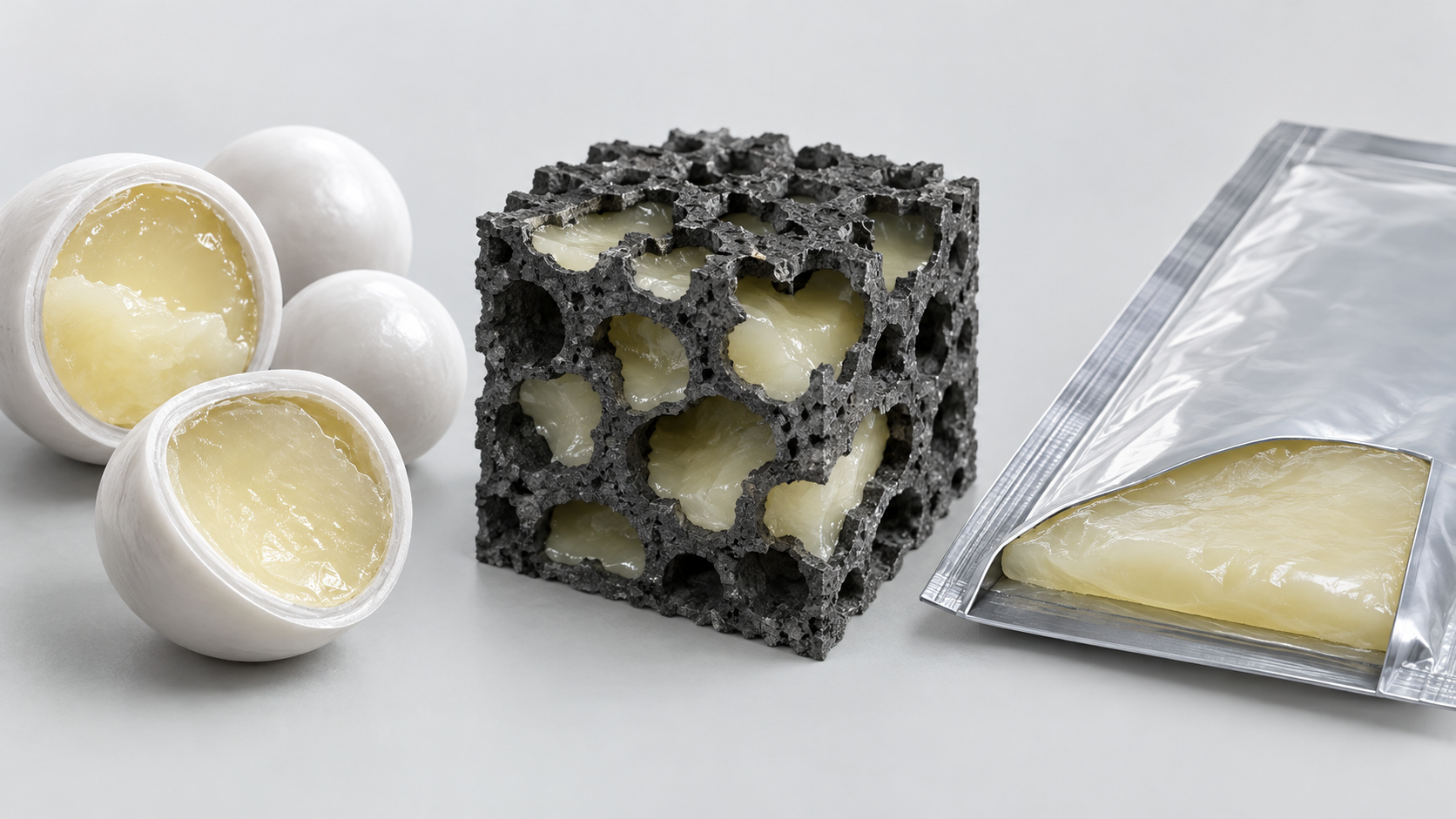
View the original SVG schematic and exact annotations
- Microcapsules: According to NASA Spinoff, NASA began in the 1980s to investigate fabric that controls temperature without pumped liquids, building on U.S. Air Force work. Triangle Research and Development Corporation, before its SBIR contracts with Johnson Space Center (1987 and 1988), had shown the value of textiles containing microencapsulated PCM (mPCM) for the Air Force. The company that acquired the patent rights later changed its name to Outlast Technologies and built mPCM into apparel, bedding and other productsSourced[Ref. 13].
- Shape stabilization (graphite, porous bodies): The review gives an example of an octanoic acid-myristic acid eutectic mixture adsorbed into expanded graphite (EG) at a mass ratio of 93:7 (phase transition temperature 6.8 °C, latent heat 136.3 J/g, no significant change in transition temperature or latent heat after 100 cold-storage and discharge cycles). In another example, a palmitic acid/polyaniline/xGnP shape-stabilized PCM had a thermal conductivity of 1.08 W/(m·K) and a storage capacity of 157.7 J/g, with a thermal conductivity reported as 237.5% higher than the system without xGnPSourced[Ref. 3].
- Container: In the data-center study, the PCM is envisaged in sealed containers to limit damage if it leaks [Ref. 11]. RAL-GZ 896 also says the stability of a PCM can fall over time through interaction with its surroundings (atmosphere, container walls) [Ref. 6].
The latent heat of a composite is roughly the mass fraction of PCM times the latent heat of the pure substanceOur calculation. For example, a composite containing a paraffin with a latent heat of 200 J/g at a mass fraction of 0.8 has a theoretical 0.8 × 200 = 160 J/g. This example was chosen to be of the same order as the statement by Hirschey and co-authors in Chapter 4 that additives are generally under 20% by mass. Assumptions and limits: the real latent heat of a composite must be confirmed by DSC (it depends on how the PCM is adsorbed, on the interface, and on how much of the PCM can actually crystallize). “Thermal conductivity multiplied by X” and “latent heat reduced by Y%” are always read as a pair.
In papers on shape-stabilized PCMs, the improvement in thermal conductivity (237.5% in the example above) stands out, but whether the material can be used can only be read when the latent heat of the same sample, the conditions of the leakage test (temperature and time) and the number of cycles are all given. For instance, another example in the review says that adding expanded graphite to erythritol improved its thermal conductivity and cycling stability, though accompanied by a reduction in latent heat [Ref. 3].
Solid-solid types are described as designs that “do not leak”, but the source of their latent heat is the crystallization and melting of a soft segment such as PEG (Chapter 3). Because the melting point and latent heat move with molecular weight and composition (191.2 J/g for PEG 2,000 and 207.4 J/g for 10,000, for instance), a trade-off is expected in which raising the soft-segment fraction raises the latent heat but makes shape retention harder (Inference. The review says the transition temperature, thermal conductivity and mechanical strength can be tuned by the ratio of soft and hard segments, but this article has not confirmed a quantitative relationship) [Ref. 8].
6. Cycling stability and flammability — “how many cycles” and “does it burn”
Cycling stability
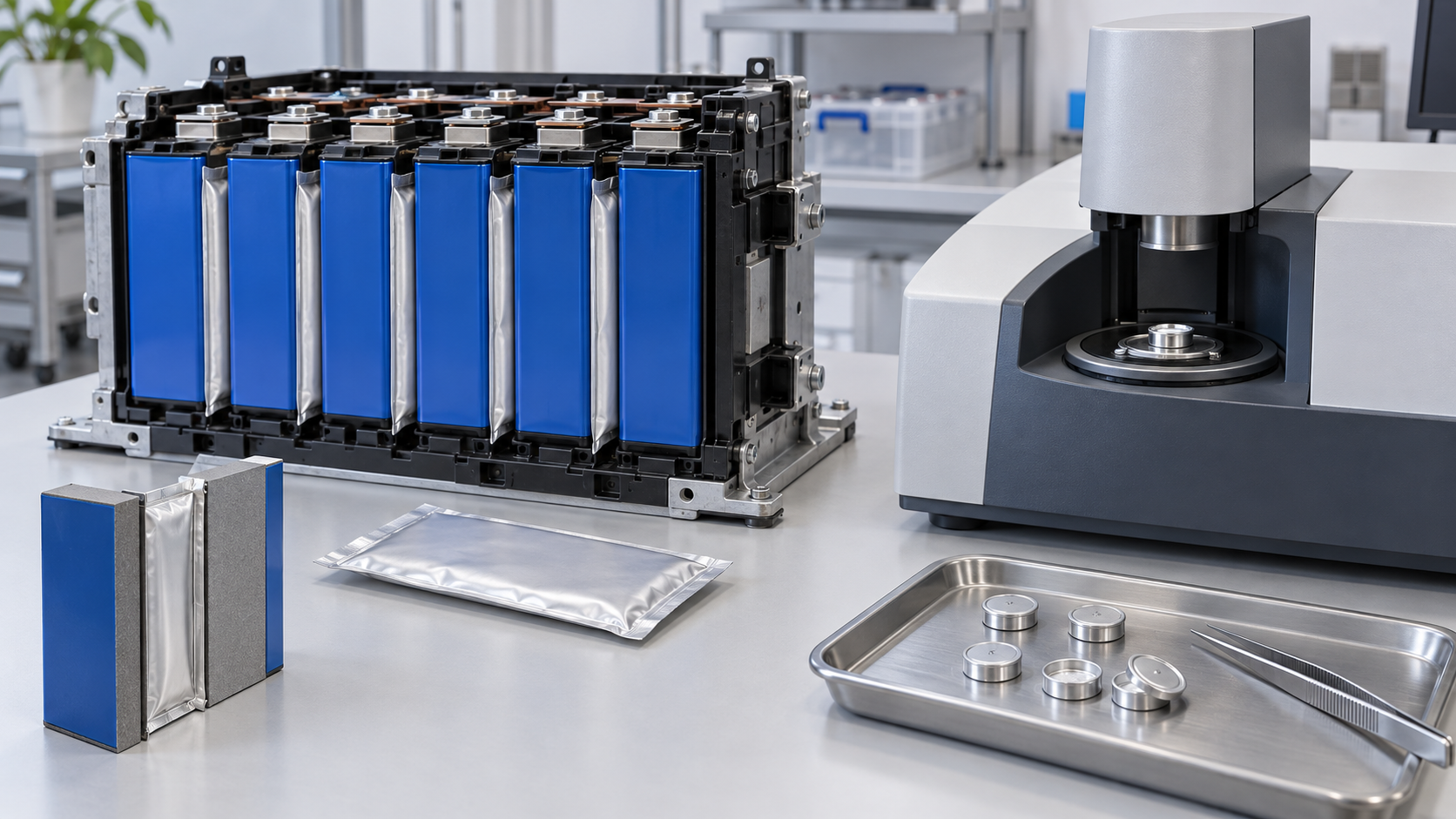
RAL-GZ 896 (August 2025 edition), operated by the German quality association Gütegemeinschaft PCM, sets out quality assurance and testing for PCMs and examines cycling stability as an indicator of long-term stability. One cycle is a complete phase change on heating and cooling; the PCM must pass a defined number of cycles undamaged, and it is declared in six cycle categories from 10,000 cycles or more down to 50 or more. PCMs consisting only of pure n-alkanes are regarded as stable and need not be tested, but composites made with n-alkanes (PCM-C) must be. The specification names segregation, and deactivation of nucleating agents when the operating temperature range is left, as common causes of failureSourced[Ref. 6]. This is a quality assurance of an industry association, not an international or national standard like ISO or JIS. The German edition prevails in application [Ref. 6].
Flammability (organic PCMs such as paraffin)
Hirschey and co-authors list, as challenges of fatty acids, fatty alcohols and waxes, low thermal conductivity, low density, some flammability concerns, and compatibility problems with common engineering materials such as polymersSourced[Ref. 2]. In an experiment on battery thermal runaway, Mei and co-authors report that adding paraffin (PA) lengthens the time of steady flame. The test used a single Sony US18650VTC5 cell (2600 mAh, NMC positive electrode, graphite negative electrode) fully charged (100% SOC), with thermal runaway triggered by a 200 W or 500 W heater. The steady-flame time was 10 s for the single cell and 42 s with PA (phase transition temperature 48–50 °C, latent heat 136 J/g, 14.55 g). With a composite combining sodium acetate trihydrate (SA, 58 °C, 260 J/g) (PA 9.7 g and SA 7.99 g), it was 25 s, 40.5% shorter than with PA but still longer than for the single cell. The average temperature rise rate of the cell before thermal runaway was 0.1 °C/s with the composite, 87.3% lower than for the single cell and 44.4% lower than with PA. The authors state that a higher heater power makes thermal runaway faster and greatly reduces the mitigating effect of the compositeSourced[Ref. 9].
In another study (a simulation), for a prismatic-cell module, a composite PCM of SAT with expanded graphite had 4.8 times the latent heat of paraffin/expanded graphite and was calculated to delay propagation of thermal runaway more than six-fold, with no propagation in the model above a thickness of 12 mmSourced[Ref. 29]. These are experimental or model results for particular cells, layouts and conditions; they do not guarantee safety and cannot be generalized to other batteries or uses. Battery thermal runaway itself is covered in this series’ explainer on thermal runaway and battery safety.
In Mei and co-authors’ results, combining a hydrated salt (rich in water of crystallization) shortened the steady flame compared with PA alone [Ref. 9]. From the materials side, this can be read as the effect of the water of crystallization absorbing heat and evaporating together with dilution of the organic component (Inference. The paper states that the crystal water of SA absorbs heat, but this article has not confirmed the details of the mechanism of flame suppression). However, salt hydrates have the problems of supercooling, incongruent melting and corrosiveness (Chapter 4), so replacing an organic PCM with a salt swaps one cycling-stability problem for another. Improved flame retardancy has to be read together with combustion tests, cycling stability, thermal conductivity and leakage (this article’s commentary).
7. Measuring with DSC — the heating rate changes the result
The latent heat and melting point of a PCM are usually measured by differential scanning calorimetry (DSC), but the habits of ordinary polymer DSC do not measure them correctly. The review by Lazaro and co-authors notes that Castellón and co-authors and Günther and co-authors showed that DSC of PCMs needs heating and cooling rates usually slower than 1 K/min, which does not match the standard practice of DSC analysis of polymers and other substancesSourced[Ref. 4].
What the IEA round robins showed
- First round (no fixed procedure): each laboratory measured the reference PCM its own way, and reproducibility was not achieved. The influencing factors were the measurement procedure, the DSC itself, calibration, sample preparation and crucible, and data processing [4].
- Second round (the RAL procedure made common): enthalpy was reproducible, but temperatures near the melting point had a large uncertainty, especially on cooling curves. On heating, two instruments deviated from the theoretical value by ±25 kJ/kg, and the end point (offset) of melting of octadecane was scattered between 26.8 and 29.4 °C. On cooling, every curve froze at a lower temperature than expected (supercooling), by up to 3.6 °C [4].
- Third round (calibration, measurement and data processing all made common, in a DSC workshop): with four heat-flux DSCs, a 5 mg sample of octadecane needed a rate below 0.5 K/min on all instruments. With calibration using water (ice) and indium, a baseline measured at the same rate, the same crucible and a check that the baseline was stable, the enthalpy and temperature on heating agreed. The results on cooling did not agree [4].
Our calculation
- Lazaro and co-authors measured 10–40 °C (a 30 K window) at 0.2 K/min. One heating run takes 30 ÷ 0.2 = 150 min [4]
- Carrying out the IEA procedure (at least three samples, four cycles each) over a 30 K window at 0.5 K/min takes 60 min per heating (or cooling) ramp, 120 min per cycle, and 3 samples × 4 cycles = 1,440 min = 24 hours [5]
Assumptions and limits: a lower bound that excludes isothermal holds, calibration, blank measurement and the heating-rate test. For a mixture that melts over a wider range than the actual window, it extends further. This cost is the background to why the DSC conditions in papers are often fast (for example 5–10 K/min) and the latent heat and melting point drift from their thermal-equilibrium values (Inference; the conditions in individual papers were not checked in this article).
To put a PCM into a building simulation one needs the relation between enthalpy and temperature. NREL’s Tabares-Velasco modeled PCM-enhanced insulation in EnergyPlus and showed that approximating the enthalpy curve by a straight line changes annual energy savings little, but that for hourly results, if a linear profile is used, one must specify a melting range covering roughly 80% of the latent heat, or results can differ by up to 20% [Ref. 12]. So the shape of the DSC curve (not only the melting point, but over what temperature range the latent heat is distributed) matters for design. Choosing a material from just two numbers, melting point and latent heat, overlooks supercooling and temperature hysteresis on the cooling side (this article’s commentary).
8. Applications — buildings, battery thermal management, clothing, data centers
| Use | What the primary sources confirm | Note when reading |
|---|---|---|
| Buildings | NREL’s conference paper says PCMs are used in buildings in wallboards impregnated with PCM, impregnation of fiber insulation, large capsules inside walls, and floor heating using shape-stabilized PCM, and that the variety of PCMs and their high cost make design for each application complicated. Research on reducing peak load and HVAC energy has run for decades, but few building energy simulation programs can handle PCMs, and fewer have been validated [12] | What was confirmed here is the statement about design and modeling; actual savings in real buildings are not given in this article |
| Battery thermal management | Al Hallaj and Selman (2000) proposed thermal management that builds PCM into electric-vehicle battery modules and reported, from finite-element simulation, that the temperature profile of the cells during discharge was substantially more uniform than without PCM. It is effective for thermally sensitive cells such as Li-ion with a large reversible heat, and the stored heat is rejected when the battery rests or its temperature falls below the melting point [10]. The single-cell thermal runaway experiment is in Chapter 6 [9] | A 2000 proposal and simulation. It does not guarantee the life or safety of real equipment |
| Clothing | mPCM is built into fibers, fabrics and garments to slow temperature changes near the body. After NASA’s SBIR contracts (1987–1988), Outlast Technologies extended it to bedding, medical supplies, outdoor gear and apparel (article of 2009) [13] | NASA’s article introduces a business history. No performance comparison of individual products is given |
| Data centers | Skach and co-authors proposed “thermal time shifting”, placing commercial-grade paraffin (latent heat about 200 J/g) in sealed containers near servers to shift the peak of the heat load. Evaluating three server configurations with a simulator validated on real hardware, they predicted that in a data center unconstrained in cooling, PCM could cut peak cooling use by 12% or allow 14.6% more servers under the same thermal budget [11] | A simulation prediction, not a measurement at a real data center. Use as backup cooling is a separate discussion and was not confirmed in this article |
All Sourced (sources in each cell).
9. How to read evaluations and standards
The performance of a PCM is evaluated by the temperature and enthalpy of melting and freezing, specific heat, thermal conductivity, change after cycling, and flammability. Melting point and latent heat are measured by DSC; thermal conductivity by the hot-disc, heat-flow-meter or flash methods, among others. However, an international standard or JIS written specifically for PCMs could not be confirmed. ISO 11357 for DSC and JIS K 7121-7123 are standards for plastics; paraffin and salt-hydrate PCMs fall outside their scope, but they are cited as a foundation for the method. Procedures specific to PCMs are in the IEA technical report (DSC 4229 PCM Standard) and the industry association’s RAL-GZ 896.
| Item evaluated | ISO | IEC / IEEE | JIS | ASTM | What changes the value with test conditions |
|---|---|---|---|---|---|
| Temperature and enthalpy of melting and freezing (DSC) | ISO 11357-1:2023, plastics, differential scanning calorimetry (DSC), Part 1: general principles [15]. ISO 11357-3:2025, Part 3: determination of temperature and enthalpy of melting and crystallization (crystalline and partially crystalline plastics) [16] | Could not be confirmed | JIS K 7121, testing methods for transition temperatures of plastics (enacted 1987, revised 2012) [22]. JIS K 7122, testing methods for heats of transition of plastics (enacted 1987, revised 2024) [23] | ASTM D3418 (transition temperatures and enthalpy of fusion and crystallization), ASTM E793 (heats of fusion and crystallization) and ASTM E794 (melting and crystallization temperatures): listed as DSC standards in an instrument maker’s material [27]. For PCMs: the IEA’s DSC 4229 PCM Standard (January 2015) [5] and RAL-GZ 896 (August 2025) [6] | Heating rate (slow for PCMs), sample mass, crucible, calibration, baseline, heating or cooling side [4] |
| Specific heat capacity | ISO 11357-4:2021, Part 4: determination of specific heat capacity (plastics) [17] | Could not be confirmed | JIS K 7123, testing methods for specific heat capacity of plastics (enacted 1987, revised 2012) [24] | ASTM E1269 (specific heat by DSC): an instrument maker lists it alongside ISO 11357-4 [28] | Running the empty pan, a reference material and the sample under identical conditions, and the baseline |
| Thermal conductivity | ISO 22007-2:2022, plastics, determination of thermal conductivity and thermal diffusivity, Part 2: transient plane heat source (hot disc) method [18]. ISO 22007-4:2024, Part 4: light flash method [19]. ISO 8301:1991, thermal insulation, determination of steady-state thermal resistance and related properties, heat flow meter apparatus (flat slab specimens) [20] | Could not be confirmed | JIS A 1412-2, measurement of thermal resistance and thermal conductivity of thermal insulations, Part 2: heat flow meter method (enacted 1999) [26] | Could not be confirmed | Sample form (homogeneity of a composite), temperature, solid or liquid (convection in a liquid) |
| Cycling stability | Could not be confirmed | Could not be confirmed | Could not be confirmed | Could not be confirmed | The industry quality assurance RAL-GZ 896 declares it in six categories from 10,000 cycles or more down to 50 or more [6] |
| Flammability (small flame) | Could not be confirmed | IEC 60695-11-10:2013, fire hazard testing, Part 11-10: test flames, 50 W horizontal and vertical flame test methods (solid and cellular materials for electrotechnical products with apparent density above 250 kg/m³) [21] | JIS C 60695-11-10 (enacted 2006, revised 2015, confirmed June 2024) [25] | Could not be confirmed | Specimen size and orientation (horizontal or vertical) and flame conditions. A powder or liquid PCM as such is outside the scope |
Numbers, titles and editions were confirmed on the official page of each body Sourced. For ASTM, only the number and the quantity measured are given, only where confirmed from non-ASTM public material (instrument makers’ pages). The arrangement of this table is Our calculation (this article’s rearrangement).
Notes on reading standards
- Do not apply a DSC standard for plastics to a PCM unchanged. ISO 11357-3 covers melting and crystallization of plastics, and paraffin and salt-hydrate PCMs are outside it. For PCMs, the heating rate (slower than 1 K/min), calibration (ice and indium and others) and treatment of the baseline are supplemented by PCM-specific procedures such as the IEA report and RAL-GZ 896 [4, 5, 6]
- RAL-GZ 896 is an industry quality assurance, not an international standard. The German edition prevails, and it is the basis of quality marking for member companies’ products. Read a value described as “RAL-compliant” together with the edition (such as August 2025), the cycle category and the testing laboratory
- Read a manufacturer’s value together with whether it is for the pure substance or a composite, and with the method and heating rate. An instrument maker’s “complies with” statement describes the instrument’s capability, and does not make the latent heat obtained a value guaranteed by the standard
10. Limits, and what could not be confirmed
(1) Standard texts
The texts of ISO 11357, ISO 22007, ISO 8301, IEC 60695-11-10 and the JIS standards were not checked. Test conditions, procedures and acceptance criteria are not stated. RAL-GZ 896 was consulted for an outline only and is not reproduced. The ASTM website was not opened, and ASTM standards are given only as the numbers and quantities measured confirmed in instrument makers’ material.
(2) Effects in real buildings and equipment
The results in Chapter 8 are simulations or reports under particular test conditions. They do not show energy savings in real buildings, the life or safety of battery packs, or operating effects in data centers.
(3) Solid-solid PCMs and the safety of organic PCMs
The statement that solid-solid types “do not leak” is the review’s claim and was not independently confirmed here. The corrosiveness of fatty acids and the toxicity and environmental impact of each PCM could not be confirmed in primary sources and are not stated.
(4) Quantitative data on cycling degradation
A primary source that compares, across studies, the fall in latent heat per cycle for salt hydrates and paraffin composites could not be confirmed (individual examples from the review are in Chapter 5). The RAL-GZ 896 categories are a mechanism for declaration, not a guarantee of life in actual use.
(5) Regulation
The application of building codes, fire-service law, REACH and similar regulation was not checked and is not stated.
- Latent heat concentrates a large exchange of heat in a narrow temperature range. For n-octadecane warmed from 20 to 35 °C the heat absorbed with latent heat is about 8.1 times that of sensible heat alone, and about 22.6 times over a 5 K windowOur calculation
- Salt hydrates store more per volume but suffer incongruent melting and supercooling. Supercooling of up to about 71 K has been reported and can also serve long-term storage. Even for one material the literature latent heat differs by up to about 28%Sourced / Our calculation
- Containment is a trade-off between latent heat and conductivity. For encapsulation, shape stabilization, containers and solid-solid types alike, read the improvement in thermal conductivity as a pair with the reduction in latent heatSourced
- In DSC the heating rate changes the result. In the IEA comparison the results were not reproducible without a fixed procedure; a rate below 0.5 K/min with unified calibration and baseline made the heating side agree, and the cooling side did notSourced
- Paraffin burns. In a single-cell battery experiment a composite with a salt hydrate gave a shorter flame than paraffin alone, but the effect was reported to fall greatly at higher heater powerSourced
11. Glossary
- PCM
- Phase change material. A material that stores heat as latent heat of melting, freezing and similar changes.
- Latent heat / sensible heat
- Heat exchanged in a phase change / heat exchanged when temperature changes.
- Enthalpy of fusion
- The heat absorbed on melting, in kJ/kg or J/g.
- Supercooling
- A liquid staying liquid below its melting point.
- Incongruent melting
- Part of the material fails to dissolve on melting, settles, and does not recombine on freezing.
- Temperature glide
- A melting point with a width, because the components of a mixture melt separately.
- Shape-stabilized PCM
- A PCM held in a porous body or graphite so that it keeps its shape on melting.
- mPCM
- PCM enclosed in microcapsules.
- Solid-solid PCM
- A PCM that exchanges latent heat through a change of crystal state while remaining solid.
- DSC
- Differential scanning calorimetry. Measures heat flow while temperature is changed at a constant rate.
- T-history method
- A method that cools a large sample and finds latent heat from its temperature history.
- Round robin
- A test in which several laboratories measure the same sample to compare reproducibility.
12. References
- Hirschey J., Gluesenkamp K. R., Mallow A., Graham S. “Review of Inorganic Salt Hydrates with Phase Change Temperature in Range of 5 to 60 °C and Material Cost Comparison with Common Waxes”, 5th International High Performance Buildings Conference at Purdue, July 2018 (listed in Purdue e-Pubs; full text checked in the PDF hosted by OSTI) — docs.lib.purdue.edu/ihpbc/320
- Hirschey J., Kumar N., Turnaoglu T., Gluesenkamp K. R., Graham S. “Review of Low-Cost Organic and Inorganic Phase Change Materials with Phase Change Temperature between 0 °C and 65 °C”, International High Performance Buildings Conference (Purdue e-Pubs 389, posted August 2021) — docs.lib.purdue.edu/ihpbc/389
- Yang G., Yim Y.-J., Lee J. W., Heo Y.-J., Park S.-J. “Carbon-Filled Organic Phase-Change Materials for Thermal Energy Storage: A Review”, Molecules 24, 2055 (2019), DOI 10.3390/molecules24112055 (open access) — pmc.ncbi.nlm.nih.gov/articles/PMC6600410
- Lazaro A. et al. “Intercomparative tests on phase change materials characterisation with differential scanning calorimeter”, Appl. Energy 109, 415–420 (2013), DOI 10.1016/j.apenergy.2012.11.045 (version posted by IEA SHC Task 42) — task42.iea-shc.org (Intercomparative tests)
- Gschwander S. et al. (IEA SHC Task 42 / ECES Annex 29) “Standard to determine the heat storage capacity of PCM using hf-DSC with constant heating/cooling rate (dynamic mode)”, DSC 4229 PCM Standard (technical report, 31 January 2015) — task42.iea-shc.org (DSC 4229 PCM Standard)
- RAL German Institute for Quality Assurance and Certification (Gütegemeinschaft PCM) “RAL-GZ 896 Phase Change Materials” (August 2025 edition). Reproduction is prohibited, so only an outline is referred to — pcm-ral.de (quality and testing specifications)
- Johansen J. B. et al. “Thermal Conductivity Enhancement of Sodium Acetate Trihydrate by Adding Graphite Powder and the Effect on Stability of Supercooling”, Energy Procedia 70, 249–256 (2015), DOI 10.1016/j.egypro.2015.02.121 — doi.org/10.1016/j.egypro.2015.02.121
- Wang Z. et al. “Recent Research Progress on Polyurethane Solid–Solid Phase Change Materials”, Polymers 17, 1933 (2025), DOI 10.3390/polym17141933 (open access) — pmc.ncbi.nlm.nih.gov/articles/PMC12298916
- Mei J. et al. “Organic and Inorganic Hybrid Composite Phase Change Material for Inhibiting the Thermal Runaway of Lithium-Ion Batteries”, Batteries 9, 513 (2023), DOI 10.3390/batteries9100513 (open access) — doi.org/10.3390/batteries9100513
- Al Hallaj S., Selman J. R. “A Novel Thermal Management System for Electric Vehicle Batteries Using Phase-Change Material”, J. Electrochem. Soc. 147, 3231 (2000), DOI 10.1149/1.1393888 — doi.org/10.1149/1.1393888
- Skach M. et al. “Thermal Time Shifting: Decreasing Data Center Cooling Costs with Phase-Change Materials”, IEEE Internet Computing 21, 34–43 (2017), DOI 10.1109/MIC.2017.2911418 — par.nsf.gov/servlets/purl/10053304
- Tabares-Velasco P. C. (NREL) “Energy Impacts of Nonlinear Behavior of PCM When Applied into Building Envelope”, NREL/CP-5500-54245 (ASME ES2012 conference paper, August 2012) — eere.energy.gov (NREL/CP-5500-54245)
- NASA Spinoff “Phase Change Fabrics Control Temperature” (published 2009) — spinoff.nasa.gov/Spinoff2009/ch_4.html
- Fatahi H. et al. “Thermal Characterization of Phase Change Materials by Differential Scanning Calorimetry: A Review”, Appl. Sci. 12, 12019 (2022), DOI 10.3390/app122312019 (open access; abstract only checked) — doi.org/10.3390/app122312019
- ISO “ISO 11357-1:2023” (Edition 4, February 2023) — iso.org/standard/83904.html
- ISO “ISO 11357-3:2025” (Edition 4, May 2025) — iso.org/standard/88106.html
- ISO “ISO 11357-4:2021” (Edition 3, February 2021) — iso.org/standard/79998.html
- ISO “ISO 22007-2:2022” (Edition 3, June 2022) — iso.org/standard/81836.html
- ISO “ISO 22007-4:2024” (Edition 3, January 2024) — iso.org/standard/86202.html
- ISO “ISO 8301:1991” (Edition 1, August 1991, reconfirmed in 2025) — iso.org/standard/15421.html
- IEC “IEC 60695-11-10:2013” (Edition 2) — webstore.iec.ch/en/publication/2938
- Japanese Industrial Standards Committee (JISC) “JIS K 7121” search result and detail page (enacted 1 October 1987, last revised 20 July 2012, last confirmed 20 October 2022) — jisc.go.jp (JIS K 7121)
- Japanese Industrial Standards Committee (JISC) “JIS K 7122” search result and detail page (enacted 1 October 1987, last revised 21 March 2024) — jisc.go.jp (JIS K 7122)
- Japanese Industrial Standards Committee (JISC) “JIS K 7123” search result and detail page (enacted 1 October 1987, last revised 20 July 2012, last confirmed 20 October 2022) — jisc.go.jp (JIS K 7123)
- Japanese Industrial Standards Committee (JISC) “JIS C 60695-11-10” search result and detail page (enacted 20 November 2006, last revised 20 March 2015, last confirmed 20 June 2024) — jisc.go.jp (JIS C 60695-11-10)
- Japanese Industrial Standards Committee (JISC) “JIS A 1412-2” search result and detail page (enacted 20 April 1999, last confirmed 20 October 2021) — jisc.go.jp (JIS A 1412-2)
- NETZSCH “DSC 214 Polyma — Method, Technique, Applications” (its table of standards lists ASTM D3418, E793, E794 and others) — analyzing-testing.netzsch.com (DSC 214 Polyma)
- NETZSCH “Precise Determination of the Specific Heat by Means of DSC” (mentions ASTM E 1269, DIN 51 007 and ISO 11357-4) — analyzing-testing.netzsch.com (DSC specific heat)
- Zhang et al. “A Thermal Runaway Protection Strategy for Prismatic Lithium-Ion Battery Modules Based on Phase Change and Thermal Decomposition of Sodium Acetate Trihydrate”, Batteries 11, 198 (2025), DOI 10.3390/batteries11050198 (numerical simulation; abstract checked) — doi.org/10.3390/batteries11050198
13. Claim-to-source audit
| Claim in the text | Basis | Class |
|---|---|---|
| That a PCM takes in, stores and releases heat at a nearly constant temperature, and is no better than sensible storage if not used at the phase-change temperature. Melting enthalpies of paraffins and salt hydrates of 100–200 kJ/kg and melting points of 0–100 °C. The definition of salt hydrates, incongruent melting, and the problems of Glauber’s salt (32.4 °C). The example of sodium acetate trihydrate (58 °C) supercooling to −12.7 °C. The melting points, enthalpies and methods in Tables 1 and 2 for n-alkanes, waxes and salt hydrates. Stored heat per volume (salt hydrates 40–125, paraffins 40–60 kWh/m³) and 47.9 kWh/m³ for the paraffin wax at 48 °C, 189 kJ/kg, 0.912 g/cm³. Additives under 20% by mass, borax as a nucleus, and the density change on melting | Hirschey et al. (2018) Reference 1 https://docs.lib.purdue.edu/ihpbc/320/ | Sourced |
| Fatty acids 125–250 J/g, about 0.9 g/cm³, 32–80 kWh/m³; salt hydrates 100–290 J/g, 1.3–2.6 g/cm³, 50–130 kWh/m³; temperature glide of waxes; challenges of fatty acids, fatty alcohols and waxes (low conductivity, low density, flammability concerns, compatibility with polymers); challenges of salt hydrates (supercooling above 5 °C, incongruent melting, corrosiveness); that PCMs may degrade in ambient exposure and need sealing | Abstract of Hirschey et al. (2021) Reference 2 https://docs.lib.purdue.edu/ihpbc/389/ | Sourced |
| Paraffin wax melting point of 30–90 °C and enthalpy of 180–270 kJ/kg, average thermal conductivity of about 0.2 W/(m·K), fatty acids at 5–70 °C and 45–210 kJ/kg, examples of composites with expanded graphite (octanoic acid-myristic acid/EG: 6.8 °C, 136.3 J/g, little change after 100 cycles; palmitic acid/PANI/xGnP: 1.08 W/(m·K), 157.7 J/g, 237.5% improvement), and the erythritol/expanded graphite example | Review by Yang et al. (Molecules 2019) Reference 3 https://pmc.ncbi.nlm.nih.gov/articles/PMC6600410/ | Sourced |
| Reference values of n-octadecane (241.65 J/g, 28.15 °C, cp 1.91 and 2.23 J/(g·K)); calibration with ice (333.5 kJ/kg); the results of the three round robins (not reproducible / ±25 kJ/kg / scatter of melting end point / 3.6 °C on cooling / below 0.5 K/min / heating agreed and cooling did not); the earlier finding that PCMs usually need rates slower than 1 K/min | Lazaro et al. (Appl. Energy 2013) Reference 4 https://task42.iea-shc.org/data/sites/1/publications/Task42-Intercomparative-Tests-on-Phase-Change-Materials.pdf | Sourced |
| The procedure of the DSC 4229 PCM Standard (heating-rate test, the 0.2 K and 0.5 K criteria, calibration with three substances, three samples with four cycles each, example sample mass of 10 mg, ±20%, crucible 2/3 full, subtraction of baseline and blank) and that it is based on RAL-GZ 896 | IEA SHC Task 42 / ECES Annex 29 technical report (31 January 2015) Reference 5 https://task42.iea-shc.org/Data/Sites/1/publications/Task4224-Standard-to-determine-the-heat-storage-capacity-of-PCM-vers150326.pdf | Sourced |
| That RAL-GZ 896 (August 2025) is a quality and testing specification for PCMs; the examination of cycling stability (the definition of a cycle, the categories from 10,000 cycles or more to 50 or more, the treatment of n-alkanes); that segregation and deactivation of nucleating agents are the common causes of failure; that the German edition prevails | Text of RAL-GZ 896 and the page of Gütegemeinschaft PCM Reference 6 https://www.pcm-ral.de/guete-und-pruefbestimmungen-fuer-phase-change-materials/ | Sourced |
| Sodium acetate trihydrate plus graphite powder (stabilized with carboxymethyl cellulose, 200 g per sample) kept supercooled at room temperature for five months | Johansen et al. (Energy Procedia 2015) Reference 7 https://doi.org/10.1016/j.egypro.2015.02.121 | Sourced |
| The construction of polyurethane solid-solid PCMs (crystallization and melting of the soft segment, shape retention by the hard segment), the melting point of 50.8–62.5 °C and enthalpy of fusion of 184.7–212.1 J/g of PEG (molecular weight 2,000–20,000), and the review’s claim of no risk of leakage | Review by Wang et al. (Polymers 2025) Reference 8 https://pmc.ncbi.nlm.nih.gov/articles/PMC12298916/ | Sourced |
| Single-cell thermal runaway experiment (Sony US18650VTC5, 2600 mAh, 100% SOC, 200 W and 500 W), the PA (48–50 °C, 136 J/g, 14.55 g) and SA (58 °C, 260 J/g) composite, steady-flame times (10 s single cell, 42 s PA, 25 s PA/SA = 40.5% shorter than PA), the temperature rise rate before runaway (0.1 °C/s for PA/SA, 87.3% below the single cell and 44.4% below PA), the reduced effect at higher power, and that PA combustion lengthens the flame | Mei et al. (Batteries 2023) Reference 9 https://doi.org/10.3390/batteries9100513 | Sourced |
| The proposal of PCM thermal management for battery modules and the more uniform temperature profile in finite-element simulation | Abstract of Al Hallaj and Selman (J. Electrochem. Soc. 2000) Reference 10 https://doi.org/10.1149/1.1393888 | Sourced |
| The proposal of thermal time shifting for data centers, commercial-grade paraffin (about 200 J/g), sealed containers, and the simulated predictions (peak cooling use down 12%, servers up 14.6%) | Skach et al. (IEEE Internet Computing 2017) Reference 11 https://par.nsf.gov/servlets/purl/10053304 | Sourced |
| Uses of PCM in buildings, high cost, the scarcity of validated simulation, and that annual savings are not very sensitive to linearizing the enthalpy curve while hourly results differ by up to 20% unless the melting range covers about 80% of the latent heat | Tabares-Velasco (NREL/CP-5500-54245) Reference 12 https://www1.eere.energy.gov/buildings/publications/pdfs/building_america/pcm_building_envelope.pdf | Sourced |
| The history of temperature-regulating fibers using mPCM (demonstration for the Air Force, NASA SBIR contracts of 1987 and 1988, renaming to Outlast in 1997, expansion to bedding, medical supplies, outdoor gear and apparel) | NASA Spinoff 2009 Reference 13 https://spinoff.nasa.gov/Spinoff2009/ch_4.html | Sourced |
| The existence of a review of PCM evaluation by DSC (abstract only) | Fatahi et al. (Appl. Sci. 2022) Reference 14 https://doi.org/10.3390/app122312019 | Sourced |
| Numbers, titles, editions and scope of ISO 11357-1:2023, -3:2025, -4:2021, ISO 22007-2:2022, -4:2024 and ISO 8301:1991 | ISO standard pages Reference 15 https://www.iso.org/standard/83904.html Reference 16 https://www.iso.org/standard/88106.html Reference 17 https://www.iso.org/standard/79998.html Reference 18 https://www.iso.org/standard/81836.html Reference 19 https://www.iso.org/standard/86202.html Reference 20 https://www.iso.org/standard/15421.html | Sourced |
| Title and scope of IEC 60695-11-10:2013 | IEC Webstore Reference 21 https://webstore.iec.ch/en/publication/2938 | Sourced |
| Numbers, titles, enactment dates and confirmation dates of JIS K 7121, K 7122, K 7123, JIS C 60695-11-10 and JIS A 1412-2 | JISC database Reference 22 https://www.jisc.go.jp/app/jis/general/GnrJISNumberNameSearchList?show&jisStdNo=K7121 Reference 23 https://www.jisc.go.jp/app/jis/general/GnrJISNumberNameSearchList?show&jisStdNo=K7122 Reference 24 https://www.jisc.go.jp/app/jis/general/GnrJISNumberNameSearchList?show&jisStdNo=K7123 Reference 25 https://www.jisc.go.jp/app/jis/general/GnrJISNumberNameSearchList?show&jisStdNo=C60695-11-10 Reference 26 https://www.jisc.go.jp/app/jis/general/GnrJISNumberNameSearchList?show&jisStdNo=A1412-2 | Sourced |
| That ASTM D3418, E793, E794 and ASTM E1269 are listed as DSC standards in instrument makers’ material (the ASTM website was not consulted) | NETZSCH material (non-ASTM public material) Reference 27 https://analyzing-testing.netzsch.com/_Resources/Persistent/1/1/3/a/113a82aa25c66d466843e79a134e449ecb15ac00/DSC_214_Polyma_en_web.pdf Reference 28 https://analyzing-testing.netzsch.com/en-US/know-how/tips-tricks/dsc/precise-determination-of-the-specific-heat-by-means-of-dsc | Sourced |
| Delay of thermal-runaway propagation by a SAT/expanded-graphite composite PCM (simulation: 4.8 times the latent heat, more than six-fold effect, no propagation above 12 mm) | Abstract of Zhang et al. (Batteries 2025) Reference 29 https://doi.org/10.3390/batteries11050198 | Sourced |
| Total of sensible and latent heat for n-octadecane (272.5 J/g) and sensible only (33.5 J/g), ratios of about 8.1 and 22.6, the supercooling span (70.7 K), the spreads of reported values for salt hydrates (+23%, +6%, +1%, +23%, +5%, +28%), the example composite latent heat (0.8 × 200 = 160 J/g), the duration of the DSC procedure (150 min and 24 hours), and the arrangement of the standards table | Our calculation. Assumptions and limits are stated in each place (constant specific heat, idealized piecewise line, solid density used, lower-bound estimate and so on) | Our calculation |
| The texts of standards, independent confirmation that solid-solid types do not leak, the toxicity and environmental impact of each PCM, a cross-study comparison of the fall in latent heat per cycle, effects in real buildings, battery packs and data centers, and regulation such as building codes, fire-service law and REACH | Could not be confirmed in the primary sources accessible within the scope of this survey, so they are not stated | Commentary |
| The readings that “salt hydrates are a phase-diagram problem, and the remedies are nuclei and thickening”, “evaluate a composite as a set of four: latent heat, conductivity, leakage, cycling”, “flame retardancy is a trade-off between latent heat and conduction”, and “slow measurement also bites in simulation”. The classification of containment in Fig. 4 | This article’s arrangement and commentary based on published content. Not views stated by any institution or company | Commentary |
| That Figs. 2, 3, 4 and 6 are explanatory drawings, not real observations or data, and that Figs. 1 and 5 are AI-generated images | Note by this article | Commentary |
Last updated 10 October 2026. Sources are limited to primary material (peer-reviewed papers, official materials from IEA, NASA and NREL, conference papers, and standards-body pages). The texts of standards are paid and could not be checked. The ASTM International website was not consulted. Because the article includes structural readings and materials-design interpretations, those are marked as Commentary and kept separate from sourced fact. The texts of standards, independent confirmation that solid-solid types do not leak, the toxicity and environmental impact of each PCM, a cross-study comparison of the fall in latent heat per cycle, effects in real buildings, battery packs and data centers, and the application of regulation could not be confirmed and are not stated here. Melting points and latent heats include many values quoted from the literature and change with the measurement method, heating rate, and whether the material is pure or a composite. The battery, building and data-center results come from experiments or simulations under particular conditions and do not guarantee safety or effect. All figures are explanatory concept graphics. Figs. 2, 3, 4 and 6 are vector drawings; Figs. 1 and 5 are AI-generated images, and none of them shows a real cross-section, micrograph or physical product.