TECHNOLOGY EXPLAINER
Self-Healing Materials and Vitrimers
— the healing conditions and the definition of healing efficiency behind “the scratch heals”
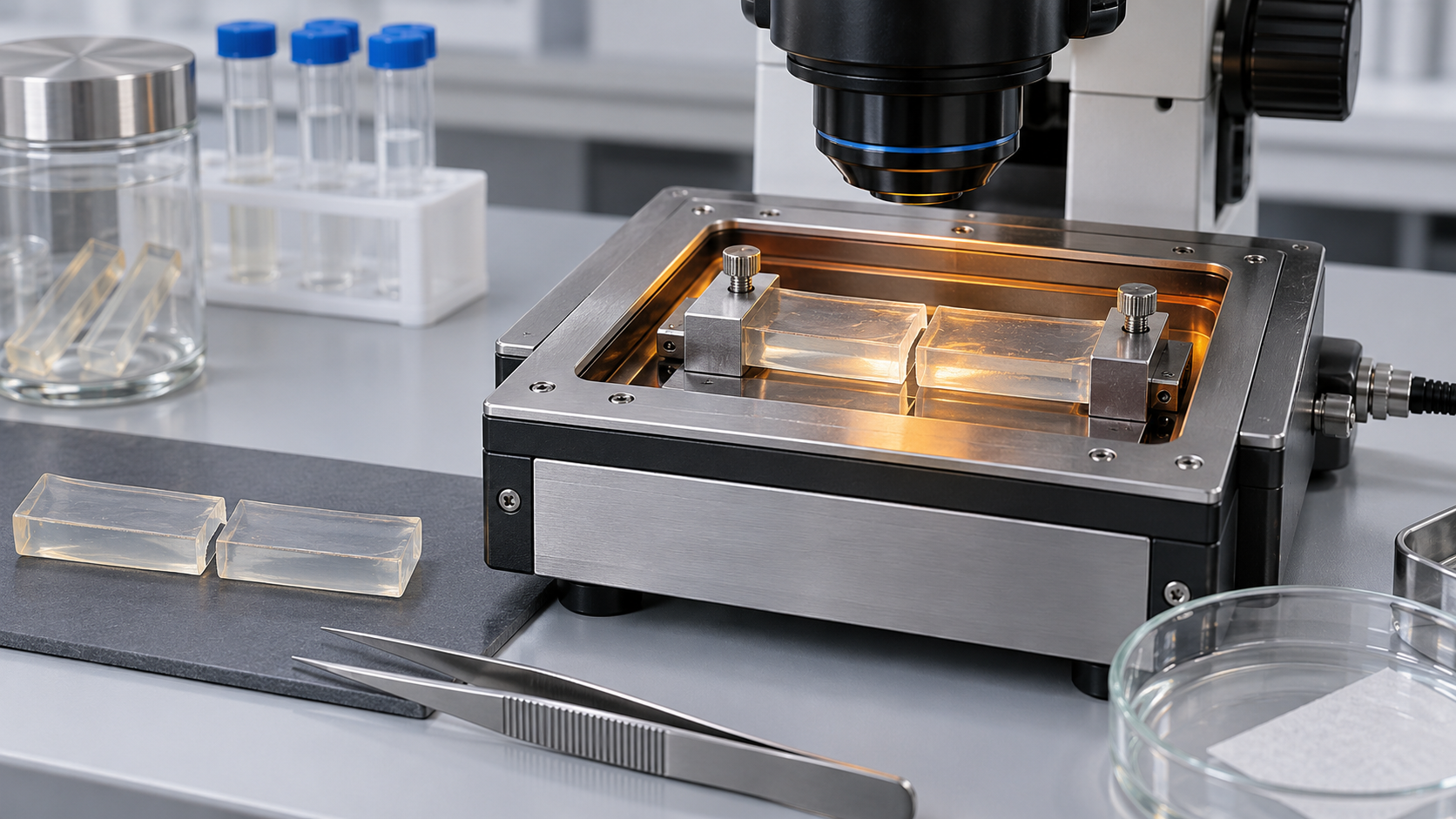
Materials that stick back together and recover after being cut or scratched are common in the research literature. But a figure such as “X% healed” changes meaning with which property was measured, under what temperature, time and contact conditions, and against which specimen. This article sets out, from primary sources, how healing works (extrinsic microcapsules, and intrinsic dynamic covalent bonds, hydrogen bonds and ionic interactions), what “vitrimers” are — networks that rearrange yet stay insoluble — and how to read healing efficiency.
- What self-healing materials are (the short version)
- A map of healing mechanisms — extrinsic (capsules) and intrinsic (dynamic bonds)
- Vitrimers — network rearrangement and two transition temperatures
- A materials engineer's view 1: where to draw the line around "vitrimer" is contested
- Our calculation: how much longer does the relaxation time get as temperature falls?
- Reading healing efficiency — what recovered, and by what percentage?
- Applications — coatings, rubbers, electronic skin
- Limits, and what could not be confirmed
- How to read evaluations and standards
- Glossary
- References (primary sources)
- Claim-to-source audit
Sourced = stated in published material (link given)
Our calculation = a figure this article derived, with the assumptions spelled out
Not yet confirmed = a plan or schedule whose record has not been confirmed
Materials-design interpretations are marked separately as Commentary. Inference is shown in bold.
The healing efficiencies, temperatures and times here are laboratory results for particular materials tested under the conditions each paper defined. They do not describe the life of production items or healing in service. The definition of healing efficiency differs from paper to paper, and this article does not line up numbers from different papers to rank them. It does not rank products or companies.
1. What self-healing materials are (the short version)
- Materials whose properties come back after a scratch or crack: self-healing polymers and composites can heal where and when damage occurs, in response to that damage. Healing may proceed without outside intervention (autonomic), or may need external energy such as heat or pressureSourced [Source 2]
- Three main approaches: self-healing has been demonstrated by capsule-based, vascular and intrinsic (the polymer itself heals) approaches. Most research to date has concentrated on recovery of mechanical integrity after quasi-static fractureSourced [Source 2]
- “X% healed” is a number with conditions: healing efficiency is usually written as the ratio of a property after healing to the same property of the original, but no standard measurement exists, and the property recovered (a strength-based criterion, a toughness-based criterion, visual assessment and so on), the time and the temperature differ from paper to paperSourced [Sources 16, 17, 18]
A healing-efficiency figure means something only when it states what recovered, under what conditions, and against what baseline. For the elastomer of Guo et al., the efficiency is 93% when the fractured faces are joined underwater, and 68% when the cut faces are left apart in air for 24 hours before being joined. The efficiency is also defined as a ratio of strain at fractureSourced [Source 13].
This article concentrates on mechanisms and on how to read evaluations. How microcapsules are made (shell material, core, particle size) is covered in our explainer on microcapsules, elastomer chemistry in our explainer on polyurethanes and elastomers, the difference between thermoplastics and thermosets in our explainer on thermoplastics and thermosets, and epoxies in our explainer on epoxy resins.
2. A map of healing mechanisms — extrinsic (capsules) and intrinsic (dynamic bonds)
The review by Blaiszik et al. lists three conceptual approaches that have demonstrated self-healing: capsule-based, vascular and intrinsicSourced [Source 2]. In this article, approaches that embed healing components from outside the material (capsule-based and vascular) are called “extrinsic”, and approaches in which the bonds of the polymer itself move to heal are called “intrinsic” (these names are this article’s own grouping).
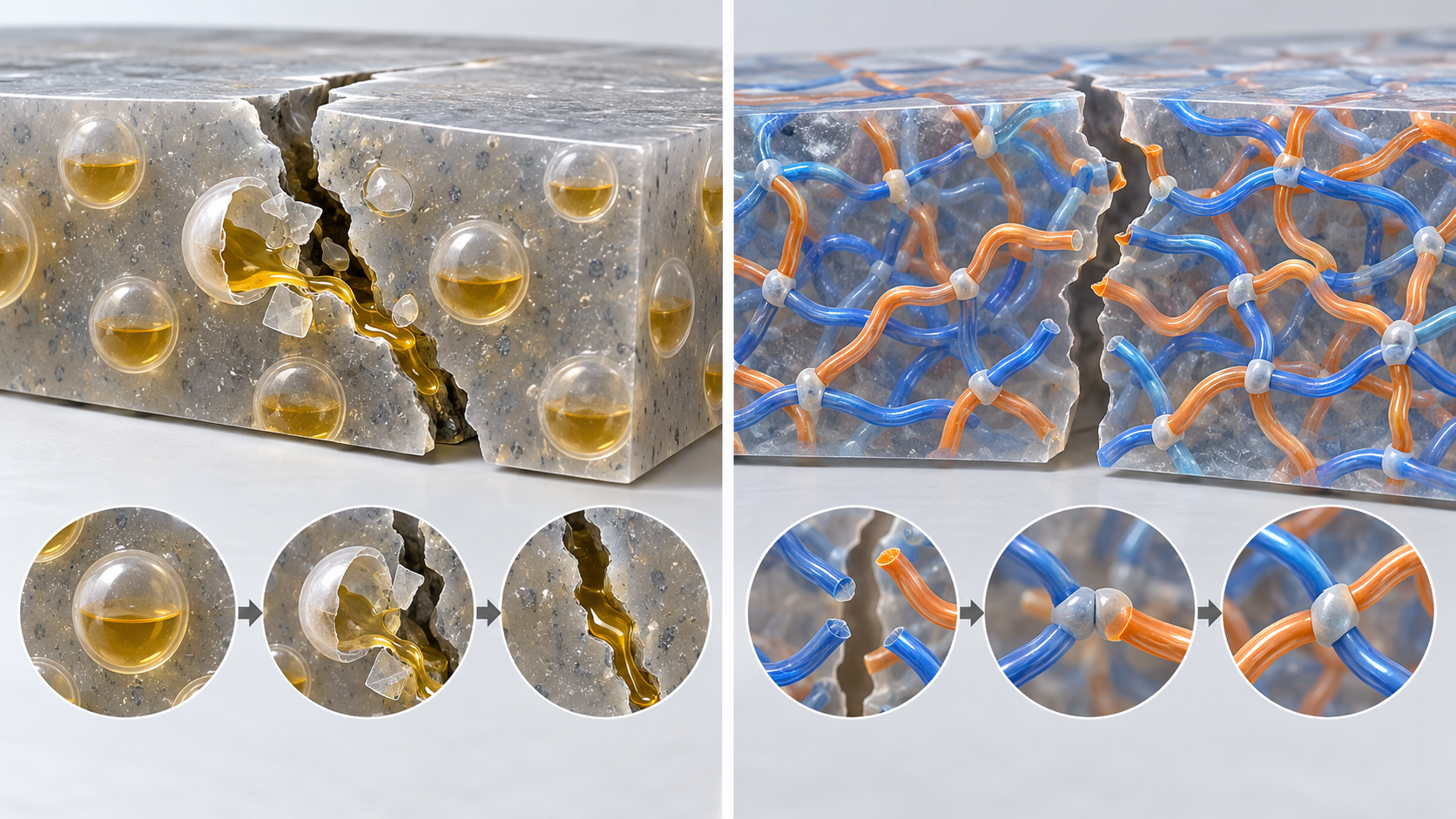
View the original SVG schematic and exact annotations
(1) A representative extrinsic example — DCPD and Grubbs-catalyst capsules
In 2001 White et al. reported a structural polymeric material in which a microencapsulated healing agent is released when a crack intrudes, and polymerization of the agent is triggered on contact with an embedded catalyst, bonding the crack faces. Their fracture experiments yielded as much as 75% recovery in toughnessSourced [Source 1]. This system pairs DCPD (dicyclopentadiene) as the healing agent with a Grubbs catalyst for polymerizationSourced [Source 19]. The same review states that this pairing has not reached practical use because of the catalyst’s poor chemical and thermal durability, poor dispersion in the matrix, and high cost [Source 19]. The test conditions in the body of the original paper were not checked for this article.
Note the words “as much as 75%”. The abstract does not say on which specimens, in which fracture test, or against what baseline. Capsules at a spot that a crack has already passed are used up, so healing the same spot repeatedly can be a weakness of this approach (Commentary).
(2) Representative intrinsic examples — a network that reconnects with heat, a hydrogen-bonded rubber, a coating that heals under light
| Example (year) | Mechanism | What was reported (within the original wording) |
|---|---|---|
| Chen et al. (2002) | A network whose bonds come apart with heat and re-form on cooling (a thermally re-mendable cross-linked polymer) | A transparent solid, tough at room temperature and below, with mechanical properties equal to commercial epoxy resins. Above 120 °C about 30% of the inter-monomer linkages (by solid-state NMR) disconnect and reconnect on cooling. The process is fully reversible and can restore a fractured part several times without a catalyst or additional monomer [4] |
| Cordier et al. (2008) | A hydrogen-bonded supramolecular rubber made from fatty acids and urea | It stretches several times its length and recovers like a rubber, and when cut it heals at room temperature if the fractured surfaces are brought together. It is made from simple ingredients and can be reprocessed. On the other hand its strain recovery is slow and it creeps under stress [5] |
| Ghosh and Urban (2009) | A polyurethane network containing oxetane-substituted chitosan | When the network is damaged the oxetane rings open; under ultraviolet light chitosan chain scission forms cross-links with the reactive ends and repairs the network, reported to take less than an hour [7] |
| Rekondo et al. (2014) | Poly(urea-urethane) using aromatic disulfide exchange | Reported to show quantitative healing efficiency at room temperature without a catalyst [6] |
All Sourced (within the abstracts of each paper). For some items the test conditions in the body of the paper (specimen shape, time, definition of healing efficiency) were not checked for this article.
Healing requires bonds or chains to move across the damaged faces. Yang and Urban name as a main challenge for self-healing polymers the design of functional materials with a high glass transition temperature (Tg) that also heal and respond to stimuliSourced [Source 3]. That the supramolecular rubber of Cordier et al. heals at room temperature yet creeps [Source 5] shows the contradiction well: bonds that move easily also move in service.
From a materials standpoint the key is to make the material move only when healing is wanted, and stay still in use. This is where the idea of designing the stimulus that flips the switch — heat, light, catalyst — comes from. The vitrimers of the next section leave that switch to the temperature dependence of an exchange reaction rate (Commentary).
3. Vitrimers — network rearrangement and two transition temperatures
(1) What was new
Conventional polymers were either thermoplastics, which flow when heated but dissolve easily, or thermosets, which cannot be reshaped after processing. In 2011 Montarnal et al. reported epoxy networks that can rearrange their topology by exchange reactions without depolymerization. The networks are insoluble and processable, and their viscosity varies not abruptly near the glass transition, but gradually in an Arrhenius-like way, like that of vitreous silicaSourced [Source 8]. The review by Denissen et al. places these among exchange-type “covalent adaptable networks” (CANs) and explains that Leibler and co-workers named such materials vitrimersSourced [Source 9].
| Type of network | How bonds are exchanged | Behaviour on heating (as the review describes it) |
|---|---|---|
| Thermoset (conventional) | Permanent bonds that do not exchange | Hard to reshape, reprocess or recycle [9] |
| Dissociative CAN | Bonds break first and re-form elsewhere (e.g. furan–maleimide Diels–Alder adducts) | Heating reduces the number of bonds and viscosity drops sharply; traditionally described as thermoplastic-like [9] |
| Associative CAN (vitrimer) | A new bond forms before the old one breaks; cross-link density stays constant | No depolymerization; viscosity falls gradually in an Arrhenius fashion [9] |
All Sourced (Denissen et al. [Source 9]). However, the distinction “dissociative networks are thermoplastic-like” has itself been criticised as often failing to hold in measurements (Section 4).
(2) Two transition temperatures — Tg and Tv
The viscoelasticity of vitrimers is described by two transition temperatures. One is the usual glass transition temperature Tg. The other is the temperature at which the exchange reactions become faster than the time scale of deformation and the network starts to flow; Leibler et al. named it the topology freezing transition temperature, Tv. Tv is conventionally taken as the temperature at which the viscosity reaches 1012 Pa·sSourced [Source 9].
- When Tg is lower than Tv: glassy at low temperature; above Tg it is rubbery (exchange is slow and the network is essentially fixed); above Tv it becomes a viscoelastic liquid
- When exchange is fast and Tv is estimated to lie below Tg: network rearrangement is governed by local segmental motion. Tv is then “hypothetical”: flow starts only above Tg, and on further heating the behaviour moves from diffusion control to exchange-reaction control (Arrhenius)
Sourced [Source 9]. Tg and Tv can be tuned through cross-link density, the rigidity of the monomers, the speed of the exchange reaction (for example catalyst loading), and the density of exchangeable groups.
(3) What chemistries rearrange the network — examples and their weak points
Terminology note: here TBD denotes the catalyst 1,5,7-triazabicyclo[4.4.0]dec-5-ene, not an unresolved editorial placeholder. See the review by Denissen et al. [Reference 9].
| Exchange chemistry | Features noted in the review | Weak points and cautions (as the review describes them) |
|---|---|---|
| Transesterification (epoxy/acid or anhydride systems) | Activation energy and Tv can be tuned by the amount and kind of catalyst. Activation energies for TBD, zinc acetate and triphenylphosphine are 106, 86 and 43 kJ/mol respectively. At room temperature exchange is negligibly slow | Fast processing needs high catalyst loadings and high temperatures. Catalyst ageing or leaching and ester hydrolysis are long-term stability issues. With rigid monomers (Tg above 75 °C) the catalyst dissolves poorly |
| Transamination of vinylogous urethanes | Exchanges without a catalyst. Relaxation time about 3 minutes at 150 °C, uncatalysed activation energy about 60 kJ/mol. Stable towards hydrolysis | Oxidative damage of the small amount of free amine left in the network is a point to watch in long-term use |
| Transalkylation of triazolium salts | Activation energy 140 kJ/mol (network with bromide counter-ion). Relaxation time from about 30 minutes at 130 °C to a few seconds at 200 °C | The exchange mechanism was unresolved at the time of the review |
| Disulfide exchange | The poly(urea-urethane) of Odriozola et al., using aromatic disulfide metathesis, heals quantitatively at room temperature through hydrogen bonding combined with network rearrangement | Because of the hydrogen bonds, little stress relaxation is seen at room temperature for deformations within the linear range; relaxation is not a single process |
All Sourced (Denissen et al. [Source 9]). The values are those reported at the time of the review (June 2015) and may have been updated by later studies.
Denissen et al. say that for most applications a vitrimer should behave like a classical thermosetting network that does not creep within the useful temperature window, and that only on heating should network reorganisation become significant, giving controlled macroscopic flow. Tv marks when the material becomes processable but also when it loses its creep resistance, so finding exchange reactions with the right kinetics is one of the main challenges in the fieldSourced [Source 9].
From a materials standpoint, systems that need a catalyst are used with the catalyst left in the network. Catalyst ageing and leaching [Source 9] lead directly to creep in service, property drift with the number of reprocessing cycles, and residue issues when the material is used as an adhesive or encapsulant. Catalyst-free systems (such as vinylogous urethanes) avoid that problem but carry other weaknesses, such as oxidation of the remaining amine (Commentary). For the basics of epoxy networks, see our explainer on epoxy resins. The relation between exchange mechanism and properties is organised in the review by Winne et al. [Source 12], and the design of reactivity including catalysts and side reactions in the review by Guerre et al. [Source 11].
4. A materials engineer’s view 1: where to draw the line around “vitrimer” is contested
In the definition of Denissen et al., a vitrimer is a CAN in which networks rearrange through an associative exchange reaction, and dissociative CANs were said to behave like thermoplastics. Elling and Dichtel, however, examined every dissociative CAN for which stress relaxation or viscosity had been reported as a function of temperature, and found that all of them showed an Arrhenius-type relationshipSourced [Source 10]. They state that there is little evidence that associative and dissociative CANs behave very differently within typical reprocessing temperature ranges (about 100–200 °C), and argue against further use of the term “vitrimer”Sourced [Source 10].
The same paper points out that even dissociative networks, under conditions where only a small fraction of cross-links come apart, show stress relaxation indistinguishable from the associative case, and that a difference does appear at higher temperatures, where dissociative networks lose cross-link density sharply (gel-to-sol transition). A polyurethane network is given as an example: it shows a rubbery plateau of constant storage modulus between 80 and 160 °C, and the cross-link density falls steeply above 180 °CSourced [Source 10].
While acknowledging that understanding the exchange mechanism is important, Elling and Dichtel conclude that when selecting a material, Tg, activation energy, the gel-to-sol and degradation temperatures, and the identity of the reactive groups matter moreSourced [Source 10]. When the relaxation time τ* is taken from stress relaxation, it is the time for stress to fall to 37% (1/e) of its initial value, which assumes the relaxation fits a single Maxwell model. Real networks have many relaxation modes, so more elaborate models (such as Kohlrausch–Williams–Watts) should be considered [Source 10].
In practice, when reading a document that says “this is a vitrimer”, first check (a) over what temperature range stress relaxation was measured, (b) what the activation energy is, (c) how far the plateau of storage modulus extends, and (d) whether the exchange mechanism was confirmed with model compounds (Commentary). Whether the name is associative or dissociative decides the use less than these numbers do.
5. Our calculation: how much longer does the relaxation time get as temperature falls?
Assuming that the stress-relaxation time τ follows an Arrhenius law with activation energy Ea (τ proportional to exp(Ea/RT)), we calculate how much the time lengthens at lower temperatures, taking the 150 °C relaxation time as the referenceOur calculation. The Ea values were picked as examples from Table 1 of Elling and Dichtel: 60 (one vinylogous urethane case), 88 (zinc-acetate-catalysed transesterification) and 111 kJ/mol (transcarbamoylation) [Source 10].
- 150 °C to 100 °C: about 9.8 times longer for Ea = 60, about 28.6 times for 88, and about 68.6 times for 111
- 150 °C to 25 °C (room temperature): about 1.3×10³ times for Ea = 60, about 3.6×10⁴ times for 88, and about 5.6×10⁵ times for 111
- Worked example: for a network with a 3-minute relaxation time at 150 °C (the value Denissen et al. give for a vinylogous urethane [9]) and Ea = 60, the calculation gives about 29 minutes at 100 °C and about 2.7 days at 25 °C
Assumptions and limits: this extrapolation assumes that the exchange reaction is the only rate-limiting step and that the temperature is above Tg. In practice it fails below Tg because molecular motion stops (Section 3), and relaxation may not be simply Arrhenius in systems where hydrogen bonds and other effects overlap. Ea also varies with temperature range and network [Source 10]. This calculation is meant to give a feel for how a modest drop in temperature lengthens healing or reshaping times by more than an order of magnitude; it cannot be used to predict the healing time of a specific material.
6. Reading healing efficiency — what recovered, and by what percentage?
Healing efficiency is normally written as the property after healing divided by the original property. But the property in the numerator differs from paper to paper. Wool and O’Connor described crack healing in the stages of surface rearrangement, approach, wetting, diffusion and randomization, and treated the recovery ratio R of mechanical properties as a function of time, temperature, pressure and molecular weightSourced [Source 16]. The chapter by Li and Feng sorts the evaluation of healing efficiency into strength-based and toughness-based criteria (mode I, mode II and mixed-mode fracture toughness)Sourced [Source 17]. In coatings, a 2024 review states that assessments of self-healing divide into visual and quantitative methods and that no standard, established method yet existsSourced [Source 18].
| Item to check | How the number changes | Examples confirmed in primary sources |
|---|---|---|
| 1. Property recovered | Toughness, strength, strain at break, conductivity and appearance (how a scratch looks) are different quantities. The efficiency of the same material differs with which one is compared | White et al.: toughness recovered by as much as 75% [1] / Guo et al.: efficiency defined as a ratio of strain at fracture [13] / Tee et al.: conductivity and mechanical properties reported separately [14] |
| 2. Baseline (denominator) | The same specimen before healing, or a separate undamaged one; whether specimen shape, cutting method and test speed are the same | Within this article’s survey, consistency across papers cannot be claimed (Commentary). The review by Panahi et al. organises the efficiency equations and defines their terms [18] |
| 3. Temperature and time | Healing proceeds as a function of time and temperature (the speed of diffusion or exchange reactions) | Chen et al.: bonds that came apart above 120 °C re-form on cooling [4] / Guo et al.: 10 minutes at room temperature [13] / Tee et al.: conductivity in 15 seconds, mechanical properties in about 10 minutes [14] |
| 4. Delay after damage | Surfaces change while cut faces are kept apart; the efficiency after a delay can be lower | Guo et al.: 68% ± 2% even after 24 hours apart [13] |
| 5. Environment | Underwater, low temperature, acid and alkali change how healing proceeds | Guo et al.: 93% underwater, 89% in 30% salt water at −10 °C, 88% at pH 0 and 84% at pH 14 [13] |
| 6. Repetition | How many times the same spot can be healed. Capsule types use up their healing agent | Guo et al.: reported that cut-and-heal can be repeated several times [13]. The limit of capsule types is in Section 2 (Commentary) |
Row 2 is Commentary; the others are Sourced (statements in the abstract or body of each paper; Guo et al. from the body of the Nature Communications paper, the others from abstracts).
Suppose the stress–strain curve can be approximated by a triangle from the origin to the fracture pointOur calculation. If the original strength at fracture is S and the strain at fracture is ε, then a measure of the energy absorbed up to fracture (the area under the curve) is S × ε ÷ 2. If after healing both strength and strain at fracture recover to 80% of the original (0.8 S and 0.8 ε), the area is 0.8 × 0.8 = 0.64, that is 64%.
Assumptions and limits: the numbers are illustrative and are not data for any real material. Real curves are not triangles, and the ratio of strengths and the ratio of areas are not simply related by a product. Even so, “80% strength”, “80% strain” and “80% of a toughness measure” are different claims. Without checking what a paper uses as its numerator, numbers cannot be compared by size alone.
The composite of Tee et al. for electronic skin (a supramolecular polymer with dispersed nickel microparticles) is reported to restore its initial conductivity with about 90% efficiency after a healing time of 15 seconds after rupture, while its mechanical properties were fully restored after about 10 minutesSourced [Source 14]. Within one specimen, the time for an electrical path to reconnect differs from the time for the material to carry load.
From a materials standpoint, expressing healing efficiency as a single number hides the property an application needs. For wiring it is “the time for conductivity to return”; for seals and coatings, “the time until it blocks liquids or gases again”; for structures, “the time until it can carry load”. Buyers and designers should first ask for only the properties the application needs, measured under service conditions (Commentary).
7. Applications — coatings, rubbers, electronic skin
(1) Coatings — “the scratch disappears” and “it still protects” are different
In the polyurethane network of Ghosh and Urban, damage opens oxetane rings, and under ultraviolet light chain scission of chitosan creates reactive ends and cross-links; repair is reported to take less than an hourSourced [Source 7]. Applications named include coatings, packaging and similar uses. On the other hand, as noted above, assessment of coating self-healing divides into visual and quantitative evaluation, and there is no standard method [Source 18].
That a scratch is no longer visible (recovery of appearance) and that the substrate is protected (recovery of barrier or anti-corrosion performance) are separate evaluations (Commentary). The anti-corrosion side is covered in our explainer on antimicrobial and anti-corrosion coatings. ISO 1518-1 and similar standards test the scratch resistance of coatings, but they are not standards for measuring healing efficiency: they determine, for example, the minimum load at which a scratching stylus penetrates the coating (Section 9).
(2) Rubbers and elastomers — cut, and it comes back and stretches
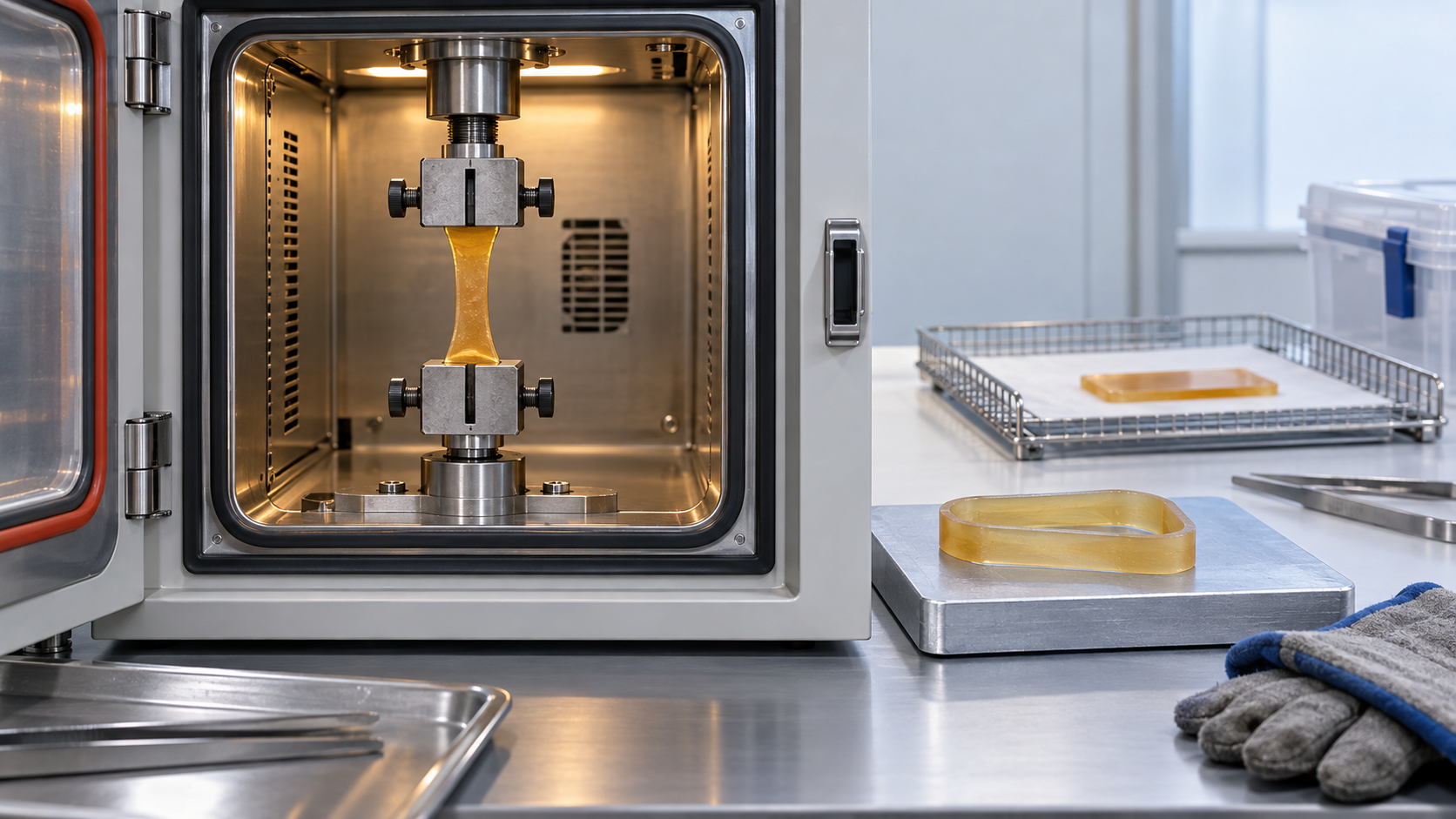
The supramolecular rubber of Cordier et al. forms chains and cross-links through hydrogen bonds and heals at room temperature when the fractured faces are brought together; the paper itself notes that it also creeps and recovers strain slowly [Source 5]. Rekondo et al. reported a poly(urea-urethane) that uses aromatic disulfide exchange to heal at room temperature without a catalyst [Source 6]. Guo et al. combined multi-strength hydrogen bonds with disulfide metathesis in polydimethylsiloxane (PDMS) chains, and report an elastomer that stretches to 14,000% unnotched and 1,300% notched, and heals in 10 minutes at room temperatureSourced [Source 13].
The difference between the permanent cross-links of vulcanized rubber and the physical cross-links of thermoplastic elastomers is covered in detail in our explainer on polyurethanes and elastomers. A self-healing rubber can be seen as a design that puts “moving cross-links” between those two (Commentary).
(3) Electronic skin — what heals is “the electrical path”
The material of Tee et al. has a conductivity that can be tuned by the amount of nickel particles, reaching as high as 40 S/cm, and is sensitive to both pressure and flexionSourced [Source 14]. The review by Kang, Tok and Bao (Nature Electronics, 2019) organises the development of self-healing electronic materials, their application to devices, and the challenges of practical use [Source 15].
In evaluating electronic skin, recovery of conductivity of the material alone differs from recovery of function with wiring and devices mounted on it. Reliability as a device was not confirmed within this article’s survey.
8. Limits, and what could not be confirmed
(1) Test conditions in the papers’ bodies
For White et al. (2001), Chen et al. (2002), Cordier et al. (2008), Ghosh and Urban (2009), Rekondo et al. (2014) and Tee et al. (2012), this article checked only the abstracts. Specimen shape, test speed and the definition of healing efficiency are not stated. The chemistry of the Chen et al. network (generally described as one based on furan–maleimide reactions) was also not checked in the body of the paper.
(2) Vascular systems and capsule fabrication
The design of vascular systems and the shell material, size and dispersion of microcapsules are not covered. Microcapsules are covered in our explainer on microcapsules.
(3) Commercial status
Actual products using self-healing coatings or rubbers, market adoption and service life could not be confirmed from primary sources (company technical documents, public documents) and are not stated here. Industrial adoption of vitrimers was also not confirmed.
(4) Standard test methods
A standard test method (ISO, IEC, JIS) for measuring self-healing efficiency could not be confirmed within this article’s survey. The 2024 review in coatings also states that no established standard method yet exists [Source 18].
(5) Differences between sources
The activation energy of the zinc-acetate-catalysed transesterification system is given as 86 kJ/mol in the review by Denissen et al. and as 88 kJ/mol in the table of Elling and Dichtel. The difference is probably due to measurement conditions or rounding (Inference), but which is correct was not checked against the original papers.
- Self-healing can be thought of as extrinsic (capsule and vascular types) or intrinsic (dynamic bonds). Capsule types use up their healing agent, and intrinsic types face the challenge of reconciling “moving bonds” with creep in serviceSourced / Commentary
- Vitrimers are networks that rearrange through exchange reactions yet flow while staying insoluble, described by two transition temperatures, Tg and Tv. Tv is also the temperature at which creep resistance is lostSourced
- Where to draw the line around “vitrimer” is contested. Every dissociative network that had been reported also showed Arrhenius-type stress relaxation. Read Tg, activation energy and the gel-to-sol temperature rather than the nameSourced
- Healing efficiency changes with the property recovered, the baseline, temperature and time, and environment. No standard measurement exists; in the example, strength and strain each at 80% give an area of 64%Sourced / Our calculation
9. How to read evaluations and standards
What is measured in evaluating self-healing materials is the ratio of the same property, measured with the same test, before and after healing. The properties include tensile strength and strain at break (mechanical properties), fracture toughness (resistance to cracks), scratch resistance of coatings, Tg and dynamic viscoelasticity (at what temperature healing or flow occurs), stress relaxation (the speed of bond exchange in vitrimers) and conductivity (electronic skin). What standards define are the test methods for each of these properties. A standard method for measuring “healing efficiency” itself could not be confirmed within this article’s survey [Source 18].
| Item | ISO | IEC / IEEE | JIS | ASTM | What changes the value with test conditions |
|---|---|---|---|---|---|
| Tensile strength and elongation (plastics, films)Sourced | ISO 527-1:2019 (general principles); ISO 527-3:2018 (test conditions for films and sheets under 1 mm thick) | Could not be confirmed | JIS K 7161-1 (general principles); JIS K 7127 (Part 3, test conditions for films and sheets) | D638 (test method for tensile properties of plastics) | Test speed, specimen shape and thickness, position of the healed face, temperature |
| Tensile properties (rubbers, elastomers)Sourced | ISO 37:2024 (tensile stress-strain properties of vulcanized or thermoplastic rubber) | Could not be confirmed | JIS K 6251 (tensile properties of vulcanized and thermoplastic rubber) | D412 (tension of vulcanized rubber and thermoplastic elastomers) | Dumbbell specimen shape, pulling speed, temperature, how the cut faces are joined |
| Fracture toughness (mode I)Sourced | ISO 13586:2018 (mode I fracture toughness of rigid and semi-rigid plastics, by three-point bending and compact tension) | Could not be confirmed | A corresponding JIS could not be confirmed | D5045 (plane-strain fracture toughness and strain energy release rate of plastics) | Sharpness of the pre-crack, specimen shape and thickness, how the healed crack face is handled |
| Glass transition temperature Tg (DSC)Sourced | ISO 11357-2:2020 (glass transition temperature and step height) | Could not be confirmed | JIS K 7121 (determination of transition temperatures of plastics) | D3418 (transition temperatures and enthalpies of fusion and crystallization of polymers by DSC) | Heating rate, thermal history, midpoint or onset reading (Commentary) |
| Dynamic viscoelasticity (DMA)Sourced | ISO 6721-1:2019 (general principles; results from different deformation modes may not be directly comparable) | Could not be confirmed | JIS K 7244-1 (Part 1: general principles) | D4065 (practice for determining and reporting dynamic mechanical properties of plastics) | Frequency, heating rate, deformation mode (tension, bending, shear) |
| Scratch resistance of coatingsSourced | ISO 1518-1:2023 (scratching with a loaded stylus to see whether the coating is penetrated) | Could not be confirmed | JIS K 5600-5-5 (general test methods for paints, mechanical properties of coatings, scratch hardness by the loaded-needle method). Correspondence to ISO 1518 not confirmed | D7027 (scratch resistance of polymeric coatings and plastics with an instrumented scratch machine) | Stylus tip diameter, load, speed, substrate. It is not a method for measuring healing efficiency |
| Stress relaxation (vitrimers), recovery of conductivity, healing efficiency itselfSourced | Could not be confirmed | Could not be confirmed | Could not be confirmed | Could not be confirmed | Temperature range, strain applied, definition of relaxation time (such as 1/e of the initial value) [10] |
Numbers and titles of ISO standards were checked on the official ISO pages and those of JIS on the JIS search of the Japanese Industrial Standards Committee (JISC); JIS titles are our translation of the Japanese titles. For ASTM standards, the ASTM website was not opened; numbers and titles were checked only through statements in peer-reviewed papers and their reference lists. The ASTM column gives no test content, conditions or acceptance criteria. The arrangement of the table is Our calculation.
Where each standard sits — international, national, trade body
- ISO standards are international, JIS standards are Japanese national, and ASTM standards are issued by a US standards organisation. Some JIS numbers resemble ISO’s (JIS K 7161-1 and ISO 527-1; the Japanese title of JIS K 7127 says “Part 3”), but the degree of agreement with the international standard (identical, modified and so on) was not confirmed in this article because the body of the JIS was not checked (Inference: they are likely to correspond)
- ISO 11357-2 is the 2020 edition (third edition), and the 2013 edition has been withdrawn [Source 25]. ISO 37 is the 2024 edition (seventh edition), and the 2017 edition has been withdrawn [Source 22]. Even for the same standard number, a different edition can mean a different procedure
Cautions when reading
- A standard is a “test method”; it does not guarantee a material’s performance. Even if a self-healing paper uses a tensile test that follows a standard, only the way of measuring follows the standard; it does not mean the definition of “healing efficiency” has been standardised
- The same named property can be measured differently depending on the standard or edition. Tensile strength changes with specimen shape and speed. ISO 6721-1 states explicitly that dynamic mechanical results from different deformation modes may not be directly comparable [Source 26]
- Read manufacturer or paper values together with the standard, edition and test conditions they followed. How specimens were reshaped or cut faces joined in a post-healing test is set not by the standard but by the paper’s methods section (Commentary)
- Watch the gap between the range of a standard and real service conditions. Most standard tests are at room temperature and constant speed, but the efficiency of self-healing is in question under service temperature, humidity and repetition
10. Glossary
- Self-healing material
- A material whose properties recover after damage, autonomously or through a stimulus such as heat or light.
- Extrinsic
- Healing agent embedded from outside as capsules or channels (capsule and vascular types). This article’s term.
- Intrinsic
- The bonds of the polymer itself move to heal. This article’s term.
- CAN (covalent adaptable network)
- A network cross-linked by exchangeable covalent bonds, associative or dissociative.
- Vitrimer
- A network that rearranges by associative exchange and whose viscosity varies in an Arrhenius fashion. Named by Leibler and co-workers.
- Associative / dissociative
- A new bond forms before the old one breaks / bonds break first and re-form elsewhere.
- Tg
- Glass transition temperature, the boundary between glassy and rubbery states.
- Tv
- Topology freezing transition temperature: where bond exchange becomes faster than deformation and the network begins to flow. Conventionally set at a viscosity of 1012 Pa·s.
- Stress relaxation
- The fall of stress with time under a constant applied strain.
- Healing efficiency
- The property after healing divided by the original property. Which property differs between papers.
- DCPD
- Dicyclopentadiene, used as a healing agent in a capsule-type example.
- Gel-to-sol transition
- The transition in which cross-links come apart and the network starts to flow; shown by dissociative networks at high temperature.
11. References (primary sources)
- White S. R. et al. “Autonomic healing of polymer composites”, Nature 409, 794–797 (2001), DOI 10.1038/35057232 — nature.com/articles/35057232
- Blaiszik B. J. et al. “Self-Healing Polymers and Composites”, Annu. Rev. Mater. Res. 40, 179–211 (2010), DOI 10.1146/annurev-matsci-070909-104532 — doi.org/10.1146/annurev-matsci-070909-104532
- Yang Y., Urban M. W. “Self-healing polymeric materials”, Chem. Soc. Rev. 42, 7446–7467 (2013), DOI 10.1039/C3CS60109A — doi.org/10.1039/c3cs60109a
- Chen X. et al. “A Thermally Re-mendable Cross-Linked Polymeric Material”, Science 295, 1698–1702 (2002), DOI 10.1126/science.1065879 — doi.org/10.1126/science.1065879
- Cordier P. et al. “Self-healing and thermoreversible rubber from supramolecular assembly”, Nature 451, 977–980 (2008), DOI 10.1038/nature06669 — nature.com/articles/nature06669
- Rekondo A. et al. “Catalyst-free room-temperature self-healing elastomers based on aromatic disulfide metathesis”, Mater. Horiz. 1, 237–240 (2014), DOI 10.1039/C3MH00061C — doi.org/10.1039/c3mh00061c
- Ghosh B., Urban M. W. “Self-Repairing Oxetane-Substituted Chitosan Polyurethane Networks”, Science 323, 1458–1460 (2009), DOI 10.1126/science.1167391 — doi.org/10.1126/science.1167391
- Montarnal D. et al. “Silica-Like Malleable Materials from Permanent Organic Networks”, Science 334, 965–968 (2011), DOI 10.1126/science.1212648 — doi.org/10.1126/science.1212648
- Denissen W., Winne J. M., Du Prez F. E. “Vitrimers: permanent organic networks with glass-like fluidity”, Chem. Sci. 7, 30–38 (2016), DOI 10.1039/C5SC02223A (open access) — doi.org/10.1039/c5sc02223a
- Elling B. R., Dichtel W. R. “Reprocessable Cross-Linked Polymer Networks: Are Associative Exchange Mechanisms Desirable?”, ACS Cent. Sci. 6, 1488–1496 (2020), DOI 10.1021/acscentsci.0c00567 (open access) — doi.org/10.1021/acscentsci.0c00567
- Guerre M. et al. “Vitrimers: directing chemical reactivity to control material properties”, Chem. Sci. 11, 4855–4870 (2020), DOI 10.1039/D0SC01069C (open access) — doi.org/10.1039/d0sc01069c
- Winne J. M., Leibler L., Du Prez F. E. “Dynamic covalent chemistry in polymer networks: a mechanistic perspective”, Polym. Chem. 10, 6091–6108 (2019), DOI 10.1039/C9PY01260E — doi.org/10.1039/c9py01260e
- Guo H. et al. “Universally autonomous self-healing elastomer with high stretchability”, Nat. Commun. 11, 2037 (2020), DOI 10.1038/s41467-020-15949-8 (open access) — doi.org/10.1038/s41467-020-15949-8
- Tee B. C.-K. et al. “An electrically and mechanically self-healing composite with pressure- and flexion-sensitive properties for electronic skin applications”, Nat. Nanotechnol. 7, 825–832 (2012), DOI 10.1038/nnano.2012.192 — nature.com/articles/nnano.2012.192
- Kang J., Tok J. B.-H., Bao Z. “Self-healing soft electronics”, Nat. Electron. 2, 144–150 (2019), DOI 10.1038/s41928-019-0235-0 — nature.com/articles/s41928-019-0235-0
- Wool R. P., O’Connor K. M. “A theory of crack healing in polymers”, J. Appl. Phys. 52, 5953–5963 (1981), DOI 10.1063/1.328526 — doi.org/10.1063/1.328526
- Li G., Feng X. “Healing efficiency characterization of self-healing polymers”, in Recent Advances in Smart Self-Healing Polymers and Composites, Elsevier, 27–55 (2022), DOI 10.1016/B978-0-12-823472-3.00005-9 — repository.lsu.edu/mechanical_engineering_pubs/1571
- Panahi, Khorasani, Mensah “A review of the characterization methods for self-healing assessment in polymeric coatings”, Prog. Org. Coat. 186, 108055 (2024), DOI 10.1016/j.porgcoat.2023.108055 (the content of the abstract was checked through a European Coatings news summary) — doi.org/10.1016/j.porgcoat.2023.108055
- Kontiza A., Kartsonakis I. A. “Smart Composite Materials with Self-Healing Properties: A Review on Design and Applications”, Polymers 16, 2115 (2024), DOI 10.3390/polym16152115 (open access) — doi.org/10.3390/polym16152115
- ISO “ISO 527-1:2019 Plastics — Determination of tensile properties — Part 1: General principles” — iso.org/standard/75824.html
- ISO “ISO 527-3:2018 Plastics — Determination of tensile properties — Part 3: Test conditions for films and sheets” — iso.org/standard/70307.html
- ISO “ISO 37:2024 Rubber, vulcanized or thermoplastic — Determination of tensile stress-strain properties” — iso.org/standard/86892.html
- ISO “ISO 13586:2018 Plastics — Determination of fracture toughness (GIC and KIC) — Linear elastic fracture mechanics (LEFM) approach” — iso.org/standard/67721.html
- ISO “ISO 1518-1:2023 Paints and varnishes — Determination of scratch resistance — Part 1: Constant-loading method” — iso.org/standard/83330.html
- ISO “ISO 11357-2:2020 Plastics — Differential scanning calorimetry (DSC) — Part 2: Determination of glass transition temperature and step height” — iso.org/standard/77310.html
- ISO “ISO 6721-1:2019 Plastics — Determination of dynamic mechanical properties — Part 1: General principles” — iso.org/standard/73142.html
- Japanese Industrial Standards Committee (JISC) JIS search, JIS K 7161-1 (Plastics — Determination of tensile properties — Part 1: General principles; title in Japanese) — jisc.go.jp (K7161-1)
- Japanese Industrial Standards Committee (JISC) JIS search, JIS K 7127 (Plastics — Determination of tensile properties — Part 3: Test conditions for films and sheets; title in Japanese) — jisc.go.jp (K7127)
- Japanese Industrial Standards Committee (JISC) JIS search, JIS K 6251 (Rubber, vulcanized or thermoplastic — Determination of tensile stress-strain properties; title in Japanese) — jisc.go.jp (K6251)
- Japanese Industrial Standards Committee (JISC) JIS search, JIS K 7121 (Testing methods for transition temperatures of plastics; title in Japanese) — jisc.go.jp (K7121)
- Japanese Industrial Standards Committee (JISC) JIS search, JIS K 7244-1 (Plastics — Determination of dynamic mechanical properties — Part 1: General principles; title in Japanese) — jisc.go.jp (K7244)
- Japanese Industrial Standards Committee (JISC) JIS search, JIS K 5600-5-5 (Testing methods for paints — Mechanical property of film — Scratch hardness (load needle method); title in Japanese) — jisc.go.jp (K5600-5)
- Publicly available papers used to confirm ASTM numbers and titles (the ASTM website was not consulted): D638 in Talecka et al., Materials 17, 4095 (2024), DOI 10.3390/ma17164095 / D412 in Vasconcelos et al., Bioengineering 13, 199 (2026), DOI 10.3390/bioengineering13020199 / D5045 in Roberts et al., Front. Bioeng. Biotechnol. 1, 13 (2013), DOI 10.3389/fbioe.2013.00013 / D3418 in Nambi Gowri et al., Polymers 17, 544 (2025), DOI 10.3390/polym17040544 / D4065 in Park et al., Sci. Rep. 5, 12356 (2015), DOI 10.1038/srep12356 / D7027 in the reference list of Skin Res. Technol. 31, e70072 (2025) — doi.org/10.3390/ma17164095 (and others)
12. Claim-to-source audit
| Claim in the text | Basis | Class |
|---|---|---|
| Definition of self-healing polymers and composites (healing where damage occurs; autonomic versus needing external energy), the three approaches (capsule, vascular, intrinsic), research concentrated on recovery of mechanical integrity after quasi-static fracture | Abstract of Blaiszik et al. (2010) Reference 2 https://doi.org/10.1146/annurev-matsci-070909-104532 | Sourced |
| A microencapsulated healing agent released at a crack, polymerized by an embedded catalyst to bond the crack faces, toughness recovery as much as 75% | Abstract of White et al. (2001) Reference 1 https://www.nature.com/articles/35057232 | Sourced |
| The pairing of DCPD and Grubbs catalyst, and the review’s statement that it has not reached practical use because of catalyst durability, dispersion and cost | Kontiza and Kartsonakis (2024) Reference 19 https://doi.org/10.3390/polym16152115 | Sourced |
| Classification of self-healing polymers (covalent bonding, supramolecular assemblies, ionic interactions and others); design of high-Tg functional materials as a challenge | Abstract of Yang and Urban (2013) Reference 3 https://doi.org/10.1039/c3cs60109a | Sourced |
| A thermally re-mendable network (about 30% of linkages disconnect above 120 °C and re-form on cooling, no catalyst, repeatable) | Abstract of Chen et al. (2002) Reference 4 https://doi.org/10.1126/science.1065879 | Sourced |
| A fatty-acid and urea supramolecular rubber that heals at room temperature and can be reprocessed, but recovers strain slowly and creeps | Abstract of Cordier et al. (2008) Reference 5 https://www.nature.com/articles/nature06669 | Sourced |
| A poly(urea-urethane) using aromatic disulfide exchange with quantitative healing efficiency at room temperature without a catalyst | Abstract of Rekondo et al. (2014) Reference 6 https://doi.org/10.1039/c3mh00061c | Sourced |
| An oxetane-substituted chitosan polyurethane healed by ultraviolet light in under an hour | Abstract of Ghosh and Urban (2009) Reference 7 https://doi.org/10.1126/science.1167391 | Sourced |
| Epoxy networks that rearrange topology by exchange without depolymerization, insoluble and processable, with Arrhenius-like viscosity | Abstract of Montarnal et al. (2011) Reference 8 https://doi.org/10.1126/science.1212648 | Sourced |
| Associative and dissociative CANs, the definition of vitrimers, Tg and Tv (1012 Pa·s), catalysts and activation energies (TBD 106, Zn(OAc)2 86, PPh3 43 kJ/mol), vinylogous urethane (about 3 min at 150 °C, about 60 kJ/mol), triazolium salts (140 kJ/mol), disulfide exchange, catalyst ageing, leaching and hydrolysis, catalyst solubility with rigid monomers | Denissen et al. (2016) Reference 9 https://doi.org/10.1039/c5sc02223a | Sourced |
| Dissociative CANs reported so far also show Arrhenius behaviour; little difference in typical reprocessing ranges; the proposal against using “vitrimer”; the activation energies in Tables 1 and 2; the polyurethane example (plateau at 80–160 °C, steep drop in cross-link density above 180 °C); the definition of τ* (37%) and the single-Maxwell assumption | Elling and Dichtel (2020) Reference 10 https://doi.org/10.1021/acscentsci.0c00567 | Sourced |
| Control of chemical reactivity in vitrimers, and the relation of reaction mechanisms of dynamic covalent bonds to properties (given as further reading) | Abstract of Guerre et al. (2020) Reference 11 https://doi.org/10.1039/d0sc01069c Abstract of Winne et al. (2019) Reference 12 https://doi.org/10.1039/c9py01260e | Sourced |
| A PDMS-based elastomer (14,000% / 1,300%), efficiency defined as the ratio of strain at fracture, 93% underwater, 89% in 30% salt water at −10 °C, 88% at pH 0, 84% at pH 14, 68% ± 2% after 24 hours apart, repeatable | Guo et al. (2020) Reference 13 https://doi.org/10.1038/s41467-020-15949-8 | Sourced |
| A supramolecular polymer with nickel particles (conductivity up to 40 S/cm; conductivity restored with about 90% efficiency in 15 s, mechanical properties in about 10 min) | Abstract of Tee et al. (2012) Reference 14 https://www.nature.com/articles/nnano.2012.192 | Sourced |
| A review of self-healing electronic materials and devices and their challenges | Abstract of Kang et al. (2019) Reference 15 https://www.nature.com/articles/s41928-019-0235-0 | Sourced |
| The stages of crack healing and the functional form of the recovery ratio R | Abstract of Wool and O’Connor (1981) Reference 16 https://doi.org/10.1063/1.328526 | Sourced |
| Evaluation of healing efficiency (strength-based and toughness-based; modes I, II and mixed) | Abstract of the chapter by Li and Feng (2022) Reference 17 https://repository.lsu.edu/mechanical_engineering_pubs/1571 | Sourced |
| No standard, established method for assessing self-healing of coatings; the division into visual and quantitative methods | Abstract of Panahi et al. (2024) (checked through a European Coatings summary) Reference 18 https://doi.org/10.1016/j.porgcoat.2023.108055 | Sourced |
| Numbers, titles, editions and scope of ISO 527-1:2019, ISO 527-3:2018, ISO 37:2024, ISO 13586:2018, ISO 1518-1:2023, ISO 11357-2:2020 and ISO 6721-1:2019 | Official ISO pages Reference 20 https://www.iso.org/standard/75824.html Reference 21 https://www.iso.org/standard/70307.html Reference 22 https://www.iso.org/standard/86892.html Reference 23 https://www.iso.org/standard/67721.html Reference 24 https://www.iso.org/standard/83330.html Reference 25 https://www.iso.org/standard/77310.html Reference 26 https://www.iso.org/standard/73142.html | Sourced |
| Numbers and titles of JIS K 7161-1, K 7127, K 6251, K 7121, K 7244-1 and K 5600-5-5 | JIS search of the Japanese Industrial Standards Committee (JISC) Reference 27 https://www.jisc.go.jp/app/jis/general/GnrJISNumberNameSearchList?show&jisStdNo=K7161-1 Reference 28 https://www.jisc.go.jp/app/jis/general/GnrJISNumberNameSearchList?show&jisStdNo=K7127 Reference 29 https://www.jisc.go.jp/app/jis/general/GnrJISNumberNameSearchList?show&jisStdNo=K6251 Reference 30 https://www.jisc.go.jp/app/jis/general/GnrJISNumberNameSearchList?show&jisStdNo=K7121 Reference 31 https://www.jisc.go.jp/app/jis/general/GnrJISNumberNameSearchList?show&jisStdNo=K7244 Reference 32 https://www.jisc.go.jp/app/jis/general/GnrJISNumberNameSearchList?show&jisStdNo=K5600-5 | Sourced |
| Numbers and titles of ASTM D638, D412, D5045, D3418, D4065 and D7027 (the ASTM website was not consulted; checked through statements in peer-reviewed papers and their reference lists) | Open-access peer-reviewed papers Reference 33 https://doi.org/10.3390/ma17164095 (and others listed at the end of the references) | Sourced |
| Change of relaxation time with temperature (relative to 150 °C: about 9.8 / 28.6 / 68.6 times at 100 °C and about 1.3×10³ / 3.6×10⁴ / 5.6×10⁵ times at 25 °C), the 3-minute example (about 29 minutes at 100 °C, about 2.7 days at 25 °C), and 64% area for 80% strength and strain | Our calculation. An Arrhenius extrapolation that does not apply below Tg or where several relaxations overlap. The area ratio is a triangle-approximation example, not data for any real material | Our calculation |
| Test conditions in the bodies of the papers by White, Chen, Cordier, Ghosh and Urban, Rekondo and Tee; details of vascular systems; how microcapsules are made; commercial status of self-healing products; industrial adoption of vitrimers; a standard test method for healing efficiency (ISO, IEC, IEEE, JIS); the degree of agreement between JIS and ISO | Could not be confirmed in the primary sources accessible within this article’s survey, so not stated | Commentary |
| The readings: “if it heals because it can move, being strong and not flowing becomes the challenge”, “the problem of leaving the catalyst in”, “numbers to read that matter more than the word vitrimer”, “electrical and mechanical properties come back at different speeds”, “a vanished scratch is not the same as protection”; the terms extrinsic and intrinsic and the grouping in Fig. 2 | This article’s own organisation and interpretation of published content. Not the views of any company or institution | Commentary |
| That Figs. 2 to 6 are explanatory drawings, not real observations or data, and that Figs. 1 and 7 are AI-generated images | This article’s note | Commentary |
Last updated 10 October 2026. Sources are limited to primary material (peer-reviewed papers and standards-body pages). Many papers were checked only to the extent of their abstracts, and the test conditions in the body were not checked for some of them. Because the article includes structural readings and materials-design interpretations, those are marked as Commentary and kept separate from sourced fact. The commercial status of self-healing products, industrial adoption of vitrimers, and a standard test method for healing efficiency could not be confirmed and are not stated here. The healing efficiencies, temperatures and times are results for particular materials under the conditions each paper defined and cannot be generalised to other materials or to real service conditions. All figures are explanatory concept graphics. Figs. 2 to 6 are vector drawings; Figs. 1 and 7 are AI-generated images, and none of them shows a real micrograph, experimental data or physical product.