TECHNOLOGY EXPLAINER
Smart Textiles and Wearable Materials
— reading “washable” and “touches the skin” together with the test conditions
Fabrics with conductive yarn woven in, garments in which the cloth itself is the sensor, and fabrics that heat or cool. Smart textiles (electronic textiles, e-textiles) must work under conditions that ordinary electronic parts never meet: washing and drying, bending, sweat and contact with skin. This article sets out, from primary sources, the roles of materials in conductive yarns and fabrics, sensors, heating and cooling, and nanofibers, and how to read the numbers for washing durability and the skin interface together with the conditions under which they were measured.
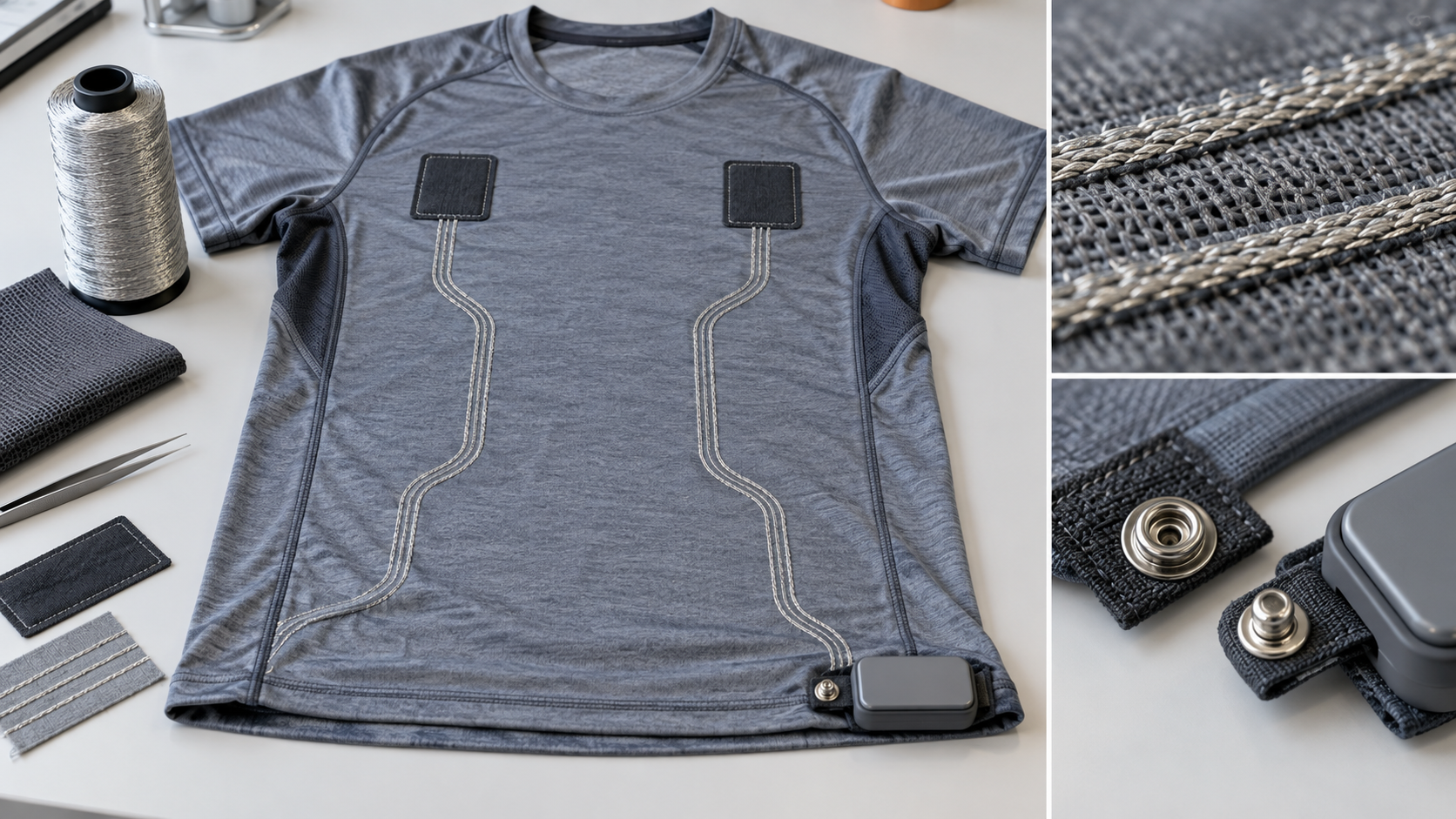
- What smart textiles and wearable materials are (the short version)
- Think in levels — yarn, fabric, connection, garment
- Conductive yarns and fabrics, and sensors
- The skin interface — contact impedance changes by orders of magnitude with the partner and conditions
- Heating, cooling and nanofibers
- Washing durability — how you wash and dry can reverse the result
- Our calculations: wash counts and time, resistance ratios, heating, impedance ratios
- Limits, and what could not be confirmed
- How to read evaluations and standards
- Glossary
- References (primary sources)
- Claim-to-source audit
Sourced = stated in published material (link given)
Our calculation = a figure this article derived, with the assumptions spelled out
Not yet confirmed = a plan or schedule whose outcome has not been confirmed
Materials-design interpretations are marked separately as Commentary. Inference is shown in bold.
The resistances, impedances and wash counts quoted here are results of testing particular yarns, fabrics and electrodes under conditions that differ by source (washing machine, programme, detergent, drying, load, frequency, a skin simulant or real human skin). They are not product performance or results for other materials. Please do not read laboratory champion data as practical durability. This article does not rank materials or companies. It gives no individual advice on medicine or health, or on the safety of heated garments. Standards are introduced only by number, title and scope.
1. What smart textiles and wearable materials are (the short version)
- Fabrics given electronic functions: the review by Stoppa and Chiolerio describes electronic textiles as fabrics with electronics and interconnections woven into them, and, focusing on materials and manufacturing, sets out the trade-off between flexibility, ergonomics, low power consumption, integration and autonomySourced [Ref. 4]
- “Washable” gives a different result for each way of washing: for electrodes of the same silver-plated nylon yarn, the resistance ratio under machine washing (R30/R0) was about 93,295 with a bleach-containing detergent, 2.4 without bleach and 0.9 with water alone. These are laboratory results as introduced by a reviewSourced [Ref. 1]
- “Touches the skin” also changes by orders of magnitude with the partner and conditions: the contact impedance of a knitted textile electrode on a human arm was at the MΩ level dry and the kΩ level wet (at 39 Hz)Sourced [Ref. 6]. On an agar skin simulant, values below 200 Ω have been reported even for dry electrodes [Ref. 5]
“Withstands N washes” and “low impedance” mean something only together with the machine type, programme, detergent and drying, and the partner measured (human skin or a simulant), the load and the frequency. A durability number without its conditions cannot be compared.
2. Think in levels — yarn, fabric, connection, garment
The review by Shak Sadi and Kumpikaitė frames an e-textile as a textile substrate (fibre, yarn, fabric, garment) combined with nanostructured electroactive materials. At the same time it says that vulnerability to the physical deformation of repeated washing and wear is the main obstacle to practical useSourced [Ref. 1].
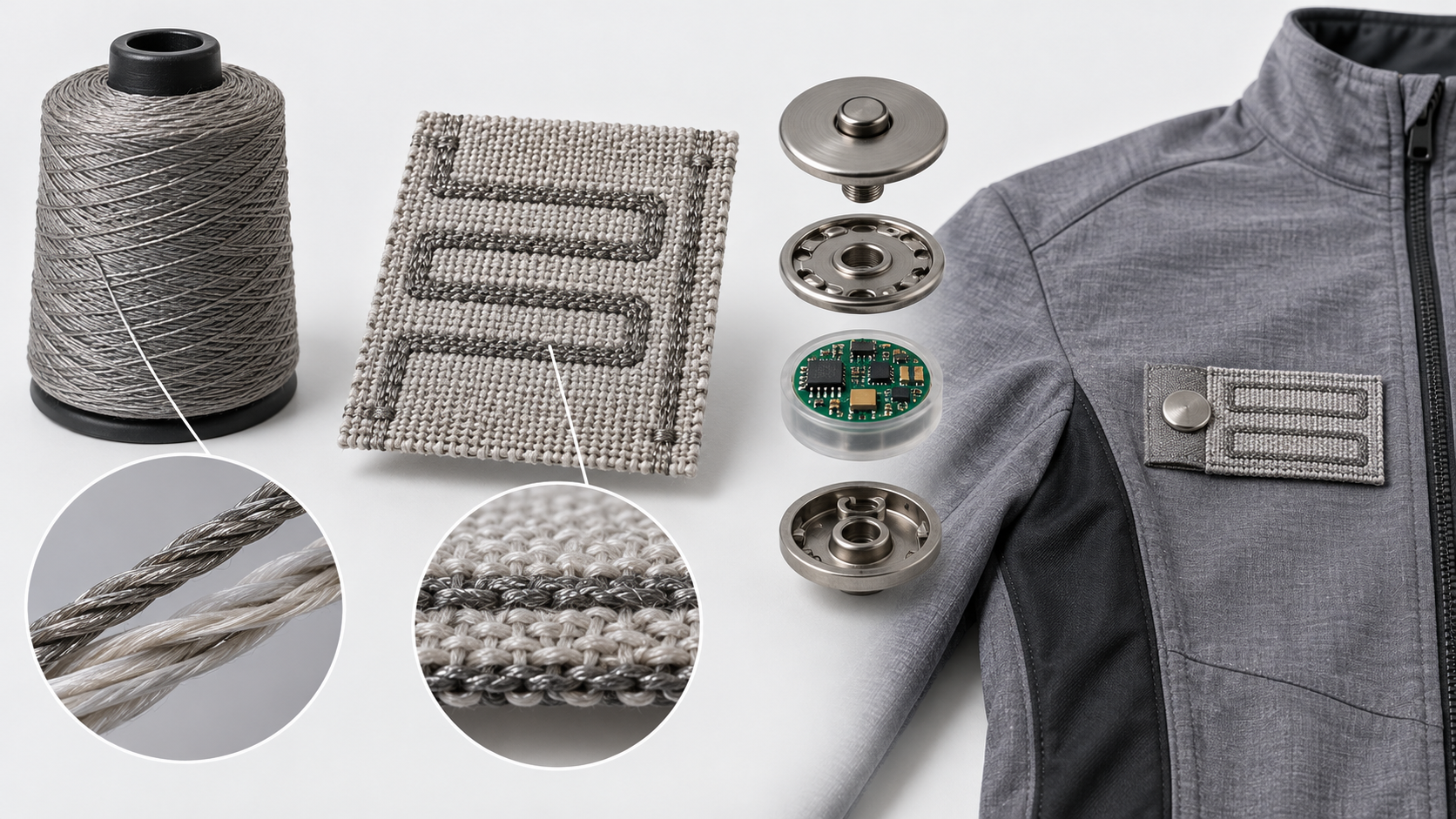
View the original SVG schematic and exact annotations
IEC 63203-201-1:2022 is a standard for measuring the basic properties of conductive yarns. The yarns it covers are conductive enough for transmitting electric signals, supplying power and electromagnetic shielding, and do not include the high-resistance conductive yarns used for antistatic and heating purposes. The standard does not define the characteristics a conductive yarn must have but specifies handling and measurement methodsSourced [Ref. 8]. IEC 63203-201-2:2022 for conductive fabrics likewise excludes high-resistance conductive fabrics for antistatic and heater applications [Ref. 9].
3. Conductive yarns and fabrics, and sensors
Conductive yarns and fabrics
Conductive yarns include silver-plated nylon yarns, yarns wrapped with metal wire, and yarns coated with carbon nanotubes (CNT) or conductive polymersSourced [Ref. 1]. The review’s table gives examples of yarn material and processing, initial electrical properties and change after washing. The table does not give the washing procedure (standard, temperature, detergent, drying), and the number of washes also varies from 5 to 50.
| Yarn or fabric | Conductive material and processing | Initial value (review table) | Change after washing (review table) |
|---|---|---|---|
| Cotton and Lycra yarn | CNT, dip coating | Resistance 2.39 kΩ/cm | Slight increase in resistance after 10 washes (ΔR/R0 about 1.6) |
| Polyurethane/PET braided yarn | CNT, dip coating | “Conductivity” 0.12 kΩ/cm (as printed in the review table) | About 10% increase in resistance after 5 washes |
| PET yarn | Copper, electroless deposition | Resistance 0.34 Ω/cm | Small change after 20 washes (below 0.6 Ω/cm) |
| Nylon yarn | Silver, nano coating | Resistance 53 Ω/m | 108% increase in resistance after 50 washes |
All Sourced (table in the review by Shak Sadi and Kumpikaitė [Ref. 1]). Values come from individual studies and the table gives no washing procedure. The materials and specimens differ between studies, so this is not a ranking.
Sensors
Fan et al. report a triboelectric all-textile pressure sensor array machine-knitted from conductive yarn and nylon yarn: a pressure sensitivity of 7.84 mV/Pa, a response time of 20 ms, stability over more than 100,000 cycles (1 kPa, 5 Hz), a bandwidth up to 20 Hz, and machine washability over 40 washes. The washing test followed AATCC Test Method 135-2017, with a 1.8 kg load and a delicate machine cycle using 18 gallons of water at 25 °CSourced [Ref. 2]. They state that the output depends on the size of the conductive and nylon yarns and on the stitch density (the number of loops) [Ref. 2]. The authors also report measuring pulse and respiration with the device; this article does not address the medical validity or clinical meaning of such use.
In the review’s summary there are examples such as a pressure sensor plain-woven from CNT-embedded electrospun nanofiber yarn that showed little change in resistance after 10,000 cycles at 0.1 N [Ref. 1]. Read a sensor’s numbers together with the size of the pressure, the number of cycles, the frequency and whether it was washed.
4. The skin interface — contact impedance changes by orders of magnitude with the partner and conditions
A textile electrode is the interface between the skin and the measurement circuit, and the lower the contact impedance with the skin, the more stable the signal. Ravichandran et al. say that the gel and adhesive of gel electrodes can cause skin irritation in long use and that drying of the gel degrades the signal, and give this as an advantage of dry fabric electrodesSourced [Ref. 5].
Euler et al. compared six knitted electrodes, dry and wet, by contact impedance on a human forearm and, for the effect of pressure, on an agar dummy. Wet electrodes had a far lower contact impedance than dry ones, and the impedance fell with area. At 39 Hz for knitted electrode E1, a larger area lowered the dry value from 14 MΩ to 4.5 MΩ and the wet value from 15.8 kΩ to 4.6 kΩ. A higher stitch density lowered it by 35.3% dry and 39.4% wet. Even dry electrodes improve when pressure is applied, which may avoid the drawbacks of wet electrodes (fluid management, drying out, a “wet feeling”), they stateSourced [Ref. 6].
Ravichandran et al. evaluated seven dry electrodes of 40 mm diameter (six embroidered and one knitted) on an agar skin phantom under load and exposure to synthetic perspiration, followed by 24 hours of drying (20 Hz to 5 kHz). Before exposure E7, E5 and E2 were below 200 Ω and after exposure below 120 Ω. E6 and E4 fell by more than 25% in mean impedance, and after drying E1 to E4 rose by more than 30%Sourced [Ref. 5].
The two sets of values in Fig. 3 come from different studies with different electrode constructions, measurement methods (three or two electrodes) and frequencies, and cannot be compared directly. Even so, the same kind of “dry textile electrode” gives the MΩ level on a human arm and below 200 Ω on an agar skin phantom, about five orders of magnitude apart, which shows that values for a phantom cannot stand in for values on human skin (calculated in Chapter 7). Ravichandran et al. also explain that skin-electrode impedance varies between and within individuals, which is why they used a standardized agar phantom for evaluation [Ref. 5]. From a materials viewpoint, electrode design is a problem of looking together at the conductive yarn material, yarn density, surface texture, contact pressure, change when wetted by sweat and recovery after drying. Since an impedance lowered by sweat can rise above its original value after drying (the result above), “better with sweat” alone does not finish the evaluation (this article’s commentary).
5. Heating, cooling and nanofibers
Heating
Heating a fabric by passing current (Joule heating) is governed by the power P = V2/R when a voltage V is applied to a resistance R (a general relation: commentary). However, heated garments are outside the standard evaluation methods for conductive yarns and fabrics. IEC 63203-201-1 and -201-2 exclude the high-resistance conductive yarns and fabrics used for heating [Refs. 8, 9], and IEC 63203-204-1:2023 on washing durability states that “safety and heat-generation test methods are not covered”Sourced [Ref. 12]. For the safety of heated bedding, pads and clothing there is IEC 60335-2-17:2022 (household and similar electrical appliances — safety — particular requirements for blankets, pads, clothing and similar flexible heating appliances), which deals with electric blankets, pads, clothing and other flexible appliances that heat the bed or the human body, with a rated voltage of 250 V or less (including DC-supplied and battery-operated appliances)Sourced [Ref. 15]. This article does not go into the content of the standard or give advice on the safety of heated garments.
Cooling
Hsu et al. showed that nanoporous polyethylene (nanoPE), with pores of 50–1000 nm, is opaque to visible light but transparent to the mid-infrared radiation emitted by the human body, and processed it into a fabric with sufficient air permeability, water-wicking rate and mechanical strength. On a device that simulates skin temperature, the nanoPE cloth gave a temperature 2.7 °C lower than cotton, and the processed nanoPE cloth 2.0 °C lowerSourced [Ref. 3]. This is a result on a simulating device, not a value for a person wearing it. Radiative-cooling materials are covered in our explainer on thermal-management materials and radiative cooling.
Nanofibers
A review summarizes that electrospinning, which can build nanomaterials into polymer fibres, is widely used to develop washable yarn-based e-textilesSourced [Ref. 1]. The principle of electrospinning itself is covered in our explainer on nanofibers and electrospinning.
6. Washing durability — how you wash and dry can reverse the result
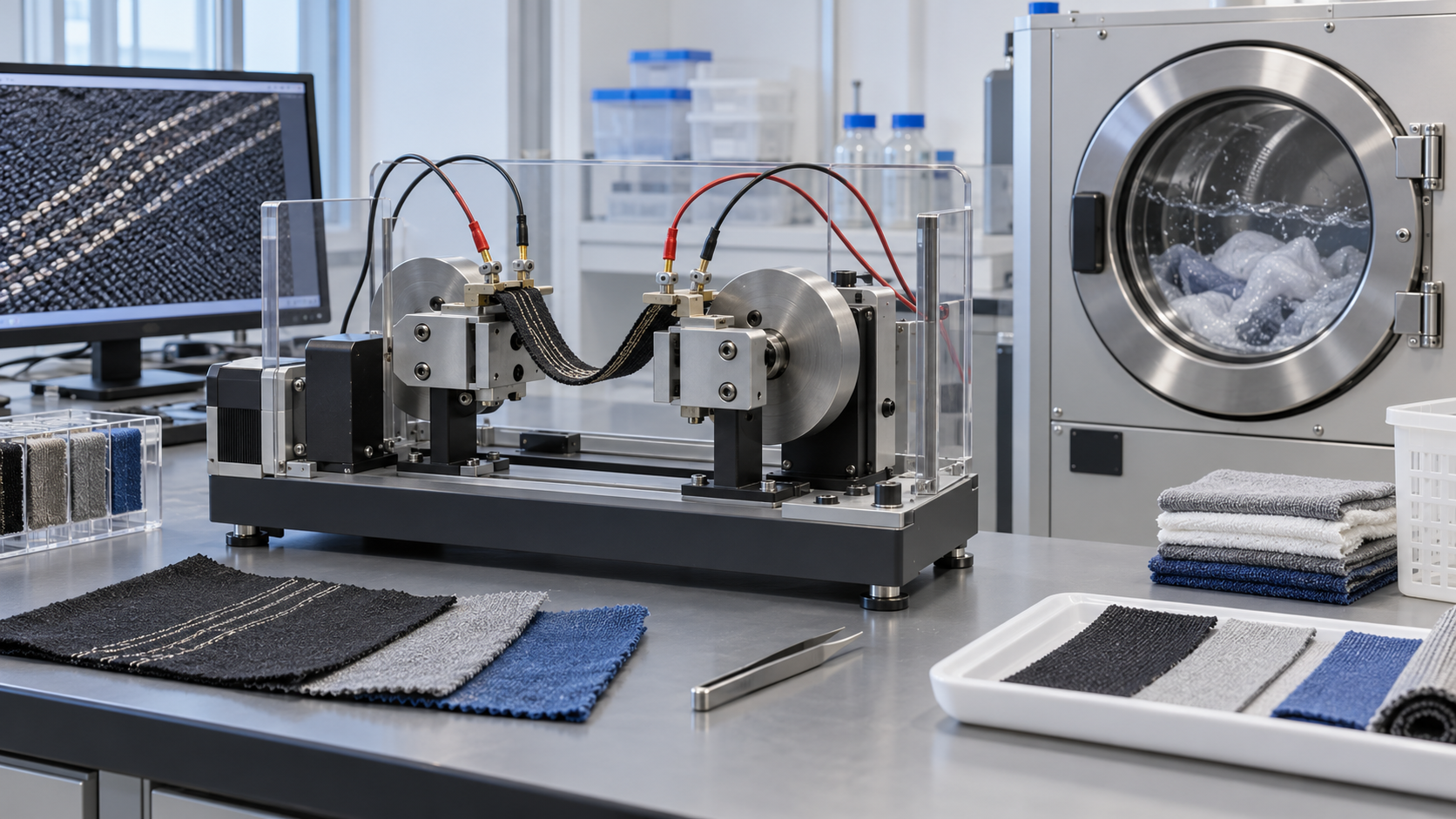
The review says that what acts most on a fabric in a washing machine is mechanical stress, and that drum speed and stop time have a large effect. The chemical action of the wash liquid, the temperature and the drying conditions come on top of thisSourced [Ref. 1]. ISO 6330:2021 specifies domestic washing and drying procedures for textile testing, with reference machine types (A: horizontal-axis front-loading; B: vertical-axis top-loading agitator; C: vertical-axis top-loading pulsator), detergents and drying procedures, and notes in its scope that different washing machine types, detergents and tumble dryers can affect test resultsSourced [Ref. 16].
In the study of Gaubert et al. (as introduced by the review), electrodes of three types of silver-plated nylon yarn were compared by AATCC 135 machine washing and by 30-hour soaking. In machine washing, R30/R0 was about 93,295 with a bleach-containing detergent, 2.4 with a detergent without bleach and 0.9 with water alone. Machine washing with sodium percarbonate pushed the resistance above 10 MΩ at 20 washes, beyond what the tester could measure. Soaking alone gave small changes of 0.88 to 1.47 in all casesSourced [Ref. 1].
The same review cites studies such as the followingSourced [Ref. 1].
- Drying: a study (Hardy et al.) in which an E-yarn of copper wire wound on PET yarn was embroidered on a T-shirt, washed per ISO 6330 and then line-dried or tumble-dried. After 25 line-dried washes the resistance went from 0.8±0.18 Ω to 0.7±0.08 Ω and all five yarns survived. In tumble drying, failures began after 5 cycles and no yarn functioned beyond 15 (failure was resistance above 5 Ω or no continuity)
- Laundry bag: a report that washing knitted conductive circuit boards in a laundry bag raised the proportion keeping their resistance (the share of boards that stayed electrically sound) by 89%
- Temperature and mechanical action: in a study (Rotzler et al.) of printed circuit boards on fabric washed per ISO 6330, the washing time (15–35 min) mattered least, and mechanical action and temperature mattered
- Water and detergent: when silver-coated polyamide yarn was soaked in water or detergent at 30 °C for 72 hours, water damaged the coating more than detergent (Ismar et al.), while in another study a pressure sensor of CNT-coated nonwoven did better in water washing than in detergent (48 hours); results in the opposite direction are also introduced
In the review’s cases, even with the same conductive layer, durability changes if any one of the substrate (yarn material, knit or weave structure), how the coating adheres, the encapsulating material, the motion of the washing machine, the detergent or the drying differs. For instance, circuits encapsulated in PDMS lost function within 15 minutes at a high drum speed (800 rpm) and survived 10–15 washes at a low speed (400 rpm) (Ojuroye et al.); this is explained by PDMS failing to stay adhered at high speed [Ref. 1]. From a materials viewpoint, the candidate main causes of failure in washing are adhesion at the coating-substrate interface, differences in thermal expansion and elasticity between encapsulant and substrate, the resistance of metals to alkali and bleach, and the heat of drying (this article’s commentary). So “N washes” can be compared only when it is written in a reproducible form (standard, programme, temperature, detergent, drying, whether a laundry bag was used). IEC 63203-204-1:2023 specifies a household washing durability test method for e-textile products [Ref. 12].
7. Our calculations: wash counts and time, resistance ratios, heating, impedance ratios
(1) Converting wash counts into time
Assuming one wash per week, we convert wash counts to months by wash count ÷ 52 per year × 12 monthsOur calculation. 40 washes = about 9.2 months, 50 washes = about 11.5 months, 100 washes = about 23.1 months.
Assumptions and limits: washing frequency differs greatly by use (sportswear is washed more often), and one wash per week is our example. 40 is the washability of the textile sensor of Fan et al. [Ref. 2], 50 an example in the review table [Ref. 1], and 100 an illustration. Whether a test of a given count is as severe as real washing depends on the test procedure.
(2) Resistance ratios and the tolerance ratio
In Hardy et al., an E-yarn was judged to have failed when its resistance exceeded 5 Ω, from an initial 0.8 Ω [Ref. 1]. The tolerable increase is 5 ÷ 0.8 = 6.25 timesOur calculation. Compared with this, the R30/R0 of Gaubert et al.’s machine washing is about 93,295 with bleach-containing detergent (about 15,000 times 6.25), 2.4 without bleach (within the tolerance) and 0.9 with water. The “108% increase at 50 washes” of nylon/silver yarn in another study is 2.08 times, and the “10–15 times at 50 washes in the silk programme” of copper-based textile electrodes exceeds 6.25, yet the review says an ECG signal was still obtained.
Assumptions and limits: 6.25 is a ratio from the criterion of a copper-wire-wrapped yarn (of a specific length and use) and does not apply as it is to silver-plated nylon electrodes or textile electrodes. The point of this comparison is that the tolerable resistance ratio differs by application, not that one is better.
(3) Resistance of a conductive trace
The silver nano-coated nylon yarn in the review table is 53 Ω/m, with a 108% increase after 50 washes [Ref. 1]. For a conductive trace of 1.5 m on a garment, the initial value is 53 × 1.5 = 79.5 Ω and after washing 79.5 × 2.08 = about 165 Ω (an increase of about 86 Ω)Our calculation.
Assumptions and limits: 1.5 m is our example and a simple series path of one yarn is assumed. In practice parallel yarns, the resistance of joints and changes from bending also enter.
(4) Power of heating (Joule heat)
With P = V2/R, 5 V across a heating element of 10 Ω gives P = 25 ÷ 10 = 2.5 W, 5 Ω gives 5 W and 20 Ω gives 1.25 WOur calculation. With a heated area of 100 cm2 (0.01 m2), these are 250, 500 and 125 W/m2.
Assumptions and limits: 5 V, the resistances and 100 cm2 are our examples and not values for any product or standard. Power and power per area only express the size of the heating and are not a judgement of usable temperature or safety (safety is a matter for standards such as IEC 60335-2-17 and the requirements of each appliance).
(5) Ratios of contact impedance
From the values of Euler et al. on a human arm at 39 Hz [Ref. 6], the dry-to-wet ratio is 14 MΩ ÷ 15.8 kΩ = about 886 times for the small area and 4.5 MΩ ÷ 4.6 kΩ = about 978 times for the large areaOur calculation. That is, wet is about 1/900 to 1/1000 of dry. The ratio between dry on a human arm (4.5–14 MΩ) and dry on an agar skin phantom (below 200 Ω, below 120 Ω) is 4.5 MΩ ÷ 200 Ω = 22,500 times or more and 14 MΩ ÷ 120 Ω = about 117,000 times [Ref. 5]. If a value rises by more than 30% on drying, a 120 Ω electrode becomes more than 156 Ω (120 × 1.3).
Assumptions and limits: the human-arm values and the phantom values come from different studies with different electrode constructions, measurement methods (three and two electrodes), frequencies (39 Hz and 20 Hz to 5 kHz) and loads. The ratios illustrate that values differ greatly when conditions differ and do not rank electrodes.
8. Limits, and what could not be confirmed
(1) Texts of the standards
We have not checked the texts of the parts of IEC 63203, IEC 60335-2-17, ISO 6330, 11092, 12947-2, 13934-1 and 20932-1, or JIS L 1930 (we checked the titles and scopes shown on the IEC Webstore, ISO and JSA pages). Test conditions, procedures and acceptance criteria are not given.
(2) Washing results
The numbers in Chapter 6 are results of separate studies introduced by a review. We did not individually check the washing conditions of the original papers (machine, rotation speed, temperature, detergent, drying) beyond what the review states. We have not checked the text of AATCC 135.
(3) The skin interface
The human-skin values rest on the forearm study of Euler et al. (with few subjects), and Ravichandran et al. used an agar model. Changes with long wear, motion, the composition of sweat, body hair and skin condition are not covered. The medical effectiveness and safety of uses that rely on biosignals are outside this article.
(4) Heating, cooling and power supply
We did not confirm or give reference values for the temperature, power or safety of heated garments. The cooling values are results on a device that simulates skin. Power supplies for textiles (batteries, harvesting) are separated into our explainer on energy harvesting.
(5) ASTM and JIS
The numbers and titles of ASTM D4966 (Martindale abrasion) and D5035 (strip-method tensile) were confirmed in the reference lists of non-ASTM papers (the ASTM site was not opened). We could not confirm ASTM and JIS standards on conductive yarns, conductive fabrics and washing durability. We did not check the edition of JIS L 1096.
- “Washable” changes with how you wash and dry. For electrodes of the same silver-plated nylon yarn, the resistance ratio under machine washing was about 93,295 with bleach-containing detergent, 2.4 without bleach and 0.9 with waterSourced
- It also changes with the drying conditions. A copper-wire-wrapped yarn was still 0.7 Ω after 25 line-dried washes, but failures began after 5 tumble-dried washes and none survived beyond 15Sourced
- Contact impedance changes by about five orders of magnitude with the partner and conditions. Dry on a human arm is at the MΩ level, wet at the kΩ level (about 1/900 to 1/1000), and dry on an agar skin phantom is below 200 ΩSourced / Our calculation
- Heating and cooling have thin standard evaluation methods. IEC 63203-201 excludes high-resistance heater yarns and fabrics, and the cooling values are results on a simulating deviceSourced
- Evaluation standards are taking shape. IEC 63203 has test methods for conductive yarns, conductive fabrics, washing and bending, and ISO 6330 and JIS L 1930 give domestic washing proceduresSourced
9. How to read evaluations and standards
The performance and durability of a smart textile are measured through these quantities: the linear resistance or sheet resistance of conductive yarns and fabrics and its change after washing, abrasion and bending; resistance under the temperature and humidity inside clothing; contact impedance between electrode and skin (or a skin simulant); the strength, elongation and abrasion of the fabric as a cloth; thermal and water-vapour resistance; and the washing and drying procedure. For electronic textiles the IEC 63203 series of IEC/TC 124 (wearables) is taking shape, while for fabric tests and domestic washing procedures there are the textile standards of ISO/TC 38 and the corresponding JIS.
| Item evaluated | ISO | IEC / IEEE | JIS | ASTM | What changes the value |
|---|---|---|---|---|---|
| Terminology for electronic textiles Sourced | Could not be confirmed | IEC 63203-101-1:2021, “Wearable electronic devices and technologies – Part 101-1: Terminology” (Edition 1, 29 June 2021; includes electronic textiles) [Ref. 7] | Could not be confirmed | Could not be confirmed | Definitions of terms (as far as the title and scope show) |
| Basic properties of conductive yarns and fabrics Sourced | Could not be confirmed | IEC 63203-201-1:2022, “…Part 201-1: Electronic textile – Measurement methods for basic properties of conductive yarns” (26 April 2022; high-resistance antistatic and heater yarns excluded) [Ref. 8] IEC 63203-201-2:2022, “…Part 201-2: … conductive fabrics and insulation materials” (same date) [Ref. 9] | Could not be confirmed | Could not be confirmed | Specimen length, tension, temperature and humidity, measuring current and method. The standard does not define the required characteristics |
| Resistance under clothing microclimate; sheet resistance after abrasion Sourced | ISO 12947-2:2016, “Textiles — Determination of the abrasion resistance of fabrics by the Martindale method — Part 2: Determination of specimen breakdown” (Edition 2, December 2016) [Ref. 18] (a general abrasion standard) | IEC 63203-201-3:2021, “…Determination of electrical resistance of conductive textiles under simulated microclimate” (7 April 2021) [Ref. 10] IEC 63203-201-4:2024+AMD1:2025, “…Test method for determining sheet resistance of conductive fabrics after abrasion” (uses a Martindale abrasion machine; 4 December 2025) [Ref. 11] | Could not be confirmed | ASTM D4966 (a paper’s reference list gives the title “Standard Test Method for Abrasion Resistance of Textile Fabrics (Martindale Abrasion Tester Method)”; D4966-22) [Ref. 22] | Abrasion load and number of cycles, specimen moisture, temperature and humidity |
| Washing durability Sourced | ISO 6330:2021, “Textiles — Domestic washing and drying procedures for textile testing” (Edition 4, November 2021; machine types A, B and C, detergents and drying procedures; notes that differences in machine, detergent and dryer can affect results) [Ref. 16] | IEC 63203-204-1:2023, “…Test method for assessing washing durability of e-textile products” (Edition 2, 16 March 2023; safety and heat-generation test methods not covered) [Ref. 12] | JIS L 1930:2014, test method for domestic washing of textile products (title translated by us; established 20 October 2014; based on ISO 6330 and adapted to Japanese domestic washing) [Ref. 21] | Could not be confirmed (papers often cite AATCC 135; we did not check its text) | Machine type, programme, drum speed, temperature, detergent (bleaching agent), drying, use of a laundry bag, number of washes. Examples in Chapter 6 |
| Bending (joints) Sourced | Could not be confirmed | IEC 63203-204-2:2025, “…Test method to characterize electrical resistance change in knee and elbow bending test of e-textiles” (14 February 2025; a dynamic method) [Ref. 13] IEC TR 63203-250-1:2021 (snap fasteners connecting e-textiles and detachable electronic devices; technical report) [Ref. 14] | Could not be confirmed | Could not be confirmed | Bending angle, speed, number of cycles |
| Strength, elongation and elasticity of fabric Sourced | ISO 13934-1:2013 (maximum force and elongation at maximum force, strip method; Edition 2, April 2013) [Ref. 19] ISO 20932-1:2018 (elasticity of fabrics, strip tests; November 2018) [Ref. 20] | Could not be confirmed | JIS L 1096 (test methods for woven and knitted fabrics; only the title was confirmed in the JISC list, the edition was not checked) | ASTM D5035 (a paper’s reference list gives “Standard Test Method for Breaking Force and Elongation of Textile Fabrics (Strip Method)”) [Ref. 23] | Specimen width and gripping, test speed, direction of weave or knit, humidity of conditioning |
| Thermal and water-vapour resistance (a physical property, not “comfort”) Sourced | ISO 11092:2026, “Textiles — Physiological effects — Measurement of thermal and water-vapour resistance under steady-state conditions (sweating guarded-hotplate test)” (Edition 3, May 2026; no performance values for physiological comfort are given) [Ref. 17] | Could not be confirmed | Could not be confirmed | Could not be confirmed | Apparatus configuration, ambient temperature and humidity, specimen thickness |
| Safety of heated garments and similar Sourced | Could not be confirmed | IEC 60335-2-17:2022, “Household and similar electrical appliances – Safety – Part 2-17: Particular requirements for blankets, pads, clothing and similar flexible heating appliances” (Edition 4, 12 October 2022; rated voltage up to 250 V) [Ref. 15] | Could not be confirmed | Could not be confirmed | Appliance construction and rating. This article does not go into the standard’s content |
| Summary (our own) Our calculation | How the standards are positioned: the test methods for conductive yarns, conductive fabrics, washing and bending of electronic textiles are gathered in the IEC 63203 series, and we could not confirm a dedicated e-textile standard in ISO. For washing, ISO 6330 (international) and JIS L 1930 (national, based on it) define the procedure, and IEC 63203-204-1 builds the durability test method for e-textiles on top of that. For ASTM numbers, only D4966 and D5035 could be confirmed in non-ASTM sources, and no ASTM standard on conductive yarns or washing durability. Heating and safety are outside IEC 63203 and lie in a separate appliance safety standard (IEC 60335-2-17). | ||||
Because the texts are paid, we keep to number, title, edition, date and scope. ASTM International’s site states that AI use is not permitted, so we did not open it. ASTM numbers and titles are given only as far as they were confirmed in the reference lists of non-ASTM papers. “AATCC” is the standard of a different organization, and we did not check its text.
Notes on reading standards
- A standard is a test method, not a guarantee of product durability. IEC 63203-201-1 says it does not define the characteristics a conductive yarn must have but specifies the handling and measurement [Ref. 8]. “Measured according to the standard” and “meets the requirement of the application” are different things
- A washing standard has a range of conditions. ISO 6330 defines three machine types, detergents and drying procedures, and notes that differences among them can affect results [Ref. 16]. As in the studies the review introduces, even within one standard the result can be reversed by the programme (silk or express), drum speed and drying (line or tumble) (Chapter 6). “Followed ISO 6330” alone does not identify the conditions
- Read a manufacturer’s or paper’s value together with the standard number, edition, programme and number of washes. IEC 63203-204-1 moved from a first edition (2021, for leisurewear and sportswear) to a second edition in 2023 that reorganized items such as the conductive-textile clause and covers e-textile products in general [Ref. 12]. Check which edition
- Watch the relation between national and international standards. JIS L 1930:2014 is based on ISO 6330 but is said to carry provisions adapted to Japanese domestic washing [Ref. 21]. The current edition of ISO 6330 is from 2021 and the JIS was established in 2014, so the procedures are not necessarily the same
10. Glossary
- Smart textile / e-textile
- A fabric or garment given electronic functions (conduction, sensing, heating and so on).
- Conductive yarn
- A yarn that can carry electrical signals or power: silver-plated nylon, metal-wrapped yarn, CNT-coated yarn and so on.
- Linear resistance (Ω/m)
- Resistance per unit length of a yarn.
- Sheet resistance (Ω/sq)
- Resistance of the surface of a fabric or film, expressed per square.
- R30/R0
- The ratio of resistance after to before washing or soaking. 1 means no change.
- Contact impedance
- The AC resistance of the interface between electrode and skin (or simulant); it changes with frequency, pressure and moisture.
- Dry / wet electrode
- An electrode used without gel / one wetted with moisture or electrolyte.
- Phantom
- A sample that imitates skin and the like; here, agar with salt.
- Joule heating
- Heat produced when current flows through a resistance: P = V2/R.
- nanoPE
- Nanoporous polyethylene with 50–1000 nm pores; opaque to visible light and transparent to mid-infrared.
- ISO 6330
- The international standard for domestic washing and drying procedures for textile testing.
- Martindale abrasion
- An abrasion test in which a circular specimen is rubbed under load.
11. References (primary sources)
- Shak Sadi M., Kumpikaitė E. “Advances in the Robustness of Wearable Electronic Textiles: Strategies, Stability, Washability and Perspective”, Nanomaterials 12, 2039 (2022), DOI 10.3390/nano12122039 (open access) — doi.org/10.3390/nano12122039
- Fan W. et al. “Machine-knitted washable sensor array textile for precise epidermal physiological signal monitoring”, Sci. Adv. 6, eaay2840 (2020), DOI 10.1126/sciadv.aay2840 (open access) — doi.org/10.1126/sciadv.aay2840
- Hsu P.-C. et al. “Radiative human body cooling by nanoporous polyethylene textile”, Science 353, 1019–1023 (2016), DOI 10.1126/science.aaf5471 — doi.org/10.1126/science.aaf5471
- Stoppa M., Chiolerio A. “Wearable Electronics and Smart Textiles: A Critical Review”, Sensors 14, 11957–11992 (2014), DOI 10.3390/s140711957 (open access) — doi.org/10.3390/s140711957
- Ravichandran V. et al. “Characterizing the Impedance Properties of Dry E-Textile Electrodes Based on Contact Force and Perspiration”, Biosensors 13, 728 (2023), DOI 10.3390/bios13070728 (open access) — doi.org/10.3390/bios13070728
- Euler L. et al. “Textile Electrodes: Influence of Knitting Construction and Pressure on the Contact Impedance”, Sensors 21, 1578 (2021), DOI 10.3390/s21051578 (open access) — doi.org/10.3390/s21051578
- International Electrotechnical Commission (IEC) “IEC 63203-101-1:2021” product page (IEC Webstore) — webstore.iec.ch/en/publication/62635
- International Electrotechnical Commission (IEC) “IEC 63203-201-1:2022” product page (IEC Webstore) — webstore.iec.ch/en/publication/63308
- International Electrotechnical Commission (IEC) “IEC 63203-201-2:2022” product page (IEC Webstore) — webstore.iec.ch/en/publication/63309
- International Electrotechnical Commission (IEC) “IEC 63203-201-3:2021” product page (IEC Webstore) — webstore.iec.ch/en/publication/64259
- International Electrotechnical Commission (IEC) “IEC 63203-201-4:2024+AMD1:2025 CSV” product page (IEC Webstore) — webstore.iec.ch/en/publication/110735
- International Electrotechnical Commission (IEC) “IEC 63203-204-1:2023” product page (IEC Webstore; the page of the redline version of Edition 2) — webstore.iec.ch/en/publication/84094
- International Electrotechnical Commission (IEC) “IEC 63203-204-2:2025” product page (IEC Webstore) — webstore.iec.ch/en/publication/67664
- International Electrotechnical Commission (IEC) “IEC TR 63203-250-1:2021” product page (IEC Webstore) — webstore.iec.ch/en/publication/63310
- International Electrotechnical Commission (IEC) “IEC 60335-2-17:2022 CMV” product page (IEC Webstore) — webstore.iec.ch/en/publication/79475
- International Organization for Standardization (ISO) “ISO 6330:2021 Textiles — Domestic washing and drying procedures for textile testing” (ISO page) — iso.org/standard/75934.html
- International Organization for Standardization (ISO) “ISO 11092:2026 Textiles — Physiological effects — Measurement of thermal and water-vapour resistance under steady-state conditions (sweating guarded-hotplate test)” (ISO page) — iso.org/standard/85998.html
- International Organization for Standardization (ISO) “ISO 12947-2:2016 Textiles — Determination of the abrasion resistance of fabrics by the Martindale method — Part 2: Determination of specimen breakdown” (ISO page) — iso.org/standard/61058.html
- International Organization for Standardization (ISO) “ISO 13934-1:2013 Textiles — Tensile properties of fabrics — Part 1: Determination of maximum force and elongation at maximum force using the strip method” (ISO page) — iso.org/standard/60676.html
- International Organization for Standardization (ISO) “ISO 20932-1:2018 Textiles — Determination of the elasticity of fabrics — Part 1: Strip tests” (ISO page) — iso.org/standard/69489.html
- Japanese Standards Association (JSA) “JIS L 1930:2014” standard preview (JSA; title in Japanese: Test method for domestic washing of textile products) — webdesk.jsa.or.jp/preview/pre_jis_l_01930_000_000_2014_j_ed10_ch.pdf
- Živičnjak J. et al. (used to confirm the number and title of ASTM D4966) “Advanced Digital Imaging Assessment Method for Testing Surface Fuzzing in Textile Materials”, Polymers 18, 1532 (2026), DOI 10.3390/polym18121532 (open access; its reference list gives “ASTM D4966-22 Standard Test Method for Abrasion Resistance of Textile Fabrics (Martindale Abrasion Tester Method)”) — doi.org/10.3390/polym18121532
- Nongsok et al. (used to confirm the number and title of ASTM D5035) “Lignin- and Silver-Modified Multifunctional Cotton Fabrics: Influence of α- and β-Chitosan Pretreatment on Structure–Property Relationships”, Polymers 18, 1279 (2026), DOI 10.3390/polym18111279 (open access; its reference list gives “ASTM D5035-11(2019) Standard Test Method for Breaking Force and Elongation of Textile Fabrics (Strip Method)”) — doi.org/10.3390/polym18111279
12. Claim-to-source audit
| Claim in the text | Basis | Type |
|---|---|---|
| The combination of textile substrates (fibre, yarn, fabric, garment) with nanostructured electroactive materials; the vulnerability to deformation under washing and wear; the examples in the review table (cotton/Lycra/CNT 2.39 kΩ/cm with ΔR/R0 about 1.6 at 10 washes; PU/PET braided yarn/CNT about 10% at 5 washes; PET/copper 0.34 Ω/cm below 0.6 Ω/cm at 20 washes; nylon/silver 53 Ω/m with 108% at 50 washes); that the table gives no washing procedure; the CNT electrospun nanofiber-yarn pressure sensor; the effect of drum speed and stop time; Gaubert et al. (AATCC 135 machine wash R30/R0: detergent with bleaching agent about 93,295, without 2.4, water 0.9; 30 h soaking 1.47, 0.88, 0.91, 1.13; sodium percarbonate over 10 MΩ at 20 washes); Ojuroye et al. (PDMS-encapsulated circuits, 15 min at 800 rpm, 10–15 washes at 400 rpm); Zaman et al. (copper-based electrodes, 10–15 times at 50 silk washes, conductivity lost at 10 express washes); Hardy et al. (copper-wire-wrapped E-yarn, 0.8 to 0.7 Ω after 25 line-dried washes, failures from 5 tumble-dried washes and none above 15, failure above 5 Ω); a 89% rise in the resistance-retention ratio with a laundry bag; Rotzler et al.; Ismar et al.; the use of electrospinning | Review by Shak Sadi and Kumpikaitė (2022) and the studies it introduces Reference 1 https://doi.org/10.3390/nano12122039 | Sourced |
| A triboelectric all-textile pressure sensor: sensitivity 7.84 mV/Pa, response 20 ms, over 100,000 cycles (1 kPa, 5 Hz), bandwidth 20 Hz, machine washing over 40 times (AATCC 135-2017, 1.8 kg load, 18 gallons of water at 25 °C); the effect of yarn size and stitch density | Fan et al. (2020) Reference 2 https://doi.org/10.1126/sciadv.aay2840 | Sourced |
| The pore size of 50–1000 nm of nanoPE, that it is opaque to visible light and transparent to mid-infrared, and the 2.7 °C (nanoPE) and 2.0 °C (processed nanoPE) lower temperatures than cotton on a skin simulator | Abstract of Hsu et al. (2016) Reference 3 https://doi.org/10.1126/science.aaf5471 | Sourced |
| The description of electronic textiles, and the trade-off among flexibility, ergonomics, low power consumption, integration and autonomy | Abstract of Stoppa and Chiolerio (2014) Reference 4 https://doi.org/10.3390/s140711957 | Sourced |
| Impedance of seven dry textile electrodes (six embroidered, one knitted, 40 mm diameter) on an agar phantom (E7, E5 and E2 below 200 ohm before and below 120 ohm after synthetic perspiration; E6 and E4 down by over 25%; E1 to E4 up by over 30% after drying); measurement at 20 Hz to 5 kHz; the issues of gel and adhesive in gel electrodes; the reason for a standardized agar phantom | Ravichandran et al. (2023) Reference 5 https://doi.org/10.3390/bios13070728 | Sourced |
| Three-electrode contact impedance of knitted electrodes on a human forearm (39 Hz; dry 14 to 4.5 MΩ, wet 15.8 to 4.6 kΩ; 35.3% and 39.4% lower with higher stitch density); wet far lower than dry; pressure lowering the dry value | Euler et al. (2021) Reference 6 https://doi.org/10.3390/s21051578 | Sourced |
| Titles, editions, dates and scope of IEC 63203-101-1:2021, -201-1:2022, -201-2:2022, -201-3:2021, -201-4:2024+AMD1:2025, -204-1:2023, -204-2:2025 and IEC TR 63203-250-1:2021 (high-resistance antistatic and heater yarns and fabrics excluded; 204-1 excludes safety and heat-generation tests) | IEC Webstore Reference 7 https://webstore.iec.ch/en/publication/62635 Reference 8 https://webstore.iec.ch/en/publication/63308 Reference 9 https://webstore.iec.ch/en/publication/63309 Reference 10 https://webstore.iec.ch/en/publication/64259 Reference 11 https://webstore.iec.ch/en/publication/110735 Reference 12 https://webstore.iec.ch/en/publication/84094 Reference 13 https://webstore.iec.ch/en/publication/67664 Reference 14 https://webstore.iec.ch/en/publication/63310 | Sourced |
| Title, edition and date of IEC 60335-2-17:2022, and that it deals with the safety of blankets, pads, clothing and other flexible heating appliances (rated voltage up to 250 V) | IEC Webstore Reference 15 https://webstore.iec.ch/en/publication/79475 | Sourced |
| ISO 6330:2021 (machine types A, B and C, detergents, drying procedures, the note on the effect on results), ISO 11092:2026, ISO 12947-2:2016, ISO 13934-1:2013 and ISO 20932-1:2018: titles, editions, dates and scope | ISO pages (checked on 10 October 2026) Reference 16 https://www.iso.org/standard/75934.html Reference 17 https://www.iso.org/standard/85998.html Reference 18 https://www.iso.org/standard/61058.html Reference 19 https://www.iso.org/standard/60676.html Reference 20 https://www.iso.org/standard/69489.html | Sourced |
| Title of JIS L 1930:2014, its date of establishment (20 October 2014) and that it is based on ISO 6330 | JSA standard preview Reference 21 https://webdesk.jsa.or.jp/preview/pre_jis_l_01930_000_000_2014_j_ed10_ch.pdf | Sourced |
| Numbers and titles of ASTM D4966 and D5035 (the ASTM site was not opened) | Reference lists of papers (non-ASTM sources) Reference 22 https://doi.org/10.3390/polym18121532 Reference 23 https://doi.org/10.3390/polym18111279 | Sourced |
| Calculations in Chapter 7: wash counts in months (about 9.2, 11.5, 23.1); the tolerance ratio of 6.25 and about 15,000 times; the 79.5 ohm and about 165 ohm of a conductive trace; heating power (2.5, 5, 1.25 W and 250, 500, 125 W/m²); the contact-impedance ratios (about 886 times, 978 times, 22,500 times or more, about 117,000 times, above 156 ohm) | Our calculation. Assumptions and limits are in Chapter 7 (one wash per week, a 1.5 m example, examples of 5 V and resistances, ratios of values from different studies) | Our calculation |
| Reference values for temperature, power and safety of heated garments; real wearing values for cooling; the text of AATCC 135; the washing conditions of each original paper; ASTM and JIS standards for conductive yarns, fabrics and washing durability; the edition of JIS L 1096; power supplies for textiles | Could not be confirmed in the primary sources accessible to this article, so they are not stated | Commentary |
| The readings that “the same electrode meets a dry and a sweaty skin as different partners” and “washing durability is material x structure x way of washing”; the positioning of the standards (Chapter 9); the candidate factors such as adhesion at the coating-substrate interface and differences in thermal expansion | This article’s own organization and commentary based on the published content. Not views stated by the companies or institutions | Commentary |
| That Figs. 2, 3, 5, 6 and 7 are explanatory drawings and not actual observation images or data themselves, and that Figs. 1 and 4 are AI-generated images | Note by this article | Commentary |
Last updated: 10 October 2026. Sources are limited to primary material (peer-reviewed papers and reviews, standards-body pages). The texts of the standards are paid and could not be checked. Because the article includes structural summaries and materials-design readings, these are marked as “commentary” and kept apart from sourced facts. The texts of the standards, reference values for heated garments, the washing conditions of each original paper, the text of AATCC 135, ASTM and JIS standards on conductive yarns and washing durability, and power supplies for textiles could not be confirmed and are not stated. Values for resistance, impedance and wash counts differ by source in yarn, electrode and test conditions and cannot be generalized to other materials or products. The article contains no advice on medicine, health or the safety of heated garments. All figures are explanatory conceptual drawings. Figs. 2, 3, 5, 6 and 7 are vector drawings and Figs. 1 and 4 are AI-generated images; none of them shows an actual cross-section photograph, micrograph or real product.