TECHNOLOGY EXPLAINER
Shape Memory Polymers and Liquid Crystal Elastomers
— what, and under what conditions, were “99% recovery” and “400% strain” measured?
In a commercial thermoset polyurethane shape memory polymer (Tg about 45 °C), shape fixity was about 98%, and shape recovery was about 90% in the first cycle and above 99% by the third. Yet for the same sample the glass transition temperature differs by about 10 °C depending on the method: about 45 °C by dynamic mechanical analysis (DMA) and about 35 °C by differential scanning calorimetry (DSC). Liquid crystal elastomers (LCEs), for their part, are reported with strains of up to 400% in thermally responsive versions, whereas a review says that many actuators run for fewer than 100 cycles. This article sets out, from primary sources, how shape memory polymers (SMPs) and LCEs work, how to read shape fixity, shape recovery and recovery force, forming by 3D and 4D printing, cycle life, and how to read the evaluation standards.
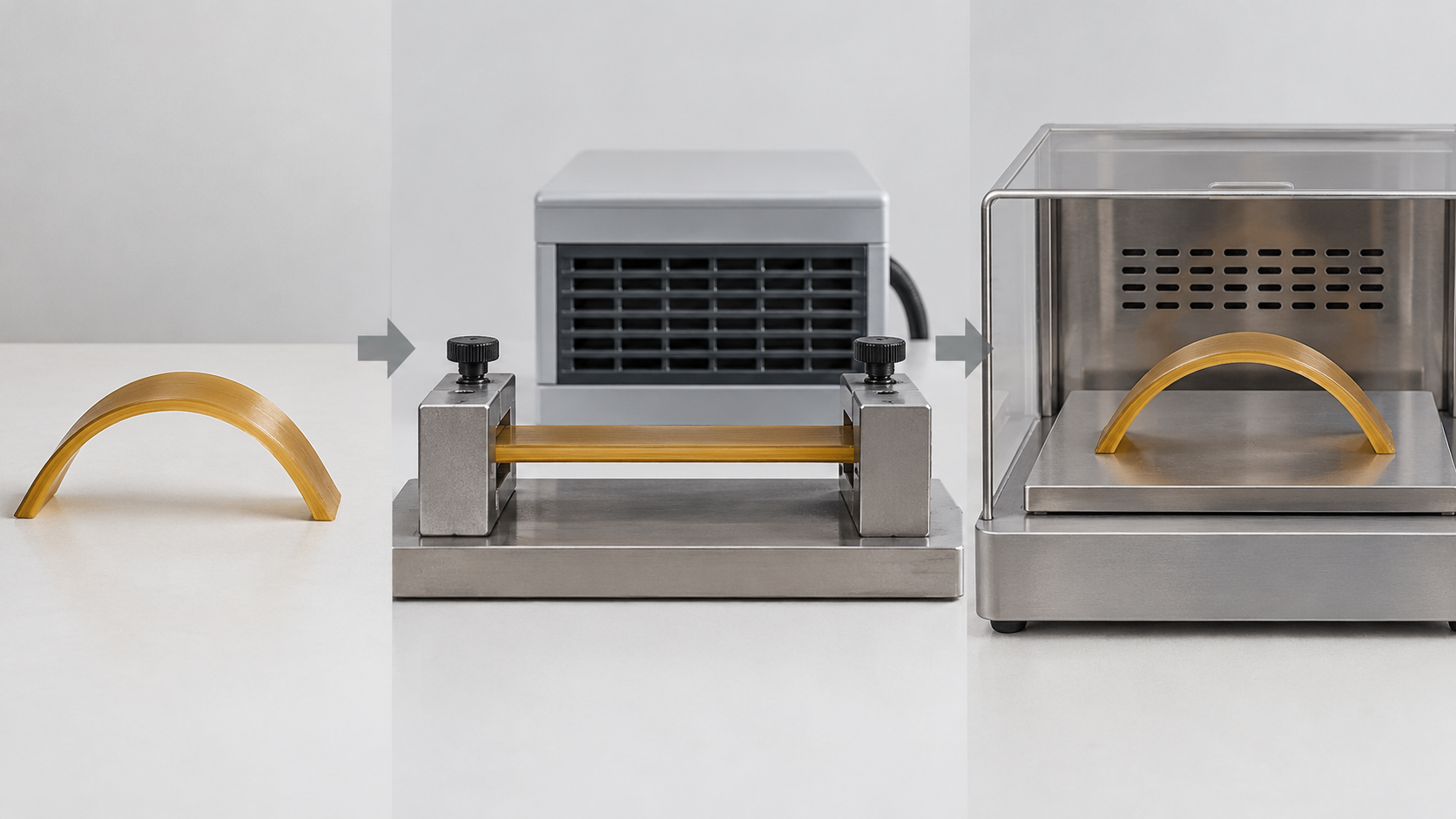
- What SMPs and LCEs are (the short version)
- How an SMP works — a network with net points, and the temperature at which it switches
- Evaluating SMPs — shape fixity, shape recovery and recovery force
- How an LCE works — liquid-crystal order and rubber elasticity
- Forming — 3D and 4D printing
- Cycle life and speed — use in soft robots
- Telling SMPs, LCEs and shape memory alloys apart
- Limits, and what we could not confirm
- How to read evaluations and standards
- Glossary
- References (primary sources)
- Claim-to-source audit
Sourced = stated in a published source (with a link)
Our calculation = a value this article computed from stated assumptions
Not yet confirmed = plans or intentions with no confirmed results
Readings of materials design are marked as commentary. Inference is shown in bold.
The recovery ratios, strains, cycle counts and Tg values here are results that specific papers obtained for specific materials under specific conditions. They do not describe mass-produced products or other materials. Please do not read a laboratory’s best result, or a value a review cites as the maximum reported, as performance under practical conditions. No product or company is ranked, and no medical advice is given.
1. What SMPs and LCEs are (the short version)
- An SMP is a polymer whose network with net points switches between “mobile” and “frozen” with temperature: a crosslinked network has net points (which fix the permanent shape) and switching domains that soften at the glass transition temperature Tg or the melting point Tm. The material is deformed while soft, fixed by cooling, and on reheating returns to its original shape through the entropic elasticity of the network. Most change one way Sourced [Ref. 9]
- An LCE is a network that combines liquid-crystal order with rubber elasticity: when the alignment of its units (mesogens) is disturbed by heating or other stimuli, it contracts along the alignment direction and expands across it. When the stimulus stops, it returns: the deformation is reversible Sourced [Ref. 9, 8]
- Read the numbers with their definitions and conditions: shape recovery changes with “which cycle”, Tg with “which measurement method”, and LCE strain with “which alignment, crosslinking and temperature”. For both SMPs and LCEs, long-term life is not well established Sourced [Ref. 1, 9]
“Shape recovery of 99%” means something only when it states in which cycle, at what strain and between which temperatures it was measured. The same SMP gave about 90% in the first cycle and above 99% in the third [Ref. 1].
2. How an SMP works — a network with net points, and the temperature at which it switches
An SMP has a network joined at net points (chemical crosslinks and the like), and its chains switch between “mobile” and “frozen” with temperature. The review by Hasan et al. describes an SMP as a crosslinked network with permanent net-points and distinct switching domains (for example segments above Tg or Tm). The material is deformed into a temporary shape when the switching domain is soft, fixed upon cooling, and then recovers its original shape upon reheating thanks to the stored entropic elasticity of the network Sourced [Ref. 9].
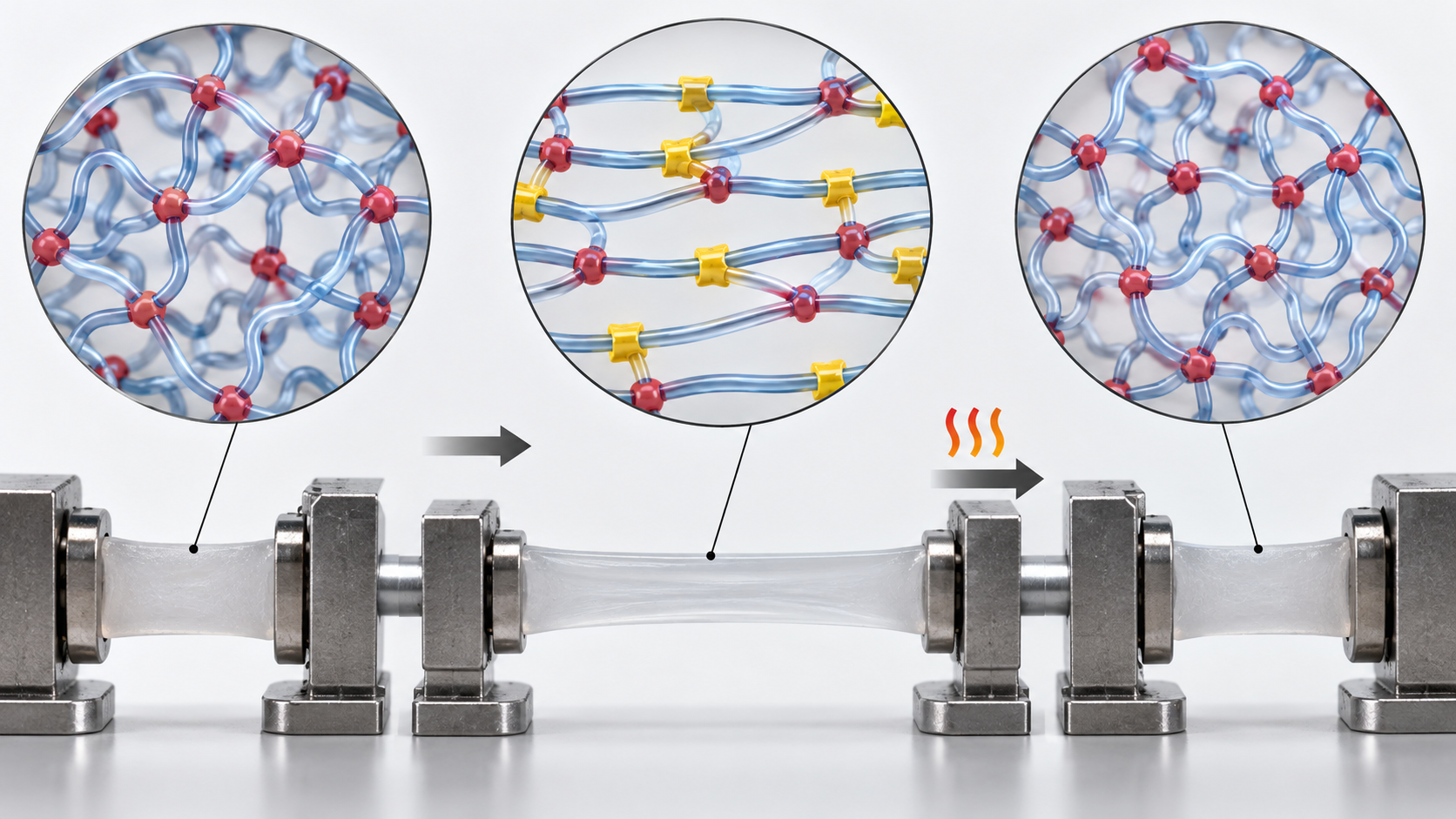
View the original SVG schematic and exact annotations
Heat is not the only stimulus. The introduction of Staszczak et al. lists heat, light, magnetic fields, solvents, moisture, lasers and microwave heating, says that heat is the most frequent stimulus, and notes that for a thermo-responsive SMP Tg serves as the activation temperature. Below Tg the frozen chain motion gives a high elastic modulus; above Tg the modulus falls dramatically, internal stresses are released and the shape recovers Sourced [Ref. 1]. For light, Lendlein et al. reported polymers containing cinnamic groups that can be deformed and fixed by ultraviolet illumination and can recover their original shape at ambient temperature under ultraviolet light of a different wavelength; the fixed shapes were stable even when heated to 50 °C Sourced [Ref. 3].
The number of temporary shapes can also be designed. Xie notes that known SMPs memorize one or two temporary shapes (dual- and triple-shape memory) and that the maximum number correlates with the number of discrete reversible phase transitions in the polymer. He then reports multi-shape memory in a perfluorosulphonic acid ionomer that has only one broad transition Sourced [Ref. 4].
Staszczak et al. state that SMPs are extremely sensitive to temperature and humidity. Moisture absorbed from the air acts as a plasticizer, increases chain mobility and lowers the modulus, Tg and shape fixity (a report by Yang et al. that they cite). In ether-based polyurethane SMPs, absorbed water may weaken hydrogen bonds and lower Tg Sourced [Ref. 1].
In the same paper, because the setting accuracy of the thermal chamber was ±5 °C, the authors added three thermocouples near the specimen to keep temperature differences within 1 °C, and used silica gel to damp humidity changes [Ref. 1]. The reliability of SMP data depends on whether the accuracy of test temperature and the control of humidity are stated (our commentary).
3. Evaluating SMPs — shape fixity, shape recovery and recovery force
The performance of an SMP is described mainly by three quantities: the shape fixity Rf (how well the temporary shape is held), the shape recovery Rr (how fully the permanent shape returns) and the recovery force (recovery stress) (the force it exerts when trying to return). These are not constants of the material but results of a “thermomechanical cycle” with a defined way of deforming, temperatures and number of cycles.
Staszczak et al. used the following program on a thermoset polyurethane SMP (MP4510; the producer’s stated Tg is 45 °C). (I) Tension at Th = 65 °C (Tg + 20 °C) at a strain rate of 10−3 s−1 up to a maximum strain εm = 20%; (II) cooling to Tl = 25 °C (Tg − 20 °C) at 7 °C/min while holding the strain, to fix the shape; (III) unloading at Tl; (IV) reheating with no load to Th at 4 °C/min. From the strain after unloading, εun, and the strain left after reheating, εir, Rf and Rr are obtained (the definitions of Tobushi and Hayashi) Sourced [Ref. 1].
For five specimens in one cycle, the mean was about 98% for Rf and about 93% for Rr. In three consecutive cycles Rf stayed at about 98%, while Rr was about 90% in the first cycle and above 99% in the third. The authors attribute the good repeatability to the stability of the chemical crosslinks of a thermoset, and describe a “thermomechanical training” effect after the first cycle. They also note that an ideal SMP has Rf and Rr near 100%, but that even a thermoset with chemical crosslinks does not fix or recover perfectly Sourced [Ref. 1].
Using the common forms Rf = εun/εm and Rr = (εm − εir)/εm Our calculation with εm = 20%: Rf = 98% means a strain after unloading of 19.6% (0.4% lost). Rr of about 90% in the first cycle leaves 20% × (1 − 0.90) = 2.0%; 99% in the third leaves 0.2%; and the one-cycle mean of 93% leaves 1.4%.
Assumptions and limits: the formulas are the general definitions and need not take exactly the form used in the paper (which is written with εm, εun and εir). The numbers are back-calculated from approximate values reported. The point is that a difference of a few percent in recovery ratio, between a single cycle and consecutive cycles, is a several-fold difference (0.2% to 2.0%) in the strain that remains.
How Tg was measured
The same paper measured the Tg of the same sample by two methods. The peak of the loss tangent tan δ in dynamic mechanical analysis (DMA; bending, 1 Hz, 2 °C/min) was about 45 °C, in agreement with the producer’s value. In the first heating of differential scanning calorimetry (DSC; about 10 mg, −10 to 210 °C, 10 °C/min) a step change appeared at 34.82 °C, so Tg was about 35 °C. The authors explain that the two values are not contradictory: DMA is a mechanical test and DSC measures the change in heat capacity of a static sample, the heating rates differ, Tg is a temperature range, and its value depends on the method Sourced [Ref. 1]. The DMA storage modulus was E′g = 1250 MPa in the glassy region and E′r = 12.1 MPa in the rubbery region, a ratio of about 100 (103). The paper says that a sharp transition from glassy to rubbery needs a difference of at least two orders of magnitude in modulus [Ref. 1].
The paper set Th = Tg + 20 °C and Tl = Tg − 20 °C from the DMA Tg (45 °C), giving 65 °C and 25 °C Our calculation. Taking the DSC Tg (34.8 °C) as the base gives Th = 54.8 °C and Tl = 14.8 °C, a shift of about 10 °C.
Assumptions and limits: “Tg ± 20 °C” is the paper’s own choice, not a standard. If another laboratory sets test temperatures from the DSC Tg, the fixing and recovery temperatures for the same material differ by 10 °C and Rf and Rr cannot be compared directly. State the test temperatures and which Tg they were set from.
Recovery force: newtons or megapascals?
Fulati et al. studied the recovery force of blends of four-branched poly(ε-caprolactone)-based SMPs while varying crystallinity and crosslinking density. The mechanical properties varied over a wide range along the crystallinity gradient (stretchability 50.5–1419.5%, toughness 0.62–130.4 MJ/m3) while shape-memory properties were maintained. The recovery force was affected by crosslinking density and correlated with the energy-storage capacity of the SMP. For the long-chain 4b100PCL alone the force was 0.061 N at 50% strain and 0.894 N at 800% strain, and with 30% of short-chain polymer it was 0.162 N at 50% strain (an increase of about 166%) Sourced [Ref. 2].
The values above are reported as force (N). For the same material, doubling the cross-sectional area doubles the force, so to compare with other materials, or with shape memory alloys (stress, MPa), the force must be divided by the cross-section to give stress. We could not confirm the specimen dimensions in this paper, so we did not convert to stress (something we could not confirm).
The recovery force also changes with strain (50% or 800%), crystallinity, crosslinking density and temperature [Ref. 2]. Read the recovery force of an SMP as a package of four items: the cross-section of the specimen, how much it was deformed, the temperature, and the force obtained (our commentary).
4. How an LCE works — liquid-crystal order and rubber elasticity
The review by Herbert et al. describes liquid crystalline elastomers (LCEs) as crosslinked polymer networks that combine the elastic properties of rubber with the anisotropic properties of liquid crystals. Their key advantage is that multifunctionality and responsivity can be programmed by patterning the local orientation, and the review surveys approaches to alignment: mechanical, surface-enforced, field-induced and rheological Sourced [Ref. 8]. The review by White and Broer details the thermally and photogenerated macroscale mechanical responses of liquid crystalline polymer networks and elastomers (bending, twisting and buckling) and the control of local topography [Ref. 7].
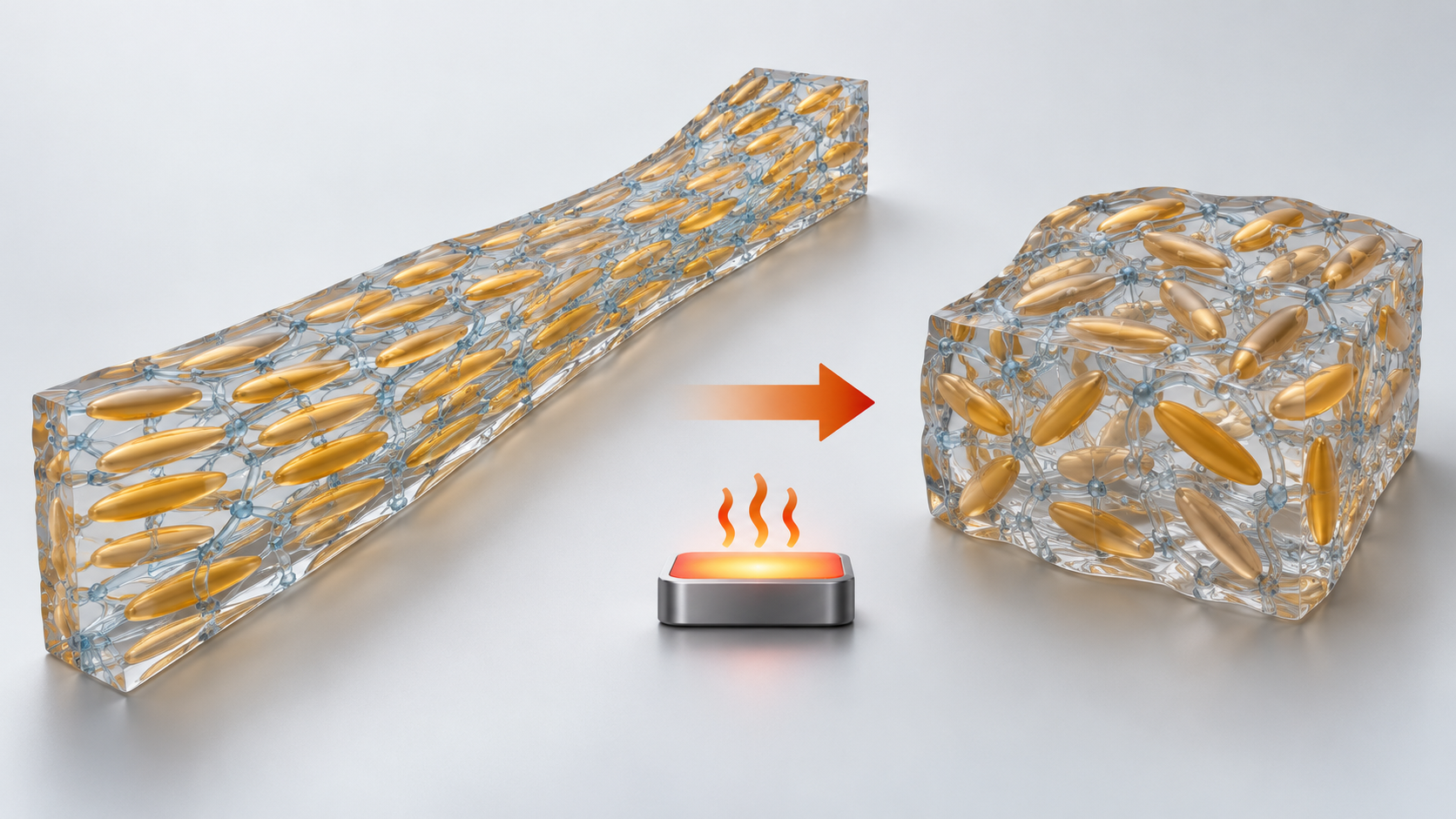
View the original SVG schematic and exact annotations
Hasan et al. summarize the mechanism as follows. In a monodomain LCE in its nematic state the polymer chains adopt an elongated, prolate-ellipsoid conformation. When a stimulus such as heat disrupts the orientational order of the mesogens, the chains become more disordered and spherical, and macroscopically the material contracts along the director and expands perpendicular to it. When the stimulus is removed, the elastic memory of the crosslinked network re-establishes the original network configuration and mesogen order. The reversible strain can be substantial, with up to 400% reported for thermally responsive LCEs (a cited value), whereas more densely crosslinked glassy liquid crystal networks (LCNs) have actuation strains of 5% or less Sourced [Ref. 9].
Ware et al. reported LCEs in which the director is written in local volume elements (voxels) as small as 0.0005 mm3. The director controls the inherent local mechanical response (55% strain), and flat sheets with a patterned director transform into three-dimensional objects under thermal or chemical stimuli Sourced [Ref. 6].
Treating 0.0005 mm3 = 5 × 10⁻⁴ mm3 as a cube Our calculation, the edge is (5 × 10⁻⁴)1/3 ≈ 0.079 mm, about 80 µm (about the thickness of a hair).
Assumptions and limits: a voxel need not be a cube, and the paper (abstract) gives only the volume. Read it as a guide to the size of the unit in which alignment can be written.
5. Forming — 3D and 4D printing
SMPs and LCEs attract attention as materials for “4D printing” because the printed part changes shape over time. Hasan et al. distinguish 3D printing, which creates a shape, from 4D printing, which gives a time-dependent, programmable shape change Sourced [Ref. 9].
(1) SMPs: several SMPs in one part from photo-curable resins
Ge et al. reported a way of printing high-resolution (up to a few microns) multimaterial SMP architectures by projection microstereolithography (PμSL). Using a family of photo-curable methacrylate-based copolymer networks, they designed the rubbery modulus, the glass transition temperature and a failure strain of more than 300%, larger than that of any existing printable material. An automated material exchange builds composite architectures, and simulations of local deformation, shape fixity and free recovery rate agreed well with experiments Sourced [Ref. 5].
(2) LCEs: building the alignment in during printing
In LCEs the alignment is fixed during forming. Hasan et al. say that direct ink writing (DIW) and vat photopolymerization are the most widely adopted methods, and that ink chemistry, rheology, curing and printing parameters directly govern mesogen alignment and actuation performance. Thiol-Michael chemistry is important because it gives precise control of the nematic-to-isotropic transition temperature (TNI), crosslink density and actuation performance, and printing in the mesophase, 10–20 °C below TNI, gives higher order parameters and larger actuation strains Sourced [Ref. 9].
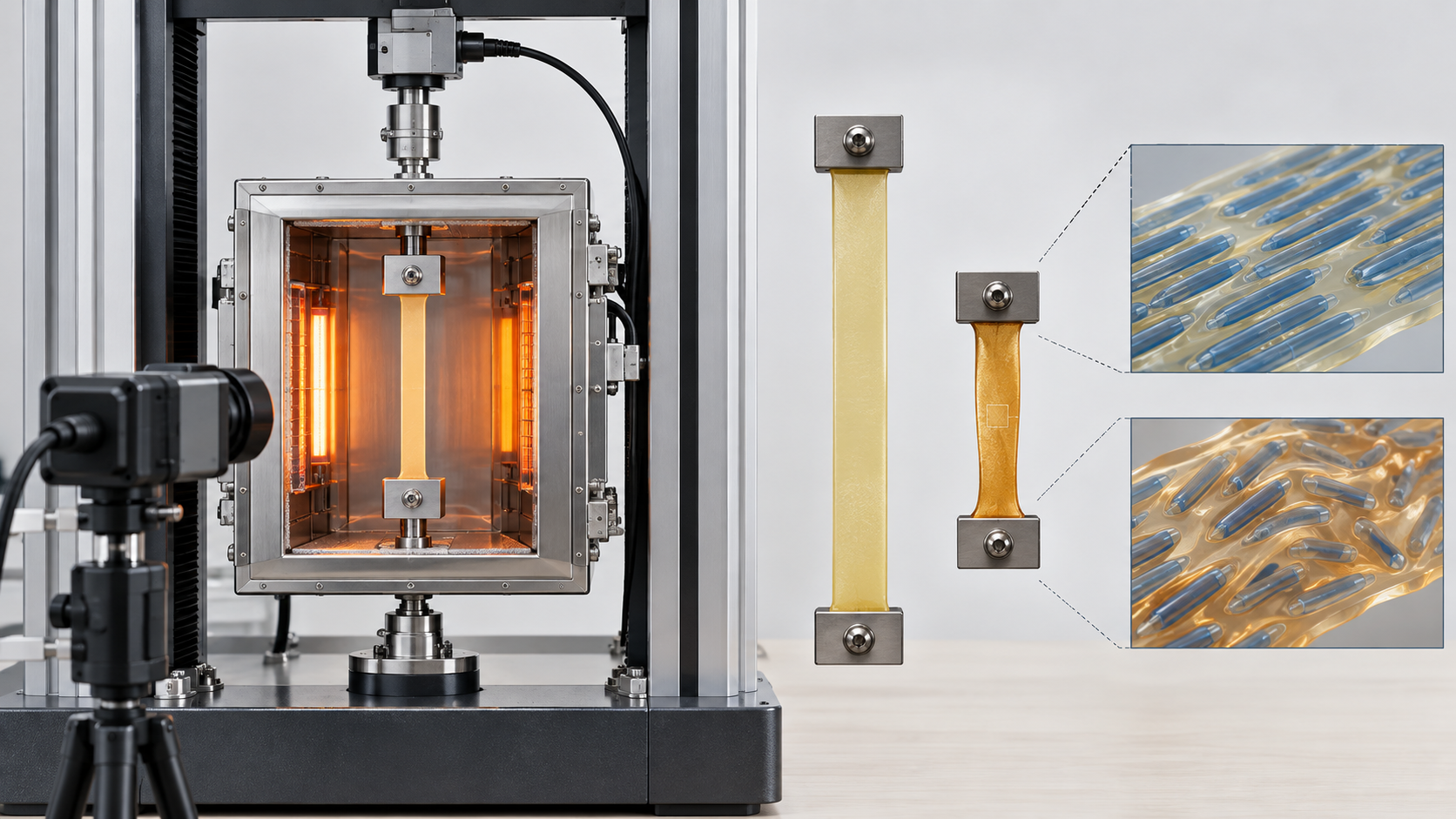
For LCEs, besides the ink composition (TNI, crosslink density), the printing temperature and shear (which set the alignment) decide performance [Ref. 9]. For SMPs too, failure strain and Tg are designed through the composition and exposure of the same photo-curable resin [Ref. 5]. Data for printed parts can be compared with those of other studies only when they state the ink composition, printing temperature, speed, nozzle diameter and post-cure conditions, not just the material name (our commentary; see also our explainer on resins for 3D printing).
6. Cycle life and speed — use in soft robots
As far as we could confirm, the long-term life of neither SMPs nor LCEs is well established. Hasan et al. list biocompatibility, long-term durability and manufacturing scalability as challenges for LCEs, and state that lightly crosslinked networks are prone to fatigue and many actuators operate for fewer than 100 cycles (a cited report). Raising the crosslink density suppresses swelling but reduces actuation strain Sourced [Ref. 9].
We set out the examples the same review presents, with their conditions. An electrically driven LCE actuator bent 162° within 30 s and was stable over 50 cycles; a 9.87 g robot driven by it crawled at 0.28 body lengths per minute and lifted 1.5 times its weight (a cited report). In another example the bend was 320° at 2.5 V, with a power consumption of 620 mW/cm2. A response time of 20 s and a curvature of 0.25 mm−1 are also reported. The review concludes that improvements are needed in speed, efficiency, fatigue life, integrated power and sensing, and 3D programming Sourced [Ref. 9].
Converted to seconds, 0.28 per minute Our calculation is 0.28 ÷ 60 = about 0.0047 body lengths per second (about 0.47% per second). Moving one body length takes 60 ÷ 0.28 = about 214 s (about 3.6 min).
Assumptions and limits: this is the value of a single cited report, not the speed of LCE robots in general. Converting the “speed of actuation” into body lengths per unit time shows the distance from practical motion.
The counts in Fig. 7 count different things: thermomechanical cycles for the SMP (3), electrically driven actuation (50) and a summary of reports (under 100) for LCEs, and a fatigue guide (about 10 million) for nitinol. The three cycles of the SMP form a test of how recovery improves with training, not a lifetime test [Ref. 1]. Life is set not only by the count but also by the size of the strain, the temperature, the speed of deformation and the environment (moisture). We could not confirm a long-term test that matches all of these for SMPs and LCEs (our commentary).
7. Telling SMPs, LCEs and shape memory alloys apart
All three materials produce a change of shape, but their mechanisms and the way their numbers should be read differ. The table lists the values we could confirm with their sources and conditions. They come from different samples and test conditions, so they are not ranked.
| Item | SMP | LCE | Shape memory alloys (NiTi and others) |
|---|---|---|---|
| Mechanism | A network with net points switches between mobile and frozen at Tg or Tm and recovers through entropic elasticity [Ref. 9] | Liquid-crystal order is lost; contraction along the director, expansion across it [Ref. 9] | A reversible transformation between austenite and martensite crystal structures (see our explainer on shape memory alloys) |
| Direction of change | Mostly one way; reprogramming needs renewed deformation [Ref. 9] | Reversible actuation that returns when the stimulus stops [Ref. 9] | The shape memory effect (restored by temperature) and superelasticity (restored by stress) (same explainer) |
| Reported size of strain | Failure strain above 300% (a designed value of a photo-curable SMP) [Ref. 5]; maximum strain of 20% in the test program for a PU-SMP [Ref. 1] | Up to 400% (thermally responsive LCE, cited), 5% or less for LCNs [Ref. 9], 55% local response [Ref. 6] | Predictable cyclic durability for wires at 3–4% or less (a review) [Ref. 21] |
| Modulus and strength of recovery | PU-SMP: 1250 MPa in the glassy region, 12.1 MPa in the rubbery region [Ref. 1]. Recovery force reported in N (depends on specimen size) [Ref. 2] | Could not be confirmed in this article | Superelastic stress rises with temperature (6–7 MPa/°C). Energy density reported at 5000–25,000 kJ/m3 [Ref. 21] |
| Repetition | PU-SMP: recovery 90% to above 99% over three thermomechanical cycles [Ref. 1]. Long-term life not confirmed | Many under 100 cycles (cited); an electrically driven example stable over 50 [Ref. 9] | Low-cycle fatigue below about 10 million cycles is associated with cyclic phase transformation (FDA regulatory science tool) [Ref. 22] |
| Pitfalls in reading | Method for Tg (DMA 45 °C, DSC 35 °C), humidity, which cycle the recovery is from, force or stress [Ref. 1, 2] | Alignment, crosslink density, TNI, build conditions, cycle count [Ref. 9] | Composition, heat treatment and measurement move the transformation temperature (same explainer) |
All Sourced (statements of each source; “same explainer” refers to another article of this series, where the sources are given). The arrangement of the table is our commentary. Values come from different samples and conditions and cannot be ranked.
8. Limits, and what we could not confirm
(1) Recovery stress, long-term life and output
We could not show, from the primary sources we confirmed, the recovery stress of SMPs (in MPa), the long-term cycle life of SMPs and LCEs, or the output (work) density of LCEs. The recovery force (N) comes only from Fulati et al. and we did not convert it to stress.
(2) How the sources were read
We read the full texts of Staszczak et al. and Hasan et al. For Fulati et al. we read the abstract and part of the results; for Ware et al., Lendlein et al., Xie, White and Broer, and Herbert et al., the abstracts on publisher or bibliographic database pages; and for Ge et al., the abstract only. We have not checked the original papers for the values that Hasan et al. cite (400%, under 100 cycles, the electrically driven examples).
(3) The text of the standards
We have not read the text of ISO 11357-2, ISO 6721-11, ISO 527-1, ISO 37 or JIS K 7121, K 7122, K 7244, K 7161-1, K 6251 and K 7127. The ASTM International website states that AI use is prohibited, so we did not open any ASTM site; ASTM standards are listed only where the number and title could be confirmed in an instrument maker’s page (Hitachi High-Tech) or the FDA database.
(4) Standards specific to SMPs and LCEs
A search of the ISO catalogue (10 October 2026) found no standard for “shape memory polymer”. In a JISC search by title, the only JIS containing the Japanese term for “shape memory” are the six metals standards (H 7xxx), and in the FDA database the standards containing “shape memory” are nickel-titanium ones. We could not confirm any IEC or IEEE standard, or any standard that targets LCEs.
(5) Biocompatibility and uses
The biocompatibility of LCEs is listed as a challenge by Hasan et al. and is outside this article. We say nothing about the safety or effectiveness of SMPs in medical uses.
(6) Product names and companies
MP4510 is the name of the sample of Staszczak et al. We do not rank any product or company.
9. How to read evaluations and standards
The evaluation of SMPs and LCEs divides into (a) switching temperatures (Tg, Tm, TNI), (b) modulus and tensile properties, (c) shape fixity, shape recovery, recovery force and actuation strain, and (d) behavior under repetition. For (a) and (b), general standards for thermal analysis and mechanical testing of polymers can be used. We could not confirm standards that directly specify (c) and (d), so each paper uses the researchers’ own definitions (such as the formulas of Tobushi and Hayashi) and test program.
Table of corresponding standards
JIS titles are our translations from the Japanese.
| Evaluation item | ISO | IEC / IEEE | JIS | ASTM | What changes the value with the test conditions |
|---|---|---|---|---|---|
| Glass transition and heat of transition (DSC) Sourced | ISO 11357-2:2020 “Plastics — Differential scanning calorimetry (DSC) — Part 2: Determination of glass transition temperature and step height” (3rd edition, March 2020). Melting and crystallization: ISO 11357-3:2025 | Could not be confirmed | JIS K 7121 (testing methods for transition temperatures of plastics; revised 20 July 2012); K 7122 (testing methods for heat of transitions of plastics; revised 21 March 2024). Correspondence to ISO 11357 could not be confirmed | E1356 “Standard Test Method for Assignment of the Glass Transition Temperatures by Differential Scanning Calorimetry” | Heating rate, sample mass, thermal history. For the PU-SMP, Tg was about 35 °C by DSC and about 45 °C by DMA |
| Glass transition and modulus (DMA) Sourced | ISO 6721-11:2019 “Plastics — Determination of dynamic mechanical properties — Part 11: Glass transition temperature” (2nd edition, June 2019) | Could not be confirmed | JIS K 7244 series (test methods for dynamic mechanical properties of plastics; Part 1, general principles: established 20 November 1998, confirmed 20 October 2023; Part 4, tensile vibration, non-resonance method; and others) | E1640 “Standard Test Method for Assignment of the Glass Transition Temperature By Dynamic Mechanical Analysis” | Frequency, heating rate, mode of deformation (bending, tension and so on), and how Tg is taken (the standard specifies several methods of obtaining Tg) |
| Tensile properties (plastics) Sourced | ISO 527-1:2019 “Plastics — Determination of tensile properties — Part 1: General principles” (3rd edition, July 2019) | Could not be confirmed | JIS K 7161-1 (plastics, determination of tensile properties, Part 1: general principles; established 22 September 2014, revised 21 March 2024); JIS K 7127 (test conditions for films and sheets) | Could not be confirmed | Test speed, test temperature (an SMP’s modulus changes by two orders of magnitude near Tg), specimen shape |
| Tensile properties (rubber and thermoplastic elastomers) Sourced | ISO 37:2024 “Rubber, vulcanized or thermoplastic — Determination of tensile stress-strain properties” (7th edition, May 2024) | Could not be confirmed | JIS K 6251 (vulcanized and thermoplastic rubber, determination of tensile properties; established 1 February 1993, latest revision 20 November 2023) | D412 “Standard Test Methods for Vulcanized Rubber and Thermoplastic Elastomers – Tension” (-16(2021)) | May be referred to for large-strain elastomers such as LCEs, but we did not confirm that it is applied to LCEs. Strain rate, temperature |
| Shape fixity, shape recovery and recovery force (SMPs) Sourced | Could not be confirmed | Could not be confirmed | Could not be confirmed | Could not be confirmed | Th and Tl, size and rate of strain, heating and cooling rates, humidity, number of cycles, force or stress (based on researchers’ definitions) |
| Actuation strain, response and life of LCEs Sourced | Could not be confirmed | Could not be confirmed | Could not be confirmed | Could not be confirmed | Alignment (director), TNI, crosslink density, build conditions, kind and strength of stimulus, number of cycles |
Numbers, titles and editions were confirmed as follows: ISO on the ISO catalogue pages; JIS in the JISC database; ASTM in the instrument maker’s list of thermal-analysis standards (Hitachi High-Tech) and in the FDA database of recognized consensus standards; we did not open any ASTM site [Ref. 10, 18, 11, 12, 13, 14, 19, 16, 15]. The ASTM editions are those given in those sources and are not necessarily the latest. The arrangement of the table is our commentary.
The number, title, edition and date of each standard are Sourced (confirmed on the official pages of the standards bodies, the Japanese Industrial Standards Committee, an instrument maker and the FDA). Which standard goes in which cell is our own arrangement (Our calculation). We found no revision or draft in progress, so no row falls under Not yet confirmed.
Cautions when reading standards
- For quantities without a dedicated standard, read the paper’s definition. Many papers use the definition of Tobushi and Hayashi for shape fixity and shape recovery, but the details of the formula (one cycle or the N-th cycle) can differ from paper to paper. Staszczak et al. themselves use separate formulas for a single cycle and for consecutive cycles [Ref. 1].
- State the measurement method and heating rate next to a Tg value. ISO 6721-11 specifies methods for determining Tg from a heating scan of dynamic mechanical properties [Ref. 11], and ISO 11357-2 specifies how to determine the glass transition temperature and step height by DSC [Ref. 10]. They measure different quantities and need not give the same value.
- Storage and humidity before the test lie outside the standards. Because moisture lowers the Tg and shape fixity of an SMP, Staszczak et al. controlled humidity [Ref. 1]. Even if a standard is followed, a value cannot be compared with others unless drying and storage before the test are stated (our commentary).
- A standard is a “method”, not a guarantee of material performance. Read a manufacturer’s value together with the standard, edition and test conditions.
- An SMP is a network with net points; an LCE is a network combining liquid-crystal order and rubber elasticity. SMPs are mostly one-way, LCEs reversible Sourced
- Shape recovery changes with the cycle. A PU-SMP gave about 90% in the first cycle and above 99% in the third Sourced
- Tg changes with the method. The same PU-SMP gave about 45 °C by DMA and about 35 °C by DSC. Test temperatures set from Tg shift by about 10 °C Sourced / Our calculation
- For recovery force, check whether it is force (N) or stress (MPa). The value changes with the cross-sectional area of the specimen
- LCE strain is up to 400% (cited), but many actuators run for fewer than 100 cycles. Match what was counted before comparing life figures Sourced
- We could not confirm dedicated evaluation standards for SMPs or LCEs. Read general standards for thermal analysis and tensile testing together with the researchers’ definitions.
10. Glossary
- SMP
- Shape memory polymer: a polymer whose network with net points holds a temporary shape and returns to the permanent shape on a stimulus.
- LCE
- Liquid crystal elastomer: a network with liquid-crystal alignment and rubber elasticity that deforms reversibly on a stimulus.
- LCN
- Liquid crystal network: a network more densely crosslinked than an LCE, with a small actuation strain.
- Tg / Tm
- Glass transition temperature / melting point; the temperature at which the switching domain of an SMP softens.
- TNI
- Nematic-to-isotropic transition temperature, at which the alignment order of an LCE is lost.
- Shape fixity Rf
- How well the temporary shape is held: εun/εm.
- Shape recovery Rr
- How fully the permanent shape returns: (εm − εir)/εm.
- Director
- The average orientation of the liquid-crystal molecules.
- Mesogen
- The unit of a molecule that shows liquid-crystalline behavior.
- Voxel
- A three-dimensional volume element; the smallest unit in which alignment is written.
- DMA / DSC
- Dynamic mechanical analysis (mechanical) / differential scanning calorimetry (thermal): two ways to find Tg.
- 4D printing
- Printing in which the printed part undergoes a programmed change of shape over time.
11. References (primary sources)
- Staszczak M. et al. “Characterization of Polyurethane Shape Memory Polymer and Determination of Shape Fixity and Shape Recovery in Subsequent Thermomechanical Cycles”, Polymers 14, 4775 (2022), DOI 10.3390/polym14214775 (open access; we read the full text) — doi.org/10.3390/polym14214775
- Fulati A. et al. “Influences of Crystallinity and Crosslinking Density on the Shape Recovery Force in Poly(ε-Caprolactone)-Based Shape-Memory Polymer Blends”, Polymers 14, 4740 (2022), DOI 10.3390/polym14214740 (open access) — doi.org/10.3390/polym14214740
- Lendlein A. et al. “Light-induced shape-memory polymers”, Nature 434, 879–882 (2005), DOI 10.1038/nature03496 — doi.org/10.1038/nature03496
- Xie T. “Tunable polymer multi-shape memory effect”, Nature 464, 267–270 (2010), DOI 10.1038/nature08863 — doi.org/10.1038/nature08863
- Ge Q. et al. “Multimaterial 4D Printing with Tailorable Shape Memory Polymers”, Sci. Rep. 6, 31110 (2016), DOI 10.1038/srep31110 (open access) — doi.org/10.1038/srep31110
- Ware T. H. et al. “Voxelated liquid crystal elastomers”, Science 347, 982–984 (2015), DOI 10.1126/science.1261019 — doi.org/10.1126/science.1261019
- White T. J., Broer D. J. “Programmable and adaptive mechanics with liquid crystal polymer networks and elastomers”, Nat. Mater. 14, 1087–1098 (2015), DOI 10.1038/nmat4433 — doi.org/10.1038/nmat4433
- Herbert K. M. et al. “Synthesis and alignment of liquid crystalline elastomers”, Nat. Rev. Mater. 7, 23–38 (2022), DOI 10.1038/s41578-021-00359-z — doi.org/10.1038/s41578-021-00359-z
- Hasan M., Liu Y. “4D-Printed Liquid Crystal Elastomers: Printing Strategies, Actuation Mechanisms, and Emerging Applications”, J. Compos. Sci. 9, 633 (2025), DOI 10.3390/jcs9110633 (open access; we read the text) — doi.org/10.3390/jcs9110633
- ISO “ISO 11357-2:2020 Plastics — Differential scanning calorimetry (DSC) — Part 2: Determination of glass transition temperature and step height” (ISO catalogue page) — www.iso.org/standard/77310.html
- ISO “ISO 6721-11:2019 Plastics — Determination of dynamic mechanical properties — Part 11: Glass transition temperature” (ISO catalogue page) — www.iso.org/standard/74988.html
- ISO “ISO 527-1:2019 Plastics — Determination of tensile properties — Part 1: General principles” (ISO catalogue page) — www.iso.org/standard/527-1
- ISO “ISO 37:2024 Rubber, vulcanized or thermoplastic — Determination of tensile stress-strain properties” (ISO catalogue page) — www.iso.org/standard/86892.html
- Japanese Industrial Standards Committee (JISC) JISC JIS list for K 7244 (test methods for dynamic mechanical properties of plastics). K 7244, K 7161-1, K 6251, K 7121, K 7122 and K 7127 were confirmed (number, title, dates) on the JISC list and detail pages — www.jisc.go.jp/app/jis/general/GnrJISNumberNameSearchList?show&jisS…
- U.S. Food and Drug Administration (FDA) “Recognized Consensus Standards: Medical Devices” database, search results for titles containing tension testing (including ASTM D412; page last updated 28 September 2026) — www.accessdata.fda.gov/scripts/cdrh/cfdocs/cfStandards/results.cfm?…
- Hitachi High-Tech “Standards – ISO/ASTM/JIS/IPC”, list of thermal-analysis standards (instrument maker’s technical page, in Japanese) — www.hitachi-hightech.com/jp/ja/knowledge/analytical-systems/thermal…
- ISO “ISO 11357-1:2023 Plastics — Differential scanning calorimetry (DSC) — Part 1: General principles” (ISO catalogue page) — www.iso.org/standard/83904.html
- ISO “ISO 11357-3:2025 Plastics — Differential scanning calorimetry (DSC) — Part 3: Determination of temperature and enthalpy of melting and crystallization” (ISO catalogue page) — www.iso.org/standard/88106.html
- Japanese Industrial Standards Committee (JISC) JIS search (by number or title). JIS Z 2255, C 2501, K 7121, K 7122, R 1611, H 7801, R 3257, R 1703-1, H 7101 and others were confirmed (number, title, dates of establishment and revision) on the JIS list and detail pages — www.jisc.go.jp/app/jis/general/GnrJISSearch.html
- U.S. Food and Drug Administration (FDA) “Recognized Consensus Standards: Medical Devices” database, search results for titles containing nickel-titanium (database page last updated 28 September 2026) — www.accessdata.fda.gov/scripts/cdrh/cfdocs/cfStandards/results.cfm?…
- Romančík J. et al. “Shape Memory Alloy Actuators in Robotics”, Actuators 15, 162 (2026), DOI 10.3390/act15030162 (open access) — doi.org/10.3390/act15030162
- U.S. FDA, Center for Devices and Radiological Health (CDRH) “Strategy to Estimate Low to High Cycle Fatigue Transition of Nitinol for Fatigue to Fracture Test Planning” (Catalog of Regulatory Science Tools) — cdrh-rst.fda.gov/strategy-estimate-low-high-cycle-fatigue-transitio…
12. Claim-to-source audit
| Claim in the text | Basis | Type |
|---|---|---|
| Evaluation of a thermoset PU-SMP (MP4510, producer’s stated Tg 45 °C): DMA tan δ peak about 45 °C (bending, 1 Hz, 2 °C/min) and a DSC step at 34.82 °C (about 10 mg, 10 °C/min) with the authors’ explanation of the method difference; E′g = 1250 MPa, E′r = 12.1 MPa (ratio 103); the test program (Th = 65 °C, Tl = 25 °C, εm = 20%, strain rate 10−3 s−1, cooling 7 °C/min, heating 4 °C/min); Rf about 98%; one-cycle Rr about 93%; Rr from about 90% to above 99% over three consecutive cycles; sensitivity to humidity and temperature; the chamber setting accuracy of ±5 °C and the added thermocouples and silica gel; the kinds of stimulus (heat, light, magnetic field, solvent, moisture, laser, microwave) | Full text of Staszczak et al. (2022) Reference 1 https://doi.org/10.3390/polym14214775 | Sourced |
| Blends of four-branched poly(ε-caprolactone)-based SMPs: stretchability 50.5–1419.5%, toughness 0.62–130.4 MJ/m3, recovery force (4b100PCL: 0.061 N at 50% strain and 0.894 N at 800%; 70/30 blend 0.162 N at 50%), and the relation to crosslinking density | Fulati et al. (2022) Reference 2 https://doi.org/10.3390/polym14214740 | Sourced |
| The summary of the mechanisms of SMPs and LCEs (permanent net-points and switching domains in SMPs, mostly one-way; loss of nematic order and contraction in LCEs, reversible); a reversible LCE strain of up to 400% (cited); 5% or less for LCNs; DIW and vat photopolymerization; printing in the mesophase 10–20 °C below TNI; thiol-Michael chemistry; fatigue of lightly crosslinked LCEs and fewer than 100 cycles; the electrically driven examples (162°, 30 s, 50 cycles, 9.87 g, 0.28 body lengths per minute, 320°, 2.5 V, 620 mW/cm2); a response time of 20 s; the challenges | Text of Hasan and Liu (2025) Reference 9 https://doi.org/10.3390/jcs9110633 | Sourced |
| The definition of LCEs (crosslinked polymer networks combining the elasticity of rubber and the anisotropy of liquid crystals), the patterning of local orientation, and the approaches to alignment | Abstract of Herbert et al. (2022) Reference 8 https://doi.org/10.1038/s41578-021-00359-z | Sourced |
| Thermally and photogenerated macroscale mechanical responses (bending, twisting, buckling) of liquid crystalline polymer networks and elastomers | Abstract of White and Broer (2015) Reference 7 https://doi.org/10.1038/nmat4433 | Sourced |
| LCEs with the director written in voxels (as small as 0.0005 mm3), a local mechanical response of 55% strain, flat sheets to three-dimensional shapes | Abstract of Ware et al. (2015) Reference 6 https://doi.org/10.1126/science.1261019 | Sourced |
| Light-driven SMPs (cinnamic groups, ultraviolet light, shapes kept even at 50 °C) | Abstract of Lendlein et al. (2005) Reference 3 https://doi.org/10.1038/nature03496 | Sourced |
| The relation between the number of temporary shapes and the number of reversible phase transitions; multi-shape memory in an ionomer with a single broad transition | Abstract of Xie (2010) Reference 4 https://doi.org/10.1038/nature08863 | Sourced |
| High-resolution multimaterial SMP printing by PμSL (a few microns), a failure strain above 300%, and agreement between simulation and experiment for shape fixity and free recovery rate | Abstract of Ge et al. (2016) Reference 5 https://doi.org/10.1038/srep31110 | Sourced |
| Titles and scope of ISO 11357-2:2020 (3rd edition, March 2020), ISO 6721-11:2019 (2nd edition, June 2019), ISO 527-1:2019 (3rd edition, July 2019) and ISO 37:2024 (7th edition, May 2024). The titles of ISO 11357-1:2023 and ISO 11357-3:2025 | ISO catalogue pages Reference 10 https://www.iso.org/standard/77310.html Reference 11 https://www.iso.org/standard/74988.html Reference 12 https://www.iso.org/standard/527-1 Reference 13 https://www.iso.org/standard/86892.html Reference 17 https://www.iso.org/standard/83904.html Reference 18 https://www.iso.org/standard/88106.html | Sourced |
| Numbers, titles and dates of establishment, revision and confirmation of JIS K 7244 series, K 7161-1, K 6251, K 7121, K 7122 and K 7127. That the only JIS whose titles contain the Japanese term for “shape memory” in a JISC title search are the six H 7xxx metals standards | JISC JIS list and JIS search Reference 14 https://www.jisc.go.jp/app/jis/general/GnrJISNumberNameSearchList?show&jisStdNo=K7244 Reference 19 https://www.jisc.go.jp/app/jis/general/GnrJISSearch.html | Sourced |
| Numbers and titles of ASTM E1356 and E1640 (a list of thermal-analysis standards); the number, title and edition of ASTM D412 (a recognized consensus standard of the FDA); that the standards containing “shape memory” in the FDA database are nickel-titanium ones | Technical page of Hitachi High-Tech; FDA database Reference 16 https://www.hitachi-hightech.com/jp/ja/knowledge/analytical-systems/thermal-analysis/standards.html Reference 15 https://www.accessdata.fda.gov/scripts/cdrh/cfdocs/cfStandards/results.cfm?title=tension+testing&Search=Search Reference 20 https://www.accessdata.fda.gov/scripts/cdrh/cfdocs/cfStandards/results.cfm?title=nickel-titanium&Search=Search | Sourced |
| The “same explainer” items of the comparison table (durable strain of shape memory alloy wires, energy density, low-cycle fatigue below about 10 million cycles) | Sources of the preceding article (shape memory alloys) Reference 21 https://doi.org/10.3390/act15030162 Reference 22 https://cdrh-rst.fda.gov/strategy-estimate-low-high-cycle-fatigue-transition-nitinol-fatigue-fracture-test-planning | Sourced |
| Rf 98% to a strain after unloading of 19.6%; Rr 90%, 93% and 99% to remaining strains of 2.0%, 1.4% and 0.2%. Th and Tl by choice of Tg (65/25 °C and 54.8/14.8 °C). 0.0005 mm3 as an edge of about 80 µm. 0.28 body lengths per minute as about 0.47% per second and about 214 s per body length | Our calculation. The formulas are general definitions, the numbers are estimates from approximate values reported, the voxel is assumed to be a cube, and 0.28 body lengths per minute is the value of a single cited report | Our calculation |
| The recovery stress of SMPs (MPa), the long-term cycle life of SMPs and LCEs, the output density of LCEs, ISO, IEC, IEEE, JIS and ASTM standards specific to SMPs and LCEs, the text of the standards, and the biocompatibility of LCEs and SMPs | Not confirmed within the scope of our research, so not stated (no standard for “shape memory polymer” in a search of the ISO catalogue, 10 October 2026; this article’s own note) | Commentary |
| The readings “the Tg of an SMP is a property of the material and of its environment”, “force or stress for recovery force”, “the performance of a printed part is set by the build conditions” and “match what was counted before comparing life”; the arrangement of the comparison table and the table of standards | Our own organization and commentary based on published material. These are not views stated by any organization or company | Commentary |
| That Figs. 2 to 5 and 7 are explanatory drawings and not reproductions of data (Figs. 4 and 7 are our own plots of reported values), and that Figs. 1 and 6 are AI-generated images | This article’s own note | Commentary |
Last updated: 10 October 2026. Sources are limited to primary material (peer-reviewed papers, and the databases of standards bodies, the Japanese Industrial Standards Committee and the FDA, and an instrument maker’s page). We have not read the text of the standards. Because the article includes organization of structure and readings of materials design, these are marked as “commentary” and kept apart from sourced facts. We could not confirm, and therefore do not state, the recovery stress of SMPs, the long-term cycle life of SMPs and LCEs, the output density of LCEs, evaluation standards specific to SMPs and LCEs, or the text and test conditions of ASTM standards. The recovery, strain, cycle-count and Tg values are results that specific papers obtained for specific materials and conditions, and cannot be generalized to other materials or products. We give no medical advice and no ranking of any product or company. Figs. 2 to 5 and 7 are vector drawings and Figs. 1 and 6 are AI-generated images; none of them shows an actual micrograph or a real product.