TECHNOLOGY EXPLAINER
Soft Actuators and Artificial Muscles
— what is a “muscle-like” figure divided by, and under what conditions was it measured?
Things called “artificial muscles” work on entirely different principles. For dielectric elastomers, a review cites linear strains above 380% in heavily prestretched films, but they need high voltage. A pneumatic artificial muscle with a 20 mm bore is said to deliver 1500 N, but it needs a supply of compressed air. A fiber made by twisting fishing line into a coil contracted by 49% and delivered 5.3 kW of mechanical work per kilogram. These figures differ in denominator (volume, mass, the whole device), in scope (material or device) and in conditions (field, temperature, number of cycles), so they cannot be compared as they stand. This article sets out, from primary sources, how the main approaches work, how to read output, response speed, strain and life, and how to read the evaluation standards.
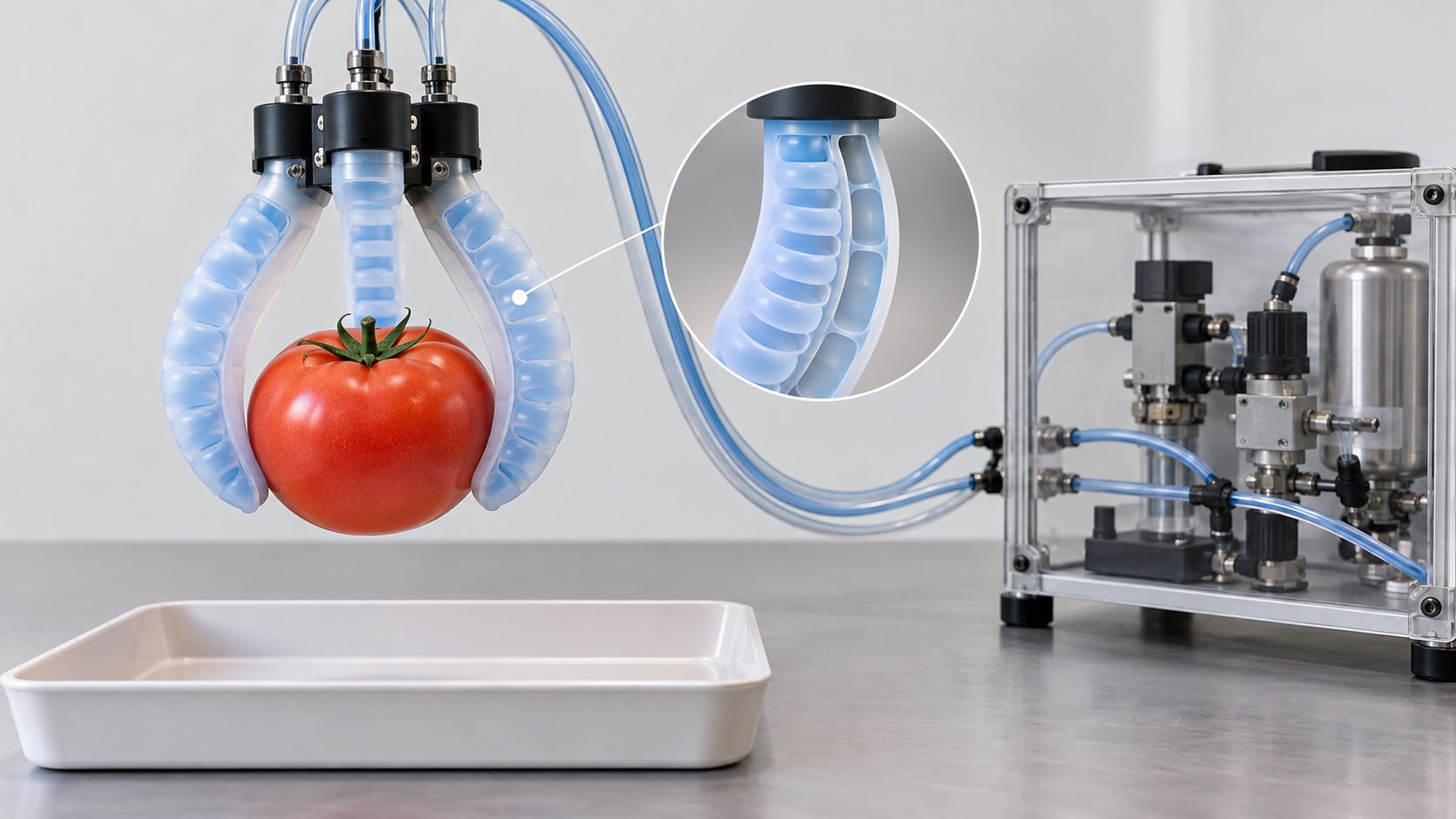
- What soft actuators and artificial muscles are (the short version)
- A map of drive methods
- Dielectric elastomer actuators (DEAs) — film, electrodes and voltage
- Things driven by low voltage, water, heat and chemistry — IPMCs, hydrogels, CNT yarns, coiled fibers
- Pneumatic artificial muscles
- Reading "muscle-like" — denominator, scope, time and life
- Limits, and what we could not confirm
- How to read evaluations and standards
- Glossary
- References (primary sources)
- Claim-to-source audit
Sourced = stated in a published source (with a link)
Our calculation = a value this article computed from stated assumptions
Not yet confirmed = plans or intentions with no confirmed results
Readings of materials design are marked as commentary. Inference is shown in bold.
The strains, forces, energy densities, speeds and lifetimes here are what specific papers and reviews report for specific samples and devices under specific conditions, including values a review cites as the maximum reported. They do not describe mass-produced products or other devices. Please do not read a laboratory’s best result as performance under practical conditions. No product or company is ranked, and no medical advice is given.
1. What soft actuators and artificial muscles are (the short version)
- Devices in which soft materials themselves deform to produce force or motion: instead of motors and cylinders, rubbers, polymers, fibers and gels deform under electric fields, pressure, heat, or water and chemical stimuli. Things that contract, bend or twist like muscle are often called “artificial muscles”; the review by Madden et al. covers dielectric elastomers, ferroelectric polymers, liquid crystal elastomers, shape memory alloys, ionic polymer/metal composites, conducting polymers and carbon nanotubes Sourced [Ref. 8]
- Each approach has a different bottleneck: dielectric elastomers need high voltage and are limited by film breakdown and viscoelasticity; IPMCs and hydrogels by water; pneumatic muscles by compressors and leakage; heat-driven ones by cooling (the speed of response) Sourced [Ref. 1, 10, 13, 11, 22]
- Read a number by its denominator, scope and conditions: energy density is given in kJ/m3 (per volume), J/kg (per mass), kW/kg (power) or N (force), and it also matters whether it is for “the material only” or “the whole device”. Reported lifetimes differ by orders of magnitude, from under 100 cycles to over 300 million Sourced [Ref. 24, 4]
“Muscle-like” means something only when it states which measure (strain, force, energy density, power, speed, life) matches muscle, divided by what, and under what conditions. For example, the energy density of skeletal muscle is given as 40–70 kJ/m3 [Ref. 22], and a coiled fiber lifted a load more than 100 times heavier than a human muscle of the same length and weight [Ref. 5]; these are different measures.
2. A map of drive methods
The approaches can be organized by what serves as the input. Fig. 2 divides them into five: electric field (high voltage), electric field (low voltage, ions), fluid, heat, and water and chemistry, and shows a representative approach in each with the limits confirmed in the sources.
| Approach | What happens | Reported features (source) | Pitfalls in reading |
|---|---|---|---|
| Dielectric elastomer actuator (DEA) | When voltage is applied to a thin dielectric elastomer film between electrodes, electrostatic force reduces the thickness and enlarges the area | With prestretch, Pelrine et al. reported strains of 117% (silicone) and 215% (acrylic) [Ref. 2]. A review cites a linear strain above 380% (large prestretch) and a device with an area strain above 25% at 450 V and 14% at 10 Hz [Ref. 1] | Breakdown field, viscoelasticity (acrylics respond slowly), the prestretch frame, temperature (Tg is below room temperature, so ambient temperature matters) [Ref. 1] |
| HASEL (hydraulically amplified self-healing electrostatic actuator) | Couples electrostatic and hydraulic forces to give a variety of actuation modes | Muscle-like performance and repeated self-healing after dielectric breakdown were shown (abstract of Acome et al.) [Ref. 3] | The abstract gives no numbers; we did not confirm output or strain values |
| IPMC (ionic polymer-metal composite) | An ionic polymer sheet coated with metal electrodes bends at low voltage and also generates voltage when bent | Bends at low voltage (typically under 5 V; a 2.5 V example). Actuation from DC to about 100 Hz [Ref. 10] | The response depends on sample geometry, humidity and hydration [Ref. 10]. Water management is a condition |
| Pneumatic artificial muscle | Compressed air is pumped into a rubber tube restrained by a coaxial woven sheath; it expands radially and contracts axially, giving force | A 20 mm inner diameter is said to give a 1500 N pulling force. Lightweight, efficient, non-polluting, and able to work without electronic components [Ref. 11] | Compressors use a lot of electricity and portable power is a problem [Ref. 12]. Bubble-free, leak-free construction is needed [Ref. 11] |
| Coiled fibers (fishing line, sewing thread) | High-strength polymer fibers are twisted into coils; heating makes them contract | Contracted by 49%, lifted loads over 100 times heavier than a human muscle of the same length and weight, and gave 5.3 kW/kg of mechanical work. Described as fast, nonhysteretic and long-life [Ref. 5] | “5.3 kW/kg” is power per mass, a different quantity from energy density per volume |
| CNT yarn | An electrolyte-filled twist-spun carbon nanotube yarn increases in volume by electrochemical charge injection and twists | A reversible 15,000° rotation and 590 revolutions per minute (three-electrode electrochemical system of Foroughi et al.) [Ref. 6]. Lima et al. reported hybrid CNT yarns powered electrically, chemically and by light [Ref. 7] | Values were measured in an electrochemical cell with electrolyte, not for a device in air |
| Hydrogel | A network containing 80–90 wt% water swells or shrinks with temperature (LCST), pH, ions and so on | Promising for biomedical soft robots. Electro-responsive types respond slowly and fatigue under high stress. Remedies include miniaturization and a pNIPAM-SWNT composite (five times faster thermal response) [Ref. 13] | Drying and dehydration degrade performance; coatings restrain it [Ref. 13] |
All Sourced (statements of each source). The arrangement is our commentary. Shape memory alloys, shape memory polymers and liquid crystal elastomers (driven by heat or light) are covered in other articles of the series. The values come from different sources, samples and conditions and cannot be ranked.
3. Dielectric elastomer actuators (DEAs) — film, electrodes and voltage
In a DEA, applying a voltage to a thin elastomer film covered on both faces with soft electrodes squeezes the film in thickness and expands it in area through electrostatic force (Fig. 3). The effective pressure from the electrostatic force is commonly written in terms of the relative permittivity εr and the field E (= voltage / film thickness) as p = ε0 εr E2 (our summary; the review by Zhang et al. also treats the Maxwell stress on the two electrodes in an expression of this kind). Because it scales with the square of the field, a thinner film gives the same field at a lower voltage. Pelrine et al. reported that stretching the film in advance (prestretch) improves performance. Strains were 30 to 40% without prestretch, and up to 117% for silicone and up to 215% for acrylic with it. They state that the strain, pressure and response time of silicone exceeded those of natural muscle and that specific energy densities greatly exceeded those of other field-actuated materials Sourced [Ref. 2, 1].
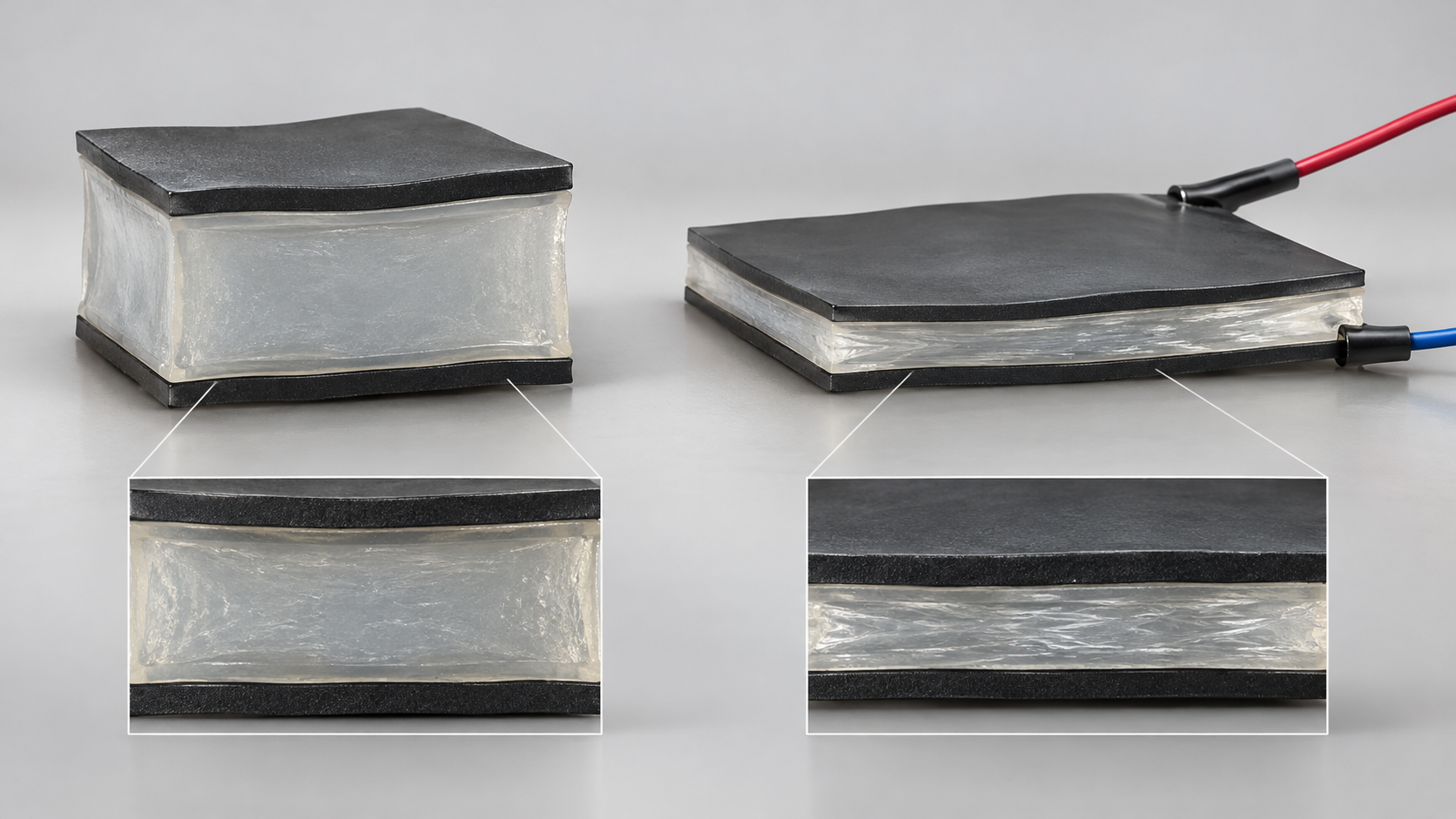
View the original SVG schematic and exact annotations
The 2025 review by Zhang et al. sets out the challenges of DEAs. Acrylics (such as 3M’s VHB) reach linear strains above 380% and area strains above 2200% (cited values) with large prestretch, but their viscoelasticity and nonlinearity make the response slow; silicones are less viscoelastic and suit fast motion and higher frequencies. DE material needs a low elastic modulus, little viscoelasticity, a high permittivity and a high breakdown field. In one cited example, the breakdown field of VHB rose from 450 MV/m in air to 800 MV/m in silicone oil. Fatigue of the elastomer under repeated loading, and heating from leakage currents under high voltage, can drive degradation. CNT electrodes can recover by themselves after breakdown (self-clearing), which is promising for longer life Sourced [Ref. 1].
Take εr = 3 (the order of magnitude from a datasheet of a silicone product, which gives about 3.0 at 100 Hz [Ref. 20]) and ε0 = 8.854 × 10⁻¹² F/m Our calculation. At E = 100 MV/m, p = 8.854 × 10−12 × 3 × (108)2 = about 0.27 MPa; at E = 50 MV/m, about 0.066 MPa. The pressure goes with the square of the field, so halving the field cuts it to a quarter.
The voltage is V = E × t. At E = 100 MV/m, a film thickness t of 1 µm needs 100 V, 10 µm needs 1 kV and 50 µm needs 5 kV (Fig. 4).
Assumptions and limits: the values of E are illustrative and not the breakdown fields a real film withstands. p is the effective pressure (the general form of the definition of Pelrine et al.); the actual strain is set by the modulus, prestretch and constraint. εr is one datasheet example and changes with frequency and temperature.
Zhang et al. also give device examples. A device reached an area strain above 25% at a drive voltage of 450 V, and a 14% strain at 10 Hz. A DE material had an energy density of up to 244.2 kJ/m3 (cited). Another dielectric elastomer showed an area strain of 253% at 46 MV/m and 225 J/kg at 40 MV/m. A DEA made by coaxial multi-material 3D printing had a life of more than one million cycles at high frequency. A gripper switches between two stable states in 0.17 s. For a flapping-wing robot driven by DEAs, they note that the DE material has sufficient power density to take off but that the overall power density is a challenge Sourced [Ref. 1].
Life changes by orders of magnitude with conditions. Matysek et al. reported that stack DEAs made of Elastosil P7670 (Wacker) could be driven for more than 320 million cycles in a very rough number, regardless of electrical and mechanical driving conditions. The degradation that followed was traced back to the interconnection, and they note that longer lifetimes are conceivable since the connection can be re-established Sourced [Ref. 4].
HASEL couples electrostatic and hydraulic forces by a different route. Acome et al. aimed at soft actuators that are powerful, high-speed, efficient and robust, and showed that they can self-heal repeatedly after dielectric breakdown, with a soft gripper and a self-sensing artificial muscle powering a robotic arm as examples Sourced [Ref. 3].
DEA performance is set by a combination of the film’s mechanics (modulus, viscoelasticity, prestretch), its electrical properties (permittivity, breakdown field) and the electrodes (softness, recovery after breakdown) [Ref. 1]. A thinner film lowers the voltage (Fig. 4), but a thin film is more sensitive to defects, which brings breakdown field, leakage current and fatigue under repetition into play (our commentary). Even for “a DEA strain of 380%”, a different amount of prestretch, frame, field, medium (air or silicone oil) and frequency makes it a different device’s figure. DEA data can be compared with other data only when the film material, thickness, prestretch, field, frequency and environment are stated.
4. Things driven by low voltage, water, heat and chemistry — IPMCs, hydrogels, CNT yarns, coiled fibers
(1) IPMCs: low voltage, with water as a condition
An IPMC is a sheet of ionic polymer covered with metal electrodes (the most common technique is chemically plating a commercially available polymer membrane with Pt or Au); it bends at low voltage and also generates a voltage when bent. The bending voltage is typically below 5 V, with a 2.5 V example, and the frequencies it can actuate run from DC to about 100 Hz. The response depends on the sample geometry and ambient humidity, and the measured voltage also depends on the hydration level and excitation frequency Sourced [Ref. 10]. Shahinpoor and Kim summarize the fundamentals of IPMCs, including ways of developing high-force-density IPMCs [Ref. 9].
(2) Hydrogels: water is both the power and the constraint
A hydrogel is a crosslinked network containing 80–90 wt% water that swells or shrinks with temperature, light, pH, ionic strength, magnetism and pressure. Above the lower critical solution temperature (LCST) the volume and shape change, which is used in actuators. The review by Banerjee et al. says that electro-responsive hydrogels have a slow response and develop high stress that causes fatigue, that low-polymer-content gels are weak and dehydrate easily, and that thin coatings of polydimethylsiloxane and similar materials can restrain dehydration. Remedies for the slowness include making the gel smaller and combining pNIPAM with single-walled carbon nanotubes to speed up the thermal response five-fold Sourced [Ref. 13].
If swelling and shrinking are governed by the diffusion of water (diffusion-limited), the response time is proportional to the square of the characteristic length L (the thickness): t ∝ L2/D Our calculation. Going from 1 mm to 0.1 mm in thickness cuts the response time to (0.1/1)2 = 1/100.
Assumptions and limits: a simplification with a constant diffusion coefficient D and diffusion as the rate-limiting step (our commentary). In practice D changes with gel composition, temperature and network, and reaction or heat transfer may be rate-limiting. The calculation shows, in orders of magnitude, the direction the review describes as “smaller is faster” [Ref. 13].
(3) CNT yarns: twisting in an electrolyte
Foroughi et al. reported that an electrolyte-filled twist-spun carbon nanotube yarn, much thinner than a human hair, works as a torsional artificial muscle in a three-electrode electrochemical system, giving a reversible 15,000° rotation and 590 revolutions per minute. They explain that contraction along the length and torsional rotation occur simultaneously when the yarn volume increases through electrochemical double-layer charge injection (the hydrostatic mechanism of muscular hydrostats) Sourced [Ref. 6]. Lima et al. reported hybrid CNT yarns powered by electricity, chemistry and light [Ref. 7].
590 rpm is 590 ÷ 60 = about 9.8 revolutions per second Our calculation, and with 360° per revolution about 3540° per second. 15,000° corresponds to 15,000 ÷ 360 = about 41.7 revolutions.
Assumptions and limits: these are values from a three-electrode electrochemical system in electrolyte, not the performance of a device in air or of practical equipment. The rotation speed and the twist angle may be reported under separate measurement conditions, so they need not be obtained together.
(4) Coiled fibers: a large stroke from inexpensive fibers, driven by heat
Haines et al. reported that inexpensive high-strength polymer fibers used for fishing line and sewing thread, twisted into coils, become fast, scalable, nonhysteretic, long-life tensile and torsional muscles. Extremely twisted fibers contracted by 49%, lifted loads over 100 times heavier than a human muscle of the same length and weight, and generated 5.3 kilowatts of mechanical work per kilogram of muscle weight (“similar to that produced by a jet engine”). Woven textiles whose porosity changes with temperature and actuating window shutters were also demonstrated Sourced [Ref. 5]. As the limits of other artificial muscles they name high cost, low cycle life, hysteresis and low efficiency, and they present this approach as inexpensive, nonhysteretic and long-life.
5. Pneumatic artificial muscles
The basis of a pneumatic artificial muscle is that highly compressed air is pumped into and out of a rubber tube restrained by a coaxial woven sheath, converting radial expansion and contraction into axial force. The review by Su et al. describes pneumatic soft robots as lightweight, efficient, non-polluting and robust in harsh environments (they can operate without ferromagnetic or electronic components under strong radiation, electromagnetic interference, dust and impact). As an example, a pneumatic artificial muscle with a 20 mm inner diameter is said to provide 1500 N of pulling force, enough for practical loads Sourced [Ref. 11].
The review by Walker et al., on the other hand, says that general compressors use a lot of electricity, so alternative power sources based on chemical reactions or combustible fuels are being examined, and that portable power supplies, circuit boards and drive components are issues for the future [Ref. 12]. Su et al. point out that thin geometries need completely bubble-free construction to avoid leakage or failure [Ref. 11].
The area of a circle with a 20 mm inner diameter is π × (10 mm)2 = about 314 mm2 Our calculation. Dividing 1500 N by this area gives about 4.8 MPa (= 4.8 N/mm2). Dividing by the area of the outer diameter (including the sheath) would give a smaller number.
Assumptions and limits: the source gives no outer diameter, and “about 4.8 MPa” is an apparent stress referred to the cross-section of the bore, not the air pressure and not the output stress of the whole muscle. The calculation only shows that the same “force” gives a different stress depending on the area (the denominator).
6. Reading “muscle-like” — denominator, scope, time and life
(1) Denominator and scope: the same “density” means different things
The performance of artificial muscles is described by energy per volume (kJ/m3), energy per mass (J/kg), power per mass (kW/kg), force (N) and so on. Fig. 6 shows the denominator and scope to which each value in this article belongs. A review of shape memory alloy actuators reports their energy density at 5000–25,000 kJ/m3, far above the 40–70 kJ/m3 of human skeletal muscle [Ref. 22]. Zhang et al. give the energy density of a DE material as up to 244.2 kJ/m3 (cited) and, for another material, 225 J/kg at 40 MV/m [Ref. 1]. These are values for the alloy or the material itself, not for the whole device including heating and cooling, the power supply and the bias spring.
Take the 225 J/kg (DE material, 40 MV/m) [Ref. 1] Our calculation. If it could be delivered ten times a second (10 Hz), that is 225 × 10 = 2250 W/kg = about 2.25 kW/kg. This has the same unit, kW/kg, as the 5.3 kW/kg reported for coiled fibers [Ref. 5], but the materials, the tests and the definition of a cycle all differ.
Assumptions and limits: an illustration that assumes the same energy at every cycle at 10 Hz. The device with a 14% strain at 10 Hz described by Zhang et al. is a different device, and in practice strain falls as frequency rises (because of viscoelasticity and so on). Energy (per cycle) and power (per unit time) differ by a factor of the frequency, and converting between per-volume and per-mass figures needs the density.
(2) Time: what does “fast” count?
Speed of response also counts different times. A DEA gripper switching between two stable states takes 0.17 s (a switching time), and a device giving a 14% strain at 10 Hz has a cycle of 0.1 s (a period) [Ref. 1]. IPMCs actuate from DC to about 100 Hz [Ref. 10]. For an LCE the examples are a response time of 20 s and a 162° bend in 30 s [Ref. 24]. A shape memory alloy actuator usually takes several seconds per motion, with cooling setting the speed [Ref. 22]. Electro-responsive hydrogels are described as slow [Ref. 13]. Fig. 7 lays out the reports that give a number.
(3) Life: reports that differ by orders of magnitude
Lifetimes differ by orders of magnitude between approaches and devices. A stack DEA reached more than 320 million cycles (until the interconnection degraded) [Ref. 4], and a coaxially 3D-printed DEA more than one million cycles [Ref. 1]. For LCEs, lightly crosslinked ones are prone to fatigue, many run for fewer than 100 cycles, and an electrically driven example was stable over 50 [Ref. 24]. For shape memory alloy (nitinol), an FDA regulatory science tool states that low-cycle fatigue below about 10 million cycles is associated with cyclic phase transformation [Ref. 23]. HASEL can heal repeatedly after dielectric breakdown [Ref. 3]. The definition of the “one cycle” being counted (strain, temperature, load) differs, so a comparison of orders of magnitude is only a guide to what has been confirmed Sourced.
From the materials side, what sets performance (the rate-limiting step) differs by approach (our commentary). For DEAs it is the electric field (breakdown field and film thickness) [Ref. 1]; for IPMCs and hydrogels the movement of water (diffusion) [Ref. 10, 13]; for heat-driven coiled fibers, shape memory alloys and LCEs cooling (the escape of heat) [Ref. 22, 24]; and for pneumatic muscles the supply of compressed air and leakage [Ref. 11, 12]. Material improvements that raise performance (thinner films, miniaturization, better heat removal, a higher breakdown field) each act on a different rate-limiting step. When reading an improvement figure, ask whether it acts on the rate-limiting step of that approach.
(1) the measure (strain, force, energy density, power, speed, efficiency or life), (2) the denominator (volume, mass, cross-section), (3) the scope (material, device or whole equipment), (4) the conditions (field, pressure, temperature, frequency, load, environment), (5) the time (switching, period or response) and (6) the count (the value at which cycle and which strain). We do not rank a number against others if any of these six is missing (our commentary; the same idea as the “five questions” in our explainer on the classification of functional materials and how to read evaluation data).
7. Limits, and what we could not confirm
(1) Coverage of numbers
Values of output density, strain and life for IPMCs, HASEL and pneumatic artificial muscles are limited in the abstracts and texts we confirmed, and we do not give them. We have not read the performance summary table in the review by Madden et al. We have not checked the original papers for the values cited by the reviews (380%, 2200%, 244.2 kJ/m3, one million cycles, fewer than 100 cycles and so on).
(2) How the sources were read
We read the text of the DEA review by Zhang et al., the pneumatic reviews by Su et al. and Walker et al., the hydrogel review by Banerjee et al., and the IPMC review by MohdIsa et al. For Pelrine et al., Acome et al., Haines et al., Foroughi et al., Lima et al., Matysek et al., Madden et al. and Shahinpoor and Kim we checked the abstracts on publisher or bibliographic database pages.
(3) The text of the standards
We have not read the text of IEC 60243-1 and -2, IEC 62631-2-1 and -2-3, ISO 6943, ISO 37, JIS C 2110-1, C 2139-2-1, K 6270 or K 6251. The ASTM International website states that AI use is prohibited, so we did not open any ASTM site; ASTM standards are listed only with the number and what the test measures, as confirmed in a manufacturer’s datasheet and a testing laboratory’s page.
(4) Dedicated standards
A search of the ISO catalogue (10 October 2026) found no standard for “electroactive polymer”; the results for “artificial muscle” and “soft robot” were unrelated standards, such as detection of larvae in meat by artificial digestion and fracture toughness of ceramics. A JISC title search found no JIS for “artificial muscle”, “soft robot”, “electroactive” or “dielectric elastomer” (the Japanese terms). We could not confirm any IEC or IEEE standard that defines performance tests for artificial muscles or soft actuators.
(5) Medicine, safety and regulation
We do not cover the safety of soft actuators in medical or wearable use, electrical safety (handling high voltage) or regulation. No product or company is ranked.
(6) Other approaches
Shape memory alloys, shape memory polymers and liquid crystal elastomers are treated in other articles of the series, and piezoelectrics and ferroelectrics, conductive polymers and smart textiles in others again. Here they appear only as references for comparison.
8. How to read evaluations and standards
The evaluation of soft actuators divides into (a) properties of the material (modulus, tensile properties, relative permittivity, breakdown field), (b) the output of a device (displacement and strain, force, work, power), (c) dynamic behavior (response time, frequency response) and (d) life (number of cycles, degradation). For (a), general standards for rubber and insulating materials can be used. We could not confirm standards that directly specify (b), (c) and (d); each paper uses its own test apparatus and definitions.
Table of corresponding standards
JIS titles are our translations from the Japanese.
| Evaluation item | ISO | IEC / IEEE | JIS | ASTM | What changes the value with the test conditions |
|---|---|---|---|---|---|
| Electric strength (a guide to the breakdown field of a DEA) Sourced | Could not be confirmed | IEC 60243-1:2013 “Electric strength of insulating materials — Test methods — Part 1: Tests at power frequencies” (3rd edition, 26 March 2013; short-time electric strength at 48 to 62 Hz); IEC 60243-2:2013 (additional requirements for direct voltage, 26 November 2013) | JIS C 2110-1 (test methods for the electric strength of solid insulating materials, Part 1: tests at commercial power frequency; established 20 January 2010, revised 20 October 2016, confirmed 22 June 2026); C 2110-2 (direct voltage). Correspondence to IEC could not be confirmed | D149 (testing laboratory page “Dielectric Strength ASTM D149, IEC 60243”; a test that expresses the electric strength of an insulator as voltage per unit thickness) | Film thickness (the datasheet example states “4 mm film”), kind of voltage (AC or DC), surrounding medium (air or oil; for VHB 450 MV/m in air and 800 MV/m in silicone oil were reported), prestretch |
| Relative permittivity and dissipation factor Sourced | Could not be confirmed | IEC 62631-2-1:2018 “Dielectric and resistive properties of solid insulating materials — Part 2-1: Relative permittivity and dissipation factor — Technical Frequencies (0,1 Hz – 10 MHz) — AC Methods” (1st edition, 27 February 2018). For thin single-layer films (about 10 to 100 µm): IEC 62631-2-3:2024 | JIS C 2139-2-1 (dielectric and resistive properties of solid insulating materials, Part 2-1: measurement of relative permittivity and dissipation factor, low frequency range 0.1 Hz to 10 MHz; established 20 February 2025). Correspondence to IEC 62631-2-1 could not be confirmed | D150 (a silicone product’s datasheet gives “Dielectric constant & loss, ASTM D150, 25 °C”) | Frequency (datasheet example: about 3.0 at 100 Hz and about 3.1 at 1 MHz), temperature, sample thickness and electrodes |
| Tensile properties (rubber and elastomers) Sourced | ISO 37:2024 “Rubber, vulcanized or thermoplastic — Determination of tensile stress-strain properties” (7th edition, May 2024) | Could not be confirmed | JIS K 6251 (vulcanized and thermoplastic rubber, determination of tensile properties; latest revision 20 November 2023) | D412 “Standard Test Methods for Vulcanized Rubber and Thermoplastic Elastomers – Tension” (-16(2021)) | Strain rate, temperature, prestretch. Application to DEA films not confirmed |
| Tension fatigue of rubber Sourced | ISO 6943:2017 “Rubber, vulcanized — Determination of tension fatigue” (4th edition, August 2017) | Could not be confirmed | JIS K 6270 (vulcanized and thermoplastic rubber, determination of tension fatigue properties, constant-strain method; established 20 November 2001, revised 20 June 2018) | Could not be confirmed | ISO 6943 covers repeated tension that relaxes to zero strain, under conditions with little or no temperature rise. It is a different test from the life of a DEA under an applied field |
| Output, strain, response time and life (artificial muscles and soft actuators) Sourced | Could not be confirmed | Could not be confirmed | Could not be confirmed | Could not be confirmed | Denominator (volume, mass, cross-section), scope (material, device, whole), field, pressure, temperature, frequency, load, definition of time, definition of a cycle |
Numbers, titles and editions were confirmed as follows: ISO on the ISO catalogue pages; IEC on the IEC Webstore; JIS in the JISC database; ASTM through a manufacturer’s datasheet (Loctite, 1995), a testing laboratory page (Intertek) and the FDA database; we did not open any ASTM site [Ref. 14, 15, 16, 17, 25, 18, 19, 28, 20, 21, 26]. The ASTM editions are those given in those sources and are not necessarily the latest. The arrangement of the table is our commentary.
The number, title, edition and date of each standard are Sourced (confirmed on the official pages of the standards bodies, the Japanese Industrial Standards Committee, a manufacturer and a testing laboratory). Which standard goes in which cell is our own arrangement (Our calculation). We found no revision or draft in progress, so no row falls under Not yet confirmed.
Cautions when reading standards
- Standards for insulating materials test the material, not the actuator. IEC 60243-1 gives short-time electric strength at power frequency (48 to 62 Hz) [Ref. 14]. When a DEA runs on slowly varying voltage or direct current, consider the additional requirements for direct voltage (IEC 60243-2) [Ref. 15] and the difference from how the film is actually used (our commentary).
- Read a datasheet value with its thickness and frequency. In the Loctite silicone example, the ASTM D149 dielectric strength is for a “4 mm film”, and the ASTM D150 permittivity is listed by frequency, about 3.0 at 100 Hz and about 3.1 at 1 MHz [Ref. 20]. For the tens-of-micrometre films used in DEAs and a 4 mm thick film, the values need not be the same even for the same material (our commentary).
- A tension-fatigue standard for rubber is not a life test under an applied field. ISO 6943 concerns fatigue under repeated tension with little temperature rise [Ref. 18]. The life of a DEA involves the field, heating by leakage current, the electrodes and degradation of the interconnection [Ref. 1, 4].
- With no dedicated standard, read the test conditions in the paper. The “output”, “response time” and “life” of artificial muscles are defined differently in each paper. Check the denominator and scope in Fig. 6 and the definition of time in Fig. 7.
- Artificial muscles fall into five groups by what drives them. Electric field (high voltage, low voltage), fluid, heat, and water and chemistry. The rate-limiting step differs by approach Sourced
- A DEA is decided by film, electrodes and voltage. Voltage is proportional to film thickness (at 100 MV/m, 1 kV for 10 µm), and prestretch and breakdown field govern strain Sourced / Our calculation
- The meaning of a “muscle-like” figure changes with denominator and scope. kJ/m3, J/kg, kW/kg and N are different quantities Sourced
- Speed has switching, period and response versions. Reports are 0.17 s (switching) and 10 Hz for DEAs, and seconds to tens of seconds for heat-driven ones Sourced
- Reported lifetimes differ from under 100 to over 300 million cycles. Match what a “cycle” counts before reading Sourced
- We could not confirm standards that directly specify the performance of artificial muscles. Read the general standards for insulation and rubber together with the conditions in the papers.
9. Glossary
- Artificial muscle
- A general name for soft actuators that contract, bend or twist like muscle.
- DEA
- Dielectric elastomer actuator: a thin film between electrodes that thins and widens under voltage.
- Prestretch
- Stretching the film in advance, which increases the strain of a DEA.
- Maxwell stress
- The pressure that the electrostatic force of the field puts on the film, of the form ε0 εr E2.
- Breakdown field
- The field strength at which an insulating material fails dielectrically.
- HASEL
- Hydraulically amplified self-healing electrostatic actuator, which couples electrostatic and hydraulic forces.
- IPMC
- Ionic polymer-metal composite: an ionic polymer film that bends at low voltage.
- Pneumatic artificial muscle
- A tubular actuator of rubber tube and braided sheath that contracts under compressed air (McKibben type).
- Coiled fiber
- A fiber such as fishing line twisted into a coil that contracts with heat.
- CNT yarn
- A yarn of twisted carbon nanotubes that changes volume electrochemically and twists or contracts.
- LCST
- Lower critical solution temperature, above which a hydrogel shrinks.
- Rate-limiting step
- The slowest (weakest) stage that sets the overall speed or performance.
10. References (primary sources)
- Zhang et al. “A Review of the Applications and Challenges of Dielectric Elastomer Actuators in Soft Robotics”, Machines 13, 101 (2025), DOI 10.3390/machines13020101 (open access; we read the text) — doi.org/10.3390/machines13020101
- Pelrine R. et al. “High-Speed Electrically Actuated Elastomers with Strain Greater Than 100%”, Science 287, 836–839 (2000), DOI 10.1126/science.287.5454.836 — doi.org/10.1126/science.287.5454.836
- Acome E. et al. “Hydraulically amplified self-healing electrostatic actuators with muscle-like performance”, Science 359, 61–65 (2018), DOI 10.1126/science.aao6139 — doi.org/10.1126/science.aao6139
- Matysek M. et al. “Lifetime investigation of dielectric elastomer stack actuators”, IEEE Trans. Dielectr. Electr. Insul. 18, 89–96 (2011), DOI 10.1109/TDEI.2011.5704497 — doi.org/10.1109/TDEI.2011.5704497
- Haines C. S. et al. “Artificial Muscles from Fishing Line and Sewing Thread”, Science 343, 868–872 (2014), DOI 10.1126/science.1246906 — doi.org/10.1126/science.1246906
- Foroughi J. et al. “Torsional Carbon Nanotube Artificial Muscles”, Science 334, 494–497 (2011), DOI 10.1126/science.1211220 — doi.org/10.1126/science.1211220
- Lima M. D. et al. “Electrically, Chemically, and Photonically Powered Torsional and Tensile Actuation of Hybrid Carbon Nanotube Yarn Muscles”, Science 338, 928–932 (2012), DOI 10.1126/science.1226762 — doi.org/10.1126/science.1226762
- Madden J. D. W. et al. “Artificial Muscle Technology: Physical Principles and Naval Prospects”, IEEE J. Ocean. Eng. 29, 706–728 (2004), DOI 10.1109/JOE.2004.833135 — doi.org/10.1109/JOE.2004.833135
- Shahinpoor M., Kim K. J. “Ionic polymer-metal composites: I. Fundamentals”, Smart Mater. Struct. 10, 819–833 (2001), DOI 10.1088/0964-1726/10/4/327 — doi.org/10.1088/0964-1726/10/4/327
- MohdIsa W. H. et al. “Sensing and Self-Sensing Actuation Methods for Ionic Polymer–Metal Composite (IPMC): A Review”, Sensors 19, 3967 (2019), DOI 10.3390/s19183967 (open access) — doi.org/10.3390/s19183967
- Su H. et al. “Pneumatic Soft Robots: Challenges and Benefits”, Actuators 11, 92 (2022), DOI 10.3390/act11030092 (open access) — doi.org/10.3390/act11030092
- Walker J. et al. “Soft Robotics: A Review of Recent Developments of Pneumatic Soft Actuators”, Actuators 9, 3 (2020), DOI 10.3390/act9010003 (open access) — doi.org/10.3390/act9010003
- Banerjee H. et al. “Hydrogel Actuators and Sensors for Biomedical Soft Robots: Brief Overview with Impending Challenges”, Biomimetics 3, 15 (2018), DOI 10.3390/biomimetics3030015 (open access) — doi.org/10.3390/biomimetics3030015
- IEC “IEC 60243-1:2013 Electric strength of insulating materials – Test methods – Part 1: Tests at power frequencies” (IEC Webstore) — webstore.iec.ch/en/publication/1101
- IEC “IEC 60243-2:2013 Electric strength of insulating materials – Test methods – Part 2: Additional requirements for tests using direct voltage” (IEC Webstore) — webstore.iec.ch/en/publication/1102
- IEC “IEC 62631-2-1:2018 Dielectric and resistive properties of solid insulating materials – Part 2-1: Relative permittivity and dissipation factor – Technical Frequencies (0,1 Hz – 10 MHz) – AC Methods” (IEC Webstore) — webstore.iec.ch/en/publication/34510
- IEC “IEC 62631-2-3:2024 Dielectric and resistive properties of solid insulating materials – Part 2-3: Relative permittivity and dissipation factor – Contact electrode method for insulating films – AC methods” (IEC Webstore) — webstore.iec.ch/en/publication/70208
- ISO “ISO 6943:2017 Rubber, vulcanized – Determination of tension fatigue” (ISO catalogue page) — www.iso.org/standard/72790.html
- Japanese Industrial Standards Committee (JISC) JISC JIS list (C 2110: dielectric breakdown strength). JIS C 2110-1, C 2139-2-1, K 6270 and K 6251 were confirmed (number, title, dates) on the JISC list and detail pages, and title searches for artificial muscle, soft robot, electroactive and dielectric elastomer (in Japanese) returned no JIS — www.jisc.go.jp/app/jis/general/GnrJISNumberNameSearchList?show&jisS…
- Loctite (Henkel) Technical Data Sheet, Product 5145, Worldwide Version, October 1995 (datasheet of a silicone product; used to confirm the ASTM D150 and D149 numbers and the 4 mm film thickness statement) — www.farnell.com/datasheets/16681.pdf
- Intertek “Dielectric Strength ASTM D149, IEC 60243” (testing laboratory technical page; used to confirm the number and what the test measures) — www.intertek.com/polymers-plastics/testlopedia/dielectric-strength-…
- Romančík J. et al. “Shape Memory Alloy Actuators in Robotics”, Actuators 15, 162 (2026), DOI 10.3390/act15030162 (open access) — doi.org/10.3390/act15030162
- U.S. FDA, Center for Devices and Radiological Health (CDRH) “Strategy to Estimate Low to High Cycle Fatigue Transition of Nitinol for Fatigue to Fracture Test Planning” (Catalog of Regulatory Science Tools) — cdrh-rst.fda.gov/strategy-estimate-low-high-cycle-fatigue-transitio…
- Hasan M., Liu Y. “4D-Printed Liquid Crystal Elastomers: Printing Strategies, Actuation Mechanisms, and Emerging Applications”, J. Compos. Sci. 9, 633 (2025), DOI 10.3390/jcs9110633 (open access; we read the text) — doi.org/10.3390/jcs9110633
- ISO “ISO 37:2024 Rubber, vulcanized or thermoplastic — Determination of tensile stress-strain properties” (ISO catalogue page) — www.iso.org/standard/86892.html
- U.S. Food and Drug Administration (FDA) “Recognized Consensus Standards: Medical Devices” database, search results for titles containing tension testing (including ASTM D412; page last updated 28 September 2026) — www.accessdata.fda.gov/scripts/cdrh/cfdocs/cfStandards/results.cfm?…
- Staszczak M. et al. “Characterization of Polyurethane Shape Memory Polymer and Determination of Shape Fixity and Shape Recovery in Subsequent Thermomechanical Cycles”, Polymers 14, 4775 (2022), DOI 10.3390/polym14214775 (open access; we read the full text) — doi.org/10.3390/polym14214775
- Japanese Industrial Standards Committee (JISC) JIS search (by number or title). JIS Z 2255, C 2501, K 7121, K 7122, R 1611, H 7801, R 3257, R 1703-1, H 7101 and others were confirmed (number, title, dates of establishment and revision) on the JIS list and detail pages — www.jisc.go.jp/app/jis/general/GnrJISSearch.html
11. Claim-to-source audit
| Claim in the text | Basis | Type |
|---|---|---|
| The DEA review: Maxwell stress; linear strain above 380% and area strain above 2200% (cited) for VHB-type acrylics; area strain above 25% at 450 V and 14% at 10 Hz; maximum energy density of a material 244.2 kJ/m3; 253% (46 MV/m) and 225 J/kg (40 MV/m); more than one million cycles for a coaxially 3D-printed DEA; 0.17 s gripper switching; breakdown field of VHB 450 MV/m (air) to 800 MV/m (silicone oil); viscoelasticity and slow response of acrylics; speed of silicones; self-clearing of CNT electrodes; heating by leakage current; the effect of Tg below room temperature; power density of the flapping-wing robot; requirements on the film | Text of Zhang et al. (2025) Reference 1 https://doi.org/10.3390/machines13020101 | Sourced |
| Strains of 30 to 40% without prestretch and up to 117% (silicone) and 215% (acrylic) with it; strain, pressure and response time of silicone exceeding natural muscle; specific energy density | Abstract of Pelrine et al. (2000) Reference 2 https://doi.org/10.1126/science.287.5454.836 | Sourced |
| HASEL: coupling of electrostatic and hydraulic forces, muscle-like performance, repeated self-healing after dielectric breakdown, gripper and self-sensing artificial muscle | Abstract of Acome et al. (2018) Reference 3 https://doi.org/10.1126/science.aao6139 | Sourced |
| DEA stack actuators of Elastosil P7670 driven for more than 320 million cycles (a rough number) regardless of driving conditions; degradation traced to the interconnection | Abstract of Matysek et al. (2011) Reference 4 https://doi.org/10.1109/TDEI.2011.5704497 | Sourced |
| Coiled fibers: 49% contraction, loads more than 100 times heavier than a human muscle of the same length and weight, 5.3 kW/kg; fast, scalable, nonhysteretic, long-life; the limits of other muscles | Abstract of Haines et al. (2014) Reference 5 https://doi.org/10.1126/science.1246906 | Sourced |
| CNT yarn: a reversible 15,000° rotation and 590 rpm of an electrolyte-filled twist-spun yarn in a three-electrode electrochemical system; the hydrostatic mechanism. Reports of hybrid CNT yarns powered electrically, chemically and by light | Abstracts of Foroughi et al. (2011) and Lima et al. (2012) Reference 6 https://doi.org/10.1126/science.1211220 Reference 7 https://doi.org/10.1126/science.1226762 | Sourced |
| The scope of the review of artificial muscles (dielectric elastomers, ferroelectric polymers, liquid crystal elastomers, shape memory alloys, IPMCs, conducting polymers, carbon nanotubes) and the existence of a summary table (table not read) | Abstract of Madden et al. (2004) Reference 8 https://doi.org/10.1109/JOE.2004.833135 | Sourced |
| IPMCs: bending at low voltage (typically under 5 V, a 2.5 V example), DC to about 100 Hz, dependence on hydration and humidity, Pt and Au electrodes. The existence of a review of IPMC fundamentals | Text of MohdIsa et al. (2019); abstract of Shahinpoor and Kim (2001) Reference 10 https://doi.org/10.3390/s19183967 Reference 9 https://doi.org/10.1088/0964-1726/10/4/327 | Sourced |
| Pneumatic muscles: the rubber tube and braided sheath; 1500 N at 20 mm inner diameter; lightweight, efficient, non-polluting, able to work without electronic components; bubble-free construction and leakage. The electricity use of compressors and the problem of portable power | Text of Su et al. (2022) and Walker et al. (2020) Reference 11 https://doi.org/10.3390/act11030092 Reference 12 https://doi.org/10.3390/act9010003 | Sourced |
| Hydrogels: 80–90 wt% water, LCST, slowness and fatigue of electro-responsive types, drying and coatings, miniaturization and a pNIPAM-SWNT composite (five times faster thermal response) | Text of Banerjee et al. (2018) Reference 13 https://doi.org/10.3390/biomimetics3030015 | Sourced |
| Shape memory alloy energy density of 5000–25,000 kJ/m3 and skeletal muscle 40–70 kJ/m3; several seconds per motion, cooling setting the speed; low-cycle fatigue below about 10 million cycles and cyclic phase transformation | Romancík et al. (2026) and the FDA regulatory science tool (sources of the earlier article) Reference 22 https://doi.org/10.3390/act15030162 Reference 23 https://cdrh-rst.fda.gov/strategy-estimate-low-high-cycle-fatigue-transition-nitinol-fatigue-fracture-test-planning | Sourced |
| Fatigue of LCEs (fewer than 100 cycles); the electrically driven example (162°, 30 s, 50 cycles; response time 20 s) | Hasan and Liu (2025) (source of the earlier article) Reference 24 https://doi.org/10.3390/jcs9110633 | Sourced |
| Titles and scope of IEC 60243-1:2013 (3rd edition, 26 March 2013), IEC 60243-2:2013 (26 November 2013), IEC 62631-2-1:2018 (1st edition, 27 February 2018) and IEC 62631-2-3:2024 (thin insulating films, about 10 to 100 µm) | IEC Webstore Reference 14 https://webstore.iec.ch/en/publication/1101 Reference 15 https://webstore.iec.ch/en/publication/1102 Reference 16 https://webstore.iec.ch/en/publication/34510 Reference 17 https://webstore.iec.ch/en/publication/70208 | Sourced |
| Titles and scope of ISO 37:2024 (7th edition, May 2024) and ISO 6943:2017 (4th edition, August 2017). That the ISO catalogue search returns no standard for “electroactive polymer” | ISO catalogue pages Reference 25 https://www.iso.org/standard/86892.html Reference 18 https://www.iso.org/standard/72790.html | Sourced |
| Numbers, titles and dates of JIS C 2110-1, C 2139-2-1, K 6270 and K 6251. That a JISC title search finds no JIS for “artificial muscle”, “soft robot”, “electroactive” or “dielectric elastomer” | JISC JIS list and JIS search Reference 19 https://www.jisc.go.jp/app/jis/general/GnrJISNumberNameSearchList?show&jisStdNo=C2110 Reference 28 https://www.jisc.go.jp/app/jis/general/GnrJISSearch.html | Sourced |
| The numbers of ASTM D149 and D150 and what they measure (a testing laboratory page; the datasheet entries “4 mm film” and “about 3.0 at 100 Hz, about 3.1 at 1 MHz”). The number, title and edition of ASTM D412 (an FDA-recognized consensus standard) | Manufacturer’s datasheet, testing laboratory page and FDA database Reference 20 https://www.farnell.com/datasheets/16681.pdf Reference 21 https://www.intertek.com/polymers-plastics/testlopedia/dielectric-strength-astm-d149/ Reference 26 https://www.accessdata.fda.gov/scripts/cdrh/cfdocs/cfStandards/results.cfm?title=tension+testing&Search=Search | Sourced |
| εr = 3 with E = 100 and 50 MV/m giving about 0.27 and 0.066 MPa. V = E × t (100 MV/m: 100 V at 1 µm, 1 kV at 10 µm, 5 kV at 50 µm). A gel response time of 1/100 when the thickness goes from 1 mm to 0.1 mm. 590 rpm = about 9.8 rev/s = about 3540°/s, and 15,000° = about 41.7 revolutions. 1500 N divided by the 314 mm2 bore cross-section = about 4.8 MPa. 225 J/kg × 10 Hz = 2250 W/kg | Our calculation. The formula is a general form, the fields are illustrative, the gel calculation assumes diffusion-limited response, the bore conversion is an apparent stress, and the 10 Hz power is a hypothetical illustration | Our calculation |
| Output density, strain and life of IPMCs, HASEL and pneumatic muscles; ISO, IEC, IEEE, JIS and ASTM standards that define the performance of artificial muscles and soft actuators; the text of the standards; medicine, safety and regulation | Not confirmed within the scope of our research, so not stated (no hits in the ISO catalogue search or the JISC title search, 10 October 2026; this article’s own note) | Commentary |
| The readings “the rate-limiting step differs by approach”, “a six-point check for muscle-like”, and “film, electrodes and voltage as a three-way trade-off”; the map of drive methods, the table by approach and the arrangement of the table of standards | Our own organization and commentary based on published material. These are not views stated by any organization or company | Commentary |
| That Figs. 2 to 4, 6 and 7 are explanatory drawings and not reproductions of data (Figs. 4 and 7 are our own calculations and plots of reported values), and that Figs. 1 and 5 are AI-generated images | This article’s own note | Commentary |
Last updated: 10 October 2026. Sources are limited to primary material (peer-reviewed papers, the databases of standards bodies and the Japanese Industrial Standards Committee, manufacturers’ datasheets and a testing laboratory’s page). We have not read the text of the standards. Because the article includes organization of structure and readings of materials design, these are marked as “commentary” and kept apart from sourced facts. We could not confirm, and therefore do not state, the output density, strain and life of IPMCs, HASEL and pneumatic muscles, any standard that directly specifies the performance of artificial muscles and soft actuators, the text and test conditions of ASTM standards, or medicine, safety and regulation. The strain, force, energy density, speed and lifetime values are reports for specific papers and devices and cannot be generalized to other devices or products. We give no medical advice and no ranking of any product or company. Figs. 2 to 4, 6 and 7 are vector drawings and Figs. 1 and 5 are AI-generated images; none of them shows an actual micrograph or a real product.