COMPANY PROFILE / HYDROGEN ENERGY
Kawasaki Heavy Industries
The heavy-engineering group that built the world's first liquefied hydrogen ship, tank and terminal, and is now building the commercial-scale supply chain
Kawasaki Heavy Industries comes up in any discussion of hydrogen because it is the heavy-engineering company that first actually built the equipment to carry and store liquefied hydrogen (at -253°C) in large quantities. It launched the world's first liquefied hydrogen carrier, SUISO FRONTIER, in 2019 and completed a demonstration voyage between Japan and Australia in 2021-2022. In January 2026 it signed a contract to build a carrier of 40,000 m3, and in November 2025 it held the groundbreaking for a receiving terminal with a 50,000 m3 storage tank. Yet consolidated revenue for FY2025 (year to March 2026) was ¥2,311.2 billion, and the part tied to hydrogen is not disclosed separately. This profile sets out, from the company's releases and results material, what the company has put into hydrogen, what it has achieved, what it plans, and what has changed.
- Kawasaki Heavy Industries in 30 seconds, and where it stands in hydrogen
- The logo and how the name is written
- Where the company sits in the field
- Scale
- Resources committed to hydrogen
- What it has done so far
- What comes next
- What the company is aiming for in hydrogen
- Map of partnerships in hydrogen
- Technologies, products and services
- The risks this company carries
- Glossary, references and claim-to-source audit
1. Kawasaki Heavy Industries in 30 seconds, and where it stands in hydrogen
Fuel cells & hydrogen end-use equipment (secondary)Centered on liquefied hydrogen transport, storage and receiving; also end-use equipment such as gas turbines
Kawasaki Heavy Industries is best understood not as "a hydrogen producer" but as "a company that designs and builds large equipment to carry, store and use hydrogen" Our calculation. It builds liquefied hydrogen carriers, storage tanks, receiving terminals and hydrogen gas turbines, and commercial-scale items (a contract for a 40,000 m3 carrier, fabrication and groundbreaking for a 50,000 m3 tank and terminal) are now at the contract and construction stage Sourced. The target for starting operation of the commercialization demonstration is FY2030, however, and hydrogen-specific revenue and profit are not disclosed. In December 2024 the company also announced that the scope of the commercialization demonstration would be carried out in Japan Not yet confirmed.
2. The logo and how the name is written

A note on names: the legal entity is Kawasaki Heavy Industries, Ltd., often shortened to "Kawasaki" in its releases. The operator of the hydrogen supply chain is Japan Suiso Energy (JSE), a separate company set up by Kawasaki Heavy Industries and Iwatani. The Japan-Australia demonstration voyage was run by HySTRA (CO2-free Hydrogen Energy Supply-chain Technology Research Association), a research association. The logo image was taken from the company's hydrogen website (global.kawasaki.com/en/hydrogen/).
Official website: https://global.kawasaki.com/en/hydrogen/3. Where the company sits in the field
Kawasaki Heavy Industries' strength is in designing and building large equipment to transport and store hydrogen Sourced. Liquefied hydrogen has about one eight-hundredth of the volume of the gas, and keeping it at -253°C requires technologies such as vacuum double-shell insulation (see our explainer on liquid hydrogen). The company also develops gas turbines, gas engines and hydrogen engines that burn hydrogen, which belong to the "fuel cells & end use" category (see our explainers on hydrogen co-firing in gas turbines and on hydrogen engines). Hydrogen production (by electrolysis or reforming) does not appear as the company's main role in the primary sources checked here, although it does sell hydrogen liquefiers.
4. Scale
Kawasaki Heavy Industries is a diversified heavy-engineering group with aerospace, rolling stock, energy and ships, precision machinery and robots, and powersports and engines. The company as a whole is covered briefly Sourced.
| Item (¥ billion) | FY2024 | FY2025 | FY2026 company forecast |
|---|---|---|---|
| Consolidated revenue | 2,129.3 | 2,311.2 | 2,560.0 |
| Business profit | 143.1 | 145.1 | - |
| Profit attributable to owners of the parent | 88.0 | 108.1 | - |
| ES&M revenue | 398.1 | 433.5 | 470.0 |
| ES&M business profit | 44.2 | 55.0 | 69.0 |
| ES&M orders | 542.0 | 552.9 | 650.0 |
| R&D spending | 48.9 | 56.8 | 65.5 |
| Capital expenditure | 141.1 | 143.3 | 170.0 |
| Consolidated employees (people) | 40,640 | 41,652 | 43,450 |
The company's fiscal year "FY2025" runs from April 2025 to March 2026. ES&M consists of Energy, Plant & Marine Machinery and Ship & Offshore Structure. The results material lists among ES&M topics the demonstration of a centrifugal compressor for hydrogen liquefaction plants and the operation of a marine hydrogen engine, but does not show hydrogen revenue separately. Its explanation of higher ES&M orders cites replacement of waste incineration plants and expansion of LNG terminals, and does not cite hydrogen.
The results material notes that ES&M profit includes the effect of "fraudulent activities in submarine repairs" (as a reduction in revenue). On the misconduct found in 2024 in submarine repairs and marine engine inspections, the company has published the final report of a special investigation committee (December 2025) and says it is carrying out measures to prevent recurrence. The primary sources do not describe any direct link to the hydrogen business Sourced.
5. Resources committed to hydrogen
Headcount and spending limited to hydrogen are not disclosed. The table shows what the company's releases confirm.
| Resource | What primary sources confirm | Category |
|---|---|---|
| People | There is a Hydrogen Strategy Division, and the March 2026 material says hydrogen strategy is overseen by the president of the Precision Machinery & Robot Company. A hydrogen technology development hub exists at the Harima Works. Headcount for hydrogen is not disclosed | Sourced / headcount not disclosed |
| Money (R&D and capex) | Company-wide R&D spending was ¥56.8 billion and capital expenditure ¥143.3 billion in FY2025. The amounts for hydrogen are not disclosed. The contract value of the 40,000 m3 carrier, the investment in the Harima test facility and the value of the 50,000 m3 tank are all not stated in the releases | Sourced / hydrogen share not disclosed |
| Outside investments, acquisitions, joint ventures, disposals | Japan Suiso Energy (JSE) is a joint venture of Kawasaki Heavy Industries and Iwatani. INPEX joined on 31 October 2023, giving Kawasaki Heavy Industries 36.6%, Iwatani 33.4% and INPEX 30.0% (Kawasaki transferred part of its holding to INPEX). The latest ratio could not be confirmed. Also: membership of HySTRA, a study with Imabari Shipbuilding and Japan Marine United on a carrier construction scheme (2025), and a memorandum with Symbio on fuel cells (2024) | Sourced / latest ratio not confirmed |
| Universities, research institutes, public funding | NEDO's Green Innovation Fund: the liquefied hydrogen supply chain commercialization demonstration (JSE is the project operator), development of marine hydrogen engines and the marine hydrogen fuel system, and development of hydrogen liquefaction equipment. The budget of the fund's whole hydrogen supply chain project is up to ¥321.12 billion (Kawasaki Heavy Industries' share is not stated). Low-temperature tests at JAXA's Noshiro Rocket Testing Center (couplers). The Harima test facility is planned to be open to universities and research institutions | Sourced / Kawasaki's share not found |
Status of major projects
| Project | Location | Scale | Stage | Date | Source |
|---|---|---|---|---|---|
| Japan-Australia demonstration voyage (SUISO FRONTIER, Hy touch Kobe) | Kobe and Victoria, Australia | 1,250 m3 carrier; 2,250 m3 onshore tank | Completed (demonstration) | December 2021 to February 2022 | References 10, 22 |
| Kawasaki LH2 Terminal | Ogishima, Kawasaki City | 50,000 m3 tank, plus loading, liquefaction and gas supply facilities | Construction (groundbreaking); operation planned by FY2030 | 27 November 2025 | Reference 3 |
| 40,000 m3 liquefied hydrogen carrier | Sakaide, Kagawa (Sakaide Works) | About 250 m long; cargo tanks of about 40,000 m3 | Contract (shipbuilding contract signed) | 6 January 2026 | Reference 2 |
| 50,000 m3 liquefied hydrogen storage tank | Kako-gun, Hyogo (fabricated at the Harima Works) | 50,000 m3 (flat-bottom cylindrical) | Under fabrication | 7 August 2025 | Reference 4 |
| High-pressure hydrogen pipeline | Kawasaki coastal area | About 4 km; designed for demand of up to 1 million tonnes a year | Contract (EPC contract signed) | 24 August 2026 | Reference 20 |
| Liquefied hydrogen testing facility | Kako-gun, Hyogo | Includes a 47 m3 liquefied hydrogen tank | Plan (operation expected within FY2027) | 23 June 2026 | Reference 5 |
| Hydrogen source in Victoria, Australia | Australia | - | Removed from the commercialization demonstration; feasibility assessment continues | 13 December 2024 | Reference 11 |
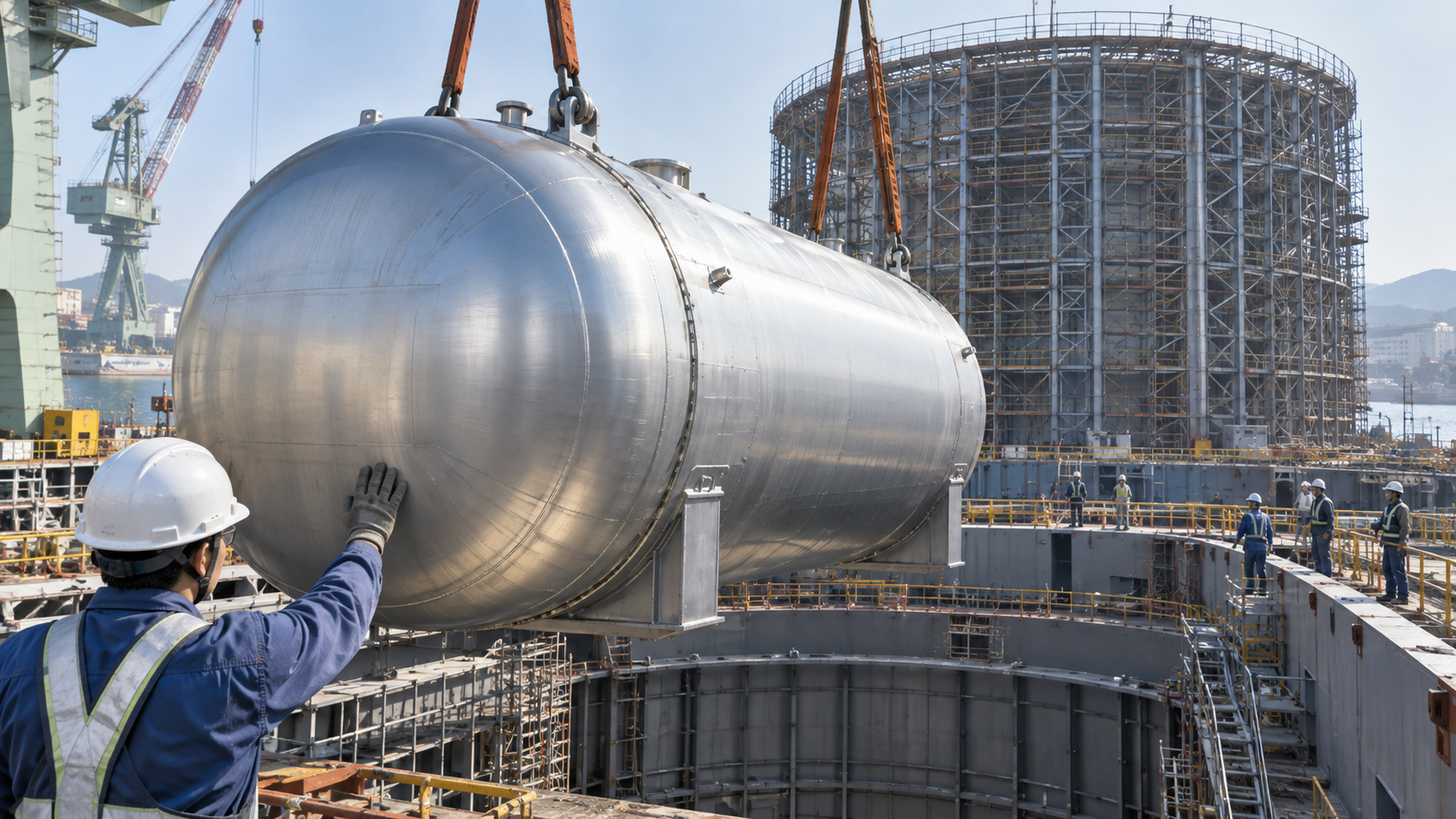
The temperature a liquefied hydrogen tank must protect is -253°C, and the performance measure is the rate at which the liquid evaporates from heat leaking in (the boil-off rate). The tanks of SUISO FRONTIER and Hy touch Kobe use a double-shell structure with a vacuum between inner and outer shells, and the boil-off rates measured in demonstration tests were 0.3% per day for the ship's tank and 0.06% per day for the onshore tank (company-reported values from demonstration tests; the company says they are comparable to LNG ships and LNG tanks) Sourced. Piping also uses vacuum double walls, and the ship-shore coupler, whose low-temperature sealing is a concern, was tested with liquefied hydrogen at a JAXA test center and obtained ClassNK technology qualification. On materials, how to evaluate the strength of metals at cryogenic temperatures and the effects of hydrogen is a foundation, and the company says its Harima test facility will carry out characterization and suitability verification of materials (see our explainer on liquid hydrogen). Individual material names and how hydrogen embrittlement is handled are not stated in the primary sources Not yet confirmed.
6. What it has done so far
| When | What happened | Meaning |
|---|---|---|
| April 2018 | At Kobe Port Island, a 100% hydrogen gas turbine supplied heat and power to four neighboring facilities (with Obayashi, a NEDO project) | Demonstration of heat and power from hydrogen alone in an urban area |
| 11 December 2019 | Launched SUISO FRONTIER, the world's first liquefied hydrogen carrier | The first carrier |
| 3 December 2020 | Completed Hy touch Kobe, the world's first liquefied hydrogen receiving terminal | Has a 2,250 m3 tank |
| December 2021 to February 2022 | SUISO FRONTIER completed the demonstration voyage Japan, Australia and Kobe (HySTRA) | Demonstration of international liquefied hydrogen transport |
| June and August 2021 | Established JSE (June). The commercialization demonstration was selected under the Green Innovation Fund (August) | The operator of the demonstration was set up |
| 31 October 2023 | INPEX took a stake in JSE; Kawasaki Heavy Industries 36.6%, Iwatani 33.4%, INPEX 30.0% | Adds capital and upstream participants |
| 13 December 2024 | Announced that the scope of the commercialization demonstration would be carried out in Japan | The Australian part was taken out of the demonstration (the company cites time constraints of the fund) |
| August and September 2025 | Began fabricating a 50,000 m3 liquefied hydrogen tank (August). Began selling a large gas engine for 30% hydrogen co-firing (September) | Commercialization of both storage and use |
| October 2025 | Land-based operation of marine hydrogen engines (20 October). Memorandum with Daimler Truck and HHLA on a supply chain for Europe (22 October) | Ship fuel and expansion into Europe |
| 27 November 2025 | Groundbreaking of the Kawasaki LH2 Terminal | Building a commercial-scale receiving terminal |
| 6 January 2026 | Contract for the 40,000 m3 liquefied hydrogen carrier | One of the largest carriers in the world |
| March 2026 | Began operating a next-generation fuel supply system for hydrogen gas turbines with Kobe Steel (10 March). Confirmed a hydrogen co-firing ratio above 95% at 100% load on a marine engine | Technology for using liquefied hydrogen in power generation |
| June and August 2026 | Announced a liquefied hydrogen testing facility at the Harima Works (23 June). EPC contract for a high-pressure hydrogen pipeline in the Kawasaki coastal area (JSE, 24 August) | Test facility and infrastructure |
7. What comes next
The primary sources also state the following plans Not yet confirmed.
- Carrier construction scheme: a joint study with Imabari Shipbuilding and Japan Marine United of a scheme for building carriers after the company's first commercial carrier
- Europe: study with Daimler Truck and HHLA of a liquid hydrogen supply chain via the Port of Hamburg (memorandum stage)
- Hydrogen gas turbines: continued supply to dry-combustion turbines, checks under harsh summer operating conditions, and long-term reliability tests of the liquefied hydrogen pump
- Hydrogen co-firing gas engine (8 MW class): on sale; the announcement gives no order record
- The IR page states 2030 targets of 225,000 tonnes a year of hydrogen transported and a hydrogen business of ¥300 billion in 2030 and ¥500 billion in 2040 (the posting date could not be confirmed and the page may be old)
Revenue, profit, headcount, R&D and capital spending limited to hydrogen / contract values for the carrier, tank and terminal / Kawasaki Heavy Industries' share of Green Innovation Fund money / JSE's latest shareholdings / the source of hydrogen for a commercial-scale carrier (other than Australia) / the current status of RWE's Lingen project. None of these appears in the company's releases or results material, or could be confirmed.
8. What the company is aiming for in hydrogen
This table separates what the company says directly from what we read into it. An Inference is our own interpretation of primary-source material.
| What can be read | Primary-source basis | Category |
|---|---|---|
| To realize a commercial-scale international liquefied hydrogen supply chain | The January 2026 release says it will construct a commercial-scale international supply chain and realize carbon neutrality by 2050 | Sourced (company's goal) |
| To provide the equipment for the supply chain as an equipment maker | It announces developing and building carriers, tanks, terminals, couplers and liquefiers. Hydrogen production does not appear as its main role | Sourced / Inference (scope of role) |
| To develop equipment that uses hydrogen (power generation and ships) as well | Hydrogen gas turbines, sales of a hydrogen co-firing gas engine, and land-based operation of marine hydrogen engines | Sourced |
| It has re-arranged the demonstration so that it does not depend on Australian hydrogen | In December 2024 the commercialization demonstration was changed to be carried out in Japan; the Victoria project continues to be assessed | Sourced / Inference (intent to reduce dependence) |
| To widen demand areas to Europe too | Study with Daimler Truck and HHLA of a supply chain via the Port of Hamburg | Sourced (study stage) |
The reading that the company has reduced dependence on Australian hydrogen rests on how the December 2024 statement is worded. The company says that, because of time constraints in the Green Innovation Fund, JSE changed the scope of the commercialization demonstration so that it is carried out in Japan, which will ensure the demonstration of commercial-scale facilities is completed by 2030 Sourced. It also says it will keep assessing the Victoria project as a potential hydrogen source. The source of the hydrogen to be brought in for the demonstration is not stated in the primary sources, apart from the August 2026 pipeline contract saying that domestically produced hydrogen will be supplied to the terminal Not yet confirmed.
9. Map of partnerships in hydrogen
Kawasaki Heavy Industries' hydrogen relationships fall into a joint venture (JSE), national research association and fund (HySTRA, NEDO), joint demonstrations of equipment (Kobe Steel, Yanmar, Japan Engine), and memoranda at the study stage (Daimler Truck and HHLA, Symbio) Sourced. HySTRA was founded by Iwatani, Kawasaki Heavy Industries, Shell Japan and J-POWER among others, and the company says it now consists of Iwatani and Kawasaki Heavy Industries. The names of hydrogen purchasers or off-takers (end users) could not be confirmed in the materials checked.
10. Technologies, products and services
This section lists Kawasaki Heavy Industries' main hydrogen-related products and activities Sourced. All performance figures are the company's stated values or demonstration results under differing conditions, so we do not rank them.
| Category | What the official materials say | Note |
|---|---|---|
| Liquefied hydrogen carriers | SUISO FRONTIER (1,250 m3, built in 2021). The new 40,000 m3 design has high-performance insulation to limit boil-off gas and a hydrogen/oil dual-fuel generator engine that can use boil-off gas as propulsion fuel (design) | About 250 m long; classed by ClassNK |
| Liquefied hydrogen storage tanks | Spherical (Hy touch Kobe, 2,250 m3) and the world's first commercial-size flat-bottom cylindrical tank (50,000 m3). Boil-off rates of 0.3%/day (ship) and 0.06%/day (onshore) in demonstrations | Vacuum double-shell insulation |
| Cargo handling and connection equipment | Ship-shore couplers (6 and 16 inch) with ClassNK technology qualification, liquefied hydrogen loading systems, and vacuum double-wall piping | Low-temperature sealing is the key point |
| Liquefaction and compression equipment | Sales of a hydrogen liquefier (2020). Demonstration of a centrifugal hydrogen compressor for hydrogen liquefaction plants (January 2026) | A NEDO Green Innovation Fund project |
| Hydrogen gas turbines | Heat and power from 100% hydrogen demonstrated (2018). Sales of a 30% hydrogen co-firing dry combustor for 30 MW-class turbines (2022). An award for the 1.8 MW-class GPB17MMX (2024). Demonstration of a liquefied hydrogen fuel supply system with Kobe Steel (2026) | Mainly demonstrations; delivery records need checking announcement by announcement |
| Hydrogen co-firing gas engines | Up to 30% hydrogen by volume at 8 MW class. Sales began on 30 September 2025 | A hydrogen-ready model based on the existing natural gas engine (over 240 orders) |
| Marine hydrogen engines | Kawasaki Heavy Industries built the liquefied hydrogen fuel supply system. Land-based operation with Yanmar and Japan Engine (2025). Hydrogen co-firing ratio above 95% at 100% load in March 2026 | A NEDO fund project; no entry into service decided |
The performance of liquefied hydrogen equipment is decided by how far the routes for heat to enter can be reduced. Beyond the tank's inner and outer shells, pipe supports, the connection between ship and shore, and penetrations for valves and instruments are all routes for heat. The company's mention of vacuum double-wall piping, couplers whose low-temperature sealing has been tested, automation of welding and inspection for large tanks, and a modular approach in which factory-assembled tanks are delivered for installation suggests that in this field the quality of the structure and construction matters more than the material itself Sourced. The announcements do not state the names of individual insulation materials or the types of metal used Not yet confirmed.
11. The risks this company carries
| Risk | Detail | Category |
|---|---|---|
| Uncertain hydrogen demand | NEDO says long-term hydrogen demand is currently uncertain, making it difficult for private companies to make large infrastructure investments. The commercialization demonstration proceeds on the premise of the national fund | Sourced |
| Dependence on a national fund and its deadline | Citing the fund's time constraints, the company changed the scope of the demonstration to Japan in December 2024 | Sourced |
| Source of hydrogen | The Victoria, Australia project is outside the demonstration, and the source of hydrogen for commercial scale cannot be confirmed from primary sources | Sourced / Not yet confirmed |
| Executing large equipment projects | The 40,000 m3 carrier, the 50,000 m3 tank, the terminal and the pipeline all have to be in place by FY2030. Contract values and costs are not disclosed | Sourced / Inference |
| Group governance | Misconduct in submarine repairs and marine engine inspections came to light in 2024, and measures to prevent recurrence are under way. A one-off reduction was also noted in ES&M profit | Sourced |
| Limited visibility of hydrogen earnings | Revenue, profit and costs for hydrogen are not disclosed, so the scale and profitability of the business are hard to verify from outside | Not yet confirmed |
12. Glossary
- Liquefied hydrogen (LH2)
- Hydrogen cooled to -253°C into a liquid. About one eight-hundredth of the volume of the gas.
- Boil-off gas (BOG)
- Gas that evaporates from the liquid in a tank because of heat leaking in. The proportion per day is the boil-off rate.
- HySTRA
- CO2-free Hydrogen Energy Supply-chain Technology Research Association, the research association that ran the Japan-Australia demonstration voyage.
- JSE (Japan Suiso Energy)
- The operator of the liquefied hydrogen supply chain, set up by Kawasaki Heavy Industries and Iwatani, with INPEX later joining.
- Green Innovation Fund
- A national fund managed by NEDO (started at ¥2 trillion) that supports companies from R&D through to implementation.
- MHFS
- Marine Hydrogen Fuel System, the hydrogen fuel supply system for ships.
- CGS (cogeneration)
- A system that uses the heat produced alongside electricity.
- EPC contract
- A contract under which one party takes on engineering, procurement and construction together.
13. References
- Kawasaki Heavy Industries Financial Results for FY2025 (year ended March 2026; results presentation of 12 May 2026). Consolidated revenue and business profit, segment figures, R&D spending, capital expenditure, headcount, and hydrogen-related topics. https://global.kawasaki.com/en/corp/ir/library/pdf/pre_260512-1e.pdf
- Kawasaki Heavy Industries / Japan Suiso Energy Contract Signed to Build World's Largest 40,000 m3 Liquefied Hydrogen Carrier (6 January 2026). The shipbuilding contract for the 40,000 m3 liquefied hydrogen carrier, its specifications, and the SUISO FRONTIER record. https://global.kawasaki.com/news_260106-1e.pdf
- Kawasaki Heavy Industries / Japan Suiso Energy Groundbreaking Ceremony: Key Facility for the Liquefied Hydrogen Supply Chain Commercialization Demonstration Project (27 November 2025). Groundbreaking of the Kawasaki LH2 Terminal in Ogishima, Kawasaki City, with a 50,000 m3 tank. https://global.kawasaki.com/news_251127-2e.pdf
- Kawasaki Heavy Industries Fabrication of Large Liquefied Hydrogen Storage Tank Launched (7 August 2025). Start of fabrication of the 50,000 m3 liquefied hydrogen storage tank. https://global.kawasaki.com/en/corp/newsroom/news/detail/?f=20250807_3407
- Kawasaki Heavy Industries Kawasaki to Build One of Japan's Largest Testing Facilities to Accelerate Development and Demonstration of Liquefied Hydrogen-Related Equipment (23 June 2026). The liquefied hydrogen testing facility at the Harima Works (operations expected in FY2027). https://global.kawasaki.com/en/corp/newsroom/news/detail/?f=20260623_5194
- Kawasaki Heavy Industries / Kobe Steel Operation of a next-generation hydrogen fuel supply system for hydrogen power generation begins (10 March 2026; in Japanese). Demonstration of fuel supply for hydrogen gas turbines combining a liquefied hydrogen pump and an intermediate fluid vaporizer. https://www.khi.co.jp/pressrelease/news_260310-1.pdf
- NEDO / Kawasaki Heavy Industries / Yanmar Power Solutions / Japan Engine World's First Land-based Operation of Marine Hydrogen Engine Achieved by Consortium (20 October 2025). Land-based operation of marine hydrogen engines and the liquefied hydrogen fuel supply system. https://global.kawasaki.com/news_251020-1e.pdf
- Kawasaki Heavy Industries World's First Commercial Launch of Hydrogen 30% Co-Firing Large Gas Engine System (30 September 2025). Start of sales of a gas engine for 30% hydrogen co-firing, and the 8 MW-class verification. https://global.kawasaki.com/en/corp/newsroom/news/detail/?f=20250930_4865
- NEDO World's First Heat and Electricity Supplied in an Urban Area Using 100% Hydrogen (20 April 2018). Heat and power supplied by a 100% hydrogen gas turbine at Kobe Port Island (Obayashi and Kawasaki Heavy Industries). https://www.nedo.go.jp/english/news/AA5en_100382.html
- HySTRA (Iwatani, Kawasaki Heavy Industries and others) HySTRA celebrates completion of world's first liquefied hydrogen vessel voyage in Japan (9 April 2022). The demonstration voyage of SUISO FRONTIER between Japan and Australia (December 2021 to February 2022). https://global.kawasaki.com/news_220409-1e.pdf
- Kawasaki Heavy Industries Kawasaki's ongoing commitment in the commercial scale project of production and transportation of liquefied hydrogen from Australia to Japan (13 December 2024). The change of scope of the commercialization demonstration (now in Japan) and the status of the Victoria project. https://global.kawasaki.com/en/corp/newsroom/news/detail/?f=20241213_2199
- Kawasaki Heavy Industries / Iwatani / INPEX / Japan Suiso Energy INPEX to Acquire Shares in Japan Suiso Energy to Build International Liquefied Hydrogen Supply Chain (31 October 2023). Shareholdings in Japan Suiso Energy (Kawasaki Heavy Industries 36.6%, Iwatani 33.4%, INPEX 30.0%). https://global.kawasaki.com/news_231031-1e.pdf
- NEDO Large-scale Hydrogen Supply Chain Establishment (Green Innovation Fund project page). The budget of the whole project (up to ¥321.12 billion) and the goal of ¥30/Nm3 by 2030. https://green-innovation.nedo.go.jp/en/project/hydrogen-supply-chain/
- NEDO Liquefied Hydrogen Supply Chain Commercialization Demonstration Project selects sites for shipping and receiving liquefied clean hydrogen (30 March 2023). Selection of the Kawasaki coastal area as the receiving site, and the Port of Hastings, Victoria as a candidate shipping site at that time. https://www.nedo.go.jp/english/news/AA5en_100455.html
- Daimler Truck / HHLA / Kawasaki Heavy Industries Launch Strategic Partnership to Establish Liquid Hydrogen Supply Chain for Europe (22 October 2025). The memorandum of understanding on a liquid hydrogen supply chain via the Port of Hamburg. https://global.kawasaki.com/news_251022-1e.pdf
- Kawasaki Heavy Industries / Imabari Shipbuilding / Japan Marine United Joint Study on the Construction Scheme for Liquefied Hydrogen Carriers (2 June 2025). A joint study of a construction scheme for liquefied hydrogen carriers. https://global.kawasaki.com/news_250602-1e.pdf
- Kawasaki Heavy Industries / TB Global Technologies Ship Shore Coupler for Liquefied Hydrogen Transport Obtains Technology Qualification from ClassNK (1 December 2025). Technology qualification of the ship-shore coupler for liquefied hydrogen. https://global.kawasaki.com/news_251201-1e.pdf
- Kawasaki Heavy Industries / Symbio Kawasaki Heavy Industries and Symbio Sign Memorandum of Understanding on Joint Development of Fuel Cell Systems (28 February 2024). Memorandum of understanding on joint development of fuel cell systems. https://global.kawasaki.com/news_240228-1e.pdf
- Kawasaki Heavy Industries / RWE One of the World's First 100% Hydrogen-to-Power Demonstrations on Industrial Scale Launches in Lingen, Germany (9 December 2021). The plan for a hydrogen gas turbine demonstration in Lingen, Germany. https://global.kawasaki.com/news_211209-2e.pdf
- Japan Suiso Energy / JFE Engineering EPC Contract Executed for Japan's First High-Pressure Hydrogen Pipeline in the Kawasaki Coastal Area (24 August 2026). The EPC contract for the roughly 4 km high-pressure hydrogen pipeline in the Kawasaki coastal area. https://www.japansuisoenergy.com/news/pdf/EPC%20Contract%20Executed%20for%20Japan%E2%80%99s%20First%20High-Pressure%20Hydrogen%20Pipeline%20in%20the%20Kawasaki%20Coastal%20Area.pdf
- Kawasaki Heavy Industries Kawasaki Proves Excellent Thermal-insulation Performance for Liquefied Hydrogen Storage Tanks (11 December 2023). Measured boil-off rates of the storage tanks (company-reported). https://global.kawasaki.com/en/corp/newsroom/news/detail/?f=20231211_8742
- Kawasaki Heavy Industries World's First Liquefied Hydrogen Carrier SUISO FRONTIER Launches (11 December 2019) and Kawasaki Completes World's First Liquefied Hydrogen Receiving Terminal Kobe LH2 Terminal (Hy touch Kobe) (3 December 2020). Completion of Hy touch Kobe (2,250 m3 tank). The launch of SUISO FRONTIER (11 December 2019) is in a separate company release. https://global.kawasaki.com/en/corp/newsroom/news/detail/?f=20201203_2378
- Kawasaki Heavy Industries Investor relations page, "Our efforts on hydrogen" (in Japanese; posting date not confirmed). Hydrogen transport KPIs for 2030 and plans for the scale of the hydrogen business. https://www.khi.co.jp/ir/finance/bond_hydrogen.html
- Kawasaki Heavy Industries Kawasaki Hydrogen Road (hydrogen website; source of the logo image). List of hydrogen-related releases (only titles checked: start of sales of a hydrogen liquefier [June 2020], sales of a 30% hydrogen co-firing DLE combustor [August 2022], an award for the 1.8 MW-class GPB17MMX [April 2024]) and the logo image. https://global.kawasaki.com/en/hydrogen/
14. Claim-to-source audit
| Claim in the text | Category | Source |
|---|---|---|
| Legal name, head office (Minato-ku, Tokyo) and the existence of a Hydrogen Strategy Division | Sourced | Reference 2 https://global.kawasaki.com/news_260106-1e.pdf Reference 15 https://global.kawasaki.com/news_251022-1e.pdf |
| FY2025 (year to March 2026) consolidated revenue of ¥2,311.2 billion, business profit of ¥145.1 billion and profit attributable to owners of ¥108.1 billion | Sourced | Reference 1 https://global.kawasaki.com/en/corp/ir/library/pdf/pre_260512-1e.pdf |
| Energy Solution & Marine Engineering (ES&M) revenue of ¥433.5 billion, business profit of ¥55.0 billion and orders of ¥552.9 billion | Sourced | Reference 1 https://global.kawasaki.com/en/corp/ir/library/pdf/pre_260512-1e.pdf |
| Consolidated R&D spending of ¥56.8 billion, capital expenditure of ¥143.3 billion and 41,652 employees | Sourced | Reference 1 https://global.kawasaki.com/en/corp/ir/library/pdf/pre_260512-1e.pdf |
| Hydrogen strategy is overseen by the president of the Precision Machinery & Robot Company (March 2026 material) | Sourced | Reference 1 https://global.kawasaki.com/en/corp/ir/library/pdf/pre_260512-1e.pdf |
| SUISO FRONTIER (1,250 m3) built in 2021 and launched in December 2019; Hy touch Kobe (2,250 m3 tank) completed in December 2020 | Sourced | Reference 2 https://global.kawasaki.com/news_260106-1e.pdf Reference 22 https://global.kawasaki.com/en/corp/newsroom/news/detail/?f=20201203_2378 |
| Demonstration voyage: departed December 2021, arrived in Australia in January 2022, unloaded in Kobe in February 2022 | Sourced | Reference 10 https://global.kawasaki.com/news_220409-1e.pdf |
| Boil-off rates: 0.3%/day (ship tank) and 0.06%/day (onshore tank), from demonstration tests | Sourced | Company-reported values from demonstration tests; the company says both were below design values. Reference 21 https://global.kawasaki.com/en/corp/newsroom/news/detail/?f=20231211_8742 |
| Scope of the commercialization demonstration changed to be carried out in Japan (13 December 2024); the Victoria project continues to be assessed as a source | Sourced | Reference 11 https://global.kawasaki.com/en/corp/newsroom/news/detail/?f=20241213_2199 |
| Contract for a 40,000 m3 liquefied hydrogen carrier (6 January 2026); about 250 m long, built at the Sakaide Works; no contract value stated | Sourced | Reference 2 https://global.kawasaki.com/news_260106-1e.pdf |
| Groundbreaking of the Kawasaki LH2 Terminal in Ogishima, Kawasaki City (27 November 2025); 50,000 m3 tank; operation planned by FY2030 | Not yet confirmed | The groundbreaking is a fact; operation is a company plan. Reference 3 https://global.kawasaki.com/news_251127-2e.pdf |
| Fabrication of the 50,000 m3 liquefied hydrogen storage tank launched at the Harima Works (7 August 2025) | Sourced | Reference 4 https://global.kawasaki.com/en/corp/newsroom/news/detail/?f=20250807_3407 |
| Liquefied hydrogen testing facility at the Harima Works: operation expected in FY2027; includes a 47 m3 liquefied hydrogen tank | Not yet confirmed | Company plan. Reference 5 https://global.kawasaki.com/en/corp/newsroom/news/detail/?f=20260623_5194 |
| EPC contract for a roughly 4 km high-pressure hydrogen pipeline (24 August 2026; Japan Suiso Energy and JFE Engineering) | Sourced | Reference 20 https://www.japansuisoenergy.com/news/pdf/EPC%20Contract%20Executed%20for%20Japan%E2%80%99s%20First%20High-Pressure%20Hydrogen%20Pipeline%20in%20the%20Kawasaki%20Coastal%20Area.pdf |
| Shareholdings in Japan Suiso Energy at 31 October 2023: Kawasaki 36.6%, Iwatani 33.4%, INPEX 30.0%; the latest ratio could not be confirmed | Sourced | Reference 12 https://global.kawasaki.com/news_231031-1e.pdf |
| Budget of the whole Green Innovation Fund hydrogen supply chain project of up to ¥321.12 billion (Kawasaki's share unknown); cost target of ¥30/Nm3 in 2030 | Sourced | The budget is for the whole project, not Kawasaki's receipts; the target is the government's. Reference 13 https://green-innovation.nedo.go.jp/en/project/hydrogen-supply-chain/ |
| Kawasaki coastal area selected as the receiving site (30 March 2023); the Port of Hastings was a candidate shipping site at that time | Sourced | Reference 14 https://www.nedo.go.jp/english/news/AA5en_100455.html |
| Memorandum of understanding with Daimler Truck and HHLA (22 October 2025); study stage | Not yet confirmed | Study stage. Reference 15 https://global.kawasaki.com/news_251022-1e.pdf |
| Joint study with Imabari Shipbuilding and Japan Marine United on a carrier construction scheme (2 June 2025) | Not yet confirmed | Study stage. Reference 16 https://global.kawasaki.com/news_250602-1e.pdf |
| ClassNK technology qualification of the ship-shore coupler (1 December 2025) | Sourced | Reference 17 https://global.kawasaki.com/news_251201-1e.pdf |
| Demonstration of a hydrogen fuel supply system for gas turbines with Kobe Steel (tests began January 2026; announced 10 March 2026) | Sourced | Reference 6 https://www.khi.co.jp/pressrelease/news_260310-1.pdf |
| Land-based operation of marine hydrogen engines (20 October 2025); hydrogen co-firing ratio above 95% at 100% load confirmed in March 2026 | Sourced | Reference 7 https://global.kawasaki.com/news_251020-1e.pdf Reference 1 https://global.kawasaki.com/en/corp/ir/library/pdf/pre_260512-1e.pdf |
| Sales of an 8 MW-class gas engine for 30% hydrogen co-firing began on 30 September 2025 | Sourced | Reference 8 https://global.kawasaki.com/en/corp/newsroom/news/detail/?f=20250930_4865 |
| Heat and power supplied from a 100% hydrogen gas turbine at Kobe Port Island (20 April 2018) | Sourced | Reference 9 https://www.nedo.go.jp/english/news/AA5en_100382.html |
| Hydrogen liquefier sales (June 2020), 30% hydrogen co-firing DLE combustor sales (August 2022) and the GPB17MMX award (April 2024) | Sourced | Only the release titles were checked; the full texts were not. Reference 24 https://global.kawasaki.com/en/hydrogen/ |
| Plan for a 34 MWel hydrogen gas turbine demonstration at RWE's Lingen site (9 December 2021); the current status was not checked | Not yet confirmed | A plan as of 2021. Reference 19 https://global.kawasaki.com/news_211209-2e.pdf |
| Memorandum of understanding with Symbio on fuel cell systems (28 February 2024) | Not yet confirmed | A memorandum at the study stage. Reference 18 https://global.kawasaki.com/news_240228-1e.pdf |
| IR page KPIs: 225,000 t/year of hydrogen transported in 2030 and a hydrogen business of ¥300 billion in 2030 and ¥500 billion in 2040 | Not yet confirmed | Company targets; the posting date is not known and the page may be old. Reference 23 https://www.khi.co.jp/ir/finance/bond_hydrogen.html |
| Hydrogen-specific revenue, profit, headcount, R&D and capex, the carrier contract value, and Kawasaki's share of public funding | Not yet confirmed | Not found for this article in the company's releases or results. We do not claim that none exist. |
| The classification (gases & large projects primary, fuel cells & end use secondary) and the example companies | Our calculation | Our own classification. |
| Reading that most revenue is non-hydrogen and that hydrogen is being built up through large demonstrations | Inference | Our own reading of the ES&M description (Reference 1) and the stage of the projects (References 2 and 3). |
| Reading that the time limit of the Green Innovation Fund led to the change in the Australian demonstration scope | Inference | Our own reading of the statement in Reference 11. |
Last updated: 5 October 2026 / Troy Technical
The figures in this article are based on Kawasaki Heavy Industries' results material and official releases, and on official releases of Japan Suiso Energy, NEDO and HySTRA. Market estimates from research firms and press-reported figures are not used. Product performance figures are the company's stated values or demonstration results under differing conditions and are not a ranking. Items marked "Inference" are our own readings of primary-source material, not statements by the company. This article is not advice on handling hydrogen.