INSTITUTION PROFILE / HYDROGEN ENERGY
NEDO
The agency that hands out Japan's money for hydrogen R&D and demonstration
NEDO is a national research and development agency overseen by Japan's Ministry of Economy, Trade and Industry (METI). It does not make hydrogen. In this field its job is to distribute the government's R&D budget to companies and research organisations, then keep track of how the work is going. The core is four hydrogen projects within the Green Innovation Fund (GI Fund, ¥2.7564 trillion in total) and NEDO's own hydrogen and fuel cell programmes. But NEDO has no power over hydrogen regulation or standards, and the grants for price-gap and hub support under the Hydrogen Society Promotion Act are paid not by NEDO but by JOGMEC. This profile looks at one question only: how far NEDO's influence over hydrogen energy actually reaches.
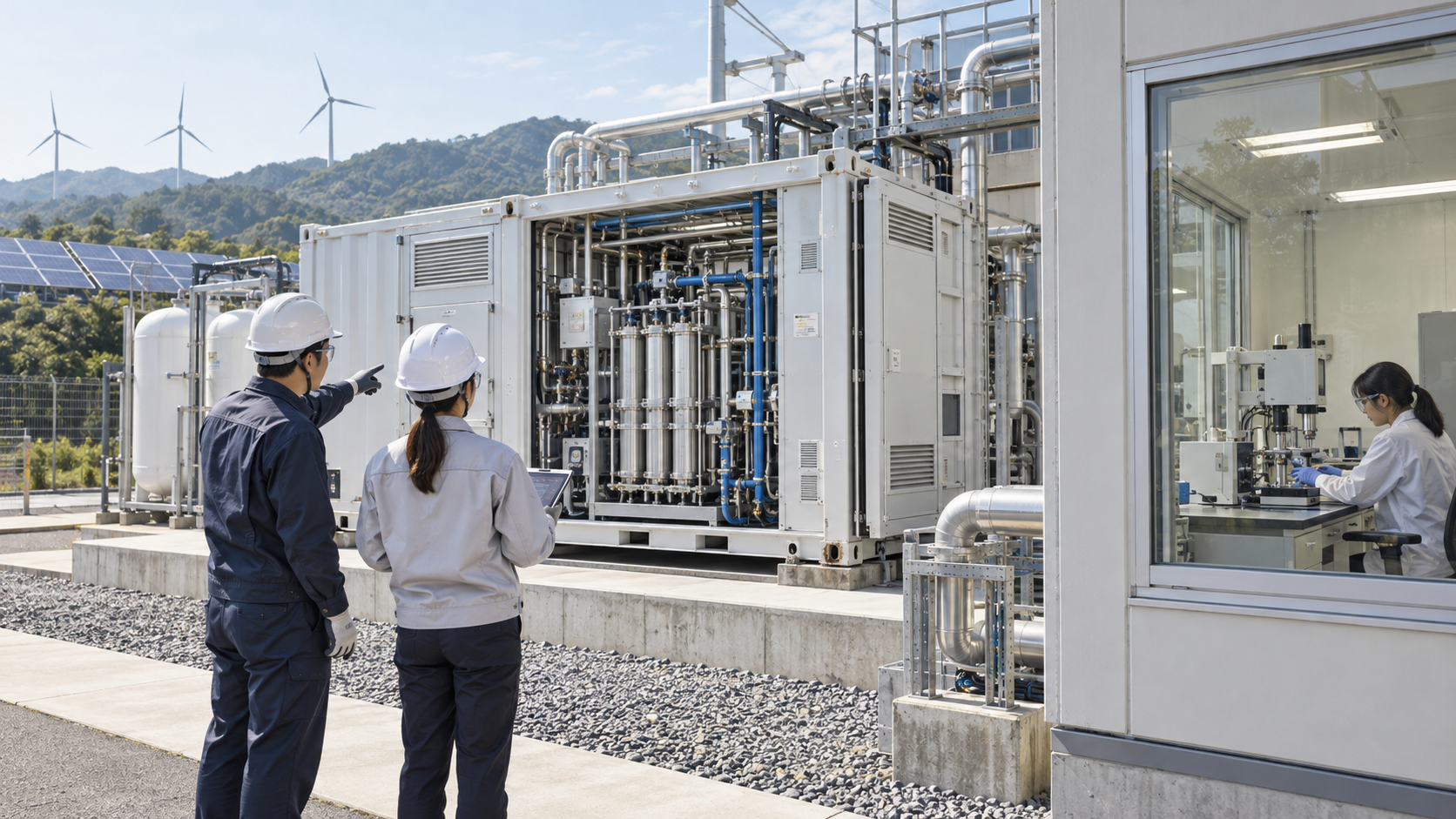
- NEDO in 30 seconds
- What kind of body it is: the four types of influence
- What it does for hydrogen energy
- How far its influence reaches (powers and geography)
- Where the money goes and who takes part
- Outlook
- Glossary, references and claim-to-source audit
1. NEDO in 30 seconds
In hydrogen, NEDO is an agency that funds R&D and demonstration, not one that makes rules or schemes. Under the Hydrogen Society Promotion Act, METI approves plans for price-gap and hub support and JOGMEC pays the grants; the text of the Act does not mention NEDO Sourced. What NEDO handles is technology development and demonstration that comes before commercialisation. The GI Fund was created at NEDO in March 2021 to support companies for up to ten years, from R&D and demonstration through to social implementation Sourced. It matters because a large share of Japan's hydrogen R&D money reaches companies through NEDO.
2. What kind of body it is: the four types of influence
Unlike the companies in this series, none of the institutions that appear in hydrogen coverage produces hydrogen. What separates them is the route by which they influence the industry, and that gives four types.
3. What it does for hydrogen energy
NEDO's involvement in hydrogen runs along two lines Sourced.
(1) Four hydrogen projects in the Green Innovation Fund
| Project | Budget cap | Targets (as stated by NEDO) | Content and examples of participants |
|---|---|---|---|
| Building large-scale hydrogen supply chains | ¥321.12 billion | Hydrogen supply cost of ¥30/Nm3 in 2030 and ¥20/Nm3 or less in 2050 | Commercial demonstration of liquid hydrogen and MCH (methylcyclohexane) chains, innovative equipment such as hydrogen liquefiers, a materials-evaluation base for liquid hydrogen equipment, and real-plant demonstration of hydrogen power (co-firing and dedicated firing). Participants include Japan Hydrogen Energy (lead), ENEOS, Kawasaki Heavy Industries (large, high-efficiency equipment for hydrogen liquefiers), JERA and Kansai Electric Power |
| Hydrogen production by water electrolysis using renewable-based power | ¥107.05 billion | Electrolyser capital cost: technology that can reach ¥52,000/kW (alkaline) and ¥65,000/kW (PEM) by 2030, and bring SOEC below ¥68,000/kW by 2032 | Larger, modular electrolysers, putting membranes and catalysts into devices, large-scale Power-to-X demonstration, and performance evaluation methods. Participants include Asahi Kasei (lead), JGC Holdings, Siemens Energy, Toray and Tokyo Electric Power Holdings in a power-to-gas theme led by the Yamanashi Prefecture Enterprise Bureau, and AIST |
| Using hydrogen in steelmaking | ¥439.16 billion | Hydrogen-reduction technology that cuts CO2 from the steelmaking process by 50% or more | Hydrogen reduction in blast furnaces, and direct reduction of iron ore with hydrogen alone |
| Building fuel ammonia supply chains | ¥69.8 billion | Ammonia supply cost in the high teens of yen per Nm3 in 2030 (hydrogen-equivalent on a calorific basis); 30 million tonnes a year of domestic use in 2050 | Lower ammonia production cost, and ammonia co-firing and dedicated firing in coal plants and gas turbines |
* Budget caps are as shown on NEDO's GI Fund site in October 2026. The participants are examples taken from the implementation pages of the supply-chain and electrolysis projects; this article does not list the participants in steelmaking or fuel ammonia. Names are as shown on NEDO's Japanese pages.
The caps of the four hydrogen projects add up to ¥937.13 billion Our calculation. The Basic Hydrogen Strategy of June 2023 gave the Fund's hydrogen-related portion as "about ¥800 billion", with caps at that time of ¥300 billion for supply chains, ¥70 billion for electrolysis, ¥193.5 billion for steelmaking and ¥59.8 billion for fuel ammonia Sourced. NEDO's current figures are higher for every one of them. But a cap is a ceiling on what may be spent, not what has been paid to participants. NEDO's site does not show amounts allocated to each participant Not yet confirmed.
(2) NEDO's own hydrogen and fuel cell programmes
| Programme (project code) | Period and budget | Content |
|---|---|---|
| Technology development for building a hydrogen society (P14026) | FY2014 to FY2025 FY2025 budget ¥8.1 billion | Hydrogen energy systems, supply chains and hydrogen power using overseas unused resources, local use of hydrogen, and overall surveys. The programme page shows photographs of the Fukushima Hydrogen Energy Research Field (FH2R) and a liquid hydrogen carrier |
| Technology development for competitive hydrogen supply chains (P23004) | FY2023 to FY2027 FY2025 budget ¥6.40 billion | More advanced, lower-cost storage tanks, filling hoses and metering systems; hydrogen stations; and R&D for regulatory reform and international standardisation |
| R&D to strengthen common foundations for wider hydrogen use (P25002) | FY2025 to FY2029 FY2026 budget ¥7.7 billion | Common evaluation and analysis platforms for fuel cells for heavy-duty trucks and for water electrolysis (alkaline, PEM, AEM, SOEC), next-generation component technologies, and hydrogen storage tanks |
| Advanced technology development and demonstration for hydrogen society models (P26004) | FY2026 to FY2030 FY2026 budget ¥3.95 billion | Building models for the local production, storage, transport and use of hydrogen through surveys and technology development and demonstration |
| R&D for wide deployment of ultra-high-pressure hydrogen infrastructure (P18011) | FY2018 to FY2023 FY2023 budget ¥0.08 billion | Technology for reviewing hydrogen station regulations and cutting their cost. Includes R&D on international harmonisation and standardisation: work on ISO, the IEA, the IPHE and the HFCV-GTR |
Internationally, METI and NEDO co-host the Hydrogen Energy Ministerial Meeting. The 8th was held on 10 September 2026 at Makuhari Messe, and the afternoon ministerial session was closed Sourced.
4. How far its influence reaches (powers and geography)
| Aspect | What NEDO has | What it does not have |
|---|---|---|
| Powers | The power to run calls for proposals, select projects, monitor progress and evaluate results. In the GI Fund it asks for an executive's long-term business strategy vision at application, and projects can be halted or part of commissioned funds returned if efforts fall short | The power to set hydrogen regulations, safety standards or international standards. Paying the grants of the Hydrogen Society Promotion Act (JOGMEC) and approving plans (METI). Setting the overall hydrogen targets and framework (METI and the Council of Ministers) |
| Geography | Japan. Projects are paid for by Japan's budget, and participants are mainly Japanese companies and institutions. It links abroad through co-hosting a ministerial meeting and R&D on international harmonisation | Direct power over foreign companies or other countries' policies |
| Duration | Support of up to ten years in the GI Fund. Regular programmes run from a few years to over ten, with budgets set each year | The power to require commercialisation or sales |
| Scale | 1,640 staff. ¥505.2 billion budget plus ¥11.3668 trillion in funds (all fields combined). The combined caps of the four hydrogen projects are ¥937.13 billion | A total of grants paid each year for hydrogen alone (not found on the official pages) |
5. Where the money goes and who takes part
| Company in this series | Participation confirmed on NEDO's pages |
|---|---|
| Kawasaki Heavy Industries | Large-scale hydrogen supply chains: participant in the theme "Development of large, high-efficiency equipment for hydrogen liquefiers" |
| Asahi Kasei | Hydrogen production by water electrolysis: lead of the theme "Development of a large-scale alkaline water electrolysis hydrogen production system and demonstration of a green chemical plant" |
| Siemens Energy | Hydrogen production by water electrolysis: one of the participants in the power-to-gas theme led by the Yamanashi Prefecture Enterprise Bureau (NEDO's Japanese list shows "Siemens Energy K.K.") |
* Participants in steelmaking, fuel ammonia, next-generation aircraft and ships, and awardees of NEDO's own hydrogen programmes, were not checked.
6. Outlook
| What can be read from the sources | Primary evidence | Category |
|---|---|---|
| Some GI Fund hydrogen themes are reaching the end of their R&D, and the next step is a hand-off to commercialisation and social implementation | The implementation page marks some themes as ending in FY2023, FY2024 or FY2025. Support under the Hydrogen Society Promotion Act (JOGMEC) runs as a separate scheme | Inference |
| Budget caps for hydrogen will keep being revised | The electrolysis cap rose from ¥70 billion to ¥107.05 billion, steelmaking from ¥193.5 billion to ¥439.16 billion and fuel ammonia from ¥59.8 billion to ¥69.8 billion (comparing the Basic Hydrogen Strategy with the current display) | Inference |
| The hydrogen society programme will be succeeded by the local-model programme | The hydrogen society programme runs to FY2025 and the hydrogen society model programme from FY2026 to FY2030. The pages do not say the latter succeeds the former | Not yet confirmed |
7. Glossary
- National R&D agency
- A corporation that carries out national research and development. It is not a ministry itself and works under the supervision of a competent minister.
- Green Innovation Fund (GI Fund)
- A fund created at NEDO toward carbon neutrality by 2050. It supports projects for up to ten years, from R&D to social implementation.
- Business strategy vision
- A document in which the executives of GI Fund participants set out their business strategy and R&D plans as a commitment. It is published on NEDO's site.
- MCH (methylcyclohexane)
- Hydrogen bound to toluene so that it can be carried as a liquid at ordinary temperature. One kind of hydrogen carrier.
- Nm3
- A unit of gas volume at standard conditions (0 °C, 1 atmosphere). Hydrogen supply cost is quoted in yen per Nm3.
- JOGMEC
- Japan Organization for Metals and Energy Security. It pays the grants under the Hydrogen Society Promotion Act, and is a separate corporation from NEDO.
8. References
- NEDO Organisation overview (name, establishment, supervising minister, governing law, staff, budget, fund budgets; updated 15 April 2026) (in Japanese). https://www.nedo.go.jp/introducing/kihon.html
- e-Gov Law Search Act on the New Energy and Industrial Technology Development Organization (Act No. 145 of 2002; Article 4 on purpose, Article 15 on scope of work) (in Japanese). https://laws.e-gov.go.jp/law/414AC0000000145
- NEDO Overview of the Green Innovation Fund (¥2 trillion fund created in March 2021, ¥2.7564 trillion in total as of May 2026, support of up to ten years, executive commitment, 14 priority fields) (in Japanese). https://green-innovation.nedo.go.jp/about/
- NEDO Green Innovation Fund project "Building large-scale hydrogen supply chains" (budget cap, update history, features) (in Japanese). https://green-innovation.nedo.go.jp/project/hydrogen-supply-chain/
- NEDO Same project: implementation structure and business strategy visions (themes and participants) (in Japanese). https://green-innovation.nedo.go.jp/project/hydrogen-supply-chain/scheme/
- NEDO Same project: basic information (R&D target: hydrogen supply cost) (in Japanese). https://green-innovation.nedo.go.jp/project/hydrogen-supply-chain/summary/
- NEDO Green Innovation Fund project "Hydrogen production by water electrolysis using renewable-based power" (budget cap, update history) (in Japanese). https://green-innovation.nedo.go.jp/project/hydrogen-production-water-electrolysis-utilizing/
- NEDO Same project: implementation structure and business strategy visions (themes and participants) (in Japanese). https://green-innovation.nedo.go.jp/project/hydrogen-production-water-electrolysis-utilizing/scheme/
- NEDO Same project: basic information (R&D target: electrolyser capital cost) (in Japanese). https://green-innovation.nedo.go.jp/project/hydrogen-production-water-electrolysis-utilizing/summary/
- NEDO Green Innovation Fund project "Using hydrogen in steelmaking" (budget cap, targets) (in Japanese). https://green-innovation.nedo.go.jp/project/utilization-hydrogen-steelmaking/
- NEDO Green Innovation Fund project "Building fuel ammonia supply chains" (budget cap, targets) (in Japanese). https://green-innovation.nedo.go.jp/project/building-fuel-ammonia-supply-chain/
- NEDO Programme pages: fuel cells and hydrogen (list of hydrogen programmes) (in Japanese). https://www.nedo.go.jp/activities/introduction8_01_05.html
- NEDO Programme page: Technology development for building a hydrogen society (P14026; FY2014 to FY2025, FY2025 budget ¥8.1 billion) (in Japanese). https://www.nedo.go.jp/activities/ZZJP_100096.html
- NEDO Programme page: Technology development for competitive hydrogen supply chains (P23004; FY2023 to FY2027, FY2025 budget ¥6.4 billion) (in Japanese). https://www.nedo.go.jp/activities/ZZJP_100259.html
- NEDO Programme page: R&D to strengthen common foundations for wider hydrogen use (P25002; FY2025 to FY2029, FY2026 budget ¥7.7 billion) (in Japanese). https://www.nedo.go.jp/activities/ZZJP_100336.html
- NEDO Programme page: Advanced technology development and demonstration for hydrogen society models (P26004; FY2026 to FY2030, FY2026 budget ¥3.95 billion) (in Japanese). https://www.nedo.go.jp/activities/ZZJP_100392.html
- NEDO Programme page: R&D for wide deployment of ultra-high-pressure hydrogen infrastructure (P18011; FY2018 to FY2023; includes R&D on international standardisation and harmonisation) (in Japanese). https://www.nedo.go.jp/activities/ZZJP_100144.html
- Ministry of Economy, Trade and Industry (METI) News release: 8th Hydrogen Energy Ministerial Meeting and international public-private symposium (13 August 2026; organised by METI and NEDO) (in Japanese). https://www.meti.go.jp/press/2026/08/20260813001.html
- e-Gov Law Search Hydrogen Society Promotion Act (Act No. 37 of 2024; grants are paid by JOGMEC; NEDO is not mentioned in the text) (in Japanese). https://laws.e-gov.go.jp/law/506AC0000000037
- Council of Ministers for Renewable Energy, Hydrogen and Related Issues Basic Hydrogen Strategy (revised 6 June 2023; about ¥800 billion of the Green Innovation Fund for hydrogen) (in Japanese). https://www.meti.go.jp/shingikai/enecho/shoene_shinene/suiso_seisaku/pdf/20230606_2.pdf
9. Claim-to-source audit
| Claim in the article | Category | Source |
|---|---|---|
| Full name, headquarters, establishment (1 October 2003; predecessor October 1980), supervising minister, governing law, 1,640 staff, ¥505.2 billion budget, ¥11.3668 trillion fund budgets and the ¥2.7564 trillion Green Innovation Fund | Sourced | Reference 1 https://www.nedo.go.jp/introducing/kihon.html |
| The NEDO Act's purpose and scope of work (non-fossil energy technologies and others), and that the word "hydrogen" does not appear in it | Sourced | Reference 2 https://laws.e-gov.go.jp/law/414AC0000000145 |
| The Green Innovation Fund: created in March 2021 (¥2 trillion), ¥2.7564 trillion in total (May 2026), support of up to ten years, executive commitment, project suspension or refund of commissioned funds, "hydrogen and fuel ammonia" among the 14 priority fields | Sourced | Reference 3 https://green-innovation.nedo.go.jp/about/ |
| Large-scale hydrogen supply chains: budget cap ¥321.12 billion, selection (26 August 2021), plan revision (1 October 2025), liquid hydrogen and MCH commercialisation, hydrogen power demonstrations | Sourced | Reference 4 https://green-innovation.nedo.go.jp/project/hydrogen-supply-chain/ |
| Large-scale hydrogen supply chains: themes and participants (Japan Hydrogen Energy, ENEOS, Kawasaki Heavy Industries, JERA, Kansai Electric Power and others) | Sourced | Reference 5 https://green-innovation.nedo.go.jp/project/hydrogen-supply-chain/scheme/ |
| Large-scale hydrogen supply chains: R&D target (hydrogen supply cost ¥30/Nm3 in 2030 and ¥20/Nm3 or less in 2050) | Sourced | Reference 6 https://green-innovation.nedo.go.jp/project/hydrogen-supply-chain/summary/ |
| Water electrolysis: budget cap ¥107.05 billion, the selection update (17 February 2026), the 2030 and 2032 cost targets | Sourced | Reference 7 https://green-innovation.nedo.go.jp/project/hydrogen-production-water-electrolysis-utilizing/ |
| Water electrolysis: themes and participants (Asahi Kasei as lead, JGC Holdings, Yamanashi Prefecture Enterprise Bureau, Siemens Energy, Toray, AIST and others) | Sourced | Reference 8 https://green-innovation.nedo.go.jp/project/hydrogen-production-water-electrolysis-utilizing/scheme/ |
| Water electrolysis: R&D targets (alkaline ¥52,000/kW, PEM ¥65,000/kW) | Sourced | Reference 9 https://green-innovation.nedo.go.jp/project/hydrogen-production-water-electrolysis-utilizing/summary/ |
| Steelmaking: budget cap ¥439.16 billion, the target of cutting CO2 by 50% or more, blast-furnace and direct hydrogen reduction | Sourced | Reference 10 https://green-innovation.nedo.go.jp/project/utilization-hydrogen-steelmaking/ |
| Fuel ammonia: budget cap ¥69.8 billion and the 2030 ammonia supply-cost target (high-teens yen per Nm3, hydrogen-equivalent on a calorific basis) | Sourced | Reference 11 https://green-innovation.nedo.go.jp/project/building-fuel-ammonia-supply-chain/ |
| NEDO's list of hydrogen and fuel cell programmes and the responsible department (Hydrogen and Ammonia Department) | Sourced | Reference 12 https://www.nedo.go.jp/activities/introduction8_01_05.html |
| Technology development for building a hydrogen society: period, budget and content | Sourced | Reference 13 https://www.nedo.go.jp/activities/ZZJP_100096.html |
| Technology development for competitive hydrogen supply chains: period, budget and content | Sourced | Reference 14 https://www.nedo.go.jp/activities/ZZJP_100259.html |
| R&D to strengthen common foundations for wider hydrogen use: period, budget and content | Sourced | Reference 15 https://www.nedo.go.jp/activities/ZZJP_100336.html |
| Advanced hydrogen society model development and demonstration: period, budget and content | Sourced | Reference 16 https://www.nedo.go.jp/activities/ZZJP_100392.html |
| Ultra-high-pressure hydrogen infrastructure programme: period, budget and content (including R&D on ISO-related work, IEA, IPHE and HFCV-GTR harmonisation) | Sourced | Reference 17 https://www.nedo.go.jp/activities/ZZJP_100144.html |
| The 8th Hydrogen Energy Ministerial Meeting (10 September 2026, Makuhari Messe), organised by METI and NEDO | Sourced | Reference 18 https://www.meti.go.jp/press/2026/08/20260813001.html |
| That grants under the Hydrogen Society Promotion Act (price-gap and hub support) are paid by JOGMEC and the text does not mention NEDO | Sourced | Reference 19 https://laws.e-gov.go.jp/law/506AC0000000037 |
| The Basic Hydrogen Strategy (June 2023): about ¥800 billion of the Fund for hydrogen and the project caps at the time | Sourced | Reference 20 https://www.meti.go.jp/shingikai/enecho/shoene_shinene/suiso_seisaku/pdf/20230606_2.pdf |
| The combined cap of the four hydrogen projects, ¥937.13 billion (321.12 + 107.05 + 439.16 + 69.8) | Our calculation | Our sum of the caps in references 4, 7, 10, 11. Not amounts paid out |
| The four types of institution | Our calculation | Our own classification |
| The reading that NEDO is the body that carries out plans while METI sets policy and rules | Our calculation | Our reading of references 3, 4, 19 |
| That NEDO's hydrogen work fits within the scope of work in the NEDO Act | Our calculation | Our reading of the wording of Article 15 in reference 2; the text does not use the word "hydrogen" |
| Amounts NEDO has allocated to each participant (hydrogen) | Not yet confirmed | References 5, 8 give budget caps and programme budgets only. This article has not confirmed per-participant amounts |
| Participation of this series' companies in hydrogen projects not covered here (steelmaking, fuel ammonia, aircraft, ships) | Not yet confirmed | This article checked only the participant lists for the supply-chain and electrolysis projects |
| The three outlook points in section 6 | Inference | This article's reading of references 5, 7, 13, 16 |
Last updated 6 October 2026 / Troy Technical
All figures come from NEDO's website and programme pages, the texts of laws, a METI announcement and the Basic Hydrogen Strategy. Items marked "Inference" are this article's reading of the primary information, not statements by NEDO.