TECHNOLOGY EXPLAINER
Hydrogen Energy Carriers
— not "which is best", but "what do we compare, up to where, and under which conditions"
Hydrogen is light and hard to move as it is. So methods are being studied that convert hydrogen into another form, ship it, and convert it back where it is used. This article centres on liquid organic hydrogen carriers (LOHC) based on methylcyclohexane (MCH), which bind hydrogen to toluene to make a liquid at ambient temperature and pressure, and sets out how to align conditions when comparing them with ammonia and liquid hydrogen. The numbers move a great deal with the system boundary, the source of heat, distance and scale. Every assumption in our calculations is written out.
- What an energy carrier is, in three lines
- LOHC and MCH: how they work, and density as a fluid
- Getting hydrogen out takes heat: the heat of dehydrogenation
- Dehydrogenation catalysts: a materials engineer's view 1
- Demonstrations: what official sources confirm
- How to compare: aligning conditions
- A materials engineer's view 2: the conditions each carrier imposes on materials
- Open issues, and what this article could not confirm
- Glossary / References / Claim-to-source audit
Sourced = stated in a public body's, peer-reviewed or company's published material (source linked)
Our calculation = a value this article derived from explicitly stated assumptions
Not yet confirmed = plans, targets or outlooks for which no result has been confirmed
Readings of structure or materials design are marked separately as Commentary.
Performance figures are given with their conditions (temperature, pressure, scale) and origin. Laboratory values are not presented as commercial values. This article explains materials, principles, evaluation and policy; it is not advice on handling or operating hydrogen or chemicals.
1. What an energy carrier is, in three lines
- What it is: hydrogen converted into a form that is easier to move or store. Candidates include compressed gas, liquid hydrogen, ammonia, organic hydrides (LOHC: liquid organic hydrogen carriers) and methanol.
- What happens: at the supply site hydrogen is bound (hydrogenation, synthesis, liquefaction), and at the demand site it is released again (dehydrogenation, cracking, vaporisation). The round trip costs energy and equipment.
- What is difficult: which carrier is better changes with distance, scale, heat source and what the cost includes. IRENA's own analysis shows the favoured option swapping places when the assumptions change [Ref. 3].
"Method A is more efficient than method B" is not a statement of fact until the boundary and conditions are given. Berstad et al. show that even three earlier studies of the same liquid hydrogen option reach very different conclusions on whole-chain efficiency because of differing assumptions, above all the evaporation loss of the storage tank Sourced [Ref. 6].
Ammonia is covered in our explainer on ammonia, liquefaction and insulation in our explainer on liquid hydrogen, methanol in our explainer on methanol, and compressed gas in our explainer on high-pressure hydrogen tanks. This article concentrates on organic hydrides and on the cross-cutting way of comparing.
2. LOHC and MCH: how they work, and density as a fluid
Preuster, Papp and Wasserscheid describe LOHC systems as pairs of hydrogen-lean and hydrogen-rich organic compounds that store hydrogen by repeated catalytic hydrogenation and dehydrogenation cycles. Releasing hydrogen yields pure hydrogen after condensation of the high-boiling carrier compounds, and the existing infrastructure for fuels can be used Sourced [Ref. 4].
The best-known pair is toluene / methylcyclohexane (MCH). Adding three hydrogen molecules to toluene (C7H8) gives MCH (C7H14), and removing them at the point of use returns toluene. In its demonstration NEDO shipped MCH, extracted hydrogen in Kawasaki, returned the toluene to Brunei and rejoined it to hydrogen; it explains that MCH occupies one five-hundredth of the volume of gaseous hydrogen and can be carried at ambient temperature and pressure Sourced [Ref. 8].
Hydrogen mass fraction and hydrogen per unit volume
The molar mass of MCH is 98.19 (PubChem [Ref. 9]); three hydrogen molecules weigh 6.048, so the hydrogen mass fraction is 6.048 / 98.19 = 0.0616, about 6.16% Our calculation. IRENA's Table 4.1 gives 6.1% for the toluene system [Ref. 3]. PubChem lists the density of MCH as 0.7694 g/cm3 (20 °C), so 1 m3 of MCH holds 769.4 kg × 0.0616 = about 47.4 kg of hydrogen Our calculation. Against gaseous hydrogen at 0 °C and ambient pressure (NIST density 0.0899 kg/m3 [Ref. 2]), 47.4 / 0.0899 is about 527 times, roughly consistent with NEDO's "one five-hundredth" Our calculation.
As fluids, liquid ammonia holds the most hydrogen per cubic metre and MCH holds less than liquid hydrogen. MCH, however, has another advantage: as a liquid at ambient temperature and pressure it can be handled in existing ISO tank containers and chemical tankers [Ref. 8, 10]. IRENA lists as challenges that LOHCs contain only 4-7% hydrogen by mass, so a large mass of carrier must be moved; that even with reuse a loss of 0.1% per cycle has to be made up; and that many are specialty chemicals produced in limited quantities Sourced [Ref. 3].
Counting the returning toluene too, the carrier mass moved for each kilogram of hydrogen is, on the MCH side, 1 / 0.0616 = about 16.2 kg, with about 15.2 kg of toluene sent back (92.14 g/mol × 1 mol / (3 × 2.016 g/mol)) Our calculation. So carrying 1 kg of hydrogen means shuttling about 15 kg of carrier back and forth (Commentary).
Properties of LOHC candidates (from IRENA's table)
| Carrier (hydrogen-lean side) | Hydrogenation conditions | Heat of reaction (kWh/kg-H2) | Hydrogen storage density (mass) | Flash point / boiling point |
|---|---|---|---|---|
| Toluene (MCH system) | 20 bar, 200 °C | 9.5 | 6.1% | 4.4 °C / 111 °C |
| Dibenzyltoluene (DBT) | 50 bar, 150 °C | 9.1 | 6.2% | 200 °C / 380 °C |
| N-ethylcarbazole (NEC) | 50 bar, 150 °C | 7.4 | 5.8% | 186 °C / 190 °C |
| Methanol | 50 bar, 250 °C | 2.3 | 12.5% | 11 °C / 65 °C |
All Sourced (transcribed from Table 4.1 of IRENA, Global hydrogen trade to meet the 1.5°C climate goal: Part II [Ref. 3]). IRENA's table collates literature values, and conditions and properties rest on different assumptions in each source, so it is not a ranking. Methanol needs a carbon source and raises other issues; see our explainer on methanol.
3. Getting hydrogen out takes heat: the heat of dehydrogenation
IRENA explains that the main driver of LOHC economics and environmental impact is the heat of reaction, and that the heat released on hydrogenation equals the heat needed for dehydrogenation Sourced [Ref. 3]. For the toluene system, Table 4.1 gives a dehydrogenation heat of 9.5 kWh/kg-H2 [Ref. 3]. We check this against NIST thermochemical data.
Reaction: C7H14 (liquid MCH) → C7H8 (liquid toluene) + 3 H2 (gas). Data: NIST standard enthalpies of formation (liquid, 25 °C): MCH −190.2 ± 1.0 kJ/mol [Ref. 15]; toluene +12.0 kJ/mol (Roux et al. evaluation, uncertainty ±1.1) [Ref. 16]. Assumptions: standard-state heat of reaction only (no heating to operating temperature, no unconverted fraction, no heat loss). The lower heating value of hydrogen is taken as 241.83 kJ/mol from the enthalpy of formation of water vapour, −241.826 kJ/mol [Ref. 17].
Heat of reaction = +12.0 − (−190.2) = +202.2 kJ/mol-MCH, or 202.2 / 3 = 67.4 kJ/mol-H2. Relative to the lower heating value of hydrogen, 67.4 / 241.83 = about 27.9%; per unit mass, 67.4 kJ/mol / 2.016 g/mol = 33.4 MJ/kg-H2 (about 9.3 kWh/kg-H2). Our calculation
This agrees closely with IRENA's 9.5 kWh/kg-H2 [Ref. 3]. IRENA states that the heat to recover hydrogen from LOHC is equivalent to 30-40% of the energy in the hydrogen (25-35% elsewhere in its summary) Sourced [Ref. 3]. Where the heat comes from (waste heat, or burning hydrogen or a fuel) changes the efficiency of the whole system a great deal (the same structure as the Niermann et al. conclusion [Ref. 5]).
Dehydrogenation is endothermic, and the heat has to be supplied at the reaction temperature (the 300 °C range for MCH) (the temperature comes from the company announcement in chapter 4). Low-temperature waste heat may not be enough. Cracking of ammonia is also endothermic and likewise needs about 13% of hydrogen's energy as a standard-state lower bound, and 13-34% in the range IRENA gives [Ref. 3]. Read this alongside the calculation in our explainer on ammonia.
4. Dehydrogenation catalysts: a materials engineer's view 1
A paper from the Chiyoda Corporation R&D Center, posted on the website of the Catalysis Society of Japan, says that this approach was examined in the 1980s in the Euro-Quebec project to ship Canadian hydrogen to Europe, but was not put to practical use because no stable dehydrogenation catalyst capable of long operation had been developed Sourced [Ref. 11]. The catalyst it reports is platinum and potassium supported on an alumina carrier whose pore structure is controlled (written K(0.1)-Pt(0.6)/Al2O3) Sourced [Ref. 11].
| Item | What is reported (company announcement) |
|---|---|
| Conditions | Fixed bed, reaction temperature 320 °C, LHSV 2.0 h-1, ambient pressure. A small co-feed of hydrogen of 20 mol% or less was supplied with the MCH |
| Performance | Hydrogen generation of 1 Nm3 per hour or more per litre of catalyst. MCH conversion of 95% or more and toluene selectivity of 99.9% or more |
| Durability | In a life test, hydrogen was generated stably for over 3,000 hours and no deterioration of activity was observed |
All Sourced (Chiyoda R&D Center paper [Ref. 11]). These are laboratory-scale fixed-bed results and a company announcement. They are not values for a commercial plant. A related paper on the dehydrogenation catalyst, sharing authors Y. Okada and H. Nishijima with that paper: Okada et al., Int. J. Hydrogen Energy 31, 1348 (2006) [Ref. 12]; its full text was not checked here.
The aim of dehydrogenation is to return MCH cleanly all the way to toluene and to suppress side reactions that decompose it to carbon. A toluene selectivity of 99.9% or more means less than 0.1% of by-products; if that slips, the carrier is lost (this feeds directly into the 0.1% per cycle loss IRENA mentions [Ref. 3]) and carbon deposition on the catalyst advances (Commentary; the breakdown of side reactions is not given in the paper). The support is reported as alumina with controlled pore structure, so the pores and acidity of the support, the dispersion of platinum and the potassium promoter look like the design levers (Inference; the paper does not allow the contribution of each factor to be confirmed). Platinum is a platinum group metal and is subject to resource and price constraints; that topic is covered in our explainer on platinum group metals and catalysts.
On hydrogen quality, NEDO's programme explanation (26 June 2025) lists, as an example result of research on hydrogen quality, that no gum-like substance affecting hydrogen power generation was found in hydrogen obtained from MCH Sourced [Ref. 14]. How this relates to hydrogen purity standards such as ISO 14687 was not checked in this article.
5. Demonstrations: what official sources confirm
The Brunei to Kawasaki international supply chain demonstration (NEDO and AHEAD, 2020)
On 25 June 2020 NEDO announced that, together with the Advanced Hydrogen Energy Chain Association for Technology Development (AHEAD), it had begun in earnest the world's first international hydrogen transport demonstration using the organic chemical hydride method with toluene as the hydrogen carrier Sourced [Ref. 8]. MCH was produced in Brunei and shipped in containers; hydrogen was separated in a dehydrogenation plant in Kawasaki and supplied to the gas turbine of the Mizue power plant of Toa Oil; and the toluene left after hydrogen extraction was returned to Brunei and rejoined to hydrogen. NEDO states that the Kawasaki dehydrogenation plant started up in April 2020, hydrogen began to be supplied to the gas turbine in May, and the return of toluene to Brunei and re-hydrogenation began in June [Ref. 8].
- Scale: hydrogen transport capacity at full operation of 210 tonnes a year (equivalent to a full fill of about 40,000 fuel cell vehicles); chain operating period of one year, 2020 Sourced [Ref. 8].
- Transport: in the 2020 trials, MCH was shipped in 24-kilolitre ISO tank containers Sourced (announcement by AHEAD's member companies [Ref. 10]).
- Assessment: NEDO says it developed large-scale dehydrogenation technology for MCH, previously thought difficult Sourced [Ref. 8]. Figures for the efficiency or cost of the demonstration were not found in the announcements checked and are not covered here.
What came after
- A trial plan for use at a refinery: in August 2021 AHEAD's member companies (Chiyoda, Mitsubishi Corporation, Mitsui & Co. and NYK) announced an agreement with ENEOS to supply hydrogen from Brunei as MCH for a refinery decarbonisation trial. The plan is to use much larger 10,000 DWT-class chemical tankers Not yet confirmed [Ref. 10].
- Green Innovation Fund: NEDO's "Building a large-scale hydrogen supply chain" project covers, among others, commercialisation projects for large-scale supply chains using liquid hydrogen and MCH as carriers. It has a budget ceiling of ¥321.12 billion and aims at hydrogen supply costs of ¥30/Nm3 in 2030 and ¥20/Nm3 or less in 2050 Not yet confirmed (targets) [Ref. 13].
- Results of the Hydrogen Society Construction Technology Development programme (FY2014-2025), per NEDO's material: for the organic hydride supply chain, design methods for scaling up hydrogenation and dehydrogenation reactors were established and reflected in the reactor design of the demonstration facility Sourced [Ref. 14].
What could not be confirmed: no official material seen shows a commercial-scale MCH plant in operation as a fact. LOHC demonstration plans based on DBT in Germany and elsewhere are described in IRENA's report, but they are plans as of 2022, and their current status was not checked.
6. How to compare: aligning conditions
There are many discussions comparing ways to move hydrogen, and most of the disagreement among conclusions comes from differences in premises. Here are the causes of divergence that primary sources point to.
Cause 1: the boundary (what is included, from where to where)
Berstad et al. compared three earlier studies of liquid hydrogen and noted that their assumptions and battery limits were not aligned, giving widely different whole-chain efficiencies for long-distance transport, and that the main cause of the differences was the assumption on the boil-off ratio of the liquid hydrogen storage tanks Sourced [Ref. 6]. The paper also reviews spherical tank sizes and the boil-off ratios attributed to them, and the prospects for larger tanks and lower boil-off [Ref. 6].
Cause 2: the heat source and the distance
Niermann et al. compared LOHCs with pipelines for compressed hydrogen, liquid hydrogen ships and others, along a chain from production in a region with good renewable resources to local distribution in Germany. They report that distance, and the way the heat for dehydrogenation is supplied, define cost performance; that if waste heat covers the dehydrogenation heat, DBT or toluene can show advantages in efficiency and cost; that no transport option is superior under all circumstances; and that long-distance transport favours LOHC while short-distance pipelines can be cheaper Sourced [Ref. 5]. The same group also published a techno-economic analysis of LOHC in a defined process chain (2019; only title and journal were checked [Ref. 7]).
Cause 3: scale, distance and how fast technology advances (IRENA's analysis)
IRENA compares pipelines, ammonia, liquid hydrogen and LOHC, identifies the size of the production facility and the transport distance as the main parameters setting transport cost, and, for 2050, finds pipelines attractive at short distances, ammonia shipping the most attractive for most combinations, liquid hydrogen with a niche role, and, where innovation is slower, LOHC attractive for smaller projects Sourced [Ref. 3]. For 2030, when pathways are expected to move from pilot to commercial scale, the most attractive carriers are ammonia and LOHC, and a transport cost (excluding hydrogen production, over 10,000 km) of USD 2.5-4.5/kg-H2 is given [Ref. 3]. These are model analyses based on assumptions about future technological progress and scale, not performance figures (a note from this article; IRENA itself separates optimistic and pessimistic cases).
Putting them in the same unit, but with different boundaries
For each carrier, we line up the energy used in the step that returns or produces hydrogen as a percentage of hydrogen's lower heating value. This is an arrangement for viewing side by side, not a table that decides which is better. Heat is supplied in one case and electricity in another, and what each includes before and after the reaction differs.
Assumptions: minimum reversible work to liquefy gaseous hydrogen at 300 K and ambient pressure (0.101325 MPa) to saturated liquid at ambient pressure (boiling point 20.369 K). Ambient temperature 300 K. Properties are NIST's for hydrogen (normal hydrogen) [Ref. 2], and the energy of ortho-para conversion is not included.
Gas at 300 K and ambient pressure: enthalpy 3958.3 kJ/kg, entropy 53.464 kJ/(kg·K); saturated liquid (on NIST's reference, enthalpy 0, entropy 0). Minimum work = ΔH − T0ΔS = −3958.3 + 300 × 53.464 = 12,081 kJ/kg = about 3.36 kWh/kg, or about 10.1% of hydrogen's lower heating value of 33.3 kWh/kg. Our calculation
A US DOE Program Record (2019) puts the theoretical minimum for a reversible (Carnot) process, with an inlet pressure of 20 bar, at 2.88 kWh/kg, and says today's industrial liquefiers need 10-20 kWh/kg Sourced [Ref. 18]. A paper from the European IDEALHY project gives about 11 kWh/kg for the best liquefaction plants in operation and a target below 7 kWh/kg for a large plant under design Sourced (the design target is Not yet confirmed) [Ref. 19]. Even the same "theoretical minimum" splits into 2.88 and 3.36 depending on assumptions such as inlet pressure.
A checklist of conditions to align (Commentary)
- Boundary: from conversion to reconversion only, or from hydrogen production to final use (Fig. 5).
- End use: if ammonia is used directly without cracking, reconversion is unnecessary (IRENA makes this point too [Ref. 3]). If pure hydrogen is needed, include purification and compression.
- Heat source: whether the heat for endothermic steps comes from waste heat or from burning hydrogen or a fuel.
- Scale and distance: IRENA names these as the main factors [Ref. 3].
- Losses: boil-off of liquid hydrogen, the 0.1% per cycle loss of LOHC, and losses in ammonia synthesis and cracking.
- Inventory and return legs: LOHC needs a stock of carrier for the round trip (IRENA points to the high initial cost [Ref. 3]).
- Maturity: whether a figure is a demonstration, a design or a future assumption, and what kind of source it comes from (public body, peer-reviewed paper or company).
7. A materials engineer's view 2: the conditions each carrier imposes on materials
Every carrier, in a sense, moves the difficulty of handling hydrogen somewhere else (Commentary). Here are the conditions that could be confirmed.
| Carrier | State in storage and transport | Main conditions on materials (as far as confirmed) | Source |
|---|---|---|---|
| High-pressure hydrogen gas | Compressed hydrogen in the 15-75 MPa class (40.2 kg-H2/m3 at 70 MPa, 15 °C) | Vessel materials that withstand high pressure. See our explainers on high-pressure hydrogen tanks and on CFRP and composite materials | Chiyoda paper [Ref. 11], NIST [Ref. 2] |
| Liquid hydrogen | 20.4 K (about −253 °C); 70.8 kg-H2/m3 | Cryogenic materials, insulation, boil-off. See our explainer on liquid hydrogen | NIST [Ref. 2] |
| Ammonia | −33 °C at ambient pressure, or about 0.86 MPa at 20 °C | Toxicity, stress corrosion cracking, NOx. See our explainer on ammonia | NIST [Ref. 1] |
| MCH / toluene | Liquid at ambient temperature and pressure | A flammable liquid (toluene flash point 4.4 °C and boiling point 111 °C in IRENA's table). The dehydrogenation side needs a high-temperature reactor and a noble-metal catalyst | NEDO [Ref. 8], IRENA [Ref. 3], Chiyoda paper [Ref. 11] |
| DBT (dibenzyltoluene) | Liquid at ambient temperature and pressure | Flash point 200 °C, boiling point 380 °C (IRENA table). Hydrogenation is given as 50 bar and 150 °C | IRENA [Ref. 3] |
All Sourced. The compatibility of rubbers and plastics (seals, hoses) with toluene/MCH and DBT could not be confirmed in primary sources and is not stated.
8. Open issues, and what this article could not confirm
- Energy and equipment on the hydrogenation side: hydrogenation is exothermic and heat could be recovered, but the track record and efficiency of recovery were not checked.
- Heat source for dehydrogenation: how the heat was supplied in the demonstration, and any efficiency figures, were not in the announcements checked.
- Commercial-scale MCH plants: no official material showing one in operation was found. The Green Innovation Fund targets are Not yet confirmed.
- Relation to hydrogen purity standards: details of the quality of hydrogen obtained from MCH, and its correspondence to standards such as ISO 14687, were not checked.
- Sourcing of carriers: IRENA points out that many LOHCs are specialty chemicals and that toluene depends on oil refining, so establishing sustainable sourcing is an issue [Ref. 3].
- Cost: hydrogen transport cost figures are model results about the future, and this article keeps them to a minimum.
- Material compatibility: compatibility of toluene/MCH with seal materials, and regulation of toluene handling, were not checked.
9. Glossary
- Energy carrier
- A substance into which hydrogen is converted so that it is easier to move, such as ammonia, liquid hydrogen or MCH.
- LOHC
- Liquid organic hydrogen carrier: a pair of hydrogen-lean and hydrogen-rich organic compounds that are hydrogenated and dehydrogenated repeatedly.
- MCH
- Methylcyclohexane (C7H14): toluene with three hydrogen molecules added.
- DBT
- Dibenzyltoluene, one of the LOHC candidates.
- Dehydrogenation
- The endothermic reaction that extracts hydrogen from the carrier. It requires heat.
- Lower heating value (LHV)
- The heat of combustion excluding the condensation heat of the water vapour formed. For hydrogen, 119.96 MJ/kg.
- Boil-off
- Evaporation of part of a liquid caused by heat leaking in from outside, and the amount lost.
- Boundary (battery limit)
- The scope of what is included in a comparison or assessment.
- AHEAD
- Advanced Hydrogen Energy Chain Association for Technology Development, established by Chiyoda, Mitsubishi Corporation, Mitsui & Co. and NYK.
- LHSV
- Liquid hourly space velocity: the ratio of liquid feed rate to catalyst volume, a guide to catalyst throughput.
10. References
- NIST NIST Chemistry WebBook, Thermophysical Properties of Fluid Systems: Ammonia — webbook.nist.gov
- NIST NIST Chemistry WebBook, Thermophysical Properties of Fluid Systems: Hydrogen (saturation and isothermal properties) — webbook.nist.gov
- IRENA Global hydrogen trade to meet the 1.5°C climate goal: Part II – Technology review of hydrogen carriers (2022) — irena.org
- Preuster et al. Liquid Organic Hydrogen Carriers (LOHCs): Toward a Hydrogen-free Hydrogen Economy, Acc. Chem. Res. 50, 74-85 (2017) — doi.org/10.1021/acs.accounts.6b00474
- Niermann et al. Liquid Organic Hydrogen Carriers and alternatives for international transport of renewable hydrogen, Renew. Sustain. Energy Rev. 135, 110171 (2021) — doi.org/10.1016/j.rser.2020.110171
- Berstad et al. Liquid hydrogen as prospective energy carrier: A brief review and discussion of underlying assumptions applied in value chain analysis, Renew. Sustain. Energy Rev. 154, 111772 (2022) — doi.org/10.1016/j.rser.2021.111772
- Niermann et al. Liquid organic hydrogen carriers (LOHCs) – techno-economic analysis of LOHCs in a defined process chain, Energy Environ. Sci. 12, 290-307 (2019) — doi.org/10.1039/C8EE02700E
- NEDO World's first international hydrogen transport demonstration begins in earnest (25 June 2020; in Japanese) — nedo.go.jp
- US NIH (PubChem) Methylcyclohexane (compound ID 7962) — pubchem.ncbi.nlm.nih.gov
- Mitsui & Co. (AHEAD member) AHEAD to Support Decarbonization at Petroleum Refineries Through MCH Hydrogen Supply Chain from Brunei (10 August 2021) — mitsui.com
- Chiyoda Corporation Development of a dehydrogenation catalyst for the organic chemical hydride method (paper posted on the website of the Catalysis Society of Japan; PDF, in Japanese) — catsj.jp
- Okada et al. Development of dehydrogenation catalyst for hydrogen generation in organic chemical hydride method, Int. J. Hydrogen Energy 31, 1348-1356 (2006) — doi.org/10.1016/j.ijhydene.2005.11.014
- NEDO Green Innovation Fund: Building a large-scale hydrogen supply chain (in Japanese) — green-innovation.nedo.go.jp
- NEDO Explanation of the programme (public version), "Technology development for building a competitive hydrogen supply chain" (interim evaluation), Document 3 (26 June 2025; in Japanese) — nedo.go.jp
- NIST NIST Chemistry WebBook: Methylcyclohexane (enthalpy of formation) — webbook.nist.gov
- NIST NIST Chemistry WebBook: Toluene (enthalpy of formation) — webbook.nist.gov
- NIST NIST Chemistry WebBook: Water (enthalpy of formation) — webbook.nist.gov
- US DOE DOE Hydrogen and Fuel Cells Program Record 19001: Current Status of Hydrogen Liquefaction Costs (9 September 2019) — hydrogen.energy.gov
- Seemann et al. (IDEALHY) Efficient Large Scale Hydrogen Liquefaction, 4th European PEFC and H2 Forum 2013, B1304 — idealhy.eu
11. Claim-to-source audit
| Claim in the text | Basis | Type |
|---|---|---|
| LOHC are pairs of hydrogen-lean and hydrogen-rich organic compounds that store hydrogen by repeated hydrogenation and dehydrogenation; releasing hydrogen yields pure hydrogen after condensation and existing fuel infrastructure can be used | Abstract of Preuster, Papp and Wasserscheid (2017)Reference 4 https://doi.org/10.1021/acs.accounts.6b00474 | Sourced |
| MCH has one five-hundredth of the volume of gaseous hydrogen and can be carried at ambient temperature and pressure; the flow of the 2020 international demonstration; the April to June 2020 sequence; transport capacity of 210 t/year (about 40,000 vehicles); one-year operating period; development of large-scale dehydrogenation | NEDO announcementReference 8 https://www.nedo.go.jp/news/press/AA5_101322.html | Sourced |
| The 2020 demonstration used 24 kL ISO tank containers; the August 2021 agreement with ENEOS for a refinery trial; plan to use 10,000 DWT-class chemical tankers | Announcement by Mitsui & Co. (AHEAD member)Reference 10 https://www.mitsui.com/jp/en/topics/2021/1241738_12171.html | Sourced / plan |
| MCH molar mass 98.19 and density 0.7694 g/cm3 (20 °C) | PubChemReference 9 https://pubchem.ncbi.nlm.nih.gov/compound/7962 | Sourced |
| Density of gaseous hydrogen (0 °C, ambient pressure) 0.0899 kg/m3; densities of liquid hydrogen and high-pressure gas | NISTReference 2 https://webbook.nist.gov/cgi/fluid.cgi?ID=C1333740&Action=Page | Sourced |
| Liquid density of ammonia (−33.3 °C, ambient pressure) | NISTReference 1 https://webbook.nist.gov/cgi/fluid.cgi?ID=C7664417&Action=Page | Sourced |
| IRENA Table 4.1: hydrogenation conditions, heat of reaction, storage density, flash and boiling points for toluene, DBT, NEC and methanol | IRENAReference 3 https://www.irena.org/-/media/Files/IRENA/Agency/Publication/2022/Apr/IRENA_Global_Trade_Hydrogen_2022.pdf | Sourced |
| Heat of hydrogenation equals heat of dehydrogenation; LOHC hydrogen content 4-7%; loss of 0.1% per cycle; dehydrogenation heat 25-35% of hydrogen's energy (30-40% elsewhere); ammonia cracking 13-34%; liquefaction at least 25% (30-36% elsewhere) | IRENAReference 3 https://www.irena.org/-/media/Files/IRENA/Agency/Publication/2022/Apr/IRENA_Global_Trade_Hydrogen_2022.pdf | Sourced |
| Size and distance as the main drivers of transport cost; favoured options in the 2050 assumption; USD 2.5-4.5/kg-H2 for 2030 (10,000 km, excluding hydrogen production); optimistic and pessimistic cases | IRENA (model analysis)Reference 3 https://www.irena.org/-/media/Files/IRENA/Agency/Publication/2022/Apr/IRENA_Global_Trade_Hydrogen_2022.pdf | Sourced / future assumption |
| Enthalpies of formation of liquid MCH (−190.2 ± 1.0) and toluene (+12.0 kJ/mol) | NIST Chemistry WebBookReference 15 https://webbook.nist.gov/cgi/cbook.cgi?ID=C108872Reference 16 https://webbook.nist.gov/cgi/cbook.cgi?ID=C108883 | Sourced |
| Enthalpy of formation of water vapour −241.826 kJ/mol | NIST Chemistry WebBookReference 17 https://webbook.nist.gov/cgi/cbook.cgi?ID=C7732185 | Sourced |
| The Euro-Quebec project examined the approach but no long-lived stable dehydrogenation catalyst existed; K(0.1)-Pt(0.6)/Al2O3 under 320 °C, LHSV 2.0 h-1, ambient pressure; MCH conversion 95% or more, toluene selectivity 99.9% or more, over 3,000 hours without deterioration; compressed hydrogen 15-75 MPa | Chiyoda Corporation paper (laboratory scale)Reference 11 https://catsj.jp/wp/wp-content/uploads/2004/09/94_3.pdf | Sourced |
| A paper on a dehydrogenation catalyst exists (title, journal, volume and pages; authors include Y. Okada and H. Nishijima) | Okada et al. (2006)Reference 12 https://doi.org/10.1016/j.ijhydene.2005.11.014 | Sourced |
| Content of the Green Innovation Fund "Building a large-scale hydrogen supply chain", budget ceiling of ¥321.12 billion, targets of ¥30/Nm3 in 2030 and ¥20/Nm3 or less in 2050 | NEDO Green Innovation Fund pageReference 13 https://green-innovation.nedo.go.jp/project/hydrogen-supply-chain/ | Sourced / target |
| Results of the Hydrogen Society Construction Technology Development programme (reactor scale-up design method); no gum-like substance in hydrogen from MCH | NEDO programme explanationReference 14 https://www.nedo.go.jp/content/800029213.pdf | Sourced |
| Three earlier studies of liquid hydrogen had unaligned assumptions and boundaries and reached different efficiency conclusions; the main cause is the boil-off assumption | Abstract of Berstad et al. (2022)Reference 6 https://doi.org/10.1016/j.rser.2021.111772 | Sourced |
| Dehydrogenation heat supply and distance govern cost performance; no transport option is superior under all circumstances | Abstract of Niermann et al. (2021)Reference 5 https://doi.org/10.1016/j.rser.2020.110171 | Sourced |
| A techno-economic analysis of LOHC in a defined process chain exists (title and journal) | Niermann et al. (2019)Reference 7 https://doi.org/10.1039/C8EE02700E | Sourced |
| Theoretical minimum liquefaction energy 2.88 kWh/kg (20 bar inlet); today's industrial liquefiers 10-20 kWh/kg; liquid hydrogen is over 99% para-hydrogen | DOE Program Record 19001Reference 18 https://www.hydrogen.energy.gov/pdfs/19001_hydrogen_liquefaction_costs.pdf | Sourced |
| Best operating liquefaction plant about 11 kWh/kg; target under 7 kWh/kg for a large plant under design | Seemann et al. (IDEALHY, 2013)Reference 19 https://www.idealhy.eu/uploads/documents/IDEALHY_EFCF-2013_Efficient_Large_Scale_Hydrogen_Liquefaction_web.pdf | Sourced / design target |
| MCH hydrogen mass fraction 6.16%, 47.4 kg-H2/m3, about 527 times gaseous hydrogen, 16.2 kg of carrier and 15.2 kg of returned toluene per kg-H2, dehydrogenation heat +202.2 kJ/mol (27.9%, 9.3 kWh/kg), ideal liquefaction work 3.36 kWh/kg (10.1%), ammonia 121.0 kg-H2/m3 | Our calculation (assumptions stated at each place); reference values from NIST [Ref. 1, 2, 15-17] and PubChem [Ref. 9] | Our calculation |
| How the boundary changes conclusions, the checklist of conditions to align, the reading of selectivity, and the mapping of carriers to material conditions | Commentary of this article (readings based on facts confirmed in primary sources) | Commentary |
| Operation of commercial-scale MCH plants, the efficiency of the heat source for dehydrogenation, correspondence to hydrogen purity standards, seal material compatibility, regulation of toluene handling | This article could not confirm them in the primary sources within its scope (not stated) | Commentary |
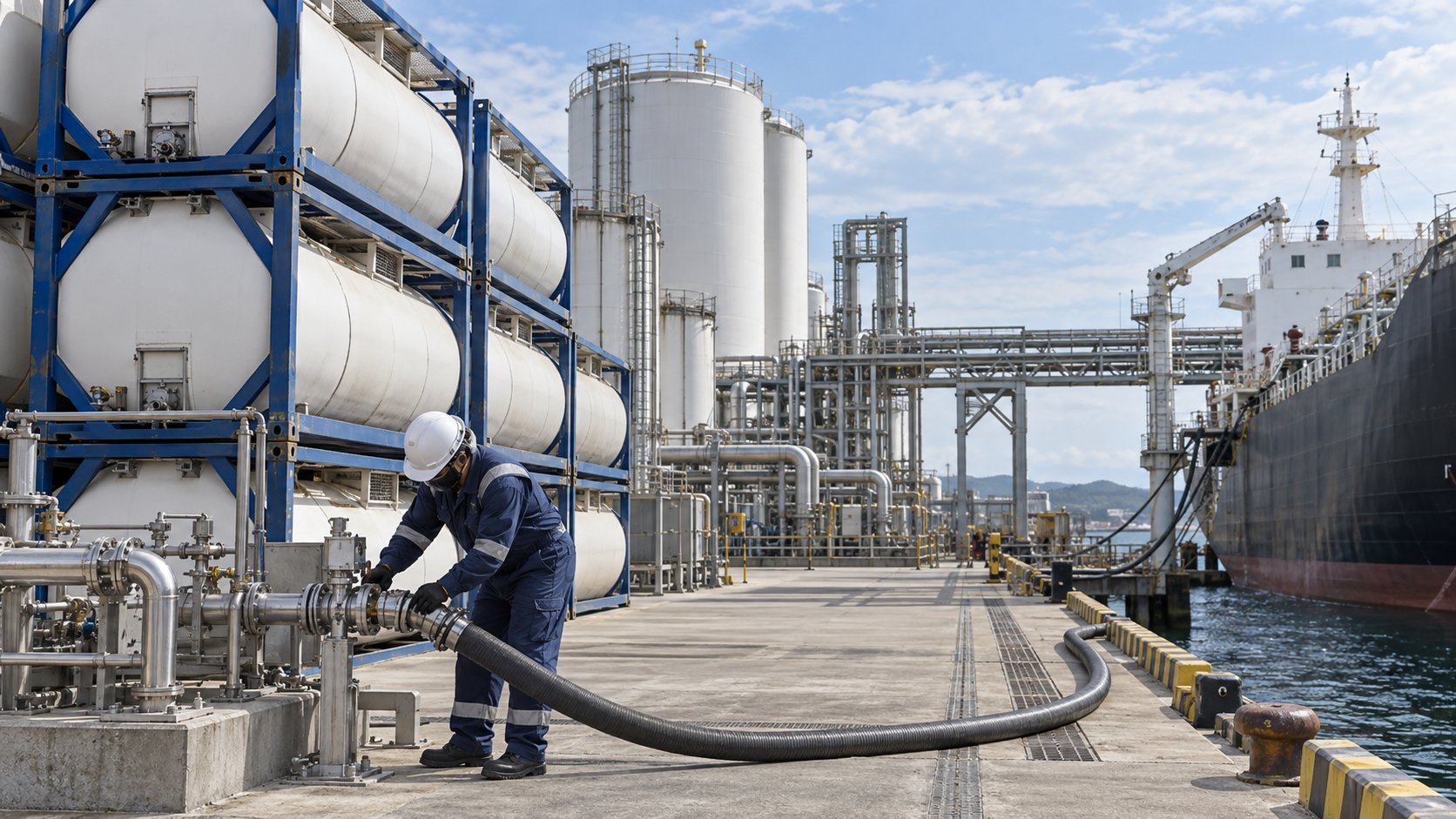
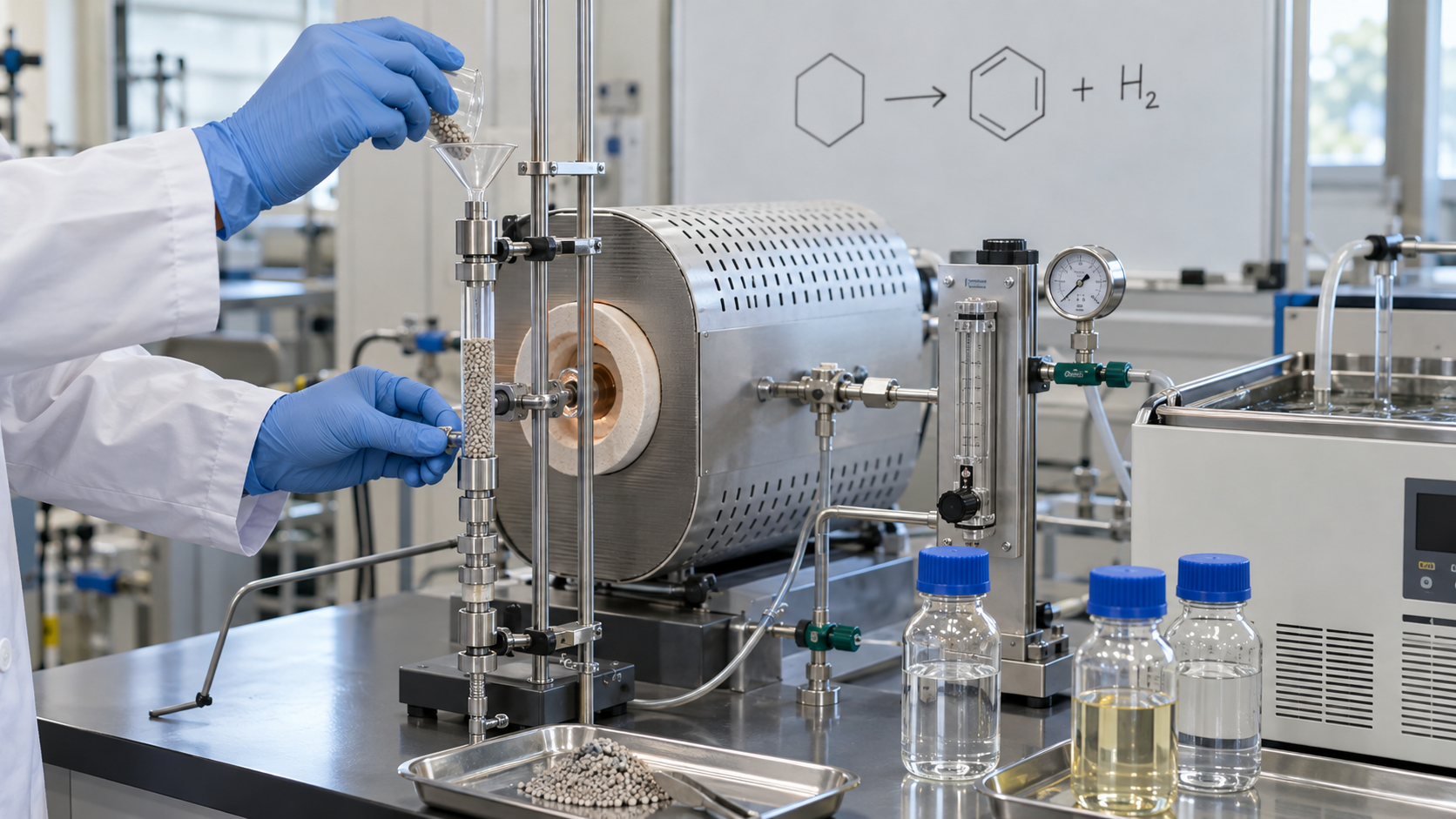
| Figs. 1 and 4 are AI-generated images, and Figs. 2, 3, 5 and 6 are explanatory drawings | Note by this article | Commentary |
Last updated 5 October 2026. Sources are limited to primary material (NEDO, IRENA, the US DOE, NIST, peer-reviewed papers and company announcements). Operation of commercial-scale MCH plants, the efficiency of the dehydrogenation heat source, correspondence to hydrogen purity standards, seal material compatibility and regulation of toluene handling could not be confirmed in published primary sources and so are not stated. Figs. 2, 3, 5 and 6 are vector drawings and Figs. 1 and 4 are AI-generated images; none of them shows a real facility or plant. This article explains materials, principles, evaluation and policy; it is not advice on handling or operating hydrogen or chemicals.