TECHNOLOGY EXPLAINER
Hydrogen Combustion Engines
— taming an easily ignited fuel by design
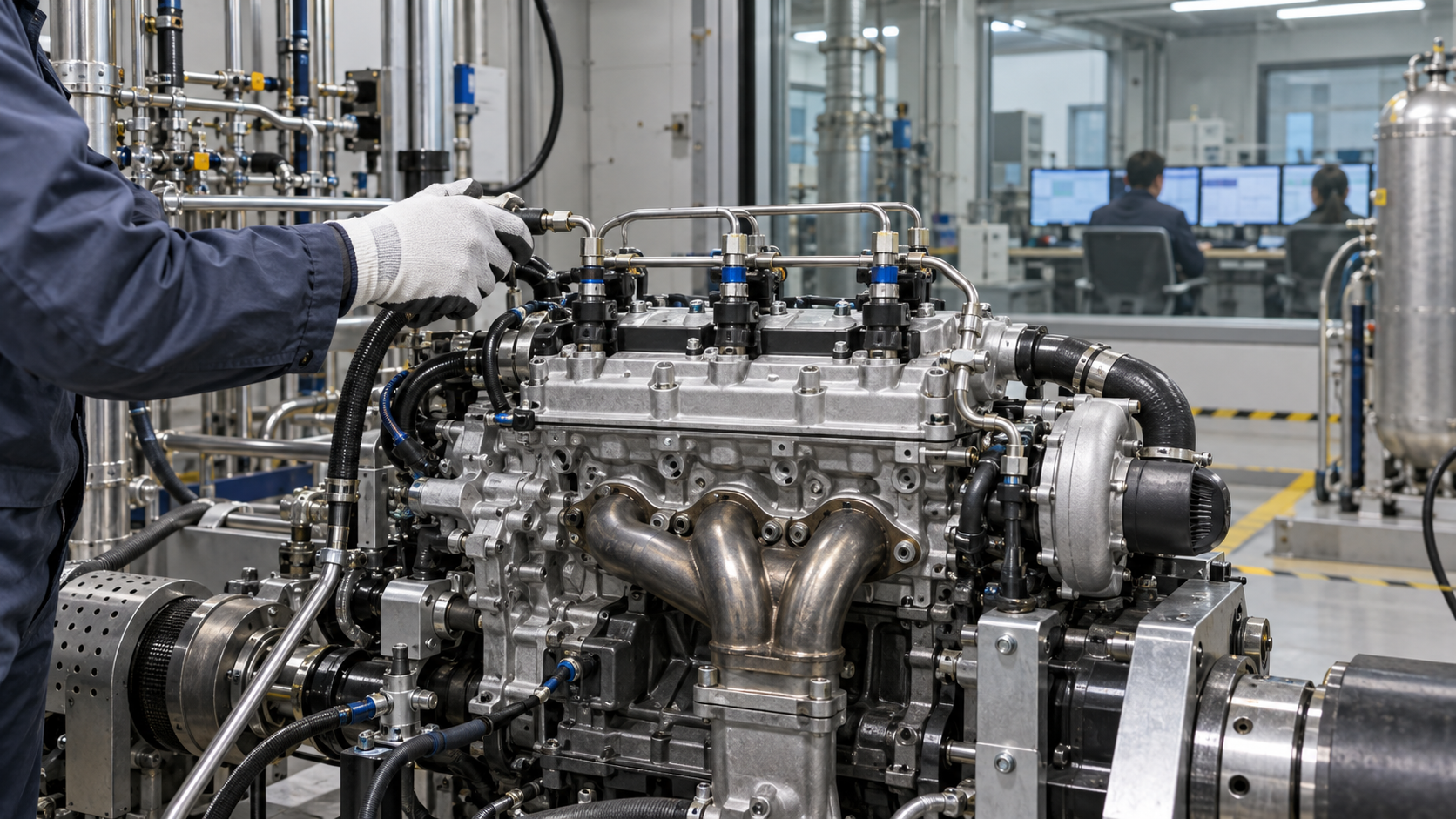
A hydrogen engine uses the architecture of a gasoline or diesel engine and swaps the fuel for hydrogen. Hydrogen is easy to ignite and burns fast. That opens the door to very lean combustion with low nitrogen oxides (NOx), but the same traits bring materials problems of their own: backfire, wear around the valves, and water getting into the lubricating oil. This article sets out what is inside the technology and how it is treated in EU and US emission rules, using published primary sources.
- What a hydrogen engine is (the short version)
- Combustion properties of hydrogen — ignition energy, burning velocity, flammability range
- NOx depends on how lean you burn
- How the mixture is made — port injection and direct injection
- Pre-ignition and backfire — what acts as the ignition source
- A materials engineer's view (1): valves, valve seats and hydrogen embrittlement
- A materials engineer's view (2): lubricating oil is both the source of CO2 and a receptacle for water
- Injectors, spark plugs and seals — a dry fuel and a very small molecule
- Emission regulation — what has been decided in the EU and the US
- What manufacturers' official materials confirm
- Our calculation: fuel consumption implied by MAN's stated values
- Challenges, and what we could not confirm
- Glossary / Primary sources / Claim-to-source audit
Sourced = stated in published material (link given)
Our calculation = a figure this article derived, with the assumptions spelled out
Not yet confirmed = a plan, proposal or target with no confirmed outcome or entry into application
Materials-design interpretations are marked as Commentary, and weakly supported ideas as Inference.
This article explains the principles, materials and regulation of hydrogen engines. Hydrogen is a flammable gas, and its handling is governed by laws and standards (in Japan, for example, the High Pressure Gas Safety Act). It is not advice on handling or operating any particular product or system; actual design, testing and handling must follow the applicable laws and expert review.
1. What a hydrogen engine is (the short version)
- The architecture is that of an existing engine: Toyota describes its hydrogen engine as an in-line 3-cylinder turbo with intercooler whose fuel supply and injection systems are modified from those of a gasoline engineSourced. MAN's hydrogen engine H45 is based on the D38 diesel engine and uses direct injection of hydrogenSourced.
- CO2 comes only from the lubricating oil: Toyota says a hydrogen engine emits zero CO2 in use apart from the combustion of minute amounts of engine oilSourced. The fuel contains no carbon, so there is no fuel-derived CO2.
- The difficulty is not "hydrogen" as such but how its properties reach materials and control: easy ignition leads to abnormal combustion (backfire, pre-ignition); the large volume of air needed for lean burn leads to turbocharging and oil blow-by; the water formed in combustion ends up in the lubricating oil. The chapters below follow the primary sources.
Both run on hydrogen, but a hydrogen engine burns it, whereas a fuel cell converts it electrochemically. Fuel-cell vehicles and polymer electrolyte fuel cells are covered in the "Fuel Cell Vehicles and PEM Fuel Cells" article in this series. A hydrogen engine draws air into the combustion chamber, so when combustion is hot the nitrogen in the air is oxidised and NOx forms — a key difference from a fuel cell (Chapter 3).
2. Combustion properties of hydrogen — ignition energy, burning velocity, flammability range
Hydrogen engine design starts from hydrogen's combustion properties. The table below collects values from NASA's hydrogen safety standard (NSS 1740.16, effective 12 February 1997). Values are for air at normal temperature and pressure (NTP) and change with pressure, temperature and mixture composition.
| Property | As stated in NASA NSS 1740.16 | What it means for an engine (commentary) |
|---|---|---|
| Flammability range (in air) | 4.0 to 75.0 vol% | Burns even when extremely lean, leaving ample room for lean-burn operation |
| Minimum ignition energy | 0.017 mJ (air, 101.3 kPa) | Hot spots and residual gas can act as ignition sources (Chapter 5) |
| Burning velocity (NTP air) | 2.70 to 3.50 m/s | The flame travels fast, so pressure rises quickly; this makes control harder but response quicker |
| Flame temperature (in air) | 2321 K (19.6 vol% hydrogen) | Directly tied to thermal NOx formation (Chapter 3) |
| Quenching distance (NTP air) | 0.6 mm (lowest reported 0.076 mm) | A flame can enter very narrow gaps, which matters for clearance design |
| Autoignition temperature | 773 to 850 K (stoichiometric hydrogen-air) | The document itself warns that it depends strongly on the system and surface condition |
| Lower heating value | 119.93 kJ/g | Large per mass, small per volume (storage is a separate technology topic) |
All Sourced (NASA NSS 1740.16, 1997 [Reference 1]). The right-hand column is commentary by this article. The document cautions that burning velocity and autoignition temperature change with pressure, temperature and composition and depend strongly on the system.
Ratio of minimum ignition energies: gasoline 0.24 mJ ÷ hydrogen 0.017 mJ = about 14; methane 0.29 mJ ÷ 0.017 mJ = about 17Our calculation.
Assumptions and limits: all three values come from the same paragraph of the NASA document and are minimums at "the most easily ignitable concentration". They are not a direct measure of how easily a mixture ignites inside an engine cylinder (hot, high-pressure, turbulent). The document also says that all three fuels have ignition energies low enough that ignition by a weak spark is relatively certainSourced. The gap is "a factor of ten or so", not orders of magnitude.
Fast burning has two faces in engine design
Toyota says combustion in a hydrogen engine is faster than in a gasoline engine, giving good responsivenessSourced. Fast burning can help thermal efficiency, because less time passes between ignition and the end of combustion. But the pressure rise is steeper, so knock, noise and loads on components need attention (commentary by this article).
3. NOx depends on how lean you burn
The fuel contains no carbon, so no fuel-derived CO2 or hydrocarbons are formed (commentary by this article). But the nitrogen in the air is oxidised at high temperature, forming NOx. Hydrogen's flame temperature is high (previous chapter), so keeping NOx down is the central issue. In a DOE annual report, Argonne National Laboratory (ANL) sets it out as followsSourced.
- In a hydrogen engine with external mixture formation (hydrogen and air mixed on the intake side; 0.5 L displacement, compression ratio 10.5), almost no NOx is produced once the relative air/fuel ratio λ exceeds about 2.2.
- Below that value NOx rises sharply, peaks at about λ = 1.3, and then falls again as the mixture is made richer still.
- The report says the same characteristic holds for early direct injection.
The same report compares two generations of ANL's direct-injection single-cylinder research engineSourced. The newer engine, with compression ratio raised from 11.5 to 12.9 and a longer stroke, needed a relative air/fuel ratio of λ = 1.9 instead of λ = 1.5 at the same load (8 bar IMEP), and NOx fell by more than two-thirds. The report itself says that a rise in NOx had been expected from the higher compression ratio, so the result was unexpected. NOx is mainly a function of peak in-cylinder temperature, and leaner burning lowers that temperature. Indicated thermal efficiency rose by about 6 points, from 37 to 38% to 43%.
To get the same output from a lean mixture you must take in correspondingly more air, so boosting (turbocharging) is assumed. In ANL's FY2011 report too, the engine maps were taken by controlling intake and exhaust pressure to simulate turbocharging, with lean control at λ = 3.3Sourced. Boosting also bears on oil blow-by (Chapter 7) and on thermal loads on parts (commentary by this article).
Reading NOx numbers with care
In ANL's FY2011 report, the single-cylinder engine map gives NOx of 0.87 g/kWh at the peak-efficiency point (2,000 rpm, 13.5 bar BMEP), 1.50 g/kWh in a small region near 3,000 rpm and 14.2 bar BMEP, and below 0.10 g/kWh over most of the mapSourced. These are engine-out values without aftertreatment, not values for a certified production engine. The report also feeds the single-cylinder results into a desk-top vehicle simulation (UDDS cycle) of a 3.0 L passenger car and computes NOx of 0.017 g/mile. But the report itself says that demonstration on a multi-cylinder direct-injection hydrogen engine remains openSourced. Laboratory single-cylinder results and regulatory certification values are different things (this article does not rank them against the regulatory values in Chapter 9).
4. How the mixture is made — port injection and direct injection
There are two main ways to form the mixture in a hydrogen engine. In port fuel injection (PFI), hydrogen is sprayed into the intake port and enters the cylinder mixed with air. In direct injection (DI), hydrogen is injected into the cylinder during the compression stroke, after the intake valve has closed.
| Item | Port fuel injection (PFI) | Direct injection (DI) |
|---|---|---|
| Where and when hydrogen enters | The intake port, around the intake stroke | The cylinder, during compression (after the intake valve closes) |
| Output and boosting | Hydrogen left on the intake side displaces fresh charge and lowers output (KIT paper). The PFI engine in the Beauregard report was boosted to make up output: about 200 hp against about 300 hp for the gasoline version | Only air is drawn into the cylinder before hydrogen is added. ANL took its maps under simulated boosting and shows high-load power density |
| Main issue | Backfire (Chapter 5). A reported case of an injector sticking open let hydrogen burn in the intake system | Durability of the high-pressure hydrogen injector. ANL calls it "the most critical component", still at a prototype stage needing development to reach production durability |
| Examples checked for this article | The GM pickups of the Beauregard report; the KIT single-cylinder (2025) | ANL single-cylinder (2010 to 2011); MAN H45 (described as direct injection) |
All Sourced (Beauregard report [Reference 2], DOE annual reports [References 3, 4], KIT paper [Reference 5], MAN [Reference 11]).
Direct-injection efficiency: reading research-lab numbers
ANL's FY2011 report shows a direct-injection single-cylinder research engine reaching a brake thermal efficiency (BTE) of 45.5% (2,000 rpm, 13.5 bar BMEP, start of injection 80° before top dead centre, hydrogen injection pressure 100 bar), exceeding DOE's 45% peak targetSourced. However, this BTE was calculated using friction losses estimated from a friction-optimised multi-cylinder engine; it is not a brake efficiency measured directly on the single-cylinder engine. The report also says demonstration on a multi-cylinder direct-injection hydrogen engine remains open and that the injector is at a prototype stageSourced. A peak efficiency from a research lab cannot be read as the efficiency of a commercial engine.
5. Pre-ignition and backfire — what acts as the ignition source
Hydrogen's low ignition energy (Chapter 2) leads to ignition in unexpected places in the intake system and cylinder. In PFI engines the main concern is backfire: ignition of the mixture in the intake port or manifold before the intake valve has closed.
A paper published in December 2025 by the Institute of Internal Combustion Engines at the Karlsruhe Institute of Technology (KIT; open access, CC BY 4.0) studies backfire conditions by experiment and CFD on a single-cylinder heavy-duty PFI engine based on a natural-gas engine (1,283 cm³, compression ratio 13.4, four valves)Sourced. Drawing on earlier work, its introduction groups the main causes of backfire as hot spots such as the edges of the exhaust valve, and residual gas, flame propagation during valve overlap (when intake and exhaust valves are open together), and excessive hydrogen concentration in the intake tract.
| Factor | KIT's conclusions (single-cylinder PFI engine) |
|---|---|
| Injector position | In a four-valve engine, injecting from near the larger intake port toward the intake valve seat reduced wall interaction and residual hydrogen and cut the backfire probability considerably |
| Start of injection | About 20 to 30% of intake valve lift gave the best balance of mixture uniformity and low residual hydrogen. Too early let hydrogen pool in the manifold, too late near the valve; either raised backfire risk |
| Back pressure | Higher back pressure increased internal EGR, raised intake temperature, and made backfire more likely |
| Valve timing | At high load, a late intake valve opening was the most effective measure, greatly reducing backflow and backfire |
| Injection pressure | Low pressure with long injection mixed better but raised backfire risk because injection overlapped valve closing. High pressure gave a safer margin but cost efficiency and cycle-to-cycle stability |
All Sourced (conclusions of Kinkhabwala et al. 2025 [Reference 5]). These are conclusions for this single-cylinder engine and do not necessarily carry over to other engines. The paper says reliable, efficient hydrogen combustion is an engineering challenge that requires optimising several parameters together, not one at a time.
In the Beauregard report (2010), prepared for DOE by Electric Transportation Engineering Corporation, PFI trucks suffered fuel injectors that stuck open, letting unmetered hydrogen into the intake system, where it ignited. In two engines flames burned through intake manifold gaskets and compromised wiring, and in at least one a muffler was blown by excess hydrogen in the exhaustSourced. These are records from an engine specification about 15 years old; recent engines will not necessarily show the same frequency.
The primary sources we opened did not let us confirm how "pre-ignition" and "backfire" are distinguished, or a quantitative ranking of the contribution of each cause. Oil droplets, deposits and the thermal behaviour of spark plugs are sometimes named as ignition sources for hydrogen, but we did not confirm primary sources supporting them, so they are not stated here.
6. A materials engineer's view (1): valves, valve seats and hydrogen embrittlement
The most concrete primary source on materials in hydrogen engines is the 2010 Beauregard report, prepared for DOE by Electric Transportation Engineering Corporation. It ran a hydrogen engine for 1,000 hours on a dynamometer, then drove eight pickup trucks (the text elsewhere says nine) for an average of 24,000 miles over about three years and took the engines apart for analysisSourced. The engines were boosted port-injected units; among the reasons for the lack of major failures, the report names an output well below the gasoline version (about 200 hp against about 300 hp).
| Observation | What the report says |
|---|---|
| 1,000-hour dynamometer run | No failures apart from corroded spark plugs and a fuel-injector failure. On teardown, every component except the intake and exhaust valves was in "exceptionally good condition". Valve recession was prevalent in both, most severe on the intake valves |
| Combustion chamber deposits | An unusual brownish-red deposit on all components in the chamber, the exhaust ports and the manifolds |
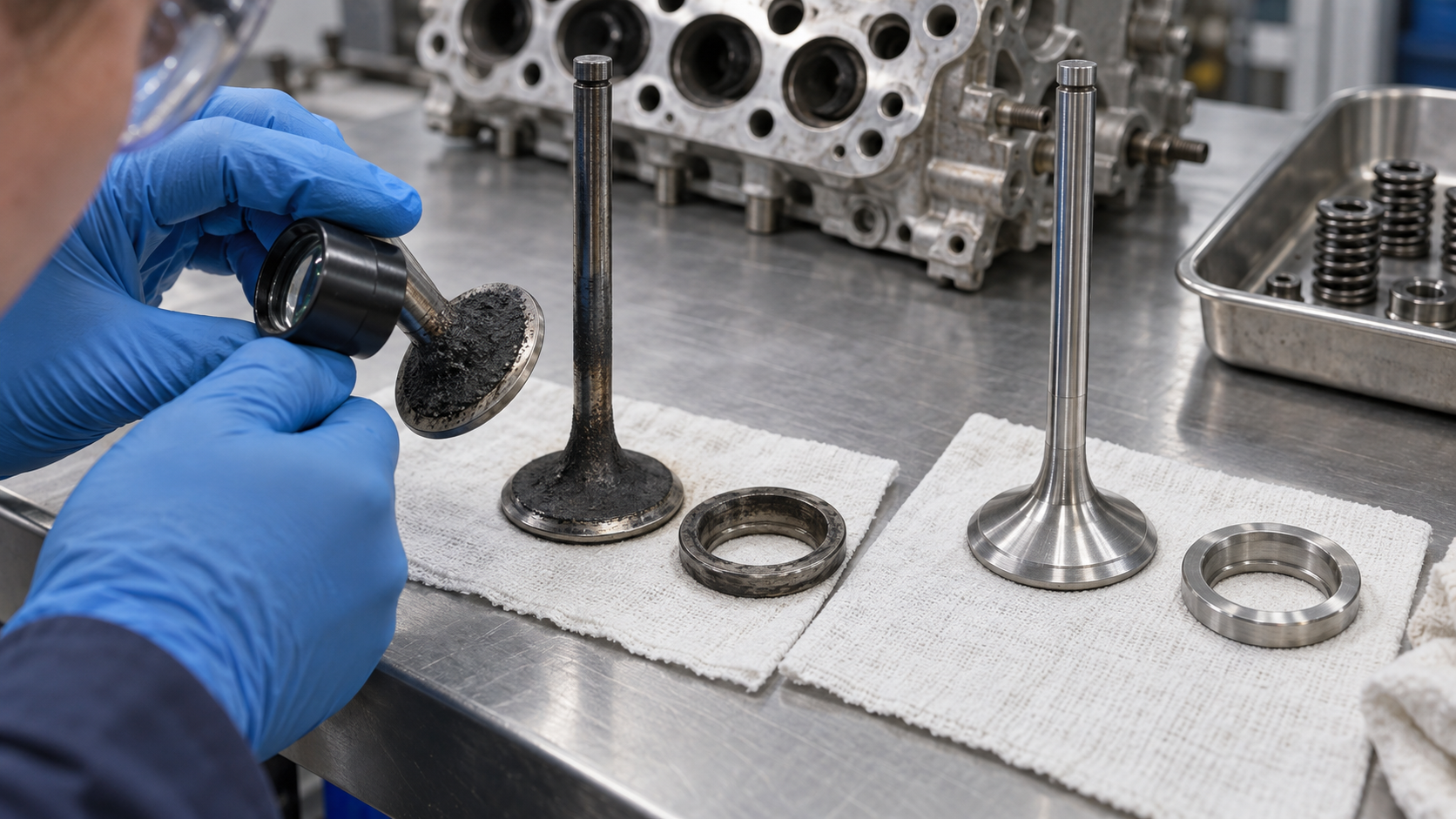
| Truck teardown | Heavy black deposits on piston crowns, valve faces and ports. Valve recession and general wear in both engines. The comparison gasoline engine showed little wear, and its valves and chambers were much cleaner |
| Impact test on intake valves | Valves from the hydrogen engines failed in a brittle manner, those from the gasoline engine in a ductile manner. The metallurgical specialists attributed the brittle fracture to hydrogen embrittlement |
| Conclusion of the report | Embrittlement is not a primary concern, yet "the particular material used for the intake valves was susceptible to embrittlement" and failure might have occurred after longer operation. Valve and seat wear was excessive; valve recession will ultimately cause valve failure or poor intake-valve sealing and lower efficiency. Materials for valves and seats that will last as long as a production passenger-car engine need further research |
All Sourced (Beauregard report, 2010 [Reference 2]). These are results for an engine specification about 15 years old and do not necessarily apply to current hydrogen engines.
According to the report, the comparison gasoline engine came from a recycler and probably had valves of a different composition from the alternative-fuel cylinder heads used on the hydrogen enginesSourced. So the "brittle versus ductile" difference in the impact test compares not only hydrogen against no hydrogen but also different valve materials. In addition, one sentence in the report's results section attributes the ductile failure to hydrogen embrittlement, contradicting the statement elsewhere that the brittle fracture was due to embrittlement (it looks like a slip, but we cannot confirm this).
NASA's hydrogen safety standard divides hydrogen embrittlement into three formsSourced: (1) environmental hydrogen embrittlement (metals plastically deformed in a hydrogen environment crack from the surface); (2) internal hydrogen embrittlement (premature failure caused by absorbed hydrogen, starting inside and possibly with little or no warning); (3) hydrogen reaction embrittlement (absorbed hydrogen reacts with constituents of the metal to form a brittle hydride; it occurs more readily at elevated temperature, and in steel hydrogen has formed methane with carbon). The same document says that stronger alloys are more susceptible to hydrogen's adverse effects, that for many metals internal and environmental embrittlement is greatest around 200 to 300 K, and that the susceptibility of steel increases with hydrogen purity.
Engine valves operate at several hundred degrees Celsius. Which of these forms actually acts on a valve is something we could not confirm in the primary sources we opened. The Beauregard report notes that high-strength steels are the most susceptible but are rarely used in the intake and combustion areas of an engine, yet it still observed brittle fracture in actual intake valves. In a hydrogen engine, hydrogen uptake and valve wear can proceed in parallel by different mechanisms, so valve evaluation has to look at both (commentary by this article).
Inference: the valve recession may be related to the weaker lubricating role of combustion products in hydrogen combustion compared with a gasoline engine. We did not find a primary source on the mechanism of valve recession in hydrogen engines, so this remains inference.
On cast aluminium alloys, the abstract of a COM 2022 paper (Walallawita et al.) says that published literature on hydrogen embrittlement of cast aluminium under high-temperature, high-pressure hydrogen exposure is limited, and proposes a two-step test procedureSourced (the full text is behind a paywall; we confirmed the abstract only). Public data on aluminium alloys used for pistons and cylinder heads under hydrogen exposure appear to be still scarce.
Evaluation: deposits get in the way of analysis
The Beauregard report also records a pitfall in materials analysisSourced. Thick deposits on the valves made the first ESCA (X-ray photoelectron spectroscopy) and SEM/EDS results implausible, with little iron and a lot of oxygen and carbon. After the samples were cleaned (an ultrasonic petroleum bath, or hydrochloric acid with an antimony inhibitor) and re-measured, a high iron fraction was obtained (some deposit remained). The result of analysing a part that carries deposits can change with the cleaning method; this lesson is not specific to hydrogen engines (commentary by this article).
7. A materials engineer's view (2): lubricating oil is both the source of CO2 and a receptacle for water
In a hydrogen engine no CO2 comes from the fuel, so the lubricating oil becomes the only carbon source (Toyota: zero CO2 while running, apart from the combustion of minute amounts of engine oil)Sourced. At the same time, combustion produces a great deal of water, and some of it gets into the oil. These two facts shape oil design for hydrogen engines.
- Water ingress: In the Beauregard report, frequent stop-start operation meant the engine did not get warm enough, so water formed in combustion did not evaporate out of the sump, and oil samples across several vehicles and periods showed excess waterSourced. The report says the water compromises lubrication, and lists faster warm-up through engine management, keeping the engine running until it reaches temperature, and external oil heating as possible remedies.
- Blow-by: The report presumes that with high intake pressure, oil was drawn into the combustion chamber through the crankcase ventilation (PCV) system and became deposits on piston crowns and valve facesSourced. Since hydrogen forms no soot, the reading is that the deposits come mainly from oil (commentary).
- CO2: Under the EU heavy-duty CO2 regulation, a vehicle with an internal combustion engine counts as a zero-emission heavy-duty vehicle if the engine emits no more than 1 g/kWh of CO2 (or, in vehicle testing, no more than 3 g CO2/tkm or 1 g CO2/pkm)Sourced. In its April 2024 announcement MAN gave the hTGX's CO2 emission as under 1 g CO2/tkm and said it meets the zero-emission criteria of the then-planned new EU CO2 rulesSourced. Oil consumption and composition therefore bear on CO2 compliance (commentary).
The sources we confirmed contain nothing on lubricant specifications or additive design specific to hydrogen engines; we could not confirm them.
8. Injectors, spark plugs and seals — a dry fuel and a very small molecule
Hydrogen is a dry fuel with no lubricity, and its molecules are very small. The Beauregard report says these two facts make injector design difficultSourced.
- Injectors: Because the molecule is so small, it is hard for a valve to seal completely and to meter fuel accurately and repeatably. The fuel gives no lubrication to the injector's internal moving parts. The early injectors in this engine lasted about 12 months; the latest third generation has proved reliable so far and may last longer. There are two failure modes: stuck closed (the cylinder produces no power) and stuck open (hydrogen enters the intake unmetered and ignites).
- Spark plugs: Life was about six months, after which fouling led to misfires. The cause is believed to be accelerated corrosion, from the amount of water formed, from interaction with hydrogen, or both; the remedy named is a plug made of corrosion-resistant materials such as stainless steel (similar plugs exist for marine use).
- A remark on fuel purity: Station hydrogen is extremely clean for fuel-cell vehicles. The report suggests that "lesser grades of hydrogen, perhaps doped with small amounts of lubricating oil" might prove useful, as an idea worth trying (not a demonstrated method).
The small size of the hydrogen molecule should matter not only for sealing injectors but also for the design of elastomers, gaskets and joints in the intake system. Yet the primary sources we opened contained no data on seal or gasket materials for hydrogen engines, or on how they change in hydrogen. All we could confirm is the incident described earlier, in which a flame burned through an intake-manifold gasket after an injector stuck open. The place of fluoropolymer and fluoroelastomer seal materials is discussed in the "Fluoropolymers and PFAS" article in this series, and the thinking on gas permeation in the "Barrier Properties and Coatings" article.
9. Emission regulation — what has been decided in the EU and the US
In regulation, a hydrogen engine is treated partly as an "internal combustion engine" and partly as something that can count as "zero-emission". What follows is limited to what we could confirm in legal texts. The date of confirmation is October 2026; where amendments or proposals are in progress, we say so.
EU: Euro 7 (Regulation (EU) 2024/1257)
| Item | What the legal text confirms |
|---|---|
| What it is | A type-approval regulation on emissions and battery durability, published in the Official Journal on 8 May 2024. It defines a "pure internal combustion engine vehicle" (ICEV) as a vehicle whose propulsion energy converters are all internal combustion engines, "including hydrogen powered ones", so hydrogen-engine vehicles fall within it |
| Application dates (Article 21) | M1 and N1 (cars and vans): new types 29 November 2026, all new vehicles 29 November 2027. M2, M3, N2, N3 (buses, trucks and the like): new types 29 May 2028, all new vehicles 29 May 2029. For small-volume manufacturers: 1 July 2030 for M1 and N1, 1 July 2031 for M2, M3, N2 and N3 |
| Limits for cars and vans (Annex I, Table 1, class M1) | NOx: 60 mg/km (positive ignition, PI), 80 mg/km (compression ignition, CI). PM 4.5 mg/km; particle number (PN10) 6×10¹¹ per km. Which column (PI or CI) a hydrogen engine falls under is not stated explicitly in the text we checked |
| Limits for buses and trucks (Annex I, Table 2) | Over WHSC and WHTC: NOx 200 mg/kWh, PM 8 mg/kWh, PN10 6×10¹¹ per kWh, CO 1,500 mg/kWh, NMOG 80 mg/kWh, NH3 60 mg/kWh, CH4 500 mg/kWh, N2O 200 mg/kWh. Real driving emissions (RDE): NOx 260 mg/kWh, among others |
| Status (checked October 2026) | Application is about to begin (first date 29 November 2026). On 16 December 2025 the European Commission proposed a "simplification of technical requirements and testing procedures for motor vehicles" (Omnibus IX, procedure 2025/0422(COD)), which includes amendments to Euro 7. On the European Parliament Legislative Observatory page the status read "Awaiting committee decision" when checkedNot yet confirmed |
Limits and application dates are Sourced (text of Regulation (EU) 2024/1257 [Reference 12]). The content and status of the Omnibus proposal were checked on [Reference 14] only to that extent; the final adopted content is not yet confirmed.
EU: heavy-duty CO2 rules (Regulation (EU) 2024/1610, amending Regulation (EU) 2019/1242)
Regulation (EU) 2024/1610, published on 6 June 2024, tightens the heavy-duty CO2 rules and also defines "zero-emission heavy-duty vehicle". A vehicle with an internal combustion engine still qualifies if the engine's CO2 emission is no more than 1 g/kWh (or 1 g/km), or, in vehicle testing, no more than 3 g CO2/tkm or 1 g CO2/pkmSourced. A recital says zero-emission heavy-duty vehicles currently include battery electric vehicles, fuel-cell and other hydrogen-powered vehiclesSourced. The structure, then, is that a hydrogen engine can qualify if CO2 from lubricating oil stays below these thresholds (Chapter 7).
US: EPA heavy-duty NOx rule and GHG standards
| Rule | What we could confirm |
|---|---|
| Heavy-duty engine and vehicle NOx rule (published 24 January 2023, 88 FR 4296) | From model year 2027 (MY2027), NOx of 35 mg/hp-hr over the FTP cycle (stated in the spark-ignition section). The preamble says the numerical standards are identical for SI and CI engines. As technology pathways manufacturers may choose, it lists alternative fuels including "hydrogen in combination with relevant emissions aftertreatment technologies" |
| Proposed amendments to the NOx rule (published 14 July 2026) | For MY2027 and later heavy-duty engines, EPA proposes changes to the regulatory useful-life periods and the emission-related warranty periods, plus clarifications and correctionsNot yet confirmed |
| Repeal of GHG standards (finalised 12 February 2026, published 18 February 2026, 91 FR 7686, effective 20 April 2026) | EPA rescinded the 2009 greenhouse-gas endangerment finding and repealed all GHG emission standards for light-, medium- and heavy-duty vehicles and engines. Manufacturers have no future obligations for measuring, controlling or reporting GHG for highway engines and vehicles. EPA states that this does not affect rules on traditional air pollutants such as NOx. We did not check the status of any litigation over this final rule |
All Sourced (Federal Register 88 FR 4296 [Reference 15], 91 FR 7686 [Reference 16], EPA web page [Reference 17]). How the 2027 NOx rule applies to hydrogen engines in detail (certification categories, for instance) could not be confirmed.
Converting the US 35 mg/hp-hr to a per-kWh basis with 1 hp = 0.7457 kW: 35 ÷ 0.7457 = about 47 mg/kWhOur calculation. The Euro 7 NOx limit for buses and trucks is 200 mg/kWh (WHSC, WHTC), so on paper the numbers differ by about a factor of four.
Assumptions and limits: the US value is a certification limit over the FTP cycle and the EU value a limit over WHSC and WHTC; the test cycles, durability periods (useful life) and treatment of real-world driving differ. This is only a unit conversion and does not show which rule is stricter.
10. What manufacturers' official materials confirm
The table below separates what manufacturers' own announcements confirm into when it was announced and where it stands now. Performance figures are the manufacturer's stated values, not third-party measurements.
| Manufacturer | What the official announcements confirm | Standing |
|---|---|---|
| Toyota | 22 April 2021: displacement 1,618 cc, in-line 3-cylinder turbo with intercooler, compressed hydrogen, fuel supply and injection systems modified from the gasoline engine's. Zero CO2 while running apart from minute combustion of engine oil [Reference 7]. 14 November 2025 (before the final race): a liquid-hydrogen GR Corolla finished the race of 30 May to 1 June without replacing the pump that pressurises liquid hydrogen. Higher engine output, however, loaded the pump more, and continuous operation at maximum output remained a durability challenge [Reference 8]. 5 June 2026 (before the race of 5 to 6 June): a superconducting liquid-hydrogen pump fitted to the same car and tank capacity raised from 220 L to a maximum of 300 L ("world first" is Toyota's own claim) [Reference 9] | A competition test vehicle used to try the technology in motorsport. Toyota describes the aim of the challenge as applying hydrogen engine technology to future production vehicles. Whether and when a production vehicle will follow is not stated in the announcements we opened. We did not check the results of the 2026 race |
| BMW | 12 September 2006: BMW Hydrogen 7. A twelve-cylinder engine that runs on either hydrogen or gasoline, 260 hp, about 8 kg of liquid hydrogen (range on hydrogen alone over 125 miles), limited series [Reference 10] | A limited series from about 20 years ago. We did not check BMW's current hydrogen engine plans |
| MAN | 8 April 2024: hTGX. Hydrogen engine H45 (based on the D38 diesel, direct hydrogen injection), 383 kW (520 hp), 2,500 N·m (900 to 1,300 rpm), 56 kg of hydrogen at 700 bar, refuelling in under 15 minutes, up to about 600 km, CO2 under 1 g/tkm, said to meet the zero-emission vehicle criteria of the then-planned new EU CO2 rules [Reference 11] | A small series of about 200 units planned for delivery as early as 2025 (at the time of the announcement)Not yet confirmed. The number actually delivered could not be confirmed |
All Sourced (official announcements [References 7 to 11]). Figures are the manufacturer's stated values, and the announcements do not give the test conditions for range and similar figures. We did not cover Cummins and other commercial-vehicle makers because we could not open their official pages.
11. Our calculation: fuel consumption implied by MAN's stated values
Using MAN's stated values (56 kg of hydrogen, range of up to about 600 km) and the lower heating value of 119.93 kJ/g from the NASA standard, we convert by arithmetic aloneOur calculation.
- Energy content of the hydrogen: 56 kg × 119.93 MJ/kg = 6,716 MJ = about 1,866 kWh (6,716 ÷ 3.6)
- Hydrogen per distance: 56 kg ÷ 600 km = about 0.093 kg/km = about 9.3 kg/100 km
- Energy per distance: 1,866 kWh ÷ 600 km = about 3.1 kWh/km
Assumptions and limits: MAN's announcement does not give the conditions behind "up to about 600 km" (payload, driving conditions, how the tank reserve is counted). This is arithmetic that assumes the whole 56 kg is usable and the range is 600 km, and it is not a real fuel economy. Under real conditions the distance may be shorter, so the consumption derived here should be read as a value that real operation could exceed (commentary by this article).
12. Challenges, and what we could not confirm
(1) Research-lab numbers and production-engine numbers are different things
ANL's single-cylinder efficiency (BTE 45.5%) and NOx are values for a research single-cylinder engine, and multi-cylinder demonstration is described as still outstanding (Chapters 3 and 4). MAN's hTGX is a commercial vehicle with direct hydrogen injection, but its efficiency and NOx measurements are not given in MAN's announcement, as far as we checked.
(2) The primary data on materials and durability is old
Concrete observations on valves and seats, spark plugs, injectors and lubricating oil come mainly from the 2010 Beauregard report. We could not confirm durability data for current-generation engines in the primary sources we opened. The "durability of continuous operation at maximum output" that Toyota named in November 2025 is described for the liquid-hydrogen pump, not as engine durability data.
(3) What we could not confirm
- Whether the MAN H45 has NOx aftertreatment (SCR and the like), and its measured NOx and efficiency
- The mechanism of valve recession and hydrogen embrittlement (which form of embrittlement acts on valves), and evaluation results for current materials
- Seal and gasket materials for hydrogen engines and how hydrogen changes them
- Lubricant specifications and additive design specific to hydrogen engines
- Official materials from other makers such as Cummins, Daimler Truck and Deutz, and their latest plans and delivery records
- The certification treatment of hydrogen engines under the US NOx rule, and the text of UN GTR No. 13 (global technical regulation for hydrogen and fuel-cell vehicles)
- The treatment of hydrogen-engine vehicles under Japanese safety standards and certification
- Hydrogen has a low ignition energy (0.017 mJ) and burns fast. But the gap to gasoline (0.24 mJ) and methane (0.29 mJ) is a factor of ten or so, not orders of magnitudeSourcedOur calculation
- NOx is set by how lean you burn. In an external-mixture example almost none forms above λ of about 2.2. But leaner burning needs more boostSourced
- PFI is troubled by backfire, DI by the durability of the high-pressure injector. In KIT's single-cylinder tests, a combination of injection position and timing with intake valve timing nearly eliminated backfireSourced
- The materials observations are old (2010) but concrete. Valve recession, brittle fracture of an intake valve, water in the oil, spark-plug life of about six months, injectors sticking openSourced
- In regulation, an internal combustion engine that can still count as zero-emission. The EU uses thresholds such as 1 g/kWh; MAN states under 1 g CO2/tkmSourced
- Manufacturers' plans are not yet confirmed. MAN planned a small series of about 200 units; Toyota's car is a competition test vehicle and names pump durability as a challengeNot yet confirmed
13. Glossary
- Relative air/fuel ratio (λ)
- Actual air supplied divided by the minimum air needed for complete combustion. Above 1 means a leaner mixture.
- Port fuel injection (PFI)
- Fuel is injected into the intake port and mixes with air before entering the cylinder.
- Direct injection (DI)
- Fuel is injected straight into the cylinder; for hydrogen, during the compression stroke.
- Backfire
- Ignition of the mixture in the intake port or manifold before the intake valve has closed.
- Valve overlap
- The period when the intake and exhaust valves are open at the same time.
- NOx (nitrogen oxides)
- Collective term for NO and NO2, formed when nitrogen and oxygen in air react in high-temperature combustion.
- Boosting
- Compressing the intake air to put more air into the cylinder, by turbocharger or supercharger.
- IMEP / BMEP
- Indicated / brake mean effective pressure; a measure of engine load, in bar.
- BTE (brake thermal efficiency)
- The share of the fuel's heat that is delivered as shaft output.
- Blow-by
- Gas leaking past the piston rings into the crankcase; it can carry oil back into the combustion chamber.
- Hydrogen embrittlement
- Loss of ductility and toughness in a metal that has absorbed hydrogen. There are several forms.
- Valve recession
- Wear of the valve and seat that lets the valve sink into its seat, worsening sealing.
- EGR
- Exhaust gas recirculation: returning part of the exhaust to the intake to lower combustion temperature.
- WHSC / WHTC
- EU steady-state (WHSC) and transient (WHTC) test cycles for heavy-duty engines.
- FTP
- The US transient test cycle for heavy-duty engines.
- Zero-emission heavy-duty vehicle
- A category defined in the EU heavy-duty CO2 regulation; a vehicle with an internal combustion engine can qualify if its CO2 is below the thresholds.
- MY (model year)
- The year-of-manufacture category used in US regulation.
14. Primary sources
- NASA "Safety Standard for Hydrogen and Hydrogen Systems", NSS 1740.16, effective 12 February 1997 — ntrs.nasa.gov
- Electric Transportation Engineering Corporation (for the U.S. DOE) Beauregard, G. "Findings of Hydrogen Internal Combustion Engine Durability", 2010, DOI 10.2172/1031548 — osti.gov
- U.S. DOE "FY 2010 Annual Progress Report, Advanced Combustion Engine R&D", II.A.14 Wallner (Argonne National Laboratory) "Optimization of Direct Injection Hydrogen Combustion Engine Performance, Efficiency and Emissions" (PDF) — energy.gov
- U.S. DOE "FY 2011 Annual Progress Report, Advanced Combustion Engine R&D", II.A.14 Wallner, Scarcelli, Matthias (Argonne National Laboratory) (PDF) — energy.gov
- KIT (Karlsruhe Institute of Technology) Kinkhabwala, B., Krishna, K., Reppert, F., Wagner, U., Koch, T. "An experimental and computational analysis of backfire initiation and propagation in a single-cylinder hydrogen port-fuel-injection engine", Automotive and Engine Technology 10, 16 (2025), DOI 10.1007/s41104-025-00163-9 — link.springer.com
- Springer Walallawita, R., Stroh, J., Sediako, D. "The Effect of Hydrogen Embrittlement on Aluminum Alloys Used for Hydrogen-Fueled Internal Combustion Engine", Proceedings of the 61st Conference of Metallurgists (COM 2022), 2023 (abstract only checked), DOI 10.1007/978-3-031-17425-4_58 — link.springer.com
- Toyota Motor Corporation "Toyota Developing Hydrogen Engine Technologies Through Motorsports", 22 April 2021 — global.toyota
- Toyota Motor Corporation "Pushing Hydrogen Engine Technology to New Heights in the Super Taikyu Series Final Race", 14 November 2025 — global.toyota
- Toyota Motor Corporation "Hydrogen-Powered GR Corolla Takes on World-First Challenge at Super Taikyu Fuji 24 Hours Race", 5 June 2026 — global.toyota
- BMW Group "BMW introduces world's first hydrogen-drive luxury performance car for everyday use: the BMW Hydrogen 7", 12 September 2006 — press.bmwgroup.com
- MAN Truck & Bus "MAN expands its zero-emission portfolio", 8 April 2024 — press.mantruckandbus.com
- European Parliament and Council Regulation (EU) 2024/1257 (Euro 7), Official Journal, 8 May 2024 — eur-lex.europa.eu
- European Parliament and Council Regulation (EU) 2024/1610 (amending Regulation (EU) 2019/1242), Official Journal, 6 June 2024 — eur-lex.europa.eu
- European Parliament Legislative Observatory Procedure 2025/0422(COD) "Simplification of technical requirements and testing procedures for motor vehicles (Omnibus IX on automotive)" — oeil.europarl.europa.eu
- U.S. EPA "Control of Air Pollution From New Motor Vehicles: Heavy-Duty Engine and Vehicle Standards; Final Rule", 88 FR 4296, 24 January 2023 — govinfo.gov
- U.S. EPA "Rescission of the Greenhouse Gas Endangerment Finding and Motor Vehicle Greenhouse Gas Emission Standards Under the Clean Air Act; Final rule", 91 FR 7686, 18 February 2026 — federalregister.gov
- U.S. EPA "Regulations for Smog, Soot, and Other Air Pollution from Commercial Trucks & Buses" (version updated 20 July 2026 checked) — epa.gov
15. Claim-to-source audit
| Claim in the text | Basis | Label |
|---|---|---|
| Flammability range 4.0 to 75.0 vol%; minimum ignition energies of 0.017 mJ (hydrogen), 0.24 mJ (gasoline) and 0.29 mJ (methane), and that ignition by a weak spark is relatively certain in all three fuels; burning velocity 2.70 to 3.50 m/s; flame temperature 2321 K (19.6 vol%); quenching distance 0.6 mm (lowest reported 0.076 mm); autoignition temperature 773 to 850 K; lower heating value 119.93 kJ/g. The document's caution that burning velocity and autoignition temperature depend on conditions. The three forms of hydrogen embrittlement, higher susceptibility in stronger alloys, the 200 to 300 K maximum for internal and environmental embrittlement, and susceptibility of steel rising with purity | NASA NSS 1740.16 Reference 1 https://ntrs.nasa.gov/citations/19970033338 | Sourced |
| The 1,000-hour dynamometer test; the operation of eight pickups (nine in places in the text) for about 24,000 miles over about three years; output of about 200 hp against about 300 hp for the gasoline version. Valve recession, deposits (brownish-red and black), brittle fracture of intake valves in the impact test and the judgement of hydrogen embrittlement, the different composition of the comparison gasoline engine's valves, and the report's conclusions (embrittlement not a primary concern but the intake-valve material susceptible; more research needed on valve and seat materials). ESCA and SEM/EDS disturbed by deposits and re-measured after cleaning. Water ingress into the oil and the suggested remedies, blow-by from boosting and deposits. Injectors (difficulty of sealing, no lubricity, early life of about 12 months, stuck-closed and stuck-open failures), a flame burning through the gasket and the blown muffler, spark-plug life of about six months and the corrosion-resistant material suggestion, the suggestion of lower-purity hydrogen with a little oil. The inconsistency in the report between brittle and ductile | Beauregard report Reference 2 https://www.osti.gov/biblio/1031548 | Sourced |
| In an external-mixture hydrogen engine almost no NOx above λ of about 2.2, peaking near λ = 1.3. The two ANL generations (compression ratio 11.5 to 12.9, λ = 1.5 to 1.9, NOx down by more than two-thirds, indicated thermal efficiency 37 to 38% to 43%). That a rise in NOx had been expected from the higher compression ratio. Similar behaviour with direct injection and early injection | DOE FY2010 annual report Reference 3 https://www.energy.gov/sites/prod/files/2014/03/f8/2010_adv_combustion_engine.pdf | Sourced |
| BTE of 45.5% (2,000 rpm, 13.5 bar BMEP, start of injection 80° BTDC, injection pressure 100 bar); friction estimated from a friction-optimised multi-cylinder engine; maps under simulated boosting at λ = 3.3; NOx (0.87 g/kWh at the peak-efficiency point, 1.50 g/kWh in a small region, below 0.10 g/kWh over most of the map); 0.017 g/mile on UDDS for a 3.0 L model; multi-cylinder demonstration still open; the injector at a prototype stage and the most critical component | DOE FY2011 annual report Reference 4 https://www.energy.gov/sites/prod/files/2014/03/f8/2011_adv_combustion_engine.pdf | Sourced |
| The KIT single-cylinder PFI engine (natural-gas engine base, 1,283 cm³, compression ratio 13.4, four valves) and its backfire conclusions (injector position, start of injection at 20 to 30% lift, back pressure, late intake valve opening, injection pressure trade-off, near elimination when combined). The introduction's grouping of backfire causes. Residual hydrogen displacing fresh charge and lowering output. CC BY 4.0, published 9 December 2025 | Kinkhabwala et al. Reference 5 https://link.springer.com/article/10.1007/s41104-025-00163-9 | Sourced |
| That literature on hydrogen embrittlement of cast aluminium alloys under high-temperature, high-pressure hydrogen exposure is limited, and that a two-step test procedure is proposed (abstract only checked) | Walallawita et al. Reference 6 https://link.springer.com/chapter/10.1007/978-3-031-17425-4_58 | Sourced |
| Toyota's hydrogen engine (displacement 1,618 cc, in-line 3-cylinder turbo with intercooler, compressed hydrogen, fuel supply and injection systems modified from the gasoline engine's, faster combustion than gasoline, zero CO2 apart from minute combustion of oil) | Toyota, 22 April 2021 Reference 7 https://global.toyota/en/newsroom/corporate/35209996.html | Sourced |
| That Toyota finished the race without replacing the liquid-hydrogen pump, the new filling valve, and that higher output loaded the pump so that continuous operation at maximum output remained a durability challenge (announcement of 14 November 2025) | Toyota, 14 November 2025 Reference 8 https://global.toyota/en/newsroom/corporate/43550115.html | Sourced |
| Toyota's GR Corolla H2 Concept (liquid hydrogen, tank 220 L to a maximum of 300 L, superconducting pump, the stated aim of applying the technology to future production vehicles) | Toyota, 5 June 2026 Reference 9 https://global.toyota/en/newsroom/corporate/44458612.html | Sourced |
| BMW Hydrogen 7 (twelve cylinders on hydrogen or gasoline, 260 hp, about 8 kg of liquid hydrogen, over 125 miles on hydrogen, limited series) | BMW Group, 12 September 2006 Reference 10 https://www.press.bmwgroup.com/global/article/detail/T0012215EN/bmw-introduces-world-s-first-hydrogen-drive-luxury-performance-car-for-everyday-use-the-bmw-hydrogen-7?language=en | Sourced |
| MAN hTGX (H45 based on the D38 diesel, direct hydrogen injection, 383 kW and 520 hp, 2,500 N·m at 900 to 1,300 rpm, 56 kg at 700 bar, under 15 minutes, up to about 600 km, under 1 g CO2/tkm, a plan for about 200 units) | MAN, 8 April 2024 Reference 11 https://press.mantruckandbus.com/corporate/man-expands-its-zero-emission-portfolio/ | Sourced |
| The Euro 7 definition of ICEV (including hydrogen powered ones), application dates, limits for cars and vans (NOx 60 mg/km PI and 80 mg/km CI, and others), limits for buses and trucks (NOx 200 mg/kWh, RDE 260 mg/kWh, PN10, NH3 and others), Official Journal publication on 8 May 2024 | Regulation (EU) 2024/1257 Reference 12 https://eur-lex.europa.eu/legal-content/EN/TXT/HTML/?uri=CELEX:32024R1257 | Sourced |
| The definition of zero-emission heavy-duty vehicle (engine CO2 of 1 g/kWh or less, or 3 g CO2/tkm or less and 1 g CO2/pkm or less) and the recital that zero-emission heavy-duty vehicles include fuel-cell and other hydrogen-powered vehicles. Official Journal publication on 6 June 2024 | Regulation (EU) 2024/1610 Reference 13 https://eur-lex.europa.eu/legal-content/EN/TXT/HTML/?uri=CELEX:32024R1610 | Sourced |
| The procedure number 2025/0422(COD) of Omnibus IX, that it includes amendments to Euro 7 (Regulation 2024/1257), and the status "Awaiting committee decision" when checked. The Commission proposal of 16 December 2025 (COM(2025) 993) is a proposal under discussion and its final content is not yet confirmed | European Parliament Legislative Observatory Reference 14 https://oeil.europarl.europa.eu/oeil/en/procedure-file?reference=2025/0422(COD) | Not yet confirmed |
| The US NOx rule (35 mg/hp-hr over the FTP cycle from MY2027), identical numerical standards for SI and CI, and the preamble listing hydrogen among alternative fuels | EPA 88 FR 4296 Reference 15 https://www.govinfo.gov/content/pkg/FR-2023-01-24/html/2022-27957.htm | Sourced |
| The repeal of GHG standards (91 FR 7686, published 18 February 2026, effective 20 April 2026): the endangerment finding rescinded and GHG standards for light-, medium- and heavy-duty vehicles repealed | EPA Federal Register Reference 16 https://www.federalregister.gov/documents/2026/02/18/2026-03157/rescission-of-the-greenhouse-gas-endangerment-finding-and-motor-vehicle-greenhouse-gas-emission | Sourced |
| The proposed amendments of 14 July 2026 for MY2027 and later heavy-duty engines (useful life, warranty and others), and EPA's statement that the GHG repeal does not affect rules on traditional air pollutants | EPA web page Reference 17 https://www.epa.gov/regulations-emissions-vehicles-and-engines/regulations-smog-soot-and-other-air-pollution-commercial | Not yet confirmed |
| The ignition-energy ratios (0.24 ÷ 0.017 = about 14, 0.29 ÷ 0.017 = about 17), the unit conversion of the US NOx value (35 ÷ 0.7457 = about 47 mg/kWh), MAN's 56 kg × 119.93 MJ/kg = 6,716 MJ (about 1,866 kWh), 56 ÷ 600 = about 9.3 kg/100 km, and about 3.1 kWh/km | Our calculation. Arithmetic with 1 hp = 0.7457 kW, 1 kWh = 3.6 MJ and MAN's stated values (56 kg, up to about 600 km). The conditions for the range are not given in the announcement | Our calculation |
| The results of Toyota's 2026 race, the number of MAN's planned 200 units actually delivered, and the current plans of BMW and others | Not stated in the official announcements we opened, and delivery numbers and current plans could not be confirmed, so they are not stated here | Commentary |
| NOx aftertreatment and measured values for the MAN H45, durability data for current-generation engines, the mechanism of valve recession and embrittlement, seal and gasket materials, a dedicated lubricant specification, US certification categories for hydrogen engines, the text of UN GTR No. 13, treatment in Japan, and materials from Cummins and other makers | Could not be confirmed in published primary sources within the scope of this article, so they are not stated here | Commentary |
| The reading that ease of ignition, boosting, oil and materials are linked; that in PFI hydrogen displaces fresh charge; that embrittlement and wear of valves may proceed in parallel; that oil becomes a variable in CO2 compliance; that deposits come mainly from oil; the weaknesses of the comparison with the gasoline engine; that Figs. 1, 2, 3, 5 and 6 are schematic drawings and Fig. 4 an AI-generated image; and the inference on the cause of valve recession | This article's own organisation and commentary on the published content. They are not views expressed by the institutions concerned (part is marked as inference) | Commentary |
Last updated October 2026. Sources are limited to primary material (a NASA standard, reports by DOE and ETEC, peer-reviewed papers, legal texts, Federal Register notices and regulator pages in the EU and US, and official announcements from Toyota, BMW and MAN). Because the article includes materials-design interpretations, they are marked as Commentary and kept separate from sourced fact. Durability data for current-generation engines, NOx aftertreatment and measured values for the MAN H45, the mechanism of valve recession and embrittlement, seal materials, a dedicated lubricant specification, US certification categories for hydrogen engines, the text of UN GTR No. 13, and materials from Cummins and other makers are not stated here because no published primary source could be confirmed. Regulatory positions (the Euro 7 simplification proposal, EPA's amendment proposal, and any challenge to the repeal of GHG standards) may change and are described as of the date of confirmation (October 2026). Figs. 1, 2, 3, 5 and 6 are vector drawings; the hero image and Fig. 4 are AI-generated images, and none of them shows a real cross-section, micrograph or physical product.