TECHNOLOGY EXPLAINER
Hydrogen Pipelines
— whether an existing gas line can be reused comes down to steel embrittlement, joints and seals
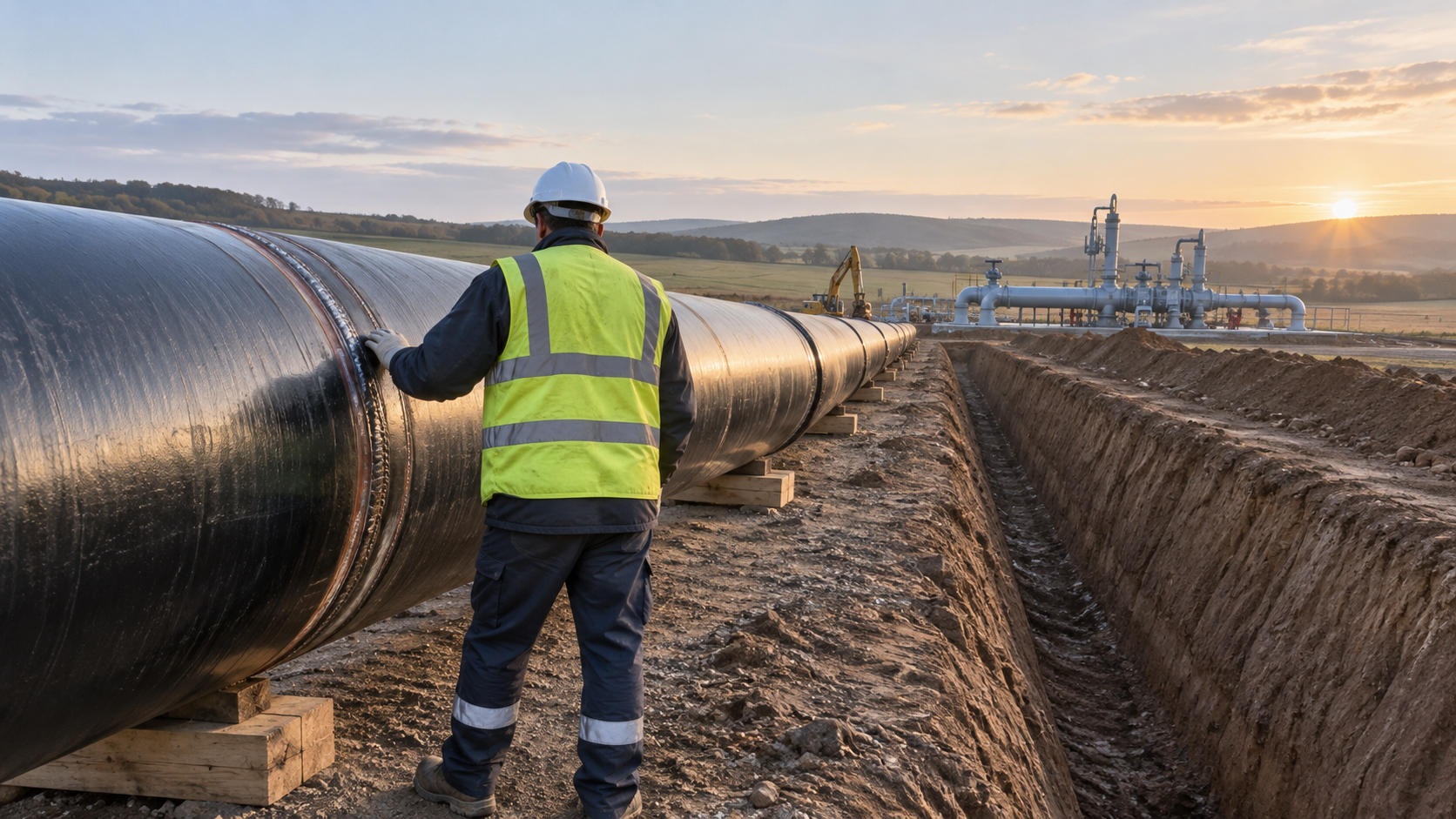
There are two broad ways to move hydrogen by pipe: mix it into natural gas lines, or use lines dedicated to hydrogen. Either way, the material questions are the same: how the toughness and fatigue behaviour of steel change in hydrogen, and how welds, joints and seals behave. Germany approved a 9,040 km hydrogen core network in October 2024, and in December 2025 GASCADE announced that about 400 km of existing gas pipeline had been converted to hydrogen.
- What a hydrogen pipeline is (the short version)
- Three routes: blending, repurposing and new-build
- Our calculation: what a blend by volume means in energy
- What hydrogen embrittlement does inside steel
- A materials engineer's view (1): strength holds, toughness and fatigue do not
- Testing in hydrogen gas — how it is evaluated
- Our calculation: think in partial pressure, not blend percentage
- A materials engineer's view (2): joints, seals and welds may matter before the pipe body does
- Welds, joints, seals and plastic pipe
- The standard: ASME B31.12
- Real projects: Germany, the Netherlands, the United States, Japan
- Policy and regulation: Europe, the United States, Japan
- What is still hard, and what could not be confirmed
- Glossary / References / Claim-to-source audit
Sourced = a statement in published material (link given)
Our calculation = a figure this article derived, with the assumptions spelled out
Not yet confirmed = a plan or a target with no confirmed record of delivery
Structural readings and materials-design interpretations are marked separately as Commentary.
Hydrogen is a flammable gas and its handling is governed by law and standards (in Japan, the High Pressure Gas Safety Act, among others). This article explains materials, principles, evaluation and policy. It is not advice on the design, operation or handling of any particular facility.
1. What a hydrogen pipeline is (the short version)
A hydrogen pipeline carries hydrogen gas through a pipe. It looks like a natural gas pipeline, but steel exposed to hydrogen changes in toughness, crack resistance and fatigue life, so the materials and design thinking differ somewhat.
- Already operating: the U.S. Department of Energy (DOE) states that about 1,600 miles of hydrogen pipeline operate in the United States. They are owned by merchant hydrogen producers and sit where refineries and chemical plants are concentrated, such as the Gulf CoastSourced
- Main technical concerns: as research topics DOE lists the potential for hydrogen to embrittle the steel and welds, the need to control hydrogen permeation and leaks, and the need for cheaper, more reliable compressorsSourced
- A barrier to expansion: DOE identifies the high up-front capital cost of new pipelines as a major barrier to expanding hydrogen deliverySourced
The materials problem in a hydrogen pipeline is not that the steel gets weaker; it is that the steel fails differently. Tensile strength barely changes, yet ductility, fracture toughness and the way fatigue cracks grow do change (Section 5). So whether an existing natural gas line chosen on strength can be reused depends on fracture-mechanics evaluation.
2. Three routes: blending, repurposing and new-build
"Hydrogen pipeline" actually covers three routes with different conditions. From a materials point of view each raises different questions (this article's grouping).
1. Blending. A 2013 review by the U.S. National Renewable Energy Laboratory (NREL) concluded that at low blends, below roughly 5-15% hydrogen by volume, the strategy appears viable without significantly raising risks for end-use appliances, public safety, or the durability and integrity of the existing pipeline network. It adds that the appropriate blend varies widely between pipeline systems and gas compositions and must be assessed case by case. At 15-50% the review points to issues such as converting household appliances or adding compression capacity, and above 50% to harder problems in pipeline materials, safety and end-use equipmentSourced.
2. Repurposing. About 56% of the 9,040 km German hydrogen core network is conversion of existing natural gas pipe, according to the Federal Network Agency's comparison table (its press release says "around 60 percent")Sourced. Gasunie in the Netherlands likewise says it is building its hydrogen network mainly from existing pipes, with new pipe where the existing network is unsuitableSourced.
3. New-build. A pipe designed and built for hydrogen. It offers more design freedom but costs more up front (DOE)Sourced.
3. Our calculation: what a blend by volume means in energy
Blending is usually described as a share by volume, such as "20% hydrogen". But hydrogen carries far less energy per unit volume than methane. So here is the volume share converted into an energy shareOur calculation.
- Assumption 1 (heat of combustion): hydrogen (forming liquid water) 285.83 kJ/mol; methane (gas) 890.7 kJ/mol. Both are from the NIST Chemistry WebBook and are on a higher-heating-value basis
- Assumption 2 (ideal gas): at the same temperature and pressure, 1 mol of any gas occupies the same volume, so energy per volume is proportional to the heat of combustion per mole
- Assumption 3 (composition): natural gas is treated as 100% methane (real natural gas contains ethane and other components, so the true hydrogen energy share is smaller than calculated here)
- Hydrogen against methane: 285.83 / 890.7 = about 0.32. Carrying the same energy takes about 3.1 times the volume
- Energy share of a 20% blend by volume: (0.2 × 285.83) / (0.2 × 285.83 + 0.8 × 890.7) = about 7.4%
Limit: at high pressure real gases depart from ideal behaviour. This is an order-of-magnitude calculation, not a design value.
The point is that share by volume and share by energy are different things. To carry the same energy at the same pressure through the same pipe, pure hydrogen needs about 3.1 times the volume. The review from the Savannah River National Laboratory (SRNL) likewise notes that hydrogen has a lower energy density than natural gas, so carrying the same energy takes either larger-diameter pipe or higher operating pressureSourced. Designing toward higher pressure moves toward the regime where hydrogen embrittlement matters more (Commentary).
4. What hydrogen embrittlement does inside steel
Hydrogen embrittlement is the general name for hydrogen entering a metal and impairing its toughness and crack resistance. The NREL review explains that hydrogen damage results from the combined action of hydrogen and residual or applied tensile stress, and that it can occur at stress levels below those the metal would typically withstand without hydrogenSourced. How severe it is depends on hydrogen pressure and purity, temperature, stress level, strain rate, and the microstructure and strength of the materialSourced.
The SRNL review describes hydrogen entering steel by first adsorbing on the metal surface and then being absorbed into the metal as atomic hydrogenSourced. Two mechanisms are put forward for the embrittlement: hydrogen-enhanced decohesion (HEDE), in which atomic hydrogen weakens the cohesive bonds of the metal, and hydrogen-enhanced localized plasticity (HELP), in which it eases dislocation motion and promotes localized deformationSourced. The failure mode shifts from the ductile growth and merging of voids in air to a more brittle quasi-cleavage mode in hydrogenSourced.
The link between hydrogen concentration and gas pressure is organised through Sievert's law: the steady-state hydrogen concentration in the metal is proportional to the square root of the hydrogen fugacitySourced. Fugacity is the thermodynamic "effective pressure". This relationship matters again in the partial-pressure section (Section 7).
5. A materials engineer's view (1): strength holds, toughness and fatigue do not
Pipe steels are usually discussed in terms of strength indices such as specified minimum yield strength (SMYS). Hydrogen hardly shows up there. According to the SRNL literature review, exposure to hydrogen gas has little effect on yield strength and ultimate tensile strength; what changes is ductility (elongation and reduction of area)Sourced.
So the same catalogue strength can sit alongside a very different tendency for cracks to grow. What needs evaluating is fracture-mechanics quantities that assume a crack is present, such as fracture toughness and fatigue crack growth rate (this article's commentary). That is why reusing a natural gas pipe for hydrogen cannot be settled by strength grade alone.
The table below collects published results. All are laboratory results near room temperature and do not directly give the life of any real pipeline.
| Property | Trend in hydrogen gas | Conditions and cautions | Source |
|---|---|---|---|
| Yield and tensile strength | Little effect from exposure to hydrogen gas | Result of a literature review. With electrochemical charging, the pre-charging time strongly affects results | [Ref. 8] |
| Ductility (elongation, reduction of area) | Falls sharply. The drop is steep as fugacity rises from 0 to about 10 MPa, then levels off | The degree varies with steel grade; no clear correlation with material strength is reported | [Ref. 8] |
| Fracture toughness (resistance to the start of crack growth) | Falls. The loss is larger for higher yield strength and for higher hydrogen partial pressure | Steels of the 1970s and earlier ("vintage") lose less; modern steels lose more but still have higher fracture resistance in hydrogen than vintage steels | [Refs. 8, 9] |
| Fatigue crack growth rate | Much higher than in air. Differences between grades and microstructures (API 5L X42 to X120) are small | Steels with very different yield strengths and microstructures stayed within a factor of 2-3. Depends systematically on stress ratio and hydrogen partial pressure | [Refs. 9, 10] |
| Welds and heat-affected zones | Welding does not appear to change fatigue crack growth. Fracture behaviour is similar to base metal of the same strength | Conclusion for specimens with no structural flaws over 1 mm and no residual stress. Large flaws compromise integrity. Data are limited | [Ref. 9] |
All Sourced (SRNL review [Ref. 8], HyBlend final report [Ref. 9], Ronevich et al. [Ref. 10]).
Researchers at Sandia National Laboratories (Ronevich and colleagues) compared pipeline steels and low-alloy pressure-vessel steels in high-pressure hydrogen gas, across a wide range of yield strengths and microstructures (ferrite/pearlite, acicular ferrite, bainite and martensite). The result: fatigue crack growth rates stayed within a factor of 2-3. Older pipeline steels with a higher fraction of pearlite showed modestly lower crack growth rates in hydrogen. The growth rate depends systematically on stress ratio and hydrogen partial pressure, and that dependence is captured in the fatigue design curves published in ASME B31.12 Code Case 220 (pipeline steels) and ASME BPVC Code Case 2938 (pressure-vessel steels)Sourced.
Read plainly, the HyBlend final report says steels from the 1970s and earlier lose only modestly in fracture resistance in hydrogen. Modern steels lose more, but their absolute fracture resistance in hydrogen is higher than that of vintage steelsSourced.
"How large the loss is" and "what the value is in hydrogen" are different quantities. Both come from laboratory data under stated conditions, so no general rule that vintage steel is better or that modern steel is better can be drawn (this article's commentary).
6. Testing in hydrogen gas — how it is evaluated
Results of hydrogen-embrittlement tests depend on which hydrogen environment was used. The SRNL review distinguishes two ways of getting hydrogen into a specimenSourced.
- Electrochemical charging: passing current through a specimen in an acidic solution to put hydrogen into it. It is cheaper, the setup is simple, and it is safer because no pressurised hydrogen is needed. Many researchers have used it for tensile properties. But charging time, and hydrogen diffusing back out of the specimen, affect the result. A specimen left in air loses hydrogen and regains its ductility
- Gaseous charging: exposing the specimen to hydrogen gas (pure, or blended with nitrogen) in a pressure vessel. It is closer to service conditions but needs equipment for high-pressure hydrogen. A specimen can be pre-charged and then tested in air, or charged in situ while being tested
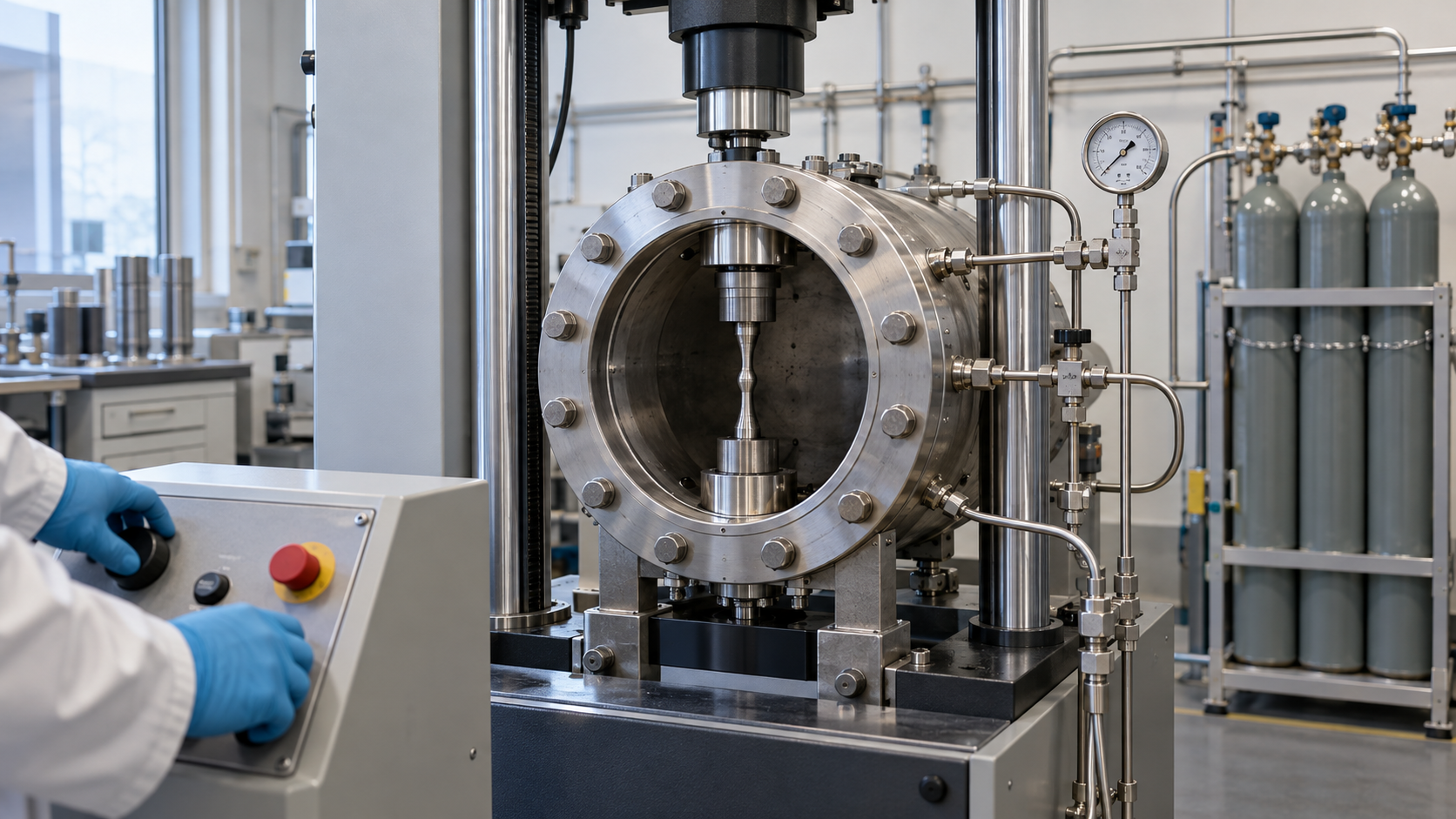
In HyBlend (a joint effort of NREL, Sandia, PNNL, Argonne and others), a single specimen was used to measure fatigue crack growth while changing conditions such as stress ratio from segment to segment, and the same specimen was then taken straight to a fracture test without leaving the hydrogen environment. The fatigue test thus doubles as the pre-cracking step for the fracture testSourced. The team also developed and demonstrated a test system that cycles hydrogen above 300 bar in small-diameter pipe (NPS 2, Schedule 40), using high pressure to reach stresses comparable to large-diameter pipe. Engineered defects on the outside of the pipe still induced hydrogen-assisted failure even though they were not directly exposed to hydrogen, which the report takes to show that native oxides and surface scale do not prevent hydrogen uptake and hydrogen-assisted fractureSourced.
7. Our calculation: think in partial pressure, not blend percentage
Blends are described by volume share such as "20% hydrogen", but what matters to the material is the partial pressure (effective pressure) of hydrogen. As an example, the SRNL review explains that a 30% hydrogen blend applied at a total pressure of 10 MPa gives a hydrogen partial pressure of 3 MPa on the specimenSourced.
- Assumption: ideal gas, so partial pressure = hydrogen volume fraction × total pressure (an approximation, since fugacity departs from pressure at high pressure)
- 30% hydrogen × 10 MPa total = 3 MPa (the SRNL example)
- 100% hydrogen × 3 MPa total = 3 MPa
- 20% hydrogen × 6 MPa total = 1.2 MPa (a hypothetical value chosen for this article)
So the same "3 MPa of hydrogen" environment can arise from a high-pressure blend or from low-pressure pure hydrogen. This is why blend percentage alone cannot tell you which side is "safer"Our calculation.
The HyBlend final report summarises how hydrogen partial pressure relates to fatigue and fracture as followsSourced.
- Hydrogen-assisted fatigue crack growth has two regimes: a pressure-dependent regime proportional to the square root of the hydrogen fugacity (pressure), and a regime at higher fatigue driving force (stress-intensity range, ΔK) that is pressure-independent between 1 and 200 bar
- At low pressure and low ΔK, crack growth rates converge with those measured in moist air. Under some conditions, fatigue in hydrogen gas is the same as in moist air (the report suggests this is likely due to moisture in the hydrogen)
- Hydrogen-assisted fracture is only weakly dependent on pressure: test scatter can be as large as the average difference between 1 bar and 200 bar
- The low-pressure regime (below 10 bar) is not well described in the literature, and impurities such as oxygen from air can mitigate the effect of hydrogen. Even parts-per-million impurities can influence measurements
8. A materials engineer's view (2): joints, seals and welds may matter before the pipe body does
Embrittlement of the pipe body is the best-documented problem, with test data accumulating and design curves approved in an ASME B31.12 code case (Sections 5 and 10). The actual routes for leakage lie elsewhere.
- The NREL review says leakage from steel and ductile iron systems occurs mainly through threads and mechanical joints, and that measurements by the Gas Technology Institute (GTI), including seals and joints, suggest a volumetric leak rate for hydrogen about three times that for natural gasSourced
- In polyethylene (PE) pipe, hydrogen permeates about 4 to 5 times faster than methane in typical pipe materials. Permeation coefficients are higher through elastomeric seals than through plastic pipe, but because pipe walls have far larger surface area, most gas loss is through the pipe wall, the review concludesSourced
- HyBlend says localized stress concentration in mechanical connectors on PE pipe can accelerate degradation when hydrogen and contaminants are addedSourced
In other words, it is not enough to look at the pipe steel. Each of welds, threads, flange gaskets, PE pipe and its fittings, and elastomer parts needs its own evaluation in a hydrogen environment (this article's commentary).
9. Welds, joints, seals and plastic pipe
The NREL review calculated the theoretical loss from a 20% hydrogen blend across the roughly 415,000 miles of PE pipe in the United States distribution network. Based on literature permeation coefficients, it comes to about 43 million cubic feet a year, about 60% of it hydrogen and 40% natural gas. The review calls this almost twice the loss of a system delivering natural gas only, but economically insignificant. It also cautions that the calculation probably overestimates the loss, because the literature permeation coefficient is likely larger than values seen under actual operating pressuresSourced.
Leakage into a confined space is a separate matter. The review says that leakage from elastomeric seals at joints in service lines warrants additional risk assessmentSourced.
DOE mentions fibre-reinforced polymer (FRP) pipe as an alternative for hydrogen delivery. It can be supplied in longer sections than steel, which means less welding, and installation cost is described as about 20% lower (DOE's statement)Sourced. For the composite materials involved, see also our explainer on CFRP and composite materials.
10. The standard: ASME B31.12
The principal standard for hydrogen piping and pipelines is ASME B31.12, "Hydrogen Piping and Pipelines", from the American Society of Mechanical Engineers. According to ASME's sales page, the 2023 edition runs to 268 pages and applies to piping and pipelines handling gaseous hydrogen and gaseous hydrogen mixtures, and to piping in liquid hydrogen service. Pressure vessels and equipment themselves are outside its scope; the Code applies up to and including the joint connecting the piping to themSourced.
| Part | Title (as given by ASME) | Content (summary of ASME's description) |
|---|---|---|
| Part GR | General Requirements | Requirements referenced by the other parts: definitions and requirements for materials, welding, brazing, heat treating, forming, testing, inspection, examination, operation and maintenance |
| Part IP | Industrial Piping | Components, design, fabrication, assembly, erection, inspection, examination and testing of industrial piping |
| Part PL | Pipelines | Components, design, installation and testing of hydrogen pipelines |
All Sourced (ASME B31.12 sales page [Ref. 12]). The text of the standard is paid, so this article stays with its title, scope and structure.
Two points on the link to materials evaluation can be confirmed from public documents.
- The HyBlend report positions its fatigue and fracture testing as generating the properties ASME B31.12 requires for design, using fatigue and fracture-mechanics test couponsSourced
- Fatigue design curves reflecting hydrogen partial pressure and stress ratio were, together with the results of other projects, approved in ASME B31.12 Code Case 220. The curves are described as a nominal upper bound on fatigue for all conditions testedSourced
DOE Hydrogen Program's FY2023 annual merit review states that Sandia developed the technical basis for the code case (titled "Hydrogen Crack Growth Rate Constants for B31.12 Pipeline Materials") and presented it to the ASME B31.12 committeeSourced. Details of the standard, such as how design factors are chosen according to material strength, could not be confirmed in the public documents available to this article and are not described here.
11. Real projects: Germany, the Netherlands, the United States, Japan
Here are real projects and their progress, as far as official sources confirm. The figures are approved plan values or expected values, not results.
| Region / project | What is published | Stage (date) | Source |
|---|---|---|---|
| Germany Hydrogen core network | 9,040 km. About 56% repurposed existing gas pipe and about 44% new-build (Federal Network Agency comparison table; the press release says "around 60%" repurposed). Expected investment EUR 18.9 billion. To come into operation progressively by 2032 | Approved 22 October 2024 Operation: Not yet confirmed | [Refs. 1, 2] |
| Germany GASCADE "Flow – making hydrogen happen" | About 400 km of existing natural gas pipe, including 1.4 m diameter pipe, converted to hydrogen and initially filled. A north-south axis from the Baltic Sea region to Saxony-Anhalt. Further connections to industrial hubs in southern Germany planned by 2029. The announcement does not say where the hydrogen came from | Company announcement 11 December 2025 2029 connections: Not yet confirmed | [Ref. 3] |
| Netherlands Hynetwork (100% Gasunie subsidiary) | A national network linking five industrial clusters, built mainly from existing pipes with some new pipe. The final welds on the first 32 km in the Port of Rotterdam were completed in mid-August 2025. After the line was filled with hydrogen and brought to pressure, the 200 MW Holland Hydrogen 1 plant on the Maasvlakte was connected on 16 March 2026. Completion of the national network moved from the original 2030 to "2033 at the latest" | 32 km: completed National network: Not yet confirmed | [Refs. 4, 5] |
| United States | About 1,600 miles of hydrogen pipeline in operation, owned by producers and located where large users are concentrated, such as the Gulf Coast. High capital cost of new pipe is a barrier to expansion | DOE page (checked October 2026) | [Ref. 6] |
| Japan | No national hydrogen pipeline plan or operating length could be confirmed in the official documents consulted for this article | Could not be confirmed | - |
Statements about operation, connection and completion rest on company or government announcements (Sourced). All are the issuers' own announcements; this article has not confirmed independent verification.
As Fig. 7 shows, between the draft and approval the German plan changed from 9,721 km to 9,040 km and the expected investment from EUR 19.8 billion to EUR 18.9 billion. The Federal Network Agency explains that it approved only those lines needed for the core network's transport taskSourced.
GASCADE's announcement stresses that the repurposed pipe is 1.4 m in diameter. In materials terms, converting a large existing line means evaluating, for each pipe's steel grade, vintage, welds and operating history, its fracture resistance and fatigue in hydrogen (Sections 5 to 7). The announcement consulted for this article gives no detail on how that evaluation was done or what it found (this article's commentary).
12. Policy and regulation: Europe, the United States, Japan
Read policy by separating proposal, adoption and entry into force (application). What follows is as confirmed in October 2026.
| Region | Instrument | Content | Stage (date) |
|---|---|---|---|
| EU | Regulation (EU) 2024/1789 (internal markets for renewable gas, natural gas and hydrogen) | Adopted 13 June 2024; published in the Official Journal 15 July 2024. It enters into force on the twentieth day after publication and applies from 5 February 2025 (some provisions apply earlier). Definitions of hydrogen transmission networks and operators are delegated to Directive 2024/1788. Article 21, on cross-border coordination of gas quality in the natural gas system, does not apply to hydrogen blends where the hydrogen content exceeds 2% by volume | In force: 4 August 2024 Applies: 5 February 2025 |
| EU | Directive (EU) 2024/1788 (common rules for those markets) | Adopted 13 June 2024; published 15 July 2024. Member States must transpose the main articles by 5 August 2026. It defines a "hydrogen network" as a network of onshore and offshore pipelines used for transporting hydrogen of a high grade of purity to customers (Article 2), and also defines hydrogen transmission and distribution networks and their operators | Transposition deadline: 5 August 2026 Status in each Member State: not checked |
| Germany | Energy Industry Act (EnWG), Section 28q and related provisions | The Federal Network Agency approves the hydrogen core network on application by the gas transmission system operators, within two months of a complete application. The European Commission's state-aid approval was granted on 21 June 2024 | Approved: 22 October 2024 |
| United States | 49 CFR 192.3 (pipeline safety regulations) | The regulation defines "gas" as natural gas, flammable gas, or gas which is toxic or corrosive. Hydrogen is a flammable gas, so these rules may bear on hydrogen pipelines (this article's reading; the details of application were not checked) | Current regulation (version of 30 September 2026 checked) |
| Japan | Hydrogen Society Promotion Act (Act No. 37 of 2024) | A law promoting the supply and use of low-carbon hydrogen and its derivatives. For businesses with an approved plan it provides "support focusing on the price gap" and "support for the development of hubs". Hub support funds facilities for transport and storage used jointly by several users. Special provisions cover High Pressure Gas Safety Act procedures (including transport by conduits as part of production), the Port and Harbor Act, and road occupancy (limited to conduits for gas retail business) | Promulgated: 24 May 2024 In force: 23 October 2024 |
All Sourced (EU Official Journal [Refs. 13, 14], German Federal Network Agency [Ref. 2], eCFR [Ref. 15], e-Gov Law Search [Ref. 16], METI [Ref. 17], Agency for Natural Resources and Energy [Ref. 18]).
For Japan, the Agency for Natural Resources and Energy page (updated 1 July 2026) lists nine certified supply plans under the Act, certified between 30 September 2025 and 30 June 2026. Hub support for fiscal 2025 was to cover only front-end engineering design (FEED), and the application window closed on 30 June 2025Sourced. This article has not checked whether any of the certified plans includes a pipeline.
The EU's "2%" marks the scope of an article on coordinating gas quality in cross-border natural gas flows. It does not directly set an upper limit on how much hydrogen may be blended into any country's network. As NREL says, the permissible blend in a given network is a case-by-case assessment by network and gas composition (this article's commentary).
13. What is still hard, and what could not be confirmed
- Detailed requirements of ASME B31.12: the text is paid, and details such as how design factors depend on material strength, or specific test requirements, could not be confirmed in the public documents consulted
- Other standards: international standards for pipelines, and specific numerical requirements in JIS or the technical standards under Japan's High Pressure Gas Safety Act, have not been checked
- Hydrogen pipelines in Japan: no national plan or operating length could be confirmed in official documents, nor whether any plan certified under the Hydrogen Society Promotion Act includes a pipeline
- Source of GASCADE's hydrogen, and how the conversion was evaluated: not stated in the announcement
- Specific recommendations for joint and seal materials: the hydrogen resistance of individual elastomers and gaskets is not assessed here
- Hydrogen embrittlement of Japanese pipe steels: hydrogen-gas data for Japanese piping steels (such as JIS-grade steels) were not checked within the scope of this article
- Cost: construction cost per kilometre and transport cost are not given, because conditions could not be matched in primary sources
(1) Laboratory data cannot be tied directly to pipeline life
The table in Section 5 reports laboratory results near room temperature. Real pipelines have residual stress, weld defects, corrosion flaws, pressure-cycling histories and gas impurities. The HyBlend report itself notes that data on welds are limited and that its testing did not include structural flaws over 1 mm or residual stress.
(2) Much about the effect of impurities remains poorly understood
Parts-per-million oxygen and other impurities can mitigate the effect of hydrogen. But the effect depends on conditions such as loading rate, and is not well described at low pressure (HyBlend). Long-term behaviour when a network carries components other than hydrogen is left as a topic for future research.
(3) There is no single upper limit for blending
NREL states that the appropriate blend varies widely between networks and that each must be assessed individually. As Section 7 showed, the hydrogen partial pressure a material sees depends on both blend fraction and total pressure.
- In steel exposed to hydrogen, what changes is not strength but ductility, fracture toughness and fatigue crack growthSourced
- Fatigue crack growth rate varies little between grades from API 5L X42 to X120 and is organised by hydrogen partial pressure and stress ratioSourced. The design curves were approved as ASME B31.12 Code Case 220
- A 20% hydrogen blend by volume is only about 7.4% by energyOur calculation. What matters to the material is partial pressure, not volume percentage
- Leak paths are not only the steel pipe body but also threads, mechanical joints, seals and PE pipe wallsSourced
- Germany's 9,040 km core network is approved, and GASCADE announced conversion of about 400 km of existing pipeSourced. Completion by 2032 is Not yet confirmed
14. Glossary
- Hydrogen embrittlement
- The general name for hydrogen entering a metal and impairing ductility, toughness and fatigue life.
- Fugacity
- The "effective pressure" of a real gas. At high pressure it differs from the actual pressure.
- Partial pressure
- The pressure contributed by one component of a gas mixture. For an ideal gas, volume fraction times total pressure.
- Sievert's law
- The relation that the amount of gas dissolved in a metal is proportional to the square root of the gas pressure (fugacity).
- Fracture toughness
- How well a cracked material resists the start of crack growth.
- Fatigue crack growth rate
- How far a crack advances per load cycle under repeated loading.
- Stress-intensity range (ΔK)
- The range of loading at a crack tip under cyclic load. A guide to how readily a fatigue crack grows.
- Stress ratio (R)
- The ratio of minimum to maximum stress in a load cycle.
- API 5L
- The line pipe specification. Designations such as X42, X52 and X70 indicate the steel's yield strength class.
- SMYS
- Specified minimum yield strength, a strength index used in pipe design.
- Heat-affected zone (HAZ)
- The part of the base metal whose microstructure and properties were changed by the heat of welding.
- Code case
- An addition that permits new technical content before the body of a standard is revised.
- Electrochemical charging
- Putting hydrogen into a specimen by passing current through it in a solution.
- Core network
- Germany's approved backbone hydrogen pipeline network linking major hydrogen production, import and consumption points.
- NREL
- The U.S. National Renewable Energy Laboratory, which in 2026 records appears as the National Laboratory of the Rockies (NLR).
15. References
- German Federal Network Agency (Bundesnetzagentur) "Bundesnetzagentur genehmigt Wasserstoff-Kernnetz", press release, 22 October 2024 (in German) — https://www.bundesnetzagentur.de/SharedDocs/Pressemitteilungen/DE/2024/20241022_H2Kernnetz.html
- German Federal Network Agency (Bundesnetzagentur) "Wasserstoff-Kernnetz" (approval, comparison table of draft, application and approval, legal basis) (in German) — https://www.bundesnetzagentur.de/DE/Fachthemen/ElektrizitaetundGas/Wasserstoff/Kernnetz/start.html
- GASCADE Gastransport GmbH "GASCADE puts 400 kilometers of hydrogen core network into operation", press release, 11 December 2025 (PDF) — https://fnb-gas.de/wp-content/uploads/2025/12/251211_GASCADE_PR_400_km.pdf
- Gasunie "Hydrogen network Netherlands" (project page with update history) — https://www.gasunie.nl/en/projects/hydrogen-network-netherlands
- Gasunie "First major hydrogen plant connected to Dutch hydrogen network", 16 March 2026 — https://www.gasunie.nl/en/news/first-major-hydrogen-plant-connected-to-dutch-hydrogen-network
- U.S. Department of Energy (DOE) "Hydrogen Pipelines" — https://www.energy.gov/eere/fuelcells/hydrogen-pipelines
- M. W. Melaina, O. Antonia and M. Penev (NREL) "Blending Hydrogen into Natural Gas Pipeline Networks: A Review of Key Issues", NREL/TP-5600-51995, March 2013 — https://www.osti.gov/biblio/1068610
- J. Herrington, X.-K. Zhu and B. Wiersma (SRNL) "Recent Advances in Pipeline Integrity for Transporting Blended Hydrogen-Natural Gas", ASME PVP2025-154678, SRNL-STI-2025-00041, 2025 — https://www.osti.gov/biblio/2586411
- T. Deutsch, C. San Marchi et al. (NREL, Sandia, PNNL, ANL) "HyBlend Collaborative Research Partnership (CRADA Final Report)", NREL/TP-5900-94949, July 2025 — https://www.osti.gov/biblio/2583498
- J. Ronevich, M. Agnani and C. San Marchi (Sandia) "Consistency of fatigue crack growth behavior of pipeline and low-alloy pressure vessel steels in gaseous hydrogen", International Journal of Hydrogen Energy, 136, 2025 (DOI: 10.1016/j.ijhydene.2024.06.287) — https://www.osti.gov/biblio/2455116
- Sandia National Laboratories (DOE Hydrogen Program) "R&D for Safety, Codes and Standards: Materials and Components Compatibility", 2023 Annual Merit Review, SCS005 (PDF) — https://www.hydrogen.energy.gov/pdfs/review23/scs005_ronevich_2023_p.pdf
- ASME "B31.12 - Hydrogen Piping and Pipelines" (sales page, 2023 edition) — https://www.asme.org/codes-standards/find-codes-standards/b31-12-hydrogen-piping-pipelines
- European Parliament and Council Regulation (EU) 2024/1789 of 13 June 2024 on the internal markets for renewable gas, natural gas and hydrogen (recast), Official Journal, 15 July 2024 — https://eur-lex.europa.eu/eli/reg/2024/1789/oj/eng
- European Parliament and Council Directive (EU) 2024/1788 of 13 June 2024 on common rules for the internal markets for renewable gas, natural gas and hydrogen (recast), Official Journal, 15 July 2024 — https://eur-lex.europa.eu/eli/dir/2024/1788/oj/eng
- Electronic Code of Federal Regulations (eCFR) 49 CFR 192.3, Definitions — https://www.ecfr.gov/current/title-49/section-192.3
- e-Gov Law Search Act on Promotion of Supply and Utilization of Low-Carbon Hydrogen and its Derivatives for Smooth Transition to a Decarbonized, Growth-Oriented Economic Structure (Act No. 37 of 2024), Japanese text (in Japanese) — https://laws.e-gov.go.jp/law/506AC0000000037
- Ministry of Economy, Trade and Industry (METI) News release: Cabinet approval of the cabinet orders for the Hydrogen Society Promotion Act, 8 October 2024 (in Japanese) — https://www.meti.go.jp/press/2024/10/20241008003/20241008003.html
- Agency for Natural Resources and Energy (METI) "Hydrogen Society Promotion Act" (support schemes, certified plans; updated 1 July 2026) (in Japanese) — https://www.enecho.meti.go.jp/category/saving_and_new/advanced_systems/hydrogen_society/carbon_neutral/
- NIST Chemistry WebBook, "Methane" (heat of combustion) — https://webbook.nist.gov/cgi/cbook.cgi?ID=C74828&Units=SI&Mask=1
- NIST Chemistry WebBook, "Water" (enthalpy of formation of liquid water, used to obtain the heat of combustion of hydrogen) — https://webbook.nist.gov/cgi/cbook.cgi?ID=C7732185&Units=SI&Mask=2
16. Claim-to-source audit
| Claim in the text | Basis | Category |
|---|---|---|
| That about 1,600 miles of hydrogen pipeline operate in the United States; that they are owned by hydrogen producers and located where large users such as the Gulf Coast cluster; that research topics are embrittlement of steel and welds, control of permeation and leaks, and compressors; that the high up-front capital cost of new pipe is a barrier; and that FRP pipe installation is described as about 20% cheaper than steel | DOE, "Hydrogen Pipelines"Reference 6 https://www.energy.gov/eere/fuelcells/hydrogen-pipelines | Sourced |
| That blends below about 5-15% hydrogen by volume raise only minor issues, with different issues at 15-50% and above 50%; that the appropriate blend must be assessed case by case; the conditions for hydrogen damage and its influencing factors; the distribution steels (API 5L A, B, X42, X46); that hydrogen permeation through PE pipe is about 4 to 5 times that of methane; that leakage occurs mainly at threads and mechanical joints, with a hydrogen volumetric leak rate about three times that of natural gas; that permeation coefficients are higher through elastomeric seals and pipe walls have far larger area; and about 415,000 miles of PE pipe with a theoretical loss at a 20% blend of about 43 million cubic feet a year (about 60% hydrogen) | NREL/TP-5600-51995 (2013)Reference 7 https://www.osti.gov/biblio/1068610 | Sourced |
| How hydrogen enters steel (adsorption, then absorption of atomic hydrogen); HEDE and HELP; the change in fracture mode from ductile void growth and coalescence to quasi-cleavage; Sievert's law; the small effect of gaseous hydrogen on yield and tensile strength, the large drop in ductility, steep up to about 10 MPa fugacity; the fall in fracture toughness with higher yield strength and partial pressure, with welds and HAZ behaving like base metal; higher fatigue crack growth rate than in air with little effect of grade; the features of electrochemical and gaseous charging; the example of 30% hydrogen at 10 MPa total giving 3 MPa partial pressure; and that hydrogen has a lower energy density than natural gas | SRNL (ASME PVP2025-154678)Reference 8 https://www.osti.gov/biblio/2586411 | Sourced |
| That fatigue crack growth is about the same regardless of grade (API 5L X42 to X120) and microstructure; the two regimes (square root of fugacity, and pressure-independent between 1 and 200 bar); convergence with moist air at low pressure and low ΔK; weak pressure dependence of fracture; higher sensitivity of higher-strength steels, and vintage versus modern steels; that welding does not appear to change fatigue crack growth and fracture behaviour is similar to base metal (without structural flaws over 1 mm or residual stress); that the fatigue design curves were approved as Code Case 220; that testing is aimed at the properties ASME B31.12 requires; the single-specimen method moving from fatigue to fracture; the NPS 2 Schedule 40 pipe test system above 300 bar and the failure from external defects; and localized stress concentration in mechanical connectors on PE pipe | HyBlend final report (NREL/TP-5900-94949)Reference 9 https://www.osti.gov/biblio/2583498 | Sourced |
| That fatigue crack growth rates in hydrogen gas stayed within a factor of 2-3 across pipeline and low-alloy pressure-vessel steels of widely different yield strength and microstructure; that older steels with more pearlite showed modestly lower rates; and that the dependence on stress ratio and partial pressure is captured by ASME B31 Code Case 220 and ASME BPVC Code Case 2938 | Ronevich et al. (IJHE, 2025)Reference 10 https://www.osti.gov/biblio/2455116 | Sourced |
| That Sandia developed the technical basis for the code case "Hydrogen Crack Growth Rate Constants for B31.12 Pipeline Materials" and presented it to the ASME B31.12 committee | DOE Hydrogen Program 2023 Annual Merit Review (SCS005)Reference 11 https://www.hydrogen.energy.gov/pdfs/review23/scs005_ronevich_2023_p.pdf | Sourced |
| That the 2023 edition of ASME B31.12 runs to 268 pages and applies to piping and pipelines for gaseous hydrogen and gaseous hydrogen mixtures and to piping for liquid hydrogen; that equipment itself is outside the scope; and the content of Parts GR, IP and PL | ASME B31.12 sales pageReference 12 https://www.asme.org/codes-standards/find-codes-standards/b31-12-hydrogen-piping-pipelines | Sourced |
| That the German hydrogen core network was approved on 22 October 2024: 9,040 km, about 60% repurposed (press release), expected investment EUR 18.9 billion, progressive operation by 2032; that only lines needed were approved; that EnWG Section 28q is the legal basis, approval is within two months of a complete application, and the European Commission's state-aid approval was on 21 June 2024; and the table of length, split and investment for draft, application and approval | Federal Network Agency press release and explanatory pageReference 1 https://www.bundesnetzagentur.de/SharedDocs/Pressemitteilungen/DE/2024/20241022_H2Kernnetz.htmlReference 2 https://www.bundesnetzagentur.de/DE/Fachthemen/ElektrizitaetundGas/Wasserstoff/Kernnetz/start.html | Sourced |
| That GASCADE announced it converted about 400 km of existing natural gas pipe, including 1.4 m diameter pipe, to hydrogen and carried out the initial filling; that the axis runs from the Baltic Sea region to Saxony-Anhalt; and that the announcement is dated 11 December 2025 | GASCADE press releaseReference 3 https://fnb-gas.de/wp-content/uploads/2025/12/251211_GASCADE_PR_400_km.pdf | Sourced |
| That Gasunie's subsidiary Hynetwork is building a national network linking five industrial clusters mainly from existing pipes; that the first 32 km in the Port of Rotterdam were welded in August 2025; that completion moved from the original 2030 to 2033 at the latest; and that Holland Hydrogen 1 (200 MW) was connected on 16 March 2026 | Gasunie project page and newsReference 4 https://www.gasunie.nl/en/projects/hydrogen-network-netherlandsReference 5 https://www.gasunie.nl/en/news/first-major-hydrogen-plant-connected-to-dutch-hydrogen-network | Sourced |
| The adoption date (13 June 2024), publication (15 July 2024), entry into force (twentieth day after publication) and application (5 February 2025) of Regulation (EU) 2024/1789, and the exclusion in Article 21 for blends over 2% hydrogen by volume | EU Official Journal, Regulation (EU) 2024/1789Reference 13 https://eur-lex.europa.eu/eli/reg/2024/1789/oj/eng | Sourced |
| The adoption and publication dates of Directive (EU) 2024/1788, the definition of a hydrogen network, and the transposition obligation by 5 August 2026 | EU Official Journal, Directive (EU) 2024/1788Reference 14 https://eur-lex.europa.eu/eli/dir/2024/1788/oj/eng | Sourced |
| That 49 CFR 192.3 defines gas as natural gas, flammable gas, or gas which is toxic or corrosive | eCFRReference 15 https://www.ecfr.gov/current/title-49/section-192.3 | Sourced |
| That the Hydrogen Society Promotion Act is Act No. 37 of 2024, promulgated 24 May 2024; and the content of hub support (Article 10), the High Pressure Gas Safety Act special provision (Article 12, including transport by conduits) and the road-occupancy special provision (Article 31, conduits for gas retail business) | e-Gov Law SearchReference 16 https://laws.e-gov.go.jp/law/506AC0000000037 | Sourced |
| That the Act's date of entry into force was set as 23 October 2024 (cabinet decision 8 October 2024) | METI news releaseReference 17 https://www.meti.go.jp/press/2024/10/20241008003/20241008003.html | Sourced |
| The outline of support under the Act; hub support for fiscal 2025 limited to FEED and the application deadline of 30 June 2025; nine certified supply plans (certified 30 September 2025 to 30 June 2026); and the 1 July 2026 update | Agency for Natural Resources and Energy, Hydrogen Society Promotion Act pageReference 18 https://www.enecho.meti.go.jp/category/saving_and_new/advanced_systems/hydrogen_society/carbon_neutral/ | Sourced |
| That a 20% blend by volume is about 7.4% by energy (1.7% at 5%, 3.4% at 10%, 12.1% at 30%, 24.3% at 50%), and that hydrogen has about 0.32 of the energy of methane per unit volume, so about 3.1 times the volume is needed for the same energy | Our calculation, from methane 890.7 kJ/molReference 19 https://webbook.nist.gov/cgi/cbook.cgi?ID=C74828&Units=SI&Mask=1and hydrogen 285.83 kJ/mol (enthalpy of formation of liquid water)Reference 20 https://webbook.nist.gov/cgi/cbook.cgi?ID=C7732185&Units=SI&Mask=2. Ideal gas, 100% methane and a higher-heating-value basis are assumptions of this article. Real gases and real natural gas compositions give different values | Our calculation |
| That 20% hydrogen at 6 MPa total gives 1.2 MPa partial pressure, and 100% hydrogen at 3 MPa gives 3 MPa | Our calculation. Partial pressure = volume fraction x total pressure under an ideal-gas approximation; the values are hypothetical | Our calculation |
| The German core network operating by 2032, GASCADE's southern connections by 2029, and completion of the Dutch national network by 2033 | Plans of the companies and authorities concerned, not results; they are outlooksReference 1 https://www.bundesnetzagentur.de/SharedDocs/Pressemitteilungen/DE/2024/20241022_H2Kernnetz.html | Not yet confirmed |
| Detailed requirements of ASME B31.12 such as design factors by material strength | The text is paid and this could not be confirmed in the public documents consulted, so it is not described. This article's commentary | Commentary |
| National hydrogen pipeline plans or operating length in Japan, whether certified plans include pipelines, hydrogen-gas data for Japanese piping steels, hydrogen pipeline construction cost, and the source of GASCADE's hydrogen | Could not be confirmed in official sources within the scope of this article, so not described. This article's commentary | Commentary |
| The grouping into blending, repurposing and new-build with their materials questions; the reading that strength holds while toughness and fatigue change and that fracture-mechanics quantities must be evaluated; the caution against saying vintage or modern steel is better; the point that joints, seals and PE pipe need evaluation too; the caution that the EU's 2% is not an upper limit; and the reading on what repurposing involves | This article's summary and commentary based on published content. Not views stated by the institutions concerned | Commentary |
| That Figs. 1, 2, 3, 5, 6 and 7 are explanatory drawings rather than real observations or design drawings, and that Fig. 4 and the hero image are AI-generated images | Our note | Commentary |
Last updated 6 October 2026. Sources are limited to primary material (standards bodies, governments and regulators, national laboratory reports, official company announcements and peer-reviewed papers). Because the article includes structural readings and materials-design interpretations, those are marked as Commentary and kept separate from sourced fact. Detailed requirements of ASME B31.12, hydrogen pipeline plans in Japan, hydrogen-gas data for Japanese pipe steels, evaluation of individual joint and seal materials, and the construction cost of hydrogen pipelines are not stated here because no primary source could be confirmed. Hydrogen is a flammable gas and its handling is governed by law and standards. This article is an explanation, not advice on design, operation or handling. All figures are explanatory concept graphics. Figs. 1, 2, 3, 5, 6 and 7 are vector drawings; Fig. 4 and the hero image are AI-generated images, and none of them shows a real cross-section, micrograph or physical facility.