TECHNOLOGY EXPLAINER
Hydrogen Steelmaking
— reducing iron ore with hydrogen: direct reduced iron and the electric arc furnace
Steelmaking emits large amounts of CO2 in the reduction step that strips oxygen from iron ore. Hydrogen steelmaking uses hydrogen instead of carbon for that reduction and releases water (H2O). The stoichiometric hydrogen needed to reduce 1 tonne of iron is about 54 kg, which is about 2.9 MWh of electricity if made by electrolysis Our calculation. In Japan, about 1 tonne of reduced iron was made with green hydrogen in June-July 2026, and in Sweden a pilot plant has made over 5,000 tonnes of reduced iron. Still, ore grade, impurities, and the quantity and cost of hydrogen and power remain obstacles to full-scale plants.
- What hydrogen steelmaking is (the short version)
- How steel is made — blast furnace-converter versus direct reduction-electric furnace
- Reducing iron ore with hydrogen — the reaction and what "endothermic" means
- Our calculation: hydrogen use, electricity and cost
- Ore grade and impurities
- A materials engineer's view (1): what happens inside a pellet, and the character of reduced iron
- A materials engineer's view (2): equipment that heats and carries hot hydrogen, and the electric furnace
- Japan's efforts (as far as official material confirms)
- Europe's efforts, and the scale and timing of demonstrations
- Challenges and cost
- Limits, and what we could not confirm
- Glossary / References / Claim-to-source audit
Sourced = a value stated in published material (link given)
Our calculation = a figure this article derived from stated assumptions
Not yet confirmed = a plan, target or outlook with no confirmed outcome
Readings from a materials or equipment point of view are marked separately as Commentary. Company and project plans reflect what was published as of October 2026 and may have changed since.
This article explains the technology and policy of steelmaking. It is not advice on operating equipment, handling hydrogen or making investment decisions. Hydrogen is a flammable gas and its handling is governed by laws and standards. It does not claim that any company or process is better than another.
1. What hydrogen steelmaking is (the short version)
- What changes: In reducing iron ore (mainly iron oxide, Fe2O3), hydrogen replaces carbon (coke or coal). Reduction with carbon releases CO2; reduction with hydrogen releases water (Fe2O3 + 3H2 → 2Fe + 3H2O) Sourced [Reference 1]. The stoichiometric hydrogen is about 54 kg per tonne of iron, and the electricity to make it by electrolysis is about 2.9 MWh Our calculation (Chapter 4).
- How far it has come: The pilot plant of HYBRIT in Sweden has made over 5,000 tonnes of iron reduced with hydrogen alone Sourced [References 12, 13]. In Japan, in a project of the NEDO Green Innovation Fund, about 1 tonne of reduced iron was made with green hydrogen from 29 June to 1 July 2026, a first for Japan [Reference 11]. Yet NEDO says hydrogen-reduction steelmaking has not yet been put into practical use [Reference 5].
- What is hard: the quantity and cost of hydrogen and power, ore grade and impurities, heating the hydrogen, and melting in the electric furnace. The IEA says using renewable hydrogen in steel production raises the cost of the steel by about 40% [Reference 4].
2. How steel is made — blast furnace-converter versus direct reduction-electric furnace
The steel industry is said to account for 4-7% of global human-caused CO2 emissions. The main cause is the use of carbon (coal, coke) to reduce the ore, and the blast furnace, which turns ore into hot metal, accounts for 90% of ironmaking (the step that turns ore into metallic iron) Sourced [Reference 1]. In Japan, steel was 14% (130 million tonnes) of FY2023 energy-related CO2 emissions of 921.71 million tonnes [Reference 7], and NEDO puts the steel industry's FY2024 CO2 emissions at about 126 million tonnes, about 40% of Japan's whole industrial sector [Reference 5] (the denominators differ, so 14% and about 40% are not the same measure).
The other route to iron is direct reduction. The ore is reduced as a solid without melting, giving direct reduced iron (DRI, HBI). Today's direct reduction mostly uses a vertical shaft furnace fed with hydrogen and CO made by reforming natural gas (MIDREX gas is about 56% hydrogen and 34% CO) [Reference 1]. Worldwide, about 100 million tonnes of DRI a year were produced in 2020, in places such as Latin America and the Middle East where natural gas is cheap [Reference 9]. The IEA says that of the 55 Mt of hydrogen used in industry in 2024, about 10% went to direct reduction in iron and steel [Reference 4].
| Route | Energy | CO2 emissions | Note |
|---|---|---|---|
| Blast furnace-converter | 18.8 GJ/t (hot-rolled coil) | 1,850 kgCO2eq/t (hot-rolled coil) | ULCOS value |
| Natural-gas direct reduction + electric furnace | 15.6 GJ/t (hot-rolled coil) | 970 kgCO2eq/t (hot-rolled coil) | Same |
| Hydrogen direct reduction + electric furnace | 13.3-15.4 GJ/t (depending on estimate) | 25-196 kgCO2eq/t | Boundaries differ (ULCOS runs from raw-material extraction to hot-rolled coil; HYBRIT and Vogl et al. use 1 t of liquid steel) |
Table 1 Energy and CO2 emissions by route (from Table 1 of Patisson and Mirgaux [Reference 1]; Sourced). The hydrogen-route values assume decarbonized electricity.
The hydrogen route's CO2 emissions are put at 89-99% below the blast furnace-converter route in the ULCOS assessments [Reference 1]. That assumes the electricity and hydrogen come from decarbonized power; it is different if grid electricity is used as it is. Bhaskar et al. say that a hydrogen direct reduction-electric furnace route run on Europe's present grid electricity (295 kgCO2/MWh) could cut emissions by more than 35% (a smaller reduction than with decarbonized power) [Reference 3].
3. Reducing iron ore with hydrogen — the reaction and what "endothermic" means
Iron ore does not reduce in one step; it passes through Fe2O3 (hematite) → Fe3O4 (magnetite) → FeO (wustite) → Fe. FeO appears only above 570 °C, and the last step, FeO → Fe, is the slowest, Patisson and Mirgaux summarize Sourced [Reference 1].
The key point of reduction with hydrogen is that the reaction is endothermic overall. Reduction with carbon or CO releases heat, but with hydrogen the reaction absorbs heat and the temperature falls. GREINS (the hydrogen steelmaking consortium) likewise says that hydrogen reduction is endothermic, causing a temperature drop, so the hydrogen must be heated [Reference 8]. From the reaction heats at 800 °C in Table 4 of Patisson and Mirgaux, the total per mole of Fe2O3 comes to about +61.9 kJ (endothermic) for hydrogen and about −36.6 kJ (exothermic) for CO Our calculation (Fig. 3).
Per tonne of iron, the reaction heat is about 154 kWh endothermic for hydrogen and about 91 kWh exothermic for CO Our calculation. It is small beside the electrolysis power (about 2.9 MWh), but because it is endothermic, the temperature inside the reactor has to be maintained, which creates a difference in design.
- Hydrogen reacts faster. Other things being equal, reduction with hydrogen is up to 10 times faster than with CO. In a real shaft furnace, however, because of thermodynamics and heat flow, CO plays a decisive role in reducing wustite in the colder central zone. With hydrogen alone, temperature and composition profiles are flatter and the calculation gives full (100%) metallization (a mathematical model; experimental confirmation is yet to come) [Reference 1].
- In that calculation the solid enters at 25 °C and the gas (98% hydrogen, 2% water) enters at 800 °C; full metallization is reached 3.4 m from the top, against a reduction zone of about 10 m in a MIDREX shaft. With a gas inlet temperature of 700 °C the average iron fraction is only 74%, while at 900-950 °C 100% iron is reached in under 2 m [Reference 1].
- HYBRIT's pilot plant tried reducing-gas temperatures from 550 to 1,090 °C and evaluated heating with natural gas, biogas and hydrogen, electric heating, and oxygen injection in combination [Reference 13].
4. Our calculation: hydrogen use, electricity and cost
From the stoichiometry Fe2O3 + 3H2 → 2Fe + 3H2O, making 1 tonne of iron needs 54.1 kg of hydrogen Our calculation (Patisson and Mirgaux also give 54 kg of hydrogen per tonne of iron for reducing hematite [Reference 1]). Made by electrolysis at 52.9 kWh/kg (63% LHV efficiency, the base case of our explainer on the cost of hydrogen production), the electricity is about 2.86 MWh. Vogl et al. say that hydrogen direct-reduction steelmaking needs 3.48 MWh of electricity per tonne of liquid steel, mainly for the electrolyzer Sourced [Reference 2]. In the calculation of Bhaskar et al., the energy consumption of a hydrogen direct reduction-electric furnace route is 3.72 MWh per tonne of liquid steel [Reference 3].
Scaled to a plant, the figures are as follows. Assumption: 1 million tonnes a year of iron is made entirely by hydrogen direct reduction (no scrap, no hydrogen loss).
| Item | Value | Calculation |
|---|---|---|
| Hydrogen per year | about 54,000 t | 54.1 kg/t × 1 million t |
| Hydrogen flow | about 6.2 t/h (about 69,000 Nm3/h) | 54,000 t ÷ 8,760 h; 1 Nm3 is about 0.0899 kg |
| Electrolysis energy | about 2.9 TWh/yr | 54,000 t × 52.9 kWh/kg |
| Electrolyzer capacity needed | about 327 MW at 100% capacity factor, 363 MW at 90%, 653 MW at 50% | 2.9 TWh ÷ (8,760 h × capacity factor) |
Table 2 Hydrogen and electrolyzer scale if 1 million tonnes a year of iron is made by hydrogen direct reduction (Our calculation). Patisson and Mirgaux say a 1 Mt/yr plant needs a hydrogen plant of about 70,000 m3/h, in line with our 69,000 Nm3/h [Reference 1].
For reference, the IEA says Stegra's plant in Boden, Sweden is a 2.5 Mtpa steel plant with 740 MW of electrolyzers [Reference 4]. In our simple calculation, supplying all 2.5 Mt by hydrogen reduction would need about 7.2 TWh a year, above the roughly 6.5 TWh that 740 MW × 8,760 h can deliver Our calculation. The difference can change with assumptions such as scrap use, efficiency and hydrogen recovery; we did not confirm Stegra's actual configuration. The relation between electrolyzer capacity and plant scale moves a great deal with the assumptions.
The cost impact depends on the price of hydrogen. At US$2/kg of hydrogen it is about US$108 per tonne of iron, at US$4/kg about US$217, and at the base case of our explainer on the cost of hydrogen production (about US$6.5/kg) about US$354 Our calculation. Vogl et al. estimate the total production cost of hydrogen direct-reduction steel at EUR 361-640 per tonne of liquid steel, sensitive to electricity price and scrap use, and say it becomes cost-competitive with an integrated steel plant at a carbon price of EUR 34-68 per tonne of CO2 with electricity at EUR 40/MWh [Reference 2]. They also describe, as a key feature, the flexibility of the process to help balance the power grid through storage of hydrogen and hot-briquetted iron or by varying the share of scrap [Reference 2] (the grid side is in our explainer on the power grid and renewable energy).
5. Ore grade and impurities
Iron ore contains, besides iron oxide, gangue (impurities) such as silica and alumina. The iron content of pure Fe2O3 is 69.9%, which is the ceiling for ore. Getting 1 tonne of iron takes at least about 1.43 tonnes of ore Our calculation.
- The blast furnace takes low-grade ore more easily. In GREINS's summary, the blast furnace route can use low-grade ore and make high-grade steel, whereas the electric furnace finds low-grade ore hard to use [Reference 8]. NEDO says that because an electric furnace finds it harder than a blast furnace to remove impurities, there is a raw-material constraint: it cannot use low-grade ore with many impurities [Reference 6].
- Existing direct reduction assumes high-grade pellets. GREINS says the feed of today's shaft furnaces is high-grade pellets, while Japan's hydrogen-reduction shaft furnace aims to use low-grade feed [Reference 9]. LKAB states that it intends to use its high-quality iron ore in HYBRIT's value chain [Reference 12].
- It is also a matter of where the ore is. The IEA points to an opportunity for Brazil and sub-Saharan Africa, with high-grade iron ore, to make DRI with low-emissions hydrogen and export it as hot briquetted iron. DRI today sells for roughly four times the price of iron ore, but developing new mines can take up to a decade, so early opportunities are limited to regions with existing or advanced mining projects [Reference 4].
- An attempt with fines: According to the IEA, in March 2025 the Oshivela plant of HyIron in Namibia made its first DRI in rotary kilns using 100% hydrogen on magnetically separated iron ore fines, without pelletizing or sintering (capacity of 15,000 tonnes a year) [Reference 4].
GREINS has set as a goal for 2030 the demonstration of a technique that makes high-grade steel usable for car outer panels from hydrogen direct reduction and an electric furnace, in a large furnace of about 300 tonnes with phosphorus at or below 150 ppm and nitrogen at or below 40 ppm, blast-furnace-level impurities [Reference 10]. For another route combining direct reduction, an electric smelting furnace and a converter, the goals are phosphorus at or below 0.015% and iron oxide in the by-product slag at or below 3% (a quality for cement use) [Reference 10].
6. A materials engineer's view (1): what happens inside a pellet, and the character of reduced iron
Patisson et al. observed iron ore pellets reduced with hydrogen under the electron microscope Sourced [Reference 1]. At the start a pellet is a porous aggregate of dense hematite grains, and its overall size hardly changes. At the grain scale, pores appear at the surface, at the wustite stage the grains break into smaller crystallites, and finally iron grows inside the crystallites. Above 900 °C the iron spreads over the crystallites and merges them. Iron grains formed at high temperature are larger and smoother.
The rate of reduction does not simply rise with temperature. A slowing at the end of the reaction is seen near 700 °C and 950 °C, and the one near 950 °C is attributed to the α-to-γ iron transformation (912 °C), which slows solid-state diffusion [Reference 1]. The rate-limiting step inside the pellet moves from the chemical reaction to inter-grain diffusion. In other words, the pore structure of the pellet (porosity, grain size) is a design item on the materials side that sets the reduction rate (Commentary). The model of Patisson et al. uses pellets of porosity 0.33 and diameter 14 mm as its example.
The character of reduced iron also changes with the presence of carbon. Iron reduced with natural gas contains 2-4% carbon, while iron reduced with hydrogen has 0%. Some electric-furnace steelmakers worry about carbon-free DRI, but Nuber et al. concluded that carbon-free DRI is not an issue; plain scrap charges are routinely used in most electric furnaces, and the important point is to obtain a good foaming slag by blowing carbon fines and oxygen [Reference 1]. HYBRIT says that DRI reduced with hydrogen to 98-99% metallization is better in transport, storage and melting properties than DRI made with natural gas. In drop tests of 10 drops from 10 m and 30 m, only a few percent broke into pieces under 6.3 mm [Reference 13].
7. A materials engineer's view (2): equipment that heats and carries hot hydrogen, and the electric furnace
Reduction with hydrogen is endothermic, so the reducing gas must be heated to 800-900 °C and recirculated [Reference 1]. With hydrogen alone, Patisson et al. note, the natural-gas reformer is not needed and the gas loop is shorter. GREINS, on the other hand, says that a conventional blast-furnace hot-blast stove heats air, but for hydrogen, because of the explosion risk, new technology such as indirect heating is needed, and heating efficiency is also an issue [Reference 8]. It adds that measures against the temperature drop in the furnace during hydrogen reduction are not yet established [Reference 8].
The electric furnace has its own issues. GREINS says DRI made by direct reduction is said to take a long time to melt and that electric furnaces are less productive than blast furnaces, so it takes efficient melting of DRI and countermeasures against phosphorus, nitrogen and other impurities as subjects of development [Reference 10]. In Japan, Nippon Steel is testing high-speed melting and better refining efficiency of DRI in a small test electric furnace (10 t), JFE Steel DRI preheating and heat input into the furnace, and Kobe Steel DRI melting technology in a modified small commercial furnace (20 t) [Reference 10].
We could not confirm numerical values in published material for the long-term durability of materials in contact with hot hydrogen (heaters, piping, refractories, furnace walls) or for evaluating hydrogen embrittlement. We list it under what we could not confirm in Chapter 11.
8. Japan's efforts (as far as official material confirms)
Japan began developing hydrogen-reduction steelmaking (COURSE50) in 2008, ahead of the rest of the world. From 2016 it ran tests in a 12 m³ test blast furnace (about 1/400 of a commercial furnace) and was the first in the world to verify that injecting hydrogen-based gas can cut CO2 emissions in the reduction step by 10% or more Sourced [Reference 7]. According to NEDO, combined with CO2 capture, a prospect has emerged of establishing a technique that cuts CO2 emissions by 30% in the test furnace demonstrations [Reference 6].
| Item | Content | Status |
|---|---|---|
| Green Innovation Fund project "Use of hydrogen in the steelmaking process" | A NEDO project. The project period is planned as FY2021-FY2030. The budget at launch in January 2022 was ¥193.5 billion; the budget ceiling on NEDO's current page is ¥439.16 billion (the R&D and social implementation plan was revised on 10 March 2026). Two tracks: hydrogen reduction in the blast furnace and direct hydrogen reduction. The goal is technology that cuts CO2 emissions by 50% or more by 2030 [References 5, 6] | Under way. The goal is Not yet confirmed |
| Hydrogen reduction in the blast furnace | Modification of a commercial blast furnace (5,000 m³ class) and injection tests of ambient-temperature hydrogen-based gas; development to cut CO2 from the blast furnace by 50% or more using external hydrogen and the CO2 in the furnace gas; verification in a medium-scale test blast furnace (500 m³ class or larger) [Reference 6] | Plan (as published in January 2022) |
| Direct hydrogen reduction (shaft furnace) | By 2030, to demonstrate, in a medium-scale direct reduction furnace (1/25 to 1/5 of a commercial furnace), a technique that reduces low-grade iron ore directly with hydrogen and cuts CO2 emissions by 50% or more against the current blast furnace route. Nippon Steel built a small test shaft furnace (1 t/h) at its Hasaki R&D Center (tests from FY2025); JFE Steel built a small bench test furnace at its Chiba district, East Japan Works (tests from FY2024) [Reference 9] | Test facilities operating. The 2030 goal is Not yet confirmed |
| Reduced iron with green hydrogen (2026) | At JFE Steel's small pilot plant (capacity 15 kg/h; tests since December 2024) at East Japan Works (Chiba), green hydrogen from a 1.5 MW PEM electrolysis facility in Yamanashi Prefecture was used to make about 1 tonne of reduced iron from 29 June to 1 July 2026, a first for Japan. The release says the stable reduction reaction with green hydrogen confirmed that reduced iron can be made [Reference 11] | Achieved (announced 31 July 2026) |
| Electric furnace and electric smelting furnace | Large test electric furnace (about 300 t): goals of phosphorus at or below 150 ppm and nitrogen at or below 40 ppm. A demonstration smelting furnace (about 10 m in diameter) is to be built by Nippon Steel and start in 2028 [Reference 10] | Start date is a plan Not yet confirmed |
Table 3 Japan's hydrogen steelmaking efforts (published material from NEDO, GREINS and JFE Steel [References 5-11]; Sourced).
GREINS assumes that the investment needed for carbon neutrality will be about ¥10 trillion for the steel industry as a whole, and says several hundred billion yen of R&D spending will be needed by 2030 and more beyond [Reference 7]. This is an industry estimate.
9. Europe's efforts, and the scale and timing of demonstrations
| Project | What we confirmed | Status (checked October 2026) |
|---|---|---|
| HYBRIT (SSAB, LKAB, Vattenfall) | The Luleå pilot plant started in 2020 on natural gas and has run on hydrogen alone since 2021. Capacity is 0.8-1.4 t of DRI per hour, run in 4-8 week continuous campaigns. Over 5,000 t of reduced iron had been made by the end of 2023. Metallization 98-99%, carbon 0%. In hydrogen storage tests (a rock cavern of 100 m³ at 25 MPa), producing hydrogen to follow electricity prices was reported to cut variable cost by up to 40% [References 12, 13] | The pilot phase (TRL 7) closed with a final report in August 2024. LKAB's planned demonstration plant at Gällivare is foreseen to run at full industrial scale in 2027, but we could not confirm its latest status Not yet confirmed |
| Stegra (Boden, Sweden) | A 2.5 Mtpa steel plant with 740 MW of electrolyzers, under construction since 2023. On 24 June 2026 a EUR 1.4 billion financing round closed. On 30 September 2026, after a 100-day review under the new owners, it said the cost of completion is significantly higher than assumed in June, so additional capital is required; it also said the timeline for green steel production remains as expected [References 4, 14, 15] | Under construction. Securing the additional funds is undecided. The IEA's 2025 edition said test deliveries of ore would start by end-2026; the company said in June 2026 that it was reviewing the timeline. Not yet confirmed |
| Three German steelmakers' hydrogen procurement | Salzgitter AG, Stahl-Holding-Saar and thyssenkrupp Steel launched tenders for hydrogen for their planned direct reduction plants; as of August 2025 none had resulted in a contract. thyssenkrupp suspended its tender because bid prices exceeded acceptable levels [Reference 4] | Open Not yet confirmed |
| ArcelorMittal | The IEA reports that ArcelorMittal paused key direct reduction projects in Europe despite having secured public subsidies, citing weak demand and regulatory barriers [Reference 4] | Paused (IEA report, 2025) |
| HyIron (Namibia) | In March 2025 it made its first DRI from fines using 100% hydrogen. Capacity 15,000 t a year, aiming to scale up to 2 Mtpa by 2030 [Reference 4] | Operating. Scale-up is a plan Not yet confirmed |
Table 4 Hydrogen steelmaking projects in Europe and elsewhere (Sourced; plans and outlooks are marked Not yet confirmed).
The IEA notes that both HYBRIT and Stegra have received grant funding from sources including the EU Innovation Fund, the Just Transition Fund and Sweden's Industriklivet programme, and that these projects aim to demonstrate for the first time the direct reduction of iron ore using 100% hydrogen, a process not yet commercially proven [Reference 4].
10. Challenges and cost
- Cost: The IEA says that using renewable hydrogen in steel production leads to a cost premium of around 40% for the steel, a major barrier in a sector with very narrow margins [Reference 4]. Elsewhere the IEA puts the cost gap for hydrogen direct reduction at 50-140% against blast furnaces and 20-80% against unabated natural-gas-based direct reduction (by region), and expects upfront cost to be 40-140% higher than for natural-gas direct reduction at commercial scale [Reference 4]. (The 40% and the 50-140% are estimates on different bases and cannot be compared directly.)
- Securing hydrogen and electricity: As Table 2 shows, 1 Mt a year needs about 330-650 MW of electrolyzers and about 2.9 TWh a year of electricity Our calculation. The IEA reports that the hydrogen tenders of the three German steelmakers have not resulted in contracts, citing among other things electrolyzer costs and uncertainty over renewable electricity prices [Reference 4].
- Ore grade and impurities: Chapter 5. Whether low-grade ore can be used is at the center of Japan's goals.
- Equipment and investment: GREINS assumes that about ¥10 trillion of capital investment will be needed for the steel industry as a whole [Reference 7].
- Rules and demand: The IEA says the public sector accounts for 25% of steel demand and lists public procurement as one way to create demand for low-emissions steel [Reference 4]. We do not cover the details of Japanese and European rules in this article.
11. Limits, and what we could not confirm
(1) Read the numbers with their conditions
The hydrogen use (54.1 kg/t) is a stoichiometric value; in a real plant it changes with losses, unreduced iron in the DRI and scrap use. The 3.48 MWh of Vogl et al. and the 3.72 MWh of Bhaskar et al. rest on different assumptions and boundaries.
(2) What we could not confirm
- The durability of equipment materials in contact with hot hydrogen (heaters, piping, refractories, furnace walls) and the evaluation of hydrogen embrittlement.
- Reference values for iron ore grade (iron content, upper limits on gangue); the official material we consulted gave no numbers.
- The latest status (October 2026) of HYBRIT's Gällivare demonstration plant.
- The latest results of hydrogen reduction in a commercial blast furnace in Japan.
- The relation between Stegra's electrolyzers and steel output (scrap share, efficiency), and the result of securing additional funds.
- Japan's price outlook for hydrogen and electricity, and how individual rules (such as price-gap support) apply to steel.
(3) Division of roles with other explainers
The cost formula for hydrogen is in our explainer on the cost of hydrogen production, the relation to the power system in our explainer on the power grid and renewable energy, and materials in contact with hot hydrogen in our explainers on high-pressure hydrogen tanks, hydrogen pipelines, and barrier properties and coatings.
- Hydrogen steelmaking reduces iron ore with hydrogen instead of carbon and emits water; the stoichiometric hydrogen is about 54 kg per tonne of iron Our calculation
- Reduction with hydrogen is endothermic overall (about +61.9 kJ per mole of Fe2O3), so heating the hydrogen is an issue Our calculation
- Making 1 million tonnes a year of iron by hydrogen direct reduction needs about 330-650 MW of electrolyzers and about 2.9 TWh a year Our calculation
- In Japan about 1 tonne of reduced iron was made with green hydrogen from 29 June to 1 July 2026. In Europe the HYBRIT pilot has made over 5,000 tonnes of reduced iron and Stegra is under construction and needs additional funds Sourced
- The challenges are ore grade and impurities, securing hydrogen and power, and cost. The IEA says renewable hydrogen raises the product cost of steel by about 40% Sourced
12. Glossary
- Reduction
- Removing oxygen from an oxide. The step that makes metallic iron from iron ore (iron oxide).
- Blast furnace-converter route
- The conventional route: hot metal made from ore and coke in a blast furnace, then steel in a converter.
- Direct reduction (DR)
- Reducing iron ore as a solid without melting it. The solid iron made is reduced iron.
- DRI / HBI
- Direct reduced iron / hot briquetted iron, a compacted form. Also called sponge iron.
- Shaft furnace
- A vertical reduction furnace with ore fed from the top and gas from below, such as MIDREX.
- Electric arc furnace (EAF)
- A furnace that melts DRI or scrap with an electric arc to make steel.
- Electric smelting furnace
- A furnace that melts DRI with electricity and separates gangue as slag. Envisaged for the low-grade-ore route.
- Metallization
- The share of the iron in reduced iron that is in metallic form.
- Gangue
- Impurities in iron ore, such as silica and alumina.
- Pellet
- Iron ore fines agglomerated into balls.
- COURSE50
- Japan's hydrogen-reduction steelmaking development: injecting hydrogen-based gas into a blast furnace plus CO2 capture.
- GREINS
- Hydrogen Steelmaking Consortium (Nippon Steel, JFE Steel, Kobe Steel and the Japan Research and Development Center for Metals).
- GI Fund
- The Green Innovation Fund, in which NEDO supports projects for 10 years under a METI plan.
- HYBRIT
- The joint hydrogen steelmaking venture of SSAB, LKAB and Vattenfall in Sweden.
13. References (primary sources)
- Patisson, F. and Mirgaux, O. "Hydrogen Ironmaking: How It Works", Metals 10(7), 922 (2020; peer-reviewed) — mdpi.com
- Vogl, V., Åhman, M. and Nilsson, L. J. "Assessment of hydrogen direct reduction for fossil-free steelmaking", Journal of Cleaner Production 203, 736-745 (2018; abstract consulted) — doi.org
- Bhaskar, A., Assadi, M. and Nikpey Somehsaraei, H. "Decarbonization of the Iron and Steel Industry with Direct Reduction of Iron Ore with Green Hydrogen", Energies 13(3), 758 (2020; abstract consulted) — mdpi.com
- IEA "Global Hydrogen Review 2025" (printed pages: p. 18 = public procurement; p. 22 = DRI price and ore; p. 37 = effect on product cost; pp. 39-40 = tenders; p. 48 = industrial hydrogen demand; p. 51 = cost gaps; p. 89 = pauses; p. 101 = Stegra; p. 169 = grants; p. 195 = HyIron; p. 198 = Stegra) — iea.org
- NEDO (Green Innovation Fund) Project page "Use of hydrogen in the steelmaking process" (in Japanese) — green-innovation.nedo.go.jp
- NEDO "Green Innovation Fund project starts the hydrogen-in-steelmaking project" (in Japanese), 7 January 2022 — nedo.go.jp
- GREINS (Hydrogen Steelmaking Consortium) "Technology 01: The current state of the Japanese steel industry" (in Japanese) — greins.jp
- GREINS (Hydrogen Steelmaking Consortium) "Technology 02: The challenge of cutting CO2 in the steel industry" (in Japanese) — greins.jp
- GREINS (Hydrogen Steelmaking Consortium) "Technology 04: Direct reduction of iron ore with hydrogen" (in Japanese) — greins.jp
- GREINS (Hydrogen Steelmaking Consortium) "Technology 05: Making high-grade steel efficiently in an electric furnace" (in Japanese) — greins.jp
- JFE Steel, NEDO and others "First in Japan: reduced iron successfully made with green hydrogen" (in Japanese), 31 July 2026 — jfe-steel.co.jp
- LKAB "HYBRIT: Six years of research paves the way for fossil-free iron and steel production on an industrial scale" (27 August 2024) — lkab.com
- European Commission (INCITE) "Hydrogen Breakthrough Ironmaking Technology (HYBRIT)" — europa.eu
- Stegra "Stegra announces closing of EUR 1.4 billion financing round" (24 June 2026) — stegra.com
- Stegra "Stegra implements changes following 100-day review under new owners - Håkan Buskhe appointed CEO" (30 September 2026) — stegra.com
14. Claim-to-source audit
| Claim in the text | Basis | Label |
|---|---|---|
| Patisson and Mirgaux: steel is 4-7% of human-caused CO2, 90% of ironmaking is by blast furnace, direct reduction and MIDREX gas (about 56% hydrogen, 34% CO), the stoichiometric 54 kg of hydrogen per tonne of iron and about 70,000 m3/h for a 1 Mt/yr plant, the hydrogen route 89-99% lower in CO2, Table 1 (blast furnace-converter 18.8 GJ and 1,850 kgCO2eq, DR + EAF 15.6 GJ and 970, hydrogen route 15.4 GJ and 196 and others), three reduction steps and FeO only above 570 °C, hydrogen up to 10 times faster than CO, Table 4 (reaction heats at 800 °C), the mathematical model (gas inlet 800 °C, full metallization at 3.4 m, 74% at 700 °C), pellet grain changes and crystallite merging above 900 °C, the slowing at 700 and 950 °C and the α-γ transformation, carbon-free DRI, and about 20% CO2 reduction reported for hydrogen injection in a blast furnace | Patisson and Mirgaux, Metals (2020) Reference 1 https://www.mdpi.com/2075-4701/10/7/922 | Sourced |
| Vogl et al.: 3.48 MWh per tonne of liquid steel (mainly the electrolyzer), total production cost of EUR 361-640 per tonne, parity with a blast furnace at a carbon price of EUR 34-68/t-CO2 with electricity at EUR 40/MWh, grid-balancing flexibility through storage of hydrogen and DRI | Vogl et al., J. Clean. Prod. (2018) Reference 2 https://doi.org/10.1016/j.jclepro.2018.08.279 | Sourced |
| Bhaskar et al.: 3.72 MWh per tonne of liquid steel for the hydrogen direct reduction-electric furnace route (slightly more than the 3.48 MWh of blast furnace-converter), over 35% lower emissions at present grid electricity (295 kgCO2/MWh), electrolyzer efficiency the most important factor | Bhaskar et al., Energies (2020) Reference 3 https://www.mdpi.com/1996-1073/13/3/758 | Sourced |
| IEA: about 10% of the 55 Mt of industrial hydrogen (2024) goes to DRI, about a 40% cost premium for steel with renewable hydrogen, the cost gap of hydrogen direct reduction (50-140% against blast furnaces, 20-80% against natural-gas DRI, upfront cost 40-140% higher), the three German tenders (no contracts, thyssenkrupp suspended), ArcelorMittal's pause, Stegra (2.5 Mtpa, 740 MW, under construction since 2023), grants to HYBRIT and Stegra, HyIron's 100% hydrogen reduction of fines (March 2025, 15,000 t/yr), DRI selling at about four times the price of ore and new mines taking up to a decade, the public sector at 25% of steel demand | IEA Global Hydrogen Review 2025 Reference 4 https://www.iea.org/reports/global-hydrogen-review-2025 | Sourced |
| NEDO Green Innovation Fund page: steel industry CO2 emissions of about 126 million tonnes (FY2024) and about 40% of the industrial sector, hydrogen-reduction steelmaking not yet in practical use, the two tracks of blast furnace hydrogen reduction and direct hydrogen reduction, a budget ceiling of ¥439.16 billion, the plan revised on 10 March 2026 | NEDO GI Fund "Use of hydrogen in the steelmaking process" Reference 5 https://green-innovation.nedo.go.jp/project/utilization-hydrogen-steelmaking/ | Sourced |
| NEDO announcement of 7 January 2022: budget of ¥193.5 billion, project period FY2021-FY2030 (planned), a prospect of 30% CO2 cut in the test blast furnace (12 m³), modification of a commercial blast furnace (5,000 m³ class), electric furnaces' difficulty removing impurities and so not being able to use low-grade ore, direct reduction furnaces (1/25-1/5 of commercial), electric furnace phosphorus at or below 0.015% and nitrogen at or below 40 ppm (3-10 t) and a large test electric furnace (about 300 t) | NEDO news release (7 January 2022) Reference 6 https://www.nedo.go.jp/news/press/AA5_101503.html | Sourced Not yet confirmed |
| GREINS: steel at 14% of FY2023 energy-related CO2 (130 million tonnes), COURSE50 (started 2008, a 12 m³ test blast furnace, a cut of 10% or more in reduction-step CO2 by injecting hydrogen-based gas), capital investment for carbon neutrality of about ¥10 trillion for the steel industry and R&D of several hundred billion yen by 2030 | GREINS Technology 01 Reference 7 https://www.greins.jp/technology/technology01/ | Sourced |
| GREINS: hydrogen reduction is endothermic and needs heated hydrogen, heating hydrogen needs indirect heating and the like because of explosion risk, measures against furnace temperature drop are not established, blast furnaces can use low-grade ore and make high-grade steel while electric furnaces find low-grade ore hard to use | GREINS Technology 02 Reference 8 https://www.greins.jp/technology/technology02/ | Sourced |
| GREINS: about 100 million tonnes a year of direct reduction worldwide (2020), existing shaft furnaces use high-grade pellets while hydrogen-reduction shaft furnaces aim for low-grade feed, Nippon Steel's small test shaft furnace (1 t/h, tests from FY2025) and JFE's small bench test furnace (tests from FY2024) | GREINS Technology 04 Reference 9 https://www.greins.jp/technology/technology04/ | Sourced |
| GREINS: electric furnace phosphorus at or below 150 ppm and nitrogen at or below 40 ppm (about 300 t scale), smelting furnace phosphorus at or below 0.015%, slag iron oxide at or below 3%, a demonstration smelting furnace to start in 2028 (planned), small test electric furnaces of Nippon Steel, JFE and Kobe Steel, and DRI being said to take long to melt | GREINS Technology 05 Reference 10 https://www.greins.jp/technology/technology05/ | Sourced Not yet confirmed |
| JFE Steel release (31 July 2026): at a small pilot plant of 15 kg/h capacity (tests since December 2024), using green hydrogen from a 1.5 MW PEM electrolysis facility in Yamanashi, about 1 tonne of reduced iron made from 29 June to 1 July 2026, a first for Japan | JFE Steel news release (31 July 2026) Reference 11 https://www.jfe-steel.co.jp/release/2026/07/260731.html | Sourced |
| LKAB release (27 August 2024): HYBRIT final report, over 5,000 tonnes of hydrogen-reduced iron, 0.0 t CO2 per tonne of steel (scope 1 and 2), metallization 98-99%, carbon 0%, mechanical strength, the plan for a demonstration plant at Gällivare | LKAB HYBRIT press release (2024) Reference 12 https://lkab.com/en/press/hybrit-six-years-of-research-paves-the-way-for-fossil-free-iron-and-steel-production-on-an-industrial-scale/ | Sourced Not yet confirmed |
| European Commission INCITE: the Luleå pilot (0.8-1.4 t/h, 4-8 week continuous runs), evaluation of reducing-gas temperatures of 550-1,090 °C, drop tests, hydrogen storage of 100 m³ at 25 MPa and up to 40% lower variable cost, full industrial scale at Gällivare foreseen for 2027 (500 MW electrolyzer, about 5 TWh/yr) | EC INCITE HYBRIT Reference 13 https://innovation-centre-for-industrial-transformation.ec.europa.eu/innovative-techniques/hydrogen-breakthrough-ironmaking-technology-hybrit | Sourced Not yet confirmed |
| Stegra release (24 June 2026): closing of a EUR 1.4 billion financing round, timeline under review | Stegra (2026-06-24) Reference 14 https://stegra.com/en/news-and-stories/stegra-announces-closing-of-14-billion-financing-round | Sourced |
| Stegra release (30 September 2026): 100-day review, additional capital required, costs significantly above the June assumption, timeline for green steel production as expected, change of CEO | Stegra (2026-09-30) Reference 15 https://stegra.com/en/news-and-stories/stegra-implements-changes-following-100-day-review-under-new-owners--hkan-buskhe-appointed-ceo | Sourced |
| 54.1 kg/t of hydrogen, 2.86 MWh/t of electricity, the reaction heats per mole (hydrogen +61.9 kJ, CO −36.6 kJ) and about 154 kWh and −91 kWh per tonne of iron, the scale in Table 2 for 1 Mt a year (about 54,000 t, 6.2 t/h, about 69,000 Nm3/h, 2.9 TWh, 327/363/653 MW), the simple comparison with Stegra (about 7.2 TWh for 2.5 Mt against about 6.5 TWh for 740 MW), the costs by hydrogen price (about US$108 at US$2/kg, US$217 at 4, US$354 at 6.5), and the 69.9% iron in Fe2O3 and 1.43 t of ore | Our calculation. The stoichiometry Fe2O3 → 2Fe, 52.9 kWh/kg (63% LHV) and US$6.5/kg are the base case of our explainer on the cost of hydrogen production. No scrap and no hydrogen loss are our assumptions | Our calculation |
| That pellet pore structure is a materials-side design item setting the reduction rate; the summary of heating and electric furnace equipment issues; the three routes of Fig. 5; the materials engineer's views | Our own arrangement and commentary based on the published material; not the views of any of the bodies or authors | Commentary |
| Numerical durability of equipment materials in contact with hot hydrogen and hydrogen embrittlement; reference values for ore grade; the latest status of HYBRIT Gällivare; results of hydrogen reduction in a commercial blast furnace in Japan; the relation between Stegra's electrolyzers and output and the result of its additional funding; how individual rules for steel apply in Japan | Could not be confirmed in published primary sources within the scope of this article (or not covered), so not stated | Commentary |
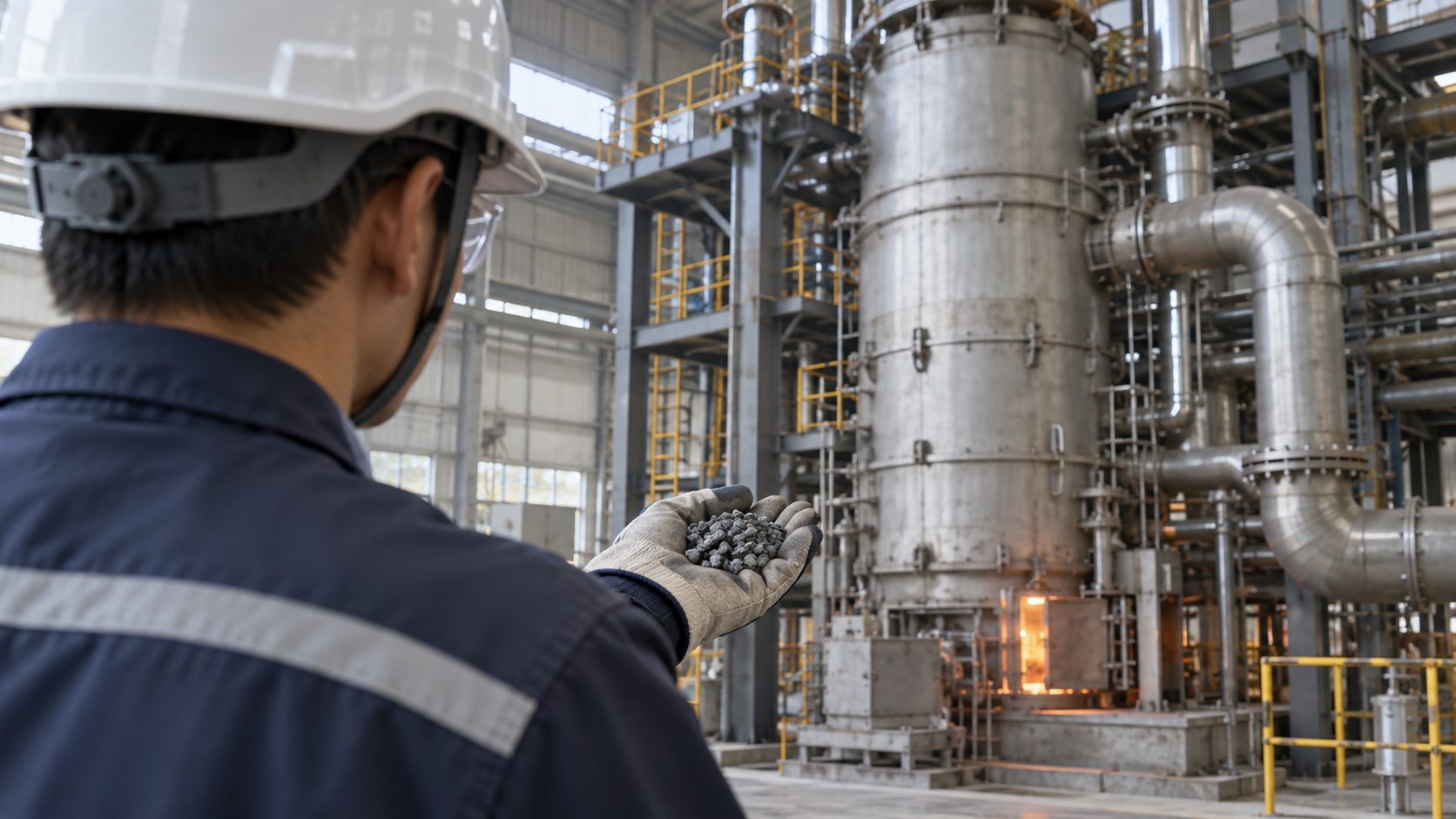
| That Figs. 2 to 6 are explanatory concept or calculation diagrams and not real equipment or measured values, and that Fig. 1 is an AI-generated image | A note by this article | Commentary |
Last updated October 2026. Sources are limited to primary material (peer-reviewed papers, IEA reports, published material from NEDO, GREINS, JFE Steel, LKAB, the European Commission and Stegra). Estimates from market research firms are not used. Company and project statuses were checked in October 2026. Readings from a materials or equipment point of view are marked as Commentary and kept separate from sourced fact. The durability of equipment materials in contact with hot hydrogen, reference values for ore grade, the latest status of HYBRIT Gällivare, results of hydrogen reduction in a commercial blast furnace in Japan, and the outcome of Stegra's additional funding are not stated here because no published primary source could be confirmed. The calculations in this article are derived from formulas and stated assumptions; they are not forecasts for any particular plant or company. All figures are explanatory concept graphics or charts of our calculations. Figs. 2 to 6 are vector drawings and Fig. 1 is an AI-generated image; none of them shows the configuration of any real equipment or company.